 Ask ChatGPT


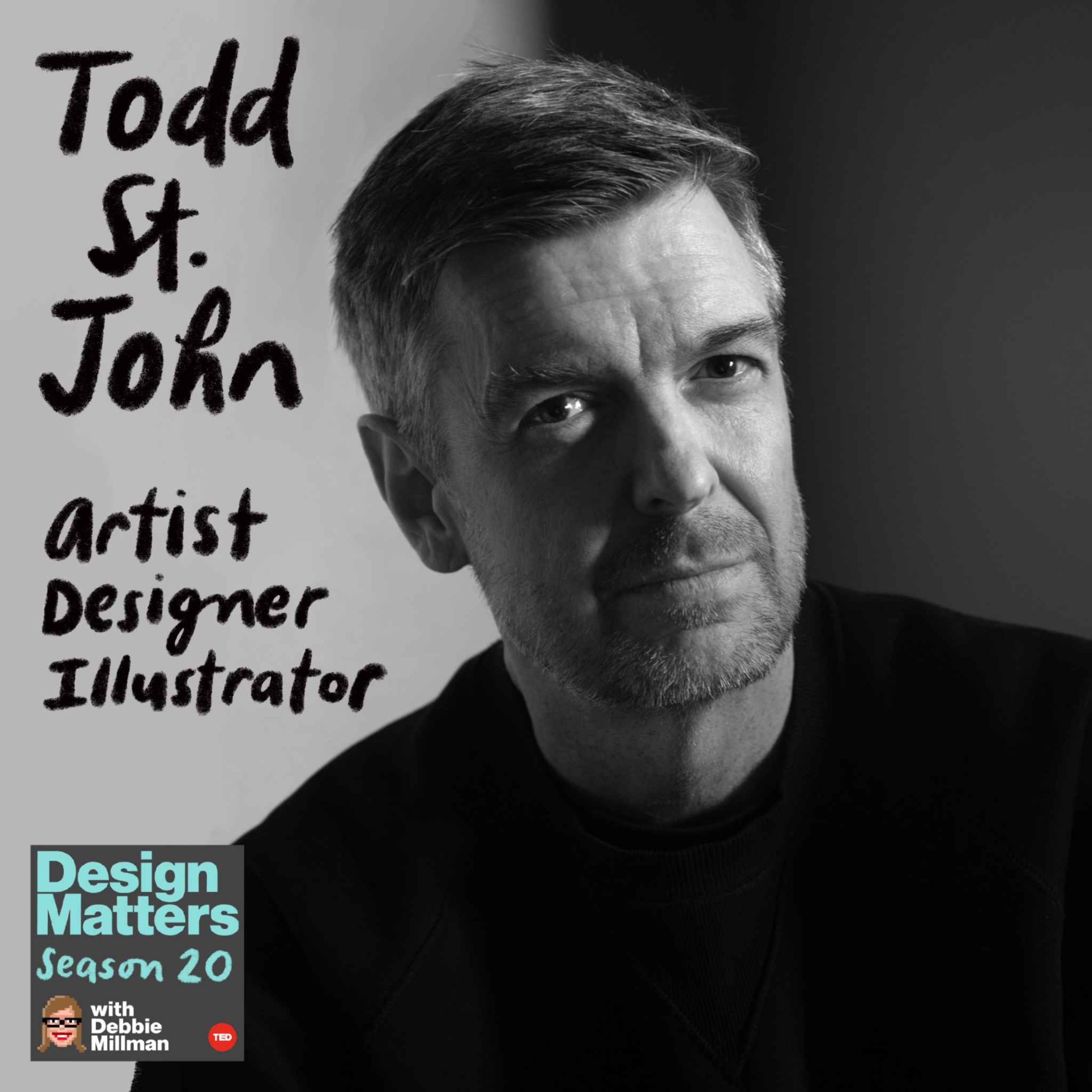
In this episode, Debbie Millman interviews Todd St. John, the founder and Creative Director of the design consultancy HunterGatherer. Todd discusses his career as a multi-disciplinary artist, his inspirations, and his philosophy on design. Throughout the conversation, he emphasizes the importance of meaningful design and the creative process.
Written by AI. May contain mistakes.

Get the gist, explore an idea or ask about something said.
 Claude
On Design Matters with Debbie Millman, what are the key points of this episode?
Searching your listeningAutomatic transcript. May contain errors.
0:00I mean, most of what we do is to create meaning for ourselves, just in life in general. A lot of times you'll see from technology companies, like, here's a way to make it. This is easier. Get inspiration. It's easier. This is easier. This is easier. And I don't think easier is usually the answer to creating meaning. It's something different.
0:22From the TED Audio Collective, this is Design Matters with Debbie Millman.
0:30On Design Matters, Debbie talks with some of the most creative people in the world about what they do, how they got to be who they are, and what they're thinking about and working on. On this episode, designer Todd St. John talks about why easy isn't always best. When you're working with kind of a difficult medium, you end up in more interesting places. Todd St. John works in a lot of different media. Illustration, animation, sculpture, graphic design, photography, furniture, and industrial design. But no matter the medium, there's always something Todd St. John-ish about his work. His designs tend to be both playfully conceptual and seriously sculptural.
1:14Even when he's working within two dimensions, his images feel like they're made of something you want to hold in your hand. Todd's the founder and creative director of Hunter Gatherer, whose clients include Nike, Google, and the City of New York. His illustration work has appeared in The New Yorker, The New York Times, Wired Magazine, and many more. Todd St. John, welcome to Design Matters. Thank you so much, Debbie. Very glad to be here. Todd, I understand that one of your design heroes is Jim Henson. Tell us about that. Yeah, I mean, I think the fact that Jim Henson came along when he did and Sesame Workshop came along when it did.
1:55I think what I like and I was always drawn to about him is obviously, you know, I'm very in the middle of Gen X for people of our generation. That was super formative. We like literally grew up with that stuff. And I actually think that a lot of things that Jim Hansen did cast a generational shadow, you know, to people our age, both through The Muppets and The Muppet Show and the movies that came after that and the people that worked with him, Frank Oz and, you know, any number of people that came after that. But I think that he's an idealist in a way. He felt like somebody who was always pursuing something that was just out of reach for him.
2:33He really respected the intelligence of his audience, whether they be children or the parents that were watching with the children. It was a moment in time where I think people were really looking at the world and saying, how can we make this better? How can we take this medium that's a relatively new medium and had the best of intentions in mind and created something really artful and really fun and really funny and amazing and pushed really hard to make it happen and left this legacy that I think will last a very, very long time. I know you work with Sesame Workshop. What was that like for you after being a fan of gyms?
3:16Oh, it was exciting. I mean, we did a handful of things with them. We did these series of shorts. Some of them were about like remembering to brush your teeth or, you know, little animations like that designed for very young kids. But yeah, it was, it was, it's exists in a different space now than it does then. You know, back when it first started, there was five, four or five TV channels, whatever it is. And we're, you know, a different ecosystem. But, but it was great and a lot of fun. And I still do stuff with them from time to time. So. You grew up in Hawaii, and I understand that when you were little, you lived across the street from sugarcane fields.
3:55And you've said it's one of those places that you realize after the fact just how great it was. You had no idea at the time how special it was to have that kind of environment? Yes, in a sense, but it's also what you knew. So it's just the thing that you're familiar with. And, you know, like a lot of places, you're always looking out at like, well, what else is there on the other, you know? Yeah, I think it was one of those things that you do really appreciate it after the fact. But it was a very special place. It is a very special place. It always has been, yeah. I know you have a special relationship with water.
4:32I'm wondering how you satisfy that living in Brooklyn. We get to the beach a fair amount, even for, you know, living in Brooklyn. And I get back to Hawaii a fair amount also. You said that you were interested in too many things as a kid. Like what? What were those things? I was really interested in music. I'm still really interested in music. I still play music all the time. Oh, what do you play? Piano, mainly, guitar, a little bit of everything, actually. Drawing, film stuff, even as a kid. I took some like stop motion classes when I was maybe like 10 years old, something like that. Wow. I was interested in a lot of things.
5:12And I think that design, I didn't really know what design was, probably like a lot of people. You know, you kind of had a sense of it. And then when somebody explained what it was, you were like, oh, that's that and that and that and the other thing. You know, when I found design, it actually, it was one of those things that I was like, oh, I can, it can maybe. encompass at all. Encompass at all, yeah, yeah. But I didn't know what it was. And I think for a long time, I probably thought I was going to be a director or a composer or a musician or something like that. Yeah, I read that you often had a crayon or an exacto blade in your hands.
5:49And if you had a book review to do in school, you'd likely illustrate it instead of writing it. And is it true for a report on the Mayflower you actually built a model of the ship? That is true. You're going way back. I try. Oh, my gosh. Yeah, we had to do some report. And my dad always had a workshop. So I kind of knew how to do that stuff a little bit. But it was also I was just avoiding doing the report. But I think I found out early on that that actually was, you know, one of the things that got me into design was I was kind of an uneven student, I would say, maybe. But, yeah, I would often focus on the visual side of something if it was at all possible.
6:37Yeah, I always felt visually drawn to making things as opposed to writing things. Even when I was working in college at the student newspaper, I was much more interested in designing the words than editing the words. but editing was really my first job. You mentioned your dad, and I know that he was an engineer as well as a woodworker. And I know that initially I read that you actually dreaded going into the woodshop, that you weren't as excited about woodworking as it would seem given your work now. I mean, I think it was more like I would get roped in on his projects, which were more like chores.
7:17Like I would have rather been out, whatever, riding bikes with my friends or that kind of thing. And so it was a little bit of that. You're like, oh, great. I'm going to get stuck doing this for the whole day when I'd rather do something. But of course, you just absorb it. You end up learning all that stuff. So yeah, I mean, it's one of those things that I kind of, you realize later just how much you knew and you picked up organically. But yeah, at the time it was maybe like, you know, he was trying to teach it to me, but like most kids, You don't really want to be taught at that moment. So sugar canes and woodworking didn't realize until much later how valuable it was.
7:53Kind of, yeah. And I think it's also, you know, sometimes when you end up doing design work or whatever you're doing later, you end up kind of mining what you do know. You look back and bring some of that stuff in. When opportunities came along where I was like, oh, this, you know what, I could actually, especially when I got into sort of animation and those kind of things, all of a sudden it became like, actually, I know how to do some of this stuff. Or there's a way of doing it that might bring in some skills that feel outside of graphic design or design or animate in a way that could make it more interesting for me.
8:27What kinds of things were you making with your dad? A lot of furniture. Stuff around the house. Well, I don't know that furniture would be considered basic woodworking. Well, shelves. And, you know, like not – I mean, shelves, lamps, beds. Basic. Yeah. I mean, he was very, it was funny, because he's an engineer, he would teach me all this basic structural stuff. He'd like cross bracing or like, you know, how that works, how joints work. And all his stuff was very angular because it was sort of strictly form follows function. And any time I would, you know, get a sander and try to like round a corner or something like that, he just thought that, he was like, oh, come on, that doesn't do anything.
9:09It was kind of a like almost anti-aesthetic in a certain way or just the core functionality of something was what mattered. Given how so much of your work undulates, I wonder how he views that evolution of your work. Oh, I mean, I think he likes it. He used to have this thing he said and probably I don't know where it came from. But he – there was one point when my mom was kind of – you know, they sort of didn't quite know what to do with me sometimes, I feel. And so she was pushing me. She's like, oh, maybe you could be an architect. Maybe that could be your job. And my dad had this – he used to say that, like, architects don't design buildings.
9:52Engineers do. Architects decide whether the lines on the outside go up and down or left and right. Awesome. Which I guess comes out of some age-old beef between engineers and architects. I don't endorse that point of view, but I think he had almost this like there's a certain way to build something and you use as few materials as possible in a smarter way as possible and don't let aesthetics come into it. Well, my father-in-law is an engineer and has worked on tunnels and bridges. And I think he would agree with your dad about what engineers do and what architects do. I never realized there was a riff, but I guess there is.
10:31So, yeah. You got your first design internship while you were still in high school. You were working for a small agency. I understand you were doing local ice cream shop and coffee packaging and things like that. At that point, had you decided that you wanted to pursue design or was it just more serendipity that you happened to get that job at that time? That actually came, I think I was already in school. I was out of college at that point. But I sort of stumbled into design. I started – there was a friend of mine whose dad had a small agency in Hawaii. And that was sort of the first time where I was like, oh, maybe that's what that is.
11:10And it was like – he sort of was really an artist. But in order to survive, he had this advertising, a small advertising agency. And so at that point, I was like, oh, well, design is advertising. I guess that's what that is. And so then when I was in school, I started out with sort of like this thing with a few minors, like I had sociology, creative writing, and I think marketing because I just didn't know. And then eventually I sort of landed in design classes. And right away I was like, oh, this is great. I didn't know this existed. And it was kind of one of those things, too, where, I mean, probably a lot of people when they get into design, if you don't know what it is, all of a sudden you see it everywhere.
11:55Kind of like this secret language that's in the ether that you can never put a name to. And it was sort of everywhere you looked and seemingly encompassed kind of whatever you wanted it to be. It could be visual. It could be writing. It could be in video. It could be all kinds of things. And so when I stumbled on that, it was really kind of like, oh, wow, this could be seemingly to me, at least at that moment, whatever you wanted to make it. Yeah, I agree. I think the laws of physics govern the universe, but the laws of design really govern every creative endeavor because you're constantly making decisions about – very deliberate decisions about where you want to take things and how you want to communicate.
12:38So you graduated from the University of Arizona in 1993 with a Bachelor of Fine Arts degree in graphic design and then went to a firm in San Diego. Talk about how you ended up in San Diego working in the firm that you did. At the time, my grandparents were living there then. So I'd known San Diego pretty well. I would spend summers out there and that sort of thing. And then I had a good friend of mine from school, Gary Benzel, who I ended up collaborating on a bunch of things with. Oh, we're going to talk about that soon. Okay. No, he moved out there like a couple weeks before I did. And it was kind of one of those things that I didn't want to go straight back to Hawaii.
13:24And so it was a little bit of like, okay, I'll do this, kind of get my stuff together. I thought I'd probably end up in L.A. or New York, but I ended up working there. And he was working for David Carson at the time, briefly. And then I was kind of bouncing around. And he ended up getting a job at this small design firm in San Diego. And then shortly thereafter, they needed somebody else. And so I ended up there as well for a couple of years. Well, in 1994, you and Gary Benzel simultaneously began an experimental side project you named Green Lady. You know, I knew quite a lot about you before I started researching just because of your reputation and the work you've been doing for decades now.
14:09But I did not know about Green Lady. Tell us about that name and what inspired you to start that initiative. Well, it was easy to miss. I don't think many people know that at this point. Well, and I ordered the book, the anniversary book, but it hasn't come yet. I was so disappointed. Oh, you should have just, oh, my God. Well, it would probably be me putting it in the envelope. So you should have. No, I got it on eBay from someone. Are you serious? Okay. But in any case, tell us all about Green Lady. You know, we were working a design job, regular design job. And this was kind of just, I think, a side project.
14:43And Gary had worked in more retail than I had growing up. He'd worked in skate shops and things like that. And so I think it was probably more his impetus than mine. But we started this little line together. You know, one of the things that I think attracted me to design and probably him too was just you can just make stuff like right away. You know, I was talking about being an architect earlier and I remember somebody at some point saying to me, like, well, you'll never – you'll be drawing windows and doors until you're 40 and you'll never – you know, before you actually design something. And I was like, oh, God, that doesn't – Wow, fun.
15:25And that's probably not true at all. But I think with design, you have sort of the means of production to make stuff. And so that came out of that. We're just like, well, let's just make something. And we were kind of interested in some brands in that space, but also wanted to make something for our friends that we could sell. And it was just kind of a project we could do on our own. You know, when you're working a job and you're working for clients and you're doing all that, that's great. But I think especially at that age, you wanted to make a little bit of a mark for yourself. And it was a very quick way to just put out products.
16:00And it was sort of also, you know, basically pre-internet at that point. So, you know, you just end up meeting people in stores and having an excuse to go around and talk to people. And that was kind of the genesis of it. Well, Architip printed a 10-year anniversary book. This is the one that I looked for desperately. And it came out in 2005, so a good 11 years after your launch. And they stated this in the book. Green Lady embraced the medium of T-shirts and silkscreens as a decidedly non-art, democratic, and accessible approach to image making in a time before independent T-shirt labels were ubiquitous, introducing visuals through an assumed name that played on the anonymity of design.
16:45It was a nod to the labels, bands, flyers, and brands that were primary forms of visual influence for Benzel and St. John as teenagers. And that just sounds like a dream job. It just sounds like the reason that somebody goes into design is to do something like this. Yeah, it was very fun. And we kept doing it for a while. And I do think there's a thing about design that's always appealed to me, that it's kind of invisible. I was saying earlier, when you find out about it, it's this thing that's kind of in the ether. And it's sort of for a lot of people, and maybe less so now with the Internet.
17:21But I think growing up, if you're like in a record store or something like that, you couldn't always hear what it was. So you're looking at the visuals, trying to sort of like dissect, like, is this good? Is this bad? What does it mean? Why are certain graphics like these, you know, all appearing at the same time? Why are there certain, you know, fashion things happening all at the same time? And so it was this kind of secret language and also very democratic language. And that always appealed to me, I think to Gary as well. And so having something anonymous, while for some people I think might have been kind of a bad thing, was also kind of the appeal.
17:59You're kind of contributing to this secret language without really anybody knowing where it's coming from. And it's not wrapped up in somebody's personality or that kind of thing. It's kind of whatever you project onto it. Yeah, I miss that browsing in record stores. That's how I actually discovered quite a lot of the music that I was listening to in the 80s and 90s. It's just things that sort of spoke to me visually that then provoked me to want to hear the music, too. I'll never forget walking around the city in 1984 and seeing posters of Suzanne Vega and being so intrigued by how she looked that that was the reason I bought the album.
18:36Yeah. And then, like, listened to it 400 times in a row. Sometimes it works out great. Sometimes you, like, see the album and you buy it and you be like, oh, this is just terrible. It's like it can lead you either way. But you learn something in both cases. So after living in California for a few years, you moved to New York City and began working as a senior designer at Frankfurt Balkhain. And we just missed each other. Oh, really? Yes. You were there for, I think, in 1995. Yeah. Yeah. And I left just a year or so before. Oh, my gosh. I know. I know. It was, you know, that little tidbit I found on your LinkedIn page.
19:11And when I saw it, I was just like, what? How funny. I didn't know that. I just missed you. You worked at MTV for a little while after Frankfurt Balkind, but then in 2000, you started Hunter Gatherer, your own firm. So that means it's 25 years, Todd. Who's counting? That's amazing. It's an amazing feat to have your own agency for 25 years. Congratulations. Oh, well, thank you. It goes fast. It's fast and slow at the same time. But, yeah, I was at MTV for maybe a little bit more than two years. And I think when I was at Frankfurt Balkan, I was kind of looking around for that. I was thinking of maybe going to graduate school, maybe going back to like film school or something like that.
19:54And then the MTV job came along and it seemed like a way to sort of get a little bit more back into video. What was going on with the design department then was there was this off-air side and there was an on-air side. I was technically on the off-air side, but they were kind of merging, basically, and I was doing everything I could to kind of get on the on-air projects. That was sort of the apex of their sort of design excellence and what they were putting out in the world was really quite groundbreaking. Yeah, there was a lot of talented people there then, and the technology was changing a lot, especially design and video and some of those things.
20:33So there's a lot of really good people that were there at that moment. I learned a ton. And they would just let you do things whether you knew what you were doing or not. And you would just have to figure it out, which was great. So it was kind of like this boot camp kind of situation where you're just like, well, I'll figure it out somehow. The first thing I ever directed was literally like we had our helicopter with a camera on it and a charter plane. And it was way too much that I had, you know, I didn't know what to do with all this, you know, the sides of the crew and everything. But they're just like, yeah, go do this.
21:08And you would do it. So it was great. It was great in that way. And then when I left, they kind of remained a client, which was very nice to start a firm and actually retain your prior employer as a client when you started it. At the time, you said you wanted to create HunterGatherer as a place where all your pursuits could exist together, which included client work, video and product design. And I noticed you have two websites. You have toddstjohn.com and huntergatherer.net. Talk about why you separate them in that way. Huntergatherer.net is basically the small agency, I mean, very small design firm.
21:50And generally speaking, the projects that appear there are team projects, you know, where we're working. Me, other designers are working collaboratively on a project. Toddstjohn.com is mostly just for work that I put my own name on. And so that's if I'm working as an illustrator for, you know, The Times or The New Yorker or whoever, that would go there. Or if I'm doing experimental projects or furniture or pieces of artwork, that's just the stuff that sort of I do completely on my own, basically. You've described your illustration and animation work as narrative by design. Do you still consider it that?
22:28And can you talk a little bit about what that means to you? I'm not quite sure in the context of what I said that, but I do think that I do more, I would say, with narrative type of projects than I do with interactive type of projects, for instance. I think I'm probably just a little bit better in that way. For me, I've always thought of design, its closest analog probably being writing. Design can be many things to many different people. Obviously, some people do it in a way that's much more about interaction or about system building or things like that. But the kind of design that I tend to enjoy the most and I think I'm sort of the best at is a little bit more about taking and explaining an idea.
23:14So it falls more into a narrative. And I think illustration obviously does that because if you're working with, you know, an art director and a writer on a story, you're trying to essentially explain something about that story or add a side or counterpoint to that story, visual counterpoint that helps to explain it. So I think generally speaking, I'm more drawn to the narrative side of it just because it sort of fits better with my view on how I think of design for myself. You just mentioned the New York Times and the New Yorker. You've also worked with companies like Netflix and Google, as we mentioned, Sesame Street.
23:55I'm wondering, because your work is so narrative and because there's so many different elements that you might be building or painting or drawing, when you start a project, do you begin with sketches or physical models or digital tools? How do you begin one of your initiatives? It all depends, but almost always with sketches, I would say. I had a boss, when I was still in school, he would always say, when I finished a project usually, that like, your sketches are usually way better than your final product. You know, it's kind of like, it didn't turn out as good as I tried your sketch. Actually, that's not a terrible thing at the very beginning of a career because it shows you have so much potential.
24:38Maybe, yeah. But I think also there's something to it where, you know, sketches don't lie, you know. Right. If the idea is good, it'll work. That's what I love about sketches. Right. Whereas you get too into overworking something and sometimes you can kind of lose your way. It mediates things in a way that's sometimes good, sometimes not so good. You know, it gives you infinite choices and sometimes infinite choices aren't the best thing for, you know, for creativity. So I do think that, yeah, it always generally starts with a sketch or sometimes writing ideas down, you know, trying to, especially if there is a narrative aspect to it, trying to get your thoughts together with that.
25:17What am I trying to say? But then a lot of times for myself, I mean, if you're building something, there is the kind of measure, you know, measure twice, cut once. You do have to sort of know what you're doing. You can't just jump in and make stuff. So there is a bit of planning involved. And then with, you know, with bigger projects, a lot of the work I do is sometimes built and hand built and modeled and photographed and that kind of thing, which is not the easiest thing to revise sometimes. If a client comes back and they say like, oh, we need to, you know, make that a different color or change the size of it, it was shot, you know.
25:55And so when you get in situations like that, you often do have to pre-visualize so that everything is kind of locked. And sometimes you can do that with drawings, but a lot of times I'll also work in CG, which surprises people sometimes because they think, you know, a lot of what I do and what we do is actually pretty analog. But I've been working with CG for probably the last 20-something years, not always in the foreground, but because it's a visualization tool that can kind of get you there and be like, okay, it's going to look something like this. So it's a combination of things. I was really curious as I was looking through all of your projects that are on your websites and wondering what would happen if clients said, oh, can you make that pink instead?
26:44I've done over the years quite a lot of work in felt and clients don't understand anymore that it's hand cut and handmade. And so when they'd say, can you revise that? You know, I did a lot of lettering, revise those letters. I'm like, no, not in the time frame that you need. And, you know, it's that's tough to say no to somebody and expect to ever get more work. You know, I generally don't like to talk about specific projects on Design Matters because it's a show that people are listening to as opposed to seeing. But I really want to ask you about a couple of projects because they're so beautiful and so interesting and so pioneering.
27:29I do want to encourage our listeners, ToddStJohn.com, HunterGatherer.net, to see some of these really remarkable—it's not even design, it's just this extraordinary collection of different disciplines that come together to create a Todd St. John piece. But in the Commission for the New York Times on Artificial Intelligence, you utilized hand-cut painted wood for the illustrations. And I'm wondering what inspired you to choose this really difficult medium for a topic that's inherently digital. I think part of the choice was the art director picking me in the first place. That is a way I work a lot of the time, working in wood, working in something that's kind of difficult.
28:15When you're working with kind of a difficult medium, you end up in more interesting places. And it really limits your options in some ways that I think also take you to places you might not otherwise end up. And there's that quote, I'm sure I'm going to bastardize it, but it's something about most of the beauty in art comes from an artist, I think, struggling against their medium, basically. Is the basic Matisse, maybe? I'm not sure. But I think that's true. I think I often will try to set up things that are a little bit oppositional to work against. And so with something like that, I think it's a little bit funny maybe to, yeah, it's about artificial intelligence, but we're going to make it in the sort of most low-tech way possible.
29:01It's a little bit counterintuitive, and that's usually a space that I like. Yeah, I think there's a tension that, a good tension in the way in which you approach topics. And you said this about design. I think the idea behind design is the promise of simplicity, and people are drawn to design because of that. But a level of complexity behind the simplicity is always interesting to me, especially when there's two things going on at once. And I found that really, really fascinating. And in looking at a lot of your work, felt that I could feel where you might have considered doing that. But you also declared that the most widespread understanding about design is probably the word design itself.
29:45And go on to say that everybody says design, but no people, no two people think it means the same thing. What does it mean to you? When I talked a little bit about explaining things, I think that's a big part of it. I think design can elevate underserved ideas. And I think that is kind of its superpower in a lot of cases. I think there's a lot out there that is just hard to get your head around. And design can be something that really points your attention at it, makes you understand what it's about, shows it from a different angle, explains it in a way that is more interesting than it might be if it's just words on a page.
30:27That, for me, is kind of what I'm drawn to about design. I do think that design is this phrase. And I think if any of us that work in design have this thing that happens where people are like, oh, what do you do? And you say, I'm a designer. And you're like, oh, what do you – like a clothing designer? Oh, yeah. Always. Clothing first. Yeah. And interior design. Yeah. And so it's this word – it's almost like we need a new word. Yeah. And it's kind of a tradeoff. Like earlier we were talking about when I stumbled into design, that was kind of a positive. It was – well, design can be literally anything.
30:57It can be filmmaking. It can be writing. It can be building. It can be all these things. And so that's what's great about it. But it is also one of those things that elicits a bit of confusion because nobody really knows exactly what you're talking about when you say it. So it's this word that goes back and forth and everybody's kind of got their own idea of what it is. Yeah, and sometimes I love that and sometimes I hate it. Your animated illustration titled The Optimists for The New Yorker delves into the collaboration between Microsoft and OpenAI. How did you approach visualizing the dynamics of that partnership?
31:36So I think with something like that, you try to pick out certain parts of it. But the idea with that, what the story is and what the image is, is this sort of little figure that's made out of keys from a keyboard. And the gist of it was that they're just figuring the form of this thing out while people are still kind of making it. So it's kind of like building the plane while it's flying. That's dangerous. Yeah, which is kind of is what's going on with that. They don't know how it works in some cases and all that. So it was sort of capturing that. So the keys being kind of the prompts, and they're kind of scattered about.
32:16It wasn't fully formed and that kind of thing. So that's, you know, you put a bunch of ideas forward and hopefully one, you know, resonates. And in that case, that's how we got at that. Speaking of open AI, how are you feeling about the possibilities of AI in the discipline of design? It's such a huge topic that we could talk for a whole other podcast about it, I think. And I think there's so many – it's hard to get your head around. Yeah. I don't think I'm smart enough to totally get my head around on what it's going to mean. And it's huge. I mess around with it. I use it here and there for certain things.
32:53Like what? Like what? I mean, some of it's just really practical stuff. Like if, you know, I'm signing a lease and I need it to translate it into English from legalese or whatever, you know, that sort of thing. Oh, I didn't even know you could do that. That's a great idea. Yeah. You know, just simplify. But also, yeah, things with Dolly and I've definitely messed around with it and just see what it does, see what it kicks out. And it's interesting. I think you kind of come back sometimes with this feeling, a little bit of an emptiness to it. I guess what it is is that when it comes to images, at least maybe I'll just talk about that, I think there's this thing where images are, I think of them, it's not a novel thought, but as vessels.
33:33They're carriers of meaning. And obviously that meaning can be a concept. It can be a feeling. It can be a record of an event. It can be just kind of a proof of life in some ways. And the meaning can be put into the image. The meaning can be added onto the image later. But I think that a lot of times when talking about at least image making with AI, that's something that's left out a little bit. You don't just necessarily make an image. You have something that needs to become an image. And that's a slightly different thing. So I don't know. I come back to that a little bit. You know, there is this feeling of maybe more so in the creative community of wanting to be open to this new thing, Not wanting to ask too many questions about it or that kind of thing.
34:20But I do think the idea that it's a new tool like any other thing. And I do think it's much bigger than that. And I do think that it's, you know, we're at a point where some of the relationship between technology and creativity or just the world in general feels a little bit less like it's helping us and more like we're there to help it. So with, you know, to the point of being a tool, I think if, you know, you're putting information in to some of these companies that are literally like training their models and users work and you're even paying them half the time, they're, you know, a bit of a question of who is the tool in that instance.
34:59And I think that stuff does feel maybe a little bit backwards in some ways where it's less responding to us and often it's us responding to the technology. That goes for, I think, a lot of things. I think it goes for social media. I think it goes for – there's a lot of instances where I do wish there was more conversation around how do we want things to be versus companies telling us this is the way to get the most engagement. It's sort of playing by our rules versus, you know, I don't know, going to a restaurant and having them tell you, like, these are the conversations that work best. Do this and here's who you can sit next to.
35:38It just feels a little bit upside down that they're making the rules for how we're supposed to interact with each other versus the other way around. You know, I think that my favorite type of graphic design is much more conceptual. So work like you do, Paul Sayre, Christoph Niemann and his illustrations where you kind of have to figure something out. And that figuring out gives you a moment of real glee, of real joy in being able to understand something maybe in a new way or seeing something in a new perspective. And I have yet to see that with AI-generated design. It feels almost soulless. Same with the writing.
36:20I mean, I can tell now my students use it so much in their writing. And I often joke now that nobody under 30 uses the word moreover or the word hence in their writing. So as soon as you see those words, you know this is AI generated and there is a real soullessness to it. But I'm wondering, especially since I'm 10 years older than you, but we did sort of come to design in a similar generation. And I remember very distinctly the uproar that people had about moving from a drafting table to a computer. And people designed – quite a lot of the older designers at that time felt that this was the reason that the discipline of design was doomed.
37:04and that a lot of jobs would be lost and people would be making the soulless design on computers. And that didn't happen. I mean, a lot of jobs were generated. I think a lot of really interesting design happens quite a lot with film and animation and video. That's all generated on computers. How are you feeling about the future? Do you feel more hopeful or less hopeful with these technologies? For me, it has less to do with the technologies and more to do with who's driving it in for what reason. I do think it's materially different than some of those prior things and just that it almost feels like an evolutionary step rather than the next tool that comes along.
37:47But, I mean, most of what we do is to create meaning for ourselves, just in life in general. A lot of times you'll see from technology companies, like, here's a way to make it. This is easier. Get inspiration. It's easier. This is easier. This is easier. And I don't think easier is usually the answer to creating meaning. It's something different. So in most of those things, I think probably we're not asking the question on a lot of levels, politically, art-wise, anything else, is this making life more meaningful or not? And I think if that question were asked more, I would hope we'd get better results.
38:24Your illustration, Truckin', showcases a departure from your typical medium. You used watercolor. What motivated you to explore this medium for that piece? And how did it influence the outcome compared to your wood-based work? I mean, I work in watercolor a fair amount on my own, I would say. Not as much for clients. And that was a piece that sort of these characters that are 3D but made out of totally flat planes, basically. And I drew some of those with watercolors, but then there was one that I also built out of wood. And I think sometimes if you can figure a way to take an idea and kind of make it work across a couple of different mediums, that's interesting.
39:11And sometimes I have them both in mind. You know, like, how can this fit here? How can this fit there? Initially, you used your woodworking skills for animation and stop-motion projects, and designing and making furniture was more of a hobby, which you've described as mostly done for yourself. How has that changed over the 25 years? It's still mostly a hobby. Around 2014, I'd been working really hard for a long time. We'd had three kids by that time. And I think I was a little bit at a moment of not quite getting burnt out, but maybe had been doing what felt like the same thing for a long time.
39:50And so I kind of didn't quite take a mini sabbatical, but had like set a little bit of money aside and was like, I'm going to just release a line of furniture, just sort of made this target. You know, and going back to some of the stuff with t-shirts earlier on and that idea of just making a product was a big motivator and just setting a deadline and just coming up with this thing. So sort of made this deadline that, okay, I'm just going to make, I've never done this as this before, but I'm just going to make a line of furniture. So I made, you know, a lamp and folding chairs and this kind of credenza and a few other things and bought like a booth at like ICFF.
40:27And I think a little bit, part of me was probably like, well, maybe this will be just a new thing. Maybe this will go great and I'll just do this. You know, once I got done with it, it was well-received, sold some stuff, and I was happy with how it turned out. But it also made me realize how much I enjoy making work about things and sort of what I was saying earlier about talking about stuff and explaining how things work, explaining complex ideas, but work that is about something. And not that furniture is not, there's people that imbue their furniture with all kinds of conceptual undercurrents, but just in the sort of world of journalism even, you know, how can this be part of that?
41:08And so I really miss that. So I still do the furniture. People will call up and I'll do stuff and I'll still do it on my own. But I think just doing that, which I maybe thought about for a second, I realized that that in and of itself wasn't quite enough. You talked about your dad before and the sort of functional approach that he took to his furniture making. And it seems like your furniture sort of contains a little bit of both. Some of the pieces have a very strong structural quality. How do you view the sort of functional aspect? Certainly your lamp is very functional. The folding chairs are very functional.
41:46the credenza is much sexier. So do you see them as functional objects first or do you approach them more like pieces of art? They are functional. And I think it's one of those things. I mean, even going back to like making t-shirts and that sort of thing, I think we could make art, but I sort of don't have the audacity sometimes or at least didn't at that point to be like, oh, this is just my idea. This is just art for and like it or, you know, at least you could say, well, even if it's so you can at least wear it, it'll cover your body, you know? And I think with furniture, there's a little bit of that also, which is like, it does both things.
42:21And so that utilitarian aspect I do like. And then in terms of, you know, you mentioned my dad and sort of this purely functional thing. There are things that I'm drawn to. There are forms I'm drawn to that I think are beautiful in just their simple functionality. I tend to really like stripped down things. Even that idea of, you mentioned this credenza, which is just credenza, but the front of it's got this sort of grid pattern and wood sliced up in all these different... Yeah, it's called the relief credenza for our listeners. But it's basically the understructure of something. So it's overlaying a grid onto something natural.
43:01And I really, you know, I come back to grids again and again, obviously with design, that's a huge, you know, everything's based on a grid. And I think there's a beauty in that. It's kind of like skeleton of the building before the facade goes on it. There's a beauty in like, how are you, what does the crossbracing look like? What is the bones? The bones, yeah. And there's a real, and I do come back to that quite a bit. What can you do with the least amount of material? What can you do in the simplest way? What can you do when you let the working parts show? I don't always know why, but I think I am drawn to that.
43:34So that shows up in a lot of different things. How much of the relief carving is done by hand? It's sliced up. And so, yeah, the front of this credenza that we're talking about is a whole bunch of different pieces sliced up in a kind of puzzle-like way that has this sort of grid structure underneath it. So, yeah, it's wood that is sliced up in those shapes and then shaped a bit as well and then reassembled back together. In looking at a lot of your work, Todd, I noticed, and I don't know if this is something intentional, but there's a lot of wave shapes. So your tape dispenser is a wave. There's waves on the credenza.
44:13Even the room divider has these sort of undulating shapes. I'm wondering if that's a specific sort of conscious shape that intrigues you. I mean, there's certain things I do with certain kind of radius corners that come back up again and again. And then I think with something like the tape dispenser. And there's been a few other things like that, too. I think growing up in Hawaii, it was, I remember when we were little kids, everybody would just, you know, people would draw like whatever, Star Wars, X-Wing fighters and that kind of stuff. But then I think in Hawaii or probably Southern Californians, people would draw waves, like pipeline waves, like Rick Griffin style.
44:56It sort of became that thing you doodle while you're on the phone and not thinking about anything. So that's what it was. And then I think we'd done, I'd done a few of those for Project Pure there. And then I did some things with Gary for Surfing Magazine. Yeah. Anyway, it kind of became like a little just shorthand doodle, but it is actually one of those things that sometimes when I just sit down to warm up and you're not doing anything, you'll just draw that. It's sort of a mindless whatever. It felt like it was really connecting your sort of trajectory all together, like this through line, this threaded line of your early years in Hawaii and that love of the water.
45:38Yeah, I mean, for sure. And I think I do. Yeah, there's things about that shape that are fun. But it really is just kind of like this doodle that became like a little mini quasi logo in some ways, I guess. It comes up repeatedly. Todd, I have two last questions for you. The first is, you said that the most important quality in a designer is open-mindedness and never assuming you're right. How successful are you at that? Because that's something I really struggle with when I'm presenting. I'm kind of feeling like this is the right thing to do and take it or leave it. It doesn't always work out well, but I've gotten a lot more pig-headed as I've gotten older.
46:18One of the things that I really like about design is that it's collaborative and that you get to, whether you're working with a company or working with a person, you get to kind of go into their world and learn about their world. And you come up with something together that's sort of halfway between the both of you. And so, I mean, I think in general, it's always good to be open-minded. That come easy for you? I think so. I mean, obviously, we're all sure we're right. most of the time. And you could ask my wife, Stella, if I'm as open-minded as I'm. Okay. But I do think that, you know, design, there's a lot of curiosity in design.
47:02And I think to be curious, you have to be open-minded if you're still looking, searching for things. And I do think sometimes in school and that kind of thing, I can remember people talking about like, well, it's your job to educate the client. And I think there's some truth to that, but there's also a chance to educate yourself. And a lot of times when you're dealing with clients, they've been doing this thing they're doing for a long time, and they do know a lot of stuff. And that's not to say like you take a backseat or something like that, but it's just, it is a collaboration. And you have to really love that collaboration.
47:36I think if you're good at it, and if you're going to get a good result, you have to really, really like that. So that's kind of probably what I was talking about when I said that. So my last question is this. 10 years ago, in an interview with Core 77, you were asked this question. What do you hope to be doing in 10 years? It's now 10 years. You responded, hopefully hitting my stride. Do you think you're close? You know, I think it's a weird thing when you get, you know, a little bit older as a designer, or you kind of think you will. And in many ways I have, but then life also gets very complicated when you're my age and kids are growing up and parents are getting old and all of a sudden things are, you think there's going to be free time that isn't there.
48:27And I know a lot of people kind of my age are dealing with similar things like that. So it's a funny mix. You have this feeling of everything you can do and everything you want to be doing right now, But then you're also dealing with a lot of other stuff. There's a feeling in the world right now. And I remember like when COVID happened, I had this feeling that like, well, maybe this will trigger this era of problem solving. Like it kind of would expose, here are the problems and maybe we'll all become more focused on solving them. I don't know if that's, you know, in this week, which is the middle of February in 2025, we're recording this.
49:13I don't know if that's the feeling I have at this moment, maybe the opposite. But I do think that my feeling would be wanting to do things that actually help solve some of these problems. And, you know, I mentioned earlier, I think that design can sort of elevate underserved ideas. I think there's a lot of underserved ideas and causes that could use elevating and promoting and explaining. So at this point, I think that's where my feelings are on that. I hope in 10 years I can ask you that question and we can look back at this time and think that it was a defining moment where we did make some good decisions.
49:57I very much hope so, too. Todd St. John, thank you. Thank you so much for making so much work that matters. And thank you for joining me today on Design Matters. Thank you, Debbie. To read more about Todd St. John, you can go to huntergatherer.net or toddstjohn.com. I'd like to thank you for listening. And remember, we can talk about making a difference, we can make a difference, or we can do both. I'm Debbie Melman, and I look forward to talking with you again soon. Design Matters is produced for the TED Audio Collective by Curtis Fox Productions. The interviews are usually recorded at the Masters in Branding Program at the School of Visual Arts in New York City, the first and longest-running branding program in the world.
50:41The Editor-in-Chief of Design Matters Media is Emily Weiland.
Founder and Creative Director of the design consultancy HunterGatherer, Todd St. John, joins to discuss his career as a multi-disciplinary artist and designer working in illustration, animation, graphic design, photography, furniture, and industrial design.
Hosted on Acast. See acast.com/privacy for more information.