Ask ChatGPT

 DeviceTalks Weekly
31 Jul 2026 · 1h 13m · 32 chapters
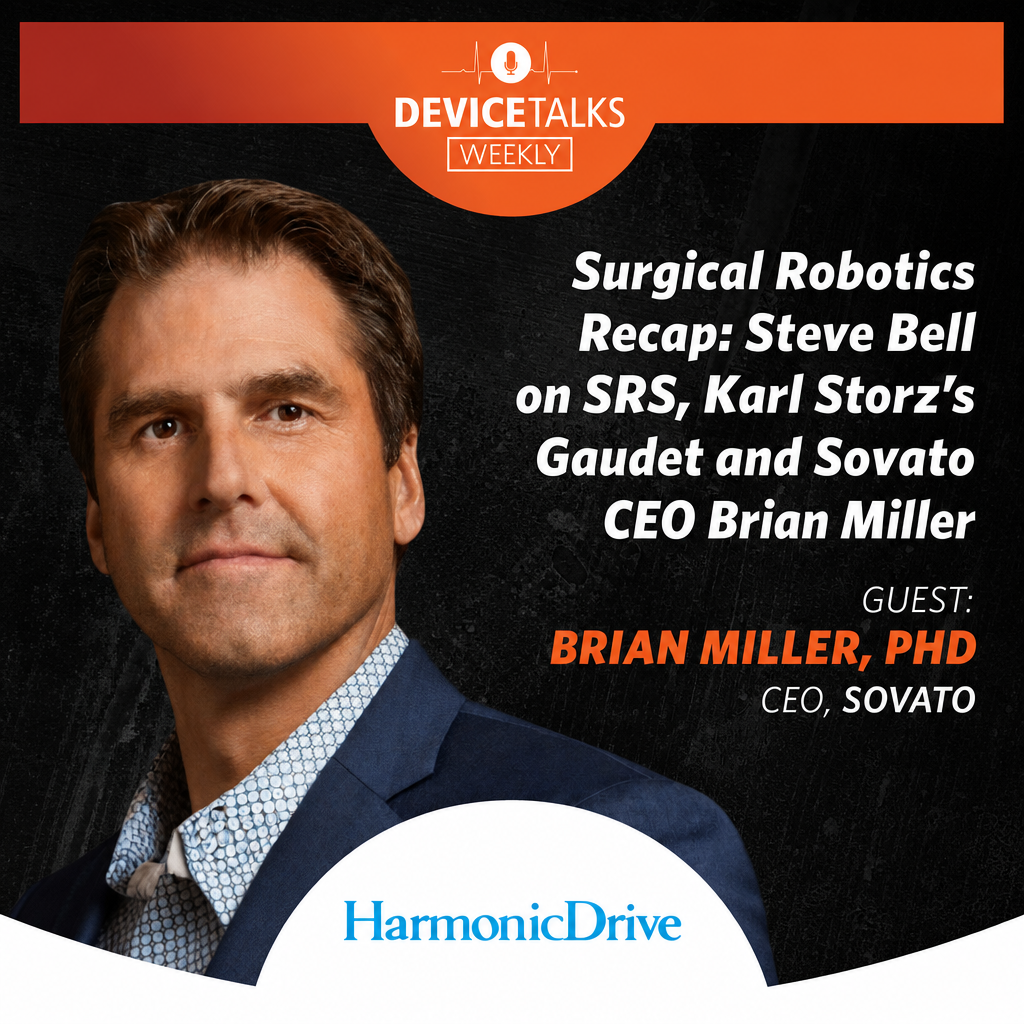
Recap of SRS 2026 surgical robotics themes plus sponsor and two strategy interviews: Carl Storz’s shift away from building its own surgical robotic systems, and Savato CEO Brian Miller on remote care infrastructure for telesurgery/tele-interventions.
Written by AI. May contain mistakes.
Tom Salemi shares insights from the SRS 2026 event and introduces guest Steve Bell.
“or just discontinue the census surgical robotic systems.”
Steve Bell discusses key takeaways from SRS 2026, focusing on robot variety and attendance.
“is brought to you by Harmonic Drive, and we'll hear from Harmonic Drive a little later in the podcast.”
Discussion on the innovative products showcased at the Shark Tank event during SRS 2026.
“So I think that's really, really interesting that we've got dental robots here.”
Steve Bell highlights the growing role of AI in surgical robotics and data management.
“I think number three is really around AI and the data layer that's just becoming more and more prevalent here.”
Discussion on the increasing presence of international robots at SRS, especially from China.
“You know, there's a lot of good quality Chinese robots here.”
The conversation shifts to J&J's new product launch and its implications for competition in surgical robotics.
“I've seen while I've been here, their new AI system on the touch surgery, which was super impressive.”
Exploration of humanoid robots' potential roles and challenges in surgical environments.
“But again, the infrastructure is built in a way that they have to really be human-shaped to be able to do their job.”
Tom Salemi wraps up the conversation with Steve Bell, highlighting key insights.
“Now you've got 40 ,000 access to a robot versus upwards of, say, a million.”
Discussing the challenges in maintaining quality standards in medical device manufacturing.
“Can you take a minute to tell our folks about Harmonic Drive?”
Transitioning to the discussion at the SRS 2026 conference.
“All right, well, thanks, Jim, for joining us on the Device Talks Weekly Podcast.”
Christy Gaudet discusses Carl Storrs' strategic shift in surgical robotics.
“All right, now we'll head to the floor of SRS 2026, where I had the chance to talk with Christy Gaudet.”
Brian Miller shares insights on Savado's mission and innovations in healthcare.
“Thank you again, Christy Gaudet from Carl Stories for joining us on the podcast.”
Learn about the current state and future potential of tele-interventions in healthcare.
“that could work together, collaborate, teach each other.”
Discover how Savato aims to improve patient access to necessary care.
“Let's talk about Stavato's mission and help people understand what you do and what the company does and what it's hoping to do.”
Understand the technology stack and logistics behind remote healthcare solutions.
“We then have a set of services that intelligently manage.”
Explore how remote surgery can alleviate the global shortage of surgeons.
“Are these connected to the guidelines that were released?”
Learn how the ROI of new technology can influence healthcare decisions.
“You know, it's one of the big things in the quintuple aim, and patients having to drive two hours for like a 10-minute diagnostic procedure.”
Examine the regulatory landscape and safety protocols necessary for remote procedures.
“You know, for me, it's been around all the time.”
Reflect on the journey of robotic surgery and its acceptance in the OR today.
“This is one aspect that is going to have to be worked through.”
Exploring the evolution of surgical robotics and its acceptance in operating rooms.
“And I think we talk about surgical robotics now with a certainty that, oh, of course we need robots in the OR.”
Discussing lessons learned from introducing robotics to healthcare teams and stakeholders.
“And one of those, and this started early, and I can't remember who pushed me to do it when I first started, but you have to go and you have to live in the hospitals.”
Understanding how patients perceive robotic surgery and the importance of personal connections.
“And so it's not like a mysterious, you know, the surgeon that I've never met behind, you know, sitting somewhere else.”
Surgeons' views on remote procedures and the flexibility offered by robotic systems.
“And I'm sort of skipping over a constituency here, the surgeon or surgeons, we talked about the shortage of them, but the ones we do have, how do they feel about this potential leap?”
Addressing technical hurdles like latency in remote surgeries and how to overcome them.
“And so the ability to go in and say, all right, once again, you don't have to worry about where that operating room is.”
Discussing the proprietary infrastructure needed for successful remote surgical procedures.
“I'm probably not knowing who's the, what do you have that's proprietary?”
Exploring the future landscape for surgical robotics and potential partnerships in the field.
“And so we're bringing on the first set of devices right now.”
Learn about the reliability and workflow integration necessary for remote surgical procedures.
“They still have to develop their system to be robust, effective, and everything.”
Explore the competitive landscape of surgical robotics and the potential for market consolidation.
“You know, we've seen now things come out in modular carts, bed mounted versus a pedestal.”
Understand how AI is expected to impact surgical robotics and the importance of network infrastructure.
“If you could please give your name and your company, please.”
Discuss the challenges faced in implementing remote care delivery in healthcare systems.
“So, and, you know, we'll see where that takes us.”
Examine the strategic goals of Savado and the potential for growth in the MedTech industry.
“I think most of the achievements in health care and med tech have been started somewhere.”
Explore the strategic goals for Savado and its role in the robotics market.
“And that's why you're going over there, and then you'll be back onto the mothership.”

Get the gist, explore an idea or ask about something said.
 Claude
On DeviceTalks Weekly, what are the key points of this episode?
Searching your listeningAutomatic transcript. May contain errors.
0:00Christy Gaudet: Hey everyone, Tom Salemi here. Welcome back to the Device Talks Weekly Podcast. We've got a Surgical Robotics Forward episode for you today, brought to you by our good friends at Harmonic Drive. We'll hear from Harmonic Drive a little later in the episode. We'll also hear from surgical robotics expert Steve Bell. He is delivering our Newsmakers of the Week. He cannot replace Chris Neumarker, of course, but Steve and I connected at SRS 2026, where I was last week. I had a great time seeing many of you. Sorry if I missed a lot of you, but I'm sure we'll connect again or connect for the first time in the future.
0:35Christy Gaudet: So Steve Bell will kick things off. Then we'll hear from Christy Gaudet. She is the Global Head of Solutions at Carl Storrs. We talked with Christy on the floor of SRS 2026 about Carl Storrs' decision to de-emphasize the census or just discontinue the census surgical robotic systems. They incorporated a lot of census technologies into their imaging technologies, but they're not going forward with their own surgical robotic systems. Rather, they'll partner with companies like Moon Surgical. We'll talk about that strategy. They did partner with Moon. They did partner with Servato. And Christy and I will talk about that.
1:17Christy Gaudet: And then finally, speaking of Servato, you'll hear my conversation with Brian Miller, the CEO of Servato, formerly of Intuitive Surgical. uh brian and i spoke at device talks boston so happy to bring you that conversation this was a month or so after brian took the helm at savato and we'll learn a lot i learned a lot about savato's approach and how it's building the uh well the information superhighway or surgical robotics so you'll i hope you'll enjoy that conversation once again this entire episode is brought to you by Harmonic Drive, and we'll hear from Harmonic Drive a little later in the podcast.
1:56Christy Gaudet: Before I let you go, I did want to let you know that we'll have a Device Talks Tuesdays, a few of them coming up in August, so make sure you go to devicetalks.com to check those out. We've got our friends from PSN Labs and others who will be giving great talks, so make sure you look for those on devicetalks.com. All right, let's get this podcast started. Are you ready for this? Ready.
2:44All right, everyone.
2:45Christy Gaudet: Tom Salemi here from Device Talks. I'm here with the surgical robotics expert, Steve Bell. Steve, great to see you in person. Great to see you in person as always. Is this your prom? Is this your high point of the year? Yeah, this is it now. This is the big one. And luckily next year, it's in Rome. I saw that. Yeah, so I get to go on a metro to go there instead of a plane. I hope you'll have us all over your home. Yeah, you've got to come on over. Yeah, exactly. So I just wanted to take a moment. This is normally the time of the podcast when we do our top five news of the week in the medtech world broad, but let's just focus it on this meeting and on surgical robotics.
3:23Christy Gaudet: From five to one, if you were able to rank it that way, what do you think some of the big takeaways from the meeting over the past four days? Oh, I've got to go backwards. So I've got to think backwards. Yeah, I know, right? It's complicated. Chris Neumacher makes it look easy. So I think number five here would be just the variety of robots. I mean, it's like 70 plus robots here. I remember the original SRS had like one. Yeah. So now we've got to know the variety of robots is like down at, We're now in the 70s, but it's not just the same types. It's all different types. So I think that's really, really interesting that we've got dental robots here.
3:57Christy Gaudet: We've got endovascular robots here. We've got humanoids here. So yes, I think that would be my number five. Yep. So the different robots, I didn't see the dental robots. I know you worked with Lupine. No, it wasn't Lupine. It was Yomi. So Yomi was here. But that's a whole classification of robots that's growing quite well, which is the application of dental and semi-autonomous and autonomous robots in dental. So that was good to see. We'll get into the humanoid or surgical robot at some moment, but I did speak with Paritas AI. Their robot was a very popular photo bomb kind of situation. They have a robot that does everything but surgery.
4:33Christy Gaudet: Yes. And do you think we'll see a lot more of those types of robots coming forth? Yeah, I do. I think humanoid is going to be big. But for me, and I've been quite vocal on this, I don't think they're doing surgery in the next decade. I think what they're doing is back office stuff first. So like Peritas is doing it down in the sterilization services department. I think they're going to be moving boxes around. I think they're going to be doing things like that. But I don't need surgery immediately for the next 10 years, but they will be in and around the hospital and then they'll eventually work into the OR.
5:01Christy Gaudet: Yeah, no, I don't think Peritas is pushing for that yet anyway. But all right, what is number four? What's another thing that caught your eye? I think another thing that caught my eye was just the size of the attendance here. I think this is the biggest attendance that SRS has had. And my understanding is next year we have to do it in a Congress center because the rooms were standing room only. I mean, literally every single session. And I think that's great. And you were doing the Shark Tank and it was great, but horribly crowded and hot. Yeah. Yeah, it was. Which speaks well to the event. It does.
5:29Christy Gaudet: It is good. And the enthusiasm that people had to come into the rooms and see and the content was great and very varied. Yeah. So speaking of the Shark Tank, what was your take of some of the newer companies coming down the pike? Yeah, some very interesting stuff. And what was interesting was that a lot of this is to do with smaller robotics and small things. So there was a couple of things that were sort of modular small robots that fit onto catheters, for example. And then we had small endoluminal robots that would inchworm their way up in the small bowel. I think there was just a lot of innovation in there.
6:01Christy Gaudet: Some of the imaging stuff that came out of there as well. There was an imaging device that shows you real-time cancer detection in surgery. So some exciting stuff. It was good. I like the Shark Tank. It's one of my favorite things. That was a lot of fun. All right, well, what is number three? Give us some more three. I think number three is really around AI and the data layer that's just becoming more and more prevalent here. There's a lot of talk about the data layer and AI. And we had NVIDIA here, who just on the day they released their open source physical world model on the opening of the event.
6:35Christy Gaudet: So, yeah, it's becoming a tech med world. And I think hardware will just become a carrier for the advanced software. And that's what's going to be really the future of what we're doing is the advanced software. Do you think five years or maybe three years from now, the robots in the expo floor will be similar to what we're seeing today? Maybe five years. And the change will really be the AI and the operating systems or the systems upon operations are done. Yeah, I think it really is going to be the software. And it's going to be much faster as well. We're going to see developments much faster.
7:07Christy Gaudet: You've seen it with DaVinci 5, right? So the hardware came out and they're already having upgrade after upgrade after upgrade. And that's the sensible way to go forwards, which is to make your hardware so that it's really software driven. And, you know, again, people like Nick Damiano with Andromeda Surgical, they've been very, very vocal on this. And I think Nick's right in the way that he's thinking about that. Absolutely. And I had a sit down with folks at your old place, CMR, talking about a project they're involved with where they're contributing data to a larger project to draw up the AI models.
7:34Christy Gaudet: And it was the first time I could actually, I couldn't envision autonomous surgery and how that might work. I got to see it and see how that might play out. And it's really very exciting. Yeah. So what is number two? Number two is the quantity of outside of US robots, especially Chinese. You know, there's a lot of good quality Chinese robots here. And the fantastic quality is the Tumai's, the Edge, the Adjibot. Really, really good. And the breadth of product they have on their stand. But you also have SSI coming out of India that was there. And you have Hinatori coming out of Japan. So it's good just to see that there's the, especially at a US meeting like this, that you see a lot of OUS robots coming in.
8:08Christy Gaudet: And I thought that was a very big signal that it's a healthy ecosystem and architecture outside of the US as well. Excellent. All right. And what's your biggest news of the week? Hot on. Of course. I was wondering, I'm like, is he going to mention the Tava? I figured you would. It is the biggest thing of the week. You know, and I, you know, I've been quite tough on them in the past, but it's not in a bad way. It's really been because my frustration is, you know, I was at J &J 16 years. I know that they can be one of the forces of influence to change robotics and to actually, you know, increase competition.
8:41Christy Gaudet: It's been a long time coming, but it was, it looks beautiful. I mean, it's, it was a gorgeous release. It looks beautiful. You know, uh, it's really worked hard to get that out. It's typically J &J gorgeous quality. Um, now, now it's to be seen in the real world as they, as they launch it out. and like tim schmidt you know said they were going to be very careful brilliant i'm also careful coordinated rollout but it just is good to see because now we have really healthy competition absolutely we have intuitive we have medtronic we have um j and j so they're big ones then we have some of the chinese but you've got three of the big giants in the world of surgery and i think that's good for everybody i think it's good for intuitive because it lifts their game i think it's great that j and j is there because you know they've got a lot that they can bring to this for education for support and you've got Medtronic and they are doing a lot of good stuff.
9:33Christy Gaudet: I've seen while I've been here, their new AI system on the touch surgery, which was super impressive. And if any of the companies can do this and lift the robotics, then it is going to be J &J, it's going to be Medtronic and it's going to be intuitive. That's fantastic. No, I agree 100%. It really feels like I was here two years ago. I didn't go last year. So I have not been to a meeting where Medtronic or J &J had their approval. Now that they're both in there, both on the scrum, it feels like a good game to watch. And it feels like a real, more of a med tech meeting to me anyway. Uh, we talked about humanoids earlier on you and I, we were together privately and I was, I was saying, this is crazy.
10:10Christy Gaudet: Why are we talking so much about you? It was the first day, uh, the few folks that were putting forth the idea that we need ultimately to have humanoid surgical, I don't know if surgical robots need to take a humanoid form or not. You told me privately when we were talking like, no, this is actually a thing this is actually happening there's actually some capital behind it give me a sense of what you're hearing that's driving that that's for humanoid robots humanoids so they go for mention them 100 000 they're now crashing down to 20 000 yeah how much functionality at that price i don't know but what's going to happen is there's going to be scale of those choice of those and the interesting thing is what we do know is that most hospital architectures and infrastructures were built around humans, right?
10:50Christy Gaudet: So we know if you want to do automation today, you wouldn't build a hospital built around. You wouldn't put steps in there and you wouldn't put things out. But there is, right? So one of the interesting things about humanoids is they fit into human spaces. They fit into human workflows. You don't have to re-infrastructure everything. So that's why I think, first of all, they have a logic in terms of their form factor. But getting them to do the right things, there is going to be a shortage of staff. I mean, Imperitas did highlight this. Yes, very much so. And I know that, for example, in the sterilization departments, it's a nightmare trying to get staff retained, staff keep staff, and staff churn.
11:25Christy Gaudet: And putting robots in there is wise. But again, the infrastructure is built in a way that they have to really be human-shaped to be able to do their job. You know, they have to be humanoid form. Now, what you get with that as well is you also get layers because they've got cameras and sensors and things like this. And when you're doing things like packings, they're making records of it. So it also helps from a record-keeping point of view and things like that. I think the humanoids coming into the OR gets more delicate and more sensitive because your patient's in there and it's a patient environment, it's a sterile environment.
11:57Christy Gaudet: But NVIDIA is making real-world models of operating rooms so that these humanoids can operate within that in the real-world confines. I think what they can do is circulation. It's called circulating nursing roles. so they can walk around, pick sutures, pick boxes, bring them in, hand them to the table. Again, they are observation cameras, which helps for safety. They can be constantly looking for different awareness within the operating room. And then I think the move from that is you eventually get them scrubbed in and they're doing back table work, not replacing the human, but helping the human and assisting the human at the back table, which is where you can get an improved quality of patient care for the patients.
12:37Christy Gaudet: maybe bedside they can get eventually swap out instruments on a da vinci let's say um but i think actually operating stood there with instruments is not the right form factor um i know that we just had a demonstration that's just been shown about that but i don't think that's the future i think the future is actually um still da vinci style robots purpose-built robots But I will give one caveat because I would say it doesn't make sense at all. But then somebody did remind me, and quite rightly, there is a whole developing world market where if a humanoid was 20 ,000, you can get two of them. And they can actually do a form of surgery.
13:20Christy Gaudet: Now you've got 40 ,000 access to a robot versus upwards of, say, a million. Is that a game changer? That's a great one. Yeah, I hadn't thought about that. All right. Well, we may need to expand your brand to healthcare robotics experts so you can carry, talk about all that we're going to be talking about, I think, at future meetings. So, Steve, always great to see you. Thanks for taking the time. Thank you very much. All right. Thanks, Steve Bell, for delivering this week's Newsmakers. Chris Neumark will be back next week. Now it's time to hear from our sponsor, Harmonic Drive. I had the chance to speak with Jim Leonard.
13:53Christy Gaudet: He is Vice President of Sales. Let's listen. Hey everyone, this is Tom Salemi of Device Talks. Very happy to have our friends from Harmonic Drive back on the podcast. I'm joined by Jim Leonard. He's the Vice President of Sales at Harmonic Drive. Jim, thanks for joining us today. Tom, thanks for having me on today. So Harmonic Drive, we've had you again on the podcast a few times. You do a lot of great things for the medtech industry, but some of our listeners may have missed those episodes, believe it or not. Can you take a minute to tell our folks about Harmonic Drive? Sure. Armonic Drive is a manufacturer of high-performance strain wave gearing systems, components, higher-level assemblies, and even motorized servo actuators.
14:38Christy Gaudet: So products are designed with high precision in mind, very low backlash in terms of strain-wave gearing. It's zero backlash. And the accuracy, repeatability, stiffness characteristics are very well suited for application, certainly in the medical arena, surgical robotics and scanning type equipment as well. Interesting. So how does Hemart Drive work with medical device companies? What we would do is interface with them, obtain the application parameters, what the intent is of the particular axis. We actually, in medical applications, go through a product safety review to make sure that the customer is clear on the characteristics of the product and how they operate.
15:32Christy Gaudet: And we also like to review the specific design to ensure that there's no risk to patients, etc. Interesting. So we'll spend a lot of time in this episode talking about the SRS annual meeting. A lot of interesting news coming out of there. A lot of different form factors for surgical robotics. It's becoming an interesting and I think complex place. What are some of the biggest challenges facing your clients in the medtech industry? Yeah, the reliability aspect and the importance of this in these types of applications, demands, very highly controlled manufacturing processes and quality checks along the way.
16:25Christy Gaudet: we absolutely need to make sure that the quality of the product coming off the production lines is 100 and i would say that is one of the bigger challenges just the maintenance of quality records certifications of raw materials and all of these types of things and we need to be very meticulous to make sure that we do that properly. Absolutely. And as I said, it's become a complex space, medical devices overall, not just surgical robotics. What kind of solutions does Hermione Drive have for your customers and for the industry? How can you help? Yeah, anywhere you're looking for a relatively high reduction ratio on the front end of an electric servo motor, 30 to 1, 50 to 1, even as high as 160 to 1 reduction ratio.
17:20Christy Gaudet: If you're looking for absolutely zero backlash, very high precision, we've got a device for you to meet the needs of those types of axes. Awesome. All right, Jim. Well, I appreciate the time you're taking. I know it's a really busy time of year for Harmonic Drive. Thanks for joining us on the podcast. Thank you, Tom. You have a good day. All right, well, thanks, Jim, for joining us on the Device Talks Weekly Podcast. If you'd like more information about Harmonic Drive, go to Harmonic Drive's website, HarmonicDrive.net. That is HarmonicDrive.net. All right, now we'll head to the floor of SRS 2026, where I had the chance to talk with Christy Gaudet.
18:01Christy Gaudet: She's the global head of solutions at Carl Storrs. This is Tom Silley of Device Talks. I'm here on the floor of SRS 2026. Very happy to be joined by Christy Gaudet. She's the head of business solutions at Carl Storrs. Christy, Thank you for joining us. Thank you for having me today. So the last time I was in Florida, or at least last time I was in Florida at SRS, it was a few months after call stores announced the acquisition of Ascensus. And it was sort of an interesting, I think, starter pistol for surgical robotics. Everyone here got very excited. Seemed like there might be some movement in this strategically for companies to move in.
18:36Christy Gaudet: Things have changed in a couple of years. You're going to de-emphasize the census program, and you're sort of moving more towards strategic partnerships. Could you talk a bit about what went on with the census, why you're moving in this different direction? Very fair question. Thank you first for acknowledging the excitement of what happened when we made the application. It was. It was very exciting. Because I think it was an exciting time for us, for the robotics community, and it did exactly what you did. It kind of gave everybody a gunshot to be able to move forward, and there was some movement.
19:07Christy Gaudet: And I had it just in a new direction. Over the years, we've been assessing both internally and externally because it takes that type of assessment. Sure. And I would say in the last 12 months, we've really focused on looking internally. And it's a hard conversation to have internally. It's actually a conversation nobody really wants to have. But we had to assess who we are, where do we want to go, and how many resources do we have to spare and where do we want to allocate those resources, both financially and human capital. And when you do all of that analysis and you consider the outside external environment, we really decided that we needed to go back to our core and focus on who we are and what we do best.
19:54Christy Gaudet: And so that puts us square in the middle of a trajectory of intelligent imaging and a trajectory of really integrated ecosystems that we have established with OR1 and all of our installations globally, worldwide. Before we pushed record, we were talking about the role of the tower and surgical robotics and the challenge of both. As you said, surgical robotics, I don't know if you said this, but I heard it, surgical robotics may be hard, but so is imaging. So is building that central tower. Talk a bit, if you would, about what Carl Storrs is providing for the OR and talk about that challenge. What is it, how challenging is it to bring the imaging and the visuals to the surgeon so they get the job done right?
20:40Christy Gaudet: So it is, it is an underestimated art. There is an art in creating a perfect frame for the surgeon. And all the details that are in that frame matter, right? How clearly can you see the vessels? How are the lines of the anatomy? How strong are the reds? How soft are the reds? How are the whites? How's the black? And so, you know, we've been fine-tuning the art of the image for quite some time. And if you look at our algorithm in doing that, it deals with the box. It deals with the whites. It deals with proprietary algorithms. And we feel like that is something we know very well. We feel like we deliver a bust-in-class image, and we feel like that actually matters to a surgeon and how well a surgical procedure is performed.
21:28Christy Gaudet: It may look really simple to just get an image on the screen. It's just a TV. Just a TV. It's just a TV. But every pixel model matters. But what's interesting about the pixels is, you know, pixels are just data. And so we've been knowing and dealing with data for many decades at a pixel level. And so we've chosen to put our resources into refining pixels and leveraging that data that is in every single frame. It is very underestimated. So at the time of the acquisition, the feeling amongst industry was that companies like DaVinci, like Intuitive, were moving with DB5, were moving into your business, into the imaging tower.
22:12Christy Gaudet: And this was sort of a hedge for you to kind of have a flag of your own on the surgical robotics side. How does that factor into your strategy? You're not moving forward with your own surgical robotics program. We'll talk about the strategic partnerships in a moment. But how are you viewing surgical robotics companies? Are they partners? Are they competitors? Are they both? We view them as, I would say, more partners than competitors. I think there will be elements that will always be competitive because that's just the nature of vendors and things that people will produce. So there will be some overlap with certain vendors, a thousand percent.
22:50Christy Gaudet: But we view ourselves as complementary to the robotic ecosystem. and we feel like through partnership, we don't want to make every single layer in the operating room. We don't feel like that's what we're called to do. We don't have the resources to do it, but we feel like we can be very, very complementary to what the robot is bringing to the machinery operating room. So the decision for the census is not about attracting the robot. It really is accelerating our storage in the robotic space just with a different competency. So you announced the partnerships with Moon Surgical and with Savado. Savado is not a robotics company, but they're providing sort of the infrastructure for the data that's moving around.
23:37Christy Gaudet: How do those deals come together and are they a sign of things to come? Do you intend to work with other robotics companies in that way as well? First of all, I just have to make a comment about Moon and Savado. to companies that are bringing incredibly compelling innovations to the market. When you see what they've created and the solutions that they are providing, the partnerships have happened, I would say, quite organically because our organizations do fit together. When we decided we were no longer going to build our own robot, the strategy really then shifted to how do we complement with all the robotics companies.
24:21Christy Gaudet: and Moon and Savado are the first of hopefully other partnerships to come and we feel like the collaboration really is the best way forward for our customer and for the patients. Both teams show up in their best form and what they're agreed at for the customer. We've agreed by way of partnership that we technically can work together. We've agreed by way of partnership how we will support the customer. And we've agreed by way of partnership how we can grow together and potentially take our solutions into different paths if we choose. Interesting. Final question. What does that mean for your relationship with other robotic companies that you don't partner with?
25:05Christy Gaudet: I mean, your systems will still be compatible. You can still use your tower and their system. There's no end to that. There's no end to that. Callsports has always been agnostic. We've always been open. And even if you forget visualization for just a second, you just look at our OL1 platform. Our OL1 platform, we have 15 ,000 integrated operating rooms across the world. Still a very agnostic, very open platform that handles the ecosystem of every single signal in the room agnostic. So in our heart of hearts, we have shown that we're an agnostic company and we will not change that. Excellent. Well, you've given us another thing to talk about at SRS.
25:47Christy Gaudet: Really grateful for the boost of energy and for taking the time today to talk about your new approach. Thank you very much for the time and have a very good SROs. All right. Thank you again, Christy Gaudet from Carl Stories for joining us on the podcast. Now it's time for our keynote conversation. Once again, this is the talk I had with Brian Miller, the CEO of Savado at our Device Talks Boston meeting. Enjoy. All right. So, Brian, we've gotten to know each other when you were at this company that folks might have heard of, Intuitive.
26:17Brian Miller: Yeah, a small company.
26:18Christy Gaudet: Yeah, a small company. You had a pretty big job there. You gave it all up for this role as CEO at Savado. I was surprised when I saw it. I mean, the fit's perfect. You and Savado have made a lot of sense. But Intuitive is a leader in a space that's growing. It's kind of a... I'm looking for my racing reference. but it's in the lead. We'll say that. What convinced you to join a startup?
26:46Brian Miller: Yeah, actually, if you don't mind, I'll just start off. Pole position. Pole position. That's what I was. All right. Well, let me just start off with a little story first, Don. Sure. Then it'll come full circle to why I made the move. So when I got done with school, I did my PhD in robotics and haptic interface. I was hired into computer motion. And for those you that don't know, Computer Motion was acquired by Intuitive in 2003. And so I walked in, you know, as a young engineer, I walk in my first day and somebody comes up and he said, well, there's two things that we need you to do. The first, we need you to help us get our robot FDA cleared.
27:22Brian Miller: That was the Zeus robot. And the second, we just agreed to do a remote telesurgery from New York to Strasbourg, France. And that was easy. And that was my first year. So I worked on that and, you know, and was able to experience that procedure in 2001. I knew at the time it was too early, but it really stuck with me that you could break down those barriers of distance and be able to project expertise to deliver care. And so it stuck with me over those years. And so then when I went to Intuitive, throughout the years, we brought telepresence along with robotic systems, but we brought telecollaboration tools that were starting to move in that direction, getting two physicians that could work together, collaborate, teach each other.
28:05Brian Miller: And then eventually you get to the point where we are today, where network technology is there, robotic systems are now standard of care, and it was time. And so it's time now where interventions, and not just surgery, we talk a lot about surgery, but there's a range of other tele-interventions that will be pretty powerful. And I think, Savato, we can enable them.
28:26Christy Gaudet: But was it time for you? Did you always have a CEO role in mind?
28:30Brian Miller: You know, I didn't. Have you been offered studio roles also? I have. And I don't do it for the title at all. But when I truly believe in the mission and I believe it can make a difference, it was kind of coming full circle where I started my career and hopefully where I can end it. Let's talk about, I'm sorry, I talked over you.
28:51Christy Gaudet: That's terrible, terrible hosting. Let's talk about Stavato's mission and help people understand what you do and what the company does and what it's hoping to do. Yeah.
28:59Brian Miller: And so we look at ourselves as a healthcare solutions company. And really, our focus is getting patients access to the care they need. And it sounds broad, but it is really a broad mission. Because if you start to look at some of the challenges that we have, and it's global, but the US, it's amazing. Take just one example for interventional radiology. There's 30 % of the population in the U.S. that live in counties that don't have access to an interventional radiologist. Wow. They just flat out can't get the care. So our mission is to make sure that care can be delivered for where the patient is located.
29:38Brian Miller: And we look broadly across diagnostics, interventions, and then surgery will absolutely be a good use case as well. So what does that look like? What does that mean? What do you do? Yeah. So we work with healthcare providers and we leverage our tech stack that, and I'll talk a little bit about what the components of those. But standing up a remote care delivery program is different than just doing something remote. And you have to think differently about how you manage your workforce. There's significant opportunities. It gives you a lot of flexibility because you don't have to deal with the constraint of distance.
30:14Brian Miller: A physician here, a patient's there. How do we make sure it matches? So we go in, we work with them. We bring in the technology stack is we create a private network that has guaranteed performance, security, and reliability so that you can make sure and tightly manage that experience that the physician will have going across the wire. We then have a set of services that intelligently manage. If you imagine, if you fast forward and you've got hundreds of devices that can do thousands of procedures daily, you need some intelligence so that you can manage the bandwidth, you can ensure that the performance is going to be there.
30:51Brian Miller: So we have a set of services that does that. And then finally, as we start to build out, there's a whole range of that end-to-end workflow for a patient. They come into the hospital and then they're discharged. There's a whole set of things that will help streamline that workflow when done remotely, and we'll start to work down that path and solve those as well. Is that a stack per hospital, per system, per customer? It's a per hospital. Yeah, so if a hospital system is connected into the Savato platform, then different devices that are compatible with our network can then be brought on. But for the hospital, it's a single entry point, and then the devices are managed across their different facilities.
31:31Christy Gaudet: And the connector between a stack here and a stack there, what does that look like?
31:37Brian Miller: It's some device vendors. So we really, you know, we manage the healthcare systems and then obviously we have a bunch of device partners that we leverage and things that have a digital link in between them or roboticized our candidates for those types of things. Sometimes we have a little hardware box that we can help package things up and ship them to the other side. Other times the devices are able to do that, and it just looks like an Ethernet cable going into our private network.
32:06Christy Gaudet: So how does your work at Intuitive, where you scaled up the surgical robotic system, the sales? How does it help you scale up this?
32:15Brian Miller: Is it a similar sales approach? There are differences, but similarities in that. One thing that taught me at Intuitive is the technology is needed, but it's necessary but not sufficient for scale. And you really need to go in, understand how to build a program around it. You need to know how to manage the fact that you have devices, you have to find rooms. And so there's a whole host of things that you need to make sure that you help the hospital evolve. Otherwise, it is hard for them to scale their procedures and scale across specialties as well. So that's one aspect that is similar where you need to look at that physician, care team, and patient experience and then start solving for those workflow needs.
32:58Christy Gaudet: And do you have the stacks? You have everything you need?
33:01Brian Miller: You're selling right now your commercial? We are right in the process of bringing on our first customers. So the tech stack is built. We always start with a minimum viable product. That's an important piece when you're getting into the market. You need something that works, but don't put all the bells and whistles on day one. So we're at that stage, and we are just closing the first set of customers that we will be talking about and announcing soon.
33:24Christy Gaudet: Did you require or did it require FDA approval of any kind, regulatory?
33:29Brian Miller: For our platform, it is not regulated. So we had conversations with FDA, went through that process. But the interface between the device partners and our platform is a set of specs. that the device manufacturer will demonstrate that their product can work reliably and work as it should as long as these set of criteria are met, things like latency, jitter, the amount of bandwidth that they need for transport. And then we satisfy those needs and help them enable it remotely. Are these connected to the guidelines that were released? Yeah, so they're absolutely related to the guidelines. Maybe we give a little background on the guidelines.
34:06Brian Miller: Yeah. So the guidelines, we started bringing together device partners. One, this is a field, and it was the same when I started in robotics 20-some-odd years ago. It needs to be done safely and responsibly. And understanding and walking through the entire process of what is it going to take, where are there potential things that need to be mitigated, it was a nice exercise to bring everybody together. We had representatives from all of the big device partners. We had healthcare technology people there as well, so that we could go through there and really detail out what is necessary for safe and effective remote care.
34:45Brian Miller: So we're actually going, taking a second round, making it more global. We'll do that in Hong Kong in mid-June. We're going to be bringing in some of the device partners from Asia, along with the ones that were in the first round.
34:57Christy Gaudet: So do you see Savado as a picks and shovel kind of company that will be serving the gold miners or the surgery robotics company?
35:06Brian Miller: I actually view it more as a high-level solution. So right now, we do need to build the highways. We need to make sure that you've got the secure, reliable lines with the right level of performance in the hospitals. But once that's done, then you're essentially building intelligent workflows on top of it. And so working closely with the device partners that are identifying the needs and working through how their device works. But we do view that we will help hospitals develop a way to build this into basically routine care. It needs to be something that they use on a routine basis, not just, well, I could do it remote if I wanted to.
35:44Brian Miller: It'll never succeed with that. They need to say, look, I've got a remote care program. and just imagine today when they're trying to get a procedure, they have to go, well, do I have a room? Do I have a device? Do I have a physician? They have all these different things. Imagine across some of these larger healthcare systems if they could just book an OR. It doesn't matter where it's at. It could be the one that this physician walks down the hallway or it could be one that's across town. That's a way with which they can be more productive and serve patients better.
36:13Christy Gaudet: I was going to ask you, are hospitals identifying this as something they need? Yes. for the sake of productivity?
36:20Brian Miller: You know, there's a couple of different. It really does start with access, where I started off. Meaning they oftentimes, in some of the outlying hospitals, they may have to refer a patient to a different health care system because they just don't have the right expertise locally at that hospital. And so that is a big need there. There's also just patient satisfaction. You know, it's one of the big things in the quintuple aim, and patients having to drive two hours for like a 10-minute diagnostic procedure. Those things are just crazy. So they are looking at this as something that is necessary kind of across the board for kind of reducing the variability of care, but also being more productive, but ultimately just being able to provide better access.
37:04Brian Miller: And are you adding to their tech costs with the system, or are you supplanting something else? So I think when you start to look at it, it will be additive from the perspective of there isn't a managed controlled network that exists today. But when you start to look at the ROI and kind of look at it as the total cost of deliver care, you look broadly across that and you start to then take into account how many subspecialists do you need in your health care system. Well, you don't need one at every physical location. Now you can have it centralized. And so when you start to build in those elements in there, the ROI and the value proposition starts to look pretty good.
37:42Brian Miller: So those are things we're working on with the health care systems today.
37:45Christy Gaudet: I mean, the clinical need is obvious and for all the reasons you state, but obviously economics comes to play into every single decision. we've really seen over the last couple of years in surgical robotics the the rise of companies mostly OUS reporting telesurgery procedures uh X-Cath did their their stroke procedure a few months ago we'll talk we'll have them on a webinar later this summer what has happened to create this sort of to me at least sudden groundswell of rising groundswell of robotics companies demonstrating, I think, effectively that they can perform long-distance surgeries. Is this AI?
38:30Christy Gaudet: There's the word, AI. What happened? What lit the match?
38:33Brian Miller: You know, for me, it's been around all the time. I don't think a year went past where, you know, somebody didn't come and say, I want to do telesurgery and things like that. I think in my mind, a couple of things really started to come up. One, you know, across the globe, just shortage of surgeons. And you start now having, especially teaching schools and whatnot, but you have people going, okay, how are we going to solve this? And remote telesurgery is not going to solve the shortage, but it is one mechanism by which you can continue to deliver care. And so I think that was part of it where there's a strong need and we're actually seeing a pull from the healthcare market.
39:14Brian Miller: It's not something where it's just a cool technology push. And so that started to build up. And I think it was clear from the demonstrations we've seen, but also the demonstration that was done back in 2001, it's not a technology problem. But those demonstrations point to point, and we did one at Intuitive as well, they're good demonstrations. That is possible you can do it safe. But it's a far cry from saying that it's a care delivery model that the hospitals can build and grow and things like that.
39:42Christy Gaudet: How does it help with the, as we talked about this before, how does it help with the surgeon shortage? Because you'll still need surgeons on both sides of the connection. You'll still need two teams instead of one. The patient is getting care that they may not ultimately get, and you can't put a value on that. So I'm not saying it's not necessary. But does this improve patient care only, or does it improve patient care and help solve for the surgeon shortage?
40:06Brian Miller: I think it's both. But one kind of scenario or use case that I think will be helpful is, you know, oftentimes during surgery, there'll be something that occurs or you need to call in a subspecialist. So it's a different specialty than the main surgeon that is performing that procedure. And so when you have instances like that, yeah, you have physicians on both sides, but you have to. And oftentimes they may be sitting there waiting 20 minutes while that subspecialist gets there, gets to the room. And so I think when you start to look at that, those are the types of things where, you know, you start to improve patient care, but you're also, you know, solving a real need.
40:45Brian Miller: So I think those are use cases that will start to go. You mentioned surgeons on both sides. This is one aspect that is going to have to be worked through. And in our first set of customers, we're really going to be hitting these things hard is how do you come up with a safety protocol now that you have a physician that is remote? And so if you kind of look at the spectrum of use cases and some that we're starting with right now, the complexity by the bedside is a lot less. And so you can have patient care through a PA or others that can manage the patient while you have an interventional radiologist remote providing the necessary expertise.
41:24Brian Miller: So there's some that you can do those types of things. When you get all the way to da Vinci surgery or soft tissue surgery, then that complexity by the bedside is higher than it is for certain applications. So working through those safety protocols and how it's going to be managed and what the use cases are. Because not all of them is there's only one surgeon at remote location. Sometimes, you know, through a dual console, there's two surgeons. You're upskilling that surgeon through a mentoring use case. So there's a range of them that are there, but for each of them, you'll have to go through and figure out how do you do it safely.
41:57Christy Gaudet: You spent a lot of your career, well, you're intuitive. And I think we talk about surgical robotics now with a certainty that, oh, of course we need robots in the OR. That hasn't always been the case. It took a long time to make that case. You and intuitive were critical makers of that case. Do you feel like you're charging a different windmill? It feels like you're taking on another campaign where you need to convince people and hopefully ultimately be proven right.
42:28Brian Miller: You know, there are similarities. It is one of those things. Anytime you bring in something that is as disruptive as robotics was then and now thinking about, hey, you can be anywhere doing doing a procedure. But there are things that are different, right? So it is essentially taking modalities, the work we're doing at Savado, taking modalities that are already in existence locally. The value is understood and the value of robotics is understood. Some of the other computer-aided types of applications that we're enabling. And we're just solving the problem that is a clear need where we're trying to manage access to the expertise that's needed.
43:08Brian Miller: So it's not much of a leap for people to go if the device is good patient care locally, and then it can be done remotely and deliver the same patient care, but I've got a lot more flexibility on how I deal with the workforce and things like that. It's not as big of a leap as it was back in the day where people would say, you're bringing what into my operating room?
43:30Christy Gaudet: Do you have any lessons learned from that experience of being part of that campaign that you'll carry over into this?
43:38Brian Miller: Yes. And one of those, and this started early, and I can't remember who pushed me to do it when I first started, but you have to go and you have to live in the hospitals. You have to understand just that experience from all the different stakeholders. And for robotics, it was, yeah, the surgeon was important, but you better understand the care team. They are the ones that are going to be the barrier for adoption and utilization. And so really going in and understanding what are the pains that those stakeholders are having and how are we solving for it. And so that's one thing, you know, when I first transitioned over, I'm like to the engineers, how many of you guys actually seen a procedure done?
44:22Brian Miller: Right. They're like, no. Well, guess where you're going. You're going to watch the procedure. So that's an important piece.
44:28Christy Gaudet: So we've talked a lot today about the patient perspective in med tech. earlier on we talked with Insulator before that we talked about at Philips we talked about their product design focusing on the patient and access and I love that patients are becoming a part of this conversation patients, people I think we all see the value in a robotic system I don't think it's a you're going to do what to me when I don't understand question anymore they hear the evidence that it makes sense do you think people are ready for wait the doctor is going to be where now is that something is that a cultural change that needs to happen it is something that
45:10Brian Miller: need to walk into thoughtfully and but you imagine the actual procedure is just one part of the interaction between a physician and a patient so when we've talked to physicians going hey how would you integrate this into your practice they said well I would absolutely you know pre-surgery you know as it's getting prepped week before or whatever the the flow is I would meet with, you know, in person with that patient. And so it's not like a mysterious, you know, the surgeon that I've never met behind, you know, sitting somewhere else. But all of those are going to have to be very thoughtful and it's going to have to be done in a way where the patient doesn't feel like that they don't have, you know, an individual or a person on the other end.
45:58Brian Miller: So So when you talk with people, I do find, you know, I'll just ask friends and, you know, when you're out and go, hey, how would you think about that? And most of them get to a point where they say, look, if that is going to give me the best result and I'm going to get the care that I need, then I don't really care where they're at as long as it's safe and everything else. Some people are a little bit more thoughtful. They do think through it. They're like, well, but have I never met them? And so I think it is something that's going to have to be addressed. But I don't think we're that far away.
46:27Brian Miller: the experience in COVID when we didn't have a choice demonstrated you could do things in telemedicine. Some people like that much better now. They're like, I don't want to go anywhere. I just want to get on my screen. I want the doctor to be able to say, what is it? And give me a prescription. So I don't think it'll be a huge barrier.
46:42Christy Gaudet: And obviously if it's a stroke or some kind of emergency procedure where it's life or death, you're going to choose life. You don't care where the surgeon is. And I'm sort of skipping over a constituency here, the surgeon or surgeons, we talked about the shortage of them, but the ones we do have, how do they feel about this potential leap?
47:02Brian Miller: Yeah, I won't speak for all of them, but the ones that I have talked to, they are welcoming it. Now, clearly they want to see that it is going to be as safe and it is going to be as effective as what they do today. But to me, that's table stakes. If it's not, then it won't be done. So a lot of them like that flexibility. They're saying what one use case that comes up a lot is they're going, hey, we're in a healthcare system where we have our main campus and our main hospital. And then we have some out of line, you know, either ASCs or smaller hospitals. And they spend an enormous amount of time planning their day.
47:38Brian Miller: They're like, well, okay, I have to be at this facility to meet with this patient. Then I got to go over there and do a procedure. I've got to do that. And they're like, I wouldn't have to do that at all. I could figure out where I need to be. And then I could go and say, all right, I'm seeing patients. Now I'm going to connect in and do a procedure and then back to seeing patients. And so for them, again, everything has to work and be safe. But if it is, they are welcoming the flexibility we'll give them.
48:02Christy Gaudet: Have you or anyone else mapped out the potential impact on economics? I mean, you could have a surgeon in an office with just 10 rooms stacked, 45 minute procedures, and they could do 10 procedures a day or more instead of just three because of the setup and the cleanup and all that?
48:21Brian Miller: I think if done well, I do think that it could have a big impact on the economics. And, you know, when you start to look at a procedure and the amount of time that a physician is actually doing the procedure versus the time that they're waiting because they're turning the room over or they're doing that, it is significant. And so the ability to go in and say, all right, once again, you don't have to worry about where that operating room is. You can definitely get a lot more productivity out of a physician because you can, you know, they could go to this room, finish what they're doing. And then while that room is getting turned over, they can connect into a room across town and do what they need to do.
49:00Brian Miller: So we have gone through and when you start to look at, you know, patients that they may have to refer out, the ability to get more productive by, you know, not having to wait for a room to get turned over. The economics start looking pretty good from the standpoint of just how much more seamless and productive the hospital operations can become. Talk a bit about the solutions for latency and delay.
49:29Christy Gaudet: I mean, I had the privilege and the joy of I visited you in Atlanta. you and I did an interview in Atlanta and then I hopped on a Da Vinci 5 and performed surgery with Miriam Curette, your CMO who was in Santa Clara and we were on the same patient and I swear I would have, if you had pulled a curtain aside and she was in the next room I would have been like you know what, I knew this was like too good to be, because I didn't feel the distance at all so that experience opened my eyes because I hear these promises of telesurgery. And I think I can't even get on the Wi-Fi in this place. Like, how are we even close to this being possible?
50:08Christy Gaudet: So have we solved for those latency concerns
50:11Brian Miller: and other tech hurdles? Yeah. So when you have a managed network, and that was the reason for building that infrastructure that we built at Sabato, when you have that done, then it's a solved problem. Meaning that if you've got that dedicated bandwidth, you're then able to control the latency and the jitter on top of it, which is kind of how the latency varies. And so it's a solved problem from a technical perspective, but you need that foundation, that infrastructure to make sure you can guarantee it. Otherwise, the experience is going to be impacted by somebody downloading a big file or maybe the hospital does their backup from their, you know, for their PAC system across the network.
50:48Brian Miller: All of a sudden, it is not dedicated to delivering care and the experience won't be good. So it's a solved problem technically, but you have to have that managed infrastructure to make sure you can guarantee it.
50:59Christy Gaudet: And why isn't this something that's done by AWS or some bigger, larger tech company? I'm probably not knowing who's the, what do you have that's proprietary?
51:08Brian Miller: So we actually, they're partners. So we work with the AT &Ts and Verizons. They're the ones with the fiber. It's the, what we do is we build those services on top of it that has context to knowing, oh, this is going to be, you know, an IR procedure. This is going to be a DaVinci procedure. Okay. so that we can intelligently then manage it so that it operates well. So that's really where it is. As I said before, right now, yes, we're having to bring them on board, but we work with, you know, we're not pulling our own fibers. We just work with the telecom companies and build it out. But then it's completely dedicated, and then we manage it for the healthcare providers just to ensure it does what it needs to do.
51:47Christy Gaudet: And is yours unique, different than other digital OR infrastructure? I mean, you're more than OR, but there's a number of companies out there building digital infrastructure for the OR. How do you differ? What do you do differently? What do you are?
52:01Brian Miller: So to my knowledge, when you start to go, there's a lot of infrastructure being built within hospital or hospital systems. But the ability to connect across larger distances with guaranteed performance and bandwidth, I'm not aware of any other company that is putting that level of infrastructure in place.
52:22Christy Gaudet: And is there any kind of moat that keeps people, someone else from doing this?
52:26Brian Miller: So, you know, like every tech stack of technology, there is, you know, there's IP that we have filed. But I really think that when it comes down to it, you know, the success and the differentiation that we'll have at Salvato is just really deeply understanding the application. Once you can go in and solve a problem for the healthcare system, we're not selling networks. We're not a technology company that goes, hey, we're selling you a high available network. No, no, no. We are helping you build a remote care delivery program, which then leverages, you know, one of the key components is this high performing, secure and reliable network.
53:03Brian Miller: So that's where we see our differentiation is really becoming experts in those areas, both for device partners and helping them do their procedures remote, but ultimately for health care systems that want to deliver better care.
53:15Christy Gaudet: and how what we were really doing we'll open up the the floor the this conversation of questions from the floor shana if you haven't already grabbed get one cool uh sean hully will run to we'll pass along on mike um what do you see your relationship being with surgical robotic companies well if they develop something that fits the guidelines and all the parameters that are laid out in your system do they have access or do you sell them access what what does that
53:49Brian Miller: relationship look like in the future yeah so our our goal there is is just to make the ability to do things remote easy for the device partner all the way from what is the design to how you do your v &v uh you know to get the the device uh cleared with regulatory bodies um and so that that is the relationship, the more devices and the more, you know, procedures that we can enable, then it's better for us when we talk to healthcare systems. And so we're bringing on the first set of devices right now. And so we're kind of working through what will that relationship be. But that's our goal is just to make it so that it's easy and straightforward for them so that they can focus on and invest their resources in, you know, making sure that their robotic devices is as good as it needs to be.
54:36Brian Miller: What areas are these devices focused on? So we're looking, there's in diagnostic, ultrasound is one area that has a similar need, and there's a device on the market that enables it remotely. There's an interventional radiology, so needle-based ablation. There's an application to that we're doing, and then clearly working with all the soft tissue robotic systems, which will take some time to go through that regulatory pathway, but there are several of them that are moving down that path as we speak and working with them to make sure that they can be compatible with the platform and do what they need to get regulatory clearance.
55:15Brian Miller: What impact do you see your, and I'll try to talk slow if I need to get a drink of water.
55:20Christy Gaudet: Go ahead. Do you see your network having on the population of surgical robotic companies we have now? Does it open up the field for more players to come in? Does it close the field for only a select few long-term?
55:38Brian Miller: I'm just kind of wondering, this is a whole new playing space for surgical robots. I think it helps. I think it will help as devices are coming online. As we know, there is a range of them. And quite frankly, when you look not just soft tissue, but even endovascular, there's a lot of devices that are coming up. And so I think it does allow for device manufacturers to come in. They still have to develop their system to be robust, effective, and everything. When you look at a remote procedure, if the device itself isn't reliable, you're not going to be a reliable remote because it's going to need that level of performance.
56:18Brian Miller: And so anyway, those are the things that we'll have to be focused on. But we do think that with the types of things that we're going to help with, And again, it's not only just the tech, but ultimately when healthcare systems really truly have worked out all of their workflows for remote care delivery and a new modality or new device comes on board, they'll be able to leverage a lot of those clinical workflows. Now, there's specifics for the application, and that's fine, but there'll be a lot on how a hospital operates that will be common. So those devices, as they're coming down the pipe in the coming years, they'll benefit from the fact that the network is already installed.
56:52Brian Miller: so they'll be able to sell and activate quicker, and hospitals will understand how to manage through when you have remote care.
57:01Christy Gaudet: You're no longer with Intuitive, so you no longer have to say that we like competition, right? When it comes to the new companies rising up. I mean, obviously, Intuitive has a strong lead. There are a lot of players coming into the space. I love your assessment on sort of where the state of the of surgical robotics the number of companies that we're seeing are we are there too many companies out there maybe there's not enough maybe you see a greater need from from you had seen a greater need from your position of intuitive and you're expecting an even larger rush where how do you view all that's going on in the space
57:39Brian Miller: Yeah, it's, you know, and it is just a perspective that I have. Part of it is when you just look at any sort of market, usually there are not 20 different solutions that are out there. And so it's just at some point in time, it's going to consolidate down just the way those things work. But I do think that it has been nice to see just the different approaches that the companies are taking. You know, there is just new ways of thinking about how do you enable a physician? How do you interact inside the operating room? You know, we've seen now things come out in modular carts, bed mounted versus a pedestal.
58:17Brian Miller: So I do think that it is good for the industry to understand what else is possible. We'll see how it evolves to the question of there are too many. I think by definition there's too many not because they aren't doing good things but you know the
58:31Christy Gaudet: market will work its way through so we'll see how that happens and I don't know if anyone has a question Sean can run it over while I'm asking another question um I mean I'll just ask the the artificial intelligence question what what what impact do you see that having on what you're doing how's it going to be incorporated in what you're doing
58:51Brian Miller: on the space at large? I actually think, you know, for me, when you start to look at, and we've seen just through demonstrations and things, what AI coupled with robots are going to do. I mean, there's just going to be some really compelling capabilities and things that are going to be there, whether it's clinical decision tools or as you get into autonomous subtasks and things of that nature. So we know that is the pathway which things are going. But the one piece that isn't talked about is you actually do need a strong network foundation underneath it to be able to help bring AI robots together and working with humans in a seamless way.
59:32Brian Miller: And so to me, I think it's going to be inevitable that it's going to be a necessary component, the infrastructure, network infrastructure, to help evolve the technology as well as to scale it and deploy it. My favorite example is Waymo. I don't know those of you who have ridden in one. I ride in one anytime I get a chance. They're pretty great. They're pretty cool. You know, usually it's in San Francisco where they're going slow and I know I can hop out if something bad's going to happen. But, but one of the reasons they were able to get on the roads and start to explore is because if the car gets confused, what does it do?
1:00:04Brian Miller: It phones home and human intervenes and helps it along. I don't think that that's going to be any different when we get into interventions. So the ability to grab an expert wherever they're located, even if you've got a procedure, that is almost fully automated is going to be critical. And so I actually think it's going to be a bigger part of even an AI and automated types of procedures as it is today where there's value in being able to grab that expert or grab that specialist and project them across distances. So I think it's a key part. That's what my three-legged stool.
1:00:36Christy Gaudet: Yeah, absolutely. Yes, sir. If you could please give your name and your company, please. Yeah, Pat Horan with Medline. there's a lot here to unpack and I think you've got done a good job and Tom's tried to explore it my curiosity is you're saying you're going to follow devices into the market and that makes sense could you comment on what you're thinking about in terms of the referral network and what I'm thinking about specifically when you get into physicians whose patient is it is it interventional radiology is the interventional cardiology that's going to affect adoption at the
1:01:13Brian Miller: The markets you're going to chase. Yeah, that is a great question. And I do not have all of that worked out. One of the things, the place that we're starting, which doesn't address what you're saying, but it will be an opportunity for us to explore it is we're going to start within IDNs. And so therefore, at least from the perspective of it functions as a health care system, going between health care systems brings in a whole host of other things that you need to talk about. And so with these first set of customers are going to be our sites that we're going to work through all of these dynamics.
1:01:47Brian Miller: So we've got about 10 work streams that we're going to work through them all the way with clinical workflows to patient, you know, referral and patient pattern and things of that nature. But those are the types of things that we talked earlier. It's not really a technology problem today, but things like that are going to be need to be answered. Otherwise, you're right. It will I will do it. I believe it's a solvable thing, but it does take attention for sure.
1:02:18Christy Gaudet: There's another question out there. We get it. But while I talk a bit about your role as CEO of a startup company, what's the state of Savado? Are you raising capital? What's next? What's next for Savado as a company?
1:02:30Brian Miller: Yeah. So fortunately, before I got there, there was a nice raise. And so from dollar perspective, we're good, which then allows us to then focus on that first set of customers that I keep talking about and really getting our product out in the market. And, you know, for those of you that have had the experience of bringing a new product to market, you know, I keep telling everybody, you think you're working hard now? You won't know what happened once that gets out into customer sites. And so that's the phase that we're at. We need to get out there because we need to do that learning. We need to help our customers.
1:03:02Brian Miller: We need to continue to grow. So, and, you know, we'll see where that takes us. But right now we're in a position where we can focus on that. And I don't have to spend my time fundraising all the time.
1:03:12Christy Gaudet: I'm sure that helped you with your decision to leave intuitive. Was there a question over there? Yeah. Hi, my name is Steve. I'm a consultant with a spearhead for MedTechSpace. Two-part question. It's a little bit looking down the road in the future. What do you think it would look like? Do you think you mentioned the network requirements specifically?
1:03:32Brian Miller: I don't know if that's 5G network that must be there or it's fiber optic. Do you see a future where, you know, you connect a Starlink to it and then you're able to do this?
1:03:41Christy Gaudet: So you don't have to have that limited by that infrastructure that needs to be built over, you know, by government or whatever large companies. The second part, do you see a mobile version of this where you put it on a, you know, put a system on the truck or on a crate, put it in a plane, fly it somewhere and then do that distance?
1:03:59Brian Miller: Yeah, and I think actually those, to me, those two questions are somewhat related. From the standpoint of kind of the telecom, right now a lot of it is fiber-based, but we continue to explore. And actually, we've got a project that we're working on with UIC, a grant from ONR to look at low-Earth orbit satellite. And so I think the good part of it is the conditions and the performance that needs to be done is well-defined. And then you can start to look at what technology satisfies it. But it will continue to evolve. We've heard a lot about 5G with procedures being done. I'm here to tell you it's not end-to-end 5G because that's just not feasible.
1:04:48Brian Miller: But you may have different links. I have always for the longest time, because it's so hard to get things wired in a hospital, I would love things to have 5G on them. You've got a base station in the hospital and you just don't have to plug in a cable. So I think hopefully those types of things will evolve. But then as you start getting outside of the four walls, and that's why it kind of relates to the mobile element of it. I think that is where we need to start to understand what does it take to get telecom access to different locations. You know, intuitive in the field really started because the Army wanted to figure out how they could deliver care to somebody out on the battlefield.
1:05:31Brian Miller: And so having kind of those pop-up locations, getting telecom in there and then being able to connect, I do think at some point in the future that that is possible with some of the things that we've seen. So it'll be interesting to see what happens.
1:05:47Christy Gaudet: Question over here. It is great. I think most of the achievements in health care and med tech have been started somewhere. They've missed like they started to develop a battlefield robot. Then you were going to be in the clinic. Then you went to the heart. and then you had to go to your life. But you got there, and it's just this overreach and this overreach. Do you feel that this, you obviously don't feel this is an overreach, that this is kind of a shoot the moonshot project?
1:06:14Brian Miller: Yeah, I don't think this is an overreach. I actually think it will be transformational, because I think when done right, it will change. It just has the opportunity to change a lot of things that are constraints and hard right now. But I think from the perspective of just the technology, can it be done? I don't see it as an overreach. Hi. Thanks, Tom. Thanks, Brian. It's such an exciting time to be alive right now and just seeing what's possible.
1:06:42Christy Gaudet: If you could give your name and company, please, that'd be great.
1:06:44Brian Miller: Absolutely. Jamie Nash with MMI. So my question is just as you're bringing on your first clients, in the next 18 to 24 months, what would you identify as your biggest challenge to face? That is a good question. I think the change management associated with just understanding, I keep referring to it as like a remote care delivery program. You know, we've got our view of what's involved with that and how that's defined. And I'm sure we got certain things right, and I'm sure we got a lot wrong. And so I think working, that's why just working with the health care systems that see this and understand the value of it, but also are willing to kind of go shoulder to shoulder with us to work through it.
1:07:29Brian Miller: And so I think those are going to be the things that are going to be important. The value is there, but like anything, if it's implemented poorly, you're not going to see the value. So we've got to figure out what that looks like.
1:07:43Christy Gaudet: Over there.
1:07:48Thank you.
1:07:49Christy Gaudet: Thank you both. Matt Suits with Insera Design. what role or what role do you want to or not want to in working with your partners to not only advance their pipeline in terms of device development and next gen to match your next gen rollout so what role do you feel like you need to play or want to play in working with the large strategics that are leveraging your platform for advancing care?
1:08:23Brian Miller: Yeah, it is a good question. I think part of the, you know, what role do we want to play? We want to make sure that we have really clear defined APIs where they can, where at some point then you can separate their development and the evolution because otherwise it gets messy if you've got timelines and things like that. So that's one thing we need to get set up and that we want to do. I think the part where, you know, I'm still trying to figure it out is on the tech stack that I've described, there's kind of a secure, reliable, and high-performing network. Then you've got your services on top of it that manage the bandwidth intelligently and do all that.
1:09:01Brian Miller: But then you've got applications that will potentially implement workflows. I don't know where that comes from. Is that from the device partner? Is that something we ought to do? You know, you start thinking about Epic and, you know, the workflows. And so that's the part where I don't know, but that may be an area where you kind of say, hey, that's on the device partner side. It's not something we do. But, you know, we're not quite there in having to answer those questions, but that is one thing I'm looking to try to better understand. Hopefully that helps.
1:09:36Christy Gaudet: Final question for me, if there's nothing else from the audience. You're a privately held company. You have venture capital backers. means that you have to exit one way or the other at some point. There's a conspiracy, not a conspiracy, there's a theory around there. When you took the job, I've heard from more than one person, so that's why I'm bringing it up, because I've heard it from two people, so it must be close to fact, that you are taking this company, you're going to take the job at this company, and then ultimately Intuitive will buy this company. And that's why you're going over there, and then you'll be back onto the mothership.
1:10:07Christy Gaudet: I don't really see the, I don't know why you would do that, you would just stay in the mothership, like if you're going to go back, and then what do you see as a long-term outcome for Savado? Is it a public company? Is it part of a larger company?
1:10:20Brian Miller: Yeah, so the goal in any time, if I'm on a board or running a company, there's always got to be a strong drive towards what you want this company to be. You make decisions all the time on that. And I'm on boards of ones, their goals get sold. Great, that's what we do. We're building this company to go public and to go global. And so when you start to look at this type of business relative to a robotics business, something that's capital equipment and disposables, it's a very different business, number one. Number two, one of the things we haven't talked a lot about, but one of the large value propositions we believe we bring to healthcare systems, and in particular to CIOs, is they can now work with one vendor to make sure that security and the things they care about are taken care of, as opposed to working with the 20 device vendors trying to figure out their solutions.
1:11:11Brian Miller: And so we believe that that is a better way to do it. And it will then, you know, it will streamline those conversations. It's also a huge benefit to those device partners because once we're there, they show up, then the device can be brought on board and you can go. So no, that wasn't the plan, number one. And number two, our goal is to take the company public and to go global because we know the need is across the world with physician shortages and patients not having access to care. Excellent. All right. Brian Miller, thank you so much for sharing your story.
1:11:48Christy Gaudet: All right, well, that is a wrap. Thanks again to Harmonic Drive for sponsoring this episode of the Device Talks Weekly Podcast. Thanks to all of you for listening. Please do us a favor, if you would, subscribe to the Device Talks Podcast Network if you haven't already, or you can subscribe to Device Talks Weekly. please follow device talks in mass device on linkedin of course of course connect directly with me connect with kayleen brown our managing editor connect with chris newmarker of mass device so we can be part of your future medtech conversations and again please uh check out device talks.com to check out our upcoming device talks tuesdays thanks everybody
In this episode of the DeviceTalks Weekly podcast, we tackle a range of topics related to the surgical robotics industry. In our keynote conversation, Brian Miller, formerly of Intuitive and now CEO of Sovato, discusses the potential of telesurgery, a promising capability of surgical robotic systems that could save lives while reducing costs and improving efficiency across the healthcare system.
In our FOMO interview, Christy Gaudet, global head of solutions at Karl Storz, explains the company's decision to discontinue the Asensus Surgical robotics systems and focus on the often under-appreciated art of imaging. Finally, surgical robotics expert Steve Bell shares his top five newsmakers from the Society of Robotic Surgery (SRS) Annual Meeting, including Ottava, AI, and humanoid surgical robots.
Host Tom Salemi also interviews Jim Leonard, vice president of sales at Harmonic Drive, the sponsor of this episode. Visit http://HarmonicDrive.net for more information.
***
Enjoy the show? Follow DeviceTalks Weekly on all major podcast players + Follow us on YouTube.com/@DeviceTalks to ensure you never miss an episode.
Want access to the complete DeviceTalks Podcast Network (DTPN)? Follow us today at https://devicetalks.castos.com/subscribe