Ask ChatGPT

 DeviceTalks Weekly
7 Aug 2026 · 1h 10m · 24 chapters
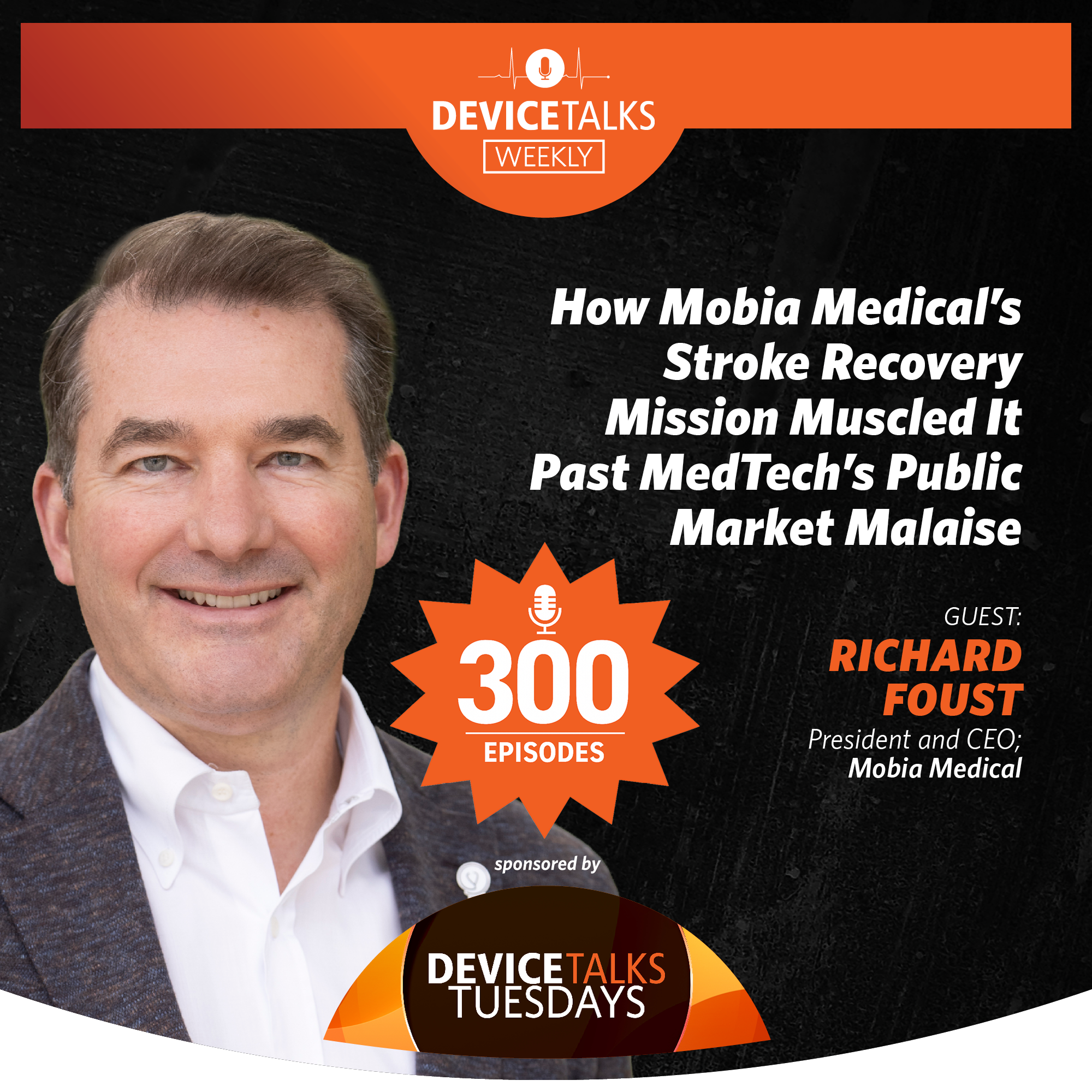
Device Talks Weekly episode featuring (1) MassDevice “Newmarkers Newsmakers” top stories on medtech industry news and (2) a keynote interview with Mobia Medical CEO Richard Faust about the company’s implantable vagus-nerve stimulation system for stroke recovery.
Tom Salemi (host) and Chris Newbaker (co-host) discuss news. Richard Faust is CEO of Mobia Medical; his medtech career includes Guidant, Abbott/Perclose, and earlier work in orthopedic tissue engineering at Georgia Tech. He also previously worked in health tech/telehealth at Analyte Health and later in vascular at Volanovascular. News segment includes MassDevice editor Sean Hooley (recently left MassDevice).
Mobia’s therapy improves motor recovery by “reprogramming” the brain via vagus nerve stimulation paired with upper-limb movement, creating a learning environment and upregulating neurotransmitters (~6x). Benefits are claimed for patients regardless of stroke location and for a wide post-stroke window (6 months to 45 years). FDA approval came in 2021; commercialization began late 2022/2023.
Kathy, an early patient whose writing became more legible over weeks, enabling finer tasks like buttoning clothes and using utensils. Wired magazine coverage is cited as highlighting potential broader impact of vagus nerve stimulation.
Written by AI. May contain mistakes.
Discussion about Sean Hooley's departure from MassDevice.
“from the great Sean Hooley, senior editor of MassDevice.”
Announcement of the upcoming Device Talks Tuesdays conversation.
“Or if you're watching on demand, if you can't make it at 4 p.m.”
Chris Newmarker and Tom Salemi discuss the latest news and stories in medtech.
“Now we have ourselves a game between Medtronic and J &J and Intuitive.”
Discussion of the $88 million jury verdict against Medtronic and its implications.
“I was like, this guy's just, I mean, yes.”
Analysis of Boston Scientific's restructuring and its impact on the workforce.
“I suspect this just has to be good news for people over at that Massimo business now inside of Danaher that, okay, obviously what they're doing is so important to that company.”
Overview of significant private equity transactions in the medical device industry.
“that, you know, that they say, like, will include, you know, headcount reductions.”
Explore the latest trends in MedTech acquisitions and private equity involvement.
“in the medical device industry supply space and the contract manufacturing space in just the last week or so.”
Discuss the cyclical nature of MedTech acquisitions and the role of private equity.
“with open arms, especially if you bring some, some Dairy Queen with you with a couple of drippy cones.”
Introduction to Richard Faust, CEO of Mobia Medical, and the company's mission.
“of the business and create really sort of hyper-efficient entities or more efficient entities, maybe not hyper.”
Richard Faust shares his background, career path, and experiences in the MedTech industry.
“Now it's time for our keynote conversation.”
Discussion on the evolution of the MedTech industry and its current state.
“And, and Deb Kilpatrick, of course, uh, Evidation Health.”
Explore how the medtech market has evolved and the complexities it addresses.
“Or do you think we're siloed to a degree?”
Learn about the guest's career path and leadership philosophies in MedTech.
“Before we get into the Mobi story, though, I do want to sort of understand you moved over to Abbott.”
Discover how the guest transitioned to Mobia Medical and the motivations behind it.
“And so I don't think anything that you do in your life and your career is a waste.”
Get insights into the technology and procedures involved with Mobia Medical's product.
“And so what had to be done at that point, like many things, is that we had great technology.”
Learn about the technical aspects and risks of the stroke recovery procedure.
“The procedure itself doesn't have a lot of blood because you're not opening a vascular channel.”
Discover how the technology aims to reprogram brain functions post-stroke.
“There's a lot to that that I really enjoyed.”
Explore the market potential for the device and the importance of patient awareness.
“that, you know, when I was walking in and doing my diligence to understand whether this was the right thing for me, that's what kind of sealed the deal.”
Hear inspiring stories of patients who experienced recovery using the technology.
“And so having, you know, a larger fundraise that allows us to grow and establish this as eventually to be the standard of care was a lot of the thought process going into the IPO.”
Understand the journey of product development and the fundraising efforts behind it.
“What's the path forward for the product?”
Learn about the historical advancements in stroke recovery and the focus on patient outcomes.
“Like I thought it would have been like 20 years ago.”
Understand how hospitals are shifting from acute care to comprehensive stroke recovery.
“And so the market is ginormous and every year we're adding to it.”
Insights into the challenges and considerations of going public for a med tech company.
“And I think more and more it will become more normal.”
Discuss the impact of leadership on career development and personal recommendations.
“and getting as many patients as possible access to the technology.”

Get the gist, explore an idea or ask about something said.
 Claude
On DeviceTalks Weekly, what are the key points of this episode?
Searching your listeningAutomatic transcript. May contain errors.
0:00Hi everyone, Tom Salemi here. Welcome back to the Device Talks Weekly Podcast. Fantastic episode coming your way a little later in the podcast. I will speak with Richard Foust. He's the CEO of Mobia Medical. He's got a good, long medtech career, started at guidance, worked his way through Abbott, and now he's leading a very intriguing company that has a device that can help folks recover from stroke. So we'll get into that a little bit later. but Richard and I also talked a bit about careers, of course, and also talked a bit about medtech and how it's changed. Before that, Chris Newmark and I will review the Newmarkers Newsmakers, his top five stories from the electronic or digital pages of MassDevice.
0:40This will be the last Newmarkers Newsmakers that features articles from the great Sean Hooley, senior editor of MassDevice. Sean has left MassDevice. His last day was Wednesday, and he's got some great things coming up. So, Sean, if you are listening, thanks for everything. You have been a complete joy to work with and look forward to remaining in touch. All right. Before we begin this podcast, I hope you'll join us on Tuesday at 4 p.m. for our Device Talks Tuesdays conversation with PSN Labs. Conversation is called How Collaborative Design Can Lower Manufacturing Costs, and it's actually brought to you by PSN Labs and PSN Manufacturing.
1:25So I'll be leading that conversation with folks from PSN Labs Manufacturing and Atricure. So it should be a great conversation. Go to devicetalks.com to register, free registration, watch live, get your questions answered right in front of you. Or if you're watching on demand, if you can't make it at 4 p.m. on Tuesday, August 11th, you can still watch on demand and get your questions answered that way as well. So, all right, let's get this podcast going. All right, you ready for this? Ready.
2:17Chris Newbaker, how are you, sir? doing well Tom doing well it's been a couple weeks man yeah I mean especially like going to the SRS conference I mean that was which I mean just even following all your LinkedIn posts from afar and everything you've done around it I mean that just sounds like a fantastic conference it's a happening place yeah absolutely lots going on congratulations to the J &J MedTech Atava team. Now we have ourselves a game between Medtronic and J &J and Intuitive. Let's go. Of course. Game is on. Companies out there but those are the big three. Yeah. It's an exciting space.
3:00There's a lot going on. It's going to be fun to really follow this. We actually have a really good roundup you can check up on mass device of top stories out of that SRS conference written by senior editor Sean Hooley who sadly has Sean's You're a scientist. Sean, why did you go, Sean? Now, Sean's moving on. He had some cool new opportunities. Yeah, really happy for him. But sad for us. Yeah, sad for us. Happy for him. You know, so a really good seven years he's had with us. And, you know, I mean, he only wrote 10 ,000 articles for us across our sites. So you tallied them up, 10 ,000? Yeah, yeah, a little over 10.
3:44You know, I mean, he says that's not why he decided to move on. Like, I mean, after you hit that 10 ,000 mark, you're like, that's it. I've climbed my mountain here. That's right. He filed that story and then picked up his Bluetooth mouse and just dropped it. Just dropped it. Done. Moving on. So, no, but. He's got great things out of him. He's a super guy. Absolutely. And we'll miss him a ton. Yeah, he'll be missed. Yeah. But I don't think many young journalists listen to our podcast, but if they do, we do have an associate editor opening at Mass Device and Medical Design Outsourcing. So I think we're a fun bunch, right?
4:25I mean, people listen to us. I mean, don't you want to come work with us? Come on. I think I'm hysterical, obviously. Me too. I mean, I laugh all the time at myself. Absolutely. Anyone who's listening to this podcast knows that we find ourselves very, very amusing. Yes. Yeah. Hopefully we aren't there and like these, these annoying older guys just like joking around. So, but in that spirit, I guess like we had and go through the new markers, news makers for the week. It's good to be back doing these. Absolutely. So let's hit a number five. Speaking of Sean Hooley, former senior editor of mass device.
4:59Dude wrote a whole report before he left. I was serious. I was like, this guy's just, I mean, yes. Yeah, Sean has an entire report about diabetes. I mean, really. I mean, he's, I mean, no. Oh, my gosh, I'm going to miss him. He's as nice as he is productive. That's the thing. Like, people are like, oh, you're just going to miss all these reports he's filing. He's like, no, he's really a good guy, too. He's a really nice guy, too. Oh, my gosh. I mean, yeah. I mean, yeah. I mean, you can have nice people that you're like, oh, they don't. I mean, I got it. And then you have, like, you know, really productive people who are like, well, yeah, there's, like, things here.
5:36oh well they're really productive he had both so I mean yeah the two circles were laying right over each other just like that was Sean that is Sean he's gone to a better place but geographically not spiritually
6:00there we go again cracking ourselves up alright so tell us about the report Christian Marker. No, I'm not even going to go there. Yeah, let's not go. Tell us about the report, Christian Marker. Yes. Sell some reports. Let's go. Yes, the report. Yeah. Actually, they're free. You don't even have to sell them. You just have to tell people about it. Yeah, we just go to MassDevice. You know, we've got it posted right up there. Diabetes Technology Innovation Special Report. Yes. Thank you. Yes. You can find it on MassDevice. Thank you, Tom. Sponsored by Viant, Jabeel, and Cadence. Yes. Thank you very much for your sponsorship.
6:32Yeah, totally. Absolutely. Absolutely. And just, you know, a really, really good, good report, like nearly nearly 40 pages here, including a roundup of the 10 largest diabetes tech companies in the world ranked by revenue. Sean pulled in all kinds of extra data about these companies, as well as like, you know, summaries of all the recent news about these companies and what they're about and where they're going. And, you know, the report also includes just some like really good, really good feature articles, you know, covering, you know, some of the really interesting developments in the space, you know, including stories.
7:08And he spoke with people at Minimet about their next-gen insulin pump. He had a story with Dexcom CEO Jake Leach. We've got a story about what's going on over at Senseonics. And a whole roundup of the biggest diabetes tech stories out of 88-2026. So that's all there. Just go to MassDevice. Easy to navigate and find it. if you really want a good, nice, good overview of the diabetes tech space, Sean's got you covered with this great report. Yes, he does. But he won't have us covered anymore, Chris. All right. Honest to God, he gave me my best LinkedIn production, like posting his stories on LinkedIn.
7:55Oh, my gosh, yeah. I know. All right. All right. Well, we'll get it again, folks. If you have someone who's interested in medtech journalism, send them our way there we go i know yeah we're laughing we're crying you know um yes you know be fantastic i'm like like hopefully you know and this is a good opportunity like um it'd be big shoes to fill but um but um yeah it'll be it'll be really great uh yeah come come on board join our team but next up on the list uh we've got this is also from sean um this is uh Oh, this is torture. Go ahead. It's like, you know, but, you know, we have Danaher. So, you know, Danaher acquired Massimo, you know, after the acquisition, you know, Katie Simon, you know, left, you know, for her CEO job.
8:48And, you know, a Danaher executive, Julie Sawyer of Montgomery, took over Massimo as their president after the acquisition. And now, you know, this Danaher president who's been running Massimo is going to be heading up and taking over the CEO job of the entire company effective October 1st. So, I mean, I think that just really shows just how important this acquisition was for Dan or her. And the fact that they also said that, you know, Julie Sawyer Montgomery, like, played, like, she basically led, internally led, you know, the efforts around this acquisition at Dan or her. So, yeah, it's exciting.
9:30If you want some career advice, kids, I'm a skilled observer of these things. Under her leadership, the business went from$6 billion in revenue in 2017 to approximately$11 billion today while tripling operating profit. So that's a great way to move ahead, boys and girls. Yeah. If you want to advance and become a CEO, that's some great performance. If you took something that was bringing in billions a year and brought in billions and billions and billions more, yeah, that can get some attention. This is the diagnostics unit at Danaher. So, yeah, good choice, I think. Yeah, totally. Yeah. I suspect this just has to be good news for people over at that Massimo business now inside of Danaher that, okay, obviously what they're doing is so important to that company.
10:22that the executive who kind of made this happen to Danaher is now going to be running the whole company. So they're a little important over there. They're doing something. And they also named a new Massimo president, Tim Brenner, who's a veteran of Edwards Life Sciences, Abbott Turumo, and Inari Stryker. Yeah. He kind of came in around the time of this acquisition as well. And so, yeah, he's going to be running Massimo inside of Danhurst. So, yeah, very cool. Excellent. All right. Let's roll on to number three, Chris Neumarker. Next up on the list, this was also from Sean. Chris, I looked. They're all from Sean.
11:04They're all from Sean. Yeah, let's just keep on going. You sick puppy. Why didn't you do this to us? Next week, it'll all be from me, probably. So, as you know, as well as, you know, we got Skylar Rivera is contributing as well as actually like just to mention like, you know, Julie Rockter-Sivia over at R &D World's helping us out a bit over at MassDevice for now as well. So thanks a lot, Julie. Really, that's been really appreciated. And, you know, the next story, we've got Medtronic, like a federal jury master, she's saying that they need to pay$88 million in damages related to, you know, a COVID-19 unit's hernia mesh implants.
11:42And this is like a lawsuit that was going on a long time and stuff kind of really moves slowly through the court sometimes. I mean, this was mesh implant that was implanted back in 2017. But Medtronic shared a statement with us saying they strongly disagree with the verdict and will challenge the verdict. But a lawsuit lost there for Medtronic. All right. Let's move on to number two, Christian Lacher. You know, a number two on the list, you know, this was from, you know, last week, but, you know, since we skipped a week or two, it's still good to mention that, you know, Boston Scientific is undergoing, you know, a major restructuring that, you know, that they say, like, will include, you know, headcount reductions.
12:35So the big thing they're talking about is optimizing supply chain, which, I mean, that makes a lot of sense, unfortunately, these days, you know, when you're seeing everything going on in the world from climate change to, you know, wars in the Middle East and Ukraine to, you know, to like unpredictable tariffs that are all over the place. So, but they'll be doing that. And yeah, like hopefully we'll be keeping an eye with no, no real numbers. I mean, Sean, Sean did have a story out. There were some like news reports out of Ireland and Costa Rica saying, hey, we're going to be getting some cuts.
13:17But, you know, we'll be keeping an eye out for, you know, more news on like actual details of like what kind of cuts we might be seeing from that, you know. But just looks like, you know, Boston Scientific's really, really looking for a refocus right now. yeah and i would think i mean they've had a string of major acquisitions over the last couple years and i would think as you sort of i know you you do some of the sort of streamlining the job elimination at the start but i would think over time that you also uh find new efficiencies as you up as you move forward so i'm guessing that's that's part of it as well yeah i could be going on as well so um so and this is i guess this is some you know some tough news for the uh the industry this week.
13:59But to wrap up, number one on the list, we've seen some major private equity deals in the medical device industry supply space and the contract manufacturing space in just the last week or so. I mean, Integer, which is one of the largest medtech contract manufacturers in the world, they're going to be acquired by KKR for$5.7 billion dollars. So they're going private under private equity. And then we had, you know, a Teleflex completing the$1.5 billion sale of their OEM business, which is, you know, contract manufacturing to, you know, the firms Montague and Kohlberg. And that's not going to be called Ingenix and actually just based on like a mile or so from my house.
14:46So I'll have to go over and visit them soon, you know, in the area. Actually, it looks like they're in a little park right behind the Dairy Queen I sometimes go to. So, here we go.
15:01Plymouth, Minnesota is a funny place, Tom. It's like, it's like I'm getting an ice cream cone and there's like, you know, you're like, you're describing this entire Met Tech region as like, go down by the swimming hole and then we can, making some devices like over there. Uh, yes, I'm sure they'll welcome you with open arms, especially if you bring some, some Dairy Queen with you with a couple of drippy cones. Especially if I show up with a few sundaes or ice cream cake. Yeah, no, the private equity continues to play a huge role in medtech. I just keep seeing these deals after deals after deals, and I keep asking myself, how is this all going to play out?
15:40I guess they all go public again, and then we have a whole bunch of smaller medtech companies that will consolidate 10 years from now. I feel like, just finished watching Battlestar Galactica, and there was a big theme of that like this has all happened before and i feel that way all happened before this has all happened before and it will all happen again here we go you know i remember years ago like one of my chats over the years i mean i'm great i actually just recently had lunch with manny villafana which was just wonderful i just he's just he's just a gem and he's going to be uh you know uh one of the speakers on our menvasive uh you know medtech webinar series uh you know next next month but um Is it next month or this month?
16:19This month. Well, time flies by, man. Yes. It's a few weeks. Please register. It's going to be managing editor Jim Hamerant's putting together a great lineup. But I remember years ago, I mentioned this to Manny. He was like, oh, yeah, they do acquisitions, they build up, and they all break up. It's just a cycle. Basically, at this point, he's been in the industry so long, he's seen a few of these. But the building up and the spinning off. but the private equity is interesting. And I mean, I've been exclusively covering this space like well over a dozen years now. And I mean, now the contract manufacturing space, yeah, I've seen a lot of private equity there, but these deals we're seeing in the OAM space seems like kind of new like the last few years.
17:03So have you heard at all why that's happening? That's actually an open question that I think we're going to be doing some reporting on to try to figure out more. Why the spin-outs? why why that we're seeing more private equity acquisitions in the oem space like hologic getting acquired and you know and yeah and actually that too you know that i mean in the past like a spin out would have happened and you know it would have been another public company probably acquiring it and now all of a sudden you know we're seeing like spin outs happen where you know they're getting acquired by private equity and they're going private they just see at least to me that seems to be more common right now and i i mean i think it's just a chicken and egg sort of thing.
17:43I think there's a lot of capital out there looking for places to go. And I think that gives these CEOs at the medtech companies opportunities to shave off some parts of the business and create really sort of hyper-efficient entities or more efficient entities, maybe not hyper. And it's just sort of a, it's a combination of two or three things. So, So why now? I think it's just there's a lot of capital out there looking for a home. And MedTech's kind of predictable. And as we've always maintained, it's a bit of a recession-proof business. Yeah, it's true. It's a good hedge, for sure. So maybe it's offsetting all the AI investments because AI is so speculative.
18:26Maybe this is sort of a safer place to put your money. Who knows? Yeah. You might have some money over on those data centers and the chips and all that stuff. But, you know, you have a portion of the portfolio that's in the device industry. Because, you know, unfortunately, people always will need medical devices. Absolutely. Unless we find the Live Forever pill, which that hasn't happened yet. I'm working on it, Chris. That sounds good, man. Yeah, I'm working on it. I'm for it. I'm this close. If anyone wants to invest in my Live Forever pill, I'll get a GoFundMe going and you can be first in line to receive it.
19:06The drug Eterna. Live eternally with Eterna. I have this vision of the Three Stooges when they used to make those concoctions and they'd put all this awful stuff into a mixer and they'd have Curly drink it. Like here, this is eternal. This is like the Live Forever drug. I think that's just an old-fashioned, Tom. It's an old-fashioned. Same thing. Same thing. All right, Chris Neumarker, good to have you back. Yeah, always good to chat, man. And thank you, Sean Hooley, for all the work and for all the newsmakers you've created for us to talk about. Absolutely. Don't be a stranger, Sean. Best of luck in the future.
19:45Exactly. All right, thank you, Chris Neumarker. Now it's time for our keynote conversation. Happy to bring you my talk with Richard Faust. He's the CEO of Mobia Medical. Mobia Medical is a very intriguing company. It has a device that can help folks who have suffered strokes regain some of their own mobility, and we'll talk about that. But of course, we'll explore Richard Faust's career first, talk about how he got to where he is, and we'll talk a little bit about MedTech, how it's changed, how it's become less siloed, and why it's a little defeatist. At least that was my assessment, and I was contributing to the defeatism.
20:25So, hope you enjoy this conversation with Richard Faust, CEO of Mobia Medical. Well, Richard Faust, welcome to the podcast. Well, thank you, Tom. Appreciate having the chance to tell the story about Mobia. No, the stroke space is one that we talk about frequently. It's one that I think is one of the more powerful ones in medtech. and I love giving some attention to efforts to help people recover from strokes. We talk a lot about clot retrieval and things like that, what happens when a stroke hits, but unfortunately it hits a lot and folks need help afterwards. And I'd love to understand how Mobia is able to help with that.
21:06But first, Richard, how did you find your way into the medtech industry? Yeah, I mean, I think the high level first, my parents, right? My mother was a math teacher. My father was or is a nuclear physicist. So I was destined to go that direction. I've always been really curious about solving problems and going into spaces that were new. And I would say my biggest interest started in grad school at Georgia Tech. I was actually studying orthopedic tissue engineering. So doing, you know, research in spinal implants with a doctor from Emory who ended up selling his technology to sophomore Danik. And surprisingly enough, I didn't end up in orthopedics.
22:01My first job was at Guidant. And a lot of that was driven by actually doing TA work on vascular pathophysiology and just becoming really fascinated with that. There was a gentleman by the name of Dr. Tchaikov at Emory who was instrumental in a lot of the TAVR space or endovascular AAA space. And I just kind of went from there and ended up at Guidant. But I would say in general, I knew it was going to be science. I knew I liked solving big problems. and I think Georgia Tech did a really good job of integrating and giving people a full view of how they could either become a scientist or become someone who would generate and develop new technology for patients.
22:51So MedTech, was that more of a bit of serendipity that you find your way into this industry or was there one moment in time that it sort of captured your heart? Because this was the 90s when all the attention was going to technology technology uh it internet uh it was a noisy time and medtech did not get a lot of attention it was a noisy time um one of my um early mentors at georgia tech she was leaving as as i was coming was uh deb kilpatrick uh and she worked i would say closer with her her research and her professor were closer on working with companies. And so I think she was pretty instrumental in me thinking about taking the road of, um, on, you know, working with companies rather than research.
23:46I would say that would be one of the most instrumental things. And I think the rest is history. Um, I think we all kind of find our way for the right reasons. You know, my wife has that, um, she reminds me that all the time, things will happen the way they're supposed to happen. And, um, so yeah, I would say if I had to say there was one instrumental thing, cause I think, um, you know, for people who are really driven, there's always more than one pathway, but there's usually that moment in time that kind of highlights and makes everything clear for you. And I think that was it. Yeah. And, and Deb Kilpatrick, of course, uh, Evidation Health.
24:23She's now at Sondra Capital. She's co-founder of MedTech Women. So, uh, if you're going to have a, an inspiration to bring you into the sector, that's a, that's a really good one to hang your hat on. So, fantastic. So you joined Guidant again in the, in the, in the nineties, I hear nothing but great things about folks who read Guidant. Uh, and I know I'll hear more from you, but, uh, what was it about Guidant, uh, that, that made it so special? Um, it was the people. Um, I would say, even to this day, there's moments that I remember of just enthusiastic celebration of innovation. And every day I went to work knowing that everyone around me was better than me.
25:11And it wasn't a competition, but it was really about moving things forward for patients. And so everyone pushed each other, not out of like, I want their job or I want to do better. Just it's because we're all moving forward with that notion that, you know, patients were first. And so when you work with great people and that you constantly are exceeding your expectations, it raises your game. And I think what Guyton did a really good job of is, first of all, investing in people, giving people opportunities probably before they were ready for them, pushing them into uncomfortable places, and moving people around different roles.
26:00You know, I think a lot of companies tend to keep people, you know, they're 14 years in regulatory. You know, I would say you were not allowed to do that because the view and the perspective and the philosophy was that people who had full perspective of bringing technology to market provided, you know, I would say not only de-risk, but an accelerated pathway. understanding that you can't just listen to the physician. You also have to understand the constraints associated with intellectual property, design, manufacturing, all of these things, current product line. And so I think all of those elements, you know, and sometimes you don't know how much you appreciated what you got.
26:51So you're 20 plus years. That's always the case. in your career and you look back at those moments and you try to pull the strings from what made it great even though you'll never have the same thing to bring some of those elements to bear in the organizations that you build. That's one of the reasons I other than Mobi being a great company I also wanted to talk to you was just looking at your background and you do have one of those I love careers that start in engineering and kind of move their way into the different businesses. Because I think engineers have the, many of them, it's a cliche that they're a certain type of person and they're not going to become anything different.
27:31So I always enjoy talking to people who do. But going back to that perspective or that belief that everyone should try to understand the more complete part of the business. Looking at the medtech industry today, I feel like that's more common, I feel like the industry is less siloed than it used to be, that there's more sharing of knowledge and sharing of experiences. Do you agree? Or do you think we're siloed to a degree? No, I think it evolved that way. I think for a lot of reasons. One, there's a lot more business being done outside the United States. Sure. And so just having that perspective, even having, you know, manufacturing and research in other parts of the world, I think is now pretty common.
28:26And I think in order to, for that to be successful, you have to have more of a diversity of background and experience to make that work. no it's yeah i i the the mark the the market as you know has changed you know um how health care manifests itself has changed you know consolidation of large companies has changed out of the dynamics there's a lot there but i would say um the med device market has moved forward and is more sophisticated than it was, you know, 10 years ago and continues to maintain that trajectory. I think it's one of the most amazing business areas to be in because we're solving really complex problems that can't be solved other ways.
29:16Mm-hmm. And that's part of the reason why Mobia Medical fascinated me so much. You know, there was actually multiple trials done with pharmaceutical agents to try to bring neuroplasticity to bear, and they failed. Mm-hmm. And so it's just an example. And, you know, I think MedDevice kind of fits in that place, you know, where surgeries are too malicious and pharmaceutical agents don't necessarily solve the problem or their side effects are too deleterious. So I think that's what makes MedDevice so magical. Agreed. And again, the reason other than talking to you, the reason I want to understand Mobi, it is one of those, I think, instances where MedTech is moving out from backstage and really engaging directly with the patients.
30:11Before we get into the Mobi story, though, I do want to sort of understand you moved over to Abbott. Was that part of a guidance acquisition or was that a move on your own? I'm looking at the timing. I think it was before the acquisition, correct? Yeah. Actually, it was even called per close when I arrived. Oh, okay. That's right. Okay. That transition was still happening. I think the deal had closed, but it was still in the process of things being sorted out. And that whole seaport area where, you know, the per-close Abbott facilities were, you know, that's really a big nexus of MedTech. Um, you know, I, the desk I had initially, you know, was right down the hall from John Simpson and the whole crew from Fox Hollow.
31:02Um, so yeah, I mean, stepping into, um, Abbott or Perclose at that time was still, um, felt like a small company. um we were still trying to figure out what we wanted to become and being a part of um you know the design of building what would we acquire and what would we build internally um was you know super interesting and you and you moved out of uh traditional medtech uh with your chief business officer at analyte health uh and then um but then to move that back into vascular so did you did you see an opportunity in sort of again that less than traditional med tech space and what was what was it about that that appealed to you because you're moving away from the science that kind of drew you to med tech in the first place but you clearly you found some other some other uh really strong interests yeah i would say um i've always throughout my um professional life um pushed myself into areas um to challenge either the way i think about things, the way I solve problems, and also to learn.
32:16I think for me, like when people ask me what I focus on, it's continuing to challenge myself and build, you know, ways in which I would solve problems. And so went down the pathway of this telehealth company, which was a more David out company, you know, to really understand how technology was going to play a role in healthcare. You know, this, at the time I went over, health tech was just starting to be popular and interesting. You know, kind of Longo was at the early stages. Teladoc was kind of at the early stages. And a lot of investment done by the major VCs was pouring money into health tech.
33:04you know, the Amadas, you know. Anyway, so I would say part of it was, you know, I wanted to have, I wanted to push myself to understand how those businesses worked. And it was very different than traditional med tech, right? Because health tech is a service business. You're right. And what I learned from that is I don't want to be in a service business. I see the value of it. I understand it. There's a lot of things I learned about direct-to-consumer advertising, a lot of things that I learned about, you know, building a service organization. It just, it didn't fill my cup as much as MedDict did.
33:55And what's interesting about it, because I think all roads lead to where you are. Very true. And so the things that I learned at Analyte, I took with me. And there's some of those tenets that I applied at Volanovascular, and there's some of those tenets that I've applied here at Mobia. And so I don't think anything that you do in your life and your career is a waste. I think it's your perspective to be introspective and to learn and to take the things that you believe could be applied in other places and to use that as a competitive advantage. Absolutely. That's a lesson I try to share with people, my kids.
34:46Keep moving forward and sometimes you'll try the door and it ends up being locked, but you know that's not your door. That's right. Try the next door. If you just keep staring at doors all the time, you're not going to get anywhere. So, let's move into Mobia Medical. So, this had previously, when you joined, it was microtransponder, correct? Right. Right. So, how did this opportunity come to you? This is your first CEO job, right? Yeah. Was this something you knew early on that you wanted to do? Was it a box you needed to check? um i i would say i've always had a desire to kind of have and to progress to higher levels of a general management type role like i thought i felt because i've been in that role at a couple different times in my career felt like it just it felt most natural to me um having knowledge across all of the different business functions, but really feeling this desire to lead and to grow and to push.
35:47And so actually at the time I was interviewing for a number of other CEO roles based in San Francisco. And like many things, this job came to me from someone who had worked for me many years ago and had recommended me, you know, to the current leadership team there. And so I took the call knowing that I was like in the ninth inning with three other companies. Wow. And it took a lot of, it took a lot of strength to put them on hold. because as you said it was my my first opportunity and i was basically looking at three jobs all very interesting and telling them all that i needed more time knowing that they would probably move to the next candidate or whatever um and even even when i made that decision I still took a number of months to do diligence on the opportunity.
37:02But the reason why I did it, you know, really comes back to the opportunity, the white space, the patient impact. And I needed to know that if this was really as good as it could be, that I would be all in. and um and that's what my diligence told me and i think the rest uh the rest is history um obviously the company had existed for quite a quite a number of years before and was not a traditional bay area medtech company um a lot of the funding had come through sbir grants NIH grants, some lesser known, but still high quality venture, as well as a family office. And I walked in as employee 11 after 10 plus years of the company's existence.
38:01Now, that company had done amazing things in that period of time, you know, and to have that many patents, that many publications, and to be almost on the other side of a pivotal trial plus, you know, publication in Lancet and an FDA approval was pretty amazing. And so what had to be done at that point, like many things, is that we had great technology. We had kind of proven clinical efficacy, but we needed to build a company. And I think, you know, I've had a lot of experiences on bringing things to market, you know, from ideation all the way through. And it's, and I understand, you know, people who are a part of the ideation pathway, they think that's the hardest and most important part of the journey.
38:59But as I always say, on the blank sheet of paper, that only takes up the small corner. Because the reality is, having kind of grown up in Silicon Valley, I've invested in and been part of companies and seen companies that have incredible technology that never make it, right? And a lot of things can go wrong. You know, the market can shift. People can't get funding. People miss an endpoint on a clinical trial. And so I think it is an important milestone. I'm not trying to take away from it. But the part of the weight that I bear as the leader of this company and what I preach to people is our responsibility is to make sure that really good things that do great things for patients become the standard of care.
39:58and so there's there's an incredible pathway for that to happen and so what we have to lean into is all of the things that we need to do to make that a reality so the the situation you're describing i want to get into the the technology i think now's a good time to sort of talk about what mobia medical does but the way you describe the quote-unquote company that you joined that you decided to lead. It was very much, I'm guessing the other two opportunities probably had more structure, maybe more traditional financing, maybe they were more traditional med tech, maybe they were kind of sure or safer or at least better known bets than this was.
40:40So I'm guessing the technology and the potential that microtransponder then now Mobia Medical was what won you over. So tell us about the tech. What was it about that product that made you say, I'm going to give up the surety of all these other things because this is something I need to do because it must have really won you over. Almost magical is the way to describe it. And just to give you the easy version. So we have a device that is an implantable IPG, goes into usually the left side of the chest. Tell me what an IPG is, just so everyone knows. A pulse generator. So a battery similar to a pacemaker or something like that that's placed in the chest.
41:28You then tunnel underneath the cutaneous skin, the skin, in order to get to the vagus nerve, which is, you know, kind of very, very close to the carotid sheath. And so a lot of people who do inarterectomies or I would say even, you know, some of the carotid work that's done out of the neck from Silk Road, they may already be exposing and very close to, you know, the vagus nerve. The procedure itself doesn't have a lot of blood because you're not opening a vascular channel. It's really cutaneous and, you know, some dissection. So you're going subcutaneous, you're bringing the lead, and then you're creating a small incision, usually in the fold of the neck so that the scar is not really apparent.
42:20wrapping the lead which is a spiral helical design so that you get multiple contact points and then you're connecting it and then you sew it up it's a 45 to an hour procedure done under anesthesia but it's an outpatient procedure so really low risk low morbidity and mortalities associated with it and so and it's something the procedure itself that's been done over 150 ,000 times in the United States. Wow. It is similar fashion for epilepsy. Okay. There's a company out of Houston that's now part of Libanova called Cyponics that has been doing this procedure for quite some time. Obviously, our technology and form and function is a little bit different, but the procedure is very similar.
43:12But the technology is all about how you use the vagus nerve as a highway to deliver something that is going to be therapeutic inside the brain. And what's incredible about it is what we are proving, not only in our pivotal study, but in the real world, is where the stroke occurs doesn't matter. So, the technology is always implanted on the left side, but if you have a stroke on the right hemisphere, and we're now going to have a publication later this year that'll describe this in more detail. I'm not going to get into it now, but there's a lot of different locations and where the stroke can occur, and the outcomes are still the same.
44:04And so we use the nerve pathways that the great nerve, the vagus nerve is connected to in the brain, actually to deliver not just this stimulation, which leads to neurotransmitters that are upregulated, usually about sixfold in the brain. And that creates a learning environment. And then when you pair that stimulation with something, right now our indication is for upper limb, it creates, you know, saliency for the brain. And then it knows where nerves need to grow and also connect in order to create more formal connections. And when you think about what happens in a stroke, and this is the key to this technology, when you have a stroke, Let's say an ischemic stroke, a clot is going somewhere in the brain, usually in the MCA, and it's blocking blood flow.
45:11And as a result, all of those cells die. You don't regrow any of those neurons. And so what our technology is doing is it's teaching all of the cells around it to take over the function that was lost. Okay? And so now you take a step back and you say, okay, we're implanting a device in the body. I would call it kind of minimally invasive. We're going to reprogram the brain. And by reprogramming the brain, people are going to change their function. And there were so many things that I had to understand about that. But when I took a step back, the concept was amazing. Using the cells of the body to change the ceiling of improvement.
46:08There's a lot to that that I really enjoyed. The concept, right? Because so much of what we can do in medtech is like trying to take the shortest distance between two points and to think that our body's not that sophisticated. And as we always say in medtech, whenever you solve a problem, you usually create a problem. And I've experienced that over the years and, you know, treating the heart. But, you know, you start with a balloon catheter, it creates a dissection, you have acute threat enclosure, which means you need a stent, which creates re-stenosis, which means you need a drug-eluting stent, which creates long-term thrombosis, which means, okay.
46:55So, my point is, is that usually is what happened when you have this kind of point-to-point solution. And this, for me, felt different. This was a little bit more sophisticated. It was hijacking the body's potential to create this connection around the affected area. So are you sending this energy and trying to redirect or, forgive me, reprogram a specific part of the brain? Are you identifying, are you targeting the area you want to change? or are you trusting? Does the brain sort of out of a capacity to know what parts of it need to be changed in order to facilitate this activity? That's the magical thing about it.
47:44That's why I said what you pair with it is what creates saliency. So if I'm stimulating and I'm moving my fingers, then the part of the brain that are involved in premotor, motor, post-motor function are where the neurotransmitters go. Wow. That's the power of this technology. That's why I was so intrigued by it. You know, because you take a step back and you're like, it's magical. And what is amazing is that we have a nature paper that kind of describes our mechanism of action. You know, we've, and that's the part of this that, you know, when I was walking in and doing my diligence to understand whether this was the right thing for me, that's what kind of sealed the deal.
48:35You know, the fact that they took the time to prove the mechanism of action, and then they began running a clinical study which still proved this two to three times motor recovery improvement in a pivotal study that was accepted and published in Lancet. So I want to unpack a bit the serious impact that this has and how it helps patients who had suffered from stroke. But I want to use this time to use my one-allotted stupid question. Can you use this technology to enable me to learn French faster? Is there a broader application of this someday? Obviously, undergoing a procedure like this might be a bit extreme, but are you looking, is there an opportunity for a broader rewiring of the brain someday?
49:24Have you thought about that? I'll answer that question by pointing to the first thing that was published after we got FDA approval, which was an article in Wired Magazine. Of course. Yep. Okay. And Wired Magazine says that vagus nerve stimulation could become a new way for people to dope. If you are a golf player, if you are a tennis player, if you are a baseball player, yes, we're using it for altruistic reasons, which is taking patients that, independent of time since stroke. I mean, this is a critical point. Patients that are six months to 45 years post-stroke, we're still improving them. There is no expiration date, okay?
50:24Now, we're using it for that purpose, not to make people that are fully functional to be, you know, cyborgs. Right. But I would say, you know, what we're super excited about is it's a massive market. You know, what we wake up every day and think about is that all of the patients that don't know we exist, that don't know that this solution is something that does exist. And obviously making the decision to IPO was all about that. It was, you know, us making a statement that, you know, this technology deserves to be standard of care. People need to know about it. We need to raise the level of influence as well as knowledge of this procedure.
51:10And so having, you know, a larger fundraise that allows us to grow and establish this as eventually to be the standard of care was a lot of the thought process going into the IPO. Sure. Well, and I want to unpack the IPO in a moment, but tell us what benefits are you seeing in folks who have used your device, been tested with your device? What results are you seeing? So, I always love to tell patient stories. I have the advantage of getting to see a lot of this on a daily basis, which is just like the second boost of caffeine. I mean, when you see these stories of how patients are getting better.
51:51And so, you know, one of my favorite stories that I tell with people, and I don't have the picture to show you, but it's how people's writing improves. Because I think that is, when you think about the hardest thing for a stroke patient to do, it's really a fine motor function. You know, and the ability to control your fingers, your elbow, your wrist to write. And when you think about, like, what does it mean for patients? Because we can talk about the numbers from a trial, but the real measure of success is a patient has decided that there are certain things that they want back. Could be washing their hair, going to the bathroom by themselves, cutting food, driving a car.
52:42um i'll tell you the story of kathy she was one of our first patients and you know her why was really centered around being able to write letters to her grandchildren and she's like look i have these incredible grandchildren i can't see them enough i want them to know how much they mean to me and so front and center you know going into you know her therapy for Vivistem was, I want to be able to write. And what we have a picture of is what that looks like in the very beginning, what it looks like after two weeks, four weeks, and six weeks. And by the end of it, it's unbelievable how much her writing has changed and how legible it is and how small it is.
53:37And so a lot of that, when you think about that, It's like in and of itself, she is now doing something which was her primary goal. How does that fine motor function translate into everything else she can do? Well, she can now button her clothes, right? She can now hold a knife and fork. So I think that is the humanity of what our technology brings above and beyond whatever measure. it's changing it's giving people back and changing what they thought was never possible and giving them that possibility I mean if you think about the world now it's structured today with our smartphones and everything I mean if if you can't text that's right movie tickets if I can't it's all there pick up a phone call you know it's it's all it's all it's all centered around you could be isolated very quickly so So where are you with the product development regulatory approval?
54:40Where's the product today? What's the path forward for the product? And then I want to talk about the IPO. Yeah. So in 2021, we got FDA approval. And so, you know, kind of we started that process of commercialization in real fashion at the end of 22 and into 23. And so we've just been in that pathway. You know, when I came on board, kind of the two things that were on my mind was one, we needed to fundraise. And so as part of that process, we raised$73 million in 2022, which was a hard time to raise money. I don't know if you remember back. I do. I do and I don't. Like I blocked a lot of it out, but yes.
55:22Now that you mention it, it was a tough time to raise money. It was a tough time. And we got great people on board, people that had, you know, the experience and muscle memory to do this. So, you know, USVP with Casey Tingsy came on as our lead investor. OUP with Bill Harrington, you know, the Action Potential Group. It was Imran and Juan Pablo, as well as the Vertical Group. And so that kind of cemented us and gave us a lot of, you know, experience around the table. Were they all first-time investors that round or? Yeah. Really? So I saw that list and I assumed like, okay, they raised that. That's an old school syndicate there.
56:05Like I thought it would have been like 20 years ago. Those are some big, other than you, other than Imran's group, which is newer, but still been around a while. Those are some blue chip firms. Yeah, it wasn't easy. I'll just leave you with that. But it was very purposeful, and I think that group played a big role. We also brought on Dana Mead as an independent and chairman of the board and off to the races. um and then you know later on in our evolution you know because this has really been about building something that was um was going to be big from the beginning you know we did a lot of things i would say the right way it wasn't about like how quickly can we you know flip this and and and sell it it was really we have something really important and meaningful and we need to do it the right way.
57:12And so, so much discipline and thoughtfulness went into how we went to market. And it just evolved in the right way. I mean, I would say, you know, things have definitely gone our way. The technology continues to deliver great outcomes for patients. And, you know, we're building a market. And just to double click on this so people have the context, You know, you talked about stroke in the beginning. You know, stroke really started with TPA. You know, before TPA, you know, it was just what can we possibly do for a stroke, an acute stroke patient. And then from there, a lot of the acute stroke devices, thrombectomy catheters came on board, but all of that was still focused on survival and triage.
58:06and no one was thinking about what do we do for the survivors now all of those technologies increase the rate of survival in fact over the last 10 years the number of people who have who are surviving stroke has improved by 50 percent now those people still have deficits. And so the market is ginormous and every year we're adding to it. And so that's part of kind of the mission. The mission is to change philosophically how people think about stroke. So transitioning hospitals away from just an acute stroke hospital to a comprehensive approach that includes survival as well as recovery. And that, you know, if I think about what are going to be the tenets of our success, it's changing the way things are done so that hospitals care about the patients they discharge in a different way, that they can bring them back for another potential technology to improve their recovery.
59:13How much attention is being paid to that part of the business? I know of CANDU affiliated with imperative care, working in another space, and I think their approach is different, but do you feel like there's more folks paying more attention to yes the folks who are surviving stroke but who who need help who who aren't where they were before and need need to get back to where they were to the best degree possible i i will tell you um everyone has energy for a solution what i've been you know kind of pleasantly surprised by is when we walk in to talk to physicians in a hospital setting it's kind of like where have you been right yeah um yes this is a problem yes we want to be part of it yes we want to offer this and so i think it's just i think the technology um had to catch up with the problem yeah um and so yes i think there's a lot more attention you'll see a lot of the stroke conferences we go to now that traditionally were just focused on acute stroke now begin to talk about stroke recovery.
1:00:28And I think more and more it will become more normal. Really great. So final area, let's just talk about the IPO. If I'm looking, I'm looking up your info. It looks like you had just over$30 million in revenue from 2025 up 100 % from 2024. Great growth, but small numbers. Um, you went, you tried to go public with very little revenue. Uh, number one, was there, did you, how difficult the decision was this for a med tech company to go public? Um, so I'll, the, the way I'm going to answer this is, um, not all revenue is the same. Okay. Right. It really depends on how you build your business, how repeatable, and how much visibility you have into it.
1:01:19And so when you think about most medtech companies, they are generating their revenue by selling devices for procedures that happen in the hospital setting. So they're dependent upon, A, potentially driving market share or the number of patients that show up that month. And there's a lot of things that I believe are outside of their control. Right? Good point. And revenue, in a lot of ways, is a symbol of the sophistication or process that you've gone through really to titrate out your predictability of success. Like, have you been pressure tested enough that this is normal enough that what you do this quarter is going to be similar to what you do next quarter?
1:02:14What I would say is the way our model is different is, first of all, we're not in a competition. There's not another company that we are competing against for these patients. Number two, the patients are self-aware and are looking for solutions. So, we have an activated patient population. Third, it's an elective procedure. It's scheduled. So this is all about how much awareness exists and how do you build that awareness into what I would generally call a patient funnel. of these people getting access to the technology and the therapy. And so I would say our model is a lot more focused on generating the awareness and building the infrastructure that allows us to understand what will happen next versus depending upon what patients show up and what market share that we can get.
1:03:21And so to answer your question, there's a lot of confidence we had going into the IPO, based on how we had performed and shown our board our ability to deliver in a repeatable way, quarter after quarter after quarter after quarter. And so we felt at this point that what we had is something that wasn't a big risk for us. No, that's a great point. I mean, God could come down and cure all strokes tomorrow and you would still have a pretty, and prevent any future strokes from happening and you would still have a pretty big population of people who needed your help. Yeah, the prevalence population is large, right?
1:04:10It's about 9 million patients in the United States. And we've narrowed that down to, you know, something that's a lot closer to a million to be kind of the most activated version, but that's still a$30 billion market in the United States. I think your story, you're definitely an outlier, but as I asked the question and you answered it, I just wondered if MedTech folks, if we have kind of a loser attitude in IPOs, like I'm like, oh, what are you, nuts, a MedTech company going public? And you explained clearly why it made perfect sense. And I'm thinking like, I wish I had looked at it that way immediately, but instead I kind of had this, oh, we don't, do we, is your story an outlier?
1:04:54Is it something, is it, or do we need to change our perspective in medtech? Are there ways of telling our stories differently that sound as convincing as yours just did? Well, maybe is the answer. Because I think about the scrutiny and the pressure testing that we have to get to the point we are. I actually believe as a group, we're probably undervalued. Um, there's a lot of companies in other areas of healthcare that go public without even knowing the answer to their pivotal study. Right. Right. Um, and so, um, you know, I wish I could press a button and change that tomorrow. Um, but I, I think, you know, what we have to do, the only things that we can control, um, to change the narrative is, is being successful.
1:05:51and getting as many patients as possible access to the technology. But I think that kind of nuance that we had in our story was recognized by our investors. And, you know, we went public in, you know, a very challenging time. MedTech was kind of at a 15-year low, and we're in the middle of a war with Iran. And the fact that we had a really strong and have a really strong investor base going into that IPO and raised$150 million is a testament to what we have. And I'm enthusiastic. I think the future is bright for us. The future is bright for patients. And I couldn't be more excited. That's great.
1:06:43Right. Final question for me, but hearkening back to the earlier part of the conversation, you said someone who worked for you recommended you for this role. Number one, does that person still work at the company? Number two, it must be particularly gratifying to have someone who worked for you identify you as someone that they would want to work for again and as someone who could fill a role like this. And just to be clear, they worked for me a long time ago. They don't currently work at Mobia and never have. It was one of the most, I would say, gratifying calls, you know, because it's a true measure, I think, of what you leave people with as a leader.
1:07:32And I still am in touch with that person today. Um, yeah, so extremely, extremely blessed for that person to, to put my name forward. That's fantastic. I don't know if you've seen the Odyssey yet, but there's a, uh, there's a perspective where the best view that you, the clearest view you get of someone is, is when they're sort of above you. So, uh, I think that should, you should, you should take a lot from that recommendation. So Richard, I've really enjoyed this conversation and I look forward to following your story. Thanks for joining us. Thank you, Tom. So excited for everything that comes next and appreciate the opportunity to tell the story.
1:08:14Well, that is a wrap. Thanks so much for joining us on this episode of the Device Talks Weekly Podcast. Once again, make sure you go to MassDevice. Check out the MassDevice Diabetes Technology Innovation Special Report compiled by the one and only Sean Hooley. Best of luck, Sean. Thank you for everything. Please do me a few solid favors. please follow Device Talks on LinkedIn. Please follow. MassDevice, please connect with me, Tom Salemi, Editorial Director. Connect with Kayleen Brown, Device Talks Managing Editor. And of course, connect with Chris Newmarker of MassDevice. You also might want to subscribe to the Device Talks Podcast Network so you don't miss a future episode of any of our Device Talks podcasts, including Device Talks Weekly.
1:09:03I hope you do join us on Tuesday. We've got a great presentation put together by PSN Labs. That's on Device Talks Tuesdays. Those are free to attend. And you can just go to devicetalks.com to register. Watch live, get your questions answered right in front of you. Or watch on demand. You can still ask your questions. You'll just need to be a little patient. But PSN Labs will get you the answers that you need. All right, folks. Thanks so much for being part of Device Talks and for joining us on this episode of the Device Talks Weekly Podcast.
In this episode of the DeviceTalks Weekly podcast, Mobia Medical CEO Richard Foust explains how the “magical” qualities of the company's neurotechnology helped steer it toward an IPO. Mobia Medical’s implantable pulse generator promotes motor skill recovery in patients who have suffered a stroke. The company’s early commercial success has generated modest revenue, but Foust tells host Tom Salemi that “not all revenue is the same,” explaining why a large, untapped and growing market won over venture capital investors a few years ago and public investors this spring.
MassDevice Editor Chris Newmarker returns with another edition of Newmarker’s Newsmakers. Tom and Chris repeatedly lament the departure of former Senior Editor Sean Whooley, who recently left MassDevice to pursue other opportunities. Despite his departure, Sean’s reporting remains front and center, as he wrote all five featured stories covering Danaher, Medtronic, Boston Scientific, Integer, Teleflex, and private equity investors.
Special thanks to our sponsors of MassDevice’s Diabetes Technology Innovations Special Report: Cadence, Jabil, and Viant Medical! Download the complimentary report here: https://www.massdevice.com/diabetes-technology-innovations-special-report-2026/
***
Enjoy the show? Follow DeviceTalks Weekly on all major podcast players + Follow us on YouTube.com/@DeviceTalks to ensure you never miss an episode.
Want access to the complete DeviceTalks Podcast Network (DTPN)? Follow us today at https://devicetalks.castos.com/subscribe