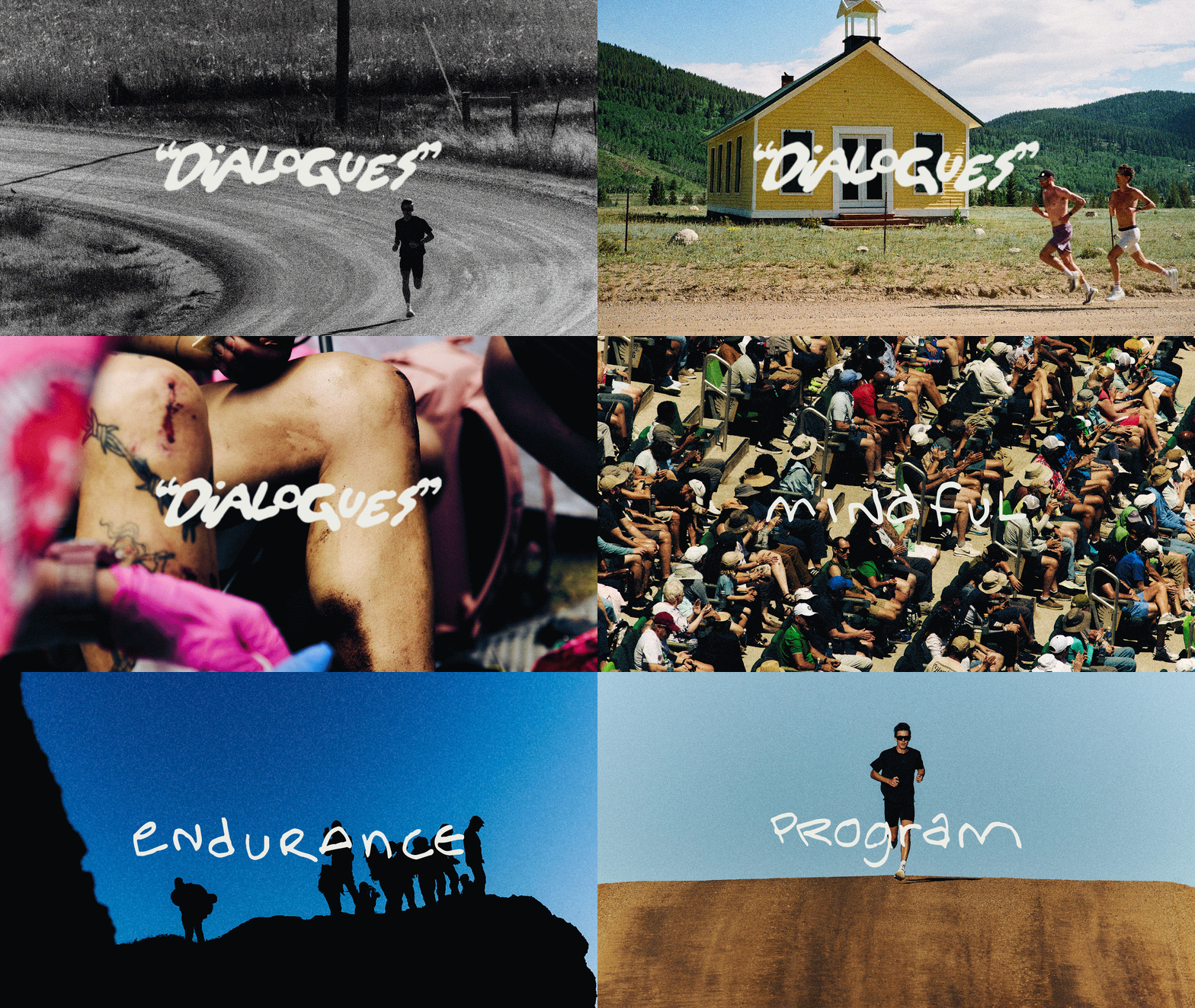

In short
Relativity in running—how comparison shapes identity, shame, and motivation; how to orient to fear and effort; and how to define “success” beyond performance numbers.
Guests
Two hosts, both named Ryan. Ryan Wilms and Ryan Lynch discuss their own running experiences and psychological/cultural observations. No other guests are mentioned.
Guest backgrounds (from the episode)
Both are runners involved in structured training (Strava use, half-marathon and marathon blocks, track workouts, group runs). They emphasize mindfulness/inner work alongside sport, and describe coaching/childhood sports influences (Little League, father/coach dynamics, skiing and soccer).
Key claims
Relativity (comparison) can provide orientation but often devolves into ego-based self-worth management and avoidance of shame. “Effort is the goal,” and best effort preserves self-worth regardless of outcomes. Competition can be healthy when it’s empathetic and effort-focused. Define success in process terms (type 2 success may feel unsuccessful in the moment).
Notable examples
A 10K time trial at the Rose Bowl where a goal was met but placement and a sub-40 belief triggered dissonance and shame. Track-night heat comparisons where slower finishers still feel equally excited. Childhood skiing lesson: the goal isn’t “no falls,” it’s brave effort. Group-run “Kohler effect” conditions (optimal gap, weak-link support, empathetic joy).
Written by AI. May contain mistakes. Listen to the episode to check what was said.
Chapters
Tap a time to open that second in VOExploring Relativity: Definitions and Personal Experiences
0:45 to 4:30
Discussion on the concept of relativity, its etymology, and personal experiences related to social comparison in running.
“So back to bearing or carry, which does feel quite apt.”
The Dichotomy of Success and Shame in Running
4:30 to 9:50
Insights on the conflict between achieving personal goals and societal expectations in running, including discussions of shame and identity.
“in the moment and ultimately to avoid shame.”
The Freedom in Acceptance of Relativity
9:50 to 14:02
Reflection on finding freedom and self-acceptance through the acceptance of relativity in performance.
“So it was like really the only goal that mattered objectively to me in my journey and my goal.”
The Goal of Running: Personal Freedom
14:02 to 16:00
Exploring how running fosters personal freedom and self-acceptance.
“It lets me come back to myself in a more deep way and, you know, run my own race.”
Dissonance in Performance: Confronting Reality
16:01 to 18:16
Discussing the impact of performance-based comparisons on self-identity.
“The numbers are the numbers and your relative position is fact.”
Childhood Sports and Adult Competition
18:17 to 21:51
Analyzing how childhood sports experiences shape adult attitudes towards competition.
“I mean, I think it's a practice of developing our awareness and then catching these patterns because they're just conditioned into us.”
The Treasure in Facing Fears
21:52 to 23:03
Highlighting the personal growth that comes from confronting fears in sports.
“And so all of these things have the opportunity to bring that, you know, And I think understandably so most people don't want to do that.”
The Value of Competition: Road vs. Trail Running
23:04 to 28:00
Debating the merits of road running against the backdrop of trail running's rise.
“Maybe it's some other kind of competition, you know?”
The Essence of Effort in Running
28:00 to 29:05
Learn how evaluating effort rather than speed can transform your running experience.
“Is, is important because as soon as we start to think, we know it's possible, we're putting a lid on our potential essentially.”
Celebrating Relativity in Competition
29:05 to 30:21
Discover the importance of recognizing the effort of all competitors, regardless of speed.
“Meanwhile, he was done in three and a half hours.”
Show all 27 chapters
Mindset During Workouts
30:21 to 31:38
Explore the mindset of top runners and how they approach workouts without assumptions.
“Another thing that I've found is a very commonly held trait in the best runners I've ever met is they just never assume anything in a fascinating way.”
Observing Our Physical Experience
31:38 to 33:08
Learn how to check in with yourself during workouts without judgment.
“but for me, when I can make those, when I can chunk out those goals or chunk out that workout, it allows me to not get ahead of myself and go, Oh man, I got two more laps and how am I going to feel?”
Dealing with Expectations in Training
33:08 to 34:16
Understand how to manage expectations when workouts don't go as planned.
Embracing the Challenge of Growth
34:16 to 35:37
Discover how facing challenges with humility can foster personal growth.
“So either way, you know, you have to go there.”
The Impact of Slow Workouts
35:37 to 36:40
Learn how slower workouts provide time for thought and reflection in running.
“I think like the slow workouts, you know, in terms of running, like there's so much more time and space to think.”
Finding Joy in Speed Sessions
36:40 to 37:55
Explore the excitement and fear associated with interval training in running.
“Um, so it's challenging, but yeah, I think it's funny because like, I look forward to my interval workouts.”
The Dance of Emotion in Performance
37:55 to 39:11
Understand the emotional journey of running and how to embrace every moment.
“Like this is the funnest part and it's like, soak it up, you know, like push your body, go to no mind.”
Acknowledging Fear and Excitement
39:11 to 40:16
Learn how to balance fear and excitement as part of the running experience.
“leading into running faster than you don't run normally.”
Lessons from Skiing: Embracing Challenges
40:16 to 41:23
Hear a personal story about learning resilience and perseverance through skiing.
“love or fear can never create safety excuse me love creates safety acceptance you know these These types of energy are what really cultivate safety.”
Lessons from Skiing: Embracing Failure
42:00 to 44:34
Learn about the importance of embracing failure and the lessons derived from skiing experiences.
The Joy of Sports: Finding Passion in Difficulty
44:35 to 48:26
Discover how joy in sports can motivate one to push through tough moments and lessons.
“And often getting better doesn't always feel better in the short term.”
Redefining Success: Type One and Type Two
48:27 to 53:09
Explore the different dimensions of success and how they relate to personal experiences in sports.
“And, um, I still don't know if it's fun.”
Relativity in Running: Balancing Growth and Comparison
53:10 to 56:03
Understand the importance of relativity in running and how to balance growth with comparison.
“And that is another one that I think, you know, when looking at success, you know, is there a fear of finding out?”
The Nature of Relativity in Life and Running
56:03 to 56:44
Explore how relativity shapes our self-definition in both life and running.
“is about, but also what life is about and how we define ourself is so relative in good and bad ways.”
The Kohler Effect and Group Dynamics in Running
56:44 to 59:24
Learn about the Kohler effect and how group dynamics enhance performance.
“I can start with the Kohler effect, which I know we mentioned when we were talking earlier.”
Shared Journeys and Collective Growth
59:24 to 1:01:07
Discuss the importance of shared experiences and collective growth in running.
“And it reminds me of like the arising tide raises all boats, but those kind of like factors you mentioned, it makes sense, you know?”
Inspiration from Fearless Running
1:01:07 to 1:03:25
Discover how fearless energy in running can inspire personal growth and commitment.
“like I think of when I see somebody riding or running down the other side of the road and I'm like, like, I see you, like you're going fast, you're going slow.”
Transcript
Automatic transcript. May contain errors.0:00All right, excited to be back again with you, Ryan. Ryan Lynch on the other side, myself, Ryan Wilms here, diving into our third episode of this new Dialogues podcast podcast. And today we're going to be exploring both, I guess, the concept and the experience of relativity and using sort of running and sport, of course, as the medium to explore that. Yeah, so jumping into relativity, as always, I'll come in with some etymology here. or etymology. So relative is really a Latin word, and it has a Latin root. Re means back, and ferre means to bear or carry. So back to bearing or carry, which does feel quite apt.
0:54In the 15th century is when it really became used to refer back to others as a means of comparison. Um, so, and this is, I think more of what we're going to be talking about today. I'm curious as always, why did you want this episode focused on relativity and how do you want to explore this topic today? Yeah, well, there's a lot of layers to it. I think, you know, I think it's been present in my own experience, um, for one. So that's usually what inspires me You don't want to talk about anything. But I had this idea a year or two ago of creating like a mindfulness for Strava course, you know, cause I just knew so many people that were like deleting their Strava or hiding their workouts.
1:40They're not going to record this workout and post it on Strava. And I was just like, Whoa, people are like really getting thrown for a loop on here. Right. And I think it's obviously the case with Instagram and other platforms too, but it was really kind of striking how affected people's you know sense of self identity how they were working out what workouts they were doing all these sorts of things so that's kind of where this started to really capture my awareness from like a cultural sense and then internally having a handful of experiences where it was just like really front and center like how impactful it could be.
2:23And, you know, I think as we'll talk about, it can have negative effects and positive effects and it's not bad or good, you know? Um, but I think like really consciously engaging with it is, is ultimately like what makes us fruitful. You know, I was also thinking about this episode and this topic and the last couple of topics. And I'm like, I don't want this to come across like, man running is just the the path for like deep dark like personal work and it's like hard and and gnarly right like i was thinking maybe even next episode should be really focused on like the joy aspect of it but you know as we find a deeper purpose with our movement practices you know and running is the sort of main example we're playing with like evolution is the goal right like self-realization is the goal and and that just involves you know our the depths of our unconscious humanity and human experience as well as the you know letting in the the divine and the light and the love and the joy as well and so we're kind of like focusing on these tools as ways to just like cultivate the ground you know um make it fertile turn it up like explore the terrain And so it can be fun, right?
3:49It can be illuminating, especially the less we attach to things. And I think that idea of attachment, right, is so tied into how our identity is created. And that's ultimately like what the ego's use of relativity in comparison is, is sort of a self-preservation mechanism that we're affirming we're either not as good or we are denying that belief that we're not good enough and finding evidence that we are better than, you know, and using both of those at times in a variety of ways to feel, you know, okay enough. in the moment and ultimately to avoid shame. Like my experience is like, we will do every single thing possible to avoid the feeling of shame, which is the felt experience of the belief of not being good enough.
4:46I love that. And I think as I've continued to explore this topic myself, I've been trying to figure out how to speak to relativity without value judgments. you know even on the value judgment of relativity right i think things like competition sometimes get a bad a bad rap and and even things like shame sometimes get a bad rap or sometimes shame is the appropriate feeling um and i've been the closest i can get to with maybe where to start with relativity is um relativity offers orientation right relativity for better or for worse, right? It lets you, it gives you indicators as to where you're at.
5:34And I think to give a bit of grace to all of us that may be attached to relativities at times, it's part of our coding as a species, right? You know, we're a social species that requires relative awareness. You know, I think it can be, relativity can be an inroad to awareness such that we can survive in our collective. Unfortunately, as humans, we don't tend to bode well on our own. And so we have to be aware of those things. And one of the things that was really fascinating when I was researching it as well is that it's estimated that around, on average, 12 % of all thoughts are ones of relativity.
6:21So, you know, one in 10, more than one in 10 thoughts is in relation. And so, I think as we keep talking about it, what are the modes of relativity that feel very constructive and being in relation with versus destructive and that comparison devolving into something that ultimately doesn't cultivate more growth. so jumping from from maybe that point of ground when did your journey with relativity specifically within sport um and maybe in running feel the most uh palpable perhaps in retrospect yeah and uh yeah i think i'll share something in a second but just to kind of continue from your last thought, like, I think it's helpful maybe for us to relatively define what we're talking about.
7:21Like the mind might be like, well, everything is relative, right? And in a deeper sense, everything is in relationship, right? There are just, every human is in relationship. We are constantly in relationship with our environment, other people, the present moment, you know, all these things. And the sort of highest version of that relationship is interdependence, right? And it's like, we are all a living organism that needs one another, right? Just like the trees and the plants and the clouds and the rain and the animals and the humans. And it's, it's all a giant organism that is functioning together interdependently, right?
8:05So I think that is great. That's beautiful. It's magical. It's mystical. It's like unreal almost. It's hard to fathom for the mind. Right. And so when we're talking about this, um, you know, it's really from this like mind perspective or egoic perspective of like comparison, right? Like, am I worse than, am I better than, what do I need to do to be better than, or as good as, or that sort of stuff, right? It's like where we are using our concept of self and comparing it to somebody else to essentially, yeah, feel okay, hopefully, you know, that's kind of like the goal of that process. And so, you know, I think like, as we think about what, which is really a codependent mechanism, right?
9:00It's codependent for others. I need somebody else to be worse than me to feel better or I need somebody else to be better than me to feel bad because I maybe believe consciously that I'm not good enough or something like that. So really kind of want to undo that, right? Because underneath that, we are whole, we are complete, and we are already in relationship and we are already in an interdependent relationship with the universe, you know, let alone just the planet and all the things on it. So kind of like, yeah, leaving that as like the foundation for what we're exploring is like the deeper truths of our relative existence, um, which are beautiful, you know, and then there's this kind of more like surface level distorted experience of it, which is what creates, you know, discomfort and suffering generally.
9:50Um, and so, yeah, this kind of like really hit me, um, last year we were doing a half marathon program and we were halfway through or something and we did a 10k time trial and so there was seven of us on the team and everyone kind of had a goal for like the half marathon in five or six weeks and we went out to the rose bowl and you know had the whatever race shoes race kits if we were doing bicarb if we were whatever the fueling strategy you know like kind of make it race appropriate so it was like you know real deal let's go for it and um yeah for me it was really basically hard to reconcile uh once this came to a finish because on one hand I hit the goal that I needed to to be on track for my I think like 128 half marathon goal.
10:48So it was like really the only goal that mattered objectively to me in my journey and my goal. Right. But then I have this other like mental attachment to running under 40 minutes, which I didn't do. And so now I'm like comparing to my self 10 years earlier or something when I was probably the fastest I had been. And it's like, well, I'm way not as good as that, you know, um plus this kind of collective idea of 40 minute 10k being under that to me is like you're a runner if you do that and you're not if you can't you know which is absolutely silly but there's like some kind of weird belief that that's the case and then amongst the group of us i think i finished fifth out of the seven and one of the people who finished behind me was pacing the slower person.
11:44So I came sort of last of the fast group and at least two guys in that group that beat me, I thought I was going to be for sure. And so then that was like really confronting, you know? And so I had all these factors of like this kind of 40 minute thing, the relativity amongst the group, then I'm like hitting my goal. It was a successful time trial in terms of my own running journey and path on that. And so the mind just couldn't make sense of it. It's like, well, this is good enough. This is not good enough. Doesn't fit together. I can't make sense of this. Right. And so kind of like, um, like a Zen koan, right.
12:28It kind of just breaks the mind and it sort of cracks open and you see the layer underneath riches, you know, shame basically. Cause even if I, so if I had failed my own goal and I've been like, okay, it's just all around failure. Yes. I'm not good enough. And like, I could probably brush that off without having to feel the shame almost, you know, or if I came second, ran 39 minutes and, you know, and hit all the goals, the ego would have been like, yes, I am good enough all around. I knew it. These guys are bums. I'm going to smoke them, you know, which is ultimately not that productive or, or healthy and certainly not the purpose, you know?
13:12And so I was stranded in this middle zone, which was just like impossible for the mind to make sense of. And ultimately that sort of cracked it open. It was like, Oh, I just have to feel this. I just have to feel this. There's no making sense of it. Right. It doesn't make sense. And this year I've been humbly reminded that like love doesn't make sense, you know, and the mind and the ego are such a sense making mechanism and it really ties us in knots. Right. And so the exploration of this, this experience for me is like that, not kind of just coming undone, which is confronting and somewhat painful in the moment, but ultimately beautiful because it creates freedom.
14:02It lets me come back to myself in a more deep way and, you know, run my own race. You know, the experience is the, is the goal. The effort is the goal. Like, I think that if we can stay connected with that idea, you know, then the relativity can sort of start to dissolve away. Yeah, I think it's interesting to hear you describe with such clarity the common thing you hear in social comparison theory more generally, right? You're usually comparing up or you're comparing down. And this is a fascinating one because some people that you were comparing down to, maybe through training, that said, oh, I'm faster than these people.
14:46This makes me feel good about myself. They're clearly good enough athletes where it still feels good to you, but not good enough where they're maybe better than you in a quantifiable way. And you also had these other people that you expected to finish above you that did finish above you. And there was a dissonance in the finish of, whoa, I didn't finish above any of these people. The ones that I was chasing, and now I no longer can appreciate that I was chasing because the ones below me got closer to them than I did. And I still accomplished my time. And my team still accomplished my time. And so that should have been the ultimate goal in the first place.
15:31But now we're interfacing with these other points of dissonance. And what do we do with these? And I think for me, that's what makes sport really valuable in exploring these things is because it forces you to confront realities that you might not cognitively understand or want to identify with. But that happened, right? What happened happened. The numbers are the numbers and your relative position is fact. from that perspective the the danger as you noted is when we start to go therefore i am i'm not worthy of love therefore i'm not you know and i think what what's interesting for me about sport is that your your splits should never define your self-worth or the self-worth of others.
16:35And I think for me, even that's, sometimes it's hard for me to hold that to myself because so much of my life, most of the good things in my life, as I saw it, were afforded to me because of my athletic ability and the success that I had. And so the idea of me not holding par with that or not being able to affirm that identity within certain constructs meant that I would literally lose those things. Yeah. At least in my head. And I think what's helped me get away from that then, it was hard for me when I was younger, but as I've gotten older, where granted it also has less of an impact on me, the thing that's been the most helpful is when I try to apply that to other people.
17:25You know, at least for me, if I were to say, man Ryan I really could have appreciate and loved you if you just would have beat those two guys you know you know and that's of course or like you know what you do deserve to be treated with more respect and dignity or whatever it is and of course that's not the case irrespective of of your ability whether you're a multi-million dollar pro athlete or whether you're somebody who just started running yesterday and and it's a tool where you can learn what growth feels like and learn how to confront realities that maybe have a dissonance or a koan-like quality to them that allow you to understand that life's not fair and that things are not always as they seem and da-da-da-da-da.
18:14But what I've been focusing on now is how do I continue to cultivate that sense of self-worth irrespective of outcomes, specifically performance outcomes and self and other, and how do I allow that to fuel deeper states of competition and growth and goals in these other constructs but not in a way that goes downstream. Yeah, it's tricky. I mean, I think it's a practice of developing our awareness and then catching these patterns because they're just conditioned into us. Even the illumination of like, oh, I'm better than this person. I should beat him in a 10K. And now I don't. And now I'm questioning how good I am as a person, right?
19:03Like, wow, interesting that that is what's feeding this self-concept, right? And identity. Also interesting, I think I'm better than that person. What is that based on? You know, what judgments is that based on? And, you know, as you were just referencing kind of the evolution of this through childhood you know i think of like playing like especially little league baseball was like very serious if i like think about being 12 and my dad's the coach and like how stressed out he was about like making the lineups and the weekend game and like you know all the things and my mom would come to probably all the games i think you know but then she would say sports are stupid, you know, like professional sports and how much people are getting paid and just like, who cares, you know?
19:58And so it was like very challenging to reconcile this seems like maybe the most important thing in the world and it's stupid and you're showing up and cheering for me. And, but also it's like not meaningful, you know, it was like, how do you reconcile that? And I think like those childhood experiences, whatever version of it we have, you know, really informs this. And I think that's why most people don't enter competition as adults. You know, there's leftover trauma from childhood sports experiences, whether we were the best on the team and we won the championship, or we were the worst on the team and we weren't getting picked or, you know, whatever that stuff is, right.
20:44It's like, it brings uncomfortable feelings up, right. If you're the best on your team as a 12 year old or 15 year old, you know it. And the pressure is real, whether it's from maybe your coach or it's from your dad or maybe from your mom, you know, like it's, it's intense, right. It's intense to hold that and carry that, like you said, to bear, to carry. And so how does that now come into our adult lives, right? And, and our casual run group, how does that show up or our ride group or whatever? Right. And where are we still trying to prove to our dad that we're like good enough on our, you know, weekend 10 K or what?
21:28And probably, you know, or we weren't good enough. And we just like, let that be, you know, affirmed as well. And so it's really challenging, but like aiming our awareness into this with curiosity is going to illuminate these patterns and you can't let go of them if you don't illuminate them, right? You can't, they can't be healed and transmuted without awareness. And so all of these things have the opportunity to bring that, you know, And I think understandably so most people don't want to do that. And actually everything is geared to not doing that, right? To not feeling shame. Like I was saying, it's like, I think it's pretty much the thing that is the last thing anyone ever wants to do.
22:14Right. So to aim yourself towards that potentially is, you know, it takes courage, right? But the joy and the fruitfulness of the other side of that is so great and it's so rewarding and empowering, you know, empowering in the sense of like, it's more and more okay to just be ourselves. Right. And that is freedom, safety, ease, joy, you know, playfulness all emerges from that state. And so there's a, there's a treasure in there, right. And like Joseph Campbell, um, you know, the, the cave, which you fear to enter holds the treasure you seek. And it's like, this is like sport offers that opportunity.
23:02So can you engage with sport with competition? Maybe it's some other kind of competition, you know? Um, and even within running, I was saying this, like, I think obviously trail running has, you know, epically beautiful, um, things to offer, you know, being in nature, sometimes the solitude, you know, just there's, there's great stuff about it objectively. but I think a lot of people, this huge move to trail running is, is also a big rejection of the seriousness and the rigidity of in road running, right. And marathon times and 10 K times or whatever it is. And maybe people run in track workouts until they puke.
23:45Right. And it's like, whoa, like that's, I don't want that. Right. I want to just like move, but take it easy. and again there's no right or wrong with that but i think to some degree it's a weird avoidance sometimes of some of that stuff and so as we kind of get into this marathon block now like i'm really trying to like orient myself and the group towards like let's use this seriousness these hard kind of time benchmarks as catalysts right because like they're gonna illuminate these beliefs and things a lot quicker. Yeah, I love that. And I think something that comes up for me that I've been reflecting on a lot in the last year is the increasing, alongside the increase of trail running, which again, as we noted, is beautiful and all the things, of course, there's so much there, especially the ultra, the distance, the vert, of course and uh there's also still value in the road and for me even the track like i've been so the most moving nights i've had as a runner and both as a part of part of a running group have been on track nights and seeing the also the rise of track nights coming back into the running zeitgeist is really exciting for me not only as someone who ran a little bit of track growing up but just because there there's something so beautiful about seeing people really push it at shorter distances and seeing what that's like in a safe environment right like i'll never forget i was at a track night last year and seeing people of course you're different heats relative to to your speed and just because you can't all run at once and seeing just the same amount sometimes even more excitement for people that were giving 120 you know falling at the finish for a nine minute mile versus the guy who ran a four minute mile five minutes ago, that touched me so deeply.
26:13And I think it showed me the importance of a really strong culture of competition, a culture of pushing oneself and what that can look like along a spectrum. Because not only can that happen within a team, it happens with you, like myself included. I am nowhere near my fastest mile time right now, especially coming off of an injury and very inconsistent running of the last 11 months since I got injured. And, and every time I go out to the track, I just went up to the track two weeks ago and I had to sit there and go, okay, like I, I'm probably not going to hit that time. I might not come even close to that time, but I might do it.
27:00I don't know who's to say you know i have to allow myself the belief that i could and what i can do is for the last episode i can control my attitude my effort my behavior and i tell you what i'm gonna do i'm gonna go until i can't and uh and for me i feel like as i've gotten older and as i've you know gone further in my own journey with athletics, there's a certain amount of bravery to that, willingness to see what happens in an environment that is relatively safe that I don't know if there's anything in my life that affords more insight and self-resilience than that. Yeah. Yeah. It takes a lot of courage to do that, to push yourself to that edge.
27:58Right. And I think that mantra of like, I don't know what's possible, right. Is, is important because as soon as we start to think, we know it's possible, we're putting a lid on our potential essentially. And so, yeah, I think it's, it's important to do that, you know, and to acknowledge those other pieces too. Like I might not be as fast as I was six months ago, six years ago, whatever the case. But if the effort is the goal, right? Because I like to think of the heart as this compass of truth. It's like, did I give my best effort? Yes. Then that is the only answer that matters, right? And there's no relativity there.
28:43It's just like, did I give my best? Yes or no? And accepting each answer and acknowledging it and taking the next step, it doesn't mean anything about who I am. bad good doesn't affect that at all right but it's like if we can be like yeah i gave my best effort it's nothing to do with anyone else and it's the only answer that really matters right and that is like the lack of codependence right and then it's from that place where we can really enjoy competition right and like thought of this you know christian blumenfeld in the triathlon space you know, he almost always, you know, well, lately he wins a lot, you know, and he wins and then he stays out and cheers on the people finishing a half Ironman in like eight hours or whatever it is, seven hours.
29:33Meanwhile, he was done in three and a half hours. And it's like, he says like, that was just as hard for that person finishing in seven and a half hours as it was for me finishing in three and a half hours. Right. So like, there's like a pure hearted relativity like the effort was relatively just as hard for each of those people going at such different speeds but for their physiology and where they're at you know in terms of endurance it was just as hard and so you know that's a beautiful example to me of like how relativity can be connecting.
30:12Exactly. And I think allowing us to see each other and celebrate in each other's relativity is also, I think, a really beautiful, beautiful thing. Another thing that I've found is a very commonly held trait in the best runners I've ever met is they just never assume anything in a fascinating way. I remember one guy I remember talking to, and he was saying how you never assume. I never assume that a run is going to be hard or a workout is going to be hard. I also never assume that it's going to be easy. I just come and essentially I try not to make a value judgment until his whole thing was like I don't make value judgments until I'm halfway so he's like I'll get halfway through the workout and then I'll say how am I feeling am I really struggling am I whatever and then I say let's check in again at the halfway point from this so then he's at the 75 % mark of whatever it is and he said by that point you only have 25 % less So if I say, ah, well, I feel terrible, uh, or I feel great.
31:32The response is the same. Ah, there's only 25 % left. Might as well just put it all out there and see what happens. Um, but for me, when I can make those, when I can chunk out those goals or chunk out that workout, it allows me to not get ahead of myself and go, Oh man, I got two more laps and how am I going to feel? It doesn't matter how I'm going to feel. How do I feel now? And let's not ask that question until we get to the next, checkpoint. And then let's just wait till we're far enough along in the race where if we burn out, so be it. Yeah, no, I think that's a great example. And because even when he's doing that check-in, right, the question isn't, is this a good workout or a bad workout?
32:11It's like, how do I feel? Oh, I feel pretty good today. Or I'm not feeling too good today. It's just an observation of our experience. There's no good, bad, this is worthless. This is the best I'm better than I'm not as good as, you know, it's just, Oh, I'm just observing my experience. And that's great. You know, then what does your mind say about that? Once you've observed like, Oh, I feel good. You know, can you just enjoy feeling good? You know, if you're feeling bad and you're still going to like finish the workout, like, can you be like, wow, look how resilient I am. Like, look how committed and devoted to this process I am.
32:51Right. Cause like, it's those hard workouts when people don't want to go and they go do it you know or they think it's going to be hard and it ends up being those are the ones that like stick with us right so there's so much gold in those experiences but it requires well it's at least a lot more helpful to have that space between like oh this is how i'm feeling this is just how my body's feeling there's nothing to do with me it's just what i'm experiencing and so we can roll with those you know punches in a way and what's fascinating is sometimes as you get further along in your athletic experience you get more comfortable with the hard right like if you if you get to a certain level you're definitely going to be very good at handling hard things and what's interesting though is that oftentimes it's the easy workout that then creates the spiral because you know this idea if I just have workouts I don't have easy and hard workouts I just have workouts and I do what I'm supposed to do I give if it's my 60 % I give it 100 % of my 60 % like you said and I don't assume and and I remember yeah yeah I remember having a few conversations with people about how they would run this crazy hard workout do this insane time and then they'd have to run a five mile at zone two and all of a sudden they were freaking out because it was really slow and it wasn't and their calf was hurting and and they're just like oh my god i thought this was going to be easy and like i'm kind of struggling right now and what what's going on and uh it's funny how it can show up there too especially once you get so comfortable with redlining, you know?
34:43So either way, you know, you have to go there. And I think, again, the most common thing I find in people that are just good at growing are people, whether it be in sport or not, they're people that continue to face that edge humbly, bravely, without a ceiling and are, they don't desire, but are willing to fail and willing to learn from that relativity, even with themselves. And I think, again, I think that's the biggest misunderstanding with great athletes is that they have this hyper-confidence such that they don't interrogate failure when it could not be further from that. Like every workout is definitionally designed to break them again and again and again you know and so can you keep showing up and can in that showing up can you not let it break you you know and break your resolve which you can't you know really it can't like we are like unbreakable untarnishable beings at the core but the fear is that it will break us right so yeah it's quite a interesting dance but it is a great avenue to explore that, you know, and it's funny.
35:59Yeah. I think like the slow workouts, you know, in terms of running, like there's so much more time and space to think. Right. And like thinking gets in the way of being thinking gets in the way of loving, you know, and if you're pushing VO two max, like there's not much space and time for thinking. Right. And so it's really, it's very interesting, you know, thinking of like a 5k, you know, versus like a 50k. Right. And you can kind of go to similar places, but the 5k is going to be a lot faster and a lot shorter in the 50k. It might be a lot longer and, you know, more subtle in a way, you know?
Read the full transcript
36:40Um, so it's challenging, but yeah, I think it's funny because like, I look forward to my interval workouts. like those are the workouts in the week like i love running so like a six mile eight mile easy run i'm like yeah cool like i'm gonna enjoy that you know mostly but i'm like okay tuesday speed session you know tomorrow i have one for it's the first kind of proper speed session of the marathon program and it's like uh six times three minutes at what's called interval pace i I guess. So for me, it's probably going to be about six minutes and I haven't run that fast for quite a while, you know?
37:24And so I'm excited about it. I'm looking forward to it. I love running that fast. I love putting on the fast shoes, you know, and I'm, fear is going to come up and I do it. Am I going to fail? Right. And then, you know, it's like, okay, three minutes at a time. That's nothing. Right. So you get into it and then it's so easy for the mind to be like, okay, four more, three more and forget. This is what I've been looking forward to. I love this shit. Like I want to do this, right? Like this is the funnest part and it's like, soak it up, you know, like push your body, go to no mind. Like, it's just like, don't count down your way out of the thing that you've been looking forward to, right?
38:13And so funny, like we had a run like that on a weekend where we did three miles, you know, broken up. And it's so easy, like a quarter mile left, right? And it's like, there's some usefulness to that for pacing, but not to be like, I'm almost done. It's almost over. Cause it's like, no, this is like it. This is what we came here for. And so I think like that whole dance, right. Is like, so interesting of like the lead up, the excitement, the fear, can I do it? Am I going to fail now? I'm in it. Is it almost over? All right. I don't want it to be over. I love it, but it is almost over, you know?
38:56And it's like, that applies to life, obviously, you know, like very, very clearly I think, but, um, you know, it's just, can we just embrace all of that? Right. Cause it's like, it's not like you're not supposed to be a little bit nervous or anxious or fearful or, and excited, you know, leading into running faster than you don't run normally. Right. It's the unknown. It's going to bring up those types of feelings. And one thing I learned recently was like, when you feel that, right, if there's excitement and anxiety, maybe together or fear and anxiety, fear and excitement is like, I'm excited.
39:34I'm excited about this. I don't know what's going to happen. I don't know if I'm going to fail, but I'm excited to find out. Like, can we own the excitement while acknowledging and honoring the fear? Right. Cause you know, in the gene keys, um, Richard Rudd speaks of like, can we look like all even non-love is love. And like fear is like non-love that is still love. it's trying to protect us it's a kind of distorted feeling vibration in the body that's trying to protect us keep us safe right so it's it's there's a self-love aspect of it but fear can never create love or fear can never create safety excuse me love creates safety acceptance you know these These types of energy are what really cultivate safety.
40:27And so if we can acknowledge the fear, its intention, and that it's not actually doing what it thinks it's doing, you know, and we can own the excitement and trust something beyond that experience of fear, right? But fear is very tricky because it's like creates a feedback loop almost. You know, we're like afraid to feel the fear, which keeps it going. And so can we really orient, you know, like you talked about orientation to the fear, right? Like if I'm not afraid of the fear, I'm not afraid of feeling shame, then I can just be and I can just have the experience to the fullest. yeah it reminds me of a very valuable lesson i learned from my father that took me many years after he taught me it to understand which was we grew up uh skiing quite a bit and he had grown up skiing my grandfather was a big skier and the way it would work is typically i was the oldest in my family so i would go ski with my cousins and his oldest brother, my uncle.
41:40And my uncle was a phenomenal skier, like heli skier, you know, damn near semi-pro. You know, he could ski everything. And his rule was, and I'm sure he was being nice to us, but at the time it always felt like this was true. He said, you know, you guys can come ski with me, me and my older cousins, you guys can come ski with me, but just know I'm skiing what I want to ski and you can try to you know try to hang on I'm not going to ski you know the blues and the greens or whatever you guys feel comfortable because you're kids you know and so we were skiing all kinds of stuff you know all the black diamonds double black diamonds tree skiing stuff that was way above my my ability and so I spent a lot of time falling and and you know they would never make fun of me there was never anything like that but it's like I'd fall off to get up keep going hang on are you sure you want to do this one we're gonna do it again and just be like oh if I do it I'm gonna have to ski with my little cousins then I'm gonna be on the bunny slopes all day like okay I just gotta keep going and they had this really great way of being just ahead of me to kind of get me there but I often was frustrated and ashamed and it was even worse because whenever we would come home from skiing the first question my dad would ask as I walked through the door was any good falls today and I'd be like I don't want to talk about the falls like I like I hit a double black diamond today and I didn't ask that any good falls today and I and I just feel like yeah like I hit a tree and I think I think it's just a bone bruise I don't think we have to get an x-rayed but it was embarrassing it took me 10 minutes to get out of the tree well and like my ski I had to get my skis on it was just like it was bad and finally one day I came home I was probably in high school by this time came home I was waiting for the question he's like any good falls today I was like nope first time I'd never fallen trying to ski with them I was so proud he didn't even look at me he just goes guess he didn't learn anything today you surely weren't trying hard enough and I was just like you mother effort like and I was so pissed and I was so like and it really you know he didn't say anything more and it took a while for it to sink in but it's something that I've carried with me ever since and it was such an important lesson um because I thought this whole time that the goal was that I stopped falling not realizing that the goal is that I keep trying hard enough and be brave enough to keep going stuff that's just out in front of my skis a little too far so that I'm willing to keep growing and not be afraid of falling.
44:34And so, again, it reminds me of this idea, you know, feeling better and getting better are not the same thing. And often getting better doesn't always feel better in the short term. And so that for me was my big inroad to that and something that I've tried to continue on as you know in all of my athletic and in life pursuits that's a hard one because it's embarrassing yeah right and embarrassment is uh you know another word for shame feeling shame right and i mean it's like that's like a zen master lesson right there and it's funny because it's like do fathers i mean know what they're doing like is there a way you could deliver that lesson that the child can understand or, you know, is the child, is that part of it is that you actually can't understand the lesson until you can.
45:26Right. But yeah, that's a great story and, uh, and awesome. And I honestly think skiing is like maybe the funnest thing ever. So I also love that and yeah, I love skiing. And when I, I went to Calgary for college and, um, there was like a handful of guys who came to the school for skiing because they're from like Montana and British Columbia and stuff. Cause there was like, you know, the Olympic park was there. Banff was close by and I thought these guys were cool. And so I got some skis and they're like, all right, we're going to like jib this rail and we're going to like build a booter and a closed down ski hill.
46:09And we're going to just launch this like 20 foot cliff. And I'm like, I've never done any of this stuff but it was like so fun trying to keep up with them and just you know yard sailing so many times and um bayoux is like so fun i just have so many good memories of skiing yeah it's it's the best and and the the amount of fun that comes with it i do think helps especially for me at that young age where i didn't have the same relationship with running like when I was running cross country and track it wasn't enjoyable enough for me to often want to push through some of those lessons whereas with skiing and with soccer I had such joy in interfacing with those sports that when it got hard it made me still want to keep pushing and so yeah I was always amazed at some of my friends who were really accomplished runners when we were young that could go through the hard parts and want to keep doing it because i in my head i was like guys i work really hard as a soccer player but i do it because it's fun it's because i love it like like i love it so much this i appreciate and i think is is really admirable but it's not fun even when i win races i wouldn't describe it as fun and uh that took me a lot longer to to develop um that type of like i'm gonna still go into this even though it's probably not going to be enjoyable at least at the at the time um but well yeah we play soccer right we play basketball we don't play running running usually it's not how it's framed and i had absolutely no interest in running in any any level of school honestly it was like i'll do whatever i need to so i can play basketball you know play soccer um you know baseball requires almost no running um so it's yeah it's funny coming to it like later later in life and finding joy in it freedom in it And, um, I still don't know if it's fun.
48:30It isn't a, it isn't a unique way. Like for me, uh, and I got to experience this this weekend with our group run, like you get like three to five people running on a road or a trail at that pace where you can't talk anymore. And it's just like a handful of feet, like, you know, and you're pushing and you're running, you know, the sun is out, the birds are chirping, you feel a breeze and it's just like that sound. And you're just like in this like synced up unit. That's the funnest experience of running for me. Like I really love that, that experience. Um, you know, and it's like, there's a letting go of everything.
49:17And it's like a return to that interdependent organism experience. You know, there's no thinking it's just pure experience. Um, would I call it fun? I mean, it is a kind of fun, but it's a beautiful experience that I love, you know? And so I think like, again, like the limits of language, right? Like what is fun really? You know? And I think what is success? You know, I think we've talked about like this relativity, right? And I think like asking ourselves, like, What would be a success if I'm doing a marathon block? What would be a success if I'm playing a season of soccer? What would be a success, right?
50:02Because in some ways it's easy to define, well, a 259 marathon for me is going to be a success. But really, I did the 70.3 a month and a half ago, and my time was fine, but I didn't feel like it was a success. you know? And so that was really challenging. Cause again, like, well, this is fine. It's good. You know, like it's the top 10 % of the world, you know, at this distance, like relatively speaking, that's plenty good enough. Right. But like, I just knew it wasn't the level of expression of my fitness and my preparation that was possible. And know a number of factors kind of like coming into this but and it was like through the acceptance and feeling of the embarrassment of the disappointment you know that was actually the success like i was able to just embrace all those feelings and so all this like race experience catalyst numbers teammate relativity brought that up and I could feel it and let go of it.
51:15And it's like, that was actually the deep success. And in that regard, I could come to my heart and be like, did I do the best I could? Yes, yeah. You know, and I think that's like, when we connect to that level of purpose, you know, and the process, like it's easy to say focus on the process, right? But like, what level of process are we talking about? you know that's like helpful to define and i'm always remember this conversation with a friend of mine and he's like not feeling good enough because he's not as successful as he thinks he should be at this time in his life for a whatever year old you know i'm like well what are those factors right it's like he couldn't say anything there was no answer so it's like there's a deep feeling that many of us carry that's just a projection of that i'm not successful enough right and then we bring in something like running where you've got these kind of hard benchmark numbers and so there's kind of no hiding from it when i get laced up to run that speed session fear is going to come up and i'm going to have the opportunity to acknowledge it honor it thank it love it you know and let it move through me it doesn't mean i'm just gonna not feel fear yeah exactly and i think there's a few things that came up in that that feel worth building on number one the importance of defining success and then realizing that your relationship to that success will that relativity will create a set of experiences for better and for worse you also then may achieve said definition of success and have a relative relationship to the difference of that you know like i've been thinking a lot about i was i was recently listening to phoebe bridgers's new album and there's a line in it that i can't stop thinking about where she says, when a dream comes true, a fantasy dies.
53:29And that is another one that I think, you know, when looking at success, you know, is there a fear of finding out? Do you actually want to know what happens if you get there or if you don't? And there's another thing that you gave me an idea on that I've never quite thought about, but originally I was thinking about are there different like is there like a type one and type two version of success kind of like there's a type one and type two version of fun right so maybe type one fun is typically it's very legible it's very immediate it's like a bounce house or you know playing soccer skiing that's like very evidently fun in most cases like two fun would be more man that was a really hard interval workout i wouldn't describe that as fun at the time but it sounds like it was fun in the way that you just told it to me.
54:22Right. And so retroactively, it may be like camping, right. Where all you talk about is all the problems that you had to solve. Probably weren't that fun when it was pouring rain and you were cold, but you know, our romantic memory isn't remembering that part. It's remembering how we overcame it and what that was like and the fun that that brought. I think there's also a type one and a type two success. There's type one success of I did the legible goal that I set. I hit my time. I, you know, whatever. And there's a type two success of I, for me, I ran my three miles yesterday that I needed to run to stay on course with my rehabilitation of my ankle.
55:01That does not feel remotely successful. I ran them probably at eight to nine minute miles. Heart rate was nowhere near where it should have been. And, you know, it wasn't like an immediate type one success, but I think in this morning and maybe even tomorrow, maybe even three weeks, I can look back on that and be like, oh, yeah, I ran in the rain and it was pouring and that was enjoyable. And it got me to a little bit further, you know, and it got me a little further than where I needed to go. And I think those the type two funds, just like the type two success are hard. It's also part of why track and road running is hard.
55:39and not to say that trail running isn't hard too at the same distances but trail running is tends to be more type one fun you're jumping on rocks you're like going or it can have more childlike experiences and so i think just understanding the different ways in which you interface with them is so important um and yeah i love this topic because it does speak to so much of what sport is about, but also what life is about and how we define ourself is so relative in good and bad ways. And I think the recurring theme here is if you never want to lose sight of relativity completely, right? Because I keep thinking of that infamous quote, comparison is the thief of joy.
56:24A lack of comparison is the thief of growth, even in oneself. And so how can we continue to hold both simultaneously. And I think perhaps it's useful to end this one with just some useful running practices that we've been exploring. I can start with the Kohler effect, which I know we mentioned when we were talking earlier. And this is, if you're not familiar, the most common psychological phenomenon of why people tend to perform better in groups, right? So if you're running with a group or you're in a team, for some reason, you tend to push yourself harder when you're running with other people that are pushing themselves hard.
57:08There are critical conditions for this effect to be true though, where you need it to feel just out in front of you. If it gets too far, it actually decreases motivation because you think, oh, I'll never, I'll never catch them. There's nothing I can do. So you want to be them like just ahead of where that competition is keeping you kind of like pushing and pulling and then the other things that they find in groups that seem to be very constructive for this is what's called um uh it's essentially like like an there's there needs to be an optimal gap but there needs to be what's called like a weak link so essentially essentially you you need all of even the weakest members to push harder to not let the team down and for the strongest members to have empathetic joy for the weakest member's success.
58:00So irrespective of where you land on the spectrum within that group, you typically want a culture where everyone's pushing each other as hard as they can and there's a collective appreciation of each other's success outside of your own. And if you have those two things, it seems like there's the most common growth curve that one finds instead of just a spiral of discouragement, which I thought was really interesting, I think is something that people do struggle with where they maybe have an ambitious goal and they don't enter at the right level that they're at. I mean, it's something that I love about Los Angeles in anything, whether it be in work or in even sports where I think people often misunderstand these big cities as, oh, well, they just have like the highest of high and the lowest of low simultaneously.
58:56And they do, but they also have every level in between. And there's something really beautiful about even in the running where you can be like, okay, I'm going to, I'm running with this group, or maybe even our group is like slowly going up together in this, this sort of a journey, but understanding where you want to be and then like what level you're actually at, which again, with running, you can find out with numbers quite simply. Enter there, enter where they're just above and try to keep up and don't be afraid of falling and who knows where you'll end up. Yeah, I really like that. And it reminds me of like the arising tide raises all boats, but those kind of like factors you mentioned, it makes sense, you know?
59:41And honestly, like I think of like the MEP experiences because I'm like, oh, that is like right there. Right. It's like, it's really beautiful and cool. And it's usually small enough groups that like, yeah, the fastest and the slowest, like they're still connecting. They're still high-fiving. They're still like, you know, showing that shared appreciation for the effort. Right. Cause the effort being the goal. And it's like, well, how does that then translate? Right. And this is like, you know, most of this is attributed to the individuals, right? But the MEP container is unique. And the last three programs we've done, half marathon, 270.3 programs, is 100 % PR rate, you know, which is pretty cool when you've got, you know, five to seven athletes in each of these groups, right?
1:00:37And I think it's like that positive version of that shared journey, right? Like Rupert Spira, you know, his definition of love is recognizing our shared being, right? And I think like at the core, like that is such a beautiful experience to recognize our shared being, you know, in another. And these experiences are really like that, you know? like I think of when I see somebody riding or running down the other side of the road and I'm like, like, I see you, like you're going fast, you're going slow. It doesn't matter. You're out here doing this, making this choice, you know, engaging with the process, putting out your effort.
1:01:22It's 95 degrees and you're out in the park running, you know, I'm like, I see you, you know? And I think like the MEP groups really like just consciously bring that into the field, bring that into the conversations. And that's what's exciting to me. And, you know, I also think of like, there's a guy who's been in a lot of the stuff we've done and I'm, you know, so grateful for our relationship. Give him a shout out. It's Connor. And yeah, he's a strong athlete, you know, and once in a while on the very odd run, you know, I'll stick with him. and um you know it's it's it feels good you know like it feels like yeah i like hung with connor today you know but the thing that has always inspired me is like his ability to push and race like fearlessly and maybe it's not entirely fearlessly but it's like there's a fearless energy of just like i'm taking the flag and charging into the unknown and i'm gonna give it my all today, you know, and usually that's pretty impressive, but it's like, that's what inspires me.
1:02:35I don't know what is half marathon PR is, you know, or is full marathon PR, you know, but like, it's that energy. Right. And so I think like that, when we're sort of looking for our relative shared being and human experience with another, if we can like find inspiration in those types of things, right? That is so much more fun and inspiring. And like, it's going to rise the tide. It's going to rise, raise the boats, right? Because it's like that sort of like commitment, that sort of devotion, that sort of, you know, embracing the unknown. Right. And it's like, wow, I'll go into the unknown with him, you know?
1:03:22And it's like, that's, that's fun. And it's like, it makes me want to cultivate that you know it makes me want to like embrace the fear so i can step into those experiences with with less fear and more of a like excitement for the unknown a beautiful way to end it with interdependent strength and inspiration well that i appreciate the conversation man this was a fun one yeah thank you as well definitely Thank you.
From the publisher
In this issue we explore the often conflicting inner dynamics that can create suffering in sport, but can also lead us to liberation. As human beings, everything exists in relationship, but our ego can misinterpret information and conflate it with our unconscious internalized self-concept. We explore how this can help, some ways that we can spot it, and offer an example to put into practice with our ‘Mindfulness for Strava’ guide below.
PRACTICE: Mindfulness for Strava
by Ryan Willms
There’s a certain irony in an app called Strava — from the Swedish “strive” — becoming a mirror for our comparison, our shame, our hiding. Einstein’s relativity tells us that motion, time, even simultaneity depend entirely on the observer’s frame of reference. The opportunity is to use Strava as a catalyst — to bring awareness to the beliefs it stirs up, the thoughts of not being good enough, or of being better than. Relativity is a tool. The numbers are helpful. And they mean nothing about who you are, or why you run.
Below are five steps to explore, to anchor more deeply into the truth of your being, your heart, and your gratitude for the experience your body offers.
1. Why am I running today?Before you run, before you log your data, reconnect and anchor into your why. Why are you running today? To feel better, for health, to process thoughts and feelings, for solitude, to lose weight? There are no wrong answers — but a why centered on your own experience of life and movement has no relativity to it. When we anchor into that, and remember it, we can put down comparison and judgment much more easily.
Journal prompt: What frame am I running from today — physically, emotionally, energetically? What would it mean to measure myself only against that?
2. Numbers have nothing to do with who you are.The number is neutral. The story you attach to it — “I’m behind,” “I’m not a real runner,” “everyone’s faster than me,” “they’re going to think I’m slow” — is something you build afterward, quickly and almost invisibly, because it feels like it has something to do with who you are, your identity. That’s the work: catching the gap between the pace on the screen and the meaning you assigned it. Most people aren’t consciously thinking this — they just feel uncomfortable, and then delete or hide the workout. But if we can explicitly acknowledge that the pace or time has nothing to do with who we are, we can put it down more easily, before we ever build a story around it.
Journal prompt: What thoughts come up when I see another athlete’s time or pace? How do I judge them as a human or a runner based on it — and can I see that mirrored in how I judge myself?
3. The effort is the goal.In relativity, there’s no universal clock — only what’s true within a given frame. The only “clock” that’s actually yours is effort relative to your own capacity that day. A 9-minute mile on four hours of sleep, in a hard week, might be your fastest mile. If we’re honest with ourselves, we can check in with our own heart — the real compass will tell us.
Journal prompt: Did I give my best effort today? If yes, let yourself feel that fulfillment — it’s worth honoring. If not, what got in the way? Fear, a thought, a belief, an excuse — let it be OK that it’s there. Naming it is the practice.
4. The truth will set you free.The instinct to delete, hide, or make an activity private after a “bad” run is the not-good-enough identity talking — treating the workout as evidence of inadequacy, rather than as data, as practice, as a simply human experience. What if the slow run stayed visible — not for anyone else, but as a small act of self-honesty? We want to shed our sense of worth based on others’ opinions. That is freedom. I am here. Here I am, today. I showed up and gave my best effort, period. (And truthfully — nobody’s paying as much attention as you think.)
Journal prompt: What am I afraid a slower or harder workout says about me — and is that fear something I’d say out loud to a friend? Consider this your invitation to take that step, and share this experience with someone you trust.
5. Gratitude for your body and breath.Just as you are not your run data, you are not your body either. It is a magnificent, magical, ever-evolving, self-healing vessel for the experience of humanity and divinity. Whatever the pace, however the run felt, bring gratitude to your body for the vast experience that movement — and stillness — allow. Each breath is a small miracle. What a gift, that this body lets you move, and lets you connect with others through running. Apps like Strava, used well, can offer insight to help us care for our bodies, connect with community, and stay devoted to the practice.
Journal prompt: What was the most joyful part of running for me today? Clarity, sweat, the no-mind, the rhythm, an idea, a sensation?
The truth is, we are all relatively mediocre, and objectively exquisite. The practice of letting go of identity is what lets us anchor more deeply in our true nature — and that nature is not relative.
INSIGHT: A Fruitful Goal
By Sri Chinmoy
We can sustain freshness and enthusiasm in running by having a sense of a clear, meaningful and fruitful goal. If we keep in mind this meaningful and fruitful goal, then enthusiasm and freshness will automatically dawn. If we value the goal, then the goal itself will give us enthusiasm and freshness. We are not aware of our goal’s conscious eagerness to help us reach it. We think that the goal that is ahead of us is indifferent to us: if we can come to it, well and good; if we cannot come to it, the goal is not going to come to us. We feel that the goal is something stationary. But it is not like that. In our case, the goal is always progressive, and this progressive goal is more than eager to help us.
The mother will stand at a particular place and wait for the child to come crawling or running toward her. But the mother is not only waiting to see; the mother has tremendous eagerness for the child to come and reach her. Finally, if the mother sees that the child is trying but not succeeding, at that time she will come running toward the child. Similarly, in the inner world the goal actually comes toward the runner. If we value the goal and feel that the goal is something worthwhile, if we feel that it has tremendous, boundless things to offer us, then naturally the goal itself will inwardly help us. The goal does not want us always to feel that it is a far cry; it wants us to reach it.
WATCH: MEP Run Retreat in Ojai, CA with On
“No man ever steps in the same river twice.”
—Heraclitus
This phrase came ringing through my awareness as I went through the photos of this year’s Run Retreat in Ojai, CA. The format of these retreats and training camps hasn’t changed much over the years, but each experience is entirely its own. Shaped by the group, the openness, the environment, the attitude, the heat, and the collective consciousness — it’s never the same river twice. Always stepping into the unknown, and always beautiful, fruitful and fulfilling.I’m grateful to the group of amazing men that ventured out with MEP this year — traversing new terrain, remembering Truth, and connecting through movement, stillness and breath. I was inspired, challenged, and reminded of why I pour myself into this work, and that none of it would be possible without the courage and commitment of everyone who shows up. We are interdependent beings, here to recognize our shared humanity — and endurance sport is a beautiful medium for that experience.
PHYSIOLOGY: Trust your Heart Rate Recovery
What HRR Actually Tells You
A heart rate drop of 20+ beats per minute within the first minute after hard exercise is a sign of excellent Heart Rate Recovery (HRR) — not to be confused with Heart Rate Variability (HRV), which measures the microscopic variation between heartbeats at rest. Both are driven by a healthy autonomic nervous system, but they’re tracking different things: HRR is how fast your heart rate drops once you stop moving, and a drop of 18–20+ bpm in that first minute is a strong, efficient signal — your “fight-or-flight” sympathetic system stepping back and letting your “rest-and-digest” parasympathetic system take the wheel. A drop of less than 12 bpm, on the other hand, is considered a red flag — often pointing to overtraining, low aerobic fitness, or cardiovascular strain worth paying attention to.
How can you improve your HRR?
* Aerobic base — the bulk of your easy, conversational-pace running. Improvements in HRR track closely with improvements in cardiorespiratory fitness, and it’s the steady, unglamorous mileage — not the hard efforts — that seems to build this capacity most reliably.
* Second, your state going into the workout: sleep, stress, and caffeine all shape how your nervous system responds, so a sluggish HRR reading on a given day may say more about last night’s sleep than about your fitness.
* Third, don’t mistake a temporary dip for detraining — a slower HRR after a heavy training block can simply be your body under load, not losing fitness; it tends to normalize again after a couple of easy days. In all three cases, the invitation is the same: treat HRR as a trend to notice, not a single number to judge yourself by.
This is a public episode. If you would like to discuss this with other subscribers or get access to bonus episodes, visit mindfulenduranceprogram.substack.com