
In short
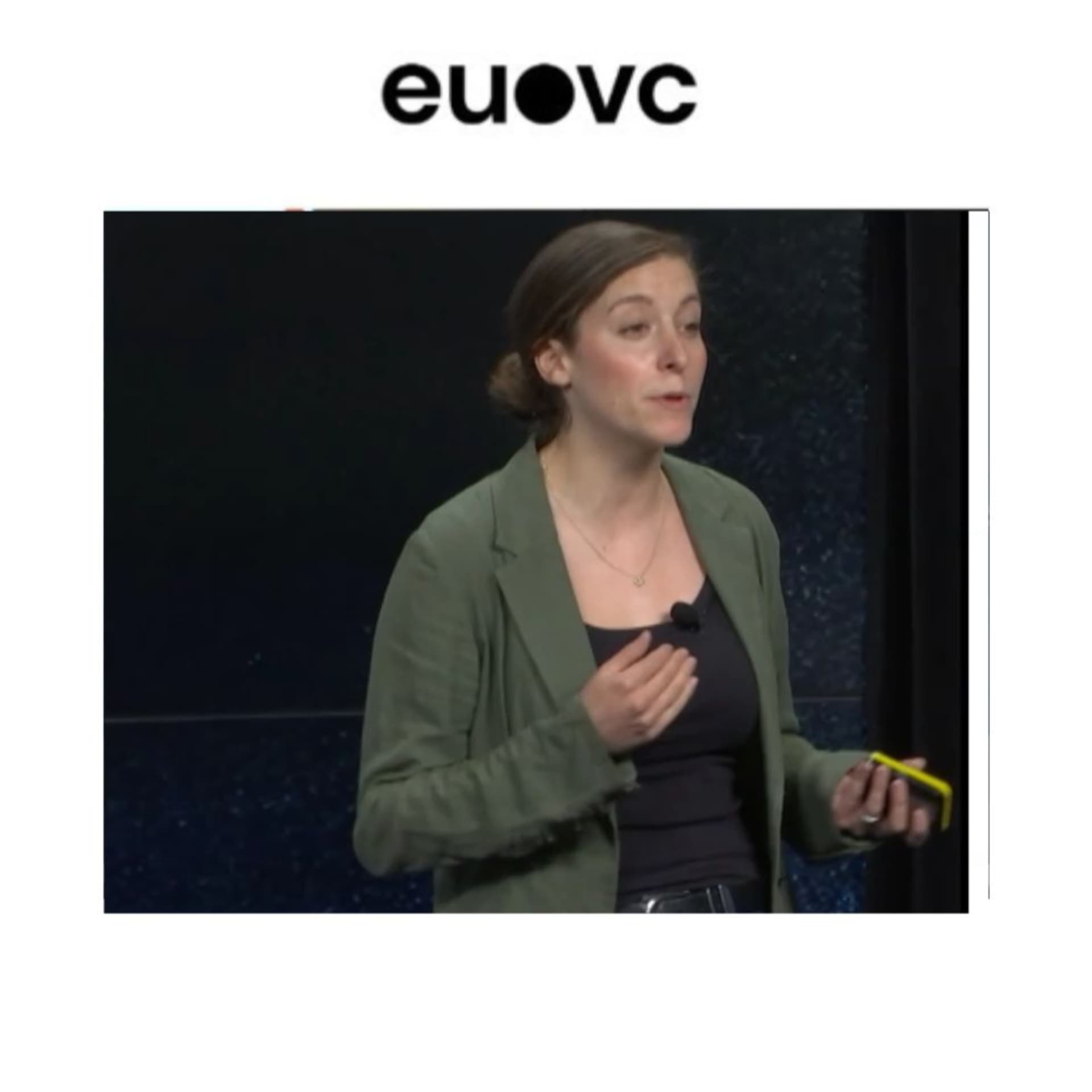
EUVC Podcast Episode Notes: E589 | EUVC Summit 2025 | Juliet Bailin, General Catalyst: European Resilience Through Applied AI
Episode Overview
- Title: E589 | EUVC Summit 2025
- Guest: Juliet Bailin, General Catalyst
- Key Theme: Europe's unique position to lead in applied AI by leveraging its strengths rather than mimicking Silicon Valley.
Key Takeaways
Europe's Unique Strengths
- Regulatory Complexity: Viewed as a strategic advantage for developing specialized AI.
- Cultural and Linguistic Diversity: Essential for creating human-centric AI systems.
- Research Traditions: Strong foundation for domain-specific AI applications.
Applied AI as a Solution
- Focus on Applied AI: Juliet argues for targeted AI solutions in regulated industries rather than general-purpose models.
- Key Sectors for Growth: Emphasizes healthcare, finance, and mobility as sectors where Europe can excel with applied AI.
Strategic Initiatives
- General Catalyst’s Approach:
- Incubation of Startups: Supporting startups focused on applied AI.
- AI Roll-Ups: Merging legacy businesses with strong distribution channels to enhance AI capabilities.
- Public-Private Collaboration: Initiatives through the General Catalyst Institute to promote applied AI adoption.
Government Involvement
- Call for Innovation-Friendly Policies: Juliet emphasizes the need for governments to create incentives for adopting homegrown applied AI companies.
- Clear pathways for public procurement.
- Regulations that encourage innovation.
- Aligned industrial policies.
Actionable Insights for Entrepreneurs
- Build in Regulated Industries: Focus on sectors where Europe has inherent strengths.
- Prioritize Trust-First AI:
- Emphasize privacy, explainability, and fairness in AI solutions.
- Participate in EU AI Champions Initiative: A platform for connecting startups with corporates and investors in Europe.
Vision for the Future
- Transforming European Legacy: Juliet envisions that if executed correctly, applied AI could reshape Europe's social and economic landscape, leading to significant advancements that future historians will acknowledge.
Examples of Applied AI in Europe
- Airbus:
- Launch of GenAir for real-time design and assembly of aircrafts.
- Enhances precision and safety.
- Physics X:
- Develops deep learning models for advanced industries, including applications for Leonardo Helicopters.
- Accelerates the modeling process and meets EU regulations.
- SAP:
- Integrates Mistral AI’s models to allow customers to build domain-specific applications efficiently.
Conclusion
- Juliet Bailin’s insights highlight a critical moment in Europe's approach to AI, stressing the importance of leveraging existing strengths and developing a supportive policy environment to ensure that Europe not only catches up in AI but leads in applied domains.
Acknowledgments
- Special thanks were given to partners of the EUVC Summit, including:
- HSBC Innovation Banking
- Google Cloud
- Ace Alternatives
- Hainspoon
- CW Communications
- Others, underscoring the collaborative effort in supporting the European VC ecosystem.
---
This structured summary encapsulates the critical discussions and strategies presented by Juliet Bailin regarding Europe's potential in the applied AI sector, serving as a guide for stakeholders interested in European venture capital and technology development.
Written by AI. May contain mistakes. Listen to the episode to check what was said.
Transcript
Automatic transcript. May contain errors.0:00The future of Europe depends on resilience. In an era of shifting geopolitical power and rapid technological disruptions, one force is shaping how businesses, industries, and nations adapt. Applied AI. And few understand this transformation better than Juliette Bailin, partner at General Catalyst, a global venture firm managing 30 billion euros in assets. The firm has backed now some of the biggest names, Snap, Stripe, and so many others. Congratulations. Congratulations. Juliet has backed companies like Physics X, Goodstack, Charm Therapeutics, and Lati. I think coming from New York, there was just a lot of conversation about, you know, could you start a really big company out here?
0:40And there was a lot of arrogance. The reality is not only can you start a company out here, it can be extraordinary and it can be global. How will Applied AI make Europe more resilient? How do we unlock its full potential? So I'm here to talk about why we believe Applied AI will be the unlock for European in resilience, global leadership, and competitiveness. We're at a crossroads today. We're at a perfect storm. This will be familiar to anybody who gets updates on their phones and news alerts. Global geopolitical turbulence, an aging population declining productivity. This is something all of us are familiar with across Europe.
1:14And as a student of history, that was my first love and will hopefully be my last, one of the things you learn in moments of incredible chaos and uncertainty is that these are opportunities for change. and these are moments when technological innovation is adopted a lot faster because there's incredible urgency to solve problems like this. Unfortunately, the world believes that we're behind, and it's hard to argue with them when we're talking about AI if you simply think about the amount of investment that's being made by governments, by companies in applied AI, and the number of new companies that are being created elsewhere versus in Europe.
1:52But there are some key assets that we have in Europe that will allow us to leapfrog our competitors over time. These include our regulatory prowess, the complex and regulated industries that we're known for here in Europe, and our cultural diversity. And the reason why those things are important is because highly regulated industries are perfect for specialized AI, because diverse cultures and linguistic diversity is important for human-centric AI, and of course the research prowess for context-specific AI. And that means that we can lead on our own terms on ones that are uniquely European. So why do we believe applied AI can drive European resilience?
2:28Any founder that has built a why now slide will be familiar with everything here. Any investor that's built a why now slide for LPs will be familiar with this list. I won't belabor the point, but I will highlight a few. The speed at which value is being created by companies, by governments, is accelerating, and that is clear. AI is not a zero-sum game. Open source is making that true. The cost of inference going down is making that true. And AI is removing barriers that mean that you don't have to be digitally native to be excellent, but you do have to be AI first. Now, of course, anyone in this room can say, well, this list isn't necessarily specific to Europe.
3:04These are true of AI globally. So let's reiterate the point on why applied AI will drive European resilience specifically, and we talked about these. Our researched institutions punch heavily above their weight. We've been leaders in open source for years. Our economy is rooted in complex and highly regulated sectors, which again, as I mentioned, are perfect for domain-specific and specialized AI, and our cultural, linguistic diversity, security, and privacy. These are Europe's bread and butter. This is where we are known and where we are excellent and where we have a clear leg up. And we love to talk about these things, of course, but people will still ask, yes, well, are regulated industries actually adopting AI?
3:44Is this something that Europe will really be able to create opportunity for? And so I'm going to share a couple of anecdotes with very specific examples that all of us can then call upon when we're asked those questions, and certainly whether they're by investors, by LPs, or by our peers in the U.S. Let's start with Airbus. They've launched something called GenAir, very cute, GenAIR, which is being used by their engineers on factory floors today. They are using these AI agents for the design and assembly of aircrafts. Again, in real time, they are getting contact-specific, aircraft-specific information from the program that Airbus has launched.
4:20And this means they're able to reduce delays, they're able to solve problems much, much faster, and they're redefining what precision and safety means in aviation. This proves that industrial innovation, industrial excellence, and AI go hand in hand in Europe. Another example, I'm obviously biased. Of course, I'm going to talk about a company that I know deeply, but this is Physics X. They're an emerging leader in deep tech here in London, building deep learning simulation models for advanced industries. And they're working with Leonardo Helicopters. Leonardo has already put the AI-driven digital twins that Physics X built into production to predict helicopter behavior in very complex scenarios.
4:58This is incredibly difficult work that normally takes weeks, if not months, of simulations running, and they're able to do that now in hours. But they didn't just stop there. Leonardo is also using PhysXX models to reduce manufacturing issues 100x more effectively than they were able to do before, specifically by speed, of course, but also by accuracy. And they're using PhysXX to build acoustic models that are allowing Leonardo to meet EU regulations around noise. And another example, everyone knows SAP, a European darling of legacy software, at least the ERP leader. They've embedded Mistral AI's models into their secure infrastructure so that any global customer of SAP is able to leverage Mistral's models with their own proprietary data to build domain-specific applications.
5:49So they're able to do this without having to procure, deploy, or monitor AI models and infrastructure on their own. They're able to use existing infrastructure by simply using SAP. And this is driving competitive advantages for any of SAP's customers. Again, incredibly quickly because there's urgency to do so. These, of course, are sparks. If we want wildfire, a lot of things have to change. And I certainly won't go through all of this. I'm sure everyone in the room could add another 10 things to this list. But what's top of mind for us are governments that can incentivize the adoption of Europe homegrown applied AI companies and to drive towards innovation-first policy.
6:30We do think that policy can be a driver for innovation, but it's not happening yet. What are we doing at GC? We're obviously investing in applied AI leaders like Physics X. Mistral, obviously being a model company, slightly different, but this is a core focus for our early stage investing practice, where I spend all my time. We're supporting industrial transformation with our creation strategy, so we're incubating applied AI companies, and we're also doing AI roll-ups. You may have read about it in the Wall Street Journal and elsewhere, with legacy businesses, with companies that have already established incredible distribution and advantage on their own.
7:03And we're convening public-private stakeholders at our General Catalyst Institute to drive towards innovation that we all so deeply care about. Founders who are watching, most likely, what can you do? Of course, build in highly regulated industries. Build trust-first AI. That is where you can win against any U.S. counterpart simply by virtue of being here in Europe. And join our EU AI Champions initiative. You can go to Aichampions.eu so that you can be top of mind for the investors and corporates that care deeply about partnering with European homegrown AI businesses as opposed to copycats. And if we do this right, we're not only going to increase GDP, we're going to rewrite the social and economic history of Europe for future historians to talk about at the next EUVC Summit.
7:46Before you go, I just want to give a massive shout out to the partners who made the EUVC Summit and awards possible. So please do not tune out. We're partnering with these firms because they're great people with offerings that we know from our friends in the ecosystem are truly world class. First up, I want to give a big thanks to HSBC Innovation Banking. They helped us incept the awards in the very beginning. And truly, they are the leading bank for anyone in European venture. There's a reason why everyone knows them. Google Cloud, they were our venue hosted the summit. What a team, what a big effort they put on to help us.
8:22We're hugely grateful. Make sure to reach out to Arabella or Oksana at the Google Cloud team to hear how they can help you as well as your portfolio. Massive credits goes to them. Ace Alternatives, we have so many friends in the Berlin ecosystem partnered with these guys. Just the best fund ops team around. And as with any good restaurant, where the locals are is also where you get the best service. And now they're expanding across Europe, so they're definitely someone to talk to. Hainspoon, they're longtime partners of ours in both our own legal work. They're great supporters of us here at EUEC, and I definitely think that they are one of the go-to legal teams to have in your corner.
9:00CW Communications, our dear friends who helped us secure CNBC, Bloomberg, Financial Times, and many more for this summer. It's a joy working with Dan and Kathy and the team. the Fundcraft, Digital Native, Full Suite, Lux Headquarter, and a great partner as you grow your firm out of Luxembourg. Definitely a fund admin to consider in your stack. I can only say that the team are incredible to work with. I'm very thankful that I've gotten to know them. I think they're one of the up and coming fund admins that you want to be thinking about. Portfolio IQ by Synaptic. You may know them for the Discover tool, which is branded under Synaptic, but Portfolio IQ is absolutely a product you should know because there's no one that understands intelligence better than this team.
9:45And finally, Goodwin. They are a truly world-class legal partner you can trust. They're hands-on, business-oriented, and expert in everything and anything transatlantic. So those were our partners for the summit and awards. I know this might've been a bit long and boring, but really, if you have these guys on your side, I don't think your firm could be in any better hands. and also they're helping us do what we're doing every day for you.
From the publisher
“Europe Can Win in Applied AI — If We Play to Our Strengths”
In one of the most focused and forward-looking sessions of the summit, Juliet Bailin of General Catalyst made a compelling case for why Europe is uniquely positioned to lead in applied AI—not by copying Silicon Valley, but by doubling down on what makes the continent distinct.
Juliet opened with a reminder of Europe’s superpowers:
Regulatory complexity,
Cultural and linguistic diversity, and
Strong traditions in research and privacy.
These aren’t weaknesses—they’re strategic advantages for human-centric, domain-specific, and trust-first AI.
“Highly regulated industries are perfect for specialized AI,” Juliet argued. “And cultural diversity is crucial for building human-centric systems.”
Rather than pursuing general-purpose models that require vast compute resources (a game already dominated by US giants), Juliet emphasized applied AI—targeted solutions built into real-world workflows. Europe’s leadership in sectors like healthcare, finance, and mobility offers the perfect foundation.
General Catalyst is backing this with:
Incubation of applied AI startups
AI roll-ups of legacy businesses with strong distribution
Public-private convenings via the General Catalyst Institute
Juliet called on governments to do more than fund foundational research:
“We need governments that can incentivize the adoption of European, homegrown applied AI companies.”
That means clear pathways for public procurement, regulation that encourages innovation, and aligned industrial policy.
Her message to entrepreneurs was crisp and actionable:
Build in regulated industries where Europe leads
Prioritize trust-first AI—privacy, explainability, fairness
Join the EU AI Champions Initiative → AIChampions.eu
(A platform to connect startups with the corporates and investors driving Europe's AI future)
Juliet closed with a powerful vision—not just of returns or GDP growth, but of rewriting the social and economic history of Europe:
“If we do this right… future historians will talk about it at the next EUVC summit.”
Why Europe? Because We're Built for ItApplied AI Is Europe’s OpportunityA Call for Innovation-First PolicyWhat Founders Can DoFrom GDP to Legacy


