 Ask ChatGPT

Interview with fashion icon Grace Coddington about her style, creative boundaries, and experiences in fashion publishing; includes anecdotes from Vogue, her memoirs, modeling and nude shoots, relationships, accidents, and her views on cruelty, “fashion police,” and designers’ treatment.
Grace Coddington is a legendary fashion figure and longtime Vogue creative force; she co-wrote memoirs with fashion editor Michael Roberts and has books including Grace, 30 Years of Fashion in Vogue, The American Years, and Grace Now. Roberts is described as strict and an artist who cut out/collaged her book covers. She also references working with photographers and editors like Norman Parkinson, Anna Wintour, and Andre Leon Talley.
Fashion is “cruel” and judgmental; boundaries make creative work stronger; celebrities often disrupt shoots more than models; “fashion police” are opinionated non-experts; shoe choice can transform an outfit and meaning; she’s warm despite being perceived as cold.
Vogue bikini dispute with Anna Wintour (Mark Jacobs intervenes); nude first shoot with Norman Parkinson; childhood Orlando the Marmalade Cat; animated-film attempt rejected for changing her drawings; car accidents including loss of an unborn child; Yves Saint Laurent admiration; Andre Leon Talley’s Ritz room and faxes; Carl Lagerfeld publishing her first book after she left a different publisher.
Written by AI. May contain mistakes.
Grace discusses her outfit choices and the inspiration behind them.
“Can you tell me what you're wearing today and why you chose these particular clothes?”
Grace shares her experiences working with Anna Wintour on a Vogue shoot.
“And in your new book, Grace Now, Mark Jacobs says she will fight for an image until she's gone as far as she can.”
Grace reflects on her childhood influences from books like Orlando.
“Because in your memoir, Grace, you talked about reading Orlando, the marmalade cat, as a child.”
Grace discusses her experiences and challenges in trying to create an animated film.
“And a child, I hate this sort of mushy little cute drawings.”
Grace recounts her experiences with relationships and her memoir.
“So, yeah, so kind of homogenizing and unimaginative.”
Listeners learn about Grace's early experiences in modeling and memorable encounters with Norman Parkinson.
“But I was actually referring to, there was a man who used to come to the coffee bar I worked in.”
The discussion covers Grace's relationships, the significance of hair changes, and their emotional implications.
“I worked a lot with him both as a model and as a fashion editor.”
Exploration of the harsh realities and pressures faced by fashion designers in their careers.
“You talk a lot about him in your memoir, and you even walked in one of his shows.”
Grace discusses her experiences with Karl Lagerfeld and the complexities of friendships in the fashion world.
“But I was a lucky one because, I mean, I think it was almost like, be careful, don't get too close because if you do, then you run the risk of losing him as a friend.”
Learn about the author's experience in publishing and their relationships with different publishers.
“They wanted a sort of gossipy, tell-all book.”
Explore the evolution of Vogue covers from models to celebrities and the challenges that come with it.
“And, you know, I've been with them ever since.”
Delve into the author's memories of working with Andre Leon Talley and his unique influence on fashion.
“So slowly, slowly, it became more and more and more celebrities.”
Understand why shoes are a crucial aspect of any outfit and how they reflect personality.
“And if, you know, if he sent you a fax and said he thought he loved your show or your pictures or your whatever, you know, it really meant something, you know, because his opinion really mattered to me.”
Examine the role of public opinion in fashion criticism and the concept of 'fashion police'.
“Because I think it's important, not for the shoes' sake so much, but you can have a really boring outfit and then you can add kind of colorful shoes and it totally changes it.”
Discuss the author's fashion faux pas and personal dislikes regarding men's fashion choices.
“because Kate Moss talked about fashion police when she was here on fashion neurosis.”
Explore personal fashion dislikes and hair color preferences, including thoughts on Anna Wintour's hair change.
“Maybe a little bit, you know, making one of those my fashion faux pas, not maybe the general fashion faux pas, but one of my, you know, dislikes.”
Discuss the dynamics of working with Anna Wintour and the importance of creative boundaries.
“because the viewer is really rooting for you to win out with your ideas.”
Reflect on self-image, receiving compliments, and a shift in personal style towards color.
“you were and always have been incredibly beautiful, and there's a sort of innate sort of low-keyness about your attitude towards yourself.”
Discuss the significance of book covers in attracting readers and personal pride in design.
“you know, which color you're going to feel good in today, and it varies.”
Discussing the significance of book covers in attracting readers.
“And now this one, I think, will have a similar effect.”
Exploring the cultural differences in giving and receiving compliments.
“And I know you hate compliments, but you are a great person and a pioneer.”
Grace shares her thoughts on the interview format and expresses gratitude.
“I mean, somehow a compliment in England is worth more than a compliment in America because in America, everybody says everything's so fabulous, you know, everything's so fabulous.”

Get the gist, explore an idea or ask about something said.
 Claude
On Fashion Neurosis with Bella Freud, what are the key points of this episode?
Searching your listeningAutomatic transcript. May contain errors.
0:00Your heart can tell you a lot about your health. Apple Watch Series 12 measures your heart rate every five seconds with the most accurate heart rate sensing in a wearable. So your vitals app, now with heart rate variability, can tell you when something is off. And your readiness score can let you know when to rest and when to push. Hear the story in every heartbeat with Apple Watch Series 12. The features described are for wellness purposes only and not for medical use. iPhone 11 or later required. Based on Apple conducted study of heart rate accuracy, August 2026. Visit apple.com slash apple watch series 12.
0:30Support for the show comes from Google Gemini. You know that moment when curiosity strikes? You're exploring a new city with a family and a sculpture catches your daughter's eye. What is that? Who made it? With Gemini, you can snap a picture and get a fully interactive breakdown of its history, architecture, and even hidden secrets. Gemini is built for moments like that. Whether you're learning something new, solving a problem, or looking for your next favorite thing, Google Gemini is here to help. Download Gemini, Google's AI app, or visit gemini.google.com to learn more.
1:09Running a business shouldn't feel like surviving a software group project. One app for accounting, another for inventory, another for sales, and somehow, none of them talk to each other. That's where Odo comes in, an all-in-one business management software that brings every part of your business together. From sales and accounting to inventory and marketing, all in one powerful platform. No messy integrations, no bouncing between tabs, and best of all, no spreadsheets. Stop managing software and start managing your business with one unified system. Try for free today at odoo.com slash vox. That's odoo.com slash vox.
1:53Hi, come in.
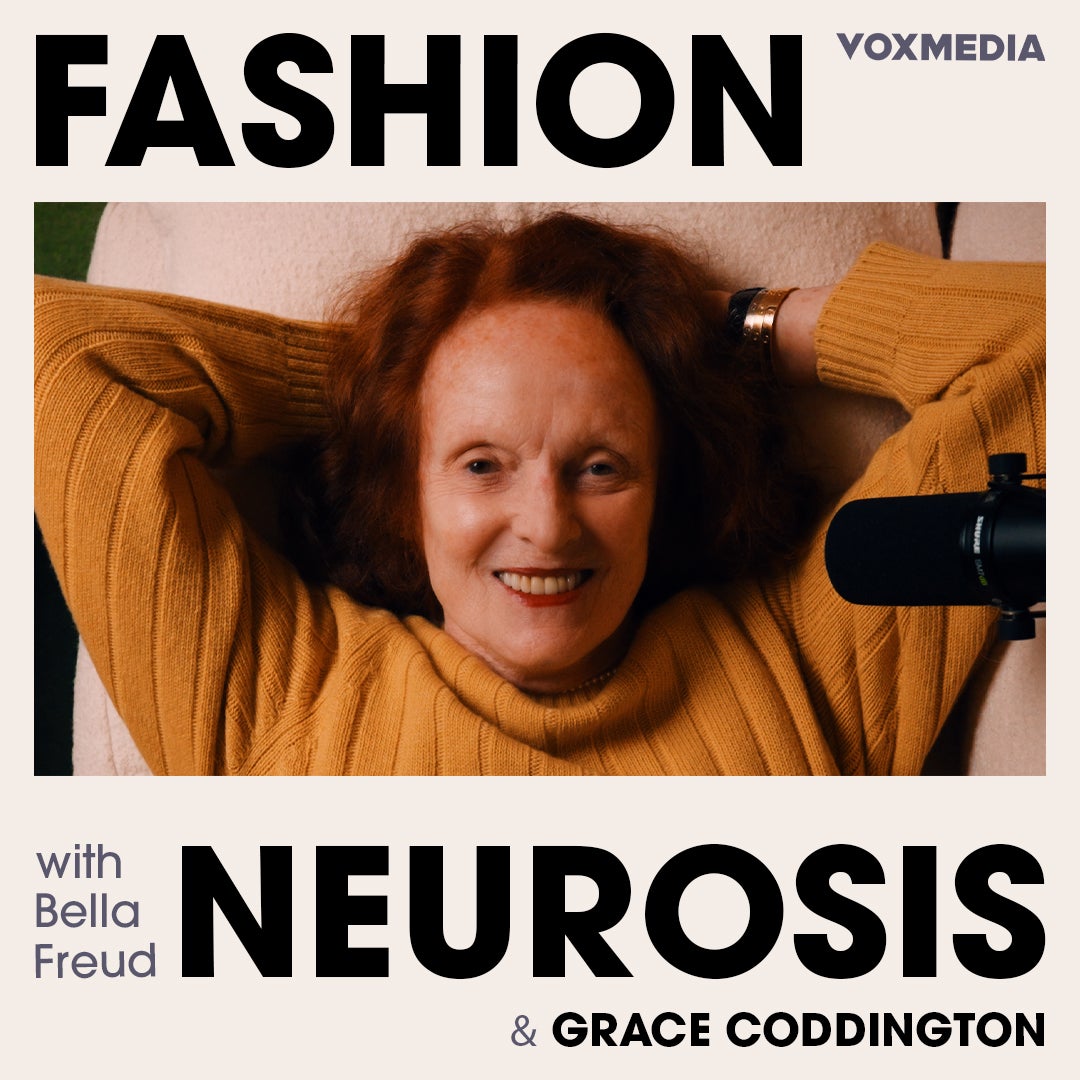
2:01Welcome to Fat and Neurosis, Grace Coddington. Can you tell me what you're wearing today and why you chose these particular clothes?
2:13Well, my latest book is yellow. And it's not quite the same yellow, but I bought this sweater from Prada in Paris the other day. And so I thought now's a good time to try it out. And I liked it with this funny brown skirt. And it reminded me of, I don't know if it's still there, a school that's close to Sloan Square. And all the kids wear this kind of yellowy, orange, and brown corduroy pants. And I always loved seeing them. So that's my skirt and my sweater are both Prada, as indeed are my shoes. Or maybe my shoes are, yeah, no, they're Prada too. Yeah, I know that school. Hill House, I think.
3:07Exactly. Yeah, no, that's it. And they have really nice outfits. Are they still there? I don't know. I hardly ever go around there. I used to stay in a hotel called Eleven Cadogan Gardens, so I would see them all the time. and I always thought they looked so cute. Michael Roberts used to stay in that hotel too, I think. Did he? Well, he had an apartment around the corner from there on Sloan Street, yeah. Because you're a legendary figure in fashion and your creative and uncompromising point of view has been recognized and appreciated by the world since he stole the show in the documentary, the September issue, about preparing the September issue of American Vogue.
3:52And in your new book, Grace Now, Mark Jacobs says she will fight for an image until she's gone as far as she can. And what is going as far as you can? What does that entail? Well, I think in Mark Jacobs' thing that he's talking about is We did a shoot together for Vogue, and he was the guest editor-in-chief for that issue. And I had shown all the clothes to Anna beforehand, and she said, yes, yes, yes, these are all lovely. Just, you know, please don't photograph the bikini, which actually was yellow with spots on it. And I, of course, that's like red rag to a ball. And that's the one thing I really wanted to photograph after that.
4:48So I felt frustrated, but I thought I'm going to try. And sort of at the end of the shoot that we did, I said, okay, let's now try the bikini. And Mark said, I think Anna didn't want you to shoot that, right? And I said, no, that's right. Maybe you would like to call her up and say, we're going to shoot the bikini because, you know, you are the editor of this issue. And indeed he did, and she said to him, well, Mark, you know, you're the editor in this case, so you can do whatever you like. but of course I can print it or not. That's still my prerogative. So anyway, we thought we had pushed her as far.
5:52She did, well, she printed it, but I think it was just digital. So that's a bit, you know, I think that everybody is, or I'm referring to my working with Anna where I think we pushed each other as far as we thought we could go. Yeah. Yes, it was very enjoyable watching that process. I mean, it's good to work like that in a way because then you know if it eventually gets through then it's going to be right or it's going to be good or it's going to be strong if it can survive the journey. Yeah, yeah, at least you've tried. At least you've tried. Because in your memoir, Grace, you talked about reading Orlando, the marmalade cat, as a child.
6:38And I read that too, and I was captivated by the clothes they wore. And the illustrations are so good. And Orlando's wife is called Grace. That's right, with her three kittens. Oh, my God, that is so beautiful. I love that book, and I love the illustrations. They're just amazing. Catherine Hale, and she was actually the mother of a friend of mine. Really? Who was, I mean, he was a, I'm not sure if he's still alive. I hope he is, but he's called Nicholas McLean, and he's a doctor, or he was a doctor. but I was always intrigued by those cats and kittens and I actually met Kathleen. She's a marvellous old woman.
7:31She's really, really, really beautiful. Yeah, because those were really good and Baba the Elephant wore really good clothes as well. Those children's books are so charming And I don't see anybody making those kind of children books anymore. I mean, the drawings are much more garish, and they've sort of simplified them for children, and I don't understand why. I think children can just as easily appreciate, you know, a beautiful drawing like Orlando or Baba. Yeah, they're much more aspirational for a child. And a child, I hate this sort of mushy little cute drawings. I hate them, yeah. I had a thing where I was hoping at one point to do an animated film.
8:33And, you know, I don't know, it's really difficult trying to enter into the film world. It's like another world and they have their ideas. and we got quite far, but then, you know, I discovered they didn't want to use my drawings and the whole point was they used my drawings and they wanted to change all the names of the cats and they wanted, you know, I kept saying I don't want it to be like a Disney, like Pixar or, you know, because it was an oversimplification and also the story. And I, but that's one time that I pushed and pushed and pushed and I didn't get anywhere. And they were determined that it wouldn't be my drawings because, you know, they're not like those regular children's cartoons.
9:30And also they said that the film had to be for like three to four year old. And that's not what I had in mind at all. So I canceled the thing. So, yeah, so kind of homogenizing and unimaginative. And if anyone is appreciative of an outlandish idea as a child, because they really recognize that and amused and interested. And with Grace, your memoir, you wrote it with the fashion editor, Michael Roberts. and he was a marvelous person and very strict and outrageous and he was a great artist as well. And did he draw you? Well, he didn't draw me so much as he did cut out and he actually, that's the cover of all my three books, Grace, 30 Years of Fashion in Vogue, Grace, The American Years.
10:32and the last one was actually his drawing, but we, I hate to say the word, digitally gave me a haircut so that it was Grace Now. But no, Michael, I love Michael and sadly he passed away not long ago, but I did so many projects with him and he helped me write my memoir. Yeah, he was an amazing person. I remember him coming to my studio and drawing a model And I don't think she realized, you know, she had to sort of really make an effort. And he was so cross with her for moving. And she was a sort of flavor of the moment. And anyway, I liked his disapprovingness. It was. He did draw me, actually, now I come to think of it, once when he was working on the Sunday Times.
11:30and he had a column there about fashion. And he did this drawing of me in, I had a sort of uniform that I wore, which was a big white shirt and an Azadean skirt, which tends to be quite tight. And he did a drawing of me from behind with a lot of frizzy hair. It wasn't in color, it was just in black and white. and a white shirt with the sleeves lilled up and a huge bottom. And there was a caption underneath that said, certain fashion editors should know better. And it took me a long time to forgive him for that, I must say. I was quite upset and I immediately stopped eating. But it was good. I lost a lot of weight.
12:30So you grew up on a remote Welsh island, and you had quite a strict convent girl upbringing, but you were never a prude. And in your memoir, which he wrote with you, you're completely un-coy about sex. And was that an unusual attitude for that time? I guess so, yeah. Yeah, I didn't know better. It was impressive to read because you seemed to have a real sense of yourself and, you know, you didn't sort of express any mortification or shame. It seemed like a great manual for how to engage with sex, really. and I was really impressed when I was reading it. Did you read the bit about my first boyfriend?
13:30Well, I read that somebody proposed to you when you were 13, some creepy hotel guest, and your mother was absolutely horrified. Well, yes, because he was much, much older. Yeah. Yeah. and I think after when I told her that he was never allowed back in the hotel but he used to come every summer and I used to go shrimping with him and then he, you know, yes, he professed his love to me. It's very medieval. But I was actually referring to, there was a man who used to come to the coffee bar I worked in. And he actually introduced me to Norman Parkinson because he worked with Norman Parkinson a lot.
14:23And then one day he invited me out and he said he had a cottage, I think it was in Kent, and I was invited for the weekend. And I had no idea what to expect, and I didn't think it was sex in any kind of way, but any. I got to his little cottage, which was beautiful, and roses around the door and things, and we had a lovely candlelit dinner, and then afterwards, you know, he showed me to the bedroom, and I got into bed, and I had a long nightdress and stuff on, And he appeared a little while later in his pajamas with a cup of coffee. And as Michael writes in the book, this is his edition, but anyway, he said, you know, he arrived at the door in his striped pajamas with thoughts other than drinking a cup of coffee.
15:33And then I was like laughing because I had found under the pillow all these little things, which I thought were chocolates, like they give you in a hotel on your pillow. And in fact, of course, they were condoms. Very well organized. And what was so funny was after the book came out, I got this letter from a lady, a very sweet lady, who said, oh, you know, that actually was my husband, and he died not long ago, but he was, I loved your story. And he was an artist, and she sent me one of his drawings, which was so beautiful, and I was so touched. by her reaction. That's so nice. How wonderful. God.
16:28Because you won a modeling competition when you were 18 and you became an extremely successful model and your first shoot was with Norman Parkinson, but it was a nude. And how did you feel about being naked? Well, you know, I don't know. I didn't really have any feelings either way. I mean, this is another occasion of me being very naive because this is the same guy had sent me to meet Parkinson. And when I met him, he said something like, are you free on Saturday? I said, yeah. And he said, well, I have a job for you. And of course, I was completely overexcited because I knew his pictures from Vogue.
17:16and it was my dream to work with him, obviously. So I said, yeah, yeah, absolutely, you know, I'll be there. And he said, well, there's just one thing, it's nude. But I actually, I didn't hear that bit at all. I was just too excited. And so then when the Saturday arrived and, you know, he said, okay, you can take your clothes off now. I said, okay, you know, and I just, somehow I just took it in my stride and it seemed completely normal. And I was leaping through the woods totally naked. That's so good. It's so interesting how people create a different, a certain atmosphere where you don't feel self-conscious because.
18:05I didn't feel at all self-conscious. And, you know, it was very close to a house he had in Kent also, Also, I think, or somewhere there. And I knew that his wife was in the house and, you know, and we were going for tea afterwards. And there was no question of any kind of hanky-panky or whatever. It just seemed normal to do a beautiful picture. It's great. He definitely had a kind of safe vibe, didn't he? He was just... Parkinson. Yeah. Yeah. No, he was a wonderful man. I loved him. I worked a lot with him both as a model and as a fashion editor. Yeah. We went on a lot of trips together and things.
19:00And he taught me so much, you know. Because you went on the Russian trip with Jerry Hall. Oh, I did, yeah. Oh, so amazing. I love that story and you had a much photographed but short marriage to Michael Chow in your 20s and he'd just created the restaurant Mr Chow which was the most glamorous place in London and you said your hair made a silent protest and it turned from being silky straight to fluffy and that thing of hair changing is a real, one of the things that psychiatrists take note of. Oh, really? Yeah. Oh, I didn't know that. I remember a story about someone being in a rehab and they'd gone out for the weekend and come back with this different hair and they got hauled in and they'd, you know, gone off the rails.
19:58And then the psychiatrist said to them, when someone changes their hairstyle, it's always a sign that something's going on. And I wondered how long after your hair gave you the red alert did you leave the marriage? Oh, the marriage itself didn't last very long. I was bad. I ran off with somebody else. But we had been together for quite a long while beforehand. Oh, right. But, I mean, it's funny you should say that because my second marriage to Willie Christie, and kind of the same thing happened except in the reverse in that we were together for quite a long while and then we got married and then he went off with somebody else maybe six months, no, not even six months after the marriage.
20:52and the first thing I did is cut all my hair off very, very short and dyed blonde because, you know, the saying, blondes have a better time.
21:08It's a real kind of a telltale. Yeah, yeah, it's interesting. Because you've had some quite serious narrow escapes, I mean, apart from the hotel guest. and you survived two serious car accidents and in the second one you lost your unborn child and in your memoir you refer to people thinking of you as cold but you take risks in the act of friendship including bringing up your nephew Tristan when your sister died and your actions seem to be the actions of a caring person and do you mind being cast as cold and do you think of yourself as a warm person? Well, I think of myself as a very warm person and I can never understand why I think some people are kind of intimidated by me.
22:04I don't know. I seem like a normal person to me, but I don't mind. You know, sometimes it's good if you don't want to, like, get involved in a conversation or something. you just put on that kind of look of I'm a cold person, don't come near me. Yes, it gives you a bit of respite, especially being a fashion editor. There's so many people around and you have to conserve something for yourself. Yeah, yeah. Because you're an ardent admirer of Yves Saint Laurent. You talk a lot about him in your memoir, and you even walked in one of his shows. And I used to go to his shows when Lulu de la Falaise was there because she was very kind to me, and he was in quite poor shape by then.
23:01And you described Dana Winter staying seated during the traditional ovation when he came out for his bow. And do you think there's a casual cruelty in the way a designer can be dismissed when they're clearly in some kind of deep distress?
23:22Well, yes, I think, you know, the fashion business is cruel. You know, you're at the top of the world and then you're not. You're gone. And it's very cruel. It's very judgmental and things. You know, they do expect a whole new way of thinking every single collection. And these days, designers have to do so many collections. You know, there's pre-spring and pre-fall and cruise and God knows what on top of their big collections and possibly couture. and just to be, to come up with something new every time, it's not possible. I don't know why people always want something new, new, new. I mean, go and buy a new dress, but it can be the same as the dress before if you liked it, and why not?
24:24Why does it have to have a short skirt or a long skirt or big shoulders or not or what? You know, I think fashion, it won't and it doesn't, but I think it could move a little more slowly. Yeah, it's quite reassuring in a way to see an idea that's the same idea, but it's just deepened in some way. I like designers. It's like people living in the country, you know, and they don't follow fashion, but they can still look beautiful. You can still look beautiful and bring out the same old dress from years and years. I mean, I do.
25:13Nowadays, yes, I buy new clothes because it makes me feel good, but I also wear things that I've had for 10 years or something, and that makes me feel good too, that they're still relevant and that I haven't, you know, splurged$500 or$5 ,000 on something that I wear once and throw out. Support for the show comes from Quince. Quince makes elevated, everyday essentials using organic materials. They do an amazing 100 % Mongolian cashmere sweater, soft and luxurious but without the luxury price tag. As the weather gets colder, you can find plenty of desirable pieces to layer up your wardrobe. I'm always cold and I particularly like their warmed-down jackets.
26:02I have an obsession with bed linen. My grandmother owned a bed and breakfast in Ireland and she taught me how to make a perfect bed. I bought the European bedsheets and matching pillowcases from Quince. The stripe reminds me of a grand English country house, but the prices are very reasonable and the quality is superb. Find the full pieces you'll reach for most at Quince. Download the Quince app for app-exclusive offers or go to quince.com. Get free shipping on your order and 365-day returns. Now available in Canada and the UK too. And when Quince asks where you heard about them, let them know it was fashion neurosis.
26:40It's the best way to support the show.
26:47because fashion it is funny and it's competitive some but sometimes it's it is quite venal i used to hear stories about carl lagerfeld championing people who work with him but then dropping them and i wondered why he was so tyrannical did you ever experience i don't know I mean, you know, fortunately I never fell out with him, but there were those that he was incredibly close to and then, you know, in later years barely spoke to. But I was a lucky one because, I mean, I think it was almost like, be careful, don't get too close because if you do, then you run the risk of losing him as a friend.
27:37And so I was, you know, I was close to him, but not too close to him. And so we always remained friends. And in fact, he published my very first book when I'd spent all this time with Michael putting it together. And the publisher I was with, it's not what they wanted. They wanted a sort of gossipy, tell-all book. It's what they expected, and it wasn't what I wanted to give. So I pulled out, and then Carl himself published it, and just exactly the way I wanted. And then, you know, which was so generous, because he just had an audition, KL, And he, I don't know, I think he had a contract with them that he made maybe five or six books a year or something like that.
28:45And that he gave two, I did two books with him. My book, The Catwalk Cats, which was my drawings. I love that book. You know, it was without question. And, you know, I thought this was really wonderful. And also to do a book or to do a shoot or to do something and not have it questioned is a very big luxury. And anyway, when I wanted to republish my first book, it wasn't working with not so much Carl, but with Steidl. And so that's when Fiden picked it up, and they were amazing, and they reprinted it beautifully. And, you know, I've been with them ever since. And occasionally they say, I think we've got a few too many pages, but pretty much I can do whatever I like with them and, you know, have whatever cover I want and so on and so on.
29:52So it's been like a wonderful relationship. Yeah, they do great. Through all three books I've done. I think my father has some books with them. I probably, but they're... With Fiden? Yeah, they're so, their printing is just superb. Oh, it's fantastic. It's fantastic. Yeah, no, they really care. And, you know, they go on press and so on. And they look after you. They're like my family. So I've had a very good experience. because I read that your biggest arguments with Anna were over actors being on Vogue covers rather than models. Well, you know, I saw the writing and the whatever, and I happen to like models, having been one.
30:44I wasn't so keen on all the actors or the celebrities that started appearing on Vogue covers, but that's the way magazines went. And they stopped, they didn't really sell so well with models. So slowly, slowly, it became more and more and more celebrities. And, you know, despite it all, I'm quite a shy person. So I had a problem working with celebrities. There's a few I work with that I really like and that are easy and not too complicated. But very often celebrities come along and they completely dictate, you know, A, where it's going to be, B, how long it's, you know, it's going to take to do the picture and see what they're going to wear and how their hair and makeup is.
31:43and they're impatient because, you know, they really want to be an actor. They don't want to be a model, but they know that, you know, it's part of their contract these days that they have to do so much publicity for films, et cetera. And so very often they're reluctant, and it's not a situation I like to be in. I much prefer modeling whose life is being photographed and looking beautiful and, you know, tend to work more with you than I know better. Yeah. Yeah, because do you think if someone has too much say in what they're wearing and how they're looking and too much focus on looking pretty, it interferes with you being able to get a great look, which is the objective?
32:36Well, you get the same look as, you know, every cover or photo that they do because they're in control. And, you know, some of them want to have photo control too. So it's complicated. Because you've worked with so many genius people. And I think my most loved person that you've worked with is Andre Leon Talley. Ah, yes. He lived for fashion in such a dramatic way that influenced everything he did. And you said he'd redecorate his room at the Ritz in Paris when he was there. And he sent people these amazing faxes like you would imagine Oscar Wilde sending. And I've even got one of his faxes. And what's your favorite memory of him?
33:26Well, he was like larger than life and literally, you know. And he always looked spectacular, you know. He never went out of the house looking ruffled or anything, and he cared very much. And there's kind of nobody like him anymore, and that makes me sad. He was such a character and so passionate. So I loved that. You know, he was, he adored Donna Vreeland and he was like the male version of Mrs. Vreeland. And he quoted her all the time. He kind of spoke, he made statements like Vreeland all the time. And that's his faxes and things were like that. And if, you know, if he sent you a fax and said he thought he loved your show or your pictures or your whatever, you know, it really meant something, you know, because his opinion really mattered to me.
34:39And so I was very happy to work alongside him. Did he kind of try and style you? Did he suggest things that he'd like you to wear or how he wanted to see?
34:56What he didn't like is that I always wore flat shoes, and he kept saying, you know, you can't go to a party or whatever for the show, and, you know, you really shouldn't be wearing flat shoes. You should be wearing high heels. He was kind of adamant about that, but I don't know. I used to wear very high heels, but then when I got a bit older and my balance wasn't terribly good and I fell over a few times, I started wearing lower and lower heels until now I only ever wear flat shoes. He'd be shocked. But you wear shoes, not trainers. No, I don't really like trainers. I mean, I have sneakers, but they're sort of old-fashioned sneakers or their maybe Prada sneakers or something that come in a nice color.
35:53And there kind of was a version at Louis Vuitton, Nicola did, that were like half a sneaker and more like a mule. And those were cool. But generally, the big fat sneakers, no, not me. Where do you start with an outfit? because I always think about the shoe first and how much courage the angle of the heel will give me. Right. No, I mean, I wish I liked heels because it makes your legs longer. But I'm kind of renowned in when I work doing a fashion picture, I always say, are the shoes in? And the photographers get really annoyed with me because sometimes they want to crop it at the waist or even higher.
36:45And I sort of get behind them and pull them by the sweater backwards so that you can see the shoes. Because I think it's important, not for the shoes' sake so much, but you can have a really boring outfit and then you can add kind of colorful shoes and it totally changes it. It really dictates what you're trying to say the shoes do. Like you say, you start with the shoes. I don't necessarily start with them, but I add them as the most important accessory. Maybe I do less of jewelry and things. I'm not quite so much into jewelry. An important shoe is very important. Yeah. I know it gives another indicator of someone's personality, I think.
37:46Oh, definitely, definitely, yeah. But it should be appropriate also because I always say,
37:57if a photographer says, well, I'm going to do the pictures on the beach or something, and I say, but it's very important that the girl is wearing heels or something. And he says, oh, well, you know, I can put like a piece of wood underneath and then cover it with sand and she can stand there. And I say, well, no, it looks stupid. And I always feel that it's important that the shoe is appropriate for where you are. You know, just because it's a picture, don't put her in something that doesn't apply to the situation. Almost more than the dress, it's more about the situation. Yeah. And also, I mean, I'm thinking of that photograph of you, the helmet Newton in the bikini, sitting in the chair, and you have a pair of stilettos.
38:54and it does seem completely appropriate to the situation. It's just... Well, those were actually San Arashus and I wore them all the time and they were shocking pink pattern leather and I just adored them. And they're really important to that picture because if you take those shoes off and I was just barefoot, it wouldn't be nearly such a special picture. But I love that picture. Yeah, it's amazing because it's got tension and it suggests that you're varying. It suggests that you're thinking and that you've got all these kind of complex and confident thoughts. Well, that's your appreciation, Ari, and that's great.
39:47But it's amazing how a shoe can send that message. People, you know, when people don't know about fashion or they want to seem like they know by just deriding it, they're dismissive about. Well, they stop thinking below the knee somehow. Yeah, that's a very good quote. because Kate Moss talked about fashion police when she was here on fashion neurosis. And do you have any fashion ninor ninors? Well, she's great. And she's a sort of natural dresser. But, you know, she sometimes liked to shock. And the fashion police are not so much police. They're people that have opinions. And very often there are people that are not qualified to have opinions.
40:46You know, all those people aren't, when you're watching the Oscars or something, and they sit around analyzing everybody's dress coming to the Oscars. And it's really annoying because it's annoying what they do like and what they don't like. And it's so obvious that this is what they're going to like and this is what they're not going to like. I mean, if it's sophisticated, they don't like it. You know, they like it if it's sexy. Yeah. Do you think they don't make enough room for, you know, sexy that someone else, you know, the kind of variation on sexiness that demure can be sexy or? Definitely, yeah.
41:29No, they don't consider it like that. They like the nice, you know, the dress that's barely there or so tight that you're bulging out of it. And it's tacky. There's one thing I really despise is tacky. Right. And if you fancy someone and don't like something they're wearing, does it kill your attraction?
41:59Maybe a little bit, yeah. Maybe a little bit, you know, making one of those my fashion faux pas, not maybe the general fashion faux pas, but one of my, you know, dislikes. Yeah, I maybe put off a bit, but, you know, hope that it's just, he's just wearing it that day, not always dressing like this. What are your particular fashion faux pas in men? In men? In men, yeah. What are those jeans with lots of pockets on them? Carpenter? Oh, cargo. I hate those. I don't like sandals with socks. Sometimes I don't like when men wear a suit and no socks. I think that's kind of a bit tacky.
42:59and actually just dressing up too much to be noticed I don't like. I prefer just something quite gentle. Certainly don't like shirts open to the waist with a lot of necklaces and hair. Like Bernard Henri Levy, he's the king of that. No, I don't like that. Your long-term romantic partner, Didier Meleige, is a hairdresser and you're really into hair and hair color. How did you feel about Anna Winters' switch from dark to blonde?
43:43I think it was quite gradual, wasn't it? I don't know. I prefer her as a dark-haired person because I feel I've always known her as a dark-haired person. But, I mean, I know from my own hair that I cannot imagine my hair being all gray. It wouldn't suit me at all. So, yes, I color it. I color it red. And red apparently is a notoriously difficult color to get right for a colorist. My colorist, Louis Licari, who I love, who I've been going to ever since I came to America, he always says it's a really difficult color. but the thing is that every time I go, which is quite often, every three weeks, in fact, I better get back to New York and go because it's beginning to show, it comes out a little bit different every time.
44:47So I imagine Anna has that problem too. But she probably said, oh, you know, I'd like it to be a bit lighter and I'm older, I don't want it to be too hard or whatever. But I prefer her with dark hair because I think that suits her. I do too. Something sort of sympathetic and endearing about the dark hair. Yeah, yeah. And I love people dyeing their hair black like Amanda Harlick. It's so glamorous. I mean, I don't really like blonde hair, so full stop. So it's not just under, it's like anybody. I like dark hair or, of course, I particularly like red hair. Yeah, it's interesting about red being so hard to replicate because it's very hard even with glazes for ceramics.
45:54Oh, really? Yeah, I don't know that. Because I was trying to make something with a red glaze, and they said, oh, God, that's the hardest thing. Please don't make us do that. It's very hard to stabilize. So that makes a lot of sense. But it's quite exciting to have slightly different. Do you enjoy the wondering how it will come out? Yeah, I think it's interesting. You might learn something. You might find that you actually like the variation better than what you had imagined. It's all like, I always think sometimes a mistake in a photograph makes it more interesting because it's not expected. Expected is kind of boring.
46:41Yeah. Because in the documentary, the September issue, which made you a recognizable figure and people, you talked in your memoir about how people stop you and they know who you are and ostensibly it follows Anna Wintour, but it really shows the creative push-pull between you both. That's their storyline that they were looking for, yes. Yes, it was so enjoyable to see, you know, because the viewer is really rooting for you to win out with your ideas. But as you said, part of your success is that you have to defer to her, sometimes at least. Oh, no, I defer to her all the time. I mean, even when it's not work even, you know.
47:39I mean, she is an extraordinary person and helps so many people and gives advice and helps them on their journey in life. Now, I mean, even if I'm looking for a doctor or something like that, I call Anna and she always comes up with the right person. So, yeah, no, she's generally a very, very helpful person. I suppose she is literally a great editor because... She is, yeah. That is such an important part of being creative. You can go a bit crazy. Do you trust her to sort of insist on certain elements in what you make with each shoot? Yeah, it's all to do with having boundaries that make your work much stronger.
48:38Yeah, because in your new book, Grace Now, you ask various people that you've worked with to write things. And Karen Nelson said that you said, don't fawn over me. And how are you receiving a compliment or paying one? I'm embarrassed. No, I mean, I typically said, because I have asked quite a lot of people to write little things, but I always said, please don't just say, Grace is so fabulous, because that's so boring. But I don't know, several of them got away with saying that to my embarrassment. And it was some of them I edited out. But no, it's embarrassing if people actually, I don't mind if, you know, someone says to you, you being you, you know, oh, Grace is so great.
49:46But if you say it to me, it is. It's difficult. I mean, it's nice to hear, but it's sometimes difficult to receive. Because when you were growing up, you had this amazing, I mean, you were and always have been incredibly beautiful, and there's a sort of innate sort of low-keyness about your attitude towards yourself. And I was wondering, did your mother encourage you? Did she pay you compliments or did she encourage you to sort of appreciate your beauty or did she appreciate it? Ah, not at all, no. And I'm not beautiful. I'm a sort of bit of an odd bull, really. And, you know, when I was working as a model, I was never really booked because I was beautiful, because I don't think I was.
50:51You know, I was booked because I had the latest Vidal Sassoon hair or, you know, I was cool or something like that. But, you know, I wasn't your beautiful Estee Lauder model, blonde hair gorgeous skin etc etc so and you know my mother she never really paid me I don't remember her ever saying god you look great well obviously she wouldn't say god you look great but she I don't remember her saying oh you look so pretty darling you know she wasn't she was quite a shy reserved person she's very kind of victorian and her family had been very victorian so that's the way she was brought up so now she wasn't about you know overflowing with compliments i know i suppose it wasn't though i mean i my mother wasn't either.
51:54I don't remember her saying those things, and it makes one quite self-contained and suspicious of, you know. People who do, yeah. Yeah. Yeah. No, no, I didn't hear it from my family at all. I mean, the only thing I remember is my sister saying, you should wear some lipstick, it'll make you much more attractive, and the boys will fancy him more. She gave me some lipstick. It worked, yes. Because you still wear lipstick, don't you? Yeah. Yeah. I like, you know, that's like, for years and years and years, I just wore black, black, black, much to Anna's frustration and we all wore black in the fashion room.
52:41And she, you know, she would say, if you're going to the Met or something, you're not allowed to wear a black dress. and I still did. And I wore black and I wore pants for years. And then I don't know what happened. I suddenly broke out and stopped wearing pants and now I almost never wear pants except maybe pajamas. And I wish I'd brought some pajamas today. I was thinking, you know, I was going to pack some of my pajamas to lie down in like now, but... I decided against it and I didn't. But, you know, nowadays I wear much more color and you open up my wardrobe and it's very colorful, whereas before you open it up and the whole thing from one end to the other and also the shelves with the sweaters, they were all black sweaters and then it was all black pants in various tightness depending on if I'd had a big meal or not.
53:42My coat was black. Everything was black. but recently I started wearing, and it's much more fun. I mean, it takes longer to get dressed because you can't just reach for anything. You have to consider color with color or not, you know, which color you're going to feel good in today, and it varies. It really looks good with your hair, I think. I hope so. I did think of it especially for you. And then, of course, I wanted it to connect with my book, my yellow book, which I'm very proud of. And I actually got the yellow from, I had a diary from Smytheson's, and I've been going to them for years. And they make, they do have the most marvelous colors in their books.
54:36And I always liked them. And this year, I thought, oh, you know, yellow looks interesting. And normally I hate yellow, like my boyfriend Didier, who was always planting yellow flowers in the garden. I'm like, yellow pansies. And I said, get those yellow pansies out of here. I can't. I hate yellow flowers. But now I really like yellow flowers. I like yellow roses and yellow, yellow, yellow. You know, sunflowers, of course, are fabulous, and they have a lot of sunflowers in Long Island. So my house is full of sunflowers, which are so happy, you know. Yeah, the great thing about being in fashion is changing your mind is part of the game.
55:32It's so wonderful to revise a hatred and suddenly decide you love it and love it. Yeah. No, it is funny. I've done a complete about turn, about color, and also particularly about yellow. But it is the most beautiful book. I mean, there it is on the... It's a good poster. It's like, I think it'll show up. You know, I always, when I go to someone's house, I look through their bookshelves, and, you know, from my first one, which was bright orange, you could see it a mile off. And that was very pleasing. for me. And now this one, I think, will have a similar effect. You'll see it from a mile away.
56:17Well, that expression, you can't tell a book by its cover, I really think you can, actually. And a good cover is part of getting closer to reading, which is one of the most important things. Oh, definitely. I think a cover sells you. Yeah. It's wonderful. Well, thank you so much, Grace Coddington, for being on Fashion Neurosis. It's wonderful to have you here. And I know you hate compliments, but you are a great person and a pioneer. And there's a moment in your book where you're at a, I think Anna's made you have a birthday party and then she says all these nice things and it does feel good. And it's nice as someone who's kind of wary of, you know, adulation to feel appreciated.
57:13And I think we do appreciate you and it's great to voice it. Thank you so much. Well, thank you. Thank you. I mean, somehow a compliment in England is worth more than a compliment in America because in America, everybody says everything's so fabulous, you know, everything's so fabulous. And then they walk away and you hear them say,
57:41I don't know how I got that out, but I hated the collection or something. And you've just heard them say to the designer, that's the most fabulous show I've ever seen. So there's a lot of compliments flying in America, which are not very true to the heart. No, no. And I really enjoyed it here. I mean, I had a late night last night, so it's very nice that I can just lie here and relax. It's been a really, I think it's a great way to do an interview. So thank you so much. Thank you. Thank you. That's fantastic. Goodbye. I can die now.
58:34Thank you.
Grace Coddington is a British fashion editor, stylist, and model.
After winning a Vogue model competition in 1959, Grace pursued a modelling career in London and Paris. Landing a job as Junior Fashion Editor at British Vogue in 1968, she worked under the legendary Bea Miller, and then as Fashion Director under a young Anna Wintour. Lured to New York by Calvin Klein in 1986 to be his design director, she was invited back to Vogue when Anna Wintour took over as Editor in Chief of American Vogue in 1988. Coddington worked as Creative Director at American Vogue until 2016.
Grace rose to wider fame as the standout of The September Issue, R. J. Cutler’s documentary about Vogue magazine. Since leaving Vogue in 2016, Grace has collaborated with Louis Vuitton and Astier de Villatte on capsule collections, styled for Vogue and W Magazine, and modelled for brands including MERIT.
Coddington wrote an eponymous memoir in 2012, and is the author of the Phaidon titles Grace: Thirty Years of Fashion at Vogue, Grace: The American Vogue Years, Marc Jacobs Illustrated , and Grace: Now, which was published this year. She has written and illustrated the series The Catwalk Cats with her partner Didier Malige, and is the muse for the three-book GingerNutz series, created by her close and frequent collaborator, the late Michael Roberts.
She lives in New York City and Long Island with Didier Malige, her boyfriend of nearly thirty years, and their two cats, Bart and Pumpkin.
In this episode of Fashion Neurosis, Bella Freud and Grace Coddington discuss changing your hair after a breakup, Sex, and Anna Wintour.
Learn more about your ad choices. Visit podcastchoices.com/adchoices