 Ask ChatGPT



Fashion Neurosis interview with Irish designer Simone Rocha, covering her design philosophy (emotion, anti-shame, mixing masculine/feminine), origins (growing up in her father’s studio; school/uniform memories), education (NCAD textiles shift; Central Saint Martins under Louise Wilson), and major collaborations (Jean Paul Gaultier Haute Couture 2024, Adidas, and filmmaker/photographer projects). It also touches on her process for menswear vs womenswear and influences from Goya and old masters.
Simone Rocha is an award-winning Irish fashion designer with an independent label. She studied at National College of Art and Design (Dublin) and earned a master’s at Central Saint Martins (London). She has collaborated with major fashion houses and artists.
Clothing is an emotional connection; she’s “anti-shame” and comfortable in her body; she designs through strong vision and “gut feeling”; femininity should be unapologetically girly yet tough; collaborations start with connecting to people first.
motorbike-helmet lining used for structured “twin set” shapes; school uniform (brown jumper/red tie) as a lifelong color/shape reference; Chloe Sevigny wearing a 2019 Simone Rocha piece; Gaultier Haute Couture guest designer (2024); Petra Collins film for Montclair; Adidas campaign photographed by Justine Kurland featuring 11 girls; Goya/Caravaggio influence and “Irish heroines” owning space.
Written by AI. May contain mistakes.
Simone Rocha discusses her outfit choice and its emotional significance.
“Can you tell me what you're wearing today and why you chose these particular clothes?”
Simone reflects on the emotional connection in clothing and her design philosophy.
“And I'm always totally intrigued whenever I see that.”
Discussion about Rocha's early influences and her journey in fashion.
“you know, what you did, how you showed it.”
Simone explains her approach to design, including fabric use and silhouette.
Rocha shares her thoughts on her school uniform and its influence on her style.
Simone discusses her unexpected journey into fashion from art college.
“When is the end of the day and you're settled into the couch looking for your evening watch, you're not looking for homework the movie.”
Exploration of the transition from fine art to fashion and the influence of mentors.
Discussion on how Louise Wilson's advice shaped the creative perspective.
Conversation about the connection between femininity and clothing choices.
“So I kind of I ended up it was Nick Wapington's Living Room series.”
Insights into the concept of shame and personal identity in fashion.
“It's a very suppressing, terrible, insidious kind of feeling.”
Recollections of the significant clothing pieces that shaped their style.
“I always felt I've always had quite a uniform, you know, so I've always felt it's like it's also a bit of a runny joke.”
Discussion on the representation of genders in the fashion design industry.
Explore how gender influences the approach and perspective in fashion design.
Discusses the personal connection designers feel with their garments and the impact on their work.
“And I think the difference is when you're a woman designing women's wear, you can't help but put yourself into it, you know, and like, like I don't design my collections necessarily with me in mind.”
Covers how relationships with other designers and personal connections shape fashion choices.
“But she wasn't talking about being uncomfortable either.”
Details the collaboration with actress Chloe Sevigny and her influence on the designer's work.
“You know, I really, I believe, I think that's what's so magical about them.”
Describes the experience of being invited to design for Jean-Paul Gaultier's haute couture.
“I was like to put me in that space and the enthusiasm of that house.”
Learn about the innovative design elements and inspirations behind the collection.
“And that's why I work in a lot of transparent fabrics and materials from the beginning, whether it's hard like perspex or soft like jewel.”
Understand the creative collaboration between the designer and Petra Collins.
“curious person can make a difference in making a better world.”
Understand the creative collaboration between the designer and Petra Collins.
“We're just days away from the midterm elections, which means I only really have one question.”
Delve into the designer's reflections on gender dynamics in fashion design.
“And she came up with this amazing film about a beautiful nightmare about a dancer.”
Discover how art influences the designer's collections and creative process.
Gain an understanding of the deeper meanings behind the designs presented at the show.
“But that's a painting we visited as children all the time.”
Exploration of artistic influences, especially Goya, in fashion design.
“And then thinking about, you know, Irish heroines and people, this formal kind of slightly frightening matriarchs who you just find they're irresistible.”
Discussion on the emotional and psychological significance of dressing well.
“I think there's something very special about getting dressed every day.”

Get the gist, explore an idea or ask about something said.
 Claude
On Fashion Neurosis with Bella Freud, what are the key points of this episode?
Searching your listeningAutomatic transcript. May contain errors.
0:00I'm Josh Muccio, host of The Pitch, where startup founders raise millions and listeners can invest. For our sweet season 16, we're giving you more of what you love and less of what you don't. Software is out. Actual cool stuff is in. We've got consumer brands, deep tech that changes the weather. Our big vision is to make it rain and snow on demand. We've got hardware that helps blind people see and dairy. I never imagined my life journey would be milk. Season 16 of The Pitch is out now. Listen wherever you get your podcasts. This season is presented by NGIN. Running a business shouldn't feel like surviving a software group project.
0:42One app for accounting, another for inventory, another for sales, and somehow none of them talk to each other. That's where Odo comes in, an all-in-one business management software that brings every part of your business together. From sales and accounting to inventory and marketing, all-in-one powerful platform. No messy integrations, no bouncing between tabs, and best of all, no spreadsheets. Stop managing software and start managing your business with one unified system. Try for free today at odoo.com slash vox. That's odoo.com slash vox.
1:22Hi, come in.
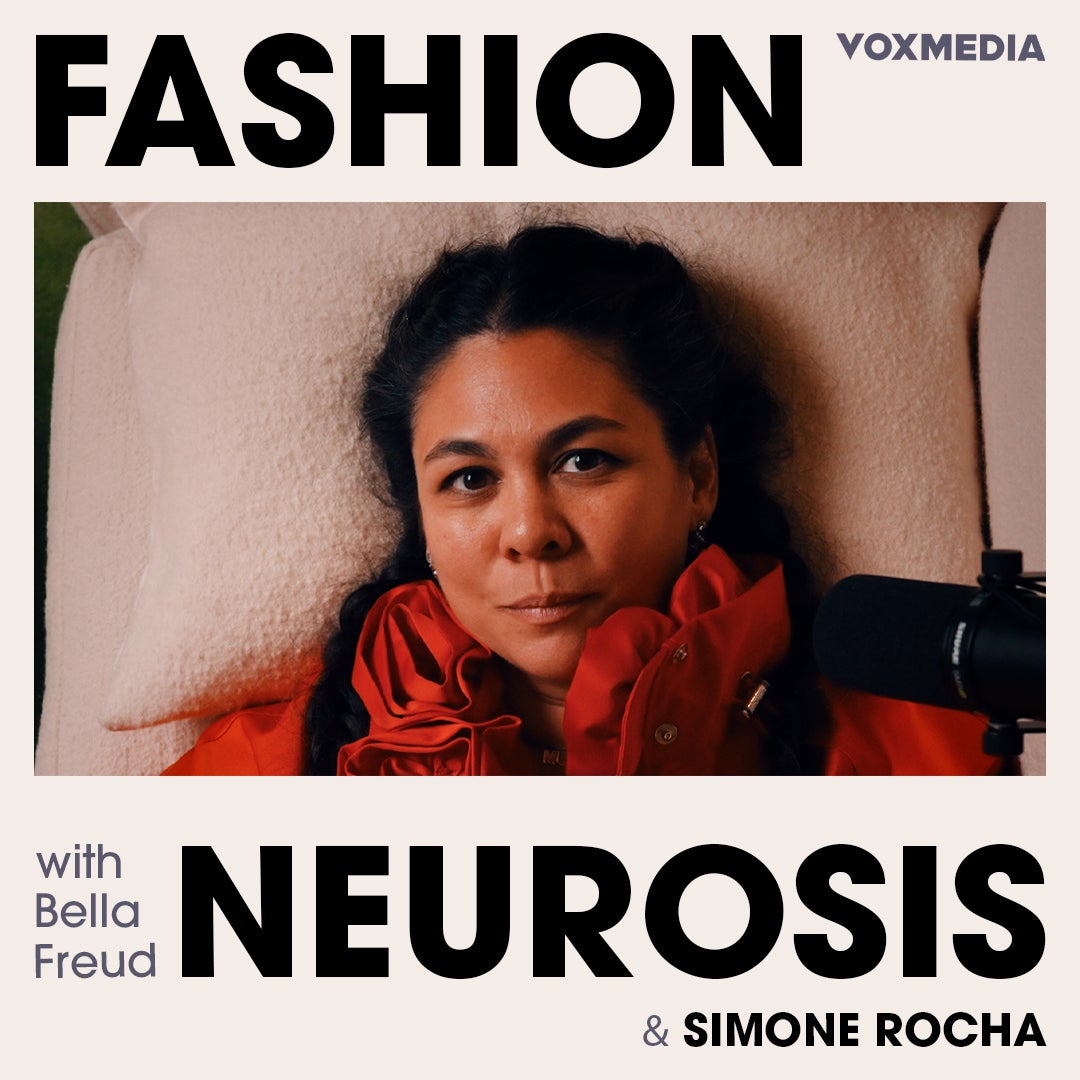
1:29Welcome to Fashion Neurosis, Simone Rocha. Hello. Can you tell me what you're wearing today and why you chose these particular clothes? I'm wearing a red satin rose jacket from my show, my collection two weeks ago. and I'm wearing a black brocade unravelling ribbon skirt and a pair of Napa kind of ballet pump mules that have been kind of sliced in half and have a faux fur footbed. And I'm wearing these because the coat, I kind of, this pattern we kind of borrowed from our men's, like a Harrington piece. and I kind of like wearing some more masculine pieces because the feminine pieces of my work can be very overtly feminine and I kind of like the mix.
2:26So I felt today this could be like a nice combination of the two that would make me feel comfortable. You're an Irish fashion designer, the recipient of multiple awards and it's extremely rare these days to have a successful independent fashion brand and being in fashion is such a hard graft and when most people are cutting back you're expanding is there something specific that you do that is capturing people's desire to wear you at this time of uncertainty yeah I think it's I think it's about emotion for me and clothing you know I've always found is a very like emotional connection and the way that I make clothes is coming from a certain subject or a feeling and how does that human connection happen and I think no matter what the times are that can run through you know and so for me at this time like I don't think I can or any designer could put their finger on what makes people connect but I think if you make work that you feel authentically connected to hopefully it'll resonate yeah well it certainly is it's um it's because I've got a couple of I've got a few close friends one of my sisters wears your dresses and she wears them like they're so elegant and and chic and like couture pieces and she's a writer and another of my friends who wears your clothes is like she looks like a girl from a manga cartoon she's just really cool and tomboyish and with this feminine beauty, but I like the way these two people close in my life who both wear you and how they wear you.
4:40And I'm always totally intrigued whenever I see that. And I remember your father, John Rosher, from when I started my brand in the 90s. And it seems like this period that seems a long time ago now. And you invited me to one of your first shows and I was knocked out by how radical and polished your, you know, what you did, how you showed it. And there's a sort of chic asymmetrical element to your cutting. And how did you know that this was your fashion language? Yeah, well, that's all incredibly kind. And something that I appreciate because like I have always been very specific and very, it's funny because sometimes like the, the inspiration behind some of my designs, et cetera, can seem almost like fantastical or like, like a grand gesture, but in like in a room or, or like on the street.
5:54So like, I think I was kind of built that way, you know, like I, you know, I grew up in my father's studio in the 90s and I always felt really at home there and kind of working there and being around there. but I kind of knew that the clothes that I wanted to portray had to kind of come from somewhere else and like really come from like the kind of the running story is that I which is true I mean it's not a story but I would always go to the the like reject rail like the out rail and then I would have license on pieces that were out and like half twalls and what that kind of thing and I would wear them and put them on my body in a different way so like skirts I would always pull them up under my arms and over my breasts so then it would become like a dress and he worked a lot in volume in that way but always you know on the bottom half of the body and I was really influenced by other like iconic independent designers of the time as well from Ray Kawakubu to Rick Owens and Marta Marjela and you know growing up in that time I think it gave me and then becoming a student in that time it gave me a real fortunate sense of self so it meant that then when I kind of got on my own path like I don't want to say it is straightforward because it's not straightforward but I've always kind of had the blinkers on you know and been kind of like like I have a very strong vision of like what I want to do or how I see something and I'll and I'll just go for it like I won't really question it I'll just be like no my gut feeling I'm a real go with my gut feeling kind of gal yeah it's interesting listening to you talk about trying those things on because the way you play with proportion which is so modern and i just remember seeing that show and thinking this is this is just amazing it's so sophisticated and avant-garde and refined and and tough as well and that was anyway I've I've loved your work ever since so it's yeah I think I remembered the show I think it was I just I had graduated a few seasons and I was starting to I got really obsessed with this idea of like twin sets and I was looking at it had come from my grandmothers and I was looking at how could I do these kind of almost 50s twin sets but completely take them out of themselves so I started using a material that was like a neoprene but it actually was a material that you line the inside of motorbike helmets was the material I don't know how did you find it like I was somehow managed to get it in pink I don't know who's lining their motorbike helmets in pink but I started making these like almost like they'd stand up on their own these kind of dresses and I kind of I've always loved those very old couture shapes and silhouettes and them being very ultimately feminine but then recontextualizing them whether it's in fabrication or like you said playing with the silhouette dropping the waist or becoming askew or like I love to slice into something one because it will reveal some skin but then two then what does the fabric drop on the body and how does that feel on your skin you know feels like a long time ago now I think it's over 10 years yeah I think it is and you wore a brown school uniform and you said I was absolutely obsessed with it but it was horrible brown box pleated skirt with a brown jumper and a white shirt with a red stripe on it but I loved it and was it a container for you to evolve out of what did you love about it yeah I loved I loved my school uniform um and I think I think it was the strictness of it I think the also now I was thinking about the bit like it was a very woolly brown jumper which now you know it's kind of back in fashion like this kind of like more earthy tone um but I also think the contrast of like a crisp white shirt beneath this brown jumper and then a red tie and red has become a really like significant color for me in my work and my life it was something that I I loved to wear and I loved that because everybody had to wear it um you could interpret it your own way whether it's like I always liked a white knee sock and I always wore a brown shoe with a little heel and I always I've always been a skirt girl so but yeah I loved it to the point that when I went to art college I thought it'd be really like ironic to wear the school jumper in art college and And I went to quite a posh girl school.
11:40So it was not ironic or cool to wear this jumper in art school. But yeah, I loved it. I'm Josh Muccio, host of The Pitch, where startup founders raise millions and listeners can invest. For our sweet season 16, we're giving you more of what you love and less of what you don't. I definitely start to blank out when we're talking about middleware AI rappers. Software is out. Actual cool stuff is in. We've got consumer brands. We're building Eight Sleep for daytime. Hardware that helps blind people see. They kept asking for middle finger. Next thing we knew, we had like 10 students running around flipping each other off.
12:22We've got deep tech to change the weather. Our big vision is to make it rain and snow on demand. What if you wanted to not make it rain somewhere else? Like one day we're just like, screw Arizona. And dairy? I never imagined my life journey would be milk. Season 16 of The Pitch is out now. Listen wherever you get your podcasts. This season is presented by Engine. Support for the show comes from Google Gemini. You know that moment when curiosity strikes? You're exploring a new city with a family and a sculpture catches your daughter's eye. What is that? Who made it? With Gemini, you can snap a picture and get a fully interactive breakdown of its history, architecture, and even hidden secrets.
13:08Gemini is built for moments like that. Whether you're learning something new, solving a problem, or looking for your next favorite thing, Google Gemini is here to help. Download Gemini, Google's AI app, or visit gemini.google.com to learn more.
13:26When is the end of the day and you're settled into the couch looking for your evening watch, you're not looking for homework the movie. You're looking for comfort, excitement, or something in between. Whether you're craving something familiar or in the mood to discover something new, Amazon Prime has what you need from screen to doorstep. Because it's not just about genres or endless content. It's about finding the thing that matches how you're feeling, whatever the mood. From streaming to fast shipping, it's on Prime.
13:59because when you went to art school you weren't intending to study fashion and but it came and hijacked you and you suddenly there you were in your familiar metier and did you find that the art was in the fashion in the end absolutely yeah and it's you know I went I went to art college which I loved I went to the National College of Art and Design in Dublin where I grew up and I you know thought it would be a cliche to do fashion for the obvious reasons and so I thought I would like to be you know maybe I could paint maybe I could do sculpture maybe I could do glass or ceramics so I was kind of doing all the what I actually ended up getting into was fine art print and doing all lithographs and printing um but like the lino print where you peel it away but it was it really like what was in my head was not happening on the page and I had an incredible tutor at the time and I think a lot of not just me but a lot of my tutors thought it would be a cliche for me to go into fashion but I had this one tutor who was who was the kind of head of fine art print and she actually suggested she was like I think you're really fighting against something um would you try a module in textiles and fashion and I was like yeah and and she was like I just I can I can feel your fighting um and I was like okay and I ended up doing um I ended up kind of switching over and I remember I did some pieces all I think it was also this idea of uniforms so I went from school uniform to nurses uniforms and I made the compromise with this tutor was I could print because I was I was convinced I was going to be this fine art printer I could print illustrations of these kind of 1950s construction of nurses hats onto materials and then I would make the I would make the hats and they became almost like into these big skirts or then I made lots of little ones and they all became you know textiles on a skirt and anyway as I started doing it the whole process just felt so natural and normal and I could pick up pick up with the pieces and thread them all together and then I was like ah maybe this is what I should be doing yes so so then I switched and I did three years um in NCD and then I moved to London I did my master's in Central Saint Martins because Louise Wilson who's the late visionary head of fashion at St Martin's advised you at one point to stop looking at girls in Victorian dresses and go and look at porn literally yeah and she she was so right she her point was and um you know having Louise as a professor actually changed my life it changed me personally and it changed and you know when you're creative your work and your personal life it's all one thing so she really did change me but what she did was she what she wanted me to do was to step out of what I know she's like I know this is in you I know you have grown up like this like it and it is like the ultimate privilege is it doesn't feel like an alien thing but sometimes you need to be an alien you know and you need you need to see things that are out of your comfort zone and then how do you interpret them and bring them into your world and that kind of contextualized everything I've done since like in my work in projects what I'm attracted to what I'm not attracted to that I force myself to look at but yeah completely changed my perspective actually what did you look at did you look at porn did you find the equivalent of what he was kind of driving I got I I actually I really one of the first things I picked up and I've always loved books and photography.
18:44So I kind of I ended up it was Nick Wapington's Living Room series. Oh, God. Was one of the first books that I because I had grown up being around a lot of aware of, you know. Different artists or photographers or painters, and that's also from being a kid and going to school trips to the National Gallery and sitting there with your coloring pencils and you know but I remember seeing that book in the library and there was another thing that Luisa used to always talk about like overweight brides like this was this was a real ick of hers that she was I think she said she would never get married because she didn't want to be in a wedding dress and then she used to take the piss out of me being like taffeta like that she's like that's bridesmaid so we had this weird like um ongoing conversation which was something as well because I was obsessed with you know I grew up in Ireland but I didn't make my communion or my confirmation which was quite out of the norm and I also where I went to college on Thomas Street It's where all the old communion shops are.
20:02So I was kind of, it's kind of a running joke that a lot of my collections are kind of the communion I never made. And the connection to like lace and tuffeta and pearl and this idea of like shoe, bag, hat, etc. But in the Living Room series, I think on the cover maybe, I can't remember if it was on the cover inside, but there is a wedding photograph. and I was like oh yeah and pulled me straight in and that was my first introduction to looking at a lot of different documentary photographers of lots of different ways of life god it's so interesting it's such a she was amazing she had I mean I didn't know her at all but I just I know that she had a huge effect on a lot of people and she had a real eye and she knew when someone had it and absolutely and she knew she knew when to give it when you needed it and she knew yeah she could just see even if you couldn't produce the work like and there are plenty of times that like you know you're producing desperate work but you could tell that she could see if you had it in you and she would push you to get to push you to that point that you had to prove it to yourself it was a real gift and yeah it was yeah incredible woman because you have this innate way of casting femininity and it's unapologetically girly and also tough and defiant and what i really like about your look is there's no shame around being girly and I wondered is shame ever something that you were aware of as a child yeah I'm kind of like I'm kind of anti-shame yeah I feel like it's funny like because I don't think shame is like embarrassment or anxiety you know I think we all get these things but I think you know it's a real I think if you're comfortable in yourself and in your own skin you know I actually think people gravitate towards that so and even if it pushes people away I also don't think that's shameful because they can also be like a protective barrier thing but yeah I'm kind of it's funny a few months ago I got very like I'm anti-shame to lots of friends and I was like, ah, life's too short, you know.
22:48It's a very suppressing, terrible, insidious kind of feeling. It's like there's no, sometimes you have to go, sometimes things are challenging and things can be very, very dark or etc. But shame, I don't know. There's no good really to come out of it, really. No. All it does is make other people feel bad. So I don't know if it's worth it. And how did you feel about your body growing up? I always felt I've always had quite a uniform, you know, so I've always felt it's like it's also a bit of a runny joke. The more like people take off their clothes, the more clothes I put on. So at a party, everyone's stripping off and I'm like putting on coats and bags, you know.
23:48And so it's kind of like that's also but always, always my legs uncovered. I was always like always happy as knee to ankle. So I've always been a skirt girl. But I felt I always felt comfortable in my own skin, which I feel very fortunate. and I kind of grew up not looking like a lot of people around me and I always thought of it as a real gift actually I think it made me not want to be kind of part of the crowd and I've always been very comfortable on the outside and then when you're on the outside you meet all the other outsiders yeah and you're like oh this is absolutely where i want to be you know i know it's like going out for a cigarette and you meet all the fun people that's the only thing i miss about not smoking anymore i'm like yeah and even if you try to go and hang out and not smoke it's not really the same because you don't have the you don't have the same exchange so i'm like You don't have the currency, do you?
25:02Exactly, yeah. I know, luckily I only smoke one cigarette a day, so I feel like I can have the most pleasure out of it. Exactly. Save it up for when you need it. Yeah, yeah. Do you remember the first time in your life you found a piece of clothing that made you feel different? It actually wasn't one piece of clothing, but there was a very specific look when I was young, which was kind of when I, you know, moved out of my uniform. I had to kind of create a new uniform for myself. So I used to buy Airtexes. So like Polo Ralph Lauren, like XXXXL, these huge air texas that I would wear almost kind of like a short dress.
26:01And then underneath, I was a real, I always loved vintage and I always loved markets and secondhand. And so I used to wear, I used to collect loads of petticoats and I would wear these really, really short petticoats or tutus underneath these really large air texas. But that kind of proportion was kind of really my thing. Yeah, and I used to, there was a shop in Dublin called the Harlequin, which had all vintage. And I used, I'd really, I still have quite small feet. I think they grew after having children, but I always had small feet like size four. And so I could always buy vintage shoes. so I'd always wear these like little like silver kind of Dorothy shoes like little vintage and I'd always find ones that fit but that was very much like that look more than like one garment yeah was really like felt like my identity when I was younger but then actually one garment that does did really make me feel something is when it's like it's a sheepskin coat because when we were small so my dad used to have when he did menswear used to do a lot of sheepskin and I always remember him wearing them like like going to football like on the side of the football pitch or the hockey pitch and the sheepskin run up and down the sheepskin coat and we would um we would uh when it was cold when we were kids what would happen is on top of our beds a sheepskin coat would go on top of the blanket once like the cold weather came in so that's like a garment that when I was small feels really kind of close to me yeah the weighted yeah bed and the fact that it was your dad's coat it's a nice thing and there were like a few of them around and they just go like onto the beds and stuff and it'd be like ah winter there are many more male women's wear designers than female women's wear designers and do you think women and men design differently i do think they design differently i think and i know it's it's a thing that there's a lot more male than women female women's wear designers but I think a lot of the this is well this is terrible but I think a lot of the ones that you remember are the women's wear designers you know what I mean or maybe that's me being personal like the Ray Kawakubus and the Phoebe Philo's and the Mrs.
28:58Prada you know these incredibly strong women with their own identities. And I think the difference is when you're a woman designing women's wear, you can't help but put yourself into it, you know, and like, like I don't design my collections necessarily with me in mind. I like, but at the same time, like, of course, when I'm in fittings, when I see the garments, when I'm working with people you know when you try it on it does make you feel something and that can change how you design it you know it can change the proportion of it it can change the material you know it can change the fit you know so and I think there's I think as well this is from my point of view but you know like I'm not a big talker which is ironic for today but um I'm a real I like the work to do the talking and I like the collections and the shows to tell a story almost like it's a play or like you're you're seeing something and you have to ingest it and have a feeling about it and I think that comes from being a woman designing women's wear like I'm in it like I'm so embedded into the garments I don't have to talk about them so much and I think I think that's kind of a difference as well that happens yeah because I I agree I think it is different and because I I remember having this amazing assistant in the 90s and he was a he would be do things that I would never dare to do to do with showing a woman's body you know shaping the seam underneath the balm on the skirt and just being much more suggestive and and uh and I thought god I I wish I would be like that I but my self-consciousness inhibited me to do certain things until I found a way which was more covered up really where I could be more avert in a different way and um and you know I worked for Vivian Westwood in the in the 80s and um and I saw how she did something which was so kind of um it was so beautiful in the way it enhanced and revealed a woman's body but it it didn't con she could always run away somehow and um yeah and you could tell it's almost for her for the wearer yeah you know what i mean like whether it's showing an intentional bit of flesh or not like i think that's like you're saying it's like it's it's the woman's intention rather than the male gaze maybe but i mean you want the male gaze obviously but it's And it's not about comfort because I remember Vivian like, oh, comfort is awful.
32:31But she wasn't talking about being uncomfortable either. It was some other kind of particular thing. Yeah, it's almost like a playful, provocative proposition, I think. Yeah. And I think you do. That's another thing. I think you have to have a sense of, a slight sense of humor and a slight sense of play. Even if it's not outwards, you know. I think that's also important in the process. Because do you always wear your own clothes? I wear a lot of my own clothes. I wear a lot of my boyfriend's clothes. Which I like to wear as well. I still wear some vintage clothes. I wear some Comme de Garcon clothes.
33:34But these days I do wear a lot of my own clothes, I think. Yeah. I know I'm slightly superstitious about, I like wearing the clothes that I've designed because I feel connected to the next incarnation and I worry that I'll just slightly drift away from knowing what I want next. And it feels important. I mean, I don't, I don't, I sort of go crazy with shoes and I love wearing other people. I mean, I don't design my own shoes. So it's so much fun to find a way of having a relationship with another designer. Yeah, totally. But clothes is a relationship. You know, I really, I believe, I think that's what's so magical about them.
34:31The way you can put them on your body and they can connect you to somebody else or something else. you know like that that transformation like to feel like you're a part of something or a part of someone else or connected to somebody else like that's what's kind of the the constant pull that it doesn't go out of like clothing can't go out of fashion you know because it's always have that pull yeah there's chloe seven you who's one of the most discerning eyes in fashion and she walked in your 2019 show and she's so specific about her choices and did you work with her on the outfit or did did you just have it and she was waiting for it yeah so chloe we we had met a few years previously because I dressed her for the Met the first time I was she was the first person to ask to wear something for the Met and I and I met her in New York and we met and she actually the piece she wore at that time she loved because it um it I went through this phase of putting lots of slits into skirts but very like um A-line skirts So the slits, then the skirts would drop.
35:56And that's how these A-line proportions came from. But there was a little slit just under her derriere that she loved. So she was like, OK, this is the dress for me. And when she was on the red carpet and she was doing an interview with Andrew Leontali, he was like, did someone step on your dress and rip it? And she's like, no. no it's Simone there's actually a video it's so good I said no it's showing off my booty like it was so and she was just yeah amazing woman but we we became friends after that and then I asked would she come and walk in that particular show? I was also collaborating with the Louise Bourgeois Great Eastern Foundation, another woman who I really admire.
37:02And so I asked Chloe, so I asked a few different women, would they come and walk in the show? And I asked Chloe and she said, sure. And then when she came, I know she wore it was like a little I think ivory taffeta bra which had embellishment on the top and then this pleated skirt that you could wear open like an apron it would fall away and I think when I was designing because she's very specific about what she likes to wear and she's such a genuine sense of style and self and fashion and art that but I could tell that she would probably like something in this world so I think it might have been the first thing I showed her in the fitting and I think she's like yes I like it I was like okay perfect then we could I'll tailor it to you etc um but yeah amazing woman yeah she's incredible she's you just when she chooses a piece you know whatever it is oh yeah it raises it up for this kind of status of but it's the ultimate like sign of approval you're saying ah okay she likes it okay we're on to something yeah she's she's extraordinary and is it rare for an independent british designer to be taken seriously in france when you were selected to be the guest designer for jean-paul gautier haute couture in 2024 which from my point of view is better than getting a legend d 'honneur and how was your fear level when you were preparing for that do you want to do something really funny when I was on my way here today like I didn't I don't know up until I was 40 which was only a few weeks ago I don't think I did nerves and on my way here today I got so nervous and I I actually thought to myself god I was probably less nervous doing Gautier which is fucking crazy but I did which is actually fucking insane but I there's something about being in a studio and creating work and you're part of like I am one of all these incredible people so it's my nerves are completely different feeling to something like this where it's just me but besides that being invited to do that was incredible and it was it was so freeing it was crazy I think well one you know I never thought that I would be invited to do an haute couture collection in Paris and never mind with Miseur Gauthier and it's so for someone that has been so full of like love and joy and provocative and flirtatious and all these facets that are so essential to being a woman.
40:24I was like to put me in that space and the enthusiasm of that house. it for me was so freeing. I felt like I was on like a honeymoon. It was insane. And it was amazing to have like a dialogue with an archive. Like I've always, like I said, I've always loved vintage pieces and archival pieces and historical pieces. And, you know, he's done many shows that had nodded to historical dress or nodded to dance and all these themes that I feel very connected to. But then to be able to have that sense, the big thing, two big things I took away from it was the sense of play because being independent is incredible, but it's a lot of responsibility.
41:24Whereas being there, I had a big sense of play and also opposite to like my job and the way I do collections, Haute Couture is one of one. So it was incredible to like distill everything down to like one specific look. I treated the show like all different characters and then really who was that character, what fabrication, then you know you would get a you get a specific pattern cutter to work on it a specific petty man and it was it was just a much slower process that it really um yeah it really made me take a step back and it's something that I've done in my career that really gave me another shift actually but yeah I wasn't that nervous I really enjoyed it it was an amazing show so beautiful those pieces and some of those dresses I'm just looking at it again and the first picture of this little transparent shape with a little crinoline underneath it at the sides yes so lovely yeah Yeah, and like I've always loved working in fabrics where I can expose beneath.
42:52And that's why I work in a lot of transparent fabrics and materials from the beginning, whether it's hard like perspex or soft like jewel. And it meant that was something that I wanted to, because obviously it's a house really known for its corsetry. Yeah. So I wanted to embrace that, but then also, you know, take it, like kind of break it down and go, actually, what are the bones of some of these pieces? So whether it's like that dress, like making the paneers, but then making like doing it in a fabrication that you can see them inside. But yeah, it was, it was, yeah, it was pretty magical. Are you tired of hearing about business, tech, and finance from the bros?
43:37We are the Tiger Sisters, a top business podcast with the Vox Media Podcast Network. Tiger Sisters releases every Monday and we decode money, power, and love. And who doesn't love all those things? We are the Internet's Wall Street and Silicon Valley Big Sisters. Tune in every Monday for late night sister talk meets boardroom strategy. Check out Tiger Sisters on YouTube, Spotify, or wherever you get your podcasts. Welcome to the Tiger Fam.
44:31curious person can make a difference in making a better world. And if that sounds like something you want to be a part of, Vox now has a brand new app and it brings all of our journalism together in one place. Go to vox.com slash app to download today. We're just days away from the midterm elections, which means I only really have one question. Hi, Shamika. I need this, Jessica. Yeah. And I'm Al. We're from the culinary union. How are the issues that we've been tracking all year actually playing out on the ground? The reason why we're out here is because we're actually out here canvassing for Aaron Ford and Mr.
45:08Horsford. I'm not sure if you've heard of him. Oh, yeah. I'm about to get my... Amen. A few weeks ago, I headed west to Nevada, where the entire midterms can basically be summed up in just three words. The Trump slump. Even with our great union jobs that we had, we're struggling. That never happened before. And it's because of these politicians what they're doing to us. The Trump's not. This week on America Actually, midterms canvassing with the Las Vegas Culinary Union. How many more days until Election Day? Catch us every Saturday on YouTube or wherever you get your podcasts. So you made a beautiful short film with the photographer and director Petra Collins for your collection for Montclair.
45:56And Petra Collins shows so well all that emotional conflict of girlishness and the shadow side of what it attracts. Is that what drew you to her work? Yeah, and I love working with photographers, actually, and filmmakers and doing these other projects to tell a story where the clothes are just a role. And Petra in particular, you know, there is always such a kinship between her pictures and my designs. And I think we connected first before we did that. A lot of my projects, I tend to connect with people first and then we go, we do a project. But, you know, when I was doing those collecting for Montclair, it was kind of I had this opportunity to show things in a different way.
46:51I said, you know, do you want to make a film? And she came up with this amazing film about a beautiful nightmare about a dancer. and yeah it's actually one of my favorite things we've made actually and I think it is that underbelly and it's almost like the I don't know is it almost like the b-side to femininity you know like taking the gloss away and there's like a real sense of it's like that fine line that there's a real sense of realism but then there's also this kind of theatrical feeling as well like the way her sets the way she lights things the way the characters come into the space um yeah it was a good project yeah i love that i love the clothes as well there was amazing this kimono type and all these layers that you were talking about you described it as like a victorian mount woman climbing up a mountain yeah exactly like this um like i've i've really the last few years i've been really building i've noticed i've been like like obviously i work a lot with silhouette and volume i've been like building building these kind of yeah almost like mountains like women climbing mountains and mountains and then you kind of get to stage and like it's funny then I had a big like shift this year and I was like I gotta tear down the mountain and I just started taking all the clothes off and I feel like I've started just like shedding yeah I feel like I've just started shedding layers of clothing and fabric and signatures or cliches that yeah it's been like I suppose that's what's so interesting about our jobs you know you get to you have these thoughts and feelings and then you translate it into clothing and what you project and put out there yeah because when you're preparing to create your menswear collection did you think about a movie star or an artist whose clothes you find an instant turn on I didn't think about one person particularly I was like it was funny doing the men's it's it was really I was kind of I was more turned on by the whole thing like I've always and it's it's funny that it is um like I'm such a known for being such a feminine designer and quite a feminine person but I like I've always been really comfortable around lads like I went to school with 13 boys and two girls in Ireland when I was in primary school so I was always around loads of lads and like it's ironic now my team is probably 90 % women who are incredible but it was funny to go to step out and go into this more laddish energy you know but um but no I really I yeah I really enjoyed it and And it's kind of, it's been nice to separate it because I'm kind of enjoying now, like the inner feminine monologue and my women's wear.
50:33And then what is the, who is the guy and what is the masculine element of the men's wear? And then what's the tension in between? and like to me that spark is really exciting because like what's more exciting than that that tension in life you know like that chemistry so now I'm trying to bring that chemistry between the two collections um which I'm enjoying yeah and if you fancy someone and don't like something they're wearing does it kill your attraction um well
51:15my boyfriend partner father of my children owen um it's a running well when i when i met him for the first time i absolutely hated what he was with me so good and it's like and everybody knows it because we talk about it all the time what was he wearing it was like uh it was like a leather and actually in his defense it wasn't that bad like he was wearing a pair of jeans and like a pair of i think nike trainers and but it was a a plaid bomber jacket it was just is a bad bad jacket and yeah it's a running joke that I was like oh god uh but it obviously didn't have too much of an effect on me but I've never been I've actually always kind of gone for the people that are badly dressed I've always gone I've never I think if someone is too put together I don't know if it's that attractive actually I kind of I've referred the unexpected um so yeah it obviously doesn't turn me off no because there's badly dressed and there's repellent items and they're very different from each other and yeah but then any but weirdly anything I in my head I can turn it around honestly like any any way somebody dresses in my head I can I can kind of break it down and pick it apart and repurpose it and in my head I'm like it could be better if this was happening but I don't get too repelled there are some people I would avoid but it's more of a uptight try too hard thing than a badly dressed thing because art always features in your work and tim blanks told me after we were both at your show recently and that you were looking at goya for your most recent runway and um i wondered do you think there's a connection between goya and the shadowy the sort of shadowy glamour of some of the Irish heroines yeah because I was saying to Tim because then he he wrote to me and said that and I said I actually just bought actually no he wrote to me and said he like had this vision and I was like what are you talking about but he was saying that I sorry I had said that I just bought a book on Goya that I found in a bookshop in Nice.
54:27And I kind of feel like it's this connection to the old masters, but I think it's also the way the women were painted. Like they're very silenced, but there's a very strong presence. And you can tell they take up space. And that's something that I've always felt very connected to, that you don't have to vocalize it too much. You can take up space physically. But yeah, but this show in particular also, there was a Caravaggio painting called The Taking of Christ. that was misidentified. And it was found in a priest's dining room in Dublin in the 90s. And it had been hanging there, misidentified for 50 years or something, 30 years.
55:43And it's now in the National Gallery. But that's a painting we visited as children all the time. and it was just this this idea of the for me I took from it the most like least obvious thing in the most beautiful place the most beautiful thing in the most least obvious place um and that really influenced the collection that I just showed yeah I I mean I because I loved the collection and I was you just never know why you respond to something so much, or you don't always know, but then Tim said that he'd asked you about Goya, and I thought, God, he's such a discerning, he's such, he notices, he's so full of kind of depth to his, to the analysis he brings to fashion, and it's quite, it's a rare thing, and you know, whether he likes something or not.
56:45He brings the breadth of his knowledge. Totally. It was so impressive. And it made me then remember things about your show and this kind of, you know, going, and also going around the Prado Museum and looking at Goya's and how kind of moving they are and that you'd captured that feeling and some of those colors and this soli sombra thing and some of the dresses and the silhouette was really, really fantastic. And then thinking about, you know, Irish heroines and people, this formal kind of slightly frightening matriarchs who you just find they're irresistible. Totally. And there's such a, like a strength to it.
57:40And like, there's like, there's almost like a pace to it. You know what I mean? And that's why like, you know, I always want, I wanted the girls walking through, like almost stomping through the space, you know, and like owning it. Even if they're in these, these like extreme shapes or extreme silhouettes that, you know, came up over their head, like these kind of hooded, like the Keenean women. you know like how like I love to see how all these things can relate and then how to kind of distill it down into like an offering or a proposition and then let it go do its thing because now you've collaborated with Adidas and made this beautiful collection that's so moody and sexy and the photographs by the artist Justine Curland are absolutely amazing I found them like modern day Manet, like the Bauer Wow cover of, you know, Dejeuner Suleb.
58:44And how did working with Justine Curland come about? Is that how you pronounce her name? Yes. Justine Curland. Yeah. And it was, you know, I'd really been a fan, actually. And I'd been like a fan for years of these incredible dystopian girl pictures. and actually now she is more of a artist she does a lot of collage work she doesn't do a huge amount of photo projects but I kind of you know myself working with different partners and collaborators I always enjoyed doing because I think it's the meeting of like two different worlds and And, you know, when I started, I was so headstrong on my identity being a certain way.
59:35Now I feel a lot freer that I can work with all these different people. But with this first introduction of myself and Adidas, I wanted it to feel very authentic to my world. So we reached out to Justine and said, you know, is it something she would be interested in doing? and she said yes yeah she came to London she was doing an amazing talk at Photo London kind of on her work and this body work on a female manifesto that she's done and just hearing her speak it was just so inspiring and then being able to be together and be on set and you know it was incredible again the opportunity to because you know the way now everything is like patchwork together or you know everything is so um rigorous in like you know we're going to deliver this and we have to do this and with her we were able to come up with this incredible concept of you know a whole world in one picture and bring together 11 different girls and have them all together and just do one photograph yeah and that felt so special and like such a tangible thing and like almost like a antithesis to today and all these deliverables and all of this and it felt really important to me and like my team my creative team to be able to put something out there that I felt really proud of and being able to bring Justine in to do it was perfect yeah because that photograph and all those girls and every they're all having these different thoughts and you feel they're these individuals in the same place and it was it's very strong and it makes you think and feel a lot of things which was so um beautiful and then you're like what are they wearing and look at those things and uh yeah and it's yeah it's nice being able to like make people pause and think and think about things and like something like it's so recognizable the three stripes obviously like it's iconic and it's and what I do like I wanted to work with silhouettes that were very recognizable to me but then like how do we bring them together and create something new yeah and make people pause and think a little bit about us yeah it's great the um you know the because the shorts the they reminded me of like your first the thing that the shorts you made in your graduation collection for louise and you'd written yes um on the bum as a tribute was it to louise bourgeois totally and i've been And I know these poor girls, I've been putting them in tiny little shorts for 15 years.
1:02:48I actually, this show, Libby, one of our models who the first time I worked with her was actually in Gaultier. And she got the marionier top, you know, the very signature stripe. And I put her in these little padded pants because I was kind of manipulating the body a little bit. The idea of corsetry, turn it on instead of manipulating the body. So she wore these little hip pants there. And then in the show that I just showed, she was wearing a taffeta rose top. and then she was also she was getting rosebud pants where I was literally poor Libby I was literally like stuffing the roses down her pants and like backstage and I was like Robbie my stylist and collaborator and incredible friend was like like you're hiding away trying to do these pants I just couldn't I was like I don't I want to like talk to the 500 people that are here.
1:03:57And I was just there. And Libby was like, you always put me in pants. And I was like, next time I promise we'll put you in a skirt. But like, yeah. But it's something, I think it's something about that there is so intimate on your body. You know, it's something that everybody has to wear, you know, and there's an intimacy to it. and I like there to be an intimacy to my clothes. So they kind of sneak into all the different collections. Yeah. Well, intimacy is everything really, isn't it? It's the most wonderful thing.
1:04:39Yeah, it's the most sort of restoring feeling, I think, to feel able to have some kind of intimacy, even if it's for a moment or and it's great to know that you can have that through clothing and there's something that you're wearing that just kind of settles you down and then it gives you you know the the energy to get back yeah but I get that do you get that that like some days I'll be like oh my god I cannot face it and then you're like okay I'm gonna put on a frock I'm gonna get out the door and I feel like like I'm a real believer in like getting dressed yeah like I I like I always woke up in a house where you left the room dressed um that's good yeah so I'm a real that's explained so much about how you go out and how you wear clothes that that's your training yeah like yeah no no I can't handle like dressing out that's my ick sorry dressing guys are my ick but um even in like a nice hotel setting I cannot I'm like cannot um but yeah I've always um Yeah, I don't know.
1:06:11I think there's something very special about getting dressed every day. No, it is. It is amazing. I like that expression, put your big boy pants on or whatever, something like that. Like once a week, it's like, oh, big girl pants. Yeah, that and push, push. When I can't just push, push, push through. yeah my friend said she said that to her husband who's like a big rock star and i just laugh so much it's such a genius idea oh yeah there's a lot of big girl pants in our studio robbie always says uh we were talking about earlier when i panic the bloomers come out he's like oh blameless that's so good good code yeah it's like I see a pair of bluebirds have migrated onto the rail and I'm like okay well thank you so much Sima and Rocha for being on Fashion Neurosis it's so lovely to have you here and you look so beautiful lying there thank you my pleasure thank you for having me
1:07:45I'm Josh Muccio, host of The Pitch, where startup founders raise millions and listeners can invest. For our sweet season 16, we're giving you more of what you love and less of what you don't. I definitely start to blank out when we're talking about like middleware AI wrappers. Software is out. Actual cool stuff is in. We've got consumer brands. We're building eight sleep for daytime. Hardware that helps blind people see. They kept asking for middle finger. Next thing we knew, we had like 10 students running around flipping each other off. We've got deep tech to change the weather. Our big vision is to make it rain and snow on demand.
1:08:22What if you wanted to not make it rain somewhere else? Like one day we're just like, screw Arizona. And dairy? I never imagined my life journey would be milk. Season 16 of The Pitch is out now. Listen wherever you get your podcasts. This season is presented by Engine.
Simone Rocha is an Irish designer.
Born in Dublin, the daughter of designer John Rocha, she graduated with a BA in Fashion from The National College of Art and Design in Dublin in 2008, continuing in 2010 to graduate from the acclaimed Fashion MA at Central Saint Martin’s College, London.
Simone debuted at London Fashion Week in September 2010, and has shown at every season since, in some of London’s most historically significant buildings such as Tate Modern, The Royal Academy of Art, Southwark Cathedral, The Old Bailey, and Alexandra Palace.
In October 2024 Simone Rocha released her monograph published by Rizzoli, a survey of the last decade of her brand. Simone curated an exhibition titled “Girls, Girls, Girls” at Lismore Castle Arts in 2022 featuring the work of female artists such as Louise Bourgeois, Cindy Sherman, Harley Weir, Dorothy Cross and Sophie Barber.
Rocha has collaborated with world-renowned brands, including Adidas, J Brand, Moncler, Crocs and H&M, infusing them with the signature Simone Rocha aesthetic. In 2024, Simone was the guest designer for Jean Paul Gaultier Haute Couture.
Simone Rocha has been awarded the Harper’s Bazaar Designer of Year Award (2016) as well as Fashion Awards for ‘Emerging Talent, Ready-to-Wear’ (2013), ‘The New Establishment Award’ (2014), “British Womenswear Designer Award” (2016), “Independent British Brand” in 2021 and most recently “British Womenswear Designer Award” (2024).
In this episode of Fashion Neurosis, Bella Freud and Simone Rocha discuss loving school uniforms, Chloë Sevigny, and radical femininity.
Learn more about your ad choices. Visit podcastchoices.com/adchoices