 Ask ChatGPT
 Fashion Neurosis with Bella Freud
14 Oct 2026 · 1h 52m · 36 chapters
Blind Boy discusses how autism shapes his sensory needs, clothing choices, masking, and emotional life; he connects these to Irish mythology (the Salmon of Knowledge), flow state/creativity, shame, and the role of humor vs “solemnity” in mental health and society.
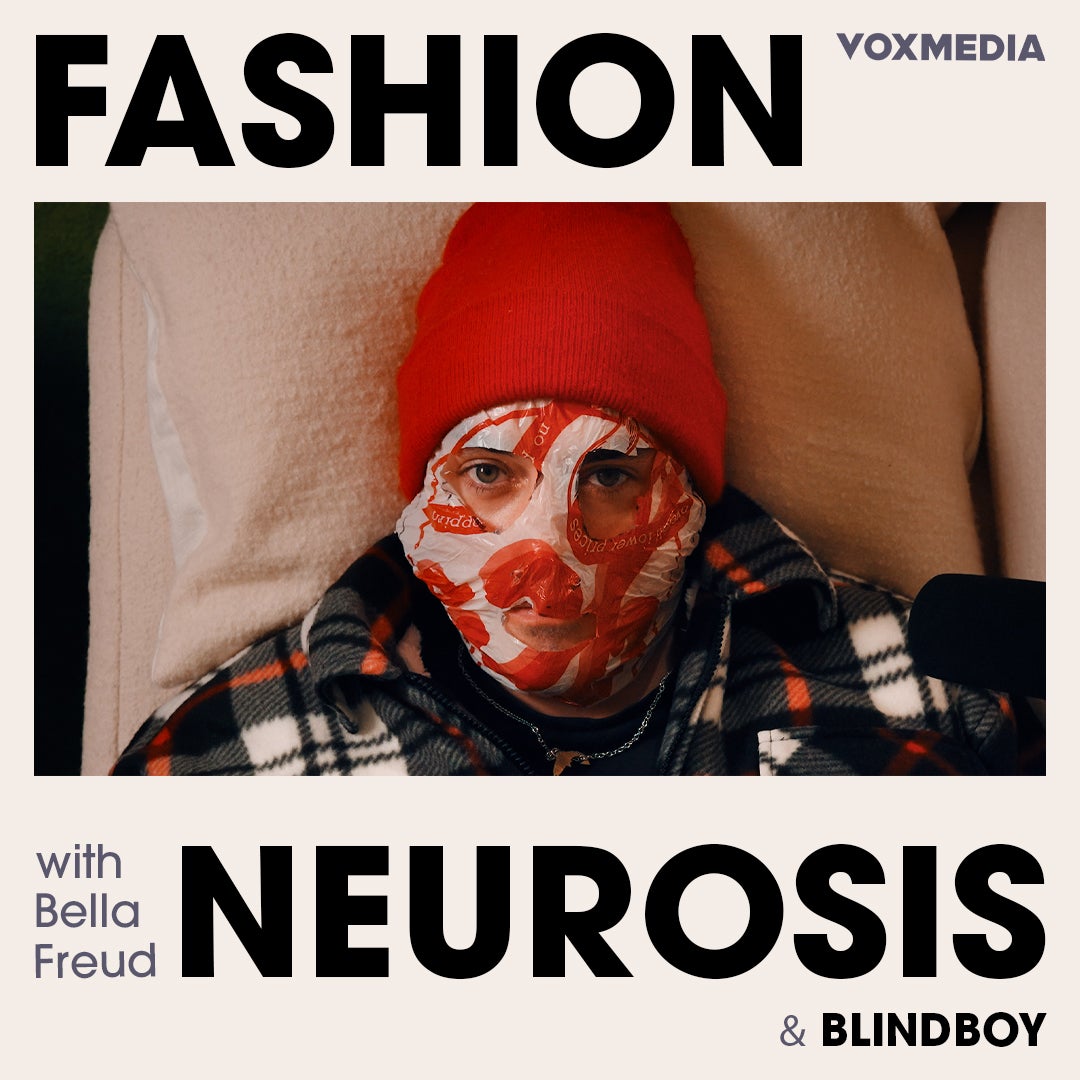
Blindboy (Irish podcaster, writer, musician, cultural commentator; wears a plastic bag over his head as part of his public “mask” and sensory comfort). Sue Bird (host of Bird’s Eye View; former WNBA player; joins to ask about Blindboy’s experiences and autism-related themes). Georgia Amor (Washington Mystics point guard; appears in the episode intro segment).
Clothing is “social communication,” but for Blindboy it’s primarily sensory regulation; tight or irritating fabrics disrupt focus and can block intelligence/learning. He describes stimming as intense joy and compares it to “computer fan” heat. He argues shame is a “contraction of self” and that anger can protect against shame. He rejects solemnity as a performance that masks absurdity and suppresses real emotion, advocating humor even in serious contexts.
Electric shocks from a plastic work shirt leading to a Pavlovian shift away from beans; using a spoon to discharge static. The Salmon of Knowledge (Fintan/Fionn McCool) as an analogy for autistic stimming (thumb-sucking). His diagnosis process included the question about why he wears a plastic bag. Sleep paralysis and dreams tied to his father’s sudden death.
Written by AI. May contain mistakes.
Blindboy discusses his personal challenges with fashion and autism.
“Apple Watch Series 12 measures your heart rate every five seconds with the most accurate heart rate sensing in a wearable.”
Blindboy discusses his personal challenges with fashion and autism.
“And what I'm wearing today is, so I'm diagnosed autistic and these are what I would call my autism clothes.”
Exploration of how clothing affects sensory perception for neurodivergent individuals.
“I don't know why, but women's socks are just cheaper.”
Blindboy shares the myth of the Salmon of Knowledge from Irish folklore.
“This shirt generates so much static because of the plastic it's made out of that I get electric shocks from door handles.”
The tale of Fionn McCool and his quest for knowledge through the salmon.
“So before we could write our stories down, we still had epic tales and people had to hold these tales in their mouths, in their brains.”
Learn about the ancient Irish story of Fionn McCool and its connection to autism.
“And when I eat it, I am going to attain all the knowledge of the world.”
Explore personal experiences related to stimming and the joy it brings.
“because that sounds to me like a two, three thousand year old story about an autistic kid.”
Discover anecdotes about Uncle Noel and how they shaped my childhood perspective.
“with a very interesting story and then run away am I talking too much Bella oh god the thing is about how you talk is so interesting and it kind of, you know, refreshes the parts.”
Discuss the challenges faced in school due to autism and sensory sensitivities.
“And I used to, like, I only got diagnosed about three or four years ago.”
Explore the deep emotional effects of shame and its irrational nature.
“Because what's happening is you're having difficulty writing a story.”
Discuss the relationship between nudity in art and personal feelings of shame.
“And what I'm very interested in is the emotions that pop up to protect me or humans in general from shame.”
Delve into the challenges of being autistic in the public eye and the concept of masking.
“Also, I've got to tell you that your shirt is quite trendy.”
Reflect on personal experiences with autism and the societal implications of ableism.
“Like, this, I only got diagnosed as autistic four years ago.”
Examine how public personas can mask true identities and the impact of fame.
“Well, it's a wonderful thing because everything is great that comes out of your mouth.”
Discussion on the cognitive load of social interactions for autistic individuals and personal experiences in psychotherapy.
Discussion on the issue of solemnity in mental health conversations and the importance of humor.
“And then you said, part of the problem with the mental health conversation is it's treated in a very solemn fashion.”
Explore Viktor Frankl's insights on finding purpose even in dire situations.
“One of my favorite books about this is, oh, fucking Viktor Frankl's book.”
Discusses the impact of solemnity on expressing true emotions during grief.
“Solemnity is, it keeps us from our true emotions.”
Delve into childhood experiences and their lasting impact on awareness of adult behavior.
“And you say that's 90 % autobiographical, that particular story.”
Examines the therapeutic potential of MDMA for addressing extreme trauma.
“So when I was writing that short story, flow state, as I spoke about earlier, flow state is a state of complete nervous system safety.”
Learn about the therapeutic use of MDMA for trauma recovery, as discussed by a psychologist.
“It reminds me a little bit of, on my podcast, I had a guest called Dr.”
Discover how writing and journaling can help process traumatic memories and emotions.
“story about the boy who tortures a cat and then sets it on fire.”
Discuss the challenges faced by autistic individuals in understanding empathy and social interactions.
“I mean, journaling is fucking wonderful.”
Learn about the chilling distinction between trauma responses and psychopathy as described by a psychologist.
“And he said, this is very, very common for people who are neurodivergent.”
Understand how to create emotional connections through vivid descriptions in writing.
“It was a brilliant, brilliant line and I, you know, just...”
Explore the concept of shame and individuality, emphasizing intrinsic self-worth regardless of societal evaluations.
“But that's, I'm going to definitely do that now.”
Dive into the dynamics of performative masculinity observed in gym environments and its implications.
“That's 10 ,000 words about one man biting another man's arse, right?”
Explore a shocking encounter in a communal shower that illustrates themes of masculinity.
“He can't be the alpha male and be ashamed of his arsehole.”
Discussion about the deeper meanings behind the actions of a bodybuilder and one's internal thoughts.
“But that story that I wrote about him, the story opens with, sometimes I have a dream about wrapping all the skin around my body.”
A reflection on the speaker's journey of recognizing personal misogyny and societal influences.
“I was, I'd say, in my late 20s, it would have been around the Me Too era.”
Understanding the challenges faced by women in creative fields through personal experiences.
Exploring writing techniques and the emotional weight behind concise storytelling.
“And he would have to condense the story into the shortest pieces of information and then telegraph that back to the newsroom.”
A discussion on the uniqueness of Hiberno English and its fluidity in storytelling.
“Yeah, I have a, well, it did exactly that.”
Learn about the fluid nature of meaning in literature and art through the lens of Joyce's work.
“And Joyce opened Ireland's first ever fucking cinema.”
An exploration of personal style choices and their implications on self-identity and social interactions.
“I wanted to take you back to your clothes.”
Discussing the desire for acceptance in the literary community and the importance of focusing on one's unique voice.
“that I wasn't jealous of Cullum's writing because he's a fucking astounding writer.”

Get the gist, explore an idea or ask about something said.
 Claude
On Fashion Neurosis with Bella Freud, what are the key points of this episode?
Searching your listeningAutomatic transcript. May contain errors.
0:00Your heart can tell you a lot about your health. Apple Watch Series 12 measures your heart rate every five seconds with the most accurate heart rate sensing in a wearable. So your vitals app, now with heart rate variability, can tell you when something is off. And your readiness score can let you know when to rest and when to push. Hear the story in every heartbeat with Apple Watch Series 12. The features described are for wellness purposes only and not for medical use. iPhone 11 or later required. Based on Apple conducted study of heart rate accuracy August 2026. Visit apple.com slash apple watch series 12.
0:30Support for the show comes from Google Gemini. You know that moment when curiosity strikes? You're exploring a new city with a family and a sculpture catches your daughter's eye. What is that? Who made it? With Gemini, you can snap a picture and get a fully interactive breakdown of its history, architecture, and even hidden secrets. Gemini is built for moments like that. Whether you're learning something new, solving a problem, or looking for your next favorite thing, Google Gemini is here to help. Download Gemini, Google's AI app, or visit gemini.google.com to learn more.
1:09Hi, Sue Bird here. I've got another brand new episode of Bird's Eye View for you this week. Joining me on the pod is Washington Mystics point guard Georgia Amor. We talk about the lessons she learned from the Mystics' first playoff push since 2023, three, making the most of her skill set given her size, and what it would mean to make the Australian national team. Check out Bird's Eye View on YouTube and wherever you get your podcasts.
1:42Hi, come in.
1:50welcome to fashion neurosis blind boy boat club what is the crack fella can you tell me what you're wearing today and why you chose these particular clothes the reason i so the first off the reason i wanted to come on here is to really step outside of my comfort zone because I don't like clothes. I'm shit at dressing myself. And what I'm wearing today is, so I'm diagnosed autistic and these are what I would call my autism clothes. The issue I have with, I don't want to say fashion, but just like wearing clothes is, it's another form of social communication it's another form of social communication where you need to understand rules and when you wear clothes you're communicating something about yourself to another human being you're saying something about your interest your personality your class status just by the how you choose to wear the clothes and that is difficult enough and then the sensory part of it a lot of clothes for me I mean clothes are uncomfortable physically for a lot of people but when you're autistic or neurodivergent that gets turned up a little bit so what I'm wearing now I would never ever wear this in public ever ever um these are my private clothes and every single aspect of what I'm wearing no part of it is about communicating anything to another individual this is all about my sensory needs so these shoey things I have they're from a company called Hoka they are orthopedic slippers I suppose you'd call them they're sliders but they're not just sliders they have a lovely big chunky sole So when I wear them, it feels like walking on air.
3:50My socks, they're just cotton. I buy women's socks. I don't know why, but women's socks are just cheaper. So I get five for a fiver in my supermarket and I repeatedly buy them. My underpants, I'm not going to show you, but I bought 364 pairs of Belgian underpants. It doesn't matter that they're Belgian. it was I was on a tour in Belgium and I was had time off from a gig and I went into it was an outlet store and they had a fantastic underpants sale so I bought a year's supply of underpants in Belgium and took them home so I'm wearing uh I think what number 167 of the Belgian underpants I don't know the number but um then these tracksuit pants they're 3XL Slazenger 100 % cotton.
4:44I've been wearing these tracksuit pants for maybe 20 years, but I have maybe 10 pairs of them. I choose, if I find clothes where it's more than just, like every person comes home and they have the clothes they lounge about in the house in. Every person does that. But for someone who's autistic it means a hell of a lot more it's how it was described to me was my my nervous system I am able to feel calm I'm able to be myself when I'm not being distracted by uncomfortable fabrics uncomfortable everyone experiences uncomfortable fabrics neurodivergent people can't not focus on it. That's my experience.
5:34So these Slazinger pants or trousers, as you call them over here, I've got like nine, 10 pairs of them, 3XL. This shirt, I mean, this is a piece of shit, but I love it. It's just a workwear shirt. It's made out of some type of bizarre plastic-y thing. I have to carry a spoon around with me when I wear this. This shirt generates so much static because of the plastic it's made out of that I get electric shocks from door handles. So I have to carry a spoon around in my pocket just to, the electric energy goes in there instead. I didn't know that stopped that. Oh, it does. Yeah, it does. That's a really good tip.
6:24that are keys keys are fantastic too so I carry the spoon around and then once I do that before I touch a door handle because I hate that I hate that charge at one point actually sometimes I will wear this shirt outside the house because it's what I'd call socially acceptable this shirt bizarrely changed how I made food now that sounds mad but just before the pandemic I tried going vegan for a while. And when I tried going vegan, I became very interested in beans, obviously, because different types of beans and pulses are a great way to make stews. And I found myself drifting away from purchasing beans and I couldn't understand why.
7:13And then I figured it out. I was generating a really strong electrical charge in this shirt. And when I would go to the canned goods aisle when I'd reach for that tin of beans I swear I used to get an electric shock and I wasn't like I'd notice it and it was horrible but I wasn't consciously clocking it and it developed a Pavlovian response for I naturally drifted back towards meat because the meat wasn't giving me electrical shocks you know what I mean yes um and then what else am I wearing so this is just again I buy this in a shop called Guiney's which is a really strange shop back in Ireland it sells incredibly cheap clothes it's where old men buy their slacks you know older Irish men have a way of dressing that kind of a tweed and slacks and they buy them in this shop called Guiney's but in Guiney's they sell everything so I buy multiples of this shirt I have maybe 15 of this shirt.
8:17Again, it's about 2XL, 3XL. This is about how my body feels when I wear this. T-shirt, it's just Uniqlo cotton. I like to have 100 % cotton on my body. And I've got this necklace here. I don't know. The necklace is more for me. Can you see it? I mean I'm not trying to communicate anything with the necklace it's was made for me a custom piece by a jewelry designer in Waterford in Ireland and what it is is it's a salmon from old Irish money when I say old Irish money I mean like would have stopped around 1992 before we entered the euro but we used to have a 10p coin and on this 10p coin was this salmon.
9:11Right, I remember that. This is the salmon of knowledge, yeah, it's from Irish mythology, the salmon of knowledge. And that's a story that all Irish kids grow up with is, I mean, when I say, now this could be 10 ,000 years old, this story, this story would have been written down in the 10th century, but it comes from our oral mythology. And what I adore about not just Irish oral mythology, but any oral folklore is we're talking about literature that existed at a time before the technology of writing existed. So before we could write our stories down, we still had epic tales and people had to hold these tales in their mouths, in their brains.
9:57But we didn't just hold them in our mouths or brains. We held the stories in the landscape. So a tree, for instance, becomes very important because that tree is like a mimetic point that allows someone to remember a certain story or a lake. And this here, this salmon, this salmon was a fellow called Fintan and he lived in, you can still visit it, it's called the Shannon Pot. It's a little spring, a natural spring up near Sligo. And the thing is with the Salmon of Knowledge is the person who could capture this salmon would attain all the knowledge in the world. Because within pre-Christian Irish mythology, we didn't have heaven or hell.
10:51We didn't really even have, we had kind of a cyclical time. we didn't have linear time and there was our world that we live in the physical world but then at all times there was a mirror reality called the other world which didn't exist in the future or past but a parallel almost like a quantum thing and in the other world you could access this through certain points the fog in the morning was a way to access the other world also natural springs of which there Armani in Ireland. So any natural well where water would bubble up from the bottom, and especially wells that contained mineral water, it could be zingy on the tongue because it might contain zinc or minerals.
11:35These were venerated as sources of knowledge. So the poets and the artists thousands of years ago would visit these wells in Ireland to drink the water so that they may get inspiration. They believed that if they could drink the water with the bubbles from the other world, Then they could achieve all knowledge and memorise everything and memorise all the stories they needed to memorise because writing didn't exist. They hadn't heard of writing yet. That only came in the fifth century with St. Patrick. So this salmon, the salmon of knowledge was a salmon called Fintan who lived in one of these wells.
12:14And Fintan ate hazelnuts that fell from a tree that was fertilised by one of these wells. And whoever could catch Fintan the salmon would attain all of the knowledge in the world, all of it forever. And there was a young boy called Fionn, Fionn McCool. And when Fionn was a little boy, he had too many questions. He wanted to know everything. And his parents couldn't answer his questions. And then they said, you know what, Fionn, you have too many questions and we don't know the answers. we're going to send you to the forests to live with these wise women. We wouldn't call them witches. They were wise women.
13:01So Fionn went to live with the wise women. And then they couldn't answer his questions. He had too much curiosity about the world. And then the wise women said, do you know what? You need to go to the poet Finnegas. And Finnegas is the wisest man that we know. He is the wisest person in Ireland. so Fionn travels to meet Finagas and Finagas is an older man and he is fishing beside one of these holy wells and Finagas has spent his life trying to find the salmon of knowledge to catch it he has learned all the stories all the knowledge but the one thing he needs to do is to catch this salmon so that he can eat it and get get the knowledge of the world so young Fionn Macool who's about 10 years of age at this point says, I'm going to help you.
13:49I'm going to help you to catch this salmon. I'm going to become your assistant. I want to learn from you. So he does. And finally, one day, the old man, Finneges, the poet, catches the salmon of knowledge. He has it and he's thrilled. And he says, I'm going to eat this. I'm going to eat this. And when I eat it, I am going to attain all the knowledge of the world. So he gets the salmon and he puts it on a spit over a fire to cook it but he's tired he's tired because he's spent the day trying to catch that salmon so he says to young Fionn McCool will you turn the spit on this salmon please and I'm going to eat it later so young Fionn does but as he's turning the salmon he notices a blister appear on the skin of the salmon and then he gets his thumb and he puts the blister out and when he does that he goes fuck it out he sucks his thumb and then he gets all the knowledge of the world it goes to the young boy and it doesn't go to Finnegas but Finnegas is cool with it because he's like the salmon chose you and then from then on whenever Fionn McCool wanted the answer to anything or to remember a poem or remember a story he just sucked his thumb I love that story because that sounds to me like a two, three thousand year old story about an autistic kid.
15:10That's what that sounds like to me. He has so many questions, they can't get the answers. And then when he sucks his thumb, that's stimming. God, that's so good. Yeah. When I generate those electric charges in my body and I need to have that spoon, often it's because I spent a good afternoon stimming. There's things that I do privately as an autistic person that I just will not do in public. I'll wear these clothes and I will spend hours pacing up and down and rubbing my hands. I have a callus on my hands from rubbing like that. When I do that on the outside, it looks like the behavior of a crazy person.
15:49But for me, it's intense joy. It's like when a computer gets really hot when you ask it to do a big task and the fan starts going quickly that's what stimming feels like for me so that salmon a knowledge story that is a ancient Irish story about an autistic kid that's what it means like to me for me what the 10p significance when I was a little child I had uh I had an uncle old fucking Irish uncle by the name of Noel and I'd have been maybe four years of age and Noel was what we'd call in Ireland a mineral uncle and what what I mean by that is you might have some kind of semblance for this because I know your grandmother's Irish she ran a pub didn't she yes yeah so if you're Irish or if you're Irish in England you'll know about these mineral uncles it's an old Irish uncle and you meet him at a communion you meet him at a wedding and they would come up to you and they'd say you have a tin of mineral you have a tin of mineral and it's a noise but what it means is the uncle is saying will you have a tin of mineral now that actually ties into what I was saying earlier about the holy wells in Ireland we call fizzy effervescent drinks minerals and we don't do it anymore but old uncles used to, minerals.
17:13And that's a really beautiful thing because in the 1940s, 1950s, all of a sudden you've got fizzy drinks, you've got fizzy orange, Coca-Cola. When older Irish people would drink these fizzy drinks, the reference that their tongue had for this drink would have been maybe a holy well that might've had zinc in it or might've had some type of metal that would've tasted zingy. So we started to call fizzy water, mineral water. so my uncle Noel was one of these mineral uncles and whenever I'd meet him he'd be like you have a tinny mineral tinny mineral or what he would do is he used to do this fucking brilliant magic trick that I thought was astounding when I was four he'd stand over me and he had this big fucking red head because he used to smoke like 60 majors a day may I don't know if he had majors or did you have majors here my grandfather used to speak an irish granddad uh he he lived in ireland but he was god knows where he came from but he he lived there married to my irish grandmother so majors were like in ireland they were nicotine stain on the mustache very very powerful cigarettes when i was a kid when we were nine or ten and we used to smoke cigarettes if you were a child and you got addicted to cigarettes you'd have to smoke major in order to get off cigarettes that was that was the urban legend they were so strong so horrible if you were a child they'd turn you away but my uncle no anyway he smoked so many cigarettes that his head was a shade of pink tipperary red we'd call it and 60 fags a day like the blood isn't going to be flowing all over your body properly so what no used to do is he would take out a 10 P coin with this salmon on it and stick it to his forehead and it would remain stuck to his forehead with the power of uncle sweat and I'd put my hands out underneath as a little child like it was a communion and we'd wait we'd wait for the 10 P to drop off his head right and then it would drop down off his forehead into my little hands and I'd get to keep the 10 P but no it was so fucking unhealthy from the fags right that he'd walk around with this white indentation of the 10p on his head for the rest of the day the blood wouldn't come back the blood would be like fuck that i'm not going off to his head he's smoking 60 fags a day i'm not going off to his head i'm going to stay here on his chest so he'd walk around with that all day and what i used to love though about the 10p i was too young to understand what money was I didn't know this could be exchange for goods and services what the 10p meant now my dad was probably a bit autistic as well because when people would visit the house my dad used to jump out the back window which is quite autistic behavior but when my uncle Noel would leave my dad would come back in and I knew if I got the 10p off Noel my dad would tell me the salmon of knowledge story that's what it means to me so this is the only thing on me really that this is for me um does it serve a purpose do you know what it fucking does because if I'm anxious about small talk I can whip that thing out and speak there for about 20 minutes with a very interesting story and then run away am I talking too much Bella oh god the thing is about how you talk is so interesting and it kind of, you know, refreshes the parts.
20:52I mean, it's just everything you're describing. I've got some kind of recognition of some of it. And I had an uncle, Sonny, I couldn't understand anything he said. Brilliant. I just remember. That's a mineral uncle yes and he was so great and so kind and great with dogs and so it's you know and listening to your podcast and and reading your stories that you everything you say just opens up all these other avenues and it's just so thrilling to to listen to so I can't really answer your question except for thank you very much but I mean that's why I do it that's the joy um as a writer you know you were asking Colm Tobin or I was listening to it when you were chatting to Colm Tobin and Colm was talking about I think he was critiquing the phrase write for yourself you know uh he was kind of saying you know if you're writing right for yourself you should have some awareness of an audience and I agree with him but I the only reason I write is so that I can have the opportunity to do it again if if I write a book it's so that that book can be successful enough that another book can happen my joy is is in the process the bit in the middle I I don't like it when a book gets published I don't when a book gets finished it It feels like a little death, you know.
22:32I adore the process of experiencing flow. That's what I'm into. Yeah. Flow state. Yeah. If I can access flow state, I'm in heaven. You know, I don't believe in heaven or hell. Heaven for me, it's in the present moment and it's when I'm in flow. And when I'm in full flow writing a piece of fiction, it's like I'm in the cinema and a film that's made just for me is revealing itself to me and it is the most beautiful feeling in the world and everything about my life is to try and chase the dragon of that feeling these clothes are important to that if I'm to experience flow my nervous system needs to be calm I can't have a set of trousers on me that are feel too tight or a jumper that I'm very aware of.
23:25And this is why, like I failed school, you know, I went all the way through secondary school, but I, in Ireland, we have a thing called a leaving cert, which is like the A-levels or whatever, GCSEs, whatever you have. I left school without that qualification. So I failed school and I could never understand why. I just called myself lazy because I'm deeply curious. I love learning. I am very good at remembering things. And I think with school, my nervous system could never relax because I have the noise of simply being in a space with other people, having to read the teacher's face while they're trying to tell me information and I kept getting suspended because I wouldn't wear my school jumper.
24:17I would not wear it. God, that's so ludicrous, isn't it? You know, yeah. And I used to, like, I only got diagnosed about three or four years ago. So the thing is with getting diagnosed with autism, you have to go back on your, it's, there's a bit of a, it's a bit of a psychoanalysis thing. You got to go back right back to your childhood and reinterpret everything through the lens of knowing now that you're an autistic person. So I knew I hated clothes. I knew I hated certain fabrics. But when I was not wearing my school jumper and getting suspended, what I had told myself was I was just a little prick.
25:01I hated the fact that I was being told what to do. I was defiant. But these are just the shame-based excuses that I'd made for myself because I did not have the language to know, actually, you are an autistic person and you sense the world very differently. And fabrics for you specifically, it's turned up a bit. For all the people at six or seven, everyone gets annoyed with fabrics. The autistic person, it's up at about eight and when it's up at eight or nine you cannot ignore it yeah and when you can't ignore it the attention that you need to learn about history to pay attention not happening because it's like a wasp in your ear all the time so I do know that about myself now and it's very helpful because for navigating shame you know we were speaking about shame beforehand And shame is, I think it's the worst.
26:05It's the most painful of all the emotions, I think, shame. A wonderful description of shame I heard recently was, it's the sudden contraction of self. Yeah, my God, that's so good. It is, exactly. Isn't it so true? Yeah. It's like you cease to function. You have a shame attack and then they call something called a shame spiral and it's like you disappear down and nothing works anymore except for the heat of embarrassment. And yeah, it's so that jumper you were describing literally stopped you from being able to use your intelligence because of how much it irritated your system. It'd be one of the, let's think of them as distractions.
27:02And in order for me to achieve flow, I need to relax. I need to be relaxed. I need to be safe and happy. Safety. We hear the word safety a lot. And like, all you got to do is look at kids. You just got to look at little kids. The little child who is playing is the child who feels safe. and when we're adults and we're artists and we're fucking creating we're just playing that's all it is it's it's a much more I don't want to say sophisticated but creativity creativity is adult play and just like little toddlers to create effectively you need to experience a feeling of safety and I can only experience flow when I feel safe mainly when I'm creating I'm trying to feel safe from the fear of failing and like fear of failure that's where that shame comes in yeah if I'm sitting in front of a blank page and I cannot write and I'm getting a bit of block shame steps in and when my shame is like shame is the sudden contraction of self but also the thoughts that you experience that I experienced during shame is my thoughts it's a negative global evaluation of my entire self.
28:27You know what I mean? Because what's happening is you're having difficulty writing a story. Who gives a fuck? Who gives a shit? You're having difficulty writing a story, but that's not the inside of my mind. The inside of my mind is, ah, you are a worthless piece of shit. Everything. Even if I look to a previous success where I created a piece of work I was happy with, my shame would step in and say, no, no, no, that was a mistake. That was an accident. Now, right now, you're finding out you are nothing. You are absolutely nothing. And that is shame. And what I'm very interested in is the emotions that pop up to protect me or humans in general from shame.
29:16Anger, anger, when anger comes in, especially the irrational anger. I'm even doing it now with my fists. It's very easy to somatically feel anger. It's actionable. Your brow furrows, you know, you do this, you grit your teeth, there's all these things. And anger, I think, often pops in to protect us from shame because what the fuck do you do with shame? Yeah. You're trying to crawl into this hole that doesn't exist. You know, it's vulnerability, nakedness. that's what I love about your dad's work by the way I feel that's I mean I've been a huge fan of his work all my life but oh great thanks when I would see the the way that he would paint nudity it was like a thesis on shame do you know what I mean well tell me what you mean
30:17like even part of my choice to do this this is my nudity here you know what I mean I know that having the the bag on your head is oh fuck it I never spoke about the fucking bag I know because you've described your entire outfit and then I forgot about that fuck it that's the best way to do it that's the best way to say nothing about every fucking cunt is watching this and I'm talking about a shirt from Guides and everyone's going, you're wearing a bag in your head, man. I forgot about it. I'm doing it for so long. Also, I've got to tell you that your shirt is quite trendy. Fuck off, is it? I'm sorry to, because there's a designer, very amazing designer called Eddie Slimane, who used to do Saint Laurent, then he did Celine.
31:04He was really into those kind of plaid shirts and it's not, there's not much difference between what you're wearing. Geez, I didn't know that. This is unintentional. It's kind of on trend without even intending to be. Well, that's fantastic. That's wonderful. But yeah, this outfit is my nudity. Like I was, like I'm here to do your podcast, but I'm also, like I'm aware who your father is. Your father's work was, again, he's one of the, when I was a teenager and I was experiencing mental health difficulties, there was artists became like a type of religious shrine to me. And your father's paintings would have been one of the things that I would have engaged with that would have made me feel safe, you know, as well as Leonard Cohen, Bob Dylan, David Bowie, Kate Bush, the writers like Flann O 'Brien, James Joyce.
32:04These people would make me feel normal. your dad made me feel normal because I think he might have been a bit of a mad cunt you know what I mean he was eccentric and I always drifted towards the eccentric artists because before I knew I was autistic I was just an eccentric artist and so many artists that I admire and read about they had eccentricities now these people are getting diagnosed as autistic um when I came here I'm going if I was doing a painting with your dad he'd expect me to show up in the nip well here this is me I'm in the nip these are my private autistic clothes that no one ever sees and they're just for me at home and this is about my sensory needs so this is my nudity as such, you know.
33:01The bag. I've been wearing the bag for 20 years. Like,
33:11this, I only got diagnosed as autistic four years ago. This bag on my head was a huge reason for that diagnosis. I'm a podcaster. I'm a writer. A lot of my listeners were listening to my podcast, especially autistic listeners and saying, I think you might be autistic. A lot of the stuff you speak about feels very autistic. So I said, fuck it. I'm going to get diagnosed for the crack. I'll go for a diagnosis and see what the crack is. And it was a long process, about six weeks with a psychologist. And the big question the psychologist asked was, why do you wear a plastic bag in your head? and then I said well you know it's I've been doing it for a long time I'm a public performer I'm in the public eye in Ireland um so you went to see him with the bag on your head no without the bag but he knew what my job was right and see that there's a big thing within autism called masking autistic people mask especially and I need to be clear I'm what's called level one autistic.
34:18We used to be called Asperger's, but we're not anymore because Hans Asperger was a fucking Nazi and Hans Asperger was a doctor. But when the Nazis were exterminating people that they considered to be disabled, Hans Asperger's picked certain kids and said, not these ones. These ones are going to be rocket scientists. There's something different going on here. So they became the Asperger's kids. Asperger's is now called level one autism. And that's what I am. I don't know how I feel about it because I cannot speak for people who are level two or three or people who are nonverbal. And I hate taking up that space for someone to look at me as a successful writer and go, oh, he's autistic.
34:58He did all right. My lived experience is wildly, is very, very different to someone who's level two or level three. But autistic people, especially level one, we mask. we have a personality that we have created to deploy in public situations in order to appear normal we suppress our hand movements I want to do this all the time if I'm talking I want to stim but I don't do it because it makes people uncomfortable but by myself I do it and I wear these clothes and the psychologist was saying you wear a mask for your job why do you do it And then I said, well, I'm kind of, I'd be well known in Ireland.
35:40In Ireland, I'm like Z-list celebrity, but I'd be recognized by most members of the public. And I said, I don't want to go into the fucking supermarket and have a stranger come up and recognize me and have small talk. And then he said, what's so bad about that? And I said, that's terrifying to me. Unplanned small talk with strangers is fucking terrifying. And that got me a big tick on the autism box. So this mask really, without me even knowing it, this is what we would call an accommodation. I'm trying to be an autistic person, an autistic artist. I want to pursue my interests. I want to be a writer.
36:20I want to release books. I want to make podcasts. I understand that part of that means I must engage in the public eye. I got to do things like this. I want to do this, but also take this bag off and be nobody and live a very, very quiet life where I can visit the supermarket, have my routines, wear this in the supermarket if I want. Here's the other fucking thing as someone in the public eye. I hate seeing it when the paparazzi, right? You'd have it around. You'd have some famous person and they'd go to the end of their gate and they might have a hangover or they might look like shit. And all of a sudden the paparazzi is outside and they're front page of the Daily Mail.
37:06This person is having a nervous breakdown. I was like, they're just wearing a tracksuit. You don't know that. They're just wearing a tracksuit. And that the idea of that used to terrify me. That if I am well known and I would go into the supermarket and I'm dressed like this in my sensory needs clothes, this communicates mental health difficulties. No disrespect to anyone else who dresses like this but sliders tracksuit pants excessive comfort not engaging with the social language of fashion that communicates this person is in distress this person is unwell this person is depressed that could be my ableism I don't know but what does ableism mean ableism is even though I'm an autistic person I didn't find out until my 30s which means I grew up with the rules from society that would have used slurs against people like me so one reason I don't dress like this is because I don't want to look autistic in public and that's my ableism that is that is unhelpful discriminatory beliefs that I have learned from society about people who are considered disabled you know it's like misogyny like racism we have absolutely unhealthy toxic beliefs about groups of people based on bullshit based on bullshit hierarchies and some of them too unfortunately make them make their way into modern psychiatric literature and the example I'd give there is when I did get diagnosed with autism the person diagnosing me said by the way uh this this may not even be in here in five years time my personal opinion is it won't but the best we can do is call this a diagnosis I'm conscious that I've only asked you one question we've been talking for I know a while Jesus, I don't know whether it's a good or a bad thing.
39:23Well, it's a wonderful thing because everything is great that comes out of your mouth. But I just want to, for anyone, for someone who may not know who you are, you are Blind Boy, the enormously successful podcaster with millions of weekly listeners, a best-selling author, a musician, and a cultural commentator. and you wear this plastic bag over your head, which I was looking at the pictures and it did remind me a little bit of Francis Bacon with the kind of swishy stripes. But your voice is so compelling and I wondered if anyone ever recognises you from your voice. I have had that a couple of times in enclosed spaces, yeah.
40:12I was in a lift once and I asked the person in the lift, I said what floor do you want to go to and they immediately turned to me and said it's you and then I was stuck in the lift for about 90 seconds and then they just kept promising that they wouldn't describe my face to people um it does happen sometimes the the thing with the bag is it does what I've realized about this is when you look at Superman and you think it's ridiculous that Clark Kent just puts on glasses and that's enough like it really is enough it It really is. But the voice does give me away sometimes. But what I find is when it comes to notoriety or fame, we're obsessed with the spectacle.
40:56Yeah. When people meet me without the bag, they're not meeting the spectacle. The spectacle is this. It's like when you see, you know, we're so used to hearing Homer Simpson's voice or Lisa Simpson's voice. and then you see the actual after on a talk show and when they do it you don't get that spectacle so I try and control the spectacle and the spectacle is this bag it's just like a puppet it's Kermit the Frog and if I can control that and a direct attention towards the bag then hopefully I can just live that quiet life and I've started like I'm really trying to navigate in this job that I do being autistic so what I've started to do now is you know doing one of the things that drew me to this interview too is like I don't have to make eye contact it is socially acceptable in this context for me to look up at the ceiling or to look into that camera and this is wonderful for me because another person's facial expressions after about 20 minutes can be a bit like the clothing right it's not it's not an anti-social thing it's just that gleaming the information of emotion from another person's face is an extra cognitive load and that is then distracting me from my thoughts as an autistic person whereas people who are not autistic it's instinctual they don't have to think about it yeah so this is wonderful and so glad but I keep thinking about like I could never get an answer as to why Sigmund Freud was would do this as as part of the to have the person looking into the air because I actually trained to be a psychotherapist when I was younger for about three or four years and that was another part of my autism diagnosis when I got diagnosed in my 30s the person told me you know a lot of high functioning autistic people can drift towards psychology right yeah that makes sense yeah because I told him I said when I first discovered psychology and psychotherapy it felt like someone had shown me the manual to be a human being when I learned about cognitive behavioral therapy when I learned about the unconscious mind it's like here's the manual now you can figure things out and apparently that interpretation and latching onto it as a manual is quite uniquely autistic.
43:30And what I used to love was when I trained to be a psychotherapist, I would learn, it was the Carol Rogers stuff, unconditional positive regard, empathy and congruence and being taught active listening, learning the skill of listening to another human being, reading their body language so that hopefully I could become an effective therapist for this person but a lot of my motivators for it were here's a little handbook on how to be human here's the handbook because before that I wouldn't make eye contact I'd talk over people I would monologue on facts do you know what I mean yeah yeah so I often wonder about if your great-granddad was in the room do you know that ask him yeah I'd love to know.
44:22I'd say this feels like after sex talk. Do you know what I mean? And every time I was looking at your podcast and I saw the people lying down, the visual reference is when I'm looking at a movie and people are talking when they've just had sex and after sex and intimacy, that physical vulnerability can leach into an emotional vulnerability where people even two people having a one-night stand can have this honesty yeah and I often wonder about thinking back to Freud was that an awareness of his is he hoping if I can get these people to lie down then I'll get that little 15 minutes after they fuck where they feel they're nervous they've just ejaculated they're just their nervous system is comfortable enough where they will tell me about their childhood I think that's a brilliant I've never heard anyone fuck off I promise it's a Brit but you're absolutely spot on because and he said the Irish couldn't be psychoanalyzed it's that moment of freedom isn't it suddenly you can say things that wouldn't have literally occurred in your system and and people one night stands in particular I find very interesting in that respect.
45:47I mean, Jesus, if you could put a camera somewhere, the things that two strangers would say to each other, lying back, supine, after sex, knowing they're never going to meet each other again. Yeah. It would nearly have to be pre-social media because that introduces an exposure, but I guarantee you there are people. And in the safety of that post-ejaculation release, they tell someone a deep secret about themselves and then disappear into the mist and the other thing about this position is sometimes I get sleep paralysis which is no crack and if you are subject to have you ever gotten sleep paralysis no what what I've heard of it but what does it actually some people get it it's just when you go asleep your brain shuts off your muscles oh right and i i think the very simple explanation is you know if you're running in your dream it's so that your body doesn't start running and wake you up so your brain shuts off the muscles but sometimes you can wake up and you are fully conscious in the room but that hasn't clicked in so you are paralyzed and sometimes when you're paralyzed, you can also experience hallucinations.
47:06So you see it within folklore, the hag sitting on the chest, that's the sleep paralysis demon. And then culturally that changed into alien abductions. A lot of people who experience alien abductions, it is the sleep paralysis. But if you're susceptible to sleep paralysis, you're kind of advised, don't sleep on your back because that's when it happens. So I don't sleep on my back for that reason, because it's no crack. I deeply dislike sleep paralysis, especially waking up wanting to scream when I can't. God, because I've had dreams where I haven't been able to scream. But do you kind of get a hunch of like, oh no, I think it might happen tonight or is it just completely arbitrary?
47:47If I sleep on my back, the thing is with sleep paralysis, I don't think it's trauma related, but there is another thing. I don't even think this has a name but my dad died when I was about 19 yeah and it was deeply traumatic but the trauma of it is I wasn't ready I I even though I was 19 I was I was quite immature I would have been about 15 emotionally 14 and I was not ready for my dad to die and he got a brain tumor and he died suddenly. He died within, within about four weeks. And I remember getting dreams around then, which it was a form of sleep paralysis where the level of stress in my body was so much that I would wake up in a type of abstract hell.
48:45Some people listening to this might relate. It's, it's an incredibly stressed waking dream state where the eyes haven't switched on and I'm living in a world of shapes and experiencing hell. And it only happened around the time my dad died, but it's just nervous system stress, trauma, and then the complications of sleep and waking up. But that was, that was hell because I think I was living in like a floating triangle or something. I know this is mad shit, but just the brain is mad. Yeah. My God, I suppose something has to happen. And it's such a, I mean, shock is such a bizarre thing, the kind of things that happen.
49:32At T-Mobile, the new iPhone 18 Pro is here with a big leap in battery life. And you can get it for nothing up front. With so many reasons to choose T-Mobile, you'll want to talk about it. I heard at T-Mobile, you can get iPhone 18 Pro for nothing up front and get$1 ,000 off. Pass it on. Pay nothing today. No taxes, no fees, nothing down. Pass it on. Hey, Mickey, pass it on. iPhone 18 Pro has the most advanced iPhone camera ever. Pass it on. At T-Mobile, you can get iPhone 18 Pro for nothing up front. Pass it on. At T-Mobile, get$1 ,000 off the amazing iPhone 18 Pro with no trade in needed. The 36 monthly bill credits when you switch to T-Mobile on a qualifying plan.
50:17If you cancel entire account before receiving all bill credits, credit stop and balance on a required finance agreement is due. Example,$1 ,199.99, iPhone 18 Pro, 256 gigabytes. Bill credits end if you pay off device early. Qualifying credit, new line, port in, and service. $85 more per month with auto pay plus taxes and fees required. $35 device connection charged due at sale. Visit T-Mobile.com. What if we told you there was one thing you could eat to reduce your risk of death by about a quarter? Interested? And what if we added that this magical substance can dramatically lower your cholesterol, improve your mood, and keep your weight stable?
50:49No, it's not protein. It's actually fiber, the least sexy, most overlooked nutrient of all. But what is fiber? How could one nutrient do all those amazing things? And how can you get enough? Is a powder you stir into some water going to do it for you? All that plus the strange tale of the gorilla poop obsessed father of cornflakes in the latest episode of Gastropod. Find Gastropod and subscribe wherever you get your podcasts. I'm Phoebe Judge, host of the podcast Criminal. Usually I'm telling stories about other people. But this fall, I'm headed out on the road with a brand new show. Stories about me and the people I love.
51:31It's called Don't Worry. I hope you'll come out and see it. We'll be in cities like Boston, Chicago, Philadelphia, New York, and lots more. Get your tickets at thisiscriminal.com slash live. You said something really interesting about, you know, talking about autism and anxiety. anxiety. And then you said, part of the problem with the mental health conversation is it's treated in a very solemn fashion. And I wondered, what's the solemnity and what would you change about it? So I have a huge problem with solemnity. I don't think we speak about it enough.
52:20Solemnity is the performance of seriousness. There's very rarely any need for solemnity. That's so interesting. Where you see solemnity the most, you see it in the military. Military is a very solemn space. The performance of seriousness. There is no room for laughter in the military. You see it in royalty. Like, solemnity always exists to highlight, sorry, to mask a fundamental absurdity. Royalty, like royalty is fucking fundamentally absurd. Like, if you, like, I'm a king. Why? Because a thousand years ago, my ancestor was profoundly violent and beat the living shit out of everyone in a neighbourhood and killed people.
53:18And then we took it over and we put on city hats and cloaks and performed rituals of legitimacy until this started to feel legitimate. Royalty uses solemnity like a magical ritual to will into existence authority. And then when you bring humour into it, humour isn't allowed because when humour comes into solemnity, they fight with each other and it exposes the absurdity. Another place where there's a lot of solemnity is the fine art world. It's a huge thing. You walk into a gallery space and it's as silent as a church. And often laughter isn't permitted. And a lot of people walk around fine art galleries with the fear and a terror that the person beside them is going to think that they don't understand that art on the wall.
54:13and the language of fine art because I know this I studied fine art when I was in college it's thought it's what I thought I was going to do I did a master's in it and we were trained in statements of intent how to use deliberately inaccessible language to describe your work now sometimes it's appropriate but other times it's just used as bollocks to make a piece of work seem far more important than it is and that has a hell of a lot more to do with capitalism than has to do with art right so that is the solemnity within art and it's an issue I have myself because I'm a serious writer I write literature but I have a fucking bag in my head I look like a clown and I this bag I'm proud of that I'm proud to reject the solemnity and back home in Ireland, I could be brought onto a talk show and I'd speak about mental health.
55:15I'd speak about something very serious like autism, depression, even suicide. And some people would get very offended and say, how can he speak about these things with a plastic bag on his head? Take that bag off. This is so disrespectful. And what I say to that is, you're not asking me to be serious. You're asking me to be solemn. And I refuse to be solemn because solemnity is a fucking performance. I can be deeply curious, deeply passionate, deeply respectful about something while still being silly, while still using humor. Humor is an essential part of the human condition. People in terrible situations will always find laughter in order to navigate those situations.
56:04One of my favorite books about this is, oh, fucking Viktor Frankl's book. You don't know the name of it, do you? Yeah, Man and Something in Man's Meaning or something. Man's Search for Meaning by Viktor Frankl. And it's a short book. You'd read it in an afternoon. But Frankl was, I think, Logotherapy. He was in, I think it was Auschwitz, but Frankl speaks about, even though he was in a concentration camp, experiencing the worst dehumanization, genocide, and still found meaning and purpose within that. And he speaks about the gallows humor, the use of humor in order to find meaning in a terrible situation.
56:53Didn't he have some sort of, do some sort of philosophy class or something when he was in, I was reading a comic book about existentialism. I'm sure it talked about, I think it was him doing a sort of symposium in the camp when, about suicide or death or something. I mean, so extreme and so bleak, but something to do to not think about what's going to happen next and use your capacity as a human. His thing was all about, even though he was in the concentration camp, to still find meaning and purpose. Yeah, yeah. And to never give up, even when he knows that he's going to be exterminated. He knew he was going to die, but still found on a daily basis some search for meaning.
57:45And that allowed him to survive through it, as opposed to the alternative of just giving up. And he survived the concentration camp. But from that, he spoke about the importance of humor. Humor is part of the human experience. And even when a situation is painful, there's still room for humor and for that to be respectful. Solemnity is bollocks. Solemnity is, it keeps us from our true emotions. The most solemn thing is, like, we're great with funerals in Ireland. We're very, very good with grief when we look at our place within the international community. but still you go to an Irish funeral and your friend of 20 years can be one of the bereaved people I had this experience look when my father died when my father died and I'm in the front row with my family so it's when you're at a funeral and you are the family the bereaved one of the most hurtful things of the entire funeral one of the loneliest feelings was when everybody queues up to pay their respects at the end of the funeral all of my friends people who I'm intimate with people who I have fun with who I hug they couldn't make eye contact with me and they had to just shake my hand and say sorry for your troubles sorry for your troubles mumbled sorry for your troubles and then they moved on.
59:22And that is solemnity. They were afraid of emotion. You're afraid of your own emotions and you're afraid of the other person's grief. When I was training to be a therapist, we had a lot of discourse about the box of tissues, you know, and learning about what a box of tissues means. One of the most useful things that I, for my own personal growth, was when I was training to be a therapist, we'd do groups and they were gestalt, gestalt psychology groups. So it was really about feeling your emotions and being present with another person's emotions. And I was like 22 and I would have to sit across from another person in the group, someone in their 50s or 60s who, to me at 22, that's an untouchable level of adult.
1:00:14You know, I'm just a tiny little kid and that is an adult. But I sat across from people who weep like babies because trauma is coming up. And I had to learn to sit with that person's tears. And that's when I learned about the role of tissues. We reach for tissues. We tell ourselves, I'm trying to help this person. I'm trying to, they're weeping. It's very rarely about helping the other person we're trying to distract ourselves from how uncomfortable we are with their emotions yeah you know and that's what the tissues are yeah tissues are very solemn so I learned to sit with another adult's tears so that I could sit with mine yeah you know um so fuck solemnity it's bullshit it serves pomposity that's all it does and the other thing about celebrity the performance of seriousness it is what politicians use to lie to us yeah if a politician can wear the suit seem very serious they can lie through their fucking teeth you know and we take it hook line and sinker because this person is performing seriousness well enough you know yeah no i i can totally agree because i wondered in your short story the cat piss astronaut.
1:01:36And you say that's 90 % autobiographical, that particular story. And you describe being brutally attacked as a four-year-old child by an adult woman after you explained to her and her young daughter that one day the sun was going to expand and it would engulf us all. And did you become hyper aware of what adults were capable from that attack on you as a tiny child by a grown adult so that story yeah it's it's so two things with that that the writing of that story is an example of bringing inner child work into my creative process I wrote that story as a journal to really it's one of those memories that I'd forgotten about and when you forget about the bad shit you know your brain was protecting you from that memory and when I was four or five you know deep curiosity about everything I taught myself how to read from encyclopedias adult encyclopedias because the adults around me my parents my brothers they kind of had to stop answering my questions and they just said look you're asking so many questions now that we're going to these encyclopedias to give you the answers so this is how you use an encyclopedia that's d that's f that's e and they were the world books and they became my life at about four or five and i very quickly learned how to read i mean my mother would have showed me uh phonetics but i the need for knowledge was so much that i was reading adult encyclopedias at four or five and i became obsessed with dinosaurs and the solar system.
1:03:30And what I became particularly obsessed about was the idea that the sun one day is going to expand and engulf everything. And we know this, this is a fact. The sun is just a star like any other and everything will one day end. And I found a comfort than that because I used to get anxiety about the idea of eternity. Right. You got to realize too, I had an enforced Catholic education, you know, there was no choice in Ireland. So when I was four years of age, I'm also navigating the terror of going into school and there's a six foot statue of someone nailed to a cross. I didn't grow up with religion in my house.
1:04:13Really? Yeah. Like my dad was a communist, didn't give a fuck about that stuff. So I get to school and all of a sudden that fella's called Christ he's nailed to the cross he loves you who the fuck is he? who's this cunt? and then when you're seven you're going to drink his blood and eat his body what? fuck off like that was his and this was big information for me and then I'm going home to my parents going I'm supposed to eat this cunt's blood is that real? and they're like no no that's not real look we have to do this so you can go to school and I couldn't parse here's this science I'm learning about the solar system and then I have to eat the blood and body of an Iron Age carpenter when I'm seven.
1:04:57And those two things didn't bode well. And also I hated the idea of the eternity of heaven. It just seemed like, oh, for fuck's sake, is it ever going to end? And I used to say it to the nuns, you mean forever? And she'd say, but don't worry, God loves children. You're going to go there forever and ever. But when's it going to stop? When's it going to end? And I know what my anxiety there was. At four, I fucking hated school. I vomited so much on my first day of school, I had to be brought home because I couldn't handle being around people. And I couldn't wait for that bell to go so that I could return home and get into my comfy clothes and listen to Mark Boland was my thing.
1:05:42That was my thing when I was that age. Ironically, my first ever album that I purchased was on tape. It was Mark Bowden, T-Rex, Greatest Hits. I bought it when I was four years of age. I purchased that with, remember my uncle earlier, Noel, who had the 10p? One day, Noel didn't have the 10p and I got the hands out, like communion going, where's the fucking 10p, Noel? And he reaches around his pocket and he has to begrudgingly give me five pounds, which was way too much money for a four-year-old. So Noel gave me five pounds and my brothers took me into town and I bought T-Rex on tape. My God. changed my life.
1:06:19But I would want to get home from school when that bell rang to go home and listen to T-Rex. And when the nuns would explain to me the eternity of heaven, I used to get a pain in my belly because it's like, when's the bell going to go off? That sounds awful. I want it to end. So I used to get great comfort in the idea of that fucking sun though. That sun's going to bloody expand and everything's going to end. So the sun became the great school bell in the sky oh my god but anyway one day I go to a fucking playground around the corner from my house and all I want to talk about is the planets and I used to love seeing an adult because adults would be more receptive to facts about the planets than other little children were other little kids were not into the planets they were into their own kid shit I'm into the planets so there was a little girl on a swing with her ma and I went over talking about Venus talking about Jupiter and then I went talking about you know the sun's gonna fucking I wasn't saying fucking at four but the sun is going to expand and everything's going to end and the little girl on the swing said mommy is that true to her mother and the mother was getting annoyed and said, no, that's not true.
1:07:36And then I went, Dave, shit. Yes, it is true. It's in the encyclopedias. The sun's going to expand. And I think what happened is that the fact, my fact about the sun expanding, the adult woman who was probably in her forties, that gave her anxiety. She had never thought about that's going to happen. And before I knew it, I just remember she grabbed me by the hair and beat the living fuck out of me. She beat me with her fists the way that you'd beat an adult. And I ran home with blood down my face. And one of the things that fucking broke my heart is that when I went into my mother I was obviously such a little lunatic that my parents wanted to know what I said rather than you've just been beaten by an adult.
1:08:31And it still makes me fucking angry today. The big problem is, I think I know who that woman is. There's about three different mas. But the problem, I was so young, I can't pinpoint it. I would love to go to that woman's house and to say to her, do you remember what you did to me when I was the age that I am now? because I'm that age now. I'm in my 40s. I cannot fathom, imagine even raising my voice to a tiny little child, let alone beating a child. And I would love my little bit of justice to just say to that woman, you were 40 when you did that. That was a choice that you made. And I'm that little boy now.
1:09:18And I just need to let you know. And I wouldn't ring the police, wouldn't do anything. I need to let you know I know what you did and that was despicable and I'm standing before you as an adult there's no excuse for that behavior so I mean that was a tough one for me I mean it's so depraved to yeah do that I didn't start remembering it until adulthood I didn't start remembering it um I can viscerally recall the pain on my head of someone pulling my hair that hard So when I was writing that short story, flow state, as I spoke about earlier, flow state is a state of complete nervous system safety.
1:10:04It reminds me a little bit of, on my podcast, I had a guest called Dr. Paul Litnitsky, and he is a pharmacologist and a psychologist in Australia. He was given the license in Australia by the government to investigate LSD, MDMA as part of therapy. And he uses MDMA in particular, therapy for people with extreme trauma. And how he described the MDMA to me was he said, when the patient, when the client is experience in MDMA, they can feel a sense of safety in their body that they can revisit the incredibly traumatic memory. So in the instance he was describing to me, it was a veteran of a war who had seen something horrendous at war.
1:10:58And while using MDMA, was able to walk through the steps of what happened on that day and what he saw and for his nervous system to be calm and safe. And flow states a bit like that for me. When I enter flow and I am so unbelievably, not just safe, but experiencing the bliss and vitality of existing because I'm doing what I'm supposed to be doing, then I can go back to those childhood memories. And I can, as an adult, hold the hand of me when I was four and stand back and watch in the playground as I was being beaten, you know? Because you have this, I mean, it really stood out to me, this ability, like I've been reading your short stories in Topographia Hibernica, and you describe people's casual cruelty and the story about the boy who tortures a cat and then sets it on fire.
1:11:56and you describe him as being curious to what will happen next. And you say there are bits of you in all these stories, but clearly there's none of the sadism. You know. You write with this kind of, it's almost dispassionate, but it's not, it's completely with compassion, but it's this, I mean. That line there, so that would have been around stuff I'd have seen as a kid. Yeah, yeah. I so recognize that as well, this kind of, you know, this Lord of the Flyers behavior. But do you think when you're writing it, it stops it from living inside you and destroying you with sadness? Yeah. Getting things out onto the page.
1:12:45I mean, journaling is fucking wonderful. Journaling is a wonderful thing. I mean, when negative thoughts or thoughts of shame or hurtful things are washing around in the head, once you get that out onto a page, you're staring at it. You have it there. You can view it in a more objective way. Regarding the cat torture. you know like so so another thing that happens when you're an autistic kid is when you don't do well in school you get grouped together with other kids who don't do well so I would have always been thrown into what's called the bad class and within that bad class you've got kids with who can't concentrate because of learning difficulties like myself then you have other kids who can't concentrate because they're undergoing the trauma of abuse or the trauma of poverty and when you find yourself in that situation you have to achieve self-esteem and status by being unruly you identify with being unruly so I hung around with a lot of traumatized kids and some of these traumatized kids would hurt animals, especially at Halloween.
1:14:03And I saw cats being thrown on electrical wires. They would throw the cats up. And the kid who could do that was feared. He was called a mad bastard. And the curiosity line there is, that was something that was said to me by the psychologist who diagnosed me as being autistic and what stuck out was some people who are autistic in their moments of shame can actually think that they're sociopaths or psychopaths and what I'm and it's it's a common fear that some autistic people have because we can struggle with listening to other people in conversations because we can monologue on topics that we're interested in.
1:14:52These are selfish behaviours. They're labelled as selfish. And in our moments of shame, sometimes we can wonder, fuck it, am I one of these psychopaths? Am I someone who's lacking in empathy? Because I didn't listen to this other person today. Instead, I spoke about what I was interested in. And... So you've had those kind of thoughts about... Yeah, am I a sociopath? Before my diagnosis, and I said it to my psychologist, And I said, you know, at times of great shame, I'd wondered this about myself. Am I someone lacking in empathy? And he said, this is very, very common for people who are neurodivergent.
1:15:32And he said, and this is what stuck out to me. He has worked with people who would be considered psychopathic or sociopathic. And he says, what stands out with those people is he's been in prisons. and there have been people who have done, committed horrible acts of violence to other human beings and have been cruel. But those people are not psychopaths. They're traumatized or whatever. But he said the psychopaths, they have a curiosity about another person's pain. Oh my God. And that hit me like, isn't that unbelievable? What a chilling description. Because the thing is, we've all seen it. Yes.
1:16:13We've seen that person. they have a curiosity about another person's pain and that is just fuck I can't relate to that so that hit me so much I decided to give it to that character because you see in in that moment in the story the story it's called the pistols of the dandelions and what this story is about it's a long kind of an epic tale of it's about two stray cats there's a bit of a watershed down vibe I was leaning in very heavily on there's an Irish writer called Liam O 'Flaherty who used to write around 1910 and he used to write a lot about nature and he would write in the third person but the voice that he would use would be the uncaring voice of nature so because nature doesn't give a fuck he would write with that uncaring voice so I brought that in and in the story there's two boys and these boys torture a cat one of the boys you can tell doesn't like what he's doing but he's going along with it but then the other boy he has the curiosity about that cat's pain yeah yeah and what I'm trying to show there is one kid is traumatized and is going along with it this other kid that's something different this person that they are curious about pain and I don't know what to do with those people because they're very, very frightening.
1:17:36God, it was such a shot. It was a brilliant, brilliant line and I, you know, just... Anyway, I'll never forget it because it's... Yeah, it's... The crack of my job is I have to go around the world like I'm sampling and you got to know when you hear a line in a pub or whatever and if you're to be a good writer, you know when to sample something. Yeah, yeah. When I step in dog shit, you know, I write it down, you know, and I sample it and I save it for later. I mean, one of the greatest things you can have as a writer is to when you experience anything, like stepping in dog shit is one of them, hitting your toes, stubbing your toe, any of these intense moments, write down exactly how it feels, save it for later.
1:18:28And then when you're stuck in a story, have your character stub their toe or have your character step in dog shit and bring in those bodily emotions what i want to do is if i can report the bodily emotions strongly enough then i can get my reader in and that reader then if i can get them to feel what i'm describing and their body then i can fucking take them anywhere yeah you know that's a that's such a genius tip But that's, I'm going to definitely do that now. And it's great crap because as well, you're journaling yourself then. And it's great around uncomfortable emotions. Write it down and go, not only am I journaling this thing and putting it down to paper and being, also when I write this stuff, I have to be so honest that I may need to throw it in the bin and burn it.
1:19:20You know, that way. When it comes to effective journaling, if you're fucking lying forget about it yeah there's no one to protect here you have to be as honest and as raw as possible and to be able to say things like i am insecure i'm jealous of other people i feel small i feel pathetic these are the things we don't like saying out loud these are the things where other unhelpful emotions step in to protect us from it but a court the thing about shame I was speaking about shame earlier this sudden contraction of self and this global evaluation of ourselves as being worthless the beauty of shame it's fucking bollocks it's bullshit it is a piece of fiction that we have written about ourselves there's no such thing as worthless we are all wonderful human beings I am better than nobody else.
1:20:18Nobody else is better than me because I am a human being and human beings are too complex to evaluate against each other. We all have this intrinsic worth. We're all born into the world as the most magnificent, beautiful little babies. That never leaves us. We just get older. That's our fucking intrinsic worth. Shame can't it. Nothing takes that away. It's forever. It's permanent. It's the weather. Do you know what I mean yeah so shame is bollocks well I was when I was reading I'll give you Barcelona I was thinking you're able to give language to the deepest and most private feelings that are hard to acknowledge as actual thoughts and and um in that story you write about the sort of alpha male codes and how delicate the balance is and you I mean it's a masterpiece that story your great-granddad was very present in that story and I'll tell you why.
1:21:14So that story I'll give you Barcelona. That's 10 ,000 words about one man biting another man's arse, right? But what the story, first off, the reason I would begin a story like that is, as I mentioned earlier, the hardest thing about writing is the fear of failure, the fear of what if I fail. So if I'm afraid of failure, I actively try to fail. If I try to fail, then I can begin to play. So how I try to fail is, fear of failure is, what if what I'm going to write is going to be shit? What if it's not good enough? Well, let's fucking start with shit. Let's start with some shit. So what I started with was, like, let's start with a terrible idea.
1:21:59I go to a gym and something I noticed about in this gym was performative male nudity. So I'm going to the changing room and I, first off, I fucking love going to the gym. I love going to the gym because it's a neurodivergent friendly space. I can wear headphones and small talk is frowned upon and I get to be around people, but not have to speak to people. And I love that. I love being around people, watching people. It's just the small talk that freaks me out. So what I noticed was all the men in the changing rooms, you had to be naked. If you wore your towel for a bit of modesty or God forbid a pair of shorts it was not popular within the room.
1:22:44You would get looked at other men would be uncomfortable and if those two men were friends they would scream at each other and make fun of each other and what it is is they're trying to be so heterosexual that they almost become gay. yes it's martin amiss i remember him writing is it gay to have sex with a woman yeah it's it almost gets to that point it gets to that point so what these may the the the male rule in this changing room was why are you wearing a towel over your dick do you think i want to look at it yes take it out good so i can ignore it and that's what it is take out your dick so i can ignore it because if you're hiding it then you're accusing me of wanting to see it so I need to see it now and that's what you're dealing with so so the rule is for everyone's in the nip everyone's nude fine dicks out no problem but now that everyone is naked how do you have hierarchy so other men would start to try and out alpha each other by being more naked than the guy beside him and the way that they would perform their nudity would be literally standing right there and bending over and pointing their anus at your face as they towel their bars you know what I mean or talking about holidays but swinging things around so it's a performative nudity I'm I'm as more naked than naked can be and I noticed this was a thing this was an unhidden language and I was fascinated by it and then one day I go into the shower and the shower was this square room and it was a Monday morning so the night before it was all bouncers they had been working in the nightclubs the night before so big strong six foot fucking four big muscly men naked washing themselves and I'm in the shower with all of them just going okay we're all in the nip we're all washing grand no modesty nothing just fucking wash yourself but then walks in this dude in his 50s who was he was about 55 he was about five four foot nine very short full of muscles old school muscle he was mahogany brown with that fake tan that bodybuilders have on and this dude was a limerick mid-50s fucking bodybuilder the type of man who doesn't he's so masculine he won't even take protein shakes he eats chickens and he walked into the shower shorter than all these huge bouncers and then what he did next fucking amazed me he went to the shower and then produced a blue razor and bent over with his anus his cheeks sparred cheeks parted anus pointed at every man in the shower and began shaving his fucking rectum at people and all the larger men got so uncomfortable that it just went and turned around and in that moment i didn't turn around because i'm autistic I didn't get the fucking social cue I stared at his rectum and said that's the silverback he just alpha mailed all these other men by pointing his anus at them and I was thinking what?
1:25:58he made a choice there like fair enough he had to shave his arse because he's a bodybuilder they put the tan on they don't have hair but he made a choice to shave his anus at us because if he'd have pointed his arse to the wall that would have made his anus a sight of shame. He can't be the alpha male and be ashamed of his arsehole. So we had to show us. But that story that I wrote about him, the story opens with, sometimes I have a dream about wrapping all the skin around my body. Sometimes I have a dream about taking all the skin off my body and wrapping it around a dog. And the dog stares at a meat version of me and terrorizes a load of people in a supermarket and I stare at the dog who has my skin over its body and I'm not afraid I want to fuck that dog's mouth and that's how that story opens and that was the first line I wrote and the reason I wrote it I was thinking about Freud when that man shaved his anus at us I just wondered about his internality and I said to myself I wonder what dreams he has what's that man's dreams that he needs to walk into the shower and shave his anus at other men's they think he's more powerful this is so fucked up what are his dreams because I do view I view people I view people like that as they would not have a very rich internal dialogue or a rich internal dialogue around their own emotions.
1:27:36And when we don't have rich internal dialogue with our emotions, it can express itself in quite strange behaviour. Yeah. Well, it was a stroke of genius. I mean, that story, God, what a masterpiece. Because I also noticed that when you write about women, even female cats, you seem to have this uncanny understanding and sympathy for what it's like to be a woman. I wondered where that comes from. God, it sounds so fucking cliched, but it comes from listening to women's experiences and recognizing and confronting my own fucking misogyny.
1:28:25I mean, I was raised, I'm a man. I identify as a man, I'm a cis man. I never had to think about or challenge any of the things that come incredibly easy to me because I am a man. I was, I'd say, in my late 20s, it would have been around the Me Too era. And then listening to, we'd say, female entertainers in my field, speaking about experiences of sexual assault and things like that. And then me suddenly being confronted with, I've never even fucking thought about that. Yeah. Or one thing that really hit me was, like my early career in my early 20s as an artist, as a performer. And when you're starting off as a creative person and you go from being some person on the internet or whatever to becoming recognized, what happens is, people with influence and power will step up usually men and they will offer you opportunities so in my early career it could have been someone running gigs a comedy promoter an agent they step in and they go I like what you're doing kid I'm gonna give you a shot yeah as a man I never have to doubt that this other dude is interested in me because I'm talented yeah and that's it it was only until I got to my late 20s and listening to female entertainers where they're like no I had to wonder whether or not he wanted to fuck me yeah and then what that does to am I talented or is this person attracted to me and they're trying to entrap me or am I going to have to trade something off or is this there's this other expectation and what hit me was I'd say I was I had gotten to my late 20s and had only ever even considered or thought about that when I heard women speaking about it and then I said that's misogyny that right there is I've never had to think about that so that and I suppose Twitter was fantastic of just recognizing of course I'm fucking sexist of course I'm a misogynist this is society is this way I've benefited from it it's told me that it's okay now let's start actually doing the work of trying to see it in myself and be okay with being wrong and learning and the same with fucking racism too you know it's like I was saying and and I'm confronting now fucking ableism I grew up being ableist labeling people with disabilities as having slurs using the r word to describe them thinking that's thinking shitty things about autistic people and now I find out I am an autistic person and a lot of the struggle is shame that is exists because of ableism that I have and now fuck I have to use it towards myself um gay people would speak about this about internalized homophobia I've heard women speak about internalized misogyny yeah you know so you can't work on this shit unless you feel safe enough to recognize it in yourself you can't become less racist without going fuck it I am a bit racist yeah yeah no it's I totally it's just how it works you know in your story about the donkey um called the donkey is so beautiful and when you you see this little kid and the donkey on the roundabout selling Christmas trees and the he has a coat hanger that he beats the donkey with and there's this look of kind of tolerance or used in it and you said I had this sense that it was a female donkey and and there was just this sort of it was like you in that description you get it that sort of unspoken language the code of you see you saw how this female put up with stuff because that's what she was used to and it was it was really um you know you didn't say anything else about you didn't quantify or qualify but reading that I was you know you've you feel sort of noted I I try to do that that is one of the examples where when I'm writing I'm consciously using craft ironically it comes from fucking Hemingway and Hemingway is one of these writers that is a misogynist writer he doesn't write a lot of female characters it's very male his biography which I love, Movable Feast which is a beautiful piece of work the women in his life barely fucking feature they're just these annoyances that come in and his writing career is the most important thing but what I took from Hemingway as a writer is he had this technique that he referred to as the iceberg technique Hemingway started off as a journalist and he was a journalist who would travel the world and I think it might have been the time of telegraphs where he could might have to go to Italy and report on something that happened in the war.
1:34:10And he would have to condense the story into the shortest pieces of information and then telegraph that back to the newsroom. But that concision in how he wrote and the economy of information then went to inform how he wrote fiction. So what he called it the iceberg, which again, most likely he was aware of Sigmund Freud when he's doing this to provide a very tightly descriptive way of writing your prose that if you can do it just right you're giving the person the tip of the iceberg but the unconscious will bubble through if you do it correctly and that will find its way up there so it's a bit of a show don't tell type thing so I try and find those little moments in my story where you're saying very little but you want to give the writer at the reader that little gut punch that makes them reflect and then something deeper comes underneath so with the beating of the donkey i'm taking a bit from young as well with this but there's there's christ christ is going on and there's always a bit of christ and that's my childhood and seeing christ getting beaten and the Crown of Thorns, there is the abuse that women put up with domestic abuse.
1:35:35And then also
1:35:39Nish has a story of one day he returned home from work and he saw a horse being beaten in the streets in Prague, I think it was, and that drove him into a nervous breakdown. You know, so when When it's something like a donkey, I am aware that I'm dealing with archetypes here. I'm dealing with very powerful imagery that means a lot of things to a lot of people. And the donkey at Christmas too. Yeah. You know, there's your crib, there's your Christ. But you don't want to be obvious with it. You bring it in and like the iceberg, all the people will fill in those dots and do what they need. My job is the economy of writing and just get that prose fucking tight so there's no bullshit.
1:36:25Yeah, I have a, well, it did exactly that. And I love the way you described, she had a head like chopped wood. And then I think the boy had a smile like a smashed shell. Was that, oh my God, it was so good. That's the Hiberno English. That's so brilliant. The thing is, and it's the same with Colm Tobin who you had on, we're very lucky in Ireland in that we speak English as a first language, but because of colonisation, because English was forced upon us, we speak the English language often with the grammatical structure of the Irish language. and that I call that's hiberno English it's English as it's spoken in Ireland that's our fucking jazz music the thing with jazz music is in the western classical tradition it's very structured you you read the music sheet you follow things but with jazz it has that there's African traditions at the roots of it and with the African traditions there's notes that don't exist in the Western scale and there's improvisation.
1:37:39So, and a lot of jazz musicians, if you go to New Orleans, a lot of them are French classical trained musicians who brought a kind of African-American folk tradition. And now you have this free form music. Irish writing is a bit like that. We're writing in the English language, but we have the wildness of Hiberno English. You can have multiple meanings. You can have a fluidity. There's no fucking rules. You do what feels right so the donkey's head has a head like chopped wood yeah it doesn't matter if it makes sense but what does it feel like in the gut yeah i could see you want to bring in the mineral uncle i always say this about uh james joyce ulysses is always seen as this impenetrable fucking book and yanks read it and they pour over it and they spend ages trying to figure out what joyce was trying to do read ulysses like your mineral uncle right a lot of ulysses is a drunk irish uncle at a wedding you know and it's how that uncle and his drunkenness is trying to associate different things together and use hiberno english to do it it's not as complicated as the yanks make it out to be read it as the drunk fucking uncle and there's a musicality in it too because yeah i mean uh joyce wanted to be a singer really yeah you can get a few of his compositions online he was obsessed with the there was an Irish tenor by the name of John McCormack and Joyce wrote a song for McCormack it's actually not bad but yeah you can hear it online the other thing about Joyce too that people don't talk about one I'm probably my favorite short story in the whole world is The Dead by James Joyce which is at the end of Dubliners and Joyce wrote The Dead in 1913 and what makes the dead so special is, well, one of the things that stands out for me is the ending of the dead where Joyce, the point of view, suddenly becomes a snowflake that drifts all over Ireland on a storm and then lands on a young man's grave.
1:39:48And Joyce opened Ireland's first ever fucking cinema. Did you know that? I read that, but I've forgotten. The Vault of Cinema. And if you think of cinema in 1913, it is an art form that's in its infancy. Cameras were often static. The language that cinema had was the language of theatre. So the ending of The Dead, and this is the man who opened Ireland's first cinema, so he's obsessed with this new art form. Joyce is imagining the possibility of cinema. He's imagining a drone shot or a dolly shot or a helicopter shot before it had been invented. and that's what you get with that story yeah it's and that's what i love that's what makes it pure modernism what i adore about modernism is it's when art is confronted with the anxiety of a new technology and instead of wilting it goes fuck that so how can i challenge this and that's what joyce's writing is jesus i'm terrified cinema that's going to do away with books fuck that i'm gonna have a camera in this story which is revolutionary in 1913 you know that's amazing Everyone's talking about the prospect of a Democratic wave in the midterm elections.
1:41:01But here's something that matters just as much. The battle to control state legislatures. That's the most important thing we should be focusing on right now. The GOP has a trifecta in 23 states, which means they control the governor seat, plus the statehouse and the state Senate. For Democrats, it's 16 states. Meaning that the opportunity to pass the policies that the majority of our state supports, things like increasing minimum wage, legalizing marijuana, codifying abortion. If Democrats flip just a handful of state legislatures, the majority of Americans will now live in a state under full Democratic control, which could have big policy implications.
1:41:43That's all on the table with the Democratic trifecta. This week on America Actually, we're in Wisconsin and we talked to Francesca Hong. We have an opportunity through Wisconsin to actually start improving the brand for Democrats. Catch us every Saturday on YouTube or wherever you get your podcasts. I wanted to take you back to your clothes. And when you get dressed, your outfit starts or ends with a bag on your head. But have you ever consciously chosen clothes to be attractive to somebody? So this is my nudity. So these are, I don't wear these in public. But when I dress in public, my day-to-day clothes, I wear a lot of Gore-Tex.
1:42:35I often say in my normal life I dress like a defrocked priest who was kicked out of the priesthood for masturbating in a cinema
1:42:47and it's very specific but it's just I dress like a fucking middle aged man who's going on a pilgrimage up a mountain because he can't stop wanking that type of way do you know what I mean all Gore-Tex I dress I love cycling in the rain Skin tights, that stuff. Yeah. And now I know outdoor clothes are after getting cool now. The Gen Z have this thing called Garp Core, which is great. But often I just, I dress for the rain. Last year, I won a fucking award. It was the Grierson Award for documentaries. And it was the biggest award I'd won. And I hate award ceremonies. I never go to them. But this one was so fucking big, I had to go to the ceremony, which means I had to think about dressing.
1:43:33so I went into Brown Thomas which is like a fancy store in Limerick and I let them dress me and I got a Hugo Boss suit but I don't really Bella I don't really Jesus Christ if I start trying to dress to impress another person it's a language I don't understand I tell you how I dress I dress to be ignored. I dress, I want to look like an Airbnb apartment. I want to look just good enough that no one's going to compliment my clothes and not shit enough that someone's going to insult my clothes. I want to blend in. I want to be cold play. I want to be, like I say, like if you're going through Airbnb, the thing with an Airbnb apartment, they're trying to look like someone's home, but it's never someone's home anymore.
1:44:27You're never actually staying in someone's home. What you're staying in is something that's run by a corporate business where they're trying to make it appear like someone's home. But if you vomit on the furniture, it's okay. They can replace it next week. So I want to look at that. I want to look like that. It's on first glance, everything's okay here nice and boring let's move on to the next person that's how I dress the question of have I ever dressed to impress someone I would fucking make a bollocks of it I'd dress like a 1960s dandy if I tried to do that I would get it so fabulously wrong that I'd be laughed out of the room so I'm just going to stick with beige and try and get away with my personality as being the thing that might impress someone when I was going on dates with girls when I was younger I used to do because the idea of going on a date would be so terrifying to me that I would have to bring them to a space where I can speak about something I'm passionate about and not make eye contact.
1:45:29And if I can just speak about this painting and show them that I'm capable of being caring and loving something and being myself and feeling safe, then they might like me. But if I turn up to a fucking coffee shop trying to dress nicely and do the eye contact and small talk they're just meeting a lunatic you know and if if you fancy someone and don't like something they're wearing does it kill your attraction couldn't give a fuck couldn't give a shit i'm interested in what the person has to say i don't i have to remind myself to look at people's clothes like genuinely honest to God I do not live in a world where clothes are things that I notice you know and I'd like to be in a world where I notice a little bit more when I listened to your podcast with Cutting to Bean and actually a jealousy came up to me and I was jealous of the world that Cutting inhabits where he is noticing what people wear where he is noticing when people have presence and stuff like that.
1:46:37And it's something you find as an autistic person. Little jealousies come up. And it's the jealousy of how social other people can be. And I reflected on it because I was happy with myself that I wasn't jealous of Cullum's writing because he's a fucking astounding writer. I wasn't jealous of that. And I liked that I was comfortable with that, you know. I was jealous of, oh, you really navigate the world and you remember this person because of a shark they wore 40 years ago. And you remember the aura they had. And I felt sad that I don't even see this shit. I don't see this shit as an autistic person.
1:47:20Because I read that you'd said, I do want to be embraced by the literary world, but The part of me that wants to be embraced is toxic, insecure part of myself. But you're a brilliant writer and it seems reasonable to me to desire that. But does that seem almost too precarious a thing to long for? It's just when, so I have difficulty being accepted by the literary community, mainly because I have a fucking bag in my head and I'm ridiculous. You know what I mean? And like I said, being solemn, the performance of seriousness and solemnity, you got to pull that off very well if you want to be in the serious art world, which I strongly disagree with.
1:48:07Often someone who is seen as a good writer, they are good writers, but also they have a personality which is this person never laughs because they're so deep in thought all the time. that bollocks I adore like someone who I love Sally Rooney I love her writing but Sally is her persona is very serious she's very controlled with it I like to imagine Sally Rooney sitting at home on her own watching Love Island and eating a Chinese do you know what I mean the humanity of it like writers and artists are humans and sometimes some artists and writers are actually performing in a character of seriousness because it works for him.
1:48:47What matters is the work. The part of me that wants to be accepted by the literary community is the wounded child who was shit at school. The little tiny child who wants the teacher to tell me that I'm a good boy. I've managed to project that now onto a critic in The Guardian. Do you know what I mean? And And I can't allow that. I need to have an awareness of that is my wounded child. I always take two from, there's a field called transactional analysis. And within that, you have your free child and your adapted child. The free child is who I can access when I'm creating, when I'm at play. This is the child who is non-judgmental, who was born into the world without hatred, without jealousy.
1:49:33just a lovely human who only wants to eat dinner and to laugh and to play that's what little kids are like that and he's still in me then there's the adapted child and that is the child who learned about pain who became insecure who learned that you receive approval for these behaviors and disapproval for those behaviors that adapted child is who wants to receive a pat on the head from the Guardian critic and I have made the Guardian critic quite unfairly the fucking my teacher what I need to focus on is the work like am I being the best version of me like I'm not even competitive with other writers can I be the best version of me and the best version of me is I have a unique voice all artists have their own unique voice it takes years to get to the point where you can truly hear your own unique voice but my job is to listen to that unique voice that is just mine and translate that out onto the fucking page yeah and if I can do that that's the best I can do it doesn't matter a fuck what a critic thinks after that you know yeah well I I think you're succeeding in no uncertain terms.
1:50:51Thank you. It's just, you know, through listening to your podcast, all the things I've learned listening to what you talk about and then discovering your writing, your short stories. And, yeah, I'm just such a huge admirer of your writing and everything you do. And it's such a great thing to hear you talk, remind me that the only thing that matters is the process of making something. And then you have this kind of exhilaration and freedom in that moment. And also, it makes you free to cope with the outcome. If someone doesn't like it, it's not quite so, you know, agonizing. And anyway, it's a great, it means so much.
1:51:41It's a great honor for me to have, for you to be here and be on Fashion. It's an honor to have been here, Bella. Thank you so much for bringing me along. Oh, it's so lovely to have you here. Thank you.
Blindboyboatclub is an award-winning Irish author, documentary‐maker and podcaster.
As a writer, he has published three collections of best-selling and critically-acclaimed short stories, blending myth, satire and the vernacular power of Limerick into fiction that is both darkly comic and profoundly humane. In 2026, these stories were adapted into a play “Animals” which is debuting at Ireland's national theatre, The Abbey.
He began his podcast in 2017, combining social commentary and insightful interviews, quickly gaining a large following. He regularly tours his podcasts globally, with sell-out shows where his mix of sharp wit, empathy and social insight draws audiences into bold conversations about culture, politics and the human condition.
His screen work, including documentaries on modern slavery and the UK housing system, has won a Grierson award in 2025, an RTS award, a Sky Arts nomination and the BAFTA long list, establishing him as one of Ireland’s most distinctive documentary voices.
In this episode of Fashion Neurosis, Bella Freud and Blindboy discuss Autism, Alpha Male codes in the changing room, and if Psychoanalysis is like After-Sex talk.
Learn more about your ad choices. Visit podcastchoices.com/adchoices