Ask ChatGPT
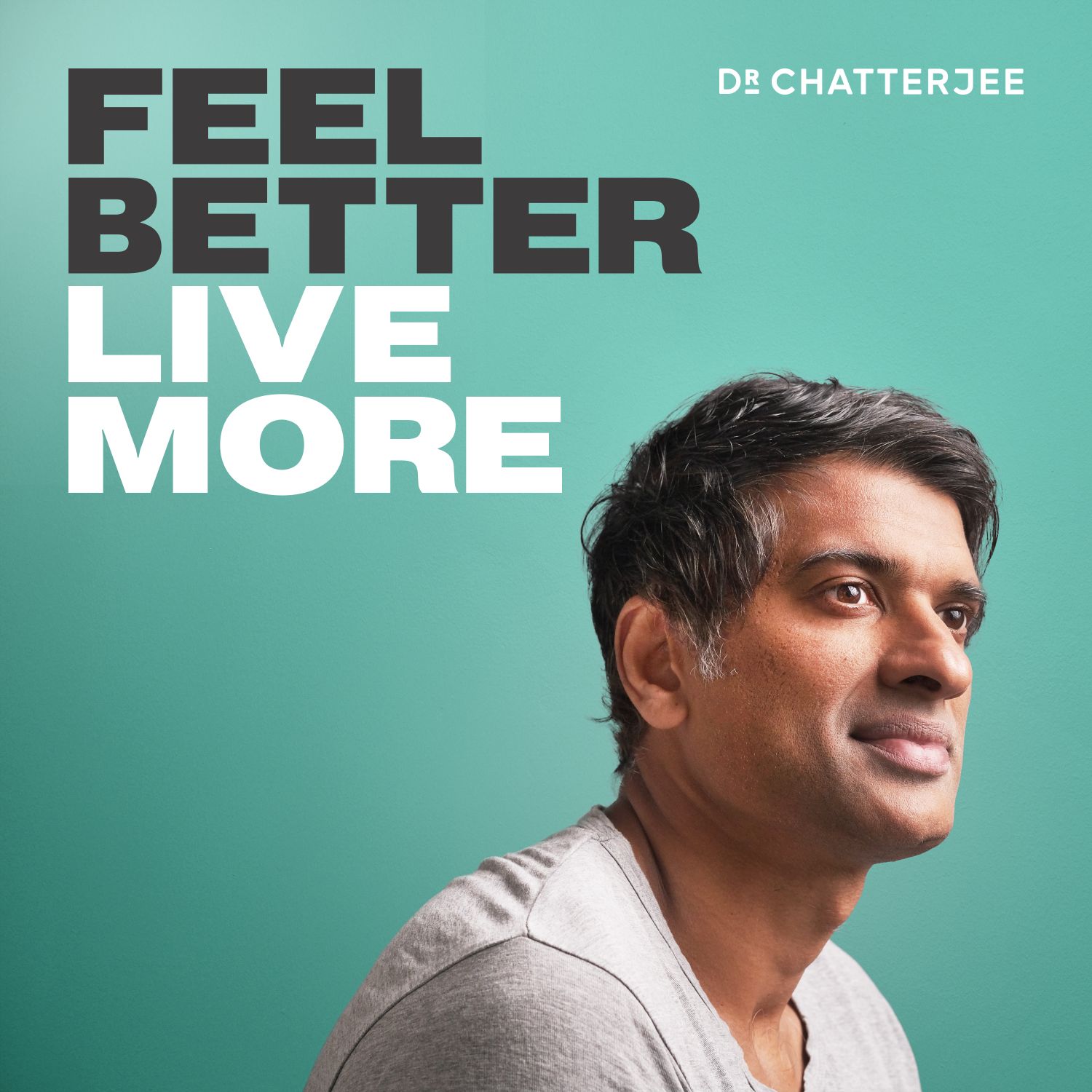
 Feel Better, Live More with Dr Rangan Chatterjee
26 Jun 2025 · 23m · 9 chapters

Helen Hall explains why people get knee pain or hit a “5K wall” when they start running, arguing the issue is often inefficient mechanics and unnoticed posture—especially forward head position—rather than running itself. She also gives practical tips: notice head/shoulder alignment, avoid one-sided carrying (phone/watch), and “walk before you run” to prepare blood flow.
Helen Hall is a movement coach whose clients range from elite athletes to everyday people who want to run or walk without pain, improving efficiency and enjoyment.
Awareness (“noticing”) is the first step to change; forward head position limits neck rotation and makes the body work harder; asymmetrical loads (phone in one hand) disrupt movement patterns; brisk walking for 7–15 minutes helps divert blood to working muscles before running.
A lockdown footballer with career-threatening injury couldn’t take a running step despite surgeries; after correcting forward head posture, he was running within two weeks. A runner’s right elbow stayed cocked due to checking a watch, creating “chaos” in other limbs.
Written by AI. May contain mistakes.
Exploring misconceptions about running and knee pain.
“Now, this is the time of year when our immune systems are under the most pressure.”
Exploring misconceptions about running and knee pain.
“I think there's this misconception that when I run, I get injured.”
Discussing how inefficient walking can lead to running injuries.
“It's the most innate movement, putting one foot in front of the other.”
Understanding how head position affects overall movement and efficiency.
“They started their couch to 5k and now they're stuck.”
The significance of body awareness in improving movement quality.
“and it is sensory headquarters, no pun intended.”
How efficient movement can enhance health and longevity.
“My job mainly entails getting rid of the elephant in the room.”
The effects of carrying asymmetrical items on running mechanics.
“I feel my meditation has become, has deepened.”
Learn how carrying a phone affects your running form and movement patterns.
“What happens when people actually do that?”
Discover why warming up properly can reduce injury risk and enhance performance.
“And as soon as you start to become aware of what's happening in your body and on the outside of your body, you will start to notice it in others.”

Get the gist, explore an idea or ask about something said.
 Claude
On Feel Better, Live More with Dr Rangan Chatterjee, what are the key points of this episode?
Searching your listeningAutomatic transcript. May contain errors.
0:00Today's Bite Size episode is sponsored by AG1, a daily health drink that has been in my own life for over seven years. Now, this is the time of year when our immune systems are under the most pressure. It's natural to look for extra ways to support our immune defenses. But most people don't want to juggle multiple pills. They want something simple, effective and easy to stick with. AG1 is a daily health drink that provides key immunity-supporting nutrients, vitamin C, vitamin A, zinc, and selenium, all of which contribute to the normal function of the immune system. These nutrients are included in highly bioavailable forms, meaning they are much easier for the body to absorb and use.
0:50And the best thing, of course, is that all this goodness comes in one convenient, tasty daily serving. For a limited time only, get a free AG1 flavor sampler and AGZ sampler to try all the flavors, plus free vitamin D3 and K2 and AG1 welcome kit with your first AG1 subscription order. That's$87 in free gifts for first-time subscribers. See all details at drinkag1.com forward slash live more. Welcome to Feel Better Live More Bite Size, your weekly dose of positivity and optimism to get you ready for the weekend. Today's clip is from episode 216 of the podcast with my very own movement coach, the wonderful Helen Hall.
1:47Helen's clients range from elite athletes to ordinary everyday people who want to run or walk without pain, with greater efficiency, and most importantly, with greater enjoyment. Whether you're a seasoned runner or just trying to move a little bit more, Helen's insights are helpful for anyone. And in this clip, She shares some simple changes we can all make when walking or running that could very quickly transform the way that we move. I think there's this misconception that when I run, I get injured. Let's say after 20 minutes, I get knee pain. So therefore, running is not for me or running is bad for my knees.
2:35That's the conclusion. But if we go upstream a little bit and go, well, hold on a minute. we can't say that running's not for you or that running is bad for your knees just because of that. The way I look at it, and a lot of this has been informed by you, is that maybe your body is in such a state at this current moment in time where, yes, you can't run without having pain, but it's not running that's the problem necessarily. It could be their structure or their biomechanics or their form. I came to you with a whole host of little injuries that were getting in the way of my ability to run. But I now believe that all of us can run pain-free if we learn how to do it.
3:26Yeah. And it's a funny thing, isn't it? It's the most innate movement, putting one foot in front of the other. It's what everything in our movement development takes us towards from this born blob that doesn't really do much to, you know, toppling around on two little feet to then being coordinated on two feet. And it takes however long it takes to get that movement coordination organized. And then the pain element, people bump into themselves because for whatever reason, and there are so many of them, they're not walking efficiently. They didn't know how to put one foot in front of the other efficiently because they don't know how they're walking.
4:05And they bring the way that they're walking into their running with all the restrictions that are there already, but they pass under the radar of being unnoticed because there's no pain when they walk. As soon as you add running into the mix, you've got intensity because now the body has to mass manage both feet off the ground, landing on one little tiny bit of foot and then pushing off the same foot onto the next one. So things that are running under the radar but are there, then pop out with the running. So they were fine. They started their couch to 5k and now they're stuck. Maybe they reached 5k, but they can't go any further.
4:45Maybe they didn't even reach 5k. It's not the running. It's what they brought to their running that was the problem, but it was under the radar. Nobody knew because it didn't hurt to walk. Yeah. This key point I really want to get across is noticing. The example I want to use is last time you came to the house, you went for a run with my brother. So you didn't go all in detail like you have them with me, but you've transformed the way he runs from spending 30, 40 minutes with him. And it all came down to head over shoulder, over hips. You know, what is, do you have the forward head position or not?
5:25And what was interesting, he said to me, I didn't realize that I was running inefficiently but when Helen showed me what to do and then we ran for a bit like that and then she said go back to what you're doing before I could just feel how sluggish and how inefficient it was so I think that's the magic in your approach is you allow the individual to start noticing themselves so is our heads being forwards the number one problem that you see these days? So I continually say with so much enthusiasm, because it is the beginning of everything getting better. If your head isn't on right, nothing great is going to happen.
6:12If you don't know where your head is, nothing great is going to happen because it is heavy and it is sensory headquarters, no pun intended. This is our most precious commodity. All of our movement coordination is organized so that we don't face plant. So if that head is off its perch, the muscles are hanging onto it for dear life. So if our head, if I just move my head there, I can turn my head this much because there's so many structures now hanging onto my head, which is not perched effortlessly on top of the spine. And for people listening, Helen just put her head forwards. So the typical sort of head forward posture that many of us have these days and her rotation was completely limited when she tried to move her neck from side to side.
7:09I forgot that this was, yes, not just me looking at you. So then I put my head on right. So I just park it where it feels most wobbly. So I'm just sat here and I can just wibbly wobbly it about and it just feels easy. And I can turn my head and I've got just this much bigger range of motion. And if you do that standing in front of the mirror, you will find you will have more movement everywhere in your body. A head that isn't on its perch is being hung on to by a whole swathe of soft tissue, which limits the joint rotations, which limits your movement, which seems a bit sad. Would you say, because there's obviously so many complaints people have with running, but also walking, just movement in general, you know, if someone said to you, what is the number one problem you see in the 21st century with people wanting to run?
8:05Yeah. Is this it? Yeah, it is. without a shadow of a doubt. My job mainly entails getting rid of the elephant in the room. Case in point, there was a young footballer, career-threatening injury. It was lockdown. He reached out and I said, send me some video. The elephant in the room was a forward head of, it was epic that he was actually able to stay upright and not faceplant. His body was working so hard with that forward head position. So I just needed to make sure that nobody had mentioned this elephant in the room because it was extraordinary. And I said, anybody mentioned your head position?
8:46And he went, oh, yes. Oh, okay. Okay, great. So did you do something about it? And he went, what do you mean? And I said, well, did your team physios help you with your head position. Oh, no, no, it wasn't. No, no, it was my wife. It was okay. Okay. You should listen to your wife. Yes. Let's deal with this. And this guy, he hadn't been able to take a single running step despite several surgeries. And within two weeks he was running. And when he went back, they were saying, oh, you're running better than we've ever seen you move. And all we'd done was popped his head back on place where it was meant to be.
9:27And I just want to add here because, I mean, I love this stuff, Helen, because it's like you said, you know, people don't know where the head is. I now know where my head is. Like, I don't think I did two years ago. I kind of, I think I'm pretty good with my body. I think I've got a really good awareness, I think. But even if I did, it has been, you know, upgraded a hundred fold over the past 18 months, which is, you know, I can really see even when I'm out walking now and that I feel I've got a new joy of movement. I love movement anyway. I love it now. I love going for a walk, but not in the way that I used to.
10:03I used to love going for a walk two years ago, but now it's an opportunity for me to, yes, switch off, get some relaxation, but also move efficiently. And it doesn't matter the sport. It's just more of you being available. So you have more joy from your movement and therefore maybe you'll keep it going and not stop once you've started. So the beginning of change is noticing, it's awareness. So as soon as you become more aware of how you do move, how stacked your body is, how effortlessly it moves, breathing improves, digestion improves. it doesn't just stop with the time it takes to do a 5k a 10k or a marathon it becomes a healthful life choice so you then can do more because your body is able through all of its functions not just the musculoskeletal element of the function of our body but our internal anatomy so it's about getting the fluids flowing so that the arteries don't get all clogged up that's also partly nutritional of course but with better movement on the outside you're getting better movement on the inside so this is health movement is life this is how we stay alive for longer and feel better and live more right good quality movement is necessary for our daily lives but it's necessary when you're 70, 80, 90, look around at a lot of people, how they walk.
11:42I see my mum who I have to help care for. I think I really don't want to be like that. And so if I can invest in my body, get more efficiency now, I'm going to be a healthier 80-year-old, 90-year-old as I move better. My breathing has become more efficient. I feel my meditation has become, has deepened. So it ain't just one thing, you know, as you say, movement is life. And it's balance. So for movement to be fluid and elegant, flowing, we have to have balance in the body, which creates balance in the system. So then people can think more clearly because thought is another movement. And throughout the whole element of noticing is there's an action and there's a thought behind the action.
12:38And what does that feel like? And you connect it all together. So the movement, which is the action, the thought around it, the feeling and the connection. So your son did it just like that. As soon as I showed him that his right arm was causing chaos in his other limbs and there was a way for him to think about that not happening. He didn't want to go back to how he was because it felt more difficult and it felt smoother when that didn't happen. So he had an action. He had a thought about it. It had a feeling inside his body. He connected it all together and now he's noticing and he can't not know that now.
13:24Yeah. You can't unknow what you know. Once you've felt it, once you've connected the dots, you can ignore it, but you probably won't. And it all, everything connects to everything. I always remember this. I was asking you about people carrying phones, right? So this is common now. You see people running or walking with phones. Sometimes they're holding it in their hand whilst they're walking and running. Yeah. What advice have you got for people? Because you've seen in real time on Doris, this incredible machine. What happens when people actually do that? Haven't you? Yes. Anything asymmetrical, anything on one side of the body.
14:08So one stick, one phone, one water bottle. It will affect your movement patterns because everything is connected. So have two phones or two bottles or two sticks or better still, put them in a pocket. Use a bum bag. The carrying of the phone dramatically changes the whole way you run. Jainam discovered this yesterday. His right arm was doing something and it was different and causing chaos in the rest of the limbs. As soon as it wasn't doing it, there was no chaos. End of chaos. He wasn't carrying a phone, was he? He wasn't carrying a phone. Good to know. We want to carry the phone because we want to be accessible.
14:52It's a safety measure. There are all these little apps that tell us how fast we're going and how far we've gone. These are all really useful things, but we don't need to carry it. We're saying that holding it in your hand on one side is probably the worst thing you can do? Yes. It's at the end of the extremity. So if we think about levers, that weight there is going to have more effect than if it was on my upper arm. So some people will attach it to their upper arm. So that's better. Attaching it to your upper arm is better than having it in your hands. But still the upper arm isn't as good as the upper thigh because lots of manufacturers make these trousers, leggings now with pockets for phones.
15:37So it's very tight to your thigh. Yeah. So that is one sided. It's not two sided. But you've measured, haven't you, that has minimal effects. because the upper arm is swinging and it's not as dense tissue as your leg. Your thighs are enormous. They're heavy and they're close to the core. The upper arm is also close to the core, but we have this attachment to the ground. So there is less influence of a phone on an upper thigh than there is a phone on an upper arm. Holding it is effectively like, well, run with the extra weight of the phone on your shoe. So run with a clod of mud on the bottom of one shoe.
16:23You just extrapolate it and equate it to something else on another limb. So it's just the same. It's an extremity. You've got a great big clod of earth on your shoe, the weight of a phone, and you can imagine how it's going to affect. You put a little weight on your ankle, it's going to affect on that side. so this asymmetry at extremities is uh is problematic so why don't we such challenge people then who who are listening or watching if you do carry your phone uh when you go for a run or walk first of all try now and again to go without your phone just to see what it feels like i would say but if you're going to take it with you for music podcasts safety safety why don't we ask people to experiment like experiment with it on your upper thigh you know tight you don't want it loose and baggy you want it tight against your upper thigh yeah and i think it'd be great on the theme of noticing asking people to see if they can pay attention how does it feel when you go for a walk let's say it doesn't have to be a run go for a walk or run when you put your phone in a different place because that starts the awareness piece doesn't Yeah.
17:37So, and what happens to the hand that was holding the phone? Because people start to move when the phone isn't there with their hand away from their body. It imprints, there's a motor program. So the whole time you're doing that, a motor response is traveling from the hand up to the brain, back down to the hand again. Okay, you've got to hold your arm over here. So I have seen runners, they run with one elbow cocked out and it's the elbow with the watch on the wrist because they look at the wrist watch so often that they end up running with their elbow cocked out. So it's not just noticing the change when the weight isn't there and the influence in your body it's noticing what did that do what did that imprint in your body what do you now notice that arm does or doesn't and invariably it stays still because it's learned to stay still yes so we're repeating and replicating inefficient movements this is not just how it looks oh i look like that when i roam with my elbow going out and actually you know this is affecting our function our form our movement and we don't realise it.
18:57And I think that's a great example. It's not just phones, it's watches. Could I just say about the phone again? So if you're holding the phone, does that shoulder elevate? If that shoulder elevates, you are leaning down on one side of your body. So that means that one side of your body doesn't have shock absorption and one side of your body is being overloaded when you're pushing off on your trail leg. It is such a big influencer. It is so easy to get yourself out of that little pickle. You don't need to see me, just find somewhere else to put that weight, the water bottle and or the phone. Yeah, I think this is really good practical advice for people at the end of the conversation, because everyone can try that.
19:44Don't just take your word for it or my word for it, feel the difference for yourself. That's kind of where the empowerment comes, doesn't it? Yes. And as soon as you start to become aware of what's happening in your body and on the outside of your body, you will start to notice it in others. Now, it's not about being judgmental. It's about being curious about why are they moving like that? Why do they need to run like a little teapot? Their pelvis has disappeared over one side. The body has bowed to counterbalance. Why? But it's all unravelable. That's the point. That's the empowering thing. Yes, things can change.
20:21Otherwise, there's nothing to talk about. God, I love that quote. Yeah. The podcast is called Feel Better, Live More. When we feel better, we get more out of our lives. When we move better, when we move more efficiently, we get more out of our lives. For people listening, have you got any parting words for them? walk before you run it diverts the blood from the non-vital organs the glands producing the hormones and the intestines to the working muscles the boffins tell us it's probably the most effective way to limit injury risk so so many people shut the door and just start running The blood you need in the working muscles isn't there yet.
21:09If we had enough blood to be around our entire body for any given job at any given time, we'd be a balloon. It's not there yet. Know it. The experts have done lots of experiments. I don't know how they do it. It takes between seven and 15 minutes to divert the blood. Seven is the minimum. So you can help yourself most easily by just walking briskly to divert the blood. Walk briskly enough that the central nervous system thinks, oh, something exciting is about to happen. I need to get some blood to those working muscles. I rule of thumb, 10 minutes and then run. And you'll probably find you enjoy it more and you'll have a smile on your face.
21:52And then you'll be able to notice stuff because you'll be in a happy place. And notice, where is your head? First job, where is your head get it on better get it on right there's only one place for it to be and only you know exactly where that is if you can understand how your body moves and notice where it isn't moving and help it along a little bit better you will move better and then further and enjoy it more and and and and it will grow hope you enjoyed that bite-sized clip do spread the love by sharing this episode with your friends and family and if you want more why not go back and listen to the original full conversation with my guest.
22:31If you enjoyed this episode, I think you will really enjoy my bite-sized Friday email. It's called the Friday Five. And each week I share things that I do not share on social media. It contains five short doses of positivity, articles or books that I'm reading, quotes that I'm thinking about, exciting research I've come across and so much more. I really think you're going to love it. The goal is for it to be a small yet powerful dose of feel good to get you ready for the weekend. You can sign up for it free of charge at drchatterjee.com forward slash Friday Five. I hope you have a wonderful weekend.
23:10Make sure you have pressed subscribe and I'll be back next week with my long form conversation on Wednesday and the latest episode of Bite Science next Friday.
23:25You
Running or walking effortlessly isn’t as easy as you might think. Often, we’re making small mistakes that impact our everyday movement and that can lead to frequent injury or pain.
Feel Better Live More Bitesize is my weekly podcast for your mind, body, and heart. Each week I’ll be featuring inspirational stories and practical tips from some of my former guests.
Today’s clip is from episode 216 of the podcast with my very own movement coach, the wonderful Helen Hall.
Her clients range from elite athletes to ordinary amateurs who want to run or walk pain-free, with greater efficiency and, most importantly, with greater enjoyment. Whether you're a seasoned runner or just trying to move more, Helen’s insights are helpful for anyone.
In this clip, she shares some simple changes we can all make when walking or running that could begin to transform how we move.
Thanks to our sponsor https://www.drinkag1.com/livemore
Show notes and the full podcast are available at https://drchatterjee.com/216
Support the podcast and enjoy Ad-Free episodes. Try FREE for 7 days on Apple Podcasts https://apple.co/feelbetterlivemore
For other podcast platforms go to https://fblm.supercast.com.
DISCLAIMER: The content in the podcast and on this webpage is not intended to constitute or be a substitute for professional medical advice, diagnosis, or treatment. Always seek the advice of your doctor or other qualified health care provider with any questions you may have regarding a medical condition. Never disregard professional medical advice or delay in seeking it because of something you have heard on the podcast or on my website.