Ask ChatGPT
 Feel Better, Live More with Dr Rangan Chatterjee
20 Nov 2026 · 22m · 7 chapters
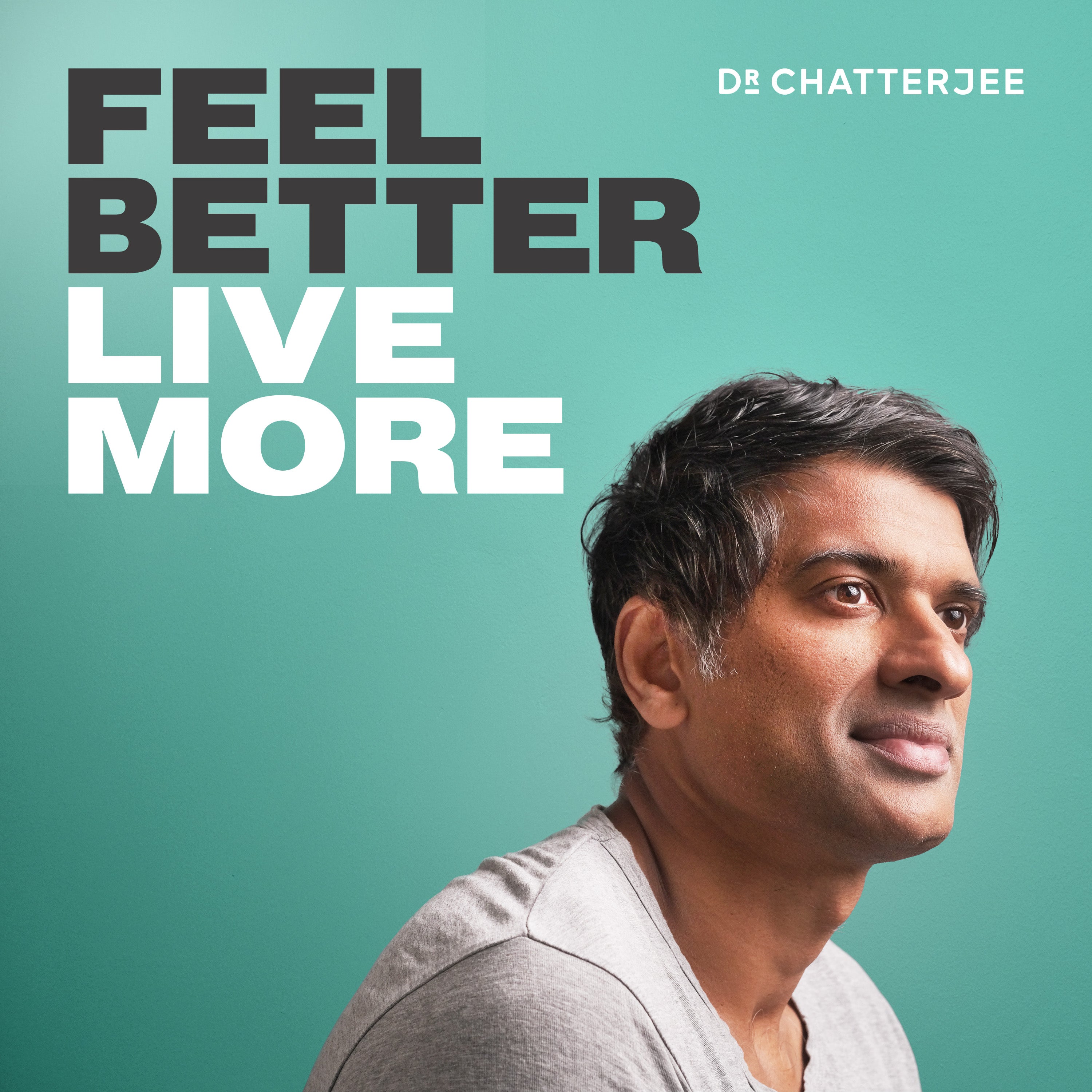
A “Bite Size” compilation on slowing down to reduce overwhelm and find joy, especially during busy, end-of-year seasons. It argues society is in a “crisis of presence” driven by constant connectivity, and proposes practical tools: meditation (observing the mind), breath work for safety/grounding, entering flow states, hobbies, and “small but certain happiness” via micro-pauses (e.g., smelling coffee/tea).
No guest names appear; the episode is a montage of “favorite moments” from prior interviews, featuring the host and prior guests. One referenced figure is psychologist Mihaly Csikszentmihalyi (flow research) and Zen teacher Thich Nhat Hanh (walking meditation).
Downtime is stolen by technology; solitude/presence are essential; flow and hobbies increase well-being; gratitude grows by focusing attention; slowness becomes “addictive” through awareness.
Snooker as flow; weekend cooking with 90s rock; 10-second coffee/tea aroma pause; “walk as if your feet are kissing the earth.”
Written by AI. May contain mistakes.
Discussion on how busy life affects our well-being and the need for calm.
“As we approach the end of the year life of course, can feel busy.”
Exploration of how technology impacts our ability to find stillness and solitude.
“I think it's the fact that we have no downtime, we have no space.”
Insights on meditation and the process of getting to know oneself through stillness.
“Now there's so many more things vying for my attention.”
Discussion on the benefits of meditation and breath work for mental health.
“Can you briefly mention what you feel meditation has done for you?”
An exploration of how our perception of time can be altered by engaging in flow states.
“And from that came a daily habit that I just couldn't not do.”
Encouragement to engage in hobbies and activities that bring joy and fulfillment.
“going mountain biking painting how you choose to make time stand still will be unique to you it won't be the same for me one of the ways i like to do it in the evenings particularly this time of year is to play snooker.”
Learn how to appreciate small moments of happiness in daily life.
“The important thing to realize here is that this stuff is good for us.”

Get the gist, explore an idea or ask about something said.
 Claude
On Feel Better, Live More with Dr Rangan Chatterjee, what are the key points of this episode?
Searching your listeningAutomatic transcript. May contain errors.
0:00Today's Bite Size episode is sponsored by the Daily Health Drink AG1. The clocks are about to change, the mornings are darker, everyone around you seems to be coming down with something, and that's why at this time of year, I remind myself to lean into the fundamentals. And for me, one of those fundamentals is AG1. AG1 is a daily health drink that has been in my own life for over eight years. And one of the many things I like about it is the fact that many of the nutrients it contains, for example, vitamin C, vitamin A, zinc and selenium, support a healthy immune system. Right now, AG1 is offering listeners of my show a free AG1 flavor sampler and AGZ sampler to try all the flavors, plus free vitamin D3 and K2 and AG1 welcome kit with your first AG1 subscription order.
0:57That's$87 in free gifts for first-time subscribers. All you have to do is head to drinkag1.com forward slash livemore to claim this offer before it ends. Welcome to Feel Better, Live More Bite Size Your weekly dose of inspiration, insights and practical ideas To help you live well and thrive Each episode brings you some of my favourite moments Useful tools and inspiring ideas From the many incredible conversations I've had on my podcast As we approach the end of the year life of course, can feel busy. With work, family commitments, and ever-growing to-do lists, it can sometimes feel as though there's very little time left for ourselves.
1:47But sometimes, it's the small things we do each day that can make the biggest difference. So today's bite size is a little bit different. I brought together some favorite moments from previous episodes to help you slow down, experience more joy and find moments of calm. I hope you enjoy listening. When I think about life, when I think about health, when I think about what people are struggling with these days, and if someone was to ask me what I think the number one problem in society is, I think it's solitude. I think it's the fact that we have no downtime, we have no space. I think one of the negatives that technology has done is, I don't think the negative that's been spoken about enough, which is the fact that any bit of downtime we previously had has been stolen from us.
2:40I want you to think about this for a moment. I'm older than you, but I think one thing that we share in our general age bracket is that to the extent that we are the same general generation, we are the last crop of people who know what it's like to live in a pre-internet world and now live in a fully connected world. Our childhood was marked by periods of boredom where we had to go out of our way to figure out creative ways to entertain ourselves. Like the amount of energy that you would have to exude with your imagination to figure out how to spend time was extraordinary. Fast forward to the 12-year-old now or the 10-year-old or the 8-year-old.
3:32they have to exert even more energy to not be distracted, to find boredom, to find stillness. And I think it cannot be overstated how profound a change that is. And I'm not sure that we really appreciate the extent to which that's going to change the course of humanity, because what is that person going to look like in 20 or 30 years when they're an adult? It's going to be a very different type of being. And I think now, more than ever, we're in a crisis of presence in that we never have to be by ourselves ever again, ever, ever. You have to go out of your way to find a moment of stillness. And who was it who said, all of man's suffering can be boiled down to his inability to spend time alone with himself?
4:35I mean, we don't ever have to be alone with ourselves. And I know that I've found myself struggling with this because of how different my life is now from when I wrote my first book. Now there's so many more things vying for my attention. And a lot of those are driven by technology, that you have to move heaven and earth to create boundaries around that to carve out a few moments of quiet because you're expected to be, you know, accountable and in communication at every given moment of your waking day. I think people need to regain agency. Yeah. And I think that's by really having those conversations with yourself, getting to know yourself and to be for me that could only happen in stillness when I wasn't distracting myself with busyness or the phone or another project it was sitting with yourself and I you know many of us think about meditation as being like getting into this calm zen place but it's not it's really observing how nuts your mind can be and then observing it again and again and again until you start to be able to get control of that sort of monkey brain and then you know not uh sort of sleepwalk through your life, which is, I think, you know, where I got to, where you are unconscious to your behaviors and then you see them and you can't unsee them.
5:59And slowly by just repetition, you get there. Yeah. Can you briefly mention what you feel meditation has done for you? And also then let's talk about breath work and how that can also potentially help. Well, meditation that kind of touched on in my life many times. And I don't know if I just didn't have the quite right teacher or, you know, hadn't grasped what meditation really meant. I do think there's a kind of perception that it's going to make everyone really calm and zen. And I don't think it's that anymore. I think it's being able to observe your mind and have a bit more agency over your mind.
6:38um but then I had this real kind of rock bottom moment in my life where I was just like I can't do anything I'm just gonna sit and it was just after the kids gone to bed and the house was quiet and I was just on my own and I was like I'm just gonna sit and see how long I can sit because I've literally I'm out of options about ideas I don't know what to do with my next step my next day. And from that came a daily habit that I just couldn't not do. And it's just never stopped. And I look forward to it. And sometimes I do it for longer. And sometimes it's in the garden. Sometimes it's, you know, I have a little area in my house where it's always comfortable, the little rug and stuff so that when it's cold, I want to do it.
7:28And it's been really profound, to just get to know myself a bit better and to give myself space, like mental space and be able to see the thoughts kind of flowing through and be like, ah, it's fine. They're just thoughts rather than like clinging onto everything and thinking this is, you know, the end of the world. It was, it was like, I couldn't not. And so after years of being on and off meditation, it just suddenly clicked into place and yeah that's that's it but then I do think it can be harder if you have a serious trauma like to sit with yourself I think that maybe sometimes you have to get a sense of safety in your body before you can sit with yourself which I think then comes from things like little moments of breath work helping extend your exhale helping your ribcage placement, grounding your feet into the earth, like those little things that make the body feel safe before you can just sit there with yourself.
8:32So I think it sort of depends where you're starting. If you're finding meditation hard, it's like, it's a process and a journey, I think. So what do I mean when I say make time stand still? Well, first of all, I want you to think about time. What actually is time? The first thing I want you to think about is this idea that time is fluid. So of course one day will always be 24 hours long, just as 60 minutes will always add up to one hour. But one hour watching paint dry is experienced in a completely different way to one hour hanging out with a close friend. So when it comes to time, the mind truly does have power over matter.
9:17Our perception of time changes its reality and we can control it and become more time affluent by making the clock stand still. Now one of the ways you can do this is by getting into flow state. Now the reason I mention flow state here is because I want to give you something practical you can do to increase your levels of contentment. When you're in flow state you are literally in the moment. You're not ruminating about the past or tying yourself up in knots about the future. When you're in flow state, your thoughts and actions are one and the same. In fact, some people say that in flow state, they're so focused on what they're doing, they feel as if they've left their bodies.
10:04So what is it you do that gets you into flow state? sometimes these are things like hobbies like playing a musical instrument playing a sport going mountain biking painting how you choose to make time stand still will be unique to you it won't be the same for me one of the ways i like to do it in the evenings particularly this time of year is to play snooker. So in my front room, I have a small snooker table that of course I love to play on with my kids, but I also love playing by myself. And often in the evenings, a great way for me to unwind and switch off is to just go and play snooker for maybe 15 or 20 minutes by myself.
10:56Now I love the game. I'm almost hypnotized by the sound of the balls, trying to think at the right angles, you know, putting on different amounts of spin onto the ball and watch it kick off the cushion at different angles. I love it. And literally, I could be in there for 10 minutes and it can feel like an hour because I'm in flow state. Now, the term flow state was coined by the late psychologist, Professor Mahali Csikszentmihalyi. He died a few years ago. When he was alive, his research showed that the more often people experience flow state, the greater their sense of well-being and life satisfaction.
11:39So perhaps you need to think about how many times you're accessing flow state, or to make it easier, how many times you're actually engaging in your hobbies. and scientific research has shown that people who have hobbies tend to be in better health and have greater happiness and higher life satisfaction. So are you engaging enough in your hobbies? Hobbies, passions, sports, music, these things are really really good for us. We know that regularly doing things that we love makes us more resilient to stress. At the same time, if you're chronically stressed, it makes it harder for you to experience pleasure in those things that you used to love.
12:24The relationship goes both ways. So I want you to think about what things can you do that will help you make time stand still? How are you going to get into flow states? How are you going to re-engage with some of your passions? How are you going to do more things that you love. Now this really does not need to be complicated. Okay, I've shared a few examples in this section already about what you can think about doing, but some of you might be struggling to think about what it is you do. You might be so disconnected from passion and things like hobbies that you don't know where to start. If that is the case, I would encourage you to think back to the sort of things you used to enjoy when you were a child.
13:14What did you spend your time doing? What did you do for you? Not so you could tell someone else, not that you could take a photo of it and pop it on social media and get validation from the world around you. I'm not talking about that. I'm talking about things that you do for you. It can literally be anything. I'll tell you, over the past few months, I've really re-engaged with cooking at the weekend. And I love it. One of my favorite things to do at the weekend is literally tidy up the kitchen, put some tunes on. At the moment, I'm going through a bit of a 90s rock phase, which I'm absolutely loving.
13:56And I prepare food for the family. I find it so relaxing. And time literally does stand still. The important thing to realize here is that this stuff is good for us. We're living in a world now where so many of us are feeling stressed and burnt out. And one of the simplest ways to address that is to put in your diary a few times a week, a little bit more time doing things that you love. Talk to me about small but certain happiness. I think it's a very simple concept that I think everyone's going to resonate with. I think oftentimes people imagine that they will finally you know feel happy and i can i will be able to relax only when i achieve you know some monumental uh goals in my life you know such as maybe marrying somebody you know uh love of your life or you know buying your first home or getting promoted to the position that you really want but while you are getting there you also have to live your life and it usually takes a long time to arrive at your goal so I think it's important we look for what I would call small but certain happiness this is not my idea this is an idea that many people you know propose but I think it is so important to look for something that's going to for sure make you happy and then do it again and again and again just speaking to what you just said now it's just so simple you say this for some the fragrant smell of freshly made morning coffee is a time of peace and happiness while for others it could be the warmth of the sun on their face the sight of spring flowers the feel of a cozy blanket on a chilly day or simply spending time with their dog or cat after work.
16:01Now here's the thing, Heyman. A lot of people listening are experiencing those things every day, but many won't have put the spotlight of gratitude onto them. So let's say someone has got half an hour to get up and get ready for work and get the kids off to school or whatever it might be. They might make their morning coffee, rush and slurp it down whilst also getting things ready for work, right? So they've still had the experience of drinking freshly made morning coffee, but the intention behind it is very different. Right, right. So it takes only 10 seconds. That is, wait, I'm just going to actually enjoy the smell of freshly made coffee.
16:53you know this intentions and then you pause a little bit and then you re-engage with the experience and from that moment you say wow this is happiness you know rather than searching for some you know big things in your life big success to be happy maybe this is what i was after you know i like the idea that it only takes 10 seconds or even five seconds sure you're in a rush in the morning, just take a simple pause, 30 seconds, smell the coffee quite literally, let it tickle your senses. You know, just that act, you're just starting to open up the door to appreciation, aren't you? Again, one of the reasons I feel generally speaking, so calm and content these days, and dare I say it, happy, it's because I believe that, and you write about this idea in your book that where you put your focus that's what starts to grow absolutely yes so i think we have to make a decision we have to decide to appreciate our life we have to decide to enjoy this moment you know once you decided that i'm going to enjoy this moment it makes it much easier to appreciate things uh without that intention it's hard you know the life just passed you pass us by and without really you know becoming aware of what we are having it yeah i think it also speaks to this idea that one of the central ideas in your work in buddhist philosophy that all the answers are within the happiness is already there we're not looking for it outside we just need to get out of its way and relax into it and relax into it but of course that's difficult for people when they're feeling rushed all the time and stressed all the time and you know you literally see the world differently when you're rushing you cover that in one of your previous books didn't you right you know people love the title you know things you can see only when you slow down you know great title yeah i think we need to just periodically pause and see if you can slow down and when we are uh slowing down then we can actually see and appreciate our life that is quickly passing in front of us yeah yeah just taking 10 15 seconds to smell that fresh tea or that fresh coffee and let the aroma go into you and surround you I think one of the things it does if you're leading a busy life is number one, it forces you to slow down.
19:46But number two, it reminds you what the feeling of slow feels like. Yeah. And then once you tune into that and go, oh, oh, it's nice not to rush this coffee and just sit there. That feeling when you do it regularly starts to follow you around in other parts of your day. That's certainly what I found in my own life. And I'm now at the point where, let's say on a Sunday, I'll sometimes intentionally in the morning go, okay, today's going to be a slow day. Today's a slow day. Everything is going to be done with the energy of slowness, including when you're driving somewhere, not rushing, just taking your time in the car.
20:28And what I like about it, the more I've done it, the more I have learned when I have a tendency to rush. So you start to develop that inner awareness of, oh, I'm rushing here. Oh, I wanted this to be a slow day, but I did rush then, or I left a bit late to get my daughter to her netball game or whatever. And again, it's all about awareness because the more you do it, the more you realize, actually, most of the time I really don't need to rush. I just don't. So that slowness, I think it almost becomes addictive because it feels so good. Yeah. And you can, you know, you can enjoy the process. As we are doing things slowly, you can enjoy driving, you know.
21:16Yeah. You can enjoy, you know, having conversation with your daughter. You know, you can enjoy arriving at that place and maybe, you know, saying hi to other parents. Yeah. you had the great fortune of spending some time with the great Thich Nhat Hanh could you share some of the key things you learned from him with us I loved his walking meditations you know he said walk as though your feet are you know kissing the earth and to me that teaching was such a powerful you know one and because we often just think about i get to i have to arrive at certain place and without paying attention to actual process of walking itself and instead can you just say i'm going to enjoy my walking you know i'm going to kiss the earth as i am taking my step i think that's a really wonderful way to start our day very mindful very present very evocative thought kissing the earth as you walk I really hope you enjoyed this week's Bite Size do spread the love by sharing this episode with your friends and family I hope you have a wonderful weekend make sure you have pressed subscribe and I'll be back next week with my new conversation on Wednesday and the latest episode of Bite Size next Friday The biggest barrier to your health right now is probably not knowledge.
22:52It's action. You already know what's good for you, eating well, moving more and managing stress. But knowing information is not the same as applying it day after day, especially if you're doing it by yourself. My name is Dr. Rangan Chatterjee and I have more than two decades experience helping patients as a clinician. And now I'd love to help you take control of your health. When I surveyed more than 1 ,400 people after my recent 21-day energy reset, eight in 10 said that their energy had improved in just three weeks. That's the kind of change I know more people can experience when they're surrounded by like-minded people.
23:36This is why I created the membership Built to Thrive community Each month we focus on one area of health Broken down into daily habits With live Q &As A private community of people on the same journey And many more features that make this journey sustainable If you think this is something that you would like to be a part of Just tap the link in the description box below to join us
As we approach the end of the year, life can start to feel particularly busy. With work, family commitments and ever-growing to-do lists, it can sometimes feel as though there's very little time left for ourselves.
But sometimes, it's the small things we do each day that can make the biggest difference.
So, today's Bitesize is a little different. I've brought together some favourite moments from previous episodes to help you slow down, find moments of calm, and experience more joy.
I hope you enjoy listening.
The full podcast episodes featured are available at:
Episode 93: Rich RollRich Roll on Conversation, Connection and How To Cope In a Toxic Worldhttps://drchatterjee.com/93
Episode 648: Dr Jenna MacciochiHow To Support Your Immunity, Reduce Inflammation & Age Better https://drchatterjee.com/648
Episode 606: Dr Rangan Chatterjee5 Simple Ways To Transform Your Happiness in 2026 Chatterjeehttps://drchatterjee.com/606
Episode 476: Haemin SunimA Monk’s Guide To Finding Happiness, Cultivating Inner Peace & Slowing Down In A Fast-Paced World: Haemin Sunimhttps://drchatterjee.com/476
Thanks to our sponsor https://drinkag1.com/livemore
Support the podcast and enjoy Ad-Free episodes. Try FREE for 7 days on Apple Podcasts https://apple.co/feelbetterlivemore
For other podcast platforms go to https://fblm.supercast.com.
DISCLAIMER: The content in the podcast and on this webpage is not intended to constitute or be a substitute for professional medical advice, diagnosis, or treatment. Always seek the advice of your doctor or other qualified health care provider with any questions you may have regarding a medical condition. Never disregard professional medical advice or delay in seeking it because of something you have heard on the podcast or on my website.
Learn more about your ad choices. Visit podcastchoices.com/adchoices