Ask ChatGPT
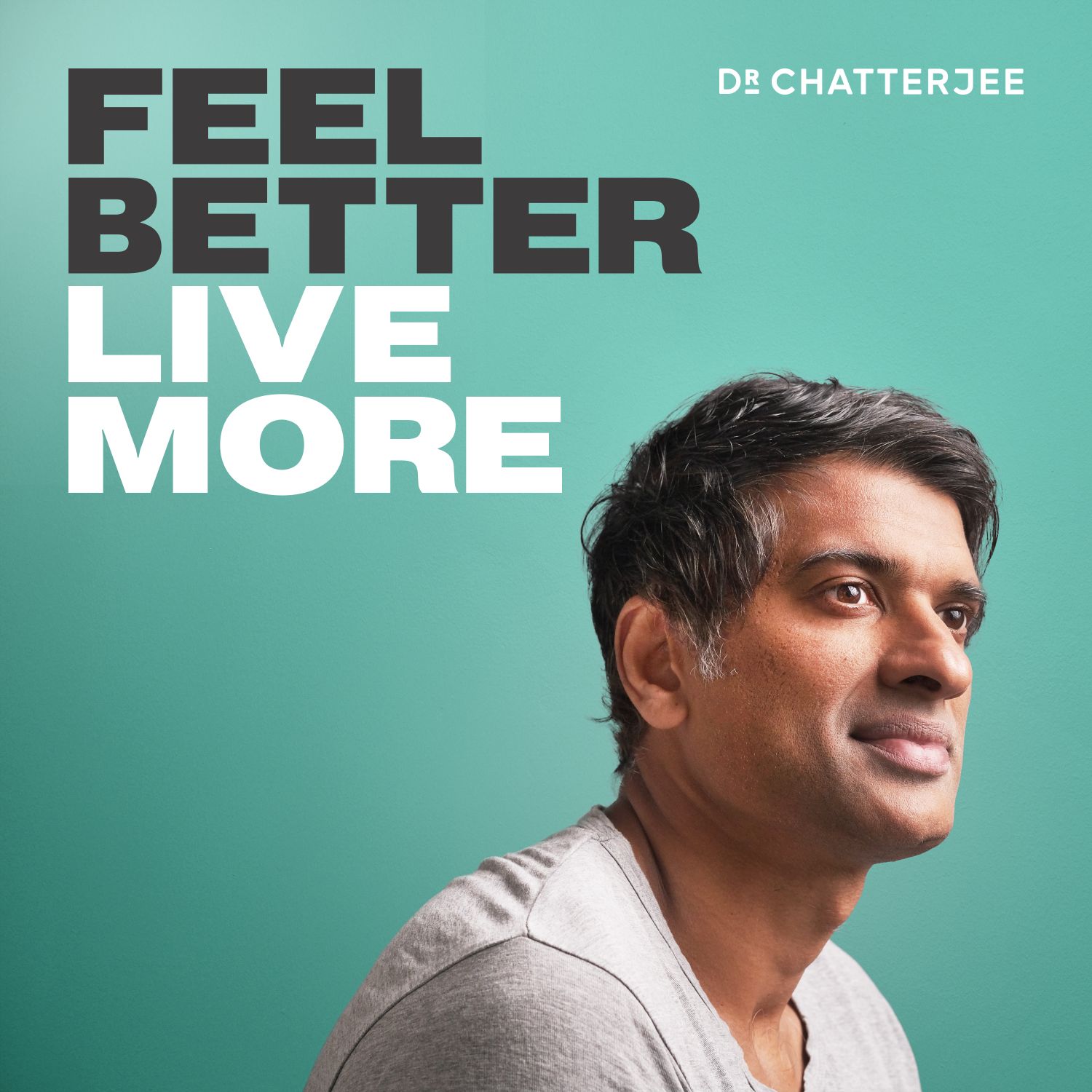
 Feel Better, Live More with Dr Rangan Chatterjee
8 Oct 2026 · 25m · 13 chapters

Walking for health, mood, and relationships; debunking the 10,000-steps myth; step targets tied to research; practical “micro-walks” and walking cues to improve gait efficiency (“walk taller”); walking as a social/relational tool.
Dr. Courtney Conley, movement specialist and co-author of Walk, Your Life Depends On It. She discusses gait assessment and patient experiences, including chronic pain and mental health links to low activity.
10,000 steps is a marketing hangover (not science). Benefits start below that: moving from ~2,500–3,800 steps helps; longevity peaks around 7,000–8,000 steps. 3,800 steps may reduce dementia risk; 5,000 steps may reduce depression symptoms. Walking together improves communication and bonding.
“Micro walks” (5 minutes/~500 steps) build confidence. Teen daughter’s mood improves after 10-minute walks. Relationship walking with spouses/grandparents. Her 76-year-old mother doing 13,000 steps and stairs while traveling.
Written by AI. May contain mistakes.
Discover how walking can improve mood and health and enhance relationships.
“Now if you've tried other meditation apps before, I am certain that The Way will be the one that will finally help you develop a consistent practice.”
Discover how walking can improve mood and health and enhance relationships.
“We unpack how many steps a day the research shows we really need to make a difference to our mood and our health.”
Explore the origins of the 10,000 steps myth and the actual steps needed for health benefits.
“You talk about the 10 ,000 step urban legend.”
Learn how increasing daily steps can significantly reduce risks of depression and dementia.
“because I actually have quite liked that as a guideline, but I totally understand where you're coming from, which is that can be off-putting to people.”
Understand why regular movement is essential and the challenges of a sedentary lifestyle.
“with something that is so easily accessible and underutilized.”
Explore the vital role of walking in maintaining overall body function and health.
“And it's become very easy to forget to do that.”
Hear Dr. Chatterjee's personal experiences and transformations through walking.
“So it's just kind of the, you know, it ignites our bodies.”
Learn how walking can improve communication and relationships, especially with teenagers.
“have the same level of autonomy that i have around my work okay they may have a lot of family commitments or family pressures.”
Discover how walking impacts our mental state and enhances our mood.
“And as a, you know, as a romantic couple, what going for a walk together a couple of times a week will do for your relationship.”
Understand the concept of walking efficiency and its importance for health.
“I want to get to some more of these walking cues.”
Learn simple cues to improve your walking posture and overall efficiency.
“What does that mean and why is it so beneficial?”
Explore the importance of maintaining mobility as we age and avoiding limitations.
“Today's the final day of your book promo trip to the UK, right?”
Inspiration that it's never too late to improve health and start new activities.
“When I was at the radio show yesterday, there was a gentleman there that ran the marathon.”

Get the gist, explore an idea or ask about something said.
 Claude
On Feel Better, Live More with Dr Rangan Chatterjee, what are the key points of this episode?
Searching your listeningAutomatic transcript. May contain errors.
0:00Dr Courtney Conley: Today's Bite Size episode is sponsored by The Way, the only meditation app with a single long-term pathway. Now if you've tried other meditation apps before, I am certain that The Way will be the one that will finally help you develop a consistent practice. You see, one of the best things about it is that you are not going to get overwhelmed with different options. You simply open the app and do the next meditation, building up your practice step by step. After a few sessions, you will feel as if you've got your own personal meditation teacher, who of course is the wonderful Henry Shookman, who has appeared as a guest on this podcast on two separate occasions.
0:47Dr Courtney Conley: Now I personally have been using this app for over six months now and I absolutely love it. In fact, I love it so much that I have invested in the company to join them in their mission to get more people meditating. For listeners of my podcast, The Way is offering 30 free days to establish your own meditation practice. All you have to do is go to thewayapp.com forward slash live more to get started. Welcome to Feel Better, Live More Bite Size Your weekly dose of inspiration, insights and practical ideas To help you live well and thrive Each episode brings you some of my favourite moments Useful tools and inspiring ideas From the many incredible conversations I've had on my podcast Today's Bite Size is from episode 660 of the podcast with Dr.
1:46Dr Courtney Conley: Courtney Conley, movement specialist and co-author of the best-selling book, Walk, Your Life Depends On It. We unpack how many steps a day the research shows we really need to make a difference to our mood and our health. Courtney shares some simple ways we can get more from every walk. And she reveals how something as simple as walking together could strengthen our relationships as well as our health. You talk about the 10 ,000 step urban legend. Yes. You describe it as a persistent myth that has actually had a deleterious effect and discouraged many people from walking because this daily step goal feels out of reach to many.
2:34Dr Courtney Conley: Is 10 ,000 steps a myth? It is. It's actually based on a, we call it a marketing hangover. So in the 1960s, there was a Japanese company that produced a pedometer called a Manpoke, which actually means 10 ,000 step meter. So it was more designed just as a marketing campaign. And then what's really wild is that that has been adopted as the step count that we should all be trying to reach when in fact there is no science behind that number. And I think when people think 10 ,000 steps, it can be very daunting. But when you look at the science, it's actually much less. And I think you've quoted research in the book saying that even going from what, 2 ,500 to 3 ,800 steps today gives you some benefits.
3:21Dr Courtney Conley: Reduces all cause mortality by 7%, which is, you know, I have plenty of patients that have been in chronic pain where these are the conversations that we're having, where anything is better than nothing. So I think that's very encouraging for people that live on that end of the spectrum where they've been in chronic pain for a while. They're afraid to put their foot on the ground. And it's, okay, we're gonna take what we've termed a micro walk, which is five minutes, which gives you about 500 steps. And it builds confidence in people's movement. They start to trust their body again. And I think at that level, that really is priority.
3:58Dr Courtney Conley: So what does the science tell us about the amount of steps we need to gain certain health benefits? So it's very individualistic. So depending upon where you start, what your baseline is. But if you were to look at just an overall number, where are we going to maximize longevity benefit? You're looking anywhere from 7 ,000 to 8 ,000 steps. 7 ,000 to 8 ,000 steps. So we'll come back to 10 ,000 steps in just a minute because I actually have quite liked that as a guideline, but I totally understand where you're coming from, which is that can be off-putting to people. And some people might go, well, I can't reach 10 ,000, so what's the point?
4:39Dr Courtney Conley: Let's make it super accessible for people. If you add 1 ,000 more steps to your daily step counts, what could that potentially do for us? So if we were gonna throw out some numbers, If you were to get to 3 ,800 steps per day, you can reduce your risks of getting dementia by 25%. If you were to jump to 5 ,000 steps per day, this is a big one, I think. You can reduce the symptoms of depression. And I just want to pause there for a second because my patients that live below 5 ,000 steps, below 2 ,500 steps, there is very often this mental health challenge that they are also facing. It's almost like the lack of step count goes hand in hand with feelings of sadness and depression.
5:41And I think that makes sense because of the lack of movement, the lack of this core biological input that our brains need. And so depending upon where someone is along the spectrum. Adding in a thousand steps, for example, which is about 10 minutes, can really bump you into different categories. When you get to 7 ,000 steps, you reduce your risks of getting dementia. And I think it's this stacking of behaviors. So I start walking more, then I'm sleeping better, then I'm breathing better, then I'm eating better. So it's building this foundation that then our health can expand upon with something that is so easily accessible and underutilized.
6:26Dr Courtney Conley: Yeah, it really is incredible. It reminds me of something that we spoke about when you were first on the podcast a couple of months ago. This idea that, yes, exercise, movement, walking is good for us and, you know, can reduce your risk of dementia. It can help you live longer. I mean, some research is suggesting maybe 10 years you can live longer, right? Reduce your risk of depression, all that kind of stuff. And the flip side is that maybe it's not that the movement is good for us. It's that the lack of movement that many of us have in the modern world is devastatingly bad for us. Yeah. I think, you know, after we spoke last time, I was thinking about that quite a bit.
7:09And if we were to flip the script, because I think people take walking for granted.
7:13Dr Courtney Conley: Yeah. Until they can't. Because if you were to ask someone, how would you feel if you couldn't walk? It's almost like a panic. Like, well, that would be terrible. I mean, think about it. You couldn't, you know, walk to your mailbox, walk around your block, walk with your friends, play with your grandkids. I mean, everything really is surrounded by and for human propulsion and gait. And so when we take that away, whether it's because we choose to by a sedentary lifestyle or we're in pain, it really compromises our health. Yeah. Yeah. So it's not that you have a problem with an individual doing 10 ,000 steps a day.
7:58Dr Courtney Conley: You're not saying that's negative to that individual. You're saying as a public health guiding principle, we should be making it more accessible. Yes. And when you look at the research, it does seem to plateau from a longevity perspective at about 10 ,000, 12 ,000 steps. So on the other end of the spectrum, if my patients will say, I'm walking 15, 16 ,000 steps per day. Wonderful. Are you also strength training? Are you doing these other things that are necessary for living well as you age? And if the answer to that question is no, because some of my patients will say, well, I just don't have time because I'm walking 15, 16 ,000 steps a day.
8:43Then we have the conversation of what if we dialed it down?
8:46Dr Courtney Conley: Let's bring you down to 10. Now I give you some time back. Now we can get you in the gym. We can strength train and start making your fitness a little more well-rounded. Yeah. In your experience, what are the common reasons why people don't get their steps in each day? I think with modern convenience comes responsibility. We have to think about it more now. You know, when you are working from home, for example, and you're sitting in front of your desk for eight, nine hours a day, you have to consciously be aware and take breaks or else you could just flow right through your day without getting much movement at all.
9:29So it has become more of this awareness. You have to really be diligent about saying, okay, it's time for me to go for a five minute walk. It's time for me to get up and move around. In the book, we have all those movement snacks in there. You could do 10 air squats. You could do walking lunges. You could get outside and take a five-minute walk. You just have to interrupt prolonged activity. And it's become very easy to forget to do that. So that's where I think it's important. I think the other conversation there is when people get their morning workout in. So I ran for an hour. I went to the gym for an hour before my workday.
10:08that hour of activity doesn't excuse you from movement throughout the day. It doesn't take away prolonged activity like sitting all day long. So there has to be this interjection of movement that people need to be consciously aware of because it just doesn't happen easily anymore.
10:28Dr Courtney Conley: Yeah. Everything works better when we've moved and in particular when we've walked. There's something quite different about walking, isn't there? It's this core biological input that stimulates every system in our body. Think about strength training, for example, which is very good. I'm very obviously a very big proponent of that. Strength training happens a couple of times a week. There's a recovery that has to occur. Walking is something that happens every single day, like breathing and like sleeping. It should be viewed as this physiological necessity that is non-negotiable. It's this low to moderate repetitive activity.
11:09So it's from an intensity perspective. So there's less loads per se than running. We get our heart rate up, but we're not maxing our heart rate. So it's this kind of constant churn that can stimulate our metabolic system, our musculoskeletal system, our nervous system, our circulatory lymphatic system, our brains. So it's just kind of the, you know, it ignites our bodies.
11:38Dr Courtney Conley: Yeah. One of the things I've done recently, I've been walking more and more over the last few years. I've recognized that, you know, how important it is. And we're currently recording this conversation in the British spring. So we're having light mornings now. But I've actually changed my pattern recently because I know the number one thing I want to get in each day is a walk. Now, I personally am trying to get 10 ,000 steps a day. You know, I say that understanding that not everyone is going to be able to do that. But it's been transformative. You know, I get up, I have a coffee, and I'm out.
12:19Dr Courtney Conley: And then I'm back to make the kids breakfast or whatever it might be, right? And even if I play paddle later on in the day, great. Okay, no problem. have fun, a lot of coordination, a lot of sprinting on the court, but it's not a substitute for your daily walk. You still need to get the daily walk in when you can. That's if there's one message that is, that is it, that that is so important and it cannot be missed. And there's something very special about that morning walk. It just kicks off your day. You have sunlight, you get your body moving. I mean, it is, it does kind of, I do the same thing.
12:54And if I were to miss it, it does change things. I mean, when I was writing this, I consider myself a pretty active person. My whole career is built around movement. The changes in my life, in my lifestyle from researching this and writing it, I'm so grateful for because walking has taken on a whole new kind of meaning for me, even though activity has always been a part of my life. It continues to be this calming measure for me, this bringing me back to baseline when I was writing and I'd get into, you know, I'd be challenged, right? Things weren't flowing. I'd go take a walk. You know, my creativity would improve.
13:43When I was stressed out, go take a walk you know so i was able to really think about the benefits and what it was doing for me and it was really cool to see to see what happened and to see how important it has become
13:58Dr Courtney Conley: yeah so we want to make this super accessible okay so i totally recognize that people may not have the same level of autonomy that i have around my work okay they may have a lot of family commitments or family pressures. So I mentioned relationship walking. I know that you have said that this is one of the funnest bits of research you did when writing this book. What is it? When I was writing this book, my daughter is now 15. And for anybody who has a teenager out there, It's fun times. You know, it's, we've certainly have had our challenges, but when she comes home from school, I can always tell what kind of mood she's in.
14:47Is she happy? Is she sad? Just by her gait, right? Like, is she, you know, excited to walk through the door? And I always will ask her, how was your day? Fine. How are your friends? Fine. What about your schoolwork? Fine. And I don't get a lot of, I don't get the answers that I'm quite looking for there. And even if we have dinner and I ask her these same questions, fine, fine. Can you take me to Starbucks? That's usually what I get. And I started doing the research for this book and I said, gosh, Courtney, take your kid for a walk. And so I told her, I said, Addie, just give me 10 minutes. Just give me 10 minutes.
15:29And then we won't have to, you know, we don't have to go through these questions. And I will tell you what, we started doing that after dinner. Within five minutes, this is no joke, that kid couldn't keep her mouth shut. She's telling me about her friends and about the boys and about her classes. And I'm like, it touched my heart so much. I was like, okay, because when you get outside and there's this change of environment, you know, there's some research looking at maybe with the teenagers, it's eye contact where she can still be looking around being stimulated by different things. But the activity, the increase in heart rate, the increase in blood flow, she really, really opened up.
16:20And it was mimicking exactly what I read in the research, which was relationship walking. You start to communicate a little bit differently. There's bonds that are created. Walking with your spouse, walking with your grandparents. There's just fascinating research on this, which sounds, it makes sense, doesn't it?
16:39Dr Courtney Conley: like it totally makes sense and it kind of it feeds back into this central idea that walking is a physiological necessity you could even expand that go walking is a social necessity a relational necessity because that research you know i think what you just described with your daughter i think many people will have experienced and there is in your book there's some really good research on relationships. And as a, you know, as a romantic couple, what going for a walk together a couple of times a week will do for your relationship. And again, it's pretty simple. It's free. It's free. You just got to do it.
17:21That's right.
17:22Dr Courtney Conley: Yeah. I read once that it's hard to have anxiety when you're looking out at an ocean, at the horizon. And I kind of think about that with walking too. It's hard to sustain being in a bad mood or to sustain being cranky when you're outside walking. It's hard because again, it's this input. Our brain is starting. We have neurotransmitters. We have all this action happening in our systems. And I think that's a really special thing that we have forgotten about. Yeah. I want to get to some more of these walking cues. We previously spoke about this idea that all of us will have a different walking signature.
18:10Dr Courtney Conley: You know, it's unique, very much like a fingerprint. But despite that, what you're hoping to help your patients and therefore us with is improving our walking efficiency. Yes. What does walking efficiency mean? So as human beings, we were designed to walk upright, balanced for long distances. It should be, when you see someone walk, I love it. It's like, it's a window to their soul. It's like this neurological window. And you can tell when they're happy or sad or in pain, if they just got fired, if they just got promoted, all in this signature of how they carry themselves and how they walk. I don't think we want to take away the uniqueness of someone's individual gait.
18:59It could also come with traumas or what have you. But what we do want to create is this efficiency because we should be able to very easily get to that magic step count number and feel well doing it. So when we look at efficiency, it's, you know, when I first look at someone when I'm assessing their gait, do they look comfortable? Do they look relaxed? Are they holding their breath? Are they stepping into a pothole on one side where they kind of look like they're tilting? Are they swinging their arms? Those are the, you know, big things that I take a look at to see how comfortable they are in their walking gait.
19:45and then I break it down into if they aren't, where's the stone in the river? What's preventing this efficiency?
19:57Dr Courtney Conley: Walk taller is something you write about when it comes to walking efficiency. What does that mean and why is it so beneficial? When we give people gate cues, you don't want them to think about too much. We can't have people thinking about, well, what's my heel supposed to be doing? Should I be pushing through my big toe? Should I be rotating my pelvis? Should I be internally rotating my hip? All of those things are true, but it's complex, and you cannot have people overthinking this. Walking should be enjoyable. Yeah, you can't micromanage it in the moment. That's right. So the cue of walking taller, just trying to get your head towards the clouds, so many things happen with just that cue.
20:39For example, one of them is the use of your diaphragm. So it changes our posture. And we can start utilizing one of the most important core muscles, which is our diaphragm, to keep us upright. It enables better breathing. The other thing that can happen is it changes our strike. So when I have a tall posture, my foot is going to strike closer to my center of mass. That's what we want. It's this grazing of the heel. so when i say walk taller there's all these biomechanical things that are occurring just from that cue that they don't that someone doesn't need to think about other than walk
21:19Dr Courtney Conley: taller this is great connie because i imagine there's going to be a lot of people listening who are very health conscious and have managed to create time in their day to walk more yeah but you're not necessarily saying you have to increase yourself let's say someone is getting 7 ,000 steps a day. And maybe that, hey, keep doing that. You found the time for that. You've got that in a rhythm. Great. Now, during those 7 ,000 steps a day, try and roll the earth away. Try and walk a bit taller. So you're actually getting more out of those 7 ,000 steps. That's right. Today's the final day of your book promo trip to the UK, right?
21:59Dr Courtney Conley: And interestingly, you've come with your mother. So you've been in London for a few days doing all kinds of cool staff. Have you two been managing to walk a lot while she'd been here? I'm so proud of her. She's 76 years old. She put in 13 ,000 steps yesterday. Put her there. Fantastic. And, you know, but she walks every day at home. She's in the gym a couple of times a week, but I was really proud of her because she put the steps in and not to mention the place that I'm staying in is on the fourth floor, which I didn't, I missed the, I missed the little fine print. So God bless her. She's had to walk up and down these stairs a million times.
22:46But yeah, so she was able, and she said to me, she goes, if some of her friends were here, and in fact, she said most of them, she's not sure they would be able to get to our flat. because they wouldn't be able to navigate the staircase or have the power or have the strength to do so. And that like broke my heart. That is one of the reasons why I wrote this book so that people don't have to have those conversations when they get older. I can't go on this trip with my daughter. I can't go on this trip with my grandkids because I'm afraid or I won't be able to do things like walking up a flight of stairs.
23:27Dr Courtney Conley: But that is happening, Courtney. it's happening all over the shop and there'll be people listening right now who that story like it a little bit did for me makes you a bit tearful because you know I can't remember the last time I was able to do stuff like that with my mum yeah and it just highlights why the message in this book is so important because so many people they neglect their health throughout their life they end up in their 70s wondering why can't I do that stuff anymore why can't enjoy my grandchildren or play with my children. And it didn't start in your seventies. It started many decades before that.
24:06Dr Courtney Conley: That doesn't mean you can't undo problems. You can. It's never too late, but it's never too early also. Yeah. When I was at the radio show yesterday, there was a gentleman there that ran the marathon. And I asked him when he started running, He was older and he goes, I didn't start running until I was 60. And he had just finished the marathon. So that was also like, I love having that conversation that it's never too late. It's never too late. Yes. Do you think, is it easier the earlier I start? Yeah. We want to avoid some of these problems. We want to take a proactive approach, not a reactive approach.
24:46And so I think it's hopeful on both ends. Like, there's no better time to start than now.
24:55Dr Courtney Conley: I really hope you enjoyed this week's Bite Size. Do spread the love by sharing this episode with your friends and family. And if you want more, why don't you go back and listen to the original full conversation with my guest. I hope you have a wonderful weekend. Make sure you have pressed subscribe. And I'll be back next week with my new conversation on Wednesday. and the latest episode of Bite Size next Friday. I am really excited to share that I am bringing my Thrive Tour, Transform Your Health and Happiness, to Canada and Europe this September and November. It's a live, interactive, uplifting show that over 20 ,000 people came to last year across the UK and Australia.
25:46Dr Courtney Conley: I'll be sharing powerful stories, life-changing insights, and simple tools that will inspire you to feel better, think clearer, and live with more intention and joy. To get your tickets right now and see all of the dates and venues, go to drchatterjee.com forward slash live. I really hope that you can join me.
Most of us walk every day without really thinking about it – but this episode is guaranteed to change that. Because this simple, free, radical act is one of the most powerful things you can do for your body, your brain and your longevity.
Today’s Bitesize is from episode 660 of the podcast with movement specialist and co-author of the brilliant book ‘Walk: Your Life Depends On It’, Dr Courtney Conley.
We unpack how many steps a day the research shows we really need to make a difference to our mood and our health. Courtney shares simple ways to get more from every walk, and reveals how something as simple as walking together could strengthen our relationships as well as our health.
All of us, whatever our age or starting point, can benefit from walking more or better – and this episode will help you do that, one step at a time.
Thanks to our sponsor https://thewayapp.com/livemore
Show notes and the full podcast are available at drchatterjee.com/660
Support the podcast and enjoy Ad-Free episodes. Try FREE for 7 days on Apple Podcasts https://apple.co/feelbetterlivemore
For other podcast platforms go to https://fblm.supercast.com.
DISCLAIMER: The content in the podcast and on this webpage is not intended to constitute or be a substitute for professional medical advice, diagnosis, or treatment. Always seek the advice of your doctor or other qualified health care provider with any questions you may have regarding a medical condition. Never disregard professional medical advice or delay in seeking it because of something you have heard on the podcast or on my website.
Learn more about your ad choices. Visit podcastchoices.com/adchoices