Ask ChatGPT
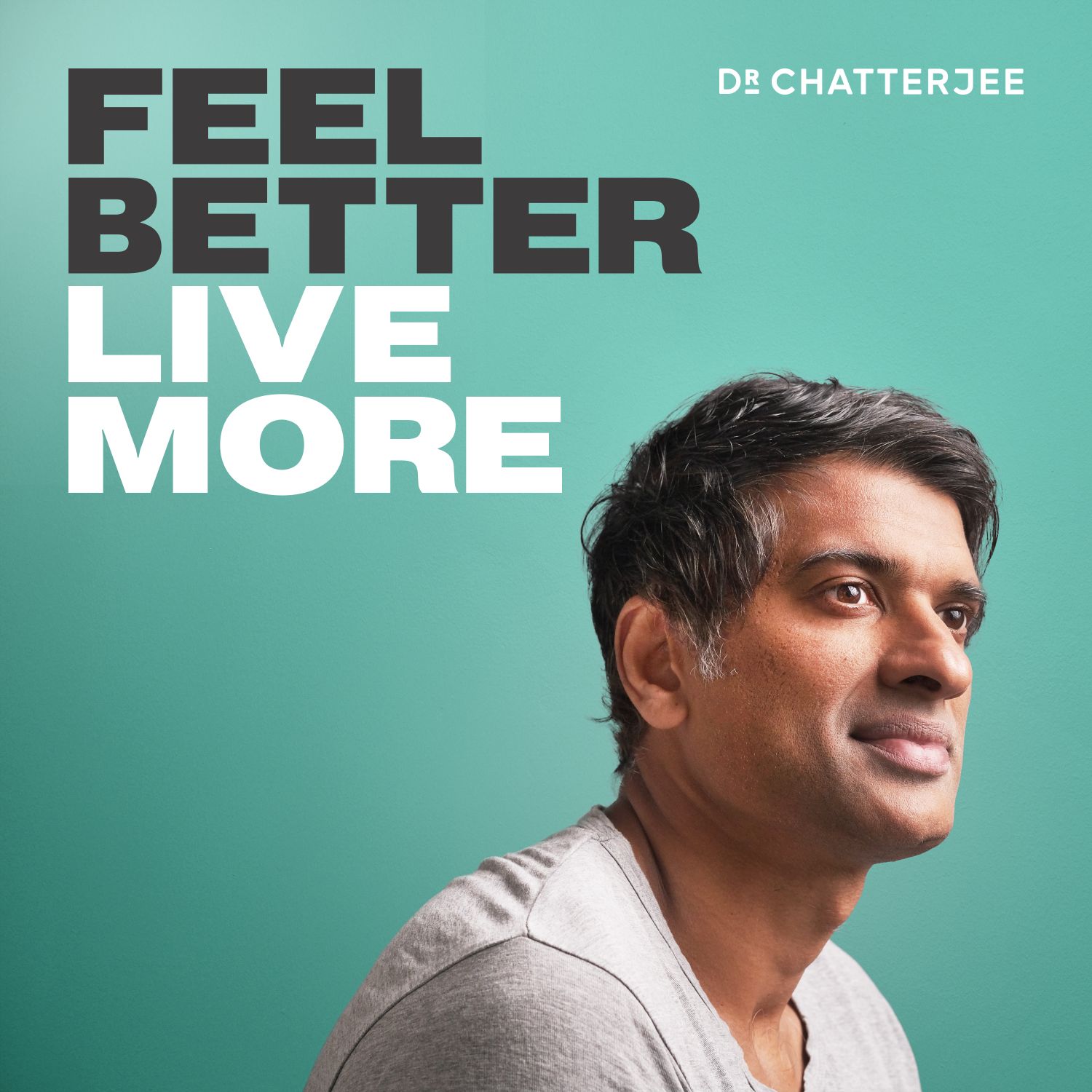
 Feel Better, Live More with Dr Rangan Chatterjee
1 Oct 2026 · 25m · 11 chapters

The science of sunlight and why daily outdoor exposure (about 15–20 minutes) can improve mood, energy, sleep, circadian rhythm, immune function, and cellular energy via visible, ultraviolet (vitamin D3), and infrared light.
Dr. Roger Seheult (quadruple board-certified physician). He discusses his own shift-work routine and how he tries to get outside during breaks.
Sunlight is the “lowest hanging fruit” intervention; visible light helps prevent depression and sets circadian timing; UVB supports vitamin D3; infrared penetrates deeply, affects mitochondria (cell energy), and may improve age-related mitochondrial decline.
Florence Nightingale’s quote about light; Glenn Jeffrey (UCL) Nature Scientific Reports showing infrared effects detectable through the body and improved retinal color-vision thresholds; analogy of “charging” mitochondria; SAD box guidance (10,000 lux, ~20 minutes).
Written by AI. May contain mistakes.
Discover how natural light influences our health and well-being.
“One thing is vitamin D, but there's many other things that sunlight does on our body as well.”
Exploration of historical views on the importance of light in health.
“There's no question in my mind that sunlight is that intervention.”
Understanding the different types of light and their health benefits.
“And if we look back historically, this was not something that we ignored.”
Examine how visible and infrared light affect our bodies and health.
“So when we look at the light that's coming from the sun, there's basically three types of light that we want to talk about.”
Insights into how light impacts mitochondrial function and energy production.
“into the skin, which is where they're needed.”
Comparing the effect of sunlight on cells to charging a battery.
“So what is the relevance of this idea that in the Glenn Jeffery study whereby the sun is coming on to us, but some of that light is going through us?”
Advice on how to safely get sunlight exposure without risk.
“If it's in the heart, it's congestive heart failure.”
Learn why daily sunlight exposure is crucial for health and mood.
“been in the sun for hours, they're not hot because they're reflecting the particular type of light that gives warmth from the sun.”
Discover the different types of light and their health impacts.
“But just getting outside in the sun on a daily basis is very important.”
Explore how different types of light affect mood, energy, and overall health.
“which is significantly less than what we were getting just even 30, 40 years ago.”
Learn actionable tips for increasing sunlight exposure daily.
“or buy anything, of course, some people's lifestyles and their jobs make it harder for them to do it as much as they might want to.”

Get the gist, explore an idea or ask about something said.
 Claude
On Feel Better, Live More with Dr Rangan Chatterjee, what are the key points of this episode?
Searching your listeningAutomatic transcript. May contain errors.
0:00Today's Bite Size episode is sponsored by the daily health drink AG1. The clocks are about to change, the mornings are darker, everyone around you seems to be coming down with something and that's why at this time of year I remind myself to lean into the fundamentals and for me one of those fundamentals is AG1. AG1 is a daily health drink that has been in my own life for over eight years and one of the many things I like about it is the fact that many of the nutrients it contains, for example vitamin C, vitamin A, zinc and selenium, support a healthy immune system. Right now AG1 is offering listeners of my show a free AG1 flavor sampler and AGZ sampler to try all the flavors, plus free vitamin D3 and K2 and AG1 welcome kit with your first AG1 subscription order.
0:57That's$87 in free gifts for first-time subscribers. All you have to do is head to drinkag1.com forward slash live more to claim this offer before it ends. Welcome to Feel Better Live More Bite Size, your weekly dose of inspiration, insights and practical ideas to help you live well and thrive. Today's Bite Size is from episode 586 of the podcast with quadruple board certified physician, Dr. Roger Schwelt. Now most of us know that getting outside is good for us But we may not realise just how powerful natural light can be for our health In this bite size, Roger explains some of the science of sunlight And shares why spending time outside can play a vital role In how we sleep, how we feel and even how our cells create energy If we think about light and the fact that we're living these indoor lives now, and yes, for many years, you know, we've just thought sunlight equals vitamin D.
2:10It's like, no, no, wait a minute. Sunlight equals many things. One thing is vitamin D, but there's many other things that sunlight does on our body as well. So we might be missing one of the most important ingredients for health, and it's sitting there right under our noses. Look, if I were to say, what is the single biggest intervention that someone can do right away that would show not only benefits in the short run, but also in the long run and is the lowest hanging fruit? There's no question in my mind that sunlight is that intervention. With the benefits of modern science and technology, we can now actually literally get down to the molecular levels and show how getting out in sunlight can be tremendously beneficial on so many different levels.
2:58That is such a bold statement in many ways. It's a statement that many people have probably not heard of before through the lens of health. But I guess the thing about sunlight, and I guess, broadly speaking, natural light, is that we've not really prioritized it or spoken enough about it for quite a while now, have we? That is true. And if we look back historically, this was not something that we ignored. And look, I'm not telling you something that you don't already know. Florence Nightingale, who by many have been considered to be the founder of modern nursing, when she was taking care of English soldiers in Crimea, said, look, there's two things that I see that have the biggest impact on the health of my patients.
3:57Number one, fresh air. But a close second to that is light, sunlight, not just daylight, but direct sunlight. And she's quoted as saying that. And she was known. She was there. She was at the bedside. She was known as the lady with the lamp. And that was well known at the time. And we have sort of forgotten about that. So someone listening is getting so far that, look, light is important. Okay. We know that getting outside is important. And I, like you, am really passionate that at the end of this conversation, people start taking their light exposure much more seriously. But let's really try and unpick what is it about being outside that has all of these different aspects on our health?
4:46Absolutely. So when we look at the light that's coming from the sun, there's basically three types of light that we want to talk about. There is obviously the visible light, which you can see. And there is countless studies and decades of research that shows that visible light itself has a tremendous health benefit on the individual. Why? Number one, it prevents depression. So we know that people who live at high latitudes, who are not exposed to enough visible light, especially during the winter months when the days are short, when they're getting up before the sun gets up and they're getting home after the sun goes down, they are susceptible to seasonal affective disorder.
5:28And a very easy way of overcoming that particular issue is with visible light into the retina that stimulates a portion of the brain that prevents depression from happening. We also know that visible light, especially early in the morning when the sun is coming up, helps to ground and to establish a good circadian rhythm. is something called the Zeitgeber that affects the timing of all of the processes in your body. So those two things right there are just the top of the list in terms of the things that visible light does when you get outside. Now, in terms of the two types of invisible light, when we go past violet, we get ultraviolet light.
6:15And we all know that ultraviolet light, specifically ultraviolet light B, is very important in the production of vitamin D3 in our skin. So that type of high energy, so this is short wavelength, high energy, they have the energy to penetrate just very shallowly into the skin, which is where they're needed. But that's just one aspect of invisible light. Okay. So we've talked about visible light. We've talked about ultraviolet light. Let's go to the other extreme. So past red, this is also invisible, but this is very long wavelength. And this is what we call infrared. And today we're going to talk about red and infrared lights.
6:57And there's a couple of aspects of this light that's very important to understand. And that is that infrared light is a lower energy type of light with a long wavelength. It's this long wavelength that's actually able, despite the fact that it's low energy, is able to penetrate deeply into the human body. And because of that, this is really important to understand, going outside into the sun on a sunny day is not just for the skin. It's not just for the eyes. It's for the entire body because this particular type of light from the sun, which is long wavelength, has actually recently been shown.
7:40There's a paper by Glenn Jeffrey from University College London, professor of ophthalmology. He's just published in Nature Scientific Reports that this type of light from the sun not only penetrates deeply into the human body, but he has actually been able to detect it on the other side of a human being. In other words, it goes right through. Yeah, it's amazing. So what is the relevance of this idea that in the Glenn Jeffery study whereby the sun is coming on to us, but some of that light is going through us? What does that tell us? So it was a very small fraction of the light that was coming in the other side.
8:22So the first thing that people have difficulty understanding is that sunlight actually is affecting their entire body when they go outside, not just the skin. Once they understand that, the next question is, okay, well, what is this infrared light actually doing? We actually have multiple studies that have looked at this, and many of them have been on a Petri dish or in a laboratory using infrared light from artificial sources, showing very amazing changes. And none of the scientists really understood at the time that this could be the effect from the sun because they had no idea that infrared light was able to penetrate that deeply.
9:02So what is this infrared light actually doing in the human body? Well, we know it's actually affecting changes in the mitochondria. And this is the organelle of the cell that is responsible for producing energy. It's the batteries of the cell. Now, this is important for the obvious reason, but for another reason too, which is that we have seen scientifically with research that as we get older, as we age 40 years, for instance, we can see a drop in the output of these mitochondria in our cells by as much as 70 % in the retina, but over the entire human body, 30 to 50 % in some cases. So there's a material drop in energy production.
9:47And what infrared light is doing is it is restoring in a partial way, the energy output and the efficiency of those mitochondria to restore energy to the cells, whatever they happen to be cells of, or whatever organ they happen to be. And they're restoring the function of those cells. And this paper that Glenn Jeffrey showed, in this case, he was checking for color vision, which is highly dependent on energy output. And it showed that in the retina, the mitochondria was able to effectively go up enough that the threshold for color blindness in these subjects dropped statistically significantly enough to show an improvement in their vision just with this type of light exposure.
10:32Yeah, it's certainly incredible. As you're describing that, Roger, I'm sort of thinking about a battery that we charge, right? So, or a phone, right? We kind of understand the concept that our smartphone needs charging, right? So many of us during the night will charge our phones so in the morning they're ready to do what we need them to do throughout the day. Maybe this infrared light is almost charging us. So our cells and our mitochondria are actually getting charged up. And if we live indoors and we're hardly exposing ourselves to natural light, maybe many of us are running around on low charge all the time.
11:15It seems like quite reasonable based upon the research and based on what you're saying to think that actually we're almost being suboptimal versions of ourselves by not getting out in the natural light and getting charged up. that's a great analogy you know have you ever put your phone on low battery mode because you didn't have enough charge and you didn't you couldn't get to a charger fast enough yeah it's it's jittery right i mean it doesn't work as fast this is this is i believe a very good analogy as to how we are functioning when our mitochondria go down our metabolism goes down we gain weight depending on the cell type that we're talking about if it's in the brain it's dementia.
11:57If it's in the heart, it's congestive heart failure. If it's in the pancreas, if it's in our peripheral tissues, it's insulin resistance. All of these things have been tied to mitochondrial dysfunction. Aging has been tied to mitochondrial dysfunction. Yeah, it's, you know, I've covered this on the podcast many times in the past that when our mitochondria are not working well, so when we have mitochondrial dysfunction, it can cause a whole variety of different problems, heart disease, type 2 diabetes, obesity, dementia, inflammation. So mitochondrial dysfunction right there at the heart. And what you're saying from the research is that one of the ways in which we can address this mitochondrial dysfunction is to get large amounts of infrared light.
12:47And the way you get that infrared light is by going outside. I would agree with that. But I would also, So, and there's probably some people in there thinking, oh, I need to get out there for hours in the day. It's very interesting. In my discussions with Glenn Jeffrey and Robert Fosbury, who also collaborated, who's an astrophysicist on this, is that you actually don't need to get out and have large amounts of infrared light to get these type of changes. Some people might out there be thinking, well, I've got very fair skin. I burn easily, or I've got a history of melanoma, or maybe I've had melanoma.
13:24or some sort of skin cancer. And here's the good news. The good news is, is that you don't need to have massive amounts of infrared light. You just need to have small amounts and you can get it without even being directly in the sun. You can actually get outside in the shade so long as you're surrounded by a lot of trees. It's bright. You're going to be getting much more infrared light in that environment than you are in your office. leaves on trees and grass are highly reflective of infrared light. You may have realized this independently. If you go out on a nice summer day, sunny day, and you touch leaves that have been in the sun for hours, they're not hot because they're reflecting the particular type of light that gives warmth from the sun.
14:13And you also know this when you go out on a sunny day. If you close your eyes, cover your eyes, someone spins you around, you can actually feel what side of the body is facing the sun. And the reason is, is because infrared light not only penetrates through your body, as we've just discussed, it can also very easily penetrate through your clothes. And so you can feel that. That warmth that you feel from the sun is infrared radiation, penetrating deeply into your skin, going through the tissues, and activating the heat receptors as they go through. Because of the nature of infrared light and its ability to penetrate through clothes and its ability to reflect off of trees and be very high in your environment, If you were that type of individual, you could go outside on a sunny day.
15:03You could sit in the shade around trees. You could cover up with a layer of clothing, wear long sleeves, even wear a wide rimmed hat. And I believe that you could get the benefits of infrared light in that environment much, much better than you would inside, even with a window. So it doesn't have to be for a very long time, but it does have to happen. And here's where we are with the population. Look, for the majority of people, and I've looked at the statistics, I think in England, it's 92%. In the United States, it's 93%. That's how much time we're spending indoors away from sunlight. And so we are talking about a huge amount of the population at very one extreme that maybe just 50 or 100 years ago, that was not the case.
15:52We were outside. We were in the sun. We were getting around. And that was enough. And so this is the existence that we're talking about. And what I'm saying is that they should make a concerted effort that's very important to get outside for just literally just 20 minutes, 30 minutes if the sun is low in the sky. And to get that sunlight on their body on a daily basis, that right there can actually have a tremendous benefit on their health. But just getting outside in the sun on a daily basis is very important. we're saying sunlight a lot throughout this conversation and i just want to make sure it doesn't get misinterpreted by anyone i think you're saying get outside ideally sunlight but of course if you're living somewhere where it's cloudy for three weeks you're still saying get outside because you will still be getting some of these benefits even if you can't see the sun Absolutely.
16:54So just to give you an idea, we measure the intensity of light, visible light, which correlates to invisible light as well, in measurements of lux. So right now in the room that I'm in, any room that you're in in your house can range between 50 and 100 lux. If you go outside on a bright, sunny day, it's about 100 ,000 lux. On a cloudy day, it may be 20 ,000 to 30 ,000 lux. Okay? So that's still magnitudes of order, higher amount of sunlight than you're getting if you stay inside your home. Yeah, wow. What have you changed in your own life over the past two to three years, having gone deep into this area of research?
17:39So I am a physician, and the nature of my work being in the hospital is shift work. So I'm in the hospital at seven o 'clock in the morning and I get out at seven o 'clock at night. And the nature of that is that I'm not going to get exposed to a lot of light. And so I've been trying to make it a point that on my lunch breaks or any type of breaks that I have, I try to get outside. I walk around, try to get as much sunlight as I possibly can. But what you don't want is someone to all of a sudden who hasn't been outside to just go outside in ultraviolet rich sunlight and get skin burned. And that's not at all what we want to see.
18:17We want to see rational, moderate sun exposure above and beyond what people are getting now, which is significantly less than what we were getting just even 30, 40 years ago. Okay. So we understand when we think about foods that there are three macronutrients, right? Fats, protein, and carbs. Yeah. So perhaps now we need to start thinking about light in the same terms. We're now saying, okay, there's light, but under light, there's at least three different components from what I'm understanding from you, okay? The first one is that visible light. So we can see that. That's why going out first thing in the morning is so good for our circadian rhythm.
19:05It helps set the kind of clock in all of our cells. And that can have an impact therefore on things like mood, sleep, and our guts. There's also a second type, which is the ultraviolet light, the UV light. And of course, for many years, we've heard about vitamin D and how important that is. And many people know that sunlight outside on your skin at certain times of year will increase your production of vitamin D. So that second component is the UV light that's going to help with vitamin D, which of course has a very powerful effect on our immune system and many other things. And then there's this third component of light, infrared light.
19:48We cannot see this part of the light spectrum, but it has a powerful effect on our mitochondria. And that's why if we sort of circle back to the start of this conversation, you said that going outside and getting sunlight is the most important thing that we can all do to improve our health, right? Which I'd love. Because when we understand that the mitochondria sits at the heart of everything, you're like, of course, a lack of sunlight is potentially going to be impacting energy, vision, heart disease, stroke, dementia, everything. So going outside is free. It's not like you have to do anything.
20:34or buy anything, of course, some people's lifestyles and their jobs make it harder for them to do it as much as they might want to. But at its core, you're talking about something that is completely free of charge, which I think is absolutely worth remembering. In terms of then practical things that people can do, okay? So, so far, you have beautifully made the case that we are a light deficient population and that is having serious consequences on our short-term and our long-term health. So there's been some practical things throughout the conversation, but I wonder if we could just really focus for the next few minutes on what are the things then you recommend people do to try and mitigate this?
21:23Absolutely. We should double our efforts this winter to make sure that we're getting 15 to 20 minutes of sunlight. That's all I'm asking. I believe that people need to get outside in any way they possibly can. If they're concerned about direct sunlight damaging their skin, they can cover up. And to get outside and just sit or exercise if they want to in an outside environment for at least 15 to 20 minutes a day, the best time of day to do that would be in the morning time because you're killing two birds with one stone. Not only are you getting the benefits of infrared light, which are bountiful in the morning, But you're also getting the visible light into your eyes, and it's causing the benefits in terms of depression and also in terms of setting the circadian rhythm in order.
22:14So that's sort of a double whammy. I understand, though, that for many people, they cannot do that. And so for people who get up early in the morning and are not being exposed to the sun early in the morning and have to do it later in the day, that's perfectly fine. What I would recommend doing, especially at high latitudes where you are there in the UK and also in Canada and the parts of Europe, is to get something called a SAD box or a SAD box. It stands for Seasonal Affective Disorder. It's very inexpensive. You can probably get these for about$20 online. And the key here is that it needs to be 10 ,000 lux, giving visible light.
22:55It sets about 30 centimeters from your face, and you're in front of it for about 20 minutes a day. You can also buy glasses that can do something very similar. It will help with the issue of seasonal affective disorder and circadian rhythm issues. So if you do this in the morning, this does not in any way make up for vitamin D from the sun. So if you need to supplement with vitamin D because you're not getting outside enough, you should do that. And it doesn't make up for the benefits of infrared light from the sun. So you still need to get outside during the day, but that light later in the day is not going to be beneficial in terms of depression and circadian rhythm unless it's done in the morning.
23:35And so we're trying to substitute for that with the visible light in the morning time. So that's the key for sunlight exposure. And I guess what I'm saying here is that when you go outside, you're getting a whole buffet, a whole cornucopia of things that are mixed together dynamically for your body at the right time. So think about this. It's an amazing situation. There is a clock in your body that is set by the sun. And as the day goes forward, the amount of ultraviolet light and infrared light that you're getting from the sun also changes along with that circadian rhythm. And so really the best solution is not to go out and necessarily buy a lamp.
24:19I mean, those have their place. But if you have the ability and you can do this, it's to go outside into the sunlight because everything that you need is literally right there. I really hope you enjoyed this week's Bite Size Do spread the love by sharing this episode with your friends and family And if you want more, why don't you go back and listen to the original full conversation with my guest I hope you have a wonderful weekend Make sure you have pressed subscribe And I'll be back next week with my new conversation on Wednesday And the latest episode of Bite Size next Friday Thank you.
When we think of sunlight, vitamin D is usually the first thing that comes to mind. But the truth is, the full spectrum of light that we get exposed to when we spend time outside plays a vital role in how we sleep, how we feel and even how our cells create energy.
Today’s Bitesize is from episode 586 of the podcast with quadruple board-certified physician, Dr Roger Seheult.
Most of us know that getting outside is good for us, but we may not realise just how powerful sunlight can be for our health.
Roger shares why spending 20 minutes a day outside - even on a cloudy day - could make a real difference to your mood, your energy and your sleep.
This Bitesize is a powerful reminder that sometimes the simplest habits, like stepping outside, can have the biggest impact on how we feel.
Sunlight isn’t just something that makes us feel good – it’s a fundamental part of how our bodies stay healthy. And the best part? It’s free and available to us all. I hope you enjoy listening.
Thanks to our sponsor https://drinkag1.com/livemore
Show notes and the full podcast are available at drchatterjee.com/586
Support the podcast and enjoy Ad-Free episodes. Try FREE for 7 days on Apple Podcasts https://apple.co/feelbetterlivemore
For other podcast platforms go to https://fblm.supercast.com.
DISCLAIMER: The content in the podcast and on this webpage is not intended to constitute or be a substitute for professional medical advice, diagnosis, or treatment. Always seek the advice of your doctor or other qualified health care provider with any questions you may have regarding a medical condition. Never disregard professional medical advice or delay in seeking it because of something you have heard on the podcast or on my website.
Learn more about your ad choices. Visit podcastchoices.com/adchoices