Ask ChatGPT
 Feel Better, Live More with Dr Rangan Chatterjee
20 Oct 2026 · 1h 57m · 35 chapters
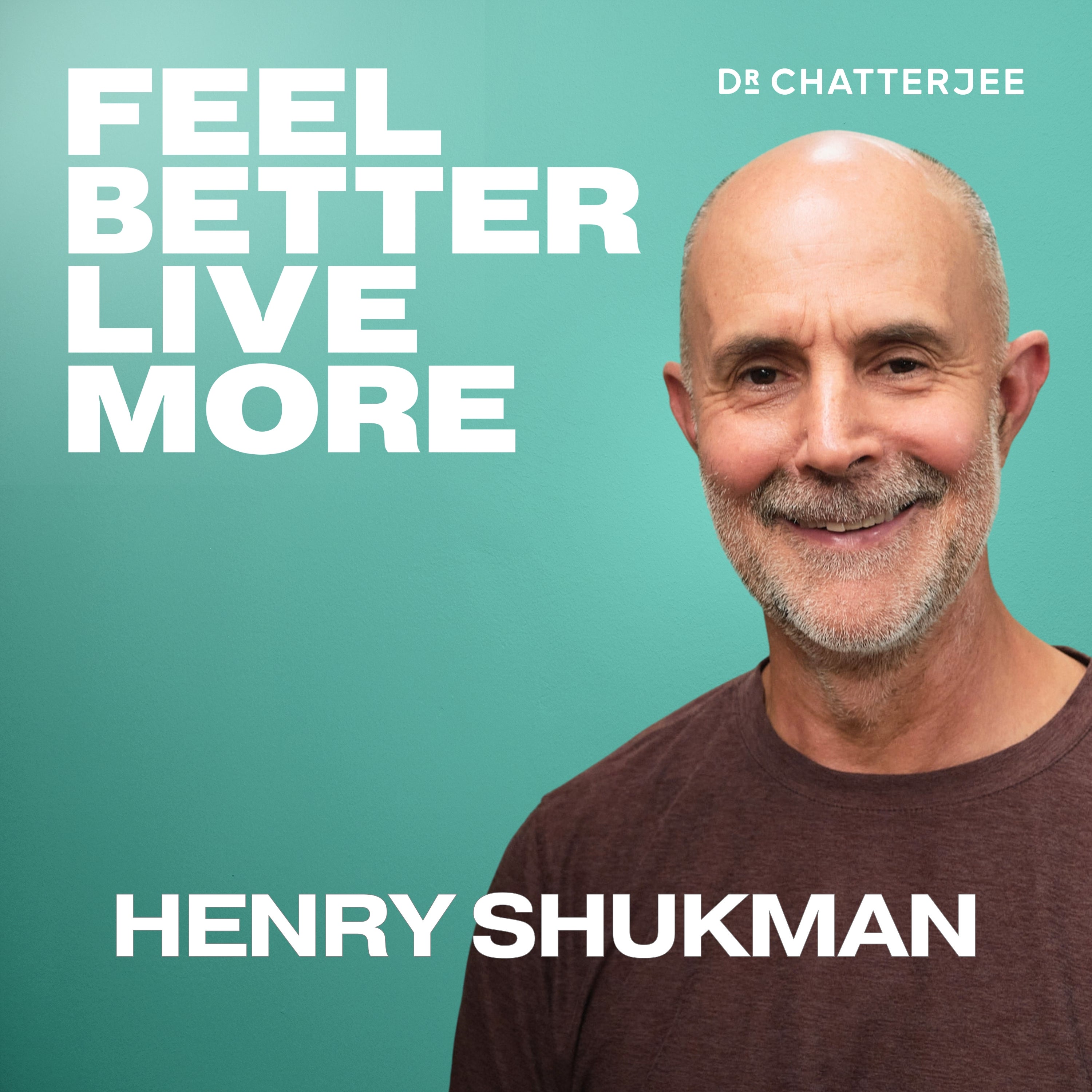
Meditation and non-duality—how meaning, happiness, and purpose come from within; how practice can dissolve the sense of separation between self and world; and how slowing down (solitude, stillness) reveals “the extraordinary in the ordinary” without denying everyday life.
Henry Shukman, Zen master, author, poet, and co-founder of the Way Meditation app. Background: long-term meditation practitioner (about 40 years mentioned), teaches in a Zen tradition; previously described a non-dual experience from age 19; appears as a guest on Rangan Chatterjee’s podcast multiple times and co-hosted a retreat in Santa Fe.
Written by AI. May contain mistakes.
Discussion on the pursuit of happiness and finding meaning within ourselves.
“Now, this is Henry's third appearance on my podcast, but this conversation goes somewhere we've never been before.”
Henry discusses how meditation connects us to our true selves beyond achievements.
“Many people these days, Henry, feel lost and lacking in purpose.”
The conversation reflects on the joy found in the present moment and authentic living.
“I still have that conditioning strongly that I've got to, I've got to, I've got to do my projects, do them well.”
The role of meditation in countering modern busyness and fostering awareness.
“And, you know, our compassionate nature comes forth.”
Discusses the relief and warmth felt when one's value is recognized by others.
“And it's such a relief when it is called out and recognized.”
Explores how modern life's busyness can overwhelm us and the importance of slowing down.
“How do I get through my to-do list faster?”
Discusses how meditation can change our internal pace and help us connect with our true selves.
“And one of the things I wrote down in my journal that I saw today, because I hadn't looked at it for a while, was I felt as if my internal momentum had changed.”
Addresses how to find beauty and connection in everyday life despite its busyness.
“And how often am I really connected with it?”
Explores the idea of tasting slowness and how it can help us reconnect with ourselves.
“Yeah, there's beauty all around us, even in a system.”
Reflects on how slowing down can help us connect with a deeper mystery in life.
“But there's a bit of another dimension that we start to sense that's with us all the time.”
The conversation delves into the importance of slowing down to connect with a deeper understanding of life.
“But I think there's something much deeper that it does that probably underpins all of that.”
A personal account of a transformative experience during a men's retreat, highlighting themes of connection and vulnerability.
“This friend has been doing a lot of what would be called men's work for the past few years.”
Discussing the nature of deeper knowledge and personal experiences of well-being.
“There's this whole side to what we are that is a mystery.”
Reflecting on changes in perception and the evolving definition of success.
“So I would say that's another thing that I've noticed over the last few weeks is that I've just got a greater awareness field, I guess is how I would put it.”
Finding beauty and gratitude in everyday life through mindfulness and meditation.
“you don't get, it's not easy to access a lot of information on this or to be met.”
Discussing the concept of awakening and how it shapes one's engagement with the world.
“we can, you know, the walls of the self get a little bit thinner and they get a little bit more porous.”
Discussing the concept of non-duality and its relation to everyday reality.
“the next 49 years teaching and you know we're still benefiting all these years 2500 years later I mean, he's only one of dozens of spiritual teachers.”
Discussing the importance of meditation for peace and deeper understanding.
“None of this denies our ordinary reality.”
Explore how our frameworks shape our desires and the potential for inner peace.
“of got that thing, we'll be out of the capsule, but we won't.”
Discuss practical meditation tips amidst life's demands and distractions.
“I know a lot of people love listening to you and they love meditating on the way.”
Discover how to maintain meditation practice even in a busy household.
“they'd come or they'd come into the living room while I was meditating.”
Learn how meditation can be practiced even in chaotic settings.
“I would, you know, I'd sit and have a 20 minute ride and it's long enough and I'd just listen to the conversation, the clacking of the tube, the noise of the tube.”
Explore how meditation can help address shame and addiction.
“Henry, I struggle with addiction and shame.”
Learn about the nature of urges and how to navigate them mindfully.
“And that there is something larger that can hold it, that can hold our sense of shame.”
Understand the importance of creating space to resist negative urges.
“urges towards doing things and to not need to obey them.”
Discover how meditation can help individuals recognize their inherent worthiness of love.
“Three slow breaths or not particularly slow breaths.”
Explore how facing difficult experiences can lead to profound insights and love.
“I was going to say that I've met many people over the years who, what really opened that up for them, that sense of being loved or having love as part of their life experience, was something really difficult.”
Discover how letting go of coping strategies can lead to deeper awareness.
“You know, we discover something that we hadn't known about our very life.”
Explore the challenge of maintaining awareness from meditation into daily life.
“I really like this question because I think it will be a very common sentiment with people who have tried meditation, have heard about the benefits of meditation.”
Learn why patience is crucial in both meditation and personal growth.
“You know, if we want something now, we go online, we get it delivered that evening.”
Understand how to recognize and appreciate progress in your healing journey.
“and I would see this in practice all the time anyway, I think the principle applies here.”
Gain insights on maintaining calmness in the face of anxiety from loved ones.
“Henry, I live with someone who is often anxious, pessimistic, and controlling, which can trigger reactivity in me.”
Discuss the importance of self-responsibility in personal relationships and growth.
“I think we went into quite a different direction today compared to our last two conversations, which were perhaps a bit more practical about meditation.”
Explore how to navigate personal struggles and discover inner strength.
“And I'm wondering, I've got a not very long poem that I could share.”
Reflect on practical insights from the discussion and their applications.
“I don't think there's much more for me to say beyond thank you.”

Get the gist, explore an idea or ask about something said.
 Claude
On Feel Better, Live More with Dr Rangan Chatterjee, what are the key points of this episode?
Searching your listeningAutomatic transcript. May contain errors.
0:00By the pursuit of what we think is best, we're missing all the beauty right here with humble, humble little things.
0:10Henry Shukman: You know, we think, I want some great awakening, but really they need so little to be really deeply happy and at peace. Hey guys, how are you doing? Hope you're having a good week so far. My name is Dr. Rangan Chatterjee and this is my podcast, Feel Better, Live More. What happens when the boundary between you and the world around you dissolves? Well, that's something I myself experienced recently and in this week's conversation, we explore what those experiences can reveal about who we really are. Henry Shugman is a Zen master, author, poet and co-founder of the Way Meditation app. As many of you know, I have been using the Way app for a long time now.
1:02And a few months back, I also became an investor because I very much support their mission to get more people meditating, as I passionately believe this will lead to a more compassionate world. Now, this is Henry's third appearance on my podcast, but this conversation goes somewhere we've never been before. we explore how meditation can lead to something beyond increased calm and focus. It can give you a direct encounter with the sense that we're not separate from the world around us. This is something I myself experienced recently and during this conversation Henry helps me make sense of that experience and in doing so opens up a conversation about awakening or non-duality, finding meaning from within and how surrendering the need to achieve allows your heart to open of course not everyone seeks truth through meditation and if you're happy to just practice in order to feel calmer and a sense of peace then henry assures us that's entirely valid as well towards the end of this conversation there is a really practical section where i put some of your most ask questions about meditation to him, including how to build a consistent practice, how meditation can help with addiction, and how to carry increased awareness from meditation into the rest of your life.
2:34This is a beautiful conversation that moves effortlessly between the practical and the profound, and I think it will probably mean something different depending on where you are in your own life. One of my own biggest insights over the past few months has been to really recognise how much power there is in cultivating an open heart, not just for our own peace of mind, but also because this will ripple out into our relationships, our communities, and ultimately, the wider world.
3:15Many people these days, Henry, feel lost and lacking in purpose. How do you see meditation as a practice that can help people find meaning?
3:30Henry Shukman: Yeah, that's a great question. Here's my initial take on that. It's like the first thing we try to do with meaning is try to find it out in the world. It's out there somewhere. And actually, I don't know that that's the right place to look for it. I think it's within. And meditation is, you know, lots of things and people understand it in lots of different ways. But fundamentally, it's always coming back to what's already here within us. I think, you know, the deepest meaning of our lives is within. And when we connect with that, we also see it out in the world. It's like it comes from within.
4:15Henry Shukman: We find it within and it reorients how we then live our outward lives. So I think that's the first thing, to be still with ourselves, to come home to ourselves. You're saying that many of us look outside for meaning, outside for purpose. and i guess many people have bought the myth that happiness also exists on the outside i mean these are just terms right you know they could for some of us they could be interchangeable meaning purpose happiness but i think the truth within all of them is that they're really not found on the outside they're all i guess to me games that are played on the inside yes i think that's That's right.
5:06Henry Shukman: I've heard someone say, or I think it's a common saying maybe, it's like, happiness is an inside job. You know, I think it's really true. I remember there was a time that the Dalai Lama came to visit Santa Fe. I'd actually, I happened not to be there at the time, but it was actually after I moved there some 30 odd years ago. And he was fascinated by skiing, you know. And he'd never done it and he wanted to see what it was like. And there's a ski mountain half an hour outside Santa Fe and he went up there. And after, I mean, he didn't actually get put on a pair of skis, but he was just watching people doing it.
5:47Henry Shukman: And afterwards he wanted to go into the cafeteria, have a hot drink. And he was sitting there and one of the servers, you know, working in the cafeteria, she so nervously came up to him and asked him, you know, you're on your what they call your holiness your holiness yeah um i know you're a very wise man i want to know what's the meaning of life and and he's burst out laughing he says how he often does there's a meal in life meal in life is very simple it's to be happy it's to be happy but not so simple is how to be happy not so simple
6:34Henry Shukman: yeah and um you know i think it's such a good reminder for all of us that when we're driven to so much by our culture to try to live up to things outward measures and we're driven to how do i measure up how do i earn my place how do i feel worthy um and there's a totally different path of non-accomplishment, non-achievement. It's the opposite. That your meaning, your deepest meaning and your deepest purpose and your happiness are never going to be earned. You know, that's, it's so radical. I still have that conditioning strongly that I've got to, I've got to, I've got to do my projects, do them well.
7:22Henry Shukman: They've got to be helpful. I want to serve the best I can and somehow my right to exist you know I can fall into this thinking my right to exist you know is earned by how well I act and sort of perform but that's that's the wrong path for true meaning and true happiness it's interesting and I guess for many people perhaps reassuring that you as someone who is a certified zen master and someone who i think has meditated for how many years now i'm a little embarrassed i ought to be better by now it's like it's getting on for 40 years yeah so let's say 40 years of meditation yeah you're still susceptible to this external conditioning that many of us fall prey to in the modern world and as you were talking just then, I thought back to the retreat that I came on that you were sort of co-hosting in Santa Fe earlier on this year.
8:28And this morning I was going through my journal actually of some of the notes I made afterwards. And I remember very clearly on the first day, because there was only about 10 of us there. And, you know, some of the people who were there were, I guess, would be relatively well-known people, not everyone, but some were. And I think you said something like, sitting in this room, many of you are overachievers.
9:02And none of you ever needed to achieve anything. Or something to that effect. And it stopped me in my tracks i thought yeah there's there's a lot of us in here who by modern standards would be considered successful and just that kind of almost contradiction but hey you guys are all overachievers and none of you ever needed to achieve anything yeah i mean what are we meant to do with that does that mean we're not meant to go out there in the world and do things or is it something
9:37Henry Shukman: difference yes it's it's it's a it's a bit of both and i think because it's great for example you offering this incredible podcast that is helping just millions and millions of people there's no question in my mind it's a really good thing um and you know you've done deep training in medicine and you know very very effective and and beautiful skill as a healer and a doctor That's all fantastic. But there's still another path. There's still another reality about our lives that we can only find by being a kind of underachiever. It's like, it's really counterintuitive. But there's a way that even while we may be, you know, you're called to do the kinds of, you know, sort of big things that you're doing and it's fantastic.
10:28Henry Shukman: Others are called to do smaller things, but they're still called to do stuff. um but either way the most beautiful thing of all is letting go of all of that and finding i think it's like finding our true heart our true heart knows that it it never needed to to prove itself and there's something about connecting with that in ourselves for ourselves to really coming back to this totally natural, spontaneous, sort of innocent, open heart that we all have. I think living with that and from that will be helpful just by our interactions and not in big ways. It might be in big ways if we have a large reach or something like that, as you do.
11:26Henry Shukman: But everybody, you know, it's something about the human race. When we come back into this sort of tender, open heart that we all have, I think that if that spreads, the whole human race gets this little magic sort of ripple of kindness and openness. And, you know, our compassionate nature comes forth. Yeah, I completely agree. The way I see it is it's to do with the energy behind what you're doing, right? So let's take this podcast for a moment. If I'm doing it in order to say something about who I am as a human being, and I judge my worth as a human on how many people have listened or not listened to an episode, I think that's very different from doing it with an open heart.
12:31Yes. Doing it because you're interested in this topic and you want to explore it and express it. Yes. And whether people listen or not, it was still worth having that conversation because I did it for me. Exactly. It's like a subtly different flavor, isn't it?
12:49Henry Shukman: That's right. I mean, I see it as a kind of gratitude for having this experience at all, that we're able to sit here feasting on the visuals that are appearing before our eyes, hearing the soft quiet in the room, hearing our voices, sharing. you know, just to be doing this is already such a gift. And to feel, to be touched by that gift of being alive, you know, it's available to us in every moment. And if we do get it, then if we do sense that, it's like we sort of don't need anything else. You see what I mean? It's like, We're not doing it for some ulterior, later purpose. It's just for serving the very gift of life.
13:45Henry Shukman: And I think when we've got that vibe going on, when we're feeling that ourselves, I think everybody recognizes it, or everybody knows that they too do sometimes feel like that. And our society, our culture, contemporary culture, so doesn't recognize the value of that. And it's such a relief when it is called out and recognized. And when we sense somebody else is just free. And I think it's a natural human thing to have that spontaneous warmth in our hearts. You know, when we're feeling it, it's its own reward. It's its own reason. I think what meditation does for many of us is provide the kind of structure and container for us to experience these things.
14:40Because I think if you are left to the prevailing wind of society in the modern world, you can end up being swept up in busyness and emails and things you have to do. and you never quite feel you're doing enough and there's always something else you could be doing and that to-do list just keeps growing even though you've made so many efforts to actually get through it. And I guess the sort of common tendency is to think that we need more productivity hacks. How do I get through my to-do list faster? Many people, and people maybe right now are listening to this episode on 1.5 the speed, twice the speed, right?
15:25I love podcasts. I have never, ever listened to a podcast at anything but the actual speed. Okay? And that's not to judge anyone who does it differently, right? Many people say, yeah, I listen to things double the speed. And actually, I really enjoy it. And I get more information quickly. I just realized I actually want to experience it as it was. Like, I don't want it sped up.
15:50Henry Shukman: Yes. You know, and I think busyness is such an epidemic these days that any practice of solitude or silence, whether that be meditation or whether it be something else, I think has incredible hidden power, basically. Yes, exactly. And it's not on the same register as the metrics of getting more done. It's not at all. It's like, actually, there's this, I'm trying to remember, there's a really funny song called The Sickest Buddhist, I think it's called. I'm the best Buddhist or something like that. I forget who the comedian is doing it. And he says, and there's a line in it, like, that 25-minute meditation, I killed it in 10.
16:38Henry Shukman: you know it's like it's exactly like that could you possibly speed up a meditation you know it's like it's it's insane the whole point is like we're just joining the unfolding of the universe we're just being still and joining what's actually happening yeah and you know it's such a different mindset from what can i get done yeah it brings me back to that retreat okay so it was something like a three-day retreat that I did with you earlier on in the year. And one of the things I wrote down in my journal that I saw today, because I hadn't looked at it for a while, was I felt as if my internal momentum had changed.
17:21Which is really beautiful because I think when we're in the sort of routine of daily life, that kind of internal pacemaker as it were runs at a certain speed right we don't realize it that we're sort of being it's like a thermostat in the house like it's always bringing us back to that speed and i felt because of the container you provided during that retreat everything within me started to slow down there's something about internal momentum that i think many of us don't realize until we slow down, until we have that practice of solitude, we just don't know how fast we're moving through life. I totally agree.
18:08Henry Shukman: Very often, as we start to settle through doing regular daily meditation, we start to feel, oh my gosh, there's a kind of flywheel constantly turning inside me. It's got this momentum. Even though I'm still now, this thing is still spinning that's trying to make me do stuff. And so it takes a while for that momentum to sort of bleed off, as it were, just gradually slows down. And we get into the pace of actual living. You know, I mean, I totally relate to it myself. You know, I've done it a lot in my life, just trying to drive myself faster. Actually, I'm wondering, I've got a poem about this, about this very problem.
18:49Henry Shukman: Yeah. Shall I share it? I'd love you to, yeah. Okay, well, it's called The Slow One. And I'm going to, I just need to go a little bit of a setup of what's going on in it. Yeah, amazing. It's a time in my life, relatively recently actually, when we had had to move to California, Southern California to support a loved one who was having a very hard time. And we were living in, you know, the suburban spread of Southern California, which was not somewhere I'd ever really wanted to live, to be honest. You know, LA area, you know, I'm blessed to live in a beautiful city, Santa Fe, where you came wrong earlier this year.
19:29Henry Shukman: And I grew up in a beautiful city, Oxford and so on. And I was really not very comfortable at going there, but we had to. But the good thing I discovered soon was we were only 10 minutes from the ocean. So I could drive down to the ocean. And I started going every morning at dawn or just before, and I'd see the sun coming up and I'd get in it. It's quite chilly actually down there, the ocean, but really, really, really beautiful. And I started to notice that I'd get this expansive, beautiful experience at dawn. And then I'd already, before I knew it, I'd be wanting to get back to get onto my computer to get working.
20:10Henry Shukman: And I suddenly realized how sad that was. And this poem is about that. It's called The Slow One. The real me moves slowly. The real me moves slowly. He looks at things a long time until he understands what he's looking at. Like this morning in the sea, down by the broad beach, early, when the sun had just risen and was bright like oil on the water, and the water itself was dark purple, almost black, and it was the sea's surface the seeming thickness of it, like animal hide, but moving, breathing in its big, slow rhythm that caught his attention. It seemed heavy like a blanket being shaken in slow motion, its colors and folds lit by the morning sun.
21:07Henry Shukman: He was studying it. He was studying it, enjoying it, learning about it, when already we were showering off the salt at the Publix Bigot. towelling dry, getting in the car, into the traffic. And he was still staring back, trying to see the sea with the great light risen across it, which wanted to show him his true place in the world. Something he was happy to learn again and again. But someone else, someone thoughtless, heedless, busy, had already taken him away. I mean, how many people are going to resonate with that straight away, Henry? It's like, you know, there's something so beautiful inside us that loves this world and loves being alive.
21:57And how often am I really connected with it?
22:02Henry Shukman: You know, my practice is to be connected with it. And I have long spells when I'm really lucky. I just do feel more connected with it. But it's not constant. I can get taken out. What would you say to someone who resonated with that beautiful poem, but doesn't feel it's relevant for them? They're like, okay, yeah, Henry, you're a meditation teacher. You live in the mountains of Santa Fe. I live in inner city London. My life is busy. I've got a job to go to. I've got errands to run. What's the relevance of that for me? What would you say to that person? Yeah, there's beauty all around us, even in a system.
22:43Henry Shukman: I spent a lot of time in New York and in London, actually, as well. And there's beauty sort of everywhere. And I would say, just see what it's like to allow yourself five minutes of sitting on a bench and just watching the world go by. the shift from being caught by our own inner momentum that society kind of approves of us having and has conditioned us to have the switch between that and just disengaging from it for even a little bit just watching, people watching watching the world go by just a moment of it we get the flavor we can all, all of us can get the flavor and the question then is when you get the flavor of slower, of coming back to a slower version of you that you've always had, that you had as a kid and you still have today.
23:46When we get that flavor, you know, how do you feel?
23:51Henry Shukman: When we really get it, do we sense there's another way of being alive? It doesn't mean I have to abandon the other one. No. It's the balance. What I've experienced myself is that if you can taste slowness in the morning, okay? Yeah. It's not just about that luxurious feeling that you have. You almost remind yourself what slowness feels like. and so this is why I personally am a fan of morning routines or rituals just some sort of morning practice of stillness because I think it just grounds you a little bit reminds you what it can feel like and even if you then get caught up in the busyness of the day I think you're much more likely to slow down at some point if you've tasted it right and I think unfortunately so many of us don't feel we've got time for even five or 10 minutes of slowness or stillness or meditation and therefore we've forgotten what it feels like we're just used to our thermometer or our internal momentum running at a fast speed we think that's our natural speed but it isn't it's your conditioned speed it is and you can actually uncondition it without needing to go to you know a wonderful retreat you can start to do that with five or ten minutes a day can't you you totally can and i would say the thing is it's actually it's not just about momentum and speed it's like if we get that little space yes in time we'll learn to disengage and we'll it's like unplugging disconnecting and you suddenly feel alive in a different way and i feel that once we've got that sense more consistently, touching into it more consistently each day, we can then throw ourselves into the busyness of life.
26:06Henry Shukman: It's fine. But there's a bit of another dimension that we start to sense that's with us all the time. And we'll remember it, we'll forget it, we'll remember it, we'll taste it, we'll forget it again. But we're starting to get the sense of slightly larger life that's with us all the time. It's not only when we slow down, and we start to get the sense, and it doesn't mean we shouldn't have our busy lives. It doesn't mean that. It's just that there's a larger life with us even while we're doing our busy thing. And that's just such a treasure to discover that. Yeah, that topic of another dimension I want to get to very shortly.
26:44Before I do that though, I just wanted to, if I may, read a section from, I think my favourite book of yours, original love entitled an invitation at the start please of course it really speaks to what we're talking about imagine you're alone in a quiet room no one can disturb you you're comfortable you're still and gradually you're getting the sense that a greater quiet surrounds you and holds you the more you feel this quiet the more you know in your bones that you can trust it it's beautiful and precious and you find yourself letting go of your plans your to-do list evaporates your agenda disappears like vanishing ink now there's only the quiet which feels almost like a presence and it brings on a deep sense of well-being and then henry you continue with another paragraph, but then I'm just going to pick it up one paragraph later.
27:50In a while, you take a deeper breath and end the period of meditation. You go downstairs, make coffee and enter your day feeling not just replenished, but as if you have just touched something wider an unnameable mystery a secret side to your life that has reset your priorities
28:17Henry Shukman: yeah i'm glad i wrote that actually it's beautiful it's always i'm not always so keen what i wrote before but actually that that yeah i sort of i think that's right by it i stand by it i think that that's the big point that we once we do once we do the disconnecting the slowing down a little bit it's not just that we go slower and we're more appreciate we touch the mystery the mystery of being and that's the big that's the big kahuna that's the thing that really matters that's what i want to focus on in today's conversation because you've been on the show twice before and you know we've covered all kinds of practical things to do with meditation and some of its benefits and it would be very easy to talk about the science of how meditation can help us with depression, anxiety, burnout, increase or change the structure of your brain, improve focus, all these things, which it does.
29:14But I think there's something much deeper that it does that probably underpins all of that. And again, you touch on it there, you know, a secret side to your life that has reset your priorities. That's what's happened to me, maybe six weeks ago, something like that.
29:30Henry Shukman: I think we need to hear about it because it's really important. And because, you know, this is what really matters is that we think we sort of know what life is. We know it in a certain way. We have a consensus about it, you know, and we're conditioned to go with that consensus. But there's a totally different way of knowing this life where it's more about not knowing. We sense in a different way. We experience it in a different way. and we actually get closer to the mystery of being. So please share what you shared with me and we'll unpack it. Yeah.
30:27ago. I certainly know that feeling and that's why at this time of year I remind myself to lean into the fundamentals and one of those fundamentals is AG1. AG1 is a daily health drink that has been in my own life for over eight years and one of the many things I like about it is the fact that many of the nutrients it contains, for example vitamin C, vitamin A, zinc and selenium, supports a healthy immune system. Some of the other things I really like about AG1 is that they are committed to continuous improvement and updating their formula as a scientific research involves. And each batch is independently tested for quality and safety markers, including heavy metals, allergens, and banned substances.
31:10This is how they can guarantee what's in your scoop and what's not. Right now, AG1 is offering a free AG1 flavor sampler and AGZ sampler to try all the flavors, plus free vitamin D3 and K2 and AG1 welcome kit with your first AG1 subscription order. That's$87 in free gifts for first-time subscribers. All you have to do is head to drinkag1.com forward slash live more to claim this offer before it ends.
31:49Okay, so a friend of mine was having a birthday celebration. This friend has been doing a lot of what would be called men's work for the past few years. Okay, so he's found that incredibly helpful to help him understand himself, to become a better man, a better father, a better husband. He's just found it incredible. so my friend invited a few people for this weekend away I was the only one who was invited who had not done you know men's work before okay but my friend thought that because of the things I'm interested in and the sort of things that I have done that I would fit right in now I didn't know much about what was going to happen and on the first day on the Friday they have something from their men's work, I think called a circle.
32:51And basically, you know, a fire is lit and we are sitting around the circle and they have a process for everyone to go and share something about themselves. It was incredible because I'd say at the end of that hour, I felt I knew all of these guys really well, right? Because there was real honesty and vulnerability and you realize we've all got a narrative and a story behind us actually being there right yeah and just to be clear this is very different from the sort of birthday celebrations i used to do with this guy maybe 20 years ago okay so there's been some evolution let's put it like that but on the saturday we sat around and And this is something one of his friends and his wife had actually set up where we were going to go around and express gratitude for who this friend of ours was, what he's meant to us, what we're grateful for, about who he has been and the person he is about to become.
34:00And it was just so beautiful just hearing all these people express from their hearts. in a way that men often don't, it was so powerful. People were tearing up. It was just absolutely beautiful. We're out in nature, there's a fire there. It was just incredible. I'm just sitting there, I'm feeling amazing. I close my eyes. And at some point,
34:32it just feels different. Like at some point, Henry, I no longer could feel where I ended and the world began. I think I could feel my bum on my seat and my bare foot on the grass. I think, but I couldn't feel anything else. Like I almost lost my sense of who I was and where my body ended. It felt amazing. It felt like bliss. Just to be clear, I hadn't meditated beforehand. I wasn't expecting anything. I was just sitting there. I was just down to see my body. And I didn't know what to expect that weekend. And when I was feeling this, Henry, at one point, I became aware that this was just an incredible feeling that I had never experienced before.
35:38And I was tempted and I stopped myself from opening my eyes because what I thought, or maybe I'd come out of this, I don't really know, Henry, but as I think back, it felt so good. I thought, Rangan, if you open your eyes, you may never feel this again. So I didn't want to open my eyes, right? And so I didn't. I just kept them shut and I sort of bathed in the luxurious bliss that I was feeling. So that's kind of what happened, right? All I know is that when I finally came out of it, and when this whole kind of ritual had finished,
36:27I just felt different. I felt I'd experienced something I'd never ever experienced before, and I loved it. So I could say more, Henry, but I'll just stop there for a moment, if you have any questions.
36:40Henry Shukman: Yeah, no, that's fantastic. Just to recap a tiny bit on a couple of points. So there's a moment, and then it extends, when you suddenly cannot tell where you end and the world begins. where there's just one space or sensation or something that includes both you and the world in itself. It's just one. That's one of the central aspects of our deeper spiritual nature. In Buddhism, it's called Buddha nature. It means that we habitually, in a conditioned way, believe that we're separate. that's the foundation of our egoic identity is that it's separate that we are alone in being ourself you know that basically that's our fundamental nature is a separate entity and what i would you know humbly offer you got a taste of is when somehow a door opens and that separateness is swept away or it's invaded by something larger that is not separate.
37:59Henry Shukman: Where we discover we are one with. You could say we're part of, but neither of those phrases are quite right. It's like the true nature of things steps in. Somehow something in us opens and nobody, nobody has, I hesitate to say this with a little bit of trepidation, but I believe nobody knows how to control that. When and how and why something in us can open and we just receive this true nature of things that's not separate. And when it happens, it's a dimensional shift. It's like we didn't know before that there's something about us that is very real that is not about separateness. It's wholeness with everything.
38:59World and us as one.
39:03Henry Shukman: And to taste that, I mean, I want to say congratulations because, you know, people seek it. People seek it for years. There's so much I want to say. like first thing I wanna make clear is that there were no substances involved. I mean, literally it was just a, well, I said, enormous assay, no, I was at this thing with my mates, but I wasn't trying to get anything, right? And I've read that before, you've spoken about that on the Way app, which you know I use regularly, which I love. You know, we talk a lot about this idea that, and many teachers do that, if you're seeking it, like you can't really get it through seeking.
39:46But of course, to a Western mind that's conditioned to saying, if you work harder, you know, you keep doing the reps, keep putting it in. And then at some point you'll be rewarded. The great thing for me, Henry, because I've reflected a lot on this over the last few weeks, is that it's as you say in original love, right? And it happened to you. You spoke about your experience when you were 19, I think on our first conversation on this podcast. It just happened. Yeah. Yeah. Straight after it happened, I shared with the group, I basically said that something incredible just happened to me. I explained a few more things, but I said, I think I've just had what people call my first non-dual experience.
40:42And then I left you a message. I think I left you a voice message to say, hey, Henry, listen, this is what happened. And you said, you know, you work for Jumping on a call. So we had a call about it. And one of the things I said to you was that, does it really matter what we call it? Right. Right. Is that not sometimes, are we not at risk when we try and I mean, we'll talk about this because I think people are very interested in what's called awakening. But it feels to me as though you can read about it as much as you want. It's just not the same as experiencing something. And then when you try and explain your experience, sometimes I think words are limiting.
41:31I'm trying to explain to you in words what happened, but it doesn't in any way capture what actually it's a bit like i don't know if you go and see a beautiful sunset yeah right and then you pull out your phone you try and take a picture of it you look at you like oh well i don't want experience or what i saw and i know what i'm looking at on my phone screen and it ain't the same thing yeah what do you make of that well i think it's
41:57Henry Shukman: absolutely right i mean the be up to me it's very beautiful that there's a whole side of our life that we cannot get in words that we cannot even get through thinking that we can get through no amount of calculation no amount of understanding it just has to be experienced in order if we're going to know it we kind of know it when it happens but it's only a kind of knowing it's not knowing the same way that other kinds of knowledge are it's not like i know the train leaves at 14 18 you know it's not that kind of knowledge it's a it's i think it's deeper it's i believe it's a it's a discovery about something of our real nature it's because it's you know it has that authority about it that this is somehow more real and but we could not get to it through words and language language doesn't know how to contain it and what a mercy what a wonderful thing that there's this whole other side to us to each of us and we say to our life but the important thing is it's about each of us it's our it's about what we actually are.
43:17Henry Shukman: There's this whole side to what we are that is a mystery. And we can encounter that mystery. We can meet it. It can come to us. We can receive it. And when we do, we're sort of, you know, you mentioned, we're sort of invaded by this well-being, by peace, by love. Sometimes it's a quiet joy you know and we just know our life in a different way so actually i wanted to ask you like when you're talking about it now and when you're sort of casting your mind back to it how do you feel one of the things that has evolved with me in the last few weeks is my definition of success i would say now my definition of success is literally how much of my life am i living with an open heart right it's it's literally can you can you act with love in every situation yeah even when people perhaps are not being nice to you can you still act with love yeah
44:37one of the other things i've noticed is
44:45my sense of my periphery has changed right so when i'm walking i'm seeing more i i i kind of feel there's an extra 10 or 20 degrees on each eye outward has now come into my awareness yeah Now what's interesting, of course, it was always there. But I was probably not seeing it. Right? I wasn't aware of it. So I would say that's another thing that I've noticed over the last few weeks is that I've just got a greater awareness field, I guess is how I would put it.
45:23Henry Shukman: Yeah, kind of capacity or sort of expanded awareness, we might call it. Yeah, yeah. And how does it feel? What's the emotional tone of that if there is one? Is it peaceful? Is it exciting in some quiet way, joyful? Is there a well-being that comes with that of some kind? I would say it's joyful. Yeah, it's joyful. I think partially because I'm able to recognize that that was always there. I was just never looking at it. Yeah, yeah, yeah. Right? Yeah. And then you can extend that even further. I know at the end of Original Love, there's a beautiful meditation you write about where you're imagining you're in a theater and the stage is illuminated, right?
46:16So maybe you might be on the stage. I can't remember how you wrote it, but essentially then you sort of move back, right? And you're sort of furthest. You can see the stage still with the lights on it, but you can see the darkness around it. And to me, I take... It's just like life. I'm looking at you. If I really broaden out, I can see Gareth in the corner shooting. I can see the cameras. But of course, there's stuff behind me. Just because I'm not seeing it doesn't mean it's not there.
46:53Henry Shukman: I know this sounds so obvious. At the same time, it doesn't feel obvious. It feels really quite profound. It's like, that's all going on. But I'm just focused on this. But it doesn't mean that isn't happening because it is. Exactly. And I think you're describing it. I think that we can get this bigger awareness. Although we're not seeing the objects behind us, we have a sense of space behind us, to the side, around the field of known experience. There's a larger presence, a larger space, a larger awareness that's wrapping around everything. So maybe you're getting some sense of that. Yeah. And it brings a bit of peace because, I mean, it brings a large dose of peace because it's like a bigger context in which life itself, as we know it, is happening.
47:50Henry Shukman: It's like there is a larger context, if you see what I mean. and that's a lovely thing to sense. If a student goes to an experience like this, are they meant to, or are they recommended to talk about it with one of their teachers? Is that how it works in your tradition? Yes, it is. Yes, it is. It can be very sort of helpful and affirming to have a conversation about it because nobody really, you don't get, it's not easy to access a lot of information on this or to be met. But, you know, as you mentioned, I had a random awakening experience of this sort of nature when I was 19 years old. And it took me about 10 years before I even began to know or think or recognize that it might have been something that other people had had some experience of.
48:44Henry Shukman: I just didn't know what category of experience it had been. I just knew that it was the truth of my life. but once I did get to meet with somebody and talk about it who understood it it was it was an immense relief to know that this this was a real thing that other human beings were valued and were in a sense devoted to and could see the extraordinary value of it because it's a it's a real shift in the whole structure of how we understand life and self. And now you, in your case, you know, I would think it's very likely that your heart is more open as a result, because you've, you clearly have expressed how the boundary between me and the world just wasn't there.
49:39Henry Shukman: And that is an open heart in a deep way. You know, we can be open-hearted on different levels. But that's a level where, you know, there's just this whole border between me and the world has gone. Now, usually it will come back. It'll reconstitute sooner or later. And that's okay. But we've seen a reality without it, where we're just not separate from this world. And just to see that, and to feel it and to be, to have let it in, to have let it happen, it can be the start of a reorientation in our values. Yeah. You know. It's kind of interesting. If I think back over the last year, one of the things I was thinking about is that there comes a stage, right?
50:30Or certainly with me where, you know, you can talk about gratitude, right? And you can look at the scientific literature and what it says about a practice of gratitude, right? But at some point,
50:45you stop practicing gratitudes and you become gratitude. Like I really feel over the last year, I just feel naturally appreciative and grateful for everything. Like even the most mundane, right? Or as you say, beauty is around us everywhere. If you look for it. I mean, one of the most incredible things on the retreat that you hosted was a walking meditation. I'd never really done a walking meditation before. And you notice, or one of the things I noticed is how much surrounds us at all times that we miss. You can actually find the extraordinary
51:33Henry Shukman: in the ordinary. That's exactly right. Because really, the ordinary is extraordinary. Exactly. If only we could see it, you know. Yeah. Yeah. So I think, you know, I would say another point, Rangan, here probably is that you've been meditating more, you know, over the last months. And when we're meditating, it's like we're more, or when we have meditation in our life, we're more exposed to reality. the reality that we cannot know in our linear through the linear mind you know the linear calculating plotting scheming planning mind we can't the reality that we can't know that way is has more we're more available to it and um so that's another reason i'm not surprised that you would have an experience like that when you had more meditation in your life and it's not I'm not saying it's the only factor, but when we have, all of us, when we have more of a practice, stillness and quiet and receptivity and noticing, mindful noticing, you know, in our lives, we can, you know, the walls of the self get a little bit thinner and they get a little bit more porous.
52:51Henry Shukman: and it's easier for them to have a little tear. So the outside, what we think of outside us and inside us, they pour in together and we discover that they've always actually been one. Because the thing about this is it's not that we're making something unusual happen, it's that we're becoming unusually more available to the way things really are. That's how I would view it And I think most spiritual traditions would as well. That it's not that through spiritual practice of some kind like meditation, we're making strange things happen. I don't even agree with the term altered states. You know, when somebody has an awakening experience, I think it's the opposite of an altered state.
53:36Henry Shukman: It's the protective state of... We're living in an altered state. Exactly. Hence the unhappiness, the lack of meaning, the purposelessness, the feeling of lostness, whatever it might be. Exactly, and all the stress and the chasing. Because we're disconnected. Exactly. Yeah. And when we're reconnected to what's always been here, yeah, it's not like we suddenly stop living. You know, there's a story actually about the Buddha, when the Buddha had his great awakening. It's a beautiful story. I mean, the nuts and bolts, the bare bones of it. that he'd been doing incredibly difficult ascetic practice, mortifying himself and not eating and not drinking, having a grain of rice a day and stuff.
54:23Henry Shukman: And he was almost dead. He was completely emaciated. And he suddenly thought, this isn't working and I'm about to die. So he took nourishment. This milkmaid brought him some lovely thick rice pudding and he was nourished by it. And they said, okay, I'm better. Now I'm going to just sit down under a tree and just let my heart show me what it wants to. And he sat down under the tree, and the story is on that after a week, at dawn, he saw the Venus, the morning star, twinkling in the sky, and he had his great awakening. And then he just sat there in total bliss for three weeks, apparently. You know, just everything was resolved.
55:10Henry Shukman: He discovered the truth. And in the story, the legend, you know, a God comes, Vishnu, and taps him on the shoulder and says, what are you doing? He said, what needed to be done has been done. I've found the truth. I've awakened. And Vishnu said, that's all very well, but look at the world. It's burning up with suffering. And the Buddha says, well, I can't do anything about that. They'd never get this. It would be like trying to swim against the stream. and Vishnu said you've got to try anyway so that expression swimming against the stream is exactly what we've been talking about with this conditioned mind the conditioned way we live to go against that is is really hard but totally possible and so he got up and he spent the next 49 years teaching and you know we're still benefiting all these years 2500 years later I mean, he's only one of dozens of spiritual teachers.
56:12But the point being, actually, awakening in this kind of way to non-duality, non-separateness, it doesn't mean we become a useless blob.
56:27Henry Shukman: You know, you still live a life. I think you can exist in the world with more love. Exactly. You can exist in this, I guess, more conditioned world. Yeah, yeah. But enjoying it more. Yes. Understanding it more with more of an open heart. Yes. I guess what's reassuring with various traditions, like the Zen tradition or the Vedic traditions, is that there's many, many human beings who've experienced things like this in the past. Right? That's right. And they have, I guess, created frameworks of understanding so we can sort of try with our minds to make sense of what just happened. In fact, in Original Love, Henry, I think you took about some research where they say maybe 30 % of humans have had some kind of, you know, transcendent experience.
57:28I don't think all of them are necessarily non-dual, but something like that. But I just want to make sure we keep the skeptic in mind here, right? So for someone who's never experienced this, they might literally be thinking, what on earth are you two banging on about? Right? Genuinely.
57:47Henry Shukman: Yes, yes, yes. They might be thinking, what do you mean? The true nature of reality. What do you mean? Like, I know my reality. I've got to provide for my family. I've got to pay the bills. I've got to take the bins out every Friday. You know, right? That is their current reality. Yes. So they may have trouble understanding. For that skeptic...
58:15How do you help them make sense of this? Why should they be even interested in this? Why shouldn't they just turn it off and go, this is complete nonsense. Let me just get on with my life rather than hearing about some sort of altered states.
58:27Henry Shukman: Yes. Well, look, I would say, first of all, you don't have to be interested in this. It's actually okay not to be. Number one. Number two.
58:42Today's episode is sponsored by The Way, the only meditation app with a single long-term pathway. Now if you've tried other meditation apps before, I am certain that The Way will be the one that will finally help you develop a consistent practice. You see, one of the best things about it is that you are not going to get overwhelmed with different options. You simply open the app and do the next meditation, building up your practice step by step. After a few sessions, you will feel as if you've got your own personal meditation teacher, who of course is the wonderful Henry Shookman, who has appeared as a guest on this podcast on two separate occasions.
59:23One of my listeners who started using the way following my recommendation contacted me to say, I have tried so many meditation apps in the past, but simply could not make any of them work for me in the long term. However, using The Way has been a complete revelation. I've been using it almost daily for the past three months now, and it has had a transformative effect on my life. Now, I personally have been using this app for over six months now, and I absolutely love it. In fact, I love it so much that I have invested in the company to join them in their mission to get more people meditating around the world.
59:59For listeners of my podcast, The Way is offering 30 free days to establish your own meditation practice, all you have to do is go to thewayapp.com forward slash live more to get started. I am really excited to share that I am bringing my Thrive Tour, Transform Your Health and Happiness to Canada and Europe this September and November. It's a live, interactive, uplifting show that over 20 ,000 people came to last year across the UK and Australia. I'll be sharing powerful stories, life-changing insights, and simple tools that will inspire you to feel better, think clearer, and live with more intention and joy.
1:00:44To get your tickets right now and see all of the dates and venues, go to drchatterjee.com forward slash live. I really hope that you can join me.
1:01:03Henry Shukman: None of this denies our ordinary reality. It actually doesn't mean that we don't go to work, we don't drive on the left-hand side of the road in the UK, on the right-hand side of the US. It doesn't mean that. It's like, it's more like all of this world is functioning the way we see and believe it to be. It's just that there's a whole other side to it that we don't normally experience and that we can experience. and when we do it's it's a it's like a great blasting open yeah and it's and life is so much richer and so much more beautiful and our hearts fill with love so you can you know you can take that or leave it as a possibility but it's not denying uh you know when i need to go to the shops i need to go to the shops when i need to go to work i go to work it's not denying that at all It's more like there's another dimension that we can also see.
1:01:57Henry Shukman: And so it's not a denial of that. Now, in terms of when it comes to meditation, I'm a firm believer that this is actually not the only reason to meditate. I'd say the vast majority of people who come to use our app, for example, they're not doing it for this. They're doing it because they want more peace in their lives. And that's an absolutely valid reason to do it. I mean, by and large, people are either doing meditation for peace or for, we might say, truth. You know, the quest for reality, a sort of deeper aspect of reality. But the huge majority is for peace. And of course, that's just great.
1:02:43Henry Shukman: so I would say to the skeptic I mean you can put all of this stuff about the ultimate nature of reality whatever you can just put it on the shelf you don't need to go there but I'd be hesitant to say the same about the beneficial effects of meditation on a nervous system that can help you with all aspects of your life it's not like you know You're going to have to abandon your work or be a less good mother or father or parent, whatever. Not at all. I think it will help with pretty much every aspect of life, relationally, personally, in the career, in our power of concentration. All will be helped because it's such a deeply human practice to be still and quiet.
1:03:36I assume that for tens of thousands of years,
1:03:42Henry Shukman: and Paleolithic humans would have done this. It would just have been part and parcel of an ordinary life, that you get lots of hours in the day when you're not doing very much, or at least some, and it would be natural to be still. I mean, if you're a hunter, you'll spend a lot of time still, because they're more likely to not scare off prey if they're still. and then when they move, move very quietly and slowly, far more observant. That's all in our history. And ever since farming or 10 ,000 years ago or whatever, we've been losing that. We've been more and more caught up in the world of civilization that puts pressures on us that are completely different.
1:04:26And actually, it's still in our makeup to benefit from stillness,
1:04:34Henry Shukman: quiet and the peace it's like it's like we get quiet and still and we find a bigger quiet and a bigger stillness yeah and a bigger peace and you don't you can do all that without any question about awakening you can just you know yeah and i think that's a really great reminder because i think there's there will have been many humans who have existed and and led happy and contented, meaningful lives, and perhaps never had an awakening experience. And I think back to the cart path analogy you write about in Original Love that we've spoken about on, I think, both of our previous conversations where there's these two cart paths.
1:05:13Yeah, cart path one, there's mindfulness, support, absorption. These are things that meditation can really help you with, right? and alongside it, not at the end of those three, but alongside it is awakening. Awakening is always there. You had it in 19 without a meditation practice. So it's not as if you meditate to get it, it can just happen. And you can have it and still exist in the world. Certainly my limited experience, because it's just been a few weeks, is I can still, I think I can just exist in the world with, I felt I was already pretty peaceful and chilled. I think even more so. You can exist in the world with a much bigger heart, an even bigger heart.
1:06:05Henry Shukman: Yes, I think so. And when I think about perspectives, I'm drawn to the sun. So your reality, if you're just looking at the end of the ocean in the morning, you just see the sun rise. Like it literally looks at it's rising really, really fast, right? Or at night, the sun is setting. Okay, that's one view. The other view, I guess the science of consensus today is actually, no, the sun is still and we in the world are revolving and we're the ones spinning, right? Both things are happening. I can perceive it as a sunrise and a sunset. and there can be a deeper knowing that actually, no, no, no. This is sort of an illusion, right?
1:06:51Because it's the world that's spinning around the sun. Both things are true. I can still exist in the world. I can still enjoy a sunrise and a sunset and know the true nature. Is that a good analogy?
1:07:04Henry Shukman: It's actually a very good analogy, yeah. Because with the experience of awakening, it can get deeper and deeper And there can be the point where everything falls away and, you know, there's just one nameless, indeterminate, they call it emptiness sometimes. And so you can experience that. It's possible. And then having seen that, in a way you sort of know everything from a different perspective. But you still have to treat it in exactly the same way. You know, the cup of coffee still has to be brewed. It still has to be picked up, brought to the lips, drunk into the body. Even if you're seeing all of this as one single field that's actually in the end empty, you know, but nevertheless, it's all appearing as it is.
1:08:00So it's a very good analogy for being able to navigate this world even while awake to its fundamental non-separateness and emptiness.
1:08:15Henry Shukman: I don't know if that makes sense, but it's like it is like you just see it all from a different perspective, but you still see the same stuff. Yeah. And it's so beautiful. I mean, that's really the point. I love the fact that we need so little. We're given so much and we need so little to be really deeply happy and at peace and filled with a love that we want to share. And it just comes from a perspective shift. Yeah, something you said at the retreat. I don't know if this is a koan or not. We shouldn't want even the best of things. Oh, yes, that is a line from a koan. It is, actually. Yeah, it is.
1:09:03Henry Shukman: It's really interesting, that, isn't it? It's like by the pursuit of what we think is best, we're missing all the beauty right here with humble, humble little things that we don't think are the best. You know, we think, you know, I think I want some great awakening, but what about the cup, the beautiful cup that's in your hand, you know, the beautiful tabletop? Yeah, we're always seeking, aren't we? We think it's out there when this happens, when I buy that, when that happens to me at work. Yes, then it'll all be okay. But it really isn't that. No, because that... That's the con. Exactly. It really is.
1:09:42It is a con. But you only realize it's a con when you've seen through it.
1:09:45Henry Shukman: That's right. But until then, you actually believe that is what's going to happen. Exactly. It's like we're in a little capsule of wanting and seeking at one end, fearing and trying to get away from at the other end. And we think that if we get to that next destination of got that thing, we'll be out of the capsule, but we won't. We're in the same capsule. The capsule hasn't been challenged. Do you see what I mean? Whereas we can actually challenge that framework, I'm calling it a capsule, like we're living in it of wanting X and seeking Y and fleeing A and B, you know, trying to avoid them. That model will just carry on being our model until we slow down and get to see it more clearly and then it can dissolve.
1:10:30Henry Shukman: And we find, oh my gosh, this is a vast life already here before I've got anything. And I remember the first time I did a retreat with my current Zen master, Yamada Roshi, a Japanese guy. He gave this powerful little bit in his talk, the first retreat I did where he was saying, we humans have got this problem. We want certain things. We want to avoid certain things. We want objects and possessions and wealth or whatever, or at least security and relationships. We don't want to lose them. But we also know that we are going to lose them when we die. Eventually we're going to lose them. And we probably will lose many of them before then anyway.
1:11:15And he said, but Zen's solution is not how to get them and keep them.
1:11:22Henry Shukman: It's to discover that we never really had them anyway. We never had stuff the way we thought we did. And that, you know, what does that mean? But it's to do with this awakening thing of inside and outside being one.
1:11:40In terms of reimagining reality or questioning what we think and what we know to be true, one thing I've been thinking a lot about over the last few years is I guess the true nature of what it means to live a happy and contented life and what I'm specifically talking about is this idea that we need to be mobile and independent in order to enjoy life that's the conventional view that's the view I hold stroke held right And even on this podcast and in many health and wellbeing podcasts, we talk about how do you stay mobile? How do you stay so you can be independent in your 80s and 90s? And I want that.
1:12:27And at the same time, I do believe it's possible to be perfectly happy without being able to do any of those things. and why I think that or the kind of situations in life that have resulted in me questioning my pre-existing assumptions are, I mean, there's two or three examples. One is my parents, right? So my dad died in 2013. Dad, you know, when he was working was a very hardworking doctor who was an immigrant to the UK in the 1960s, worked incredibly hard to give us a better life. but dad got really really sick suddenly in his late 50s so he gets the Alzheimer's disease lupus his kidneys fail and he's on dialysis for 15 years right I've been reflecting on this recently I don't think my dad ever complained about his condition and my dad was a very active person up until that point he was always working or when he was back home he was in the garden he was do do do, do, do, do.
1:13:32And for 15 years, he couldn't do anymore. He had to let other people do for him. And I never really appreciated him when dad was alive. But now I think, that this seems to be quite peaceful in his last few years, but he couldn't do all the things that he could have in the past. My mom has lost some ability in the last few years and I've never seen her more peaceful. So if I'm to buy into the belief that you need independence and mobility to be happy, I'm like, well, yeah. And there are people I know, namely my parents, who seem to have gained inner peace by not being able to move and do things.
1:14:17So in terms of understanding the fundamental nature of reality, yeah, we can talk about awakening, but I can also talk about these people and their experiences ago they just make me question what i thought i knew to be true
1:14:33Henry Shukman: right does that make sense it totally does i mean i think there's this there's this switch that we've really been talking about which is like from pursuing identified goals and activities and projects and things we think we want to suddenly not doing that or not being able to do that and finding that there can be deep peace and joy anyway i think it's it's very real you know um i'm thinking of my i mean my mom has been very very busy very you know she's she's now 95 i was just with her in scotland for a week and she's got she's very you know she's very very smart and And she's been an academic, actually, as well as a priest and a very busy person.
1:15:25Henry Shukman: And now she's still, she's quiet, she listens to the wind, she looks at the trees. Her mind's still clear as a bell, but she's at peace doing so little. Yeah, to me it almost feels, especially these days, right? Because it's so easy to stay occupied, right? Phones, Netflix, whatever it might be. There's always something that can take you away from yourself, right? Yes, yes. It can be very enjoyable and entertaining to do so. But I think in some of these examples that I've mentioned, when that is, I guess, taken away from you, right? Maybe you didn't choose that. Yeah. it almost and i can't speak for someone else right if dad was there i'd love to chat about this with him but it's almost as if when you know staying busy and constantly doing things has been removed from you you're left with no choice but to see what exists underneath yeah Yeah, it's like what's already here before all those activities.
1:16:41At the same time, I am not at all saying, and I'd love your take on this, right? Even despite knowing that, I think I'd still rather be active and independent in my 90s, right? You know, I believe I can do the things and practices that I enjoy doing that will hopefully keep me mobile and independent for years. and at the same time I can also acknowledge that should things go in a different direction I still think it's possible for me to find peace and happiness
1:17:19Henry Shukman: yes I think that's exactly right I mean we may as well pursue that or hope to do what will be more likely to allow you to stay active mobile independent as long as possible but know that you're going to be perfectly fine actually even if that doesn't work out. It's like we, it's again, it's a little bit like discovering that inside us and outside us are one. It's analogous to finding that the pursuit of things, we can do it. It's fine and good that we do it. But actually, if we can't do it, we're more likely to discover this other way. That's the irony. It is. When you can't distract, you're much more likely to find it.
1:18:09Henry, listen, I could go so deep into awakening with you, I guess primarily because of what has happened in my life recently, but if it's okay, let's just shift the focus. I know a lot of people love listening to you and they love meditating on the way. right? Since you started coming on my show, there's many thousands of my listeners who use the Way app each day, like myself, like many of my team. So many of them will say it's the best meditation app out there. But I think what makes it different is that there's no choice, which sounds like a restriction, but actually is freedom really, because you just go on and you do the next meditation.
1:18:56You don't have to choose between hundreds of different ones, you just do the next one. And it feels like you're on a journey that you are guiding us on. It's not about awakening. Having said that, if you do have an awakening experience, the teachings will probably help ground it within you. So you know what to do with it, right? But I thought we can maybe go to some of the common questions people have about meditation at large because as you've already said most people aren't really meditating in order to experience awakening they do it because they want their lives to be a little bit better i feel a bit more peace so i've got a few questions from my audience that i thought i could put to you and i think these are common things that people struggle with yeah okay in terms of the practice of meditation how do i make sure i sit consistently it's so difficult for me to get into a routine which makes meditation a practice that can easily
1:19:56Henry Shukman: slip away yeah i think this is really common right yeah it is i mean the traditional view is like the easiest thing is to do it first thing if you do it first thing um there's a little window before the current of the day has picked you up and and it's generally like get it out of the way as it were, just do it very first thing. That's one solution that many like. And another would be like, make sure there's something you decide you won't, you won't do this without having meditated first. For example, have lunch. If you've got a lunch break, you can spend the first 10 minutes meditating. Something like that.
1:20:38Henry Shukman: You just make it a decision that you've already taken upstream. So you don't have to keep remaking the decision every time. See what I mean? Like, so if it's going to be first thing or it's going to be lunchtime or whenever whatever you decide you've already decided that and you know and i think it's people find that easier to do if it's time limited say well for the next month i'm doing every morning first thing and and then before my coffee for example it could be literally first thing maybe you go to you have a quick pee first you're allowed to do that then you're going to sit you know and i know somebody who put their they like sitting on a cushion to meditate they put it next to their bed so they would literally sort of spill out of bed onto the cushion first thing and that would that would make her do it every morning it's interestingly if you if we think about the sort of research on habit formation yeah having a reward some sort of reward straight after you've engaged in the behavior helps to lock that behavior in and help turn into a habit and so in the morning for example many people myself included enjoy a cup of coffee yeah and there's something quite powerful isn't there about okay i'm not going to have it until i meditate so you wake up yeah you do your five minutes or your 10 minutes or even 20 minutes depending on on what where you're at in your practice and then you get the rewards off your coffee yeah and i there was a period when i was always doing it before lunch and i really like that because i would be hungry and i'd find while i was meditating I was enjoying looking forward to lunch.
1:22:16Henry Shukman: I was enjoying being hungry, which was really interesting. And then I got the lunch. Well, the second question, I guess, kind of relates to that first one. Since becoming a parent, I find it hard to make time to sit. How can I find balance between my life and my practice? I guess the answer is quite similar but anything specific for parents? Well look I mean I think a lot of sympathy you know I've been I'm a dad too and I remember those early years when our two lads were really young it was definitely harder and it's a little bit more unpredictable they're usually up really early it's hard to get up you know significantly before the youngsters if you can do you know or i would do often late in the day and back in those days with young kids and once they're sleeping more regularly it's all a little bit more predictable yeah and again that you just have to lock it in as a decision that's the thing the key thing is making the decision you know so that it's again it's not like a decision you're making daily you've done it upstream i'm meditating every day you know and it's going to be at time x and if it can't be then on a particular day it'll be time y so yeah once they're sleeping regularly you can do that you know i wonder if i might add something there and get your perspective one of the things that i changed when i was meditating when i had young kids is i let go of the attachment to silence and what i mean by that is i used to have an expectation that i can only meditate in silence and then when my kids were little and if they'd come or they'd come into the living room while I was meditating.
1:24:07It used to frustrate me, right? And I thought, it's ridiculous. What a nice thing that they want to come and see their dad when they've woken up. They want to come down. They're excited to see you. Why should that frustrate me? And I, in certain ways, let go of my need for science. I thought, well, why can't I just meditate when they're here as well? And I would do that often with my daughter. So I'd meditate and I'd open my eyes, I'd smile at her and, you know, tap the carpet next to me. She'd come sometimes to sit next to me while I did it for a bit or she'd go off and read and then come back.
1:24:39And yeah, so I just wanted to add that because many parents think, oh, I can't meditate now because the kids are making noise in the next room. I would say you still can. I couldn't agree more.
1:24:51Henry Shukman: Yeah, I mean, actually, I got a bit of a schooling in it when in the earliest days of meditating, I was a graduate student in London and I was often taking the tube and I'd do it on the tube. I would, you know, I'd sit and have a 20 minute ride and it's long enough and I'd just listen to the conversation, the clacking of the tube, the noise of the tube. It's absolutely valid. Yeah. You know, actually I started to really enjoy doing it in the thick of things. You're still, the world's doing all this stuff around you. Beautiful. Yeah. And actually you could argue if you want to use a sort of strength or gym analogy, you kind of, you know, if you can do it there, you can do it anywhere.
1:25:34If you do it when there's people around you or kids playing and shouting in the room next door,
1:25:40Henry Shukman: it's pretty easy to do it in silence, you know. So I think there's something about that side as well. You know, I'll just say there's actually an old Zen saying that, you know, it's one thing to be able to meditate in a hermitage up in the mountains, but you haven't really got it till you can do it in the middle of a busy city street. Yeah, there you go. Okay, I quite like this question. Henry, I struggle with addiction and shame. Can meditation help? Oh my gosh, yeah, it totally can. I mean, mercifully, I haven't had addiction issues myself, but shame, I grew up with tons of shame from this disfiguring eczema I had as a kid and very difficult parental divorce and remarriage situation.
1:26:26Henry Shukman: Just lots and lots of shame. I believe stillness and quiet is healing. I think there's a healing power that we can tap into when we're still, when we come home to ourselves. Shame is almost the opposite of being at home with ourselves. It's like, I'm not good enough. I'm never good enough. And, you know, there's something wrong with me. You know, it's a very painful thing. And I think I want to say on the subject of addiction, you know, it's such an epidemic at the moment. So many of us have different kinds of addiction. You know, it's not all about substances. But many, many, many people have substance abuse issues.
1:27:17Henry Shukman: and so it's so easy to feel shame around it and stigmatized and unfortunately society is not very wise about it still. They don't really understand the power of addiction and how it works but many do and there's a lot of communities of support of course around addiction. so I think one of the I would say we do have quite a few people on the app actually who are in recovery for addiction which I'm really happy about personally I would say just keep doing it keep doing it on a daily basis and let it be part of your process of recovery to be recognizing your own shame and knowing that it's just a point of view, it's actually in a certain way, it's just a habit, an emotional habit.
1:28:23Henry Shukman: And that there is something larger that can hold it, that can hold our sense of shame. And as we discover that more and more, that we ourselves have a greater capacity than we think we do to hold what ails us, including our shame. And it will gradually dissipate, will gradually get freer of it. I speak from experience about that. I think the incredible power of solitude, one of the things it gives us is the ability to really experience what we're feeling. when we don't distract with noise yes we have to feel it and you know if you do that enough you can process it and let it pass through you and go you know that's not me yes i know i'm feeling that but i am something much bigger yes so much deeper than that feeling that feeling will go yes yes exactly it will they all go yeah yeah can you sit with it long enough to allow it to go yes because a lot of our, you know, yes, you can have some quite serious addictions, but many people in the modern world have low grade addictions, don't they?
1:29:42Henry Shukman: Totally. Don't we, I should say? You know, sugar, social media, shopping on Amazon, whatever it might be, something to distract us away from our uncomfortable feelings. And I've certainly experienced in my own life, the more I can, I'm able to sit in silence with nothing and be okay with that, the easier I find it to resist what might be considered temptations. And so one of the things I was hoping to ask you, Henry, is about human behavior. So I'm fascinated by human behavior. Why is it, despite knowing the right things or the things that we want to do for ourselves, we end up self-sabotaging so much.
1:30:34Anyone, for example, to make it really practical, who is trying to improve their health and wellbeing probably knows that excessive sugar consumption is probably not helping them. Yet many are still engaging with it, right? So there's a gap between knowledge and doing. Right. Right? Yeah. Let me put it to you. You've been meditating for, as you said before, almost 40 years. Since I've met you, you strike me as someone who is very calm, serene, balanced. Now, of course, that could just be when you're showing up with me or running a meditation retreat. I don't know what you're like at other times, right?
1:31:17but I guess question one to you is in terms of these sort of low-grade addictions that many of us have let's let's say sugar and social media for example okay have you found that as you've gone deeper into meditation your behaviors have changed yes I would say it does get much easier to see
1:31:46Henry Shukman: urges towards doing things and to not need to obey them. I want to just put it this way. It's not that the urges don't arise and it's also not that I need to get rid of them. It's that I can allow them. Because when we can allow it, we can just watch it go by itself. That we don't have to push it away. we just let that impulse be towards something that isn't going to be good for us we just let it arise and allow it it's as simple as that because to allow it is to let it be itself and then it just evaporates and it doesn't even matter if it doesn't evaporate because we're allowing it you see what i'm not meaning that we allow ourselves to do it we allow the urge to do something that wouldn't be good for us to to just manifest and actually it's very i find it's very beautiful to watch them because they're actually it's an amazing thing this this thing is this system is doing this thing and i could just watch it well that's kind of a theme throughout today's conversation isn't it it's about how do we change our relationship to things exactly not not necessarily changing the thing, but our relationship to it.
1:33:11That's right. Our relationship to life, our relationship to reality, our relationship to the urge to pick up our phone.
1:33:18Henry Shukman: Yes. Yes. And a lot of people who never created space between the urge and the action don't know yet just how powerful it is to even pop in two minutes in between. That's right. Three minutes. That's right. Even five minutes. Yes. You just start to separate the urge from the action. Exactly. I personally believe that's 89 % of the change that you might be seeking. You know, there's some research in the world of addiction, actually, that says typically cravings, which is a big issue for people with substance abuse issues, last 15 seconds. I don't know where that research came from, but I know that's not very long.
1:34:03Henry Shukman: No. Three slow breaths or not particularly slow breaths. but when they come they're so powerful and they're loaded with so much um associated emotional you know material that's very difficult to just let them be but for people with substance abuse issues but if they if we can if they can 15 seconds they'll start to tail off yeah and again bringing up another theme from this conversation if you're not regularly engaging in stillness that internal speedometer is running at a different pace and therefore you know the the space between your urge and your behavior isn't very much at all but if you can train yourself to just to slow down even five ten minutes a day yeah you know you're much more likely to be able to put some space in between that urge and a behavior later on.
1:35:02I couldn't agree more. I don't think people really get that. It's like, it's not just about that urge. It's, you know, how are you running outside that urge, which then will impact your, your, you know, your ability to resist or not act on it. That's exactly right. It's like getting
1:35:18Henry Shukman: upstream, doing a little bit of work upstream. Yeah. Okay. A few more questions. I mean, there's so many, I don't think we'll get through them all, Henry. Can meditation help me realize I'm worthy of love? That's beautiful. I can say in my own life, it has been absolutely pivotal for me to discover not just being worthy of love, but there's a love already here. I mean, I don't want to get too woo-woo, but there's a loving presence. there's a presence in our experience right now and it's i don't mean a presence of something divine or something like that but there's a i don't know what else to call it a presence here and it's it's awake it's alive in some way it's who we really are and it has a it has a loving quality to it.
1:36:19Henry Shukman: We just sense it more and more. It's sort of, love is in the air. It's here. And in a way I feel, oh my gosh, maybe that's the real reason to meditate is that we get to know a loving quality in the fabric of existence more and more. I love that. I can't imagine someone will go through the pathway on the way and not at some point start to realize that they are worthy of love. I think that will be a natural byproduct if you show up and do the sets. Yes, yes, yes. I really hope so. I was going to say that I've met many people over the years who, what really opened that up for them, that sense of being loved or having love as part of their life experience, was something really difficult.
1:37:28Henry Shukman: They went through something, you know, a tragic loss or a really, you know, very difficult situation, maybe a very grave diagnosis or something like that, you know, either for them or someone they loved. And in that sort of extremity of human experience and suffering, a shift happened where something gave way that they might not have wanted to give way. They thought they needed it. whatever it might have been, but it did. And instead of finding that they were unable to cope, they found that they were met and held by another dimension of their own experience that was loving. And so there's a strange phenomenon whereby the giving up of our coping strategies with difficult things can actually be the thing that opens us up to a discovery that we didn't need those coping strategies to begin with.
1:38:40Henry Shukman: We surrender. And actually it's okay. In fact, it's a blessing. You know, we discover something that we hadn't known about our very life. Yeah. Yeah. I really like this question because I think it will be a very common sentiment with people who have tried meditation, have heard about the benefits of meditation. And it's this, Henry. I enjoy my sits, but I have a hard time carrying anything from them into the rest of my day. often when I start meditating I realize I haven't really been aware since my last sit the previous morning how do we apply what we do in meditation to the rest of our lives I can so relate to this the$64 ,000 question I know, I know I mean I totally remember it's very well described I mean I remember this early days of meditating exactly that it's like oh my gosh where have I been the last 24 hours I'm now sitting again suddenly I'm aware again it's like literally what are I what where where has this awareness been since I was last meditating so here's my take on this number one you cannot overstate the value of patience it just comes in the 21st century we're not patient anymore, Henry, are we?
1:40:11Henry Shukman: That's old-fashioned. That's old-fashioned. You know, if we want something now, we go online, we get it delivered that evening. I mean, I joke, but that joke is tinged with seriousness. I kind of feel people have become so impatient. Or even, oh, meditation is good, is it? All right, let me try it. Oh, I tried it for three days. It's no good. I can't meditate. It's like, okay, wait a minute. Wait a minute. Like, you would not apply that to anything else, right? If you want to get athletic training, you know it's going to take time. You want to be a good snooker player, you know you're not going to just try three times and suddenly be doing 50 plus breaks.
1:40:52You have to put in the work, but somehow we think it's different.
1:40:57Henry Shukman: But anyway, so you're saying patience is important. I think that's sort of number one. I mean, actually, the reason I think that's so important is that if we get that, this is a long path. It's going to take time. You'll already probably start finding more awareness coming up just with that attitude and all shift. But secondly, we can do little things. There are little, if you like, hacks. You can do a thing where I've found this helpful. Anytime there's a sort of transition in your day, meaning you've been sitting down and you're about to stand up or you're about to open a door uh you know the most basic sort of transitions or you're moving yeah from one room to another you're going from inside to outside every time see if you can notice every time there's a transition however small notice that there is one and that's enough that can be enough right there just to notice I'm going from sitting to standing.
1:42:03Henry Shukman: If you want a little bit extra, it would be be aware of an in-breath and an out-breath and then stand up. Be aware of an in-breath, an out-breath and then go through the door. You'll find just those little micro moments, they make a big difference. I've experienced that myself. They feel almost insignificant, but you're bringing yourself back to your body, to your breath. To here and now. And even that question, if you think about it, often when I start meditating, I realize I haven't really been aware since my last sit the previous morning. Well, you know what? That is awareness. Yeah, of course it is.
1:42:44Henry Shukman: That is literally what we're talking about. That's progress. That is progress. That's really good. The human tendency, and I would see this in practice all the time anyway, I think the principle applies here. I would for many years see people who'd been ill for years and they were looking for someone to really take an alternative root cause approach with them. And I'd seen them for about an hour, hour and a half. So really trying to understand what is driving this and how can we help it? And one thing I noticed very early on is even if this patient is significantly better in two months time, they've forgotten the things that are better they're focused on the things that are still not going well right right yeah and that's not a criticism that's just i think the human condition and so we have these things in medicine called symptom questionnaires right and so the practice would be when they first came in and i took their full history like okay i'd like to fill this in as well it's a lot of questions and they'd have a score.
1:43:52So it could be that their score was 67 out of 100 in terms of symptoms. And that meant if in two or three months time, if I'd managed to help them make some improvements and they were saying, oh, you know, things aren't getting better. I'm struggling with this, this and this. I'd get them to redo the questionnaire. And it is amazing how many times they'd start at 67, they're now only scoring 17, right? Right. Which is great improvement. And I guess it's a shift in perspective. They're like, oh yeah, I didn't realize that all these other things that I was struggling with have gone. So it was a beautiful way of demonstrating improvement.
1:44:35And I guess that relates to that question. I think the question in and of itself shows that that person is becoming more aware.
1:44:43Henry Shukman: I totally agree, yeah. Yeah. Okay, let's go to this as a last question. I think it's quite an interesting one. Henry, I live with someone who is often anxious, pessimistic, and controlling, which can trigger reactivity in me. How can I remain calm and less reactive in the moment without getting pulled into that energy so this pattern doesn't keep repeating? yes that's beautiful it's a great question yeah it really is i mean i would i would want to ask you know for this person first of all actually have they been meditating for a while and they've come to see more clearly how this pattern is working which they might not have seen before because it's a good analysis of it they're actually realizing that when they're in the thick of it with with their partner or loved one whoever it is that they're living with that's anxious and controlling, they tank.
1:45:45Henry Shukman: Their awareness gets sucked into that and they're no longer aware and they get reactive. So to be able to state that, again, is a level of awareness. Now, I think this is probably more common than we'd like to think, actually. Because, you know, we're complex beings and our relationships are complex, especially when they're close. and it's very easy for us to get caught in relationship dynamics that can get very habitual and they can get very set in their ways. Here's the meditative sort of formula and prescription, as it were, is that rather than first off trying to get them to behave differently or trying to make the relationship dynamic different, the first step is actually that you do the disengagement you need to stay more with yourself to stay more balanced and grounded in yourself the daily practice obviously as as we've been saying is going to be key to that as that gets stronger and as you get more grounded and sort of know yourself better so that you understand your own dynamics and how they get switched on, how you get triggered and caught up in the relationship dynamic.
1:47:07Henry Shukman: As you get clearer about that, you'll be able to navigate, interact in the moment in a different way. But it's really going to, it sort of comes down to you can't it's it's not the wise course is not to be trying to change them it's to be working on yourself you know there's a in in some in some schools there's a there's a there's a saying let it begin with me that if i take on my responsibility for for myself in this dynamic we actually may be very surprised by how different the relationship becomes yeah because we've taken responsibility for our part and that means i'm going to stay grounded in myself yeah the best i can and i know that i'll get pulled out at times but i know that my intention is to be more you know with myself balanced grounded centered knowing sensing you know my own place in the world here.
1:48:13Yeah. You mentioned the word intention there. And I think, again, that's a very much under-emphasized sentiment. This question, which I think many people who are listening right now will probably have experienced themselves. I mean, you know, often it's our loved ones who get the worst of us, right? The irony there. It is. it is it is yeah but one of the things i love about my morning solitude practice which includes meditation is the intention behind it and one of the intentions i set and very much so over the past few weeks has been an intention to live the day with a fully open heart and if you keep reminding yourself of that every morning the chances are that you're going to do it more often than before yeah yeah you know you may react at one point but then the following morning in your practice you can acknowledge that and be truthful and go hey you know and and also try and figure out why did i guess ah you know what i didn't meditate i i was rushing around i didn't go for my walk whatever it might be you start to understand yourself better and i completely agree you know trying to get the other person to change is one of the most futile endeavors in life.
1:49:40And you keep trying and trying. And we'll all do it. Until you realize this is a freaking waste of time, right? Because you've got no control over that. That's right. But as you say, you know, when you change yourself,
1:49:54Henry Shukman: you change the relationship. That's right. The dynamic changes, like the kind of alchemy within it, the sort of the balance, it's different. Yeah. Right? So you stay grounded. That thing is not going to blow up as much as if you had reacted. And you're not perfect. You're not going to be perfect. But if you keep reminding yourself every day, little by little, things start to change. Yeah. Yeah. It's beautiful how it happens. Yeah. And it really does. Yeah. Yeah. Henry, I love chatting to you. I think we went into quite a different direction today compared to our last two conversations, which were perhaps a bit more practical about meditation.
1:50:33But I think the conversation we had about awakening, I think it's really important because there will almost certainly be people who have experienced that themselves.
1:50:42Henry Shukman: Well, honestly, that's the thing that I really, really have. I'm on a mission in a way, because when I was a young man and this thing happened to me, where I discovered something about the nature of being alive that was so different from anything I'd ever been taught or heard about or knew about, and yet was undeniably somehow true, I wish it had been more available, understanding of it, you know. So, and I do think it happens. I think, you know, many people get a little glimpse of something, another order of things. And I think it's really because it's part of our makeup, but it isn't something that has been talked about in the West very much at all.
1:51:24Henry Shukman: So I think it's really important that we get some sense to this possibility, human possibility, kind of out there more. I don't want people to have the hard time that I had for a number of years, sort of flailing about trying to understand what on earth had happened to me. It's, you know, it's, I really think it's, I want people to know, you know, if in case it happens, it's already happened to them and they wondered what that was, or, or if they're curious about it, or if they feel some sort of calling, you know, to pursue this mystery of our being alive at all it's great to know there is a path yeah you know thank you for letting us go in this in this wild direction i wonder if we could finish off henry thinking about the individual who is struggling at the moment so they've heard what we've had to say but they still feel you know what life is difficult they're caught up in the stress of life maybe a relationship has ended and they don't know what to do about it they think their well-being is dependent on things in their external world changing and they're feeling a bit lost yeah you've got a lot of experience helping people through situations like this you've been in similar situations yourself what would your final words of wisdom be for that individual Yeah.
1:52:51Henry Shukman: Wrong. And I'm wondering, I've got a not very long poem that I could share. I'd love to hear it. Yeah. It's called Frozen Lake. And it's about going through really hard times, you know, and I think I'll just recite it and just see how it lands with you. Frozen Lake. When I think of friends who have been through the worst, through the dread love lives with, through the terrible fear anxiety can only dream of, I feel sorry for the rest, for those who had it all as they had hoped, who crossed the frozen lake from one side to the other, never guessing the great dark beneath. But those for whom the lake cracked and opened, who fell into its unspeakable night while still walking upright in the light of this world whose hearts burst and met its waters for them there is no consolation nor is any needed
1:54:16Henry Shukman: yeah that poem came out of personal experience and as well as many difficult times people shared with me. And the discovery that, you know, in the depths of desperation and extremity, catastrophic loss, that's where we can find that we're held by something that's already here, by what we already are and where our sense of separateness can dissolve. And we find we're not alone. What a beautiful way to end this podcast, Henry, with a poem. I don't think there's much more for me to say beyond thank you. Thank you so much for having me on again. It's such a joy to be with you.
1:55:19Really hope you enjoyed that conversation. Do think about one thing that you can take away and apply into your own life. And also have a think about one thing from this conversation that you can teach to somebody else. Remember, when you teach someone, it not only helps them, it also helps you learn and retain the information. Now, before you go, just wanted to let you know about Friday Five. It's my free weekly email containing five simple ideas to improve your health and happiness. In that email, I share exclusive insights that I do not share anywhere else, including health advice, how to manage your time better, interesting articles or videos that I've been consuming, and quotes that have caused me to stop and reflect.
1:56:05And I have to say, in a world of endless emails, it really is delightful that many of you tell me It is one of the only weekly emails that you actively look forward to receiving. So if that sounds like something you would like to receive each and every Friday, you can sign up for free at drchatterjee.com forward slash Friday Five. Now, if you are new to my podcast, you may be interested to know that I have written five books that have been bestsellers all over the world, covering all kinds of different topics, happiness, food, stress, sleep, behavior change, and movement. weight loss, and so much more.
1:56:43So please do take a moment to check them out. They are all available as paperbacks, ebooks, and as audiobooks, which I am narrating. If you enjoyed today's episode, it is always appreciated if you can take a moment to share the podcast with your friends and family or leave a review on Apple Podcasts. Thank you so much for listening. Have a wonderful week. And please note that if you want to listen to this show without any adverts at all, That option is now available for a small monthly fee on Apple and on Android. All you have to do is click the link in the episode notes in your podcast app. And always remember, you are the architect of your own health.
1:57:26Making lifestyle change is always worth it. Because when you feel better, you live more.
What happens when the boundary between you and the world around you dissolves? It’s something I experienced myself recently, and this week I sat down with Zen Master Henry Shukman to try and make sense of it. What results is a conversation that moves from the practicalities of a sitting practice, to the outer edges of what meditation can reveal about who we really are.
Henry has been meditating for almost 40 years and is the guide behind The Way, the meditation app I use myself and have long recommended to you. He’s Director of the Mountain Cloud Zen Center in Santa Fe, New Mexico, an award-winning poet and the author of several books. This is his third appearance on the podcast, but our conversation this time goes somewhere we've never been before.
We begin by talking about how meaning, purpose and happiness are found within us, not externally. Our culture may measure worth through outward achievement, but meditation can show us a deeper reality beneath the striving – a natural, open heart that doesn't need to prove itself.
I share the deeply affecting experience I had at a retreat earlier this year –
one that changed how I understand connection, identity and what it means to feel truly at peace. Henry helps unpack it, drawing on Buddhist teaching, his own blissful awakening at 19, and decades of guiding others through similar moments. We talk honestly about what this means for people living ordinary, busy lives, and why none of it requires stepping away from our responsibilities.
Our conversation also touches on ageing and independence, prompted by reflections on my own parents and what they taught me about serenity in circumstances that looked far from peaceful. And in the second half, I invite Henry to answer some of your most-asked questions. Among many useful topics, we cover building a consistent meditation habit, fitting it into family life, coping with shame, cravings and addiction, and how to stay grounded in a difficult relationship.
This episode moves effortlessly between the practical and the profound, and I think it will mean something different depending on where you are in your own life right now. But whether you're new to meditation or have been practising for years, rest assured there's a powerful message here for you.
The Thrive Tour: Transform Your Health and Happiness, a live show: Book Your Tickets https://drchatterjee.com/live
Thanks to our sponsors:
https://drinkag1.com/livemore
https://thewayapp.com/livemore
Show notes https://drchatterjee.com/689
DISCLAIMER: The content in the podcast and on this webpage is not intended to be a substitute for professional medical advice, diagnosis, or treatment. Always seek the advice of your doctor or qualified healthcare provider. Never disregard professional medical advice or delay in seeking it because of something you have heard on the podcast or on my website.
Learn more about your ad choices. Visit podcastchoices.com/adchoices