Ask ChatGPT

 Figuring Out with Raj Shamani
31 Oct 2026 · 2h 30m · 57 chapters
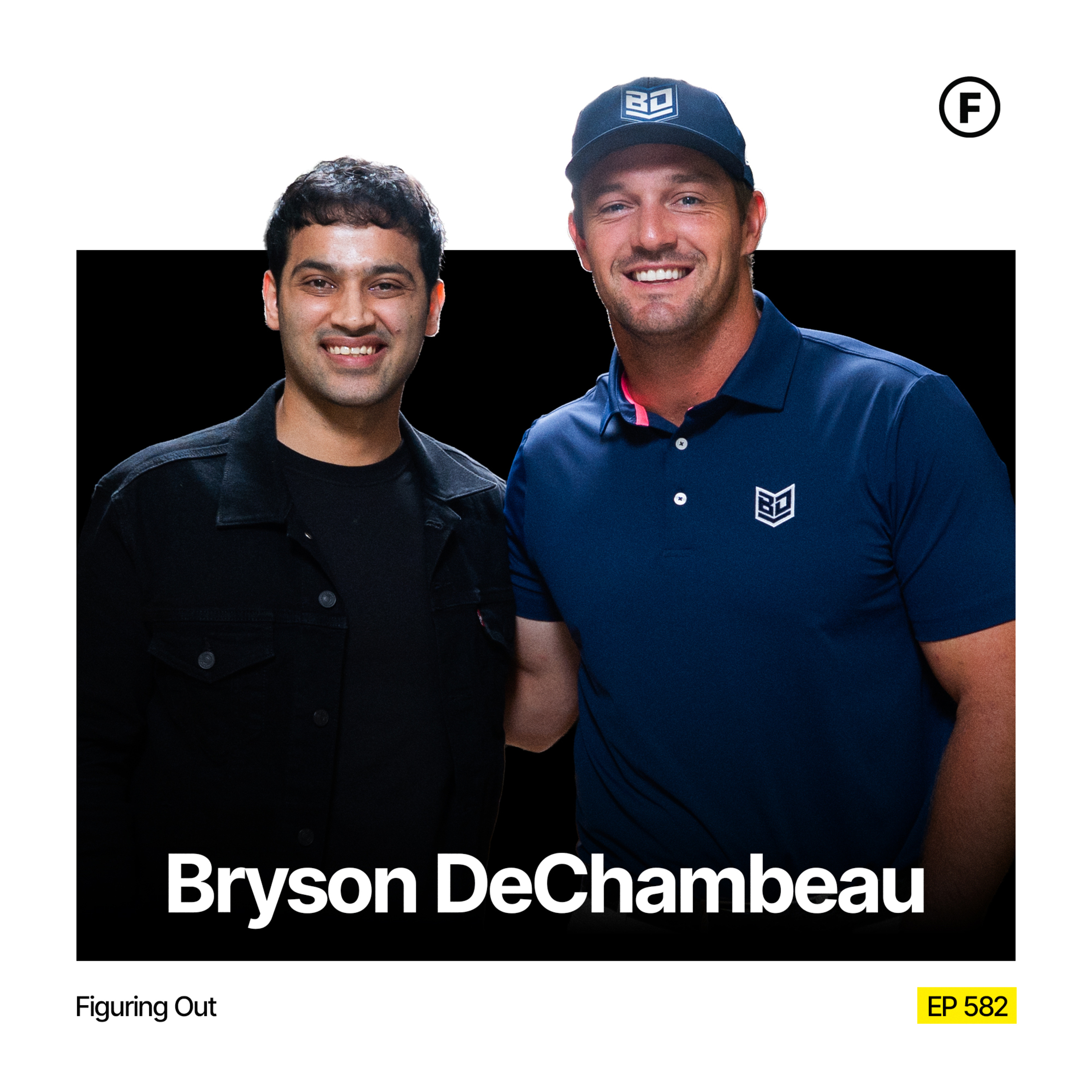
Bryson DeChambeau discusses elite athlete mindset, loneliness after major wins, first-principles thinking, and how curiosity and technology drive performance. He also shares personal stories about losing his father, raising money as a teen, and developing his one-length club concept.
Raj Shamani (podcast host). Bryson DeChambeau (guest), professional golfer who turned pro in 2016 and started playing at age 9; known for analytical experimentation, equipment innovation, and building a golf-centered business/YouTube presence.
Written by AI. May contain mistakes.
Discussion on the loneliness and pressure that comes with fame and success.
“Well, Bryson face one of the greatest players on the planet.”
Bryson shares his emotional experience of winning the US Open and losing his father.
“If you have to make a Bryson framework that people should have for next one year in order to become an elite athlete, let's go one by one.”
Bryson reflects on the impact of his father's last words and family support.
“And the one thing he said to me when it was over, he's like, I'm going to go now.”
Bryson describes his journey in golf and his passion for the sport.
“Let's say someone's watching you for the first time.”
Discussion on how golf reflects one's character and its impact on business.
“And again, I don't know how much you've played if you've ever played before.”
Bryson delves into his obsessive mindset and continuous improvement.
“And so I think golf is that bridge of the gap to seeing someone's character and personality.”
Explore the motivations behind striving for greatness, including insecurities and curiosity.
“I think there was some insecurity there for sure as a kid, not really understanding things and trying to understand them, but not having it click in my head.”
Learn how gaming shaped Bryson's perspective on improvement and achievement.
“And then I realized monopolies aren't that great.”
Bryson shares his childhood insecurities and the impact on his social life and identity.
“You know, that's why I did break 50 with him because I wanted him to be shown to the world like I know him.”
Hear the story of how Bryson raised money for golf tournaments as a teenager.
“the time and practice and play, but there's a lot of times where I just would not see eye to eye with people and we just never would become friends at all.”
Learn how early experiences shaped a future entrepreneur's mindset.
“And so that was the inception of kind of my entrepreneurship of, Hey, I can go do this.”
Discover the journey of questioning traditional golf practices and equipment.
“And so I realized quickly that I can either continue to work really hard on my game and maybe I can get somewhere or I can find a distinct advantage.”
Uncover the process of creating one-length golf clubs for improved performance.
“And when I swung with a pitching wedge, the angle looked a certain way.”
Explore advancements in golf club technology and design techniques.
“So it'll be different lengths as well if they want.”
Understand how passion drives curiosity and questioning in sports and life.
“So anyway, that's one of the businesses that we're building right now.”
Hear about the importance of questioning norms and exploring new possibilities.
“If someone's watching this in their own sport or in their game or whatever they're doing, they want to develop this first principles thinking that you have.”
Learn how a positive mindset can transform challenges into opportunities.
“I've always, so this off season, I'm going to work really hard on my wedges to make them good.”
Learn how maintaining a positive perspective can improve your challenges.
“it doesn't matter if you're in the worst financial situation, on a really bad relationship, or even the best relationship.”
Hear about Bryson's transformative experience with a new golf driver.
“Um, I need more forgiveness and that forgiveness is based on a curved face.”
Discover the importance of incremental changes for performance enhancement.
“So you feel today because of technology, people should not be crazily obsessing of a number of hours they're actually putting in something, they can be smart about it just by leveraging technology.”
Understand the impact of dietary sensitivities on health and performance.
“But try to make yourself better immediately.”
Explore the importance of continual improvement in sports and life.
“Um, you know, it's, we're all going to die one day, right?”
Explore Bryson's evolution in golf, focusing on striking the ball farther and the techniques involved.
“point where you go to sleep and one day you don't wake up.”
Understand the physical and mental challenges faced during intense training sessions.
“And we're working on that right now to improve that.”
Learn about the relationship between speed training and strength in achieving optimal performance.
“I reached the fastest swing speed I've ever reached, which is 152 mile an hour ball swing speed, 221 mile an hour ball speed.”
Learn about the significance of using the actual equipment in training to improve performance in sports like golf.
“And then I'd go weight train to get the strength of it.”
Explore the balance between questioning practices and trusting specialists in various fields.
“Like if you're trying to become more powerful, do the sport with the right equipment.”
Understand the mindset and techniques that differentiate exceptional golfers from average ones.
“Like those are the things I don't question.”
Discover how intuition and sensory awareness play a critical role in a golfer's performance.
“This is, you're like at the same time, you're just like two or three things.”
Bryson discusses how he copes with poor performance during golf rounds.
“You know, if I'm on the ninth hole or fifth hole or first hole even, and I'm like, I got nothing today.”
The importance of staying true to oneself despite external criticism.
“I think that's what a lot of golfers have struggled with too, is that they've turned into somebody else because they don't want to be criticized by the public.”
Bryson reflects on moments that made him a target of public scrutiny.
“And so I don't ever really regret things that happen.”
Insights on how moments of failure contribute to personal growth.
“But would you feel that was you behaving in that manner?”
Bryson shares the psychological pressures of maintaining success.
“And if there's one thing that people don't realize about me, I think this is something that's a good little point too, is that it's not that I like being humbled.”
Exploration of the isolation felt by top athletes despite success.
“What does it do to your psychology and your brain?”
Bryson DeChambeau reflects on the isolation that accompanied his success.
“And I think when you do get to the top of the world, you have to have a really good team around you in order to stabilize you.”
Bryson discusses his journey of understanding and transforming his anger.
“You spoke about two feelings right now, anger and loneliness.”
Bryson explains how he turned anger into a tool for growth and communication.
“you worked a lot on your anger and your demeanor what changed what did you do i would say it was a lot of understanding more of who I am.”
Bryson shares his experiences of attaching self-worth to golf performance.
“I was trying to win as much as possible.”
Bryson recounts the physical toll of overtraining and its impact on his career.
“but I will say, you know, the ones that have been super successful are the ones that aren't affected by it, that we shoot a certain score and we go, that doesn't define me.”
Bryson discusses his experience with injury, overtraining, and recovery.
“And, uh, so yeah, it definitely, there, there was a point in time where I overdid it and I wasn't cautious about my surroundings.”
Bryson shares how he leveraged YouTube to build his personal brand after surgery.
“And then why, how did you come back then?”
Discussion on how media often misrepresents athletes and how they can take control.
“You know, the media rights kind of control exactly what happens to us.”
Bryson reflects on human connection from his travels and experiences.
“You found another distinctive advantage.”
Bryson shares lessons learned from notable individuals he's met.
“We're all humans experiencing this for the first time.”
Bryson opens up about his father's passing and its effect on his career.
“He gives so much of his time back to the community and the world to make it a better place.”
Bryson recounts the challenges his father faced and their relationship.
“Because when he passed away, after that, you won the US Open.”
Bryson shares the struggles of his father's health and their emotional connections.
“He went to school in Winnemucca, Nevada, and they connected.”
Bryson emphasizes the freeing power of forgiveness and living without grudges.
“You know, it's not just about winning all those tournaments.”
Bryson reflects on his mindset during the US Open, influenced by his father's passing.
“And that's the thing I feel like a lot of people get stuck on is, is that I wish I would have done this during, you know, life.”
Bryson discusses feeling guided by energy and a sense of destiny during his victory.
“I felt like I was almost sort of watching myself do it.”
Explore how belief and emotional states contribute to winning moments.
“Like I was doing everything and I'm feeling everything and I'm like, this is going to happen.”
Learn Bryson's framework for becoming an elite athlete, focusing on passion and daily routines.
“I want you to tell me the routine, the questions, the outside, the belief that people should have for next one year in order to become an elite athlete.”
Understand essential questions to ask yourself for personal growth and improvement.
“And then is this, if it's, uh, if working, excuse me, if working, how do I improve if working?”
Bryson shares insights on thinking independently and pursuing unique paths.
“so it's not truly original it's nothing's ever original you think fire was invented by us no it happened because something got on fire and like how do we recreate that right think about it Fair.”
Bryson expresses his extraordinary goal of playing golf on the moon.
“Just because something's been done before doesn't mean that it's the perfect solution.”
Hear about the personal sacrifices made to achieve elite athletic status.

Get the gist, explore an idea or ask about something said.
 Claude
On Figuring Out with Raj Shamani, what are the key points of this episode?
Searching your listeningAutomatic transcript. May contain errors.
0:00Today and please welcome the winner of the 124th United States Open. Tell me what happens when you feel like you're invincible, you're top of the world, where you have a lot of money, a lot of fame, you're winning majors. Bryson DeChambeau. Well, Bryson face one of the greatest players on the planet.
0:22When you do get to the top of the world, I'll say that you feel alone. Everybody loves me, but nobody understands me. You can explain everything about the whole entire situation. Everybody goes, yeah, but you won. You're the best in the world. What are you talking about? Oh, but you don't understand how much energy, how much time, effort I put into making that happen. Take me to the moment where you are one shot away from winning the US Open. You lost your father. You're about to win the biggest championship of your life. Father wanted you to win. What was going on in your head before the final shot?
0:55So I got over the pot. I stepped over it and I was putting well that week, obviously. And in my head, all I said is, it's just like on the practice screen, like you've done a thousand times. And I knocked it right in the hole. If you have to make a Bryson framework that people should have for next one year in order to become an elite athlete, let's go one by one. Passion is the start. You have to love something. You know, spend at least three hours a day on that passion. What questions they should ask themselves every day? Yeah, like you always ask, is this working or is this not working? That's the number one question.
1:27Right? Number two, if it's working, great. How do I improve? Three, if it's not working, is this the right road? If it is the right road, then what am I missing? That's it. What is a belief you have and it only makes sense to you? I have a belief every day that you're not working is another day somebody else is getting better than you. Right after winning this, the most priceless possession that you have. You felt lonely? Oh, yeah. I had the trophy right next to my bed. And you wake up and you look over and you're like, I won the US Open. And then right after you say that, it's like, what do I do next?
2:01I'm in bed alone. I don't have my family with me. I don't have anybody around. And it's real moment of frailty. And it's not easy.
2:13Changed my life. My dad died in 2022. And the one thing he said to me when it was over, he's like, I'm going to go now. I just know it sucks sorry take care of your mother you're gonna be fine that's all I said
2:41I have a small favor to ask you I need you to subscribe to our channel the more subscribers we have the better and bigger guests we can bring and provide you more value through these conversations. And the full audio experience of this show is also available on Spotify where you can follow us and listen to the new episodes as well. And the styling partner for this episode is Levi's. Click on the link in the description to explore their latest collection. Enjoy the show.
3:14Let's say someone's watching you for the first time. They have no clue who you are. Yeah. They don't know what you do. How would you explain them? Like, what do you do? Where did all of this started? And why should somebody watch this for the next couple of hours? Yeah. Look, I would say that I'm a professional golfer. I'm Bryson DeSham. I'm a professional golfer. And, you know, I've played a bunch of golf throughout my entire career. I became a professional in 2016. I started playing golf when I was nine. I was a big sports player. Loved sports. I was terrible at school. I still got good grades, but I was not great.
3:49I couldn't remember things very well. And so I always viewed myself as not necessarily the smartest person in the world, but I could figure things out. I always was problem solving. So I wasn't good at memory, but I was always problem solving. So I knew growing up as a kid, I could build Lego sets. I could look at something and go, okay, I could do that again. I can replicate that. And I can make it a little bit better. So I always knew as a kid that's who I was. And so whether it was golf or eventually now business, it was more of how do I just continue to improve things? So I think looking at it from my perspective, like I'm a person that loves professional golf.
4:26I love sports. I love giving back to people and helping people become inspired as much as possible. So the three main things that I always go into anything with is I love entertaining. I love educating and I love inspiring. Those are the baselines of me. So for people that want to know more about this, it's, you know, I'm a professional golfer, but I'm much more than that. I love inspiring people to play this great game. Golf is something. And again, I don't know how much you've played if you've ever played before. Have you ever played before? No, just once. Okay. That's okay. Golf is something that is fun to do outside.
5:02I mean, there's a lot of people starting their YouTube channels, whether it's LeBron, Kevin Hart. You know, those are professional athletes and a celebrity that has just taken a love for the game of golf. And I think a lot of that has to do with being out in nature. You know, we're in these cubicles, we're in these boxes all day long, right? And at some point we want to get outdoors. And golf does a really good job of expressing that in its purest form. And then the sport on top of it, golf is a sport of character and integrity. And, you know, you're going to get exposed if you're cheating, lying and doing that all the time.
5:37Like it just exposes it. You know, you're going to move your ball and everything. So golf is a great way to show someone's character. So that's why a lot of businessmen love playing golf. And they love doing it because it shows someone else's character. and it's really cool to see it take shape. There's some deals that just don't get done because a person doesn't act well on the golf course, a person cheats in the golf course. And you see that and you're like, I don't want to partner with that person. I don't want to work with that person. Interesting. And so it's very interesting how golf can shape the future of business and entrepreneurship every single day.
6:09It does it every single day. And so I think golf is that bridge of the gap to seeing someone's character and personality. Fascinating. This is fascinating, but I don't want to understand golf today. I want to understand your mindset. Okay. I want to understand this, this elite athlete mindset that you have, which is obsession. You said, I want to continually, I want to continuously just keep improving. Yes. And that's where, which gets interesting to me. Like, why are you incapable of just accepting that I'm enough? Like this is good enough. What's happening inside your head? Why this obsession?
6:45So, I would say this. I know that if golf was taken away from me right now and everything else was taken away from me right now, I would be okay. I wouldn't lose my life. I would continue to move on and I'd do other things or find other things to do. But it's a continual pursuit of perfection. This obsessive nature of wanting to improve all the time. This knack of how can I find a distinct advantage in a situation to create as much value as possible is always at the forefront of mind. And the reason is because when I was a kid, I always asked the question, why? And my parents hated me for it. They despised me for it.
7:28I would ask them, why is this cup made this way? why couldn't it be like this this would be more this would be better this is the way it could be done and my parents like just eat your food just drink your drink like stop you know and then when i got into golf i fell in love with golf i started doing that with that sort of mentality and i try to find the distinct advantage and now that i'm into business i'm doing the same exact thing whether it's on youtube whether it's you know building golf equipment building sports tech building
8:01golf course design, whether we're doing CPG, consumer product goods for people, this is all just starting, building a holding company that consolidates business from different verticals that are in the same ecosystem of golf, but consolidating it into one umbrella. And then trying to excrete as much value as possible out of those verticals. but have it all flywheel and then have YouTube be a media machine engine behind all of it. You know, that whole formulation came from trying to find distinct advantages in every single facet. And then I went, wait a second, I can potentially consolidate this and bring it under one house and multiply it.
8:45And that's kind of where it just came from. It's literally, everybody talks about creativity and this is what I find so funny. it was true as a kid too for me I thought creativity just came about popped up in your head like the thoughts and the ideas came about from from just your your soul thought that's not true at all like creativity comes about from different ideas and things that you've seen over the course of time and bringing them together or making it unique or making it a little different or this way or that way and so from a creative perspective I always say that you have a creative nature at your core self.
9:21Everybody has a certain creative sort of nature. It's just that if you can utilize it or not, if you can say, Hey, I see this, well, this can be different in this way, and this will make, you know, this work in this, in this way. And so I think a lot of it's just through personal experience and you wanting to improve and getting 1 % better each day that has allowed me to not only flourish, but allowed others around me to hopefully get inspired. Um, so that's more of me on a personal note. But when did you realize first that you're wired differently? You're wired like this way, you keep questioning.
9:58Well, when my mom got mad at me for asking too many questions, that was definitely something that she said, I was a little different, a little quirky. Uh, I would say when I was nine years old, I remember playing in my first golf event and I know it's all golf. I get it, but there's a, there's an actual life lesson here to be had. I played golf for the first time. I was nine and I played my first event and I went out and played from the front tees. I played nine holes and shot a score, a really good score.
10:33And there's this kid, I remember his name, RJ Magot was his last name. And he was the best junior golfer in that area and I came in and tied him for nine holes they thought I had cheated the entire you know community around was like no way he cheated but because I tied we had to go into a playoff so we went into a playoff and I beat him on the the first hole and everybody was up in arms they're like Bryson cheated there's no way this kid playing his first tournament won his first tournament no way and it just goes to show you that like no matter how you get there there's always going to be people that that knock you down and for me like this whole journey of mine when I when I felt like I was a bit different was the fact that I saw people even though I had accomplished something great be incredibly negative towards me that's nine-year-old kid.
11:33That's a nine-year-old kid. And I recognized that that was something weird. That was something different. Why are they knocking me down when I did something so great? And so for the first time in my head, that was when I knew that I had a different mindset. It wasn't the fact that I didn't care about what they thought and I just went and won. It was that, why are they thinking so negatively about me, even though I did everything right and I won the tournament at fair and square. It was because I came in, disrupted an environment, and I had haters with it, even at nine years old. And that mindset almost fueled me to say, well, I did something that was different and better.
12:14You know, why can't you accept that? And so it formulated in my head at that early of an age that there's something different about how I thought about things. it was introspective even at nine like I looked at myself differently like whoa not just that I was a champion and I beat everybody it was that people were saying that I didn't win there's no way that I could have won and I was questioning that fascinating so usually if a nine-year-old goes through an experience like this they'll either be like hey I'm gonna show them again by doing this and I'm gonna prove them wrong or they're gonna be like I won or like they'll be affected by it.
12:51All of this is affecting me because people are hating me for no reason. I don't like this. No, it was more of a, how can I show them there's a better way? That type of thought process. Cause I, I, I remember thinking, well, I'm just going to beat him again and show him again. And then I was like, well, no, that's not right. That won't do anything. What is that going to do? But if I can show them that there potentially is a better way, maybe I can, I can convince them that there is a better way. And it wasn't that I was, Because they were rooting for RJ and wanted him to win. I mean, that's just the basis of it.
13:22And somebody just loved that. Just like somebody who's going to root for Rory McIlroy, who's a competitor of mine, or Scotty Scheffler, or whoever. But the fact of the matter was that I took it as a challenge almost on my head to not coerce, but to show them that potentially there's another way. And they can always make their choices. They can say, I don't want to believe in that. I'm never going to force anybody to believe something. But all I wanted to do ever since I was a kid was show people that there's potentially a better way. So as a kid also, you were always like, why are things the way they are?
13:54So that's the question. But is this, do you think, is this curiosity, insecurity, or competitiveness? Or is it like just fear of being ordinary and you wanted to be accepted? I think it's a bit of all of it. I think there was some insecurity there for sure as a kid, not really understanding things and trying to understand them, but not having it click in my head. wanting to be the best at something, this obsession of just wanting to be the best, wanting to prove people, prove to people that I could do it. And then I think it was a function of personal achievement of knowing that even if nobody sees it, I know in myself, if I can sit by myself at the end of the day and go, I gave everything I had that I would be okay with it.
14:39But if I didn't, I'd regret it. Hmm. And which one do you think is more? Is it more curiosity, more insecurity, more competitiveness? I think it's more of a curiosity factor because I get the most high. I get the most dopamine release when I figure something out. It's a distinct advantage. That's the only time when I feel like I understand it. Let's go. That's so cool. And I tell everybody and I try to tell everybody. That gets me in trouble sometimes. tell me as a kid what were you obsessed with which is irrational which is not golf like or maybe something around golf but it's irrationally obsessed yeah i was i was definitely obsessed with golf equipment like how to make it differently um that was one uh i was actually into gaming so i'd play a lot of video games as a kid what games okay so So it was RPG games, role-playing games.
15:37And I love The Elder Scrolls. I don't know if you've ever heard of The Elder Scrolls. No, I'm not a big gamer. Okay, that's all right. Yeah, for people that are watching, I'm sure people will know what The Elder Scrolls is. But it was on Xbox. I played on Xbox and I loved Morrowind, Oblivion. They were all role-playing games. And you'd create a character, right? And there was magic and sword fighting and all of that. and you could improve your abilities and different verticals, right? And so at a young age, that game actually formed my, my thought process and opinions on how to improve different attributes in your life.
16:14And it was, it was the progressionary. I want to always get better because then I get better stuff and I get, you know, more achievements. And so it was really gaming that funny enough, I've never really talked about this. Actually, I think gaming actually helped develop my mindset of wanting to be better all the time too because I played at such a young age and I always wanted to win I always wanted to be better and I saw there was different ways to become better that made me formulate this opinion around how do I just improve every day were you always constantly thinking about how to get better how to get better I really wasn't until I started getting into my teens okay so it was more just playing for fun but I recognized things and I knew I had to work hard I knew I had to get better but I didn't have this obsession or this crazy passion until I was around like 12, 13, 14.
17:00And then 14 is when it just went off the rails, when I just started going crazy with golf. But 12, 13, I started 4 million. And that was when I was playing a lot of games. I played The Sims. I don't know if you've heard of The Sims. It's another role-playing game, but your character and you build a house and you have to feed yourself and go to the restroom and shower yourself, everything. It was like this self-help game, I guess you could say. But it's just a fun game that I used to play. And every game that I played, I was always fascinated with how to improve yourself. Just something that I fell in love with.
17:31And was it because you didn't want to be an ordinary just like every other player? Great question. I definitely wanted to pave my own path. It wasn't necessarily that I wanted to be completely unique and different. It's that I wanted to pave a path that may be better. Like a Monopoly, I would play Monopoly as a kid too. And I didn't care about how much money I had. It was just about owning all the lots. It's all I cared about. I was like, I just want to own all of them because I know people are going to have to pay me at some point. That was just me as a kid. That was me as well as a kid. It's just fascinating.
18:06All I wanted to do was just monopolize the whole thing. Correct. Yes. I'll be the mafia here. And then I realized monopolies aren't that great. So they eventually fall. But yeah, that was the thought process I had as a kid. And okay, if you have to choose one. or maybe let's make it general as well because you've met a lot of these elite athletes including yourself yeah right yeah steph curry and people like him as well or even the president i think that's like incredible uh by the way i've got a ball signed by steph when we uh did a break 50 here so nice this one yeah this one yeah this isn't the exact golf ball but he signed it and then we like commemorated it so we've got like a lake merced break 50 we'll get into that in just a little bit that was kind of fun i don't know they can see that it's not a problem but it's kind of fun so that's all the athletes like so do you think the greatest people the greatest athletes okay and i'm including the billionaires the presidents the golfers the basketball players all of them including right do you think most of them they want to be great and continuously keep improving because they want to keep winning or is it because they fear that they just don't want to be like every other ordinary person they cannot tolerate being video yeah i i can't comment on everybody else but i know there is a bit of i think there's a lot of insecurities for us kids growing up of not being enough feeling like they've got to pave their own way feeling like if it's not me then who else is going to do it right sort of mentality I think there are a lot of insecurities in us professional athletes that have paved the way but then they realize you know it's a self-journey and we all have a passion of getting better at some capacity you know and so So I think it's a bit of both for sure.
20:14What fuels you more? I think some people it's different. You know, some people it's because of the fear and insecurity. Some people it's because they just want our competitor and want to be the best. Like Tiger. Tiger was the most intense and fierce competitor I've ever met in my entire life. This is an insane ability to just say, I want to beat the living shit out of you. Because they love it. They just want to absolutely beat you. That's what it is. It's a weird thing. I don't like that. That's not the way I approach things. But I never forget him looking at you and then looking right through you like you weren't even there.
20:49And I was taken aback. I'll never forget. I was in the Bahamas and we were just talking about something and some people came up to him. And we were talking just like we are now, focused and whatnot. And then he'd go over and look at them and just like look right through them. Like they weren't even there and they would talk to him and he wouldn't even recognize them there. but it would make it known that he didn't even see you. And the reason was because for him, it was, I feel like it was always kind of a game and I'm not going to speak necessarily ill on him. He was, is a great golfer and athlete and whatnot, but to get to that level that he got to of complete and utter dominance, there was a bit of, I'm going to do anything and everything to beat you.
21:40So on the golf course, he would go out there with that mentality. Like he wouldn't even know you're there and it would intimidate everybody. And he had such an unbelievable ability to tune people out, tune things out and focus on just winning. There was no other option. He was not going to come back with a second place finish. And that insane willpower is what made him special and different from everybody else. Fascinating. Do you think the president also has this? Again, I don't want to speak on people's behalves, but what I do know is he has a bit of that winning mentality. Like he'll do anything and everything to win.
22:21And, you know, I think he's misunderstood a lot too. You know, that's why I did break 50 with him because I wanted him to be shown to the world like I know him. And I think he's very passionate about America. I think he cares deeply about it. And, you know, I know, look, that's not a job that I think anybody should really want, no matter what side you're on. It's a difficult thing to appease a full population, right? And, you know, everybody has their viewpoints on it. And albeit, I don't think, like any president, they've ever done everything right. Nobody's ever done anything right. I think it is impressive to see how much he has got done and how much he cares about America.
23:09True. Coming back to the point where you said most of us are driven out of our insecurities as a child. What was your biggest insecurity? I had some abandonment issues. I had abandonment, like just people leaving me and not believing me. So think about it, right? As a kid, I get told after winning a tournament, like you cheated and you're not actually that good. There's no way you won. Right. And so I had this fear of people like not accepting me, not being okay with it, not staying around, walking away from me. And my parents are great. I mean, I was very lucky to have very loving parents and my dad was hard on me.
23:48My mom was amazing, but, um, you know, and I had a great coach that helped coach me as a kid as well. Uh, and for me, whatever, for whatever reason, I had people always telling me you could never do it this way. This, there was this, you couldn't, you couldn't achieve these goals. You couldn't do it this way. And so for, for, for me, I always felt like nobody accepted me. Nobody, I always thought it was weird, different, unique, and that, you know, I was never going to be like accepted in the ecosystem. So I had a fear of people just leaving me. And even the friends that I was around because I was a little different and quirky, they would want to hang out with me, but then they wouldn't, you know, because I was always thinking of something else.
24:24Like, oh, let's go do this. Let's go do that. And they're like, no, no, no. I'm just going to go stay inside. I'm going to do this. I want to do this. I want to, man, you're a lot, you know, you just won't stop talking or you won't, you know, just calm down. And I feel like a lot of that made me insecure of myself and going, what's wrong with me rather than just realizing I wasn't in the right crowd. And I was in a very unique crowd of unique thinkers. And it wasn't until later in life when I surrounded myself with people that were very unique thinkers and go-getters and passionate that I had such a relatability to them.
24:58And so it was difficult for me to make a lot of friends growing up. And I had friends and we'd go out the golf course all the time and practice and play, but there's a lot of times where I just would not see eye to eye with people and we just never would become friends at all. And it was because of, you know, my curiosity that ultimately people were like, whoa, I don't want to be a part of that. I just want to live life and have fun and call it a day where I'm like questioning things and asking these difficult, deep questions. And they're like, what are you talking about, man? And I'm like, well, I just want to know, you know?
25:31And so, you know, I just, I just had a different mindset as a kid. And that's where those insecurities came from because people wouldn't accept me for asking those questions. And does that, like, is that the reason why you, why you went out to strangers to raise money for your, uh, one of your tours as a kid, you raise your own money, right? I did. You didn't go to your friends and family. You actually went to everyone else. Yeah. We didn't have that much money growing up. And so this is a great story, but, um, I think it's a funny story that in 2009, when the housing market hit in the United States, we didn't have any money to go pay for tournament entry fees for golf.
26:12And I did it every summer. I'd go play tournaments and, you know, it was a couple thousand dollars to do that. It was not cheap whatsoever. And for whatever reason that year, my mom told me, my dad told me that, like, hey, hon, we don't have any money this year for tournaments. I don't know what we're going to do. literally said that to my face and I said well mom I know what to do she's like what and I go I'm just gonna go raise money she goes I don't think you can I don't know if you can do that I don't know if you can do that so again even the resistance for my parents I had this great idea and I wanted to see if it would work right and she's like I don't know you know she's like okay hon like if you want to go try go do it so I went and two days later I'd raised two thousand dollars around my neighborhood.
26:57And I went to doors. I went up and I said, Hey, I'm Bryson DeChambeau and I'm aspiring professional golfer as a 15, 16 year old. And I said, my goal is to play the PGA tour one day, play in college, play the PGA tour one day. And I need some money this year to play tournament golf, junior tournament golf. Is there any way you can support me with just 20 bucks? And I did that for a while. I'll never forget this one older gentleman. And he said, yeah, no problem. No problem, son. I'll be right back. And he came back with an$800 check and gave it to me. And I was like, I can go play golf this year.
27:35And it like even tears me up today because it was this belief that this person saw the passion that I had and said, yeah, I'm going to take a risk on you. And that was the first time I realized what private investments actually were. as a young kid, not knowing what it actually was, but somebody, you know, me going and pitching myself and then somebody saying, Hey, yeah, I believe in that. Here's an angel check. Exactly. An angel check. Right. And so that was the inception of kind of my entrepreneurship of, Hey, I can go do this. And it was funny. It stemmed from selling candy bars as a young kid, going around to different houses and raising money for a fundraiser for the school.
28:14We just sell candy bars and we did a jogathon and there's numerous things that we'd go sell, And it just got me out of my comfort zone of going and selling myself, selling this opportunity as a youngster. And it made me into the person I am today because of that. Did you ever give him money back? Yes. $800 you gave him back? Yep. It was fun. It was right when I turned professional too. So it was like almost a decade later. And there's numerous things that I had given back to him. He went out and practiced the same tent and we'd hang out for quite a while. so nice what how did he react what did he say the moment when you came back he didn't want it he didn't care he didn't care about it you know so i can't remember if he actually took it back or didn't but you know i had the thought of of at least paying him back and he's like don't even so it was really cool he just did it he just wanted to see me succeed and it was really cool nice so you were always this kid who was questioning things you were driven out of a little bit insecurity and curiosity at the same time yes right and then you question the whole the the way the whole game is played yeah and what was that like you have legends yeah playing games over the decades over over hundreds of years now hundreds right and then there's legends like tiger wolf and jack nicholas yeah all them yeah all of these and all of these people exactly like jack nicholas nicholas like a word like the big the legend they have been playing over the since generations a single singular way you question that why you know it's funny it wasn't it didn't stem from actually a question it stemmed from me sucking it stemmed from me not doing well i wanted to play like them i just couldn't for some reason you know whenever i'd go practice i would practice for an insane amount of hours and wouldn't get that good.
30:08I wasn't getting better. And so I realized quickly that I can either continue to work really hard on my game and maybe I can get somewhere or I can find a distinct advantage. And that distinct advantage usually came from equipment. And so the equipment I'd ask questions on, and even though it's been played a certain way, I said, well, maybe there's a better way and let me just investigate it. And so I had a coach that was nice enough to let me go down those rabbit holes. My dad didn't really like it, but I had a coach that was nice enough to go down those rabbit holes and let me experiment and see what things worked for me and what things didn't.
30:40And then what did you do? Tell me the whole thing. Like, well, I started building. At what point you start questioning? What did you do? What did you question? Tell me everything about it. Yeah. So when I was 15, I started, um, I started asking questions on my equipment and I'll never forget one day I was hitting golf balls and I was on a camera down the line and there's a certain way you, um, there's a certain way you look down the line for videoing, uh, with a camera and there's a certain particular placement. You put it on. And when I swung with a pitching wedge, the angle looked a certain way.
31:17And then when I swung with a three iron, cause it's a different length, it looked a different way. And I'm like, why am I practicing all these different swings? I have to learn every single swing all because there's 14 clubs in a bag. I have to practice every single golf club in that bag in order to be good. And I said, what if I could simplify that down to where I only needed like three swings? Maybe the irons are all the same length. And that led me down a physics question and a physics journey of which I was a physics major in college. It piqued my curiosity enough to where I wanted to be a physics major in college.
31:52And so I then take about$400 that I had that my parents had and scrummage it up with the help of my coach. And he spent a little money too. And we bought shafts and we bought iron heads or we actually took iron heads and we bought grinding wheels and we started grinding on the pitching wedge heads, which are the heaviest heads that the shortest club and everything. And then the three iron, the longer irons, the ones that go farther. So pitching wedge goes shorter than the three iron. Um, and the three iron was a longer club with a lighter head. So all I did was just exchange the length for the mass of the head to make them all the same club, just with, just with different lofts on the face.
32:35The loft was going to dictate how far the ball went, which seems simple in nature. Everybody's like, well, why doesn't everybody do that? Yeah. There's reasons for it. Won't get into that. But And it's been tried in the past too before. But I said, I just want to try it. And I tried it and it worked for me the first time out with these old, this old Nike set of irons that I had. And then I used tailor-made for a little while after that, they helped build a set too. But we tried it and it worked. I'll never forget going out in the second hole and taking a five iron out that was way shorter, you know, had less loft and had a lot of mass on there and hitting it and seeing the ball fly just as far as when it was built originally.
33:17And I went, Oh my gosh, there's something there. And we kept making it better and better. And then ultimately I'm playing with the single link set today. And now I'm building my own golf clubs, uh, one length. Um, but we're building it for anyone and everyone. So it'll be different lengths as well if they want. So I can show, here's actually the original, some of the originals I played the 2016 U S amateur with, and I won the U S amateur with these clubs right here. Okay. So they're all pretty unique. They look pretty mangled but um it's from adele and they're all named differently so there's azalea and this is kaiser here why have you named them differently because they were named after some famous things in golf like azalea is the 13th hole at augusta national there's a five iron and i was using a five iron for that second shot i just remembered naming it that because it was the second shot i hit into there which is kind of fun then kaiser was one of the champions um back in the day and it was a 46 degree it was i think it was the 1946 u.s amateur i believe uh kaiser won it and then or might have been the masters i can't remember but 1946 is definitely not the u.s open yeah mangram won lloyd mangram won that year but kaiser i believe was the u.s amateur or the master's champion in 1946 because it says 46 degrees.
34:35So it was a 1946 thing. And that's actually not the original but now we're 3D printing golf clubs. So it looks like that.
34:48Fascinating. So this one's going to be available for people next year. Yeah, it will be available. And this is all an interchangeable thing right now to change different shafts for different people with different flexes and based on the way they swing. But it's a pretty cool prototype and again we're going to go through another iteration of this but you can see the micro grooving yeah yeah so it's micro grooving on the face and this is all legal it's approved by the usga we have a governing body that dictates what can be used and what can't be used but this is 3d printed laser treated heat treated after um and then we see and see it to create the little grooves and stuff in here to machine it out and make it look as good as possible but the amount of work that goes into this and the time to iterate is so much faster than the normal process than going through.
35:39They ship it overseas and they've got molds. You've got to buy a mold and they've got to cast it and then send it back over. And a lot of time is wasted just on shipping. It's a lot of shipping time going back overseas and back and forth. Interesting. So anyway, that's one of the businesses that we're building right now. But how do you know what to question and what not to question? it's based on my experience and then what other people have seen when you were a kid like let's say you didn't have any experience like today you know yeah but when you were like 15 year old 16 year old you're questioning how the golf is played or the you know the length of your club like all of these things how do you know what rules to accept and be like hey these are the rules of the game i need to keep playing so that i get better and these are things i'll challenge so that i find a distinct advantage in play yeah so that's the balance that i tried to figure out as a 15 year old.
36:29And there were some things I went down rabbit holes where I got, I got lost. And then sometimes where I had to pull myself back out and it took me a little bit to get back out. So it wasn't like a success story right off the bat. Like there were things that I tried that didn't work and it set me back, you know, a month or two. Right. And I hurt my back doing one thing or this or that or whatnot. And I have to pull myself out and go, I can't do that anymore. That doesn't work. And then I'd go down a different rabbit hole. So, but I was always going down different holes, different rabbit holes. And then when it didn't work, I'd pull myself out.
36:58But if it did work, I'd then go off of that into another hole, trying to figure out more and more. That's how I viewed it. How do you develop this? If someone's watching this in their own sport or in their game or whatever they're doing, they want to develop this first principles thinking that you have. How can they develop it? So I'd say the first most important thing is you've got to be passionate about whatever you're doing. If you're passionate, you will start to ask questions. If you're not passionate, you won't ask the questions. Because if you truly are passionate in your field, you will then ask the next question, how do I do that?
37:32Or how do I get better? Or what isn't working for me? Or what isn't working in the world? Those questions happen from a stance of passion. I don't care if you know nothing about the sport. If you asked about the game of golf and you had a passion around and you went and asked questions on the internet, you'd figure some stuff out and then you'd ask another question and then you'd ask another question so i think a lot of it has to do with being truly super passionate about something
38:08and so let's say you're super passionate let me ask you only this like you're super passionate always asking questions what is something that you've believed which everyone else thought that you're crazy about? Well, one-night clubs is easy. I mean, they work and everybody doesn't agree with it. And my wedges aren't that great. My, you know, the more lofted clubs, um, I'm not really the best in the world at it. And people think that I need to go back to short wedges and I've just always sucked at it. I've never been that great. I've always, so this off season, I'm going to work really hard on my wedges to make them good.
38:44Um, another thing that man, I have to think about that for a second. Um, something that people thought would never work. Um, yeah, it's a YouTube. YouTube's one of them. It's crazy to say, but in golf, like it's kind of a, you know, push off subject. YouTube's one of those where, you know, my team was like, what are you doing spending time on YouTube? And I said, well, there's a massive audience over there. Most of the people in the world watch YouTube. That is one of the most viewed websites outside of Google. And Google owns YouTube. It's like, why wouldn't I want to be a part of that? I'm missing out.
39:34If I'm just on broadcast television, I'm missing out on a whole new audience. because I guarantee you they're not consuming the youtubers aren't necessarily consuming broadcast all the time and vice versa so I just wanted to try that market and well guess what it worked out it worked out pretty well yeah a lot of trials a lot of tribulations but you know we formulated the company back in 2022 and it's now formed into what it is today and what is about performance that you strongly believe in and you tried and experimented and you turned out to be right and everyone else thought you were crazy, but you proved everyone right.
40:14You know, I've never been one to truly prove to people that I'm right. It's always been about, here's another path. Here's another opportunity. Not everybody's going to follow the normal road, right? Some people are going to go down a different road. Hopefully me making that path for people will open their eyes to asking the questions and being inquisitive and wanting to know more. Because through that, hopefully you become incredibly passionate. I think a lot of human beings struggle with passion nowadays. They think, oh, everything's been done. I'm not smart enough. I'm struggling with things at home.
40:57I don't have any ability to make any motion anywhere, moves anywhere i just life is just gonna life me life is just gonna go after me but we always have an opportunity to ask the next question yeah to improve your life a little bit i'm struggling with my finances i can't get out of debt you can get out of debt it's the mindset so example for example i saw a great thing on instagram actually the other day it's hilarious it talked about it said on the page I am alone and it had this sad graphic with it and it was a split screen and below it it said I'm alone and it was happy it was like euphoric like I'm alone I can do whatever I want I'm excited it's perspective right and so I think that when you look at life in a different lens, right?
41:59And anybody that's struggling out there, it doesn't matter if you're in the worst financial situation, on a really bad relationship, or even the best relationship. I mean, it doesn't matter. You can always improve yourself. You can always make it better. You can always give yourself a different perspective. So as much crap as you're going through, as much as I'm spending time in the range trying to figure out my golf swing and I can't figure it out, I can always look at it as what a privilege, what an opportunity that I have to make this better. That's my perspective on life. And so from a passion perspective, like, even though I'm struggling in a certain moment, it's really difficult.
42:36I relish that opportunity. I relish it because I know from that I will become better. And so it's not, gosh, I have to deal with this today. It's, I have to deal with this today. fair fair and when was when was the last time let's say you were low and things are not going great but because you're passionate you wanted to fix something and you found out you know like this this is something that i found out it makes no sense to others but it makes sense to me and i i was right about it it's every day it's an everyday thing let me give me an example of one which was a big change in your life and specifically from lens of performance like your performance just improved when you did something so this is a great example great segue um so it's when i shot 58 in 2023 which is 12 under par so for anybody that doesn't know golf you have to shoot a certain number uh to shoot par which par is normally 70 strokes on an 18 hole golf course and if you go below that you shoot under par 69 shots 68 shots 67 shots that's under par over par is you know 71 72 and then above and however many over par is like you're plus 10 that's 80 shots if you're minus 10 that's 60 shots which is really difficult to do but i shot 58 there's only been two people that have ever shot it at the highest professional levels uh which is jim furek and myself and i shot 58 and ultimately um that changed my career in 2023 because of this driver head that has more curvature on the face so because i hit it really far.
44:15Okay. Um, I need more forgiveness and that forgiveness is based on a curved face. So the toe and the heel is actually pointed more to the right and more to the left for my miss hits. So they look at it from above, you know, the toes pointed more right and the heels more left and that's not normal. Like there's a little bit curvature on faces, but it's more like that, not, you know, over here. And so for my miss hits, you're swinging at my fast speeds. I was able to get it in the fairway more. And because of this driver head, I was able to break through in 2023 and play some of the best golf I've ever played and then give me the freedom to not have to practice as crazy amount of hours to be just as good all the time.
44:57It was the technology that changed my career. And I was struggling before that. I mean, I had hand surgery. People can look at that. I had hand surgery for a broken hook of the ham ate bone. So I struggled with that, came back from that. And then later in the next year, I figured out this driver and I put it in play. And this is for long drivers. This is for people that are like, this is like a long drive. And I put it in play and it changed the trajectory of my career because then I could do YouTube content without having to practice a crazy amount of hours. And then I could also do YouTube content while I practice.
45:29So I made the YouTube content kind of around me completing these difficult challenges. So it kept my mind sharp. So I integrated the content into my practice and professional golf. So for anybody that's trying to start a YouTube channel, like make it around what you're passionate about and make it work, you know, fit something like your basketball player, fit it into how you would practice, you know, um, that's what I would recommend. So you feel today because of technology, people should not be crazily obsessing of a number of hours they're actually putting in something, they can be smart about it just by leveraging technology.
46:03That and I think improvement in your own personal health and performance. So there's a litmus test that I always tell everybody, and this is something I've had to learn over the course of time, especially in golf. In golf, everybody's trying to obtain this perfect looking golf swing. Okay. Now that's not going to fit for everybody. Everybody's unique in their own way. and it's a great life lesson too because whenever i've tried to do something that somebody's told me and i've struggled with it and i've worked for a week with it or two weeks with it i've not gotten better well you're wasting time yeah some people would say oh it just takes time to get there well if it takes time to get there i've lost two weeks of getting better but then they say oh it's worth the investment?
46:47And I go, okay, I understand that. But is the juice worth the squeeze? Right? Is the amount you're squeezing on that fruit producing the right amount of juice? And that's the question. That's the age long question that everybody has to ask themselves when trying to change something. I liken it to more of, hey, let's focus on what's going to improve you right now. And if it improves you right now, let's multiply that. It's like, It's like building, let's say a wall and you put one brick down perfectly. And then you put the next one down perfectly. Well, if you put that next one down imperfectly, you can't ultimately form the wall.
47:25True. Right. And so every single brick layer has to be put down right. If you try to put this wall down in the first moment, the whole thing right there, a new thing. If the ground is not stable, it's going to fall. True. So a lot of that has to do with like a litmus test. stuff. If it doesn't work right away, I would tend to try something else that makes you better immediately. Interesting. So it's not about necessarily two, three weeks of just working like crazy and not getting better. I would say that's a strategy. That's fine. But try to make yourself better immediately. It'd be like you reading a book.
48:06Here's a great example. You're reading a foreign book, you have no idea what it means. It would take years for you to decipher that. But if you learned one letter of that new language that day, and you did it for the next however many, you could understand the book way quicker than just getting a book thrown to you and trying to understand the book and decipher it on yourself. So the little incremental steps, I think is what actually is the journey. People misinterpret the journey. You got to love the journey right you gotta love the journey and and that's the truth but i think people misinterpret the journey as all the pain and all the difficulty and all the strife and you know it's never getting good and then all of a sudden boom one day it just happens no no no no it's the micro improvements every day that you make along that journey that turn you into that person or help you understand whatever it is you're trying to to work on does that always work no no i meant does does this thinking that anything that can improve me now is better for me versus things that I will suck at today, but probably maybe in six months from now or a year from now, it'll make me better.
49:18Yeah. There's a lot of debate on that. I'd prefer, I would say it doesn't always look, there's situations in which that's not always applicable, right? So I'm taking it from like a physics perspective and looking at the macro and the analytics of a statement like that. I would say that no, but in most cases, especially in golf, people are just looking to get incrementally better and taking a long break of getting better to then trying a new swing out to become better usually doesn't work out for people. So that long break for sports athletes, because it's such a neurological thing in your fingers and your feeling, your touch and your proprioception, I think it works more times often than not, but it doesn't work all the time.
50:03The micro improvements, I think, are what is more important than the big changes and the big adjustments and the big changes that are going to take a month or two months to work. I'd focus on the micro improvements. Nice. Okay. I have more questions on micro improvements as well. Yeah. Tell me another micro improvement that has worked really in your favor. My golf swing every day. But then the calls I make. the calls every day who I pick up the phone to call right if I wouldn't have called in that day that job or that thing wouldn't have gotten done you know so I think people underestimate how much a call or a text really matters to people and the more you're able to engage every day or have a conversation with somebody every day about a business idea or a situation or thing you're doing really is important.
51:02You know, if you just say, say, Hey, I want this done and you wait a week, probably won't get done. But if you're calling every day, talking about it in the right way, you'll make more improvements on that. So I think every day getting up, doing the next right thing is very important. Interesting. Tell me one time when you were convinced about doing something and it was completely wrong? That's a great question. Let me think.
51:38Yeah, I'd say one of them was getting more mass. So when I was trying to hit the ball a lot farther, I went on a journey of eating and consuming as much food as possible to get as big as possible because I thought more mass, heavier weight meant I could hit it farther. I wasn't right. It was a lot more about the fast-twitch muscles and developing the fast-twitch muscles. And that was a big thing for me is I went down this health journey, negative health journey actually of just consuming a lot of food, stuff that really was sensitive to my body. And it made me overweight and didn't feel really good.
52:13I won the US Open in 2020 because of it, because of getting bigger and getting stronger and swinging harder. But it wasn't because of the food I was eating and getting bigger that I was able to swing it faster is because of the speed training I was doing. And I didn't correlate that until afterwards. And so when I got to a level where I was three times the risk of a heart attack, I got to that level as a 27, 28 year old. I then said to my doctor, we've got to change something. We've got to figure something out. So I got a chef and we started eating whole food relative to my sensitivities, like all my blood sensitivities.
52:44And I lost 24 pounds in 30 days. It was like that. 24 pounds in 30 days how i ate i ate whole food what all did you stop eating oh sugars candies anything packaged i took all that out and it was not the most fun time to be around me i was very agitated my gut biome was messed up and so it was uh it was angry so yeah he wouldn't like being around me at that point in time that's for sure but i can't say that afterwards when i finished the whole cleansing thing. I felt the clearest in my head I've ever felt. I felt the most productive. I felt like my eating sessions were small, minimal, and they were just micro food sessions over the course of time.
53:33It was fasting better. Fasting is one of the most important things you can do to the human body. Probably more, I would say, than even physical activity sometimes. That ability to fast your system and make sure it's taking care of itself is important. Obviously, working out everything is really important too. You have to have both them and you got to eat and you got to sleep. But fasting is something that's not done enough today. And it was those things that changed my life. But that was something I was definitely wrong about. But what were you insensitive to? What were the things that you found?
54:09gluten dairy eggs uh cucumbers some vegetables in there oh yeah there's some vegetables that you could eat somebody could be sensitive to lettuce there's no question about there is someone on the earth that is there's a lot of people on the earth that are sensitive to greens i got sensitive i found out my sensitivity to broccoli there you go and i used to think it's the best food in the world and then it was just sensitive exactly but that's the point and that's something that I think a lot of people don't know is that everyone's unique. Every gut biome is minuscule different. You know, everybody has different tolerances to certain foods and getting yourself tested, going out, getting a health test, and they're becoming a lot cheaper.
54:50There are ones that are like, you know, 80 bucks, 80 to 150 bucks, something like that. And getting yourself that information is a micro step in that right direction for your health and wellness and longevity. That's what I say to anyone and everyone that touches my life. I try to say, just go get a, go get a sensitivity test and start eating relative to that, that test. You will feel completely different. Your sleep will be better. Your mental clarity will be tenfold better. Um, something like that. I don't know if that's an accurate statement to say, but ultimately, you know what I mean? It'll be, I get the feeling.
55:24Yes, exactly. And your life will, will be better because of it, in my opinion. Um, you know, it's, we're all going to die one day, right? But I will say that the better you can live life, the more time you can have to enjoy it, you know, that quality of life is, is, uh, going to be enhanced quite a bit throughout the ending days. There's the last 10 years that you're going to be living and you want to make that quality. You don't want to be living in an assisted home, you know, or you don't want to be, uh, unable to walk upstairs or go to the restroom on your own. You want to be able to live all the way up to that point where you go to sleep and one day you don't wake up.
56:05Fair. And then tell me, tell me before you got to this wisdom, tell me, take me to the time where you thought like, okay, I would now want to redesign my body so that I could hit the golf ball harder. 2019. Okay. Going back to distinct advantages. I was struggling with my game in 2019 a little bit, still was playing fine. So you're always like in a constant pursuit of finding distinct advantage. Yes. Every single day, micro improvements. I think micro improvements in life is a very underutilized tactic. Okay. And that's what's allowed me to progress quite quickly. Most people think, oh, you know, I'm going to get better over the course of time.
56:46And I go, well, what about right now? Nice. So in 2019, I said to myself, I'm not doing great in the game. I'm fine. I won the Dubai Desert Classic that year, but I didn't perform that well in every other event. And then late in 2019, I said, okay, I'm just going to hit the ball farther. Because I read something online. I talked to it from Mark Brody. It was a strokes gained thing. It's a way to evaluate how good our games are relative to each other. It's called strokes gained. And in that book, he talked about you can hit it three yards farther and be six more yards offline and have the same strokes gained potential to every other competitor.
57:32Meaning I can hit it three yards farther and be six more yards offline and still be the same level as everybody else. Which meant that if I could get it to five yards offline, hitting it three yards farther, I'd gain strokes on them. I'd actually get better than them. That was the distinct advantage. I was like, well, what if I went 10 yards farther? Could it be then, you know, however much that is 18 yards offline, right? 19, something like that. And it worked that way up into a certain point. But that was then the limits of technology. That's when I brought this into play in 2023 and it helped me hit a straighter.
58:06So, okay. I made that decision because I couldn't figure out my golf swing as well. I wasn't hitting it very well. So it's not only the strokes gained opportunity that was there where I could get actually better from hitting it farther, but it was also I might learn something about the biomechanics of my golf swing and how to be more repeatable. And so there's a repeatability thing that I tried to figure out alongside hitting it really far that made a big difference for me. And I went down that journey as well. So I wanted to know how to hit it as far as possible and as straight as possible at the same time.
58:35I said, screw it. I'm just going to go down this journey. I don't care what it does to my game. I'm risk averse to this. I know I can always go back and play good golf the way I was playing and be just fine and stay on tour. But most people are afraid of that. Most people are scared of that. So it's a bit of that. I've got a risk taker mentality and a lot of things. I can see that now. Yeah. And I was okay with, I was okay with, you know, the fallout of it. Because again, going down that rabbit hole, like I was as a kid, I could pull myself out. I still had a lifeline. I always made sure I had a lifeline whenever going down rabbit holes.
59:08So I could pull myself out. But if I did work, I'd then keep going down it. I'd figure out other, other, uh, interesting to have. So it was in 2019. I did that and changed my body and tried to get bigger and stronger and worked out in the gym, speed trained a bit, worked with some long drivers, uh, and hit it farther. Tell me, tell me your training routine during that time. What did you do? What did you change so that you could become bigger and stronger? Yeah. So I, um, started speed training. So I would hit speed training is where you take your driver and you go to the driving range. You have a launch monitor unit that tells you how fast the ball is going.
59:40Okay. So just something to use a guideline off of. It's like a radar almost. It's radar. There's infrared. It's a whole other conversation. And pretty much you just hit it as hard as you can for about an hour long. And you swing it as hard as you can. You hit about 120 balls. There's times when your body physically starts to dip and your ball speed goes incredibly low. And then you push yourself back up. You go over that neurological barrier because your body neurologically saying, okay, I'm done. I'm exhausted after like the first 10, 15 minutes. Yeah. You can't do it anymore. And then you go, no, I'm going to push you.
1:00:18And so it goes down for a little bit. And then all of a sudden your body goes, okay, I got to, I got, it says, this is fight or flight. I now got to run away from the lion. It's the same, you know, relatable thing. Relationship is like, if you're in the wild and you're running, you're like, I'm tired. I can't do anymore. But then you see a lion running after you. You aren't thinking about anything, but running away, right? Your body doesn't get tired. Adrenaline spike. Boom. You now have the energy of a kid again. So it's the same sort of feeling in speed training. You kind of dip and then all of a sudden your body just goes, okay, I got to keep going.
1:00:46I'm pushing it. I'm pushing it. And then you start rising and rising and rising. You keep going up and up until about 120 balls until you physically start convulging and almost throwing up. Because it's so much of a toll on your body that your body just physically responds in a negative way. that's when you can injure yourself but you got to be really careful doing it and so I was lucky enough to for the most part not injure myself doing it besides one of the one little issue with my hand in 2022 but late 2021 and then 2022 I got surgery but ultimately that progression really taught me how to stay in it when the going gets tough.
1:01:32So, you know, speed training actually has a lot of precedent on how it shaped me. And how many times would you do that? I would do it when I was full blown into it. And I did a couple of long drive events as well and almost won the world championships. I finished second to Martin Borgmeier, who hits it way farther than me. But it was quite interesting and fun. Thank you. I don't know. It was something for me that I just wanted to experience and I tried it and the speed training would go from anywhere from two to three times a week, an hour session. And then I'd go work out after to make sure my body was able to tolerate forces.
1:02:11Because think about it, when your body gets depleted, like if I worked out beforehand, there's no way I can have the neurological output of speed training. true it's your body's just done but if i did it afterwards i can make sure that everything was functioning through its full ranges of motion and then i wasn't injuring myself and then everything was okay so i'd go weight train after speed training um and do like a recovery sort of thing but i was still working hard i was trying to work my body out and speed train so i was double dosing myself uh probably a couple times a week and i did that for you know a couple months and then during covid when everything got shut down i was able to work on that for about a month and a half two months.
1:02:46And that's when I really gained speed. I went from like 180 miles an hour, 193. And then, then I've started to hit, I kind of hit a block because my body physically, you know, everybody has physical, physical limitations. You start hitting this physical limitations and, you know, that's kind of where it stopped, but I'm going to push myself here at some point once I get the equipment, right. So I hit a physical limitation and then also a tech, a equipment limitation. And we're working on that right now to improve that. So I can hit it farther and faster. um all my physical limitations are i'm still pushing them and seeing where they go and during this period when you wanted to find this distinct advantage of where you're trying to hit it further and further you were gaining and everything what was one metric that you were measuring every single day uh the most important metric well sleep i would say oh you were measuring that oh yeah Yeah.
1:03:40Had to measure sleep. You had to make sure you're getting at least eight hours, eight and a half hours of sleep and then enough deep sleep. So you were doing these like sleep, you were doing the speed sessions, you were gaining a lot, you were weight training, you were doing a bunch of these things. So you were not measuring how many swings are you able to do in that one, two hours. You were not measuring how much weight are you, like lifting. Or were you not measuring? The weightlifting I was, like I was trying to push barriers on the weightlifting, trying to get as strong as possible, but that wasn't as important of a metric.
1:04:09It was more the speed training and how fast I was hitting the ball. I was always trying to push myself on the ball speed. And then I wanted to, I needed to sleep as much as possible. And it was difficult. There's sometimes where I was convulging in bed. I was like shaking in bed because my body was hurting so bad from speed training. Not kidding. My hands were blown up. Like it was cracking. Why? What was happening? Why are you not able to sleep? This is fascinating. Yeah. So it's because of the exhaustion. Exhaustion. Yes. Thank you. The exhaustion that I put amongst my body. I couldn't physically sleep because I was shaking from my body neurologically convulsing you know when you were a kid and you had growing pains or like your legs were like hurting from the growing that's literally what it felt like when I was trying to sleep when I was speed training it was the same exact feeling so your body was in pain and you're not able to sleep yeah and it wasn't like a muscle pain it was a nervous system like my nervous system was shot and it was just shaking and feeling like It was, everything was growing.
1:05:08Like all my muscles and everything were growing as it was happening. It was a new growth spurt. It was weird. And I didn't, and I didn't take anything by the way. Zero. Everybody thinks I did. I didn't. And you were just shaking and then not able to sleep properly at all. And why didn't you stop then? Because this is an unusual feeling. You could have actually thrown down your career. Yeah. Cause I'm a crazy man. Cause I like pushing the limits. That I can see. Yeah, there was a time where I then hurt my hand and I had to slow down. So until late 2021, I was pushing it. I reached the fastest swing speed I've ever reached, which is 152 mile an hour ball swing speed, 221 mile an hour ball speed.
1:05:50And after that, I started feeling something in my hand. Like I broke something and I played through it early into 2022. And then at some point after the Masters, I was like, I can't do this anymore. I just got to get fixed. So I went and fixed my hand. So I was playing with a broken hand in early 2022. It took me eight weeks to recover. And then I, yeah, I went to live at that point too. So it was a big change in my life. My dad died in 2022. I had some relationship stuff. And then, yeah, I just literally went to live. and there was a whole big change from PGA tour to live, live as a team golf concept.
1:06:31And now they're going through bankruptcy right now. Funny enough. Um, exactly. Yeah. More than that, actually. But, but the point of it is, is that the team golf stuff I was very excited about. I really care. And I still do care deeply about the team golf stuff. Um, and the top coaches wasn't really managed that effectively. And I know that now I didn't know that during the time our teams were doing very well like our teams we generated almost 29 million dollars last year in revenue nice we had 21 uh in cost just from payment of players and expenses and travel and everything so we made eight million dollars ebda last year and uh the teams were doing well but then all the player payments and everything got pushed down to the teams when they went bankrupt because the topco wasn't being uh run effectively um which i had no fault to each other it's just We thought that there was a lot more capital that was going to be at play with the guys that were funding it.
1:07:27And it didn't work out. But the business model makes a lot of sense. And we're actually working through that right now for this new model where it will make full financial sense. It's no funding business, no nothing. It's going to be done right. And this is going to be a league, hopefully, that exists forever. It's not combative. We're not trying to compete against the tour. where we want to be accretive. We want to bring value to anywhere and everywhere in the golf market across the world. And so, you know, that whole live situation was great. We had to get up front payment because we had no real governance.
1:08:04You know, if we knew like they were going to control how this thing was run, like we had to get paid, you know, and so we did. And then this time around, it's more the opposite. We're not really getting paid, but we do have the governance, you know, control. Interesting. But coming back to the transformation, right? Yeah. What did that transformation teach you about getting stronger, getting bigger and actually getting powerful? Because you just said that you bulking up didn't necessarily mean that you would hit it the far, like really far. So what is it? Yeah. So actually becoming powerful is not, Or it's equals to getting like you being strong.
1:08:45Bodybuilders don't hit it very far. They don't have power. They don't have the neurological quickness. The synapses don't fire as fast, as quick. Slow twitch fibers and fast twitch fibers, those sorts of things. You know, you're building a lot more slow twitch when you're bodybuilding and whatnot. So the power component of it, you have to layer in the speed training. You swing in the golf club as hard as you can. And you got to be careful, make sure you consult with, you know, whoever you're working with, make sure it's okay. Disclaimer on that, please. But then you have to make sure you're able to move through full range of motion and not hurting yourself.
1:09:24And so the weight training, whenever I weight train to get stronger, to get bigger muscles and whatnot, I'd make sure I train almost not overstretched, but train it to its full range of motion, whatever it was, whether it was, you know, the rhomboids doing that or pec minor, pec major, or anything else, deltoids and serratus anterior, all those things have to be moving through full range of motion. Most people, when they weight train, they just go into miniature ranges and they'll just do, oh, I'm just getting a huge hyper, you know, so much hypertrophy right now in this mid range. It's like, you got to go through full range of motion to train, to make sure you don't limit your ranges.
1:09:59So that was a big thing for me is that I would speed train to get some power or to get the speed of it. And then I'd go weight train to get the strength of it. And the speed in that, you know, weight training helped create power for me. Interesting. What is one thing in all of this transformation and your pursuit of actually finding that advantage you would not recommend anyone doing?
1:10:28i would say working out every day without speed training like you have to do both um and then i'd also say
1:10:41man there's there's some stuff out there where they're just swinging a stick you know i don't know if you've ever seen it but like to gain speed they just swing a stick it's not actually a driver or anything like that. Um, but you always, you always want to make sure that whenever you're trying to move faster in a motion, whether it's, you know, track or whether it's, um, uh, any other sport, a baseball bat, you know, make sure you're swinging the actual thing you're using, make sure you're, you're, you're doing the actual motion. So whether you're running right and trying to run faster, well, if you just strength train, you're not going to get faster, right you have to work on being more explosive more powerful right so anything to make your fast twitch muscle fibers you know jump more off the line right or in that next step make a wider stride or something like there's it's got to be around your sport you can't just try to do something adjacent and hopefully that translates over interesting a lot of people say like oh you know you play baseball they hit it you know they'll hit it farther well yeah they can swing it pretty well but they have no idea where the golf club is pointed and they hit it everywhere right?
1:11:43And so you want to practice and train the sport that you're trying to train at, right? And so I wouldn't recommend doing anything adjacent to it or using something else that isn't your golf club. So if it's like a speed stick with just a weight on the end of it, like that's not going to help you. It's not actually going to train you because you have to have the inertia, the right inertia, which is the golf club itself to make sure that your body can time everything up to get that face square and down the, down the line. So it relates to any sport. Like if you're trying to become more powerful, do the sport with the right equipment.
1:12:17Don't, don't use some adjacent equipment that says it's going to make you faster. Like use the actual equipment and learn how to make that thing go faster. Interesting. You know, I love this thread. I want to go deeper on this thread. It's like you are this kid who faced a little bit of insecurities and then since then you've been obsessed about finding the distinctive advantage always right so your first time when you when you were you were having like these abandonment issues you were like okay let me win and then when you won then you started questioning then became curiosity when you stopped winning then you're like okay let me fix the equipment then that worked and then when that stopped working you're like let me fix my body exactly when that stopped working, then you found something.
1:13:01You're getting it. That's exactly what it is. So every time we're just questioning, okay, what's my distinctive advantage and how can I question everything else around me so that I get that advantage? Yep. And you know, there are things that I don't question. I guess that's a good question to ask is like, what don't you question? Yeah. Okay. Go ahead. Tell me that. That's a good one. Yeah. I would say there's very few things that I question, especially your girlfriend or your wife, like you don't want to question. No, I would say though that for the most part, like I leave a lot of the, I would say other businesses in my life to people that are specialists at that.
1:13:46So the things I really don't question are the people that are incredible professionals, high achievers, high value individuals around specific businesses, you know, whether they're a high end craftsman or they're an incredible artist. Right. Or they're an incredible legal advice. Like I just don't question those things all the time because they've gone down the road of doing the same thousand things and questions I would probably ask. Right. And so when they're when they're heavily backed, verified professionals, I rarely question that. So whether it's legal, whether it's somebody that's raising money that has done it before, experienced, has the connections, you name it.
1:14:32Like those are the things I don't question. But when it comes to their daily little things, I question, oh, why is that this way? Why is the law written that way? Why is this whatever it can be? I have little questions, but there are people that I entrust to run those things. So it's not like I'm, you know, necessarily micromanaging everything. It's more of I'm delegating. Okay. I trust you. I've hired you. Go do it. Right. This is the vision. Go accomplish it. It's only just you and your support. So tell me if I, okay, let's, what makes you exceptional? I want to try to understand that. What makes me exceptional?
1:15:07You know, and here's, I'm going to ask you, reframe the question and ask you in a much deeper way. there's an athlete who's an average athlete, whatever they're doing, they're doing something. If I watched them for eight hours a day practicing, and if I watch you for eight hours practicing, what differences will I see in your practice, which makes you the truly exception? I'm efficient. Explain more. I'm efficient. Like what are you doing differently? Yeah. A lot of people just go play golf. I practice it for a crazy amount of hours and I'm always iterating my golf swing to be more repeatable so that I feel the club more than everybody else.
1:15:48So in my head, I'm feeling where the club face and club head is all the time, no matter how fast or slow I'm swinging. And that just comes about from me asking the right question of, is this emotion that I can sense over the course of my golf swing? Is this a position that helps me feel like I can close the club face more consistently through impact or keep the face wherever it needs to be more consistently through impact? And so it's that litmus test of asking the question, is this new input making me better right away? Or is it not? And if it's not, I throw it away and I try something new. So what makes me different from everybody else, I'll just go play golf and I'll try to shoot the lowest score possible.
1:16:34But my goal is how do I become the most repeatable? every single time. And how can I become more intuitively? How do I become more in tune with my intuitive nature? Right? So I'm very creative. I am a interesting cat when it comes to that. I can do some weird things with a golf club because I see and feel things differently. A lot of it through experience, but then it comes down to how can I repeat this motion every time as much as possible. So when I'm on the tee box in the fairway, have a shot into the green, I'm just doing it like I'm on the driving range. But I also throw myself in unique situations.
1:17:16Like I'll throw myself in the trees and do whatever and try to work on it out of there. And so from that, I'm trying to be as efficient as possible with my time. I go out and I practice for three, four hours and I make sure my golf swing is repeatable. And then I go play one or two holes and I'll play those two holes really quickly. And then I'll throw myself in a weird place and say, how do you hit this shot? How do we become more intuitive? So it's the combination of hitting small facets in an efficient manner that encompasses the whole game rather than going and playing for four hours and then having to go practice.
1:17:47And then maybe having to try to think of something with your golf coach and whatnot. I'm very particular and efficient in every single aspect of my game so every time you're hitting something in your head you're just like in your head and through your focus you're you're making your and you're seeing how your entire body is feeling with every swing yes i see it in my head and you consciously put that effort like you see that in your head every time you're playing something and then you feel that okay when did it hit? How did it hit? Which angle that? So you're, you're not only making like trying to hit as good as possible, you're training your entire body to feel a certain way and that you just try to improve that feeling.
1:18:30Is that what you're trying to say? Yep. This would be like anybody that's, you know, learned how to type on a keyboard, right? And they're now just doing it because they know how to do it. Right. At first it was like, okay, I got to feel this. I got to do that. I got to, okay. Okay. And then as you start getting better, you just start connecting the dots and it becomes natural, right? That's the same exact process that I go through in my head and I see it. I see it happen. So like when I'm texting on my phone, right? If I text, sometimes, you know, I won't even look at my phone because I know where the place in my thumb needs to be for all the words.
1:19:00Cause there's boom, like they, I know exactly where they go in my head with they. So I see it and feel it in my mind based on my proprioception. It's all like, I can see the world without my eyes in my head based on where I feel everything is. And I've just developed that to a hypersensitive level. It was not something I had growing up. Like I wasn't, I was pretty clumsy as a kid, but I just learned over time. Do you, like, do you consciously just wait or probably just sit down and think about certain things and just imagine certain things? No, I can't. I have to walk and talk. So you see all the hand motions I'm making.
1:19:37So you're always in the motion and then you're also thinking at the same time. That's amazing. This motion makes me feel the world around me. It's like an antenna almost. Like it makes me feel the energy. Like if I'm moving my hands, I can feel the energy from you. Like, and it's not like some pseudo science spiritual thing. It's just, that's how I perceive it. Interesting. It's like the same thing I went back to just a minute ago of like, um, I'm alone and there's a negative frame to it. I'm alone, right? It's how you perceive it. Like I could be talking in this conversation right now and be really mad, right?
1:20:13And not engaging and whatnot, but I'm not because that's not first off who I am. And I want to feel the energy. You know, you guys, great questions. I love giving great responses. I want to be the best at giving the best responses I can, right? I'm always trying to improve. I'm always trying to figure out. So in that pursuit, I'm using every one of my senses. You see what I mean? So it's this feeling that I have from that. I try to engage with it like that. This is fascinating. This is, you're like at the same time, you're just like two or three things. And because you've consciously put in so much thought that you're able to do it.
1:20:48Because a lot of other athletes, they do, they sit and think, and then they also then go and perform. So it's like the way they've thought, they go end up performing that same way because they've practiced it in their head so many times. So that's their process. But this is for the first time hearing this. Do you visualize? I'm actually not a great visualizer. Okay. But I feel things in my head. There's people out there that can like see or excuse me, they can hear color. Like if something bounces off of something, they can hear it. Yeah. There's some really crazy superhumans that can do that.
1:21:25I feel like with me, and I don't feel like I'm a superhuman because I think a lot of people can do this, but I almost, I sense the world around me in my head. Like I just, I use all my senses to feel something. Like I can go into a haunted house and be like, yeah, there's a ghost in here. There's no question. Like I feel something weird in here. Or I can go into an environment and know, oh, this is not going to be a good conversation. Or, oh, this is going to be an amazing conversation. So you can just feel the energy. I sense it. yeah it's something that i sense and i've become decent at it and so like when i'm on a golf course it's the same thing i can get behind a ball and i just sense everything i know what's going to happen before it happens i get over the ball and i can sense if i'm going to be a little off or not i just can feel it i don't know why it's something that i've developed over the course of time it's a hypersensitive thing to the world around me can you see yourself winning oh yeah i can see it winning but i can't visualize it there's a difference between visualizing and feeling it Yeah.
1:22:20Like I know what it feels like to win. I know what it takes to win. I can't see myself going. I see myself there and I'm making the putt to win. And that affects me in a positive way. What I, what I feel to win is the energy with everybody and myself and my caddy and me going to the shot and going, I am the, I know how to do this better than anybody else. And it's not like a, I'm not thinking that I'm not saying that it's more of. I just know how to do this better than anybody else. Yeah. And it's not a cocky thing. It's not at all. It's just a, I get up there and I've like, I've done this so many times.
1:22:58I know exactly what to do, make the ball go in the hole. Nice. And let's say when your performance breaks, suddenly it just breaks. What is the exact diagnostic process then? Yeah. So it's a litmus test. You go back to, okay, micro improvements. What's the next thing that's going to allow me to get a little bit better okay let me go back to that let me give you a situation let's say you're you're in the in the game yep in the moment you have hit five terrible shots back to back what's going to be next what happens next everybody gets pissed i get frustrated okay clubs i do all that you know that happens sometimes i try not to but um you know i'll go back into my head with my caddy and and i'll go back into my head first and i'll go okay, what am I feeling right now?
1:23:44Why am I not lining things up correctly? What am I missing? And then I'll ask if it gets really bad, I'll ask my caddy, like, okay, I need some help, man. What are you seeing right now? And so it's a collaborative effort between us and my brain that I go, how can I get this around, get it in the house is what we call it. How can I just get it in the house? You know, if I'm on the ninth hole or fifth hole or first hole even, and I'm like, I got nothing today. I don't know. I can't feel it very well. How do I just play as good a golf as I possibly can to get in the house to go work on my golf swing after.
1:24:14That's what I think. How do I just get it around? You know, there's an A game, B game and C game that we kind of define for ourselves as golfers. And A game is when, you know, pretty much anyone, anybody can win. Like if I get that to that stage, I can win any tournament. If I'm at my A game, B game is like, okay, I can win, but I've got to work at it. And C game is like, I'm struggling. I just, I got to get to the range and get back to B level at least. So I'm always trying to get back to that A level, that highest performance that I've ever experienced. Interesting. So your framework is the moment you play bad, the diagnostic framework would look like first you let the feelings to be there, allow yourself to be pissed, to be angry, whatever feeling you're feeling, just feel that moment.
1:24:57Then you sit down by yourself in your cad, like with your caddy, and you just think about what am I feeling? What am I going through? What's going on? So you're trying to look inward yes then you ask the caddy which is was like okay what am i missing so we work together yes then you ask for an outsider's perspective what do you think that i'm not able to do it and then then you're like okay how do we turn this around and what are our chances to turn this around and if there are very slim charges to turn around then how can we play the best golf game i can with what i have with what i have right now so it's like you work in there and then you You just keep repeating every time till you get back.
1:25:35Yeah, exactly. It's a bit of insanity. I will say that. It's a crazy sort of life. But it's somebody that's very passionate about their business as well. Like there's always little things that are going to fall through and you're always trying to improve it. What I really like is two things which stand out for me. You're not trying to suppress the feeling that you're feeling. Like you're like, okay, if I'm angry, yeah, I'm angry. And I'm passionate. Yeah. Because that's the passion. So it's good that you're allowing yourself to feel. that's a that's a very good thing because most of the time the moment performance is going down most of us we would be like no at this time i need to be calm i need to do this i'm this i'm that i'm stoic and i'm just i can't get this wrong and you start and what's funny is the you know the fans sometimes try to put you that way like no you're good you're good you're good i'm like no i'm not i'm pissed right now you know i'm mad i'm you know you're cursing like yeah you don't say that to them obviously but like in your head that's what you're thinking yeah and if you don't let that be your true authentic self, I think you become somebody different.
1:26:33I think that's what a lot of golfers have struggled with too, is that they've turned into somebody else because they don't want to be criticized by the public. And at some point you're just like, you're living a fake reality then you're not living your actual life. And so for me, like I had a choice. I could either be that villain that everybody made me into or be the passion, authentic person that I am. And that passion, authentic person is going to make people frustrated and mad sometimes. And there's going to be people that hyper inflate me, you know, so I can't really do much about that. I'm just going to continue to be the person I am.
1:27:06That's all I care about. Which year was this? 2020. Well, it's happened through my entire career. What is the peak? Peak was, well, going to live 2022. Okay. So 2022, you were, you were a peak athlete and yet you were one of the most hated people in golf. Yes. Like people made you a villain. 2021, 2022. So you were winning and people were hating you. How and why? Media. Media is really good. But why did people hate you? What was your story in your head? I was different. I thought of things differently. I said things that people didn't necessarily like. Like? Well, I was critical of my equipment that I knew wasn't right.
1:27:47And I found out wasn't. But I probably shouldn't have said that. You know, if you're trying to be politically correct or trying to not rock any boats, you wouldn't say that. and you say it privately, but at some point, I just kind of had enough. So I said that. Do I regret it? Look, I wish I wouldn't have said it, but I guess you could say I regretted it, but it taught me a lot. Those moments. That's why I don't say I really regret anything. I just learn from it. I feel like people that regret things almost don't learn from it. Maybe you can regret and still learn from it. I really thought too much about it, but But from my perspective, like those moments where I failed, I call it a failure of that moment because I don't want to be viewed like that.
1:28:34I learned from it. And so I don't ever really regret things that happen. I try to understand the failures and be okay with it. And that's a part of my system. And you know what? I'm going to grow over time from it. Fair. But what was the more terrible thing you did? Which you feel, which really pissed off people and made you like made you the most hated person?
1:28:57uh i you know look there's a few moments i don't know necessarily why there's a slow play moment where i took a bit of time to hit a putt and people call me out for slow play which is kind of a you know frustrating thing because i'm not necessarily the slowest player on the greens i'm very slow but everywhere else i'm really fast so i'm pretty average when it comes to professional golfer and if not i've gotten quicker over the past um five years six years and then when i said my driver sucked, uh, was not too great. Uh, and then when I got hit in the face with a rope, uh, because one of the security guards accidentally dropped it on me and I went underneath here and it caught my eye and, uh, hit my eye.
1:29:34I got really frustrated. I was playing bad golf. This is peak 2022 and it caught my eye and it cut part of my cornea. Actually, nobody really knows that, but it looked like I was a, and I'm going to curse on here. So sorry. It looked like I was a bitch. And I felt like one too. And I, that's one thing, that's one moment that I wish I could have handled a lot better because it really was in a moment of frailty. And I, I do, I do know that I could have acted better in that moment. And I got pissed on my caddy, I yanked the towel from the caddy and it was all, you know, recorded live and everything.
1:30:10And, you know, everybody made a big story about it and, you know, they still mess with me today on it. And they said, Oh, is that the guy that got hit by the rope and got taken down by a rope? You know, and so it is what it is. And I own it. I absolutely own it. And I really, honestly, I appreciate the banter, in my opinion, because it reminds me of the humanity that is there. So it keeps me real, too. So I actually respect a lot of it. But would you feel that was you behaving in that manner? because there are very few champions in the world who get hated like very few right and where the audience just boosts them or like probably is cheering someone else when they're playing even at the when they're playing at the highest levels right so there has to be something wrong at least on the percept perspective or perception from the audience so do you feel when you were getting hated was it because you were behaving in a so it was because you were behaving in a certain way but were you behaving in a certain way because you were pissed that you were not able to actually push your game forward yeah or were you like did you get a little egoistic no no no it was arrogant about certain things no no no no it was because i wasn't playing good and i know i could do better and so that's just like more passion and frustration yeah towards yourself I was so mad at myself for not doing well.
1:31:38And then something happened extraneous to it. And I reacted in a really negative way. And that's what happens a lot of the time is people mistake, you know, that passion for being a child. It's not actually. There are people that do act childish for sure. But I think that passion of you getting really frustrated, really pissed off and holding yourself to a professional level. Those are two different things, too, by the way. So like holding yourself as a professional is what golfers should hold themselves to. And I admit that how I handled that rope situation was not obviously how that should have gone down at all as a professional.
1:32:15But it was because I was so passionate about how poorly I was playing that that came out as a reaction. Like, why is everything bad happening to me? You know, this is all happening bad. And yeah, I'm playing for a lot of money. I should have been more introspective on that and having and had better. I wish I had better perspective. Like, look, you're still playing for a lot. Like you can figure this out. Just take it easy. You're okay, Bryson. I should have had that. Right. But at the same moment, like I actually appreciate everyone that talks to me about that or says it or brings it up because it humbles me.
1:32:47And if there's one thing that people don't realize about me, I think this is something that's a good little point too, is that it's not that I like being humbled. I like having that perspective, right? Right. Like it sucks getting humbled. Right. Everybody doesn't like, but yeah, it needs to happen. Right. In order for me to improve in life, I need to be humbled. There's no question. And, you know, whether it's me losing the masters to Rory or him losing to me at the U S open when I won, um, it's so good for us. I think that's why golf is so great. Cause it does humble us no matter what you can think you're the best in the world.
1:33:24And the next day you can't, can't go ahead and hit a golf shot. Um, and I think that's, what's so beautiful about it. And so, you know, that, that difficult moment, you know, is what honestly has helped shape me into a better person today. So if I didn't have that, I wouldn't be the person I am today. Interesting. So were you arrogant at any point because you said, uh, arrogant, um, people would view me as arrogant. But was there any point in your life where you yourself felt arrogant?
1:33:59probably probably in certain situations where um you know whether i was frustrated at a volunteer for like you know get out of the way or whatever like that's arrogance and that's something that needs to be checked and you know it's it's a bit of um where you feel like you're at top of the world and like i'm the best i can you're like what are you doing you know sort of thing and that's part of that humbling sort of thing yeah and so like i take ownership to you had that moment where you felt like you were top of the world oh yeah absolutely you know where how do you feel at that moment what was the feeling explain man uh you feel a bit invincible you really feel invincible um you know i won back-to-back events in 2018 uh playoffs um i won the northern trust and the dell technologies i felt like i was invincible and i went that out there the next week we had a tournament the next week as a fedex cup playoffs and we played at aeronomic a golf course actually missed the cut this year on and I played really poorly that week and I was like getting pissed at everybody and I'm like but you just won twice well no because I expect to continue to win and that's the tough part because with golf like when you win right the next week everybody gets level set we're all back at even par and we've got to try and win again and beat the field again 125 players and so when you win a few times you become a bit arrogant And even when you win majors and whatnot, you become arrogant.
1:35:21It's just a part of it. And you've got to learn how to deal with it and be humble and gracious in nature after winning these tournaments. And that's something that nothing really prepares you for that. Like you've got to learn how to be you, be your authentic self, even when achieving these high goals. This does not define me. It's a part of my story. But what defines me now, and that's something I've had to learn over the course of time, and YouTube has helped tremendously. what defines me now is the footprint that i leave on this earth and this is just a part of it it ain't the whole story tell me what happens when you when you feel like you're invincible you're top of the world at a very early age where you have a lot of money a lot of fame you're winning majors you're deshaked like and in your world you feel like there's no other world the only world that exists i am at the top of it because everything falls into your place.
1:36:16What happens? What does it do to your psychology and your brain? What's the dark side of it? I think Tiger could talk to you a lot more about that. I love Tiger, by the way. But, you know, he's had his tough moments as well as everybody has.
1:36:36I'll say that you feel alone. You wake up the next morning going, that was it. that's what I worked my entire life for and it's done oh but then they're asking me to do it again but I know how hard it work I work to get there so it's actually a dichotomy more of they're expecting me now to do this every time and then I know how hard it is to get there I can't hold up to this standard there's no way how many things had to go my way for me to win that tournament right and me to be on top of the world i have to do that again and so it makes you feel lonely like nobody understands you and you feel on an island where even though you can explain everything about the whole entire situation everybody goes yeah but you won you're the best in the world what are you talking about Oh, but you don't understand how much energy, how much time, effort I put in to making that happen.
1:37:41And you're asking me to do it again and again and again. Every day I show up in that capacity in that manner. That's not authentically me. I can do it for short spurts because it requires so much energy. you don't understand what we have to do to make that happen. You know? And I think when you do get to the top of the world, you have to have a really good team around you in order to stabilize you. Cause if not, you can fall real quick. You can fall off. And I've seen it happen to a lot of people.
1:38:22It's not easy. And then you got to pick yourself back up and do it again. and you level set and you figure it out and plenty of times where i've felt you know on top of the world and just as everybody loves me but nobody understands me you know as lonely as can be but as loved by many you right after winning this the most priceless possession that you have right after winning this you felt lonely oh yeah yeah i mean i don't have a family i don't have a family. I don't have kids. I didn't have a wife. I don't have a wife. And, you know, that's one of the things where I had the trophy right next to my bed.
1:39:03I'll never forget. We had a nice party. We were all having fun. And I go to bed. It's tough to sleep, by the way, your endorphins and your adrenaline is still going. But you sleep for the five, six hours and you wake up and you look over and you're like, oh, I won the US Open. And then right Right after you say that, it's like, what do I do next? I'm in bed alone. I don't have my family with me. I don't have anybody around. And it's a real moment of frailty. And it's not easy because your entire life you're told that's what the goal is. The goal is to get to this trophy. and then you realize when you hit it, you go, I gave up most of my life for this.
1:39:56I gave up 20 years of my life to do this and I did it. Well, now what do I do? And I don't have anybody next to me. I don't have somebody loving on me and giving me a kiss and a kid coming up on the bed and, you know, holding my hand and all that. Is that really what I want to do for my life? Is that one legacy I want to leave to? And so it really transforms you and makes you realize what life is about. So it's a great thing. It's also a humbling thing. And it makes you feel lonely at first. But if you can get past that loneliness, you realize what life is truly about. You spoke about two feelings right now, anger and loneliness.
1:40:38Okay, let's explore one by one. First was coming back to anger. So you used to get angry, but then you worked on it. Yeah. What used to make you angry? What was the, because anger is always an emotion sitting on top of something, some another emotion. It was abandonment issues and, and feeling like nobody could understand me. You know, you felt misunderstood? Completely, completely. I felt like that my entire life. What's the biggest misunderstanding you feel? Um, uh, I would say that, you know, uh, people think that I, I'm an entitled, you know, son of a, you know, whatever you want to call me.
1:41:21Um, they think that I'm, you know, this, this, uh, cocky individual. And I'm like, look, I think I'm good at the game of golf, but I know I'm not the best of all time. And I know that I'd have to work a crazy amount of hours to even get close to that level. And so from like a cockiness perspective, like, no, three things I want to do are entertain, educate, and inspire. And I've always been that way. I love inspiring people. Even as a kid, I loved inspiring people. And so everybody thought when I was talking passionately about something that was cocky and it kind of probably came off as that way, but I was not trying to make that happen.
1:41:57So I was totally misunderstood. And when people would say, he's crazy, he just doesn't know what he's talking about. He doesn't know whatever. I'd get pissed. I'd get like, what do you mean? and so there's this cycle because then you go oh look yeah he is cocky because he thinks he's the best he thinks he knows everything and and whatnot and so it was this perpetual cycle of getting angry after no somebody not understanding me and i would say to myself like this is a cycle i can never get out of until i realized when i did youtube i just have to be authentically myself and not really care what other people think in the end of the day i have to understand their position, but I don't have to be affected by it.
1:42:35And then how did you turn in one of the recent interviews or somewhere you've said that anger, it can be very powerful. It's a tool. It's a tool in your toolkit. It can be a tool. It can be a tool in your toolkit, right? So anger was a thing which probably made you pissed and destroyed you in certain way and made you hate it, made you the villain and now you have anger you've worked on a lot of a lot of people who used to hate you now they love you we have just turned around that thing right and now anger is just a tool how did you turn it turn that around like how how did you work on being super brash and privileged and angry person who you were in the image of the world to now being loved and now you worked a lot on your anger and your demeanor what changed what did you do i would say it was a lot of understanding more of who I am.
1:43:30So I went in introspective. I went, I went internal. I said, okay, what is affecting me? Why am I getting so angry? It's because people don't understand me. Okay. How do I have people understanding me more? I'm not going to tell people who I am anymore. I'm going to show people who I am. That's where YouTube came into play. And that's where, when I started realizing I could express myself, uh, I then didn't have to become angry. You know, people could see me and start loving me for that. And whenever I do get angry, you know, there's specific moments in which it happens where, you know, it's, it's for a purpose.
1:43:59It's for a specific purpose. Um, you know, like I'm, uh, I'm a bit religious and whatnot. I'm faith-based I would say. And so, you know, like on my faith, you know, um, Jesus got angry. He got mad. Right. And there's numerous figures that have gotten mad throughout history that have been very influential and, and whatnot. Um, and that's where I look at it from that perspective of like, you can get angry, but for the right reason in the right way in the right time. And so it then became a tool for me to go, all right, I've got to focus on delivering this. And so I could be the, so in business has taught me a lot about that.
1:44:38I could, I could be so angry on a situation, but how you communicate that to people is more important. It's not just, I hate what you're doing. What are you doing? This is no, it's like, I appreciate the work you've put in, but I'm very disappointed right now. Two totally different ways to do it, right? And I think it took me time to learn that. I never learned that as a kid. And I think it'd do a lot of people's service if, you know, parents or education systems taught that. Like, don't subdue somebody's anger. Help them transition it into getting what they want and how they can use it effectively.
1:45:13So, everyone becomes better from it. Is that how do you get better every day sort of mentality rather than screw you this is wrong this has to be this way no how do we how do we work together because this really hurt me this didn't make me feel good this is a struggling point i don't understand why you did this to me and to that how do we make it you know better together right not a i'm gonna go after that mentality so now when you get angry is there something that you do like do you pause do you do breath work do you do something i don't know what do you do? Breath work and then I just take 15 seconds, like 10 to 15 seconds.
1:45:51Tell me, give me a situation. Let's say you get angry. Now what? Something happened wrong, right? Today. Like, let's say, you know, something happened and I, you know, couldn't get here in time or whatever. And I got really frustrated because I hate being that type of, you know, whatever. Right. I hate that whole situation happening. I don't react to the people that may have messed up, but I go, Okay.
1:46:21That's it. And then I make the next move. I just give myself time. And it changes everything. Just that pause and breath. Yeah. Because your first reaction, that immediate reaction can be subdued by just a sit with yourself for a second. It's working out very well for you. Yeah. I mean, that's... Is it? For me, yeah, that's, that's, that's what I do. Some people it works in other ways, but for me, it's, I just have to bite my tongue and go, okay, just stop, stop 15 seconds. Nice. So this is anger. So you turned it around. Now, do you still have moments of weakness? All the time. Okay. No, he's ever perfect.
1:47:04We've gotten better. A hundred percent. Yeah. But it stems from a lot of my, like, as a child, I was, you know, my father was pretty tough and he got angry a lot. And I learned from that, right. Instead of having, you know, someone that maybe just sat there and said, I'm really disappointed. I'm not okay with this, Bryson. How can I help you not do this again? Right. Instead of being pissed and saying that's wrong. Don't do that. You're ruining our family name. That is that sort of stuff. But was one thing that your father did and you hated? Yeah. I mean, there are times where he'd slam the door in my face because he was so mad at me when I was doing something or I played bad and I slammed my club on the ground and he just, he'd get angry at me for me getting angry.
1:47:46And I'm like, well, you're doing the same thing, you know? And so there was some tough moments at that point. Yeah. Yeah. And he was by no means appropriate father, nor is most fathers, but we all try our best with what we know. And they all try their best. Right. Of course. So. But it's a thing usually, you know, I heard it somewhere from a very wise man. He told me that most of the times, if you're not very well aware about who you are and you don't do the work in words as a man, the thing that you hate in your father the most, you end up becoming exactly that. Correct. 100%. You end up building the exact same trait.
1:48:25Yep. Unless you - Unless you work on yourself. Work really hard to make that not happen and find other ways to be yourself that allow you to express an alternative emotion. so he told me like be very self-aware that you don't end up doing the exact same thing because there are things about your father you must be loving there are things about your father that you must be hating make sure that you focus on the part which is loving because that is something that you want to inculcate not the hating part correct or else you'll end up become that and i was like that is so powerful because the truth i have found myself doing that and it's it's frustrating to the core okay so anger was one second was loneliness so you know i think you explained loneliness well i want to go further on that do you think that you made winning in your head so important that it made you miserable yeah i would say in 2017 2018 2018, 2017, I missed 14 cuts in a row.
1:49:26I was trying to win as much as possible. I missed 14 cuts and I was at a super depressive state. Like I was mentally unstable for sure. And then four weeks later, I went and won because I figured some stuff out. Finally had some distinct advantages that I figured out. But there was that moment in 2019, I struggled a little bit. 2021, I struggled late in 2021. Early 2022, I struggled a lot with those same things. And those are just you know, moments that, that I, you know, learn from, and it was a difficult thing for me to go through, but everybody, I guess, in some stage goes through it, you know.
1:50:02Did it, did it turn you into someone who you didn't like? Oh yeah. I mean, again, like I felt depressed, like there were times where I was very on the edge of, of not going to a really great place. And, you know, I had to be pulled out numerous times from it, from other people that cared deeply about me. And I, and I I love those people today. You know, it's having really good people and having understanding. Like I just told you. Yeah. I sat there and won. I was like, this is it. Right? This is what I worked my whole life on. But what didn't you like about it? What didn't I like about it? Like about yourself.
1:50:34Like at this point. It's the way I treated people. It's the way I interacted with people. You know, it made me into a person like it was ultra demanding. Yeah, it was passionate, but it was ultra demanding. It was a lot of things were unreasonable. And I'm like, no, it has to be this way. it has to be and they're like it's just not going to be that way i don't understand what you're trying to talk about so you know people didn't like me for that as well because i um you know pushed the boundaries a lot and they didn't work and then people were like well what are we doing being a part of this you know and it just became really difficult in 2017 and then i went and won four times in 2018 played really well transformed everything and then it just progressed from there on out and it's just been that way ever since evolving have you ever found yourself that you've attached your self-worth to the score that you've had that day all the time yeah that's the tough part like in golf golf everybody kind of attaches themselves to you know the score that they shoot and how valuable they are based on the score they shoot and every day so that it'll change oh yeah 100 so with every game you're like today i'm best and this day i'm terrible exactly 100 it happens all the time.
1:51:41So you're constantly living like this. How crazy is that? Golfers are psychotic. There's no question about it. We have a bit of mental instability when it comes to that, but I will say, you know, the ones that have been super successful are the ones that aren't affected by it, that we shoot a certain score and we go, that doesn't define me. And that takes a long time to learn. That's why back in the day, like people didn't win golf tournaments until they were in their thirties, you know, because a lot of it, they didn't have the access to equipment and whatnot and then secondarily they you know um didn't have the mental stability with it as well because it's such a volatile game so was that the time when you were not performing well it was and you were practicing over practicing was it the time where you ended up having a surgery or like you oh for my hand yeah like yeah so i enjoyed yourself yeah i was over practicing over training and i was stressed out well i was so i was practicing at the summit club hitting doing long drive and I was going up against Brooks Koepka for this match that we were having it was a 1v1 match and it was for show it was a fun show and we had some spite between each other moving up into that point and I speed trained that afternoon getting to 200 mile an hour ball speed and I just felt something in one swing go just it clicked and I went oh that hurt and then immediately just pained through my whole arm I was like oh okay this is not good and so I played through that and it got a little bit better you know but it still hurt for quite a while and it ultimately got to a place where I, um, I just couldn't swing the golf club anymore.
1:53:14And, uh, so yeah, it definitely, there, there was a point in time where I overdid it and I wasn't cautious about my surroundings. It was really cold out. If it was warm, I probably wouldn't have hurt myself, but it was cold and I wasn't warm and I pushed my body more than what it could take. And, um, I, you know, broke my hand. Shit. And then why, how did you come back then? Like, what was the distinctive advantage you found after the surgery because hand is something that you need in golf to be functioning at the best. This is the worst kind of injury that you could have for. So luckily I've been working with a neuromuscular specialist, Greg Roscoff and Ryan Overturf.
1:53:51Greg Roscoff is the founder of MAT. And so he works a lot on training the muscles to contract and perform at their highest potential output. And what that means is you just train it through the full range of motion. You're able to test the muscles to see if they're neurologically active or not. And if they can contract on demand in a shortened position. And that shortened position is the most vulnerable position for the muscles. But I luckily had somebody that could help me recover in eight weeks. And I got back out there and then went to live. But were you able to find your distinctive advantage, a newer one after the surgery?
1:54:26Or you were like, oh, now I have surgery. So my hand works perfectly. Yeah, right. Yeah, it's a robot hand. Yeah. Right. No, it's like. I was just cut it off, put a robot hand on there. Right. No, no. It's funny. I actually figured this thing out. The crank driver after that. Yeah. 2022, I had the surgery in 2023. I figured out some of the technology and then shot 58 and then kind of expedited my. Nice. Exponentiated my YouTube career as well outside of that too. So YouTube was a distinct advantage. That was a huge advantage. Distinct advantage as well. Yeah. YouTube was a sneaky little secret that was growing and brewing.
1:54:57And I thought of the idea in 2019 when I saw Mr. Beast and Dude Perfect. Dude Perfect was a big one. I was like, these guys are trick shot artists and they're really great athletes, but the trick shot artists and they're getting hundreds of millions of views. Golf on the weekend is only getting like 10, 12 million views. Maybe, maybe at max with all the different platforms. And I'm like, there's something wrong with this. You know, why is somebody that's really not a professional athlete, not getting as many views as some tricksters? And that's kind of what started me on my journey of how do we, how do we garner a bigger audience than what we currently have?
1:55:33Because every weekend it's about, you know, 10 to 12 million views that we get on all platforms pretty much for weekend professional golf. And on YouTube, hundreds of millions of views for, you know, experiential channels or exploration channels or trick shot artists or food channels or toy channels or whatever it is and podcasts and everything. right? I'm like, we're missing the boat here. Professional athletes are completely missing the boat and we don't have a voice. You know, the media rights kind of control exactly what happens to us. And so I was like, I want a voice. I want to, um, I want to be able to have that, that voice permeate in the market more efficiently.
1:56:11So decentralizing it and going to YouTube, uh, and being able to speak, you know, whenever I wanted to was, was really important for me. And yeah, athletes can go on podcasts, but ultimately the broadcast when they were on TV would make them that character. And that was the frustrating part. It was like, they're talking on my behalf while not speaking to me. What the heck? What's going on? Like, I'm hitting a shot and you're talking about who I am. You don't know me. Talk to me. And then when they interview you, they ask questions in certain ways to never let you be your true self. They manipulate the situation.
1:56:46You know, it wasn't like a podcast forum or what we're doing now. You know, it wasn't a conversation. It was just, well what do you think about this player and then immediate pitting against each other it's like it's not what i'm trying to do you asked me to like trying to answer because you're telling me i gotta answer it it's like what's going on but now it's a lot more decentralized and i think you know broadcast and everybody's realizing that okay we gotta we gotta more be more um positive to the athletes i guess you could say but they're still trying to i mean they're still trying to do it.
1:57:15They're just trying to pit people against each other. So, so when people were hating you, they were getting, and that was making you pissed and angry and that was affecting your performance. You found another distinctive advantage. They're like, let me communicate my personality to people. And then they'll understand the real me because I'm misunderstood. Yes. That was the distinctive advantage of YouTube. Exactly. Interesting. Very, this is very non-athlete like, but I like it. But you know what? Why not? Why not? You only live life once. I agree. And then on the show, you started Break 50, right?
1:57:52And you've gotten like who's who of the world. Yep. What did you learn about human connection? Which golf could never teach you?
1:58:03Well, I would say that, you know, human connection, I think a lot of it stemmed from traveling internationally. I went to India a few years ago now about a year and a half ago after I won the US Open and played there and it was the biggest showing that they've ever had there and you just realize when you start going across the world and filming the humans are all pretty much the same I mean there's we're different and unique in our own right but we all want for the most part the same thing we want to live a great life we want to have a great family we care about others around us we want to give back as much as we can we want to make sure that we do as well as we can for our future generations and that we're all living lives just in a little different bubble i agree yeah and it's not um i don't know why i really don't know why media and people uh and cultures have pitted each other against each other it's it's it it doesn't make any sense to me i mean we're all humans.
1:59:05I mean, in order for, and this is getting a little loud outside of golf, but in order for the world to come together, like we're going to need an alien invasion. I'm serious. Like at this point, that's literally what we're going to need. Cause we're just not like together, I guess. I don't know, man. You know, it's just frustrating to see people, you know, fight and bicker and go at each other when we really don't need that. We're all humans experiencing this for the first time. We didn't sign up to live this life, by the way. We didn't sign a contract to live this life, right? And so I feel like having more grace with people is not giving out enough.
1:59:43We judge people too quickly. And the media has done that quite a bit. For better or for worse, there's some great things that have come from it. There's also some bad things coming from it. But that's everything in life. You know, you can use, this is a crazy example, but you can use a twig to build something or you can use a twig to hurt someone. You know, it's always the yin and the yang and you always have that opportunity to do either side of the coin with it. Tech can be used for good and tech can be used for really bad things. It's just the way the world works. But I wish people would sit back for just a moment and go, what am I really passionate about?
2:00:20What do I care most about? You know, and I hope that, I hope most could have the perspective of how do I just help the world out? how can I make a difference? How can I make it better? True. Tell me one, one, give me three athletes or three people who have been on your show and what have you learned from them? Tell me one insight, which is like the most fascinating insight. And I want non-golfers. Yeah. So Steph Curry, um, he is such a giver. He gives so much of his time back to the community and the world to make it a better place. Number one. I would say number two is the president.
2:01:12He's just a grandpa that has a love for his country. Whether you like him or not, he's done a lot. And then I'd say three. Let me think about that. Adam Sandler. I can't tell you how good of a human being that person is, how much he cares about his family. He's such a family man. And I love that about him. No matter what, it's about his daughters and his wife. And it's what he can do for them. And I think that's what's really special about Adam. So Adam's family. Steph is? Steph is his giving back his ability to give back his charitable work and Donald Trump is his passion and care for the country and him being just a grandpa that really cares you keep calling him grandpa I know I mean look he's 80 years old so technically is by the way but it's fun to see him it's fun to see him in different places because like when you when you get him on the golf course He's just, I would say, someone that just wants to play golf.
2:02:24He just loves it. And he loves passionate people. You know, he's been friends with so many people. Frank, I think it was Frank Sinatra. He had met him a few times. And then Michael Jackson, he was friends with him. And then, I mean, he's been friends with Oprah. He was friends with Oprah for a long time. And, you know, so he's just, he loves passionate people. And I think that's what people misinterpret with him quite a bit. Not that I want to speak too much on him because I don't know exactly everything, but from what I can tell, he really likes passionate people and he loves golf. Fair. Okay.
2:03:04So here's, here's what I could make out of all the things that you've spoken is you found your insecurity, turned it around, equipment, body. Anger, human connection through YouTube. Yes. So these were the things which were going great for you. All of these things, right? And then I want to know about what happened when your father passed away. Because when he passed away, after that, you won the US Open. Yeah, absolutely. I mean, he passed away in November of 22. And, you know, he was a diabetic, type 2 diabetic. and had some health issues, had a triple bypass, fused his back a few times, over 20 surgeries on his eyes.
2:03:58He was a foot amputee, double foot amputee, a leg amputee, below the knee leg amputee, and then a double below the leg amputee with diabetes. He got a kidney transplant. He got a rib taken out that was wrong. Oh, yeah, the wrong rib. So he had two ribs that were out, that he got taken out. Doctors messed it up. And just had a difficult upbringing as well. Like he didn't really have a father. My last name is actually not DeChambeau, it's Aldrich. But my dad liked the DeChambeau dad. And so he put the DeChambeau name in with the Aldrich. And so I'm now known as Bryson DeChambeau, but technically my name is Bryson Aldrich.
2:04:41And so it was funny, real quick side note. uh as a as a kid growing up I always thought I was a DeChambeau right and as I went to high school we tried to register for high school and they go we don't have DeChambeau here I'm like what I'm right here here's what my ID says and they're like no uh but there's an Aldrich DeChambeau and my mom was like oh no your dad forgot to write down Aldrich is the middle name Um, so my last name is actually Aldrich hyphen DeChambeau and that's where they get BAD on the back of my, my book. I have BAD. So it's a, it's like bad-ass, but it's fun. Um, and, uh, so my dad, um, didn't really have the greatest childhood growing up and, you know, he did his best with me and then got into a little bit of drinking early on, fixed that, uh, and then married my mother and had me at like 35 34 and right about that same time he developed diabetes type 2 diabetes uh just drinking diet cokes and oreos and everything in the wrong way um i don't know if there's a great way to do it but it's it's fun but you know yeah that can obviously lead to bad things just like anything you know if you do too much it's not a great thing um but developed diabetes and then since 2012 back in 2012 he got put on dialysis and once you get put on dialysis which is every it's like a part-time job every time you go into dialysis you got to get your whole blood cleaned out so they take your blood put all of it through a machine put an put an entry of new blood into your system to clean out your blood you know I think it was like twice a week or two or three times a week for three hours a day.
2:06:28And that's what it took for him to stay alive until he got a kidney from a pretty, I mean, they thought that they were blood brothers by the looks of it, but it was his high school teammate that he had reconnected with in Winnemucca, Nevada. He went to school in Winnemucca, Nevada, and they connected. And, you know, they were a perfect match. You know, he got, he went through four or five different, you know, trials with different people to try and get a kidney match. And they finally found this guy, Ron Bank of fear to give that kidney to my dad. And, you know, he lived a tough life. I wouldn't say it was an easy life whatsoever.
2:07:18Ever since he had diabetes, he was giving himself shots every day and then he'd drink a liter of Coke. It was craziest thing ever. Um, but he did it to himself, you know, and, um, I'm sure if he was here right now, he'd say, I wish I would have taken it more seriously, but, um, you know, his last days in 2022 were not easy. I remember going to him in the middle of 2022 and he went to the hospital once and I said, dad, you're gonna be okay. He's like, yeah, I'll be fine. I'm good. I'm good. Gets out of the hospital. And then like a A month later, the ambulance was called and he went back in with some heart issues.
2:07:53And he just looked frail and not good. And I then fly out to see him. And I see him and I go, this is it. There's no way it's going to be more than this. And I saw him and I remember him talking to me in gibberish. because when he got pulled because his heart was hurting, he actually had a heart attack. He had seven heart attacks in the last moments in his life and gray matter started to develop. And that's when you lose your mind. They saved him, but he lost his mind. And I'll never forget him saying, hey, Bryson. And then he just dozed off and didn't even know I was there. It was like he was in a whole nother world.
2:08:39and I remember I was like this is it there's no way it's going to be any more than this and the next week they kept him on for a little while and I went to the Bahamas I had to go do some stuff over in the Bahamas and sort of filming and some golf stuff and I didn't know if it was really going to be his last time but I thought this might be the last time and I went over and just one morning I woke up and I go he's gone there's no way he's there anymore and i get i went over to my text i got out of the shower i felt just chills go over my body like he he had exited and i remember going over the phone and my mom texted me this was at 6 a.m over or excuse me it was 8 a.m over on the east coast so it was 5 a.m my mom was with him and um uh the text said he just went on a ventilator meaning he wasn't there anymore and that was the time i knew he he passed away and it wasn't he wasn't declared dead till the next day but i mean i felt him and i went out and had like a 30 minute conversation uh with him personally in the sky and i just i i saw him and i felt him right right up there and we made our peace with each other um and we were okay with each other you know it was it was uh it was a really sad but cool moment because there was a lot of things i wanted to say to him that i couldn't get to say to him in real life that i got to say to him that i got to say to him um just in the sky because it was okay and um it was awesome to feel that and even right now like it makes me so emotional because he meant so much to me as much as we fought and much as we struggled with each other.
2:10:37We still loved each other like nothing else. And he meant well, he meant well. And I knew that. And you know, I saw my grandma up there, she passed before him and I saw him up there and we just talked for like 30 minutes about different things and everything. And the one thing he said to me when it was over, he's like, I'm going to go now I just know it sucks sorry take care of your mother take care of Garrett who's my half brother and he's my brother I call him my brother but
2:11:18you're gonna be fine that's all I said
2:11:25and it still makes me emotional today you know because it was so real like I have no question in my mind that he was right there you know and I just felt it it's one of those same things I talk about when you have the five senses and you just feel it and I'm like I know you're there I'm talking to you and I saw his parents and I you know he was there with my grandma and his mom. And it's so weird how that's why I believe so much. There's something after this, you know, cause I literally felt it right there. And he said, I'm okay. For the first time in over a decade, he was going through so much pain.
2:12:12He was like, I'm free, you know? So So that was a great moment that ultimately made me realize that there's more to golf. You know, it's not just about winning all those tournaments. It's like how you affect people. And so from that moment, the whole next year made me feel like I had a different responsibility than just winning tournaments. Yeah, I wanted to win tournaments, but I wanted to impact the game in a way where I left a really amazing footprint of the likes of Arnold Palmer, you know, and what he's done for the game. And I feel like I have a responsibility now to give back to this great game that's given me so much because my dad.
2:13:03What did you want to tell him? well I told him I told him how much of a piece of you know what he was to me and I was real with that and that I forgave him for that
2:13:27makes me cry every time I say it because it's just the realest thing ever it's alright you're gonna cry And yeah. And like to anybody that's like holding grudges and stuff, like just forgive them. Who cares? You got one life. You might as well live it without holding grudges on people.
2:13:50And I'd encourage that, you know, because it's freeing, man. When you let that go, you just go, it is what it is. And I've learned from it. I've become better because of it. I thank you for those moments. Do you regret that you couldn't tell him while he was still there? No, I told him. Not at all. He knows. He knows. And that's the thing I feel like a lot of people get stuck on is, is that I wish I would have done this during, you know, life. Right. But I believe that they're out there. It's energy. It's, you know, I believe in heaven. Whether you don't believe in that or not, it's not the point.
2:14:30The point is there's something else out there. and for me like i was able to express that when he passed doesn't matter if it was during or after i still feel it i still feel him he's not right there he's doing his own thing with whatever has been called to him to do in the next life but i feel um i still feel like that that moment that opportunity was afforded to me and i took the moment to apologize and so you know in life if you have the opportunity to apologize if you don't sit for a while and just connect with that that person that you want to talk to because they will show up they'll be there and you can you can you can tell them take me to the moment where you are one shot away from wearing the u.s open yeah you lost your father yeah and this is father's day week yes yep you're about to win the biggest championship of your life in father's day week your father wanted you to win you won't win what was going on in your head before the final shot yeah so it was a focus mentality of this is just like i'm on the practice range again And I'm just going to hit a shot like I've always done growing up.
2:15:55Having my dad watch me and having everybody around saying that I can't do it, that it's not going to happen. And me just going into that bubble and saying, I'm going to do it. And I don't care how it gets done. I'm going to make it happen. I'm going to make it happen. so I got over the putt I'll never forget this I stepped over it and I was putting well that week obviously got up into it, I lined it up, I looked once and I go and in my head all I said is it's just like on the practice screen like you've done a thousand times and I knocked it right in the hole it was just a complete bubble mentality of focus and I've done this thousands of times could you feel your father was watching at that time?
2:16:47oh yeah right at that shot as well you had this thought not not necessarily at the shop but after when i did my emotions and then i looked up in the sky and i realized it was a beautiful sun was starting to get you know golden with the clouds and and i remember thinking it was the 25th anniversary of pain stewart and his death and his win at the u.s opened at that golf course and And Payne Stewart was an idol of mine. I wore the cap. He went to SMU as well. And so it was a whole connection piece to it all. And then knowing that my dad was watching me and that Payne Stewart was watching me as well.
2:17:23When that tournament, it was like fate. It was like it had to happen that way. And me getting up and down out of the bunker from 50 yards, one of the most impossible shots in the game of golf. and even the shot before that hitting off the side of a magnolia tree and magnolias are my favorite tree just knowing how that all happened and the difficulty of me getting up and down in that bunker knowing that i'm going to have the most difficult up and down it's always been that way for me i never win easily and knowing that through the fire i can persevere on you know So that's what we always say. And hitting the shot out, hitting it close to four feet.
2:18:07And when I hit it out to four feet, I got really excited. And then I realized I still got to make it. And so I kind of got excited and I kind of reserved myself. I knew I had to make it. But knowing that it was going to, I knew that like I was going to make it. I knew I was going to get up there. I was like, this is just going to go in. So everything happening, getting the bubble, telling me that, and then knowing my dad was there and Pantsuit was watching was all part of the journey. I just had to walk through it. And you got this feeling that this is your day. Yeah. Way before it happened. It's weird.
2:18:40I don't think it was at any moment specifically, but I knew that that opportunity was there and I just had to walk through it. And did it make it more difficult or easy knowing that your dad's watching right now from up there? And this is Father's Day week. So yeah, maybe there's more pressure. There was more pressure in moments. I recognized that. But I always went back to focusing on the task at hand of just completing the job. And then when, you know, the final hole was there and I stepped up on the tee box and knowing I just had to par pretty much to win. And I hooked the drive off the tee, making it more difficult on myself, hitting it into the bunker, hitting it up and out.
2:19:20I felt like I was almost sort of watching myself do it. It was really weird. And when I replay things back in my head, it's not like I'm in the moment. I feel that same exact thing. again. I'm actually like watching myself do it from the third person. It's the weirdest thing ever. So I feel like there's, it's just energy. I don't know. It's something that I just sense and feel. And when I replay it in my head, I'm almost third person viewing it. It's wild. I still remember doing it, but I felt like at the time I was walking and I was, it was just going, you know how you have deja vus? Have you ever had like a deja vu and you're like, oh, I was supposed to be here.
2:19:56It's kind of the way it felt. Wasn't exactly like that. It wasn't like completely exactly like that, but it was similar to that. Like I was doing everything and I'm feeling everything and I'm like, this is going to happen. Like I just know somehow I'm going to win. Wow. Yeah. So the belief that painstooled and your father was watching became a distinctive advantage at that moment. Yeah, absolutely. I mean, there's moments in tournaments where I just feel like it's going to happen for whatever reason, whatever moments. you know whether i'm struggling with something or you know my family is struggling with something or that there's just a reason that things happen and i go oh this is all aligning this is going to happen for some reason i just know and i feel it and it happens quite often with me for some reason when i'm winning events so whenever i win events it's kind of cool so very lucky to that let's sum this entire thing up and make it an episode for people to take one framework away from you if you have to make a Bryson framework to become the most elite athlete or the most elite version of yourself in no matter what you're doing.
2:21:02I want you to tell me the routine, the questions, the outside, the belief that people should have for next one year in order to become an elite athlete. Let's go one by one. Maybe, maybe get like, you know, I'll get a whiteboard on. That'll be in in fact absolutely interesting to build your framework yeah so it's it starts with this let me just do this so it's
2:21:37passion is the start you have to love something okay love right yeah so what i want you to do is in the passion, if you can tell me what is the daily routine, what kind of questions they should ask to keep myself better, because you keep asking a lot of questions, what they should be focusing on outside the daily routine as well, because you said like the call you make, like stuff like that. And then what is a belief or a superstition they should have, which only you have, it only makes sense to you, but maybe it makes sense. So routine, routine is going to be you know spend at least three hours a day on that passion okay or love every day every day and again if people like the framework of three hours or just at least a combination of three hours throughout the day whether it's making calls or whatever it is right and this next one was questions what questions they should ask themselves every day yeah Why does this or doesn't it work?
2:22:58Number one. Okay. Like you always ask, is this working or is this not working? That's the number one question. Number one. Number two is then if it's working, great. How do I improve? If working. Okay. Is this the right road? Hmm. Right. If it is the right road, then what am I missing?
2:23:22That's it. Um, these are the questions, those are three. And then, and every day you ask these questions so that you can keep improving. Yes. A hundred percent. So what's working, what's not working, how do I improve what's not working? And then is this, if it's, uh, if working, excuse me, if working, how do I improve if working? And then if it's the, Is this the right road? And if it's the right road, great. You go back to how do I improve, right? So it goes back up to there, right? And if it's not, right, what am I missing? Then what should they focus on outside their daily passion and work as well, which will eventually help them build an elite mindset as well?
2:24:08health mind
2:24:14which is a part of that okay
2:24:19spirit you don't you didn't necessarily put like network connection something outside in this no so I would say it's always but again if you've got a good mind that mind is a part of creating a good network got it so i'm generalizing it quite a bit yeah so this this health you have to be healthy you have to take care of yourself first and then if you're healthy how do you utilize your mind to get where you need to go and if there's a limitation a physical limitation how do your body where you want to go and then probably the most important ultimately is the spirit because that comes about from your morals.
2:25:03And then the last thing is, what is a belief or a couple of beliefs or superstitions that you have and it only makes sense to you? Only makes sense to me. Okay. I have a belief. Can I do a belief first maybe and then one that only makes sense to me?
2:25:28Every human, how do I describe this in a short frame of mind? So every day that you're not working is another day somebody else is getting better than you. That's one. So you're going to be obsessively outworking 24-7. Yeah, that's a belief. And then something that I believe that nobody else believes. um okay a lot of people struggle with um aggregating so they struggle with bringing things together and i believe that the best ideas are usually formed from ideas that have already worked before and aggregating them again to make something new okay so i think something along those lines would be great it's not necessarily to keep innovating certain things you can just actually pick up things and make your own combination that is an innovation innovation innovation has always stemmed from something that existed before other ideas combinations so it's not truly original it's nothing's ever original you think fire was invented by us no it happened because something got on fire and like how do we recreate that right think about it Fair.
2:26:47What's that? Fair. Nice. So that's a Bryson's framework for every day. That's right. For rest one year. That's right. And then anyone who follows this, I'm sure it's going to help them a lot. That's great. Thank you so much, man. I appreciate it. I just have last three questions, which I ask every guest. Yes. One is, what is one advice nobody should follow? One advice I think nobody should follow, in my opinion, I would actually say I would encourage you to be a lion, not a sheep. Think for yourself. Just because something's been done before doesn't mean that it's the perfect solution. go try something don't be afraid to go down a rabbit hole and get yourself bit have a lifeline pull yourself out but always always pursue what you're passionate about and give something unique a try wow perfect what's the most extraordinary thing that you want to do in your life i want to go to the moon i want to go to the moon maybe hit a shot be the second person to play on the moon or mars maybe at the first shot on mars i don't know that'd be fun nice i'd love to do that okay and what's the cost that you have paid personally to become the most elite athlete in the world my childhood i lost my childhood so i'm now trying to live it well thank you so much man thank you pleasure having you yeah i appreciate it thank you it It was a great time.
2:28:36Amazing. Hey, what's up my friend? How are you? Good to see you. You and me, we were at a dinner table. Yes. And then randomly we start talking about obsession, hustle, entrepreneur life, YouTube career. And you're talking about YouTube, right? Like all of this content station career. Yeah. And I didn't know you at that point. Yeah. So. Nor did I about you, by the way. Yeah, exactly. I think that's the most beautiful part. Which is just like two strangers sitting right across and we're talking. and you had no clue what I do. I had no clue what you do. And we were vibing on YouTube. Only like 40 minutes or 30 minutes later in the conversation, I found out, shit, like this dude is...
2:29:19Same with you. The president of France. I was like, oh my gosh, this guy knows his stuff. So it's impressive. But that was insane. Like to me, it was one of the most impressive things is that how can you be amongst the most elite athletes in the world, have your whole identity that you are the champion of something, in top five, in the world, and not talk about it as your identity. And yet be very curious and humble enough to be like, hey, you know what? Let's talk about something else, which is maybe content and business and entrepreneurship. That was, I really commend you for that. I enjoyed it so much.
2:30:01Thank you. Thank you for watching this episode till the end. We would love to know what you liked or disliked about this episode and which guests you would like to see on the show. Let us know in the comments. Your feedback help us improve and make every episode a little better. I'll see you next time. Until then, keep figuring out.
To know more about our Styling Partner Levi’s, Checkout:- https://levi.in/?srsltid=AYCX9vKN1wQBhovoPXfhTURdNkQMSWXoIovOaa97bkDk7z6x8Nvc8x3J
Get your hand-picked playbook here: https://www.figuringout.co/pdf/fo-582
Guest Suggestion Form:
Disclaimer: This video is intended solely for educational purposes and opinions shared by the guest are his personal views. We do not intent to defame or harm any person/ brand/ product/ country/ profession mentioned in the video.
Our goal is to provide information to help audience make informed choices. The media used in this video are solely for informational purposes and belongs to their respective owners.
(00:00) — Intro
(03:15) — Bryson DeChambeau on Golf, Curiosity and Constant Improvement
(06:14) — The Obsession With Finding a Distinct Advantage
(09:50) — How Bryson’s Childhood Shaped His Curiosity and Competitive Drive
(19:00) — What Makes Elite Athletes So Competitive?
(23:10) — Childhood Insecurities, Fear of Rejection & Raising Money to Play Golf
(29:09) — Why Bryson Challenged Golf’s Traditions & Invented One-Length Clubs
(39:59) — How Changing Your Perspective Can Improve Your Life
(42:54) — How a New Driver Helped Bryson Shoot 58
(45:50) — The Power of Micro-Improvements
(56:07) — Why Bryson Decided to Hit the Ball Farther
(59:25) — Inside Bryson’s Intense Speed-Training Routine
(1:05:23) — Playing Through Injury, Surgery & Joining LIV Golf
(1:19:25) — How Bryson Uses Movement to Think & Feel
(1:30:39) — Handling Criticism, Frustration & Humility
(2:03:04) — Bryson on His Father’s Death & the 2024 US Open
(2:27:03) — One Piece of Advice Nobody Should Follow
(2:28:13) — The Personal Cost of Becoming an Elite Athlete
(2:28:37) — BTS
(2:30:02) — Outro
In today’s episode, we sit down with Bryson DeChambeau, Professional Golfer, to understand how he approaches golf differently and what it takes to perform at the highest level.
Follow Bryson DeChambeau Here:Instagram: https://www.instagram.com/brysondechambeau/ X: https://x.com/brysondech
About Raj Shamani
Raj Shamani is an Entrepreneur at heart that explains his expertise in Business Content Creation & Public Speaking. He has delivered 200+ speeches in 26+ countries. Besides that, Raj is also an Angel Investor interested in crazy minds who are creating a sensation in the Fintech, FMCG, & passion economy space.
To Know More,Follow Raj Shamani On ⤵︎
Instagram @RajShamani https://www.instagram.com/rajshamani/
Twitter @RajShamani https://twitter.com/rajshamani
Facebook @ShamaniRaj https://www.facebook.com/shamaniraj
LinkedIn - Raj Shamani https://www.linkedin.com/in/rajshamani/
About Figuring Out
Figuring Out Podcast is a Candid Conversations University where Raj Shamani brings raw conversations with the Top 1% in India.