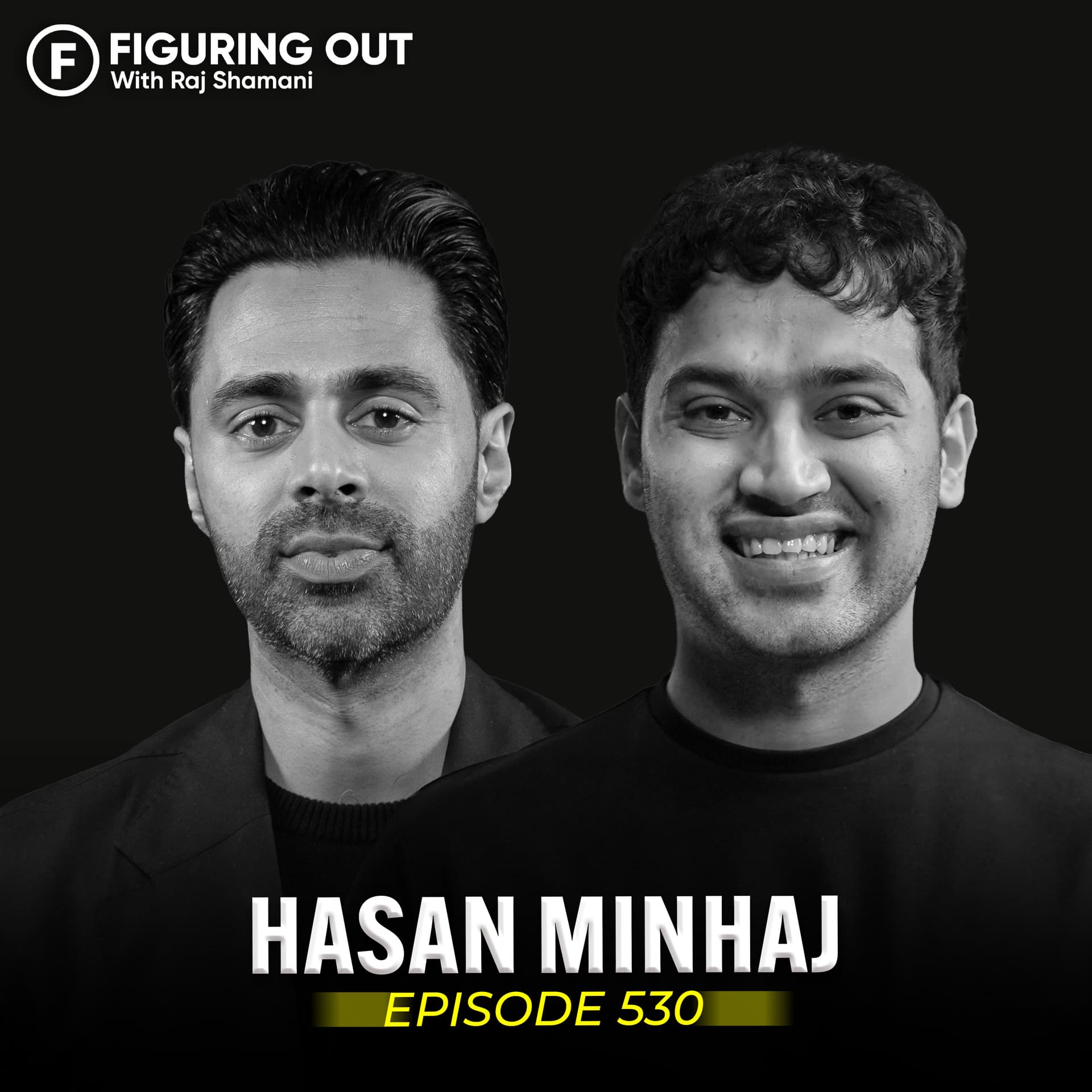

In short
What it takes to become a world-class comedian—rigor, handling rejection/uncertainty, immigrant-family motivation, and balancing Indian communal values with Western individualism.
Guest backgrounds
Hasan Minhaj is a child of immigrants (father arrived 1982), a stand-up storyteller who rose from small stages to major platforms (e.g., White House Correspondents’ Dinner). He’s known for work like Patriot Act and is currently touring; he also mentions film/TV projects including Tron: Ares.
Key claims
Uncertainty is the only certainty; rejection is constant in comedy, so rigor and process matter. Art/culture isn’t dying—more comedians are doing arenas and genre-bending work. The “soul” of comedy is the IRL club experience, not just algorithmic distribution. Parents’ work ethic sets a standard; success should not be conditional on others’ approval.
Notable examples
Zakir Khan’s multi-layered storytelling/poetry; contemporaries Bo Burnham, Daniels, Zach Kreger, Jordan Peele, Chris Rock, Dave Chappelle; films Get Out, Everything Everywhere All at Once, Eighth Grade; financial example from JL Collins’ index funds; references to Zoran Mamdani and India’s global “our time has come” optimism.
Written by AI. May contain mistakes. Listen to the episode to check what was said.
Chapters
Tap a time to open that second in VOThe Journey of Comedy
0:45 to 2:20
Hasan Minhaj reflects on his immigrant background and how it shapes his comedy.
“Zakhar Khan just came to this city and sold out an arena, primarily in Hindi.”
Embracing Uncertainty
2:20 to 4:40
Hasan discusses the challenges and uncertainties in choosing a career in comedy.
“If you have found anything valuable from this channel, please subscribe.”
India's Rising Global Presence
4:40 to 7:30
Exploration of India's growing influence and ambition on the world stage.
“there is some drama or hangama with whoever chacha, khala, masi whatever it is am I giving it my all?”
Cultural Impact of Comedy
7:49 to 10:00
Discussion about the cultural significance of comedians like Zakir Khan.
“So I tried to explain this to my American colleagues.”
The Evolution of Stand-Up Comedy
10:00 to 13:00
Hasan reflects on the changes in stand-up comedy over the years and its societal impact.
Art and History's Reflection
13:00 to 14:00
Exploration of how historical context influences the art of comedy.
“And so I think that the unique thing that's changed is the delivery mechanism for that, that art form that was part of a West Village basement can now be broadcast to 8 billion people on earth.”
The Drive to Succeed: A Child of Immigrants
14:00 to 16:45
Exploring the motivations behind the drive to succeed as a child of immigrants.
“there is a very tactile, real thing that's happening there.”
The Balancing Act of Parenting
16:45 to 18:49
Discussing the challenges and joys of parenting while honoring familial legacies.
“So it's like simultaneously, like, it's a beautiful thing.”
Financial Lessons from Family
18:49 to 21:24
Reflecting on financial insecurities and lessons learned from childhood experiences.
“So the lessons and the things that I've learned through real lived experience have, sure, at times they've been painful, but they taught me a lot.”
The Power of Index Funds
21:24 to 22:36
Understanding the concept and benefits of index funds in financial growth.
“this changed my relationship sure i'll give you i'll give you i'll give you a great great example so in the book jl collins talks about the idea of the vanguard vtsax the index fund what is the index fund.”
Show all 24 chapters
Redefining Success for the Next Generation
22:36 to 24:49
The importance of allowing children to pursue their individual paths in life.
“I mean, I mean this, um, growing up our parents, if you had two brothers and three sisters, they would run the same program on both of you.”
Lessons from Science and Rigorous Thinking
24:49 to 27:21
Exploring the rigor of sciences and how they can provide valuable life lessons.
“It's like everybody has a different temperament.”
Choosing a Career of Rejection
27:21 to 28:05
Understanding the choice to pursue a career filled with frequent rejection.
“But my dad said this often, that chemistry, physics, sciences, and math are extremely rigorous.”
Facing Rejection in Comedy
28:05 to 29:04
Discussion on how comedians deal with frequent rejection and uncertainty in their careers.
The Journey of a Comedian
29:04 to 30:53
Hassan Minhaj discusses his career milestones, including his show 'Patriot Act' and current projects.
“silicon valley which is basically ran by indians okay like the sp500 is brought to you by indians But those very same companies are laying off friends that I went to college with that are smarter than me.”
Evolving Dreams in Comedy
30:53 to 32:51
Hassan shares his evolving goals in comedy and storytelling, reflecting on his influences.
“And then as you develop and you go like, Hey, this is really what I do.”
Cultural Perspectives in Comedy
32:51 to 36:22
Exploration of how Hassan blends Indian cultural values with Western individualism in his work.
“Like the idea that you can't call someone if you're in a tough spot.”
Rebellious Spirit in Art
36:22 to 37:38
Discussion about the rebellious nature of artists and the importance of activism in creative work.
“the way that you do things just to put out your point yeah i think i think 100 000 it's it's about um it's a it's about the degree to which you um are willing to live and breathe it.”
Changing Opportunities in America
37:38 to 39:51
Conversations on the shifting landscape of opportunities in America and beyond.
“Her body of work is unflinching, going all the way back to Mississippi Masala, unflinching in what she was trying to say as a filmmaker.”
The Aspirations of Young Indians
39:51 to 42:06
Discussion about the aspirations of the younger generation in India and their global perspectives.
“And there is, I think, a genuine intellectual curiosity to go see the world and go see the opportunities that could happen in other places.”
The Changing Global Landscape
42:06 to 44:12
Explore how the perception of global opportunity has evolved across generations.
Balancing Success and Family
44:13 to 46:08
Discuss the challenges of balancing a successful career with family life.
Parental Influence on Identity
46:09 to 47:39
Examine the paradox of how parents shape both successes and challenges in life.
Closing Reflections and Call to Action
47:40 to 48:29
Wrap up the discussion with key reflections and encourage audience engagement.
“Number one, subscribe to this channel right now.”
Transcript
Automatic transcript. May contain errors.0:00We've heard enough cases of Indians living in America, in UK, everywhere. Yeah, who are going through certain problems. How is it like to be an Indian who's killing you? Lord, it's a seminar! From performing on small, unnoticed stages to standing at the center of the White House correspondence dinner, he has redefined what comedy looks like in the modern world. I'm a child of immigrants, so my parents came, my dad came in 82. Seeing how hard they worked, and then to you, you have this standard where you want to live up to their expectations or at least their work ethic. Does it kill your creativity at some point?
0:36I sometimes ignore the cynical headlines that tell you that art and culture is in a really bad place. I can also equally argue that I think right now there are more comedians than ever that are doing. Zakhar Khan just came to this city and sold out an arena, primarily in Hindi. That's an incredibly inspiring thing. I was reading again that small rejections affect you very deeply. but you still literally chose a career which rejects you every minute. Basically what you're saying is you chose a profession of uncertainty. Why would you do that when there was a path of certainty? And what I'm saying is I grew up in Northern California, Silicon Valley, which is basically ran by Indians.
1:11Those very same companies are laying off, you know, friends that I went to college with that are smarter than me. And so the thing that I'm trying to tell you is the only thing that is certain is uncertainty. Every path filled with these things that you cannot quantify or account for. uncertainty is a part of the game how you deal with it defines who you are your parents were worried because you were choosing a kind of career where yeah they didn't have any idea about but now that you've chosen it would you want your kids to choose this part absolutely not no i'm not trying to shape them into being me i'm trying to see who they are and say i think this is where your skill set is this is where your gift is let's maximize that I have a question for you.
1:55Okay. What do you think? What is the vision and the perspective of India on the world stage? I think the biggest difference that we see that we genuinely have a belief that our time has come now. Beautiful. And specifically when we have seen people like you or Satya Nadella or like Mumdani feeling it in different domains. Yeah, yeah. So we feel there's like opportunities and definitely the whole country's ambition has gone up. That's beautiful.
2:19Before we start today's podcast, If you have found anything valuable from this channel, please subscribe. It's free, it takes less than a minute, but it means a lot to us. And to listen to the audio experience of this episode, please follow us on Spotify. This episode is brought to you by our travel partner Goibibo. Check out the link in the description to download the app and avail exclusive first-time user discounts.
2:48we've heard enough cases of indians living in in america in uk everywhere yeah who are going through certain problems xyz xyz yeah how is it like to be an indian who's killing it you think i'm killing it yeah of course you are like what is it like like do they do you face do you face difficulties just because you're indian the so there's there's a couple things man like first of all that's it's very sweet of you to say that i'm killing it that's very sweet i'm i'm uh humbled you know of course you know no no you've had huge superstars on your show so this that means a lot man um the fact that i can take care of my mom and dad um i can take care of like my wife or cousins or other people i can help people that's really cool and that feeling of fulfillment of i can be a friend or a brother-in-law or a cousin that you can count on that's a beautiful thing that's a beautiful thing that you know my cousin in jamia nagar can what's at me and i can be like all right i got you whatever that is tickets to a show or you know i need to connect you with someone to to meet i can i can be a facilitator for something positive that's awesome like that's really cool um the only thing that i am seeking now is now that i have kids is am i am i meeting my my capacity of?
4:27my capacity to are you giving it your all? for real, for real to family or to Kari? I know, both both like if there is some drama or hangama with whoever chacha, khala, masi whatever it is am I giving it my all? am I being
4:57diplomatic, kind, am I living up to a standard that I'd be proud of? Am I giving it my own? And then with the career stuff, and you know this, like, you know, when you're lying to yourself, you know, when you're slacking off in school, you know, so am I giving it my own? Am I meeting my capacity? And that's the, that's the little stuff to the big stuff. Am I, again, like we talked about at the beginning am i rigorous with my process am i showing up on time am i being thorough with my notes am i hey showing my set am i sending sending it to other comedians that i really respected admire the ghosts hey take a look at this before i put the special out what do you think do you have any notes do you have any tweaks only you know if you're really killing it being rigorous no it's not about killing it's about being rigorous in your process does it kill your creativity at some point.
5:48So for me, I sometimes ignore the cynical headlines that tell you that art and culture is in a really bad place. I can also equally argue that I think right now, in terms of American cinema, young filmmakers, young artists, there are more comedians than ever that are doing theaters, arenas. I mean, just compared to 2004, there was probably less than 10 comedians that are doing arenas. Zakhar Khan just came to this city and sold out an arena, primarily in Hindi. I'm talking about at the time in 2005, there were less than 10 comedians doing arenas in English. It was probably less than five. Now I could tell you there's probably 20 to 30 that can do arenas.
6:33In terms of the number of filmmakers, when I think of the young American filmmakers that are my age, Bo Burnham, The Daniels, Zach Kreger, Jordan Peele, those are just people that come from a comedy background and you think of the movies that they've made get out everything everywhere all at once um eighth grade like the breadth of the type of art so while you're showing me an article saying that the movie industry is dying and filmmaking is dying i'm giving you examples of people that are like changing the genre zach crager with weapons and Babylon. This dude, you know, Zach was an improv performer here in New York City.
7:14And for him to do genre bending horror, and he's my age, he's in his early 40s. So to me, it's like, hey, you can look at this either way. For every article that you show me that the sky is falling, I am equally seeing my contemporaries and colleagues that are doing fucking incredible work that is holding me to a standard where it's like, hey, I got to up my game and stay with them. I mean, And going to Zakir Khan's show, I want to just give Zakir some flowers here. Have you had him on the show? Yeah. I mean, I'm watching a guy go do simultaneously. He's doing stand-up comedy. He's doing incredible storytelling.
7:51And then he's doing real poetry. So I tried to explain this to my American colleagues. I was like, Zakir Khan is essentially doing micro big deal level storytelling meets Javed Akhtar poetry. while simultaneously doing you know chris rock level social commentary about men and women family all that and then merging it all into one unique thing that's an incredibly inspiring thing yeah um and i brought a couple friends to the show and he was putting them onto game they weren't aware of the layers and levels and the the verbal dexterity that zakir has they don't know what shairi is they don't know what poetry is they don't know what like wow wow but yeah but yeah like wow like they're like what does that mean it's like he's dropping bars he's basically dropping bars he's summating life into these beautiful in these slash urdu couplets that's making an audience that speaks eight different languages all not in agreement yeah this is a beautiful amazing thing yeah so it was so cool to see this guy do that in new york city so an art form that started here almost 100 years ago travels around the world inspires this guy in indore he remixes it and makes it this new thing and then comes back to msg aka the mecca it's literally called the mecca and he rocks manas's square garden i mean it's just a beautiful thing is it also difficult in new york yeah yeah we're on a island that's like eight miles long yeah i mean it's like it's less than 10 miles long and you have 10 million people on this island but i mean this is like is life in delhi hard you know like of course life in delhi's hard but there's something very kind of i love the i love that about no specifically about your art stand-up comedy oh because stand-up comedy you're saying like it was born here yeah there are like a lot of street shows to the most iconic shows which happened here in madison square madison square garden radio city music hall yeah yeah of course so is it like really difficult here or is it just like now because we are in an internet era everything seems same i think that i can't tell you uh i can't read the tea leaves so to speak on uh is it hard or is it not hard i can only tell you from my experience and my experience is that this is the place where i got good at stand-up comedy i i got to run with in and share the same bill with the people that i admire and love the most in the art form dave chappelle chris rock uh micro big lia like the list just keeps you know going everybody that i admired and had there this is going to i mean date me a little bit cds so basically if you don't know a cd is cd is basically uh it's like a spotify playlist but you only have 12 songs but yeah these are people that i had their albums and would listen to them as a kid and you heard them like yeah and you get to meet them and you get to perform with them it's a surreal surreal thing so on a cd you would get stand-ups yeah people would make um this goes back to the 50s 60s and 70s people would make vinyls um and they would record albums and so the the most iconic you know kind of comedy albums steve martin george carlin dick gregory really what they became is time capsules and sound capsules of where american society was at at that period of time so you'll listen to an old bill Cosby album or listen to a Steve Martin album and you get a very interesting insight into the Overton window where society was at that time and the Overton window is essentially hey what what is kind of allowed in public discourse during that period of time socially politically um what's in the air at the time and so even if you listen to an old album you go I don't get it just from an anthropological perspective it's really cool to be like oh that's what was happening at the time and and you know for history nerds out there you can kind of see the similarities or differences between then and now um which i find to be really fascinating do you think it has changed like now you have to be because you're quoting like probably stuff that i don't even know from the era which yeah and you're talking about social commentary from that time yeah and you also started pretty early like let's say 2004 or 5 and 20 years do you think yeah now things have changed like people are more offensive is it like comedian from that time yeah when you listen to them giving social commentary because that's what jokes are all about people around you and society around you yeah they had more liberty and you have less so this is where i wish i've always wanted to have this as a social experiment i wish there could be like i'm sure this sketch has been done before i don't i mean someone could probably find this in archival footage but if if there was almost like ghosts and spirits of the past and they could articulate what was happening during the times that they were living through but social and political unrest war um uh economic issues uncertainty fear of the future like these things have been happening for a long time and so as someone who i guess this this is a product of turning 40, who now is like reading history more, you can see the fact that history has this ability to repeat itself and then delete itself.
13:37And so I think that the unique thing that's changed is the delivery mechanism for that, that art form that was part of a West Village basement can now be broadcast to 8 billion people on earth. That's really interesting. But I think the soul of it, man, the thing that actually matters is the IRL experience. When you actually go to a comedy club in New York City or San Francisco or Bangalore, Delhi, Bombay, and you experience it there, there is a very tactile, real thing that's happening there. And so I think there is a delineation or I try to have a delineation between what's happening through the algorithm and what's happening IRL you know I was hearing one of your interviews and you said you have this drive that you need to make it right right where does this come from um you know I'm I'm a child of immigrants so my parents came my dad came in 82 um and I you know you may agree with this too seeing how hard they worked um and also being part of a culture that has multi-generational community so you get to see how hard your dadi and dada worked and then you get to see how hard your parents worked and then to you you have this standard where um you want to live up to their expectations or at least their work ethic um and i think about this My daddy passed away in 2022 and I'm so glad that I got to see her before she passed.
15:16She passed in 22 or 23. I got to see her when she passed.
15:23And I know that the life that she lived, she had to work incredibly hard and she worked through incredibly painful circumstances and situations. And I think about the level of agency and freedoms that I have in relation to her. And that's where like I can touch and feel the DNA of inspiration there. And so it's not about status or the outcome of those things. It's meeting that standard that I saw with my own eyes. you know you know there was a research i was reading yeah which says that sons of immigrant parents work extraordinarily hard to just prove their fathers that they're worth something and it's it's like they like somebody quoted beautifully that they're literally building monuments to show that they can do this they're worth it yeah do you seek validation from your father uh bro i mean if I had a healthier relationship with myself and if I had more self-confidence, I wouldn't be a stand-up comedian.
16:35I wouldn't be performing on stage for strangers to tell me if I'm worth it or not. So yeah, like, look, we are built in the crucible of conditional love, right? So it's like simultaneously, like, it's a beautiful thing. You can, as Tupac brilliantly wrote, he was the rose that grew from concrete. Like when I saw that title, I was like, yeah, every every desy kid that makes it is the rose that grew from concrete you know and that concrete is you know a cement of disappointment and but the me's and shoes being thrown at them and that sort of thing um uh you know here in the United States of America they always say you're it's you're you're innocent until proven guilty um I think with our parents it's the opposite you're guilty and prove until you're proven innocent you know um or you know you don't you are worthless until you prove otherwise.
17:23And that's, that's funny. Like, I mean that jokingly, but it also, it also can be the driver for stuff. Like there is nothing anybody in the outside world or the comment section can tell me that I haven't heard from my own dad. You know what I mean? Or my own parents. It's a good thing. So like, it's, it's good and bad, which is like, which is, I think like that um that paradox that paradox is the is the beauty of um comedy do you still seek his validation um so so my dad was born 1950 so my dad now um he is 75 years old you know so it's beautiful and i'm i'm 40 i have two beautiful children i'm married um so i'm in like my i'm I'm in my Mufasa era now.
18:15You know, Simba has grown up. And so I'm in between two things. My parents are getting older. I've seen the passing of my grandparents. And then simultaneously, my children are getting older. So all of these memories that I had as a child, riding your bike for the first time, you know what I mean? All of these things, watching your first movie in the theater, having a Coke, going to a theme park. I'm seeing this now through the eyes of my children. And then I'm seeing my parents, dadan dadi get to witness this again so that's where my like my khushi is and seeing them take their grandkids to disneyland and this time they get to experience it without the stress of having to like and you finance yeah yeah you know i mean they're always stressed about that so that's a that's a very cool thing it's a it's a blessing and simultaneously it's stressful because I'm like I'm managing two essentially two small children yeah the wants of like my parents and the wants of my kids which is like yeah you know they're both they're both very similar in that way you've also said that you you were at some point insecure about money because you've seen your parents growing up and fighting about money because that's a very normal thing to see when you're yeah when your parents are working really hard yeah does that insecurity ever goes um or do you still have that insecurity in some sort that maybe you know i i'm very lucky i got to i read uh jl collins's book the simple path to wealth and that really changed my relationship and my understanding of the way money works the way index index funds work and um And the one thing that I wish I had had as a child was more transparency and kind of timeless lessons around those sort of things about the way the world really is.
20:17but a lot of the conversations I think in in our culture they treat children and they keep them that way of like go to school study you don't have to think about these other things but the real world isn't a standardized test and it's not a textbook and there's a lot of things that you need to understand outside of that and I'm lucky enough that I got to pursue a path that's almost like there's no real guide here. So you figure it out as you go along. So the lessons and the things that I've learned through real lived experience have, sure, at times they've been painful, but they taught me a lot.
21:00So the mistakes that I made financially, keeping cash in shoeboxes, not investing, like literally keeping cash in Nike Jordan shoeboxes, being like well if it's in a shoebox you can't take it away from me hoarding it you know like it's like a red crushed pepper from domino's pizza or something like that this was not wise but then i learned you know what i mean and that's important and that's okay like that's okay that's part of it give me an insight which you learned from the book which you felt like this changed my relationship sure i'll give you i'll give you i'll give you a great great example so in the book jl collins talks about the idea of the vanguard vtsax the index fund what is the index fund.
21:40So on the internet, you'll see a bunch of people that are like, you have to buy the stock, you have to da-da-da-da-da. The amazingly simple, boring idea of an index fund being self-cleansing, the fact that when you hold the S &P 500, you hold the 500 most valuable companies on the stock market index means you already own Tesla, you already own NVIDIA, you already own Apple. you don't have to spend every hour of every day watching cnbc or looking at the money markets and over the course of 10 20 30 years you will see the beauty and the power of compounding through your reinvested dividends and so something so so simple so simple but so solid wait tell me one thing which is so your parents were worried because you were choosing a kind of career where yeah they didn't have any idea about right yeah i was exchanging certainty for uncertainty so they were worried but now that you've chosen it you know these certainties and uncertainties which comes with it yes would you want your kids to choose this part absolutely not no 100 % no yeah my parents you made it big so you should probably be more open right you know like I said at the beginning of the conversation hey I'm I'm doing uh what works for me so so here's here's I think one thing that's interesting so you and I were having this conversation we come from a similar culture but I think we have an opportunity to be the software update you know our parents are running Linux or Windows 95 C++ JavaScript you know we get to be Ruby on Rails or we get to be Python we get we can be a an update to that software and what what do I mean by that.
23:22I mean, I mean this, um, growing up our parents, if you had two brothers and three sisters, they would run the same program on both of you. Hey, you guys should both be pre-med. You guys should both be, you guys should both do this path, path.exe. Now just execute on that. And I think what's beautiful, what our generation has the opportunity to do is see children or see a person where they are and say, I think this is where your skill set is. This is where your gift is. And let's maximize that. And so for me, that's what I try to see with my two kids. It's like, I'm not trying to shape them into being me.
24:07I'm trying to see who they are. You know, if you were to ask my dad, what's Hassan's favorite color? He could not tell you or like what's his like what's his favorite dish he wouldn't be able to tell you you know he's not meeting me where I'm at he's like I need you to do this it's like like the black ops like I need you to execute on this mission I don't care what your interests or hobbies or things that you're into like or even your inherent temperament what are you good at what what are your personality traits that would allow you to succeed or fail at a particular domain. And that's something that I also realized too with time.
24:49It's like everybody has a different temperament. I can't tell you what to do. My risk tolerance, my drive and desire to want to be on stage. Some people may not want to do that. They're like, Hey man, I'm, I'm an introvert or I'm a private person. I don't want to do. And as they should, they should honor who they are internally you know so you'd be okay if they want to choose this career if if they wanted to do it yeah you know if they truly felt like they wanted to do it if they had um the the the internal temperament the internal like desire and to do all of those things but man thank god like i've kept them away from they're really young they're just being kids they're riding their bikes and just being kids they're pretty much away from kind of what i do which is awesome because i want them to organically find what they love and like you know you know you've also said something about your career itself that your entire value depends on whether the guys like you or no like yeah people like you or not right that value in the business depends on that and that would be heartbreaking for my children you know to for me as a father to watch my children go through something where they have to derive value from what others think of them yeah so just as a father that's a that's a tough premise that would be difficult for me because i love them unconditionally and i think they're deserving of love exactly the way they are and i hope they don't have to put on and act to get a fruit of the validation you know so that's me as a father like you would hate to see people that you love unconditionally have to tap dance for that thing uh i fundamentally don't like that premise um one of the things that i love it's it's so interesting and this is maybe this is like a full circle moment where simba is like realizing the power of mufasa so my dad My dad, by trade, is an organic chemist.
27:01And one of the things my dad told me, I hated chemistry and physics growing up. Actually, like general chemistry, organic chemistry kicked my ass. And physics kicked my ass. Like, it's so hard. So shout out to anyone who does physics or engineering or organic chemistry. It's very difficult. It destroyed me. And biochem. Biochem destroyed me as well. But my dad said this often, that chemistry, physics, sciences, and math are extremely rigorous. in the way in which they can be litigated or adjudicated. And I used to kind of like roll my eyes at that. What a robotic way to think. But in a messy, complicated world, how beautiful is it that there are certain languages that unite the world that are incredibly undeniably rigorous.
27:45So it's so funny that you start this discussion with me about like social norms and do you feel like you have to change this or that? But like a math proof is what it is. You know what I mean? And the periodic table that like my dad had over his desk at his office for 35 years he was at the Cal EPA for 35 years remains so rigorous and kind of bullshit proof that this thing that I rolled my eyes at that I actually kind of see beauty in later on in life so shout out to you know Najmi for dropping those gems you I was reading again that small rejections affect you very deeply right yeah yeah sure sure sure being sensitive yeah yeah so you you get affected by rejections you're wise now but when you started i'm sure you were not this wise you were not this accepting of everything that's going on but you still literally chose a career which rejects you every minute because yeah let's say you're giving a special of 60 minutes and then you have to give like 20 punch lines 10 of them didn't work yeah so every like five or ten minutes you're getting rejected then in there yeah why did you choose a career which is full of rejection when rejections affected you so much well what's what's interesting is if you think about that premise you chose a profession what basically what you're saying is you chose a profession of uncertainty why would you do that when there was a path of certainty and what i'm saying is i literally again i i grew up in northern california silicon valley which is basically ran by indians okay like the sp500 is brought to you by indians But those very same companies are laying off friends that I went to college with that are smarter than me.
29:23And so the thing that I'm trying to tell you is the only thing that is certain is uncertainty. And every path is filled with these things that you cannot quantify or account for. Where, oh, we're going to have to take a hard left here unexpectedly. Holy shit, this thing just crossed the road. We have to veer around it. So this idea that we've been told that, oh, the path is going to be certain. The only thing that I've known from everything, from the health of your parents, your loved ones, your relationship, real life shit, not show, forget showbiz stuff, man. I'm talking about real life shit.
30:02Uncertainty is a part of the game. How you deal with it defines who you are. But it just is part of the game. You know, I was really excited to see you at The Daily Show as well. Yeah, it's amazing. what like you you would have had your own show right i've had my own show yeah but then what happened like did it get canceled what what oh patriot yeah um so patriot act we did we did six amazing seasons and shows end you know covid happens we do six amazing seasons we had our offices here on 11th avenue and then shows end yeah and then what's next now uh so right now i'm on tour i have an amazing tour with my arch nemesis ronnie chang it's called hassan hates ronnie ronnie hates hassan um i have my podcast hassan minaj doesn't know um i have uh i'm in the movie tron aries tron and imax um and i have a movie coming out next year that i that i wrote and i'm starring in and yeah so that's that's you know that's my uh joy as like someone who's been doing this a long time is that you build a you build a body of work you know what's your biggest dream now um my biggest dream is to continue making can let me i'll restate this so when i first started, uh, your biggest goal is, can I make a living pursuing this?
31:39And then as you develop and you go like, Hey, this is really what I do. This is my craft. This is what I pursue. The, the goal then is that people come see your work to see what you have to say. And I'm, I'm in that chapter of my career is that, Hey, every time I put something out, I want people to be like, I want to see what he has to say about the world, whether that's a film or TV show or a comedy special. What is his worldview? And so I talked about the contemporaries that inspire me, the Bo Burnhams, the Daniels, the Zach Craggers, the Jordan Peels, the Chris Rocks, the Chappelle's. It's what's their perspective on the world.
32:24I revisit them to see what is their worldview. you know so what's your worldview now tell me about that oh what's my worldview um like what's going on it's it's project specific so one of the one of the films that we're working on right now um i don't want to give it away i don't want to give it away yeah you got to see it you got to see it yeah okay okay don't tell me about real projects tell me about what do you see in the world right now like what's what's exciting what's problematic from maybe indian lens from in the Western lens, anything? Oh, I think that, you know, for me, the most important thing that I think I try to think about in terms of my place in America and in American society as someone who is like really proud of my culture and heritage is Juggling the beautiful things that I love about my culture, like our family values, our communal values, the fact that like in our culture, you'll never be lonely.
33:39Like the idea that you can't call someone if you're in a tough spot. This is like not a thing that I think we go through. One of the things that I'm trying to navigate is, and I've always tried to infuse this in my work, which is simultaneously like the values that I love about my culture. and specifically within Indian culture our love of family, of community, of rallying for each other. If you are ever in a bind, there are at least five or six people that you can call if you're in a health scare or in a pinch. And you can count on them. But then also simultaneously meeting the radical individualism of Western culture.
34:30and we recently had the great documentarian filmmaker Ken Burns on my show and he has this new documentary series about the American Revolution here in the United States and one of the things that I think is so interesting about the American Revolution of the late 1700s and as we have this conversation we're here in New York City it's the 10th anniversary of Hamilton on Broadway which is just a few blocks away is that fundamentally this country was built by immigrants and mavericks. And the Hindi word that I would describe to describe the energy of Thomas Paine, George Washington, and even now the modern mavericks is fundamentally they're batamis.
35:08They are insolent. They are irreverent. They are pushing the status quo. Rebellious. And I think fundamentally rebellious. I mean, the original writings like date back to the American Revolution to now is these are people that are writing their version of a middle finger to the British, but they are insolent in their behavior. And when I saw that and I interviewed Ken and I watched the docu-series is phenomenal and all of his work is, he's one of the greatest documentary filmmakers of all time. Is that, oh, this is a DNA that has existed here for centuries. As messy, as complicated as it is, that DNA remains.
35:55And for me, as someone who comes from South Asia, comes from India, my family's from Delhi, is to infuse my irreverence and insolence into my work, into the chapter that is, you know, American pop culture. And I think there is a unique spin and way to articulate that that i think is unique and so to tap into that and not shy away from that i think is a beautiful thing do you think you'll be as rebellious in the way that you do things just to put out your point yeah i think i think 100 000 it's it's about um it's a it's about the degree to which you um are willing to live and breathe it. Like if you believe in it, you can do it.
36:46We're having this conversation in New York, right? New York City. Zoran Mamdani became the mayor of this city. Do you see what I'm saying? Like this is a place of possibility. And this is a place where he built a coalition starting with the parts of this city that were oftentimes overlooked, where there are Indian, Bengali, Pakistani, different immigrant communities of Queens, of the Bronx, and building a coalition. And by the way, building a young coalition in one of the most important cities on planet Earth. So this is what I'm talking about, which is there is a spirit of, that too was also Maverick-like.
37:33And once again, this is the story of this country. And by the way, shout out to him, you know, like his mother, an esteemed director, Mira Nair, legend. Her body of work is unflinching, going all the way back to Mississippi Masala, unflinching in what she was trying to say as a filmmaker. Deeply proud of her culture and heritage. His father, an incredible academic, incredibly knowledgeable of the world. This is amazing soil that shaped who this person was, you know. And the fact that he's 34 years old is we are witnessing an incredible moment in world history and in American history. So what a time to be alive.
38:17I'm curious to know, why do you think he won? What resonated with people a lot? I think that he focused on, I think, two critical things that he was unflinching about. This city is one of the most expensive cities to live in. And there is a generation of people between the boomers and the young millennials and zillennials and Gen Z and people that are trying to pursue the American dream in the city that he started with a clear, affirmative agenda of what he was talking about. freeze the rent, cost of living, free, free and fast buses. We are talking about the, the social needs of a robust society that works for all people and all citizens.
39:04And he was unflinching in that. Um, and he was willing to build a coalition and activate a group of, um, voters, uh, in a way that we've, we've never seen. I think in the last week he had a hundred thousand volunteers this is incredible i mean it's an incredibly inspiring thing to see because i love talking about this thing sure do you feel the way everybody used to see america has like this is the place sure now even americans are looking out in the world that other places are more important for them to maybe build audience build businesses build certain life yeah then just here they feel like just purely from the market economics and behavior point of view yeah Is that spirit dying here and around the world more opportunities are coming?
39:50I think one of the things that I think is just awesome is the world is a bigger place.
40:04And there is, I think, a genuine intellectual curiosity to go see the world and go see the opportunities that could happen in other places. And like I said, what's really interesting is that like the the Mavericks and the people that are trying to figure stuff out, they will find a way. I'll give you just a tactile example. Take the film industry, for example. When California and New York made it difficult to make films, Atlanta stepped up. Vancouver has stepped up. Toronto has stepped up. Other states or regions or even countries have stepped up. The UK, London obviously became a place where people would go.
Read the full transcript
40:44Um, in other places, create these opportunities where, Hey, you can go make your movie or make your film. I think it's incumbent on artists or entrepreneurs or people like to be aware of those things, to see where that possibility is happening and be bold and brave enough to, Hey, go make that leap. And so I think in my industry that that comes with international touring or filming internationally. And whoever steps up to the plate on the other side of that, I think there's a ton of opportunity and possibility to happen because of the positive and the upsides of the new digital reality that we live in.
41:28Go ahead. Yeah. I have a question for you. Okay. As India has entered the global stage, what do you think as a young person in India, What is the vision and the perspective of India on the world stage? What's something that you'd want to see in the world? Or what do you think your generation is feeling in the world? See, I can tell you bases on what I feel and the conversations I've had with people who have been able to make it big in the previous generation and not been able to make it big. i think the biggest difference that we see that we genuinely have a belief that our time has come now beautiful like that when you talk to like my parents generation they they used to not feel it they used to feel somehow they were like right in a way that they even the top leaders billionaire they used to feel somehow they were inferior in some point in front of the world right today i think our generation doesn't feel it that's purely from an opportunity point of view that's awesome and also i think because we feel like because a digital age the world is so global yeah that it doesn't matter whether you're born in america or europe or india if you have talent and you can make it even if you're indian you can just go kill it outside and specifically when we have seen people like you or satin adela or like momdani or like just people of different origins healing it in different domains yeah yeah so we feel there's like a lot of scope possibility possibilities possibilities yeah and definitely the whole country's ambition has gone up that's beautiful and we somehow get feeded in media which i feel is also becoming true that earlier it used to be like if you want to be global then you have to be in america or as you can't be global sure i think that's changing totally i think you can be anywhere in the world and just be global or like yeah just make it big yeah i think and i think it's also about your perspective and that that that singular perspective is the thing that you imprint on the world um speaking of history i mean one of the one of the all-time legends that i think impacted the world in this way was bruce lee yeah and his films came from hong kong but it was the specificity and the the i don't even know how to describe the je ne sais quoi of his pov that traveled across the world and changed the world and for him to be one of the most adored icons in america but also in black america people love bruce lee in that way he's like a hero yeah um is a is a very powerful thing and a testament to being singular and unflinching in your vision do you think you're killing it do i think i'm killing it i mean you have to you have to ask my like my wife and my children and my parents i'll give you what do you think you think um you're doing dude i'm you were yeah yeah man i'm dude i'm i don't i mean maybe you tell me you'll see this in the avid bro i'm tired man i'm very i'm doing a lot yeah i'm on i'm on tour and i'm doing this and i'm in the edit on a movie i'm doing a lot man so i'm i'm doing the best i can and the things I'm very lucky that God has kept me healthy enough that the things that I wanted to do that I set out to do that I planned a year or two ago I'm doing right now you know like we're in Boston this weekend next week we're doing a residency here at the Beacon Theater in New York City so you know I'm very lucky that that's happening and I'm really really happy it's good to see that because yeah not like a lot of people feel it no matter what who feels who doesn't feel that way like everyone who is who i meet who are trying to make it big and they've already made it big in some sort of way okay they feel like man i'm not living up to my potential maybe i'm not doing enough have you ever felt like that in current times
45:43um the only thing i wish man the only thing i truly truly wish is i wish uh i was closer to geographically closer to my parents that's the one thing i wish they were they were closer so my my parents my in-laws they're in california we're here in new york that's the one thing that's tough my my sister my family they're in you know i'm i'm away from them that's hard that's tough that's the one thing where i was like i wish i could somehow you know yeah but again like this is this is the thing like the sliding doors you know yeah i've been i've been thinking about this idea too which is like what's really interesting in our culture is like everything good in your life is because of your parents and everything horrible in your life is because of your parents which is a very it's a very unique thing which is like they're like i owe everything to ammi abbu i owe you everything and then you're like why are you like this you're like my ummy my abu they told me i you know what i mean like it's it's simultaneously both of those things you know what an interesting paradox that is right okay because you keep bringing your family again again and yeah i'm just i want to do this last question as well what do you want what do you want your daughter to feel about your success i just want to be the best father that i can for her and for both her and my son just really fill them up and have them have a sense of self-worth and know that like their dad uh loves them deeply like and they don't have to worry about the rest of the world is going to be what it's going to be but at home they have somebody who like really really loves and cares for them they never have to wonder like did i make you did i make you proud i mean it's an insane thing that there's like this is very sad there's like a generation of like men in their 30s 40s and 50s that are like is is i'm happy with me you know what i mean it's a crazy thing so they never have to worry about that they know that they're they're loved just for being who they are and that they're a miracle in and of itself and you know beautiful beautiful you know yeah yeah thank you yeah thank you thank you so much that's very awesome very awesome but it's real it's real that's how i feel about that yeah thank you cheers bro thank you for doing this thanks for having me man thank you thank you thank you so much for watching this episode till the end Now you have to do three things.
47:59Number one, subscribe to this channel right now. The more you subscribe, the better the guests we will be able to get for you. Number two, please comment and let us know what did we do wrong and what did we do right. Because the more you give us feedback, the better we will be able to make episodes for you. And number three, please share this episode with at least one person because one conversation can change someone's entire life. I'll see you next time. Until then, keep figuring out.
From the publisher
Checkout Goibibo: https://app.goibibo.com/mnXF/ol62526n
Get your hand-picked playbook here: https://www.figuringout.co/pdf/fo-530
Guest Suggestion Form:
https://forms.gle/bnaeY3FpoFU9ZjA47
Disclaimer: This video is intended solely for educational purposes and opinions shared by the guest are his personal views. We do not intent to defame or harm any person/ brand/ product/ country/ profession mentioned in the video.
Our goal is to provide information to help audience make informed choices. The media used in this video are solely for informational purposes and belongs to their respective owners.
Order 'Build, Don't Talk' (in English) here: https://amzn.eu/d/eCfijRu
Order 'Build Don't Talk' (in Hindi) here: https://amzn.eu/d/4wZISO0
Follow Our Whatsapp Channel: https://www.whatsapp.com/channel/0029VaokF5x0bIdi3Qn9ef2J
Subscribe To Our Other YouTube Channels:-
https://www.youtube.com/@rajshamaniclips
https://www.youtube.com/@RajShamani.Shorts
📺 Watch Figuring Out episodes on YouTube: https://youtube.com/playlist?list=PLE0Jo6NF_JYO5-phess8GKafKMtPv3tfZ
(00:00) - Intro
(02:49) - How Does Winning Abroad as an Indian Feel?
(09:26) - Is Stand-Up Comedy Tough in New York City?
(12:17) - Did the Older Generation of Comedians Have More Freedom?
(14:26) - Where Does His Drive Come From?
(19:23) - Does Financial Insecurity Ever Go Away?
(22:31) - Would He Want His Kids to Choose This Career?
(28:17) - Why Choose a Career That Rejects You Every Day?
(30:11) - Did His Show Get Cancelled?
(31:17) - What's His Biggest Dream?
(32:31) - What's His Worldview Today?
(39:24) - Are There More Opportunities Around the World in Economics & Marketing?
(41:32) - Hasan to Raj: What's India's Vision on the World Stage?
(44:15) - Does He Think He's Killing It?
(46:43) - What Does He Want His Daughter to Think of His Success?
(47:56) - Outro
In today's episode, we sit down with Hasan Minhaj - stand-up comedian, actor, and former host of Patriot Act, the son of Indian immigrants who's spent two decades turning rejection into some of the sharpest comedy in America.
We discuss why comedy rejects you every single minute, why every immigrant kid is secretly trying to prove their father wrong, and why the certainty of a "safe" career is really just an illusion. Hasan also breaks down his obsession with Zakir Khan's Madison Square Garden show, why he traded a shoebox full of cash for index funds, how he's raising his own kids differently than he was raised, and why he still won't let them become comedians.
Raw, personal, and unexpectedly moving - this one will change how you think about success, rejection, and what it really means to make your parents proud.
Subscribe for more such conversations.
Follow Hasan Minhaj here:
Instagram: https://www.instagram.com/hasanminhaj/
About Raj Shamani
Raj Shamani is an Entrepreneur at heart that explains his expertise in Business Content Creation & Public Speaking. He has delivered 200+ speeches in 26+ countries. Besides that, Raj is also an Angel Investor interested in crazy minds who are creating a sensation in the Fintech, FMCG, & passion economy space.
To Know More,Follow Raj Shamani On ⤵︎
Instagram @RajShamani https://www.instagram.com/rajshamani/
Twitter @RajShamani https://twitter.com/rajshamani
Facebook @ShamaniRaj https://www.facebook.com/shamaniraj
LinkedIn - Raj Shamani https://www.linkedin.com/in/rajshamani/
About Figuring Out
Figuring Out Podcast is a Candid Conversations University where Raj Shamani brings raw conversations with the Top 1% in India.


