In short
Lyft’s rebrand and brand strategy as it matures from ride-sharing into a broader “global mobility platform,” plus how its creative team is using AI.
Guests
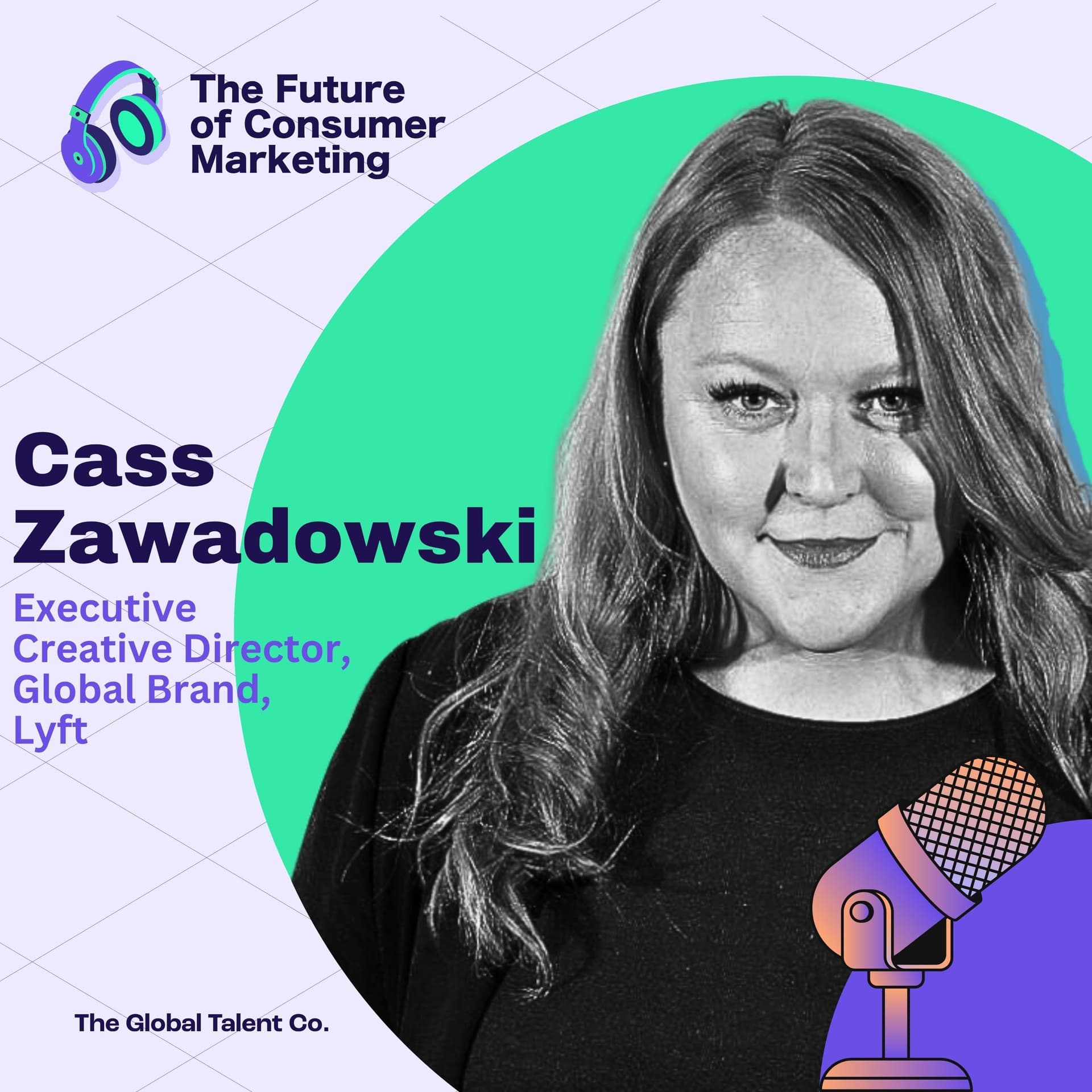
Kat Zawadowski, Executive Creative Director at Lyft. Background: ad school and agency-side work (Toronto), then international experience in New York, Germany, and Seoul; later moved client/brand-side before joining Lyft about a year and a bit ago.
Key claims
Lyft’s purpose stays stable while the brand evolves; rebrand was an “evolution, not a revolution” to feel more grown-up for expansion (including Europe via FreeNow). AI is a creativity multiplier, not a replacement, with humans owning judgment.
Notable examples
Lyft Pink color and logo changes; new photography and color palettes; Q4 launch campaign targeting mid-20s to mid-30s with “not on autopilot” messaging and creator partnerships; AI route-planning for drivers and a 10–12 week creative sprint using tools for brainstorming, prototyping, and A/B testing.
Written by AI. May contain mistakes. Listen to the episode to check what was said.
Chapters
Tap a time to open that second in VOLyft's Mission and Mobility Ecosystem
0:00 to 0:42
Learn about Lyft's core mission and how it operates within the mobility ecosystem.
“Lyft's mission has always been about sitting at the intersection of technology, mobility, and urban life.”
Understanding Lyft's Evolution
1:28 to 4:00
Kat discusses Lyft's journey, its current market, and the services it provides.
“Yes, we are very happy also that we were able to make this work and especially speaking to a company such as Lyft that I personally know who you guys are.”
Kat's Journey in Advertising
4:00 to 6:06
Explore Kat's unconventional journey in advertising and her experiences across the globe.
“And I'm happy to tell you a little bit about my journey.”
The Rebranding Journey
6:06 to 8:00
Learn about Lyft's rebranding efforts and the strategic decisions behind it.
“Because in my time at Lyft, I've had some different priorities and goals.”
Rebranding Insights and Challenges
8:00 to 11:27
Discover the challenges and processes involved in Lyft's year-long rebranding.
“So of course, always looking for opportunities to keep the brand growing in those markets.”
Balancing Longevity and Relevance
11:27 to 14:00
Kat shares insights on how Lyft balances brand longevity with cultural relevance.
“say a year, maybe slightly like a month less.”
Lyft's Team Structure and Remote Work
14:07 to 18:20
Learn about Lyft's hybrid work model and team distribution across various locations.
“Not sure if you're opening headquarters in Europe now that you're going to offer the service there, but we'd love to know more about that.”
Leveraging AI at Lyft
18:21 to 23:16
Discover how Lyft is integrating AI into their operations and creative processes.
“And I would love to know is, are you able to share some insight in how Lyft is leveraging AI nowadays?”
Creative Excellence and Business Impact
23:17 to 25:54
Understand the balance between creativity and business performance in brand marketing.
“You know, it's been like bringing things from Weevy into Figma, from Figma into, you know, Google Docs.”
Transcript
Automatic transcript. May contain errors.0:00Cass Zawadowski:Lyft's mission has always been about sitting at the intersection of technology, mobility, and urban life. So how do we make getting from point A to point B simpler, of course, but safer and, of course, more flexible for millions of people? Would you be able to tell us more about the company? Lyft is what we call a global mobility platform. And when we think about ourselves as part of the broader mobility ecosystem, we've really been about helping people move around cities in smarter ways. What would you love to accomplish with your team for the end of this year? continuing to build creative work that people remember, but also making sure that it's very tightly tied to the product and the value we're delivering for our riders and our drivers.
0:42Hey everybody, welcome to the show. This show is brought to you by the Global Talent Company, helping fast-growing teams hire exceptional remote talent from Argentina, South Africa, and beyond. We connect companies with world-class professionals who bring skill, reliability, and a global perspective to every role. And just for our listeners, we're offering an exclusive 10 % discount on your first hire. All you need to do is visit globaltalent.co, click start hiring, and mention the podcast listener discount when we reach out. And today, with me here, guys, I'm speaking with Kat Zawadowski, Executive Creative Director at Lyft, one of the first ride-sharing communities in the United States since 2012, if I'm not mistaken.
1:25But Cass, it's a pleasure to have you on the show. How are you doing today?
1:29Cass Zawadowski:I'm doing very well. Thank you very much. I'm really honored to be here. Thanks for inviting me. Yes, we are very happy also that we were able to make this work and especially speaking to a company such as Lyft that I personally know who you guys are. I've seen you around. But just in case, Cass, anybody listening does not know what Lyft is, would you be able to tell us more about the company, about yourself and how you came to be the executive creative director of Lyft? Yeah, I'm going to start with your question about Lyft. Thank you for giving me the opportunity there to go a little deep on the brand.
2:02Cass Zawadowski:So what does Lyft do? What markets does it serve? Really at its core, Andreas, Lyft is what we call a global mobility platform. So not just a ride sharing company anymore. We are now 13 and a half, almost 14 years old. And when we think about ourselves as part of like the broader mobility ecosystem, we've really been about helping people move around cities in smarter ways. Of course, that includes traditional ride share, but also things like bikes and scooters. A lot of people don't know that, yeah, Lyft does service bikes in a lot of different cities, City Bike in New York, Divi Bike in Chicago, and of course, yeah, other cities too.
2:42Cass Zawadowski:And then we've got our scooters in some places too. But in terms of the market that we actually serve. It's pretty broad. So we are primarily North American based right now. We'll be moving into the European market through this year. We did have an acquisition last year of FreeNow, which has allowed us to move into quite a few countries across Europe. And so on one side of all of that, we serve about 51 and a half million people globally a year. So riders who really need reliable transportation for everyday life, whether we're talking about commuting to the airport, their job, or just going out with friends.
3:21Cass Zawadowski:And then on the other side of the platform, of course, we serve drivers. I think right now over a million drivers who are just really looking for flexible earning opportunities. So I'd say at the bigger level then, we're also serving cities by helping reduce friction of how people move around. And our mission has always been, And Lyft's mission has always been about sitting at the intersection of technology, mobility and urban life. So how do we make getting from point A to point B simpler, of course, but safer and, of course, more flexible for millions of people? So that's in a maybe a long winded nutshell what Lyft does and who we serve.
4:01Cass Zawadowski:And I'm happy to tell you a little bit about my journey. I would say pretty unconventional. So my journey into advertising was very much fueled by curiosity. I started out in ad school, just kind of falling in love with the idea of storytelling and the way that creativity could sort of shape culture. And I worked early in my career, actually through the majority of my career, I have been agency side, both in Toronto. And then I had the opportunity as well to venture out into the world and see how creativity worked in different parts of the world. So I also moved abroad for a couple of years of my career, worked out in New York City, worked in Germany, worked in Seoul.
4:46Cass Zawadowski:So really got a chance to understand diversity of thought across global brands and, of course, across teams and cultures. And then I had the opportunity to try something brand side a few years ago. or client side, however you like to refer to it. And it really inspired me, Andreas. It gave me a very different perspective. Suddenly, I wasn't just thinking about, you know, campaigns on the agency side. I was really thinking about the entire brand, the business, the culture of a company. And that really was something that inspired me. So from that brand side role, the opportunity at Lyft came up.
5:24Cass Zawadowski:And I really admired not only the company, But I think it's important when you move into a role like this that you understand and admire the vision and the mission of the business and the brand, as well as your executive leadership. So I did, you know, my due diligence of, of course, interviewing with the leaders, but understanding who they were as individuals and how they believed in the value of marketing. And so back in about a year and a bit ago, I landed at Lyft. In terms of advertising or any campaigns that you've had to do, manage, oversee, could you give us an example of any good ones that you've noticed that Lyft has done that you could maybe give us an example of?
6:05Cass Zawadowski:Yeah, yeah. Lyft has been, I mean, so in my time, let's take a step back. Because in my time at Lyft, I've had some different priorities and goals. So, of course, yes, brand campaign and brand strategy. But first and foremost, last year was a very foundational year for Lyft. we were undergoing a complete rebrand. So as I mentioned, uh, last year we turned 13, turning 14 this year. Um, and we all joked, you know, 13 is, you know, you're a teenager now, you are undergoing some changes. You want to show up a little differently. So our rebrand last year was very much rooted in, um, the brand maturing, if you will, you know, we've been a very, um, uh, punchy spirited, fun loving brand, and it is very well served us for, you know, our brand life, but lots of new competitors coming to the market and just an opportunity for the brand to show up a bit differently.
6:59Cass Zawadowski:So the premise of my first year was really about helping, you know, co-steer our new brand, our new look at how we, you know, reshape the brand from visual identity, verbal identity, how we showed up with our just brand strategy in general. And of course, thinking about our new brand archetype. And so again, that was the culmination of last year. And then in addition, Andreas, we did embark on our first brand campaign that was the culmination of the new brand. So that was around Q4 of last year. And we got to market quite quickly. Our opportunity was to really speak to some of the, I'll call them young working adults, you know, mid-20s to mid-30s range.
7:51Cass Zawadowski:and yeah, we saw some great success with moving specifically to markets that were very important for us to move, the New York market and the San Francisco, you know, that is our home base. So of course, always looking for opportunities to keep the brand growing in those markets. And we went to the market with a varied message, message around not being on autopilot when it comes to ride share. You do have options as a rider And when you look into your options, those options usually serve you better. So a lot of fun with some really great headlines and some tremendous partnerships with some creators that really helped drive some results for the campaign as well.
8:34Cass Zawadowski:Okay. And how long did the rebranding take? Like, was it the whole year that you guys were working on just changing the image and how Lyft looked and representing that new maturity that you're mentioning that I'm 13 years old? Yes, you are a preteen right there. And it's crazy. But yeah, was that a project that took the whole year? It did, actually. Yes, it took the whole year. I mean, it was definitely an evolution of the brand, not a revolution, as we like to say internally. We, for example, maintained our very well-known Lift Pink, but the ways in which we use that color are a little bit relegated now.
9:14Cass Zawadowski:We use it very differently than we used to. So we explored a whole new primary color palette. We explored a secondary color palette. We changed our logo. Again, wanted some of that maturity to be injected in not just how we showed up visually, but also through brand identity like our logo. We changed all of the way we approach photography. And so when you think, and all of that, of course, starting and being rooted in a new brand strategy that is related to our purpose and to our value proposition. So our purpose at Lyft is to serve and connect. And our mission, I'm sorry, our value proposition is to expect more from every journey.
9:54Cass Zawadowski:So when you take that language and you think about strategically how to start bringing that to life, there was different ways, as I said, that we wanted to explore color, that we wanted to show how humanity and warmth and connection showed up in the brand. And then, of course, takes a year, Andreas, because Lyft's a big company. And at the end of the day, the way the brand shows up is not just in marketing and communications assets. It's through our product as well, through our marketplace. So tremendous partnership across cross-functional partners. Of course, our executive leadership team weighing in.
10:32Cass Zawadowski:So a year because it was a very purposeful exercise. A year because, you know, there was a lot of things we had to consider. And just a really great example, in my opinion, being that being one of the very first things I worked on when I went to Lyft. just tremendous like respect and partnership across the entire organization for getting to the best place we possibly could with a new brand that was reflective of where not just where we are now but where we're trying to go as well. Lyft is as we just talked about of course more than just rideshare we're also moving into global expansion as I mentioned we're in the AV space now so really needed a brand that was maybe a little less mustache and a little bit more a little bit more grown up.
11:17Cass Zawadowski:Not that the mustache did not serve us well for many years, but it was just time for something new. So yeah, that was a whole, just about a year, Andreas. I'm going to round up and say a year, maybe slightly like a month less. And we worked with a tremendous agency partner, Codo, out of New York. So they were our design partners and design thinkers on this exercise. Wow. And I ask why a year? Because I understand how big Lyft is as a company. And I totally applaud you guys for really taking the time to make sure that the rebranding and what you are laying now is a foundation of how people are going to remember Lyft.
11:56It's something that is going to add a lot more longevity to the brand and it's going to make it a lot more sustainable. But it's amazing understanding how long it could take a big brand such as Lyft to actually do a complete rebranding, as you're mentioning. Because a year I felt it's even not that long for how big I know Lyft is. But I imagine there must be a lot of bureaucracy as well in terms of changes that will cure approvals that need to happen or anything like that. So so really, really congratulate you guys on that, because I must say Lyft colors are my favorite from all the apps and all the competitors you have.
12:30Which is the one I like the most, although it's a shame it's not here in Argentina because I'm located in Buenos Aires. And when I came, I thought I'd see Lyft and your competitors all here. But I only know one, although I won't say their name because.
12:42Cass Zawadowski:uh-huh okay you know what um you can we invite um healthy competition our ceo david rischer is um sometimes we refer to them as the other guys andreas but we also um you know don't shy away from um it's it's all in spirit of yeah healthy competition and and who knows maybe very soon lyft will be um in south america we are um you know we're just making our move into europe but who knows what the future holds i do i do just want to note i love that you mentioned longevity because I think what great brands do is they think about longevity. And I think there's two things you need to balance when you're thinking about that.
13:19I think you need to be
13:20Cass Zawadowski:stable in your purpose. So regardless of how our rebrand went, we never wavered in our purpose. And I think you have to be really flexible in how you show up in the world. And I think that was even more prevalent in our exploration last year. I think looking at some of the brands that have real longevity. They're doing a couple of other things really well to clear sense of who they are. I think the strongest brands really know what they stand for and then what they don't stand for too. And the third is they really evolve with culture. I think longevity doesn't mean staying the same forever, of course, case in point last year, what we did, but I think it means staying relevant.
13:59Cass Zawadowski:And I think Levi's is a great brand example of a brand that has embraced longevity beautifully. they've always delivered on that promise of what their product or in this case their product for sure but in our case would be the service that that and and just consistently lived up to the story um that they're telling and i i think that's a great way to have brand trust over time and cas in terms of lyft as a company and looking not in the outward perspective but more in terms of the teams you guys have is lyft a remote first company or do you guys have physical headquarters in San Francisco and in other places.
14:36Not sure if you're opening headquarters in Europe now that you're going to offer the service there, but we'd love to know more about that.
14:42Cass Zawadowski:We are a hybrid first company. So our headquarters has been and always will be, I believe, in San Francisco. That's where our biggest team sits. Of course, that's where we were born and bred, so it makes a lot of sense. In the U.S., our second biggest office is in New York City. We have a large team sitting there. a lot of our social team and a lot of our comms teams members sit in and some of our creative studios sit in New York and then in San Francisco I should go back a beat for you here most of our executive leadership team sits there so the c-suite most of our product developers and product marketers sit there and then some of our creative studio as well and then now about two and a half, I'll say I'll round up a little bit.
15:32Cass Zawadowski:About two and a half years ago, we opened the Toronto office and we've been growing exponentially. Our whole brand marketing team sits in Toronto. Some of our creative studio as well sit in Toronto. And then a lot of our engineers and product team, a lot of our talent team sit in Toronto. We're just growing by the day. We're actually moving into a new head office in Toronto later this summer, August 2026, which will be really nice yeah a nice new big um official home for the toronto team we've got some of our um i mentioned bikes and scooters team they are part of what we call the lust team at lift lift urban solutions and we have a large lift urban solutions team in montreal um and then um a few team members in mexico city and um in europe and as we start to expand more officially through Europe.
16:22Cass Zawadowski:I don't know what shape that will take yet. But our FreeNow partners currently, you know, have offices in Germany and Spain and in the UK. So they're very well represented in different cities across the European landscape. But then structurally, I'll just talk a little bit maybe about the team, specifically marketing team, the Creative Studio, which I run and oversee. it lives in the marketing org currently at Lyft and we're really set up to cover like the full creative lifestyle so I've got brand and design so visual identity campaign concepting all the right and then on that's on sort of one end and on the other end of our team as well we've got production and creative operations and so we're all those expertise are divided across our three offices right now, Toronto, New York, and San Francisco.
17:18Okay, wow. So it's hybrid because you have these several different offices. I imagine you have some days you can stay at home and work. But in terms of complete remoteness, Lyft does not outsource talent, right? It's not like you're looking for team members in Argentina or in South Africa to cover for time zones or anything like that?
17:34Cass Zawadowski:Well, no, great question. No, that's not, no, we're not set up that way right now. We're hybrid. We're in office three days a week. Right now, it's Monday, Wednesday, Thursday. And that's just, you know, to facilitate inter-office, of course, but then should you need to travel, which does happen quite a bit at Lyft, if you're traveling, you know then exactly what days your counterparts are in the office as well. So if I'm traveling, for example, I always make sure that I'm in San Francisco for Wednesdays and Thursdays, specifically knowing that my other teammates will be in as well. But, yeah, we're definitely not.
18:10Cass Zawadowski:There may be a couple of folks, you know, on the team that may have some accommodations, Andreas, for full remote working. But that's that is not the spirit or the culture of Lyft as a whole. And Cass, after I talk about team members and teams and everything internally in the company, I love to use this as a segue into the trending topic of the moment, which is AI. And I would love to know is, are you able to share some insight in how Lyft is leveraging AI nowadays? Maybe some peculiar processes or solutions that you guys have devised with AI that you can tell us about? Yeah, it's a great question.
18:45Cass Zawadowski:And I'll be honest, I think about where maybe my headspace was, you know, a good eight months ago. It was very skeptical and very unsure and very resistant to even wanting to explore, understand AI. And my CMO, Brian Irving, was very encouraging and very influential in ensuring that the marketing org as in general, not just Creative Studio, but the marketing org in general, was getting just embracing an AI journey. Like we're all in it together. Let's educate and learn together. No one knows more. No one knows less. Like, let's just try and like ground zero, like just start fresh and everyone kind of came along the AI journey together.
19:31Cass Zawadowski:But before I dive into like what we're doing within Creative Studio, Liff's been doing some pretty interesting things with AI as a key to helping drive. I'll just use our drivers as an example to drive effective routes for them. So let's say you're a driver. Maybe you are a busy mom or dad. You know you only have the hours of, okay, you drop the kids off at school by nine. You need to pick them up by three. So you've got about six hours of your day to like maximize making the most money you can. We have an AI tool within the platform that allows drivers to choose, you know, sort of the routes they want to take, the hours that they have and the money they want to make.
20:16Cass Zawadowski:They can input all of this and AI will really help generate a route for them to take for the day. So that really we're maximizing their efficiency and trying to really help them make the most they can out of their time and their day. So I'm pretty proud of that particular way that the brand is using AI outside of the creative space. More specifically with my team, Andreas, we started a 12-week sprint. No, about it's OK. 10 to 12 week sprint back in early October. And we just as a creative team embarked on understanding what tools were out there, what processes we wanted to sort of make more efficient.
21:00Cass Zawadowski:And also at the end of the day, what did we want AI to be for us? Of course, nobody wants it to be a replacement for creativity. and I absolutely, now that I've had the time to play with AI at Lyft and the ways that we have to play with, discover, I really do believe that AI is one of the most interesting creative tools that we have had in a long time. I think it is a multiplier for creativity, as I just said, not a replacement for it. And I think you need to find yourself in environments that believe the same. So I'm very lucky at Lyft that we believe AI should be an accelerator to our work, not a replacement for our work.
21:36Cass Zawadowski:we've been using it for things like brainstorming you know getting to prototypes faster pressure testing concepts a b testing things like that so now you know a different mindset than i was about eight months ago i'm very much using um ai day-to-day and the team is is being encouraged to use it day-to-day um however as much as we're using ai tools really the insight the taste and a judgment of the work, it still has to come from my team. I don't believe that is what AI can replace. So creativity is really ultimately about still understanding humans, still understanding culture. And I think that's something technology can support, but certainly not replace.
22:17But I feel AI right now, it's just, it's crawling. It was born, it started to exist. It's only crawling. And if you don't, what's it called, like perch it up and help it be okay, it is going to fall down and it's going to make mistakes and it's not ready to roll by itself just yet. And what I feel is going to be, it's what's happening with us is that it's not here to replace us. It's here to elevate us. And you mentioned a word that I love that I use so much. And it's the fact that the human judgment is the thing that remains that is so important because you can replace taste and you can give the same AI to five different people and they'll all prompt it differently.
22:54You'll give them the same goal and they'll all use different prompts and end up with a different result, even though it was the same AI. And that is where the distinction is going to come, because it's who can use the AI better now. It's not who can work best, but who uses it better.
23:10Cass Zawadowski:Absolutely. We've been actually really diving deep on prompting and really understanding how to prompt different tools, how to prompt different tools to work both individually, but then how to get those tools also working together. You know, it's been like bringing things from Weevy into Figma, from Figma into, you know, Google Docs. So, yeah, crazy, but exciting and interesting and all those things at the same time. But I'm with you on the judgment piece that that has to be owned by humans still. And Cass, I have one more question for you before we do finalize the episode. And that is, what is your goal for Lyft and what you want to accomplish in your role for the end of this year?
23:49Like we're closing quarter one literally today and tomorrow. And now we have just three more quarters left. The year is flying by. But what would you love to accomplish with your team for the end of this year?
Read the full transcript
24:00Cass Zawadowski:Yeah, I'm going to say two things. I know you just said one, but I'm going to give you two rounded into one maybe. My biggest priority over the next or the remainder of this year for sure is to continue to strengthen the brand. But to do so while driving business impact. I think that's the biggest shift when you come from creative agency side, excuse me, to brand side. Your role is to do both. You're not just creating strength for the brand. You have to be thinking about how it's driving real business impact. And so I'm very focused on making sure the brand's showing up in ways that feel meaningful and consistent across all of our experiences and touch points for the remainder of the year.
24:42Cass Zawadowski:I think that that's going to mean for sure one thing, continuing to build creative work that people remember. So really pushing the team, my team to create and our marketing team to, you know, buy into work that is relevant and inspiring, but also making sure that it's very tightly tied to the product and the value we're delivering for our riders and our drivers. So maybe to sum that up, like the goal for me is balance. You have to be doing work that's culturally interesting and sort of pushing creativity and being creatively strong, but also making sure you can get up in a boardroom and talk to an executive team member and talk about how that creative work was measurable and it was able to move the business forward.
25:27Cass Zawadowski:So I'm very focused on that balance. Andreas? And then secondly, I'm very focused on our team as a creative studio owning creative excellence, but then scaling creative excellence across the marketing org. Yes, we drive it as the owners, I guess, of the creative. But I think it's really important that everyone across the marketing org understand how we get to great ideas, how to evaluate great ideas, how to push great ideas. So that would be the second part of my answer on the priority for this year is creative excellence, owning it across the studio, scaling it across the marketing org. It really will get you guys even farther from where you are now, which I know it's been a lot, but I can only expect amazing things for Lyft in the future.
26:14And especially with you and the creative team. And with that said, Cass, we really appreciate you hopping on today for being able to talk to us, tell us your insights, your story, and all about Lyft. It really has been an excellent conversation. So thank you very much.
26:28Cass Zawadowski:Thank you, Andres. Appreciate you so much, guys. This was fun. It really was. And to anybody who is here listening to us, we really appreciate you as well for being on the show with us, for being able to hop on and listen to all the different personalities that we're talking to and all the different industries that we're learning about. So with that said, have a good one.
From the publisher
Cass Zawadowski, Executive Creative Director at Lyft, takes us inside the most significant transformation in Lyft's 14-year history — a year-long rebrand that touched everything from color palette and logo to photography, brand strategy, and brand archetype. She walks through what it actually takes to evolve a beloved brand without losing the soul that made it iconic, how Lyft launched its first major brand campaign post-rebrand targeting young working adults in New York and San Francisco, and how an entire marketing org moved from AI skepticism to daily creative practice through a CMO-led "ground zero" approach. From the three pillars of brand longevity to the tension between cultural creativity and boardroom-measurable impact, this is a rare behind-the-scenes view of creative leadership at one of North America's most recognized consumer platforms.
Topics Discussed- Lyft as a global mobility platform: rideshare, Citi Bike (NYC), Divvy (Chicago), scooters, and the FreeNow acquisition expanding into Europe
- Cass's career arc: ad school in Toronto, agency work in Toronto, New York, Germany, and Seoul, then the move to brand-side
- The year-long Lyft rebrand (2024): "evolution not revolution" — new color palette, logo, photography, and brand strategy
- Brand purpose: "serve and connect"; value proposition: "expect more from every journey"
- New brand archetype and the shift from "less mustache to more grown up"
- Design agency partner: Koto (New York) for visual identity
- First post-rebrand brand campaign: Q4, young working adults (mid-20s to mid-30s), NYC and SF, "you have options — you're not on autopilot"
- The three pillars of brand longevity: stable purpose, flexible expression, evolving with culture
- Levi's as the benchmark example of brand longevity done right
- Hybrid work structure: Mon/Wed/Thu in office; offices in San Francisco (HQ), New York, Toronto, Montreal, Mexico City, and Europe
- Toronto as a fast-growing hub — new headquarters opening August 2026
- Lyft Urban Solutions (LUST) team in Montreal: bikes and scooters division
- CMO Brian Irving's org-wide AI adoption: "ground zero, start fresh together"
- Driver AI tool: input available hours and earning goals → AI generates optimized daily route
- Creative Studio AI sprint (10-12 weeks, October): brainstorming, rapid prototyping, concept pressure-testing, A/B testing
- AI tool chaining workflow: Weavy → Figma → Google Docs
- 2026 goals: brand strength tied to business impact; scaling creative excellence across the entire marketing org