Ask ChatGPT
 Happy Mum
31 Mar 2026 · 1h · 28 chapters
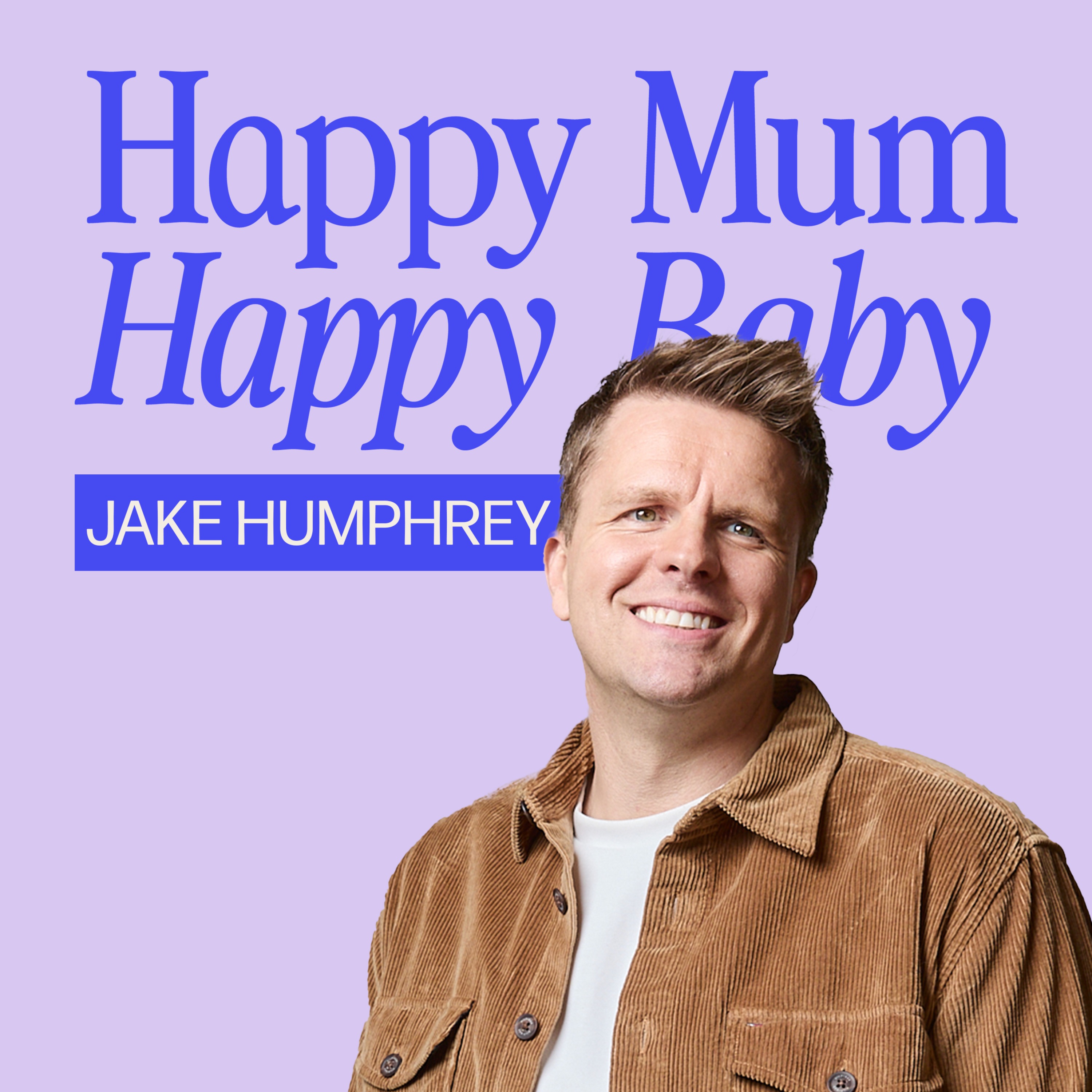
Jake Humphrey (Happy Mom, Happy Baby) discusses how his “horrible” school bullying shaped his parenting philosophy, plus his career pressures and early parenthood experiences with wife Harriet and their children Flo and Sebastian.
Jake Humphrey is a TV presenter and host of the High Performance Podcast with Damien. He grew up in Norfolk, was bullied from ages 7–9 and again around 11–12, and later became a BBC F1 presenter. He and Harriet have two kids: Flo (born March 2013) and Sebastian (born August 2015).
Happiness isn’t in achieving big dreams; it’s found in everyday “mundane” moments. Parents should be kids’ biggest cheerleaders, not constant advisers. Bullying can build resilience and emotional regulation, and emotionally intelligent kids may be targeted for standing out.
A traumatic swimming-pool incident where other boys stole his towel and exposed him naked; hiding in a dark space between parked school buses for lunch. Career example: after Harriet saw online claims he’d “be shit” hosting F1, Jake felt the same loneliness as school. Parenthood examples: fertility struggles, Flo conceived during a night he flew home from Euro 2012, and Harriet’s intense induced birth; later Sebastian born via water birth with no drugs.
Written by AI. May contain mistakes.
Explore the importance of pursuing personal dreams while finding joy in everyday life.
“I'm not saying you shouldn't chase the dreams that you have, but don't think that getting those dreams is going to make you happy.”
Learn how moving to Norwich helped Jake redefine his priorities and find happiness in family.
“Like, all of that, if you can make all of that feel like a pleasure, I think you win.”
Understand the importance of being a supportive parent without overwhelming children with pressure.
“Also, just being able to stand there and enjoy it and take pride in what your son's doing rather than feel the pressure of having to host.”
Discuss how childhood bullying affects resilience and emotional growth.
“I've listened to the high performance with your mum and I love her.”
Examine the emotional scars left by bullying and the importance of resilience.
“And how old are you when you were getting bullied?”
Guests discuss the impact of childhood bullying on their current lives.
“about time you see what the bullies you know you look at the picture of the bullies and you kind And I go, that little child did that.”
Exploring how being bullied can highlight unique strengths in individuals.
“It's the ability to have freedom of thought and to chase the stuff that you really want to chase.”
Jake shares a painful school experience of being bullied and exposed.
“And then because you're trying hard, you're not yourself.”
The transition from children's television to F1 presenting and the pressures faced.
“And the same as Tom would have in the band, the in-ears that we wear are ear defenders with your own voice coming back at you and the voice of your pundits or your experts and then the voice of the production team.”
Reflecting on loneliness and how childhood experiences shape adult resilience.
“And I think sometimes in life, It's so easy to look at what happened to us through a negative lens or all of the stuff it took away from us or it denied us or the pain that it caused us.”
Discussing the influence of parents and shifting perspectives on upbringing.
“And I remember seeing her exactly like you.”
The conversations shift towards desires for larger families and legacy.
“So I definitely always wanted to, there was never any doubt about whether we wanted kids or not.”
Exploration of the bond between grandparents and grandchildren.
“You don't think about the whole grandchildren thing.”
Discussion on the emotional weight of aging parents and their legacy.
“And so I think that, I think she drove that hard.”
Conversation about societal pressures of being busy and its implications.
“when how are you, oh yeah, I'm really busy at the moment.”
Jake shares his experience with pregnancy and the emotions involved.
“And I said to Harry, I'm going to the hospital.”
Insights into the birth experience and the feelings of new parents.
“And so Harriet just turned into Wonder Woman and just had this, like, look on her face.”
Discover how shared experiences strengthen partnerships in parenting.
“you feel like you've just been on this like most unbelievable journey.”
Learn about Jake's excitement and apprehensions about having a second child.
“Do you think you realised that at the time or did you ever try and go in and say, what about this?”
Understand the contrasting experiences of childbirth with Jake's second child.
“No, because I think, like, there are very, very few moments in life that you don't know what the outcome is going to be.”
Explore how Jake's childhood influences his parenting style.
“I can't relate to them because like you just I just know that she took herself to places I would not be able to get to.”
Discuss the importance of safe spaces and open communication for children.
“Florence wants to talk incessantly at half past 10 about everything that's happened to her that day.”
Learn about efforts to integrate important life lessons into school curricula.
Learn about the significance of soft skills and mental resilience for young people.
“Where anything you need to know AI can tell you any minute.”
Discover how personal hardships can build resilience and inform parenting.
“So who are you underneath all of that knowledge as a person?”
Explore the challenges of balancing parental wisdom with being present for children.
“Do you feel like your kids listen to you in all your wisdom?”
Hear a heartfelt message about the legacy of fatherhood and love for children.
“But hey, I'm a flawed individual, right?”
Understand the value of family moments and connecting through shared activities.
“and actually a bit like you felt a reminder like I was so young and it was an unfair thing to happen.”

Get the gist, explore an idea or ask about something said.
 Claude
On Happy Mum, what are the key points of this episode?
Searching your listeningAutomatic transcript. May contain errors.
0:00Hey y 'all, it's Kelly Clarkson with Wayfair, where delivery and setup are as easy as a few taps on your phone. Picture this. You're relaxing in an old hammock, scrolling Wayfair's app when you spot it. A brand new patio set. Next thing you know, Wayfair delivers it right to your patio and sets it up. Oh, you need a new grill too? Alright, Wayfair's got you covered. With Wayfair's room of choice delivery and fast expert setup on qualifying orders, life gets a little easier. Visit Wayfair.com or the Wayfair app. Way fair, every style, every home. Are you noticing your car insurance rate creep up even without tickets or claims?
0:34You're not alone. That's why there's Jerry, your proactive insurance assistant. Jerry handles the legwork by comparing quotes side by side from over 50 top insurers so you can confidently hit by. No spam calls, no hidden fees. Jerry even tracks rates and alerts you when it's best to shop. Drivers who save with Jerry could save over$1 ,300 a year. Don't settle for higher rates. Download the Jerry app or visit jerry.ai slash ACAST today. We live in a culture obsessed with dieting, weight loss, and exercise. And that can make eating disorder behaviors easy to miss. But the reality is, eating disorders are serious mental illnesses that take a major toll on your health and your life.
1:17But recovery is possible. Eating disorders are more common than you might think. Chances are you know someone who is struggling with one. Or maybe you're struggling yourself. If you're concerned about an eating disorder in yourself or a loved one, I want to introduce you to Equip. Equip is a fully virtual, evidence-based eating disorder treatment program that helps patients achieve lasting recovery at home. Every Equip patient is matched with a multidisciplinary care team that includes a therapist, dietician, medical provider, and mentors. And you get a personalized treatment plan that's tailored to your unique goals and challenges.
1:52Equip treats patients of all ages and all eating disorder diagnoses. It's covered by insurance and there's no wait list. If you think that you or a loved one could be struggling with an eating disorder, don't wait to get help. Visit equip.health to learn more. That's equip.health.
2:16Hello and welcome to a brand new episode of Happy Mom, Happy Baby, the podcast. Today's guest is Jake Humphrey. Now, Jake, he's been someone that I have known for a while. We've got lots of friends in common. We've bumped into each other in different places. But the thing that I think he is most known for now is the High Performance Podcast. And I absolutely love it. It's him and Damien. And they have chats to different people who, at the height of their career and a height of success, and they talk to them about their career and what drives them and what success looks like to them and what high performance looks like to them.
2:52I think it'd be really easy to think about that podcast looking a certain way, but I actually encourage you to listen to it because I've listened to it a lot over the years. And it actually gives you a really interesting insight that is maybe not what you think it will be. As I said, he's absolutely incredible. He's got two children, Flo and Sebastian. His wife, Harriet, sounds like an absolute delight. I have met her. She is a delight. And he's someone who obviously, with high performance, talks a lot about growth, about how we learn from different experiences. And I found it really interesting, actually, to hear what he had to say about how his kids react to all of his wisdom.
3:33Because I know if it was me with the wisdom, you'd go one ear and out the other. But here it is, my chat with Jake Humphrey.
3:43I'm not saying you shouldn't chase the dreams that you have, but don't think that getting those dreams is going to make you happy. And also realising that you've got to check that those dreams that you're chasing are your dreams, not a dream that someone else has that makes you go, oh, I should be doing that. Yeah, or a dream that society tells you you should chase after, which I think is what happens a lot of the time. But, you know, I think a lot of the people we speak to do chase the dream that they want. But it's their natural human make-up, which is the reason why they're on our show in the first place, right?
4:14Because when they win a European Championship, if it's not enough they want a world cup when they have a business worth a few million it's not enough they want to be a billionaire when they um act in a film they actually want to win an oscar yeah so by the time they come and sit in front of us they've achieved all of those incredible things so what is the answer the answer is not to not achieve stuff or not to not be ambitious or not to not want things the answer is to realize that when you don't achieve those things you should still be happy yeah and that in the kind of everyday drudgery of life you know literally the mundane stuff which makes up 90 % of life, that's where we have to look for happiness.
4:50Because we find it in that stuff, in getting the kids ready for school, in waking up a few minutes late, in cooking dinner, in feeling a bit frazzled because you've got to drive your kids to 100 different clubs on a Saturday or a Sunday. Like, all of that, if you can make all of that feel like a pleasure, I think you win. Because then whatever the outcome is, you've done okay. Has moving out of London helped you land on that a little bit more? Yes, I think what moving out of London did was kind of... I don't think that when I moved to London and got a job in TV, as you know, my background was kids' TV, a lot of our mutual friends I would have worked with, and then Formula One, and then it was towards the end of my time on Formula One, I then left and worked in football, and that's when we started to make the move out of London.
5:39I was fortunate that I don't think I ever... I was never what I would call like an A-list TV presenter. Right. You know, so let's think of someone that I work with, like Holly Willoughby. Yeah. Who I did Fame Academy with on CBBC. And, you know, like she absolutely got to the point where if she left the house, the Daily Mail would take her photo. That sort of stuff was happening to her. And that never really happened to me, which I remember my early agent, a guy called Anthony, saying to me once, he said, in life be a bronze medal winner. Because the bronze medal winner is always the happiest.
6:11if you're the silver medal winner you think I could have got gold if you're the gold medal winner everyone's chasing you down and you feel like you've got too much to lose if you're the bronze medal winner you're kind of happy to have a medal around your neck and I feel like that's kind of my I was never the main presenter at CBBC there was always much more famous people on the Formula One coverage than me I was a football presenter but not on like BBC One or ITV it was on you know a digital channel so I kind of feel like I'd never like lost myself in television because I wasn't famous enough to lose myself.
6:42And, you know, you hang around with far more famous people than me and you probably know the challenges that has for them. I'd love to know what kind of life you think I lead. Well, come on now, let's tell the truth. After nine years, it's time to reveal the truth. You live in a palatial marble line. This is true. Mansion in North London, just hanging out with actors. and so I moving to Norwich wasn't like I found myself again because I don't think I ever lost myself but it was certainly a reminder of the stuff that really matters which is hanging out with family, my mum and dad are local my brother and sister are local, all of their cousins are around and I think the best thing for me actually was when my boy Sebastian started playing football on a Saturday morning and now a Sunday morning, I pretty quickly realised I was happier standing on the side of a football pitch watching under nines football than hosting a Champions League final.
7:37And you know what? I remember thinking, there's a lot I've got wrong in my life, but I think I've got that bit right. This is more important than a Champions League final to me. I think my, you know, hopefully that means my priorities are kind of in balance. Absolutely. Also, just being able to stand there and enjoy it and take pride in what your son's doing rather than feel the pressure of having to host. Yeah, absolutely. It's freedom, right? And you still feel under a different sort of pressure because you think, you know, whenever your kids do stuff, you just do not know, do you? And I know that, you know, you've got ambitious kids and they're acting and all these amazing things.
8:13Like, how do you get that right as a parent? Do you encourage them only or do you try and give them constant advice? Do you pick up where they got things wrong? And I've sort of come to the conclusion the only thing to be is their biggest cheerleader. Yeah. Let other people coach them, manage them, encourage, like do all the hard stuff. You just be their biggest cheerleader. I think that's enough, actually. Absolutely. Well, while we're talking about our kids and the ages that there are, you have written a book. Indeed. With Damien called Game Plan. Yeah. Talk to me about it because this is also the book that you have said that you wish you had it as a kid.
8:48Yeah, for sure. So growing up, I absolutely believed that there was successful people and then there was people like me. So I had a really loving upbringing. I can't fault the amount of love my parents gave us. I've listened to the high performance with your mum and I love her. Oh, that's kind of you. It's such a gorgeous episode. I just loved hearing that different perspective. Yes. And you know, it's interesting for me because obviously we have, as you do, like globally famous, iconic people as our guests. And then when people stop me in the street and go, I loved that episode with your mum, I think, oh, man.
9:21Whereas when you're booking it, you're like, are people going to like listening to my mum talk about stuff? Because you know what it's like on podcasts. These days you've got people going, yeah, well, we're not sure that'll pop on YouTube. what should the title be what about the algorithm like actually the nice thing was that's how we now talk right about podcasting we recorded with my mum three or four years ago and it felt different then it was a bit more freedom you just did the shit that you liked you just spoke to people that were interesting and I'm so pleased that we got my mum on the show and she's amazing she was a teacher my dad was a charity worker grew up in a little village in Norfolk absolutely loved it but there was a number of pretty big struggles for me as a kid, which we can talk about if you want, but it was crap for quite a long time.
10:11You were really badly bullied, and the thing that got me on that podcast actually is when you talk about the loneliness that came with that, also knowing that, because I was bullied as a kid, going to your parents and saying that that's going on and actually the way that that will, knowing that you're going to break them by saying how broken that you are. Mate, can you see how emotional you get? I know, I know, yeah. How old are you? I'm 41. 41, right, and I'm 48. And how old are you when you were getting bullied? Nine. Okay. Between seven and nine. Man, that's young. That is brutal. I was a bit older, but not much older.
10:46I was like first and second year of high school, so like 11 and 12. I remember exactly the emotion you just mentioned. I remember sitting on the, and it gets me like, isn't it strange? you know because it's for me it's like almost 40 years ago and I think people don't people think when you stop getting bullied you stop living with the feeling yeah when you drop your kids off at school do you still remember the feeling of going absolutely absolutely isn't it the worst and also when they first started you know that kind of feeling of what is your school life going to be not what are you going to be like in the lessons what you're going to be like in more like what are other children going to be like with you how have you got us crying after five minutes we're not even talking about our kids talking about us as kids we are so self absorbed guys we're crying about our own experiences so my wife loved school and so when we dropped the kids off she has this overriding sense of optimism and joy because that was her feeling I have that like remember that moment where you either see your parents car drive off or you see them walk around the corner and that like emptiness and then you take a breath and go right here well here we go and you walk in and now when you see photos of the 11 and 12 year olds that were bullying me or the seven eight nine year olds that were bullying you you think well I actually let that you can't believe how little they are because the time it feels like the whole world is like is on you right um but one thing that I feel that I live with now is this understanding that just because it was hard for us I honestly don't think it was bad for us no because I think that as you get older the most important sort of muscle in your body is your muscle of resilience right it's the one thing that keeps you going as life is tough and challenges come your way and I think and I don't want any child in the world to be bullied but I do want young people to get you know a sense of failure at times and to not always win and to realize that sometimes life can be tough and that it shouldn't come through bullying absolutely it should come through trying your best and sometimes not not winning right that's fine but I certainly think my resilient muscle which I've used a lot was built in that time I don't know whether you you can relate to that absolutely absolutely what did those school days look like for you they were just like they were just horrible so my mum and dad would drop me off and this was in the time before I'd sort of told them what was happening so the isolation was insane so I had a younger brother and an older sister I think my older sister might have known because she was at the school with me but she's 13, 14, she's living her own life her life can't be looking after her little brother who's got some challenges and I think the other thing about bullying is it's so easily discarded as nothing by people who go we're only having a laugh yeah we're only having a bit of fun we didn't mean it it wasn't really bullying like the only way to know if it's bullying is to ask the person on the receiving end how they feel yeah and then you will know and it's it's amazing how as an adult someone can say something and it can just cut you open imagine doing that to a seven or eight year old or 11 or 12 year old it's really interesting that you said about you know if you look at a picture of about time you see what the bullies you know you look at the picture of the bullies and you kind And I go, that little child did that.
14:08I found it really triggering a few years ago. I was doing an anti-bullying campaign. And it was just before Buzz started school. So obviously it's kind of you have that fear. And I took in a picture of myself when I was that age. And actually seeing how young I was. And you would have this, right? Rather than looking at a picture of them, looking at a picture of you and kind of going, that little human had to take on so much. Yeah, but look how strong you are. like you did that Steve Backshaw was also bullied by the way you know I said earlier about the about the similarities bullied and also just really struggled at school so interesting isn't it because I think that like if there's one thing that I look for in people now and if you were to say to me what's the one thing that you think can discern how great your life is going to be right is the ability to be an individual It's the ability to stand out.
15:04It's the ability to have freedom of thought and to chase the stuff that you really want to chase. Those are all the things you get bullied for as a kid. So actually, you were bullied because you had some amazing skills that you now use every single day to be a mum, to be a podcaster, to be a wife, to be a friend. All of that stuff was separating you when you were seven or eight years old. also I used to my way of coping with it was to go off around the field and I'd sing to myself I'd act out little stories those are all skills that I use now yeah yeah you know so I remember saying that to someone once and then saying I'm not really surprised you were bullied if you're walking around the field and talking to yourself um but also that that coping mechanism and knowing how to regulate and to make yourself feel um it's interesting you say that because so my one of my things was that in the um I mean the the the worst moment for me was when we my school had its own swimming pool and we were getting changed after swimming one day and I'd taken off my swimming trunks and as I took off my swimming trunks the kids or the other boys stole my towel so I was like totally exposed but then pushed me like a group of them pushed me out of the changing room into the car park which was surrounded by other classrooms right so I'm 11 years old probably 11 or 12 standing totally naked in the playground right of the school with kids at the windows like pointing and obviously as you would laughing like look at that kid he's naked in the car what's so hard about that is that that took it from just a few kids in my class to this sense of a it's everyone and i'm sure you relate to this like why me yeah like what is so wrong with me like what why am i either annoying why am i the one that makes them want to laugh like i And then you try harder to not be that person.
16:59And then because you're trying hard, you're not yourself. And then it makes it worse. And then the sense of isolation gets bigger and bigger. So what I used to do was in the playground, there was these two, like the two school buses were parked. And in between them, there was like probably the width of this table. That was the perfect dark space just to go in and put my school bag down and sit on my school bag for lunchtime and just eat my food and just be. it's pretty um it's a pretty desperate image isn't it of a 11 year old kid doing that can really see it but you know like only when you said like the things that you did to cope then have been useful in adulthood if i roll forwards to like 2009 i was on obviously kids tv and i got offered the job as the bbc's f1 presenter and when they offered me that that was like the most unbelievable opportunity you know to move on from being a kids tv presenter yeah and my boss at the time they gave me a one-year contract and my boss said to me he said look just so you know um the audience are going to make up their minds about you instantly and if the decision that they come to isn't a good one for you there's not going to be a second year of you hosting formula one so that was the like the the kind of the the contract if you like yeah that i had with them in my head like those were the rules of engagement this can't go wrong and I remember just after they announced that a kid's tv presenter was going to get the formula one presenting job it was on a it was on a Thursday and my they announced it at 10am and at half 10 Harriet called me she was crying I said are you okay and she said I've just been on the internet everyone thinks you're gonna be shit yeah exactly thank you wow Harriet I know say it like it is my love so there was the time there was a thing called like the 606 message board it was like a forum for people to say whatever they wanted about anyone with like seemingly no caveats or no one to actually monitor what was being said and they were basically saying that this guy on Kids Telly should already be fired from hosting F1 before he'd even done his first show so I said to her where did you read it and she's like on the BBC Sport website and I thought man this has not started well my attempt at getting year two out of this job has not started well and then the very first race like you go out um to this first race in australia and i remember standing in the pit lane and for anyone listening to this has never sort of um thought about what what it's like as a tv presenter the what we call the tv compound which is where the producers and everyone is is a probably about a kilometer away from the f1 pit lane where you are and you're only connected to them by the that little radio pack on your back and your in-ears.
19:53And the same as Tom would have in the band, the in-ears that we wear are ear defenders with your own voice coming back at you and the voice of your pundits or your experts and then the voice of the production team. And the reason for that is you wouldn't normally have that in TV but the cars are so loud and you're right next to them. You basically go deaf if you haven't got solid ear defenders. And I remember standing in the pit lane and the PA who sort of counts you on air and off air saying, okay, going on air on BBC One in 60 seconds, right? And bearing in mind that I'd been told it was a one-year deal and the audience would make up their minds quickly, remembering that Harry had called me in tears saying that everyone thought I was going to be shit.
20:34And now this feeling of, like, here I go, and you know the feeling I got? Exactly the same feeling that I had sitting between those two coaches at school as an 11 year old I felt totally on my own totally because there's no one there there's no safety net there's no backup my mum and dad can't come and help me out no one else can tell me what to say there's no auto cue it's not delayed it's live to the entire nation at that moment that everyone will obviously as human beings do decide probably in 20 seconds if I'm the right guy for that job. And actually in that moment, I was, and I didn't have this sense now, but now I have this sense, like a sense of gratitude for the fact that my ability to cope with that sense of loneliness was forged in those experiences at school.
21:22So that actually like 25, 30 years later, the biggest challenge of my entire professional life, I was able to cope with that sense of loneliness because of what had happened in those years before. And I think sometimes in life, It's so easy to look at what happened to us through a negative lens or all of the stuff it took away from us or it denied us or the pain that it caused us. But I think it's so valuable to also look at what has it actually done for you. Absolutely. And I'd certainly feel that it did a lot for me. I don't know whether you feel that actually it did something for you. I completely and utterly agree.
21:56Completely agree. I wouldn't be the person I am today if it wasn't for that situation. Yeah. If I didn't feel like the outside of something. and it's made me look a lot at my sort of people-pleasing and my need to be nice. But actually I think it makes me connect with people in a much better way. Yeah. Yeah, I just, yeah, I wouldn't. It's interesting how it still hits us, but we're thankful that it, not thankful, but if it hadn't have happened, we wouldn't be the people that we are. You know, there is a lot of research into the fact that the people who get bullied at school tend to be the ones who are more emotionally connected to their own feelings those those that can at a young age display empathy and one of my teachers said to my parents like when they went in to try and work out what was going on he said look like jake is jacob as they call me jacob is emotionally intelligent and that's not necessarily the case for all boys aged 11 or 12 so therefore like he's a little bit he's a little bit separated yeah from them but i'm so like i'm so grateful that I was emotionally intelligent because I see the value now.
23:02But I think you were the same. Because actually, if I think about the most painful moment, same as you, my most painful moment was sitting on the stairs and the kitchen was just below there so I could sit. And it was like, you know, the stairs goes down and the landing goes across. There's like a tiny crack of light. And I can see my mum at the oven cooking. And I finally decided I just have to tell them. And I remember seeing her exactly like you. I just thought, God, this is going to hurt. like when I tell my mum what is actually happening. And it's a mix of shame and embarrassment and this kind of sense of failure because you haven't managed to solve it yourself.
23:38But above all of those, the fact that you're going to then break someone else's heart was definitely an emotion that I can relate to you having. Did you feel relieved once it was finally out? Yeah, I did. It didn't really, like it didn't help in terms of the bullying. You know, my mum and dad, my mum tried to do what she thought was best, understandable and went to the school and spoke to them but then one of the teachers at the school made me stand up in front of everyone God I remember you saying this and then said Jacob's being bullied, this needs to stop that's like totally the wrong thing to do and then eventually I moved schools because that was the decision was taken to move schools and that really made a difference and really helped and I think my parents probably remember the pain more than I do because I think when you're, it's amazing what you don't remember at that age, particularly the hard stuff.
24:28Like, you know, when you have kids, it's bloody hard. And all you remember now is the good stuff. And you long for another baby because you just think it's totally amazing. And like, you forget it's fucking hard. It's hard. Yeah. I think I'm grateful that I don't remember a lot of the hard stuff. But they probably do. I love the fact that your mum says that when you were younger, she didn't make you feel like you had to be the best. You had to be your best. Yeah, yeah, yeah. I love that. It's such a gorgeous, gorgeous outlook. And I think for too long, and I will readily admit I was totally wrong about this.
25:02You know there's like this modern trend of blaming our parents for stuff. You've seen this everywhere. It's, oh, I've got trauma from my apartment. Like, you know, obviously there are some bad parents out there. But 99 % of parents were doing their best and were doing it for the first time. Yeah. And were young and didn't really know what they were doing. And I think were too critical too often of the things our parents did. And I definitely fell into that trap a few years ago where I kind of, I was, I longed for my parents to be more ambitious for me. Like I wanted them to be saying to me, what about an MBA at Harvard, Jake?
25:35Could you move to America to go to university? You know, they were, they were not like that. They were, they had a, they instilled an amazing work ethic in me. But they, they would just allow me to be me. And if that meant, you know, they wouldn't want me to be lazy or useless. but it was not like a household where we're driven all the time there was no comparison culture there was no look at what other kids are doing there was no sense that we were letting our parents down yeah I was in no clubs I was in no groups I was in no no sports team I did was I was so like the gray man at school I just slid through very average exam results obviously also some awful exam results but I'm but it was never like forced upon us that this is an unacceptable way to be i think they allowed us to be ourselves my sister worked harder than me my brother is way brighter than me yeah so they were kind of all right this this way of operating kind of ended up with me just getting through my gcse and failing all three of my a levels um but i now realize how powerful it was that my parents just allowed me to be myself rather than push push push there is so much pressure i think especially nowadays on kids there's pressure coming from everywhere plays left the building you know it's all about you're seven years old what's your kid's thing what the fuck why does my kid need a thing it's bad enough when you're nine you have to choose your options but then i feel like i should my kids should have a thing oh no they better be good at something all right it's unbelievable yes the pressure is unbelievable did you always know that you wanted a family um yes i did yes i did um like we were a really tight and close family Yeah.
27:13So I definitely always wanted to, there was never any doubt about whether we wanted kids or not. I think the only thing that Harriet and I now think is I wish we'd had more, like I now wish I had four or five kids. Oh, really? Yeah. We've got two amazing children and we have one of each and they're beautiful and amazing. And so in some ways you can look at that and go, well, there you go. Like what I've literally just said to be unhappy is to want what you haven't got. Right. But I do sometimes, I love the idea of being an old man with five or six kids piling all over me, but it wasn't to be. Yeah.
27:47And also, you two have had two kids. Their family will grow. You'll have loads of grandkids. I think, well, I'm going to encourage my children to have lots of children at a very young age. That's how I'm going to parent. That's the spirit. That's how I'm going to parent. Come on, guys. Give me some grandkids and do it now. But it's funny. You don't think about the whole grandchildren thing. And then as you get older and start to have kids and you start talking to your parents, There are people of similar age to your mum and dad who aren't yet grandparents. Yeah. And you can see they're like, they're almost mourning for the grandkids they haven't got.
28:18My mum and dad are incredible. My mum and dad love their grandkids like their own children. Don't they have all the kids once a week? Yeah, well, they did. On a Tuesday, for years and years and years, my mum and dad would go off their separate ways and collect all eight of their grandchildren from different schools around Norwich, take them back to their house and feed them all. And it's turned our kids from cousins into brothers and sisters. They are so tight. And now Joseph, the eldest, has gone to university. Tilly, the second oldest, is doing her GCSEs. Like, people are busy. And my mum and dad are now also almost 80.
28:50So they don't do that now. But that period was at, like, a really, like, key time for our kids. And that is my, I think, anyway, that's my mum and dad's legacy. My mum was an only child, right? And so I think that, I think she drove that hard. I think she wanted those kids to really have that relationship. And you know what's interesting? Like, you know, when you're young and if someone dies in their 70s or maybe even their 60s when you're a kid, you think, oh, that's okay. You know, as you get old, like the older, old becomes. So now that you and I are in our 40s, like 70 does not seem very old.
29:26It's 30 years away. 90 doesn't even seem that old because we're halfway there. I get this sort of sense that as you get older it never becomes like not heartbreaking to not be around and I sometimes think of my parents everyone's parents have they have to come to terms with the fact they love these grandchildren like their own children but they're very unlikely to be at their wedding or see their children and I think if that was you or I knowing that we pretty much wouldn't see Buddy or Flo get married and have kids I mean that would dominate our thoughts we'd be heartbroken I think it's a really hard emotion for the generation above that you probably will not be at the wedding of the kids that you now love more than any in the world and I think we discard that a little bit and we shouldn't really, we should talk to our parents or our kids' grandparents about the fact they won't be, probably won't be there for those moments and how they feel about that because I do get that sense, my mum particularly I think she's trying to pack it in every minute of every day with her grandkids Really?
30:27It's lovely that you all now live close. Yeah, yeah, yeah, it's amazing. We're literally five minutes from each other, yeah. But sometimes that breeds like a sense that you don't make the effort to see each other as much as you should with my brother and sister. You know, I still want to see them more often, but as I say, we're in this midlife squeeze where we're all hyper-busy. Trying to get everything in. Yeah, but it's bollocks though, isn't it? That like the answer that most of us give, when how are you, oh yeah, I'm really busy at the moment. Almost like that is a badge of honour. Yeah. I'd love us to move away from this sense that if we're not busy, we're not valuable.
30:59Yeah. I hate when the whole work's been up to you lately because suddenly I'm like, ah, ah, what do I say? Relentlessly working. You know, I've just bought into this lie that if I just work really hard until I'm 60, then I will finally be given some freedom at the end, just as my body's incapable of enjoying the freedom that I've told myself I'm going to be able to have by the time I get there. And that is hard, man. We have to work to live, but you've got to find the life among the workers. Absolutely.
31:54do yourself a favor, download the Jerry app or head to jerry.ai slash a cast. We live in a culture obsessed with dieting, weight loss, and exercise, and that can make eating disorder behaviors easy to miss. But the reality is eating disorders are serious mental illnesses that take a major toll on your health and your life. But recovery is possible. Eating disorders are more common than you might think. Chances are you know someone who is struggling with one, or maybe you're struggling yourself. If you're concerned about an eating disorder in yourself or a loved one, I want to introduce you to Equip.
32:29Equip is a fully virtual, evidence-based eating disorder treatment program that helps patients achieve lasting recovery at home. Every Equip patient is matched with a multidisciplinary care team that includes a therapist, dietician, medical provider, and mentors. And you get a personalized treatment plan that's tailored to your unique goals and challenges equip treats patients of all ages and all eating disorder diagnoses it's covered by insurance and there's no wait list if you think that you or a loved one could be struggling with an eating disorder don't wait to get help visit equip.health to learn more that's equip.health
33:09how did it feel when harriet found out she was pregnant the first time so we've been oh my god we've been trying for ages really yeah well I say ages a year yeah and she would kill me for saying this but I do like we were naive right to what what was required and I think you didn't know what to do we knew what to do okay I was exceptional at that part okay just checking I think and I Harriet will correct me if I'm wrong I think we had we bought a machine to tell us when to when Harriet would be able to have a baby right but I think we bought a machine that told us when to have sex to not have a baby
33:45honestly and we'd been using this thing so harrett would be like let's go and it was only after months she went hold on i think this is actually the problem and obviously we did what a lot of people do went to the doctor so we've been trying for a year we were only in our early 30s or whatever and i remember once they said oh you need to bring a semen sample to the hospital You need to keep it warm. I remember this moment so clearly. So I did what you need to do. And I said to Harry, I'm going to the hospital. And I'm like, what do I do with this? So I put it between my legs to keep it warm all the way there.
34:18Drove to Kingston Hospital, right? Ran in at the speed of light, keeping this thing wrapped in my hands. Said, I've got a sample. She said, OK, yeah. And she literally took it off me, turned around, put it on a shelf. Like that. And then carried on working. And I stood there going, sorry. sorry, that is my semen and it needs to be kept warm. Like I was so protective, I needed the answer to what was going to happen. So it was a bit of a, it was a long-winded first pregnancy, or first attempt at getting pregnant. And then Harriet said to me, I then said to her, listen, I've just found out I'm going to be one of the hosts on location at Euro 2012.
34:58And she kind of was happy for me in a moment because it was a good opportunity work-wise, but then started to cry. I was like, what? She said, I've just looked at the dates. It's another six weeks you're going to be away. It's another six weeks when we might not be able to get pregnant. So I said to her, tell you what, I'll do a deal. She will definitely kill me for this. So I'll do a deal. You tell me the period in that time when I'm away that you are going to be fertile and I will fly home. And I thought if I just say this, it will just appease everything. It won't actually need to happen. And also, she could have flown over.
35:33Yeah, she could. I think she did as well, actually. I think she came out as well, but that was the wrong period. Wrong time. Yeah, the wrong time. But I said to her, I'm happy to, you know, I could find some flexibility. Harriet at the time was working on Big Brother or Strictly Come Dancing or something, and so she couldn't just leave and just come out to Poland and Ukraine where we were. And so I remember she gave me the date, and I was, like, travelling around Ukraine and Poland, all these different places, and then there was a certain date that I had to fly home, would you believe, for 12 hours to then fly back.
36:04to carry on hosting at the Euros. You know what? What? That was when Florence was conceived. No way! Yeah. Flying home from the Euros for one night, that was the night. Oh, my gosh. Yeah, isn't that mad? When did you find out? Were you back by the time that Tess had come back positive? Yeah. So I remember, despite the fact that, like, even if you've wanted it and waited for it, fucking scary, isn't it? Yeah. It is, like, scary. scary because you just have to be a grown-up all of a sudden so i remember harriet doing the pregnancy test and not daring to look and i and i remember standing in our bedroom in richmond at the time and looking at it and it you know you think your eyes are tricking you but it did say pregnant so i said do you want to see and she's like yeah okay and i still think i've got the video somewhere on my phone and my wife you've met her like she doesn't swear much i showed it to it and she just went fuck fuck fuck fuck fuck and she just walked around like in circles blind panic like serious blind panic and that was the beginning of the of the parenthood journey that's amazing even if it's something that you've wanted there is that instant fear yeah of course I don't know how many of your audience listen to this having never had a baby actually quite a few you know the feeling when they let you leave the hospital hospital you can't you you were sort of like no you don't understand we can't leave the hospital because someone needs to tell us what to do to keep this baby alive now don't let me leave with the baby like you like you don't know anything do you you gotta go home and you're honestly like well what now yeah what happens now how do we keep this baby alive well how did you even feel about the birth um the birth the birth was for florence the birth was was pretty was it traumatic it felt traumatic for me because you feel so out of control yeah you know um there was we had a consultant who was looking at harriet and he wasn't very happy about something like maybe the like slow growth or something so they decided to induce harriet for for florence and that's a that was kind of like a more brutal process than we were anticipating so it's a it's a definite challenge as a as a dad or as a husband or as a partner because like there is a real lack of there is a real lack of control and you kind of have to let people do what they're doing and I'm a bit of a catastrophizer anyway so I'm kind of like the worst case scenario but it's funny isn't it how your body sort of protects you because it was taking a while and eventually the consultant sort of said to Harriet, listen, you need to squeeze this baby out now or we'll have to take you to surgery for an emergency cesarean, okay?
38:48Because the baby's not that happy. And so Harriet just turned into Wonder Woman and just had this, like, look on her face. Like, Florence was born. Perfect. And then afterwards I said to Harriet, man, what about when the consultant said to you, like, this was the moment, if it didn't happen now, like, there was going to have to be surgery. And Harriet went, he said what? And I was like, you don't remember? She had no recollection. I think it's probably a protective mechanism in the brain. It just... That's what I find fascinating, though, because as a woman in that moment, like, the world is a very weird place in that room.
39:25Like, time for me just, I didn't know, time didn't exist. You know, people would come and go. I remember faces, but not... And it's not because you're out of it, because between contractions, you're not feeling anything. Yeah. So it's a really weird kind of... But whereas for the partner who's in the room, they're obviously seeing everything in a very different way and are able to really... You're kind of like, I think you're just hypersensitive to everything. Yeah. Almost like your eyes are on stalks and you're like on alert mode. What did you feel like was your role? Not to get in the way, probably.
40:03Like just not to fuck anything up and just let the medical people do what they needed to do and just be there for Harriet, I guess. Yeah. I remember when Florence was born, she was just a little bit floppy and I remember they took her over to this little area where they were kind of patting her to try and get her to breathe and whatever. And I obviously, at that point, I think fatherly instincts took over and I went over and gave Florence a really quite vigorous little shake and immediately she started to cry. So I love to tell her that you were like, you weren't that happy until dad came over and just did what was right.
40:37and then I had this grand I said to Harriet I'm going to have a six pack by the time Florence is born do you remember the Athena poster when we were kids? Yes with the guy with the most unbelievable body he looked like he's all perfect and he's holding a baby on his arm and it's just fucking amazing I said that's going to be me How'd that go? Well I look more like the guy from the Mr Muscle adverts with very skinny arms and a slight pot belly and no six pack Did you still do the photo? Well I picked Florence up to do the photo and she pooed all over me. So my attempt at the Athena poster was a guy that does not look like he should have his photo taken with his top off, covered in is it Macomium?
41:16Covered in Macomium, with a crying baby that didn't want to be picked up and we do have the photo but it's not going to make a poster and be sold in the shops. Probably the 18th birthday That's when it will come out That's the time to bring it out Good memories man, and then I remember Harriet ringing me, because they stayed overnight and they said I could stay in the hospital and then Harriet ringing me at maybe like 2am going, you need to come upstairs, she won't stop crying and you sort of, you go upstairs and you're trying to do all the right things you're totally right, it's quite a trippy sort of period isn't it, where you feel like in the days afterwards when you go home and the sunlight comes through, if I was born in March the spring sunlight coming through the window you feel like you've just been on this like most unbelievable journey.
42:06But as a couple, it just brings you tightly together, doesn't it? Like once you've been through that as a partnership, I think you've got something for life, yeah. Well, so it feels like the world has changed in that moment. Then you step outside and everyone's, it feels alien and it feels really threatening and it feels like everything's a risk. But everyone's just going about their normal lives. We just used to look at Florence, particularly when we were barfing her, and just cry. Really? Yeah, we just cried. like for the whole time she was in the bath. We just loved her so much. And then a few days later, we took her on our first trip to the local bakery, wrapped, you know, like wrapped up.
42:42Yeah, yeah, yeah. That baby was not getting cold. When did you first have to go off to work? I was working throughout that time, actually. I was doing a show for Channel 4 called, it was a programme about sleep. It was a sleep programme. Ironically. Ironically, it was like the sleep experts. dealing in real time with people whose babies wouldn't sleep. And then the sleep experts would, live on the Channel 4 show, what the hell was that called? It was really cool, actually. It was a live Channel 4 event that lasted a few weeks. And then we followed certain families over the time to see whether they managed to get their babies to sleep.
43:19And it was me as a host with a psychologist, Tanya. I must remember these names in this show. I'm getting a bit old. I'm a forgetful man but that show was going on at that time so I then would go to work and do that Would you come home and go look I've heard this today, maybe we should try this and was Harriet kind of like bugger off Six months after Yeah We employed the services of one of the sleep experts on the show Florence was not asleep but I think you do as the husband you have to be so careful at going to work coming back and thinking you've got the answers Yeah. You know, you just your your role in that moment is just I think actually my role in that moment was to accept whatever came my way.
44:06So if I went in the front door, having been at work all day with a really young baby and a wife who's in a totally different world to the world of television, which she was in just weeks before, you know, dealing with working on Strictly Come Dancing, there can't be very many more distinct changes from one to the other. I don't think my job is to walk in the house and have answers. I think my job is to accept what comes my way. Do you think you realised that at the time or did you ever try and go in and say, what about this? Yeah, I definitely made the mistake of thinking I could give answers.
44:40How did it feel when you found out that Harriet was pregnant again? Oh, yeah, magic. Really? Absolutely magic, yeah, yeah, yeah. Did it happen a little bit quicker this time? Yes, it did. We didn't make the same mistakes. Yeah. Yeah, it did happen. It happened quite a lot. So Florence was born in March 2013, and Seb was born August 2015. Ah. So just a couple of years. Yeah, yeah, yeah. So Florence had been one when she became pregnant with Seb. And I was, you know, it's funny actually, because we had a girl, so I was desperate for another girl. Really? That's interesting. And we both felt the same.
45:12We both sort of felt like we wouldn't quite know what to do if it was a boy. That's what I've said about my third. Really? I was like, because people always assume, I think, if you've got more than one of one sex, that you must be desperate for the other. But actually I felt worried about having a girl. Because I was like, I know boys. And I know you don't know boys and that boys are all different. But in my head, it made me feel anxious. But it's also a totally understandable emotion, isn't it? Because you were a mum to boys. Therefore, you kind of felt that you had whatever answers were required.
45:45You felt you had them. And all you want at that moment is to believe that you can do the job that you need to do, which is be a mum. And I think we, I said, and Harriet felt the same. We felt like we knew that we would love a girl because we do. We knew what was in store. We did not bargain on, A, having a boy. Like, we both would have bet our house on the fact that baby number two was going to be a girl. Did you find out before he arrived? No, because I think, like, there are very, very few moments in life that you don't know what the outcome is going to be. And there are also not that many Hollywood moments in your life.
46:22I think finding out the sex of your baby after they've been born is one of those Hollywood moments, you know, where the doctor goes, it's a boy or it's a girl. No, Harriet didn't believe me, so Seb was born. Yeah. And Seb was very different to Flo. It was totally natural, no-inducing, born. It was a water birth. Oh, nice. At our local hospital, because by this time we were living in Norwich. no drugs even that was like a whole different like that is a whole different level of impressive to see your wife give birth to a baby with no drugs like how is this within someone like any man that has seen a woman give birth and doesn't then realise the immense incredible power of a woman I can't relate to them because like you just I just know that she took herself to places I would not be able to get to.
47:16Like, you guys are fucking incredible. Like, it's incredible. So she has this baby, and it's a boy. They wrap it up and give it to me to go to Harriet. Because she was, like, because she'd done no drugs, it was all quite intense for her. So they were just sort of looking after her. You know, the whole romantic, have a baby. Yeah. So I remember Seb was born, obviously, in water. So then you need to get, you climb out of the water. And I remember him being born in the water. and they like left him in there and I'm thinking, do you realise there's a baby at the bottom of this pool? Not really knowing that that was fine for him to be there for a little bit.
47:52Yeah, yeah, yeah. As long as he hadn't come out already and then gone back in. So they were tending to Harriet and then they'd sorted out Sebastian. And then Harriet didn't believe me when I said, we've had a boy. So I had to show her his little willy and go, no, look, that is definitely, she's like, show me, I don't believe you. And I'm like, there it is. Magic, man. And I'm so pleased we've had one of each. Yeah. They are like, they're totally chalk and cheese. Has your own childhood informed how you parent them? I can only say yes to that question because I can't, like I can't have any other experience, right?
48:31Other than my own, other than my own childhood. And I think, I think it has to. Yeah. Because I actually think that, you know, like memory formation happens so late in life. Like, you know, we all both have pretty sketchy memories of everything really until we're about 15, 16. But all of that stuff that happened to us in those years was like super formative for who we are and what we are. So yes, without question. And I don't think it's a surprise either that as soon as we had kids, we both had this yearning to go back to where we'd come from, which is Norfolk. And, you know, it is not easy to, it's not easy to try and run a media career, try and be a TV presenter and a podcast and own a production company, all of which happen in London, whilst living in Norwich, right?
49:19But I think if I'm proud of anything, it is walking away from stuff that isn't right to get your priorities in the right order. So I loved doing Formula One, but when I knew we were having a baby, I quit the Beeb so I could do football, which would mean I'm around more. I then walked away from doing football to be a podcaster when I realised that football wasn't kind of serving what I wanted. It was too opinion-driven. And I love these conversations because they're all about empathy and understanding and leaning into each other. And then leaving London to go back to Norwich is something else. It was very hard for Harriet.
49:56She worked in TV. She loved working in the media. She suddenly couldn't do that anymore. So it's been a journey for her to kind of work out who she is without television in her life, which was definitely something that kind of defined her and she was brilliant at it. At the same time, I was trying to work out what being a mum looks like. And, you know, she still is the most remarkable person I've ever met, but still gives herself no credit for being as remarkable as she is. But also, actually, if you honestly said to me, now, what do you want out of your life at the moment? My answer would be, whatever my kids want.
50:33And I think that's fine. Yeah. You know, because it won't be like that forever because I have to accept there'll be a day where Florence won't want, like every night before bed, she likes me to rub magnesium butter on her feet because it helps her sleep. Seb still comes in our bedroom every night and he's 10 years old and climbs in between us and he goes to sleep. Florence wants to talk incessantly at half past 10 about everything that's happened to her that day. And there's not one part of me that wants to stop those things. Because they will be gone in the blink of an eye and the house will be quiet and we will miss those days.
51:05like and we will give everything to go back to them. Talk to me about your family motto. Family motto is roots and wings. I love it. Talk to me about it. I think they're the two most important things that we can give our children. It's definitely what my parents gave us. You know they gave us the wings to fly and to see the world and to believe that anything is possible but also the roots that at any time this is a safe place for you and we have a light above our front door right and it never gets turned off and I've said to the kids this light never gets turned off wherever you are in the world no matter how dark it is no matter the challenges no matter if you feel like you're going to be judged no matter if it's your mistake or your error or your issue or something that you've done that makes you feel horrendous this light does not go off and you can come back whenever you want this is the safest space in the world for you Do you feel like also nowadays that that's a really important thing to really lean into?
52:07Because I think there's so much noise when our kids start going on the Internet and seeing all this other stuff that's out there that's telling them that that's not true. That, you know, when things are bad, they are bad and there's no coming out of it. Do you feel like we need to really be firm on that now and really articulate that more than ever? Absolutely. yeah i absolutely think that you know where are the safe spaces now for our young people right where are the spaces that they can genuinely be themselves they definitely can't genuinely be themselves in the sort of competitive pre-teen teen school environment they definitely can't be themselves on social media you know they definitely will have a period where they struggle and in some ways this is okay because we all have to go through this period of exploration trying to work out who we are and what we are but we live in a world now of constant comparison a world of constant judgment we live in a world where because everyone only shares perfection with the outside world that we assume that we're broken and everyone else is mended and that they're all in flow and that we're struggling and that they're successful and we're a failure right that is now the lived human experience because of the desire to not just share our lives on socials but share the curated version of our lives on socials.
53:23Whereas you and I and our children, we see our whole life. We can't forget all of the stuff that we wouldn't want to show on social media. We know it's there. So that's why we are in the middle of a mental health crisis. You know, like 20 % of young people are reporting a problem with mental health disorder. The self-efficacy and the self-belief of young people has been on a steady decline since they started assessing this in the 1970s. like our young people are in crisis we live in a country with a genuine mental health challenge we are hurtling towards a real disastrous time and that is why i think actually all of this probably comes back to that's why i started high performance that's why i've written this book that's why i say to my kids this light is always left on here because we have to find a space a non-judgmental safe space where young people can be themselves without the need to compare themselves to what other people are doing and feel constantly like they're failing because it's hard enough for me and for you in our 40s to deal with this imagine trying to grow in this world now as a 12 13 year old and this is even before we start speaking about the constant negative rhetoric of the media that everything's broken yeah and everything's crap and everything's awful and it's broken Britain and like I would be scared to hell if I was growing up today I'm so pleased that I didn't have to have this and we have to find a way to protect young people against it is that why I mean you're never going to fix everything with a book but the fact that you are now putting the focus on that area especially having had difficulty in that time as well yourself yeah and now having you know flows kind of in that stage Seb's just going through it now like is that why it feels like an important time to to lean into to that stage yeah absolutely so when we first started high performance one of the biggest surprises for us was that we were getting messages every day from teachers so we were thinking why are so many teachers listening to the high performance podcast and then feeling the need to reach out to us and say this is really valuable stuff so we started reaching out back to them saying yeah why does this resonate so much with you and what they said was that we're doing our best we love the kids the curriculum is doing what it's designed to do which is to get tens of thousands of young people to all come through the same process at the same time but obviously if you're going to do that if you're in any way an outlier you don't fit into the system therefore there are people that get left behind or anyone who's even slightly different doesn't quite fit in but it's the kind of the best that we can do but one thing there isn't in the curriculum is the provision for conversations around all of the things that you know are actually really important when you leave school you know the soft skills the emotional intelligence the resilience the ability to deal with difficult moments and difficult people all of the stuff that you can't learn in a classroom the soft skills not the hard skills so we said to those teachers well what like what can we do what do you need and the answer for then was we need to get the lessons from the high performance podcast into the classroom so we recut loads of our biggest most popular episodes found a younger much better looking much cooler presenter than me to front the content we called it game plan right we made it free for schools to use yeah and we're currently working across the uk you know with a hundred thousand school kids who are in their lessons listening to and enjoying game plan and all of the research that we do afterwards says that if you can do game plan for a time it makes a genuine difference to the mental strength of a young person and then we wrote game plan to accompany the lessons and to try and help people to really level up their mindset because it you know it isn't about the grades that are written on a piece of paper it's about the skills that you can take into the real world so that you can own your future in a world that is changing so fast because the reality is that AI is going to do all of, like we're in the post-knowledge generation, right?
57:25Where anything you need to know AI can tell you any minute. So who are you underneath all of that knowledge as a person? That's what we stand for. And if I, you know, I look back on the bullying, the being fired from McDonald's, the failing my A-levels, the losing my grandma to suicide, all of those things that happened were all moments that were so hard and so horrible, but actually built the resilience that I know has been so valuable in the real world. And if I can do anything that helps to build that resilience in young people for the next generation, then I will go at it like crazy. Do you feel like your kids listen to you in all your wisdom?
58:03No.
58:07So the other day, I don't know what I did, but Florence, being nearly 13, just looked at me and I've messed something up and she went, oh, I thought you were Mr. High Performance. like she loves she rolls her eyes she rolls her eyes when I start talking about her she goes oh not more from your bloody podcast dad and you just not you must feel like you want to come home after certain chats though and share it and kind of go this little gem that I found today it's hard though isn't it to not want to do that to not want to share it and Harriet's the same she's like just be the be my husband be their dad don't come home as some like learned psychological scholar like we don't need that we just want you to turn up and ask us how our day has been.
58:48It's okay to just not try and be high performance all the time. It's an important thing to remember. Absolutely. Really important. I will do my best. But hey, I'm a flawed individual, right? Like everybody, just trying to work it all out. Absolutely. If you were to write a letter on fatherhood, who would it be to and what would you say? That's a great question. Thank you. I ask it on every podcast episode. I think I would write it to my son, actually. And I imagine a lot of people would write to their dad and sort of thank them for their fatherhood. But what I'd actually do is write to Seb and say to him that I definitely didn't get everything right.
59:30I definitely tried my best. I definitely couldn't have loved him any more than I do. And that I am a product of my dad. My dad was a product of his dad and he was a product of his dad. And we can go back generation after generation after generation and not to think that you are alone. Like you are a product of all of those men who've tried to be a dad before you and got things right and got things wrong. And you're just kind of the latest one to get the opportunity to do your best. But you're not alone. You're carrying the legacy of all of those dads, grandparents, and great-grandparents going backwards.
1:00:12I think that's what I'd say to him. How does it make you feel that he's only a year away from the age that you were when you had such a difficult time? It just makes me very aware of trying to be there for them, I guess, and actually a bit like you felt a reminder like I was so young and it was an unfair thing to happen. But also I think it gives me a bit of freedom that that was a really difficult time for me there will be difficult times for him but those difficult times for him are not going to be the things that define his life I think that's important We end the podcast with you completing three sentences, the first one is being a dad means everything, since having children I have tried my best but felt like I'm failing more often than I'm succeeding I'm happy when I am sitting on the sofa with all of my kids, eating pizza and watching Stranger Things.
1:01:14We had us, over Christmas, we sat down and we watched the whole lot as a family. This is so interesting, because guess what happened to us over Christmas? The same thing. We've just finished season four. Oh. We've watched season one to season four in about three weeks. Yeah, that's basically what we did. But the whole month, we watched no Christmas films, just back to back Stranger Things. Right, so we didn't, not on Christmas. When season five came out, we were like, what is all this talk about this thing, Stranger Things? And decided to watch with the kids the first episode. We can't let it go.
1:01:43So this morning they were late for school and I was late for my train because we tried to watch 10 minutes of episode one of season five of Stranger Things. Oh, wow. But isn't it great as they get older you start to connect through these things? It's so much fun. Like that time. And it also makes you realise that that time of sitting together and experiencing something together is just delicious. I love it. it is you know i just feel like in the blink of an eye that stuff is over like so so i can't believe that i'm nearly 50 i can't believe that florence is 13 you know it's gone like that and that again and she will be 26 yeah and that's why all i want people to do is just to not throw away these these precious moments no matter how hard they are no matter how tired you are no how challenging life is you will in 20 years time give everything to be at this point again like everything just to have your little kid want to talk to you about their day or want to hold your hand or want to give you a hug um or you know like i actually miss tying their shoelaces because it was like i don't know you felt useful when you were tying their shoelaces it's very easy now to not feel that useful when they're 13.
1:02:58Jake, thank you so much. I loved it. You're so easy to talk to and you've done and continue to do amazing work on this podcast. So thank you for, I was actually very honoured when they said you'd have me on. I was like, really? You'll have me on? You get much cooler, higher profile, more amazing people than me. Thank you very much. Thank you. Thank you.
1:03:25Hey, y 'all. It's Kelly Clarkson with Wayfair, where delivery and setup are as easy as a few taps on your phone. Picture this. You're relaxing in an old hammock, scrolling Wayfair's app when you spot it. A brand new patio set. Next thing you know, Wayfair delivers it right to your patio and sets it up. Oh, you need a new grill, too? All right. Wayfair's got you covered. With Wayfair's room of choice delivery and fast expert setup on qualifying orders, life gets a little easier. Visit Wayfair.com or the Wayfair app. Wayfair, every style, every home. Thank you.
This week, we welcome broadcaster, High Performance Podcast host, and father of two, Jake Humphrey, to the studio.
Jake and Giovanna share their experiences of being bullied at school, with Jake sharing how those early challenges later helped him navigate public scrutiny as the BBC’s F1 presenter. He also talks candidly about fertility struggles and the deal he made with his wife while trying to conceive their first child during long periods away for work...!
'Game Plan: Level Up Your Mindset. Own Your Future' is out now!
Hosted on Acast. See acast.com/privacy for more information.