Ask ChatGPT


 Here's the Scoop
6 Oct 2026 · 30m · 12 chapters
“Here’s the Scoop” covers (1) fallout at Cornell after a 2024 lawsuit alleging campus gang rape; students protest and demand Cornell President S. Kotlikoff resign, while faculty consider a no-confidence resolution; (2) the Oct. 7, 2023 anniversary and Israel-Gaza impacts, including hostage deaths and ceasefire conditions.
Maggie Vespa, NBC News correspondent reporting from Cornell in Ithaca, NY. Gil Dickman, Israeli hostage-family advocate; his cousin Carmel Gott was abducted from Kibbutz Kfar? (Kibbutz Ferry/Be’eri area) and killed after 328 days in Gaza. Mohamed Al-Aklouk, Palestinian humanitarian aid worker for the Norwegian Refugee Council in Gaza City.
Cornell protesters cite failures by campus police and a nurse who allegedly advised therapy instead of a rape kit/police. Faculty fear replacing leadership won’t fix a “dysfunctional system,” and some call to abolish Greek life. In Israel, Dickman cites reports of Netanyahu ignoring warnings (UAE/Egypt) and calls for an independent commission; he commemorates graves in Be’eri. In Gaza, Al-Aklouk says “no major change” for civilians despite the ceasefire; he reports strikes near his location, 67% in tent/makeshift shelters, housing destruction, and urgent needs for unrestricted aid, rubble removal, and winter shelter materials.
Written by AI. May contain mistakes.
Discussion on the missed opportunities to save hostages and the ongoing pain in Gaza.
“I know that there were so many chances to get the hostages back, so many chances to stop the war and make a deal to get hostages back and save their lives.”
Exploration of the situation in Gaza and perspectives from both Palestinians and Israelis.
“If it's any different than it was in the early days of this war and what Palestinians and Gazans need most right now.”
Investigation into a lawsuit at Cornell University regarding a gang rape and student protests.
“Last week, New York Governor Kathy Hochul appointed a special prosecutor to conduct her own investigation into the allegations from Jane Doe.”
Discussion on student demands for the resignation of the president amidst ongoing protests.
“So then, last night, the Cornell faculty introduced a no-confidence resolution against the school administration.”
Faculty members introduce a no-confidence motion against Cornell's administration.
“I asked the professor why, and he said, because if he steps down, someone will take his place.”
Reflections on the anniversary of the October 7th attacks and their aftermath.
“Paid membership with connected payment account required.”
Discussion on Netanyahu's political actions and responsibility after the October 7th attack.
“And that's what's so hurtful to us, what we can't really forgive Netanyahu about and the whole Israeli government about when we think about October 7th and the war that preceded.”
Introduction to the segment focusing on the situation in Gaza post-ceasefire.
“All right, we're going to take a very quick break.”
A detailed account of the ongoing struggles faced by Gazans following the ceasefire and the humanitarian needs.
“And we are back with Here's the Scoop from NBC News.”
Explore the dire living conditions faced by Palestinians in Gaza.
“All the population already suffers from these aspects.”
Discuss the challenges faced by humanitarian workers in providing aid.
“the number of people in need is 1.9 million in need for Shelter.”
Hear a parent's worries and hopes for their children's future in Gaza.
“You know, again, Mohamed, you are a humanitarian aid worker, but you are also Palestinian.”

Get the gist, explore an idea or ask about something said.
 Claude
On Here's the Scoop, what are the key points of this episode?
Searching your listeningAutomatic transcript. May contain errors.
0:00I know that there were so many chances to get the hostages back, so many chances to stop the war and make a deal to get hostages back and save their lives. and they were missed. And that's what's so hurtful to us. Gaza is still in pain from all aspects. So there is no major change for the normal people living inside Gaza City. Hi, everybody, and welcome to Here's the Scoop from NBC News. I'm Yasmin Basugin. So today on the show, we are talking about the three-year anniversary of the October 7th attack in Israel and one year since the Israel-Gaza ceasefire. We're checking in on both sides of this conflict, both with Palestinians and Israelis.
0:42I spoke with a Palestinian humanitarian aid worker who lives in Gaza, has been there the entire time, by the way, to understand what life is like there right now. If it's any different than it was in the early days of this war and what Palestinians and Gazans need most right now. I'm also speaking with an Israeli who lost his aunt on October 7th and his cousin who was taken hostage and held inside Gaza for 300 plus days to understand how Israelis are feeling ahead of the election there and also how they are marking October 7th three years later. Up first, though, we have been covering the fallout after a former student at Cornell University filed a lawsuit over an alleged gang rape on campus in 2024.
1:34Last week, New York Governor Kathy Hochul appointed a special prosecutor to conduct her own investigation into the allegations from Jane Doe. And now anger is rippling across campus. On Monday, thousands of students gathered to protest. More than 50 years later, we are still demanding that survivors be heard. That contradiction should disturb us, but it should also remind us, Cornell has changed before, and we can change it again. And faculty, staff, and alumni are now responding. So for more on this, I want to bring in NBC News correspondent, Maggie Vespa. She's in Ithaca, New York, for us on Cornell's campus.
2:17Hey, Maggie. Hi, Yasmin. Thank you for having me. It's good to have you. So I know you've been there essentially since the beginning. And the Cornell president shared a video message over the weekend. Right. Calling this a defining moment for the university. We are listening. We are learning. We are committed to communicating more openly. And where we can do better, we will. So look, I know there's been protests on campus. I know there has been calls to action as well. How are students now responding to that message that we just heard? We haven't met a single student who says that that message makes them feel better.
3:00I'm not saying that those students don't exist, but a resounding through line of like the demands of the students in the crowd was that they want President Kotlikoff to resign. They want him to step down. They want other administrators to step down. There were other demands like expel all seven of the accused and or revoke their degrees if they've already graduated. Some calling for it sounds like they wanted the quote unquote return to an independent justice system, seeming to allude to the involvement of campus police who are overseen by Cornell University. And they're the ones who handled the criminal investigation into Jane Doe two years ago.
3:40So you take into account that it's not just the president who they feel like failed them. They feel like campus police failed them. They feel like the DA failed them. Even details of Jane Doe's lawsuit about going to a nurse on campus and telling her that she had had something traumatic happen sexually. And the nurse, she says, told her to go to therapy. Didn't suggest a rape kit or going to police or anything like that. They feel like that nurse failed Jane Doe and in effect failed all of them. They all feel like so connected to her. So when we talk about their demands calling for the president of the university to step down, when we talk about their reaction to the president's video statement, again, we haven't met anyone who feels like it remotely comes close to assuaging their pain and their anger.
4:33So then, last night, the Cornell faculty introduced a no-confidence resolution against the school administration. What's happening there? So what's happening there is it's been introduced. They will have to vote on it. They will first discuss it at their next meeting, which is October 14th, and then they can vote on it effectively any time after that. This, we just talked to a professor here on campus, who I will note was the first faculty member to be willing to go on camera and do an interview, Professor Paul Ortiz. And he is a member on the Faculty Senate. And he said, since this has been happening, we, meaning a number of professors and staff here, have had students coming to us crying, talking about their own experiences with sexual assault, talking about how they don't feel safe on campus.
5:22He said, I've had female students come to me and say they've dropped out of sororities because they don't feel safe in the culture of fraternities, like mingling with the fraternities here on campus. And then he said what really threw him was they have had alumni, women who went to Cornell, as long ago as he said the oldest one that he could remember off the top of his head, someone from the class of 1959 reached out to him in the last week and said that she had, in her words, witnessed sexual assault on campus. and couldn't believe that this was still happening. And that's the resounding through line of these women that I can't believe this is still happening.
6:00We're talking decades after I was a student at Cornell and I endured this, that this is still going on in a post-Me Too world, kind of like a, we thought this problem was solved vibe. And he said, a number of them have said, as alumni, as an alumnus, I have donated to Cornell, not anymore. I'm not going to support the school. I can't believe this is still a problem like it was when I went there. So he said a number of us on the faculty got together, faculty senate specifically. He said, this feels like the least we can do, but what's something we can do? But it is, because it is symbolic. It is symbolic.
6:35And they're not calling on anyone to step down. They're not calling on the president. They don't even name anyone in the administration to step down. I asked the professor why, and he said, because if he steps down, someone will take his place. They'll come into the same system, and they believe the system holistically is dysfunctional. And he said, and my fear is people will look at, oh, we have a new president, problem solved. And he said, I think it needs to be a more holistic rebuild than that. From policy and or doing away with institutions, like, do they see this as like a rebuild? And by the way, I mean, students, faculty, all the people you've been talking to, do they see this as a potential rebuild of the policies of the university, of a takedown of the Greek system, i.e.
7:18the doing away of the Greek system, which we have seen at other universities, by the way, in the aftermath of certain things that have gone down, whether it be sexual assault or other things. Because it's also about society, right, and the way in which society handles, deals with, talks about sexual assault. You know, one thing that he brought up, this professor said, this is a really small town, and Cornell, like, defines it. Like, in Ithaca, New York, this is a major Ivy League university. It's the main employer. And he said, and it's One of those situations where in this case in particular, for instance, Cornell controls the police because it was campus police who investigated this case.
7:53And this professor said, so my students, and we've heard this too, students are saying they are now distrustful of campus police. Could there have been another law enforcement agency brought in who is not controlled by the university? And maybe students think wouldn't have the university's reputation in mind when conducting a criminal investigation. Right. We have also heard, to your point about the Greek system, a number of people calling for the abolishments of frats and sororities on campus. The president, Kotlikoff, in his statement, in his video statement, said we are going to be reexamining the roles of sororities and fraternities on campus because he said belonging to a group and all the benefits of it does not negate personal responsibility in situations like this.
8:37How is the administration responding both to the no confidence vote and to the protest, Maggie? In both cases, Cornell University and the administration had no comment. They said no comment in response to our question. So we asked them about the protest when it comes to especially the calls for the president of Cornell to resign. No comment. We asked them about the no confidence vote this morning because that emerged overnight. They also said no comment to that. I think the statement from President Kotlikoff is really the most holistic response, perhaps that we're going to get for a while from Cornell University on the evolution of this scandal here on campus.
9:14Maggie Vespa, thank you for being there. Thank you. Appreciate it. All right, coming up. Tomorrow marks three years since the October 7th attacks. We're going to take a look at how the conflict in Gaza continues to impact both Israelis and Palestinians.
9:36For adults with Crohn's disease or ulcerative colitis symptoms, every choice matters. Tremphaya offers self-injection or intravenous infusion from the start. Tremphaya is administered as injections under the skin or infusions through a vein every four weeks, followed by injections under the skin every four or eight weeks. If your doctor decides that you can self-inject Tremphaya, proper training is required. Tremphaya is a prescription medicine used to treat adults with moderately to severely active Crohn's disease and adults with moderately to severely active ulcerative colitis. Serious allergic reactions, increased risk of infections or lower ability to fight them and liver problems may occur.
10:16Before treatment, get checked for infections and tuberculosis. Tell your doctor if you have an infection, flu-like symptoms or need a vaccine. Explore what's possible. Ask your doctor about Tremphaya today. Call 1-800-526-7736 to learn more or visit trimfiradio.com. Does checking your bank statements feel like digging through a dusty attic full of forgotten subscriptions and old free trials? Experian can help take the pain out of canceling by handling it for you. Think of it as Operation Get Your Sanity Back. Over 200 subscriptions are cancelable. So get started in the Experian app and see how much you could save.
10:58Results will vary. Not all subscriptions eligible. Savings not guaranteed. Paid membership with connected payment account required. See Experian.com for details.
11:08And we are back with Here's the Scoop from NBC News. So tomorrow, on October 7th, Israelis are going to mark three years since Hamas launched a simultaneous wave of attacks on Israeli settlements along the border, killing 1 ,200 people, wounding hundreds, and abducting more than 250 hostages. It was the deadliest massacre for Israel and for Jewish people since the Holocaust. In retaliation, Israel Defense Forces invaded Gaza, and a two-plus-year war ensued. Now, nearly one year since Israel and Hamas agreed to a ceasefire, there are new reports saying that Israeli Prime Minister Benjamin Netanyahu who was warned about Hamas' planned attack and chose not to alert senior security officials.
11:53The prime minister's office denies that Netanyahu received any warnings and is calling these reports false. But this has still outraged some Israelis, including some family members of victims of October 7th. That includes Gil Dickman, whose cousin Carmel Gott was killed in captivity in Gaza. Gil has been an outspoken advocate to free the hostages and has become a leading voice demanding accountability from the government. And he joins me now from Tel Aviv. Hi, Gil. Hi. Good to be here. It's great to have you. I'm really sorry for the loss of your cousin, Carmel. I know that your cousin was visiting her mother in Kibbutz Ferry on October 7th when Hamas actually attacked.
12:38Her mother was killed. Carmel and her brother, sister-in-law and niece were all abducted. The rest of the family returned home. Carmel did not. Tell us about her and her mother and how the family and you were doing since. So Carmel was 39 years old on October 7th when she was kidnapped from her parents' house in Kibbutz Valley. and Carmen was able to stay alive in captivity for 328 days. At first, she was with two youngsters, a boy and a girl from the kibbutz, and she was sort of their guardian angel in captivity. She was doing yoga and meditation with them to keep them safe. She knew that her mother, Kineret, was murdered.
13:26The two youngsters returned home, and they're here with us in Israel, and they're safe and okay. and she remained in captivity. She was transferred to Rafah just a few days later. And after 328 days, which is almost 11 months in captivity, she was murdered alongside Hirsch Goldberg-Polin, Alex Slobanov, Orita Nino, Almog Serusi, and Eden Yerushalmi. They were called by Hirsch's mother, Rachel Goldberg-Polin, the beautiful six. And I know that there were so many chances to get the hostages back, so many chances to stop the war and make a deal to get hostages back and save their lives. And they were missed.
14:11And that's what's so hurtful to us, what we can't really forgive Netanyahu about and the whole Israeli government about when we think about October 7th and the war that preceded. I want to talk about the politics. And I know that you have been pretty outspoken politically, demanding that the state set up an investigation into the Israeli government's failures ahead of the October 7th attack. And the reporting recently points to the fact that there were potential failures. I'm talking about Haaretz newspaper that reported that the president of the United Arab Emirates warned the prime minister about an attack by Hamas that could, quote unquote, destabilize the entire region, citing three foreign senior sources who were familiar with that conversation.
15:04The prime minister's office has called that reporting false. The Wall Street Journal also said that Egypt warned Netanyahu three times about signs of an impending attack from Gaza, according to officials inside the Arab government. The prime minister's office, by the way, did not respond to questions from that outlet. How does that make you feel? What has been your reaction to that? I think Netanyahu knew something was planned. And I think it was in the air for a very long time, even before September or before August 2023. And he decided that he was not going to focus on it. And he's going to put his focus on the West Bank, on other things.
15:49I know that Netanyahu was actually sponsoring Hamas for a very long time. He was actually funding them through Qatari money. That was his plan. That was his strategy. That's why he didn't want to hear any warnings about what was going on in Gaza. I think he thought that Hamas remaining in power in Gaza was good for him. We know that it was bad for us as Israelis. It was bad for the people of Gaza. But Netanyahu does not care about the people of Gaza. Why do you think he thought it was good for him? I think it was much more convenient for him to have Hamas in Gaza rather than the Palestinian authority in which a body that you can actually go to negotiations with and start something that may lead to a Palestinian state.
16:38So you're saying having an enemy in Gaza was better for him than having someone that could potentially be negotiated with. Exactly. Netanyahu is using these enemies as political weapons. He doesn't take any responsibility for his 15 years in office in which He was supposed to make a better plan that would actually keep us safe and secure. And he doesn't see himself as responsible for what happened before October 7th or after October 7th. I was in many conversations with Netanyahu talking to him about what happened the days after October 7th, about the opportunities to get hostages back and why hostages were still in captivity.
17:20He doesn't seem like he can even understand what responsibility means. He is forever, he will see himself as the victim. And we're all, the whole world is against him. Even the families of the hostages. There is now something that was said by one of his mouthpieces, Yenon Magal, who said that we as the hostage families should apologize to Netanyahu because we were so angry at him and we had such criticism about him. This is the way he looks at things. That's why I think the only solution to what we're going through is to have an independent commission of inquiry that is not connected to Netanyahu, that is not connected to politicians at all, and that will actually find the truth about what happened before October 7th, because Netanyahu does not want us to know that.
18:10So with regards to the allegation that you just made, I just want to note about Netanyahu funding, as you said, Hamas. I know there was an investigation that was launched into that. Netanyahu's office has rejected that investigation, saying, and I quote, It's a collection of recycled lies that have already been disproven in the past. And they maintain that Israel's security chiefs had supported the Qatari grant to Hamas because it was intended for humanitarian purposes and was expected to help maintain calm in Gaza. You have a parliamentary election that's coming up at the end of October. His main opposition essentially has accused the prime minister of evading responsibility.
18:50I mean, you're in it. You're there. You're talking to people. Yeah. What are they saying about this election? Because he has managed to stay in power in spite of everything that has gone on. When you look at the polls, not even all the people in Israel notice that Netanyahu does not have a majority and did not have a majority for a very long time. In Israel, I'm not just explaining the whole political system. In Israel, you need a coalition majority of 61 seats. And Netanyahu has now in the polls around 50. It's not even close, but he's trying to divide the opposition to say, well, the Arabs are a part of this opposition, so don't count them.
19:29And leftists are a part of this opposition, so don't count them. It's working on some of the people, some of his supporters and on some of the media. But when you look at the actual numbers, people are voting against Netanyahu. and I really think they will be voting against Netanyahu on October 27th. I hope personally that when they go to the polls on October 27th, they will think about October 7th. They will think about the man who was in charge of their own security on October 7th and his government who failed us so miserably and will vote for something new. Gadi Eisenkot is the main opposition to Netanyahu right now.
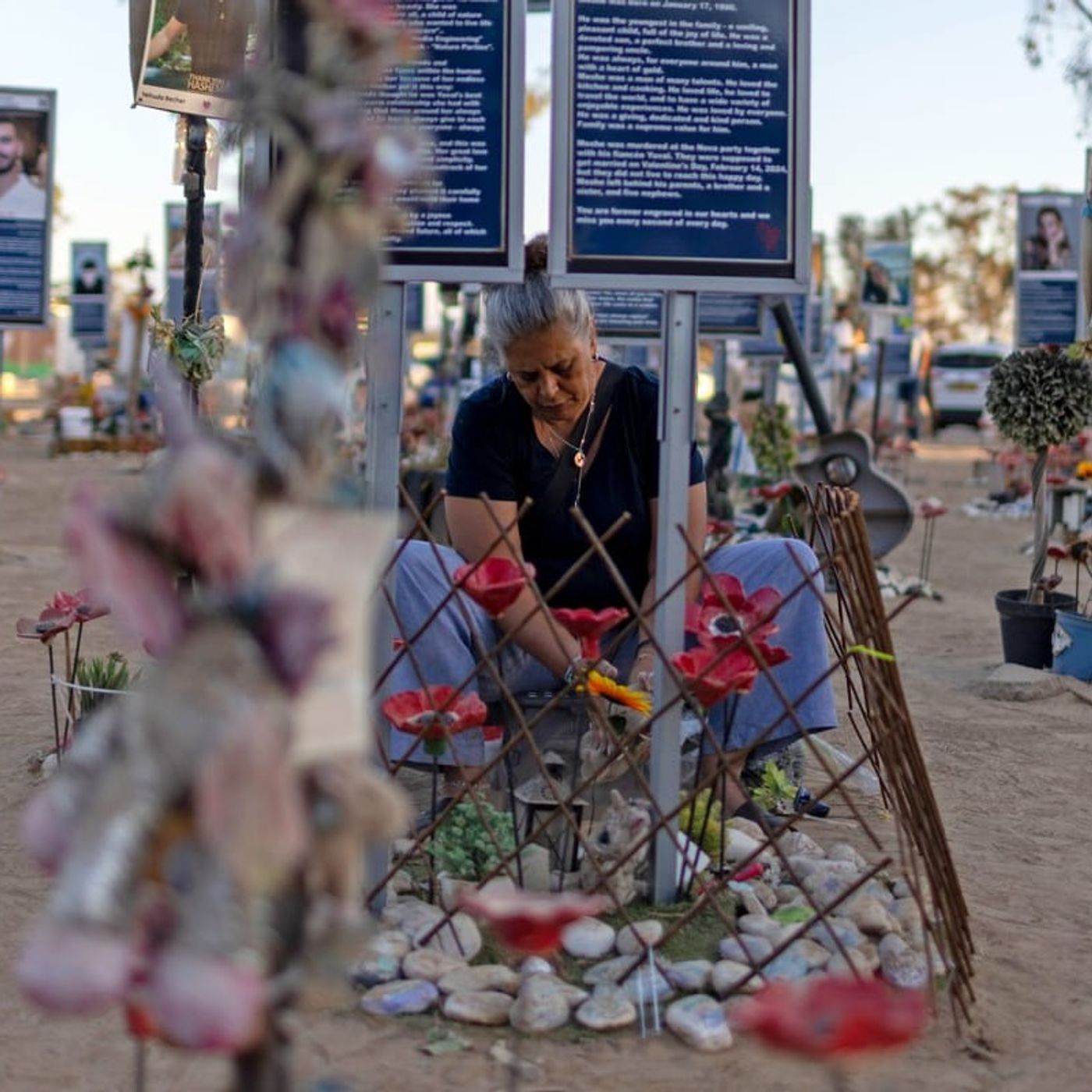
20:08I really hope that he will have the courage to say on October 28th when we get the results, Netanyahu does not have a majority. He must go home and we will start and form a new government. It's possible, but Eisenhower must have the courage and the political power to do that. Gil, how are you planning on marking the third anniversary of October 7th and also your cousin and your cousin's life? we will be tomorrow in Be 'eri at the cemetery, visiting these two graves of Kineret and Carmel and more than a hundred graves of the people of Be 'eri. And I'm trying to think about her and about her daughter Carmel, about what we missed and how to make sure that nothing like that ever happens again for us, for many Israelis.
20:57You know, it's not only the third year after October 7th that we commemorate this horrible day, but it feels like we're still in this very long day that started October 7th. I believe we deserve better. And I think once we actually have a new government, when a commission of inquiry that will go into the details of what happened October 7th, before October 7th, and during this horrible war, I believe I will be able to actually focus on my own personal memory of Karmel and Kineret and how much I miss them, which is something that it is very hard to do when we still have this political catastrophe still going on.
21:39Gil Dickman, thank you. Thank you so much. All right, we're going to take a very quick break. And when we are back, how the people of Gaza are doing a year into the signed ceasefire, the other side of the war. That's next.
21:59For adults with Crohn's disease or ulcerative colitis symptoms, every choice matters. Tremphaya offers self-injection or intravenous infusion from the start. Tremphaya is administered as injections under the skin or infusions through a vein every four weeks, followed by injections under the skin every four or eight weeks. If your doctor decides that you can self-inject Tremphaya, proper training is required. Tremphaya is a prescription medicine used to treat adults with moderately to severely active Crohn's disease and adults with moderately to severely active ulcerative colitis. Serious allergic reactions, increased risk of infections or lower ability to fight them, and liver problems may occur.
22:40Before treatment, get checked for infections and tuberculosis. Tell your doctor if you have an infection, flu-like symptoms, or need a vaccine. Explore what's possible. Ask your doctor about Trimphia today. Call 1-800-526-7736 to learn more or visit TrimphiaRadio.com. Shell V-Power Nitro Plus fuels every drive with a fuel like no other. It removes up to 100 % of performance robbing deposits to rejuvenate your engine's performance. That means more power when you need it and more performance with every drive. Shell V-Power Nitro Plus Premium Gasoline. more power, more performance. Formulation unique to Shell.
23:22In gasoline direct injection engine fuel injectors with continuous use of Shell V-Power Nitro Plus premium gasoline compared to lower octane fuels. Actual effects and benefits may... Your call is important to us. Please hold for the next non-existent representative. Ever get a pit in your stomach when you realize your afternoon is about to become a bureaucratic cage match over a bill? Someone will be with you shortly. Skip it. Save time by letting Experian negotiate your bills and look for new deals and savings opportunities. Get started in the Experian app now and see how much you could save.
23:51Results will vary. Not all bills eligible. Savings not guaranteed. Available with eligible paid memberships. See Experian.com for details. Experian.
24:02And we are back with Here's the Scoop from NBC News. So as we all know, in the wake of Hamas' October 7th attacks, Israel launched its own retaliatory assault on the Gaza Strip. Palestinian authorities say the military campaign has killed more than 74 ,000 people so far. And officials in Gaza say that includes over 1 ,400 that have been killed by Israeli airstrikes since Hamas and Israel agreed to a ceasefire one year ago. Israel says that four of its soldiers have been killed in Gaza in that time as well. Meanwhile, millions of Palestinians in Gaza are still struggling to access basic necessities, food, shelter, and medical supplies.
24:45For more on what life in Gaza looks like today, three years after the war started, I want to bring in Mohamed Al-Aklouk, an aid worker for the Norwegian Refugee Council in Gaza City. Mohamed, thanks for being here. Thank you. Thank you for you and for inviting you. It's been nearly a year since Israel and Hamas agreed to the ceasefire. What's going on there right now in Gaza? one year since the ceasefire and three years after October 7th? So, first of all, all of us need to know, Gaza is still in pain from all aspects. So there is no major change for the normal people living inside Gaza City. Even some food items entering with a high cost and the people can't afford this.
25:35In the media, we hear there's a ceasefire, but on the ground, each day there is a targeting. Today, there is a target not far away from me, 300 meters. You said 300 meters away from where you are right now, there was a strike today? Exactly, exactly. From where I am living right now in Gaza City. What about housing? Is this still a tent city everywhere? I mean, people's homes have been completely destroyed. So when we say there is around 67 % from the whole population living in tent or makeshift shelters, that means that people are living protected by a piece of fabric, while the remaining is living on the partially or severely damaged housing units.
26:20So the whole population is affected. The whole population is suffering from shelter and housing. What needs are highest right now for Gazans? Like, what do they need most right now? I think they need to open the aid to enter freely without restrictions. This is the most important thing, to let the heavy missionary enter, to remove the rappels. There is no space for the people. 70 % from the whole Gaza Strip area is controlled by Israeli forces. And the 2.1 million is already squeezed in 30 % of the Gaza Strip. half of this area is rubbles and destroyed buildings. So we need the first thing for the people to feel in hope, a little bit of hope, in hope that maybe the future comes with good things better, to remove the rubbles, to allow this heavy machinery to enter, to remove the rubble, and entering the restricted shelter items and other files.
27:22And you're not just helping others there. You're living this, Mohamed, right? You've been displaced seven times with your family since October of 2023. What has that been like for you to have to move with your family so many times? The whole population has sometimes become displaced during the past three years. So my role as a humanitarian aid worker, I know how much the people displaced suffering from each aspect of their life. But the problem, even us as a personal and personal living also, we are suffering from the shelter situation, the leakage of water, the bad environment because there is no infrastructure, the rodents, the snakes, the rats.
28:07It's everywhere. All the population already suffers from these aspects. There are elections in Israel at the end of the month. Prime Minister Benjamin Netanyahu is running for re-election, essentially parliamentary elections. Do people in Gaza, are they watching this? I think they know about that, what's happening around. But for them, I think after three years with the silence of the whole world, it will not make a big difference for them. If Netanyahu or others, he win, he lose. Because they are looking now just to survive. I think they are focusing now on who will present the Palestinian people in the future to try to provide them with any type of security or any normal life.
28:59You talk about what Gazans need, what Palestinians need, right? Food, housing, water, connectivity. You and I have been trying to have an interview for the last 10 minutes and you've dropped out five times. We're getting into the colder months of the year. Gaza is on the water. It gets cold. It gets windy. It can oftentimes be miserable in the winter. How are you preparing? How is your organization preparing to help Palestinians through that time? According to the last assessment conducted by Shelter Cluster, the number of people in need is 1.9 million in need for Shelter. How you can imagine out of 3.2 million, 1.9 million in urgent need of shelters.
29:47If we spoke about the 68 % from them living in tents and makeshift, those people will not protect from the wind and not protected from the winter and from the flooding. It's a piece of fabric. So the piece of fabric not secure anything regarding to the cold, regarding to the protection from the weather, even from the insects and rodents coming from outside. So I think we are looking to shifting from this emergency response to transitional solution, better dignity, better sheltering for the people. Allow for reconstruction material to be entered. The materials we advocate a lot to entering the dual-use materials.
30:34It's not dual. It's normal materials, even for hammer or for some type of plastic, glass for windows. I am one of whom the people consider lucky. He's living in partially damaged homes. But without, I have no windows. So in addition to that, today I'm looking for duct tape to try to secure my home with plastic sheeting to cover the holes and the walls. And this is why I am a humanitarian worker. You can imagine with one who didn't get any money, he's jobless, there is no opportunity to receive funds. So the situation goes worse and worse. There is no comparison between the needs and the material.
31:25Still, we have it in our stock or in our warehouses. You know, again, Mohamed, you are a humanitarian aid worker, but you are also Palestinian. You are also a Gazan. You live there with your family and your children. What do you hope that they will have in their future? For my kids, really, the situation is very difficult. I'm like the other Palestinian people. Now they are back to school. Today at 12 a.m., there is a targeting while I am in the working hours. I spent around 30 minutes just to check on my kids once to reach my daughter in the school, if it's safe and not afraid and not have any fear attack, to check my kids and my wife in the home and check my father, the old man in his home.
32:20Everyone is safe until I know where is the targeting. Because you hear a huge explosion. at that moment you need to discover about your family. This life is not life. Yeah, we're trying to cope, we're trying to push. There is a hope. The future will not stay like this. I make some comparison when we were in the famine. The situations were catastrophic. Now there is some food and the situation now is a little bit better. So I'm trying to make this comparison to trying to give them some hope. Mohamed Al-Akhluq, thank you. Thank you very much. All right, that is going to do it for us. Here's the scoop from NBC News.
33:09I'm Yasmin Vasugin. We'll be back tomorrow with whatever the day may bring. And if you like what you heard, subscribe wherever you get your podcasts. And you can also subscribe to our daily newsletter, The Inside Scoop. It is a deeper dive on the main story of the day that comes out every weeknight straight to your inbox. You can sign up for The Inside Scoop as part of our paid subscription at NBCNews.com. We'll see you tomorrow.
33:45Your call is important to us. Please hold for the next non-existent representative. Ever get a pit in your stomach when you realize your afternoon is about to become a bureaucratic cage match over a bill? Someone will be with you shortly. Skip it. Save time by letting Experian negotiate your bills and look for new deals and savings opportunities. Get started in the Experian app now and see how much you could save. Results will vary. Not all bills eligible. Savings not guaranteed. Available with eligible paid memberships. See Experian.com for details. Experian.
Anger over Cornell University’s handling of an alleged 2024 sexual assault is rippling across campus. Thousands of students have gathered to protest and faculty have introduced a resolution declaring a no-confidence vote in the university administration. NBC News correspondent Maggie Vespa joins from Ithaca, New York, to explain what students are demanding — and how the university is responding. Plus, three years ago Hamas militants entered Israel from Gaza and carried out terror attacks in several towns near the border, also taking hundreds of people hostage. Israel retaliated with a war that destabilized the region and led to a humanitarian crisis in Gaza. On the anniversary of the Oct. 7 attacks, we speak with Gil Dickmann — whose cousin was taken hostage and killed by Hamas — about why he’s calling for more accountability from the Israeli government in light of new reports that Israeli Prime Minister Netanyahu ignored warnings of an attack and what he’s expecting from the upcoming Israeli elections. Then, Mohammed al Aklouk, an aid worker for the Norwegian Refugee Council based in Gaza City, shares what’s changed for Palestinians in Gaza since the Israeli-Hamas ceasefire one year ago and why many in Gaza are still struggling to access essential services including food and shelter.
Hosted by Simplecast, an AdsWizz company. See pcm.adswizz.com for information about our collection and use of personal data for advertising.