Ask ChatGPT

 Here's the Scoop
11 Sep 2026 · 42m · 20 chapters
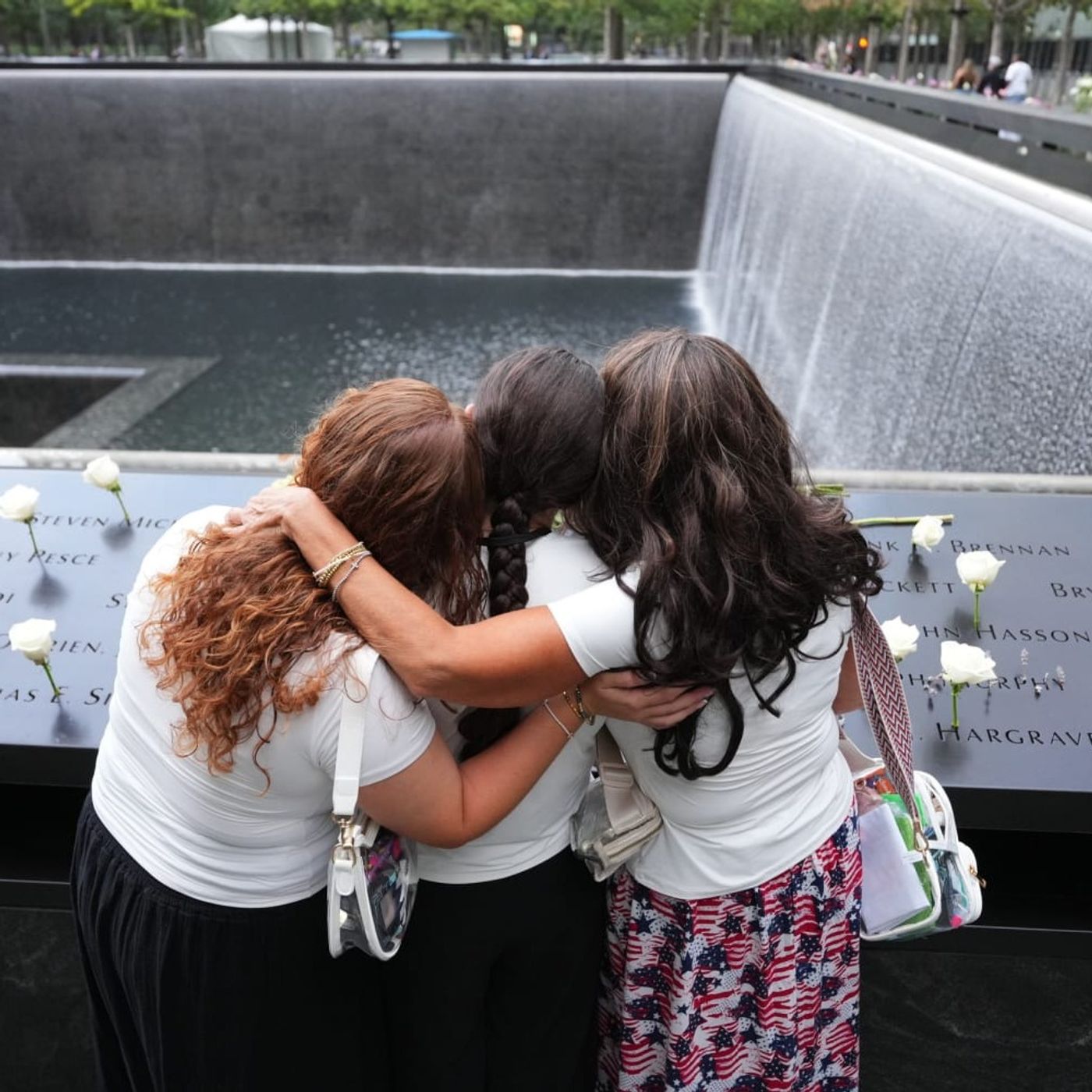
The episode reflects on how the 9/11 generation is passing down shared history as the 25th anniversary approaches, and how 9/11 reshaped Muslim American life and education about “hard history.” Guest 1: Matthew John Bocci, whose father John Paul Bocci worked at Cantor Fitzgerald and died when American Airlines Flight 11 hit the North Tower. Matthew was nine, later struggled with grief, addiction, and mental health; he wrote the memoir Sway and now commemorates by celebrating his father’s life, sharing stories, and visiting a memorial.
watching 9/11 footage fueled obsession; learning details from the chief medical examiner helped him; speaking up matters.
his family’s phone-call timeline; the image of someone falling he saw on TV; his sobriety-driven shift. Guest 2: Ayman Ismail, an 11-year-old Muslim student in New Jersey in 2001; his Islamic school closed, his family faced FBI raids and Islamophobia.
hate crimes and surveillance rose; patriotism was encouraged (American flags at mosque). Guest 3: Megan Jones, vice president of education programs at the 9/11 Memorial and Museum; she teaches using museum artifacts and inquiry-based, grade-differentiated lessons (e.g., FDNY Ladder Truck 3).
Written by AI. May contain mistakes.
Discussion on the impact of 9/11 on a generation and their stories.
“And some of the people who were children at the time, who lost parents on that day, or who were in communities affected in the aftermath, are now actually parents themselves.”
Matthew shares his experience growing up without his father and how it shaped him.
“It's been 25 years since you lost your dad.”
Matthew discusses how he commemorates his father's memory each year on 9/11.
“So the weekend before, he's like, I'm going to do it.”
Detailed account of Matthew's memories from the day of 9/11 and its aftermath.
“and my dad just simply told him that he loved him and goodbye.”
Matthew explores his quest for answers regarding his father's death and coping mechanisms.
“And so the story we were told, because this is what they told my mom, was that they found my dad three days later, and they came to our house a week later to tell us that they found him.”
Matthew reflects on his struggles with silence and trauma following his father's death.
“and I asked them a bunch of questions about how the phone calls that lasted seconds, how they went.”
Understand the emotional challenges of sharing personal trauma and the importance of speaking up.
“and like kids would make fun of me for wearing that.”
Explore how parents approach discussions about 9/11 with their children and the significance of family history.
“And just a note I want to make, if you or someone you know is struggling or in emotional distress, call or text 988 or chat at 988lifeline.org 24 hours a day, 7 days a week to reach the 988 Suicide and Crisis Lifeline.”
Learn about mental health resources available for individuals facing emotional distress or crisis.
“What was it like to grow up in a community that was affected by the September 11th attacks, but also viewed suspiciously in the aftermath.”
Hear firsthand accounts of how children from affected communities experienced 9/11 and its aftermath.
“A holiday deal this good obviously deserves an enormously expensive holiday song, like All I Want.”
Examine how the aftermath of 9/11 led to increased scrutiny and fear in Muslim communities.
“So I wanted to bring him on to talk about that, and then what came next.”
Discuss the implications of FBI interventions in Muslim communities following 9/11.
“And so the mosque community, I think, really struggled to keep everyone together to make them feel like there was safety.”
Analyze the current political landscape for Muslims in America, especially in light of recent events.
“We're at a time in which, my gosh, the first Muslim mayor of New York City ever, Mayor Mamdani, right?”
Discussing the complexities and challenges of Muslim identity in America following the events of 9/11.
“family has faced in the past, and here he was now being elected as mayor.”
Conversations and reflections from attendees at the Ground Zero ceremony discussing the impact of 9/11.
“It's destroying athlete, creator, and YouTube Maxer.”
Conversations and reflections from attendees at the Ground Zero ceremony discussing the impact of 9/11.
“Upfront payment of$45 for three months,$90 for six months, or$180 for a 12-month plan required,$15 per month equivalent, taxes and fees extra.”
Exploring methodologies for teaching about 9/11 in schools to students who didn't experience it.
“So how do we talk about that day and everything that came after it with a new generation for whom it is just U.S.”
How educators use artifacts from 9/11 to engage students in meaningful discussions about the events.
“So for example, you know, when I was a teacher, there was in the curriculum, there was a section to talk about 9-11 and the repercussions.”
Learn how educators incorporate the 9/11 narrative into various subjects.
“you know, a month-long unit, we make sure that we have resources that are available.”
Reflect on the importance of remembering those who lost their lives in 9/11.
“What are your parting words, Matt, on this day commemorating the 25th anniversary of 9-11?”

Get the gist, explore an idea or ask about something said.
 Claude
On Here's the Scoop, what are the key points of this episode?
Searching your listeningAutomatic transcript. May contain errors.
0:03Hi, everybody, and welcome to Here's the Scoop from NBC News. I'm Yasmin Basugin. Right, quick, march. Hang on, ready!
0:19So you just heard those bagpipes marking the beginning of the reading of the names today on September 11th. It has been 25 years since nearly 3 ,000 people died in the attacks in Washington, D.C., in Shanksville, Pennsylvania, and right here in New York City. That means that literally an entire generation has grown up under the shadow of 9-11. And some of the people who were children at the time, who lost parents on that day, or who were in communities affected in the aftermath, are now actually parents themselves. So today, we want to share their stories. How do they reflect on this seismic event in their childhoods?
1:04How has becoming parents changed how they think about that experience? And what do they think the next generation should know about what happened? That is what we're going to talk about today. So as they do every year, commemorations at Ground Zero began at 8.40 this morning with a moment of silence for the victims of the North Tower of the World Trade Center. The first hit by American Airlines Flight 11. Among those remembered was John Bocce. John Paul Bocce. John was an employee at Cantor Fitzgerald who was working at his office on the 105th floor when that first plane struck. His son, Matthew John Bocce, was just nine years old at the time.
1:52Losing his father in 9-11 changed the trajectory of Matt's life. Through childhood and young adulthood, he struggled with grief, with addiction, with mental health issues, which he describes in his memoir, Sway, the first ever written by a child of a 9-11 victim. I spoke with Matthew earlier. Hey, Matt. Good to see you. Great to have you. It's been 25 years since you lost your dad. What has your ritual been like in commemorating 9-11 up until now? Well, it's interesting because there was a transformative change. There was a block of years where the ritual was surrounding myself with as much alcohol and drugs that I could possibly consume and then numbing myself throughout the entire day and watching the footage.
2:43and when I finally got sober, I, and really when my book came out, this paradigm shift happened where I started to, and my family included, we started to more so celebrate my father. And it wasn't as much grieving his death as celebrating his life. How do you celebrate your dad? So we normally, we have a small memorial that we go to in town and then we spend the day at home with the family. In New Jersey. In New Jersey, yeah. Your family is from New Jersey. My family's from New Jersey. So you have a memorial that you go to. Go to Memorial and then we spend the day at home together. Talk about him.
3:14You share memories of him. You'll get pictures. Yeah. Pictures, of course. More so stories. Talk about happier things. And my brothers and I will drive his cars. And the weather's supposed to be beautiful. So it's just... You still have his cars? We still have his cars. Wow. What kind of car? Porsche 911 Carrera. Excuse me. And an Alfa Romeo Spider. Excuse me, John Bocci. Yeah. I know you were little, but what was your dad like? What do you remember most about him? I remember how charismatic he was. He had this mentality of it's either you liked him or you didn't. And if you didn't, then that's okay because he had tons of friends and tons of family who loved him.
3:50He didn't care. He didn't care. But he was a jokester and a prankster. And that's what I hold on to. So I keep mentioning the fact that you're only nine years old because I think it's important. The way in which you write about that day in your book is in detail. What sticks out to you about that day? Well, it's funny you mentioned about remembering it because I hardly remember anything prior to it. I have the one memory of going to his office right before, during Christmas of 2001, or 2000, excuse me. You visited his office at Canter Fitzgerald. Went to my father's office at Canter, and we were going to the Christmas party at the Wellness on the World restaurant.
4:26And that's where the title of the book comes, my dad bringing me to his office and having me looking down through the window and asking me if I could feel the building swing, which I could. and uh that day i remember and i i remember that day up until about 3 30 in the afternoon and then it blacks out why 3 30 so basically my mom kept me in school um on 9 11 on 9 11 so 8 46 plane hits my dad's building at 8 49 in the morning my dad calls my mom leading up to 9 11 my dad had several times voice that he was unhappy he at canner at canner just in general with that work he was tapped out he had voiced to my mom that he was unhappy he wanted to quit and he never would call her during the work day uh from his cell phone so at 8 49 in the morning his cell phone pops up on the on the house phone caller id and also too my father actually had a vacation day scheduled for september 12th wow so he couldn't wait for that day because he was going to spend the time with my three-year-old brother michael and my my baby brother Paul, who was three months old, and my mom.
5:33So the weekend before, he's like, I'm going to do it. I'm going to walk out. And so he calls her and she's thinking he walked out. And she didn't know the planes had hit. She had no idea. So she picks up the phone and as she described it, you know, she heard the typical commotion of a brokerage firm's trading desk, basically, in the background, guys yelling, probably, whatever. My dad said, Michelle, do you have the TV on? We think a small plate hit the building i'm beginning to grab my stuff and get out of here um and like i said he was known to pull pranks and jokes my mom thought it was a prank and she she literally said john this better not be some sort of sick joke and right when she finished that sentence the line cut off wow she turned the tv on and she saw the smoke coming out of his building and so she starts hysterically crying freaking out and um calls him and then he would pick up and she wouldn't hear anything on the other end but static and when he would call her she'd pick up and the same thing here static and finally he got through to her one last time and he said Michelle I love you and uh you're loving my life I love you forever and the line cut off she never talked to him again my dad's brother my uncle Tony got through to my father at about nine o 'clock in the morning so I think right before the second plane hit the second tower he was the last person that spoke to my dad and my dad just simply told him that he loved him and goodbye.
6:58So you were in school the whole day. I was in school the whole day and this is something that I questioned for a long time as to why my mom chose to do that and I do look back now and I'm very fortunate that she did keep us in school because it was the last chance of us having a normal childhood. She knew, I think instinctively, that when we got home it was over. There was just so much chaos at my house. You know, there was 30 people at the house at least, maybe 40. By the time you got home? By the time I got home, they had just established hotlines and hospitals had lines for you to call and say your loved one's name.
7:30And I kept walking through the rooms to go into the room we call the family room. And when I turned left, turned the corner and turned left, I saw the TV. And I sort of stood near it, watching it, and I saw the footage for the first time. And there was a family friend who was there. And when my dad's building, the second building, came down, she changed the channel. And when she changed the channel, it went over to a Spanish news station. And the moment she switched over to that station, I saw an image of someone fall into their death from the North Tower. And that was the image at nine years old that left an imprint on me.
8:07Does it make it more complicated for you in dealing with the aftermath of your father's death? That it wasn't your dad dying on that day full stop. It was your dad dying on that day. and it was the nation's largest terror attack. I think that was probably one of my biggest struggles of it was, number one, the way I viewed it was, for lack of a better term, anyone had the access to watch my dad's final moments and essentially his death whenever they wanted to, still can. And the thing is, so many family members at the time tried to shelter us, my brothers and I, from seeing it. And then TV was on all the time.
8:43That's all you would see. um but uh that was a big piece of it for me that bothered me um and as a result i sort of almost welcomed the feelings of it and that's why i became so i believe uh obsessed with looking at the footage because i wanted to find something and i thought i could find it and then it would give me some closure do you still even know how he how he died i mean do you know yeah um so So they found my father four days later, three days later, excuse me. Well, that was the story that we had been told for a long time. I actually recently figured out that they found him two days later.
9:24I actually went to the memorial and met with the chief medical examiner because unknown to me for a long time, each person has a file. This was literally three months ago. And so the story we were told, because this is what they told my mom, was that they found my dad three days later, and they came to our house a week later to tell us that they found him. And when they came to the house, they basically told my mom that they found my father's lower half. They identified him because of his wallet in his pocket. My mom was asking a lot of questions too. she called my neighbor who was a dentist and he was helping identify people downtown through dental records and when they found my father she called him and said is there anything we can do to learn more so he had the chief medical examiner there call my mom and my mom is told that uh she believed that he was in the building in either the staircase of the building or in the windowsill and presumably was alive one moment and gone the next that he died instantly.
10:32So I heard that for a long time. And I sort of correlated that with this sort of convenient answer to give a grieving widow. That was my thinking as a child, because I would overhear the conversations where she would say these things. And then she didn't really ever directly tell me. Then I thought, well, maybe he fell or jumped from the building. And that was my thing that I held on to and I was like searching all these footages and videos and photos. So anyway, I'm mentioning all that because this meeting that I had with the medical examiner and honestly, I would encourage if families are open to it to consider going and doing it themselves because for me, it was what I needed.
11:16Truthfully, I was at a part of my life where I had been really good for a long time at not looking at the footage and not thinking about it, not obsessing about it anymore. And that did set me down a little bit of a spiral with it temporarily, thinking about it a lot. Recently. Recently, yeah. Thinking about it a lot. And probably because it was this summer and it's coupled that with the 25th year anniversary coming around. But I learned a bunch of things, right? I learned that my father was found on September 13th and that the things that the medical examiner told my mom, I was told we have no reason to lie to a family.
11:56So she was like, if that's what they told your mom, I would presume that's the truth. You kind of had a little bit of a spiral recently, but you're in a different mindset now than you were years ago when you had that initial spiral and became obsessive. And that took you down a path of major mental health struggles and drug addiction. Yes. Coping with the loss of your father, I assume. Yeah. That's how you coped. So yeah, that's how I coped.
12:25I turned to my mom and my dad's brother, the only people that I knew that spoke to him, and I asked them a bunch of questions about how the phone calls that lasted seconds, how they went. Thinking that each time I would ask the question, they would tell you something different. And that's just like the definition of insanity. And that's the pinnacle piece of what I've learned in sobriety. So eventually my mom and my dad's brother were like, this is not good for you. You cannot keep doing this to yourself. And I didn't like that response. So it's not either of their faults. But sadly for me, I had an uncle through marriage who found out that I was so inquisitive and curious and wanted to know more.
13:09And he had been grooming me for like two years. and once he found out that I was so obsessed with that specifically, he started feeding me a bunch of lies about it. And he told me deceitfully that my father jumped or fell from the building, which was not the truth. So that led to me being sexually abused. By him. By him. And I would argue that that experience in many ways was probably more traumatic for me than losing my dad 9-11 you know i went to an all boys prep school um i was already sort of spotlighted as this 9-11 kid freshman or sophomore year of high school i was on oprah and that was like you know it was it was cool but like kids also made fun of me for for things like i wore this bracelet i still do so it's my dad's name in world trade center and they made these for the families and like kids would make fun of me for wearing that.
14:04Like it was just kids being kids. I shut down and I said to myself, I cannot speak about this to anyone and I will not speak about this to anyone. And I turned to drugs and alcohol to cope. You've told your story in this memoir in detail. You travel and speak with children about your story. What do you want people to take away? The interesting thing is with the kids now in the schools I speak at, I make it very clear that it's not my story anymore. They don't understand 9-11. They will never understand it. I try to educate them enough and I'm there to answer questions about it, but I want them to pull something and extrapolate something from my story and the message that they're hearing that day and connect it to their own.
14:49The biggest takeaway I want for them is to speak up. I mean, I suffered in silence for nearly 10 years, really longer, but 10 years since I was abused. And it wasn't until I got sober that I came forward. You have a nine month old baby. You're a dad now. Yes. How do you, how do you plan on talking to your kiddo about 9-11? Yeah, actually it's, you know, it's been a very, um, prevalent conversation recently. He's going to know everything about his grandfather and, um, I'm going to, I'm going to give him the truth. You know, I want him to know everything. Um, and I'm not going to sugarcoat it and he needs to know what happened that day and he'll know about his grandfather and the man he was and he will not be forgotten.
15:32And he'll know. Matt Bocci, thank you. Thank you. And just a note I want to make, if you or someone you know is struggling or in emotional distress, call or text 988 or chat at 988lifeline.org 24 hours a day, 7 days a week to reach the 988 Suicide and Crisis Lifeline. And if you or someone you know has experienced sexual assault, RAINN's National Sexual Assault Hotline offers free, confidential, 24-7 support. Call 1-800-656-HOPE or text HOPE to 64673. You can also use their chat at rainn.org backslash hotline. Coming up. What was it like to grow up in a community that was affected by the September 11th attacks, but also viewed suspiciously in the aftermath.
16:24We're going to talk about how 9-11 upended the Muslim American experience. That's next.
16:51Matthew John Bocchi: doesn't turn leg day into loading day. Plus, I get ad-free videos, background play, and so much more. YouTube Premium, it's like YouTube got some extra gains. Try YouTube Premium for two months free at youtube.com slash premium. Trial eligibility varies, terms apply, cancel anytime. This holiday, all plans, even unlimited, are just$15 a month. A holiday deal this good obviously deserves an enormously expensive holiday song, like All I Want. Right. Okay, we can't afford that. You know what? Forget the
17:40And we're back with Here's the Scoop from NBC News. So among the families and dignitaries at Ground Zero to mark the 25th anniversary of the September 11th attacks today were all living former presidents, along with former New York City Mayor Rudy Giuliani, Vice President J.D. Vance, and current New York City Mayor Zohan Mamdani. Now, of course, it is not unusual for the mayor in New York to commemorate one of the most impactful moments in the city's history. But Mamdani is the city's first Muslim mayor. And when he was campaigning, he spoke about the Islamophobia directed at his campaign and tied it back to September 11th.
18:17I want to use this moment to speak to the Muslims of New York City.
18:28Matthew John Bocchi: I want to speak to the memory of my aunt.
18:36Who stopped taking the subway after September 11th because she did not feel safe in her hijab. So at the time, Vice President J.D. Vance actually mocked Momdani's comments, writing on X, quote, According to Zorhan, the real victim of 9-11 was his auntie, who got some allegedly bad looks. But his aunt's fears were not out of nowhere. I mean, hate crimes against Muslims soared in the wake of 9-11, and a growing number of non-Muslims started to hold negative views about Islam, according to the Pew Research Center. In 2001, Slate Magazine staff writer Ayman Ismail was an 11-year-old at an Islamic private school in New Jersey.
19:16After the terror attacks, his school was closed for weeks, and the moment completely altered his relationship to his faith. So I wanted to bring him on to talk about that, and then what came next. Hi, Eamon. Hi, Yas. How are you? I'm good. It's really good to have you. Um, it's been 25 years, but take me back to that time on September 11th, 2001. That was the last day that you attended, um, your private Islamic school. You know, that's a moment that's going to stay with me forever. Uh, I was 11 years old. It was like the first week of school. We were still getting our syllabuses and getting to know our new friends and our new teachers.
20:04instead of going to the next class, they called in an assembly. We were brought into like this multi-purpose room where we usually pray, have lunch, do gym. It's like all in one. And that's where we were told that we were getting dismissed first, getting dismissed because of what had happened in New York. So we're in Northern New Jersey. Many of us have parents who work in that area. My dad included, he worked as a town car driver and I knew he was going to be in that area. So my heart dropped. My first thought was, is he safe? Is he okay? Yeah, of course. Somebody else's dad offered to give me a ride home.
20:40And as soon as we got home, my sister was already there. And we put on the TV and we were just looking at all of the images, scanning the faces, trying to discern whether or not our dad was there. I don't know if you remember but there was this stream of footage of people running through the dust clouds, running for their lives in a panic and all I was looking for was just a sign that my dad was alive it wasn't until two days later when he came home and he was covered in dust and he said that because his car was his livelihood, he couldn't just abandon it when the tunnels got shut down so he eventually had to make his way home as soon as the tunnels were reopened.
21:23When the details started to emerge about who the attackers were that, you know, drove those planes into the towers, that drove the planes to the Pentagon, that they were, in fact, Muslim, how did your parents explain the attack to you? They didn't really sit me down and explain it, to be honest. They, I think, were just so preoccupied with what they were doing with trying to keep the mosque together It wasn't just me who got pulled out of the Islamic school at that time. It was many students because the Islamic school was so slow to reopen because of the fear of reprisal attacks. And they didn't want to put any of the kids in danger.
22:01And so many of the parents like my own, they had to go back to work. They had to go back to life as normal quickly. And so the mosque community, I think, really struggled to keep everyone together to make them feel like there was safety. One of the things that they did was they distributed small American flags to the worshipers at Friday prayer. There was like a rush to show patriotism, to perform it, to put your flag everywhere, to hang it out of your car, hang it out of your window. And I think it gave Muslims in that community an opportunity to just like participate. It's a way to like buy it and be like, look, we're all in this together.
22:37So it's always easy to look back at that moment and think, well, obviously people would blame you. Obviously, people wouldn't just think of you as part of who was attacked or under attack in that time. But I think thinking back to September 11th, 12th, 13th, there was a real hope that this would be an opportunity for Muslims to show the world who we were. And that actually we are different from them and that people would believe us and know that we are Americans and proud to be American just like anybody else. Were you afraid to make the transition to the public school and leave your Islamic school?
23:08Was that a hard time for you? Yeah. Yeah, it was. I think part of the reason was that the school had already started. And so it was like already first week, second week of class. And, you know, I was aware, I was conscious of what they were saying about Muslims on the news and how there were all these like rising questions about like what to do about the Muslims that were here. so I was a little nervous that people would maybe assign guilt or blame towards me especially as like the new kid maybe I get picked on and so I was nervous and then I go and thankfully it was like in a place like Newark New Jersey where everybody's from somewhere so I was really met with a lot more curiosity than people like assigning their own preconceived ideas about who I was on top of me which was very comforting you've written about a night after 9-11 in which FBI agents came to your house?
23:59It was a year or so after 9-11? Yeah. Why? Why did they come? What happened? Yeah, so about a year into it, when it felt like our lives were turned upside down, it had been like a slow progression to that night. There were police coming to the mosque to investigate or follow leads or ask questions. And the people who were in charge at that time, namely Ahmed Shadid who was more of like a community liaison he was like a volunteer but he ended up like really trying to show the police the local police and the FBI that we were willful participants and that we had nothing to hide and they were welcome to come to the mosque anytime so there was like a moment where we all sort of like we're following his lead but then something really changed I think especially earlier or later when people we knew were being deported for frivolous reasons people were having their houses raided I had kids that I knew that I were growing up with who were going to jail for like these really weird reasons.
25:02You know, so it sort of felt like it was all spinning out of control. And I don't know, it was like these weird like environment in which really started to feel like we were under attack by law enforcement that really flipped our lives upside down. And then in the middle of the night, my dad was already at work. He worked a night shift. It was just me and my older brother. and uh yeah it was like i the first thing i noticed when i opened my eyes in the middle of the night was people in fbi bulletproof vests inside my room oh my flashlights digging through my clothes digging through my legos and connects and stuff oh my gosh uh and i was sort of like jolted awake and i it almost felt like a dream and when i came outside of my room and i saw my mom, like begging them to like explain to her what was going on.
25:49It was already too late. I found out later that they just sort of had this program where they were just going in and knocking on people's doors and asking them for permission to come and look. And my mom was like terrified and under the impression that we had nothing to hide. So she was just like, yeah, sure. Come take a look. Not knowing that it's within her rights to just say, no, come back with a warrant. So they came in and they just, they tore the place up. They looked under everything. They looked at everything. The only explanation that my mom ever gave me afterwards was they were looking for someone named Muhammad Muhammad, which to me sounds like kind of cartoonish.
26:26But at the time, I was like... Totally a made-up name. Yeah, or not. Maybe. I don't know. Or not, but yes. Either way, there was nothing... The most Islamic name they can think of, Muhammad. Yeah. But there was nothing that tied my family to this person, right? So it was just a matter of them, I think, you know, I don't know what their intention was. Maybe there was like a real, I don't know. I don't know. But we were one of the few Muslims on our block in Newark, New Jersey. Our school was in Jersey City. We had to, you know, so where we were in Newark, we were one of the only ones. And yeah, I remember from that moment on, I almost felt like I needed to keep it close to the chest.
27:02Like you can't trust these people to protect you. I want to talk about politics for a moment amidst all this. We're at a time in which, my gosh, the first Muslim mayor of New York City ever, Mayor Mamdani, right? Historic, a wow moment, coupled with the 25th anniversary of 9-11 in which you have certain high-profile lawmakers that are calling for the mayor to skip the 9-11 anniversary events because they claim he has not rejected
27:44extremist views about America in connection with 9-11, which, by the way, he has. So you have this progress on the one hand, right? History in the making. Mayor Mamdani, the first Muslim, getting, you know, emotional, talking about experiences his family has faced in the past, and here he was now being elected as mayor. And then you also have calls for him not to attend this event. Where do you think Muslims are right now in this country? Like, what progress has been made considering what is happening now with that? You know, I think about this a lot, especially in my writings. I'm trying to, like, trace, like, how far Muslims have gone as a community since then.
28:23And I think of Mabdani as more of, like a Rami Youssef kind of new generation of Muslim in which we're tired of explaining ourselves. We just want to do what everybody else has the right to do, which is if you love New York City and you believe in these like economic principles and about like housing justice and things that are totally detached from religion or what happens in a mosque or anything to do with that, that you have the right just as anybody else to run for office and then enact those policies that got you elected. So I wrote a lot about Mdani's campaign. And, you know, I was almost embarrassed sometimes to ask him about his identity because it almost felt like I was wedging it in to something that he wasn't naturally bringing up.
29:06Like, would you be asking someone else about their identity if they weren't Russian? Exactly. But in the end, inevitably, it becomes part of who we are and a part of how politically charged it is to just be who you are in a place like New York or New Jersey or the rest. But at the same time, I think what we're seeing when people are sort of condemning him as a reflex or questioning whether or not a Muslim person has a right to mourn the victims of 9-11. I mean, it's just racist. I don't think it's any deeper than that. I don't know if there's like anything else we can like extract from it. I don't think it tells us anything other than who these people are who are making these calls.
29:41You know, I'm a mother, you're a dad. We both have two kids. I have an eight and nine-year-old, you have a three and a five-year-old. And for the last few years, as my kids have become more aware of their surroundings, like we stand on our rooftop in Brooklyn and they see the towers, the lights of the towers, right? And they're like, what is that? And so I've had to answer a lot of questions as of late about 9-11. And I was raised Muslim. My family is Iranian and my kids know that. And And it's an interesting conversation to have with your kids. And I had my kids asking, well, why would they do that?
30:24Wait, they're Muslim like you? I don't understand. Kids sometimes see things in very black and white, right? How have you had that type of conversation with your kids? Or have you had that type of conversation with your kids? Or do you plan to? No, I don't plan to. Yeah, I don't know. I've given this a lot of thought and before they were born I was obsessing about like how am I going to teach them to be Muslim in this world and Trump is president oh no like how are they going to see themselves in this world and at a certain point I just turned kind of turned a corner and considered whether or not I was latching this emotional baggage that I have from my experience onto them the truth of the matter is the world that they're growing up in is so different and I can't even relate.
31:13And I should just remind myself that over and over again and think of myself as somebody who needs to give them the tools for confidence, the tools to feel like they don't owe people something because of who they are. Those are the things I need to focus on rather than trying to project onto them. Well, when I was 11 and this thing happened, it made me feel this way. So you're going to feel this way. So how do I prepare you for that? No, it's, you know, being Muslim is a lot of things. How do you show up in a mosque and feel like you can make a real connection with this greater being that gave us a purpose, that gave us a book, that gave us a community?
31:50And everything else is a sort of, I think, hopefully, if it comes to it, they can come to me with questions. Amen, Ismail. I'm going to take that with me for my own parenting lesson today as I navigate this world. Thank you. Thank you. So in light of that conversation, I think Michael Mazzaroli Jr., the son of Cantor Fitzgerald's Michael Mazzaroli at today's Ground Zero celebration, said it best. I think the one parting thing I want to leave everyone with is that you do my dad's legacy and the legacy of all these victims no honor by using this tragedy to spread hate. we have seen a medley of people come up today of all races, all religions, all creeds, and this tragedy is just that.
32:42It's a tragedy. And it shouldn't be. I've had to grow up and spend the past 25 years seeing people use it to hate on our Muslim brothers and sisters, to hate on people who don't look like them. And that's wrong, and that does no honor to the victims here. Up next, we're going to speak to the Vice President of Education at the 9-11 Memorial and Museum about how they teach 9-11 and what it can teach us. Stay with us.
33:15Call Her Daddy is brought to you by SoFi, the everything app for smarter money. If your money is scattered across five different apps you never open, you're not in control. Your money should move you forward. with SoFi. You get award-winning banking, investing, borrowing, and more all in one app. So you finally know where your money is. Make your first move with SoFi checking and savings, competitive APY, no account fees, a bonus when you join with eligible direct deposit, terms apply, SoFi bank, NA member, FDIC. When you're ready to invest or pay off that debt, everything you need is right there.
33:50As a SoFi member, you get access to SoFi Wealth's world class financial planners to help you know what to do next. Get started today at SoFi.com slash call her daddy. SoFi, get your money right. This is a paid advertisement by SoFi Technologies and is not intended to be financial advice.
34:06Matthew John Bocchi: If you like YouTube, you'll love YouTube Premium. It's destroying athlete, creator, and YouTube Maxer. YouTube Premium enhances how I use YouTube with awesome features like offline downloads so I can download my favorite training videos before I hit the gym. So no Wi-Fi doesn't turn leg day into loading day. Plus, I get ad-free videos, background play, and so much more. YouTube Premium, it's like YouTube got some extra gains. Try YouTube Premium for two months free at youtube.com slash premium. Trial eligibility varies. Terms apply. Cancel anytime. This holiday, all plans, even unlimited, are just$15 a month.
34:41A holiday deal this good obviously deserves an enormously expensive holiday song, like all I want. Right. Okay, we can afford that. You know what? Forget the music budget. We're going to stick with whatever's in the public domain. Give it a try at mintmobile.com slash switch. Upfront payment of$45 for three months,$90 for six months, or$180 for a 12-month plan required,$15 per month equivalent, taxes and fees extra. New customer offer for initial plan term only. Greater than 50 gigabytes may slow when network is busy. See terms.
35:12And we are back with Here's the Scoop from NBC News. So amongst the family and friends at the Ground Zero ceremony today are a lot of young voices.
35:22Matthew John Bocchi: My grandfather and my namesake, Andrew Ira Rosenblum. Grandpa Andrew, me and my brothers, Maddie and Teddy, hear so much about you. You blessed us with the Knicks and this year we got our first championship. Knicks in five. You also cursed us with the Jets. We're still waiting on that one. We never got to meet you. We'll always remember you. We love you. God bless America. About a third of Americans living today were not even alive on 9-11 or were too young to remember it. So how do we talk about that day and everything that came after it with a new generation for whom it is just U.S. history?
36:04That is the question at the heart of Megan Jones's job. She is the vice president of education programs at the 9-11 Memorial and Museum here in New York City. I spoke with her earlier this week. Hi, Megan. Hi. So you have been at the 9-11 Museum and Memorial since 2014. Before that, you were actually a social studies teacher for high school. Why did you decide to dedicate yourself, your teachings, educating both teachers and students, by the way, about 9-11 and what has come after? Well, I've always been interested in what I call hard history or difficult history, especially as a social studies teacher.
36:45And I always felt that while it's challenging to talk about these topics, that if we don't in the classroom, students will go somewhere else for the answers. So it was really just my passion for working with young people and really fostering their curiosity and not being afraid to delve into difficult content. So I want to talk about how 9-11 is taught and how it should be taught and what kind of pillars and curriculum to rely on. Because you have about a third of Americans alive today that have not experienced 9-11, obviously kids. But that also includes some teachers. What are the big moments and ideas that you focus on in teaching about 9-11?
37:37Well, the first thing that we always start with, whenever I'm working with teachers, for example, I used to ask them, you know, how many of you remember where you were on 9-11? And everyone in the room would raise their hand. And to your point, when we ask that question now, it's, you know, it's not everyone. And so just like with our students, we always start with the factual foundation of the day. You can't talk about the themes that come out of 9-11 or the repercussions or what it means to remember if you don't know what you're remembering. And then from there, you know, we really focus on the artifacts in the museum and the stories that they tell.
38:16Every artifact in the museum has a story. And so we use inquiry-based teaching, which is question-based, asking students or the teachers, actually, when they come for professional development what they notice about the artifacts and use their answers to tell the stories behind them. Can you give me like an example of what you mean by that? Sure. So, for example, we have FDNY Ladder Truck 3 in the museum, which is a fire truck that's easily recognizable for most students from the front. But when you look and do a 360-degree view of it, when they walk around it, they notice all of the damage. They notice that it's been crushed.
38:57And I know this because this is what I ask. I'll say, what do you notice about this truck? You know, oh, okay, so where do you think that came from? And then when they give me their responses, I'm able to then share the story of the firefighters of Ladder 3 who responded that morning riding heavy, meaning that, you know, the attacks occurred during a shift change. So there were more people on the truck than normally would be. And it speaks to this theme of service and response. But you get there by the student observations because then they're hooked. They're not just being told a story. They're participating in the unveiling or revealing of the story behind Ladder 3.
39:42So there is the teachings of what happened on that day, which is the loss of 3 ,000 lives, including first responders, the people that were in the building, the people that were aboard those planes, the people on the ground at Ground Zero. Then there's the aftermath. There is the wars in the Middle East. There is the American government's surveillance of its own citizens. There is the rise of Islamophobia here in the United States. these are tough things to talk about. These are tough things to talk about with children, even probably some teachers. How do you talk about that, or do you talk about that with students?
40:22Well, everything that we do is differentiated by grade level. So with the middle school and high school students, we do talk about the repercussions of 9-11 in the context, again, of the stories that we tell inside the museum. So we have cases dedicated to the health effects that we're continuing to still see today. You know, this isn't something that just affected the world 25 years ago. In fact, this is a very important point for young people to see, is that this is not just something that happened in a history book, but it's something that's continuing to impact the world that we live in today and the world that they are going to inherit.
40:58You know, it's amazing to me that there's not a specific standard or curriculum in teaching 9-11 across this country. There was a recent report from the Associated Press that found about 40 states in the U.S. expect or suggest that schools address 9-11 in some way. But again, there's not a standard of curriculum or even a requirement that they do. Do you think there should be? Well, I think it's really, you know, it's up to the states. It's up to, you know, individual districts and school boards. So the approach that we take is to make sure that everything that we create is high quality and flexible to meet the needs of whatever environment the educators are in.
41:41So for example, you know, when I was a teacher, there was in the curriculum, there was a section to talk about 9-11 and the repercussions. And I know in some states, you know, with teachers that I talk to, they say we just talk about it on the day. So regardless of whether an educator has one day, you know, 15 minutes, or they can do, you know, a month-long unit, we make sure that we have resources that are available. And there are thematic ways to connect what happened on 9-11 throughout different disciplines. So, for example, I remember one educator thought, you know, we had just told the story of Michelle Martacci and how she was wearing these— And who is Michelle?
42:20If you can remind listeners who Michelle is. I'm sure. Michelle Martacci was, you know, again, was working in the—at the World Trade Center when they were attacked. And so she was, you know, forced to, you know, evacuate quickly, evacuating downstairs. So flights and flights of stairs in these shoes down through the underground mall. And she ended up walking across the Brooklyn Bridge. And, you know, she didn't even think until after she got to the end of the bridge, oh my gosh, I've had these four-inch heels on the whole time. So there's this, again, it's this idea of ordinary to extraordinary.
42:52This ordinary object, a pair of shoes, becomes extraordinary through the story that it tells. And I had an English teacher say, oh, you know, this is sort of like this idea of the hero's journey. You know, I can connect to this in my English language arts class, and that's something I had never thought of. But there are ways to integrate the lessons and themes from 9-11 into different parts of the curriculum if there is only one day allotted to talking about that. Megan Jones, thank you. Thank you so much.
43:27What are your parting words, Matt, on this day commemorating the 25th anniversary of 9-11? I think it's crucial to remember that the people that were lost that day were people that had families, that were fathers, mothers, sons, daughters, had kids and families that adored and loved them, and that none of them should be remembered for their death but the lives that they lived. And that's what I think that we need to remember. I also think we need to remember how united we were after 9-11. I mean, it's remarkable how much of a shift and a divided sense this country is in, especially the city, in all honesty.
44:03I think we need to revert back a little bit to the way things were. Not saying that we need another tragic event to happen, but I think that we need to really remember what it was like and how we were scared, and yet we still showed strength and wisdom and courage and hope, and we cared for one another. That is going to do it for us at Here's the Scoop from NBC News. I'm Yasmin Vasugyan. We'll be back on Monday with whatever the weekend may bring. And if you like what you heard, subscribe, replicate your podcasts. And you can also subscribe to our daily newsletter, The Inside Scoop. It is a deeper dive on the main stories of the day that comes out every weeknight straight to your inbox.
44:43You can sign up for The Inside Scoop as part of our paid subscription at NBCNews.com. We'll see you Monday. Thank you.
45:19Matthew John Bocchi: managers who start with skills are 60 % more likely to find a successful hire. Hire skills first. Learn why at tearthepaperceiling.org. Brought to you by Opportunity at Work and the Ad Council.
Twenty-five years after the Sept. 11 attacks, a generation has grown up in the shadow of the event. To commemorate the anniversary, our guests reflect on how 9/11 affected their childhoods and how becoming parents or interacting with a younger generation has shifted their perspective.
When Matthew John Bocchi lost his dad, an employee at Cantor Fitzgerald in the World Trade Center, on 9/11, he was just 9 years old. In the aftermath, Bocchi became fixated on learning every detail of his dad’s death, and his trauma spiraled into drug abuse. He wrote about all of it in his memoir "Sway." Bocchi, now a father himself, reflects on how he celebrates his father’s life, why the historic event affected his childhood, and what his children and others struggling with mental health challenges and addiction can learn through his experience.
Slate magazine writer Aymann Ismail was an 11-year-old at an Islamic private school in northern New Jersey when the Sept. 11 attacks happened. Now a father of two, Ismail talks about how his community reacted and was treated and how the post-9/11 experience has shaped his life and the lives of generations of Muslim Americans.
At least a third of Americans alive today are not old enough to remember the events of 9/11. As we look to the future, Megan Jones, vice president of education programming at the National September 11 Memorial & Museum, explains how her group helps a new generation of students and teachers understand why 9/11 has shaped the culture and politics of the world they have inherited.
Hosted by Simplecast, an AdsWizz company. See pcm.adswizz.com for information about our collection and use of personal data for advertising.