Ask ChatGPT


 Here's the Scoop
6 Nov 2026 · 27m · 10 chapters
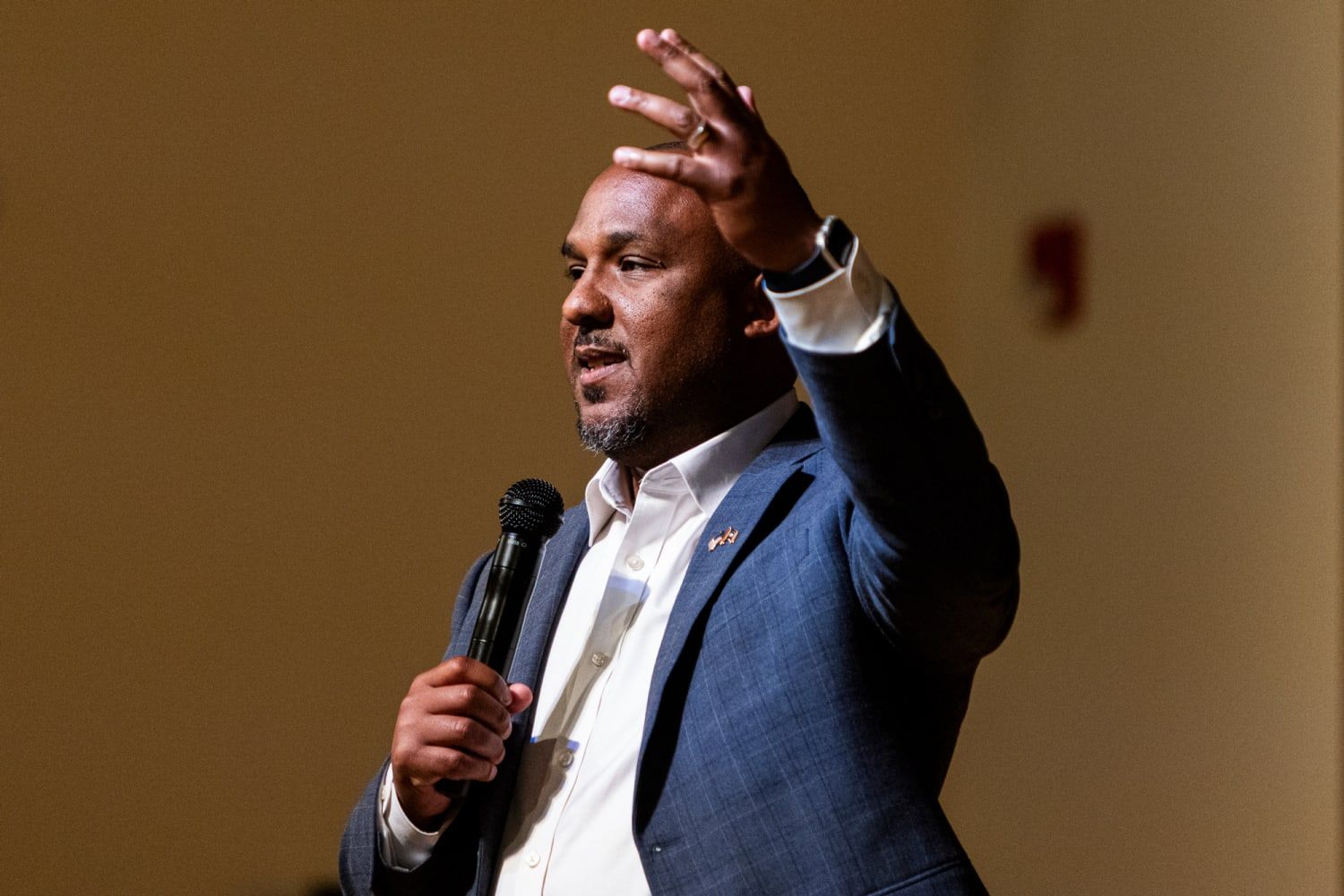
The episode covers three stories: (1) the extremely close Mississippi Senate race, still too close to call after Election Day; (2) California Gov. Gavin Newsom commuting all 548 California death sentences; and (3) the “Super Age Games,” a competition measuring how well people are aging.
Yamiche Alcindor (NBC News White House correspondent, recently in Mississippi); Misty Maris (NBC News legal analyst); Jamie Waters (Wall Street Journal columnist, participating in the Super Age Games).
Mississippi officials are still counting thousands of absentee/provisional ballots; Scott Colom says provisional/mail ballots favor Democrats and his lead could grow. Newsom’s commutations would convert death sentences to life without parole, with legal challenges likely. Super Age Games’ scoring heavily weights aerobic capacity (air bike) and combines event results with lifestyle surveys.
Medgar Evers Airport and Colom’s use of Medgar Evers’ bullet-marked home; California’s “multiple felony restriction” requiring Supreme Court review for 382 inmates; Waters’ balance-beam and cargo-net struggles, yet “super age” score of 27 at age 36.
Written by AI. May contain mistakes.
Discussion on the tight Mississippi Senate race and its historical significance.
“He decided to commute all the sentences of folks on death row in the state of California.”
Exploring the historical significance and voter sentiment in Mississippi.
“So you were in Mississippi, I mentioned, earlier this week.”
Details on the vote counting process and the role of provisional ballots.
“He said, I could have gone anywhere in the world.”
Insights into Scott Colombe's campaign tactics and voter engagement.
“Scott Colom told me that he believes because this is about really now provisional ballots and mail-in ballots that tend to favor Democrats, he believes his lead against Sidney Hyde-Smith, that it's just going to grow.”
Discussion on the potential legal battles following the election results.
“because I asked him this, the direct question I asked him was, how are you doing something the Democrats haven't been able to do in decades?”
Analyzing Governor Newsom's decision to commute death sentences in California.
“They're going to really try to put up a robust legal argument.”
Exploration of the implications and challenges of Newsom's decision.
“That's from the very first Today Show in 1952.”
Learn about the potential legal challenges surrounding Gavin Newsom's death penalty commutations.
“and four of the justices have to give the green light.”
Introduction to the next topic on longevity and fitness competition.
“And when we are back, we're talking about the search for longevity and a new competition that's putting super-agers to the test.”
Learn about a new competition measuring aging and the concept of super-age.
“So we are in the midst of this longevity craze, right?”

Get the gist, explore an idea or ask about something said.
 Claude
On Here's the Scoop, what are the key points of this episode?
Searching your listeningAutomatic transcript. May contain errors.
0:00You walk along a balance beam and you're holding this big tube of water and it sloshes about as you walk, which puts you even more off balance. And you have to go forwards and backwards. I mean, I was absolutely terrible at it. Hi, everybody, and welcome to Here's the Scoop from NBC News. I'm Yasmin Vasugan. So today on the show, how well are you actually aging? Maybe you're 40, 50 or 60, but you feel like your body is like 20, 25 or 30. Well, there is a way to get an answer to that question. I am speaking with a Wall Street Journal columnist who is looking to understand his own longevity ahead of the first Super Age games coming up this weekend.
0:43So we're going to get into all of that. Plus, California Governor Gavin Newsom made a huge decision after the blue tsunami. He decided to commute all the sentences of folks on death row in the state of California. It is certainly going to face some legal challenges. So will they hold up? And why is he doing it now?
1:05Up first, though, so we are still waiting for some results from Tuesday's midterms, and that includes the Mississippi Senate race, which is still too close to call. Democratic Scott Cologne holds a razor-thin lead over Republican incumbent Cindy Hydesmith, and state election officials say that several thousand absentee ballots still need to be counted. If Coulomb is elected, he would be Mississippi's first Democratic senator in over 40 years and the first black senator from the state since 1875. So with time running out to certify these results, how is the race to count every vote in Mississippi going to play out?
1:44For this, I want to bring in NBC News White House correspondent Yamiche Alcindor, who just got back from Mississippi. Hi, Yamiche. Hey. Thanks for joining us. So you were in Mississippi, I mentioned, earlier this week. How are voters reacting to the possibility of its first Democratic senator in decades, really? Well, Yasmin, it's really interesting because as soon as you land in Mississippi, your soul sort of feels the history of the place. You land at Medgar Evers Airport, which, of course, Medgar Evers was this iconic civil rights leader who was shot in his driveway in Mississippi for pushing for the rights of black people to vote.
2:29And that rich history continues to reverberate even today because there are so many people who, when they cast their ballots, they literally still think of Medgar Evers. And Scott Colombe, in his closing argument, featured Medgar Evers and his home where the bullet marks are still in the walls where that bullet killed him. So his home has been preserved. So it's with that history that people are looking at this Senate race. And I asked Scott Colombe about that. How is he feeling about the fact that he's making this history? And he said he really feels that as someone who is something like a seventh generation Mississippian, that he believes that his state has his back and that he's going to have the back of the voters.
3:09And when it goes back to this idea of him making that history, he talked about the fact that he loves Mississippi. He said, I could have gone anywhere in the world. I didn't have to come back to Mississippi, but I wanted to be here because I really believe in this place and I believe that the people here have been forgotten. So he really cast himself as this generational person who is there to tell people in Mississippi, Black people and white people, that they care and that they matter as a people. Yamiche, you spent some time, obviously, as I mentioned there, you interviewed Scott Cologne. For folks that don't know, who is he?
3:43He's someone who is steeped in the history of Mississippi. He has been there for a long time. He went to law school. He actually would have been a federal judge, by the way. This is some interesting fact. He would have been a federal judge. President Biden nominated him for a lifetime appointment. And Cindy Hydesmith, she blocked him from getting that appointment. So if she hadn't blocked him, he would be sitting as a federal judge right now and wouldn't be running against her. You know, we're three days out from this election and Mississippi is still not done counting. What did election officials actually tell you they're doing right now to make sure that every ballot is received, every ballot is counted?
4:24Because they're still getting mail-in ballots right now. Yeah, I talked to election officials and spent some time in a vote processing center yesterday in Jackson, Mississippi. They tell me that they're going through very carefully to make sure that every vote is counted, whether that's a mail-in ballot that was sent in or whether that's what they call affidavit ballots, which we call provisional ballots. You probably heard that term more. Provisional ballots are where someone tried to cast a ballot, but their eligibility was questioned, whether they were on the voter rolls or maybe they forgot their ID.
4:53There could be some sort of issue. They are going through those ballots to first figure out which ones are eligible, which ones are not. And then they're going to go through and count who are the people once they're eligible, who do they vote for. Scott Colom told me that he believes because this is about really now provisional ballots and mail-in ballots that tend to favor Democrats, he believes his lead against Sidney Hyde-Smith, that it's just going to grow. So that's why he says he feels confident that the work that's being done right now is going to favor him. I thought it was interesting because Democrats are saying they're doing outreach to folks that essentially said they're registered to vote, but they were actually turned away from polling sites on election day.
5:30Is there a possibility those individuals could actually still vote if proven they were turned away before the deadline, before polls closed? Yes. If someone who was eligible to vote, but because there was some sort of mix up or some sort of misunderstanding, those people could still vote. And I could tell you, when I was in that vote processing center, there are people literally taking calls. I was sitting next to an older black woman who was telling me about the history of Mississippi because everyone wants to tell you about the history of Mississippi because it's rich. And she was also in between telling stories, picking up the phone and saying, tell me what happened.
6:02Oh, no, that's not right. They shouldn't have done that. Come down here. Make sure that we know what happened. So people are calling in and are being told to call in to say you make sure your vote counts. So it is an active process happening in Mississippi right now. You know, after the election, we kind of did this roundtable discussion. It was Ryan Nobles, Hallie Jackson, Garrett Haake and I. And we talked about, you know, Mississippi. And Hallie made the point in this conversation that Chuck Schumer was literally like boots on the ground for Scott Colombe. He also told The Atlantic this week that flipping Mississippi was his quote unquote white whale.
6:37But when you interviewed Scott Colombe yesterday, he had some pretty strong words for National Democrats. First of all, let's not give him too much credit. They haven't been trying. Right. I've been in Mississippi 15 years. Most of the time, the Democrats conceded to state—
7:18team. How did he actually make this race so tight? He made this race so tight by his own telling, because I asked him this, the direct question I asked him was, how are you doing something the Democrats haven't been able to do in decades? His response was, I showed up. I went to town halls. I went to music festivals. I went to rural areas. I went to populist areas. I went to areas that had been ruby red. And I told people that I care about you, that I see your struggles, that you have suffered enough, and that if I am put in the U.S. Senate, I will do my best to make your life better. And he also told me that at the last minute, yes, Chuck Schumer did give him some money for ads.
7:55And he had these sort of viral ads that people might know about. There's one, you know, pick another protein. I'd rather pick another senator. There are a number of ads that he run. One was looking at sinners. It's the movie Sinners. He actually has an identical twin. So they made a video casting Citi Hydesmith as a vampire trying to get in their home. But those ads were able to get on the air because of some money that Chuck Schumer gave him. But overall, he also says that he doesn't believe that the leaders of the Democratic Party in Congress should be two New Yorkers from the same borough. Those are his exact words.
8:26So the crazy thing is Mississippi does not have a state law spelling out a recount process, right? And this could literally come down to a few votes to decide who actually is winning this thing. So what are these legal experts telling you about what could happen as we get closer and closer to the deadline of certifying the vote in the state of Mississippi? The experts I talk to who are on the ground say that, one, this could just come down to who literally has all the votes when it comes down to even if it's a few dozen votes. Because at one point there were 65, Scott Colombe's lead at the beginning was only 65 votes.
9:00Every vote counts. So even if it's one or two votes, there is no automatic recount law. And then it's going to come down to the legal fight. The Republican Party has made clear they are going to likely file some sort of legal challenge if Scott Colombe is declared the winner here, especially if it comes down to provisional ballots. They're going to try, I think, to really focus on making sure that there was any sort of arguments that they could make challenging the legality of any votes that they think are maybe not in their favor or at least that they think aren't legally cast. They're going to really try to put up a robust legal argument.
9:33But overall, at the end of the day, the state is going to decide who the winner is here. I'm pretty sure Sunni Hyde-Smith is regretting blocking Scott Colombe's appointment to a federal judgeship right about now, considering how tight this race is. Give me Shalcindor. Thank you. Thank you. All right. We're going to take a very quick break. But coming up, Governor Gavin Newsom is commuting all of California's death sentences, more than 500. So how is that moving the national conversation around capital punishment? That's next.
10:25Lock your phone and it still plays, baby. Oh, and it is completely ad-free. Yes, I said it, ad-free. Try YouTube Premium for two months free at youtube.com slash premium. Trial eligibility varies. Terms apply. Cancel any time. Well, here we are. Good morning to you. Al Roker here. That's from the very first Today Show in 1952. And we've been starting the day together ever since. Good morning. Welcome to Today. For 75 years, we've woken up to breaking news. Lent a helping hand and met some pretty incredible people along the way. Oh, it has been such a fun morning on the closet. For generations, you've welcomed us to your neck of the woods and we'll keep welcoming you into ours.
11:08Tomorrow morning and every morning. We are today.
11:15And we're back with Here's the Scoop from NBC News. So on the heels of Tuesday's blue tsunami, California Governor Gavin Newsom has announced that he intends to commute all death sentences in the state. In this open letter, Newsom called the decision, quote unquote, amongst the most difficult of his career, but said he believes that the death penalty is, quote unquote, incompatible with California's values. Newsom is term limited. He is leaving office in January. But he's also been floated as a possible 2028 Democratic presidential candidate. So to understand the criminal justice implications of this decision, I want to bring in NBC News legal analyst, Misty Maris.
11:56Hi, Misty. Hi, Yas. Thanks for having me. It's great to have you. This was a real shock when it came out. It affects 548 death row inmates in California, all of them. It's the highest number of any state in the country, but California has not put a prisoner to death in over two decades. So what does this decision actually do? Yeah, so Yasmin, California hasn't put someone to death since 2006, and there's been a moratorium on executions since 2019. But if, in fact, the commutation goes through as Gavin Newsom has proposed, it would mean that those 548 death sentences are commuted to life without the possibility of parole.
12:45So that's everyone on death row in California. And what I think is interesting from a statistical point of view is that California has the most prisoners on death row of anywhere in the country. So if they were, in fact, all commuted, that would be 30 % of death row inmates nationwide who would be, whose sentences would be life without possibility of parole, and they would no longer fall under that category. There's going to be legal challenges to this for sure. Will all of these commutations stand up to legal challenges, to legal review? Yes, they will. And there's some really specific challenges that are right out there, the first to come.
13:26So when it comes to commutations in California, you have to look at the specific state law. And the California Constitution gives that core power to commute sentences to the governor. But there's actually an exception to that rule. And it's called the multiple felony restriction. So if an inmate on death row has more than one felony, so has two felony convictions, the governor cannot commute the sentence on his own. He actually has to go to the Supreme Court of California. and four of the justices have to give the green light. So there's a process there. And when you talk about the numbers here, yes, 382 of those death row inmates have two felonies.
14:13So they will be subject to that court review. So that's about two thirds, right, of the individuals that we're talking about. With the other, the one third. So that's gonna be its own challenge to move that through the court and will be court proceedings and an application the governor will have to make with regard to those inmates. With the others who only have one felony, there's a lot of power for the governor to make that determination on his own. But victims advocates groups have already spoken up, and they're talking about other legal challenges to all of the commutations, not just what I'm speaking about, which is written into the California Constitution with the two felonies.
14:55But there's likely to be a challenge, and victims advocates groups have said as much, that they're going to bring a lawsuit saying that Gavin Newsom, with this blanket commutation, is violating victims' rights laws, laws about technicalities of notice to victims. and also that they're not being looked at case by case. It's being done on a, as per Gavin Newsom, a moral and ethical analysis of the death penalty being against the values of California. So that's another legal challenge that is sure to come. I do want to make the point that when the court looks at those two felony cases, the court is looking for abuse of discretion.
15:39So it's important to note that on that challenge, with regard to two-thirds of these inmates that the Supreme Court of California has to agree to, it's an abuse of discretion analysis. So it's a narrow review as opposed to going into the actual facts and specifics with regard to each case. So these two challenges, they're both going to happen, and they're both going to look very different. So it's going to be interesting to see the way that this plays out. We were talking a lot about the death penalty back in September after Krista Pike's botched execution in Tennessee, right? 11 states have abolished the death penalty in the past two decades, but 27 states still have it.
16:21That's according to Death Penalty Information Center. And three people, by the way, were actually put to death in Florida, Alabama, and Indiana just this week. So how does kind of Newsom's decision, how does it fit into the national conversation around capital punishment right now? So there's been a decline, at least when you're talking about the academic analysis of the view of capital punishment in America. There's been a decline in support for it. And as you said, there's a whole bunch of states who have actually abolished the death penalty in the past two decades. and there's states that have not abolished it, for instance, like California, who have said, well, we're putting a moratorium on execution.
17:02So even though it's still on the books and even though it still could be pursued as a penalty, the practical effect is that executions are not being conducted. And I think, Yaz, when you just spoke about Krista Pike, that was another instance where the death penalty was really, really a point of conversation. And the talk goes beyond just her case, right? because it goes to whether or not the death penalty is something that, from a moral and ethical point of view, is supported. Others believe that it is. Then you have challenges with actually facilitating the death penalty, cruel and unusual punishment.
17:40There's been many challenges to the methodology across the country. There's been, with Krista Pike, cruel and unusual punishment challenges with regard to facilitating the actual punishment. So a lot of discussion surrounding that. And many who are looking at Gavin Newsom say that this is giving potentially the blueprint to other governors to make similar overtures to do these mass commutations of those that are on death row. But I do think when you look at the death penalty, it does remain a state-by-state issue, right? So you have states like Florida and Texas who, you know, they move forward with executions.
18:20And then you have states like, for instance, California, as we were just saying, because this is the focus of our conversation today with Newsom, where there's a moratorium on the death penalty. But another public policy argument I would expect to be raised is that there was actually a referendum on the ballot in 2012 and 2016, and California voters actually decided to keep the death penalty on the books. So it's a really complex legal issue when it comes to how states move forward. And it's largely viewed on that state-by-state basis. And then you get to those constitutional issues, which often make their way to the Supreme Court.
18:59Misty Maris, thank you. Thank you, yes. All right. We're going to take a very quick break. And when we are back, we're talking about the search for longevity and a new competition that's putting super-agers to the test. Could you keep up? You're going to find out next. And while you're listening to the ads and thinking about whether or not you are a super-ager, do us a favor, share this episode with a friend. It'll keep them up to speed on the day's news, and it's a great way for us to reach new listeners. I'll see you on the other side.
19:34Hey, what's up, guys? It's Haley Bailey. Okay, I need to tell you about something. I just got YouTube Premium. It's got tons of awesome features like offline downloads, so I can download my favorite videos before I travel and watch them whenever I don't have Wi-Fi, because we all know airplane Wi-Fi is the worst. I get ad-free, I get backroom play, and there's like a ton more in there. You should try it. If you like YouTube, you'll love YouTube Premium. Try it now for two months free at youtube.com slash premium. Trial eligibility varies. Terms apply. Cancel anytime. That's a mouthful. Over the years, I've met people whose lives were changed forever in a single moment.
20:10In my new podcast, Before and After, I explore what happens after that decisive moment. Personal, powerful conversations with Colin Kaepernick, Jeremy Renner, Gabby Giffords, and others. Join me wherever you get your podcasts. Listen to all episodes of Before and After with Lester Holt now, wherever you get your podcasts.
20:35I'm Kristen Welker, and this Sunday on Meet the Press, political earthquake. We'll dig into what it all means for the Democrats reshaping Congress and the Republicans reckoning with their losses. Plus, our political experts weigh in on the impact on the 2028 race this Sunday on Meet the Press.
20:58And we're back with Here's the Scoop from NBC News. So we are in the midst of this longevity craze, right? You've got tech leaders, you've got celebrities, you've got influencers. They're all looking for better ways to live longer and live a much bigger life, right? Well, now there is this new fitness competition that is supposed to measure how well you are aging. It's called the Super Age Games, and it's kicking off tomorrow in New York City. Contestants ranging from their teens to their 70s to their 80s, they're going to do things like walk on a balance beam, test their grip strength, and then hurdle over wooden boxes.
21:33Wall Street Journal columnist Jamie Waters is going to be participating tomorrow and recently took part in a trial run of these games. And he's joining me now. Hi, Jamie. Hi, Yasmin. Okay, so there are eight different events at these games. They aren't all physical, right? Some are cognitive as well. Walk me through what the experience was like in the trial first, because I know you're going to be joining tomorrow, too. there's all these kind of activities that are just so unfamiliar like my body was just like not quite sure what was going on so the so i'll just give a few highlights of the best and worst but the one i one of the ones i struggled with the most was you walk along a balance beam and you're holding this big tube of water and it sloshes about as you walk which puts you even more off balance and you have to go forwards and backwards i i mean i was absolutely terrible at And it's just so unfamiliar, the feeling.
22:32And then there's another physical one where you kind of clamber across this like big rope like net. It's called a cargo net. I guess we are the cargo. And you have to like, it's almost to a bear crawl, but it's on a net. Like you have to stop slipping through. And it's like, it just, it's stuff that you, I guess, wouldn't normally train for in the gym or in your day to day life. How did you compare it to other people that were competing? You get compared to people of your gender in your age range. So that is like the direct comparison. And so I pretty early on, I met two brothers who were in their 30s and I was like, okay, right, you're my direct competition.
23:10So I want to beat you. And then they turned out to be unbelievable. One was like skipping along the balance beam. I was like, were you a gymnast? And then we had to put on 3D glasses and do this tracking thing that F1 drivers do. and you track tennis balls on a screen. It's much harder than it sounds. And I heard the founder of the event tell the one brother afterwards that he was like CIA level at this task. So all of which is to say I was a lot worse than them and sort of took a hit to my self-confidence. And when I got the scores back, I did come last for men in their 30s. No. Oh, I'm so sorry.
23:47Have you recovered from that? I have recovered because fortunately it was a bit of a case of swings and roundabouts because my super age score which is essentially they they gather all the data from the events and then you also I filled out a form about my lifestyle habits and basically they compile it all and give you what they call is a super age which is kind of like a rough approximation of how you're aging and my super age was 27 which I was thrilled about so though I was last for men in their 30s I actually got a younger age than I am. So I... How old are you? I'm 36. Oh, okay. So almost 10 years.
24:23So nine years. Wow. That's huge. Wait, so how do they actually score this? Like scientifically? So, I mean, this event is done with the SuperAge, which is a company, a media and longevity company in collaboration with the Buck Institute for Aging, which is, you know, a research institute. but essentially different activities are weighted in different ways depending on how important they are for aging well for instance um there's this thing called like an air bike or an assault bike which people might know from the gym and you pedal on it and it's there's resistance on the pedals and a fan blows in on your face and it's absolutely horrific and you do that and basically that tests your aerobic capacity okay and that is apparently how long do you do it for four minutes Okay.
25:14I was doing, after three, I was like, I wish I was dead already. I don't want to age. Come on, Jamie. I don't want to live a long life after this. But that test aerobic capacity, which is one of the strongest predictors of how long you'll live well. So the air bike scores get weighted more heavily than anything else. So there is this system to how they do it. So basically all your scores combined, weighted in a kind of, there's a metric that they're using. And then that is combined with your lifestyle habits. And then it's all comparative. It's about how you go compared to other contestants. And also your scores relative to the average American male and female, like the general population.
25:57So there is a bit of... Did you get a score, a better score for not being an American? I didn't. I should have gotten bonus points for being Australian, but they rudely didn't do that. But they did say at the end, when they gave me the score of 27, they said, they emphasize that they were like, this is extremely rough. And after the official games, when there's a lot more competitors, the score is going to get, they're going to get a lot more accurate because there'll be a lot more data to compare it with. But I kind of ignored all that. I was like, no, you told me I'm 27. So I'm 27. You're like, your first answer is the correct one.
26:30That's what I'm sticking with. Exactly. Why do you think people like, you know, I'm sitting here and I'm listening to you and I'm like, what is the purpose of this? Why should I want to know what my longevity score is or my super age score is? What's the point? Yeah. I mean, I think it fits into this culture of optimization. We track everything. And longevity is this buzzy thing that has become you know a cultural obsession a lot of us we associate it with you know billionaire tech bros in cryo chambers and red light rooms and this thing that is like a very associated with money but then we also have this idea of it you know it's associated with with what people have called the blue zones and there's this vision of like you know people in Italy or Greece you know who are in their 80s and sort of laugh their way into old age and and have a very different kind of lifestyle and it's not all carefully tried.
27:32All that's to say is I think that there is this obsession with people who live long, healthy lives and how can we achieve that? And I think, yes, it fits into optimization culture. I also think it's one of those things that I guess a lot of wealthy, successful people have focused on because it's like you want to control your mortality. I mean, it's this thing that's kind of out of reach and it's like, well, I want to control that as best I can. If there's another one, I'm coming. I'm not coming this weekend, but I'm coming. I want to do it. I'm setting myself up. We'll compete against each other.
28:03Well, I'm going to be like 17. Let's be clear. They'll be like, you're a toddler.
28:11Okay, I'm not competing with you there. Jamie Waters, best of luck tomorrow, my friend. Thank you. Thank you very much. I'll need it. All right. That is going to do it for us. Here's The Scoop from NBC News. I'm Yasmin Vasugan. We'll be back tomorrow with whatever the day may bring. And if you like what you heard, subscribe wherever you get your podcasts. And you can also subscribe to our daily newsletter, The Inside Scoop. It's a deeper dive on the main stories of the day that comes out every weeknight straight to your inbox. You can sign up for The Inside Scoop as part of our paid subscription at NBCnews.com.
28:45We'll see you tomorrow.
28:59I'm Craig Melvin. Cheers. Cheers. Cheers. I've always been a glass half full kind of guy. And now I'm talking to some people who look at the world that way too. Some really fascinating folks who share their defining moments, their triumphs, their challenges. Their stories are funny and quite candid. So I hope you'll join me each week. And who knows, you might just come away with your own glass half full. Search glass half full with Craig Melvin from today. on YouTube and wherever you get your podcasts.
One of the most shocking outcomes of Tuesday’s blue tsunami is the Mississippi Senate race, where Democrat Scott Colom has a razor-thin margin over incumbent Republican Cindy Hyde-Smith. If Colom wins, he would be the first Black senator to represent Mississippi since 1875. NBC News White House correspondent Yamiche Alcindor breaks down how provisional and mail-in ballots could still shape this extremely close race – and why Colom is not praising Democrats for their support.
Plus, California Gov. Gavin Newsom wants to commute all 548 death sentences to life without parole. NBC News legal analyst Misty Marris explains the legal roadblocks ahead and the role victims’ rights groups will play.
Lastly, “longevity” is the new “wellness” – but before jumping straight into the cryo chamber, you might want to test your body’s age at the “Super Age Games”. Wall Street Journal columnist Jamie Waters explains why the balance beam threw him for a loop and why everyone from tech leaders to influencers seem to be obsessed with living longer.
Hosted by Simplecast, an AdsWizz company. See pcm.adswizz.com for information about our collection and use of personal data for advertising.