Ask ChatGPT

 Here's the Scoop
23 Sep 2026 · 23m · 9 chapters
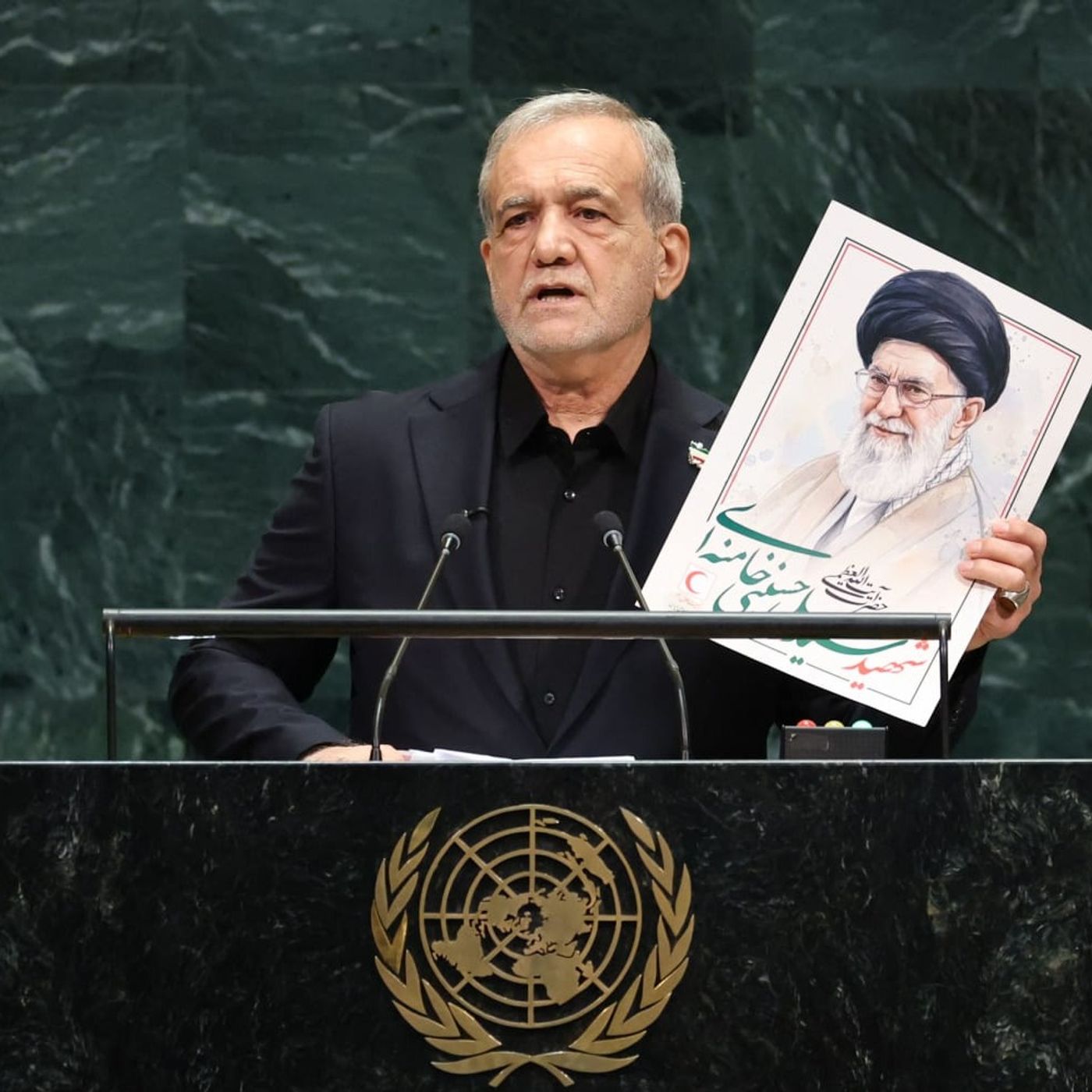
The episode of NBC News’ “Here’s the Scoop” covers three stories. First, Iran’s President Masoud Pazishkian responds at the UN after Trump warns he could “annihilate” Iran, saying the US and Israel started the war and Iran won’t accept “language of force.” Bilal Saab (former Pentagon adviser; Senior Managing Director at Trends U.S.) argues there are no winners, notes behind-the-scenes talks via Qatari intermediaries and a proposed roadmap, and says US domestic politics/midterms are overstated. He also predicts Netanyahu will deliver a prepared speech and may attack NYC Mayor Zohran Mamdani to shift narratives. Second, China’s Xi Jinping visits Trump for an AI-and-trade-focused summit; Janice Mackey-Ferrer (NBC News correspondent in Beijing) says Trump seeks economic gains while Xi seeks reduced tech export pressure, and China frames AI “guardrails” as safety and stability. Third, Dolly Parton’s estate feud: manager alleges nephew/head of security Brian Seaver made violent threats and extortion attempts; Billboard’s Rachel Scharf details messages (“I’m a killer,” “all I do is warfare”) and a restraining-order request.
Written by AI. May contain mistakes.
Discussing the internal conflicts following Dolly Parton's passing.
“It's unfortunately somewhat common in the music world and in general in the world of celebrities and, you know, high net worth public figures that when they pass, there's lots of infighting that happens.”
Analyzing Iranian President Pazishkian's speech and its implications.
“Also, it's been a whirlwind of diplomacy over the last couple of days.”
Insights from Bilal Saab on U.S.-Iran tensions and diplomatic maneuvers.
“So yesterday, we talked about how President Trump warned the U.N.”
Exploring the rhetoric and strategies of global leaders regarding Iran.
“So, you know, this is a day after the president of the United States stood at the same podium in which he said, maybe I'm going to annihilate Iran.”
Discussing Trump's comments on Iran and the complexities of the conflict.
“and yet we still have not been able to achieve the strategic objectives that we set out from the very beginning.”
Examining the significance of Xi Jinping's visit and the AI agenda.
“So President Xi Jinping of China is heading to the White House for a three-day state visit, the first for a Chinese leader in more than a decade.”
Discussing the implications of AI in U.S.-China relations and global policy.
“and China as the steadier, more reliable power in the world.”
Explore how China approaches AI safety and regulation amidst global competition narratives.
“The goal is to really make AI a part of people's lives, an indisputable part of people's lives.”
Understand the allegations against Brian Seaver regarding threats and extortion following Dolly Parton's death.
“So there is a feud brewing over Dolly Parton's estate.”

Get the gist, explore an idea or ask about something said.
 Claude
On Here's the Scoop, what are the key points of this episode?
Searching your listeningAutomatic transcript. May contain errors.
0:00It's unfortunately somewhat common in the music world and in general in the world of celebrities and, you know, high net worth public figures that when they pass, there's lots of infighting that happens. Hi, everybody, and welcome to Here's the Scoop from NBC News. I'm Yasmin Basugin. So today on the show, a feud is brewing in Dolly Parton's estate. The very guy who announced Dolly Parton had died on Instagram, the head of her security of her properties, is going up against her manager who is asking for a restraining order against her head of security, Brian Severs. So we're going to talk about what her manager is alleging is actually happening, the threats, and if this could impact Dolly Parton's legacy.
0:48Also, it's been a whirlwind of diplomacy over the last couple of days. The U.N. General Assembly, the president speaking at the U.N. yesterday, Iran's president speaking today. Well, the president of China, Xi Jinping, is in Washington for the next few days with a state dinner happening Thursday evening. He is meeting with the president as well. And top of mind for this conversation will likely be artificial intelligence or superintelligence, as the president now likes to call it.
1:21Up first, though. So yesterday, we talked about how President Trump warned the U.N. that he could annihilate Iran or make a deal. He hadn't decided yet. Well, today, Iranian President Masoud Pazishkian gave his response, blaming the United States and Israel for starting the war, and then saying Iran will not accept the language of force. Here he is speaking through a translator. Those who are terrorists and train and protect terrorists describe us as such. We have only defended ourselves. We are not terrorists. And then when he said that, the only U.S. delegate in the room got up and walked out.
2:03So for more on what this war of words tells us about negotiations in the actual war and how Iran is positioning itself to the rest of the world, I want to bring in Bilal Saab, Senior Managing Director of Trends U.S., an organization that analyzes global issues and a former senior advisor in the Pentagon during the first Trump administration. Welcome, Bilal.
2:25Bilal Saab: Hey, it's a pleasure to be with you. Thank you. Great to have you. So, you know, this is a day after the president of the United States stood at the same podium in which he said, maybe I'm going to annihilate Iran. Or maybe not. Maybe we negotiate an end to this war. So now you have Iran's president, Pazishkian, standing at that same podium, trying to project strength in his speech. but it didn't seem as if he was really trying to one-up the president. What did you make of what you heard from Pazeshkian, and how do you think it may have resonated in that room of world leaders? Sure. I don't think we should be surprised by either Trump's style at the UN or, frankly, the reaction of the Iranians.
3:15Bilal Saab: I did not expect the Iranians to say, okay, we surrender, that's it, we give up. They're going to continue their defiance. They pretty much have been through the worst of it, to be honest with you, after, as you recall, the 40 days of intense bombing by the Americans. So now they're sort of in a much better place, strategically speaking, at least. Behind the scenes and behind this war of words, as you called it, there are actually interactions going on between the two sides through Qatari intermediaries, as you very well know. A number of hours where Steve Litkoff and Jared Kushner exchanged letters and communicated indirectly with the Iranians.
3:49Bilal Saab: And the Iranians have put on the table an actual roadmap to end the conflict. Now we're trying to figure out whether we Americans are actually interested in this roadmap that they're presenting and whether we can decouple the immediate issue, which is destruction in the Strait of Hormuz and now Babamenda, from the much broader issue, the main reason why we went to war in the first place, which is the nuclear program. This war has not necessarily been supported by the United States' more traditional allies or for, you know, by many for that. Who do you think is kind of winning out in the speech race at the U.N.
4:24General Assembly? Who is sounding more logical?
4:26Bilal Saab: There are no winners in this. There are only losers. And I think the faster both sides realize that, the better it is for not just both of them, but for the international economy. And this is precisely why those traditional Gulf partners that you're talking about are so nervous, because they understand that there are no winners in this conflict, and that the more you spread the pain, the worse it is for everybody. The United States could always project strength, and obviously we are the most powerful nation on the planet, militarily speaking, and yet we still have not been able to achieve the strategic objectives that we set out from the very beginning.
4:59Bilal Saab: So I don't think this war of words really has made a dramatic difference in the trajectory of this conflict. Tomorrow, we're going to hear from the Israeli Prime Minister Benjamin Netanyahu, who released a video saying that he's actually going to tell the truth about New York City Mayor Zohra Mamdani, right? Do you think he's going to try and throw fuel on this fire that is currently burning between the two speeches we just mentioned? And why is it in doing this he's potentially going after a New York City mayor as the prime minister of Israel? Well, I hate to say this, but Bibi Netanyahu is an eloquent speaker.
5:45Bilal Saab: And so he's going to come well prepared with a speech, obviously describing all the evils of Iran and why, you know, they joined the United States in their attack against the Iranians and to try to destroy the nuclear program and so on and so forth. As far as the domestic politics of it all and the attack on Mondani, I mean, I think he understands very well that the popularity of Israel, not just within the Democratic Party, but also in the Republican Party, is probably at an all-time low. And so the only way he could try to address that is by attacking multiple data points, multiple sources of that.
6:21Bilal Saab: And I think he sees him as one of those personalities where, in his mind, if he attacks him, he feels like he can correct the narrative about Israel and probably boost those opinion polls. President Trump said yesterday as well in his speech that he believes Iran is waiting out until the November midterm elections. They're kind of drawing the war out. They're not necessarily wanting to negotiate or find an end to the war because in a way they're trying to harm the president through his own politics. What do you make of that, of what the president said? Okay, the president also said that time now is in our favor and we are winning this conflict and they have very little country left.
7:05Bilal Saab: I mean, we're all trying to catch up, frankly, with what Trump is saying because it is often contradictory. And so there is some truth to actually the fact that now the United States is in a better position, tactically speaking, because they really are inflecting serious economic pain on Iran as a whole, frankly, not necessarily the regime. And so I would suspect that the Iranians will be far more amenable to some kind of a negotiated settlement sooner rather than later. So I'm not sure I exactly, you know, subscribe to the notion that they want to drag this out as long as they can. I don't agree with that.
7:44I will say, though, that we have seen social media posts from members of the Iranian government in which they have mentioned U.S. domestic politics, in which they have mentioned the midterm elections.
7:56Bilal Saab: You know, our opponents obviously read our politics and how they influence policymaking. But I've always been, and maybe I might be in the minority here, yes, but I've always believed that this factor of the midterm elections really is insignificant when it comes to President Trump's prosecution of this war, his management of this war, and what he decides to do, either escalation or, as he calls it, annihilation. I think it's overstated, frankly, the impact the midterm elections have had on his decision-making. I think it's him, how he feels about it, how he assesses risk and opportunity more than anything else.
8:33Bilal Saab: It's not really the well-being of his party. It is himself and him only. Bilal Saab, thank you. Oh, it's my pleasure. All right, we're going to take a very quick break. Up next, President Trump hosts Chinese President Xi Jinping for a historic White House summit. it. How has the AI race set the tone for the meeting? That's coming up. And also, while you're waiting, instead of scrolling on your phone endlessly, why don't you just take this commercial break to send our episode to a friend? We would love to find new listeners. I'll see you on the other side.
9:13Avoiding your unfinished home projects because you're not sure where to start? Thumbtack knows homes, so you don't have to. Don't know the difference between Matt paint finish and satin, or what that clunking sound from your dryer is. With Thumbtack, you don't have to be a home pro. You just have to hire one. You can hire top-rated pros, see price estimates, and read reviews all on the app. Download today. Great meeting. Who took notes? Anyone? With Monday Notetaker, the meeting ends and the plan already exists. Action items, owners, deadlines. Go to monday.com, the AI workspace platform.
9:52And we are back with Here's the Scoop from NBC News. So it has been a busy week for international diplomacy, not just at the United Nations. So President Xi Jinping of China is heading to the White House for a three-day state visit, the first for a Chinese leader in more than a decade. And President Trump is going to be rolling out the red carpet, including a state dinner on Thursday with the heads of America's biggest AI and tech companies. But despite this fanfare, the relationship between Trump and Xi has often been pretty fraught. And a lot is on the line this time, including questions about trade, about AI, and about Taiwan.
10:30So what does each side hope to accomplish during this visit? NBC News correspondent Janice Mackey-Ferrer is joining us from Beijing for this. Hi, Janice. Hey, Yasmin. So President Xi's visit is coming just months after President Trump actually went to Beijing. And we spoke to you then as well. And they have had kind of this love-hate relationship, a bit of a rollercoaster ride, shall we say. Where are these frenemies right now? And what is on the agenda mostly for this visit? I think we're seeing both leaders coming into this state visit wanting stability in their relationship. But they're going to be looking for it in different ways.
11:13President Trump is looking to score some economic gains out of this meeting with Xi Jinping, wants to shore up Chinese purchases of American goods, in particular agriculture, Boeing airplanes, critical minerals, rare earths, that sort of thing. Xi Jinping is looking for stability in the sense that he wants Washington to lessen the pressure on China, in particular when it comes to export controls on technology, because the U.S. is a strategic competitor to China, but it also represents a big business partner in terms of China's economy. There's also some question over whether there's actually going to be any deliverables out of this meeting.
12:04What probably the best case scenario that could happen is that there is an extension to this trade truce between the two countries that's due to expire next month. Xi Jinping is also coming off quite an active diplomatic stretch. He's been in Egypt. He's been in India. So he has been being a player on the global stage, which is what China has been trying to do. It's been part of its ambition over the last several years is to try to position Xi Jinping as the global statesman and the alternative to the U.S. and China as the steadier, more reliable power in the world. Let's talk about AI. Because in the president's address yesterday at the United Nations, he first of all made up a new word, not artificial intelligence, but now super.
13:02It's SI, Yasmin. Yes, it's SI. It's not AI. It's now super intelligence. But then along with that, essentially said, listen, I'm not into this whole global regulation thing, right? Completely kind of dismissing the concerns that we have heard from people inside the industry that are developing this super intelligence, this AI. some of which are going to sit down with President Xi on Thursday evening for this state dinner. How does China kind of position that, position themselves, I should say, considering where the president is at? China wants to position itself as a global leader in AI, as a technology, because they're seeing this not just as a technology, but as an industrial policy.
13:57AI is something that they are trying to integrate into every aspect of the economy, in factories, in education, in healthcare. The goal is to really make AI a part of people's lives, an indisputable part of people's lives. And when you look at the safety aspects around AI, regulation has been in play with Chinese AI as the industry itself has developed. So the guardrails have been in place for companies from the outset. So it's not that there isn't the same sort of concerns in China about AI and about safety, but they do push back on this idea that there's this, you know, global anxiety. They see that as a very strong U.S.
14:53narrative that the anxiety is being drummed up and this idea of a competition is being drummed up by the companies in the U.S., the companies in Silicon Valley. And they see that as some sort of mechanism to create fear that if there are too many constraints put on AI in the U.S., that that will somehow compromise the U.S. lead in artificial intelligence vis-a-vis China. So the argument from China's perspective is that the U.S. companies are saying, oh, we can't slow down because if we slow down, then China is going to take the lead. Even though there's some evidence to suggest that in some ways, China has already narrowed the gap, if not taken a lead in AI.
15:44You talk about how there's already guardrails and regulations, I would say, in place in China. Is that because they foresaw the potential pitfalls of the development of AI? Or is that because it's an authoritarian state? And so naturally, there are guardrails because of the way in which technology is developed inside of an authoritarian state. Either and both. There are some of the restrictions that make sense that there's logic attached to it. Companies are being told that they have to restrict, for example, companion AIs because, you know, AI boyfriends and AI girlfriends are creating a sort of emotional dependence among young people that can venture into, you know, compromising mental health and creating attachments and creating a social upset.
16:33that the government doesn't want to see. The other restrictions are in place, as you say, because with the sort of security and surveillance establishment that exists here, they don't want AI or AI models to become so powerful that they can create a type of social instability that would be not only out of the control of the AI companies, but out of the control of the government or the security establishment itself. So they don't want artificial intelligence to someday challenge the control of the government here. Janice Mackey-Fraer, thank you. Thank you. All right, coming up, a legal battle over Dolly Parton's estate is afoot.
17:26We're going to tell you about it after a very quick break.
17:56You can access FDA-approved GLP-1 weight loss treatment at your lowest possible price if you're covered. Start with Rowe's free insurance checker. Just upload your insurance card to see if you're covered for certain GLP-1 shots. Whether you use insurance or pay cash, Rowe helps you find an option that works best for you. Plus, Rowe's membership plans help you save even more. See if you qualify at Rowe.co. Rx only for side effects of GLP-1 medications including boxed warning. Go to Rowe.co. Go to Rowe.co. Go to Rowe.co. Go to Rowe.co. Go to Rowe.co. Go to Rowe.co. Go to Rowe.co. Go to Rowe.co. Too many meetings?
18:27Too many things falling through the cracks? Monday.com was built for that gap. The AI work platform designed from the ground up for people and agents to work side by side and deliver more together. Drafting the brief, flagging risks, running a competitive scan, your agent can do it all. And the best part, anyone can build one. Even you. Try it. Create your first Monday agent today at Monday.com.
18:56And we are back with Here's the Scoop from NBC News. So there is a feud brewing over Dolly Parton's estate. You remember Brian Seaver, right? He is Dolly's nephew, head of security for her properties. Brian is the one who delivered the news of Dolly Parton's death in a video posted to Instagram last month. My name is Brian Seaver, son of Cassie Parton, and I'm representing the Parton and Owens family today, announcing the passing of my Aunt Dolly, Rebecca Parton Dean. Sister, sis, Aunt Granny to one generation and Gigi to the next. Well, Dolly's manager has now requested a restraining order against Brian Zieber, accusing him of threats of extortion and intimidation.
19:41So what is going on here? For this, I want to bring in Rachel Scharf. She is a senior writer at Billboard covering the intersection of music and law. Hi, Rachel. Hi, how are you? I'm good. That's quite an intersection. But I get why you're covering it, why that's your beat. Yes. Walk us through the estate's accusations here against Seaver. Like, what are they alleging? Right. So the estate of Dolly Parton, which is run by her longtime manager, is alleging that Brian Seaver, who, as you mentioned, was Dolly's nephew and longtime head of security. They're alleging essentially that since her death, he has been making increasingly violent threats in an attempt to extort more money out of the estate than he's already been given through Dolly's estate planning.
20:28Do we know when these threats started? So according to the lawsuit, the threats actually started shortly before Dolly's death when she was in her final days. They say he became, quote, emboldened as she neared her death. And then they increased after her death. According to the lawsuit, they say part of what made him so, quote, unquote, emboldened was that he had this job to announce her death to the world. And that there's a series of text messages attached to the lawsuit as evidence. And in one of them, he says something to the degree of, I'm a star now. I had, you know, everybody watched my video.
21:01It has all these views. Like, I have more negotiating power. I have more leverage because I'm a star. So I think it's not a coincidence that he made that video and then this all kind of spiraled out of control. What are some of the other threats? So there's a lot of text messages and emails, like I said, attached to the lawsuit. In one of them, he says, quote, I'm a killer. In one of them, he says, I'm going to spend the time I have on Earth hurting you and anyone who's betrayed my family. He called himself a mercenary. He referred to himself as an international arms dealer. And in one, he said, quote, all I do is warfare.
21:37Everyone needs to be worried about what I might do. In what context is he saying these things? Do we know? So that's, I mean, that's something to be aware of where he might come out in his defense and say that these are taken out of context because the messages that are attached to the lawsuit are, you know, cropped down to not really show what the full context is. And I imagine having seen a lot of lawsuits like this that he will say these were all taken out of context. I was clearly joking around or I was clearly, you know, using hyperbole or he had said something else violent that I was matching, you know.
22:06So I think that there's definitely going to be room to contextualize these things later on. He did tell the New York Times that he denied threatening anyone associated with Ms. Parton's estate and said that his messages had been twisted to portray him as an antagonist. He also said that Parton would call him killer as a joke. So the estate's asking for a restraining order. What does that look like? What does that mean for Seaver, especially as they're kind of dealing with executing Dolly's estate? Definitely. So the restraining order, if granted, which it hasn't yet been ruled upon, if granted, it would bar him from interfering generally in business operations.
22:47And specifically, there's a physical component to it. It would require him to stay a thousand feet away from, you know, Dolly's properties and staff members. But I think an important caveat is that it's made clear in the papers that they're not seeking to cut him out of the will. They're not seeking to change the distributions he's already been given through the trust. That remains unaffected. that would be, you know, a much different proceeding if you were trying to essentially cut him out of his inheritance. They basically just don't want to deal with him right now. Essentially. They want him to stay away.
23:18Do you think this is going to muddy Dolly's legacy at all? I mean, she's a superstar. She's like, you know, she's such like an idol. Do you think that affects, this affects that at all? Listen, Dolly made very clear during her life that she was doing very careful estate planning specifically to avoid this kind of situation. She did a cover story with Billboard actually in 2020 where she specifically said, I don't want to leave a mask for my family to clean up. It's unfortunately somewhat common in the music world and in general in the world of celebrities and high net worth public figures that when they pass, there's lots of infighting that happens.
24:01And often that's because if you don't have a will at all, for example, Michael Jackson and Prince both died without wills. And there's been like years and years of fighting. But this, I think, goes to show that even if you do very careful estate planning and you really, you know, do everything to get things in order and avoid this, these things can still happen. And at some point it's out of your control. You know, I don't know if it will necessarily change Dolly's legacy, but I do think it's a somber, perhaps, reminder that this is kind of, unfortunately, very apart for the course. Rachel Scharf, thank you.
24:36Thank you. All right. That is going to do it for us. Here's The Scoop from NBC News. I'm Yasmin Basugin. We'll be back tomorrow with whatever the day may bring. And if you like what you heard, subscribe wherever you get your podcasts. And you can also subscribe to our daily newsletter, The Inside Scoop. It is a deeper dive on the main stories of the day that comes out every weeknight straight to your inbox. You can sign up for The Inside Scoop as part of our paid subscription at NBCNews.com. We'll see you tomorrow.
25:15Real talent is defined by what people can do, not where they learn to do it. So by stopping at the education section of a resume, you might throw away the perfect hire. Skills First Hiring helps you see talent others miss, like more than 70 million stars, skilled through alternative routes. Let their story unfold and gain a competitive advantage because hiring managers who start with skills are 60 % more likely to find a successful hire. Hire skills first. Learn why at tearthepaperceiling.org. Brought to you by Opportunity at Work and the Ad Council.
At the United Nations General Assembly on Wednesday, Iranian President Masoud Pezeshkian responded to President Donald Trump’s verbal threats, sending a message of strength, while also casting Iran as a victim of the U.S. and Israel’s aggression. Bilal Saab, senior managing director of TRENDS US, an organization that analyzes global issues, explains how the verbal barbs factor into the ongoing negotiations between the U.S. and Iran. Plus, Chinese President Xi Jinping arrives in Washington on Wednesday for the first visit by a Chinese head of state in over a decade. NBC News Asia correspondent Janis Mackey Frayer explains what Trump and Xi are each hoping to get out of this bilateral meeting and how AI will factor into their conversations. Finally, there’s a feud brewing over Dolly Parton’s estate, with her longtime manager filing a restraining order against her nephew, alleging that he engaged in threats, extortion and intimidation in an effort to get more money. Billboard senior writer Rachel Scharf explains why this sort of infighting is common with a celebrity death — despite Parton’s rigorous estate planning.
Hosted by Simplecast, an AdsWizz company. See pcm.adswizz.com for information about our collection and use of personal data for advertising.