Ask ChatGPT

 Here's the Scoop
9 Sep 2026 · 25m · 11 chapters

The episode covers three stories: US-Iran attacks in the Strait of Hormuz, Nebraska Medicaid cuts driven by an algorithm, and Apple’s fall event including a new foldable iPhone. Matt Bradley (NBC international correspondent) says Iran is escalating to break a diplomatic impasse and survive US economic pressure, with an expanded “exclusion zone” that forces ships to choose US-permitted or Iran-blocked routes; oil prices cross $100/barrel and gas rises (AAA national average about $4.22). He cites sanctions aimed at secondary markets, with China largely absent. Mike Hickson-Baw (NBC senior investigative reporter) reports Nebraska’s “InterRi” algorithm reduces Medicaid home-care funding for disabled Nebraskans, cutting budgets by over $100,000/year; families like Susan and Michael Brown’s two profoundly autistic, nonverbal sons face $225,000/year cuts and potential unsafe care gaps. Nebraska claims it’s for standardized, “fairer” assessments; an outside consultant is reviewing reliability after backlash. Brian Chung (NBC business/data correspondent) details Apple’s new iPhone Duo foldable ($2,000), Touch ID instead of Face ID, 7.6-inch unfolded screen, and AI Siri features; he notes CEO John Ternus’ first major keynote is a high-risk hardware bet.
Written by AI. May contain mistakes.
Discussion on Apple's announcement of their new foldable phone.
“So today on the show, we are talking about Apple products and you're wondering why.”
Exploring the impact of U.S.-Iran tensions on global oil prices.
“Plus, hundreds of people on disability benefits in the state of Nebraska have had their benefits slashed.”
Examination of the military strategies and tensions between the U.S. and Iran in the Strait of Hormuz.
“Tell us about this new round of strikes between the United States and Iran in and around the Strait of Hormuz today.”
Understanding the economic pressures faced by both the U.S. and Iran.
“I was actually kind of on a road trip this weekend with my family, and literally gas prices were super high.”
Discussion on the stalled negotiations between the U.S. and Iran regarding the Strait of Hormuz.
“really adding a lot of volatility to a situation that was enormously volatile to begin with.”
Investigating how a computer algorithm is affecting Medicaid benefits for disabled families in Nebraska.
“See jared.com backslash radio for details.”
Investigating how a computer algorithm is affecting Medicaid benefits for disabled families in Nebraska.
“Lucky Land Casino, where the magic happens.”
Learn how cuts to caregiving budgets are affecting families with disabled individuals.
“Just so I understand this correctly, Mike, how, for David and John Michael, for instance, how has their care been affected acutely?”
The hosts introduce the upcoming segment on Apple's latest products.
“We're going to break down what we learned at today's Apple event.”
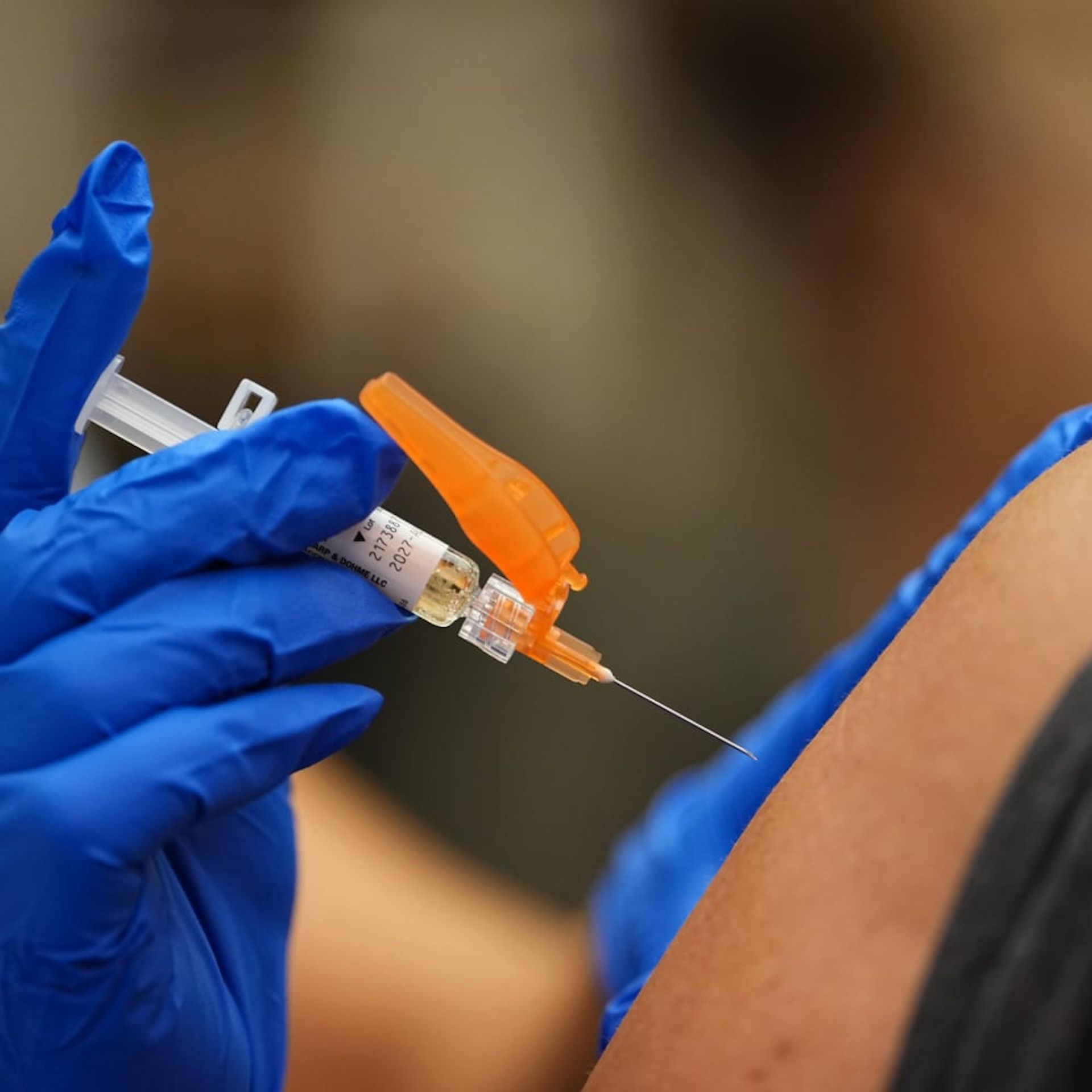
Overview of Apple's new foldable phone, the Duo, and its features.
“And we are back with Here's the Scoop from NBC News.”
The hosts summarize the episode and tease future content.
“And here we are in 2026, and they're still not yet at launch.”

Get the gist, explore an idea or ask about something said.
 Claude
On Here's the Scoop, what are the key points of this episode?
Searching your listeningAutomatic transcript. May contain errors.
0:00Mike Hixenbaugh: It's kind of emblematic of his time at Apple that his first large keynote as CEO of Apple is a huge hardware launch, the biggest change to the iPhone ever with this iPhone duo. But I think that also could be a huge risk for him.
0:15Matt Bradley: Hi, everybody, and welcome to Here's the Scoop from NBC News. I'm Yasmin Basugin. So today on the show, we are talking about Apple products and you're wondering why. So they made an announcement about their new foldable phone in spite of the fact that Samsung and Google were already out with their versions of a foldable phone. But you know how Apple is. They wait and wait, and then they roll out what they hope is the best one. The thing is, the price tag is a whopping$2 ,000. So we're wondering, is it actually worth it? Plus, hundreds of people on disability benefits in the state of Nebraska have had their benefits slashed.
0:57Matt Bradley: And a computer algorithm may be to blame. So we are talking to an NBC reporter who has been digging into this, who spent some time with some families, some parents that are aging, and their children that could be affected. Up first, though, so the U.S. and Iran are back at it with the biggest wave of attacks on shipping in the Strait of Hormuz since the war began, and its sending energy costs skyrocketing. Oil prices crossing$100 a barrel today for the first time since July. So what impact is this having on the global economy? And is there hope for a diplomatic solution for that? I want to bring in NBC News international correspondent Matt Bradley.
1:43Matt Bradley: Hi, Matt.
1:44Mike Hixenbaugh: Hi, Yasmin. How's it going?
1:46Matt Bradley: I'm good. Tell us about this new round of strikes between the United States and Iran in and around the Strait of Hormuz today.
1:53Mike Hixenbaugh: You know, you and I, we've seen this kind of thing before. We've all seen this before, these sort of flare-ups in the Strait of Hormuz. This war has been going on for six months. But this one looks distinct because this one doesn't look like your run-of-the-mill flare-up. It does look convincingly like Iran is choosing a strategy of escalation and that Iran is hoping that that will help them break the impasse and it will help them survive. They're facing substantial economic pressure from the U.S. blockade. And you can really see that in some of the decisions that they're making. So, you know, they are not just attacking U.S.
2:30Mike Hixenbaugh: warships, which they haven't really done in any convincing way since this war began back six months ago. And they're not just attacking U.S. assets and U.S. bases in places like Jordan. This is actually matched with some rhetoric that looks as though their policies are going to be expanding. You know, they're saying that they're going to be expanding this exclusion zone that they have, which means essentially that any ship that the U.S. allows to approach the Strait of Hormuz, where the Iranians have their current blockade, that that means that that ship will basically be sailing with the permission of the United States, which means that it will then be excluded from the Iranian part of the Strait of Hormuz.
3:10Mike Hixenbaugh: So that really does kind of clinch that stranglehold that's already existing.
3:14Matt Bradley: So wait, there's going to be basically two areas in which ships will be moving through. There'll be the American side and the Iranian side?
3:21Mike Hixenbaugh: Yeah, I mean, this is already a two-ply blockade that's been going on for quite a while, but now it looks like the Iranians are saying that they are applying a firmer set of rules on this. And it sounds like they're expanding what they call this sort of zone of exclusion, which means that ships that transit through the area that's currently being, I suppose you could say managed or secured by the U.S. with the American blockade, that those ships wouldn't be eligible to travel through the area that's being secured by the Iranian blockade. So basically, Iran is saying, go with our permission or don't go at all.
3:56Matt Bradley: I was actually kind of on a road trip this weekend with my family, and literally gas prices were super high. I mean, like$4.39 in some places. The national average right now, according to AAA, is$4.22. Brent crude, I should say, is surging, passing this like symbolic, as we talk about often,$100 a barrel mark, which is having the impact that we're now seeing on these energy costs across the board and gas here in the United States. How much do you think these price hikes could affect this tit for tat that we are seeing play out between the United States and Iran and what's happening in the strait?
4:32Mike Hixenbaugh: Well, I mean, it's interesting because, you know, as I mentioned, it's not just economic pressure that's biting on the U.S. side. There's also a huge amount of economic pressure pushing on the Iranian side. So both sides are facing a diplomatic impasse over the strait of war moves and other issues. And both sides are feeling substantial economic pressure to try to negotiate some sort of deal, and yet they can't. So we're not really talking about a paradigm shift here. Despite the fact that the U.S. gas prices are going up and we're seeing the approach of these midterm elections. Everybody that I'm talking to in the region, from the Israelis to the Americans, they all seem to act as though nothing major is going to happen until these elections are over.
5:12Mike Hixenbaugh: So if anything, it just looks like more of nothing can be done until there's some sort of either leadership change or a renewed mandate for leadership in Israel, in the U.S. It's all really adding a lot of volatility to a situation that was enormously volatile to begin with.
5:32Matt Bradley: You know, a few weeks ago, the United States says, OK, they're changing tax, right? They're changing their tactics and they're going to shift to an economic war with Iran. Have those sanctions been instituted on the Iranian economy as of today?
5:44Mike Hixenbaugh: Well, I don't really know. I mean, we haven't really heard that much in terms of details on those sanctions. And most of the real thrust of what was announced, that economic D-Day that came out with so much fanfare, was actually the real big part of it was aimed at sort of the secondary markets, It's those countries that were continuing to do business with Iran in defiance of these U.S. sanctions. So if we see anything at all, it's going to be mostly in the trade that Iran does with its few existing trade partners, most important of all being China. And that was one of the reasons why when we heard about this economic D-Day, the big absent part was real punishment for China, which with their oil purchases are essentially propping up what's left of the Iranian economy.
6:27Mike Hixenbaugh: And it didn't sound as though from the very brief remarks and the very sort of sketchy program that was laid out by Scott Besant that there was going to be any real punishment for Chinese entities or firms that do business with Iran. There were only a couple listed among dozens.
6:45Matt Bradley: So Iran has actually hiked up costs of gas for its heaviest users. What type of effect is this having on the Iranian economy, do we know?
6:53Mike Hixenbaugh: Well, already, I mean, anything that we see is going to add to already sky-high inflation on the Iranian economy. And this is something that is going to be adding and adding to the misery and woes that are already rampant throughout that country. You know, we've seen in the past, long before this most recent war, that things like raising costs for bus fare have sent, you know, hundreds of thousands of people into the street protesting in Iran. So these sorts of economic stressors, they are not far from causing real challenges to the regime from the street level. And that's one of the things that President Trump and his administration are hoping to do or hoping will really bite.
7:32Mike Hixenbaugh: The problem is, is that these sorts of stringent sanctions have been going on for generations. Iran has been the most sanctioned country really in the world, and it hasn't been. So that leads me to my next question, which is, have they made any progress?
7:47Matt Bradley: on negotiations between Iran and the United States? Is anything happening between the two?
7:53Mike Hixenbaugh: No, we haven't really heard about anything in the last couple of weeks. And now even U.S. administration officials aren't boasting about how negotiations are going well. We haven't even heard President Trump really talking about how negotiations are successful, which he used to do, you know, regularly, despite the fact that the Iranians would then come out and say there are no negotiations at all. Now, the one thing that we haven't heard about in a little while of those negotiations that were supposed to be going on between Iran and Oman with the U.S. kind of playing a very, very background role, that was the closest thing we had seen in the past couple of months to something that would lead to the opening of the Strait of Hormuz.
8:33Mike Hixenbaugh: And we haven't really heard that much from it, despite that we were constantly hearing from Qatari officials and others saying a deal is imminent. We haven't heard about that. Matt Bradley, thank you. Thank you. All right.
8:47Matt Bradley: We're going to take a very quick break. But when we are back, an NBC investigation into how a computer algorithm has been slashing Medicaid home care benefits for disabled people and their families. That's coming up after a very short break.
9:06Hey there.
9:07Mike Hixenbaugh: I'm Kat. I'm a college athlete. I was diagnosed with ankylosing spondylitis, which caused back pain and stiffness every day. With Cosentix, I'm able to stay active.
9:39Matt Bradley: bacterial, fungal, or viral infections. Some were fatal. Tell your doctor if you have an infection or symptoms like fevers, sweats, chills, muscle aches, or cough, had a vaccine or plan to, or if IBD symptoms develop or worsen. Serious allergic reactions and severe eczema-like skin reactions may occur. Learn more at 1-844-COSENTICS or cosentics.com.
10:00Mike Hixenbaugh: Move and feel better. Ask a rheumatologist about Cosentics.
10:04Matt Bradley: At Jared Jewelers, we know the right gift can bring a lifetime of meaning. A memory cherished forever. 20 % off storewide. Exclusions apply. See jared.com backslash radio for details. Jared, make the holiday last forever. Shop Jared Jewelers. Looking for your lucky side? You'll find it at Lucky Land Casino. It's your ultimate spot for fun. No app needed. Just jump right into your browser. Spin for free gold coins or collect free sweeps coins for a chance to win prizes. Plus, score daily login rewards every single day. Ready to meet your lucky side? Head to LuckyLandCasino.com right now. Your first surprise is waiting.
10:42Matt Bradley: Lucky Land Casino, where the magic happens. No purchase necessary. VGW group. Voidware prohibited by law. CT &Cs 21+.
10:52Matt Bradley: And we are back with Here's the Scoop from NBC News. So people with developmental disabilities and their families, they often rely on Medicaid to afford care. But in the state of Nebraska, hundreds have had their benefits slashed because of a program using a complicated computer algorithm. All of this is coming as states are preparing for around a trillion dollars in Medicaid cuts over the next decade from President Trump's one big, beautiful bill. Although Nebraska officials say saving money was not the reason they started using the program. So why is this algorithm leading to their funding being cut?
11:29Matt Bradley: And what impact is this having on the families? For this, I want to bring an NBC News senior investigative reporter, Mike Hickson-Baw, who has been reporting exclusively on this. Hey, Mike. Hey, yes. How's it going? I'm good. You spoke with several families for this investigation into these Medicaid benefit cuts in Nebraska. What are they telling you?
11:53Mike Hixenbaugh: The families in Nebraska I talked to are desperate. As you mentioned at the top, these are families whose loved ones, often it's their children, adult children, have profound autism, other developmental disabilities that require constant continuous care to keep them safe. They rely on Medicaid for caregiving that allows them to live safely in their homes or communities rather than being locked away in an institution. And some of these families have relied on these services for decades to keep their children safe at home. And because of this new algorithm assessment tool, many of those families are suddenly being told, your child who has relied on this service for decades, who needs constant care to avoid being a danger to themselves, they don't actually need that much.
12:52Mike Hixenbaugh: And some of these families are facing annual caregiving budget cuts of more than$100 ,000 a year.
13:00Matt Bradley: So you spoke to one family, Susan and Michael Brown. They have two kids, David and John Michael, who both of them have profound autism. Take me inside their home. How have they been using Medicaid? What does their home life look like?
13:19Mike Hixenbaugh: Through these Medicaid programs, Susan and Mike Brown have created a round-the-clock caregiving system, a rotating cast of trusted caregivers who watch over David and John Michael 24 hours a day. They help them eat. They help them get dressed. They bathe them. They keep them from eloping, running out into the street. David is 47. John Michael is 45. They're nonverbal. They are entertained and spend their time doing a lot of the same things that they did when they were two-year-olds. You know, John Michael, while I was there, was playing, like, plinking out notes on the piano and singing out notes.
14:13Matt Bradley: Just so I understand this correctly, Mike, how, for David and John Michael, for instance, how has their care been affected acutely? Like, what does it look like now versus before the funding cuts were put into place?
14:31Mike Hixenbaugh: The potential impact is a combined caregiving budget cut of$225 ,000 a year for just those two. And what it would mean is that the Browns would no longer be able to afford caregivers to provide one-on-one continuous care. There would be gaps in the day. There might be one person trying to watch both of them, which is, as they've showed me when I was there, not safe or practical. And then longer term, you know, Susan Brown, just as these NRI cuts were coming into effect, she was diagnosed with a rare and aggressive breast cancer. She's in her 70s. And that fear that she's always had that many parents like her of disabled children have, that fear of what's going to happen to my sons after I die, that fear that just went to a new level.
15:29Matt Bradley: So now this algorithm in Nebraska, it's called InterRi. They started using it last year. How does it work?
15:40Mike Hixenbaugh: The way it works is a state worker comes and visits with the family. They interview caregivers, family members. They're supposed to review medical records. And they input answers into this long questionnaire full of questions about each person's biographical details and questions about their ability to perform everyday tasks like cooking or going to the store or driving a car. And then all of those answers are inputted into a state system that takes in this NRI algorithm, and the algorithm spits out a funding decision. That tells—this family tells the state how much caregiving funding that each person can receive.
16:27Mike Hixenbaugh: In the case of David and John Michael, the reason that they were blocked from receiving the highest level of funding that they'd always received was because they had never been institutionalized.
16:42Matt Bradley: But they had likely never been institutionalized because they had been getting the care.
16:47Mike Hixenbaugh: That's the paradox. They relied on this Medicaid caregiving to stay out of the institutions. That was the whole goal of these programs. But because they succeeded at that, this algorithm is now saying they can't keep getting the care that made it possible in the first place.
17:03Matt Bradley: So why is Nebraska actually using this? Because they say it's not about funding cuts. This is happening, as I mentioned, as states are preparing for Medicaid cuts related to the one big, beautiful bill. Do we have an answer on that? Yeah.
17:16Mike Hixenbaugh: And Nebraska, although those big, beautiful bill cuts have not really hit state budgets yet, Nebraska is facing a multi-year$1 billion shortfall. So this is happening within that context. But state officials say that's not the goal and that the purpose of this is to ensure that these benefit decisions are fairer, more consistent, based on a standardized assessment rather than human judgment.
17:42Matt Bradley: They're hiring an outside consultant, Nebraska is, to review this algorithm. What do they want to find?
17:48Mike Hixenbaugh: Well, this comes after months of backlash from families who are saying their lives are upended, they're terrified for the safety of their loved ones. And so last month, the state health agency announced that although they're already using this tool, they're going to hire an outside consultant to study whether it's reliable and validated, whether it's working appropriately.
18:13Matt Bradley: You talk about the outrage. I know that recently there was a rally with people with disabilities, along with their relatives, at the Nebraska State House to protest the cuts to Medicaid. How have lawmakers responded to what has been happening in that state?
18:32Mike Hixenbaugh: There are a number of state senators in Nebraska who are calling on the state agency agency in the governor's office to be more transparent about what they're doing with this tool, how it works. And they're also, some of them are calling on the state to pause implementation of this until they can study to make sure that it's actually appropriately assessing the caregiving needs of people like David and John Michael.
18:57Matt Bradley: Mike Hickson-Bow, thank you. Thank you. Coming up, a new foldable phone. We're going to break down what we learned at today's Apple event. That's next. And also, while you're waiting, why don't you pull out your phone, foldable or not, probably not foldable because they're very expensive, and share this episode with a friend. We would love to meet some more future fans of the show. I'll see you on the other side.
19:29Mike Hixenbaugh: Hey there. I'm Kat. I'm a college athlete. I was diagnosed with ankylosing spondylitis, which caused back pain and stiffness every day. With Cosentix, I'm able to stay active.
19:42Matt Bradley: Cosentix Secukinumab is prescribed for adults with active psoriatic arthritis, ankylosing spondylitis, or non-radiographic axial spondyloarthritis, available in both IV infusion and self-injection. Don't use if allergic to Cosentix. Get checked for TB before starting. Increased risk of infections and lowered ability to fight them may occur, like TB or other serious bacterial, fungal, or viral infections. Some were fatal. Tell your doctor if you have an infection or symptoms like fevers, sweats, chills, muscle aches, or cough, had a vaccine or planned to, or if IBD symptoms develop or worsen. Serious allergic reactions and severe eczema-like skin reactions may occur.
20:18Matt Bradley: Learn more at 1-844-COSENTICS or cosentics.com.
20:22Mike Hixenbaugh: Move and feel better. Ask a rheumatologist about Cosentix.
20:54Matt Bradley: Plan term only. Greater than 50 gigabytes may slow when network is busy. See terms. At Jared Jewelers, we know the right gift can bring a lifetime of meaning. A memory cherished forever. 20 % off storewide. Exclusions apply. See Jared.com backslash radio for details. Jared. Make the holiday last forever. Shop Jared Jewelers.
21:16Matt Bradley: And we are back with Here's the Scoop from NBC News. So Apple announced a whole slate of new products at its annual fall event in Cupertino Today. New iPhones, Apple Watches, a brand new, get this, foldable phone. The event also served as a formal introduction to Apple's new CEO, John Ternus. He is the company's longtime product guy who officially took over for longtime CEO, Tim Cook, last week. Our NBC News business and data correspondent, Brian Chung, has been following all of it for us, and he's here to give us the highlights. Hi, Brian.
21:51Mike Hixenbaugh: Hey, are you in the market for an upgrade?
21:53Matt Bradley: Not for$2 ,000, I'm not. Unless the company's playing, of course. So let's talk about this foldable phone, right? Out for Apple, called the Duo. Samsung, Google already had their phones out for quite a while. Apple's like, no, no, no. We got a foldable phone now, too. Is it worth the price tag?
22:10Mike Hixenbaugh: And so this is classic Apple, by the way, not being the first to reveal something because Samsung, for example, has had foldable phones for like eight generations. But they feel like they jump in when the market's ready. And clearly, they think the market is ready for a foldable phone. So enter the iPhone Duo. It's this phone that, you know, if you look at your standard, what they call, I guess, like a candy bar shaped phone. It's just no hinges, just single screen. It's going to be a little shorter. It's going to be a little wider, a little fatter. And it's going to be just a little bit thicker.
22:37Mike Hixenbaugh: But it unfolds into the largest screen that you've ever had in your pocket. In the iPhone's case, it's a 7.6-inch screen that is completely bigger than anything you've ever seen before. So the idea is you could multitask. You could have one window on one side, another window on the other. You can just see, have a more fully immersive viewing experience if you're watching a movie on your device. But if you don't need all that real estate, you just kind of fold it shut and put it back in your pocket.
23:03Matt Bradley: So what differentiates Apple's foldable phone, the Duo, from the other ones that are on the market?
23:08Mike Hixenbaugh: First off, you'll notice that the phone on the back has two cameras, not three. They've had to make some compromises because of the thinness of this device where they couldn't pack in the highest-end cameras that they have. those will be in the 18 Pro and the 18 Pro Max. It's not going to be in the iPhone Duo. They do say it's still a 48 megapixel camera, so it should still be pretty high power. A few other things you'll notice, you probably are familiar now with Face ID, right? Yeah, of course. All you have to do is just look at your phone. The iPhone Duo will not have Face ID. They cannot pack that into this particular device.
23:39Mike Hixenbaugh: So Touch ID is back. Do you remember Touch ID? Of course, with your thumb. Exactly. So you could basically, as you hold the phone on the side of the sleep button, it will also have that touch reader. So it would just unlock it. And if you have an Apple Watch, it can unlock that way as well. When you open the iPhone Duo, you're not going to see a camera because the camera appears to be, and they didn't really talk about this in the keynote, but a bunch of slews online, including myself, kind of noticed that there is obviously a selfie camera inside when you unfold the device. It appears to be underneath the screen.
24:11Mike Hixenbaugh: So it's essentially invisible. But then at some point when you're taking a photo with it, it'll, I guess, hollow out that edge of the screen so that it could take a photo of you as a selfie. So that's something I really want to play with when it comes out. But these are all kind of like unconventional features that they've had to put into this foldable phone that maybe are not features of your existing.
24:28Matt Bradley: When they have like the iPhone 19 come out and the iPhone 20, are those going to be versions of a foldable phone? Or is this just like the foldable phone and then they're going to continue on with the other kind of design Apple iPhone?
24:41Mike Hixenbaugh: Well, I think if the competition is any tell, because with the Samsung Z Fold 8, which I have right here, this has not eliminated the need for their traditional non-folding phones. They still have the S26 or S27, whatever they're on.
24:53Matt Bradley: So this is like an option.
24:54Mike Hixenbaugh: This is an option, exactly.
24:55Matt Bradley: Is it worth the price tag?
24:57Mike Hixenbaugh: Well, at$2 ,000, that's how much the Apple iPhone Duo starts at. Even, by the way, the comparisons, like the Z Fold 8, the Samsung, that's already at$1 ,900. So you're not going to save a lot of money by looking for certain types of foldables. And$2 ,000 is going to be more expensive than the new iPhone 18 Pro, which is already, by the way, I should point out,$100 more expensive than last year's models. So those are going to start at$1 ,200. Oof. That's so much money. For a 2-terabyte version of the iPhone Duo,$3 ,200. Yeah.
25:33Matt Bradley: Any other big reveals aside from the fact that Apple wants to spend a lot of money to continue talking on our iPhone?
25:39Mike Hixenbaugh: Yeah, well, look, they have new AirPods, which can do live translation. So if someone is speaking to you in a different language, you can actually have that on a small lag translated to you.
25:50Matt Bradley: As if you're at the UN.
25:51Mike Hixenbaugh: As if you're at the UN. Yeah, right. It looks probably a little bit better, too, than those huge headsets. But you also have new Apple Watches, where they say that they have better heart rate tracking on those devices. And then you also have, as I mentioned, the new 18 and 18 Pros. Those phones are, again, starting a little bit more expensive than they were last year. But the company says they have better battery life and they have better cameras. They have aperture. Like, you can change in the phone. So, in theory, you should be getting better photos. Real photographers are going to love those.
26:21Matt Bradley: So, the other big reveal, aside from all the products, the shiny products, is the shiny new CEO, right, who is John Ternus. He's got some pretty big shoes to fill, Tim Cook. I mean, Tim Cook, yes, bringing in half a trillion dollars, I believe, right, in revenue yearly. Also, he's kind of made like a celebrity for himself as a CEO of Apple for some time now. What are the expectations from what did we learn about Ternus today in this reveal?
26:47Mike Hixenbaugh: Yeah, look, John Ternus, he's been at Apple for 25 years. He's someone, I mean, when Tim Cook turned it over, people were like, are they going to pick an outsider? They went with as insider as you could get. A guy who's been at the company for 25 years spent a majority of that on the engineering side of the business, worked a lot on the AirPods, worked a lot on the watches. And now it's kind of emblematic of his time at Apple that his first large keynote as CEO of Apple is a huge hardware launch, the biggest change to the iPhone ever with this iPhone duo. But I think that also could be a huge risk for him.
27:18Mike Hixenbaugh: I mean, if you imagine that if this product doesn't land for some reason, it's going to be a fumbled product, but also a fumbled launch for the next chapter of this company. It's not just foldable phones. I think we have to remember, too, that Apple is also a software company, and they are behind the game when it comes to artificial intelligence. They announced a few AI features as part of their announcement today, namely Siri AI. This is a smarter Siri that, you know, we're all familiar with talking with. But the idea is that Siri will be able to look across your applications to add events to your calendars, to summarize conversations you've had on email and messages.
27:53Mike Hixenbaugh: But, yes, I was at the Apple event two years ago at WWDC, what they call the Software Developers Conference. That was when they were teasing these features. And here we are in 2026, and they're still not yet at launch. So they are behind the game. They're behind their own internal target dates to unveil these types of AI features. Is that going to be something that turners can turn around to? That's a major question.
28:17Matt Bradley: Brian Chung, thank you. Yep. That is going to do it for us. Here's The Scoop from NBC News. I'm Yasmin Vasugan. We'll be back tomorrow with whatever the day may bring. And if you like what you heard, subscribe wherever you get your podcasts. And you can also subscribe to our daily newsletter, The Inside Scoop. It is a deeper dive on the main stories of the day that comes out every weeknight straight to your inbox. You can sign up for The Inside Scoop as part of our paid subscription at NBCNews.com. We'll see you tomorrow.
29:06Matt Bradley: or intravenous infusion from the start. Tremphaya is administered as injections under the skin or infusions through a vein every four weeks, followed by injections under the skin every four or eight weeks. If your doctor decides that you can self-inject Tremphaya, proper training is required. Tremphaya is a prescription medicine used to treat adults with moderately to severely active Crohn's disease and adults with moderately to severely active ulcerative colitis. Serious allergic reactions, increased risk of infections, or lower ability to fight them and liver problems may occur. Before treatment, get checked for infections and tuberculosis.
29:40Matt Bradley: Tell your doctor if you have an infection, flu-like symptoms, or need a vaccine. Explore what's possible. Ask your doctor about Tremphaya today. Call 1-800-526-7736 to learn more or visit TremphayaRadio.com.
The U.S. and Iran continue to trade attacks in and around the Strait of Hormuz, which has sent oil prices to about $100 a barrel. The U.S. and Iran are both dealing with domestic economic pressure, but NBC News international correspondent Matt Bradley explains why it’s not enough to get them back to the negotiating table. Then, hundreds of people with disabilities in Nebraska have had their Medicaid benefits slashed after the state began using an algorithm to assess financial need. NBC News senior investigative reporter Mike Hixenbaugh lays out the potential toll of these cuts on the families who rely on government funding to care for their loved ones. And Apple has a new phone — and a new chief. NBC News business and data correspondent Brian Cheung has the deets from the annual fall reveal, including the new foldable iPhone Duo and whether CEO John Ternus is ready to follow in the footsteps of Tim Cook.
Hosted by Simplecast, an AdsWizz company. See pcm.adswizz.com for information about our collection and use of personal data for advertising.