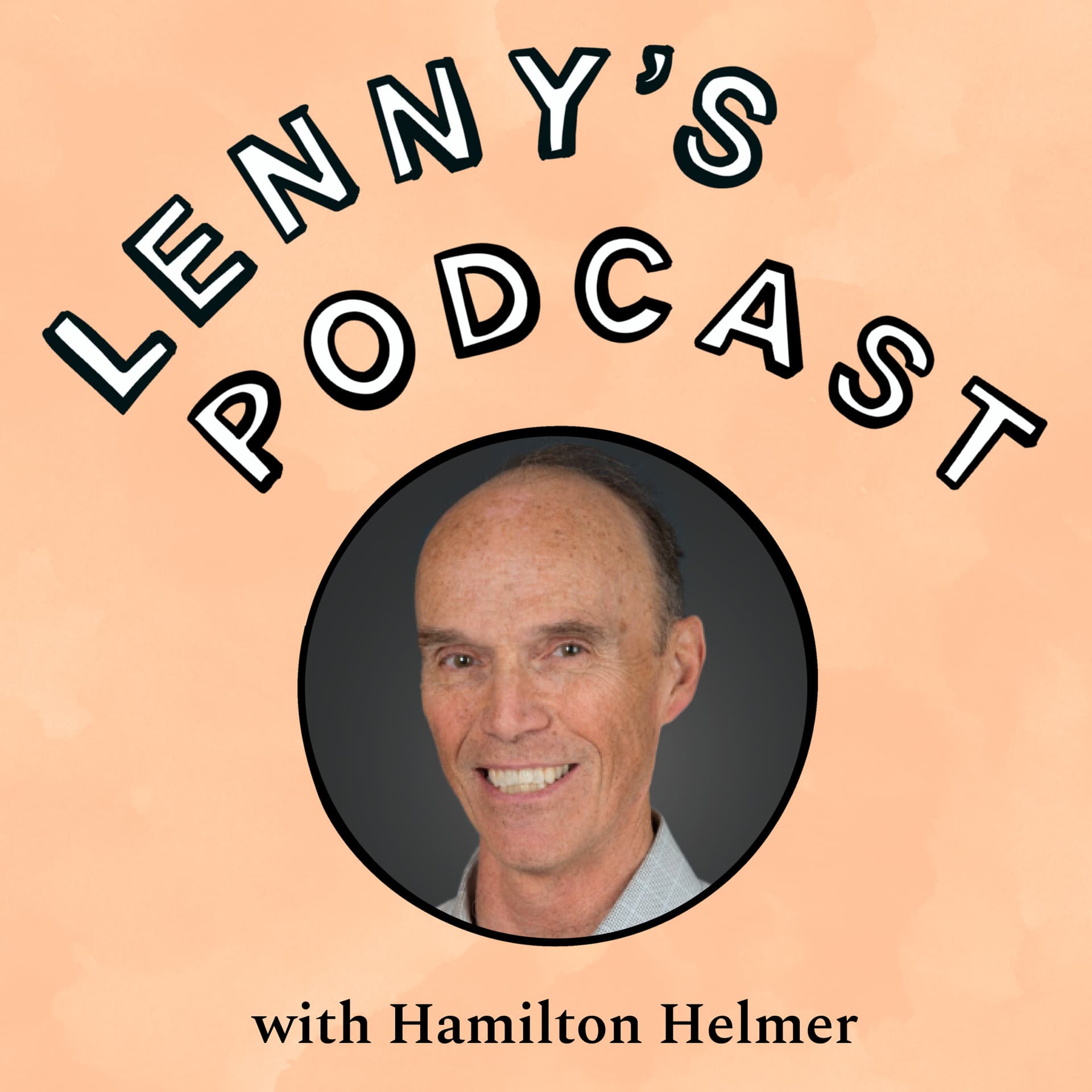
In short
```markdown
Lenny's Podcast
Product | Growth | Career
Episode
Business Strategy with Hamilton Helmer
Overview In this episode, Lenny interviews Hamilton Helmer, an expert in business strategy and author of the book *7 Powers: The Foundations of Business Strategy*. They discuss the framework for achieving competitive advantage and delve into various strategic concepts.
Key Topics Discussed
- Sources of Power for Startups: Key powers that startups should develop from an early stage.
- Common Misconceptions: Misunderstandings companies have about the types of power they possess.
- Strategy and Power: The relationship between strategy and power in business.
- Moat vs. Power: Differences and similarities between the concepts of a moat and a power.
- Practical Strategies: Insights for non-leaders to leverage power and strategy in their work.
- AI's Impact: How AI affects competitive advantages and barriers to entry.
Key Insights
Understanding Power in Business
- Power requires both a benefit and a barrier.
- There are seven types of powers that provide competitive advantage: counter positioning, scale economies, switching costs, network economies, branding, process power, and resource-based power.
The Timing of Strategy
- The importance of considering power at all stages of a company's lifecycle, even pre-product market fit.
- Strategy should not be postponed until after achieving product market fit.
Strategy and Operational Excellence
- Operational excellence is critical but not synonymous with strategy as it can often be mimicked by competitors.
- Execution and process power can be strategic if they are material and inimitable.
Network Economies vs. Network Effects
- Network effects can be common but do not always amount to network economies, which must be significant to provide a competitive advantage.
AI's Role in Business Strategy
- AI doesn't necessarily introduce a new power but can impact existing powers like scale economies and network effects.
- AI may primarily enhance existing business models rather than creating entirely new ones.
Building Strategic Thinking
- Reading foundational strategy literature and engaging in discussions about strategic concepts can enhance strategic thinking.
- Understanding your company's source of power is crucial for making informed decisions.
Personal Recommendations
- Books:
- *The Road to Reality* by Roger Penrose
- *The Gene: An Intimate History* by Siddhartha Mukherjee
- Movie: *American Fiction*
- Product: Farahan Sarouk Rugs
Hamilton's Perspective on Economic Trends
- Concern about the debt trajectory of the U.S. and its potential impact on future economic crises.
- Optimism about the role of entrepreneurship and creativity in economic development.
Final Thoughts
- Action is the first principle of business; theory should guide but not hinder action.
- Encourages continuous learning and application of strategic principles in business endeavors.
Links and Resources
- [Hamilton Helmer on LinkedIn](https://www.linkedin.com/in/hamilton-helmer-42983/)
- [Hamilton Helmer's Website](https://7powers.com/)
- [Lenny's Newsletter](https://www.lennysnewsletter.com)
Sponsors
- [WorkOS](https://workos.com/)
- [Vanta](https://vanta.com/lenny)
- [Paragon](https://www.useparagon.com/lenny)
---
*Note: Lenny may be an investor in companies discussed.* For more episodes, visit [Lenny's Podcast](https://www.lennysnewsletter.com/subscribe?utm_medium=podcast&utm_campaign=CTA_4). ```
Written by AI. May contain mistakes. Listen to the episode to check what was said.
Transcript
Automatic transcript. May contain errors.0:00Hornbuffet, famously said in business. I look for economic castles protected by unbreachable modes. Power requires a benefit in a barrier. So he's taking care of the benefit part by saying a castle. You have to have a pretty good understanding of why it's a castle and not a shack. So in a lot of decks it's like, oh, we have the most amazing team. We move the fastest. You mention how rarely is that actually a power. You're on a treadmill and if you'd stop running that treadmill you get creeped, but it's not power. The things that drive operational excellence once can be mimicked. Let's actually talk about achieving these powers.
0:32There's a single power progression. There are times when certain types of power are available. The path of power is where the lever meets the road.
0:43Today, my guest is Hamilton Helmer. Hamilton is a legend in the world of strategy. He's the author of Seven Powers, which outlines a framework for identifying and developing sustainable competitive advantage. It is widely considered to be the best book on strategy and people like Patrick Hallston, Peter Teal, Reed Hastings, Daniel Eck, and so many more leaders credit the book and Hamilton's teachings for helping them build durable lasting companies. In our conversation, Hamilton shares what sources of power startups can start developing early, which types of power companies often think they have, but they don't.
1:19How power relates to strategy and modes? Once to start thinking about power, as a startup, and also what individual product managers and non -leaders can do about these insights about power, also how Hamilton sees AI impacting various entry and the sources of power. He also gives a preview of his new book that he is working on currently, and so much more with that, I bring you Hamilton Helmer after a short word from our sponsors. And if you enjoy this podcast, don't forget to subscribe and follow it in your favorite podcasting app or YouTube. it's the best way to avoid missing feature episodes and it helps the podcast tremendously.
1:55This episode is brought to you by WorkOS. If you're building a SaaS app, at some point your customers will start asking for enterprise features like Samo authentication and skim provisioning. That's where WorkOS comes in, making a fast and painless to add enterprise features to your app. Their APIs are easy to understand so that you can ship quickly and get back to building other features. Today, hundreds of companies are already powered by WorkOS, including ones you probably know, like Versel, Webflow, and Loom. WorkOS also recently acquired Warned, the Fine -Grain Authorization Service. Warned product is based on a groundbreaking authorization system called Zanzibar, which was originally designed for Google to power Google Docs and YouTube.
2:42This enables fast authorization checks at enormous scale, while maintaining a flexible model that can be adapted to even the most complex use cases. If you're currently looking to build role -based access control, or other enterprise features like single sign -on, scam, or user management, you should consider WorkOS. It's a drop -in replacement for Auth0 and supports up to 1 million monthly active users for free. Check it out at workos .com to learn more. That's workos .com. This episode is brought to you by Vanta. When it comes to ensuring your company has top -notch security practices, things get complicated fast.
3:22Now you can assess risk, secure the trust of your customers, and automate compliance for SOC 2, ISO 27001, HIPAA, and more with a single platform, Vanta. Vanta's market -leading trust management platform helps you continuously monitor compliance alongside reporting and tracking risk. Plus, you can save hours by completing security questionnaires with Vanta AI. Join thousands of global companies that use Vanta to automate evidence collection, unify risk management, and streamline security reviews. Get $1 ,000 off Vanta when you go to vanta .com slash Lenny. That's V -A -N -T -A .com slash Lenny.
4:08Hamilton Helmer, thank you so much for being here. Welcome to the podcast. Hi, Lonnie. A pleasure to be here. It's even more my pleasure. I want to start by talking about when power becomes important. When do you recommend founders start thinking about power in terms of pre -product market fit, post -product market fit, is it worth spending time thinking about power early? Obviously, it's good to think about a little bit, but how much and how seriously should founders be thinking about it before they found something that people actually want? One of the things that has really surprised me in the last five years has been that my understanding of the answer to that question has changed.
4:51And before I thought it was, you do product market fit and then you do strategy and if you try and put strategy before a product market fit. It doesn't, it is not much you can do with it. That's wrong. Actually, one of the, I mentioned before, one of the great pleasures for me in my work is being able to talk to company founders. And one of the things that has surprised me is that And conversations with them, even at an early stage about strategic matters, have a richness and relevance to me that was unexpected. And founders are practical people, right? I mean, they're, it's very hard to do what they're doing and they have to be extremely focused and choose what's worthwhile spending time on.
5:54And so in observing their reactions in that dialogue, I could see that there was something going on that was meaningful to them. And this second book I'm working on will tease out why that's so more. But the answer to your question is when should you thinking about this? The answer is always. And that's an odd answer. And so even before you have product market fit, it's worth thinking about strategy. Now it's not strategy in the sense of sort of this fully articulated strategic planning. We're going to do this. These are going to be the competitors. This is going to how we're going to answer them.
6:43This is how we'll price not like that at all. at the earlier stage, you can imagine, you know, while the more degrees of freedom. And the questions are of the business propositions that you're thinking of in trying to get to product market fit. What are the underlying characteristics that might tilt them towards the availability of power or not? And those actually are meaningful conversations. And certainly by no means certain, right? You're still thinking probabilities. You're not creating a determinative things. And then later on, once you've already have product market fit, then you have to understand your source of power if you're to understand what competitive position is because then you have to establish that.
7:39And then later on, in a more stable phase when you're in a stability phase of business, because you have to know what your source of power is if you have one, because you have to know how to defend it. And then also, it is also the foundational knowledge that you need for if there's another step, because another thing that's quite surprising about iconic businesses is they often have a second act or third act or fourth act. I mean, think of AWS or Intel going into CPUs or Apple going into iPhones, all not the original business, right? And that's actually common, not unusual. And that's starting the process all over again.
8:24Awesome. You mentioned this word strategy. I want to set a little foundation here. How does strategy relate to power when people are thinking about these two concepts? And then do you have just like a nice definition of what strategy is? Everyone's always just like, what the heck do you mean when you're talking about the strategy? You know, as I said, I'm sort of a concept person, right? And so when you develop concepts, you have to be very highly constrained by their usefulness. You know, I'm a great fan of the great mathematician John Bonnoim. And he had a view which really irritated a lot of mathematicians, which is that if, If mathematics wasn't guided by what was useful, it would become, I think the word he used was aesthetic to aesthetic.
9:14And so any concept developments like that, it needs to be guided by usefulness. So in dealing with strategy, the question is, what domain of things do you want to include in that conversation? Because the term is ubiquitous in business. I mean, do a Google search sometime. I have done one recently on Google Scholar for the word strategy, and you'll get a million, I'm not exaggerating a million hits. And so, strategy for some people might mean everything that gets to the pile, gets to the top of a pile in terms of what you have to do that year. everything. And that's a perfectly legitimate definition, you know.
10:04But what I have found is that there is a very important narrowing that makes it much more useful. So that's coming back to what I was saying about time. That makes it much more useful to the business. So my My view is that you want to focus, it's very useful for a business to focus on the fundamental determinants of business value. And that's an arbitrary choice. It could be something else, but I can tell you from decades of business experience that narrowing is very useful. And then so once you make that, once you reach that understanding, it tells you some important things. So if you understand what drives business value, I mean if you do the math of it, right, it's NPV of cash flow, right, expected cash flow.
11:00And what that tells you is that strategy is a long, long time concept. You're looking far up in the future. So think of Pearl Harbor. Pearl Hargrove for the Japanese was this enormous tactical success. They just destroyed the US ability, naval ability, and the Pacific Ocean. And the worst possible strategic move because it completely solved Franklin, Bellino, Roosevelt's problem of how he could get the US citizens on board to attacking Hitler. The strategy of it was US's industrial might would eventually win the war and population. And the difference there is time constant, tactical, short strategy long.
11:53And so if you focus on value, that narrows what you think about and allows you to get rather concise and offer up advice to founders about what they need to pay attention to. So then how specifically is power in forming strategies? Like the way you think about it, focus on your power and that will inform your strategy. Earlier I talked about these economic structures that provide durability in terms of refuge from weathering arbitrage of everybody who wants to eat your lunch, right? And so that's what power is. So you have to understand what is an economic. I think you're asking me questions that get pretty deep into theory or I hope you don't this is a duke and zup shoul.
12:45But you have to say you have to understand how competition takes place and say what is it that creates some kind of refuge. And what it is is there's something in what you do that gives you either a cost or price advantage over others. So let's say you're lower cost and that's the benefit. And the barrier side is that there's something that is durable about that that makes it over time that you can't, that competitors can't take away from you. So benefit in a barrier called the to be or not to be test right. And if you have that, you can think of that immediately translating it into value because that will give you good margins out into the foreseeable future, which is what you're after.
13:43And so I don't know if that's we're getting into the weeds here, but that's what it's about. And so power is those structures. Let me give you quick example. So, one I use in the book. So, Netflix would feel like, he's right, they more subscribers, the cost of their content is a very large fixed cost, about 50 % of their cost structure over a year. They can take that fixed cost and spread it over more subscribers, so their cost per subscriber is less. So, versus somebody with fewer subscribers. So, if they were, if they face the same prices as their, as descriptions as their competitors, they will be more profitable.
14:31So that's a scale economy. And that's an example of type of power and a common one I'd say. But these things are hard to achieve, because they're kind of the holy grail. So let's actually talk about achieving these powers. Essentially, the argument here is your power informs everything you do because this is the thing that will allow you to stay durable and competitive in the last. There's seven powers. We're not going to talk about all of them if you want to go understand each other. Go read the book. That's not the conversation. All this goes too long. Yeah, exactly. So what I'm wondering is, okay, so say you're looking at this list of seven powers and your specific type of startup.
15:14Do you have a heuristic that tells you, here's most likely the power and set a subset that will most likely be an option for you? Like, V2B SaaS companies, is there a smaller subset? Like probably one of these has to be one of your options versus B2C. That's a great question, Lenny. Because I think the path of power is where the rubber meets the road. And it's very complicated and nuanced, but I'll give you a few thoughts along it. And frankly, our next book, the second invention, that's what it's about. It's about the power of man, the entire book. So in a book, there's a thing called Power Progression, which says it tells over the cycle of a business, there are times when certain types of power are available.
16:12and the converse of that is times when they're not available. And so there's some that only are really available in the, when you reach the stability phase of a business pretty far out there. And so if you're starting a company, take those off the table. So those two are branding and process power. So often, I find that there's a confusion about this because brand recognition first start up may be incredibly important, but you can get brand recognition by buying and adding the Super Bowl. That's not power that you paid for it. And so take branding and process power. And process power is really sort of operational excellence on steroids kind of, and usually is immutable.
17:02So it's usually not. So take those off the table. And then a kind of resource to power, which is you have something that is of value that if you transfer it to somebody else, it would be a value to them, but you own the rights. So the barrier is law, for example, or lack of knowledge from others. And there are classes of businesses that are like that. So prescription pharmaceuticals, right? If you have if you're the first person to come up with Viagra, that's worth a lot of money. If you took that license and gave it to somebody else, it'd be worth a lot of money to them. But that's a different class and it's usually not the types of things that that either I'm dealing with and it's and it's and it's kind of obvious to everybody.
17:54So the key challenge there is can you invent a pharmaceutical that's effective for a large market. So you can take those three off the table and that then leaves power positioning, scale economies, switching costs and network economies. And the important thing to keep about in mind there is that they're sequenced. So, almost every startup that you want to deal with starts with counter positioning, because remember what product market fit is primarily is a substitution. It's you are coming up with a way to satisfy a more or less existing need in a novel way that creates more value. Now there are sometimes you tap into entirely new needs, but it's not so often.
18:53I mean, Amazon was up against brick and mortar stores. Google was up against Yahoo, who, you know, and so on. And so you're usually substituting. And that's and that substitution so you're competition at that point is functional competition. And if you don't have counter positioning at that point, you're pretty high risk from an incumbent who already has the capabilities necessary to do that. They just have to extend their product or do this or that. But counter -positioning is the refuge from that. Then you go into the other three types of power scale economies such as Klausa and network economies.
19:48Those depend on your scale relative competitors. This is pretty cursory, but that's what I'd say. Focus on those four. I would recommend that you think pretty hard about whether you think there's UF counterposition into start. Awesome. I actually want to double down on that thread, but just to summarize, I have the list here. Basically, you're saying, if you're in early stage startup, the forward to really, that are actually potential powers for you, at least early on, or counterpositioning which your point is you could just start with that. That's essentially positioning and business model design, which happens at the beginning.
20:28And then you can start to think about network economy, scale economy, switching costs, as powers. Right. And you've done the right thing by not having me go through and define each of those. But your listener will need to sort of go back to my book and see what those things are to get me over. We're going through the shorthand as we should. but all of a sudden won't be completely obvious to them. Yeah, I think a simple Google search I find just gives you a very simple definition of these products. Yeah, that's right. There's some people who have done some really good summaries of this stuff. Or ChatGPT, even better in a lot of cases.
21:05Right, ChatGPT, if they get it right, sometimes I find that they're hallucinating. hallucinating eighth power. You mentioned how some companies think they have a certain power or it's common to think you have a certain power. If you look at every start of deck, there's always like, here's our moat, here's the way we're going to have barriers to entry. I'm guessing in almost every case they're delusional about the power that they actually have and the power they think they'll have. Do you also find that to be true that often founders are like wrong about how much barrier they've actually created?
21:39And is there power you often find most wrong and mistaken? Yeah, so I agree with your observation, but I don't want to be unkind. So, I mean, there are two things to keep in mind here in terms of making people feel better about that incorrect slide. And the fact, one is that founders have to be optimistic, right? I think it's an important quality that they maybe understate the risk a little bit, But they're so committed to, I'm going to do this thing that they go through that. And I may give them an advantage over a large corporation crisis. The other is that despite the name seven powers, which makes it sound like, oh, you can sort this out, actually understanding whether or not there is a type of power in place is hard.
22:34I mean, if I did it with my colleague, Sirus Strategy Capital, and we're looking at a well -known company, it might take us weeks to answer that question for a single company. And it comes down to the hard part of industry economics is what really are the economic relationships and it's very hard. So with those caveats that sort of, I think it was some courtesy, I'll say some of the obvious ones are, I mentioned before, people sometimes think they have brandy power, but another one that I think I heard you mention is people often think that they get scale economies through data. And I'd say that that's possible, but it's rare.
23:22And the reason it's rare is not because there aren't scale economies in data, but rather that the range of scale that the existing competitors have are often large enough to be able to put them in in a shouting distance of each other so that the differences in their cost per unit is not that great. The curve flatens in other words, which is typical of any because the most common scale economy is you've got a big fixed cost and then you and you pro rate that and as you get more and more scale the percentage cost advantage of a fixed cost advantage like that goes down. And that often, so that's a pretty frequent one that we see.
24:14We sort of laugh whenever we say we hear somebody say they have a flywheel, which kind of gives you the idea of network economies. There are often flywheels, the ones that really are material are rare. The key thing here is materiality, not whether the flywheel exists, but whether the effect is strong enough to really tilt returns. I was actually going to ask about that one because it's software and social consumer products. Network effects is always the pitch. Once we get big enough, we create this huge barrier. You mentioned just now, you often find that's not actually true. it's really something that'll be a become a barrier.
24:53Is there anything else you find with network? And I know your power is called network economy, is not network effect. I guess just to be clear, are these kind of the same thing in your mind with different words? Yeah, kind of. I mean, I have called it a type of power. So for me, it's only those things which clear the significance barrier, hurdle rather, that they're a large material, right? And so there are lots of things that I would say have network effects, but not network economies. Oh, interesting. Wait, can you speak to that? So there's a difference between these terms, network economies.
25:29Yeah. So for me, the difference is materiality. You know, whether the value benefit is large enough to engender a price delta significant going to enough to give you materially different margins into the future. Basically, does that network effect have an actual impact on your business and your ability to price? Yeah, it's not an impact. It's a mature impact. So it could have, if it's a penny to your bottom line, that's one thing. If it's a billion dollars or something else. Wow, that's actually really interesting. Is there an example of a company that comes to mind that they had network effects, but not network economies as a power.
26:12Oh, I think you could turn almost anywhere and get some modest network effects. Any platform business would probably likely have some modest network effects. You asked me or in cheerly you sent me about Uber and Lyft. I'd say that they probably have network effects involved, but not network economies. Wow, that's interesting. And the reason you're saying they don't have network economies is because they're still so competitive, they still have to spend so much money to stay ahead. And so that is not the advantage that they get is not material, right? Wow, that's interesting. kind of along those lines, it's so interesting to see Uber and Lyft these days.
27:06In theory, they both had some sort of strong network effect. I was just looking. So Lyft is 5 % the market cap of Uber. Is there a lesson from just what it is that allowed Uber to just win and kind of run away with the market essentially? I'm not entirely sure. I'll take a guess, but I'll, but take it as sort of an unformed guess. I haven't really studied it carefully.
27:38I think that over time, if I had to guess, I'd say they're probably modest sale economies in the business and over time, Uber has just very successfully played a war of attrition. And that's both been in how they run their business. They made one sort of initial misstep, which is they misdefined their business. They said it was international transportation and it's not that business is extremely geographically specific. You know, if you have a great position in the Bay Area, it doesn't help you in London, right? And so their forays into China and everything really didn't make, but they pulled back and that focused down on understanding their source of power, which was a geographically specific scale economy.
28:36And then they've done interesting things like Uber Eats where they've tried to utilize the platform that they have to get other opportunities for the one side of their platform the drivers. And so, so I, if I had to guess, I'd say it was a well -played war of attrition with modest scale economies. And is that attrition coming from a source of power? Is that just like a broader moisture? Yeah, it only works because there are modest scale economies. If there weren't any, then if they did all this stuff, they'd still have a cool currency. Let me go in a slightly different direction. We've talked about power, we've talked about strategy.
29:21There's also this word, moat, that comes up a lot. Everyone's always trying to build a moat. In your mind is a moat equivalent to a power, as there are different, when people talk about these two. Power requires a benefit and a barrier. Right. You have to have something that you do that gives you a better outcome than your competitors, It's lower cost or higher price and then something that makes it impossible for somebody else to mimic that. So mode is the second. So it's not synonymous with power because you can have a mode around a very undesirable piece of property. And wouldn't get you far.
30:04So, but I think it is pretty synonymous with barrier. I think Warren Buffett sort of, Charlie Munger, who I admire enormously, I think I get credit for sort of popularizing those concepts. And I think the way they think about it is good. I'd say that seven powers is probably more systematic and comprehensive and saying that, I don't think there's this wonderful, I don't know if you read any of Microsoft, any trust literature that came out of the lawsuit, but there was a communication between Bill Gates and Warren Buffett, Warren Buffett was saying why he couldn't invest in Microsoft, so he just didn't understand it, right?
Read the full transcript
30:54And so that meant he didn't, you know, the idea of network economies and what the moat was there, he didn't understand. And so I think, but I think the concept of a mode is a good one. The idea that you have something that gives you a refuge from, from a competing forces. In terms of Warren Buffett, I found the quote about modes, Warren Buffett famously said, in business, I look for economic castles protected by unreachable modes. Right. And so he's taking care of the benefit part by saying a castle. Right. He's got a cover. But one of the tricks to understanding power is you have to have a pretty good understanding of why it's a castle and not a shack.
31:39So I'll give you a Netflix example. So a company I admire a lot. And I think if some of the things that they had to do to develop their business were so important for their business that aren't the don't guarantee a castle. So for example, UI development. It's been an enormous amount of resources on trying to get just the very best UI, I mean a Zillion AB tests, all kinds of things. The recommendation engine everybody's kind of knows the story about how that went on, you know, their interface with the content world and all this. So those things are important. There are things they have to spend a lot of time and resources on, but they can largely be mimicked.
32:31So when Netflix and an earlier phase was fighting blockbuster, when blockbuster finally threw in the towel and said, well, we darn will better do a mail order to DVD business. If you look at the blockbuster site, their UI site, you couldn't tell it different from Netflix. I just copied it. And so all that thoughtfulness about which things you put first and now you structure it and all that to make this suitable was immemicable. So that's an understanding of looking at the properties you have and trying to figure out if they're a castle or a shack. Hmm, I love that. This episode is brought to you by Paragon, the embedded integration platform for B2B SaaS product development teams.
33:15Are your users constantly requesting new integrations with other SaaS platforms that they use? Unfortunately, native product integrations take months of engineering to build, and the maintenance never ends. Paragon enables your engineering team to ship integrations seven times faster than building in -house by removing the complexities around authentication, messy third -party APIs, and debugging integration errors. Engineering teams at companies like Copy AI, SINCH, TLDV, and over 100 other SaaS companies are using Paragon so they can focus their efforts on core product features, not integrations.
33:52The result? They're shipping integrations on demand, which is led to higher product usage, better retention, and more customer upsells. Visit useparagon .com slash Lenny. To see how Paragon can help you go to MarketFaster with integrations today, that's use P -A -R -A -G -O -N dot com slash Lenny. So let's take this concept of seven powers. A lot of people are sending to this are just like individual contributor product managers on teams building your product or iterating on products they already have. What do you suggest they do with this knowledge of their exist, these ways to build benefits and barriers.
34:31I'm working on saying new product. What do you recommend they do? What's like something they could do this week next month to infuse these lessons into the products they're building? I'd say they're a few and it's a little bit different. You know, I'm not a great fan of the strategically driven organization because that idea because it fuses over how this knowledge is useful at different stages in the business. And so for somebody in that position, say a product manager and an existing successful business, so it's important in terms of just understanding their business to know what their source of power is because they, and that can inform them about, you know, what it is that they're working for.
35:26And also they may see things since they're down in the weeds. They may see things that, that are important to that that they need to bring to other people's attention. Because they're the ones that really have the knowledge of what that's going on. There's another aspect I mentioned before this idea of transforming of starting up entirely new things. And usually, I wouldn't say usually, I say it's not uncommon for ideas about that to bubble up from down below, you know, and so that's another source. If you're, so let's separate a business into three phases, you know, origination takeoff and stability.
36:15So the answers I've given are more in the stability phase. In the takeoff phase, let's say you've launched a product, you've gotten customer traction. Now you're in a phase where there's just very rapid growth, probably other entrants like you. What are you facing? What you're facing is, remember that underneath all of this is a change in technology. That's what made the product market fit. possible in the first place. But that doesn't just stop. If you're in a technology way, often there are all kinds of offshoots, both for you and the compliments to your business, or else going on at the same time.
36:59And to win at that stability phase, which is really a market share of win, you have to be aware of those and understand, okay, we have to incorporate this new feature, or or maybe now things have gotten to the point where this new market segment is our product is attractive for it wasn't. This is meat potato stuff for somebody at that level. And it may well be the decisive element in terms of whether you win that market share battle with the other contenders. And so you have a very, very important role at that point. And so I'd say the first thing to do with your question is to make sure you think about the different phases of this and then ask what those responsibilities are.
37:51What about for people that are just trying to get better at being strategic, thinking strategically, something every product leader has always encouraged to do, become a better strategic thinker, get build as muscle of strategy, what do you often advise to people will just get better at the stuff. Obviously, read your book. Read the book and then have conversations with your colleagues about the topic. Because as you sort of internalize what that means and how to have conversations with them about, do we really have this kind of power? What's going on here? What's important? What isn't, you know, those conversations tend to allow you to sort of get a better grip on things.
38:33I mean, in the case of Netflix, Reed actually had me come in and train the top 100 people in Netflix and strategy, where I actually ran classes in the company. But that's unusual, I'd say. And I didn't have a book yet. And so I think the book gets people pretty far down that path already. And you don't do that anymore, imagine if someone wanted to do that today, not an option. I sadly don't have time. I do often do, you know, fireside chats at company meetings and that kind of thing, but not a full -blown course, and I'm not teaching at Stanford anymore either. And so I don't. I enjoyed that immensely.
39:19A wonderful people to work with, but sadly, I don't have the time. You're about to get a lot of requests for fireside chats. I hope you're ready. You mentioned AI at some point in our chat. I'm curious how you think AI is going to change your seven powers framework. Do you think defensibility goes down in general? Well, certain forms of power become more important or harder to achieve. How do you think about AI? Yeah, it's a great question. I mean, we're all in this phase of wondering exactly how genera AI is going to play out. My own view, currently, I don't see any change in seven powers from it in terms of an eighth power or something.
40:01But the issues that it brings up, like scale economies, I mean, think of scale economies. If you have to, if you have a fixed cost of trying to develop a model of a billion dollars or something, or network effects will AI models develop so that they learn in a way that for one user's interaction helps another user's interaction. That would be a powerful network economy, or if it learns, if it learns about you and becomes a better psychiatrist or something, then that's a switching cost right. So all these things are relevant to which business models will work and I find that useful. But I think in general the way I think about it is it's a sort of a standard form of potentially very powerful technology that is being introduced into the business world and just asking how that plays out.
41:10I probably tend to think of that there's sort of three types of plays. There's the company that's the technology play itself. So if you think of micro -processors, it would be Intel. There's the companies that wouldn't exist without the technology. So for semiconductors, it would be Microsoft. off. And then the companies that utilize the technology, but they have existed before and after. So for some, again, debtors, there will be automobilization, a ton of chips, but there were still cars before and after. And so I'm kind of of the view, very much uncertain at this point, that generative AI will, its biggest impact will be that tertiary class.
42:02It will be used in a lot of things that existed before and exist after but are made better by it like semi -ductors and automobile. And so it reminds me sort of, if you think of really big technology shifts like this, it reminds me sort of electricity. When electricity came, you could completely reconfigure a factory floor. right? You no longer had to have you could have the power source at essentially at the operating unit of an operator. But but that took a lot of redesigned and corporation investment learning complements all kinds of stuff. I tend to think this will be more like that. But there will be some pure cases.
42:53People will want to have them right. They're turn paper with jet GPC or something. But if you think of businesses, it's hard for me to think of a single functional area in a business that with redesign couldn't benefit. it. So, you know, accounting, HR, R &D, you know, all have uses of this, but requires incorporation, which is always, you know, troublesome. And so, so that's kind of my view. And so, but there may be, there certainly will be businesses that couldn't exist without it and there's something that are coming up but and some of those are the fact the businesses that empower the tertiary need they're the ones that bring in but if you go back this will date me but if you go back into business history that can I guess it was the 90s there was just think hopeless process re -engineering you know the idea that you would you could take a computer sensibility into business processes redesign them and get these monstrous cost savings and it was a gigantic consulting opportunity for people, whole companies got developed based on that.
44:20And it sort of feels kind of more like that to me, but it's very interesting. I could be wrong, but it feels different than crypto. So it feels like there's more in the real ultimate use case. I mean, if it really is true, what they say, that a 50 % improvement in programming efficacy is not uncommon. Just that propositional loan is worth an awful lot of money if you think how many programmers are in the world. No question. You mentioned eighth power. I just want to check is there an emerging eighth power you wish you maybe would have included or may be added in the future that's like oh maybe this is on the edge or it's like nope we got the seven.
45:14You know it's a great question. I'm always looking for it because if you find it it probably means it's so obscure that it will also be a great investment opportunity. We're looking all the time, but so far know, so far I'm pretty satisfied that seven is an exhaustive set But never saying ever, you know, you know, that's an empirical Seven, not a theoretical seven. Yeah, if we start seeing you making incredible returns You've clearly found any power I'm gonna close one thread on the power that you mentioned that is often a miss a kind of a pitfall Which is around process power and basically execution a lot of people think So in a lot of decks, it's like, oh, we have the most amazing team.
45:54We move to the fastest, we're earliest. You mentioned how rarely is that actually a power actually being able to execute and create a process that is an actual barrier. You just talk a bit more about that to help people understand, okay, it's probably not our power. One of the great thinkers in strategy was this Harvard professor, Michael Porter, and he, and probably 40 years ago made the very controversial statement the operational excellence is not strategy. You got a lot of people of Harvard Business School faculty really mad at him because that's what their careers were and it sounds like he was dissing him.
46:30But the point he was making was when you get to kind of this end state, if you already have power, that things that drive operational excellence can be mimicked because you can hire a consulting firm with who has best practices and all the just the coming and get you up to snuff, you can hire people from your competitors who know how to do it better and that, and that's kind of true. But it's also true in the take -off phase in a business that we talked about before, when you're trying to attain competitive of position, operational excellence is everything. And so if you think of not strategy, not statically, endpoints like Professor Porter was, but if you look dynamically, how you get there, operational excellence is essential for a strategy.
47:28And so think of those things I mentioned before about Netflix, about their UI and recommendation editor and so on, our international rollout, all those things. there were in a battle to get more subscribers than other people. And those were critical for that, right? But in themselves, they're critical and obtaining competitive position, but in themselves, they're not sources of power, typically. Unless there's some very tight considerations here, are very demanding considerations for the endless. If they're really there have to be material, but they also have to be opaque or some way people can't easily imitate them either.
48:19They don't understand what's going on or it might be opaque. So for example, think of TSMC. So when they put up when they put up the latest fab, there's, uh, uh, and, and get that operational. Are there, are there a lot of steps in doing that? They kind of know how to do with their staff is training to do, but it's not documented necessarily. And not, and you can't imitate it. Yeah, then maybe, Maybe they have it. I don't know if they have process or not, but it takes that level of complexity. In my book, I use the example of Toyota and a car manufacturing is complex enough that you can have this opacity in terms of material steps, but it's not common.
49:24If you're day is on those issues and it should be because if you if you if you don't do it, a competitor can and they can end up better than you. And so you're always you're on a treadmill. And that's the way businesses that's fine. And if you'd stop running that treadmill, you get creamed. And so you got to do it. It's most of your day, but it's not power. And And there are those rare cases where it's so material and so inimitable that it can be power, but they're rare. I like the heuristic that if you haven't written it down or you can't describe it, that might be a sign that maybe process power is a power of yours.
50:12Yeah. Yeah. And there isn't a consulting firm that offers to bring you up to speed. Making more like Amazon as a service. Yes. Right. Kind of along these same lines, you talk about how the only three things they create value in a company are power, market size, and operational excellence. And I think hearing that will blow a lot of people's minds because they think there's so many things that contribute to the value of a company and you would all add down to these three things. What can you say about that insight? So I'd say they're right and I'm right. They're right because there are this incredible, I mean, businesses really hard, right?
50:58And there are just a multitude of things you have to pay attention for. I'm right because all those things fall into those three categories. So it's an exhaustive set. And it's just, it simply comes out of the math, you know, you know, it's, it, it, so, so we're both right. Let's say. Final question. and the intent of a lot of your work is to empower founders. I'm curious if you've noticed any broad economic trends or shifts that you think will make life easier or harder for founders in the coming years. Personally, I am very, very concerned about the debt trajectory of the United States and many countries around the world, but I'll pick on the United States, but it's a trend going on everywhere.
51:50We're on a trajectory for this extremely high indebtedness. And so if you think about the last 30 years, right, there's been a crisis about once every 10 years. So there's the dot -com bust, there's the financial crisis, there was COVID. You know, I have nothing makes me think that the frequency will be a lot less. I don't know what it is. Who knows? These are all uncertain events. But imagine if we got to one of those and we had no dry powder. And dry powder for us is the ability to heavily deficit spend, take on debt. But unfortunately, our government did that in both the financial crisis and in COVID.
52:38And because that people had jobs, my own view about the financial crisis is that if we hadn't done that, plus having Ben Bernike as the head of the Fed, we would have gone into another great depression. It was that ugly. So this current debt trajectory, you don't know how long it will take exactly what it Eventually that will mean we will not have drive out or people will not respect the credit worthiness of this country and so so I'm that worries me a lot and and and it utterly will affect You know the idea of company founding because if you get into a crisis like that It just you know the capital markets lock up and it gets very difficult to do anything and To really stretch my credibility here Oh, pine on just how hard a problem this is to solve.
53:34The reason this is so difficult for this country to solve in other countries is that it is right at the crux of the delicate dance between capitalism and democracy. So if you think about the problem, of course, that's driving all this entitlements, there's sort of discretionary spending, you know, the, you know, certain recovery programs and stuff. But those can go away. The thing, the underlying trend that people just can't get their arms around us entitlements and anybody who looks at the numbers can see that every economist knows that. But that's not an easy fix. And the reason it's not an easy fix is there are two opposing views of kind of what's going on and there's no way to resolve those two views.
54:29One is that capitalism is repatious and results in more and more inequality and the government has to do something about it and the other is that the government is on a path that that is creaking socialism that will undermine our freedom and economic sufficiency. And the poster child for the rapacious capitalism, one is, I don't know if you've seen the recent analysis of inequality in the United States, it just came out much more robust analysis than it said that basically inequality in the last 60 years in the United States is unchanged. But that's post transfer post tax inequality, which basically says the amount of taxing and transfer going on was about right.
55:18So it says that the amount we're spending is about right from that perspective. That compensates for the other inequities and we should be spending that much. So we should tax more. And the other poster child for the other point of view of the dangers of government is the steadily increasing without interruption percentage of the economy that is government and at two levels, 75 years ago, people would have thought absolutely impossible. So there are these two views about what's going on. One is that we're compensating for the normal inequities of capitalism and the other is that we're headed down a path to socialism and ruin.
56:04and that leads to a deadlock, which is you don't tax anymore and you don't cut spending, and that leads to deficits. So anyway, a long rant, sorry, but that trend is extremely politically difficult to deal with and extremely threatening and that concerns me immensely. not to leave listeners with a very sad state of affairs. Sorry, no, I think this is important. I think it's important people think about this and know these things. Is there anything that gives you hope? Is there anything that gets you excited about either for founders or anyone in general just to kind of leave folks with maybe on a happy?
56:50Yeah, I mean, I am an optimist really in a way. And I do, there's a famous Austrian and an eventually American economist pending Joseph Schumpeter who wrote this wonderful book theory of economic development way back when, over 100 years ago, where he took the unusual view of saying that the vitality and economy depended on entrepreneurs. And I ascribe to that. I think that creativity and action are the ways society and people advance. And I think the U .S. and a pre -society has huge advantages in that. And I think that I'm feel very lucky to be in a place. I mean, so it's a valley, but it would be in a place in a country where that is vital and active.
57:55And that's, and I think that's that's sort of ground zero for me. And so, so I think you see that alive and well, I think, and there are people that are very enthusiastic about that and as I am. Beautiful way to close that or chat. Is there anything else you want to share before we get to our very exciting lightning round. Is there anything you want to leave listeners with or any last tidbit of advice? I sort of alluded to it before, but just remember action is the first principle of business. You do stuff. And my book is very oriented towards that. The idea was not to tell you what to do, but to give you sort of guideposts, follow your on that journey.
58:41And so I just to people that are enthused about it, I encourage you to do stuff, you know, that's where it all starts. And I can think about it and maybe help a little bit, but it's mostly doing stuff. I love that point so much. It was something I was going to touch on, but I didn't get to. There's so many people that just sit around and theorize about a strategy of their business, especially in their early stage. that cheers our grand master plan here's an amazing strategy, or just read about startup ideas and don't actually try it. I love this final note, just try it, just do it. Don't just sit there and enjoy it.
59:18Yeah, just do it. And life is full of surprises. You'll end up in a place you didn't expect. Amazing. Speaking of ending up in a place you didn't expect, it's time for a very exciting lightning round. Are you ready? Oh, sure. I'll do my best here. I'm not very good on lightning, but... First question, what are two or three books that you recommended most to other people? One book that is extremely wonky, and I can only take it in very small doses, but is magnificent, as one called the road reality by Roger Penrose, who is this brilliant mathematician. and it will be very daunting for anybody unless you're a deep math person, but his brilliant scenario edition just shine through in this thing, and it's just, it's an amazing book.
1:00:13I would say there's another book, boy, I wish I could remember the name, maybe you can get the name of the author of book, called Gene, by this geneticist, and I think it's a Harvard medical school professor that's about the history of genetics. And he is an absolutely luminous writer. I mean, it puts me to shame. I'm embarrassed when I read it, because I think how pedestrian my writing is.
1:00:44He's incredibly knowledge about the history of genetics. And I think that's such an important topic. So those are two that I would recommend. I would fairly wonky, but I like them both. I love them. The author just looked him up said, Arthur Mukherji. Yes, just amazing. You just you read it and you'll go, how did he think of that phrasing? I mean, it's just amazing. Do a favorite recent movie or TV show you really enjoyed? I'm a huge movie fan and have been all my life. And I'm particularly keen on animated films. But the movie that I've recently seen that I liked particularly was American fiction.
1:01:27I thought that was it didn't make any of sort of the easy choices in a movie and as a result was just incredibly interesting and thoughtful I thought. Do you have a favorite product you recently discovered that you really love? In my office, just this last week, we actually put a Persian rug in our entry room. And this is what's called a Farahun Sirik rug. And it's 150 years old. And it had an effect on me that I didn't expect, which is it is a work of great. beauty. And it was before, it was all hand done before machines. You get all this wonderful variation of the actual icons in a rug and the different die colors.
1:02:25And I find that every morning when I walk in, I go, that's really beautiful. And it's a blifting. And it shows you the importance of, or the the value of the quality of art. I mean, it's just kind of blows my mind actually. So that's probably not the usual product of discussion that you get. Now I love that answer. Recently we've had some really unique choices. One is a very nice Mercedes and a Rivian and a Venevian. Recently we've got a lot of very nice things. Oh that's good. I'm a card guy too. So I didn't answer in the card. Oh man, I love that. We have a Rory Sutherland coming on the podcast soon.
1:03:09He's one of the leaders of Ogle V and he has a whole thing about how buying a home is like the best value of art to buy art. If you live in a home that makes you feel inspired and is beautiful. Yeah, I'm a big believer in that. I mean, I think that you know, it's sort of your place and how you connect to it has an important grounding effect. and then before I talked earlier about creativity and I think surrounding yourself with an environment that stimulates that is really important and so I couldn't agree with it more. Two more questions. You have a favorite life motto that you often think about come back to share friends or family.
1:03:58One is what Clint Eastwood advice to actors which is don't just do something stand there and so there are a lot of things that are long termish with kind of low signal to noise and you can be often just do a lot of stuff that you think makes a difference, but it really doesn't. And so that's one. The other one, which is somewhat not profound, I think, was one that I had a famous Sri Lankan journalist who was a mentor of mine and a very dear friend. And he had a favorite expression that I had here too all the time, which is everything is always about something else. Wow. Deep. And that's so true if you're dealing with this power stuff.
1:04:55When if you're really dig down, everything is always about something else. Speaking of power, final question. People that have a lot of power are leaders in the world. I'm curious. Do you have a favorite historical leader? So yeah, so I have some that I admire a great deal. I'm a tremendous fan of Winston Churchill's. You know, a quirky, a most leader, most really great people are quirky, you know. And he call up by their things you could say about him that, you know, you might have liked that so much. But he was a genius and at great fortitude, human sense, he understood things long before other people.
1:05:35I've given him high marks. Some of the great artists I admire enormously. I'm just I'm reading a book right now and sort of the last 20 years of Michelangelo, which is a wonderful book actually. And which is a very interesting period because in his first 70 years he sort of finished, you know, he finished up all that he wasn't going to do sculpture anymore. He just finished the last judgment, which was the wall of the cysteine chapel. And I think the last major fresco he did. And a lot of his friends at that time he was exiled from Florence and living at Rome. And the end of this Roman community.
1:06:21And a lot of his close friends had recently died or had difficulty. So he's at this inflection point in this life at 70, which in those days was very old. And yet he went on to do some of the most remarkable architecture in the history of world. And so that, you know, you've got to admire that, you know, I mean, just, I'm sort of doing that, which is that rare second act. So, but I think for world leaders, Winston Churchill is very high. I'm a fan of Teddy Roosevelt, I must say, too, in this country. I love that. Hamilton, you are wonderful. I feel like we have helped a lot of people up level their ability to think about strategy and modes and power.
1:07:07Thank you so much for being here. Two final questions. Working folks find more online if they want to dig in further. And how can listeners be useful to you? Yeah, so as I say, I'm an idea person and I'm about trying to empower company founders and so, so, uh, uh, the only thing I can say is, um, you know, read the book, spread the ideas, start your own company. Those are the things that would make me happy. Amazing. Hamilton, thank you so much for being here. Good. My pleasure to many. Bye, everyone. Thank you so much for listening. If you found this valuable, you can subscribe to the show on Apple Podcasts, Spotify, or your favorite podcast app.
1:07:52Also, please consider giving us a rating or a leaving review as that really helps other listeners find the podcast. You can find all past episodes or learn more about the show at Lenny's Podcasts .com. See you in the next episode!
From the publisher
Hamilton Helmer is one of the world’s leading experts on business strategy and the author of the seminal book 7 Powers: The Foundations of Business Strategy, which provides a comprehensive framework for understanding what it really takes to achieve and sustain a competitive advantage. With more than three decades of experience in the strategic consulting industry, Hamilton has advised over 200 companies—from burgeoning startups to Fortune 100 giants—on how to identify, build, and leverage their unique strategic powers. In our conversation, we discuss:
• Potential sources of power that startups should develop from an early stage
• Common misconceptions among companies about the types of power they possess
• How power relates to strategy
• The difference between a moat and a power
• Practical strategies for non-leaders to leverage insights about power and strategy in their work
• AI’s impact on competitive advantages and barriers to entry
—
Brought to you by:
• WorkOS—Modern identity platform for B2B SaaS, free up to 1 million MAUs
• Vanta—Automate compliance. Simplify security
• Paragon—Ship every SaaS integration your customers want
—
Find the transcript and references at: https://www.lennysnewsletter.com/p/business-strategy-with-hamilton-helmer
—
Where to find Hamilton Helmer:
• X: https://twitter.com/hamiltonhelmer
• LinkedIn: https://www.linkedin.com/in/hamilton-helmer-42983/
• Website: https://7powers.com/
—
Where to find Lenny:
• Newsletter: https://www.lennysnewsletter.com
• X: https://twitter.com/lennysan
• LinkedIn: https://www.linkedin.com/in/lennyrachitsky/
—
In this episode, we cover:
(00:00) Hamilton’s background
(04:08) When power becomes important
(08:24) How strategy relates to power
(12:09) How power informs strategy
(14:46) The sequence of powers
(21:13) Common misconceptions
(24:39) Network effects vs. network economies
(26:58) Uber’s success
(29:16) Moats vs. powers
(31:12) Strategies for non-leaders to leverage power and strategy
(37:51) Advice on how to become a strategic thinker
(39:27) AI’s impact on the seven powers
(45:43) Why moving fast is not a power
(50:24) Three things that create value in a company
(51:16) The debt trajectory of the U.S.
(56:35) Optimism for the future
(59:25) Lightning round
—
Referenced:
• 7 Powers: The Foundations of Business Strategy: https://www.amazon.com/7-Powers-Foundations-Business-Strategy/dp/0998116319
• John von Neumann: https://en.wikipedia.org/wiki/John_von_Neumann
• Pearl Harbor: https://www.history.com/topics/world-war-ii/pearl-harbor
• Where the Japanese Went Wrong at Pearl Harbor: https://pearlharbor.org/blog/where-japanese-went-wrong-pearl-harbor/
• The ‘7 Powers’ of business success—from one of Netflix’s early investors: https://www.qualitycompounders.com.au/post/the-7-powers-of-business-success-from-one-of-netflix-s-early-investors
• 7 Powers: Foundations of Business Strategy (Key Takeaways): https://www.linkedin.com/pulse/7-powers-foundations-business-strategy-key-takeaways-nikita-maloo/
• Strategy Capital: https://strategycapital.com/
• Warren Buffett: https://www.forbes.com/profile/warren-buffett/
• Charlie Munger: https://www.forbes.com/profile/charles-munger/
• Poor Charlie’s Almanack: The Essential Wit and Wisdom of Charles T. Munger: https://www.stripe.press/poor-charlies-almanack
• Bill Gates reveals why Warren Buffett was an invaluable source of support during the stormiest period of his career: https://www.businessinsider.com/bill-gates-interview-warren-buffett-support-microsoft-antitrust-lawsuit-2019-6
• Billionaire Warren Buffett’s Secret Love Affair With Castles, Revealed: https://www.thestreet.com/opinion/billionaire-warren-buffett-s-secret-love-affair-with-castles-revealed-14290973
• Netflix didn’t kill Blockbuster—how Netflix almost lost the movie rental wars: https://www.cnbc.com/2020/09/22/how-netflix-almost-lost-the-movie-rental-wars-to-blockbuster.html
• Michael Porter on LinkedIn: https://www.linkedin.com/in/professorporter/
• What Is Strategy?: https://hbr.org/1996/11/what-is-strategy
• TSMC: https://www.tsmc.com/english
• Toyota Production System: https://en.wikipedia.org/wiki/Toyota_Production_System
• America will be left with ‘severe, irreversible scars’ if national debt goes unchecked. Now, a blockbuster report warns the bill is higher than believed, hitting $141T by 2054: https://fortune.com/2024/04/01/america-social-economic-scars-us-debt-gomes-price/
• Ben S. Bernanke: https://www.federalreservehistory.org/people/ben-s-bernanke
• Forty-four of 50 U.S. states worsen inequality with ‘upside-down’ taxes: https://www.theguardian.com/us-news/2024/jan/10/states-wealth-inequality-taxes
• Joseph A. Schumpeter: https://en.wikipedia.org/wiki/Joseph_Schumpeter
• Theory of Economic Development: https://www.amazon.com/Theory-Economic-Development-Science-Classics/dp/0878556982
• The Road to Reality: A Complete Guide to the Laws of the Universe: https://www.amazon.com/Road-Reality-Complete-Guide-Universe/dp/0679776311
• The Gene: An Intimate History: https://www.amazon.com/Gene-Intimate-History-Siddhartha-Mukherjee/dp/147673352X
• American Fiction on Prime Video: https://www.amazon.com/American-Fiction-Jeffrey-Wright/dp/B0CQKR72NX
• Farahan Sarouk rugs: https://nazmiyalantiquerugs.com/persian-sarouk-farahan-rugs/
• Rory Sutherland on LinkedIn: https://www.linkedin.com/in/rorysutherland
• Ogilvy: https://www.ogilvy.com/
• Clint Eastwood quote: https://www.brainyquote.com/quotes/clint_eastwood_168005
• Winston Churchill: https://en.wikipedia.org/wiki/Winston_Churchill
• Michelangelo, God’s Architect: The Story of His Final Years and Greatest Masterpiece: https://www.amazon.com/Michelangelo-Gods-Architect-Greatest-Masterpiece/dp/0691195498
• The Last Judgment: https://en.wikipedia.org/wiki/The_Last_Judgment_(Michelangelo)
• Theodore Roosevelt: https://www.whitehouse.gov/about-the-white-house/presidents/theodore-roosevelt/
—
Production and marketing by https://penname.co/. For inquiries about sponsoring the podcast, email podcast@lennyrachitsky.com.
—
Lenny may be an investor in the companies discussed.
This is a public episode. If you'd like to discuss this with other subscribers or get access to bonus episodes, visit www.lennysnewsletter.com/subscribe