
In short
Playful parenting to turn everyday childhood chaos into joy through presence, connection, music/movement, and calming routines; also protecting kids’ “bubble” from scary media and helping them cope.
Guest
Kira Willey is a bestselling children’s music artist and former kids music teacher who expanded into kids yoga and mindfulness. She created the Rockin’ Yoga School programs and wrote The Joyful Child.
Key claims
Joy should be the daily approach (not a reward), and parents’ calm is contagious because kids mirror adults’ nervous systems. Transitions are hard because children live in play/flow; use brief connection to make cooperation easier. Movement supports brain development; screens and adult conversations can overwhelm young children.
Notable examples
Get down to the child’s eye level for 30–60 seconds before leaving; “cleanup as a dance party” with a song; “worry box” at bedtime; bear/candle breath; “rise and shine/on the road/brain boosters/time to eat/good night” activities.
Written by AI. May contain mistakes. Listen to the episode to check what was said.
Chapters
Tap a time to open that second in VOKira Willey's Journey to Joyful Parenting
0:45 to 3:52
Kira shares her journey from music teacher to children's mindfulness expert and the importance of joy in parenting.
“You know, you are doing so much to make childhood more joyful.”
Weaving Joy into Daily Life
3:52 to 9:18
The discussion centers on integrating joy into daily family routines for better relationships and smoother transitions.
“It's about creating a transition that works with how the child naturally operates, right?”
Understanding Children's Joy and Transitions
9:18 to 11:21
Exploration of how children experience joy differently from adults and why transitions can be challenging for them.
“So, you know, it's like, if you want to develop the mind, you need to develop the body.”
The Impact of Movement on Learning
11:21 to 14:00
Kira discusses the critical role of movement in children's development and how it relates to their joy and learning.
“I mean, it's way more than a book because you actually get a full, you get a full, it's like a program.”
Protecting Childhood from Negative Influences
15:06 to 19:17
Discover how parents can shield their children from overwhelming negativity and maintain their joy.
“One click and your Sunday night instantly gets happier.”
Joyful Connection Practices for Kids
19:17 to 21:19
Explore techniques to instill joy and connection in children's lives amid chaos.
“They'll just hear about a really scary thing and they could think it's next door and that will affect them.”
Effective Practices for Anxious Children
21:19 to 24:19
Learn practical strategies for helping anxious children feel more secure and relaxed.
“And your book does such an incredible job of opening up all the different ways that we can explore.”
Weaving Joy into Parenting
24:19 to 25:58
Understand how to incorporate joy and playfulness into daily parenting routines.
“So what ages is the joyful child appropriate for?”
Transcript
Automatic transcript. May contain errors.0:03Thank you for joining us for episode 567 of Live Happy Now. This month, we've been digging into how to bring more humor and playfulness into our lives. And today, we're going to learn how to turn the chaos of childhood into moments of fun for the whole family. I'm your host, Paula Phelps, and this week I'm talking with bestselling author Kira Willey, a children's music artist, kids' yoga and mindfulness expert, and creator of the Rockin' Yoga School programs. Her latest book, The Joyful Child, teaches parents how to prioritize presence and play in their children's lives and make everyday moments more fun for everyone.
0:41Let's have a listen. Kira, thank you so much for joining me on Live Happy Now. Thank you for having me. I'm excited to be here. You know, you are doing so much to make childhood more joyful. You've created music, you teach kids yoga and mindfulness, and you write some books. And I love your story about how all of this came to be. So I wondered if you'd talk about that first and how this became your mission. Oh my gosh. Well, I started as a kids music teacher, which I absolutely loved and started incorporating more and more movement into my music classes. And that led to me teaching kids yoga and just incorporating music, movement, and eventually mindfulness with kids with lots of play and imagination and just working with how they're naturally wired, which is to bounce and sing and wiggle and giggle, was so much fun that I started creating my own songs, my own curriculum, my own activities.
1:34and it just took off from there. That is amazing because I think one, it takes somebody special just to be a teacher. I think that's a special gift and a calling because not all of us can do that. And then to be able to take it and extend it, I think that's just an incredible, incredible journey that you've taken so many people on. One of the things that jumped out at me as I was going through your materials is this doesn't just add joy to the child's life. You are really bringing joy to the parents and anybody who's participating too. So can you talk about how a family changes when they set out on this journey to become more joy-filled?
2:10Oh my gosh. We think sometimes of joy as like the destination, the place where we're trying to go, right? If we only do X, Y, and Z, then we'll be happy. I want to change that approach to have joy as the actual approach to parenting in your daily life, weaving it into your everyday moments, the transitions, the routines, the wake-ups, the mealtimes, the car rides, weaving joy into daily life and just having it be part of the purpose on a daily basis, as opposed to this eventual destination, or even like a reward. Like when we get this done, then we can have fun, right? Or when we get the chores finished, we can have fun, right?
2:49No, no. How about we have fun while we're doing the chores? How about we have fun while we're getting in the car, while we're cleaning up the blocks while we're. So making it an approach to your daily life and everybody benefits in the entire family and the wider community, right? Joy is how children naturally, they're born joyful. It's their birthright, so to speak. We just need to create the conditions for that to flourish. We need to clear what's in the way. And then when they're naturally more joyful and we're naturally more joyful, the household is calmer. Things run more smoothly. There's more laughter.
3:24There's more cooperation, right? It's all good. Everything goes better. I was thinking as you were speaking, I was thinking about a mother who is trying to get her kids out the door so she can go to work, she can get them to school. And then how that would change the course of both their days if it was done joyfully. And I know it sounds like an impossible mission. It's like, oh yes, we're going to get up on a Monday morning and we're going to be joyful and leave and get to work joyful. How does that happen? But you make us believe that it can happen. I believe that it can happen. It's about creating a transition that works with how the child naturally operates, right?
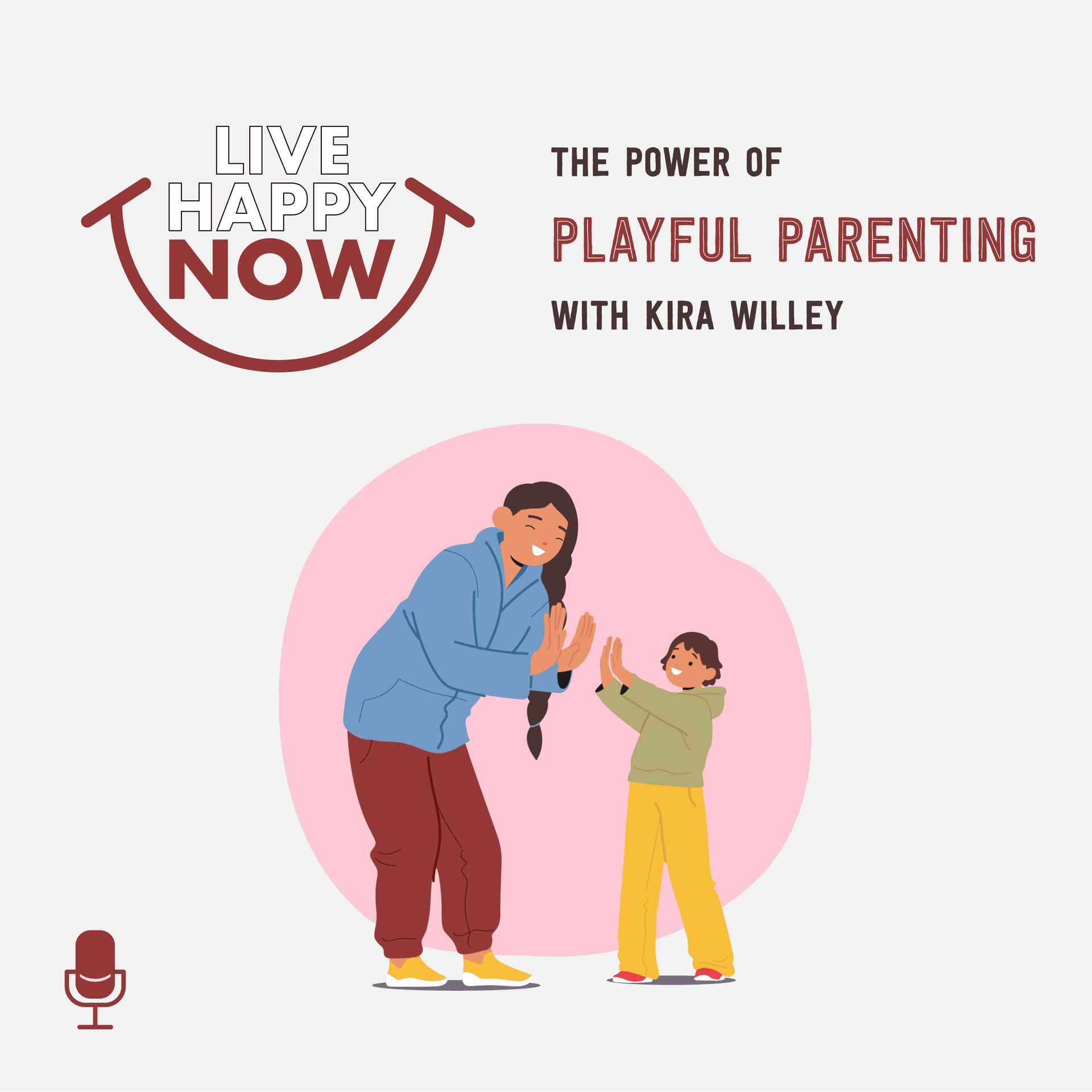
4:01So if you think of, you know, your child's in the next room playing, you're in the kitchen cleaning up the stuff because we got to get out the door. From the kitchen, you're going, we got to go, we got to go, we got to go, right? Your child's living their best life playing something in the other room, why would they want to leave their block city that they're building and come join you when you're hollering at them using all your adult words, right? What needs to happen there is joyful connection. So when you come to them and connect, even just for 30 or 60 seconds, get down on the floor, right?
4:32Get down to their eye level, make eye contact, touch them on the shoulder, hold their hand, hand on the back, right? Some kind of contact. What are you building? What's happening here? Tell me about it. Contact with them. Now they feel seen and heard, right? And after 30, 60 seconds of that, you can say, looking them in the eye. And when you're actually ready to go to, it's time to get in the car. It's a completely different scenario than you hollering at them from the other room, right? We got to get in the car. We're going to be late. We were late yesterday. We don't want to be late today. Right?
5:03Words, words, words, words, words. They operate with play and imagination, right? And so we have to connect with them where they live, which is in that world, music, rhythm, dancing, singing, all that kind of stuff. And when we make those connections and they feel more seen and heard and understood, they're so much more likely to go along with the flow, right? To cooperate or to do what needs to happen, right? They do need to get out the door. Yeah. And last week's episode, we had Piera Gilardi on who talked about her new book, The Playful Way, and talked about the importance of adults playing.
5:36And one of the things we talked about is like, grab a kid because they'll teach you how to play. So parents have this like built in secret weapon, right? Like, so if your days are hectic and starting off your mornings are frazzled, incorporating some of your techniques and practices is going to be like the bomb that helps them calm down and have a better day. And they're improving a relationship with their children at the same time. Yeah. And starting the day on a good note makes a huge difference, as we all know, right? When the day starts chaotic, you feel frazzled, you're harried, you're rushing getting out the door.
6:11That tone carries through the day. So it's so important, especially in the morning, to have those moments of connection. And again, when children feel connected to you and you send them out into the world and they feel connected to a loving grown up who's got their act together, who's had at least some moments of calm presence in the morning, that makes a huge difference in their day. Rather than being hustled out the door, right? With lots of words, words, words, and instructions and commands, and everyone feels stressed, can tell what kind of a day that might lead to when they arrive at school.
6:43And that's the experience that they've already had in the morning. Right? Yeah. So you're really changing the effect of their entire day, because then the people they interact with, it's going to be a different experience. They've been yelled at, and they're already upset by the time they hit the school door. It's a positive ripple effect, right? I love that. Yeah, which is a great thing. Now, do children experience joy differently than adults? Well, if you can take yourself back to when you were a child, right, they more often get into that flow state, like we call it sometimes as grownups. If you can remember being little and getting completely absorbed in what you were doing, you had no idea what time it was.
7:21You were surprised when you got called for dinner. You just completely immersed, which is a beautiful state to be in. But we adults don't get in that state nearly as much. right? Because we have all the things happening and our minds are spinning all the time, right? Because we're taking care of so many responsibilities, completely understandable. But children experience this flow state of joy often. And so that's why transitions are often so hard for them. You're yanking them out of this world that they're so happily playing in to go do something that's important to you. Get to the grocery store.
7:54We got to get to the grocery store, right? It's not important to them. And they don't have the sense that if you don't get to the store, it's going to close. Like they don't care, right? That doesn't. And so we just have to put ourselves in their shoes, so to speak, to understand why particularly transitions, I hear this from parents and teachers all the time, transitions are really, really hard. And we have to understand why that is for children. And again, come back to that connection piece. So it's not such a jarring change to pull them out of their play to whatever the agenda is that we have or the schedule that necessarily needs to be held to.
8:28But that's why it's such a different thing for children than for adults. And schools today are much more structured than I think they used to be. We used to have more recess time. We used to have physical education. We had a lot of things that they don't have now. So is that something we need to keep in mind as well, that we're taking them out of this state of like this playful, natural state that they're in, and we're putting them into a very rigid environment for the next several hours? where they don't get nearly enough movement. I mean, the statistics on movement for children in this country are dire.
9:00It's really unfortunate that many, many children just don't get enough movement throughout the day. And children develop from the bottom up, so to speak. They learn how to move, how to balance, right? They develop proprioception, that vestibular sense, where their bodies are in space, all that kind of stuff first. And that lays the foundation for the cognitive development. So, you know, it's like, if you want to develop the mind, you need to develop the body. Well, if children don't have enough movement, they have to work so hard to keep their bodies still and do what's asked of them in school that they don't have anything left over to listen to your directions, to do the math worksheet, right?
9:38To follow instructions. And this leads to all kinds of problems in school. So yes, we're asking too much of their developing brains in a very structured school setting. They just don't get enough of that free movement that their bodies need, not only to let off excess tension and steam, right, and just energy, but also for brain development. You know, movement isn't a break from learning for kids. It is learning. It is literally how they learn and how their brains develop. Wow. That is a profound statement because I think we miss that a lot in the education system now. And with The Joyful Child, you give us all these worksheets, this way to just approach it.
10:21Talk to me about, tell us how this book is structured because it's really, one, it's adorable. Thank you. And it's just, it's a lot of fun. So talk to us what they can expect as they pop open this book. Yes, it's built on time of day because mom of three, myself, and working with just tons and tons of parents and teachers throughout the years, it's the daily routines where the wheels come off the wagon, right? It's mealtime. It's getting in the car and getting the seatbelt buckled. It's goodnight. You know, bedtime can be a huge pain point for parents with young children. So I structured it based on times of day.
10:57So rise and shine, on the road, brain boosters, time to eat, good night. And so for each time of day, there's not only practical tips and strategies for how to calm yourself and calm your environment, which is huge for children, but lots and lots of activities that you can do. take one minute or less with your child or your child can do or that you can do to help create that joyful connection and smooth those transition times and those times when the wheels can really come off. There's links to songs, videos. I mean, it's way more than a book because you actually get a full, you get a full, it's like a program.
11:33Thank you. Yeah. And I give playlists for each time of day, you know, I talk so much about how music is so powerful with young children. And you can be the DJ of the vibe in your house. You can use music as a tool to curate the vibe that you want, you know, which I think is really an underestimated tool that people don't think about using. But I provide playlists for all different times of day. But if you want cleanup to be a dance party, put on a fantastic song and start dancing and wiggling while you're cleaning up, your child's going to join you. That is so funny because I have a cousin who who she is a fanatic about cleaning up after they eat.
12:10And she explained to me one time that when they were little kids, her mom was six. So the dad was in charge of all four kids and he turned it into a game. And it was like, okay, we're going to have a race and we're going to see like each person got a task. And to this day, she enjoys cleaning up. She's like 50 some years old and she enjoys cleaning up after dinner. So you're giving us such great tools that they can, that'll last a lifetime. I love that. I do that with my boys to this day too. They're pretty grown up, but we set a timer for cleaning up the kitchen and we put on a great song and we just go for it.
12:45And it's really fun. That is amazing. Your book makes me believe that we can turn anything into a fun and joyful experience. I 100 % believe that. Yeah. It's our mindset first. And that's something I really try to get across in the book is that our child's nervous system is wired to mirror our nervous system. Our calm is contagious. So is our chaos, right? So is our stress. So is what's happening, our emotional temperature, so to speak. So if we put some time and energy, and it doesn't need to be a lot of time and energy, I'm not talking about 20 minutes on your meditation cushion, which is great.
13:26Not, you know, if you can do that, I'm talking about one minute, you know, in the bathroom with your hands on the sink with a few deep breaths in and out, right? Before you start the morning routine, right? I'm talking about just observing three things that you can see, two things that you can hear, one thing that you can feel for 30 seconds and taking a few deep breaths, you know, before trying to get three kids into the car, just getting yourself a little bit more centered and grounded because the best resource we can give our children by far, like we work so hard to give them good food, good schooling, all the other things, the best resources we can give them is the most centered, grounded version of ourselves by far.
14:07We'll be right back with more of Live Happy Now.
14:13April is National Humor Month, which means it's the perfect time to bring a little more laughter into your life. And honestly, who couldn't use that, especially on Sunday nights? Whether you're someone who feels the Sunday scaries creeping in, or you just want to end your weekend with a smile, we've got you covered. It's called Sunday Sillies, our weekly microdose of humor from Live Happy. Every Sunday night, we'll drop a tiny joyful note into your inbox, something short, sweet, and guaranteed to make Monday feel a little less like Monday. Think of it as a friend texting you a silly thought before bed, a wink that says, you've got this week, or that little laugh that you didn't know you needed.
14:55And because it's National Humor Month, there's no better time to join us. Signing up is easy. Just visit livehappy.com or find us on social media at at mylivehappy. That's it. One click and your Sunday night instantly gets happier. So celebrate National Humor Month with us. Give yourself permission to smile before the week begins and let Sunday sillies be your new favorite Sunday night ritual.
15:21And now let's hear more from Carol Willey. we're living in some very tumultuous times and there's a lot of negative information. There's a lot of negative energy. There's a lot going on that kids are absorbing that they probably don't understand. So I want to break this out like in the home and then as they go out beyond it. So how do you start in your home when times are very difficult as they are right now? And when we are going through things that are really historically unprecedented. How do you as a parent approach that? It is so important to let children live in their bubble of childhood for as long as we can.
16:02It is really critically important. So it used to be when screens were not so ubiquitous, the children just didn't know about what was happening in the world, right? As much until they got older because it wasn't screaming at them from all sides all of the time. Now, Now, unfortunately, devices are everywhere. Screens are everywhere. Media is 24-7. And many adults are not, frankly, doing a good enough job protecting their children from that. So especially in the home where you do have control over it. I mean, if you go to a doctor's office with your child and you're waiting and CNN is on the screen, there's not a lot you can do about that, right?
16:42Right. But in your home, you are driving the bus. You can decide to keep the TV off and the phone out of sight and the screens silenced or at a minimum or with appropriate content on them and not let the outside world come screaming in all the time. You can keep your adult conversations outside of the earshot of your children. We want them to believe that fairies live in the woods for as long as they can. Right. We want them to believe their dolls have secret lives. We want them to believe those are beautiful and magical things inside that bubble of childhood. And another way to do this is to not make everything a teachable moment, right?
17:23When they say, why is the sky blue? You could say, hmm, I wonder, why do you think this? Instead of, well, the refracting of the light. Let me get a PowerPoint. Exactly. But not make things such a teachable. They have plenty of time. The real world will come knocking on the door soon enough. So it's really critically important for your child's healthy development and joy, frankly, to keep the real world, so to speak, at bay for as long as you can. You know, as you're speaking, I'm thinking of that movie, Life is Beautiful, where they were in a concentration camp and the boy never knew it because his father filled him with joy.
18:05He made such adventures out of everything, even hiding from the soldiers. And that struck me as you're talking, because it might seem oftentimes like we can't protect our children from everything that's going on. But that was a prime example of how a father's love really worked to do just exactly that. And that's kind of what you're talking about. Absolutely. Yeah. We don't have control, so to speak. I feel like there's a better word, but I'll say control over our children's lives for very long, right? But when they are very young, we do. We can control what they hear and see, and we should. It's very important, especially the adult conversations.
18:44Unfortunately, I think sometimes the child is playing in the corner on the floor, or we have a friend over for a cup of coffee, and the conversation goes to a place that it's really not appropriate for the child to hear, but we think, oh, they're not listening, they're playing. They're absorbing everything that's going on. And a young child doesn't have the perspective to distinguish whether the scary thing they're hearing about is happening across the country or around the world or down the street. They don't have that perspective, right? And they don't have words. A young child doesn't have the words to ask about it.
19:18They'll just hear about a really scary thing and they could think it's next door and that will affect them. So we just really need to be very protective of that magical bubble of childhood. And so as long as we have them with us, we can manage a lot of that. We can change the conversations we're having. We can change what's on the television or on the screen, but they go out into the world and they're going to hear things and they're going to see things. So how as parents then do we give them practices to help them cope with that, to help them process what's going on? So here's where there's a couple of things.
19:51First of all, it's so important to weave in these joyful connection practices when they're young, to make cleaning up a game, to incorporate lots of songs and rhythm and movement into your day. So these things are ingrained in them as they get older and start to head out more into the world and become more independent. Those things will give them tools like self-awareness that are so critical for them to be able to regulate themselves, to manage their bodies and emotions as they go out into the world. The second thing is we need to talk to them about it, right? So once they are out, they're in elementary school, they're getting older, a lot of kids will have devices, they're going to hear lots of things.
20:26It's having conversations. It's not being afraid to talk about the scary things, but to balance it with things that are joyful, examples of people doing good things, examples of people helping and doing good in the world, people finding solutions. Maybe it's ourselves as a family going to volunteer or do something to help people. It's finding that balance because it is really easy these days with the world so topsy-turvy to just talk about that all the time, right? It's easy. I mean, because there's a lot to talk about and I completely get it. And if you get in that sort of complainy, like hell in a handbasket mode, right?
21:03You could just go right down a rabbit hole and never come back. So it's important to check yourself and yes, talk frankly with your children about what's happening in an age appropriate way, but to balance it, there's still a lot of joy in the world. There's a lot of good in the world. There's a lot of people doing incredible things to help other people. Absolutely. And your book does such an incredible job of opening up all the different ways that we can explore. How did you come up with so many different practices? First of all, how many are there in the book? It's like ongoing. I think 75. There are more than 75.
21:38Yeah. So there's plenty of variety for everyone and for every child. I think you'll find lots of things that you love with your child. But I've been working with in schools and with children and with families for more than 20 years. And I've tried lots of activities. So only the best ones are in the book, only the ones that really work really the ones that take the ones that are really effective. The ones I've used with my own children, bear breath at bedtime, or we imagine we're a bear in our cozy, cozy cave. And we take long deep breaths in and out because that's what bears do when they hibernate or candle breath or the worry box where we put our worries in a box at night and put the top on tight and put it somewhere safe so we don't have to think about them and can have a good rest.
22:19You know, they're ones that are the home run activities that really work. And I've developed over just many years of doing this, doing this work. And again, those things you just mentioned are all things that we as adults can do too. 100%. You know, we say we're doing things for our children, but it's like, this is going to help me too. Absolutely. If you can participate with your child, fantastic. And also each chapter, there are calm starts with you tips that are designed specifically for the parent, really quick centering grounding activities you can do anywhere. And again, it doesn't need to take a lot of time, you know, just a few long, deep breaths can change your stress physiology can really bring that nervous system back online.
23:01So out of all these practices, is there one that you love the most? honestly, the worry box that I just mentioned, I have found to be magical with anxious children in particular. You literally say, imagine you're holding a little box. Do you have a worry? You can say it out loud and they can say, or in the classroom, you can have them write or draw their worries and then crumple up the piece of paper. Say, put it into the box. Do you have another worry? And they say, yeah, I'm afraid, you know, my grandmother's sick and I'm afraid what's going to happen. Put it into the box. And you say all your worries, they can be big or they can be really, really little.
23:37And you let them, you know, what else, what are your other worries? Let them, let them say them all, put them. Okay. So now put your box on tight, your top on tight, and I can hold that for you. So you don't have to, it's not about fixing. This is really important. It's not about fixing anything, right? It's not about fixing anything. It's about taking it off their plate, so to speak, out of their head. So you can hold them for them so they can rest. And it has almost a physical, like, helpable effect on them. When they say them all, put them into the imaginary box and put it aside or give it to a loving grown-up to hold, and their bodies relax.
Read the full transcript
24:13And they can go to sleep. And I used to do it with my youngest, and it really was magical. And then he would go to sleep. That's amazing. So what ages is the joyful child appropriate for? The sweet spot is about two to eight. The concepts and practices are universal and really work for anyone. But as far as developmental age, it's really perfect for the activities is about two to eight. That's fantastic. So we are going to give our listeners free printable downloads from your book and tell them how they can find more about you. You've got a great TED talk. You have so much that they can discover about you.
24:48Like we'll just keep them busy for a while. Oh, yes, please. Go discover. Yes, that's what we're going to ask them to do. And so you've done other books. You've done a lot of things. So as we just mentioned, what is it that you hope this book really accomplishes? I hope to give parents the message that, as my grandmother used to say when I was a teenager, she was a first grade teacher for about 50 years. And she would say, it doesn't have to be so hard. I think a lot of parents are white knuckling it through the early childhood years with all the activities and the schedule and the schools and the good nutrition and this and the screen time, right?
25:26And I understand. It's a lot. and doesn't have to be so hard. We can weave more joy and connection into our daily routines very easily without extra time, without any special training or equipment or anything, just simple playful activities. And it will make everyone calmer, happier, more regulated, more self-aware, and just make it a more joyful experience for everybody. There is no downside to that, is there? No. Well, that's fantastic. Kira, this is such a gift that you are giving people to really rediscover the approach to childhood, the approach to our own nervous energy. It's really fantastic.
26:08I'm excited for our listeners to learn more about you and see you. And I really appreciate you coming on today and talking to us about all this. Thank you so much for having me. It was a joy.
26:22That was Kira Willey talking about how to bring more presence and play into your life. If you'd like to learn more about Kira, check out her videos, books, or TED Talk, follow her on social media, or download free printable worksheets from her latest book, The Joyful Child. Just visit us at livehappy.com and click on this podcast episode. That is all we have time for today. We'll meet you back here again next week for an all-new episode. And until then, this is Paula Phelps, reminding you to make every day a happy one.
26:56Thank you.
From the publisher
In this joyful episode of Live Happy Now, host Paula Felps sits down with bestselling author, musician, and kids’ mindfulness expert Kira Willey to explore how parents can transform everyday chaos into meaningful moments of connection. Drawing from her new book The Joyful Child, Kira shares simple, playful practices that help families navigate transitions, reduce stress, and build stronger bonds — without adding more to the to‑do list.
In this episode, you'll learn:
- How to turn stressful daily transitions into joyful, cooperative moments.
- Why children struggle with structure — and how movement, music, and imagination help them thrive.
- Simple one‑minute practices that calm your child’s nervous system (and yours).