
 Live Well Be Well with Sarah Ann Macklin | Health, Lifestyle, Nutrition
12 Oct 2026 · 11m

 Add vo to ChatGPT or Claude to ask about everything you hear
vo listened to this episode to put together the overview and transcript, so there may be the odd mistake.
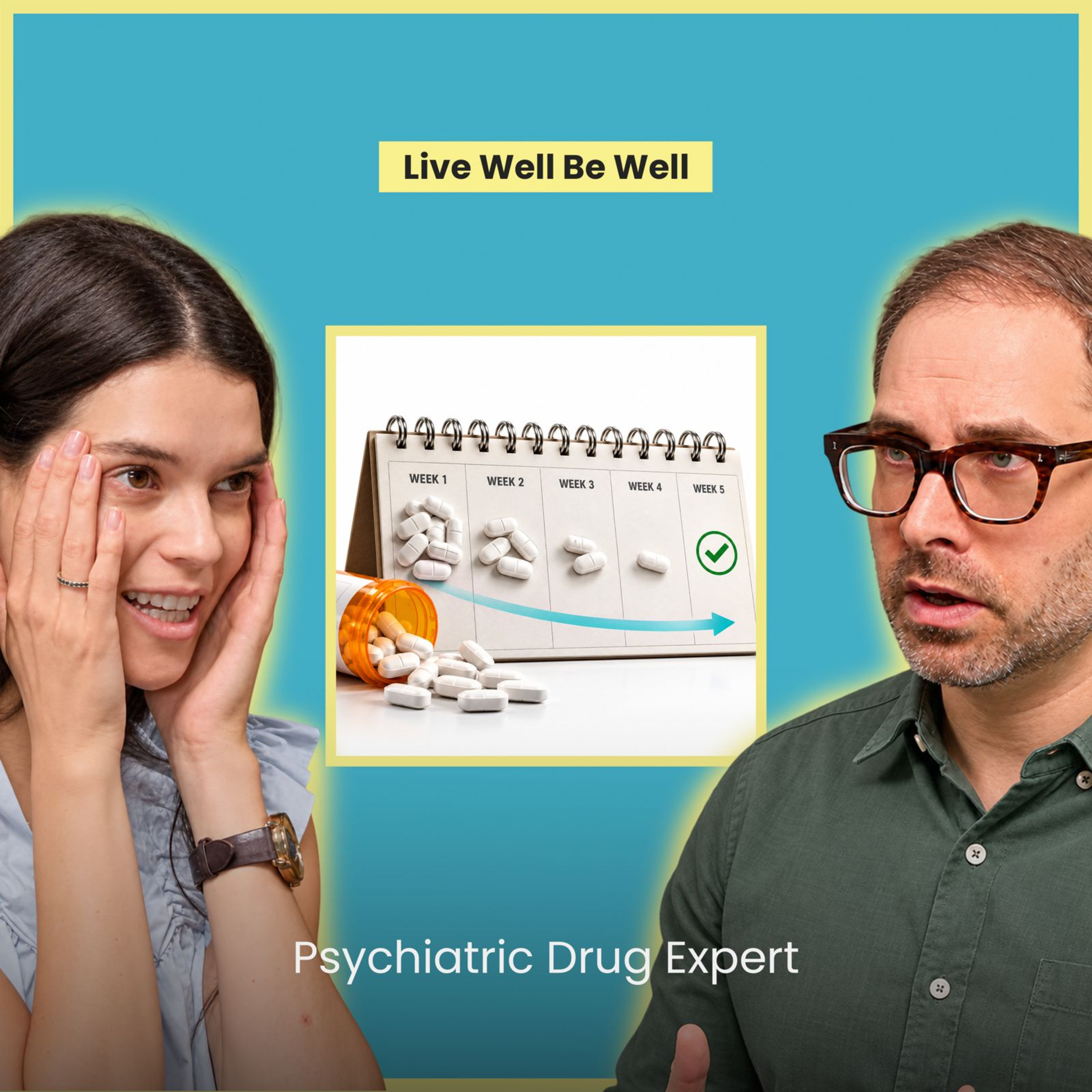
Psychiatrist Mark Horowitz explains how to taper off antidepressants with less withdrawal risk, emphasizing slow, individualized dose reductions and using liquid formulations. He argues withdrawal is driven by the rate of brain adaptation, not just “how long you’ve been on” or “small dose size.”
Mark Horowitz, a psychiatrist who publishes on antidepressant tapering guidelines and withdrawal physiology.
tapering too fast causes withdrawal; pause and slow if symptoms emerge; reductions should be slower at lower doses because brain effect changes nonlinearly; “small dose” tablets can still have large brain effects.
altitude-sickness analogy; citalopram/Celexa and other SSRIs (e.g., sertraline/Zoloft, fluoxetine/Prozac) show steep effect near zero; example taper from 20→15→10→5→0 where the final step is likened to “jumping off a cliff.”
0:00Okay, so before people like completely lose hope and freak out, I don't want people to, if anyone's on antidepressants, I really don't want people to be spiraling. I'm very like, worry about people listening to this going, oh my gosh, I've been on antidepressants for 10 years and now I'm going to go through this. So I think this is a good time to set the TV up, to get out the graphs, and to show people the right way, the least harmful way to start tapering what that means. And they can keep this for when they're ready to do it. Can we do it? Great plan. Let's get the graphs out. Let's get serious.
0:38Let's get the graphs out. When the going gets tough, the tough graphs get going. Okay. We have a graph. Sorry. I apologize. I apologize. I can't help myself. So I'm going to say if you're not watching on YouTube or Spotify, definitely go over there because you can get the video. So let's talk about withdrawal and tapering. So we left just a second ago with you had basically liquidized in your own lab your own way of coming off these drugs. And now you're changing guidelines that people can actually understand how to do this. Firstly, can people actually go and get this liquid formula? That's just in my brain.
1:20Yeah, you know, great, good question. That's the key. If I had to sort of give one message to doctors and patients, I would say use a liquid version of your drug and do it slowly. And in America and the UK, most antidepressants come as liquids. Amazing. So yes, you can. So we can actually, there's nothing worse than giving advice where you can't actually access it. No, you can. So that's an amazing advice. So if anyone is now stopping or wanting to stop or now being intrigued by listening to you, the first question they say to their GP or their psychiatrist is I would like the liquid formula of this drug full marks exactly thank you if you remember nothing else from what I said ask for a liquid of the drug that's what we want okay so what are the steps that people are maybe on I'm thinking 50 milligrams is probably the average dose say say 20 milligrams that'll that'll cue me up better okay sorry 20 milligrams okay so someone's on 20 milligrams and they're okay I want to come off yeah what are the steps they take how do they look at their dosaging so let me just zoom out a bit before i give you before i inflict a graph on your your poor i think they're gonna love this they can visually see it okay so number one why do you get so what what problem are we trying to solve if you come off a drug too quickly you get withdrawal if you do it more slowly it becomes easier let me give you an analogy the analogy i like using is altitude sickness if you go up a mountain too quickly your body can't adapt to lower air pressure at higher bits of the mountain and you get altitude sickness, you feel headache, dizziness, joint pain, it's not the height that gets you, it's the rate at which you go up.
2:48So for example, if you go from sea level to the top of Everest in two days, guaranteed you'll get terrible altitude sickness, it might even kill you. If you go from sea level to the top of Everest in two years, your body has lots of time to adapt, you're not going to get any altitude sickness. Same as coming off an antidepressant. While you've been on the drug, your body has adapted to the levels of chemicals that the drug produces. If you come off in four weeks, it's a very quick change in your body and your body goes into disarray and you get all the sort of symptoms that I mentioned. If you do it over months, maybe over more than a year, you give your body much more time to reset.
3:24So that's the first principle coming off. Doing it gradually is better than doing it quickly. Principle two is you've got to do it at a rate that you can tolerate. There's lots of risk factors. if you've been on it for long periods of time it's worse certain drugs are worse but basically if you start to feel withdrawal effects you should pause go back up a step and then go down more slowly again like mountain climbing you start to get altitude sickness what do you do you should pause where you are to adapt to the new level of air pressure or go back down the mountain and they got more slowly so you got to adapt it to how you feel and the third principles where I need a graph and this is why when you get down to lower doses you should do it more slowly so I'm going to show you this so this is a paper we published in the lats of psychiatry a few years ago and I'm giving an example here of citalopram or celexa but this principle I'm about to show you applies to all antidepressants lexapro cymbalta effects or any antidepressant you're on in fact sertraline zoloft prozac fluoxetine in fact any psychiatric drug and what I'm showing you here is on the x-axis is dose and on the y-axis is effect on the brain.
4:32It happens to be something fancy about affecting serotonin transporters. We can think about it as effect on the brain and the main point of this graph is it's not a straight line. So the most common doses of citalopram or Celexa are 20 milligrams and 40 milligrams and increasing from 20 to 40 doesn't increase the effect on the brain by that much. It's only a small increase and the smallest tablet in lots of countries is either 20 milligrams or sometimes 10 milligrams but even a little tiny dose like two milligrams actually has about half the effect of 60 milligrams can i say one thing here go for it i'm sorry i so i have something called reynolds disease which is very severe circulation for anyone that doesn't know i get like chill blades on my hands and I used to, I can't, basically I can't hold my ski poles when I want to ski.
5:25It's a very annoying condition. Terrible, terrible condition. And my toenails fall off. Right. So I've totally just lost anyone that would ever fancy me. Anyway, when I go and see my doctor for brain odds, the thing that they prescribe 80 % of patients is fluroxetine, which is an antidepressant. Right, right, right. Obviously, they told me that I should go on fluroxetine And I went off and on. Sorry, this is not to be a personal story. This is just because of the dosaging. But they were like, look, it's the only treatment unless you go into hospital and have kind of an infusion for four days. And it is quite a debilitating thing to live with, especially in the winter if you live in the UK.
6:07They told me that going on 20 is such a low dose that it's never used for psychiatry and mental health purposes. And it would never change my brain. and I would be absolutely fine. And the reassurance around that was massive and that I was in the very small percentage of people that aren't going on this and I really need to rethink my decisions about going on this. And I mean, I've been treated now for probably like 10 years and I never chose to go on it. And there was a point where I nearly did because they kept saying to me, it will physically not change your brain. It will not have any frequency of effect.
6:41That's totally false. That's why I'm looking at this craft and going... I'll just say that. The same graph exists for phyloxetine. I don't think I've actually got it here. I normally have it. I can show it to you in a second. So that is commonly what doctors say. They say you're on a very... This is what they say, not just to you for your... I'm sorry, I made fun of your disfiguring disease. No, we can't. It's fine. You've got to laugh about it. But it's what they say to lots of patients. You're on a very small dose. You can just stop it. And what they're saying is you're on the smallest available tablet or capsule, but your brain doesn't care what you're putting in your mouth.
7:13It cares about the effect on target receptors. so the smallest tablet for Celexa 20 milligrams for Prozac 20 milligrams for Zoloft 50 milligrams is a small tablet but a very big effect so it's always false and people get as I'll show you in the next slide people get pushed off what they call a small dose but actually they're being pushed out of the eighth floor of a building and that's why they're end up in trouble that's the that's the key issue because like I was never being treated for something that was depression it's like and it's an off so if you don't know off labeling is basically when you can use a drug for multiple things.
7:44For instance, Viagra is another one that they use for Raynaud's because it helps increase your blood, it's your vascular system, right? So it helps. The same reason it works from Viagra, bringing blood stimulation, it works the same with your extremities. But the amount of convincing that nothing was ever going to affect me mentally. But I was also just so terrified of taking it because I hadn't suffered with depression that, you know, and I was in that very rare case that wouldn't accept it. Yes. Well, again, the other thing they said is false. is you won't have any effects from it. Even these doses have profound effects.
8:16So this is so many that it is. It has profound effects on the brain. And so even small doses... So people, exact doctors will say, you're not on a high dose, you'll have no problem. That's not true. High doses don't have much more of an effect than very low doses. And so the point is that even very tiny doses, like two milligrams, still have large effects. And that makes doctors sometimes chuckle because they say it's a homeopathic dose, two milligrams. But according to this graph and lots of other research, it's not a small dose. So let me show you what happens when people come off the drugs.
8:43So you walk into a doctor and you say, I'm on 20 milligrams of Selexa, how should I stop it? And the doctor says, look, let's break it into small steps. We'll go down 15, 10, 5, 0. They might split the tablets, give it to you every second day. And it sounds intuitively right, 20, 15. It sounds like it's evenly spread. But in terms of effect on the brain, it's not evenly spread. So the first reduction from 20 to 15 causes a small change in effect on the brain. Some people find that OK. Some people already find that quite difficult. The next reduction from 15 to 10 causes twice as big a change on the brain.
9:1510 to 5, twice as big again. And going down from 5 to 0 is like jumping off a cliff. I mean, it is literally jumping off a cliff. So if anyone, this is like the changes in the brain on the y-axis. On the x-axis is the dose. That's like, I mean, three squares versus one square. Exactly. So going from 5 to 0 is about 20 times the effect. So it's a 58 % change compared to the 3 % change going from 20 to 15. So yes, if you can't see this graph, it's basically the side of an archway on the left-hand side. It goes up extremely steeply and then it flattens out. And people are kind of pushed off this because the doctor says to them, you're on now half of the smallest dose.
9:55This can't be causing you half of the smallest tablet. This can't cause you any trouble. And what people say is the first few reductions were fairly easy and the last few reductions were hell. and the doctor looks at them and says this can't be the drug it must be you you've either had a relapse of your depression or anxiety it's unintentional gas the doctors are not they don't know they're ignorant they're not they don't know this relationship but it is but it but people are told this is in your head it's your condition it must be something else it can't be the drugs because look at the textbook the drugs only cause mild withdrawal effects for two or three weeks and you're coming in after three months with severe panic attacks, can't sleep, it can't be the drug, you must have developed a new panic disorder.
10:39So then you put you back on more? Put you back on the drug, maybe sometimes more of the drug, and you're told you've got a severe lifelong condition that needs the drug.
This week’s Live Well Be Well Moment is with Dr Mark Horowitz, lead author of the Maudsley Deprescribing Guidelines, the UK NHS’s official guidance on safely stopping psychiatric medication.
This is a moment from the episode that stuck with me: Dr Horowitz explains the liquid tapering method for coming off antidepressants, the non-linear dose-response curve behind that “jumping off a cliff” feeling, and what a genuinely safe, gradual reduction can actually look like.
My book ‘Healthy Shouldn’t Be This Hard’:
https://www.amazon.co.uk/Healthy-Shouldnt-Be-This-Hard-ebook/dp/B0G1DHNRV5
This episode is sponsored by:
POLSEN HEALTH: The compassionate health tracker. Connecting body and mind with unique stress recovery insights so you can live fully today.
👉 15% off with code LWBW15 at https://polsen.health/
PULSETTO: Vagus nerve stimulation for stress, sleep and calm.
👉 Use code SARAHANN at https://pulsetto.sjv.io/SARAHANN
📖 If this resonates, you can join the thousands who read The Compassionate Cure each week.
https://sarahmacklin.substack.com/
Let’s be friends!
📷 Instagram: https://www.instagram.com/sarahannmacklin/
📹 Subscribe: https://www.youtube.com/@livewellbewellsarah
🐦 Twitter: https://x.com/SarahAnnMacklin
📱 TikTok: https://www.tiktok.com/@livewellbewellpodcast
💌 Newsletter: https://sarahmacklin.substack.com/

Scan the code with your iPhone camera
Listen in the app.