In short
Stress research and burnout prevention through emotional granularity, recovery, and mindset. Guest explains that stress is a subjective internal response (not the event itself), shaped by appraisal of threat and perceived ability to cope, and that resilience is an effective stress-regulation system that includes appropriate recovery to homeostasis.
Guest background
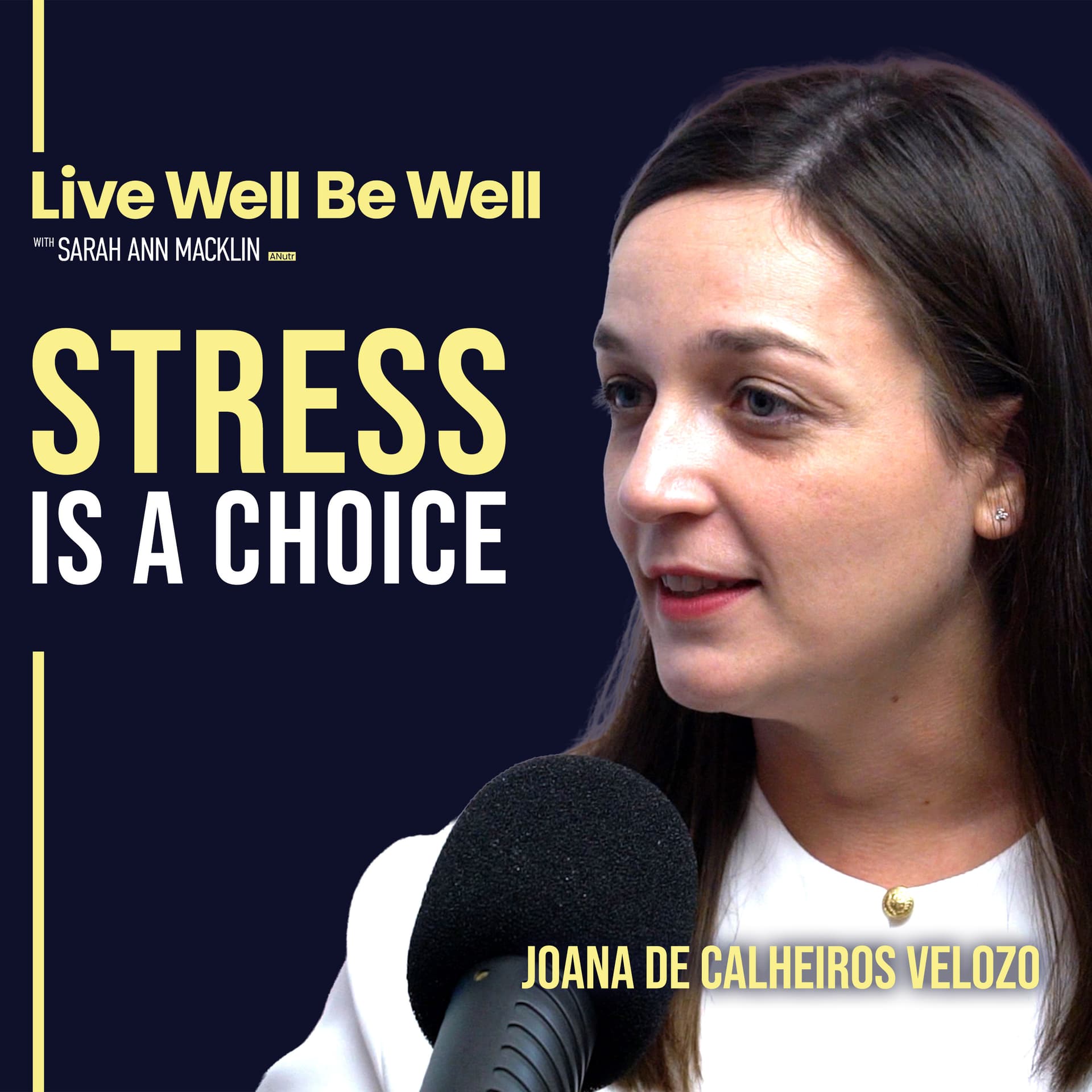
Joana De Calheiros Velozo is a biomedical science researcher with a mental health background. She previously experienced debilitating panic disorder and agoraphobia (couldn’t leave her house due to panic attacks), which motivated her research into stress and regulation.
Key claims
Over 60% of people report stress affecting daily life; about 30% experience chronic stress. People often can’t name emotions; emotional granularity (pinpointing specific feelings) is “half the battle” for regulation. Burnout builds from chronic daily hassles when recovery fails. Locus of control predicts stress impact: an external locus (“life happens to me”) worsens regulation versus an internal one. Mindset can prolong recovery time. Wearables can help people tune in, but scores can become obsessive and misleading; focus on trends and contextualized data.
Notable examples
Somatic signs of chronic stress (migraines, back pain, fatigue, volatile emotions, menstrual changes). “Just-in-time” interventions using monitoring to choose the right psychological or physiological response at the right moment. Habituation after repeated successful stress exposure.
Written by AI. May contain mistakes. Listen to the episode to check what was said.
Chapters
Tap a time to open that second in VOUnderstanding Stress and Emotional Granularity
0:45 to 3:10
Discussion about the prevalence of stress and the concept of emotional granularity.
“In my life, I myself suffered tremendous amounts of stress, actually.”
Impact of Stress on Health and Recovery
3:10 to 5:55
Exploration of how stress affects health and the importance of recovery.
“And it really made me think a lot about our relationship to stress.”
Locus of Control and Stress Responses
5:55 to 8:53
Insight into locus of control and its role in stress management.
“But actually that's not the case at all, right?”
Subjectivity of Stress and Perception
8:53 to 11:08
Discussion about how stress is subjective and influenced by personal perception.
“You know, the shaping of our mind comes in.”
Stress and Resilience: Building Strength
11:08 to 13:30
Exploration of the relationship between stress and resilience, including personal insights.
“I define resilience in the sense that each time that you step into the moment of not letting a situation define you and you can have a more of a reflective process, you can have the strength and courage to move forward.”
Coping with the Hustle Culture
13:30 to 14:00
Discussion on the impact of hustle culture on stress and mental health.
Understanding Stress in a Hustle Culture
14:00 to 18:32
Explore how hustle culture and technology contribute to chronic stress and burnout.
“So people don't just wake up and are in the burnout, right?”
Disconnection from Emotions and Stress
18:39 to 21:02
Discuss the challenges people face in recognizing and articulating their emotions related to stress.
“of Live Well Be Well and this whole community that understanding yourself in the most mindful way is one of the most powerful things that you can do for your health.”
The Importance of Emotional Vocabulary
21:02 to 23:28
Learn how having a richer emotional vocabulary can help in stress management.
“And you know that emotional granularity is incredibly important, right?”
Joana's Journey from Panic to Research
23:28 to 28:00
Hear Joana's personal journey and insights on how understanding stress can empower individuals.
“It's like using stress as a compass, basically.”
Show all 28 chapters
Embracing the Uncontrollable
28:00 to 29:15
Learn how accepting lack of control can alleviate stress.
“But in that process, it can be very scary because you don't have the tools.”
The Power of Letting Go
29:15 to 30:24
Understand the importance of letting go of control for stress relief.
“Because a bit of stress builds you, too much breaks you.”
Defining Moments and Stress Resilience
30:24 to 31:35
Explore how defining moments can strengthen resilience against stress.
“And then I think, you know, going back to the resilience conversation that we had, there's those moments in our lives that like just hit us like a bus.”
Recognizing Personal Stress Responses
31:35 to 33:26
Discover how to identify your unique stress responses and their effects.
“I actually had a conversation with a friend yesterday where her sister is not leaving the house at the moment because she has extreme amounts of depression and anxiety and panic attacks.”
Understanding Stress Recovery
33:26 to 35:56
Learn about the importance of recovery in managing stress effectively.
“Some people will respond very intensely with heart rate, other people won't, right?”
Different Stress Management Strategies
35:56 to 38:15
Examine how different lifestyles affect stress management and recovery.
“But if that stress event prolongs for hours, then you're really loading your body, right?”
The Locus of Control in Stress
38:15 to 40:04
Understand how locus of control influences stress responses and mindset.
“And another one that's going through the exact same things and feels excited and joyful and energized, right?”
The Role of Mindset in Stress Recovery
40:04 to 41:43
Explore how mindset impacts recovery time from stress events.
“And prior to that, we see that your mindset really predicts how long it takes you to recover, right?”
Just-in-Time Interventions for Stress
41:43 to 42:00
Learn about adaptive interventions to manage stress effectively.
“Just-in-time adaptive interventions have come in because we have more access to wearables and passive monitoring.”
Understanding Stress Interventions
42:00 to 43:31
Learn how to identify and adapt stress interventions for individuals.
“is that we'd be able to find what are the moments to intervene for you and what are the right interventions for you.”
The Role of Wearables in Stress Management
43:31 to 45:16
Discover how wearables can help individuals reconnect with their bodily signals.
“And so I had this love-hate relationship.”
The Psychological Impact of Sleep Data
45:16 to 47:28
Understand how sleep scores can affect your perception and health.
“So it's actually very troubling that you're seeing a negative score changes how you perceive that sleep, and then will have a negative impact on your health.”
Empowering Data Interpretation with Wearables
47:28 to 49:34
Explore how to interpret wearable data to enhance self-empowerment.
“And actually it's very healthy that you go through these ebbs and flows, right?”
Long-Term Monitoring and Health Trends
49:34 to 51:46
Learn about the importance of long-term health monitoring versus daily fluctuations.
“So really recognize what the body is saying for what it is rather than over-interpreted it.”
The Concept of Compassionate Tech
51:46 to 54:17
Discover how compassionate technology can redefine our relationship with health.
“And I was really angry because I was like, there was going to be something I was going to build.”
The Future of Wearables and Women's Health
54:17 to 56:00
Explore upcoming advancements in wearables focusing on women's health.
“been good or bad with my sleep or good and bad with my stress levels it's actually trying to allow me to be more connected to my mind my body and those like somatic experiences is.”
Understanding Stress and Wearables
56:00 to 59:21
Explore how wearables can help manage stress and enhance awareness of hormonal impacts.
“And you're like, okay, that's not helped me at the end of the day.”
Defining 'Live Well Be Well'
59:36 to 1:00:05
Reflect on the personal meaning of living well and being present.
“I hope this hasn't been too stressful for you.”
Transcript
Automatic transcript. May contain errors.0:00How stressed are we as a nation? We're incredibly stressed. Over 60 % of people report so much stress that it completely affects their daily lives. We've noticed that one of the things people struggle the most is identifying how they feel. People are not really able to name their emotions. The wheel of emotions that has like 200 emotions on it. And it's when I show them that you see their faces just go, wow, actually maybe I do feel this. Emotional granularity is incredibly important. Being able to really identify the emotion is already half the battle to being able to regulate appropriately. Stress can feel really overwhelming, but stress can translate into multiple emotions.
0:40Was there a moment in your life that got you super interested in this? I'm Joanna, a researcher in biomedical science with a background in mental health. In my life, I myself suffered tremendous amounts of stress, actually. I used to suffer from panic disorder and I had agoraphobia and it was so incredibly debilitating that I couldn't leave the house. I love this line, the dose makes the poison. Because a bit of stress builds you, too much breaks you and like weightlifting, it's the recovery that makes you stronger, not the strain itself. How important is recovery? That's really where we see the differences in people who develop health concerns over people who don't.
1:16What's person A doing that person B isn't doing in those moments to handle stress? I think the biggest thing that we talk about is this locus of control. I don't know if you've ever heard about that. No, what's the locus of control? The locus of control is... If you are a regular listener to this show or live well, be well, or this is your first episode you're listening to, I really want to ask just a very small quick favor. If you could please hit the subscribe button or leave a review, this helps the show more than you can imagine. It means the world to help growing this show. and you all know that I have a huge thing to want to hit 100 ,000 on YouTube this year and I can't do that without your support.
1:54I really aim to bring you the best guests possible out there and I pride myself in doing that for the show because it's so important but to keep the guests coming to get them to be bigger and to bring more helpful information to your ears and your eyes I really would love to ask you to subscribe to the show. Thank you. I want to start with a question on is there really such a thing as good stress or is it just clever branding? Yes, there is. Actually, stress is essential for you to do things in life. Stress is actually a sign of a healthy stress response system. It means that your body is regulated effectively.
2:35Okay, so that's interesting because I think a lot of us can talk about stress as the enemy. um i think one of the most common statements that i use is i'm just feeling very stressed many people will relate to that but then i was thinking like what if stress isn't the problem and it's actually like our relationship to stress itself and so how much of stress is what happens to us and how much is it that we interpret it first i think it's important for us to define stress um stress is your body's response to something that's destabilizing your homeostasis your normal equilibrium let's say it being destabilized is normal but how you respond to that disturbance is really what matters i think that's the thing right it's not being afraid of it and i think a lot of us especially having dr lisa feldman barrett on here the neuroscientist she a lot about how we have emotions and how it's predictions of past memories.
3:36And it really made me think a lot about our relationship to stress. So is it possible to be addicted to stress? Addicted to that like high feeling that so many of us can have when it comes to stress without us knowing it? I mean, stress can be confused with excitement and adrenaline, right? They all elicit the same stress response, but the feelings we associate with that response are different, right? When you're addicted to stress, you are excited all the time. You're always on the move, always wanting to feel. It's energy. Basically, stress is energy. And you can direct that energy into something really positive or something really debilitating.
4:18That differentiation happens in your mind, actually. Yeah, I want to decode that a lot today, like the mind and the body. And it's quite like a stoic saying, but I love this. We suffer more in imagination than in reality, but maybe the modern version is that we suffer the most when we don't understand the pattern of our own stress. So I think about like the landscape of stress today, like how stressed are we as a nation? We're incredibly stressed, to put it very mildly, but we actually see that the statistics are incredible, right? Over 60 % of people report so much stress that it completely affects their daily lives, right?
4:56About 30 % experience chronic stress, right? So we really see that it affects us all. Outside the statistics, you just know that virtually everyone experiences phases of more or less stress, but we all handle it very differently. And that's what's really important to recognize. Yeah, that's really interesting, actually. It's a question I was thinking about coming here. Why do two people respond to stress so differently? Because one person might, it might send them spiraling and the other person they seem to not collapse at all like why is there two different responses to stress from yeah so i'd like to dive a little bit into stress before answering that question because i'd like to explain a little bit what is stress in the sense that people often think of stress as specific events or behaviors you know things people think that things are objectively stressful this interview is stressful that accident was stressful that meeting, that feedback, you know, we have these objective events, right?
5:56But actually that's not the case at all, right? Stress is entirely subjective, right? It is really in the eye of the beholder, if you will. Anything can be stressful or not. And what is stressful to you might not be stressful to me and what's stressful to me today might not be stressful to me tomorrow. The first thing that's important to recognize is that stress is actually not external to us. Stress is entirely internal to us, right? It is our perception, our experience of things that dictates whether something is stressful or not, right? Yeah. So actually, we're going through this two kind of phase approach in that you first appraise a stimuli as being, one, important to you and posing some type of threat to you.
6:44So there's something that can happen out of this that might affect me. It could be a physical threat or it could be an emotional threat, like my self-esteem will be hindered. And two, I appraise, is the situation something that I'm able to handle or not, right? And it's in the second part that it's really important, right? In the second part, if you feel that you can handle it, you approach it quite differently. But then what I want to go into is once you've established that, okay, this situation is quite stressful and it's triggering my body to respond, right? To allocate a lot of resources into handling this.
7:17you can this is stress response has two dimensions let's talk one is the physical dimension right your body responds to the stressful yeah like the fast heartbeat the sweaty palms like the shakes yeah you feel it in your body yeah but then you have the emotional response to the stressor and it's the emotional response to the stressor that will dictate how it will shape you and how it will affect you. Wow, there's so much about mindset with stress, isn't there, that we don't see. Do you think a lot of this is like tied to how we're brought up from a young age, like how we've perceived our parents to understand stress?
7:56Or do you think that as the world's feeling more heavier, there's more demand, there's less time to switch off, the constant pressure, the financial constraints, like all of these other ways that we're living in a very stress-dominated world, that. I mean, we never turn off. Unlike my parents who would come home after work and there wasn't a phone and there was no way to contact you, like you would have stress at work in one isolated area and then you'd come back and then you would just be at the family because there was no way to contact you. So with those two dimensions, like how do you think it's shaping our stress today with that emotional response as it seems to be a real mindset approach than with like a physiological a cool reaction.
8:36It's really interesting that you say that because a lot of people do associate work as stress and home as not stress. But like I said, it's actually not that objective. And actually, yes, we are in an environment that is more stimulating than ever. But actually, if you look at previous generations, there was tremendous amount of stress as well. You know, the shaping of our mind comes in. It's not so much in the environment that we're in, but It's something that we call this diathesis stress model. So if you think about the fact that when you are born, you actually already have a higher or lower predisposition to experience, to be more or less sensitive to stress.
9:14That's the first thing. Wow, just from the moment you were born, it's like genetics. Yes, of course. Genetics play an important role. If your parents are more sensitive to stress, you're also more likely to be more sensitive to stress. That's normal. That's the first thing. The second thing is that can either be exacerbated or minimized by your environment, right? If your parents not only are more sensitive to stress, but they also exhibit these types of responses in their behavior, and if you go through events that can be traumatic or difficult and you're witnessing around you certain ways in which people respond to stress, you will also emulate that.
9:50So that will exacerbate. The thing is that if you start at a place where you're already a bit more sensitive, It means that daily stressors will, you will experience more things as stressful and that in turn will play a heavier role on you, right? So it's kind of a loop, right? So when you see people going through similar events and some of them coming out fantastic and other people coming out with all kinds of troubles, there's already that whole background there, right? On how they have learned and grown to be more or less sensitive to stress. Now, the great thing about it is that you can cut that, right?
10:26You're not a victim to that situation. You have a power to kind of cut that loop for yourself. I love that you just used the word victim because I think that's so important when thinking about the word resilience. Yeah. And stress and resilience to me kind of go hand in hand. I think some of my hardest moments, and even speaking to a lot of people, people that listen to the show and write in and tell me their stories, the resilience is built through stress. But like, how do you balance that? How is, how important is stress to building resilience? And when is it too much? And resilience kind of then just becomes broken.
11:05So first I'd like to ask you, maybe, how do you define resilience? I define resilience in the sense that each time that you step into the moment of not letting a situation define you and you can have a more of a reflective process, you can have the strength and courage to move forward. And each time you take those learnings and each time the situations appear smaller and smaller and smaller, it's like approaching a mountain. Like at the beginning, you can see the mountain that feels so humongous and terrifying and that you've got to climb this huge peak. But each step of that journey, it becomes a little less hard and a little bit more manageable.
11:49That's my understanding of it. And I think that's maybe my own personal journey with it. But I think you can't be resilient without having compassion connected to it. And that's a big part of it, because I think if you're constantly beating yourself up and then you're getting all the external resources of people beating you up or the environment or things feeling too much, like that will always feel very distant, that peak. But if you kind of got your own back, that helps you build the resilience. That's my interpretation. So that is not how I define resilience. That's why I wanted to ask, because then it also helps understand better your question, because the way that I look at resilience and actually the way that we define resilience in stress research is that your body exhibits the appropriate stress response for the appropriate situation.
12:39So that actually your body is regulating itself effectively so that in a situation that demands you to experience a stress response, that demands you to gather all of your resources and energy to face some challenges, it does so appropriately and then recovers appropriately, right? Or doesn't exhibit a stress response when there is no need for one. So resilience is really about having an effective regulatory system in a way. And if you have them, then you're also much more capable of handling these challenges, right? Yeah, I guess I totally can align with that. But I also think that unless you experience stress, you don't build resilience.
13:21I kind of see resilience as a muscle that you have to push, which is why I think about it as seeing a mountain because I think you know these people people have experience and I've had heard amazing stories of people that experience such hardships through their life and they have this amazing amount of resilience in them so if but I think the thing where it can go a bit wrong and I think I've gone into this before it's like the hustle culture you know like we're very much now in maybe there is a toxic resilience culture building where it's all about go go go go and burnout is a very common word now you hear that like all over social media and linkedin and you know a lot of people building companies or you know even like you know doctors and think about covid like the amount of people that were burnt out um how do we understand stress in this environment like the hustle culture yeah well the environment plays a really big role of course if we're always on we never have the time to recover i think what happens and i think that's where also social media and all of these new technology that we are lucky to have but that also play a big role in our our health they really disconnect us from ourselves in this in this hustle culture i think what we see happening is actually people stop tuning in, stop paying attention to the signs that their bodies are telling them, right?
14:47So people don't just wake up and are in the burnout, right? There's normal many signs leading up to that. And we just fail to listen and intervene earlier, right? And that's often because we feel that we should be always on, right? That the society demands that of us and that we should be capable, right? It's almost a badge that we carry, right? That we keep going despite the fact that maybe we shouldn't and it's not good for us, right? How can someone interpret if they're under chronic stress? How you respond to the small daily hassles. That's really the type of stress that we're looking at. And that really builds up, right?
15:26So if everything is causing you to respond and you're unable to recover after that, that piles up, right? That starts loading on the system. Eventually that can really overload the system. But as it builds up, what you will notice is, one, more things will cause you stress, right? So things that didn't feel important before now start causing you to respond, right? So you used to have your daily Monday meeting and now you're stressed to go there. Two, it will take you longer to recover, right? Things will be harder to manage, right? It means that your stress system is actually no longer resilient.
16:05It's struggling to regulate effectively. Three, you will start experiencing somatic things as well, right? You might get migraines, back pain. So, you know, the 9 out of 10 people that go to the GP, it's due to stress actually. And it's normally by the time that you get physical complaints, it's your body physically telling you, please stop, pay attention, something's going on. You'll be tired a lot more often, you need more to sleep, you're fatigued quicker. your emotions will be a lot more volatile. It will be harder for you to, you might feel that your emotions are more negative or that you go from positive to negative a lot quicker.
16:49And if you have a menstrual cycle, you really notice it in your menstrual cycle, right? You might feel more cramps, you might miss a cycle. So it really is intimately related to that. So there's lots of signs in your body that things are happening that need attention. and that's all in the build-up to burnout. And by the time you reach burnout, you've completely overloaded the system so much so that it sort of shuts down. As someone who has spent a long time studying the mind-body connection, I'm constantly asked, what do I use to track my health? Since April, you've probably seen, if you're watching the show, me wearing a piece of tech on my arm and that is no watch because I genuinely believe it has been one of the most thoughtful and mind-aware pieces of tech that you can wear.
17:36Unlike most wearables that focus just on your steps or your sleep, Know Watch is a bit different. It gives you real-time insights into your nervous system, the invisible engine that calibrates everything from your stress to your sleep to your recovery, your rest, and ultimately your health. With its stress recovery metric, it doesn't just show you how long you were stressed for, but also how long you recovered. It shows you your homeostatus. And that to me is where real health begins. And I think it's all something that we're craving. and most importantly it does this without dragging you back to your phone because that motion just depletes you.
18:11It delivers meaningful health insights to you only when something genuinely matters using AI to turn complex signals into clarity that you can understand and in just five days it calibrates to your body and creates your personalized health fingerprint. You can try it for 30 days completely free and if you're curious now's the time because they're giving you guys 15 % off with my code LWBW15 if you head to knowwatch.com. And you guys know as listeners of Live Well Be Well and this whole community that understanding yourself in the most mindful way is one of the most powerful things that you can do for your health.
18:49And this little gadget helps you on your journey. Do you see from your own research, because you've done a lot of research on stress and I kind of want to get to you in a second about why we're here talking about this but do you see a lot of people that are just disengaged from noticing how stressed they are I think there's a couple things I think people are not so comfortable thinking and talking about stress that's the first thing and there's a lot of misunderstanding around stress and two I think they're not so much disengaged with how stressed they feel but actually I think they're disengaged with how they feel periods so actually we noticed that one of the things people struggle the most is identifying how they feel right people are not really able to name their emotions or you know recognize what's happening in their body so I think there's really a disconnect between people and themselves yeah I think that's a really big thing that the vocabulary around language and emotions because if you think about when we're at school we're never taught how with how we feel so we kind of go into this weird emotional landscape of beno brown always says you know and i don't know if this is scientifically completely correct but that we only really have language for three emotions sadness fear and happiness and we kind of put them into that one bucket where actually there's so many there's like 200 emotions but we don't have the literature and our own language to be able to describe that so that creates a big block and I give my patients in clinic this the wheel of emotions that has like 200 emotions on it and it's when I show them that you see their faces just go wow actually maybe I do feel this yeah and it's that moment of like feeling seen and all of a sudden you just see their shoulders like relax because they themselves have understood it yeah and I think about that as a child you know when you're a child, you're very frustrated because you can't have the vocabulary to tell your parents or tell your caretakers who's looking after you, how you're feeling.
20:58And it feels like that's very similar to what you just said around stress. Absolutely. And you know that emotional granularity is incredibly important, right? Being able to really identify the emotion is already half the battle to being able to regulate appropriately, right? And that's intimately connected stress. So stress can feel really overwhelming, but stress can mean, can translate into multiple emotions. It could be excited, scared, frustrated, happy. You know, it could be a multitude of things and helping pinpoint exactly the emotion associated with the body is feeling really helps. But we don't take time for it.
21:39No. How can you get people on here to connect to understanding their emotions a bit more in relation to stress. Actually, a lot of my research was actually on that. Also, how to track emotions of people throughout the day. And one of the big things that we actually notice is just by starting to ask people how they feel throughout the day, it already helps them feel better, better mood. Like overall, there's a tremendous amount of health outcomes by just stopping the question for yourself. So that's where we start, actually. And when we actually ask about how do people feel, we want people to think of emotions in these two dimensions.
22:18I don't know if you've ever heard of the circumplex model of emotion, but really emotions are not just emotional, but they also have very much a physiological component, right? So when you check in, we think, okay, first think, how is your body feeling, right? Does that mean that you're connecting more to like the interception? Absolutely. Which I think people might not know, but it's more about connecting internally to the bodily sensations. Yeah, absolutely. So that's the first level. Indeed, interception. What is my body saying? And two, what is the valence associated with that? What is the specific emotion associated with what my body is expressing?
22:55And that's where you can start understanding stress better. Because stress is not just, I'm afraid of this. It's also, I'm excited about this. It's sometimes a mix of both, right? And that will help manage it. And also use it as a resource because stress can be a fantastic and powerful resource, right? If you don't experience stress, you're also not engaged with life. You're not motivated. You will not go out and do the things that you actually really want to do. So it's important to also harness that energy. I love that. It's like using stress as a compass, basically. So I was just thinking about what you were saying there.
23:32So I guess like somebody could interpret this because journaling is such a big thing now. Everyone's, you know, which is great. Everyone's, you know, doing morning pages or journaling. And a lot of people write to me and say, well, I just don't quite know what to journal about. This could be an amazing way that to help you understand your stress response better, I guess. It's like, how am I feeling? Could be the first question. What am I feeling? Which is the interception. And then the third question, which was, remind me, what's my body telling me yeah those three things could be quite a good indicator because i think sometimes we always try and demand an answer yeah you know um we kind of we're all problem solvers at the end of the day we kind of really want to get to the solution and also you have to think that there's no right answer right uh it's it's whatever makes sense to you in that moment and you become better as you practice it it also helps you being much more able to identify when things are okay and when things are actually not okay.
24:32When should you go visit the doctor, right? That's so true. I think so many people listening to this will connect to moments when, I don't know, maybe they've had like GI distress or they're feeling constant nausea or the migraines or, you know, they're so anxious that they're not going to sleep. There's all these signals and maybe they're in the wrong relationship, but they're like, no, I'm really going to push through this. Or they're really unhappy at work, but they're determined to not give up and they're like pushing against all these signals where their body's like maybe this isn't right for you yeah and that's your internal compass but it's so easy for the mind to override those signals yeah I think it's so interesting so I want to go a little bit into stress phenotypes but before I do you know I always find it really interesting when every guest who sits here as an expert in their field and I don't think people just walk into the job that they do especially if it's in research like normally there is such a passion behind why somebody is so interested in this area so joanna just give everyone a small introduction to like who you are and why you entered this field like was there a moment in your life that got you super interested in this well i'm i'm joanna i'm a researcher in biomedical science with a background in mental health and i actually got really passionate about stress because i really see it as the the linchpin to everything else.
25:56In my life, I myself suffered tremendous amounts of stress. Actually, I used to suffer from panic disorder and I had agoraphobia and it was so incredibly debilitating that I actually couldn't leave the house for quite a lot of time because it caused panic attacks. And it got me really interested in the topic and how, of course, I think when you suffer from something, you will search for answers on how to deal with it. So at the time it felt that my life was so tied to this disease really that I was looking for answers. And so as a researcher, I went on to research these answers and it's actually been very liberating because once you start understanding what's happening in your body and how your mind influences things, then you realize that there's actually nothing to be afraid of.
26:48So I always really looked at stress as something that's happening to me but actually I have a big role to play in this relationship what helped you kind of flip that and go from somebody who had panic attacks and I think so many people will relate to this yeah I think a lot of times people also don't realize how extreme their panic attacks can be and are just so confused and then to not leaving the house to sat here now as a researcher talking about it super confident you know working with an amazing company like how what what helped you get from that stage to stage two so i think one of the things with panic attacks i think with stress in general is this feeling that things are really beyond your control right that you don't have the resources to do something about it and it can be really really scary so no matter how much you can tell yourself well this is a safe situation and nothing is going to happen to me sometimes the body isn't listening also because this relationship actually goes both ways.
27:48The body sends signals to the mind, the mind sends signals to the body, right? So sometimes the body has received messages and has reinforced messages that are not correct anymore and we need to unlearn them basically. But in that process, it can be very scary because you don't have the tools. For me, what has been incredibly liberating is to, you know, it's a couple of things. I think one thing is actually just letting go. Like really that things are, yes, I do not have control over them and that's actually okay. So one thing with stress is that you are always trying to look for things that you can control and it's stressful because you don't have.
28:32And for me, the answer has been to stop looking for ways to control it, but accept that I cannot control it. And the second step is to recognize that no matter what happens, I will be able to handle it. So if you think before a big event, I used to ruminate a lot, right? And when you ruminate, that's actually a stress on its own. So you're actually already having a stress response before the event has happened. I'm interrupting for one moment to ask one small favor, please subscribe to the show this helps it grow more than you know and I'm so bad at asking this from you I'm so bad at thinking about this but you know my goal is a hundred thousand to get to on YouTube and I really want to bring you more content and better guests and bigger episodes and we can only do that with your help together so please do hit subscribe thank you I love this line, the dose makes the poison.
29:36Because a bit of stress builds you, too much breaks you. And like weightlifting, it's the recovery that makes you stronger, not the strain itself. It's kind of my interpretation of that. And it was really interesting hearing you talk about it, because a couple of years ago, I started introducing into clinic the word, how would you feel if you just let go? And so many people would come back to me and say, that's been so powerful. Yeah. Just to say to myself, like, just actually, like, letting go of it. Because I do think, and I might be completely wrong, and I might be stereotyping, I put myself in this category, which is why I say it as an opinion and anecdotal, but, like, I'm very type A and I'm very perfectionist.
30:18And I think those types of people tend to want to have more control. and so stress can build when we don't naturally see things fitting to place properly and I've always been quite jealous of those people that feel way more laid back and like are laying horizontal I have some friends where I just think wow you're so relaxed and realize that that was so much of my own interpretation about stress and so the word letting go and actually knowing that you can't control every situation is really, really powerful. And then I think, you know, going back to the resilience conversation that we had, there's those moments in our lives that like just hit us like a bus.
31:01And everyone will have that in their lives. But actually what I found is those moments are like the most defining moments of your life. Absolutely. And actually what you just described here, it's a very adaptive stress response system. It's a very resilient system. So if you experience something once that caused tremendous stress, but it works out well, the second time you actually shouldn't experience much of a stress response is actually called habituation. Your body habituates to that situation. Wow. Okay. So how, for any of those people that are listening and go, oh my gosh, that's me. I actually had a conversation with a friend yesterday where her sister is not leaving the house at the moment because she has extreme amounts of depression and anxiety and panic attacks.
Read the full transcript
31:45for those people that are experiencing that high magnitude of stress, what advice would you give them? Something that I like to always remind people is that the situation that you're in today will not last forever. It's temporary. It's temporary. In it, we forget about that, and that can be really scary. But actually, this will not be like this forever. It will pass. The second thing is start small. You don't have to... get into a life full on right and those can also start um help your body relearn new things right because basically your body also has just learned something that it needs to learn something new so give it the opportunity yeah starting small was such an important thing like any habit or any lifestyle change or anything you kind of have to be able to layer yeah otherwise it collapses.
32:43It's like thinking of building a foundation to a house. You've got to layer those parts on. Something that I'm really interested in when it comes to stress is stress phenotypes, which people might be like, what is that? And it's quite similar to having your own fingerprint, like stress is kind of your own individual experience. So what do you mean when, or what does one mean when somebody says everyone has their own stress fingerprint? Yeah, we often think of stress as just your body is doing this, right? And indeed, there's a certain amount of things that are expected of the body, right? Your heart rate will go up, your skin conductors will go up, your heart rate will go down, your cortisol will pick after a few minutes.
33:23So all of those are expected. However, what that looks like for everyone is slightly different, right? Some people will respond very intensely with heart rate, other people won't, right? And it's important to understand what does this response look like for you? So when we're thinking about stress, genuinely. I mean, you've mentioned the physical symptoms that we can get. And I think everyone shows up in different ways. I know when I'm run down and stressed, I always get a stye. Yeah, that's interesting. That's like a really common symptom for me. All my glands come up. I know a lot of my friends get very bad migraines, GI distress, there's lots of different areas.
33:57But if we're trying to like really connect to our health, what are the ways, other ways that we can try and understand where our stress status is? Yeah, I think first by starting paying attention, because I think most people have no idea when they are stressed or not. So first recognize what the stress feel like to you. I often hear people say, I'm not stressed at all when everything in their body is screaming. So first just stop and pay attention. And then you will notice, right? You will have people who experience a lot of skin rashes. And if you ask them to start tracking those skin rashes, they will be able to pinpoint with certain periods in their life that are more stressful.
34:38So it's just about starting to pay attention with what's happening in your body. So thinking about when it comes to recovery, how important is recovery? Because a lot of people talk about the stress bucket. It's a very famous analogy. And I always think about it with a bathtub. That makes me find it somehow more attainable. and I can think about, you know, opening up the plug and allowing the water to drain when I want to top it up with some more hot water when the bath gets cold and I can kind of keep it at a level where I'm in control. But if a phone rings or someone answers the door and I'm not keeping an eye on the bath and the plug's down, then all the water overflows.
35:18And that's how I try and think about stress. How important is recovery in relationship to our stress? I would say it's the most important actually in the sense that what we see is it's not so such a big problem it's normal that you experience stress right it's only human if you weren't experiencing stress i'd be worried but what matters is that you're able to effectively recover once the event has passed and that's really where we see the differences in people who develop health concerns over people who don't right so if you experience a stressor and immediately your body comes back to normal Well, that's a very healthy stress system, right?
35:56But if that stress event prolongs for hours, then you're really loading your body, right? That's very maladaptive. And that's what causes a lot of strain on your body and what leads you to develop all kinds of health concerns. It's interesting because I think about some people that I know that, um, there's two different types of people here. There's people that run very big companies that have very intense schedules. and will reduce their sleep time to work out in the morning because they feel like they need that energy to get pumped up to go into work and have a big day and then I also flip it to a really busy mum who I think is like has exactly the same amount of stress as someone running a big company because their sleep's disturbed and they have very little time for themselves but then they also are trying to keep themselves healthy and they're hearing all this overwhelm of information so they're like I've got to try and get to a class or you know running with the buggy to get any kind moment of exercising.
36:53Kind of two very similar people, very different situations. For these people, how would you talk to them about recovery? Yeah, interesting. First, I want to maybe talk a little bit more about what we mean by recovery, because I hear you mentioned sleep, which is indeed really important for recovery. But actually, what we also look at in terms of recovery is how long it takes you to go back to homeostasis once you responded to an event. So once your equilibrium has been disrupted, like how long does it take you to come back. And those are two different aspects of recovery that are important to consider.
37:26So one is indeed that bucket, I have a limited amount of resources, how much do I still have, and how much can I still recover. But in your daily life, so when you're awake, you also should be mindful of the resources that you're wasting, right? So it's not just about resting, but also that you don't strain your system during the day, right? So that you quickly come back down. So those two very different people, where sleep plays a really big role is that if you don't sleep enough, it also makes it harder for you to recover from stress. But the problem that people have is not so much what's in their bucket, but it's how are they handling the things that are in their bucket.
38:08So that soccer mom who's having 10 things to do at the same time, You might have one that has those things and is completely overwhelmed and her bucket is drowning. And another one that's going through the exact same things and feels excited and joyful and energized, right? And the situation is the same, but how you're coping with those is very different. And I would like to challenge people to not run away from things, but rather handle them differently. What tools can they use though to handle this? what's person a doing that person b isn't doing in those moments to handle stress she's recovering she's able to to navigate the ebbs and fall of the demands that are put in front of her on a daily basis well the other one is finding everything more difficult everything's more negative everything's more against her i think the biggest thing would we talk about what about is this locus of control I don't know if you've ever heard about that.
39:11No, what's the locus of control? The locus of control is how much do you think that life happens to you or that you have control over what happens, right? And overwhelmed soccer mom probably has very external locus of control. All of these things are happening to me, right? And that can be really overwhelming. While the soccer mom who feels more energized, she feels more in control over the things that are happening. and that's I think the the biggest difference and of course it's not that you shouldn't drop things when there are too many things but it's about knowing when to drop and what to drop not running away I guess yeah that connects really really well to the victim approach that we spoke about earlier on when we started like the victim mindset I think that's our protective mode right that's like the warrior kind of coming out and being like no no no why did this happen to me as opposed to what do I learn from that situation which is just a very like interesting reframe which is why I find the conversation on mindset so so important yeah around stress and we haven't really dialed down on that like what has your research found and you personally found on on the mindset piece in relation to stress yeah mindset is is the most important actually um but what we see is that But if it takes your body a lot of time to recover, you magnify the effect that it has on your health, right?
40:41And prior to that, we see that your mindset really predicts how long it takes you to recover, right? So if you experience things as very negative, it will take you much longer to recover. You will extend the life of the stressor tremendously. tremendously, and that in turn will, um, will hold your system much more and have much more detrimental effect on your health. It takes me to a really interesting thought where just in time interventions. Yeah. People might not have heard of that. Can you explain what just in time interventions are? Because I feel like this can be very much connected to one's mindset when they connect to how they're feeling.
41:24Yeah. This is the control piece that would be the autonomy, basically. And then the just-in-time interventions feel like they play quite a key role here. Where interventions happen is in daily life, right? It's as you experience things repeatedly, you need to intervene and build up that resilience muscle. Just-in-time adaptive interventions have come in because we have more access to wearables and passive monitoring. So we're much more able to effectively identify when are good moments to intervene. and where we see really the field going and which I find incredibly exciting is that we'd be able to find what are the moments to intervene for you and what are the right interventions for you.
42:06So being able to recognize, okay, this is a moment where this person is experiencing quite a bit of stress and what do they need to do in this specific moment that's appropriate. And sometimes the tools are different. Sometimes you need to reframe a thought or sometimes you need to do something that's a bit more physiological. It depends, but being able to adapt to the situation and find the right intervention for the right moment for the right person, that's where we really want to go. Gosh, I think the word adaptability is so critical to stress. Just thinking about like psychological flexibility, how one can adapt to situations, pivot, all those moments are so integral because actually if I think about stress I normally think about it as quite rigid so you just mentioned there about wearables which feels you know connected to this just in time how can we understand our stress in connection to wearables so like we spoke about earlier people are a bit out of touch with how they feel so wearables can really help shed a bit of light.
43:16I really see wearables as a tool to help you tune in basically because it's really hard to know where to start right. If you feel disconnected from your body where do you go to start reconnecting. So helping to see what's happening and helping you interpret and navigate it it can be really powerful. Yeah. Well I think about wearables I've had like an interesting journey with them that we all want to feel better right and we want to live better and we want to have more happier content lives overall um but when wearables came out I struggled with them because I would then obsess over them yeah and if I had a bad sleep score it would make me feel terrible and sometimes I would sleep really well or I thought I slept really well so when the mindset's really interesting and I'd look at my wearable and go oh I haven't and then I'd be more tired.
44:09And so I had this love-hate relationship. And then I spoke to Brian Johnson, who I'm sure many people are aware. He's been on the show. So has his son Talmadge and so has his co-founder and CMO, Kate. And they're all obsessive about wearables and analyzing every inch of their data. So if there's like an extreme person to connect to in this area, it's them. And they always say, well, it's really important to know what your data is. And I agree with that. I do think you know getting a blood test like once a year seeing where your minerals are and things like that having a baseline but you can tip into obsessiveness yeah and i find it interesting that that can also shape your health if you're constantly so how do we how can we have a compassionate caring relatable um relationship with wearables like what's that landscape look like?
45:04Yes, that's a question. I mean, I'd like to go back a little bit to what you said about your sleep score, because it's such an important thing in that, you know, a lot of the research has actually shown that how you feel you sleep is actually more meaningful for your health than what your objective data says. So it's actually very troubling that you're seeing a negative score changes how you perceive that sleep, and then will have a negative impact on your health. And actually, we see that changing the score by just about 5 % has a direct impact on your mood, which is really quite important. So we really don't take that lightly at all.
45:44And like we've spoken quite a bit at length, your mindset will really shape how your body responds to things and will really then shape the outcome, the impact that it has on your health. So we need to be quite cautious about what wearables are telling you. And I think there are ways that you can have a wearable without making it obsessive, without making it addictive, without it disempowering you from yourself, actually. Because I think what a lot of wearables are doing right now is actually distancing you further from your body, right? Because it's almost you become over-reliant on what it's saying and you stop actually paying attention to what you feel.
46:25So that's more harmful than it is useful. Well, ways in which you can mitigate that is by, well, there's several ways, but one I think is important is to stop focusing so much on the now, actually. So I think what's really fantastic about wearables is that they allow for this long-term passive monitoring. And actually what you want is this long-term tracking. It's not so much about what is happening right now, but it's about how you are doing over time. So it's a lot more about trends than it is about daily scores, right? What you want to know is, are you going through a period in your life that requires more attention or are you going through a period in your life where everything's fine?
47:17So that's the first thing. We really want people to zoom out and not worry so much about these day-to-day fluctuations, as in a bad sleep won't wreck your day and it won't wreck your life. It's normal, no worries about it. And actually it's very healthy that you go through these ebbs and flows, right? If you were always feeling fantastic, then your fantastic would be your normal and you would need something else to feel better actually. So be comfortable with these ebbs and flows. When it becomes problematic is if you are in this more chronic state and that's where you need to zoom in a little bit more.
47:51So that's the first thing. The second thing is scores are actually quite problematic. And I look at scores a little bit like t-shirt sizing. It's a bit, I guess, and it's very manipulative. So I don't know that you know, but in Europe, for instance, we added like XXS instead to kind of give people this perception that they have smaller sizes than they actually are, right? So t-shirt sizing can be very manipulative, right? It's also trying to say something. Scores are a little bit like that as well. And we need to be cautious about it because while it may seem that it is an easy way for you to interpret your data and to get to understanding what the body is saying, it's actually a barrier between you and what your body is saying, right?
48:39Because there's a whole layer that's kind of masking what's really happening. And that layer, a lot of things can go into it. So it's not a very straightforward thing, right? A score is a very arbitrary value, right? And you don't really know what goes into it. It's a series of things that you don't know how much each of them weighs. So instead of doing that, we want to empower you. And the way that you do that is by giving the data as is, actually. So while a sleep score of 90 seems fantastic, you knowing that you slept seven and a half hours and that's the amount of time that you feel good is also very meaningful.
49:20Or that you didn't wake up a single time tonight as opposed to previous nights where you woke up four or five times. You know, those things, data that is contextualized is much more empowering, right? what you want is people to see their heart rate and understand their heart rate. 82 beats per minute. My average is normally 74. I'm a little bit high. Maybe I'm a little bit stressed. What can I do? So really recognize what the body is saying for what it is rather than over-interpreted it. I think what's the most powerful thing of that, which was really interesting when I spoke to Dr. Amdi Gelpin on here, who's been on recently, he's the human performance expert, was he was saying like every wearable is different like you're not really sure of their technology and how it's going to be used and so you're going to be getting lots of different mismatched scores the most important thing is the long-term data like understanding like over the week how has that looked over the month how has that looked and I think a lot about that in relation to weight gain and weight loss and your weight stability if you're constantly weighing yourself every day.
50:28You're going to have water retention, you might be dehydrated, menstrual fluctuations, all of these things are going to make your weight fluctuate up and down. Like you never stay the same way every single day. Yet if you're giving yourself a mean average and you're looking this over like the month, the next month, the three months, like is your weight stable? That's a really good indicator of health. And I think this is how we should be tracking with our wearables. a lot of people post like 100 sleep score last night brilliant but like how is it looking over three months exactly feels like the more compassionate way and also i guess like the more reliable data because if you're also hrv which is your heart rate variability which we did speak a lot to andy gapp and i'd say go and listen to that episode if you want to know more about it he was like if your hrv is going up and down so erratically constantly then that's actually an indicator that something's going on absolutely you know rather than it just being maybe you are naturally more on the low side but are you stable exactly and i think a lot of data isn't always translated in that way yeah so it confuses and then the irony is it stresses out the user yeah where all of a sudden people are worried because something's plummeted yeah um which weirdly adds more stress yeah yeah if you're not describing it so you know we're talking about this and you're saying the word we which is definitely that I'm not involved in this research but I came across and people have probably been if you've been watching this on YouTube or you've been following me on Instagram or wherever there's a picture or a video of me in the last six months I've been wearing something really interesting on my wrist which you know is different to most of the wearables that you guys are making but it's a very special one and it's one that has no face to it so everyone always the amount of times I've been stopped with this thing on my wrist is unbelievable like I can't say when I was first handed this um from one of your founders Tim when we met at Ted in Vancouver we automatically connected very deeply because I am doing a lot of my work and all my listeners will know this in self-compassion and that's kind of for me like the biggest pillar of health it's like once you have that the next step becomes a little bit easier in your health decisions it's more about the mindset which is why i connect so much to this and understanding how the body reacts to our thoughts and our feelings and everything and our perception interpretation of the world and ourselves and obviously this is everything that tim and you guys have been building at the company, KnowWatch, which is compassionate tech.
53:11And I was really angry because I was like, there was going to be something I was going to build. It was going to be this. And so we had this like really interesting conversation. And I was obviously insanely curious about what you guys were building. You know, it's really interesting that being in this like health world that I've been in for so long, compassion has been so overlooked. And I think it's so important for health so hearing compassionate tech obviously for me I really wanted to know more and so I've got to know you guys a lot over the last six months and it's been a massive part of my life and I've never ever taken this off in six months which has been really interesting also just because not just for health just because I love how it looks and so I think everyone's been writing to me going what is that on your wrist because I mean it's such an amazing piece and it's really cool this one I love more because also it's special it's got a precious stone that connects the mind and the body and all of that stuff which I won't go into but I find it really interesting because it's definitely allowed me to have a better relationship with wearables in that sense where it is giving me data over the longer period and it's not telling me every single day if I've been good or bad with my sleep or good and bad with my stress levels it's actually trying to allow me to be more connected to my mind my body and those like somatic experiences is.
54:31Just so like people, because I think this is such a new area of health. You know, I know this from when I speak to people around the word compassion and, you know, understanding their bodies, you do feel people connect to it more. And we're starting to come into that realm of that. Like, talk to me a little bit about just the understanding of No Watch and the concept for people to really get what this means. Yeah, we really want to redefine your relationship with technology which we find that is really uh obtrusive and unhealthy but I think what's really interesting is you give like mean averages as well like you do like long you do the long-term understanding you don't always look at your phone and get the instant reactions and hits and dopamine hits that other wearables get which I think that's for me the connection to this that I felt karma with because I have to I do have to have barriers and boundaries put in for me because I will find ways of getting through them yeah I will find hacks I really want to know what that is yeah and what I like about this is that I kind of can't do that yeah it gives me that barrier to entry it creates the friction for me so I don't get obsessive about my health and I think that's the thing that is really healthy because I can still have you know and it buzzes it tells me, it alerts me when I'm stressed.
55:52You know, all of these things is really interesting. I mean, it's helpful seeing a wearable saying, oh, you've been really stressed today or your HRV is 10. And you're like, okay, that's not helped me at the end of the day. Whereas, you know, what I love about this is it gives me a mental check-in to like breathe and stop. And that's really helpful because I think, you know, I can work a lot on my own sometimes or in isolation. and actually it's like a friend just being like hey you're a little bit stressed right now and that's what this wearable does which is different to to any other wearable and the most exciting thing for me is that you're about to kind of explore more into the woman's health and connect more to the menstrual cycles that's like the 2.0 edition that's coming very soon which I'm very excited about because for me that shapes so much about how I feel with my stress levels and of course PMS and hormonal changes.
56:45And when I know where I am in my cycle, it gives me that control back because I have the autonomy to go, ah. Exactly. That's why I feel stressed. Exactly. Something's happening in my body hormonally. Okay. I now know I need to do these things to help restore my recovery and I need it more than usual. So I think that's really like, you know, how you can grasp. For me anyway, that's been my relationship change with wearables because I do find that mindset of perception so interesting about stress and I don't think we talk about it enough and I think we're always trying to define and box things but actually the perception and understanding and and to be fair Dr Lisa Feldman Barrett's conversation with me over a year ago really changed my understanding with this it's such a um interesting way that we do have more autonomy than we realize when it comes to stress.
57:41Yeah. So thinking for anyone who wants to take, you know, an action towards having a healthier stress response, to having more autonomy, you know, with all of your research, maybe data that you're getting, what advice would you give to that person listening? First is, you can do something about it. That's the thing. You have agency over this. And that's what I want people to really recognize stress is not happening to you yeah that's true stress is not happening to you yeah this perception the mind body conversation that we're talking about is that things are marketing to us to make us feel that we're like losing control and that we've got to get these things to get us back in control but actually the whole entirety of this conversation has been based on like the controls within us yeah there's not these external things that are going to make us feel less stress because it's such a marketable strategy yeah yeah that's what they want you to believe i know i know this figures itself from youtube other rhythms but they're like just just scare the shit out of them and then you'll get them in and actually we kind of want to be giving hope um and that is actually what's sadly not sadly excitingly within us but sadly you can't market that so i think like that's something that i'm leaving this conversation with is that there's so much about having that autonomy which is so powerful i do think you know we talk about wisdom and i think that's one of the most like wisest things maybe if we teach people in their 90s that hopefully they would tell us that it all kind of resides within you so do you want to thank you for coming on um we have an amazing discount of 15 off to anyone that wants to try it with lwbw code i have to put that in there because you know it's only going to be for a limited time i am obsessed with my no watch like generally it also goes with all my outfits so thank you for making it fashionable but i always ask my last question to all of my guests which is joanna what does live well be well mean to you yeah i think it just means being being comfortable with who you are and where you're at.
59:52Yeah. Presence. Yeah. Amazing. It's a great word, just so. Yeah. Thank you. Thank you. Thanks. I hope this hasn't been too stressful for you. No, I hope it hasn't been for you. Yeah.
From the publisher
👉 Join thousands in exploring actionable insights that prioritise compassion, clarity, and real-life impact. https://sarahmacklin.substack.com/
Here's the thing about stress that nobody tells you: it's not actually happening to you. You're actively participating in creating it.
That sounds provocative, maybe even annoying if you're genuinely stressed right now. But stay with me, because what Dr. Joana de Calheiros Velozo reveals in this conversation genuinely changed how I think about stress—and it might do the same for you.
Joana is a researcher in biomedical science who specialises in stress and mental health. But here's what makes her perspective unique: she's not just studying this from an ivory tower. She personally experienced panic disorder so severe that she couldn't leave her house. Agoraphobia. Panic attacks. The full experience of feeling like your body has completely betrayed you.
We go deep on why daily micro-stressors (spilling coffee, traffic, emails) matter more than occasional crises. Why recovery is more important than the stress itself. Why most people can't even identify how they're feeling (seriously—emotional granularity is a genuine skill most of us lack). And why wearables, despite being everywhere, often make our relationship with stress worse by creating dependency on scores instead of a connection to our bodies.
Here’s what we dive into:
- What stress truly is, and why perception shapes biology.
- Why two people experience the same event but respond so differently.
- How upbringing and genetics influence stress sensitivity from birth.
- Why emotional vocabulary is essential for stress regulation and mental health.
- How daily micro-awareness can reshape the stress system.
- What resilience means scientifically, and why it is not just pushing through.
- How the body warns us before burnout, and when to listen.
- Why letting go, not control, may support recovery.
- How technology can help or harm our relationship to stress.
- What just-in-time interventions are, and how timing shapes healing.
Love,
Sarah Ann 💛
***
This episode is sponsored by:
NOWATCH: The compassionate health tracker
Connecting body and mind with unique stress recovery insights so you can live fully today
15% off with code LWBW15 at nowatch.com
***
Let’s be friends!
📷 Instagram: / sarahannmacklin
📹 Subscribe: / @livewellbewellsarah
🐦 Twitter: / sarahannmacklin
📱 TikTok: / sarahannnutrition
💌 Newsletter: https://sarahmacklin.substack.com/
***
If You Enjoyed This Episode, You Might Also Like:Why Being ‘Strong’ Is Making You Weak | Sophie ScottSophie Scott on Breaking Free from Anxiety: Practical Strategies That Work
4 Types of Stress: How To Manage Each One | Mo Gawdat & Alice LawWhat's the REAL Reason Stress is Making You Sick? | Mo Gwadat
***
Sign up to Sarah’s Compassionate Cure newsletter:
Sign up to Sarah’s Compassionate Cure newsletter:
Science Simplified, Health Humanised. Join thousands in exploring actionable insights that prioritise compassion, clarity, and real-life impact. https://sarahmacklin.substack.com/
***
Highlights:
The Stress Question That Changes Everything (00:00:00)
Why Stress Feels So Different for Everyone (00:06:55)
When Stress Becomes Too Much (00:15:18)
The Emotions We Forgot How to Name (00:23:03)
Her Story: Panic, Fear… and a Turning Point (00:31:13)
What Your Body Is Really Doing Under Stress (00:37:59)
How Two People Live the Same Day… Differently (00:42:06)
The Mindset Shift That Alters Your Stress Response (00:49:30)
Technology That Knows When You're Stressed (00:55:31)
A New Kind of Wearable: Compassion in Tech (01:02:50)
A Different Way to Live With Stress (01:13:33)
***
Love what you’re hearing?
My small ask is to please rate and review Live Well Be Well. This helps the show expand and allows me to keep producing these with the best quality guests. It means a huge amount to me, so thank you.

