
 Live Well Be Well with Sarah Ann Macklin | Health, Lifestyle, Nutrition
30 Oct 2026 · 13m

 Add vo to ChatGPT or Claude to ask about everything you hear
vo listened to this episode to put together the overview and transcript, so there may be the odd mistake.
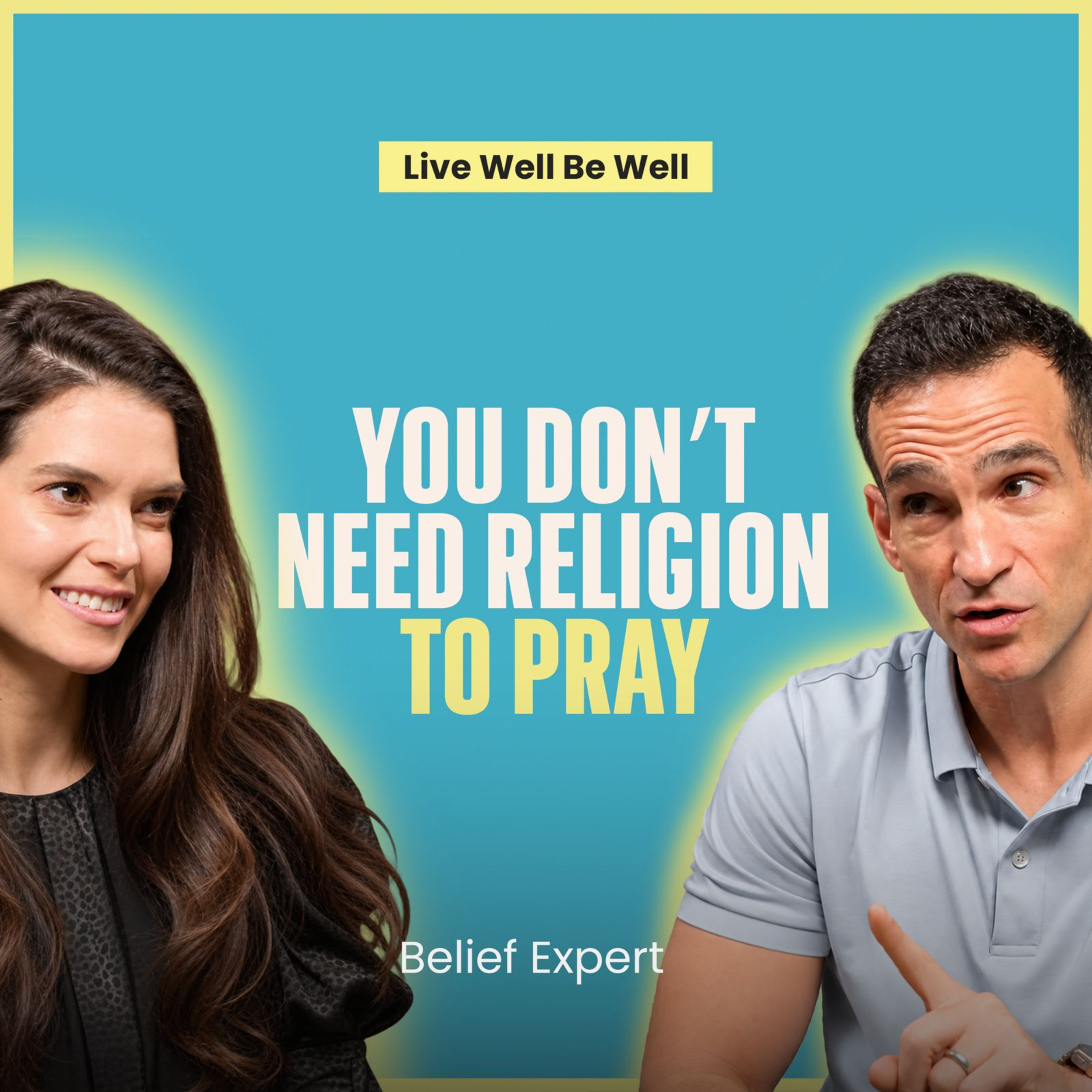
The “science of prayer” as a self-compassionate, ritual-based practice that can improve wellbeing without religious faith or belief in the supernatural.
Nir Eyal, a scientist and author focused on beliefs and self-compassionate prayer; inspired by Robin Schwama’s “MVP” morning practice.
Prayer is psychologically protective—one study found higher pain tolerance for people who pray with faith and for people taught to pray without faith, compared to a no-prayer control. “Spiritual but not religious” people report higher anxiety/depression, possibly due to isolation and lack of community.
Eyal’s childhood sky-praying for comfort; substituting “God” with “Mother Nature/the universe”; asking Rabbi Mordechai, an imam, a swami, a monk, and a priest if prayer is allowed with doubts; citing Exodus (“we will do and then we will hear”); comparing Japan’s religious rituals without supernatural belief.
0:00Talk to me about faith, right? Because in my book, I talk about the self-compassionate prayer. So I'm not religious. Do I, you know, I'm a scientist. I'd love to believe that there's energy and something happens. I don't know. But I'm a big ritual person, right? But the self-compassionate prayer is one of the tools that I have in the book. And I was very inspired by Robin Schwama, who came on the show, and he talks a lot about MVP and about doing kind of a prayer in the morning. And again, he says, I'm not also religious, but this is something that helps set my mindset up for the day. You talked about fact versus faith.
0:38Talk to me about how important it is. And I don't want this. Obviously, there is religion involved, but it doesn't always have to be religion faith. I think faith, we automatically connect it to a religious belief. But I actually just kind of connect it just to a maybe hope or ritual is the way that I call it. how important is kind of faith in our lives to help our beliefs?
1:01Nir Eyal: Yeah, so when I was six years old, that was the last time I prayed. And I remember my family was going through a really tough time. We were in America for only three years, and my parents got scammed. Some local American saw there was a family that barely spoke English, and he took them for a ride, and they lost everything. And they had to rebuild from nothing. I remember they had these terrible fights. They were on the verge of divorce. so I can still kind of hear their shouting matches in my ears. And I remember I'm the youngest of three boys, and I would wake up early, and I would go outside on my driveway, and I would just look at the sky, and I would pray.
1:37Nir Eyal: And at the time, I thought I was talking to God, and it was very comforting because this voice told me things were going to be okay. And as I grew up, I stopped praying because I thought to myself, if I can't prove as a fact that anyone is listening, then who am I talking to? And I stopped. I also consider myself a scientist and I want to see the evidence. And I didn't really grow up with any kind of strong faith tradition at home. So I just, I stopped. And then as I was writing this book, it's a book about beliefs. And I kept seeing evidence about the power of faith, the power of prayer. And it was kind of annoying because it turns out people who pray live longer, they make more money, they have more friends, they contribute more to the community.
2:24Nir Eyal: All these good things happen to people who pray. And I was kind of jealous that, you know, well, that's nice, but I can't have that. And then I read a study that changed everything. They did a study where they had three groups of people. One group of people didn't pray, didn't do anything. That was a control group. Another group of people were people who prayed through some kind of faith tradition. So they were Christian or Jewish or Muslim, Buddhist. They had some kind of faith tradition and prayed. A third group were people like me who didn't have a prayer practice. and they taught them how to pray.
2:57Nir Eyal: But they said, instead of the word God, you can substitute whatever you want that's meaningful to you. Mother Nature, sum of all forces, the universe, whatever is meaningful to you, please substitute that word. And what they found was that people who prayed with faith and people who prayed even without some kind of conviction in the supernatural both had significantly higher pain tolerance than the people who didn't pray. So there seems to be some kind of psychologically protective effect to the practice of prayer So that's what I call you know that prayer is possible even without faith and the reason I think this is so important is that you know in america The largest religious community today are the nuns not not the catholic nuns the n-o-n-e None like no don't have any religious affiliation.
3:45Nir Eyal: That's the largest religious denomination today The trouble is that people who classify themselves as spiritual but not religious Actually have higher rates of anxiety and depression disorder than people who are spiritual and religious Tell me more Can I get all the time? Well, that can't be true And first of all, look it up I mean, this is what the studies show I didn't make this up This is based on the study So, you know, as good as you think the studies are They seem to show that spiritual but not religious has much higher rates of mental health issues And I think part of the reason is you know they say don't remove a fence until you know why I was put there and so what we're doing and by the way this is coming from the most skeptical secular person you've ever met I have a really tough time with anything supernatural but yes because you want some evidence I want I want it to be a fact I want it to be a fact so here's what I did I went to five religious leaders this is going to sound like the setup of a joke this is exactly what I did I went to five spiritual leaders, a rabbi, a swami, a monk, an imam, and a priest walk into a bar.
4:50Nir Eyal: It sounds like a joke, right? I went to five religious leaders, and I asked them all the same question. Can I pray even when I have doubts about God? And I thought that they would kick me out. I was kind of hesitant. I thought they would say, heretic, get out of here. What are you doing? And you know what? They didn't do that. Yeah, they welcomed you, right? They welcomed me. And in fact, I remember The rabbi, Rabbi Mordechai, he says to me, I'm sitting in his office, and he's full of books, and he's got this tiny space, and he tells me, he looks at me, he says, so there's this omnipotent, omniscient, eternal being, and you don't have any questions?
5:30He's like, you don't have any doubts?
5:33Nir Eyal: So he tells me about how in the book of Exodus, the Israelites, when they're receiving the Ten commandments on Mount Sinai. God gives them the 10 commandments through Moses. And the Israelites say back, they say, which means we will do and then we will hear. And he's like, and he tells me that's backwards. Think about that. That's backwards. Because first, you know, if I want to convince you of something, first I have to tell you, hey, here's what you should do. And then first you hear it, then you do it if you agree with me. But that's not what they say. They say, first we will do and then we will hear.
6:10Nir Eyal: And so he says the believing part, the having the faith, isn't necessarily the requirement. And I thought that was amazing. That we can still pray. Like nobody has a monopoly on prayer. Why can't I pray? I can pray. I can still have those protective effects. I can still benefit. It doesn't mean I have to have perfect faith in everything that the holy book says I have to buy hook, line, and sinker. I don't have to have blind faith. Why would I have to have blind faith? The problem is twofold. One, people like me, previously, I would tell myself, well, if I can't believe everything, then I want nothing.
6:42Nir Eyal: I don't want anything to do with it. If I can't prove everything's a fact, I think that's pretty closed-minded because I was missing out on all these benefits. Secondly, the religious institutions, you know, nobody's asking the Pope if he believes everything, right? So why is it that when I step into a religious institution, I need to have also a faith test? I need to buy everything the way that that religious leader says it is, but the religious leader down the street thinks, as a completely different interpretation? No. So I think we're really missing out. And I think the answer to this question of why do people who affiliate as spiritual and not religious, why do they have these worse mental health issues?
7:13Nir Eyal: Because they're not participating in the community. The father told me, the priest told me, he said, you know, people come to church and they think it's like a cosmic slot machine. That they say, they pray for this, they pray for that. I want this, I want that. You know, I need, my business is not doing well. I need money. Somebody's sick in my family. I want them to be healthy. I want love in my life. I want, I want, I want, I want. And he says what they don't realize is that by coming to church, that's where God fulfills miracles. That's where he fulfills his request. Because the person down the pew, if you're looking for love, that might be the love of your life.
7:49Nir Eyal: The person who you meet could help you with your business. That's where God makes these wishes happen. And I think for people like us, you know, these secular communities, they don't last. You know, the Sunday Assembly, the atheists, they don't have that bonding community. So I'm kind of on a crusade, for lack of better words, to help us say, hey, you know what? We don't have to have blind faith in everything in order to have a belief that the practice is beneficial, that participating in the community, to going somewhere where you know that people in that congregation have an obligation to take care of you and that you have an obligation to take care of others.
8:33Nir Eyal: That's incredibly healthy. And I think we should go back to that. So that's - I think we're losing that, right? We're losing because we're becoming more isolated than ever before. And I think that is the incredible part about faith. And I was similar, right? So I grew up with a very atheist father and a Christian mother. So I was kind of in this household where it was like you decide yeah and so i had both shapes the thing that i connected to a lot was was buddhism because i'm very into philosophy and so i found that very interesting and when i went to japan i absolutely loved japan and a lot of my book has a lot of japanese philosophy in it do i still know essentially what i believe in no i'm kind of figuring it out as i go but the rituals i find incredible japan is is actually an amazing case study in that because unlike Like in the West, where there's a lot of people who are spiritual and not religious, the Japanese, the Shinto, are religious but not spiritual.
9:26Yes.
9:27Nir Eyal: Right? Yes. They do the rituals because it's part of their – it's what it feels like to be Japanese to them. But the spiritual, when you ask them, wait a minute, do you actually believe there's a supernatural thing that works this way? No. But they do the ritual. Exactly. This is the thing. And I think that's why I put it in the book because I put it in the book by saying I grew up watching American films where people say grace and I couldn't connect to it. You know, I was very much in a similar mindset to you. But uncovering the research that you can live like four to 14 years longer with some of the research from Harvard.
9:58I was like, well, why are we doing this? Have I missed out on this massive?
10:02Nir Eyal: If it was a vitamin, we would all be taking it. Exactly. And I just think also, do you know what it gives you? It gives you just a moment for yourself. yes even if you know we're thinking not about the it just gives you a moment to connect to being a bit more mindful we live in a very mindless world right we're constantly doing and just having that moment of whatever that ritual is and whatever practice you are and whatever you're doing something for you and you're becoming mindful right and when we're mindful you make 90 more logical decisions. You know, when we're mindless, we make 90 % more emotional decisions.
10:43Nir Eyal: Right, right. And it's different from meditation. I think meditation is great. It's got its own practice, but it's a very, very different practice. Prayer seems to be a form done correctly as a form of problem solving almost. Like sitting with an idea, with a thought, you know, thinking through it. When I ask and people say, well, if I'm not praying to the supernatural, what do I pray for? And I don't pray for things. I pray for beliefs, for mindsets that help me overcome no matter what comes. So I'm not asking for things to be worked out. I'm not asking for good things to happen. I'm asking for patience.
11:19Nir Eyal: I'm asking for the right beliefs. I'm asking for strength to overcome whatever might happen. And that's just that daily reminder, you know, wishing for patience, reminding myself. So when I pass by a temple or a church, if the door's open, I'm going to go in. There's no requirement that I have to agree to everything. In order to step inside, there's that feeling that you get in a house of worship that I think is a beautiful first step. Or even just taking 10 minutes in the morning and focusing on that time to problem solve through what you can do about it. Well, sometimes what I also pray for is it connects me to the gratitude because we have a very big negativity bias in our brains.
12:04Right. And we'll normally remember all the things that have gone wrong or all the things you've got to do in the day. And sometimes when I just sit down, I'm like, you know, just give me a minute. Like, what what am I grateful for today? Because that is also really important practice to help change your beliefs.
12:18Nir Eyal: Right. Right. The gratitude doesn't have to be grateful for everything. But it's really important just to try and connect to one thing that happened today that you can be grateful for. That's way bigger than you are. I always like to do this like cosmic reflection of when I go into a house of worship and I think of what am I grateful for. You know, the math, the probabilities of why you're here right now. I don't know if this is maybe it's just me. But when I reflect on that. It's a ridiculous number, right? About that the sun has to be a certain distance away from Earth so that we are not frozen or all burned up.
12:54Nir Eyal: And that 3.4 billion years of evolution got us here. 200 ,000 years of human history. That the sperm had to find the egg within your mother and father just so that it could happen exactly this way. And that you're alive today to be here and listening to the sound of my voice. Like the odds. Just the odds.
This week’s Live Well Be Well Moment is with Nir Eyal, million-copy bestselling author of Hooked, Indistractable and Beyond Belief.
My book, Healthy Shouldn’t Be This Hard:https://www.amazon.co.uk/Healthy-Shouldnt-Be-This-Hard-ebook/dp/B0G1DHNRV5
📖 If this resonates, join the thousands of readers who receive The Compassionate Cure each week:
https://sarahmacklin.substack.com/
Let’s be friends!
📷 Instagram: https://www.instagram.com/sarahannmacklin/
📹 Subscribe: https://www.youtube.com/@livewellbewellsarah
🐦 Twitter: https://x.com/SarahAnnMacklin
📱 TikTok: https://www.tiktok.com/@livewellbewellpodcast
💌 Newsletter: https://sarahmacklin.substack.com/
Scan the code with your iPhone camera
Listen in the app.