Ask ChatGPT

 Live Well Be Well with Sarah Ann Macklin | Health, Lifestyle, Nutrition
9 Nov 2026 · 4m · 3 chapters
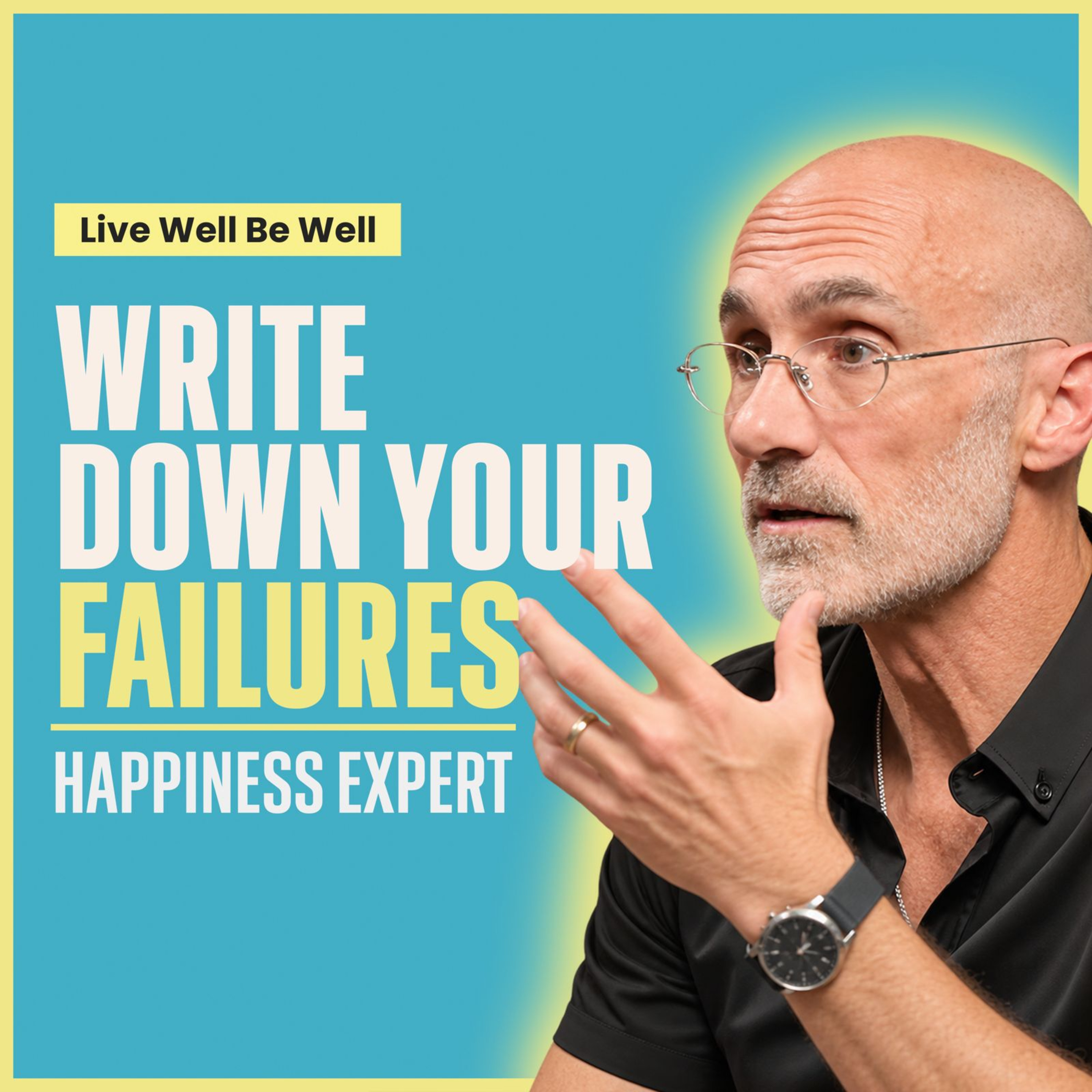
Arthur Brooks argues that a “failure journal” (writing down significant disappointments and what you learn later) boosts well-being more than traditional gratitude lists, by countering negativity bias and turning setbacks into “generative” learning.
Arthur Brooks, author and happiness researcher; he also assigns gratitude exercises to students.
Gratitude lists help but don’t necessarily increase happiness as much as focusing on failures. Writing on paper is more effective than typing. A failure journal raises well-being (cited average: 12% happier after 10 weeks).
He describes journaling after a parent’s death—initial reflection on remaining time with loved ones, later realization of getting closer to his brother—then using later entries to see patterns of learning and positive outcomes.
Written by AI. May contain mistakes.
Discussing the effectiveness of a failure journal versus gratitude lists.
“Well, the failure journal is actually a lot more effective exercise for your own happiness and progress in life.”
Steps to effectively maintain a failure journal for personal growth.
“It fights against the negativity bias of the human brain.”
Understanding the lessons and benefits that come from reflecting on failures.
“Come back to it after two or three weeks to the first line that you left blank under it and write down something you learned over that period because of the disappointment.”

Get the gist, explore an idea or ask about something said.
 Claude
On Live Well Be Well with Sarah Ann Macklin | Health, Lifestyle, Nutrition, what are the key points of this episode?
Searching your listeningAutomatic transcript. May contain errors.
0:00Do you know what I loved about your book? You keep a journal of your failures and disappointments.
0:05Arthur Brooks: Yeah, yeah. But not the things that go right. Yeah. Why? Well, the failure journal is actually a lot more effective exercise for your own happiness and progress in life. And it winds up actually raising your well-being more. So good, count your blessings. Yeah. And I do. I mean, I pay attention to the things. I have gratitude lists that I keep. And I assign gratitude lists to my students. the five things that you write down on Sunday that you're most grateful for. My mom is healthy. You know, the national team won in the World Cup. You know, whatever. Whatever your thing is, no matter how dumb it is, it doesn't really matter.
0:39Arthur Brooks: And then I look at it each day over the course of the week for a couple of minutes before I go to sleep, and I update it on Sundays. And by the way, if you do that, on average, you'll be 12 % happier after 10 weeks. Gratitude's great. Gratitude's awesome. It fights against the negativity bias of the human brain. Yeah. The negativity bias exists because negativity keeps you alive by keeps your head on a swivel, right? But it's maladapted because we're not in that much danger anymore, right? There's not something sneaking around. Is there a snake in a cave? I mean, it's not, you know, we're pretty good about that now.
1:10Arthur Brooks: But what really will help you out that's even less natural is actually focusing on your failures and disappointments. So I keep a journal, and I recommend my students do as well. The failure disappointment journal is every time something kind of significant comes down the pike that bugs you. And no matter how wonderful and magical your life looks like. So a lot of people watching were big fans of yours. They're like, if I could have Sarah's life, I would be completely happy. And you're like, no, no, no, no, no. Spend a day in here and you'll see. Because everybody's the same. Everyone's the same.
1:48Arthur Brooks: And you're grateful, I know, for all the good things, but you're not happier per se. So when something bad happens in Sarah's life, you write it down. Now in your journal, I recommend actually pencil and paper because it has cognitive impacts that are more profound and enduring than typing it into your phone, but whatever works. Leave two lines under it and then set an alarm to come back to it. Come back to it after two or three weeks to the first line that you left blank under it and write down something you learned over that period because of the disappointment. And then come back after about two more months and write down something good that happened because of that disappointment.
2:30Arthur Brooks: Okay, now you're always writing things down. And sometimes you'll have like three or four of these things with the blanks under them because you haven't, you're going through kind of a tough time. But once you've got a lot of things in this journal, you're going to start looking at the things above. And you're going to say, yeah, every time something bad happens, I learn something and something good happens as a result. Not better than the bad thing necessarily. Doesn't mean you'll say, sure, I'm glad mom died. No. But you will learn something. You will learn, for example, about the decisions that mom, let's say mom does die because mom's going to die.
3:00Arthur Brooks: And when it happens, when my parents died, I remember thinking, what did I write down? In the first line I wrote down, this is making me think about my own life and how many Thanksgivings I have left with the people that I love. And it's making me think about the passage of time. And I'm learning a lot. And I came back to it later. And I said, what good came from that? I'm closer to my brother. I love my brother. And I'm closer to my brother as a result of that. And then as that starts to fill out, you start to look at the failures and disappointments from before. And you start looking forward to writing them down.
3:37Arthur Brooks: Because these have become generative. And they become I'm generative because they were explicit. This is self-management. This is management over your life. Instead of just like, that sucked. Let me try to forget that by having a couple of drinks or hanging out with my friends. And your friends are going to be like, it's okay, Sarah. He was a jerk. He was no good for you anyway. So just move on. No. No, I mean, you're going to move on. But move on with power. Because they say, what did I learn? He did this and this and this. That wasn't a good thing. What was the good thing that came from it? Now I'm free and I'm meeting new people.
4:14Arthur Brooks: That's a classic case of what happens after a breakup. Never waste your suffering from a breakup.
This week’s Live Well Be Well Moment is with Arthur Brooks, Harvard professor and #1 New York Times bestselling author.
Keeping a journal of your failures and disappointments, not just the things you’re grateful for, could do more for your happiness than you think. Arthur explains exactly how to do it, why it can be so powerful, and what the practice taught him after losing his parents.
My book ‘Healthy Shouldn’t Be This Hard’: https://www.amazon.co.uk/Healthy-Shouldnt-Be-This-Hard-ebook/dp/B0G1DHNRV5
📖 If this resonates, you can join the thousands who read The Compassionate Cure each week.https://sarahmacklin.substack.com/
Let’s be friends!
📷 Instagram: https://www.instagram.com/sarahannmacklin/
📹 Subscribe: https://www.youtube.com/@livewellbewellsarah
🐦 Twitter: https://x.com/SarahAnnMacklin
📱 TikTok: https://www.tiktok.com/@livewellbewellpodcast
💌 Newsletter: https://sarahmacklin.substack.com/