In short
How menstrual cycle “normal” variation can signal reduced ovulation and fertility issues; explains cycle phases, anovulatory cycles vs amenorrhea, and lifestyle/diet changes to improve reproductive hormone function.
Guest background
Dr. Stacy Sims, likely a sports/health researcher and clinician focused on women’s physiology, metabolic health, and endocrine effects of stress, nutrition, and training.
Key claims
Normal cycles range 21–40 days; follicular phase length changes with stress. Many “periods” can be anovulatory (bleeding without egg release). Amenorrhea (no period for ~3 cycles) is driven by hypothalamic signaling problems. Lifestyle energy deficiency (sleep/food) can suppress ovulation; carbohydrate availability may be insufficient even when calories seem adequate.
Notable examples
Women with shorter cycles from luteal phase deficiency; fertility patients told “everything looks fine” but improve after increasing carbs for egg maturation.
Written by AI. May contain mistakes. Listen to the episode to check what was said.
Chapters
Tap a time to open that second in VOUnderstanding the Menstrual Cycle
0:36 to 4:42
An in-depth explanation of the phases of the menstrual cycle and hormonal changes.
“But it really gets into the heart and not into the mind of the person who is sat in front of me.”
Anovulatory Cycles and Amenorrhea
4:42 to 7:24
Discussion on anovulatory cycles, their implications, and how they differ from amenorrhea.
“So ovulation means that you are producing an egg and it's dropping.”
Diet, Lifestyle, and Fertility
7:24 to 10:08
Exploration of how diet and lifestyle affect menstrual health and fertility.
“So how would you treat those two things?”
The Role of Partners in Fertility Discussions
10:08 to 11:09
Importance of male partners understanding dietary needs related to fertility.
“Because when you get to that phase in your life where you're with somebody and you're maybe thinking about children, you may be eating similarly to your partner.”
Transcript
Automatic transcript. May contain errors.0:00Welcome to a new release on the show. This is the five questions to nourish the mind, body and soul. To get to know the person sat in front of me a little bit more and ask them questions they wouldn't normally have. This has become very quickly one of my favorite parts of the interview. Now we are re-releasing these because we released these months ago for our paid subscribers over on my newsletter, The Compassionate Cure on Substack. If you're not a paid subscriber, you will get these months in advance of being part of our community. However, we are now starting to release them. So enjoy. This is more of a personal connection and a shorter episode.
0:39But it really gets into the heart and not into the mind of the person who is sat in front of me. So let's start with the menstrual cycle. Okay. Okay. So like this is going to be like going back to school. but I want to understand the different phases of a menstrual cycle and how our hormones react in each phase how should we be aware how can one read their body okay can we talk through these yep absolutely so when we are looking at a textbook you'll see this diagram where it says zero to 28 and this is a textbook cycle that I'll explain but I want everyone to be aware that no woman is textbook.
1:19I'm so pleased that you said that. Okay. Normal cycle is anywhere from 21 to 40 days. And there's variation within the early hormonal phase or the follicular phase. But let me start by explaining it through that 28 day look. So if we say day one is the first day of bleeding. So that's the first day of your period. Is it the bleed cycle? Yeah, the bleed cycle. Yep. So bleed cycle, that's very, also very variable. It could be three days, it could be seven days, it could be eight days. And every woman should understand her own bleed phase and what the pattern is within that. Because when you start to have missteps in stress, either life stress or training stress, or as you get older in a perimenopause, the first thing that changes is the bleed phase.
2:03So if we go through the bleed phase, then we get to about day eight and that's mid follicular. So follicular phase is low hormone phase. Mid follicular, you start to have a rise in estrogen. And then you have also a rise in what we call luteinizing hormone, and that precedes ovulation. So you have a surgeon in luteinizing hormone around day 13 with ovulation occurring within 24 hours after that. After ovulation, you have the degradation or the breakdown of the follicle that was holding the egg that produces progesterone. So progesterone comes up, estrogen comes up, and now we're in the high hormone phase, which is called the luteal phase.
2:40And that's from about day 14 to day 28. So around day 21, we have a peak in progesterone, and then it starts to slowly fall. And about the five days before your period starts, that's when you have a significant drop-off of estrogen progesterone, which is why women feel PMS, right? They have really bad bloating, headaches, poor sleep. Not everybody does. Yeah, gut problems, exactly. Not everybody does, but if you are tracking your own cycle and understanding your pattern, then you'll start to see why these things are happening. So if we take a step back from that textbook, 1 to 28 days, and we see someone who might have a 40-day cycle, so that means from day 1 to the next day 1 is 40 days.
3:31It's that low hormone phase, that follicular phase, that is lengthening. And the reason for that is the body is trying to become very stress resilient and trying to mature an egg, but wants to make sure that the environment is very stress resilient so that the egg has the availability of being fertilized to then grow a baby. So that follicular phase really lengthens. And then the luteal phase or that high hormone phase is pretty stable at 14 days. If someone has a very short cycle, so that means around 21 or 22 days, there are two things that might be happening. Either you have a very short follicular phase because you have very robust eggs that are really easy to mature, or if you have what we call luteal phase deficit or deficiency, it means you're having lots of anovulatory cycles and you're not producing progesterone.
4:28You'll still have a bleed, but it's not a true bleed. This is why it's telling women that you want to see what your bleed phase is like. Anovulatory. Anovulatory. Which is? No release of an egg. Yeah, I don't think people know what that is. So ovulation means that you are producing an egg and it's dropping. Anovulation means that your body is really trying to mature an egg for it to, I guess, be dropped. But it doesn't happen. And we're seeing that across the board, there are more and more anovulatory cycles happening in the world. Do we know why? Some of it's environmental, some of it's genetic.
5:07And when they're really trying to dig down into it, they're seeing pockets of areas that might be more environmental. But overall, it's the general global stress in diet. So we're seeing - Wow. From ultra-processed foods, do you think? Yeah. And also maybe from people that are undernourished? Yep. Okay. Yep. So if we're bringing, like we look in today's society, all the ultra processed foods, but that doesn't guarantee nutrition. No, of course. It's overnourished and undernourished at the same time. Exactly. Exactly. And the high stress rates, right? So if we're seeing a significant amount of stress and the body's not stress resilient, then it's not going to ovulate because it's like, well, I don't have enough reserves to keep myself going.
5:50I'm not going to have enough reserves to be able to grow a baby. Maybe. So that means they have no periods. No, you do have a period. See? So how can you tell? So this is why we say, as a woman, you want to track your cycle. And we look over the course of three full menstrual cycles. You'll start to see your own patterns. and that's why I said at the start where as a woman you really want to be able to identify your bleed pattern and say okay well I know that the first two days are pretty heavy then it starts to get lighter and then it might pick up again and then it's medium and then some spotting and it's done but if you start to say wait my first two days are super light and then I had some spotting and then a couple more light days that should be a cue because you will still bleed with an anovulatory cycle amenorrhea is different it's when you skip your parents so yeah when your periods don't come for they say three months in a row or three full cycles in a row and you're waiting and waiting and waiting you're like gosh i could have had three periods by now but i haven't then we're amenorrheic and that is more uh driven by the hypothalamus and there's a misstep in a luteinizing hormone surge and estrogen.
7:05So there's actually a hormonal problem or signaling that is happening that's like - In the brain. Yep. Where we can't ovulate, we can't be reproductive. So when we're looking at anovulatory cycles, they're becoming more and more common, but it's not necessarily driven by the hypothalamus. When we're looking at amenorrhea, that is what's driven by the hypothalamus. So how would you treat those two things? So I'm thinking the control center in the brain, which is the hypothalamus, which is obviously a hormone imbalance. Would you treat that differently to having a period where you're not ovulating, but you're still bleeding?
7:40Yeah. So if we have the definitive aspect of amenorrhea, so we call it secondary amenorrhea, or hypothalamic amenorrhea, then we have to look and say, okay, are you eating enough? Are you sleeping well? So we look at all the lifestyle things. And generally for active women, it comes down to an energy misstep where there's poor sleep and not enough food coming in. And that's low energy availability or relative energy deficiency in sport. If it is someone who is dialed in with all of that, then it could be a pituitary problem. So that's when we start looking more clinical. We look at anovulatory cycles.
8:17Most women have between four and six anovulatory cycles in a year. So that's normal. If you start having more or you're seeing a shortening of the cycle, then this is where you want to talk to your physician about, well, maybe it's a luteal phase deficiency, and then we have to do some intervention. So there are definitely ways of going about trying to understand it. And the way I try to counsel women is, well, let's really make sure that you're eating for the task at hand. So you're not delaying food after training. You are eating food before training. You're staying with circadian rhythms. You're taking care of your gut.
8:59All the things that you talk about all the time and most of us in the health and wellness space are like, look, this is the things that we've gotten so far away from in this society that we need to bring ourselves back. And when we start doing that, our body becomes very stress resilient. And then we can see an uptick in a lot of the fertility aspects where a lot of women are struggling with infertility. I've had a lot of women who have been trying to get pregnant and struggling with infertility. Their doctor's like, well, I don't really see anything wrong. You have a lot of ovulatory cycles. It comes down to their diet.
9:36So they're too low in carbohydrate. You boost the carbs, then you have availability to actually mature the egg. You have the macronutrient that is there to help boost egg development. And then And they're like, wow, okay, now I have enough carbohydrate availability. Even if they're eating enough calories, it was they didn't have enough carbohydrate. So this is how we have to really start digging into what are you eating? How are you eating? And are you eating as a woman should to support metabolic health and endocrine health to keep moving forward? Well, it's interesting, isn't it? Because when you get to that phase in your life where you're with somebody and you're maybe thinking about children, you may be eating similarly to your partner.
10:17and actually we're quite different people. You know, men and women are different. And we spoke about this a lot more on the show, which we won't go into as much today, but we spoke about fasting. You know, women do not fast like men, that we have different systems. Men are more resilient to it, women are not. So I'm just thinking about that phase when you're with your partner, that actually you need to be more aware if you're trying to get pregnant of your diet and your training. Right, and so that's where, you know, earlier you're saying, why should men be involved in the conversation? This is why.
10:47Exactly. So if they understand that there's these nuances and you guys are eating the same and you as a male is like, I can go lower carb and I'm training hard, but oh wait, my partner's not eating enough and we're struggling with this fertility issue. Maybe I should encourage her to eat more carbs instead of going, well, why are you eating those carbs? Yeah. It's a big thing. It is a huge thing. Thanks so much for listening. to hear the full episode. There's a link in the description.
From the publisher
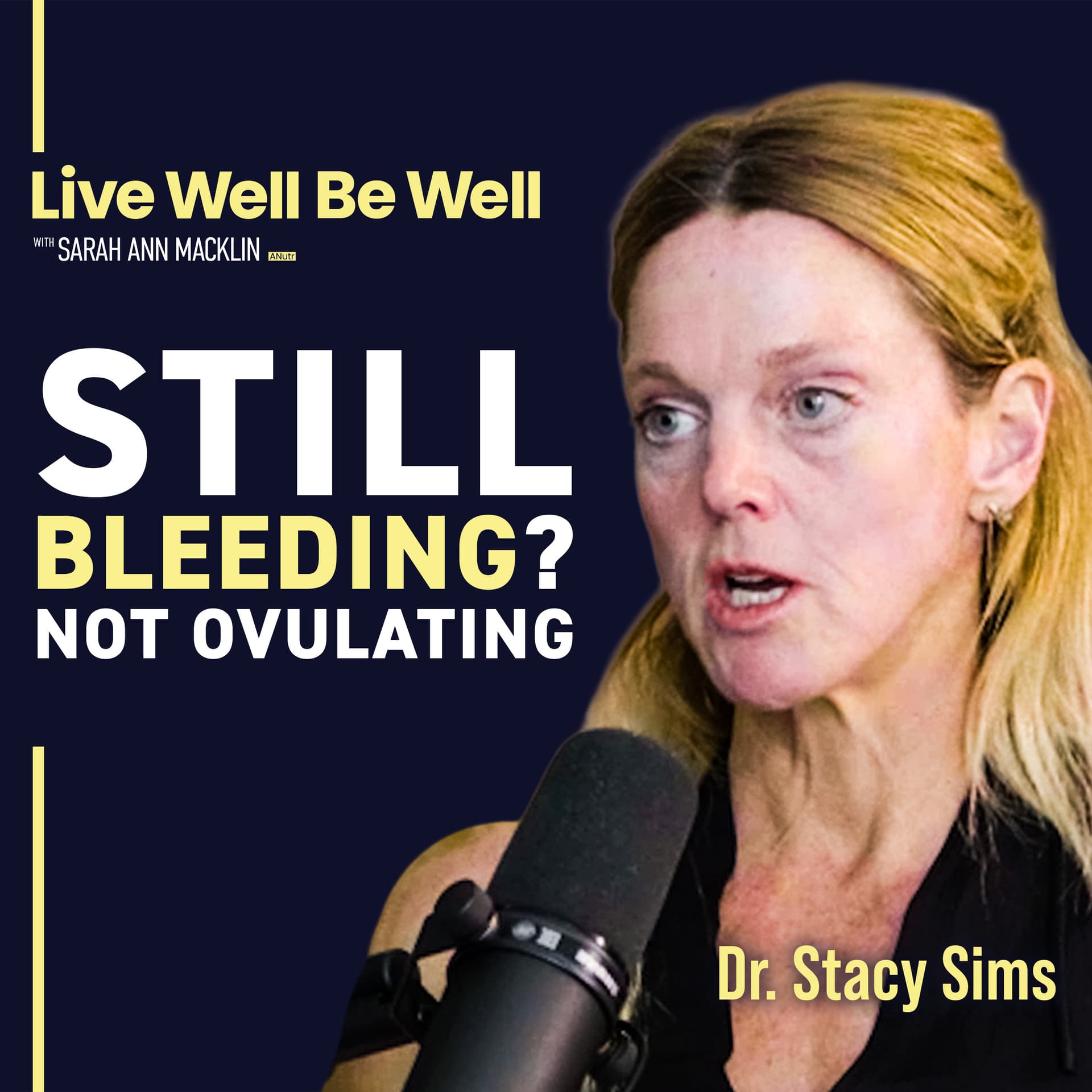
Does understanding your menstrual cycle unlock better health, fertility, and performance? In this conversation with Dr. Stacy Sims, she breaks down the four phases of your cycle, reveals why anovulatory cycles are becoming more common, and explains how stress, diet, and lifestyle directly impact your hormones. From tracking your bleed patterns to understanding why women need different nutrition than men, this isn't just about periods. It's about optimizing your entire well-being.
Dr. Stacy Sims
Listen to the full episode here.
Watch the full episode on YouTube here.
***
If you enjoyed this episode you might also like:
Dr. Stacy Sims on Perimenopause & How to Manage Symptoms | Fitness and Nutrition for WOMEN
https://www.youtube.com/watch?v=hsaGZXiEbNs&list=PLfXKbjBGaUhb8BME00cxF6YPp1J5EcO7j&index=18
***
Sign up to Sarah’s Compassionate Cure newsletter:
Science Simplified, Health Humanised. Join thousands in exploring actionable insights that prioritise compassion, clarity, and real-life impact. https://sarahmacklin.substack.com/
***
Let’s be friends!
📷 Instagram: / sarahannmacklin
📹 Subscribe: / @livewellbewellsarah
🐦 Twitter: / sarahannmacklin
📱 TikTok: / sarahannnutrition
💌 Newsletter: https://bit.ly/3rUbHyS
#MenstrualCycle #HormoneHealth #5Questions

