In short
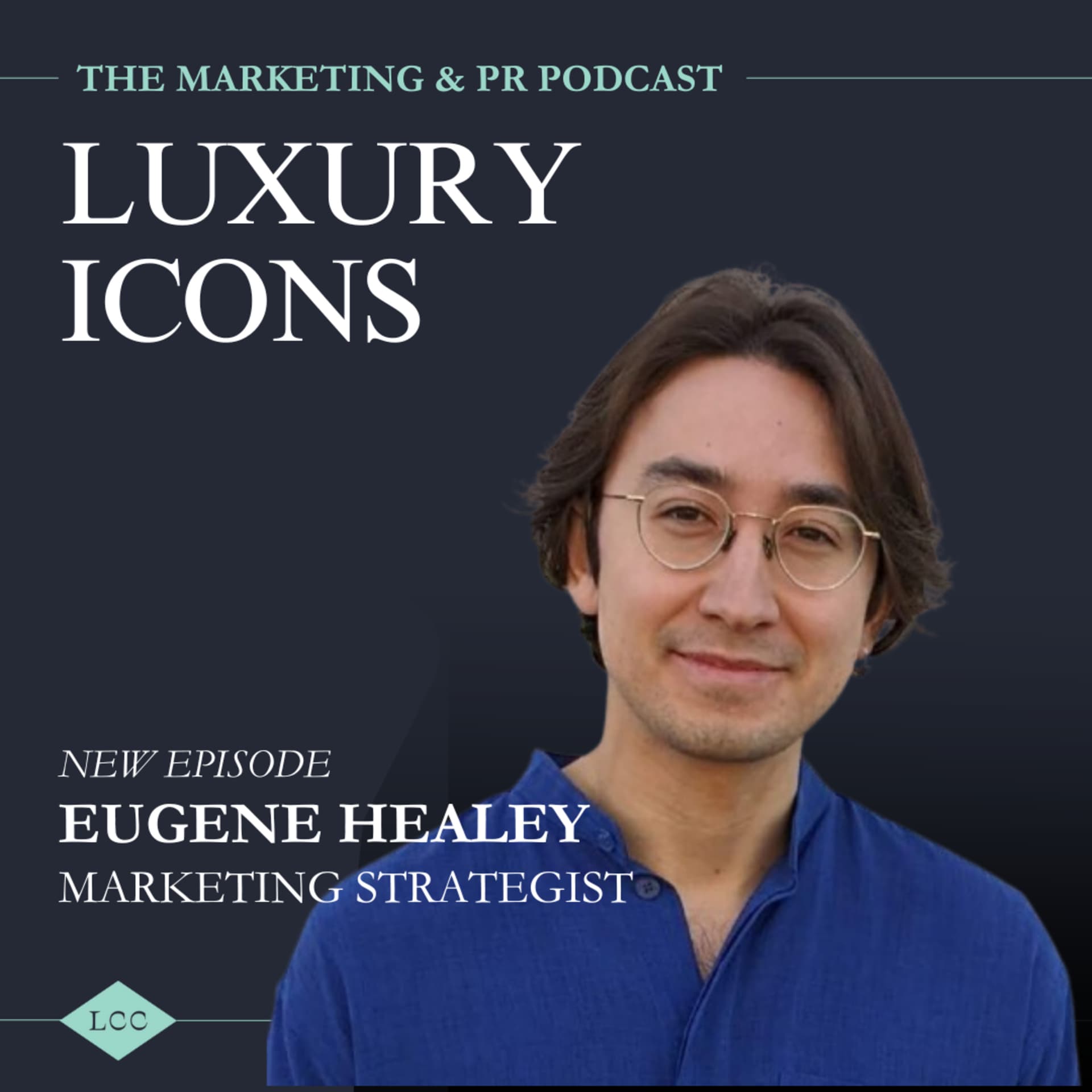
Eugene Healey, a social-media-first marketing strategist, discusses Cannes Lions impressions and major shifts in luxury marketing: the “social media engagement recession” pushing users into closed networks/DMs, the need for “brand intimacy” over extroverted shouting, and why luxury’s fiction/monopoly on status is eroding via cultural oversaturation and consumer tech. He also argues long-form is rising inside short-form ecosystems, and that AI will reshape creative services over 10–20 years (flattening time-based models and threatening mid-tier roles).
Notable examples
SnapForward keynote prediction that brands will be opened into messaging platforms (WhatsApp later allowing advertisers); IKEA DM campaign; LVMH Olympic partnership (Canne Lions Grand Prix) and Ritz-Carlton long-form video (Gold); Hermes/Birkin “algorithmic wallpaper”; Bottega Veneta “I’m photographed, not me”; sleep as a new status symbol (Oura Ring).
Guests
Eugene Healey only. Backgrounds: 9 years agency-side brand strategist for Google, Spotify, Red Bull; lecturer at University of Melbourne; educational videos on LinkedIn/TikTok with 300,000+ audience; keynote speaker at major events.
Key claims
creativity is being “tamed” by tech/quantification; creator economy helps reach fragmented niches; luxury status is moving from objects to behaviors (privacy, sleep).
Written by AI. May contain mistakes. Listen to the episode to check what was said.
Chapters
Tap a time to open that second in VOIntroducing Eugene Healey
0:46 to 2:53
Eugene Healey shares his background and achievements in marketing.
“During this, he has an acquired audience of over 300 ,000 and has flown around the world to address brand leaders at major events.”
Insights from Cannes Lions
2:54 to 4:36
Eugene discusses his experiences and impressions at Cannes Lions.
“It's everything people say it is and more.”
The Role of Technology in Creativity
4:37 to 6:41
Exploration of how technology influences creativity at the festival.
“But the awards themselves, whilst that is the raison d 'etre for being here, actually feature far less than you'd imagine.”
Luxury Marketing Trends
6:42 to 7:24
Discussion on the trends of long-form content in luxury marketing.
Challenges for Luxury Brands
7:25 to 12:12
Eugene discusses the challenges faced by luxury brands in the current market.
“and was that something that you're seeing I guess more of a demand for or more of a trend for this sort of sense of long form?”
The Future of Luxury Marketing
12:13 to 14:00
Thoughts on potential changes and the future direction of luxury marketing.
“It's a significant cultural, economic, and technological issue as well that's going to require effectively the whole of business to mobilize in very different, interesting ways.”
The Changing Landscape of Creativity and AI
14:00 to 16:51
Explore how AI is reshaping creativity and the implications for creative professionals.
“and then also the way that these brands themselves are organized too.”
Brand Engagement in Closed Networks
16:51 to 19:16
Discuss the challenges brands face in adapting to closed social media spaces.
“Like, we live in a capitalist society or a post-capitalist society, depending on who you're talking to.”
Luxury Brands and Personal Touch
19:16 to 22:56
Examine how luxury brands must adapt their engagement strategies in the digital age.
“And actually, exactly as you say, the moment something feels intrusive, you've lost them.”
New Status Symbols: The Rise of Sleep
22:56 to 25:21
Learn about the emerging status symbols in society, particularly around sleep.
“And one of the reasons was also completely out of their control.”
Show all 14 chapters
The Evolution of the Creator Economy
25:21 to 28:01
Understand the importance of the creator economy and its impact on marketing strategies.
“and the sleep thing, I mean, it's like a competitive sport.”
The Evolution of Marketing in the Creator Economy
28:01 to 29:27
Learn how the creator economy is reshaping marketing strategies and brand engagement.
“I don't want to use the word personalization, but effectively everyone lives in their own little reality bubble these days.”
Eugene Healey's Journey and Future Plans
29:28 to 31:14
Discover Eugene's plans for business growth and his approach to storytelling and strategy.
“Like I think that was, you know, the best example is like Charlie XCX.”
Defining Luxury: Eugene Healey's Perspective
31:15 to 33:39
Explore Eugene's unique definition of luxury and its implications in modern society.
“I think probably the most exciting thing for me at this point in my career is that as a business owner, I'm building my business in such a way that I never have to do anything that I don't want to do.”
Transcript
Automatic transcript. May contain errors.0:05Welcome to Luxury Icons, the marketing and PR podcast created by the Luxury Communications Council. I'm Rosie Shephard, the founder of the Luxury Communications Council, the world's only membership network dedicated to advancing the global luxury industry by uniting, supporting and championing marketing communication leaders. This podcast is dedicated to meeting some of the industry's most prolific leaders, delving into the challenges and opportunities that we face together. Today we are joined by Eugene Healy, a marketing strategist best known for his educational videos on LinkedIn and TikTok, highlighting everything from the macro trends to the micro nuances of luxury marketing.
0:46During this, he has an acquired audience of over 300 ,000 and has flown around the world to address brand leaders at major events. Eugene started out as a brand strategist working agency side for the last nine years on brands such as Google, Spotify and Red Bull and he's also a lecturer at the University of Melbourne. He is part of a whole new wave of social media first marketing educators and is one of those great minds that makes you stop in your tracks. Eugene welcome to Luxury Icons. We're obviously here at Cannes Lions, we've been hanging out a bit it's been really fun um what's really struck me is the actual sheer quantity of people who actually come up to you and are familiar with your work has that been surprising to you yes you found your people basically this is your gang or more specifically my people found me yes exactly let's just jump back into sort of thinking about your career and this can be sort of your latest version of your career we could we can think a little bit back sure um what's been sort of your proudest moments and personal achievements I suppose?
1:51More recently I would say I did a keynote at SnapForward so Snapchat's EMEA annual conference and I gave a keynote there about effectively the social media engagement recession and where users are going and what brands are going to do to respond so I effectively said users are all starting to go into the closed networks and in hiding and in DMs and in private groups. And what that means is that brands are going to start to open that space up for advertisers. And in the five weeks since I made that prediction, what we saw here at Cannes was now WhatsApp is going to allow advertisers into their messaging platform.
2:31So you can actually start to see some of that thinking actually crystallize out in the real world. It is always really gratifying as someone who's a cultural commentator or someone that makes a prediction, to see that prediction, you understand the intellectual rigor that goes into it, but then to see the brand actually respond, yeah. That was a really nice little moment, just obviously actually to experience here. Yeah, well, this is your first time at Cannes, isn't it? It is my first time at Cannes. It's a lot. It's completely overwhelming. It's everything people say it is and more. Any sort of overarching impressions?
3:04I have to do my thinking rap about this probably next week because there is just so much to internalise, I think, and it is so overwhelming. You don't really think about what four days back-to-back is going to feel like until you're sitting there baking in the 30-degree heat on the promenade and you can't even see the beach because there's so many activations that are lining the croissette. I think that probably the first and most interesting thing for me is that this is not an advertising festival. I wouldn't even call it a creativity festival. If you were to look at it through those lenses, I think it would be an unmitigated disaster.
3:43I've seen barely any ads. They're tucked down in the basement of the Palais. I think that coming here, what's been clear to me is this is a creativity-themed tech and media festival. And if you analyze it through that lens and you look at all the conversations that are happening here, it's all about technology and how technology is evolving and how technology is evolving with respect to creativity. But really, creativity is the wrapper. That's, I suppose, subordinated by the tech narrative. And that's, as it is with many things, that tech is effectively eating the world. That's probably my first big impression.
4:20And the other major impression that I got was that all of the real value here happens in the liminal spaces. So the keynotes themselves are incredibly polished, but they have been I suppose heavily PRified or modified because there's just so much money here you can't afford to have a controversial moment all of the interesting conversations I've had have been before a keynote or after a keynote or you're at this party or you bump into this person and then you end up having dinner with them and then you end up having a really interesting conversation with them that never makes it on stage and I think it's sad that those conversations never make it on stage I really think that there should be a place here somewhere where those extreme provocations can be made even as a contrast like you know as a little bit of acid to lift the entire meal but I'm really grateful for those conversations because the fact is everyone is here and I have you know I started this week with my schedule 20 % full and I ended it with it being 100 % full and you know this podcast effectively is one of them yeah like on on Wednesday I was deciding I had to decide between going up to a villa to watch a talk and going to an ad week party and someone invited me on a yacht to do a to do a caviar and champagne thing and I was like well I have to do one of these and I had to pick the one that was actually the the one that was obligated in my contract so oh damn it you didn't make it on a yacht next time next time well to anyone who hasn't been to canline and is listening that's pretty much a spot-on summation of the amount of things going on here you could pretty much um even if you had you arrived with zero percent in your schedule you can fill it so fast even if you're completely anonymous because there is so many talks so much going on now sort of a fraction of it is sort of the official schedule that happens at the palais um but the fringe is is vast you know that's sort of probably 80 percent of the action and you mentioned that a lot of the work is sort of tucked down we refer to the work because the advertisers who have, or the creative agencies, or indeed the brands who have submitted work for the actual awards.
6:23But the awards themselves, whilst that is the raison d 'etre for being here, actually feature far less than you'd imagine. We're working officially, well, so Luxury Communications Council are an official partner of CanLion. We were brought on two years ago to sort of propel this new luxury lifestyle award. You know, we've sort of helped shape it. It was announced, obviously the winners last night, the big news was that the Grand Prix was given to LVMH for their Olympic partnership that's the highest possible commendment did you, you've seen the work presumably, the winners I think some of the some of the main I guess commentary that came out of it was this real sense of long form being really praised so yes that incredible sort of 360 partnership where LVMH got the Grand Prix but actually the gold prize was that she awarded to the Ritz Carlton for this beautiful long form video and was that something that you're seeing I guess more of a demand for or more of a trend for this sort of sense of long form?
7:33I think it's interesting to see in the branding and advertising world how it's in many ways is a reflection of our attention spans getting shorter, now I don't actually believe our attention spans are getting shorter. I just think it's that whatever platform we're on determines what the attention span is because they have whatever their metrics or incentive structures within those platforms. But I think as people move further and further away from broadcast TV or they move, you know, even away from streaming, they move on to YouTube, which is now obviously this absolute gargantuan platform that everyone's concentrated on, decentralized creation, etc.
8:07As people start to watch more and more short form content and spend more time on short form, they're demanding longer form content in their short form. And I think particularly for luxury brands that are really looking to find a way to reestablish that sense of drama and fiction and bring people into their brand worlds that's really been lost, you know, COVID and post-COVID. Yeah, it's an opportunity to tell what I would call an unmediated story. So not a story that has to be mediated through the demands of this particular channel and it needs to be this and it needs to be hook optimized or it needs to fit in this particular format or, you know, it needs 30 seconds long.
8:42It's really just a chance for the brand to tell the story on its own terms. And at the same time, the consumer is themselves more willing to step into that brand story. Be much more immersive, absolutely. Just going back to what you said, so we are in a slightly strange, challenging time for the luxury industry. It often is falling to the marketeers to sort of go, oh God, how are we going to correct this? Do you think a marketeer can sort of correct the course of a brand in this strange time? I might. Yeah, I might start that question by actually maybe giving my perspective on what I think the problem is in the first place.
9:23Right. Other than, yes, the fact that it's very difficult to maintain a narrative of infinite growth when you grew so exceptionally over COVID and the pricing and everything like that happened as well. How are we dealing with the fact that we don't have quantitative easing anymore so there isn't trillions of dollars that are concentrated in the upper classes being able to be spent in market? But I think from my perspective as a brand strategist, the luxury industry was always able to maintain extraordinary margins because it held a monopoly on fiction. Fiction is effectively what drives brand equity, but particularly in luxury branding.
10:01I'm going to create this incredibly beguiling world that you can step into for the price of$5 ,000. You know, you get the brand is, sorry, the product is just an execution of the story. And that's true for many brands, but most true for luxury where I'm giving you access into this world for the price of a handbag or a key chain or things like that. That was also supported by a narrative of, you know, to maintain that fiction, you know, luxury had the best people in the world. You had the best CDs, the best ADs, you had the best production, you had the biggest budgets. You had all the best production equipment.
10:35So you were able to create the most evocative images. There was simply no one that you could compare it to. And then also there was a traditional narrative, a genuine narrative of scarcity and craft. And these products are made by genuine artisans. You know, like Hermes saying, there's literally only one person in the world that can make this glove. and he's trading the one other only person in the world that will be able to make the glove after he's gone. And so both of those elements have effectively been eroded by one by cultural forces and one by the brands themselves. The monopoly on creating the fiction, consumer technology is rivaling professional technology.
11:16Fidelity doesn't matter anymore. You have creators who are building their own evocative content worlds. that luxury is actually starting to borrow from. So you see Emma Chamberlain now, she was a model, I believe, for LVMH. They're learning from the world of the consumer and they no longer are able to maintain the monopoly on that evocative fiction. Secondly, there was the divorce of luxury from scarcity and they did that effectively to grow at the rate that they grew at, which was obviously when a product is scarce, I can only make so much of it. And so they effectively cut that narrative out to grow in this extraordinary way, and they built their brands out.
11:53And so now you're able to access Gucci for the price of a$60 pair of socks or a dad cap or a keychain, et cetera. And so in doing that, they lost that authentic source of value. And I think that's an interesting thing, that marketing can't necessarily solve for that problem. All of this preamble is effectively to say it's not a marketing issue. It's a significant cultural, economic, and technological issue as well that's going to require effectively the whole of business to mobilize in very different, interesting ways. I think the other day we were having that conversation about are luxury brands going to have to start thinking about reorganizing the brand architecture in the short term to deal with the pricing issue?
12:35Because how do you bring the prices down from the absolutely, frankly, ridiculous prices that they are now without tarnishing the brands? Like, is it just that we rely on inflation and then we keep the prices static? So effectively, there's a disinflationary pressure there. Is it that we build out the brand architecture like Christopher Bailey did? So, you know, we'll put the prosum out there and we'll maintain the pricing there, but then we'll drop mainline prices down to more reasonable levels. You know, we were also talking about what happens in Japan when, you know, in Western countries now, everyone's conditioned to buy at 40 % off.
13:11So we've created a sale culture for luxury. No one expects to buy the handbag at$11 ,000, but maybe I'll get it at$6 ,000. Whereas in Japan, what they do is they take lower margins, but they've conditioned their customer to buy at full price. So most of the stock clears before sale season, and then sale season hits right at the very end, and it's at 40 % off, but most of the good stuff is gone by then. So the customer genuinely believes, and rightfully so, the good stuff will be gone. So I should buy it at that. but the price itself is usually a lot cheaper than it is in Western markets. So I think if it is a marketing issue, it's a four-piece of marketing issue rather than just the promotional comms aspect.
13:53It really ties to the heart of product and pricing and the way that the distribution channels are going to work and then also the way that these brands themselves are organized too. Well, we'll see how it progresses over the next sort of 12 months, but I think it is we are at a moment where things do need to change. And I think that there was a lot of commentary on that this week. What I think is why you have this incredible following that you have is that you have this ability to really shine a light on things that people are actually potentially missing and should be paying attention to. What do you think of a couple of things at the moment that are playing on your mind?
14:37so the most interesting thing that i've seen at khan list this week was effectively what people aren't saying and i think that that is effectively like what a lot of my content is based on is what people are saying it's effectively that you know it's a very british thing of talk around the issue um but i think that that applies en masse here where everyone for instance is talking about artificial intelligence in the short term effectively one to three years you know they're saying it's a co-pilot, it's going to really help nurture creativity, it's going to give creatives agency, it's going to allow us to create more work, et cetera, et cetera.
15:10And I think that that's true in the short term. There's another strategist, Joe Burns, who said, well, the implications of that is that everyone is going to have to start doing a lot more work. You're going to be expected to produce at a much more significant scale. But I think what people aren't actually talking about is the implications in the 10 to 20-year cycle. All the stuff that people are saying about AI is true now, but is not true in the medium to long term. It's going to be a fundamental reorganization of the creative services. It's going to mean the death of a lot of the people that are here right now.
15:43It's certainly going to flatten any business model that builds on time. And I think it's interesting. Of course, this is a giant promotional festival, but no one is talking about that. if you're a creative and you're just a person that does stuff, if you can't develop taste or perspective or intuition, you are in serious strife. Tech is coming to eat creativity. I saw at Microsoft on the wall, one of their taglines was literally, tame your creative demons. And I thought that was such an interesting... It was such an interesting... And of course, it was done with the best of intentions. And I think it was probably true to what was being talked about at Microsoft of solving the problems.
16:21But I think that was a really interesting... Again, what's not being said is creativity is being tamed by tech. We can take the world of creativity, which was always a qualitative world, a world that was based on art, a world that very much was based on quite human sacrifice of I'm not going to talk about the numbers and I'm going to build something that I think is beautiful. And tech is saying, I can quantify that. I can make that a number. And I can do that. And I believe I can do that better than you can. And I think that is the goal. That is the goal for these companies. And that's fine. Like, we live in a capitalist society or a post-capitalist society, depending on who you're talking to.
17:00But I think, you know, if you were to be pragmatic about it, unless you're someone who is at the very, very senior of these companies, if you're just someone whose job is to tell people to do stuff, you're in trouble. Like, tech and AI is coming for the middle to upper middle layer. That's one thing that I've been thinking a lot about. The other thing that I've been thinking a lot about is this, call it the social media engagement or attention recession. So the public internet engagement and attention is really down. And sorry, attention is still there, but engagement rates are really down. Users are starting to become a little, you know, watch social media in a little bit of a stupor.
17:42and I think that that is, you know, I think we spoke about it before, that that is driving users into closed spaces and closed networks and obviously that's really great for some tech platforms like Snapchat which have built themselves as a messaging platform from day one and have effectively built a space that's about play rather than performance, etc. But I think that's going to be an interesting thing for brands and marketers is all of the attention is going into hiding. So how are we starting to build our brands for closed networks And this was a talk I gave at Snapchat about a month ago now where I spoke effectively about how brands are going to have to learn a new skill because they are going to go into these closed spaces.
18:20These platforms monetize on attention. If the attention is going into private spaces, the platforms will maintain their monetization networks by allowing brands into those closed spaces as well. But the big thing there is the type of brand building that you do in public. I call it effectively brand extroversion. You want to make yourself impossible to ignore. You want to create a spectacle. That's all very well and good when you're advertising and you want to be impossible to ignore. But if you show up in a messaging platform like that, people are not going to respond to it well. So effectively, brands are going to have to learn.
18:54I call it the skill of brand intimacy where you're going to have to learn to brand build without shouting. You're going to have to learn to effectively integrate and be the canvas for the user experience rather than being the interruption to the user experience. I've been thinking a lot about that, about how are brands and effectively brand managers as the skill set, how are they going to start to learn how to build in closed networks as well? Yeah, it's a very interesting space. And actually, exactly as you say, the moment something feels intrusive, you've lost them. And actually, I mean, I certainly, and Gen Z even more, have that ability just to, I don't even see the branding.
19:33I just see through it. And so, yeah, already it's a problem. So when you're not expecting to see it, that could be really positive or it could be incredibly intrusive and frankly negative. And I think that's the thing is the other step change that's important here is in every other place that attention has been so far, the user treats it like an entertainment platform. And like all pieces of entertainment, you expect advertising on that platform. And in some instances, as with Instagram, I think you actually like it. You follow creators that advertise. You follow influencers that wear certain clothes because you want inspiration about what kind of clothes to wear, et cetera.
20:14But when we go into closed networks like messaging platforms or private group chats, et cetera, like the user not only does not expect you to be there, but you don't have an implicit right to be there as a brand. So you effectively need to learn how you're going to do that because if the user sees that, there's a much higher risk with the brand. And it's especially what happens when more people do it. So IKEA ran a very successful campaign earlier this year that I think won a lion, which was it started to DM its followers and send the messages like you up and ran a really beautiful campaign through there.
20:50Really fantastic. It's game theory. Really fantastic when one brand breaks through in a really interesting and novel way. when every brand is sending you messages you up, trying to pretend like they're some fuck boy. That, again, that becomes this really unique vision of dystopia that we're living in right now. So, yeah, I think that's another suggestion to brands. As we move into these closed spaces, show up as a brand. Don't show up as a person. Don't try to strike up a parasocial relationship because I think there's an uncanny valley effect. as we get closer and closer to the consumer, the worse it gets when we try to show up just like another human.
21:33Yeah. Effectively, the more inhuman, the more grotesque we look as we try to pretend. Yeah. But it's really interesting because obviously luxury, when we're talking about high luxury, it is all about that really sort of personal touch. And when we're talking about getting to a certain level of product, it's only about that. And, you know, in many ways, you know, those brands have actually been showing up with their top salespeople, their top stylists that are in their DMs for years. Like, this actually isn't a new phenomenon. Like, it's just been done in a really human way. And now it's got to adapt to being done in a more, I guess, mass way or whatever that looks like.
22:10Yeah, I think it's got to be done in a speculative way. I think with luxury in particular, it is, to go back to that earlier part of the conversation, it's really just how evocative the world is. So if you want, yes, you can go into a user's DM, but effectively you've got to be giving them something like an invitation to step in. It's like you don't shout there. You gently slide something across the table where you can do the big brand, the more extroverted brand building elsewhere. In terms of other sort of things that we've been thinking about a lot recently, now the first video I ever watched of you was about the new markers of the elite.
22:47I think it's just such an interesting piece of work. Yeah, so it really started from that thinking where I said luxury is effectively losing its status as a status symbol. And it was losing that for a variety of reasons. And one of the reasons was also completely out of their control. I call it cultural oversaturation of luxury. So even brands that have physical scarcity like Hermes, the Birkin, that's very difficult to buy. If you open up your phone, you can see a million images of Hermes and Birkins. And they're photographed. you know some are great some are not some you know some of the customers that are photographing them as well they look a little bit oh my god look at the botox that wasn't a great job etc like so the brand itself loses the mystique because you just see it it starts to be ordinary it starts to be kind of like algorithm effectively algorithmic wallpaper and i thought there was one really interesting thing when i looked at old money aesthetic last year how the old money aesthetic became so big i thought that was really funny because it really showed that anything can be flattened into algorithmic wallpaper and for rich people your culture can be my costume and I thought that was and that was a bit that really twigged in my head that everything that lives in the visual realm because we live in this peak visual oversaturated image culture none of that is really special anymore so a status symbol necessarily has to have some form of scarcity about it and so what I basically posited through that series is that status symbols are moving into the realm of behaviours.
24:12Not only are they much harder to acquire, but they're also much harder to post about. They're much harder to actually document because they're a little bit more ephemeral. So one of them I said was privacy, the ability to live offline, but still live offline while still being at the right parties and still being connected. Effectively, the Bottega Veneta strategy of I'm photographed, I'm present, but I'm not the one that's telling that story. You know, it was things like having children or having large families and how you have large families and how to what extent you're able to maintain your pre-parent lifestyle and maintain the appearances and wear clothes that don't have a little bit of puke on them etc you know it's about increasingly i've seen it's about sleep so sleep has become this incredible new status symbol that everyone's now talking about the amount of sleep you're getting the quality of sleep you're getting the conditions under which you're sleeping you've got the uro ring that's tracking that stuff too so all of these all of these new interesting fun little bits and pieces and the sleep industry you can see it's just about to absolutely boom and luxury sleep.
25:10And you can actually see now some luxury brands respond to that by building luxury sleepwear collections too. So you can see, I think, like you can see the product following the culture. Yeah, absolutely. And, I mean, this is ringing true for my entire 360 of everything we do, both in personal life but also, you know, at Shepherd Communications, which is our consultancy, we do ultra-high net worth individual hosting all the time. That's one of our sort of main things. and the sleep thing, I mean, it's like a competitive sport. I mean, it's the first thing people talk about. Oh, how old is it? It's like, we used to talk about like what party we've gone to the night before last and it was like, no, well, how many hours?
25:50Yeah, exactly. It's the opposite. I'm actually leaving this party early because I want to make sure that I get at least 86 on my rings. My partner has one and it's very like, there's a um there is a an academic called sitai nguyen who uh is teachers out at the university of utah i believe and he talks a lot about games and he talks about a game not in terms of like a video game but he effectively says a game is any kind of environment where there is a set number of rules to achieve a goal and sleep has been gamified in that they there is now a set number of metrics to track your sleep and so what that effectively does is capture your value where it's not just sleep that you care about you care about sleep according to how the ura ring tells you you sleep it becomes this kind of competitive sport where you're effectively more interested as with fitbit you became more interested with tracking your steps than you came with actually tracking your level of fitness i think that's that's going to be another interesting thing is as um this particular status symbol evolves is how are we going to be talking about sleep and how are we going to be talking about it through the context of what these platforms define as good sleep it's so interesting isn't it um let's sort of think about the future so macro micro you choose um what do you think is going to be the next thing that's really important for marketers
27:15it's quite a big question it's been look this is not it's not a new thing but i like i think it's actually probably the most important thing for me to talk about speaking as myself a creator I think that the creator economy is still undervalued. Seeing it here, it feels like the brands understood creators better than Khan itself did. And I think that's probably that activation. They'll have to learn the lesson eventually. Creators don't solve all of the problem, but there is one major problem that the creator economy solves. And it's not authenticity. It's not about they can say things in a more authentic tone.
27:48It's that the path to the consumer is getting more fragmented, that the mass is fragmenting into niches. Mass reach, mass engagement media is not as effective as it was five years ago, as it was 10 years ago, and it's in structural decline. It's getting harder to carpet bomb generic mass messages from scale. I don't want to use the word personalization, but effectively everyone lives in their own little reality bubble these days. More people watch, particularly young people, watch YouTube weekly than broadcast television. And what that means effectively is YouTube is a decentralized creation platform.
28:18They're looking for content that is relevant for them, and it may be someone that's only got 50 ,000 views or it may be someone that's got 500 or a million views. The creator economy is a way of effectively fragmenting the mass story through the niches. So you can see Unilever responding. They're upping their influencer spend from 30 to 50 % of their total ad spend now. I think a lot of other brands are going to follow suit. I think what's obviously interesting for me is that the B2B creator space is starting to evolve now. Like 20 % of my income comes through content partnerships. I keep that as a relatively small part of my business because I don't want my channel to become just a sales platform.
28:55And I always want to be able to add value in interesting ways. So I often have to turn content partnerships down because I just don't believe that I'm going to be able to tell the right story there. But I think the space is going to continue to grow because that problem around how do we reach the consumer is not something that all of the money that's tied up in traditional mass market advertising is going to be able to address. So that's what I would say. I'm still really bullish on the creator economy. I'm bullish on this idea of effectively the mass has to these days be reached through the niches.
Read the full transcript
29:28And you grow to mass out of niches. Like I think that was, you know, the best example is like Charlie XCX. Like last year, that was like a very surprise monocultural hit. Camping atmospheres, you know, like drinks in the garden, et cetera. To now, I actually saw Yeti was present at a luxury hotel somewhere in the French Riviera. So Yeti's now become a luxury brand because obviously the product story, which is about keeping your drinks as cold as possible, that is really important when you're sitting by the poolside for several hours and you don't want that bottle of champagne to get warm because that runa is disgusting once it gets above 18 degrees or whatever.
30:01So it's been really interesting to watch these brands that use niches to get into the mass and they use the niche to go into adjacent niches and then they build to the mass from there. That's another big thing that I've been thinking about. I just love the way you compile these thoughts. So this is why we got you on the podcast, because as most of our listeners will know, we do normally actually just speak with in-house people, and we have made an exception here. And I think everyone will really understand why. I'm so interested to track your journey as to what you do next. Have you got any immediate plans, anything you can share with us?
30:40Most of the stuff is under... In fact, all of the stuff effectively is under wraps right now that I'm building. But I am looking to build some effectively products or services that can scale some of the stories that I tell. And then, yeah, I suspect you'll see me more. And I suspect most of these listeners are somewhere in Europe. You'll be seeing me more around here. Because, yeah, I'm just going to be doing more keynote speaking, more workshops, more exercises and strategy pieces with brands. and the brands I've been working with have been getting bigger and bigger. And so I think that's really exciting.
31:15I think probably the most exciting thing for me at this point in my career is that as a business owner, I'm building my business in such a way that I never have to do anything that I don't want to do. So my work is diversified across strategy consulting, keynote speaking, and content creation. And effectively, what that means is I turn down things across basically all of them, so I don't have to do any strategy projects. The strategy projects I take on are projects where there is an interesting problem that I want to help people move the needle on. The keynote speaking is only when I get to talk in the way and to a story like I don't want to, you know, I've got a keynote that's brewing in my head called Authenticity and Other Delusions that I'm like, I'm really excited for the platform that allows me to tell that story.
32:01And the paid content creation, I only have to talk about the types of things that I feel I can actually deliver value to the audience with. So I think when I do paid posts, there's a mutuality of even if the viewer isn't a consumer of the product, they would still learn something interesting from this. And I only take brand partnerships where that story can be told. So I think that's almost the things that I'm most personally excited about. Absolutely. It is very exciting. And you are definitely one for everyone to be watching. Our final question, which we ask all of our guests. Eugene, what is your ultimate luxury?
32:37It is to live unmediated, in full accordance with my values and beliefs, and to have the time to develop those values and beliefs. Almost, yeah, like to be able to constantly think about those things. It's to be surrounded by people that really challenge you in the best way possible. Like, I think like, I'm not even like the fifth smartest person in my friend group. And I think that is a real luxury. and I think the other luxury as well which is one that I don't think I'm going to have for the foreseeable future is to live as if there isn't an invisible camera following you around all the time so I think that the modern experience is like one of, you know, Foucault was right like it was one of panoptic surveillance where we always feel like we're being watched we feel like anything can become a piece of content so we self-moderate ourselves in certain ways as well and to be the type of person that's able to live completely unmediated from that and just be in the world, I think that is effectively the ultimate luxury.
33:40And again, it's a behaviour. Well, we will be following you very closely. Thank you so much, Eugene. Thank you for having me. Thank you so much for joining us for Luxury Icons. This has been brought to you by the Luxury Communications Council in conjunction with Trapped Door Productions. If you'd like more information on the Luxury Communications Council, please visit our website, luxurycommunicationscouncil.com Thank you.
From the publisher
In this Cannes Lions edition of Luxury Icons, Rosie Shephard is joined by Eugene Healey, prolific content creator, marketing strategist, and lecturer at Melbourne University. With a global following of over 300,000, Eugene has become a trusted voice for brands seeking to cut through the noise of the digital age.
From front-row seats at the world’s biggest festivals to behind-the-scenes strategy sessions, Eugene shares what it takes to craft content that resonates at scale while staying authentic. He reveals how brands can navigate the fast-moving world of social media without losing their essence, and why storytelling—done right—still holds the power to shift culture.
Recorded live in Cannes, the conversation explores the intersection of creativity, influence, and strategy in today’s luxury landscape. Insightful, energetic, and brimming with real-world lessons, this episode is a must-listen for marketers and brand leaders looking to harness the true potential of content in the luxury space.