
 Mixed Signals from Semafor Media
6 Nov 2026 · 59m

 Add vo to ChatGPT or Claude to ask about everything you hear
vo listened to this episode to put together the overview and transcript, so there may be the odd mistake.
Parag Agrawal discusses Parallel’s “parallel web” for AI agents—how agents will read the internet far more than humans, why agent search/ranking must differ from human search, and what new incentives/media business models are needed so content creators can be paid. He also reflects on X/Twitter’s durability and business challenges.
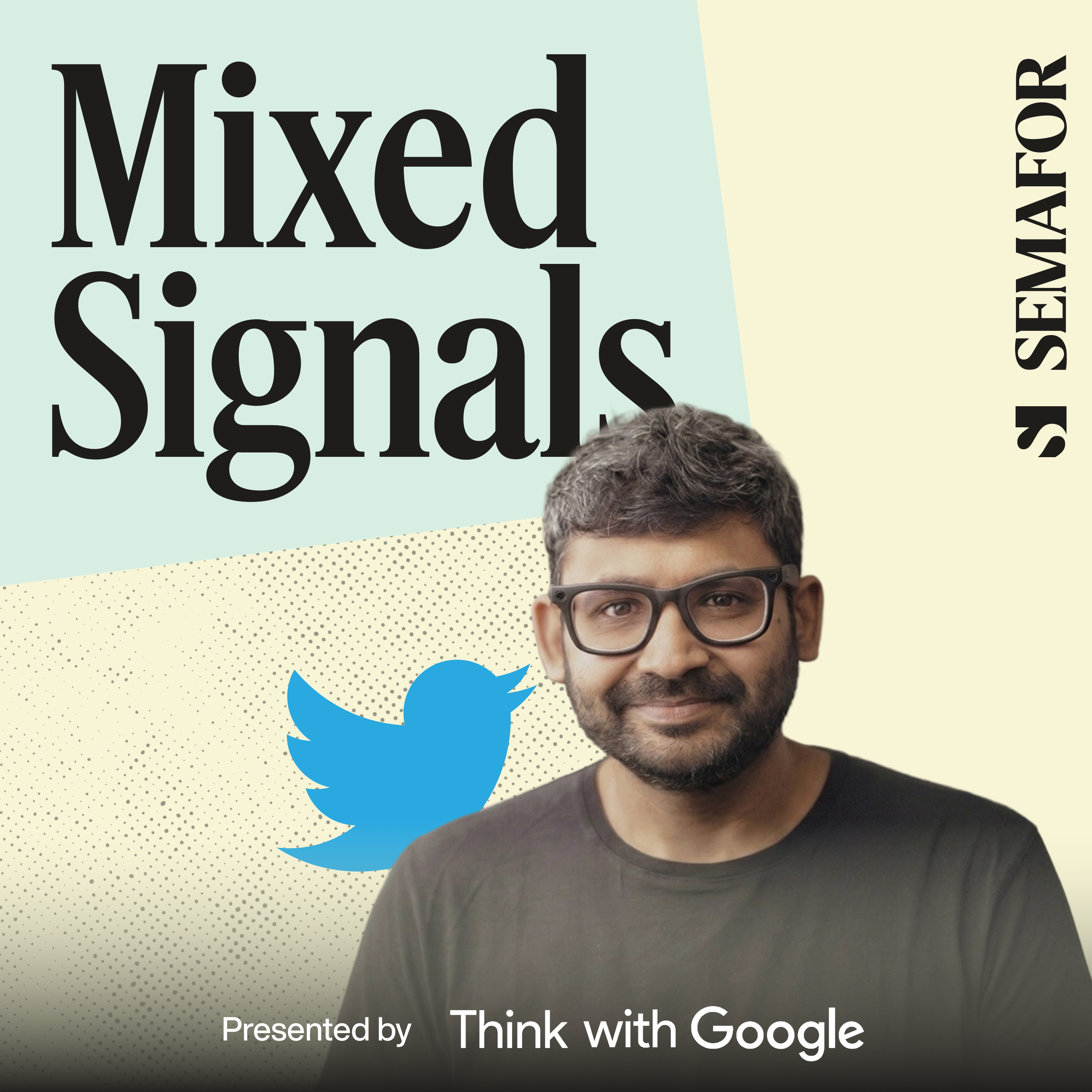
Parag Agrawal is the last CEO of pre-Elon Twitter (now X). He is now building Parallel, focused on agent-accessible web infrastructure and pricing/value measurement for content used by agents.
0:11Max: Welcome back to Mixed Signals from Semaphore Media. I'm Semaphore Editor-in-Chief Ben Smith, joined as always by our media editor, Max Tani. And our guest today is Parag Agrawal, the last CEO of pre-Elon Twitter, X as it's now known. He's now building a company called Parallel, whose focus is a parallel internet to be read not by humans, but by agents. It's a really bold and different vision of the future of media that, unlike some other visions, has space in it for media companies. We talked to Parag about how an agent sees the internet, about how media companies can make money off of a new swarm of agents, and of course, about whether he thinks the new X is good for the world.
0:57Max: We'll be right back with Parag Agarwal after the break.
1:04Max: Hey, Mixed Signals listeners. There's a new podcast we thought you'd enjoy. It's called Frontier CMO, hosted by our friend Josh Spanier, Google's VP of Marketing. It's about the forces driving innovation and reshaping the marketing landscape today. Whether it's AI's impact on the industry or creator's role in culture, Josh is getting into the weeds with the people who are actually shaping what's next. These are your notes from the frontier. You'll hear from CMOs, agency legends, brand visionaries, and brilliant thinkers. Search for Frontier CMO from Think with Google wherever you get your podcasts or watch on YouTube.
1:43Max: Parag, thank you so much for joining us. Hey, Ben. Thank you for having me. And I guess I wondered if, to begin, you could just describe for us how, in your vision, in Parallels Vision, this thing that we used to call the internet, which is publishing files to servers. They're read by browsers. Those are then read by humans. This is what we've all grown up with. Can you explain to us how you think this is going to change and what that next thing looks like? So before we talk about what the change would look like, let's talk about why the change is happening. Change is happening because the web, which has primarily been consumed by you and I in a browser historically, is now evolving.
2:25Humans is evolving. And now there are these AI agents which are often acting on your behalf or mine, going and searching the web, reading information on the web, synthesizing it, doing work, or giving us a shorter summary or a really long report to wait through. This is the core change that sort of underlies why Parallel was started in the first place. Now, one really important thing about this change is what I believe is the scale that the agents will read the web at. So when we started Parallel, it was with this hypothesis that agents will use the web a thousand X more than humans. And three years ago, we were walking around, there are no agents telling people that agents will use the web a thousand X more than humans ever have.
3:20And sometimes like the word thousand, it just like flows. But if you sit down and think about it for a minute, it is somewhat ridiculous. Like imagine the amount of infrastructure that exists for the web. Imagine the infrastructure that exists to build Google search across all of these data centers everywhere to do the 10 plus billion queries that happen on Google search every day. And now we're saying, oh, it's going to be 10 plus trillion searches a day. And the one thing you know is you need to invent multiple generations of technology in order to serve a need at that massive scale. And the same systems that may have worked no longer work at like even 10x the scale, forget 1 ,000x the scale.
4:13So that's one part of it that is going to change.
4:18Max: So just to go back, why are the agents going to consume, why do they need to Google so many things? So if you think about what decides the number of human consumption of the web, it is fundamentally limited by human time and attention. How many people are online? How much time are they spending online? In what activities are they spending time? What is the time X short form video or X Netflix? Right. And which is always, it's a trade-off. We could be spending time with our kids. We could be doing other human things. But it's fundamentally limited by human time attention and the value where people decide to spend that time and doing what.
5:02Now, if you think about agents using the web, you're taking this constraint of human time and human attention is no longer a factor in how many searches happen. What is a factor? Is useful, potentially economically valuable work that these agents could do. Is there a willingness to pay$5 for an agent to go do a thousand searches for something, right? If there exists that willingness, agents will go to that search.
5:29Max: And basically agents you're saying have nothing better to do. Yeah, they have your data, your company's data, the web, some action space, right? And the web, that's roughly what the agents have access to. And for doing almost anything, you kind of take the web for granted. Like even the model itself. You think about a model, what is a model? It feels like it is smart and all-knowing. Because you can ask it like some random Wikipedia fact and just knows, right? Except it doesn't know who won a football game this weekend. It doesn't know where someone you work with went to school, although you could have gone online and found that information in about a minute on Google, right?
6:21So it presents this sort of mirage of being all-knowing, but it's not. So now every product or experience you build with a model, which are agents now, your implicit expectation is, oh, if this thing is so smart, why can't I do something so basic that I can do? And so anytime you end up using LLM or its tokens to build an app or an experience, you almost smuff to give it access to the web. Otherwise, like the mirage is broken. So Parag, just to, again, take a little bit of a step back here. If you're an AI agent, how is that different from, you know, how the web exists currently? Yeah, so I think the web as it exists from a technical basis of content being on servers that can be read over some protocols like HTTP, that fundamentally does not need to change.
7:20That's not the limiting quantity, right? What does need to change is the scale at which these reads happen, the latency constraints under which these reads happen, how many searches a search engine needs to support, how efficient a search engine needs to be, how, this is the interesting part, like how do you create incentives for the web to remain open? Like what is the new trade when like the ads business model starts getting free, there's less internet traffic around. When there aren't people to click on subscribe after seeing some amount of content to go then subscribe as a person to pay up for a monthly subscription, those two business models are now both at risk.
8:02So what happens? Like what is the incentive? to allow an agent to read somebody's content. Now, you have these sort of two principles you can hold at the same time. Number one, I would really like my agent, no matter whether it is built by a large lab or a big company like Google, or is running on my personal computer on an open model. I want it to have access to the information I have access to. That feels like a reasonable thing to shoot for so that I can fully benefit from these models and agents in the way I would like. Simultaneously, I believe that if you have content that you have put out on the web under the presumption, an assumption that you will monetize it via some combination of ads or subscriptions or some other mechanic, Like, it doesn't feel to you that your content just got stolen by these agents and repurposed where you no longer participate in whatever this new economy with agents gets created because the business models didn't evolve.
9:16Right? So that is, I think, the core business model problem that we must grapple with as the internet evolves alongside these agents. Yeah, that's definitely something that I know that we want to get into here because this is, of course, a media show. And, you know, as a person in my mid-30s who works in media, I'd like for some business model to exist still for those of us who want to gather information and share it with the world. But how is the information that agents want different than the information that humans want currently when they search for something? Is it just that the volume is different in terms of the queries?
9:54Or is it that the types of information, the things that agents are reading, is that different? I think a lot is different. So let's just talk about the search engine for a minute. And search engine is a core part of the internet construct. How should a search engine built for agents be different from a search engine built for humans? Now, a human search engine, our way of thinking about it from maybe a few years ago, was that you search a few keywords, you get 10 blue links, you click through on them, you go back and forth, you perhaps search again, and you satisfy your information need in a session with a few searches and a few clicks, right?
10:36That is the world model of how a human navigates the web. Now, something to note about people are our searches don't actually tell the search engine what we're truly looking for. They're like extremely underspecified. So you'll write down like two keywords or three keywords, perhaps use autocomplete. Infrared of, this is exactly what I'm seeking. Two, if a page you click on takes 10 seconds to load Infrared of under one second, you will click back because you will be impatient. If the information on that page isn't above the fold, you will click back and go elsewhere. This is how humans work, right?
11:14So as a result of this, the entire ranker of a human-built search engine is trying to infer what you might be looking for, trying to infer the source which loads FAFT and has that information above the folder. Very simple example. Let's say you go out looking for a public company's revenue number from last quarter. Simple, basic information-seeking query. You end up either on, after searching, you either end up on like a Google Finance thing or a seeking alpha thing or one of these things. You know where you do not end up? On the PDF filed with the SEC or the investor relations page of the company.
11:54Unless you're a freak financial journalist, business journalist, such as, you know, some of the people who work for us here at Sebafor. It's pretty rare. In which case, you have to be careful to type out, like, file type PDF into your Google search with kind of real humans don't do. But we have to observe, why is that? When you go out looking for like, oh, there was a court ruling about something, you find media articles about it, but not the PDF, which is in the public domain. Right. You want the most important information quickly. You don't have time to read through the entire court filing. It has to be above the fold.
12:32Imagine if you got shoved into a PDF, which was 200 pages, where the information you wanted was on page 77. Ben is asking me, when am I going to file this thing? and I'm on page two of reading the PDF. And like, so, but for an agent, trying to do something interesting, it has the capacity. Our job is to not send the agent to this PDF. Our job is to take the paragraph from page 77 from the most authoritative source document and bring it into the context window of the agent, right? With clear attribution. So now if you think about the formula that goes into ranking for a human versus an agent, it's very different.
13:17And so now when we're building the search engine, it surfaces more authoritative source content. It expects almost the agents to write clearer, crisper queries about what it's actually trying to do and why. So our system has a lot more context than Google does in terms of to be able to do that work. Um, sometimes if you're using a voice agent, you don't want the voice agent to pause and think for like five seconds. So our search engine has to be way faster than a search engine built for humans had to be to make the voice agents feel natural. Like humans have the same one second patience window, right?
14:00Now, if you're going to do more work in that one second, you have to build a search engine that can do like three reps, five reps, allow more compute in that same one second. On the other hand, if the agent is working overnight while you sleep, we can do a way better job because we're no longer limited to the 500 milliseconds or a second Google is limited to, right? So if you think about how you solve the problem for agents, the inputs are different, the outputs are different, the compute constraints are different, the latency constraints are different. And so everything about how you build a search engine changes.
14:37Now, if the search engine changes, your incentives, once the market is more and more agents, changes. Do you have incentive, the same incentive, to create a website that moves the most important information from a PDF above the fold? Perhaps less so, right? But perhaps you have incentives to have more authoritative source content. which can be remixed with other information from other places to get real work done. So I want to think about a regular use case here, you know, for agents versus, you know, kind of the old way we use the web. So I was just on vacation. I was in Slovenia, very nice place.
15:19And part of it was having a conversation with Claude about, you know, best hotels, best restaurants, you know, kind of things, you know, helping me plan a route, you know, whatever it was. I also did some old school Google searching, just reading the art, searching in, you know, Ljubljana, the capital, like restaurants or whatever. So, and, you know, it organized information for me, you know, kind of in this way. So let's say that I had used agents as a part of this trip planning, essentially. How would that have helped me plan this trip different? And how would you kind of have insert, why should the web be different for in kind of in that context?
15:57One, right, like pre-agents and post-agents, pre-agents, you would have done a bunch of searching on Google, a few other search engines around travel, found some information, decided to make your itinerary and gone with that, right? My presumption is when you used Claude and a bunch of other agents to, you probably typed a few fewer prompts than you would have typed searches. As a result of those prompts, my presumption is a lot more searches happened. I would guess somewhere between 15 to 50x more searches were done on your behalf as a part of this trip planning. The agents ended up going deeper in the search results than you might have gone in reading some random Reddit post about like a off the beaten path thing or some review about some place or some special edge case interest of yours, which you had, you would not have asked a query about, but if the agent had that in its context, it went around and found those things, right?
17:03So what happened as a result was more searches happened. Hopefully, if the agents we're building are actually useful, with less effort, you planned a more personalized, more desirable trip. Now, in order, but also your agents probably got blogged on a lot of places on the internet. Right? That's probably what happened. And the places that didn't block you influence more of your trip. Yeah. The places that did block your agents did not influence your trip. Right. That's what actually happened under the covers. Now, the technology needed to support these use cases. Now, you probably spent some amount of dollars in tokens as you did that.
17:48Now, if your agents had used parallel search, you would have spent materially less on tokens. because if your agents use a traditional search engine, they're fumbling around the web using it, pretending to be a human in an inefficient way. If you use parallel search, they would have wasted fewer tokens and gotten perhaps the same results with fewer tokens or better results with the same number of tokens.
18:15Max: And that's because you've processed, you've already pre-chewed the web for them in some sense? Yes, and we are optimizing for agents, right? You're just going to let agents be agents. They don't have to pretend to be humans. And you want to bring the... It seems good. Yeah, like I think agents feel like they're human-like, but they're not if you build with them. And so if you observe the differences, you can help them be way more successful. Does this make you... I'm just going to go in a different direction here. Does this make... There's this whole debate over anthropomorphizing agents and anthropomorphizing the AI models.
18:52Max: Has this project made you feel that they are more human or feel that they're less human in building this parallel? Your company is called Parallel, building this parallel digital universe. Yeah, the parallel web for agents is how we describe it. I think there are two different things here. Number one, for people building systems, I don't like to think of them as humans. These are like machines with technical, So like it's compute that you're throwing at problems to produce some outputs and you're optimizing for those outputs using the compute you have. Now, I think it's a different question when you think about how do you build products and user interfaces for us to interact with systems, which might be really complex underneath that we can interact with in a way that is easy to understand and natural for us, right?
19:45and there I do think there is merit in these analogies, right? Like, oh, this is your chief of staff or this is your personal agent or this is just like texting a human being, right?
19:57Max: But you don't personally think that they have consciousness and sort of ethical status and things like that. I don't believe so. Okay, that's a relief. We'll be right back with Parag Agarwal after the break.
20:18Max: This week on our branded segment from Think with Google, we're sharing an excerpt of a conversation with Josh Spanier, Google's VP of AI and Marketing Strategy, and the host of Frontier CMO. I have two parts of my job, all right? I'm helping Google marketing transform as a practitioner of how do we get our teams to actually adopt and use AI. And then I speak to CMOs and sort of evangelize a little bit for how Google is solving the the same problems we're having on the marketing side and how to help other marketers. One of the things I talk about is like, where are we in our own journey, Google marketing, in terms of our AI transformation?
20:51If you think about it in terms of a 100 meter race, right? So think of Usain Bolt running the 100 meter race from zero to, crossing the finish line, digitally native, fully transformed AI savants, right? Where is Google marketing and where is sophisticated advertiser? Down that racetrack, I think we're around meter 12. Early days. Early days. Oh, and by the way, that racetrack isn't a straight line. It's a higgledy-piggledy all over the place. I wish it was a straight line. So we're still really, really early days. So most of the customers I speak to of Google, most of the CMOs I speak to put themselves somewhere on that same sort of racetrack, somewhere between meter five to meter ten.
21:28So although we have made big investments, big changes, big actions to improve our AI capabilities inside of Google marketing, we're still clumped right at the beginning of this race. We're still closer to the start. We're still close to most other advertisers.
21:42Max: For more, check out the full episode. The link is in the description. Or head over to thinkwithgoogle.com.
21:57Max: Media business is part of your business. Your customers include everybody from Pfizer to notion, but also to Fortune and to the Atlantic. And I guess I just wonder if you could sort of explain clearly, what does this new parallel agent-based web mean for media companies? Which obviously, that's what's really important here. Absolutely. Much more important than everything else. Yes. What does it mean for the media? I do think it's important. I think, but let's actually go broader than the media for a second, and we can come back to the media. I think just principally the reason the company was started is because there is a core belief of mine, which is that this is like goes across Twitter and the open internet prior to that.
22:46The value maximizing way for a bit of useful information is for it to reach or be available to as many people as possible, preferably everyone. with the fewest possible walls, right? That to me is the value created in the world maximization function. Now, sometimes it turns out that if we want to not just value maximize, but capture a part of it to sustain the business that we are in, we must decrease some of the value created by this bit of information in order to capture some of it, right? So it would be amazing if all of the great reporting from a media organization were available to everyone and everyone would be better informed.
23:37But then we wouldn't be able to create more reporting tomorrow. So we must make this hard trade-off to put some of this information behind the paywall, essentially decreasing its value delivered today in order to be able to finance the creation of more of this information tomorrow. Right? Right now, this is the, there is a real trade here. Right now, if you think about business models as AIs come online, and let's say we don't invent any new business models or any new ways of doing data deals between content owners and these AI agents. The natural path we will end up on is you want to sustain the old business model, but But AI agents are essentially what feels to a content owner.
24:25They're stealing your information. You can't monetize either the traffic because there is no human traffic to click on ads. And they don't subscribe because they don't yet have wallets. Right? And so where are you at? They just took your information. There is no return back in any currency that you currently understand. And so the natural thing is you're going to go block those agents. Right? And I think, which is fundamentally, in my opinion, a value destructive move that you must do because you got forced into it to preserve value capture, right? So I don't like these sort of hard trade-offs.
25:07In an ideal world, right, you would simultaneously be able to capture value while maximizing value creation from the work you've done. That is the ideal standard that we would have. So now, how do you solve this problem is the core to what we're trying to do here. So let's go back to the previous era of the internet, an example which accommodated some of this, right? The ads business model is like universally hated as a consumer. And I am with you on hating on ads, right? We love ads. Except for our sponsors. We love them. Yeah, for what it's worth. But otherwise, yes. But there is real magic to that business model.
25:52It's because it is the ads business model that allowed so much of the internet to be open and free. Listen, I'm trying to reinvent Google, but like, Google is an amazing piece of technology built over decades by extraordinary people. the reason it is available to everyone for free is because they are really good at monetizing it with ads. Right? Same thing went for Twitter. Same thing for great content that many people put out there and they monetize using ads. The only reason it can sustain and be free is because of ads. Now, the impressive thing about ads is that it is, in my opinion, in the best engine we have created for differential pricing.
26:41A Google or a Twitter can lose money on 90 % of users or requests, but make so much from the other 10 % to want to keep it available to everyone for free.
26:55Max: Yeah. Still be viable and create businesses over time. Now, we do price differentiation everywhere, right? Like, okay, talk to sales or like go buy a business class ticket or people find all kinds of ways of doing price differentiation. These are all, in my opinion, extremely inefficient, right? Like by a plus plan or a pro plan or a max plan today in the world of AI. These are price differentiation levers that we're coming up with, which are extremely inefficient relative to ads, right? So now the question, in my opinion, for the content ecosystem... Wait, actually, sorry, Parag, who are they inefficient for?
27:33Because if I'm a pro or max subscriber, it's like, well, I got the best version of this. So, and I don't have to bother with those pesky ads. No, but I think whoever's using it, let's actually talk about the content business, right? For the, let's say there is the New York Times, right? I don't know actually what the subscription costs. Let's say it's like$20 a month for the New York Times subscription. I think by making it a$20 a month subscription, you're pricing out a chunk of audience. but you're not able to extract out like for some part of the audience, there is a willingness to pay way more than$20 a month, right?
28:11Now you've said, like if you could get exactly the amount it was worth for everyone, the New York Times would be a much bigger and much better business. We don't know scalably how to figure that out today. So there exists somebody who for breaking news, You know because there exists these sort of research report writers who are selling subscriptions at like$1 ,000 a seat per month to people who trade or for people who are going to try to hunt down the next data center lease. And so if you want a business model at scale, you might price it low and make it accessible and then limit the value capture for where there is high willingness to pay for something special you do, right?
29:01And so, but because if you, we don't know how to differentiate and price differently based on value in the world of human subscriptions. And we try, but every time you try to do that, you add a bunch of friction. So whoever is employing the business model is causing inefficiency in extracting value and destroying value in the process of the work they did, right? Right? Today, for example, right? Let's say we had decided to take Twitter one day and wait it like, okay, you must pay$5 a month to even do anything basic, to log in. Yeah. And there was no content logged out. The audience would shrink dramatically and the platform would lose all value because without the audience, like content creation would shrink.
29:49So the thing does not exist if you decided to do that, right? In fact, you can't even put it behind a login wall, right? If you decide to put all the content behind the login wall, you decrease top of the funnel enough to lose the product value and mechanics. So in this world of AI, though, there are now two interesting things that are in our favor. Even as existing business models get destroyed. Number one, scale of usage is going to be 1000x. That's what our belief is. Number two, they're hopefully with AIs now exist. Because you just have agents running around doing a bunch of stuff, basically.
30:30And creating value. And you can now try to have a more scalable mechanic other than these subscriptions where you're not able to price differentiate. So for example, right? Now let's go to a real example. Let's say there is the agent from a casual reader just trying to understand the news today versus the agent from someone who's going to make a very consequential decision about something. Now, their reliability bar, their quality bar, and the delta, the same bit of information mixed to the two of them is very high. Imagine if we figured out how to have the content creator whose information someone relied on to make a decision of consequence paid some fraction of the value, which is still defined.
31:24So one person consumes that bit of information for a cent. Another person consumes it for 50 cents.
31:30Max: So basically, you charge Bill Ackman like 10 ,000 times as much as you charge me to read an article because he's going to go make a trade based on it? Even though we have the same experience? Or does his agent then get to spend some more tokens churning around it? Yeah, that's one way to think about it. But the way I would talk about it is, listen, if you decided, if you today use the frontier grade model, like a Fable or a Astra, versus you use the Luna or a Haiku from Open Anentropic, the price differential is about 50 to 100x today across these. And the smaller, cheaper models are actually reasonably capable and very, very usable.
32:20What if your information was being read by a small model, you pay less? Because implicitly, by choosing that model for a use case, you're telling the world that this use case
32:31Max: isn't worth spending too much on. But by using an after-hours, Listen, it may be that the cheaper model is right nine times out of ten for what I need, but I can't tolerate that one time where it might not be the best, right? Yeah, so this is, I mean, I just sort of talk a little about what this would mean to a media business. It's a much bigger world where the ad business is just gone, where the consumer subscription business, maybe it's gone, maybe it's not. But in some sense, you're moving from having a business-to-consumer direct relationship with a consumer to a kind of business-to-business relationship in a marketplace.
33:14Max: Is that right? Perhaps. I don't know. There might be multiple shapes of these business models, but I think there are a few underlying things that must happen for a thriving open web and a thriving collection of media businesses. Number one, agents must create meaningful value at scale. And the pie must grow larger because if the pie doesn't grow, I think it's really hard to see everything click and work. Number two, we have to find ways of empowering everyone's agents. And it can't happen if we only sell our data to an open AI and a Google and to nobody else's agents, which has been sort of the pattern over the last two or three years.
34:00All of these transactions that media companies have done have been done with these large labs slash businesses where, and they're kind of these fig-free businesses where at least my presumption is that in two years, in three years, whenever the first deal runs out and you're up for a new O, the labs business will be 10, 50 X of where it was last time. but your renewal will actually get smaller in scale. So your actual value capture of the agent economy is dropping 5, 10x year on year effectively, which is, in my opinion, eventually going to lead to the death of the content ecosystem or the open media ecosystem.
34:49And so what I'm trying to do here is how do you grow the value going back? If the pie is getting so much larger with these agents, if these things are going to do useful work, if they're going to start taking some fraction of, they're going to add productivity on top of labor time or start taking on some amount of labor time, if those things are going to happen, if we just figured out a way to reward high quality data that allows these agents to be more successful in proportion with the GPUs being used by these agents. Like a small fraction of these. That is enough to sustain a pretty compelling and really valuable ecosystem of information on the open web, including media.
35:32Max: Yeah, is there a version of this where we should all go out and be like buying media stocks? Because this is what you're describing actually sounds like a much bigger business than the current media business. It could be. I can't tell. Is this like a super optimistic view? Or is this just like a, Maybe we can help you keep the lights on for you. I think the error margins on this are large, right? I think, and our bet today is fundamentally, I think it's the only compelling one. And I'm biased in stating this because if I thought something else was compelling, I would be doing that too. But I think there is a world, I don't think it is the natural predestined way the world will go.
36:19Right? So I think, if I thought so, then I wouldn't be doing it. If I thought this was the natural course of where things end up, like what's my role in this? Right?
36:28Max: So you're like the, you're sort of, you see yourself as kind of the rebel alliance here? Great word. Yes. Rebel alliance of the small guys across the world of AI, across the world of content on the web and to build essentially, like one of the ways, like when we talk to media companies or content partners, right? Like admittedly, we don't have enough dollars to make life interesting for them today. So what feels to us like as a small startup, it's not small, it's like a three-year-old reasonable startup with reasonable success in the AI world. But I don't think we are there in terms of being able to pay out really meaningful dollars to all the media companies and all the open web today, right?
37:21So, but what you're betting on is, one, that by working with us, you will learn how the agentic demand is different from human demand and how to go to that. Like when you transact with a big company, you get blind. You get no information about what the worth of your data is. You get no information about what you must do next to be more valuable. When you work with us, we literally have built a model to price every bit of information used by every agent, which relies on many factors. And we give that back to content partners alongside the dollars paid. Now, this model isn't perfect. that this model will keep evolving.
38:04And we learn alongside them to figure out how to have this rebel alliance, not just survive, but thrive. Before we move on and ask you about your old job, you said, you know, right now, you know, the company parallels a little too small to kind of make this, you know, a super meaningful exchange for media companies. I mean, how do you, so how do you get there? Because how I look at it as somebody who's in the media, as I say, The future that you've outlined is pretty scary. It would be nice to be able to survive and maybe even grow in this kind of new model. But it seems like getting from where we are now, which is, oh, this is a nice thing.
38:44It's nice to have some information about what this information is actually worth to I can build a media business around this. There seems to be a pretty big gulf there. Yeah, I think that is. But I think if you, let's talk about the rate. The other way to think about our business is as we use models more and spend more on GPUs or on tokens, however you want to look at it for work. That business, I think, is evolving at a 5, 10x year on year, somewhere in between that. if that continues and we are able to pull that off alongside like as i said earlier when agents when you run an agent alongside gpus you do more searches and you use read more content so if you take us from where we are over two years growing five to ten x year on year and you look at the models our models and the math that they spit out to pay out to reward to reward people.
39:47I think our forward-leaning partners, like the ones you called out earlier, Atlantic and Fortune, I think they've taken a bet alongside us to be a part of this alliance, right? Like, and the bet is not based on dollars today. The bet is based on, in two years, there is a path with some uncertainty around it. For the dollars to become substantial and growing, a path to having insight and information that allows you to act to be even more interesting and a path to know the value of your data in this agentic world, to be able to extract that value, parallel is not going to be the only way for agents to use information that is open AI, entropic.
40:31But I would like for our pricing principles to be the way most transactions happen because that sustains the content ecosystem. And if you think about why I so deeply care about it is, if this doesn't happen, then I don't get to transact. If I don't get to transact, I can build all the info I want, but without the information and the data, because if all of that shuts up, my business is done and only the labs get to be, or the big players get to be in this business, right? So the Rebel Alliance is existential for me. And in that sense, I'm in the business of incentive alignment, right? incentive alignment between AIs.
41:10AIs ultimately want data and high quality information because everything relies on it if intelligence gets commoditized. But if you don't figure out the right incentive alignment, the information shuts up to everyone's AI and remains available to the big guy's AI. And so the Rebel Alliance is like I have tied my fortunes in some sense to the success of the Rebel Alliance by being in this business.
41:42Max: I did want to move a little bit to your old business in the last few minutes here, which is the social media business. You were the CEO of what used to be called Twitter. Eli Parris around here recently told us that he thinks that the social platforms are going to go away in the age of agents. Do you think X and these other platforms, such as they are, survive? Yes, I think they will survive and thrive. Yeah, I don't believe social platforms go away in the world of agents. The human need to post and to get angry about stuff you think will survive as the rest of the web goes away. Why is that? It's easy to see AI take on things which is more utilitarian, but not things that craft the experience, if you may.
42:30So things which are experiential for people, things which are about human to human connection. Now, human to human connection as a format will evolve, right? Like we went from in-person connection to video connections and text connections and social media connections, right? So I think there will be evolution. I think that is the thing I imagine remains a durable need for people. and we might even have, I think, more of a value placed on that kind of stuff. So I think social evolves but survives. I think anything experiential evolves but thrives. Yeah. Scrolling is still fun. Email, not so fun.
43:18Email could be disrupted easily by agents. Scrolling, though, still a pretty fun and addicting experience that I'm doing in my free time. Looking at a lot of the changes that have been made on X, and I'm sure this is a question that you get a lot, but we're curious about it here too. What do you think of the changes that they've made there over the past several years? I mean, are they ones that make sense to you or are they ones that have left you scratching your head a little bit? I think that my bigger picture reflection is that X, the product, right? I think it's useful to think of Twitter or X as the product and the business.
43:52what we built as a product and a piece of technology is somewhat extraordinary and unique and very, very durable. So I was there 10, 11 years. The product is like I'm on Twitter basically every day. I think in the world of AI, you must be.
44:15Max: You still call it Twitter? I think I'm trying really hard to call it X. It doesn't feel right, does it? It still doesn't feel right. I still call it Twitter. I mean, come on, X. I do too, but I'm trying to call it X these days. But I think there is something extremely durable about the product and its mechanic and everyone that's there. And you can kind of mess around with it and not really mess it up, right? So the product changes, I don't have a real, like one thing I've said consistently that I'm pleased with is that what I used to call birdwatch and is today called community notes. that has remained and survived and continues to maintain transparency continues to be I think run by almost the same people right and has like grown in provenance perhaps I wish it was a little bit more prominent even yeah but I think so these are but you don't like I think that is a a thing that I'm happy about.
45:36Yeah. Now, I would definitely not have, I think the other part to reflect on is like Twitter, the business, right? And I think that was always the hard part at Twitter, right? And I think there were real things you could have done to make Twitter a meaningfully better business. And I don't think we've yet seen that succeed. What would you have done if you'd had these, I think it's been something like three years. What would you have done in these four years. What would you have done in those four years? Say, you know, we live in alternate worlds where it's still Twitter, you're still going on your however manyth year as CEO.
46:18What would you have done in those four years, do you think? I don't know. It would be wrong to say there was a written down four year plan, right? I think there was a very concrete focus on making Twitter a materially better business. by focusing on a few things, like I think there was real potential there. You can talk about what, I think there would have been more product iteration than Twitter had seen over the past decade. That was part of what got me really excited. And I think we would have done way more around transparency, around efforts like Birdwatch or community notes on everything around Twitter, becoming more externally visible, inspectable, transparent around what happens and why, right?
47:09So if you follow through those three themes, plus actually using AI to enhance the experience, as the person responsible in part for the rank timeline, whether or not you love it or hate it, I think it's existential for a product to maximally use AI to drive the objective that you care about most, whether it be information content, whether it be repeat usage, whether it be engagement, and you can argue and agree and disagree with various kinds of ways of framing an objective for a ML model in the context of a social product. But if you don't maximally and efficiently use machine learning AI, I think you don't build the best experiences that can be competitive in the world.
48:07Max: In terms of Twitter's just sort of impact on the world, I mean, you sort of, well, you left, and among other things, Musk just turned it really hard to the political right. Do you think that he should get credit for turning American culture and politics, global culture and politics to the right? Do you think Twitter has that kind of power? I don't know. I don't think so. And when you were there, I think people believed that it had driven American politics way to the left. And that it created this kind of progressive capture of the elite conversation. Did you not believe that either? I did not believe that.
48:42And that is why I struggled to believe the second one, although I don't have enough data about the second one. And I think the combination of a platform plus a platform plus Elon Musk are slightly different comparables. So I don't have a real data point here. But like when I was there, I think you look at this very simple data points, right? If Twitter was so influential, why was it not a great business even when in a previous era, it sold political ads around elections? Why was it not a great business for brands to influence people? Right? So you can look at a few of these clear raw data points and like infer that sometimes we might, so Twitter, if you think in the big scheme of the information ecosystem, we all live there.
49:35So we are influenced by it. But in the bigger scheme, its audience is relatively small relative to other platforms. Its reach is materially smaller. Time on app is materially smaller than what, at least three short form video apps today and three other text-based apps today, right? And if you add it up, its share is much smaller. Now, Twitter, though, has an outside influence on the influencers, right? And that is really hard to figure out in terms of its impact. Does that make sense?
50:16Max: Yeah. So I guess the last question, do you think that Twitter X as it now exists is good for the world or bad for the world? I don't know. All right. Well, that seems like a great place to leave it. Well, Parag, this has been a really fascinating conversation. It feels like two separate, really fascinating conversations about two of our favorite topics, which are what media is going to look like, particularly in the age of AI, and Ben and I's favorite platform. I think while it's in the bottom rankings for most people in terms of below TikTok and And Instagram, my phone says time spent on my screen says quite differently.
50:51It's still our number one. Can't quit it.
50:53Max: Yeah. Thank you so much, Parag. This was fast. It gave us a lot to think about. Thank you both.
51:06Max: We spent 2025 talking to people who channeled the excitement and belief in AI in media and marketing. A lot of that conversation in 2026 will be about the hard work of building with those tools. Think with Google is here to bridge the gap between inspiration and implementation. This isn't fluff. It's a rigorous look at the mechanics of growth to help CMOs solve the hard problems, like navigating complex consumer journeys and proving value through better measurement. Make this the year you turn potential into performance. Visit thinkwithgoogle.com.
51:43So, Ben, over the last few weeks as we have had these episodes about AI and the media and our future and whatnot, there's been a lot of doom and gloom. There's been a lot of scary stuff about kind of what happens when people stop reading news articles because they can just get their personal agent, Ben AI, to just summarize everything that happened for them and where does that leave us. Parag actually presented an interesting alternative and an interesting way of thinking about things differently, which is it's increasing the amount of visibility of our information that we're producing as journalists for these machines at the very least, which might find it useful or might not find it useful.
52:27Was that as much of a revelation to you as it was for me?
52:31Max: Yeah, I think it was sort of fascinating, right? If you think from the point of view of an agent, like you can't go touch grass. Literally all you got is the web, and there are millions of you. And so if you can, at your lower cost of time, you're just out there browsing all the time, and we who publish things onto the internet suddenly have this much, much larger, this, as he says, thousand time larger audience. And then the question becomes, like, how do you get those people, except they aren't people, to pay? It's just a totally different way of thinking about the future of digital media. And in some ways, yeah, a very optimistic one.
53:05Max: But as you said to him, the gap from we have these advertising and subscription businesses over here to those are going to collapse into rubble and way over here. We have this totally different business to business model of agents forking over money in ways that allow us to charge different agents different amounts. is, I mean, it's a long distance, but it is really fascinating. And it does in some ways feel more like a free market for information than this notion that, well, we're going to get by by doing deals with a small number of companies who have all the leverage. I don't know, Max, did you leave that more optimistic or more pessimistic?
53:42I want to be optimistic because that's my disposition, despite my fears about the future. And I do think I have some AI anxieties, which have been playing out on this show to a certain degree. But the gulf worries me because we've heard that before in a different form, which is, you know, oh, we're going to start these new digital websites and there's this huge audience for all these people and they're going to, you know, one day read all of this stuff if we can only, you know, reach them. There's this larger pool that exists now. Like this is a familiar thing to people who experienced the first digital media bubble.
54:18And it's like, well, there's this gulf in between of business where it kind of doesn't make sense. But if we get over here, it will, right? Like that element is scary and reminiscent of something that we've kind of lived before. So that raises some yellowish flags. But at the same time, I think that the fundamental truth at the heart of all of this stuff, which is that people want good quality information and AI agents in particular and LLMs and whatnot need high quality good information. to return a good experience for users, that part is definitely true. And so there is a need that those platforms that these companies have for kind of the quality information that in a lot of times journalists and media companies have to offer.
55:07And so it does seem like we should be able to work something out that makes sense for all of us.
55:12Max: I wonder what he really thinks about Twitter. Well, the fact that he didn't say, I still think it's good for the world, I think, does tell you something, right? But actually, that's a good point. Let's shift over then to the second interesting part of that conversation. There were two really specific interesting conversations. One about the future of media, what it all means, what my job is going to look like in 20 years when you're long retired, Ben. I don't know. Maybe you will be retired in 20 years. Yeah, I don't know. It just depends on what you want to do with your time. You've been going pretty hard for the last few decades.
55:44But there was this other separate conversation about X and Twitter and this bizarre experience that he has now essentially kind of being forced out of the job a lot earlier maybe than he would have hoped when they had to sell the company because Elon was offering so much money. What did you think about his kind of reflections on what is now X and Twitter?
56:09Max: It's like sort of once in a while in Europe, you'll run into like the exiled Romanian king living in London or something. And you ask him, well, you know, it's not really my role to express a view on the proceedings of democratic Romania. It felt a little like that to me. Like I know he has thoughts, but I wanted to be careful. One thing he said, I mean, he certainly would never have said when he was at Twitter. Like, oh, the ad business doesn't really work because we aren't that influential. It's overrated by elites. Like that was kind of interesting. And now that it's been sucked into SpaceX, into an Elon, Galaxy brain, you know, success or failure AI business.
56:46Max: I mean, I do think the thing he said, which I didn't believe at the time, he's obviously right, is that you can just like take a sledgehammer and like whack Twitter with it repeatedly and like it just totally survived. Totally, because there is still this incredible demand for new information right now and it's a better platform for that than, you know, it still is better than all of the alternatives. and people want to share information in short text bursts to a large number of people and that that hasn't really changed. And frankly, you know, the algorithm, the Twitter algorithm, the current one that they're operating on, like, I mean, there's some obvious big problems with that.
57:20And I certainly wouldn't argue with them. But it's also delivers me some amazing stuff every day that I kind of wouldn't get otherwise. And I actually, you know, I left our conversation with Eli thinking, you know, having drank his Kool-Aid about kind of the platforms and, you know, that these things were going away. But then I did think about my own behaviors and it's like, what do I like to do in my free time? I like to go through and scroll and be delivered information and like, I don't want to outsource that process to something else's. But maybe this will be seen as a really funny and retro, you know, and kind of old school feeling in five or 10 years, like people who still like to read a print copy of the newspaper or something because they like how it feels.
58:01It'll just be me and my old-fashioned scrolling habits. All right, Ankh. Yeah. Well, that is it for us this week. Thank you so much for listening to another episode of the Mixed Signals podcast from us here at Semaphore Media. Our show is produced expertly, as always, by Manny Fidel, with special thanks to Josh Billinson, Amber Olley, Rachel Oppenheim, Anna Pizzino, Daniel Haidt, Garrett Wiley, Jules Zern, and Tori Kaur. Our engineer is Rick Kwan, and our theme music, of course, is by Steve Bone. If you like Mixed Signals, please follow us wherever you get your podcasts, and feel free to leave us a five-star review.
58:44And if you want more, you can always sign up for Semaphore's media newsletter, which is out every Sunday night.
58:57Thank you.
Former Twitter CEO and Parallel founder Parag Agrawal joins Mixed Signals to lay out his bet that AI agents will search the web a thousand times more than humans ever did. Max and Ben ask Parag why a search engine built for agents has to work completely differently than one built for humans, and how a world of agent traffic could let publishers charge a hedge fund trader much more than a casual reader for the same article. They also get into whether he believes consciousness applies to the systems he’s building, what he misses and doesn’t miss about running Twitter, and his surprisingly undecided verdict on whether X is good for the world.
Sign up for Semafor Media’s Sunday newsletter: https://www.semafor.com/newsletters/media
For more from Think with Google, check out ThinkwithGoogle.com.
Find us on X: @semaforben, @maxwelltani
If you have a tip or a comment, please email us mixedsignals@semafor.com

Scan the code with your iPhone camera
Listen in the app.