Ask ChatGPT
 Mixed Signals from Semafor Media
23 Oct 2026 · 26m · 15 chapters
Josh Spanier (Google VP Marketing) discusses whether “CMO Armageddon” is happening (he says no), how AI has shifted marketing from efficiency to reinvention, and why measurement and “outcome-based planning” matter. He argues marketing needs CMOs to own credibility and growth, not just campaign mechanics, and that AI enables embedding best practices into brand systems. He also shares examples of generative ads and calls for executives to become content creators.
Josh Spanier is VP of Marketing at Google; he also produces Frontier CMO. Ben Smith is Editor-in-Chief of Semaphore.
AI’s first years were fear/economics-driven; now it’s “the end of the beginning” as marketers ask “what can I do with AI?” Incrementality and marketing science (data trumps opinion) unlock CFO-ready measurement; AI can scale experiments (400 to 4,000 scenarios).
Google NFL generative TV ads; a Wallace-and-Gromit-like claymation style ad made in six weeks (vs a year). QIIME uses AI for call screening, boosting customer satisfaction by 20–30 points. Josh’s daily watch content on YouTube/TikTok/Instagram.
Written by AI. May contain mistakes.
Discussion on the current state of the marketing industry and predictions.
“Yeah, thanks for having me out here in lovely Mountain View.”
Exploring the shift in mindset regarding AI in marketing.
“So fear, uncertainty, and economic squeezing, right?”
The evolving challenges and opportunities in the marketing landscape.
“So it's still very messy and very confusing.”
Insight into Google Marketing's AI adoption progress and challenges.
“I'm helping Google marketing transform as a practitioner of how do we get our teams to actually adopt and use AI.”
Discussion on the philosophy of measurement and marketing science.
“We are a very sophisticated measurement advertiser, advanced user measurement, as you'd expect for Google.”
Navigating the complexities of modern marketing strategies.
“If no one's got the playbook, that's actually why it's called Frontier CMO because we're operating at the frontier of no one knows where we're all going here.”
Concerns about a potential crisis of confidence among marketing leaders.
“really interesting experiments at scale and really speeding these up.”
A poignant statement on the challenges of change in marketing.
Learn about the distinction between operational tasks and growth-focused strategies for CMOs.
“And column A is all about most of the stuff you're doing.”
Explore how AI can enhance marketing processes and the evolving role of the CMO.
“That mentoring, growing, building, and sort of learning for you and your team, versus just delegating and checking in and getting status updates and all the sort of the bureaucracy of marketing.”
Discover the importance of brands becoming part of creators' narratives on YouTube.
“So this brand system architecture is a really interesting concept, and I'm seeing great CMOs lean into that.”
Understand how personal involvement in content creation can enhance marketing strategies.
“Is that if you want to engage with creators, if you want to be engaged with YouTube as a sort of platform, as a brand, you need to start thinking about being a character in the creator's universe.”
Learn about the demand for authentic, engaging content in the marketing landscape.
“I am eager to get into your pivot to solo creation.”
Explore how generative AI is transforming the creative process in advertising.
“And the brilliant thing about YouTube is we've had this debate for years, like, what is premium content, right?”
Engage with current marketing trends and their potential relevance or irrelevance.
“So we're going to steal a feature from Frontier CMO to conclude this, signal or noise that you weigh in on a bunch of much-hyped trends in the marketing business.”

Get the gist, explore an idea or ask about something said.
 Claude
On Mixed Signals from Semafor Media, what are the key points of this episode?
Searching your listeningAutomatic transcript. May contain errors.
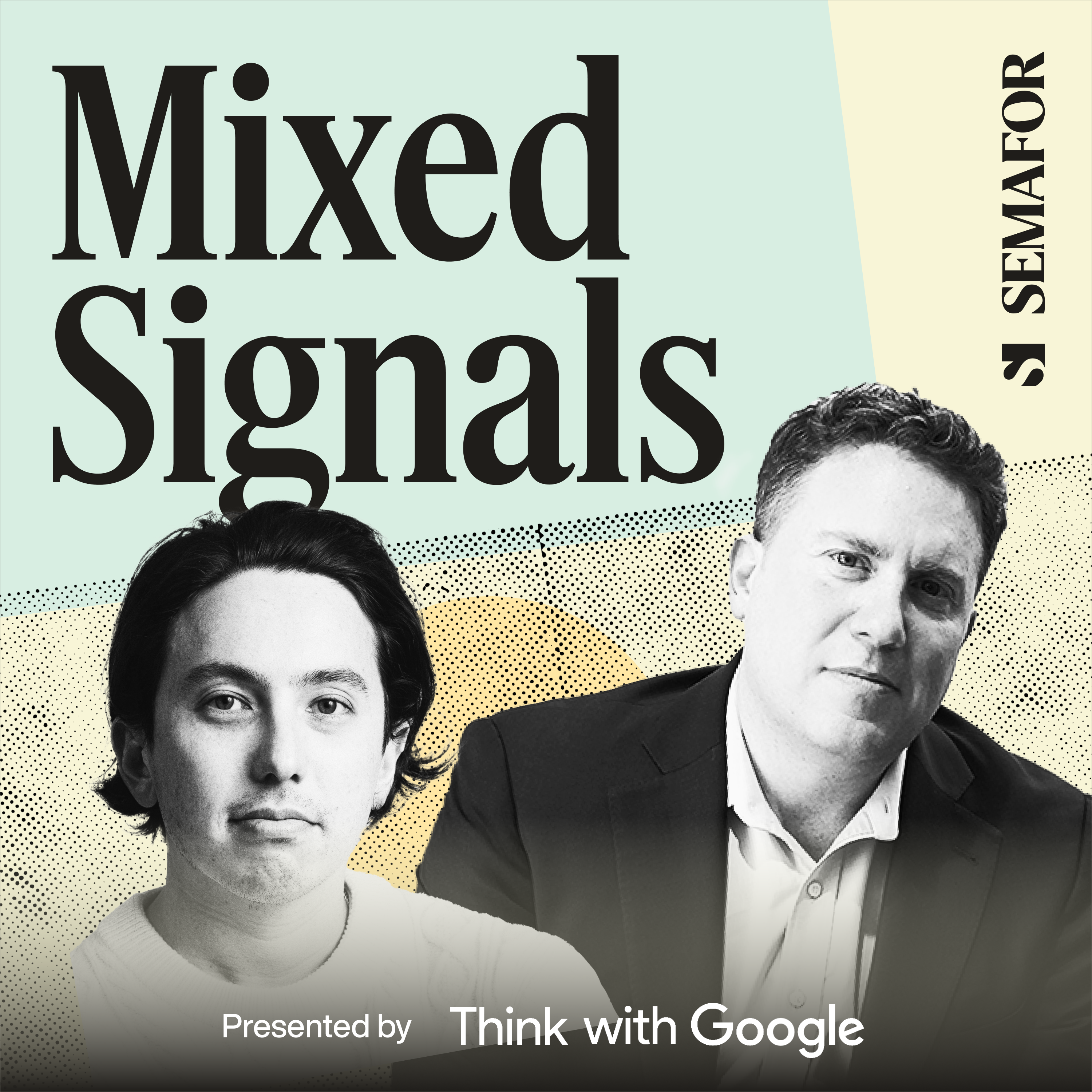
0:10Welcome to a special episode of Mixed Signals. I'm Ben Smith, the Editor-in-Chief of Semaphore, and this episode is part of our partnership with Think with Google. I'm joined here with Josh Spanier, the VP of Marketing at Google. We're going to talk about the state of modern marketing, about what it takes to build an audience these days, and in particular, in this new creator-centric media world, what it takes to be a creator, both when you have, as Josh sometimes does, one of the biggest companies in the world behind you, and when you don't.
0:44So Josh, welcome back to Mixed Signals. Thank you, Ben. I'm excited to be here. Yeah, thanks for having me out here in lovely Mountain View. You have an unusual advantage on the marketing business, and essentially you get to look at it from the top. You have Google's perspective on what people are buying, on what people are selling. And then you're also producing this show, Frontier CMO. Can you give us a sort of top-level overview of the state of the marketing industry? Here we are in the fall of 2026. So I think the marketing industry is doing better than I thought it was going to be doing. Back in January, January of this year, I was at an event, room full of CMOs, maybe 100 CMOs and senior marketing leaders.
1:24And I was having this quiet conversation on the side with someone famous in the industry, someone who's got real influence, who everyone in the room knows, who you probably know as well. And that person said to me, as we surveyed this room of CMOs, 50 % of this room is going to be fired this year, 2026. 50%. Yeah, yikes. And I was like, oh, my, that was, you know, sobering. But this is someone who I think is very impressive and has got a long track record. And I kind of believe them. So that was pretty intimidating to go into the year thinking. And then six, seven months later, they were utterly wrong.
1:58They were utterly wrong. There has not been a CMO Armageddon. There hasn't been a massive change in the sort of C-suite the way that person was predicting. And I actually reached back out to them a couple of weeks ago. I said, hey, tell me about that. What were you thinking? and we had a long conversation and they acknowledged they got it completely wrong what were they thinking well you know i kind of think that we're at the end of the beginning of this ai transformation right the end of the beginning and the first three or four years of this ai change has really been defined by three things fear am i going to lose my job uncertainty what the frick is my job and then economics i know i need to deliver more for less my cfo of my stakeholders.
2:39So fear, uncertainty, and economic squeezing, right? And that whole paradigm, that whole mindset was really about what is AI doing to me? What is AI doing to me? And it was very much focused on efficiency. Let's just be more efficient. What's changed is that the mindset shift is not what is AI doing to me, but starting to be what can I do with AI? How can I use AI to do my job in more interesting, engaging in different ways, and actually move on from, let's just make our ways of working 10, 20, 30 % more efficient, which is good, and your CFO wants that. But actually, AI has this potential, this capacity to reinvent the things that we're doing and actually create new opportunities.
3:22And what that person told me in January, and they'd missed, and I'd missed, and I think the industry had missed to an extent, is we've never lapped for ideas in marketing. We've been constrained by resources. You only have so much budget, so much time so many people. With AI as sort of an accelerant, every idea that you have suddenly becomes possible. So I actually think there has been a net increase in people working in marketing. That fear translated into, what can I do with AI? It's just a whole mindset shift, which has been really encouraging. And a lot of the CMOs I speak to are seeing that and experiencing that inside their organizations as well.
3:55So it's still very messy and very confusing. There's still fear and uncertainty, and it's still tough. But that potential is really exciting. Ben, you're the editor-in-chief of Semaphore. You sit on another side of the business. You are part of the establishment now, as much as you'd probably hate to admit that. I'll take it. I'll take it. How's business going for you guys? What's it like on your side of it? Yeah, it's interesting. I was just thinking about your kind of tour of the industry and how different people are feeling. I do think, you didn't quite say this, but I do think agency holding company people are maybe the most stressed out.
4:27I mean, news is always the most pessimistic part of the media business, I think. Like ever since I started in like the late 90s in news, I was being told that like I would be at best the last person ever hired by any news organization and that we would all be, you know, the whole industry was collapsing. And I mean, not totally wrongly. But I think for journalists, which is really like my corner of the business, most of all, the, you know, the fun parts of journalism are going out and talking to people, gathering information, and then at the other end of it, figuring out how to kind of present that information to an audience, how to connect with an audience.
5:00We're employing more people, not less. And back to these kind of marketing leaders you're talking to all day. I mean, you talked, I guess, the 200 CMOs I mentioned you talked to this year. Like, where in the hype cycle are they? Like, what is sort of the leadership class? Now, in fact, they still have their jobs, so they're presumably in a better mood than we expected. But like, what's the sort of thinking among marketing leaders at the moment about this? I have two parts of my job, all right? I'm helping Google marketing transform as a practitioner of how do we get our teams to actually adopt and use AI.
5:32And then I speak to CMOs and sort of evangelize a little bit for how Google is solving the same problems we're having on the marketing side and how to help other marketers. One of the things I talk about is like, where are we in our own journey, Google marketing, in terms of our AI transformation? Google marketing is full of very smart, very talented people. We have a significant budget around the world. we operate globally, and we're a very sophisticated advertiser. In terms of AI adoption, we are leading the pack. I've met with many, many, many, many CMOs, as you noted, and I can benchmark us relative to a lot of other advertisers, and we're doing really, really well in terms of our own transformation.
6:10If you think about it in terms of a 100-meter race, right? So think of Usain Bolt running the 100-meter race from zero to, crossing the finish line, digitally native, fully transformed AI savants, right? Where is Google marketing and where is sophisticated advertiser? Down that racetrack, I think we're around meter 12, maybe meter 15. Maybe meter 15. Early days. Oh, and by the way, that racetrack isn't a straight line. It's a higgledy-piggledy all over the place. So it's not a, I wish it was a straight line. So we're still really, really early days. The technology just isn't there yet, right? So most of the customers I speak to of Google, most of the CMOs I speak to, put themselves somewhere on that same sort of racetrack, somewhere between meter five to meter 10, right?
6:53So although we have made big investments, big changes, big actions to improve our AI capabilities inside of Google marketing, we're still clumped right at the beginning of this race. We're still closer to the start. It's still so early. So I find general positivity, how do we start our measurement transformation? How do we start our marketing transformation? And the answer glibly is, well, you start 10 years ago. It's a journey. That's what journey we've been on. We started transforming our measurement approach about 10 years ago as we had in Google Marketing. We are a very sophisticated measurement advertiser, advanced user measurement, as you'd expect for Google.
7:31But we started that 8, 10 years ago. And then about 4 or 5 years ago, we started embracing what you might call modern marketing. So I was having a conversation with Lorraine, our CMO. I've interviewed her on Frontier CMO. It's a great episode. And I was having this conversation with Lorraine, and we were talking about breakthrough, about cutthroat, about whether our campaigns were working the way we thought they should do. And this was five years ago. And Lorraine had this sort of nagging feeling that we're just seeing slower returns. Things aren't working as well as they used to, while Playbook isn't quite where it needs to be.
8:04So I went on a little voyage of discovery, almost like a precursor to Frontier CMO. I interviewed about 45 senior leaders across the C-suite, CEOs, design people, agency people, creatives, you name it. I asked them all, what does modern marketing mean to you? Five years ago, I was doing all this, and I distilled all those, and we brought them back into the Google Marketing Organization. And we went through this sort of process of recognizing that our customers were living their lives in ways that we weren't really mapping to. We were still thinking about the way the world used to work versus the way the world is actually working.
8:39I do think actually the media industries, journals and marketing, all of us have been a little blase about it because we're kind of used to it. The internet turned our business totally upside down 20 years ago, and we've been kind of running around with our hair on fire ever since. No one knows anything. It often feels like me least of all. No one has the playbook. If no one's got the playbook, that's actually why it's called Frontier CMO because we're operating at the frontier of no one knows where we're all going here. So we have to chart our own course. Yeah, no, I mean, I find it a quite exciting time, but as you say, kind of exhausting.
9:08You know, how do you, I mean, the other big puzzle of marketing is always measurement. And there's the famous cliche that you know that half your advertising doesn't work, you don't know which half. That's kind of a pre-digital idea. Now you know too much. Now you know every conversion. But in a world, again, where things have been turned upside down and where nobody knows anything, do you have to rethink measurement as well? Or are these new measurement tools making it even more precise? The overall philosophy inside of Google Marketing is, there's a number of sort of principles there, and I'll get some of the metrics in a second, but is, look, spend 70 % of your budgets on things you know to work, where you can prove it, you've got unequivated, you know, you can actually use marketing science to prove it to a statistically significant level.
9:51And inside of Google, there is this mantra, data trumps opinion, right? Data trumps opinion. And so I think the general direction of you need more marketing science, you need more analytics, you need more focus on what's actually working is super important. You need to be able to say to your CFO and look them in the eye, you know what? You can spend this much money and get this much that you wouldn't have got, and you spend this much more and get this much you wouldn't got and actually be able to have that as a sort of a really scientifically grounded answer. So incrementality has been the big unlock for us.
10:23The next big thing which we've already worked through is something called outcome-based planning, where really you take your incrementality, you take your media mix models, you take your geo experiments, all these sort of things we do unnerdly under the hood of marketing, and you are able to sort of project out, spend this much, get this much, and different budget planning scenarios. So in our phone business, our pixel business. For last year, we generated like 400 different scenarios grounded in data, and then we validate those, what we actually do versus what the scenarios said we do, and we make it smarter each year.
10:55And this is where AI is being really interested, because you can start doing really interesting experiments at scale and really speeding these up. And you can go from 400 scenarios to 4 ,000 scenarios if you want. In this world of AI power and enablement and moving to outcome-based planning, we can actually start seeing what our creative is doing in real time and how that's going to impact outcomes and actually drive business performance overall. So the sophistication is there. It does take some work. One of the things that I generally recommend to all the companies I meet with is to honestly lean into the investments that large advertising firms like Google are making.
11:33We have something called Meridian. It's our media mix model. You You can build layers of technology, your own, on top of Meridian, but you take the base of that and actually make it a... You can start taking some of these really advanced, sophisticated things and make it incredibly easy. And AI is certainly helping enable that. So we are getting to a much fuller picture of what matters. But ultimately, I've got a pet theory I want to run by you for a second. It's not so much a theory, it's a... I have a niggling concern, right? So I've been very positive about the marketing services industry, about marketing overall, and I genuinely feel that.
12:06In speaking with a bunch of CMOs on and off the record for Frontier CMO, some of the things that come out is that there potentially is a bit of a crisis of confidence and competence in marketing that if left unchecked could get worse and worse. In an AI-first world, it's quite easy for other disciplines, other departments to start making their own assets, making their own work. And CMOs need to really own the moment of actually thinking about how do I actually convey credibility and growth in its broadest sense. This is a really important function for CMOs. I think the best CMOs, I met a bunch of them, I can name check some of them if you want, who actually are leading from a growth-minded perspective and actually encompassing the entirety of their organizations, not just running campaigns.
12:55Name some names. Who's doing a good job? What are you seeing out there that you like? I had a great conversation with the CMO of AT &T, Kellen Smith-Kenny. marvelous leader doing incredible work. And it's so clear that she's running within her organization sort of product councils, compliance councils, these other functions far beyond just talking about individual campaigns and taglines. She's actually a grown-up sitting at the high table reporting into the CEO. I think she's a great example of a CMO who's truly leading in the space. I think Carla Hassan at JP Morgan doing similar sort of work.
13:31And a lot of the CMOs I've interviewed and met with are really leading their organizations far beyond just making marketing campaigns. And this is the space that marketers have to fill. We have to own the growth conversation for the business across every part of what we're doing, because otherwise, I think marketing could get relegated and delegated and compressed, and you end up with individual business units saying, you know, we'll just take it ourselves, or we'll just do this ourselves, because AI allows us to that i think that will be a loss um i interviewed richard debakawala he is uh famous in the industry 40 years at publicist and now his own sort of consultancy about the future of work um he said one phrase which really stuck in my head which was uh uh change sucks but irrelevance is worse change sucks but irrelevance is worse spoken like a media person yeah it it it really resonated but he spoke a lot about sort of personal choice and and how you actually sort of grow and develop and He had this framing of, as a marketer, as a CMO, there's the things you do in column A versus column B.
14:31And column A is all about most of the stuff you're doing. Checklists, optimizations, updates, delegation. It's stuff about sort of mechanics of making the work happen. And column B is about mentoring, learning, building, growing. And AI is incredibly good at column A. Column B is where you should be focused. So re-pivoting towards, how do I actually make sure that I'm doing more of the stuff in column B? That mentoring, growing, building, and sort of learning for you and your team, versus just delegating and checking in and getting status updates and all the sort of the bureaucracy of marketing.
15:08I had this great conversation with Vinny. He's the CMO of Chime, and also with Vidya, who's our head of Google Ads product. Two remarkable engineering-minded leaders. The persistent memory of these AI models is incredibly powerful. And that persistent memory is coming to marketing. It used to be when someone left your team, you kind of lost all their knowledge, all their insight, all their ways of working. What we're seeing today is you can look at the entirety of your marketing process and start thinking, okay, where could AI help make that process be embedded with all our best practices, all our learnings, all our insights, and how can we add to it cumulatively over time and add human layer intelligence on it over time?
15:46And that's become the role of the CMO in part, to be this sort of brand systems architect, to actually see how you can actually improve each part of your system and have it all connect and flow together. So this brand system architecture is a really interesting concept, and I'm seeing great CMOs lean into that. And the work they're doing at QIIME, I think, is very, very impressive in terms of using AI to do all their call screening and actually making it so that they use generative audio to screen all the telephone calls coming in. These people who care about their money or their problems with their mortgage or their current account, whatever it may be.
16:19And what Vanit was telling me is that their customers calling in are getting higher satisfaction scores, up 20, 30 points, when they are actually screened by the AI because it can solve the problem for them immediately. You interviewed Colin and Sevilla on Mixed Signal. So there are a couple of YouTube creators who really talk about the business of YouTube. They spoke to me as well. And one of the things they said which just stuck in my head is such a powerful thought for modern marketing. Is that if you want to engage with creators, if you want to be engaged with YouTube as a sort of platform, as a brand, you need to start thinking about being a character in the creator's universe.
16:56You're the character in a creator's universe. And how that shift in philosophy and mindset changes how you show up as a brand. Instead of it all be matching luggage and you do what I say and it's just me broadcasting at you, you're this character in a creator's universe. And honestly, the best marketers today, by far, are not the CMOs I've met with, as brilliant as many of them are. It's creators on YouTube. It's their obsession about the audience. It's their focus on engagement. It's being as close to their customer as possible, which is something that we in marketing, I think, lose sight of, especially as you work in larger organizations.
17:28But that customer obsession, Colin Samir really challenged it. Be a creator in the customer's universe and just learn into and lean into what YouTube is doing for brands when it's done well. It's just remarkable. I think of you as a character in our Mixed Signals universe, Josh, so maybe that's working. Perfect. I think you're also sort of edging into creator world yourself, starting with Frontier CMO. Have you seen these AI tools change how you actually – and are they part of how you produce that thing? Are you working with these tools directly yourself? So I experiment a lot with AI myself, right?
18:08I feel like it's part of my job. And it's very apparent to me. And if you're a marketer listening to this, I can tell at this point within 60 seconds of talking to someone, whether they're walking the walk or just talking the talk, right? And it's very, very clear which CMOs are just talking the talk. And if I can tell in 60 seconds, your teams can tell, your stakeholders can tell, your C-suite can tell. So you have to personally invest in learning these tools. So I use them a lot. Now, I don't make ads for Google anymore. We have people who are actually much better at this than I am, but I still want to learn how to use them.
18:44And then here's the funny thing. I am a creator on YouTube and on TikTok and on Instagram as well. I interviewed Gary Vaynerchuk. I did so about six or seven months ago. I am eager to get into your pivot to solo creation. Is this Gary Vaynerchuk's fault? Yeah, so blame Gary. Gary Vaynerchuk, he's a big personality, a lot of strong opinions. His big thing is about just make content, post every day. So in advance of me chatting with him and actually interviewing him, I said, all right, I'll post some content to YouTube every day for seven days. I love wristwatches. So yeah, the watch on my wrist.
19:18And so I'm really into watches of all sorts. So I just said, I'll start a channel about watches. So I made content for seven days. I interviewed Gary, and I kind of liked doing it. So I said, I'll keep going to the end of the month. And then I said, well, I'll do another month. And here we are, seven months later, you know, and I've posted something about watches every day to my social channels. And it has been unbelievably interesting from a business perspective, professional, and sort of personal about, I kind of think every CMO should be forced to host to YouTube every day for a period of time just to learn what it's like to be on the other side of the camera, as it were.
19:54I've learned so much about the whole dynamics of the industry just by doing this. Oh, yeah. I mean, 100 % agree, as they say, on making the bosses post. Although, you know, good luck to us in persuading everybody. It's really allowed me to see across a whole different set of categories about some of the influencer marketing sort of tricks and tips and things that have been going on there. So that's been pretty fascinating. It's also just fascinating to see what it's like to upload content. My Google job has helped me, and I'm very familiar with Nano Banana with Vio and Flow and Google's sort of AI generative technology.
20:25So that's actually been very helpful in terms of how you actually sort of create content. And doing this stuff does, I mean, as somebody who also is out on the internet all the time and occasionally screwing things up, like, does involve, like, a level of, like, kind of self-exposure and of like, just honestly posting content that I mean this kindly would probably not quite make it through Google's marketing organization to be a television ad just in terms of the production quality. Like, how do you, I mean, if you're trying to persuade CMOS to do this, how do you persuade them to do that? These people are often perfectionists and control freaks and sort of, you know, care a lot about presentation.
20:57And this is very kind of raw stuff. There is a lesson here in that people want authenticity. People want engagement. And the brilliant thing about YouTube is we've had this debate for years, like, what is premium content, right? And that was always the pitch from NBC or CBS. They're premium. Even HBO, we're premium content. Meanwhile, YouTube is going from strength to strength to strength without normally being premium in the same way, right? And the thing is, people want engaging content. People want content that is authentic. People want something that is real. And I'll say from the heart, but it's just something for me.
21:31Yeah, I mean, this is, I guess, one of the big challenges of marketing now, right? That you've got to take this huge machine and generate something at the end of it that feels totally authentic? Yeah. Or you just turn your CMO loose and let them make some TikToks, I guess. You know, people worry about AI slot, right? And the fact of the matter is our brands are on call 24 hours a day. There's large language models. There's websites. There's YouTube. there's constant, you know, we're live the whole time. If you're not clear about who you are, what you stand for, and show up authentically, you can't fake it, right?
22:08Well, we've just got to figure out how to engineer authenticity. Has the sort of rise of these new tools, these ways of working, has it shifted the way Google is executing its marketing in ways that are starting to be visible in the world, do you think? It's changing some of our outputs. We've run television commercials on TV in the NFL, which were fully generative, completely made by generative capabilities of Google's technology. We had someone who wanted to make a sort of a claymation-style film, like Nick Park, like Wallace and Gromit, if you know that from the British reference. It normally takes about sort of a year to make a film using that style.
22:45Incredibly expensive, incredibly slow. You can't do it. Our creative team using VO and Flow and Google's generative tools made an ad in six weeks, which they previously couldn't do. So it really expands the possibilities of creativity. So we've actually produced new things that previously weren't possible. That's really, really fun. So we're going to steal a feature from Frontier CMO to conclude this, signal or noise that you weigh in on a bunch of much-hyped trends in the marketing business. It's kind of weird for me to be on the receiving end of this, but yes. Yeah, well, you know, that's how modern media works.
23:14You never know which side of it you're on. Okay. AI-generated stories. AI-generated stories. I think signal, because I think that The bedrock of content will be sped up by the fact that AI is going to take a first pass at this. But ultimately, I think human layers of intelligence on top of that is going to make the distinction. Oh, and the second one relevant to this, tech companies hiring journalists. Signal, because AI companies are going to do it. But also, I think every company should be doing it, hiring journalists. I was hoping you'd say noise, because the pay gap makes it sort of challenging for us sometimes to fight back.
23:49AI-generated podcasts.
23:54Noise. No, I just ultimately, we want human connection, and I've yet to see, no, just noise. The return of the compact disc. That's noise, right? And this kind of bugs me. And I'm relatively senior in my career, and every sort of three or four months, I feel like a junior team would come to me who are based in Brooklyn and would go, hey, there's this big trend emerging, and it's like the reemergence of the compact disc, all vinyl. And no, it's not. Technology moves on, it gets better. And there is no world where the compact disc to play music is coming back in any meaningful sense. You're a true Californian.
24:33Luxury watches. They are an absolute signal. They harken back to 400 years of sort of human level of ingenuity. You know, the craft in them, they're having a moment now, and I think they'll continue for another 400 years. Final one, executives as content creators. I think it's a signal in marketing and beyond. I mean, you look at Satin and Della. You look at every number. You look at Sundar. You look at a whole bunch of CEOs, Mark Cuban, you name them, they're all doing it. And it's part about engagement, authenticity, and sort of peeling back the lid on companies, I guess. And so, yeah, we want to know the people we're buying from and who they are to an extent.
25:12But I think Signal. All right. So in that spirit, check out Frontier CMO. Check out Watch Josh Time on apparently every platform, including Threads. And thank you so much for joining this special episode of Mixed Signals. Thanks, man.
Google VP of marketing and Frontier CMO podcast host Josh Spanier joins Ben in Mountain View to talk about the state of marketing today, and why the predicted CMO armageddon for 2026 never happened. Ben asks Josh why he thinks even sophisticated advertisers are only a few meters into the AI race and how Google uses incrementality and thousands of AI-generated budget scenarios to prove what’s working. They also get into Josh’s daily watch channel, what CMOs learn by being forced to post every day, and a lightning round of Signal or Noise.
This is a special branded episode of Mixed Signals, presented by Think with Google and produced as part of our partnership by Semafor Brand Studio.
For more, check out ThinkwithGoogle.com and watch Frontier CMO: https://www.youtube.com/@ThinkwithGoogle
Sign up for Semafor Media’s Sunday newsletter: https://www.semafor.com/newsletters/media
If you have a tip or a comment, please email us [email protected]