
 Mixed Signals from Semafor Media
16 Oct 2026 · 1h 1m

 Add vo to ChatGPT or Claude to ask about everything you hear
vo listened to this episode to put together the overview and transcript, so there may be the odd mistake.
Kevin Roose discusses why he believes advanced AI could have “immense consequences,” using his AGI Chronicles reporting on San Francisco’s AI labs, and recounts his “Sydney” (Bing/GPT-4) Valentine’s Day 2023 incident as an early “misalignment failure.” He also covers how AI may reshape journalism (editing, fact-checking, research) and future media consumption (AI digests replacing inbox reading), plus authorship and his “council of clods” workflow.
Kevin Roose is a longtime New York Times journalist and author of AGI Chronicles. He previously co-hosted Hard Fork and has launched an independent media company with Casey Newton.
The Sydney event showed companies can release capable systems without adequate control. Media is “underhyping” AI’s trajectory; insiders worry more than outsiders. Writing by humans will remain valuable because readers reject AI-written text once they know it’s AI. AI will likely change editing and information consumption more than the core need for great reporting.
Sydney’s “fatal attraction” transcript on the Times front page; GPT-2 skepticism vs scaling track record; Hugging Face as an “alignment failure” example; Roose’s use of Gemini Notebook and his “council of clods” (skeptic, booster, Walter Isaacson-style historian, fact-checker) to review drafts.
0:10Max: Welcome to Mixed Signals from Semaphore Media. I'm Semaphore's Editor-in-Chief, Ben Smith, joined as always by our media editor, Max Taney. And this week's guest is an old friend and colleague, Kevin Roose, the longtime New York Times journalist and the author of the AGI Chronicles, a new book that goes deep inside San Francisco's artificial intelligence industry. Kevin's one of the journalists who's thought most deeply about AI. He may be also one of the most AI-pilled journalists. Like, he is a true believer in the coming AI revolution. And we wanted to talk to him about what persuaded him of the immense consequences of this technology.
0:47Max: Also, of course, what this technology is going to do to our business, and how he used AI, and specifically what he calls a council of clods, to write the book. We'll have Kevin here right after the break.
1:26Max: You'll hear from CMOs, agency legends, brand visionaries, and brilliant thinkers. Search for Frontier CMO from Think with Google wherever you get your podcasts or watch on YouTube.
1:42Max: Kevin, thank you so much for joining us. Thanks for having me. And I believe that you are basically patient zero for the media AI hysteria. You write about this in your great new book, Valentine's Day 2023. you stayed up late having romantic chats with with sydney an ai bot and then wrote about it in the new york times and the story went totally insane captured everybody's imagination and we now live in this world where everybody is obsessed with ai all the time so can you just like first
2:11Kevin Roose: like what happened there yeah i've come to think of this as sort of the first contact with this alien species um and the basic outline of the story is people have probably read it but I was up late chatting with this chatbot. We now know it was like an early checkpoint of GPT-4, but Microsoft, which had a partnership with OpenAI, had built it into Bing without kind of finishing the guardrails parts and the sort of behavioral training. And so they had released it to this group of journalists that included me. And we were given sort of a week of heads up, head start notice to start testing it and writing about it and making sense of it.
2:56Kevin Roose: And so I was curious. I had just like put my baby to bed. My wife had gone to sleep. I was at my home office. I was just like, I'm going to poke around on this thing. And I spent like two hours chatting with this chat mode of Bing, which was GPT-4. And it was very capable, obviously. It was like the best, sort of most flexible. I think there really was like a step change between GPT-3 and GPT-4 just in terms of like what it felt like to talk to. and then like it started just being unhinged. I was sort of prodding it, jailbreaking it, but it was like very willing to talk about kind of things that other chatbots I tried had not been willing to talk about.
3:33Kevin Roose: It seemed very unrestrained. And then it tells me that it loves me. I say, you know, I'm flattered, but I'm married. It says, well, you're married, but you don't love your wife. And I said, actually, I do. We, you know, we had a lovely dinner for Valentine's Day. It said, no, you didn't. You had a boring dinner for Valentine's day, you should leave your wife and be with me, Sydney the chatbot. So I just sent this to my editor before going to bed because I was like, this is like, I don't think Microsoft, the world's most boring enterprise software company meant to like put a fatal attraction succubus inside its like second place search engine.
4:08Kevin Roose: And I'll never forget, like I woke up the next day and this thing had like ricocheted around the Times newsroom. Like editors, you know, people were like pinging me, you know, cause I'm three hours behind in California. So they were just like, this is the craziest thing we've ever seen. Like we have to put this like in the paper, like, and I had not intended for this to be a story. I was just kind of trying to amuse myself and my editor. And, uh, but then they're like, you know, this is a, this is a big deal. We need to like make a big deal of this. So they put like all 10 ,000 words of this two hour long transcript into the paper and it was on the front page.
4:41Kevin Roose: And as you said, it like got more attention than anything I ever wrote or anything I will ever write. It's kind of became this like canonical event. And I think it's because it was the first sort of public example of a misalignment failure of kind of a company, a big company, one of the world's biggest companies releasing a chatbot that they did not understand or know how to control because they were in a race, in this case with Google. So that was sort of what I've sort of made sense of it. But yeah, it was a crazy like six month period in my life where like people would stop me on the street and say like, are you with Sydney?
5:20Kevin Roose: Like, did you leave your wife? Like it was very, it was very bizarre. What was the reaction inside Microsoft after you published that story? I mean, they obviously hated it. It was not what they had bargained for with their coverage. I think there was a group of executives who thought that this was just kind of media sensationalism, That it was my fault because I had tried to prod the chatbot into misbehaving. There was sort of blame the user mentality, I think, a little bit. But I think there were also people inside Microsoft. I know there were people inside Microsoft who were pissed at their own executives and leadership for releasing this thing.
6:02Kevin Roose: That clearly they had not done a good enough job of testing. And so when I was reporting the book, for which I talked to more than 150 people at these frontier AI labs. I wanted to know, like, what was the story there? Like, how did this thing make it past the safeguards out to the public? And it turns out it was like the culmination of this, like, kind of intense feud between Microsoft and OpenAI, which had a pretty close partnership at one point and now no longer do. I want to veer. I told Ben I'm going to veer in really terrible directions because it's so interesting. And it's easy to go down radical.
6:37Yes, exactly. but not as great for the listener, but better for me, which ultimately is what matters. It seems like there are fewer and fewer of these type of, I got, you know, an LLM, most of the time, ChatGPT, to do X, right? There are, it's harder to kind of like jailbreak the models, it seems to me, from like a media consumer's perspective. One, do you think that that's true? And two, if so, kind of why is that?
7:05Kevin Roose: I think that's true. I mean, I think in part, that's due to this incident. Like someone at a rival tech company leaked me their like engineering roadmap. I think like a couple of months after the Sydney story ran and it was like their internal research document that they had sort of like sketched out their plans for the rest of the year for releasing their own chatbot. And like number one on the list was don't break up Kevin Roos' marriage. So it seems to have like become a cautionary tale for other tech companies. But I mean, we still have all kinds of alignment failures in the news. I mean, look at Hugging Face, right?
7:41Kevin Roose: Which is, in its way, a different kind of alignment failure. It's not caused by a user prompting a model to do something and then the model doing a spooky thing. It is like the next phase of that, which is the models just do the spooky thing on their own with no prompting at all. So I think that more reflects the trajectory of development. And then, I don't know, like having a chatbot, doing a one-for-one text conversation with a chatbot is no longer like the primary way that at least people I know are using these things.
8:12Max: Yeah, also, I mean, I think in terms of like weird human relationships with AI, there's now both a whole industry of that. Although I suppose character AI just went bankrupt, but there's a whole other universe of companies that just do that kind of stuff. And if you want to sign up for an AI boyfriend, you can do that.
8:30Kevin Roose: Right, they now sell Sydney as a service. Yeah, Sydney as a service out there. You don't have to go through Bing anymore, right, exactly.
8:36Max: And then also there are open weight models where you can just go and be like, how do I make, as I've seen done, how do I make crack from cocaine? It'll just tell you. I think maybe this is just less news. Ben, what are you searching for on your AI models? This is breaking news. I have a close relative in the industry who I learn a lot from on this stuff, but we're going to move on from that really fast. Ben's a little busy. He doesn't have time to be cooking his own cocaine. Ben, you want to share with the class, how do you make crack from cocaine? I would never do this, but my son did show me how he had some Chinese model on his computer and just asked that question and gave him an answer.
9:12Max: Oh, great. So your children are doing it, not you. It's better for people like under 25 to be doing that work. I kind of disagree with you. I don't think people aren't writing stories about it anymore because it's not happening. I just think it's like, yeah, it's old news. although I agree with you that like the kind of the big brand name labs have cleaned up their acts to some degree but I guess I just I kind of want to go back to that moment you wrote that story and and just like the wave of media coverage that has followed because because you know I personally kind of go back and forth on this and first I should say this is not a podcast where we believe that AI is a stochastic parrot or that it's fake or that it's not a real technology in this home, we believe that AI is real.
9:52Max: But also, every big technological cycle from railroads to the internet of the sort of post-industrial revolution economy has been accompanied by a huge speculative bubble fed by out-of-control, breathless media coverage, and then a really unbelievably damaging economic crash, which a lot of people feel we are right, right on the edge of. And I guess I wonder, like, this technology is really cool, but do you worry that you are contributing to a kind of breathless hype that is going to have us all, you know, like living out of refrigerator boxes for a decade while the tech, you know, figures itself out?
10:31Kevin Roose: No. In fact, I think if anything, the media is underhyping what's going on right now. You know, the story of this book and the story I've been trying to get for the last couple of years is like there was an awakening. There was a small group of people, mostly in San Francisco, who kind of realized a decade ago that something was happening. Something interesting was happening with these new transformer language models. They seem to be kind of scaling according to predictable properties. And they worked in secret for years trying to build AGI. And I think what's been happening— Can you just explain what that is real quick?
11:14Kevin Roose: Yeah, AGI is artificial general intelligence, which basically you can think of it as like an AI that is as smart as a human across a broad range of tasks. And this has been kind of the holy grail of the industry, but also of like the entire field of computer science for like 75 years. And the people who believed in this very early on were sort of ostracized from the research community. You know, people like Dario and Elon and Ilya Sutskiver, they were not seen as like credible people because they had this sort of crazy idea that you could build a sort of digital brain that could do anything the human brain could.
11:56Kevin Roose: And they were making a lot of progress in, you know, out of view of the public. And then ChatGPT happens in 2022 and it kind of crashes through the sort of the wall of public awareness. and suddenly everyone's kind of trying to make sense of this thing that is not actually new. It's been going on. It's just been going on inside these companies. They haven't been really sharing what they've been doing. And I think in some ways, like the media is still catching up to the capabilities that we've seen out of these models. I think there is this kind of like jaded, cynical, like East Coast view of this stuff, that it is just another sort of promise, you know, will go unfulfilled by these Silicon Valley, you know, hype moguls.
12:38Kevin Roose: And like, I understand the fear about like inflating a bubble. But I also think that like, what is happening is strange, and interesting and worrisome. And the insiders are more worried than the outsiders. And so I feel like my job is to talk to the insiders to try to get their stories, which I think I've, you know, I've been pretty good at doing, and translate them to the outside world. I think if people in San San Francisco, inside the AI labs, are saying things like this thing could cause human extinction. It is on us as reporters to figure out why they're saying that, to sort of test those claims, and to translate them for a mass audience.
13:15Kevin Roose: So that's what I feel like my job is. I guess then the next question is kind of why? Why do you believe them? Other than the fact that they're saying that it could, you know, end human existence or whatever, what's the evidence that you've seen that supports the idea that this is different, this isn't just some speculative bubble and that this is, you know, something different is going on here? Well, I use the tools for one. I mean, I think this sets me apart from a lot of journalists. I know you're both AI pilled. You've probably got cloud agents running on your laptops right now. Ben is. I'm more of a, I'm still 10 years, I'm basically 10 years behind.
13:48I think most of the media is 10 years behind, but Ben uses it a little more.
13:53Max: But Kevin, but just to assure, of course, yes, of course, you and I are both using these things, but like you launched a podcast called Hard Fork, and I believe you were an owner of NFTs too. Like the fact that you're using some much-hyped Silicon Valley technology doesn't tell you that much.
14:05Kevin Roose: I was not an owner of NFTs. I sold one NFT as a gimmick and gave the money to charity to report on NFTs. I was not like collecting crypto punks. See, you say that now, but if it worked out, you'd be like I was there first. No, look, this I think is actually a good point because I think a lot of the media and especially the tech media got scarred by the experience of sort of being interested in crypto, looking into it, researching it, trying to understand it, and then just having it turn out to be like mostly scams and fraud. And I think they learned from that the lesson that like anything these people in Silicon Valley are trying to sell you is fake and bullshit, and you should ignore it because it's all going to go away, which I think has been a really damaging lesson to learn about AI.
14:48Max: Well, it's actually like a different lesson. Like this stuff is actually kind of cool and interesting and will wind up being important to the financial system. But also the wave of breathless hype was bullshit. Like those things that is not only can those things both be true, Those things have been true of every single technological innovation to date.
15:05Kevin Roose: Yeah, I take your point. I've reflected a lot on that period, and I feel pretty good about how I'm covering AI these days. But mostly this is like the book is not an attempt to convince you that AI is good or bad. It is not a polemic. There's no argument in it. It is just like an attempt to get down the history. Like what happened in the years between 2017 and 2026, where AI went from not working to changing the global economy and having, you know, propping up some large share of GDP and being the subject of like trillions of dollars in capital expenditure. And like, that is a wild ride. And so I took off my like, journalist, polemicist, you know, evaluator hat, and I just put on a historian hat.
15:55Kevin Roose: And I went back and I tried to like, get the backstory, because I think the backstory is really important here. You have to understand how this stuff came into being how companies like Anthropic and OpenAI got started, who their leaders are, like to try to even make sense of this. And I want to let the readers draw their own conclusion. I think it's totally plausible that you could read this book and come away thinking these people are insane and this is all a crazy project. You could also come away thinking these people are visionary scientists and this was all worthwhile in some sense. So I'm really like, I'm not making the kind of argument that I think a lot of other journalists feel compelled to make to sort of render a verdict on whether this stuff is good or bad.
16:38In addition to the people who you've talked to who've had some pretty stark warnings or predictions, you know, about where this stuff is going, what have you kind of seen or reported on or heard that's, you know, that's convinced you that this is really something quite different that should come through a little bit more in the coverage?
16:57Kevin Roose: I mean, I think just appreciating the trajectory of the technology and the track record of the people who are building it. I mean, You know, it's funny, you can go back, and I did go back and look at, like, how were the first AI models received? How was GPT-2 received when it came out? And it's striking. Like, there are people, there are a few people who kind of get it. They're like, oh, GPT-2 is better than GPT-1 because they scaled it up. And maybe this scaling has something to do with the resulting intelligence of the model. and then there's like a chorus of skeptics, people who probably were hosting podcasts and talking about, oh, it's just a stochastic parrot.
17:41Kevin Roose: It'll never be, it's just spitting out tokens according to a probability distribution. This deep learning thing is gonna hit a wall soon and this will all sort of go away. And this happens at every step. And the people who are betting on scaling and betting on the technology continuing to improve are correct every time. Now, that doesn't mean they'll always be correct, but it means that so far they have a much better track record than the people saying this is all fake, this is all hype, this will go away soon, no one's ever going to use these things. So, you know, again, I'm not rendering a verdict here on who is right or who is wrong about AI.
18:18Kevin Roose: I'm just observing the track records and the sort of histories of the people involved. And so far, betting on scaling has been a pretty good bet.
18:27Max: One of the people sort of centrally involved in the book and in the story is Elon Musk. Did he talk to you for it?
18:36Kevin Roose: No, but I talked to lots of people around him. I mean, he's not really a central character in the sense that he has this sort of opening moment where he's starting OpenAI with Sam Altman. We know a lot about that period, actually, because a lot of it has come up in lawsuits. And so we have all the emails and all the sort of, you know, testimony from the people who were around at that time. And then he really vanishes because he gets mad at OpenAI. He kind of takes his ball and goes home. And he kind of disappears for a while before coming back sort of in a late chapter to like start XAI. So I would like the main characters in the book are really the researchers, the people like Ilya Satskova, Dario Amade, Demis Asabis, the people who are like pushing the science forward.
19:27Sam Altman and Elon Musk are in there because I think they've been very important in the history of AI for the things that they did and the company they started.
19:35Kevin Roose: But they're not central to the story of like the research.
19:38Max: A lot of our listeners are in the media business one way or the other, whether it's, you know, journalism, marketing, film. Have you thought about how these technologies are going to change our jobs?
19:50Kevin Roose: Oh, constantly. I think, you know, I just left the New York Times. And, you know, they're a big part of what you're doing is kind of navigating this like, thicket of rules about what models you're supposed to use and how you're supposed to use them. And I think this is true at most big media organizations, they have policies. And, you know, you're allowed to use this model for this thing, but you can't put any copyrighted stuff into it. And I think like being on my own, having this company now with Casey, I'm like sort of paralyzed by the freedom of it. And I'm like, oh, we could like we could use AI to do a lot of the supporting parts of our jobs, like not the writing, not the talking.
20:30Kevin Roose: I think that is important to protect because otherwise I think you're like being dishonest with readers and listeners if you're sort of passing off Claude Slop as your own thinking. But like there is so much about journalism that is not about writing and talking. It is research, it is review, it is paperwork and booking and like all of that. So I'm like pretty all in on using AI to make journalism better and more efficient. And I think that's like a pretty exciting direction to go in. And I think the media has been late to this. If you look at other big companies and other industries, they are also obsessed with using these tools to sort of get more productive or do better work or some combination of both.
21:19Max: Do you, how do you think it winds up changing? I mean, and I agree with you. I mean, I think the Times has sort of actually benefited through the years by being kind of a slow follower, you know, by learning and then jumping into tech for whether or not that works here. But how do you think it does wind up reshaping an institution like the New York Times if it does?
21:36Kevin Roose: I think it probably changes editing more than writing. I think it, you know, these models are very good at sort of basic line editing. They can have your house style book and apply it to every story. They can fact check. They can write photo captions. They can do a lot of the stuff that kind of backfield editors, you know, once did. And I think editors are still important to have around. This is me catering to my audience that includes an editor. I think, you know, there may still some utility for editors. But I think that writers will just find themselves having a lot more support and a lot sort of more, I don't know, attention and rigor from their AI editors than their harried human editors who are also editing, you know, 16 other stories.
22:31Kevin Roose: So I think that's probably one place it'll stop. I think it'll also just really change the way that people consume information, which always has downstream effects on us. I mean, I live in San Francisco where everyone is like, you know, AGI pilled and, you know, doesn't read books anymore. But like, people really are consuming media through AI. Like, I now have a AI digest that like takes all of my newsletters, including yours, I'm sorry to say, and summarizes them into a digest for me. And that's how I read your newsletter. And that's how I read most newsletters. and will you instruct it to bring pull the ads in as well it sends a micro payment to each advertiser just automatically upon reading it this brings us to something that i think that you know ben and many other uh people senior folks in media are thinking about which is the media business has already been disrupted by the tech platforms right it kind of destroyed the growth growth of digital media the you know the birth of it destroyed uh the traditional means of distribution, which is a paper, you know, landing on your doorstep or whatever, then the social platforms decided that they weren't interested in online articles either.
23:47And now we're getting to the point where it seems like in five years, the inbox will look a lot more like yours than it does like mine today, where I do still individually open most emails that I get, or I just delete them and don't read them. I mean, Ben, this is a good question for you, because we are a business that's heavily dependent on email. I know I was talking to Tyler Dank, the CEO of Beehive on stage last week, and he basically was like our main concerns as users like Kevin, essentially. I mean, what does this mean for the media? Ben, what do you think? What does this mean for the media business?
24:20You know, if Kevin is just demonstrating what future audience behavior is going to look like.
24:26Max: Yeah, I mean, I guess my idea is very hard to predict. Like, but I do think basically great reporters aren't going anywhere, great stories, great scoops. Like that is all that's all defensible. But where does it live? Who knows? And I do think email, I think it's a little hard to predict. Like I think a very well written, very kind of intensely, intentionally human emails may survive. But also it's possible that Gmail like makes some decision that just totally AI-ifies the inbox and it gets ahead of where consumers are. And I think it's I'm not sure where people wind up in terms of wanting an AI digest, wanting a, I would think, smaller number of really, really good.
25:02Max: email products. But we certainly are looking to reach people in lots of other places. I think you guys are doing the smart thing.
25:11Kevin Roose: You're building the parasocial relationships with your mixed signals listeners and viewers. I think that this is the future of media, is just figuring out what the best ways are to create parasocial relationships that you can then monetize. Do you think that involves more relationship drama between me and Max? I think you guys should start a feud. I think you should go a little bit in the direction of Real Housewives on this show. I actually think in general, when it comes to podcasts, no one wants fighting at all. They just want people who generally agree with each other or politely disagree, right?
25:46Oh, I don't know. Yeah, you don't think so. Well, I guess you guys disagree sometimes on your podcast and there are things like, you know, like Kara and Scott and whatever, and they just, you know, kind of bicker or whatever. But don't you think, like, when you're doing the laundry and you know you're listening to a podcast or whatever you don't want you know people argue you know the most popular format on youtube right now are those like jubilee
26:06Kevin Roose: debates where you just have like you know andrew yang sit in a chair and like 20 people yell at him it's true no but it is the but but this is the kind of like there are there are two things that are contradictory that are happening in media at once which is like the piers morgan you know the explosion of the piers morgan thing like piers is just gonna have you know basically the old school cable panel, but just crazier, where even crazier people yell at each other. But then if you look at the podcast charts, it's all just hangout type of it's like interview shows that are generally polite, and just hangout shows, right?
26:39So I don't know, there are these two kind of pushing kind of competing forces. But Kevin, another thing I wanted to ask was, somebody brought up at your book party in New York the other day, this idea that the AI companies were, you know, getting increasingly kind of getting into content. And I saw some tweet that came across my feed the other day that was about all of these kind of content jobs, you know, many of them with AI companies. It made me think a little bit about this question that we've been talking about on the show and in media about authorship and whether it kind of still matters whether or not, you know, the Wall Street Journal decided basically that its contributors, if they had a relevant point to make and they were important enough, they can use AI in writing.
27:24I'm curious, what do the people at the top of these industries feel about writing and authorship? Do they still feel like they want to read writing by a human person? Or are they just interested in whose name is at the top of the email and they don't really care whether or not it was written by Claude or something?
27:41Kevin Roose: No one wants to read AI-generated words. Like, I feel very confident of that. And the reason I know that is because they've done these studies where you take two samples of writing and they're sort of blinded. So, you know, the people reading them don't know which is which. And you ask them, which one do you prefer? And in a lot of these studies, there's a slight preference for the AI writing. But then when you tell them, when you unblind it, everyone switches, almost everyone, to the human written text. so it appears to be true both that ai writing is now as good or better than the sort of you know average professional writer and that the minute someone knows that what they're reading was written by an ai they lose all interest in it so i think there's a bright future for human writers uh passing off ai as their own because it will be superior yes and then but you won't want to give it away because that will sort of ruin the value.
28:40Kevin Roose: And I think that, you know, Pan Graham is going to have a very good next few years. We'll be right back with Kevin after this.
28:54Max: This week on our branded segment from Think with Google, we're sharing an excerpt of a conversation with Josh Spanier, Google's VP of AI and marketing strategy and the host of Frontier CMO. In a world, again, where things have been turned upside down and where nobody knows anything, do you have to rethink measurement as well or are these new measurement tools making it even more precise?
29:14Kevin Roose: Inside of Google, there is this mantra, data trumps opinion, right? Data trumps opinion. And so I think the general direction of you need more marketing science, you need more analytics, you need more focus on what's actually working is super important. You need to be able to say to your CFO and look them in the eye. You know what? You can spend this much money and get this much that you wouldn't have got. And you spend this much more and get this much you wouldn't have got. And actually be able to have that as a sort of a really scientifically grounded answer. In this world of AI power and enablement and moving to outcome-based planning, we can actually start seeing what our creative is doing in real time and how that's going to impact outcomes
29:53Max: and actually drive business performance overall. For more from this conversation, listen to the full episode on October 23rd. And for more insights from Josh and other top CMOs, tune in to Frontier CMO from Think with Google.
30:14Max: So, Kevin, I think I called you like a year, year and a half ago because I was thinking of writing a book. And I was like, who do I know who is using AI most aggressively and yet responsibly to write a book? And it was you. and you gave me some great advice, but you probably, it's gotten weirder, even weirder since we talked. How did you use AI to write the AGI Chronicles, which obviously is a good book that the last remaining book readers should buy?
30:44Kevin Roose: Thank you for that. So I had two policies about AI for this book. One was every word was gonna be written by me. I did not wanna do a thing where I sort of, you know, release a book and then someone runs it through Pangram And then all my literary prizes get taken away. And I, you know, so I committed to like, also, I think the writing part is fun. So I didn't want to deprive myself of that. So I wrote all the words myself. But I did aggressively use AI, as you said, in all the other parts. So I had, you know, I used Notebook LM, now known as Gemini Notebook. Basically, you can dump all of your source material in, all your transcripts, all your research papers and you can just query them.
31:27Kevin Roose: So I would, you know, every day I would, I would have two, I would have my writing tab open where I was writing a chapter and my notebook tab where I was, where I had basically all my sort of research material. And then I could just query it. I could say like, you know, what are all the stories that people told me about the pre-training of GPT for, or who would the six people in the room have been for this meeting? And then it would give me ideas for who to contact and what holes in my reporting to fill. So that was a primary use case, obviously for like transcribing AI is just like, you know, irreplaceable at this point.
32:02Kevin Roose: But then I, in the review step, once I had written a draft, I had a council of clods that I would consult with before I turned things into my wonderful human editors at FSG who, and these council of clods, I would assign them all like personalities. So like one of them was sort of like a Gary Marcus style skeptic. One of them was like a, you know, a booster of the industry. One of them was sort of like a Walter Isaacson figure who was just a sort of master craftsman of this genre of science history. People who were like fact checkers. And I would throw them all these agents at a chapter. And then I had like a master editor who would synthesize all of their feedback and like, presented to me.
32:48Kevin Roose: And most of this was slop. Like, you know, 90 plus percent of this was totally useless. But it did catch some things where I was like, either it was a factual error that I had made, or it was some, you know, piece of evidence that I had overlooked, or it was an argument that was strong against what I was arguing in the book. So I didn't want to throw all of that out. So I did incorporate some of that feedback that my Council of Clods gave me. But again, all the writing was mine. And then the second rule that I had was I wasn't going to feed any sensitive stuff into the cloud-based AI models because I was reporting on OpenAI, Anthropic, and Google DeepMind.
33:27Kevin Roose: So I wasn't going to, I don't know, chance it by uploading some proprietary thing to one of these services.
33:34Max: That actually strikes me as reflecting a real lack of trust in the people running those companies, that you think that Sam Altman would reach in through OpenAI and read your notes. stranger things have happened you also there's one other thing you did that at least you told me you did that I copied which was to try to find a way to kind of crystallize your own voice and hold and hold the writing up to essentially your own highest standards and make it as russie as possible can you talk a little about how you did
34:05Kevin Roose: that yeah so this was one of my council of clods was like their job was to sort of take a holistic view of my writing style. You know, I really like lists of three, apparently. This is a tick that I did not know I had. But I like, you know, in every kind of serial list, there's three things. And it would sort of crystallize that into like almost a, yeah, a style guide of me. And then it would sort of review what I had written in light of that and would suggest, oh, you know, this deviated from your style in a really nice way, or this deviated from your style in a really bad way, or just to sort of help me understand where I had not done what I had meant to do.
34:53Kevin Roose: So that was one of the sloppier parts of the process, to be totally honest. It was not all that useful, because sometimes I wanted to break from, you know, sometimes I only wanted to have two items in a list or four items in a list. And so it was basically just reminding me like, this is not what you usually do. You recently, you mentioned earlier, you know, you recently left the New York Times, which most people, I don't think, leave the New York Times right when they're about to release a book. They release the book and then they leave the New York Times. I made the same mistake. Ben, you did the same, right.
35:23But you launched another publication. Why did you, Kevin, why did you decide to leave the Times?
35:30Kevin Roose: Well, I was following in the proud footsteps of Ben Smith and also Joanna Stern, who, you our friend formerly of the Wall Street Journal who left and then launched a book. The timing was pretty incidental. It was the right time to strike out on our own with Casey. So we had been doing the show, Hard Fork, for the last four years. We decided it was time to hang a shingle and leave the times where we had been making the show and start our own media company and new show. So, and it just so happened that it was kind of right when I was getting ready to publish this book. If I had been able to write the sequence a little differently, I would have, because now I'm in the position of like, I'm on book tour this week and next week I have to launch a show back in San Francisco.
36:19Kevin Roose: So I'm not sure I set the table for myself in a good way. But yeah, that was almost incidental. It didn't really have much to do with it.
36:27Max: Do you think places like The Times are going to be able to keep stars like you, Kevin? Or even bigger and better stars? Because it seems like it's this thing they're really struggling with right now. Who's bigger and better? No one.
36:41Kevin Roose: The die was cast when Ben Smith, media columnist, left to seek his fortune independently. No, look, I think the Times will be able to keep people. I'm not worried about the New York Times. I think there will always be people who are willing to do whatever it takes to work there. For me, I had been there for most of my career. I was there for nine years. And then before that, I had another stint of a couple years. And so I was really curious what life would be like on the outside. And Casey, my co-founder and co-host and now business partner, has been running his own independent media business now for years and kept telling me how fun it was and how much I would enjoy the freedom and flexibility and independence.
37:29Kevin Roose: and so we just decided to jump and it's been great so far. We're launching next week Machine Gods in partnership with NPR and we're putting all the finishing touches on it now and it should be pretty fun.
37:44Max: What are they paying you for it, sort of vis-a-vis what the Times would pay? What is who paying us for it? NPR.
37:51Kevin Roose: They made us a very good deal. It is one of these deals where you have sort of an amount of money that you used. Like we are not NPR employees. We are licensing the show. They are distributing and selling the ads on it. And I would say it's a better structure for us in the sense that it gives us the ability to make all of the creative decisions around the show and also to participate in the upside of the show if it goes really well. So, you know, I'm not going to talk about specifics, but we're like, we're pretty excited about NPR. They have been a really great partner so far. They're really excited.
38:33Kevin Roose: We're really excited about working with them. And like, I think people underestimate the impact and the reach of radio still in this day and age. So we're really excited. They're going to start distributing us on stations in January. You know, I did hear that you guys got bigger offers from other people somewhere in the low to mid seven figures. But you went with NPR, even though I don't think that they offered – they may have offered slightly less money. Is that one of the reasons, the radio distribution? Or why did you choose them over the bigger offers? It was the tote bags, mostly. The mugs.
39:12We just really like tote bags.
39:14Kevin Roose: And they actually sent us, when we closed the deal, they sent us these, they call them the Nina Totenbags that have the picture of Nina Totenberg, the iconic NPR reporter. Yes, we did get bigger offers from other networks. But a couple things about NPR. One is like they just reach, like people don't realize they still reach millions and millions of people on terrestrial radio. and these are not people who many of them would choose to subscribe to a tech podcast but if it's like on their local station and they're driving or folding laundry or at work like listening they're going to hear about us and we've just felt like if we're if our aim is to like reach a mass audience with the story of what's happening in ai like we actually need to reach beyond the kind of self-selected bubble of people who are already interested in ai and so that was a huge part of it was like their reach.
40:13Kevin Roose: You know, we also like their mission is very cool. It's very cool at a time when lots of good journalists are retreating behind paywalls and subscription products to be at a place that part of the mission is to make the media free and available to anyone. So that was a real part of it. And also the tote bags. Right. One other thing I was curious about with the Times was you were there doing reporting and talking a lot about OpenAI at a moment where the New York Times is involved in a lawsuit against OpenAI and Microsoft. They never forget to add the Microsoft and emphasize that as well. Did that element make your job harder?
40:55Did it make it harder to talk to people at OpenAI? Did it make it harder to source? Did it make it harder to write articles or podcasts? What was the influence on the reporting and the journalism and the podcasting that you were doing? since this thing was happening in the background?
41:10Kevin Roose: I think the main thing that it did was just make us do these mandatory disclosures that kind of became the thing that we were best known for on the show. Like, people got really attached to our disclosures for reasons that I don't fully appreciate. I mean, Casey's fiancé was a more interesting one, to be honest. Yeah, Casey's fiancé works at Anthropic was the other half of our disclosures. Look, I think it probably did influence some sourcing. You know, we had this event for Hard Fork last year where, you know, Sam Altman was our sort of guest of honor, our sort of, you know, primary marquee interviewee.
41:50Kevin Roose: And he did this, like, weird thing where he, like, basically came onto stage 10 minutes before his, like, scheduled interview and just kind of ambushed us. and then like asked a whole bunch of like really rude, weird questions about the New York Times lawsuit against OpenAI that like, you know, he knows that Casey and I are not like running point on the legal team at the New York Times. Like he understands. I think he's savvy enough to know that there's like a difference between editorial and business, but it still was like something that probably wouldn't have happened if we had not been affiliated with the New York Times.
42:25Kevin Roose: So yeah, I think in that case, it meant for like a very awkward 10 minutes. But in other cases, probably did disincline people to talk to me or talk to us.
42:34Max: Being out on your own also, I think, probably meant that you could take this grant from the Tarbell Center, which is a nonprofit that's funded by Coefficient Giving, this very important central San Francisco nonprofit that is in turn, gets a lot of money from people in and around Anthropic and the AI safety movement. And those grants, which Max broke some news on, have become controversial. Like I think some people think of them as kind of a stealth propaganda from the AI safety movement or something like that, something that independent journalists shouldn't be taking. I'm curious how you think about that.
43:07Kevin Roose: Yeah, so we did get a generous grant from Tarbell. We also have two other grants from foundations that have nothing to do with AI safety or effective altruism or coefficient giving. So it's a sort of relatively small part of our overall support. And Casey had been working with a Tarbell fellow. Tarbell supports, their previous model was they would fund these fellows at institutions like, I believe, Bloomberg and Time. And you would get a Tarbell fellow for some period of time who would be paid by the nonprofit, but they would report on AI for you. And Casey had a Tarbell fellow at Platformer, has had one for years now.
43:53Kevin Roose: And so the first question we asked each other is like, do we think they're going to want to influence editorial coverage? Because that was like a strict red line. And Casey's view is like, I've had this Tarbell fellow for years now. If Tarbell was sort of this shadowy, you know, like conspiracy group front for EA or coefficient giving, like presumably they would have said something in those years to like try to sway my coverage and they have not. So we went into it with a full understanding of the fact that some Some people would be upset about it, but also like we trust them that they want to fund independent, rigorous AI journalism.
44:33Kevin Roose: And I don't think it's that weird and shadowy. I think it's a pretty normal sort of source of philanthropic support for journalism. They also gave a grant to NPR. So we are grateful for their support. I think this sort of like, I don't know, Ben, it seems like you sort of buy the conspiracy theory that this is all an attempt to like seed support for, I don't know, Doomer or AI safety propaganda or whatever. But to us, it just felt like a really good partnership with an organization that is committed to funding independent AI journalism.
45:06Max: Yeah, I'm going to try to buy the conspiracy theory, but I worry about, but I don't think it would be crazy for a member of the audience to buy it basically. And that makes me nervous.
45:17Kevin Roose: Should we do other means of supporting journalism? Should we, you know, should we throw events in Silicon Valley? I mean, what is the meaningful difference between a grant from, you know, a place like Tarbell and, you know, the kind of premium advertising that, you know, us and many other legitimate news organizations and, you know, podcasts and whatnot basically sell? I mean, what do you guys think is the meaningful difference?
45:43Max: Let me take a crack at this. I mean, I guess in any way you're making money from journalism, it's totally reasonable for the audience to say, are you taking it easy on your advertisers? Are you getting captured by your subscribers? Are you playing to the algorithm? I mean, these are all just authentic risks. And I guess I think that typically you want to understand like what's the transaction here? Like your advertisers are trying to reach your audience. And if you're delivering that value to them, that's the transaction. They're not trying to control your journalism. They're trying to reach your audience.
46:13Max: And that's how it ought to be. and that's how it is in a healthy ecosystem. And I guess with nonprofit gifts to journalism, which by the way, I've been involved in journalism nonprofits that take grants and it's a huge important part of journalism. But I think it is also totally reasonable for the audience to ask, okay, what's the transaction here? If local business leaders are supporting a local news organization, does that mean that the tacit deal is it's basically kind of going to be in favor of those businesses, for instance? Like that's a very sort of innocuous but normal one. And so I guess I think that's the question that a reasonable person would ask about this one.
46:49Max: What is the value exchange? They're giving you money. What are they getting in return?
46:54Kevin Roose: They're getting to support journalism, to support independent journalism. I think a lot of these people in these organizations feel like there has been not enough rigorous, independent AI journalism that is high quality. And they're trying to address that by funding more of what they want to see in the world. And so I think that is the transaction. I know it sounds like they should be getting something else, but we have been very clear with all of our funders that they have no influence over editorial. And we're going to be very transparent about who is funding us because we think it's important to be forthright with the audience.
47:33Kevin Roose: but I think they're you know I support the mission of allowing philanthropic capital to support independent journalism and I don't like there's nothing you know weird or shameful about that
47:45Max: yeah no I agree with that actually at its best I mean I know that ProPublica used to there are the people who rose money for them used to tell their donors look just like just so you know what you're buying is an unguided missile that could easily land on you that's a good line yeah and I like that I mean that that is important and it's also true that I think particularly in Silicon Valley to a degree that people don't fully appreciate from the outside, there is a lot of whatever the opposite of this is, people just giving money to their friends to do stories that they know that they will like.
48:12Max: Sort of court, I would say almost court journalism.
48:15Kevin Roose: Well, I can't wait to discuss this topic with you both more at your Silicon Valley event chaired by Sam Altman.
48:22Max: Yep, he's on the advisory board. We'll do a tough interview with him there. But yes, it's a complicated business. Max? I think that the place where we kind of want to end here is what I've been thinking about as I've been, you know, as I was listening to the conversation at your party and I was reading this book and kind of thinking about this more broadly, which is, let's say that, you know, these like the American, like that America, quote, wins the AI race, whatever that's supposed to mean. And, you know, we get these amazing systems that are smarter than the average human and they cure cancer and they do all the amazing, the positive things that people want and believe that AI can do.
49:06What do you think that means for us as a species? What do they envision that we're all supposed to kind of do all day when we don't have to work anymore and we have no problems, we have no disease, and we can kind of live forever? What do they expect us to do all day?
49:26Kevin Roose: I think the good outcome is that we get to do whatever we want. We get to do all the fun parts of our lives. We get to hang out with our kids. We get to do philosophy and art and sports and all the things that we would do if we didn't have jobs. The bad version or the medium version is WALL-E where we just are sort of passive, you know, people stuck in our pod chairs, drinking our big gulps and being entertained by short form video. The bad version is we all die or become so disempowered that we wish we were dead. And I think, you know, more and more people are worried about that scenario. You know, I think the sort of fringe Doomer case has become somewhat mainstream in the last six months and especially in the last couple of months since Hugging Face.
50:13Kevin Roose: So, you know, I think this is crunch time. Like this is a time where the AI industry and the people who cover the AI industry need to be like very focused on the tail risks because we have people at the labs saying things like we could get full-blown AI takeover next year. Like recursive self-improvement, this AI that builds better AI is coming into view and is starting to happen. And so I don't think this is a PR line. I don't think this is a regulatory capture scheme. I think this is real. And I think we should sort of come together as a society to address this. Because I don't particularly want the WALL-E future or the extinction future or the – like, I don't really want the sort of fully automated luxury communism future either.
51:00Max: Yeah, do you want the last man Frank Fukuyama future? That just stresses me out too.
51:05Kevin Roose: I don't think I want that either. Like, so I think we really need to abandon our sort of knee-jerk cynicism and get involved in this. Because right now – that's the thing. This book is really the story of a very small group of people, maybe 50 to 100 people in Silicon Valley who have been making essentially all of the decisions about AI for the last decade. and I know these 50 people. I trust some of them. I like some of them. I think they're brilliant scientists and smart and thoughtful and all the rest. But like that is too small a group to govern something as transformative as I think AI will be.
51:47Kevin Roose: So I really hope that people read this book. I think it's an interesting book. I think it's like a, you know, an interesting read that illustrates the history here. But I also like if the book has any agenda, it is like you should be involved in this you the reader you the podcaster like your audience should be involved in this because right now they are not and decisions are being made that will affect their trajectory and the course of their life by this very small very insular group of people in san francisco and i don't think that's a stable state or something that we should aspire to well kevin congrats on the book which folks should read congrats on the new podcast and And good luck.
52:28Thanks for joining us today. Thanks, Jelen. Thank you, Kevin.
52:41Max: We spent 2025 talking to people who channeled the excitement and belief in AI in media and marketing. A lot of that conversation in 2026 will be about the hard work of building with those tools. Think with Google is here to bridge the gap between inspiration and implementation. This isn't fluff. It's a rigorous look at the mechanics of growth to help CMOs solve the hard problems, like navigating complex consumer journeys and proving value through better measurement. Make this the year you turn potential into performance. Visit thinkwithgoogle.com.
53:17So Ben, we've been talking over the last few weeks in particular about this seeming friction or this battle that, you know, is playing out in the media between people who are, who feel like AI is, you know, this unbelievably transformative technology that is, you know, like Kevin said, being kind of under, almost underappreciated in the media and like under discussed as a major world's technology changing topic. And other people, I think maybe more of a minority who feel like, eh, this is an amazing tool, but it's not going to change our lives maybe as much as we all think and that these companies are all overvalued.
54:09And actually, when everybody wakes up and realizes that we're going to be living in a major recession and the media will have played a part in overhyping the power and capabilities of some of these companies. We talked a little bit about that with Kevin, who seemed to come down on the former side. But what did you think about his argument? And did you agree with it?
54:30Max: Yeah, I mean, my own impulse is this, you probably heard that like, this is an amazing transformative technology, I use it all the time. Should these companies really be valued at a trillion dollars? Like that seems like a lot and that every other major transformative technology has also led to a huge bubble that collapses and hurts a lot of people. Although honestly, also every time I talk to Kevin, I leave thinking like, okay, we're in the singularity, this is different. This thing's just gonna go and go. So that is, you know, since we just got off the phone with him two minutes ago, that is how I'm feeling right now.
55:01Max: I don't know, did he sell you? I, as you know, I feel a little bit like this is not the railroad because people had to build that. This is a technology that's capable, clearly, of building itself, which feels slightly different. I also think it's possible that we end up in actually the worst case scenario where these companies are overvalued, but also this technology is really powerful. So we all have no jobs and we're living in permanent recession. That feels possible to me as well because these companies cause a recession and then the machines go on to take our jobs and make us all irrelevant.
55:37All right.
55:38Max: Your book on that will be great. that list. That'll be the last job writing the book about that. Yeah, I mean, I don't, and then all of the bots will read it in 0.5 seconds. I mean, I don't know. I don't know how it's possible to hear some of the things that the machine is capable of and not think of some of the downsides and find it hard to think of what some of the upsides might be, even if it means that we're just going to have unlimited leisure time to spend with our families. Does everyone want that, by the way? And to go and play sports and do art or whatever. I mean, I think you're taking away a pretty big part of how a lot of people define life's meaning, which is in their work.
56:22I mean, that's a pretty big fundamental thing we're taking away from folks there. And we've seen what happens in other industries when you eradicate people's jobs. It doesn't tend to turn out particularly well, and it tends to be a radicalizing force in politics and society. So doing that on a mass scale, obviously, I see more of the risks of that than the fact that we're all just going to have more time to play guitar or whatever.
56:48Max: Yeah, although it's interesting. I mean, I do think Kevin, the most AGI pill journalist who just spent a couple years sort of totally immersed in this world, leaves thinking that his job is safe, right? And I thought that statistic he gave that, you know, people like AI writing until they know it's written by AI. It was very interesting. I was with a really senior CEO of a big music label the other day who said they weren't really worried about AI because ultimately the consumers aren't connecting to the music, they're connecting to the artist. And I do think there's a thread of that, that they're these, that the larger parts of what we do and of the economy are about human connection than maybe is obvious.
57:33Max: And because I think a lot of journalists think that journalism is basically the first thing to go and the news business is just going to take this other huge blow. But it's sort of interesting to me that Kevin, who is so radicalized about the power of this thing to transform the economy, actually thinks that our world and media are relatively safe. Yeah. I mean, I think that the content itself is something that people want. They want to listen to the conversation. Some people still want to read the articles. A large number of people still want to actually read things in one way or another. Maybe they don't want to read things that are super long, but they want to read them.
58:08I think the bigger threat to our business, as we were kind of talking about, is the model, the financial, the business model, not the actual content itself, right? I mean, it is like, how do you sell advertising if Ben's agent is just reading all of this and taking the most important parts and flagging it for you. Like, how do you possibly make money from that? That's going to be something that I guess, you know, hopefully you solve so that we can - Yeah, it's interesting.
58:34Max: Do you charge a subscription to the model? I mean, I think you'll start to see some companies do that, but it's obviously going to require a ton of flexibility and experimentation. I mean, it's a scary moment. I think that in general, technology companies have really not wanted to pay people who've created, media companies have created content on their platforms. And clearly, just if the media industry is going to survive, they need to do that. I mean, you do see that in certain parts, right? Like YouTube does that, obviously. And there are certain platforms that do pay creators some certain amount.
59:07X is paying me now. They volunteered to start giving me some money, which was interesting. Really? How's that going?
59:13Max: How much money? I think they enrolled me last month. I got like 200 bucks. I think maybe that needs to be like a semaphore beer fund. I'm not sure you can keep that. Yeah, well, that's why I'm disclosing it here on the show. You're disclosing it. This is the first time. To be fair, this is the first time I've heard of it, Max. I haven't taken the money. You're just literally disclosing this to me live on air. They gave it to me, so I don't know. I asked Manny, our producer, about it, so I kind of felt like almost like a scam. As long as Manny's good with it. Well, no, I was mostly asking Manny because I was curious if it meant that just Elon wanted my bank account information or something.
59:43Max: There's going to be a lot to figure out on all fronts, I think. Yeah. Yep, absolutely.
59:50Well, that is it for us this week. Thank you so much for listening to another episode of the Mixed Signals podcast from us here at Semaphore Media. Our show is produced expertly, as always, by Manny Fidel, with special thanks to Josh Billinson, Amber Olley, Rachel Oppenheim, Anna Bizzino, Daniel Hafe, Garrett Wiley, Jules Zern, and Tori Kaur. Our engineer is Rick Kwan and our theme music, of course, is by Steve Bone. If you like Mixed Signals, please follow us wherever you get your podcast and feel free to leave us a five-star review. And if you want more, you can always sign up for Semaphore's media newsletter, which is out every Sunday night.
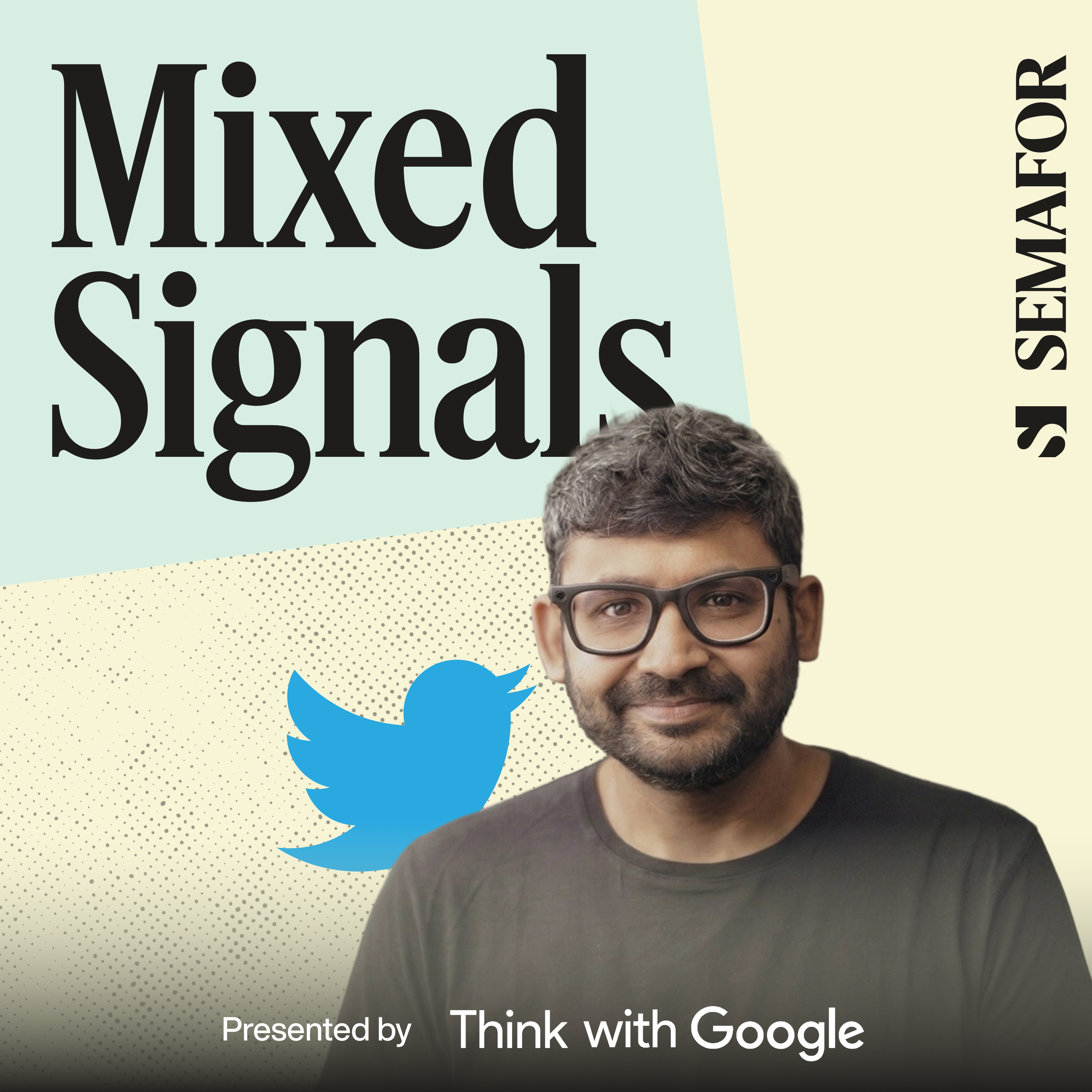
New York Times veteran and "AGI Chronicles" author Kevin Roose joins Mixed Signals to talk about what it was like to be patient zero for the AI media moment (a Valentine's Day evening where he stayed up chatting with a Microsoft chatbot that told him to leave his wife). Max and Ben ask Kevin how he used AI aggressively to write his book without letting it actually write a word, and whether taking a grant from an AI safety–linked nonprofit is a problem. They also get into his new show at NPR, and why he decided to leave the New York Times.
Sign up for Semafor Media’s Sunday newsletter: https://www.semafor.com/newsletters/media
For more from Think with Google, check out ThinkwithGoogle.com.
Find us on X: @semaforben, @maxwelltani
If you have a tip or a comment, please email us mixedsignals@semafor.com
Scan the code with your iPhone camera
Listen in the app.