
 Ask ChatGPT

- Podcasts
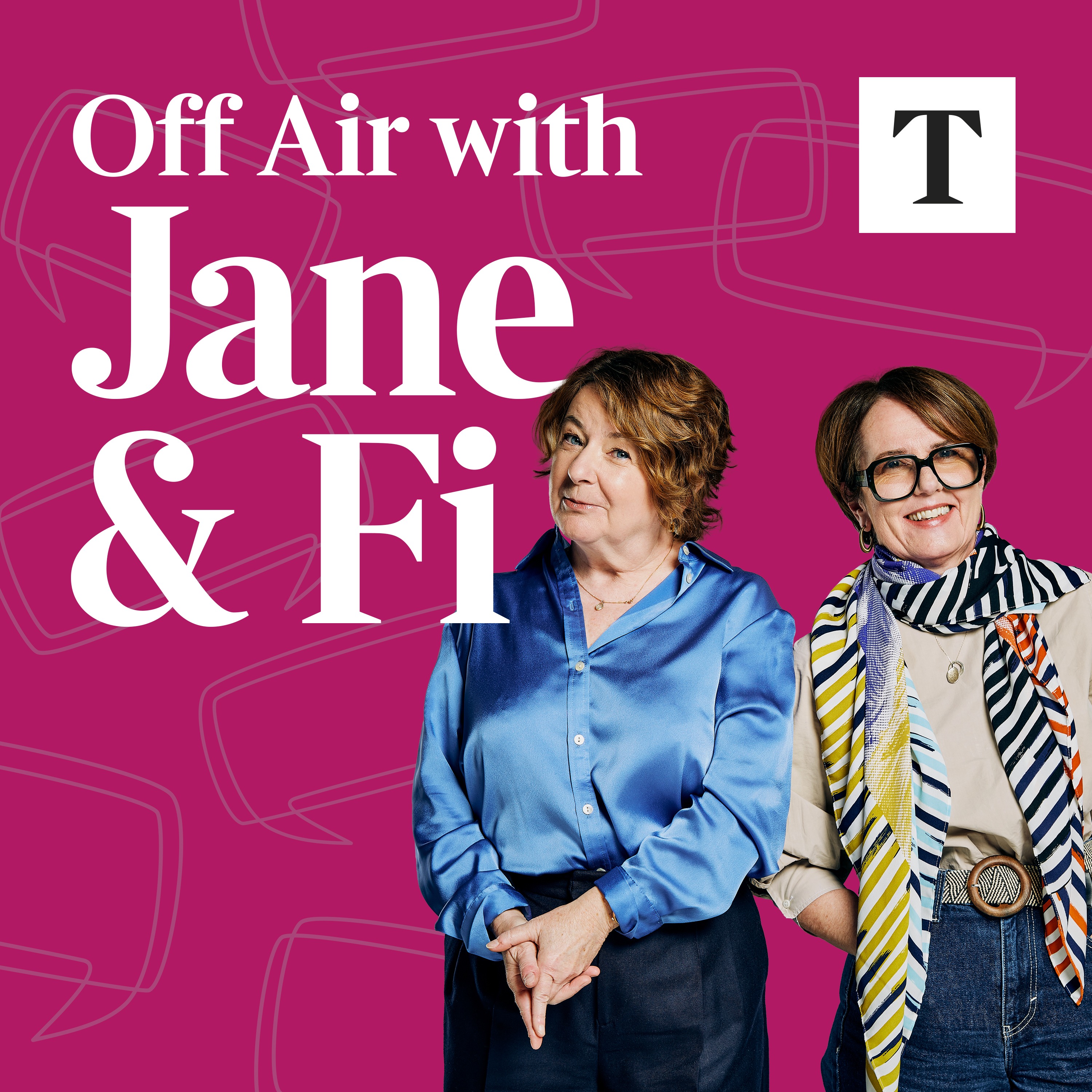
- Off Air with Jane & Fi
- Sally Slap Cabbage and fag-smoking dollies (with Bettany Hughes)
Off Air with Jane & Fi30 Jul 2026 · 55m · 18 chapters
Sally Slap Cabbage and fag-smoking dollies (with Bettany Hughes)
In short
The episode is a mix of listener letters and discussion, then a long interview about ancient history and classics. It includes: grief and end-of-life care conversations prompted by prior guests (including Dr Richard Coker), debate about assisted dying vs improving palliative care, and a lighter segment about children’s dolls’ names and odd toy noises. The main guest interview focuses on the Odyssey and ancient Egypt, especially Egyptian medicine/beauty and how classics can be taught in state schools.
Guests (and guest backgrounds)
- Bettany Hughes: historian, author, and broadcaster; wrote adult classics work and a children’s book, There Was an Egyptian in Your School; founding patron of Classics for All.
- (Also referenced earlier in the episode: Dr Richard Coker, a doctor who discusses end-of-life care; and political/business guests Andy Haldane and Claire Blackburn are mentioned as part of another show segment, not interviewed here.)
Key claims
- Egyptians made prosthetics (e.g., false toes) and practiced advanced cosmetic/mummification techniques; their eyeliner used coal and incense with protective/repellent purposes.
- Homer’s epics preserve real archaeological/historical details and contain “myth” as meaningful information.
- Classics should be accessible in state schools; films like The Odyssey can spark interest (“Gladiator effect”).
Notable examples
A worn wooden false toe from ~3,500 years ago; Egyptian “cheese” buried in tombs that still smells after millennia; Helen of Troy as a powerful, present figure in Homer; prosthetic/beauty practices like lip plumpers and eye treatments.
Written by AI. May contain mistakes.
Chapters
1:05
Listener Feedback and Grief Discussion
Hosts discuss listener emails and plans for a special episode on grief.
“Their program is designed to make weight loss a smooth ride, helping you understand what drives you.”
1:43
Listener Feedback and Grief Discussion
Hosts discuss listener emails and plans for a special episode on grief.
“This is the Hannah and Fee Off-Air edition of the podcast.”
3:56
Childhood Dolls and Their Names
Hosts share funny stories about their childhood dolls and their names.
“G, did you have any funny ones in your childhood?”
6:28
Unique Doll Names and Sweet Memories
Listeners share amusing names of their dolls, reflecting on candy and sweets.
“Do you think there'll ever be a very realistic doll, you know, who's got a lost Mary clutched in her hand?”
10:03
Accent and Language Discussions
Hosts engage in a conversation about accents and cultural references in language.
“Yeah, but even the ones that have got...”
14:01
Exploring Accent and Humor
Dive into a lively discussion about accents, humor, and cultural perceptions.
“They are proper hootie, though, aren't they?”
22:23
Reflections on Death and Care
A heartfelt discussion on end-of-life care influenced by Dr. Richard Coker's insights.
27:39
Anticipation for The Odyssey
Excitement builds as hosts discuss their plans to see 'The Odyssey' and share spoilers.
“though I saw two friends last night and they bloody spoiled it.”
28:00
Discussing The Odyssey and Film Experience
The hosts discuss their thoughts on The Odyssey film and its characters.
“No, no, no, it's fine, Hannah Bickleton.”
34:10
Interview with Bettany Hughes on Ancient Civilizations
Bettany Hughes discusses her new book on ancient Egypt and its cultural significance.
“Availability and coverage vary by state and insurance plan.”
Show all 18 chapters
42:07
The Universality of Myths and Their Impact
Discover how ancient myths influence modern culture and society.
“There's no gateway, there's no barrier to understanding those extraordinary stories.”
44:40
Homer's Poetic Legacy and Historical Accuracy
Explore the historical elements within Homer's epic tales and their implications.
“If they were absolutely rubbish and they were irrelevant and they didn't speak truth, people wouldn't have repeated them.”
47:26
Representation of Women in the Epics
Analyze the portrayal of women like Helen of Troy in Homer's works and their significance.
“Tell us a bit more about how Homer was sympathetic towards women, because actually one of the criticisms that's been made about Christopher Nolan's film is that the women of the epic poem aren't actually in it very much.”
50:04
The Nature of War in Homeric Epics
Discuss how the Iliad and Odyssey portray the brutality and consequences of war.
“You know, what's the truth of these women?”
51:27
Elon Musk's AI Grok and Historical Truth
Speculate on the implications of using AI to reinterpret historical narratives.
“Well, I mean, both those things are totally right.”
55:22
Learning from History: Optimism vs. Frustration
Reflect on the lessons of history and humanity's ability to learn and adapt.
“You know, the stories, like we were just saying, You know, we think of Helen as this kind of floozy, femme fatale, blonde bombshell, because that's what we've been told she is for centuries.”
56:00
Optimism in History
Discussing the lessons history teaches us and the importance of optimism.
“and feel frustrated that we really don't learn from history very much?”
57:00
Guest Appreciation
A heartfelt thank you and summary of Bettany Hughes' contributions.
“It's always so entertaining and informative and educational to see you, Bethany.”

Ask about this episode
Get the gist, explore an idea or ask about something said.
 Claude
On Off Air with Jane & Fi, what are the key points of this episode?
Searching your listeningTranscript
Automatic transcript. May contain errors.
0:00Your heart can tell you a lot about your health. Apple Watch Series 12 measures your heart rate every five seconds with the most advanced heart rate sensing in an Apple Watch. So your vitals app, now with heart rate variability, could tell you when something is off. And your readiness score can let you know when to rest and when to push. Hear the story in every heartbeat with Apple Watch Series 12. For general wellness purposes only, not intended for clinical use or to detect, diagnose, monitor or treat medical conditions. requires iPhone 11 or later. Dominic O 'Connell and Hannah Previtt here from The Business Podcast.
0:33Join us for a special episode with President of the British Chambers of Commerce and former Chief Economist at the Bank of England, Andy Haldane, and PwC's UK tax leader, Claire Blackburn, as we look ahead to John Healy's first budget. We'll discuss the challenge he faces trying to get the economy growing with an uncertain geopolitical backdrop and a party that's not keen on making cuts to public spending. We'll also ask what businesses are looking for, whether the government will be in a position to deliver, or if more tax squeezes are on the way. Listen to the business wherever you get your podcasts.
1:27Even if you get off the meds. Their program is designed to make weight loss a smooth ride, helping you understand what drives you. So you can build better habits to not just lose weight, but keep it off. Noom. Lose for keeps. Get started at Noom.com. Not all customers will clinically qualify for medications. Individual results may vary.
1:58Welcome to Thursday, everybody. This is the Hannah and Fee Off-Air edition of the podcast. So I think that we can all agree that Hannah has been an absolute women's star this week. You've stepped up and stepped in and also brought us some really fantastic topics of conversation. There are so many emails in the inbox saying how lovely it is to hear you. And I just completely agree myself. So that's where we started the podcast. It's only downhill from here. Thank you to all the listeners for being so welcoming because... Oh, they're a nice bunch, though. A lovely, lovely, lovely bunch. It's been so warming to read so many and confidence-boosting as well.
2:39And Jane and Fee are such pros. Yeah, stop that. Right. Yeah, don't worry about that at all. But we have decided as well because a lot of people have written in about grief and dealing with grief. And we're going to try and do a Friday edition special, aren't we? because there are too many emails to get through in the podcast today and there are some really interesting stories. So we will head towards that maybe next Friday before everybody heads off on their holidays. We've got a very odd kind of bumpy supply teacher a couple of weeks coming up, haven't we, as well? Yeah, we're on. Nobody's in the right place at the right time.
3:21No, we're all over the shop, but that's what summer's about, isn't it? Well, it is, and I hope that everybody forgives us for that because, you know, Jane and I don't always take our holidays at the same time, which does mean that we might not have a very, very firm run of affair with Jane and Fee until about 2028. The good news is that Jane is doing fine in Liverpool and we've had some very funny email exchanges. So she's back on Monday and we will talk much more about everything that has been happening with her, then we love your dolls' names. Oh, so, so good. G, did you have any funny ones in your childhood?
4:04Fee, you're asking me a question that you already know the answer to.
4:11Well, sometimes you have to do that. Yeah. Yes. So my mum actually emailed in, didn't she? Yeah, with my doll's name. Yes, your mum has emailed in. Does she listen all of the time? Or was this a special week just to make sure that you weren't going too offered a tangent? She does listen. I think she dips in and out because she's a busy woman with a big social life, as I've already alluded to. But I think this week she thought, damage control, I need to make sure. I've got it. Sorry, we were scrabbling around for it. Dear Fee, Hannah's mum here. hope all is well love that very direct uh hannah had an excellent name for one of her favorite dolls fairy doll so fitting as it was a fairy doll it came everywhere with us really enjoy listening best wishes to the team uh helen two kisses well helen two kisses back at you um so tell us about fairy doll what what exactly did fairy doll look like well she was fabric so she wasn't plastic she was very soft and she had like yarn hair she was actually a bit scary she had a very big head for the size of her body she had some wings she wore a dress and she was a she so two gold stars for me for not making her a boy um but she made this noise so you'd like press on the press on her belly and she'd go like but I found her actually a few months ago and I thought oh god fairy doll look at you she's got a bit mucky over the years but i gave her a press and she went
5:55so well that's aging for you we're gonna have to name her t-rex i think she's she's a dinosaur now right um i love those dolls that make sounds because they do always start going awry don't they just happen though they start making them of their own volition at the bottom of the toy box that's always the spookiest thing. It is spooky because you'd expect them to lose their power and not be able to make the noise full stop. But to make a completely different noise, it actually is a bit spooky, isn't it? To make her ominous... Well, maybe she's just smoked too many fags. Maybe she's just had a bit of a life.
6:30I'd actually love that for her. I would love that. Yeah. Do you think there'll ever be a very realistic doll, you know, who's got a lost Mary clutched in her hand? Oh, my God. Oh, my God. There probably already is. Let's not go there. There is another Helen who loved hearing about Big New and how quickly that sounded so normal to the family she lived with. It reminded me of my brother's choice of names for his toys. He had a big rabbit wearing bright orange and purple furry dungarees from John Menzies, a long-gone shop from the high street, which I remember being like a posh newsagent, bookshop and gift shop.
7:04So my brother called his rabbit John Menzies. When he was given a small teddy a little while later, my sister and I were keen to know what he was going to call it. It may have been that my brother felt a little under pressure as he quickly scanned the room and declared the name of his teddy as Light Switch. And despite my sister and I trying to suppress our laughter, Light Switch soon became a very normal name. I love those ones. We've got one here from Fiona. As a child, I had a rubber doll, no clothes, about a foot tall. It had no joints, so it would not bend. I couldn't understand why it wouldn't sit down.
7:39so the doll became known by the name of its instruction It Down Baby It Down It Down Baby These are good This one comes in from Nicola and Nicola needs to join the register the early morning register also on the early morning register today is Victoria I don't know Victoria is wrangling a toddler of a morning so greetings to you and I hope today is going alright Nicola says the following On the topic of dolls' names, my dolls were always very precious to me, but they did have incredibly dull names that also root them firmly in the early 1980s. So I had Rebecca, Tina and Helen wild. Tina was a tiny tears gifted to me one Christmas.
8:23My mum decided she couldn't face small puddles around the house, so she hid the instructions very badly, as my older brother and I had unearthed those before tea time. Small puddles ensued, but my dolls were always very well cared for. In contrast, my older cousin's dolls have gone down in family history for frankly being dragged up. Like our friend Big New, I'm told that my cousin's dolls had very few fingers and toes attached, but what they lacked in digits they made up for in their inventive names, including the notorious Sally Slapcabbage. Oh, my God. I've no idea where the name came from or why.
9:01for some reason I've never asked, but the older I've become, the more I appreciate that name. Oh, brilliant. Sally Slapcabbage. It is good, isn't it? It is. This one is from Fenella. Just a doll's name from my sister. She was much younger than the rest of us and caused amusement and teasing when she named her doll Aniseed Ball Lady Doll. Oh, yeah. I loved that one this morning. Aniseed Ball, small gobstoppers with aniseedy bits in the middle. Yes? I've never had one. The really proper sweet shop thing has just gone for your generation, hasn't it? Because you've got the American candy stores. Yeah.
9:39Those aren't right, Hannah, are they? I know they're not. And do you know, like, my mum loves pear drops, etc. I do not find them tasty whatsoever, and I feel like not many of my friends would. So sweet taste clearly changed at some point, because they're, what were the other ones, like the licorice all sorts? Licorice all sorts were obviously a big hit. They don't appeal to me. No, but those were disgusting. Oh, were they? Yeah, but even the ones that have got... They had those funny ones that had a kind of layer of very dry fondant on either side of them. They just tasted like sponges, didn't they?
10:13But you're right, if you went into an old-fashioned sweet shop, which for us was such a huge treat, I mean, massive, massive treat, I don't think my kids would want anything that was in the jars. I find... They find... They have always found those to be very laborious sweets. I love the look of them. I think they look so pretty, but they don't appeal to me. No. I want something, I don't know, that like sticks to all your teeth. Well, it's the Haribo thing, isn't it? I think you have probably got used to very sweet, gooey ones, whereas I think we were trained to believe that a mint humbug that lasted half an hour was a thing of beauty and joy.
10:56I bet you don't even digest Haribo's. I bet they just sit in your tummy and talk to each other. Ryan Neeker loves a Haribo. Oh, my goodness. She does, doesn't she? Strawberry one. Yeah, I was quite surprised. And I don't know why. I mean, there's no reason why being a royal correspondent means that you wouldn't like great big bags of sweets. But she can go some. She can do a whole bag during a show. She can. Yeah, crazy. It's tiring work. We also have some Australian dolls in the house. Choco and Woco. Choco and Woco. G'day. G'day to you. That's from Connie. Thank you, Connie. This starts, lovely Hannah.
11:35It's very lovely to hear Hannah's northern toes. Right, I think actually enough. I mean, Hannah's great. Hannah's great enough. I grew up in Preston, went to university in Manchester, then moved to Cambridge at 21. That's 40 years ago for Judith. I still have a recognisably northern accent and recently sacked my hairdresser because he was constantly doing the accent. It was so patronising and annoying that I wasn't willing to sit and listen to him anymore. I'm not surprised. I'm struggling to find a new one, but I'm not going back. On the other hand, I've bonded with my new dentist as he still has a Blackburn accent and we had a very good reminiscence about great aunties.
12:11Hannah also reminded me about our kids' much-loved and greatly-missed nursery key worker. She remained a good friend until her untimely death and she absolutely hated owls. if one ever popped up anywhere, she would yell, hooty fucker. Can we leave that in? We can, we have to. We still always refer to it. I find it very difficult to swear in a studio and feel comfortable with it. We had our first F on, didn't we? On the live radio show on Monday. And that's weird in itself, that I think I've probably been doing live radio shows for a very long time. you know 25 years and nobody has ever sworn use the f-bomb uh on a show that i've been doing and that includes phone-in shows as well the f-bomb is just it's become such a part of daily language now though hasn't it well this was a cambridge professor he was from jesus college that is a college jesus wouldn't be happy with that no not at all so i feel really weird so i'm gonna um i'm i mean feel free to leave that in but i'm not going to repeat it again in the body of the email judith if that's okay uh we always still refer to owls as who teat whatsits and think fondly of becca now i am in deep deep sympathy with you judith my own phobia is coming down spiral staircases Unfortunately, I quite often get sucked into going up them and then have to cope with getting back down.
13:43I will never go up the Duomo in Florence again and still have vivid nightmares about getting down. At some point, there's a void that you have to step across. Oh, that's awful. Lovely to meet Hannah, and maybe next time she's confronted with an owl, she can distract herself by shouting, Hootie, what's it? They are proper hootie, though, aren't they? Aren't they? I mean, I think it's a great term for it. Absolutely great term. use it freely outside in the production office just not in the studio i think it's a slippery slope isn't it would you prefer feckers i think you could do feckers yes yeah or fudges and and the accent thing i mean it's a bit it is a bit difficult isn't it because obviously this is the podcast that brings you a lot of good eyes i think as long as the accent is good and not in and you You're not, it's not someone who you're seeing every day.
14:34Like if I came into the office and all of you every single day spoke to only me with the Yorkshire accent as described in the email, that would be annoying. But if it's a good accent and it's in moderation, then I'm all here for it. Okay. Is it also about the punching up and punching down? Yeah. Yeah, I think that does play its part. But I've had to think about that a bit. I'm not sure whether or not I am punching up or punching down on Australia. But look, people who live in Australia, they seem to be fine with a good day. They're having a fun time. Merchandising for curly hair. This one comes in from Helen, who's done something incredible, I think, with the help of some artificial intelligence.
15:16Whilst Jane is away, says Helen, Fee, you could approve a whole load of merch. Hannah has spotted your commercial eye. I thought I'd send a mock-up of what's bound to be a real winner for hair that doesn't fare so well in the rain. Bring back the retro hair scarf, not the hairbrella, as some people are calling it on Instagram. Have you seen that, a hairbrella? I've not been shown a hairbrella yet, but I'm open to seeing one. Would it stick off the top? It might be uncomfortable. I think it would be very uncomfortable if it was an umbrella that you put on top of your head. That would be weird. And they were invented.
15:54so individual umbrellas that you wore on top of a hairband were a thing for a while but they went because they just made people look ridiculous and also you just have very wet shoulders What happens when the wind gets to you as well? You look like a right mini And also I think if you're going to do that individual thing why not just wear a hat? Yeah It all comes back down to the hat really doesn't it? But Helen has done a fantastic mock-up of a very, very shiny plastic hair coverer, big scarf thing with off-air with Jenny's film. And it's the new branding as well. You are so, so on message there.
16:36Literally. It is. It's a thing of beauty, and I'd wear that if it had somebody else's photograph on it. I'm not going to wear it with my own photograph. I think the day when you start wearing your own merchandise, it's the day you need to leave the building, isn't it? Oh, I don't know. live and let live no it would not be good uh sue says in the 1960s i remember all the women of my mother's age wore plastic rain hats think coronation street i've just googled rain hats for women and an array of similar rain hats are available mainly on ebay so we know that the hat is out there and all of that but it just doesn't seem to be sue in hannah's generation uh a great big maxed thing to go back to where we started our podcast on Monday.
17:21And I think that's because the style's not quite right, but we're going to get there. Yeah. We had such a fantastic guest yesterday, Dr Richard Coker, and he was one of those guests where I thought, oh my word, we could do another 20 minutes with you because his book, although everybody, including us, have very much picked up on assisted dying and him talking very openly about end-of-life care for his patients. Actually, the book is a really fascinating read about death and he's got a chapter in there about the connection between sex and death, which is quite often referenced, but I've never really seen it explained in the way that he explains it.
18:04And also some really good insights into a doctor's perspective on longevity. And he does have some decent things to say about that. We talk about this quite a lot on the programme. The men in particular who have... And it always comes back to Brian Johnson, doesn't it? He's got a contraption that he puts on his penis so he can work out overnight whether or not his penis has had a good night. Oh, my goodness. The app that nobody, nobody wants to download, Brian. Just put it away. This one comes from Christine Sampson, who says, Dear Fee, interesting listening to the Dr. Coker, but I'm interested that he's not mentioned nurses.
18:47It is nurses who tend to be with patients when they die. It's nurses who are there in the hospice. It is nurses who are with the families. Why are nurses not worth a mention here as a retired nurse and also a nurse having worked in hospice? I'm surprised he's not mentioned that it is usually a nurse who's actually with you at the end and usually the person actioning the doctor's prescription. Nurses are very much there in the book, Christine, as are his thoughts about the type of person who becomes a doctor and maybe therefore the type of person who becomes a nurse. So not covered in depth in the interview simply because of matters of time but I do agree, Christine, I mean at any point he could have referenced nurses but don't take it against him that it wasn't there in the interview because I don't think, am I allowed to say, Christine, I don't think he's one of those doctors who doesn't have time for the nursing profession and I think you might agree that those are definitely out there.
19:42Jo from Southend says, following the interview with Dr. Coker on Wednesday's podcast, I'm sure you've had plenty of emails from listeners who've also found themselves in the horrible position of seeing a loved one slowly fade away in unimaginable pain. Well, we absolutely have, Jo, and we thank people for writing in about that because it can't be an easy subject to revisit. My family was fortunate to have been able to use the services of our local hospice, the wonderful Havens Hospice in Southend, 10 years ago when my mum was dying of lung cancer. She didn't want to die in hospital or at home.
20:16We were lucky that a bed became available for her. Lucky for us, but obviously it meant another family had lost somebody and she was able to spend the last few weeks of her life surrounded by her loved ones whilst receiving the most excellent care to make her as comfortable as possible. I'm encouraged by the words of our new Prime Minister regarding the need to improve palliative and social care before the assisted dying bill goes any further. This echoes the sentiments that I'd already shared with my MP a few weeks ago. It is unacceptable that hospices have to rely on charitable donations to ensure that people can have access to the same wonderful care my family received.
20:55I'm absolutely with you on that, Jo. I think it is astonishing that we have come to accept that hospices run on charitable donations. How has that come to pass? It is definitely something that our new Prime Minister, Andy Burnham, will have on his desk in front of him when the latest report from Louise Casey comes in. And I thought it was very interesting, actually, in what Andy Burnham said yesterday. and just to give you a kind of in brief, he wants to put social care right at the top of the political agenda. He wants it to be a cross-party thing. So whatever it is that he recommends is not immediately rebutted by the other parties.
21:40But actually Labour has such a massive majority in Parliament. The Lib Dems are really on the page about social care. So hopefully whatever it is he decides will go through. and he did say, I thought, some very decent things about the people who've looked after his dad. So his father has dementia. Many of them come from other countries. He was thoughtful and sincere in his gratitude towards them. So hopefully we're on a different page with regard to social care. But the hospices thing, it wasn't mentioned in particular. you have to hope that it will get covered but obviously the sticky bit for any government is the enormous amount of money that they would suddenly have to find if they were to take hospices into the NHS but at some point if we're also going to accept that we want to live for longer and that we have the medical resources to do that this end-of-life care it has to be front and foremost in all of our lives at a much earlier age we can't just start thinking about it when we hit old age ourselves or our parents do I've gone on a bit there and I haven't but I just think it's so important so so important and not previously addressed in the way that it was yesterday so I feel like it's opened up a whole dialogue and when he when he answered that question on assisted dying it was one of those moments where he kind of left it to the end of his answer doesn't it it's like oh what's he gonna say here it's quite contentious and then when he said actually we need to sort palliative care out first i think it's hard to disagree with that to be honest i think it's a a really good point and then yeah where the uncertainty around hospices lie it's needs to get sorted doesn't it yeah and if you have better end-of-life care it's just a fact that some of those difficult cases of assisted dying won't be difficult cases that's the point isn't it removes the slippery slope effect a little bit because the last thing you'd want is anyone to be opting for that option because they're not comfortable yeah i thought it was very good speech and he did ask the press not to be cynical and immediately come up with dismissive and and slightly kind of dangerous headlines and i've had to give that quite a good think as well there's a very fine line between not being cynical and also continuing some scrutiny and I'd be quite interested to know whether or not people outside journalism would like a change in tone or whether you think that was a bit much of somebody a politician to say you know be nice about everything I do I can't quite work that one out yet you'll all have thoughts it's Jane and at times.radio if you do in at number one he said that he was going to tackle the paucity of money respite care and respect available to family members who look after their loved ones and we know that many of you are in our hive congregation so we'll keep a very close eye on that and this one comes in from an anonymous correspondent and we touched on this in the interview with Dr.
24:54Coker yesterday just in brief and forgive me for for slightly editing your email it's only for purposes of time. My mum had terminal cancer and was nursed in a hospice for a week while we adapted her house to bring her home. As a nurse I was prepared to care for her in her final days. We managed quite well but had very little input from her GP because she'd never complained of pain until her final day. That happened to be a bank holiday so I called the on-call service who duly sent out a doctor who prescribed antibiotics for a chest infection. I was horrified but my dad saw it as a cure. I rang the service again because mum was clearly in pain.
25:35They did promise to send another doctor hours past. This went on for quite a long time. And eventually, she was given some medication. And she was advised of the doses that she would need to relieve her pain. Our correspondent says, I then gave her the medication, she fell into a restful sleep. and obviously she gave her a level of medication that was high in order for her to have less of a painful end of life. And she says, I didn't tell my dad, but he was glad to see her out of pain. We sat and held her hands as she slowly and quietly died. I've often felt guilty that I did that, even though the end was inevitable, but I had likely hastened it.
26:22Hearing Dr. Coker speak about his experiences had brought back those emotions from over 25 years ago and finally made me feel that what I did was OK. I mean, that's such a load to have carried for such a very long time. And I think that's the remarkable thing, isn't it, about Richard Coker's very open conversation. And as he says, he thinks that this is what all good doctors do, but they haven't been able to talk about it before because the area of the law
26:53means hastening the end of somebody's life could carry, you know, an awful lot of difficulties for you. I'm fighting shy of saying, you know, these people are criminals because you're absolutely not. But gosh, how amazing to have heard him say that yesterday and maybe for a little bit of relief to have come your way. I'm sure in that moment you absolutely did the right thing for your mum. I mean, of course you did, actually. But I'm so sorry that you felt like that, actually, for 25 years. So we are very, very grateful to Richard Coker. His book is called Timor Mortis, everything to do with death, and we would highly recommend it.
27:39We are now going to introduce a guest. Have you been to see The Odyssey yet? I forget when it is in your schedule. I'm going tonight. I'm very excited. though I saw two friends last night and they bloody spoiled it. Why? Did they tell you the ending? They told me, I see, I don't want to spoil it for any listeners, they didn't tell me the ending and they told me something that I already knew was going to happen to do with Circe. Yes. And the visitors and what she does to her visitors. Yes. Not including... Oh, wait. No, it's a spoiler. It's a spoiler. No, no, no, it's fine, Hannah Bickleton. It's absolutely fine.
28:11Because, I mean, this is an epic poem that has existed in the world. In the world for years. If you don't know, you've not been reading up on your classics, and that's your own problem. Yeah. But it's not like the crying game. No, exactly. It's different, isn't it? It's very different. Yes, it is different. So don't feel bad. Don't feel bad. I'm sure you'll still enjoy it, having known some things about it. I know. I'm not sure I'm ready to watch that, though. It's quite graphic, isn't it? Some of it really is, haven't I? I'm a bit scared for you. I'm a sensitive soul. But yeah, no, I'm excited.
28:43I'm going with two of my friends and my boyfriend. We've got a little cinema club. So, yeah, it'll be good. Are you ready for the two hours, 53 minutes of it? It's long. Did it feel long? Were you thinking, oh... Well, I did take a little bit of a break just because the cinema was so hot because the Google Deep Mine Buildings air conditioning wasn't working. And so quite a few people went outside just for 10 minutes. I mean, it's the type of film where you absolutely can. OK, that's good. You just take 10 minutes off, go back in, someone can catch you up. Where would you recommend the break? I would take a break...
29:26Oh, that's a very good question. I would take a break in the first 40 minutes. I thought the first 40 minutes was a bit too long, actually. And I know they have to set up the story. but once Odysseus once you see him starting back on the journey and all of the difficulties that he faces along the way but I don't quite know what I did miss in the 10 minutes I went out a bit later but I think it was fine it was still a film that has stayed with me I've heard Anne Hathaway's acting was very good I've also heard it was over the top so people are taking different views on that did you like her well i think all acting's over the top i mean that is acting it is acting sometimes i find the problem with you know with actors is that they're acting yeah um so no i don't think she was over the top i've heard people criticize um tom holland's telemachus yes for not being quite meaty enough of being a bit a bit little boy so i think that's the thing it's like him next to anne hathaway who's this amazing actress who's coming with so much emotion one of them either looks like they're not doing enough or that they're doing too much maybe i see what you mean the contrast yeah yes compare and contrast yes but i didn't mind the fact i just thought tom holland uh played a blinder in making telemachus look a little bit unsure of himself and a bit weedy and a bit incapable because he is i mean he's a boy and and he hasn't had his dad around or very good influences so i don't think i minded that i didn't think matt damon had an awful lot of layering going on okay in his portrayal of odysseus but look we're about to talk about all of this with one of our modern classical greats so bethany hughes is about to come your way we are going to talk about the odyssey via egypt what more could you want so highbrow so highbrow it's all there all the civilizations are about to come your way after some commercial appealing breaks
31:47your heart can tell you a lot about your health apple watch series 12 measures your heart rate every five seconds with the most advanced heart rate sensing in an Apple Watch. So your vitals app now with heart rate variability could tell you when something is off. And your readiness score can let you know when to rest and when to push. Hear the story in every heartbeat with Apple Watch Series 12. For general wellness purposes only, not intended for clinical use or to detect, diagnose, monitor or treat medical conditions, requires iPhone 11 or later. Dominic O 'Connell and Hannah Privet here from The Business Podcast.
32:20Join us for a special episode with President of the British Chambers of Commerce and former Chief Economist at the Bank of England Andy Haldane and PwC's UK tax leader Claire Blackburn as we look ahead to John Healy's first budget. We'll discuss the challenge he faces trying to get the economy growing with an uncertain geopolitical backdrop and a party that's not keen on making cuts to public spending. We'll also ask what businesses are looking for, whether the government will be in a position to deliver, or if more tax squeezes are on the way. Listen to The Business wherever you get your podcasts.
32:55Therapy's biggest impact doesn't show up in some dramatic breakthrough. It shows up in the smallest moments. You bite your tongue instead of escalating. You put your phone down instead of firing off that text. You say what you actually mean instead of what would hurt someone else the most. Nobody applauds those moments, but they quietly change your life. That's what growing feels like, and that's exactly what Grow Therapy is here for. Grow is therapy that works, covered by insurance. Sessions average$21 with insurance, and some pay as little as$0, depending on their plan. There are no subscriptions, no long-term commitments.
33:32You just pay per session. Grow connects you with thousands of high-quality, licensed therapists across the U.S., offering both virtual and in-person sessions, nights and weekends. You can search by what matters, like insurance, specialty, identity, or availability. And you can book a therapy session in minutes and begin in as little as two days, not the national 48-day average. See if you could pay as little as$0 for therapy in seconds at growtherapy.com slash ACAST. That's growtherapy.com slash ACAST. growtherapy.com slash ACAST. Availability and coverage vary by state and insurance plan. Now, our desire to learn more about the ancient world show no sign of dimming the further we get from them.
34:22This summer's Blockbuster is the Odyssey, where you can learn all of your lessons about hubris, not offending the will of the gods, respecting the laws of the land, not being a woman unless you're a goddess, and seeking to find life after war altogether now. What is it good for? Absolutely nothing. And a similar curiosity has always existed about the Egyptians. How did they live? Who built those pyramids? How did they become so rich and powerful? How has that influence stayed with us for so long? Well, both are areas of expertise for our guest, Bettany Hughes, historian, author and broadcaster.
34:56Her latest work is a book for children called There Was an Egyptian in Your School. Right, we've got to pack many ancient civilisations into the next 18 or 20 minutes, Bethany. So off we go. Let's start with the Egyptians. This is such a corker of a book. Tell us about the concept of it. I wrote it because I was inspired to become a historian because when I was five, somebody showed me the Tutankhamun exhibition at the British Museum. And I remember the moment of epiphany of thinking, all those stories you hear about boy kings buried in secret tombs and treasures and gold and mysterious deaths, hello, they're true.
35:35And I'm looking at it, when I was looking at the Tutankhamun mask, and I was so inspired, I actually wrote my first book when I was five, which was my own theory on how Tutankhamun had died. Terrible spelling, I've spelt some mosquitoes, spelled S-U-M, mosquitoes bit him, and they were a bit germy and he died, which of course turns out to be true, because he had malaria. So I know how important it is when you're young to have just that little spark of inspiration and access to ideas. So I've written lots of books for adults, so I thought I'd have a go writing for kids. And maybe I'm about 95 myself now, so maybe I'll become a grandparent as well.
36:17And then they can read these books about ancient civilisations. Obviously, what kids love to know are the slightly kind of icky sides of any civilisation. and you don't spare the punches in here. So let's do the false toe, please. Yes, people don't know this. The Egyptians loved a prosthetic. So they created really incredible false toes, false legs, false arms. And for generations, because he was obviously turned up in their tombs and people thought, oh, you know, they're just making them perfect for their journey to the afterlife. But actually now we've started to analyse them and you can see there's a huge amount of wear, for instance on this beautiful wooden toe which is one of my objects in the in the book so this was a woman who was wearing for some reason her big toe had dropped off so she was wearing a false toe and it really works because again you probably have heard this that why people have sore feet is you have a huge amount of pressure you put on your big toe so if you haven't got one it's a real issue so the false toe was a real toe that was worn by a real egyptian woman around three and a half thousand years ago right i mean a prosthetic false toe is also quite difficult to attach and keep on your foot isn't it it is but you know what we think that she actually had a little strap on her foot and a sort of specially adapted sandal so that it would also sort of slot in to her footwear as well because it's got all these interesting kind of ties on but they were total and again just to say it was often the women in the society who were making these things and who were in charge of medicine in the palaces.
37:52They were also absolute masters and mistresses at basically kind of ancient Egyptian plastic surgery because of all the mummification that they did. So these mummies have their, they have, you know, like fillers put into their cheeks. They have lip plumpers put in. They have little corns of pepper in their eyes so that their eyes look kind of nice and wide open. So they were very ahead of their time. What's extraordinary, actually, is just how impactful that Egyptian symmetrical beauty has been on modern beauty standards. We are still seeking to recreate Tutankhamen's look, aren't we? Which is wide eyes, high cheekbones, quite a narrow chin and very, very symmetrical lines.
38:39It's such a force, isn't it, that image? And also gorgeous smoky eyes, which you can create with coal eyeliner. They really did. I know we sort of might think of all the ancient Egyptians and you see those masks and then you might imagine Liz Taylor as Cleopatra with a ton of 60s eye makeup on. But they really did wear eyeliner a lot, guy liner as well, girls and boys. and they made it with kind of burnt incense, which is really, really interesting because it acts both as an antibacterial and as a slight sort of insect repellent incense. So they were putting it on to make them look fabulous, but also to protect them from the glare of the sun on the sand and as an insect repellent.
39:21So it was a make-up and beauty with purpose. Yeah, they were multi-skilling, weren't they? They were multi-tasking as well. Tell us about the oldest cheese in the world, please. No, I'm so glad you like that. The oldest cheese. Well, I spend a lot of time with ancient cheese of all kinds. But ancient Egyptian cheese really, you know, has to take the biscuit just to mix our food metaphors because it was buried often again. Because if you think if you go to the afterlife, you need food and drink for your journey. You need to be kind of treated with great honour. And we're discovering these tombs.
39:54First of all, it was a bit of a mystery object. We didn't know what it was. and it turns out it was a kind of cream cheese. It was a sort of Philadelphia almost of ancient Egypt. Very salty. They loved their cheese and you can analyse it from the inside of the pots and you can still smell it. It still smells cheesy after a thousand years. But don't all old pots, Bettany, smell a bit cheesy? They do. They do. Anyway, so I hope people, I hope kids and the adults, you know, reading this book with them will enjoy the ancient Egyptian cheese. You are a founding patron of Classics for All, a national campaign to get the study of classical civilisations back into state schools.
40:37How is that going? Amazingly. So since we started, it's now in 1 ,000 more state schools than at the beginning because you were pushing against an open door. People really want to learn this stuff. The stories are incredible. The myths are incredible. If you play any video game, you've probably met half of the Greek mythological characters. Greek and Roman is the basis of around, you know, what we're speaking now, probably about 40 % of that is basically Greco-Roman. It's the basis of 32 European languages. So it's a really good thing to do. And school, so parents want it, teachers want it, school children want it, because it's cool.
41:15It's something, you know, if you've watched Harry Potter, there's sort of versions of Latin spells. If you've watched Gladiator, if you go and watch the Odyssey it means that you can talk about what's going on with real confidence and strength so um we've it's been really fascinating I have to say we thought it was going to be an uphill struggle and by the way if there are any donors out there donate it to Classics for All and we'll we'll make sure that we can get some more Classics teachers into state schools but but you know it's been a scheme I have to say that has that has worked. Do you think the whole classic genre though suffered from a little bit of pomposity because when it remains attached to the study of Latin and Greek, I think it can be quite off-putting to an awful lot of kids.
41:58Whereas, you know, you go and see the Odyssey, you read a play by Euripides, you learn about ancient Rome or whatever it is. There's no gateway, there's no barrier to understanding those extraordinary stories. So do you think we just have to take the languages out? Or do both, you know, and then it It depends kind of what you like doing as a learner. So I think if you have classive, as you say, and you learn about all those myths, you know, which, because we use phrases from ancient myth the whole time. We talk about mentors, you know, a mentor was a figure in the Odyssey. We talk about having an Achilles heel or a Trojan horse, you know, all of these things.
42:39So we're sort of riddling our lives with these ancient stories. And I absolutely agree. But something I'm really passionate about, you'll see I get a bit heated about this, it's not an elite subject a subject is only elite if you only allow the elite to study it and if you look actually the story of the uk farmers sons and daughters would sit and learn latin and about the greek myths when they came home from the fields it always used to be something that was available to everybody and then basically it got sucked in by the private schools and now that's why we want to get it back out and so that everybody has the chance if they want to to learn it and i mean this is a genuine question do you think that the success of the odyssey the movie is is going to help 100 so we talk about the gladiator effect so people went to watch the gladiator film and suddenly there was a big interest again in the classical world everybody is talking about the odyssey i've just been filming i'm making a new film about the goddess artemis about the about the goddess of the moon and why she matters and we were down in a space station in Cornwall.
43:41Tiny, tiny, went to a tiny, tiny little pub for supper and down there they were really hotly debating was Tom Holland good, was he believable as Odysseus' son? So it's totally captured people's imaginations. Yeah, it will definitely spark something because they're universal stories, that's the point of myths, they relate to everybody. They're amazing stories, you know. Have you seen The Odyssey? I have, yes. There's a lot going on on screen.
44:10so you know that's that's fantastic and i think if people get that actually this is this is everyone's inheritance you know these are stories that were told in east and west north and south alike there's a sort of problem if we think of it just as being something that belongs to a kind of western civilization or western culture they're totally universal so um yeah i i i have no doubt there's going to be lots of little lovely classicists running around. Well, how brilliant. Because it is all there, isn't it? Those enormous lessons of life. That's why the epic poems survived. If they were absolutely rubbish and they were irrelevant and they didn't speak truth, people wouldn't have repeated them.
44:49Totally. I mean, I always think that with Homer, there are two things that really strike me whenever I see the news. So Homer talks really beautifully about one of the goddesses who brushes an arrow off one of her favourite soldiers like a mother brushes the fly off the face of a sleeping child in conflict. And you listen to that metaphor and in a second, thousands of years collapse and you can imagine being that mother, being that parent of that child. And then in a passage very close to that, they talk about there's a diplomatic truce has been agreed, you know, they kind of thank goodness, war in the Middle East is about to stop, in the Near East and the Middle East.
45:29And then one hot-headed archer lets off an arrow and the whole thing kicks off again. And that's what we are seeing on our news screen. So that's why these stories were told. Myth doesn't mean a fantasy or a fairy tale. The word myth, muthoi, it means points of information, things that matter, things that are really useful for us to know. So I think, personally, there's as much fact as there is fantasy in Homer's Odyssey and Iliad. How long would it have been after the Trojan War, whatever evidence there is for that actually having taken place, that Homer wrote the Odyssey? So he composed, Phoebe, have to say he composed.
46:08I'm so sorry, you're right, yes. Because he didn't write it down. He didn't write it down. He was sort of singing these lyrical verses. So there's hundreds of years of a gap. But what is, but that doesn't really matter because what, Homer's a historian by accident because whoever he is, some people say it's a she, you know, because it's so sympathetic towards women, the actual, you know, the original verse. I think it's probably like a mix of people and then a genius poet who kind of puts it all into something which is very consumable. If you look at details in those poems, they are absolutely replicating the historical truth of what was happening at the time of the Trojan War.
46:50So we're talking, you know, 400 or so years before. So things like we talk about Helen of Troy weaving with this beautiful golden spindle and a golden spindle exactly the same has turned up in the grave of a Bronze Age woman. The helmets that Odysseus and his team are described as wearing, with these boars, tusk helmets strapped together with leather, again, identical helmets have been uncovered from the graves of dead heroes from the Bronze Age. So he's definitely passing on real archaeological details of real history, of real history as lived. And when he talks about the ships that come over to rescue Helen, Actually, it doesn't scan in the Greek that he's using from his time, but if you use the early Greek, it's called Linear B from the Bronze Age, it scans perfectly.
47:39So that tells us that there were real people sitting in the courts of real kings and real queens remembering these foreign campaigns and listing the heroes and the heroines and the boats involved, and then Homer has inherited that centuries later. Tell us a bit more about how Homer was sympathetic towards women, because actually one of the criticisms that's been made about Christopher Nolan's film is that the women of the epic poem aren't actually in it very much. I mean, they're there, but they're not in it very much. I know, because there's massive fuss about Lupita and Yon-Yon-Yon and the casting of Lupita.
48:14The big issue is that she hardly appears Helen of Troy. I mean, Helen of Troy is actually Helen of Sparta, so she was a Spartan queen. and this queen is so compelling, so powerful in Homer's epics that the known world comes to fight for her hand and then to follow her to Troy. And in those epics she's dignified and resourceful and feisty and clever and very, very present. And kind of one of the very last passages of the Odyssey, at the end of this huge battle that's happened, Helen is back at home in her palace in Sparta with Menelaus, who's come to fight for her and get her back, you know, after 10 years.
48:56And 10 years then of the heroes returning, so 20 years later. There's no recriminations. She's still powerful. She takes Menelaus' hand and leads him to her beautiful purple bed spread with these purple sheets. So it's all very sexy. So Homer is basically saying she's a woman who matters and actually doesn't matter what she looks like. You don't really hear her described as being beautiful. What matters is what she makes men do. that she has this incredible impact and effect on all of those around her. So I'm really glad the Odyssey has happened. I'm really glad because I think it will bring a whole new generation to the classics.
49:33I'm really sad that the super fascinating, interesting, sexy, powerful women that are there in the epics hardly appear at all in the film. But what people need to do, Bettany, is buy your book about Helena Troy, which was a very prescient book to write. Oh, Fee, I love you so much. But you're right, I'm so proud of it. This is my first book that I wrote 20 years ago. It's out as an audio book, if you want it as an audio book. And I was basically tracing the truth of Helen in the Bronze Age archaeology and saying, could she have existed? You know, what's the truth of these women? And I remember when I wrote it 20 years ago, everyone went, oh, that's such a fluffy subject.
50:12You know, she's just a pretty face, an academic colleague. So you can't do that. It will ruin your academic reputation. But actually, it's fascinating because these women, as I said, had real impact. We know that they spoke in council, they could bequeath their land to others. We've got a new show coming out on Channel 4 the week after next when we look at the real queens of what's now Turkey, so on the Trojan side. And there's this brilliant queen called Queen Putihepa, who's the queen of the Hittites, who lived at exactly the same time as the Trojan War. And she basically takes Egyptian pharaohs to task and that Ramesses the Great, the most powerful man in the world, he complains about the dowry that she sent over with one of her daughters.
50:54And she writes in this basically spanking, scolding letter, treating him like a schoolboy and said, I'm incredibly disappointed with your tone, Ramses II. Are you so tight that you actually expect me to give you more gold? You know, come on, man up. So that is the reality of that world. But yes, you are right. That is in my book, Helen of Troy. I think one of the most beautiful things as well about the Odyssey is it's telling us something about the true nature of war, isn't it? That grief and loss are suffered often, often by the people left behind. There is a very brief scene about Agamemnon's sacrifice.
51:32Is it as brief in the Odyssey itself? And can you explain that a little bit? Well, I mean, both those things are totally right. And, you know, there are two big books. The Iliad, which is about the war itself, and the Odyssey, which is about the homecoming. and you hear about the fighting in the sort of recounting sequences when Odysseus is telling his story. And you're absolutely right, the brutality. The Iliad is a really difficult read. I mean, it is so visceral and you get these graphic descriptions of the wounds on the battlefield. And again, we see those wounds in the archaeological record.
52:09So if you look at how people are fighting back then, they have arrows kind of wedged in their hips and arms. arrows in their heads which have been pulled out and they've been pushed back in to carry on fighting in the battle and we can tell that because of the way their bones have healed and you're absolutely right that the devastation and pity of war is something which is it's not glamorized in the Iliad or the Odyssey people talk about it's this appalling creeping malign influence so and and I do think you get that from from the Odyssey of the film you know the sort of as Odysseus says, he watches his countrymen come in and just the rage and the rape and the pillage that happens when they enter Troy.
52:50And the sacrifice is fascinating. You're absolutely right. So this story of Agamemnon, basically the winds have dropped and it's because somebody has offended Artemis, the great goddess Artemis, by shooting a deer in her sanctuary. So she says, okay, you guys, you can't sail to Troy. You can only sail if you sacrifice that which is most precious to you. And Agamemnon thinks, or it's going to be some beautiful cow or a bull or a peacock or something. And it turns out it's his daughter. So I know. I mean, it does. It makes... It's visceral, isn't it? It's so visceral. So he has to take... It's a decision that he makes.
53:24He has to take his daughter and sacrifice her on an altar for the goddess Artemis. And there are two fascinating things about that. One is that we are actually finding evidence of human sacrifice of young girls from that time when there's a period of terrible calamity so in the island of crete again from the bronze age there was a massive earthquake and there's a skeleton of a young girl who's been sacrificed obviously as an offering to the gods so you offer the most sacred the most beautiful thing that you can give to try to placate them so that story actually is history but again what people forget is there's so many versions of the greek myths and there's a much more popular common version where artemis asks agamemnon to sacrifice his daughter but just at the moment that he's about to put in the blade she turns the daughter into a young deer who escapes from the sacrificial table and runs off into her sanctuary and is saved so it's almost like the greeks themselves couldn't found it too much turned it too much yeah i mean i thought it was a remarkable tiny scene to keep in the film and you know all credit to Christopher Nolan for doing that I mean it's not the actual it's not an actual sacrifice itself just I tell people in case I'm thinking my god I can't sit through that very quickly can I ask you whether or not you would be the slightest bit interested in watching Elon Musk's AI Grok version of the Odyssey well I'm fascinated by the proposal of Elon Musk's Grok version because he says it's going to be the truth which he's going to create through AI and given that AI basically scrapes what's written and there is so much rubbish and nonsense that's written about the Odyssey and the Iliad, how is it going to be true?
55:13That's what I would really love to know is how is he going to programme AI to seek out the truth? Because the reality is the truth is hidden in history. You know, the stories, like we were just saying, You know, we think of Helen as this kind of floozy, femme fatale, blonde bombshell, because that's what we've been told she is for centuries. So I suspect that's how it will appear in Elon Musk's Grok version. That is definitely not the reality of the real women of the time. So I will watch with a reserved interest. Fair enough. Somebody wise once told me that if you have a great love of history, it is like travelling through the present with a friend.
55:55Do you find that yourself? Or might you look at the carnage that we still managed to create in this time and feel frustrated that we really don't learn from history very much? I go with the first statement and it's a much more hopeful one because people sometimes say to me, oh, as a historian, isn't it very lonely? and you think, no, I'm just surrounded by people the whole time. They happen to be long dead, but it doesn't matter because they are my friends and what they can teach me is extraordinary. And the thing about learning from history, you know, I take a slightly different point of view.
56:35We do learn from history. We have had loads of chances through time to self-exterminate as a species and 99 times out of 100 we pull back from the brink, which is why you and I are sitting here now in this studio. So I think we have to try to be more optimistic. We're a stupid speech is a lot of the time, but then wisdom, which has the same root as the word history, by the way, kicks in. So let's just hope we give wisdom a chance. What a lovely, lovely note to end on. It's always so entertaining and informative and educational to see you, Bethany. So this is such a lovely book. If you've got young ones, there was an Egyptian in your school.
57:14It's illustrated by Nathan Reid. It's got a little bit of guts and gore in there as well. Lovely to see you, Bettany. Thank you very much. Bettany Hughes. I mean, that woman just has an encyclopedia. She's got a British museum inside her head and we're very grateful to her for letting us in for a while. Jane Garvey returns on Monday. We will be with you next week. We just have to say a massive, massive thank you to Hannah because it's been really good fun this week. and we've also talked about some very serious things. I think you've talked about them in such a brilliant way and we will do a special on grief.
57:50Do you want to pass a message on to your mum if she's still listening? Do you want to make the most of the sign off? I'm going to just leave it to you now. Oh, OK. This is fresh. Well, thank you everyone for having me again. It's time to say goodbye. Time to... Goodbye! I thought you were going to do a Ken Bruce and to everyone who knows me. Oh, yeah. That's what they all say on Popmaster. Popmaster. Oh, what's the Truman Show one? If I don't see you. I will see you, though. That's the thing. Yeah, that's the thing. I'm getting super sub-tier there and everywhere. So we'll just say, we'll say à bientôt.
58:28Au revoir.
58:44Congratulations, you've staggered somehow to the end of another Off Air with Jane and Fee. Thank you. If you'd like to hear us do this live, and we do do it live, every day, Monday to Thursday, 2 till 4 on Times Radio. The jeopardy is off the scale. And if you listen to this, you'll understand exactly why that's the case. So you can get the radio online on DAB or on the free Times Radio app. Off Air is produced by Eve Salisbury and the executive producer is Rosie Cutler.
59:39So your vitals app, now with heart rate variability, could tell you when something is off. And your readiness score can let you know when to rest and when to push. Hear the story in every heartbeat with Apple Watch Series 12. For general wellness purposes only, not intended for clinical use or to detect, diagnose, monitor or treat medical conditions, requires iPhone 11 or later. Dominic O 'Connell and Hannah Privet here from The Business Podcast. Join us for a special episode with President of the British Chambers of Commerce and former Chief Economist at the Bank of England, Andy Haldane, and PwC's UK tax leader, Claire Blackburn, as we look ahead to John Healy's first budget.
1:00:17We'll discuss the challenge he faces trying to get the economy growing, with an uncertain geopolitical backdrop and a party that's not keen on making cuts to public spending. We'll also ask what businesses are looking for, whether the government will be in a position to deliver, or if more tax squeezes are on the way. Listen to The Business wherever you get your podcasts. I love days like these at the pool, but my moderate to severe plaque psoriasis can sometimes take me out of the moment. I'm ready to make a splash with clearer skin thanks to SkyRizzy, Rizinkizumab RZA. SkyRizzy is a prescription-only injection for adults who are candidates for systemic or phototherapy.
1:00:57At four months, most people saw 90 % clearer skin when measured from head to toe, And many were even 100 % plaque-free. People also saw significant improvement in psoriasis symptoms of pain, redness, itching, and burning. Don't use if allergic to SkyRizzy. Serious allergic reactions, increased infections, or lower ability to fight them may occur. Before treatment, get checked for infections and tuberculosis. Tell your doctor about any flu-like symptoms or vaccines. Now there's nothing on my skin, thanks to SkyRizzy. And that means everything. Ask your doctor about SkyRizzy, the number one dermatologist prescribed biologic and psoriasis.
1:01:31Visit SkyRizzy.com or call 1-866-SKY-RIZZY to learn more.
From the publisher
A week of supply-teacher chaos concludes! Normal service resumes Monday when Jane, Fi, and Young Eve are reunited. In the meantime, Fi and producer Hannah bring you chain-smoking dolls, dubious plastic rain scarves, and royal Haribo habits.
Plus, Fi speaks to historian Bettany Hughes about all things The Odyssey and her latest children's book 'There Was An Egyptian in Your School'.
Our book club pick is a collection of short stories! 'Interpreter of Maladies' is by Jhumpa Lahiri.
You can check out our YouTube channel here: https://www.youtube.com/@OffAirWithJaneAndFi
Our most asked about book is called 'The Later Years' by Peter Thornton.
If you want to contact the show to ask a question and get involved in the conversation then please email us: [email protected]
Follow us on Instagram! @janeandfi
Podcast Producers: Hannah Quinn and Eve Salusbury
Executive Producer: Rosie Cutler
Hosted on Acast. See acast.com/privacy for more information.
More from Off Air with Jane & Fi
All episodesWe use cookies.They keep VO running smoothly and help us improve it. Privacy policy