
In short
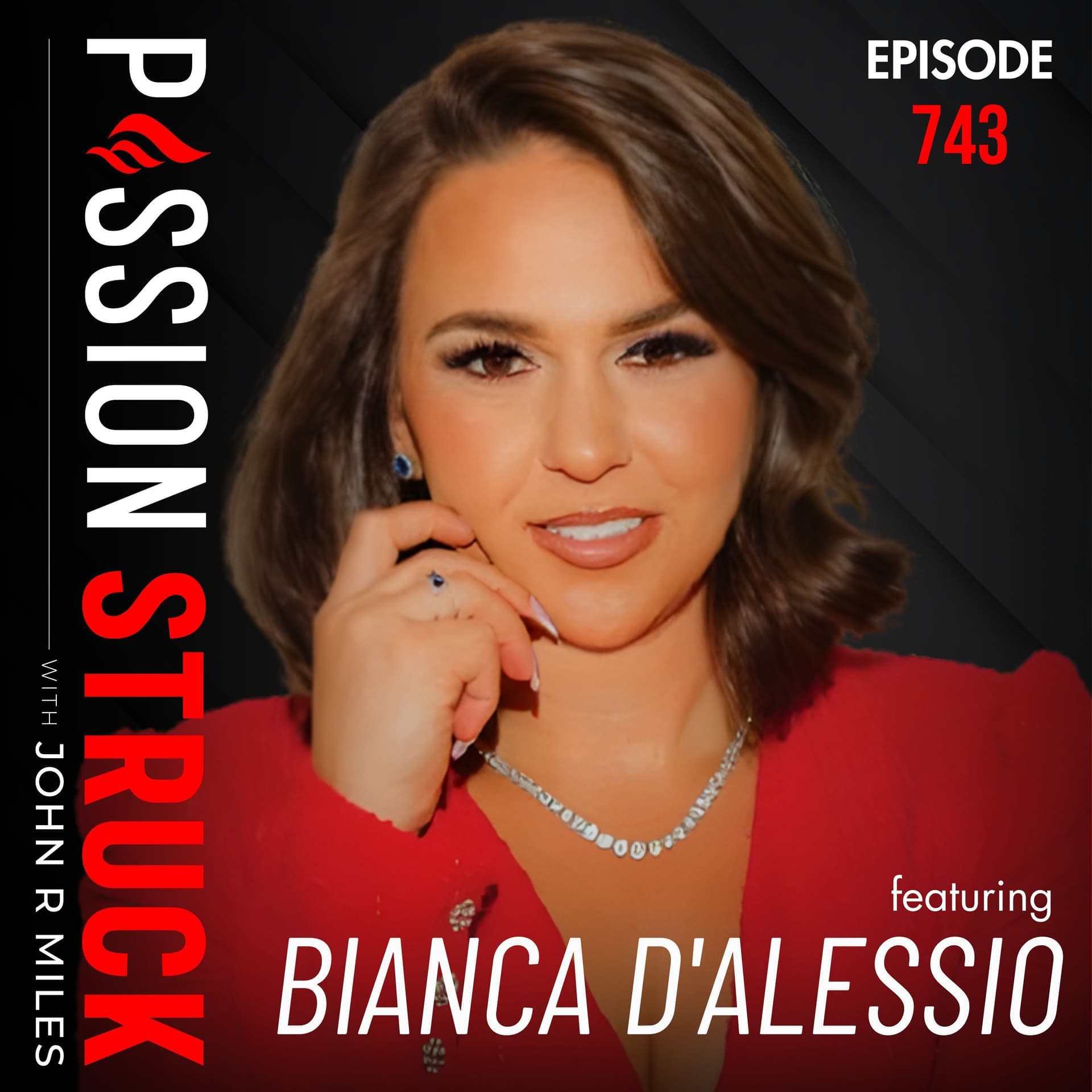
Podcast Summary: Passion Struck with John R. Miles - Episode 745
Episode Title
How to Rebuild Your Identity When Everything Falls Apart | Bianca D’Alessio
Episode Overview
In this episode, host John R. Miles engages in a profound conversation with Bianca D’Alessio, a notable real estate broker, entrepreneur, and author of *Mastering Intentions*. The discussion centers around identity, resilience, and the process of intentional reinvention following personal and professional upheavals.
Key Themes
- Crisis of Identity:
- Bianca recounts her journey during a pivotal time when her father was convicted of financial fraud, leading to a loss of stability and identity for her family and herself.
- This situation forced her to navigate public scrutiny while building her own successful career in real estate.
- Survival to Self-Discovery:
- The conversation explores the transition from merely surviving to embarking on a journey of self-discovery.
- Bianca emphasizes that ambition alone can lead to emptiness; intentionality is key.
- The Role of Intentionality:
- Intentionality became a guiding principle for Bianca as she rebuilt her life.
- She discusses the importance of aligning actions with personal values and long-term aspirations rather than just chasing ambition.
- Healing Takes Time:
- Bianca reflects on the prolonged nature of trauma recovery, highlighting that healing is often underestimated in terms of time and effort.
- She stresses the need to focus on one change at a time rather than trying to overhaul everything at once.
- Self-Talk and the “Brain Bully”:
- The concept of the “brain bully” refers to self-doubt that resurfaces during transitions.
- Bianca shares practical strategies to counter self-doubt through positive self-talk and gratitude.
- Future Casting and Manifestation:
- The episode discusses the idea of future casting as a method to manifest desired outcomes.
- Bianca explains how visualizing goals and acting as if you’ve achieved them can help realize one’s aspirations.
- Building a Human-Centered Business:
- Bianca discusses her approach to leading a successful real estate team, emphasizing a culture of support and collaboration.
- She believes in uplifting team members while also fostering personal growth and well-being.
- Work-Life Integration:
- The importance of integrating professional responsibilities with personal life is highlighted.
- Bianca advocates for maintaining boundaries and prioritizing time for oneself and loved ones.
Key Takeaways
- Live for Yourself: Individuals often exhaust themselves trying to meet others' expectations; it's crucial to focus on personal goals and relationships that serve one's well-being.
- Intentional Decisions: Decisions made should align with one's values to avoid future regrets.
- Embrace Vulnerability: Sharing personal struggles can build connections and foster authenticity in relationships and leadership.
- Time Management: Being disciplined and organized with one’s time is essential to protect energy and personal boundaries.
- Continuous Learning: Healing and personal growth are ongoing processes that require patience and self-compassion.
Conclusion
Bianca D’Alessio’s journey from personal trauma to professional success serves as a powerful reminder of the importance of self-awareness, intentionality, and the ability to redefine one's identity amidst life's challenges. The episode encourages listeners to embrace their vulnerabilities, practice self-compassion, and pursue a life aligned with their true selves.
Additional Resources
- Bianca D'Alessio’s Book: *Mastering Intentions: How to Build Power and Purpose Through Adversity*
- Follow Bianca:
- [Website](https://www.biancadalessio.com)
- [Instagram](https://www.instagram.com/biancadalessio)
- [LinkedIn](https://www.linkedin.com/in/biancadalessio)
For full show notes and additional materials, visit the official website [Passion Struck](https://passionstruck.com/mastering-intentions-bianca-dalessio/).
Written by AI. May contain mistakes. Listen to the episode to check what was said.
Chapters
Tap a time to open that second in VOExploring Identity Through Change
0:36 to 3:21
Discussion on the challenges of identity shifts in response to personal and familial crises.
“This is the show where we explore the art of human flourishing and what it truly means to live like it matters.”
Bianca D'Alessio's Journey
4:41 to 11:20
Bianca shares her personal story of rebuilding her identity after familial trauma.
“Caraway, non-toxic kitchenware made modern.”
Intention vs. Ambition
11:20 to 14:01
Discussion on the importance of intentional living in contrast to mere ambition.
“I think I used to have this practice when I was younger before all this happened.”
The Importance of Intentionality
14:01 to 14:50
Learn why intentionality is crucial for fulfillment in your journey.
“But at that point in time, when those rankings came in, I felt so empty.”
Self-Discovery and Life Experiences
14:50 to 17:04
Discover how past experiences shape who we are and influence our goals.
“I said to what you were just saying, I told her you can have all the passion and perseverance that you want.”
Real Estate Insights and Storytelling
17:04 to 19:47
Explore how storytelling enhances real estate practice and client relationships.
“I want to apply what you just said to how you've operated your business.”
Adapting to Market Changes
19:47 to 20:50
Learn about adapting business strategies during market upheaval.
“later, I was actually approached to be on the TV show selling the Hamptons because of that transition, because of that journey and working between the two markets.”
Behind the Scenes of Reality TV
21:00 to 23:41
Gain insights into the reality TV experience and its impact on personal stories.
“You're listening to PassionStruck on the PassionStruck Network.”
Overcoming Self-Doubt and the Brain Bully
23:41 to 25:35
Understand how to confront self-doubt and build self-confidence amidst challenges.
“You don't get to have those opportunities to do over.”
Living Authentically Beyond Societal Expectations
25:35 to 28:05
Learn the importance of living for yourself rather than societal expectations.
“I understand, Bianca, that brain bully also emerged halfway through writing your manuscript.”
Show all 19 chapters
Breaking Free from Societal Expectations
28:05 to 30:21
Learn how to free yourself from societal pressures and define your own identity.
“What do you think is the hardest thing in doing that?”
Future Casting and Intentional Planning
30:23 to 32:59
Explore the concept of future casting and how to align your life goals with actionable plans.
“the science or the art of creating the future life that you want.”
The Power of Intentional Manifestation
33:00 to 36:41
Understand the daily discipline required to align behavior with personal beliefs through manifestation.
“priority to me right now and so recognizing I only have maybe one or two holidays left with them and this is the amount of time that their health may be in a good place.”
Engaging Audiences as a Keynote Speaker
36:46 to 40:31
Discover the importance of vulnerability and engagement in effective speaking.
“I honestly think it's far less about the actual message and much more about the engagement and the enthusiasm you're able to bring to a stage.”
Building Sustainable Success and Team Culture
40:35 to 42:00
Learn how to create a high-performing, collaborative culture within a team.
“for you is building sustainable success that uplifts others.”
Building a Culture of Support
42:00 to 44:20
Learn how to create a workplace culture that integrates personal growth and support.
“about that prospect and who want to share and engage with other people.”
Protecting Time and Energy
44:20 to 47:20
Discover strategies for protecting your time and energy through intentional relationships.
“I remember when I started my business, I started my business at the same time an eight year relationship had ended and it was, but I threw everything into the business.”
Mastering Intentions for a Fulfilling Life
47:20 to 50:10
Understand how mastering intentions can lead to fulfillment and personal growth.
“Once you do that, you really can, you will find you really can make time for the things that are most important to you.”
Living a Passion Struck Life
50:10 to 52:50
Explore what it means to live passionately and the importance of enthusiasm in daily tasks.
“And Bianca, what does it mean to you to live a passion struck life?”
Transcript
Automatic transcript. May contain errors.0:00Coming up next on PassionStruck. I think the most important thing is realizing that we all only have one life to live and we have to live it for ourselves. And you will exhaust yourself so much trying to live life for everyone else. And that's so much easier said than done because I've been on that hamster wheel many times. But I think that's why for me a constant recalibration of understanding like, what are my goals? Why am I doing this? Is this serving me? Is this relationship serving me and helping me become the best person I want to be? Welcome to PassionStruck. I'm your host, John Miles.
0:39This is the show where we explore the art of human flourishing and what it truly means to live like it matters. Each week, I sit down with changemakers, creators, scientists, and everyday heroes to decode the human experience and uncover the tools that help us lead with meaning, heal what hurts and pursue the fullest expression of who we're capable of becoming. Whether you're designing your future, developing as a leader, or seeking deeper alignment in your life, this show is your invitation to grow with purpose and act with intention. Because the secret to a life of deep purpose, connection, and impact is choosing to live like you matter.
1:23Hey friends, welcome back to PassionStruck. Lately, I've been sitting with a question I want to start today's episode with. What part of your life looks strong on the outside, but feels heavy to carry on the inside? Because some of the hardest chapters aren't the ones everyone can see. They're the ones you keep showing up through, succeeding through, while quietly holding everything together behind the scenes. Earlier this week, I had a conversation with Dr. Robert Wachter about how artificial intelligence is reshaping healthcare. And one theme kept coming up. The world is changing faster than we can emotionally process it.
2:00Roles shift, systems shift, identities shift, and suddenly the version of you that worked yesterday doesn't quite fit today. My guest today knows exactly what that kind of disruption feels like on a deeply personal level. Bianca D 'Alessio is a powerhouse real estate broker, entrepreneur, TV personality, and author who built extraordinary success at a young age in one of the most competitive industries in the world. But just as her career was gaining momentum, her father was convicted of financial fraud. Overnight, her family lost stability, reputation, and the sense of identity that they had built their lives around.
2:36And Bianca found herself trying to build a future while carrying the weight of a past she didn't choose. What followed wasn't just a professional challenge. It was a complete reconstruction of self. In this conversation, we talk about identity after trauma, the pressure to hold everything together, the loneliness that can accompany achievement, and how intentionality, not ambition, became the compass that helped her move forward. We also talked about something I think many of you will recognize, what it feels like to reach a milestone you once dreamed of and realize it doesn't feel the way you imagined.
3:11If that opening question stirred something in you, you're not alone. So take a breath, settle in, and let's dive into today's episode with Bianca D 'Alessio. Thank you for choosing PassionStruck and choosing me to be your host and guide on your journey to creating an intentional life of meaning. Now, let that journey begin.
3:32There's something about March that makes you want to reset your space. For me, that started in the kitchen, clearing out what I didn't need and upgrading what I use every single day. That's when I brought in Caraway. What I love is how simple it makes everything. The ceramic coating means food just lifts right off, so I'm using less oil. Cleanup takes seconds, and cooking actually feels enjoyable again. But it's not just performance, it's intentional design. The storage system keeps everything organized and my cabinets finally feel calm instead of chaotic. And I've become a lot more mindful about what I bring into my home.
4:10Caraway is third-party tested and made with high standards, which just gives me more confidence in what I'm using every day. It's one of those upgrades you feel immediately. Caraway cookware set is a favorite for a reason. It can save you up to$230 versus buying the items individually. Plus, if you visit carawayhome.com slash passionstruck, You can take an additional 10 % off your next purchase. This deal is exclusive for our listeners, so visit carawayhome.com slash passionstruck or use code passionstruck at checkout. Caraway, non-toxic kitchenware made modern.
4:48I am so excited today to welcome Bianca D 'Alessio to Passionstruck. Welcome, Bianca. How are you today? I'm doing great. Thanks so much for having me on. I'm really excited to be here. I am so excited as well. And I love the fact that you have built a real estate empire before most people even finished grad school. Behind that success, you were holding your family together through an incredibly painful chapter. Can you take us back to that time? So I started real estate in my young 20s after a stint in the nonprofit space. And as I was just starting to pick up my stride in real estate in my later 20s, my father was convicted of a financial fraud.
5:32He was also in the real estate space, and it was really difficult for so many reasons, the biggest one being that all of my family had lost everything. I had this personal identity crisis of thinking, my father figure, this hero in my life, all of a sudden you realize how grave one mistake could be and how quickly everything could fall apart. And then it was years of feeling like I needed to rebuild, but living in the shadows of what wasn't my mistake, what wasn't something that I had done, but almost like a black cloud that was following me because I had been taught from such a young age. I come from a really tight-knit Italian family that one, family first, and two, your reputation is everything.
6:13And as I was trying to build my brand and stronghold my place in the industry, I was embarrassed of my name and embarrassed of my family and who I was. And that was really hard as I was just starting to pick up some momentum to come to terms with for how I stand out in the world while also managing the responsibility that I felt of taking care of my family at the same time. Yeah. And you mentioned your sense of identity changing. Do you think that was more your family sense of identity, your own sense of identity, or were both transforming at the same time? I think both transforming at the same time I think what I had realized at that point in time that I hadn't fully, I think taking care of my family had always been something super important to me from, like I said, at a young age, my parents got divorced when I was young.
7:04I was the eldest sibling. I always took on that weight. But I think that as I got older, I realized, and as everyone in my family made different decisions for how they responded and reacted to what had happened, what I needed to do for myself was make the decisions that I could live with in the end. And that became a very different decision-making model of how can I make decisions today so I won't have regret later on. That started to transform into a lot of other relationships and the way that I showed up both in my professional space, but in a lot of my personal spaces as well is who do I want to be?
7:43How can I be the best person to not have regret for how I handled any situation or any relationship? And so I would say it was happening at the same time. Yeah, it's incredible. On the podcast, I've had so many people who talk about defining moments, and it really is a wake-up call for your spirit. And you end up going through the self-discovery process again. What was one of the first steps that you had to take when you were going through your own re-identity journey? I think the biggest thing that I have learned through these re-identity journeys is how long it actually takes. When you experience these defining moments and these periods of trauma, like how long it takes your physical being to unwind from all of that, to find peace, and then for you to start using what you've learned in the world, either for how you show up or how you relate to other people.
8:41but I think it's very underestimated how long it actually takes. One of the things that for me, it took almost a decade for me to unwind everything that had happened during that period of life. And I think the biggest thing for me was where I had to start was that I didn't have the answers and that I couldn't let what other people were doing or other people's perception impact the way that I looked at myself. And self-talk has always been a very important and integral part in my life from when I'm super young. I struggled with depression at a pretty young age. And I always found this practice of talking to myself and hyping myself up.
9:22Well, so why that's so important is because it helps you rewrite the narrative of how you see yourself. And I think when we go through these defining moments, we think, oh, what does the outside world think? Well, yeah, that plays a part in it. But what we think about ourselves is really the most important thing. And leaning into, and I didn't realize this till so much later on, the power of gratitude for what I learned from that moment of hardship that changed and defined me was the greatest gift and the greatest lesson I could have ever taken. And I just remember when I was going through that, I didn't believe it, but I kept telling myself, Like, this will make me a better person.
10:03This will make me a stronger person. I will survive. And I constantly go back to that when I have those inflection points, those defining moments of this is shaping me to become a better person. I don't know what the exact learning moment is right now, but I know I will understand later. I want to go back to something that you said, because I think it's important, especially a lot of our younger audience. When I talk about my own journey and how long it took, I think oftentimes we want a quick fix. And what I try to educate them about is your life didn't get to where it is now over a period of days or months.
10:47It took you a long period to learn the behaviors that you have. So to unwind yourself from it all, it takes a long time as well. What do you think, as you were beginning the journey, were a couple things that allowed you to gain momentum? Because I think that's one of the biggest issues for people is they know that they need to change, but that change often is difficult because it's like you're looking over a canyon and you can't see how you get from one side to the other. What worked for you? I think I used to have this practice when I was younger before all this happened. I've always been a very goal-oriented person, writing down all the lists of things that I wanted to change all in one go.
11:34But the reality is you can't do everything all at once. Life is a series of trade-offs and sacrifices. And I think that's the same when you're going through those defining moments of what is the thing that you really want to focus on and focusing on one thing first. And for me, like in the beginning, so much of that was like feeling trapped. And I was like seeking this feeling of liberation and I couldn't find it. I felt like I had no control over life anymore. And so I like tried to look at what is the one thing that I can control. And that one thing that I can control that time was work. and I was working harder and I was throwing more into that.
12:14And then from that, it started to like almost cascade into the other areas of my life. Like my relationship took a major hit at that point in time, because again, like I wasn't able to deal with my emotions in my workspace and selling real estate and have to deal with the gravity of dealing with people and the complexity. So it became one area at a time. And I think that's the biggest thing for a lot of people to take away is you're not going to fix everything overnight and you're not going to fix it all at once. Start with the most pressing thing that's in your life of if it's your relationship with your significant other, because that relationship with your significant other trickles into everything else, focus on there.
12:54The relationship you have with yourself is single-handedly the most important relationship. So change the way that you show up or your confidence, start to work on confidence building, start to walk on that self-talk, focus on one thing at a time before moving to the next. Thank you for sharing that, Bianca. And you are the author of the brand new book, Mastering Intentions, How to Build Power and Purpose Through Adversity. And I'm glad we started with this story because looking back now, how did that moment ignite your understanding of intention versus ambition? Ambition without a direction could just be a never-ending cycle of chasing.
13:35Intentionality for me has been so much more focused on the mind and heart alignment for the way that you show up in the world and the way that you feel showing up doing it. You could have, and I've experienced this, when I started my company four years ago in that first year, I had more success than I ever could have imagined in that short of a period of time. We were already ranked one of the top selling teams in the entire country. and that wasn't even a goal that I had set out. But at that point in time, when those rankings came in, I felt so empty. I felt so isolated. I felt so alone. So if you don't have the intentionality of why you are doing something on the journey for why you're trying to achieve, you're going to feel unfulfilled.
14:18And so that's where intention really comes into play is stripping everything down of understanding why am I working towards this? What am I hoping to feel or what am I hoping to learn during this process? And how do I move forward to chasing that goal with that intention? I was having an interesting discussion a couple of years ago with Angela Duckworth. And I love her book, Grit, where she talks about passion and perseverance. But I was trying to get her to go to another leg of the triangle that I didn't think she covered enough in her book. And I said it was intentionality. I said to what you were just saying, I told her you can have all the passion and perseverance that you want.
14:58But if it's not aligned to a positive direction where your values are aligning with your ambitions and your long-term aspirations, then you're going to look up a few years down the road and you're going to wonder, how did I get to this opposite spot? What was it all for? Right. And she doesn't use the term intention. What she uses to frame this as self-control, which she feels is the science behind our intentions. But you say mastering intentions is different than just setting goals. What's the key distinction and why does that matter? The way that my book is written is it's multiple practices to help a person to realize that on the journey of self-discovery, that it's not just a solo journey.
15:47You could be doing all of the work, but if you are not bringing around the people with you, all of your companions in life, it will continue to feel very isolating. you will continue to feel lost. So the important thing is how do you move and co-create life with people to move in the direction of aspiring to become better, to working towards those goals, to communicating those goals. And where all of that starts, I believe very much so, is bringing it back to the beginning because we are each a sum of all of our life experiences. Every single moment that has happened in our life from the family we were born into, our relationship with money, our relationship with their parents, our relationship with their siblings, those traumatic moments, those high winds, what we were taught in school, the professor we had in college, those are all a sum of who have shaped us to be who we are today.
16:36And so it's understanding what is that past story of what got us to where we are today and then how do we regain the control to write the narrative for ourself, to set the direction for where we want to go and that's the intentionality is how do we understand what has made us? And then how do we make the specific decision today of where we want to go using all of that information to fuel us and push us to become the force that we want with that intentionality? I want to apply what you just said to how you've operated your business. As I understand it, and I found this pretty fascinating because I myself have a real estate background.
17:19But when you were starting your practice and you were helping people find land deals, not only were you helping them find the deal, but you were giving them a vision for what they could use the land for, which I found pretty fascinating. Can you share a little bit more about that? My main business, I am a real estate broker, but my main business, I work with real estate developers from site acquisition. And then I help advise on exactly what they could build on that land that would be the best use based on how the market's responding. So specifically looking at plots in New York City, building condo towers.
17:53So understanding who are our buyers for this specific location? What is transacting? But the biggest part to once that's all data and science, right? A computer could tell me that. The biggest part after that is the storytelling of how now that we know who our buyer is, how do we build a building to fit their lifestyle, to help them achieve and feel what they want to feel in their home. And that's what we're selling. And the power of that's through storytelling. The same way the greatest products and the greatest companies in the world, you know, the Apple, Spotify, Tesla, they're telling a very specific story about their product to their end user.
18:33I'm doing the same with my buildings for the consumer. And that becomes so much more, to me, it's so exciting. Because one, I get to be involved from the beginning. But two, it's creating that alignment with how someone perceives and understands not just their home, but their neighbors and the community. Because it all is one and the same. How and where we live is such an important part of how we show up in the world. And how did you go from selling real estate in New York to then shifting to the Hamptons? So it was during the pandemic. My business had always been in New York City. And overnight, all of my business dried up because no one wanted to buy in New York anymore.
19:19Remember, March 2020, April 2020, it was not a great time to be in New York City. Definitely not selling real estate and scary in the world. And people were fleeing. And it was at that, it was another one of those defining moments in my career of I could sit here and do nothing or I can move to a new market and I can learn it and I can figure it out. And that's what I did. So I started noticing all my clients were moving to the Hamptons. So I was like, I'll go with you. And that's what I did. And it was after I made that migration that a few months later, I was actually approached to be on the TV show selling the Hamptons because of that transition, because of that journey and working between the two markets.
19:57It was an incredible opportunity to learn a new market and it cascaded into something much bigger. If this conversation is resonating with you, if you're hearing pieces of your own story and Bianca's, I'd really encourage you to share this episode with someone who might need it right now. These kinds of honest conversations don't spread through algorithms. They spread through people. And if you're looking for ways to bring these ideas into your everyday life, especially with the people you love, I recently wrote a children's book called You Matter Luma. It's a simple story, but it carries a significant message that I think many adults need just as much as kids.
20:35that your worth isn't something you earn, it's something you already have. You can learn more about that along with deeper reflections and companion essays connected to this series at the ignitedlife.net, my sub stack where we continue these conversations beyond the podcast. Now, a quick break from our sponsors. Thank you for supporting those who support the show.
21:00You're listening to PassionStruck on the PassionStruck Network. Now, back to my conversation with Bianca D 'Alessio. Okay, well, I want to talk just a little bit about selling the Hamptons because I live down here in the Tampa Bay area, but closer to the beach side. So I actually live in Clearwater. And a couple of years ago, we were at one of our favorite beach restaurants, right on the Gulf. And while we were there, there was a reality TV show called Siesta Key that they were filming. I don't know why they weren't doing it in Sarasota, but they were doing it up on St. Pete Beach, about 45 minutes north.
21:37But it was so interesting because the actors were just hanging out. I didn't even know they were the actors at the time until these, like a Lamborghini and a Ferrari came driving down the road. A couple of people got out. And then right in front of us, they started having this discussion. and after they were done filming the scene, I went up and talked to one of them and I said, that didn't look at all scripted. And he told me, actually, all they told us about was the scene and what they were trying to get out of it. And then we had to just lean into it with our own script. Is that similar to what you've experienced?
22:17That is exactly it. Here's the location and the time. We're going to mic you up and we're going to let you walk in and then the rest is up to you. And that is absolutely not at all what I expected from being on reality TV. I remember showing up. I had no TV experience part of being on the show. And I remember showing up that first day and I'm like, okay, where's my script? They're like, there is none. I'm like, so what do I talk about? They're like real estate. And I'm like, what about it? What part of it? And they're like, just go in. You're going to have a conversation like every day. And so that is a hundred percent it.
22:50You're given a location and an objective and the rest is up to you. How hard is it for you to come out of your shell to be on this TV show? Because for me, just the thought of it would be terrifying. Having to put yourself out there. It was very hard then because I had a lot of fear about doing the show, given what had happened to my family and my father. I knew that was going to be the moment that I was revealed and everything came out. And so I had a lot of hesitation about actually saying yes. But again, I had that bigger regret of fear of how would I regret this if I said no? So I leaned in.
23:34And yeah, it was definitely nerve wracking in the beginning. I wished a part of me like I could go back now and do season one all over again. But that's life. You don't get to have those opportunities to do over. But I had learned so much during that experience of and for me, again, I look back on it like the power of owning my story and stepping into my voice. But in the beginning, I was definitely more timid than the person on camera today. One of the things you write about in the book is what you call the brain bully. And it's when you end up hitting a wall of self-doubt that so many of us encounter.
24:08As you were approaching this television show, did the brain bully emerge? Oh, of course. Oh, it emerged then and it still continues to emerge. Specifically during the show, it was, who am I to be on reality TV? Do I have enough business that's worthy of a TV show? Who am I to be the leader of these other cast members and pioneering this team? I was the youngest one on the show. I was the last one cast on the show. What happens to my real, my actual business once I'm revealed? Are people going to stop working with me? Am I going to lose all my money? Am I going to have to start all over again? Of course, the brain bully creeps in.
24:48And I think that's a very, it's a very natural part of life. It continues to creep in at every single point in time that my business has leveled up and you've reached that new threshold. It's like a recalibration of needing your brain, needing to catch up with who you are in the universe. So of course, there's those moments of self-doubt, but that's why the positive self-talk and the reaffirming concepts of like, this is who you are. And reinstating that confidence in yourself is so important to make it, for me, a daily practice so that the moment that does creep in, I could be like, okay, Bianca, you've got this.
25:26You know what you're doing. Lean back on the experiences of where you felt comfortable in the past and you persevered and you made it through and you came out stronger. You will do that again here. I understand, Bianca, that brain bully also emerged halfway through writing your manuscript. And I think you experienced the same types of doubts that I experienced when I was writing my first book. Things like no one's going to care what I have to say, or people are going to think the book is a vanity project or something like that. How did you consciously train yourself to silence that brain bully as you were writing the book?
26:04That's a great question. I think it was so much of, I had been so excited to write a book and put it out. I just didn't know what the words were going to be when I had signed, again, signed up for the project. And I didn't know exactly what direction it was going to take. When I started the book, it was a real estate sales book that had no vulnerable storytelling and none of these practices. It was about being a salesperson. I think as I was writing, I realized I had a much bigger story to tell and I wanted to have more impact. And I had realized the power of when I stepped into my vulnerability and my authenticity after the show, how much my life and my business and my relationship started to change.
Read the full transcript
26:46That for me, like that was the, that was the experiment. That was the proof that I had done it once and it would work again. but there's no doubt at the middle of writing my book I'm like oh my gosh like how do I keep going do I start over again and then I remember when I turned my book into my publisher I was I had I couldn't sleep at night I was like did I share too much are people gonna think I'm nuts do people want to read this did why did I do this and it creeped all in over again I'm like you know what you take it one day at a time if no one reads it no one reads it and I did it for me And if someone does read it, even if one person takes one thing out of it, then it was worth it.
27:28And so I think it's just trying to find the justification and the comfort in everything in this book and everything that I'm doing and showing up at is authentic and it's vulnerable. And to me, there's enough power in that all on its own that I need to own that. I just finished a series last month on the forces that shape us. And the last solo episode I did was around the stories that we tell ourselves. And a lot of those are based on societal expectations or expectations that your family sets on you when you're young and like. And I know this is a core chapter of your book as well about how to free yourself from societal expectations.
28:12What do you think is the hardest thing in doing that? And what would you recommend to a listener on how they themselves can take the first step to break free from them? I think the most important thing is realizing that we all only have one life to live and we have to live it for ourselves. and you will exhaust yourself so much trying to live life for everyone else. And that's so much easier said than done because I've been on that hamster wheel many times. But I think that's why for me, a constant recalibration of understanding like, what are my goals? Why am I doing this? Is this serving me?
28:54Is this relationship serving me and helping me become the best person I want to be? I think that's all very important. But I think there's definitely, there becomes a lot of pressure from society and from family for how we show up and what we deserve and our obligations and our responsibilities. And I think there's so much of it that's just looking inward of what is the life that I want to live and what do I want to be remembered for? And then how do you craft life around that? But I think a big, a really big part of that is, is recognizing, I think I had this conversation about work-life balance a lot.
29:35And to me, like rewriting that narrative, because I feel people get the most frustrated and the most burnt out when they try to silo their lives of this is work and this is my personal life. and this is my parents and this is my kids finding a way to bring surround the energy and the peace around all of the places in the world in which you exist is which will is what will bring you the most internal peace and so I think that mental shift is also very important as you're trying to shut down this is what work wants for me this is what my spouse wants for me this is what my kids want for me well who do you want to be how do you want to show up in each of those relationships how How do you want to define yourself and your trajectory and your success and then creating that pathway forward?
30:22A couple of the things that I just picked up from your answer really tie into kind of the science or the art of creating the future life that you want. And I know a lot of your work is based on manifestation and manifesting the future. And it's something that I think you refer to as future casting. So what does that future casting look like to you? And how could someone else who's listening employ this in their own life? I think there's something that you cannot underestimate about wanting to build the future life that you want and recognizing the hard work and the discipline and the intentionality that comes with creating that plan.
31:05And to me, in a very simple way that I think helps people, especially in a lot, I speak to a lot of women, especially professional women who, again, they have these societal pressures of how do I have a family and how do I be a great partner, but how do I also grow my career and how do I manage all of that? and trying to look at, I like to have some sort of a plan. Like life's funny. Sometimes it'll throw you a different one, but some sort of a plan of, if you are looking to start your family in X amount of time, what does that mean? And what does that require from you? And what is the sacrifice you need to make in a time period to that before you start that journey?
31:46And then coming to terms with how does life shift your relationships, your profession, your experience with yourself once you make that adjustment? And then what's the period for you that you're outlining on paper? Now, of course, it may change for when you get to jump back in or what that looks like after. Why I say all that is that creates some sort of a control of this is the work that I'm going to put in for the next two to three years. And then in year four, provided everything works well, this is when I get to make that shift. And giving yourself that sort of grace of this is how I'm going to dedicate everything I can to my work right now and how I'm going to show up or this is what I'm going to dedicate to my spouse.
32:28That allows you to have these intentional conversations with the partners in your life of this is where I am on my journey. And why that's so important is when you're able to communicate and vocalize your planning, that makes a lot of shifts for you. A big thing that is happening for me yesterday, I just took the afternoon off of work because my grandparents are getting elderly and I'm very aware of my grandparents are a very important and big part in my life and I don't get to see them nearly as much but when they call I'm there and when something is health wise is going on with them I'm there and that is the most important priority to me right now and so recognizing I only have maybe one or two holidays left with them and this is the amount of time that their health may be in a good place.
33:17So because of that, I'm going to act differently right now, intentionally. I'm going to share that with my team because I know that this will be an inflection point. This will be a change in the future that is out of my control, but I'm going to control what I can right now to make sure I don't have that regret later on. I'm really just taken by what you just said because I miss my grandparents so much and they passed away over a decade ago and my parents are getting up there in age now as well. So it's, you got to cherish every moment that you have. And what I really took away from what you just said is intention is not a wish.
33:52It's the daily discipline of aligning behavior with belief. And something that you often talk about when it comes to manifestation is intentional manifestation. How does that work in real life? Meaning how do you ground mindset work into real world? I can't even say it. How do you ground mindset work into real world action, which I think is so difficult for so many of us? So I think that there's people who are big manifestors and there's a lot of people who think that's just very woo woo. To me, why manifesting has become such an important part of my life is one, the actual neurological component of bringing something that you want to the forefront of your mind and then concentrating and focusing on that event or action or moment in time for you just will start to look at opportunities differently when you bring it to the front of your mind versus trying to shove it down in a box.
34:50That's number one. Number two is the component of acting as if. I had a few years ago, I started manifesting wanted to be a public speaker. Prior to that, I'd never spoken on any stages, but I kept saying, gosh, I really want to speak. I really want to find community on a stage and be able to share my story and then have other people share their stories with me. And I started manifesting that and I didn't know how and what form it was going to take place. But I started thinking about the feeling that I would feel when I got on stage, the fear that I would feel because I had never done it again, like my palms sweating and the lights hitting me and then getting off stage and then talking to people and them sharing their stories with me.
35:30And that was the manifestation. And that was the act as if, right? Acting as if I had gotten there, what the feeling was when I got on stage, what the feeling was when I got off. And I kept bringing that to the forefront. I would think, I kept thinking about it and talking about this manifestation. And then years later, I get this call of someone asking me to give, it was my first big speaking opportunity, a keynote speech in Dubai. And I booked a ticket and I went, I didn't even realize she had asked me to be the keynote speaker until I landed in Dubai the day before I was supposed to give this speech.
36:03I thought I was just like speaking on stage. I did not know I was headlining the conference, but it was that same thing when I got up on stage, like I felt the heat. I felt the lights. My palms were sweating. I was so nervous. I don't even know what I said during that speech. But then like when I came to, when I got off that stage and people came around and then they started sharing their stories with me, I was like, wow, this is the thought. This is what it was. And so it's being ready for the experience when it happens to you. One, you're bringing it to the forefront of your mind. And then two, you're prepared to say yes and deliver once you get there.
36:41So what do you think is the most important aspect of being a keynote speaker? How do you get the audience to really lean in on your message? I honestly think it's far less about the actual message and much more about the engagement and the enthusiasm you're able to bring to a stage. And my best keynote speeches have been where I've had very I've shared very vulnerable stories and I've leaned into the lessons that I've learned because what I realized is really it's so hard to be vulnerable. And everyone is going through something and everyone has difficult things going on. and very few people feel like they have a tribe of people who could understand them or they're siloed or they're stuck in their world the same way I was when I was going through what I was going through with my dad, where I felt like no one else would understand me.
37:32And I didn't have anyone else to talk to outside of my family. And everyone in my family was dealing with it in their own regard. Even though that experience wasn't similar to what someone else is going to, by now starting to share that and people coming up to me of, gosh, I felt this and this is the financial burden I'm taking on, or this is the fear that I have. It just breaks down walls. And I think once you're able to get people to start to think and be introspective, that is the most important part of a keynote speech. One of the people I've had on this show is Bo Eason, who's a really prominent keynote speaker.
38:08And the thing that I always take away from his advice is that people don't want to hear your success stories. They want to hear the lowest moment you've ever experienced. And he always brings up Tom Brady. It's like, people don't want to hear about the seven Super Bowls. They want to hear about the time when he almost quit football altogether because things weren't working out for him at Michigan and how he had to retrain his whole brain and his work acumen to stay in the game and recreate his vision for what the future would look like. And I think he's so right. Absolutely. Totally. Yeah. People want that confidence of, okay, you could do it, I could do it too.
38:49Or that if I could take one step away for how I could move closer or that I can implement it into my life, that's going to help me. And I believe in that app 100%. We've recently launched a speakers bureau that's part of PassionStruck called PassionStruck Speakers. And people don't come to us necessarily with, I want a leadership speaker, or I want this or that. They're more coming to us as we want a vulnerable speaker whose words matter and who's going to move our audience. And I think for a lot of event coordinators who are out there, they really need to look at that outcome that they want out of the event.
39:24How do they want people to be moved by what the speaker is saying and start there? What are your thoughts on that? I could not agree more. I went to a conference a few weeks ago and one of the women who was keynote speaking, she runs a billion dollar a year business. and I am not going to tell you today how you're going to become successful. I'm going to tell you all of the things that I need to sacrifice in order for me to become this successful. And then you could leave today deciding if you want to make those sacrifices or not. And I was like, okay, go. I'm ready to hear the story. But the room was captivated.
40:02And so many people after that were like, I don't think I want that life. I don't think I want to make those sacrifices. And it got people really thinking, but I could not agree more. I go to so many conferences and so many speaking events, and it's not how did you get all of the accolades? It's really what was the moment that broke you? And then what did you do to rebuild? And how did that shake you at your core and challenge you? And then how did you persevere? Well, thank you for sharing that, Bianca. And I know one of the things that is really important for you is building sustainable success that uplifts others.
40:39And as we talked about early on, you lead one of the most successful real estate teams in the country. But leading a team, what does teamship mean to you? And how do you focus on building a culture that stays both high-performing but deeply human at the same time? So I have never liked to work alone. I love working with people. I get my energy from other people. So that has always been my business model, will always continue to be my business model, is how do you build groups and teams and companies where people uplift one another and collaborate with each other. Even in one of the most competitive sales industries that is very cutthroat and who wants to hide their secrets and not share their playbook, that's not how I operate.
41:29I'm very much like, here is the playbook, do with it what you will and I will help you to become the best that you can be and like go spread your wings and fly and so I think coming at it one from that position initially it helps me recruit bring in a lot of great talent but the biggest thing that I've learned as I'm growing my team is that the culture and the mindset and the collaboration like that's something from within and that you can't necessarily train that. You need to have people who are excited about that prospect and who want to share and engage with other people. So maintaining culture has been very, very important.
42:08But then how do you bring it to the next level? For me, as I've continued, first of all, like I said, I started my business four years ago. Prior to that, I knew nothing about starting a company. And I'm very genuine and sincere when I say that. I always figure it all out in real time. I've been very fortunate that all of the people here with me almost all of them have been with me since day one. And so they've watched me on that journey. But the most important thing that as they've watched me on that journey is that they realize they're part of that journey and that the journey that we're building, what we're building is not just in the office.
42:39It's how do we bring it home to our families? How do we bring it home to our partners? How do we realize the way that we are showing up and what we're learning about our work styles and our communication styles and how we handle conflict? All of that could be applied to how we handle those conversations at home because we may not be able to practice all of that skills at home unless someone's giving us the tools. And so that's been very important to me for how I maintain this human component of you can, we're all cheering for each other. You could, we have to get the work done, but show up here, but be a better person at home and then come back.
43:15So again, we're not creating this. I want to clock out at five o 'clock and I want to get home. It's how do we just create this world in which family and work and life, it all operates in one synergenistic place. I love that answer. I recently had on the show Claude Silver. I'm not sure if you're familiar with Claude, but she's been working with Gary Vaynerchuk now for years and is the first chief heart officer in the world. And I love that title because during my own time working for Fortune 50 companies, I think we end up stovepiping people from the aspect of how we see them at work, not realizing or not taking into account their whole persona, like the whole person.
44:01They might be a coach. They might be having family struggles. Yes. They're a parent. All these different things that influence who they are. And I think one of the things companies got to get better at is treating people as a whole person and helping that whole person grow, which speaks to what you were just saying. Oh, I could not agree more. I could not agree more. I remember when I started my business, I started my business at the same time an eight year relationship had ended and it was, but I threw everything into the business. I was like, well, I'm married to my work now. And like, this is everything I have.
44:36And then I realized like a year and a half later, like that wasn't aspirational. Most people want to have a partner, want to have a family, want to go home to someone. And once I realized that was not just because I was showing up every single day and doing everything and working all of the time. That wasn't what 98 % of the people around me were striving towards. I wasn't speaking the same language as them. So I started to figure out how do I make Bianca a more whole person and a better that will make me a better leader. And that was huge in my business of like when I started finding hobbies and finding time to sign off and go do dancing.
45:14I love dancing. Go dancing. That made me far more interesting to the people I'm working with and around because they're like, oh, wow, you have time to be super successful and also have a life. And that's what I want. I want to go right there because people might be listening to this. And here you are, this real estate broker who's managing a 10 billion plus portfolio. You're starring on a national television show. You're an author. You're a keynote speaker. And I think a lot of people struggle with their own version of this, plus family obligations, everything else. What's your advice to listeners on how you go about protecting time, energy, and your boundaries?
46:01So one of the practices I have in my book is called a companion audit. And it actually helps reshape a lot of the relationships that you have in your life. And that was a very important practice for me, is to look at every single companion in my life, both of my parents, all of my grandparents, my siblings, my superiors at the time, all of my colleagues, my leadership team, my partner at the, sorry, at the point in time, when I originally started this, I didn't have a partner. It was the partner I wish to have someday, the kids I hope to have one day. And how do I show up in the world for them?
46:38Not who do I hope they are? That's not what the wish is, because that will continue to leave you very frustrated. How do I become the person that I need to be to have the best relationship with both myself and them. And I think that was very important because I started realizing that I needed to protect my time a little bit better. There were some people in those buckets who were draining on my energy and on my time. So how did I reprioritize and reshape my time? But the most limited thing that you have in the world is time. And so figuring out how you structure your day, discipline and organization are hard things to do, but how you figure out how to be disciplined with your time and organized with your tasks.
47:24Once you do that, you really can, you will find you really can make time for the things that are most important to you. And the things that aren't, you just have to get better at saying no to. And that's where I am right now, is how do I say no and continuing to redefine that? How do I say no to things when they just aren't serving me or they're not for right now? I love that answer, Bianca, because in my own book, Passion Struck, the third principle that I talk about to something that I term the mosquito auditor. And I feel like those companions that are out there and even the activities we do in life are like a mosquito.
48:00Sometimes those that are impacting us the most, we don't even realize the impact because it's almost invisible until it bites us. And so I call them the blood suckers, the invisible suffocators and the pain in the asses. And you need to learn how to recognize who they are because if they're allowed to infiltrate, Their bites become huge repercussions on where you're trying to take your life. Yep, totally. So my key takeaway from what you just said is that your path is not about doing more. It's about doing what matters most and doing that on purpose. Yes, exactly. I've been in the cycle of doing more and more for so long.
48:42And I realized it just becomes a chase. When you're in that cycle, it just becomes a chase because you're always going to reach the next benchmark. You're always going to want something bigger or chasing more money or this. And it doesn't end. The key is finding fulfillment. Finding fulfillment in the things that you're doing and coming to peace with where you are in your life. That is the most liberating, most incredible feeling in the world. For people today who, and I highly recommend that they buy your book, but if you were going to tease one thing out to them about mastering intentions and how this could help them close any gap that they might have in their life, what would you want to say to them?
49:22I would truly say like everything that I have shaped and built in my business and all of the most difficult periods of life and time and hard lessons that I've learned all came from practices that I do in this book. And it does not matter where you are on your journey. You have the ability to rewrite your narrative at any point in time and change the script. You just have to be wanting to do that, taking control of it, and then recognizing the hard work that it will take in order to get there. But it is truly never too late. And there never is too low of a point to be able to start over again.
50:05The power is totally in your control because it all exists in your brain right here. And I love that answer. And Bianca, what does it mean to you to live a passion struck life? Oh, gosh, I'm such a passionate person. I don't do anything without passion. Like I'm zero to 100. It's a no, or it's an all in. Yes. And I love that because living passionately and with enthusiasm and also romanticizing the small minute day-to-day tasks is what gives me life. And that's why I truly feel like even when I'm on a low point, I could come back up to a high point because I've created this muscle memory of how do you create enthusiasm and passion in the everyday occurrences because there's so much excitement and beauty around us all the time.
50:59And living with passion is such a beautiful thing. And I hope more people get to enjoy and embrace that. Awesome. Bianca, where are the best places for listeners to go to learn more about you? All too often, every single day on Instagram at Bianca D 'Alessio. I'm also very active on LinkedIn, or you could visit me on my website, BiancaD 'Alessio.com. Bianca, it was such an honor to have you today. Thank you so much for joining us on Passion Struck. Thank you for having me on. This is amazing. That's a wrap on today's incredible conversation with Bianca D 'Alessio. And I hope it left you thinking differently about your own courage, your capacity, and the story you're building day to day.
51:41Here are a few reminders worth carrying forward. First, being underestimated is not a disadvantage. It's an accelerator if you choose to see it that way. Second, feedback is information, not identity. And Bianca shows us how to use it without internalizing it. And lastly, leadership isn't about being the loudest voice in the room. it's about being the clearest. If today's episode resonated, please take a few moments and leave a five-star review in Apple or Spotify. It's the strongest way to help more people discover this work. Want to go deeper? Join me at theignitedlife.net for weekly insights.
52:14Subscribe to the PassionStruck podcast on YouTube at PassionStruck or John R. Miles, and visit startmattering.com to wear intentional reminders that reinforce your worth and spark connection. Next on PassionStruck, we shift from personal reinvention to one of the most fundamental human needs of all, connection. I'm joined by Dr. Justin Garcia, Executive Director of the Kinsey Institute and one of the world's leading experts on relationships and intimacy. We explore why human beings are biologically wired for closeness, how modern life is reshaping love and partnership, and what it means to seek connection in a world where many people feel more invisible than ever, yet less truly seen.
52:53It's a fascinating, deeply human conversation, and I can't wait to share with you. We know that the from studies of fmri brain scan of people who are recently romantically in love and people who are passionately in love, it is a very much parallel to addiction in the brain. And in fact, romantic rejection studies of people who have gone through breakups, they the brain looks remarkably like someone going through with drug withdrawal, particularly cocaine withdrawal, which helps explain why breakups can feel so intense and emotionally, physically, it's why people feel physical pain with breakups, that I'm always a little cautious of calling it an addiction, but it is very parallel to addiction.
53:30And in part because we're so used to addictions being negative and love is a positively balanced one for the most part. Until next time, remember, you may not control everything that happens to you, but you can control how you respond and who you become because of it. I'm John Miles, and you've been Passion Struck.
53:59From GEICO Subconscious News, I'm Tammy Racing Thoughts, broadcasting from your brain. You think you live in a pretty safe place, but you just heard about a break in four miles away, which isn't close, but it isn't far either, you know? Art Palpitations is on the scene. I sure am, Tammy, and I don't even know why I drove out here, because as you know, you got customized renter's insurance through GEICO, so your stuff is covered. Oh, well, that's great. Any sign of crime there, Art? Just some light littering, Tammy, but like they say, a little litter can lead to a lot. Wise words. It feels good to worry less.
54:28It feels good to GEICO.
From the publisher
What do you do when your life looks successful on the outside… but everything underneath it collapses overnight?
Today’s conversation explores identity, resilience, and intentional reinvention with Bianca D’Alessio, a powerhouse real estate broker, entrepreneur, TV personality, and author of Mastering Intentions.
In her late twenties, just as her career was gaining momentum, Bianca’s father was convicted of financial fraud. Overnight, her family lost stability, reputation, and the identity they had built their lives around. She found herself navigating public scrutiny, private trauma, and the pressure to hold everything together, all while building one of the top real estate teams in the country.
In this deeply human conversation, Bianca shares how she moved from survival to self-discovery, why ambition alone can leave you feeling empty, and how intentionality became the compass that helped her rebuild her life on her own terms.
If you’ve ever felt like you were performing strength while struggling privately… or succeeding while quietly searching for meaning… this episode offers both validation and a roadmap forward.
Passion Struck is the #1 alternative health and personal growth podcast dedicated to human flourishing and the science of mattering. It is consistently recognized as one of the world’s top business and mindset podcasts.
Check the full show notes here: https://passionstruck.com/mastering-intentions-bianca-dalessio/
Explore guided prompts, reflections, and a companion reflection guide connected to this episode at:
Connect with John
Keynotes, books, podcast, and resources: https://linktr.ee/John_R_Miles
Children’s Book — You Matter, Little Luma: https://youmatterluma.com/
Get Bianca’s Book: Mastering Intentions: How to Build Power and Purpose Through Adversity
Learn more about Bianca:
👉 https://www.biancadalessio.com
👉 Instagram & LinkedIn: @biancadalessio
In This Episode, You Will Learn
- Rebuilding After Public Collapse: How Bianca navigated the fallout of her father’s conviction while building her own career and identity.
- Ambition vs. Intentionality: Why success without alignment can lead to emptiness — and how purpose-driven action changes everything.
- The Long Arc of Healing: Why trauma recovery takes far longer than most people expect — and what true unwinding looks like.
- The “Brain Bully”: How self-doubt resurfaces during major transitions and practical ways to counter it through intentional self-talk.
- Future Casting and Manifestation in Action: Turning vision into reality by aligning behavior, decisions, and relationships with long-term goals.
- Building Success Without Losing Yourself: How to protect time, energy, and boundaries while leading a high-performing, human-centered team.
Support the Movement
Every human deserves to feel seen, valued, and like they matter. Wear it. Live it. Show it. https://StartMattering.com
Disclaimer
The Passion Struck podcast is for educational and entertainment purposes only. The views and opinions expressed by guests are their own and do not necessarily reflect those of Passion Struck or its affiliates. This podcast is not a substitute for professional advice, diagnosis, or treatment from a licensed physician, therapist, or other qualified professional.
See Privacy Policy at https://art19.com/privacy and California Privacy Notice at https://art19.com/privacy#do-not-sell-my-info.


