Ask ChatGPT
 Passion Struck with John R. Miles
9 Oct 2026 · 1h 14m · 26 chapters
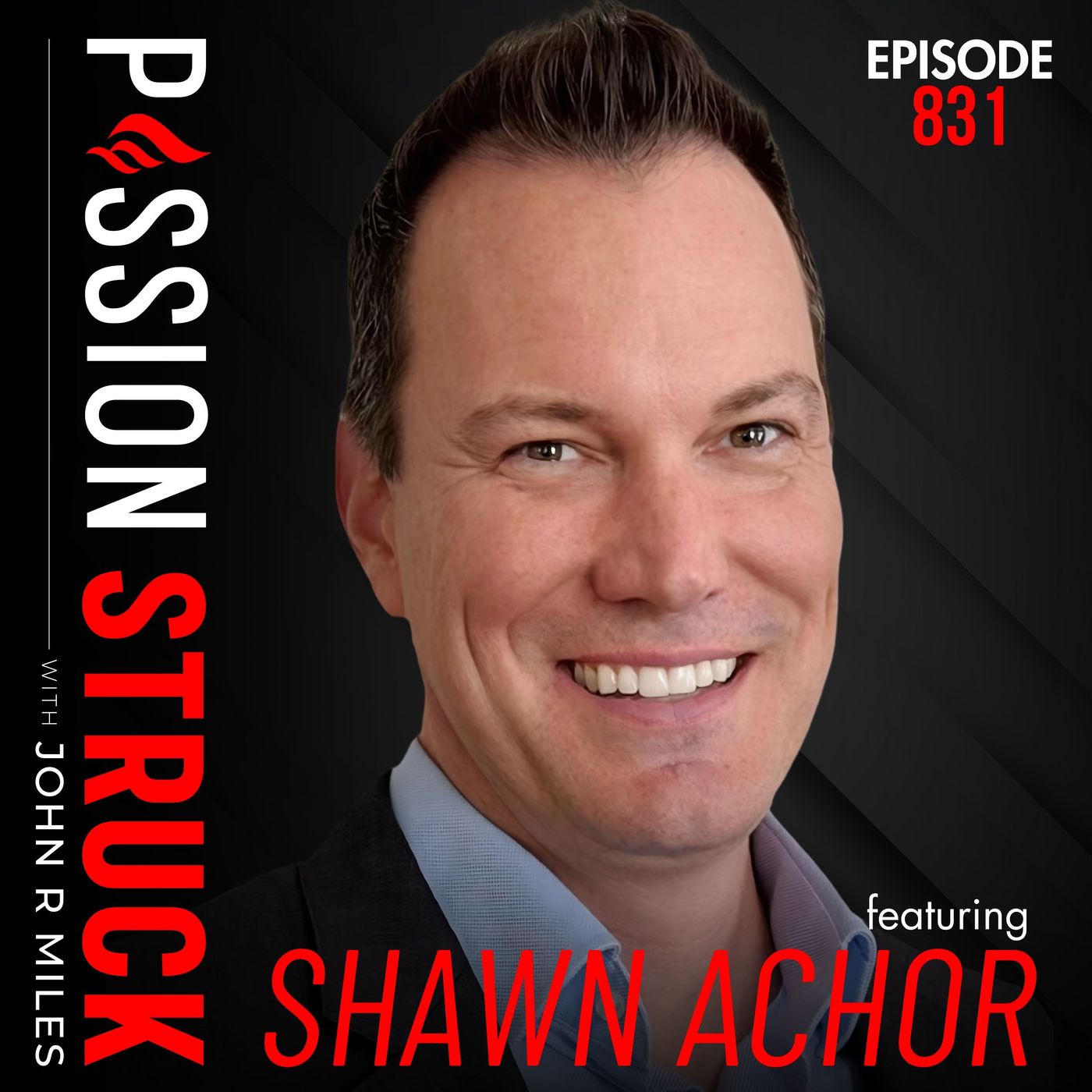
How beliefs shape happiness, success, and the future; why people can be successful yet feel unseen; the “mattering” problem; and how to build beliefs that lead to real outcomes.
Sean Achor is a leading researcher and public voice in happiness and positive psychology. His work has taken him from Harvard to major organizations, and he’s known for the bestselling The Happiness Advantage.
Success doesn’t automatically create happiness; the lens you view the world through predicts what happens next. Beliefs can be more predictive than ever (e.g., placebo effects rising). Negative “great drift” beliefs (behavior doesn’t matter, I don’t matter, I’m alone, work isn’t meaningful) reduce performance and increase depression/anxiety. Positive beliefs don’t guarantee outcomes; they propel you toward them. Fruitful beliefs include “warrants” (because) and “qualifiers” (if-then actions).
Placebo effect doubling/tripling across conditions; sports “home field advantage” disappearing without fans; Ted Lasso’s “believe” framing; athletes/teams (Pete Carroll, Tom Brady culture); knee-surgery placebo study; Sean’s personal story during his daughter’s NICU stay and feeling “replaced.”
Written by AI. May contain mistakes.
A discussion on how beliefs shape our happiness and sense of purpose.
“What happens when the story you tell yourself about your life starts shaping the life you actually experience?”
John introduces guest Sean Achor, highlighting his research on happiness.
“Thank you for choosing PassionStruck and choosing me to be your host and guide on your journey to creating an intentional life that matters.”
Sean discusses how beliefs influence happiness and success.
“Sean, you spent so much of your career studying happiness, optimism, positive psychology.”
Sean explains the increasing importance of beliefs in a modern context.
“then by changing that math, we could change someone's path.”
Exploring the psychological aspects behind home field advantage in sports.
“with technological advances and with AI, it turns out the lens through which you view the world is actually more important now than it has been in the past.”
Explore how beliefs influence performance, especially in sports.
“just for being at home when they look at the odds.”
Learn about the author's book that explores beliefs and their influence.
“Thank you for supporting those who support the show.”
Discuss how beliefs shape paths to success and the nuances of wishful thinking.
“And you were recently on Oprah's podcast.”
Explore how belief stems influence success and the importance of warrants and qualifiers.
“So even if they don't make it to that goal, that belief not only changed their path, but might bear fruit along the way, which is incredibly important.”
Discuss the impact of mindfulness on belief systems and life transformations.
“I'm not sure if you've seen this new documentary from Joe Dispenza.”
Examine the societal drift affecting community and belief structures and its consequences.
“But you identify four major consequences of that drift.”
Understand the significance of core beliefs in personal struggles and societal changes.
“And so people grab onto OnlyFans subscriptions, or they scroll through social media hoping for a hit of dopamine.”
Explore the concept of systemic unmattering and its connection to societal disorientation.
“the lonely, the helpless, the anxious, the burned out, and the disengaged.”
Shawn shares a personal story about his daughter's premature birth and its impact on his sense of mattering.
“And interestingly enough, five minutes before you and I got on to talk today, Gord sent me an email.”
Discussion on how recognizing one's mattering can change perspectives and life experiences.
“And then the next part of the story is incredibly petty.”
Exploration of how the belief of being enough relates to community and support systems.
“I was a senior executive at Dell and we each were put on to different accounts as the main executive who would go out and work with them.”
Explore the significance of relationships and the need for personal growth.
“I might not need a girlfriend, but I do need deep friendships, right?”
Discuss how feelings of mattering impact self-worth and personal fulfillment.
“And if growth is possible in our lives, it means it's possible I might have chosen some things that were not great in my life.”
Understand the deeper significance of work beyond compensation.
“I see them as related things, but I see them as completely separate things.”
Learn how recognition and praise at work can boost morale and retention.
“Because I think it's one of the most important ones in the book outside of I matter.”
Examine how belief changes can create a sense of mattering in individuals.
“And the reason for that is when they look around the people around them, they're like, oh, these are the type of people I work with.”
Discover how simple gestures can foster community and connection.
“beliefs within this world, I tried to look at religion, I looked at politics, I looked at history, and then I outlined these six ways that we change our beliefs.”
Learn how simple gestures like waving can influence community dynamics and behavior.
“So in the book, I'm going to describe just as a metaphor, this guy who is in Silicon Valley, he moved to Texas.”
Discover Sean Achor's insights and resources for improving happiness through beliefs.
“What we're finding is if we can change the chemistry, biochemistry, the neurochemistry of someone and change their brainwave patterns simply by smiling at them, what would happen if we had more than one second with them?”
Explore the fundamental human desire for connection and the impact of beliefs on our lives.
“But I put almost all this research into the newest book, The Power of Beliefs, which is my favorite one I've written.”
Get a sneak peek into the upcoming discussion about psychological patterns and growth.
“know that our work contributes to something larger than ourselves.”

Get the gist, explore an idea or ask about something said.
 Claude
On Passion Struck with John R. Miles, what are the key points of this episode?
Searching your listeningAutomatic transcript. May contain errors.
0:01Hey friends, what if your biggest problem isn't that you're not doing enough, but that you've spent too long proving that you are enough? You can be successful, needed, and surrounded by people and still feel completely unseen. That's the problem I explore in my new book, The Mattering Effect. I show you how we become hypervisible for what we produce while quietly becoming invisible to ourselves, and introduce the matter framework to help you reclaim meaning, autonomy, trust, time, energy, and reciprocity. Stop auditioning for your worth. Start living from it. The Mattering Effect is available for pre-order now at matteringeffect.com.
0:37Therapy's biggest impact doesn't show up in some dramatic breakthrough. It shows up in the smallest moments. You bite your tongue instead of escalating. You put your phone down instead of firing off that text. You say what you actually mean instead of what would hurt someone else the most. Nobody applauds those moments, but they quietly change your life. That's what growing feels like. And that's exactly what Grow Therapy is here for. Grow is therapy that works, covered by insurance. Sessions average$21 with insurance, and some pay as little as$0 depending on their plan. There are no subscriptions, no long-term commitments.
1:16You just pay per session. Grow connects you with thousands of high-quality licensed therapists across the U.S., offering both virtual and in-person sessions nights and weekends. You can search by what matters, like insurance, specialty, identity, or availability, and you can book a therapy session in minutes and begin in as little as two days, not the national 48-day average. See if you could pay as little as$0 for therapy in seconds at growtherapy.com slash book now. That's growtherapy.com slash book now. growtherapy.com slash book now. Availability and coverage vary by state and insurance plan.
1:58Coming up next on Passion Struck. What happens when the story you tell yourself about your life starts shaping the life you actually experience? Your beliefs influence what you notice. what you attempt, how you respond to setbacks, and what you believe is possible. Sean Aker and I went deep into that idea and into a much bigger question about what happens when people lose their sense of purpose, connection, and significance. In a world changing faster than ever, what gives us a reason to believe that what we do still matters? Take a listen. But we're still hungering for meaning, for purpose, and as you know, for mattering in this world.
2:44What we see in the midst of this great drift is driving us towards all those negative beliefs. My behavior doesn't matter. Look at this news alert. I don't matter. I'm alone. This work isn't meaningful. I have nothing to give. It's not that I matter less. It's that I don't matter. Hey, it's your friend John, and welcome to PassionStruck. I'm so glad you're here. Whether you're a longtime listener or someone who just discovered the show, thank you for pressing play today. Maybe you've built the life you were supposed to want, but you've quietly wondered why it still doesn't feel like enough. If that's you, you're in the right place.
3:21Every week, I sit down with the world's top scientists, researchers, and thinkers to uncover what it actually takes to build an intentional life that matters. Thanks for joining me. Let's get into it.
3:39Hey friends, welcome to episode 831 of Passion Struck. This week, we've been exploring the mattering effect from some very different perspectives. On Tuesday, the book officially launched, and I played my interview from the Next Big Idea Club. Yesterday, Mick Hunt and I explored the beliefs underneath achievement, success, and our drive to prove ourselves. Today, we're going deeper into the power of belief with Sean Acor. If you don't know Sean's work, he's one of the world's leading researchers and voices on happiness, positive psychology, and human potential. His research has taken him from Harvard to some of the world's largest organizations, and his best-selling book, The Happiness Advantage, help bring the science of happiness into the mainstream conversation about performance and success.
4:29What makes Sean's work so important to this conversation is his focus on the lens through which we experience the world and how changing that lens can change what we see as possible. We talk about happiness, optimism, AI, home field advantage, social connection, and why the lens through which we view the world can influence the path we take. And eventually, we arrive at something even more fundamental, our enduring hunger for meaning, purpose, and mattering. What happens when people begin to lose their sense of significance? How do those beliefs affect the way we experience our work, our relationships, and our ability to contribute?
5:11Sean brings a fascinating perspective to those questions, and I think you'll see some powerful connections to the ideas in The Mattering Effect. Here's my conversation with Sean Acor. Thank you for choosing PassionStruck and choosing me to be your host and guide on your journey to creating an intentional life that matters. Now, let that journey begin.
5:36I am absolutely thrilled today to welcome Sean Acor to PassionStruck. Sean, such a great time to see you. And we're going to be talking about your brand new book, The Power of Beliefs. Welcome to the show. Thank you so much for having me, John. I've been looking forward to this. Sean, you spent so much of your career studying happiness, optimism, positive psychology. What led you to the conclusion that belief itself may be one of the most powerful predictors of what happens next in our lives? It's a great question. With my first book, The Happiness Advantage, I was fascinated by the fact that not only were we getting the formula of how we pursue happiness and success wrong, but then when we looked at the research, it was very clear that as the brain became more positive, as we deepen our optimism or social connection or meaning and purpose that we see in our lives, every single business and educational outcome we know how to test for rose dramatically.
6:38Their sales rise, productivity improves, we live longer, we get better standardized test scores, we make deeper friendships, which is how I crystallized that and synthesized it into the happiness advantage that when the brain is positive, it leads to this incredible advantage in our lives. But what fascinated me as I was doing that is that our beliefs about how we pursue happiness and success were wrong. That we thought if I work harder and then I'm more successful, then of course I'm going to be happier. And that formula wasn't working. That we would look at people who are billionaires or professional athletes or pop stars or movie stars.
7:18and they had the highest rates of substance abuse and depression and antidepressants and anti-anxiety medication compared to the average person. So what we were thinking was going to automatically cause happiness wasn't. And every time the brain had a success, we were just changing the goalpost of what success looked like to made it higher up. So we were chasing after a moving target. And success, of course, is a moving target within our lives. It absolutely should be. Otherwise, we'd stop the first time we put our very first Lego together or we kicked a soccer ball for the first time. But we want those targets to keep moving.
7:55But the question was, where was happiness in the formula? And what I realized in the midst of riding the happiness advantage was that it's our belief that was wrong, that our belief was that if I pursue success, then I'll get happiness. But what we were seeing in the science was that belief was misaligned, that when in the midst of pursuing a goal, in the midst of a world that doesn't look like it should, we raise the optimism and social connection meaning we feel within our lives, then success rose dramatically for people. So it made me start to question the beliefs that we had about our work and the world and about ourselves.
8:31And I realized that happiness was only one part of it, that there was actually something much bigger. And it was the lens through which we view our world. So I've literally been wanting to write this book, The Power of Beliefs, since I wrote The Happiness Advantage. Because it's bigger than happiness. It's about how the lens through which you view the world predicts what happens next within your life. That our beliefs don't just change how we experience the present. They change what happens next. and if beliefs change the math about what's possible and probable within our lives, then by changing that math, we could change someone's path.
9:06And I got hooked. I love that because I think psychologists often describe our mind as a math-making machine. So I love how you went into that. What convinced you, Sean, that this wasn't simply a collection of interesting psychological effects, but a much larger phenomenon about how human beings operate? So I'd say there are two things that kind of were the genesis of the power of beliefs. The first was I had this experience where I was reading through some research on different types of antidepressants. And I noticed that with the same antidepressant in 2002 and 2015, that the placebo effect was wildly different.
9:49Now, the placebo effect, as most of the listeners know, is that when we test a drug or we test a treatment, we also have to test it compared to a placebo, which is we tell you we're giving you a drug that works or a treatment that works. And we know from research that happened back in the 50s that the belief that this drug might help me actually heals a large minority of people, that it causes an improvement in their health outcomes is real, even though the medicine itself isn't real. So at the cutting edge of biotechnology, we compare every single drug to something as old as human history, to the power of beliefs, the belief that this is going to work.
10:33Because we want to know, is this drug working because I believe it's going to work? Or does this drug work because it actually has a chemical agent that's going to cause a change? So we knew that was happening. But what I noticed was the placebo effect for the same drug was wildly different during this 15-year period of time, 13-year period of time. And I thought, well, clearly they did the study wrong. This is a methodological problem. This is sloppy research. But I got interested and I went down a rabbit hole and I started reading a lot of literature from all different forms of placebo effect in different conditions.
11:07And what I found is from 2000 to 20 years later, so when a lot of this new research was being done, over the past 20 years, the placebo effect for heart disease, for cancer, for childhood epilepsy, for 23 different forms of chronic pain, the placebo effect has, for some reason, doubled, if not tripled, for some of these conditions during that 20-year period of time. Now, what that means, before we go anywhere else, what that means is that, for some reason, your beliefs about the world are more healing today than they were 20 years ago. Your beliefs about the world are more predictive of what's about to happen next to your body than they were 20 years ago.
11:54So we live in this world with AI and technological precision and microchips and NVIDIA. And it looks like in the midst of all this world with the AI and the MRIs and the SSRIs, that there's no room for me, that the human is on the decline. And certainly the power of our beliefs must be on the decline with all this medicine technology. But what I found in this research, not just in the medical space, but in the work that I've been doing out with companies and schools worldwide, especially in the midst of the pandemic, what we found is that our beliefs about the world are more predictive now than they were before AI, before the technological revolution.
12:36They're more predictive than they were 20 years ago, which means that the power of least is not descending, it's actually rising. So in the midst of a world that's changing so much with technological advances and with AI, it turns out the lens through which you view the world is actually more important now than it has been in the past. It changes what happens next as we use that. So that was one of the starting points from this book. But also during the same period of time, I got the opportunity to go out and work with coach Pete Carroll when he was at the Seattle Seahawks. And I went out there and got this opportunity to talk to him.
13:10And I was so excited because what I want to talk to him about was how the lens to which you view a game predicts whether or not you're going to win the game, right? Because there are all these players with all these incredible skills. They all want to win. They've all been lifting weights and running their entire lives. How do you know who's going to win? And one of the things we talked about was the home field advantage. And the home field advantage is known all throughout sports and in the betting world. Because we know if you're playing college football, you have a 60 % chance of winning at home on your home turf, regardless of opponent.
13:42If you look and average out all the opponents you're going to look at, the home team wins 60 % of the time. In soccer, you get 0.3 more goals per game just by playing in your home stadium, which in a sport where one goal matters There's a ton. That's huge. The NFL odds makers, they actually give you a free field goal made just for being at home when they look at the odds. And I asked him, why is that? Why is the home field? And he was like, well, Sean, it's obvious because when you're a visitor, you're traveling. So you've been on a plane, you're away from home, you're exhausted, you're on a different time zone, you're at a different elevation, you don't know the weather, you don't know where the uprights are, you're in someone else's locker room.
14:22Of course, it makes sense that there'd be a massive advantage for playing at home. That's what everyone believed until the pandemic. And for the first time in the history of sports, we got to watch athletes play in their home stadium, but with no spectators or fans in the stands. And the home field advantage evaporated. Statistically, it completely disappeared, which is incredible because the visiting team is still traveling. They're still at a different elevation. They're still with different weather. They're still exhausted, but that wasn't what was causing such a massive change in their performance.
14:59What was causing it was the belief that the people that were in the stadium were for them or against them, that the world was for them or they're against them, or that I'm alone versus I am not alone while trying to make it to that end zone. And that caused such a massive difference in our performance. So what that meant to me was that as we look at AI and sports and education and medicine, what we kept finding was the lens to which you view the world today is scientifically predicting what happens next. So if we could change that lens, we could make some massive changes within our world. Sean, I'm going to talk a little bit about a couple of things that you just said.
15:40So about the home field advantage, I went to the Naval Academy. And at the Naval Academy, the two biggest games of the year are Notre Dame and Army. And neither one is ever played at Army, at Navy and Marine Corps Stadium in Annapolis. And so I always wonder, because neither one has ever played on the home field, how much of a difference does that make? Now, I think when the game is in Baltimore, you still get a ton of that fan base, but it's still not being in your own locker room. And I think it's had a pretty big impact on playing Notre Dame because you never play him in your home stadium. I also want to talk about a second thing, and that is I interviewed Sean Springs, who you may or may not know, on this podcast a number of years ago.
16:34Sean was, I think, the first draft pick for the Seahawks. He was a cornerback coming out of Ohio State, was drafted one or two cornerbacks in that draft. But he told me when he went to the Seahawks, it was just a different culture. It was a culture of belief, believing that everyone on that team had a role to play and that they mattered and that each individual mattered to the team. And then he talked about when he went from there to the Redskins, and eventually he ended up playing for New England. And I asked him, did Tom Brady make a huge difference in that locker room? Was it Bill Belichick or was it Tom Brady?
17:18And he looked at me and he said, John, Tom Brady next year could become the coach of the worst high school team in America. And he said within 18 to 24 months, they'd probably be national champions. He said he had such a belief around him that it permeated the entire locker room. And I just going with what you just said, those are two examples that came to mind when you were talking. I'm not sure if you have any more thoughts on that. I do. And actually, I asked Coach Carroll about Coach Belichick, who I've not met in person. And I won't say what he said, because that was probably private. But part of the reason I brought him up was because I think his style clearly led to a lot of successes and how much that was related to the players or to him.
18:05But he's been such a winning coach. But one of the things I noticed was I was a Patriots fan during that whole period of time. I was up in Boston and I loved getting to watch them play. And I remember that season that they went undefeated for a while. And they kept saying in the press conference, we're not happy yet. We're not happy yet. We're not done. We're not happy yet. We're not happy unless we won the Super Bowl, right? And they ended up not winning the Super Bowl. They had this incredible season. And yet during that whole period of time, they thought happiness would exist once they won the Super Bowl and it didn't happen.
18:39What's incredible is these are some of the best athletes in the entire world and a successful dynasty and franchise that they had there. And to miss out on happiness in the midst of that, to me, seems so tragic because it's so easy for like, I would love it if a high school basketball player was thrilled when they won a game instead of thinking to themselves, well, that's not state or I'm not playing college ball or I'm not an NBA player. I haven't done it as many times as LeBron James. That comparison oftentimes rips apart the happiness that we want. My kids, when they play putt-putt, they are the happiest golfers in the world.
19:15They love it. They love when the ball goes into the water and I have to go get it for them. Right. But you watch the professional athletes and so many times you see them just unhappy, even in the midst of their successes. Right. So I think I was curious about that style because clearly Belichick has been successful. But I would also want my team to feel joy in the midst of that pursuit as well. And also, John, I was appointed to the Naval Academy. That's the only place I was going to go. And I applied to Harvard on a dare and then got a military scholarship to go there. So that's the only reason I wasn't at the Academy.
19:50Yeah. So I don't know if you knew that background, but we have a lot more in connection. We'll have to talk about over a drink sometime. I love it, man. Congratulations. Neither one are the easiest place to get into. Let me pause here for just a moment. If this conversation is making you think differently about the beliefs you're carrying and the environment that's shaping them, that's exactly what I explored in The Mattering Effect. The book is available now wherever you get your books, or you can simply go to matteringeffect.com. Now, a quick break for our sponsors. Thank you for supporting those who support the show.
20:31you're listening to passion struck right here on the passion struck network and now let's get back to my conversation with sean acor so when i think about belief and what we're talking about with stadiums my wife and i have been re-watching ted lasso because we wanted to regroup before we got into the latest season, but I just remember his yellow sign, believe. And you were recently on Oprah's podcast. And as I was listening to it, I just have to throw out there that that episode is like 4.2 million views. It's incredible. Oprah said something in it that really struck me. She said, you become exactly what you believe is possible, which is exactly what we've been talking about.
21:19And you agreed with her, but you then also made an important point that positive beliefs don't guarantee positive outcomes. They propel us toward them. And this is something that I actually talked to Angela Duckworth about a couple of years ago, because I said to her, I said, Angela, grit is a great thing to have, but let's go back to the Naval Academy example. I said, a midshipman can have all the grit they want in the world. But when I was there, the class behind me was part of the largest cheating scandal in Academy history. And so here's where people could have beliefs, they could have grit.
22:00But if that grit is misapplied, if you're not doing it intentionally, then it can lead you in the opposite direction that you want to go. Where's the line between a powerful belief and wishful thinking? It's such a great question. And it's a huge question. And I wrestle with it. It's chapter three of my book. And honestly, it could have been a whole other book. Because it's very difficult to know from the outset, from a scientific perspective, what is a wish and what is something that is a belief that could bear fruit. And that's what we're looking for. We're not looking for, I have all of my eligibility left in sports, so I could go back and play college football now.
22:40And that would be a terrible idea. I would break at the very, I would be broken after a single tackle, if not a single practice. So that's clearly a delusional belief. And we wouldn't want that delusional belief to lead us in our lives. Now, I just was just part of, it was a Bible study at my son's school. and I came in and one of the questions they asked at the beginning to all the boys is, what do you want to be when you grow up? And the first five boys, three out of the five of them want to be an NFL football player. And unless they have a couple more growth spurts, it's just, it's not going to happen, right?
23:17And if you look at the statistics, it's very unlikely that's going to happen. So the problem is though, if someone says, I'm going to be a professional athlete someday. In the book, I put the actual statistics of an eight-year-old who says that they want to play in the NBA someday actually getting to play. And if you round it to the nearest thousandth of a percentage point, it's still scientifically zero. It's 0.000 rounded to the nearest point, right? But eventually there's a number in there and that's because somebody makes it. So somebody believed that they could be an NBA player, and a lot of them did.
23:54And so the question that arises as a complex one is not, is this belief something that we should squash? Should I say, hey, you shouldn't play, you shouldn't think you're going to be a professional baseball player someday? Or should you allow them to have that belief because there is not, there's a non-zero percentage chance? Well, in the book, one of the things I talk about is how our beliefs changes slowly over time. And if someone keeps playing basketball, and they make it onto the high school basketball team, and then they make it to the college basketball team, well, their chances from going from college to the pros is 0.27%, which is still incredibly low, right?
24:35But what's amazing about that is it was literally, and I can't remember the actual statistics, but it was literally like 8 ,000 times a higher percentage than it was when they're an eight-year-old saying it. And that's because when they kept believing it, it led them to a place where that belief actually becomes more and more likely. Now, if I look at LeBron James and I'm watching him in high school, I'm like, well, of course, yeah, you're going to play in the NBA. It'd be an easy one to be able to do, but I'm doing that backwards from a scientific perspective. How do we know who's going to be able to run a sub four minute mile or who's going to make it onto a professional team?
25:10Or let's take it out of the sports domain. There's all these kids that want to be social media influencers. My son was telling me about how he wants to have a hundred million followers and be like Mark Rober because my son loves engineering. And there's one Mark Rober, right? There's a couple other people that are engineers that have incredible channels, but the number of people that do it is extraordinarily low. But I don't want to break down that belief that he has. And it comes to the second part of it, which is one, we need to make sure that the beliefs we have align with some of the reality that we have around us, right?
25:43the likelihood of something occurring, which we'll talk about more deeply in one second about how to make that happen. But the other is, let's say my son is wrong, that he is not going to become a social media influencer, or that someone who believes that they're going to be a crypto billionaire if they just put enough into crypto right now, or someone who believes that they're going to hit their sales target, or that they're going to be a CEO of a company someday, or that they're going to go to the Naval Academy. We can look at the statistics. And what I find fascinating, AI is so powerful. If you ask AI, what is the likelihood of my child making it into the Naval Academy or becoming a millionaire someday?
26:23If you ask AI, it can give you the odds and the percentage of that. It can look and map through big data, what is your likelihood of hitting that goal? But what AI cannot do, and you can check me on this, you can go look on chat or Claude afterwards, ask them, do you believe that I can beat the odds and be one of those people? And it cannot. It'll tell you, well, actually, I don't have any beliefs. What's amazing about that is it's lacking the willpower, the determination, as Angela Duckworth talks about, the grit, the hope, the drive that causes us to look at something that's a low odd and still believe that you're going to be one of the people that's going to beat it.
27:09Now, you can train it to say, I'm sure you can do it, but it has to first realize you're probably not going to do it. So AI is terrible at looking at whether or not you're going to be able to beat the odds. So when I look at that, one, some people make it into the NBA, but here's the other part of it, that our beliefs about the world change our path. So an eight-year-old who loves basketball, keeps playing, gets to play maybe in high school and in college, which would be an incredible career. But if I stopped that belief early on, I stopped that path. They stopped playing basketball. But what they just missed out on is what that belief does to their path.
27:43Because they believed that they were going to be a professional baseball player, they joined teams, they worked out, they exercised. That was part of their self-esteem, their confidence, how they made friends, how they deepened relationships, how they learned about competition, built grit within their lives. So even if they don't make it to that goal, that belief not only changed their path, but might bear fruit along the way, which is incredibly important. So as people are hoping to get into a good college or to become a scientist or to be successful someday. We want them to hold those beliefs, but then it comes back to something that I didn't realize was so important until after I had written the book.
28:22And it's the part that comes right before that, that when we look at beliefs, one of the checks that we have, and sorry, I'm going on and on about this one, but I think it's the most interesting question because it's so hard to disentangle. But here's one of the most practical things I think from the book. And I didn't even put it in the practical section, which is the last third. I put it at the beginning. I think one of the ways that you can upgrade your likelihood of getting a belief to transfer to somebody else or increase the likelihood of bearing fruit is to add two things to a belief. If we say, my kids started a new school last year, if we say, honey, you're going to love this new school.
28:59You're going to love it there. Or I believe you guys are going to hit your sales targets this year. Or we're going to beat Notre Dame this year, or I know you can get over this cancer. I know you can beat cancer, or I know you're going to graduate from that program. When we're doing that, we're doing exactly what we've been taught to do, which is to be positive and encouraging. And it's a lot of the Ted Lasso inspiration, right? We want people to believe they can win this game and they can beat cancer and that they can find a date to prom and that they can overcome these challenges in their life.
29:29But the way that we phrased it is what I call a belief stem. We actually haven't given in the brain any foothold to make a change to what happens next. If we want that belief to transfer over or to bear fruit, we need to add two things to it. A warrant and a qualifier, which is their philosophical terms. It's just the because statement and the if then statement. The because statement is the reason why you believe this. So if a manager says, hey, we're going to hit these sales targets next year. I believe in you guys, right? And let's enjoy our sales conference, that does nothing because what they might be thinking is, yeah, right.
30:03But if the leader got up there and said, we've hit our sales targets three years in a row, that's a warrant. Or we have a new technology, or we have a new positioning in the global market, or we're better than our competitors for these reasons, and we've gotten these new leaders in place, and we've got the funding for it because of this, I believe we can hit our targets five years from now. Suddenly it goes from, yeah, right, to, yeah, he's right, because I've got these warrants in my brain proving that either in previous experiences or in the present, I have the resources necessary to accomplish this task.
30:36And it causes that belief to hold. So if a child's getting dropped off at a new school and said, you're going to love this new school, which I catch myself doing these belief stems all the time now, and I have to stop myself. Instead of that, what we should be saying is, because they might be thinking, yeah, right, dad, I love my old school. Instead, you provide the warrants. You made so many friends at your last school, you didn't even want to leave there. And you made friends within two weeks on your soccer team. And you are one of the kindest people I know. You're always making people feel good about themselves.
31:06Because of that, I know you're going to love this new school too. So when they get out of the car, they might still feel trepidation, but they also have these warrants about why they should believe that they're going to love that new school and it changes their path. And then the other side of it is the if-then statements, the qualifier. And this is the part that's so important to your question about irrational or wishful beliefs versus a fruitful belief. If we say, I believe you're going to beat cancer, that sounds nice. But what we should be saying, or you're going to get onto a sports team is that if you keep practicing, if you sleep well, if you meet up with a coach, if you make good friends on the team, if you watch these YouTube videos about how to improve, I think you have a good chance of making the high school team.
31:48Because then you're giving the actions necessary for that belief to come into reality, right? And if someone's trying to beat cancer, it's like, if you listen to the doctor, if I listen to the doctor, if I eat better, if I meditate or pray, if I surround myself with social connection to know that I matter, then I have an increased likelihood of beating this cancer. We've got tons of scientific research proving that. So those two things, the warrants, the because from the past, and the if then about what happens next in the future is what changes those unlikely beliefs into beliefs of bear fruit.
32:23Sean, thank you for that. I'm not sure if you've seen this new documentary from Joe Dispenza. It hasn't released yet. I think it's coming out the week that we're recording this, but it's called Source. I'll send you the link after this and I'll put it in the show notes as well. But he's talking about our belief system and how it can be a source for changing our lives. And he talks about what you were just describing, how so many people who've come through his programs who are facing diseases, diagnoses, other things, by teaching them mindfulness and reprogramming how they think about it, how many of them have shifted their entire direction of their lives or their illness.
33:06So it is something really huge. I want to go into something that I think is one of the most important parts of your book before we go through some of the solution set. For those who are not watching us, behind Sean are two rockets. And when I think about belief, when we went to the moon, we definitely had to have a belief system that we could get there. I'm using this space metaphor on purpose because a few weeks ago, I happened to be at the Naval Academy and I interviewed Major General Charlie Bolden, who if people are not familiar with his name, he went up to space four times on the space shuttle, but became the NASA administrator in the Obama administration, where he was the administrator, I think, for eight years.
33:56And as Charlie and I were talking, he and a couple astronauts recently started something called Astronauts for America. And the reason they started it, you're going to love this, Sean, is he said that we saw a drift happening. We saw a fracturing in America of community, work, and traditional belief structures, and we felt we had to do something about it. And now 100 different astronauts have banded together, but even civilians like ourselves can join. I joined it. But you identify four major consequences of that drift. Can you talk about that? Oh, I'm so excited about this. I'm going to have to join too.
34:40I want to make this very practical because we're not talking about beliefs in just a general sense. So let me just say as a framing for this that if you know someone who's struggling in their life right now, I'm willing to bet that in addition to the external problem that they're dealing with, that they're also dealing with a challenge to one of their core beliefs. So at the outset of this book, I try to identify, we have beliefs about a lot of things. We have beliefs about whether or not we can make it to the moon or whether or not a Waymo is safe to be inside. Or we have beliefs about whether crypto is a valuable currency.
35:15We have beliefs about a lot of things, but a lot of them don't cause a lot of change within most people's lives. But there are some universal ones that apply across the board. And what I want to look at is if we look at the literature, could we put them into these umbrella categories? And I'm willing to bet, think about someone that you know is struggling in your family or someone you're leading at work. And I'm willing to bet that they are holding one of these negative beliefs. They believe that my behavior in the midst of this challenge doesn't matter, right? That I can't beat this addiction.
35:44I can't learn a new skillset. I can't hit this target. My behavior doesn't matter. I'm alone. I don't matter. My work is not meaningful. I have nothing to give. I'm missing out. And there's nothing greater than me. And if they're struggling with one of those, I'm willing to bet that most of the problems we have, we're struggling with one of those. And if we could fix that belief, we'd change what happens next in people's lives. So we're talking about belief as a positive. We're talking about belief like the sign above Ted Lasso's office. But at the same time, beliefs go both directions. Beliefs can heal us.
36:19We can tell you that this is a medicine that's going to work, and it heals people. I did the knee surgery study in the book about how they gave fake knee surgeries to people. that they thought were real because they actually gave 100 of these gentlemen real scars on their knee. They made an incision while the patient was under anesthesia, went and had a coffee, came back in and sutured them back up, giving them a lifelong scar. So when they woke up, they believed that they had knee surgery and they actually had the almost identical statistical outcomes at the six-month mark, one-year mark, and 18-month mark of people who had real surgeries on their knee.
36:57That's flexibility, mobility. So we know that our beliefs are powerful. Unfortunately, they go both directions. So in the book, I cite Gallup because we have beliefs like we can make it to the moon. Some people believe we've never made it to the moon. That's a different type of belief. But we have beliefs that we can make it to the moon or we can cure cancer someday or the beliefs that we can solve these environmental challenges. But if you ask people about the world, Well, 32 % of people in the United States believe that we are in the end times right now. Now, that's a cross politics, and that's cross religion, actually.
37:33Even with people that are not religious, believe that we're in the end times. So if you believe that we're in this rapid descent into entropy or an AI overlord or a zombie apocalypse, then how engaged you're going to be on your next Zoom call? or how likely are you going to bring kids into this world? How likely are you to focus on romantic poetry in college or on history or to buy new products if you think that's what the world is like? So we have these negative beliefs that are around us. And part of the reason for them is exactly that drift that you're describing, which I find fascinating. I went to the divinity school before getting into psychology.
38:09So I was studying religious ethics because I wanted to understand how our beliefs that billions of people have held predict like why we give and why we forgive and why we wake up in the morning. And while I was doing that, some people in the psychology department said we could measure those things. But what I got fascinated by was that when you look at throughout all of human history, you find that most of our collective beliefs about the world came from our village, our work, our political structure, and our religious structure. But over the past two decades, right when we've seen this doubling of the placebo effect in many conditions, what we're finding is we've become untethered from all four of those.
38:49We're in the midst of what I call the great drift, not knowing that there are other people calling it the drift as well. And that's because we don't stay in the same village anymore for work or for school. And even when we do, we have 60 % lower face-to-face interactions, at least for adult American males. So the village is gone. We don't stay in the same jobs. Only 16 % of people, according to Google last year, Gallup last year, only 16 % of them want to be in the same job next year that they have this year. That's a historical low. That's worse than it was in the midst of the pandemic. We have the lowest trust in our government in the past 70 years.
39:26And between 2000 and 2024, in 2000, only 5 % of people didn't believe in something greater than them, in a God, actually, is what they asked. And by 2024, that number had gone from 5 % in the United States to 24%, which is a huge shift in the way that we look at the world. But we're still hungering for meaning, for purpose, and for mattering in this world. And as a result of that, we're clinging on to the beliefs that people are espousing because we don't have those collective beliefs that were around us in the past. So we grab onto influencers who are just as angry and as upset as the rest of us, or we are lonely.
40:09And so people grab onto OnlyFans subscriptions, or they scroll through social media hoping for a hit of dopamine. But what they're really getting is a continual source of I'm missing out, which changes what happens next to our lives. So what we see in the midst of this great drift is driving us towards all those negative beliefs. My behavior doesn't matter. Look at this news alert. I don't matter. I'm alone. This work isn't meaningful. I have nothing to give. There's nothing greater than me. And when people believe that, it radically decreases our long-term performance, our longevity, and our happiness, which is why depression rates have doubled over the past two decades, why anxiety has doubled over the past two decades.
40:50And so what we're finding, that's for every group down to eight-year-olds. So what's amazing about this is that we're going the wrong way. So the reason I wrote the power of beliefs is that the other side is so powerful. If we can get people to believe, as you see on your shirt, if people are watching this, that I matter or that I am not alone or that my behavior matters or that this work actually is meaningful or have something to give or have something to be grateful for, or there's something greater than me, we've scientifically changed the trajectory of what happens next. Sean, you don't know this about my background, but the whole reason I got into what I'm doing now is I took a very extensive course at a church I was attending 20-something years ago.
41:36It was called Discipleship One, big in the Methodist community. And it's 34 weeks long. You have to meet with the pastor twice a week, had assignments in between, very intensive class, and there's a discipleship one, two, and three. But during this, I got this calling that I had no idea what to do with for a long time. I was called to serve the broken, the battered, the lonely, the helpless, the anxious, the burned out, and the disengaged. And as I went into this, I was like, at the time, I'm an IT executive at Lowe's. I'm like, what am I supposed to do with this. I don't even know who these people are.
42:18But when I think about your book and that mission I was given, when I think about what you were just talking about, my behavior doesn't matter. I'm missing out. I don't matter. I don't have enough. I'm alone. This work is not meaningful. There's nothing greater than me. I think we're talking about the same exact thing. And what I started to question, and the question that sat underneath all the questions is, I came to the realization before I ever started to talk about mattering that these things can't be isolated conditions. Each one of these can't be a separate epidemic. There has to be something sitting underneath them.
43:03And I agree with you that our whole belief system is a major component of it. As I researched and what I hypothesize in my new book is you call it the great drift. I call it the great erasure. And what I have come to conclude is that what's sitting underneath all of this is something I call systemic unmattering. Because Henry David Thoreau, two centuries ago, said the mass of men are leading lives of quiet desperation. I think what is happening is given everything that you've been talking about this entire conversation, we've gone from quiet desperation to quiet disorientation, because at least when he came up with quiet despair, you could see the four walls that you existed in.
43:52Today, we can't see it anymore. And so we are so disoriented that it's had a magnifying impact of all these conditions that you're describing. And the reason I call it systemic unmattering is this is what happens when the environments and the institutions that surround us treat us as if we're in a mattering market where every single day, more and more of us feel like we have to earn, produce, achieve, or whatever you want to call it, our way to feel seen. And when that stops happening, it produces the condition that our mutual friend Gordon Flett calls anti-mattering. And interestingly enough, five minutes before you and I got on to talk today, Gord sent me an email.
44:42So I kind of looked at that as a godlike intervention. So as I was reading your book and thinking about this, I think this whole idea of systemic unmattering and belief system kind of go hand in hand. And I wanted to get your perspective on it. I love it. If I had more space, I would have done more space on mattering in the book. I tried to go for too much, right? Because I was trying all these different beliefs, which to your point, I think is absolutely accurate that part of the reason we feel like we don't matter is because we feel like our work doesn't matter, right? So if I get my work to feel like it matters, then I suddenly feel like I matter to the world because I'm healing people or helping people or giving them insurance or whatever it is that the person's doing.
45:23when someone believes that there's something greater than them, they can see how their behavior would matter, that they're not alone, that they matter. There's all these ways in which these beliefs connect into one another. But it's interesting getting to talk to you. And I'm so excited about your book coming out. Of the seven, mattering is the one that I struggle with the most. If I had to pick one of the seven, I took a lot of time since my last book before writing this one. My last book was called Big Potential. And that came out eight years ago. And it was about how we have to pursue happiness and success with one another instead of alone.
45:55And when a book comes out, you've got one week to get on a bestseller list because you've got all these pre-orders, right? It's a crazy system. And so my wife was pregnant. So I said, hey, I'm going to have this book come out the first week of February and I'll get off the road. And when we have a baby at the end of April, I will be there for you and I will have that time. So that's what we decided. And the day before the book came out was the Super Bowl. And during the first quarter, while the Patriots were playing, my wife's water broke. We didn't know that was what was going on at the time.
46:29We're both researchers. And it was three months too early. We didn't have a name for this child. So it was just, it couldn't be happening. And it was during the Super Bowl. So my son was with me. So she Ubered to the hospital. So husband of the year, right? And they got there and they said, you have to wait here in the hospital for six weeks trying to hold this baby in because it's not ready to come out. And three days later, she was rushed into emergency surgery. We almost lost our daughter three times in a two-day period of time. She kept sparking back to life. And we found her name. It's Zoe Sparks Acor.
46:58And she's doing wonderfully. I dropped her off at school this morning. She's eight. She's wonderful. But instead of going on a book tour to talk about this research, my happiness as a researcher sat in an incubator in NICU for the next 50 days while they tried to keep her alive. And what I got to do is to battle test a lot of this research that I was writing about, but I wasn't out doing it. And I remember the next day that she was born, I was holding her little hand, which covered the final digit on my pinky. And I... I've seen her picture in that incubator, man. Yeah. She was tiny. She was so tiny.
47:31And I decided there, it was right around where that picture was taken, that I needed to step back from work. And I decided almost to become basically a stay-at-home dad. I would still go out giving talks, but I stopped all media. I shut down my research projects and was just there for the kids. And then I kept doing it. And it was wonderful. It changed who I was as a person, as a parent. But it was also hard in a way that I did not expect because I felt like my cup had been filled up with all these things that I got to do before that. And then slowly and surely, I started getting replaced in the world.
48:06People started doing what I was doing or writing books that I want to write or getting to have these speaking experiences. And I remember in the midst of this, starting to feel like I mattered less. And there was this one moment that I wrote about in the book in that mattering section that I think answers your question and at least gets back to it, which is that I remember I got to give a talk at Target, which is an amazing opportunity to talk to a lot of people. And I got in at 2 a.m. I was tired. I woke up the next morning. And then the next part of the story is incredibly petty. But I got a news alert that one of my friends, one of our friends, had a number one New York Times bestseller.
48:41And I was like, well, I know this was Adam Grant. And I was like, great. Congratulations. And I'm happy for him. Right. I'm like, tell him I'm happy for him. And he deserves it. He's brilliant. And then I got another note and Arthur Brooks was writing a book with Oprah on happiness. And I'm like, I've been completely replaced in the world. And in that moment, because I was tired and I got these back to back, I could have just been like, okay, but I've got my kids. But instead, my brain took the next step and was like, hey, look, if you stop working, the world is not going to be like, no, Sean, it'd be like, who's Sean.
49:19And then it took the next step, which was, it's not that I matter less, it's that I don't matter. And I remember getting into this car to go to the talk and sitting in the back of the car and looking out the window and felt like the world was just passing me by. And I forgot about the talk. I forgot about my kids, I just felt like I didn't matter. I got to the talk and you'll love this with your background. I got to the talk at the wrong place and they were supposed to drop me off at the theater and they dropped me off at headquarters at Target. So I called them and they were like, Hey, don't go anywhere.
49:50You're clearly lost, which I was that morning. And they said, don't go anywhere. We'll send somebody. So I went, I didn't listen. I went inside and went up the escalator into headquarters. And this guy came up the escalator, but on the stairs next to him. So over the escalator railing, he was shaking my hand and running up the stairs. He was like, are you Sean Acor? And I was like, oh yes, thinking this is the escort. And we get to the top of the escalator, the short little escalator. And he said, hey, I just want to let you know your book saved my life. And then he disappeared behind a turnstile and I've never seen him again.
50:19I have no idea who that person was. I have no idea why the research had an impact upon his life. But suddenly in that moment, it's like the scales fell from my eyes. I could suddenly see that I was in the wrong place, but at the right time, right? And from the divinity school, they say, I'm including this because your method is background, but the word angel just means messenger. And my brain needed to hear a message that morning. And that message was that, hey, you matter. And as soon as that happened, I also realized this talk matters because maybe there's somebody in there that might need to hear this research too.
50:53Even though I've heard it so many times, maybe they haven't heard this before. And when I got back into the car after that talk, I looked out the same window in the same car that had dropped me off in the wrong place. And I still felt replaced in the world. But I pulled out these two Paw Patrol characters my daughter gave me that had in my backpack, and I put them on the window sill and made her a quick video. And this goes through all the things we talk about, is that mattering is something that we have to self-construct. The meaning is imbued and created. And that when we don't believe that we matter, it's not because the world has just told us we don't matter.
51:29It's that we believe that the world might be right, that we don't matter, or that we're telling ourselves we don't matter in those moments, which blinds us to those moments of counter evidence that shows us, actually, you've been great in your kids' lives. And look, you've helped people through this research. And look how many people your podcast is affecting, and you don't even get to see all of that data, right? And so in those moments, what happens is when people start to believe that they matter because someone gives them a compliment or a boss recognizes them or they give them a nod or they smile at them on the subway or they give them a nice note on a paper in a class.
52:05Those moments feeling like they matter might be exactly what they were starving for, but also might change what other data points they're looking for. And they might change how they parent, how they get into a car, how they perform in a talk. Because as soon as I realized that talk was not about me, but about other people, I did a much better job than when I think the talk's about me. Sean, when you went over that similar story with Oprah, I just want to bring in Oprah's words here that she said to you and her audience. Oprah said, that's why knowing you matter is so vital to every human being.
52:39And that's why one of the biggest lessons through all the years that I've been here is that knowing you matter is so important, common denominator in our human experience. We all want to know that we matter. And every argument that you have, every conversation that you have, everybody wants to know, do you hear me? Are you listening to me? And does what I say matter to you? And I couldn't have said it any better than Oprah did, which is why I'm bringing her words into this. I had a very different experience to you and talking to Target. I was a senior executive at Dell and we each were put on to different accounts as the main executive who would go out and work with them.
53:28And so Target was one of my main accounts. And it just so happened while I was there, they had that major hacking incident. And it made my value to them even more important because I was hired at Lowe's to help them fix at that time, which was the largest hacking incident in retail history at Lowe's. And the talk I gave them wasn't about cybersecurity. It was this. What I discovered when I was at Lowe's was that they had a culture of unmattering and that people didn't think that they could speak up about the problems that they were seeing in the culture. And it turned out that the same thing was going on at Target the more and more I became part of their ecosystem.
54:15And so that is the talk that I gave them well over a decade ago. Now I want to go here, Sean, there's an important question that I have been wrestling with for many years. And I just wanted to ask you this, since we're on this topic, people hear I'm worthy, I'm enough, I matter. And they sound awfully similar, but I don't think they're psychologically identical. I wanted to get your perspective on that. I'd be happy to, but I have my take on this one. I don't think it's a popular one. So I would love to hear your one because I think you have to have a lot of caveats and kindness with it. I think one of the most important things that I think about with my speaking, I saw on a bumper sticker, honestly, and it was disturbed the comfortable and comfort the disturbed.
55:06And I love that because I think sometimes we need to push ourselves out of our comfort zones to be able to help other people. But if somebody is already disturbed, my job is there to comfort them. So I want people to believe that they matter. So I think that's the reason why you see so many things on social media to say, I am enough, right? Just tell somebody, you don't need that boyfriend, you're enough, right? You don't need that job, you're enough. Whoever you are, you're enough. You don't need anyone else in your life. You're already perfect. Those are designed to comfort the disturbed. And it feels good to hear them, but I don't believe that we're enough.
55:50I don't believe I'm enough. And I think that there's some great evidence for it, and it actually leads us to some good outcomes. Because I know that I'm not enough, that means that I need a great ecosystem around me and social support system. It means I need friends, right? I might not need a girlfriend, but I do need deep friendships, right? It doesn't mean that you have to have a wife. I have a wonderful wife, but you don't have to have that wife to matter. I matter and I'm important and I'm loved, but I would want to make sure that I'm also appending to that, I'm not enough. I can't create a business all on my own.
56:27You have to have somebody to sell to, right? I can't be a speaker on my own. You have to have someone to listen or to read a book and translate it into their life, right? So I recoil actually at those beliefs where we say that I'm enough because what I think it does is it causes us to have some spiritual complacency that there's nothing that I need to be doing in my life. When I would say, actually, there are some things that you could be doing, that you need to be a friend to other people so that there'll be a friend back to you. And that my grandmother said friends are gold. And I believe that.
56:59I think that it's a greater currency than most of the currency that we use normally. But that requires effort and reconciliation and hope that things could change and reaching back out to people and forgiveness that we sometimes just gloss over when we say that I'm enough. I also heard somebody just recently say that you're right where you're supposed to be right now and that no one's further down the path than other people. And I don't like those either. Those are all the same type idea that they're designed to make you feel good about where you are. But I hope I'm better now than I was at 23.
57:32And if growth is possible in our lives, it means it's possible I might have chosen some things that were not great in my life. The reason I included that seventh belief in the book that there's something greater than me, by that I mean loving God. So if someone's like, oh, you just mean God. I mean that, but that's not necessarily what you mean. Somebody might mean nature with a capital N or the universe or energy or several gods or justice or humanity that they're, or this company's mission statement. So there's something greater than me that is important, that gives us meaning in the midst of that challenge.
58:06But the reason I include that belief in there is because if you believe there's something greater than you, then not only do you matter, but if you believe that there's a God, you also believe that you're loved in the midst of that. So it doesn't matter if you've lost your job, you're loved, but you're also not enough in the midst of that. So that's why I think we have to be very careful with that language when we use it. What do you think? I think our brain is extremely susceptible to evidence that we don't matter. And as I've done more and more research on this, what I believe is that when we experience anti-mattering, when we experience prolonged periods of time in our life where we feel we're never enough, that's what creates the mattering gap.
58:58And when that mattering gap, when you sit in that mattering gap for too long, what it starts creating is a chasm of less and less self-worth. And I consider that degradation and self-worth to be the mattering tax that we pay. So to me, the way that you have to fix any of this is you have to establish a mattering dividend in your life. It's interesting, as I have talked more and more with Rebecca Goldstein and Anne Gordon and Isaac Pralintensky before his unfortunate untimely passing, the starting point for this before you can matter to anyone else is you have to matter to yourself. I see them as related things, but I see them as completely separate things.
59:51And I mattering kind of being the overwhelming kind of point that sits on top of all of them. I totally agree with you. I love that. And it makes me also think about people that are like, you're perfect as you are. And what we want that person to feel is loved, right? But I think I can love things that are imperfect. And I can love myself if I'm imperfect. And I think that when we conflate those ideas, we can very quickly think of people that are clearly not perfect, right, within our world. So it's easier to judge other people than ourselves, right? And then we start to doubt some of those beliefs.
1:00:26But if our love is not based upon being perfect, then I think we can keep getting that mattering dividend a lot longer. Completely agree with you. I wanted to touch a base real quickly on your sixth belief because we've talked about Target. it. We've talked about work a little bit, and I want to get into the work is meaningful. And one of the things I've really looked at is a person at work can be highly compensated. They can be highly successful. They can be highly respected, and they can still be psychologically depleted and disengaged. Why is this belief so important? Because I think it's one of the most important ones in the book outside of I matter.
1:01:10Because our work can be more than just corporate work. It could be our work as being a stay-at-home dad or mom, right? Our work as being a spouse or being an altruist or being a deacon or whatever the person is within their life. We want to feel like it matters. Sometimes I've gone and worked at soup kitchens and left feeling like I didn't matter. Like no one needed me to, they didn't really need me to soup, like move that spoon. And there's other things that maybe I could be doing, but feeling like I didn't have any impact upon other people's lives in the midst of it. When we feel like our work matters, it changes in really fundamental ways that we can measure.
1:01:46In fact, we just got research on this after the book, sadly, that we were working with a large benefits company. And what we found was that 69 % of people believe that they're adequately compensated at work. And 81 % of them are looking for a new job. So what's amazing is we can pay people, but it doesn't mean that they want to stay, right? And I remember when I first got into doing this work, this manager, when I was just starting out, It was like literally my first talk. And he, in the middle of my talk, interrupted me. He was like, why are we talking about happiness and engagement? We pay people to be engaged.
1:02:29And it was a room full of managers. And I thought to myself, I don't remember what I said at the time, honestly, but I thought to myself, well, I have some sympathy for this. We, if we pay people, we want them to be doing the job that we're paying them to do. At the same time, that person's a manager. And if they're ignoring the psychological levers that we have to make people feel like that they matter, that causes them to perform at higher levels, that in the happiness advantage we found raises every single business and educational outcome we know how to test for, then that manager is not doing his job if he doesn't understand the role of mattering, engagement, of optimism, of hope in the midst of this.
1:03:07So what I think is there's so much great research on how you can build up that sense of mattering. You can show people at work, the people that are benefiting the beneficiaries as Adam Grant talks about of the work, right? So that it's when you come in and you feel like you're just selling insurance, but then you find somebody who's that insurance rebuilt their home after hurricane, then you go back and feel like your work matters or that you are a janitor at a hospital, but you get to hear from the doctors about how, because the room was so clean that when that person woke up, they felt like that they were in a nice and safe and kind place.
1:03:41and that that janitor is part of the healthcare that's being provided at that hospital. It makes you feel like you matter. And that can happen with just a single piece of praise. And we saw that at LinkedIn. At LinkedIn, we measured peer-to-peer praise. So not even top-down, just peer-to-peer praise that was occurring. We found if someone received three touch points of praise on this peer-to-peer praise platform that we were using, if someone received three touch points of praise over a six-month period of time, their likelihood, their retention rate went from 80 % for new hires to 94%. Same pay, same building, same job and economy, 14 point swing in whether or not they want to stay at LinkedIn.
1:04:20And the reason for that is when they look around the people around them, they're like, oh, these are the type of people I work with. And my work matters because people are recognizing it. And I matter because people know that I'm part of this. And because of this, I want to stay. and what we found is you hold those other things constant these psychological ones the pay gets you in the door but it's the psychological ones that cause us to perform at our highest levels and cause us to actually feel and decreases those long-term costs on the back side of it it links back to what we were talking about with the home field advantage the only thing driving the home field advantage is whether or not you think the people that are around you are for you or against you and think about how much we think about that for the world this isn't just work this is schoolwork for kids.
1:05:04And if you feel like the world's against you, that we're in the end times right now, that there's nothing you can do, that all these negative news alerts or people like you that are being discriminated against, or that you're not as rich as other people, so that you've got inequality that's stacked against you, you start to believe the change isn't possible. And the more we believe that, the less likely change is going to be possible. So Sean, throughout this conversation we've talked about the great drift, loneliness, meaning, belonging. We've spent a lot of time on the belief I matter. You end the book by telling the reader, I'll read it.
1:05:40You matter, you're not alone, your work matters, and you have something to give. So let me ask you this. In a world where so many people are increasingly questioning whether they matter, what do you believe we need to do, not just to change what people believe about themselves, but to create a world that gives people real evidence that they do matter. When I look at how we change people's beliefs within this world, I tried to look at religion, I looked at politics, I looked at history, and then I outlined these six ways that we change our beliefs. And we won't have time to cover all of them, but basically, if you want to get somebody to believe something, you have a common text.
1:06:24We have a U.S. Constitution, or you have a political platform, or you have a mission statement for an organization, or you have a scripture or a Bible, you change the language. And when you change the language about things, it changes the way that we follow. Our brains go where our words go, or you change the people that are around you. And when you change those people, it changes the influences you have and changes what you decide to believe, which is why a lot of times we have the political beliefs and religious beliefs of our parents because they were the people that we were around. You can change the memory upon which the belief is constructed, which is actually one of my favorite parts of the book, where I just get people to, for five minutes a week with one another, to go through the favorites on their phone.
1:07:06So you've already pre-curated them as the meaningful, positive moments. But when you watch them again, it entrenches that memory more deeply into your storage of memories, but also the memories you access that tell you who you are in the world. So if you think, I don't matter, or I'm bad with people, but you see all these pictures of how you're constantly doing these activities with other people, and you've been doing these meaningful things, and you feel like you're working all the time. But look at all these pictures of things that were not work. It starts to shift the way that we look at the world.
1:07:38But the one that is most aligned with the way that you phrased that question, which is how do we see evidence of change, is for all of human history, if I smiled at someone that I didn't know, only two main things can happen. They smile back or they don't. And then, because I don't have any other information about that stranger, that's the end of the story for me. I don't know if that changed that person. It was a brief interaction. if they didn't smile at me, what I started to believe is my behavior doesn't matter. And oh, I'm not supposed to smile at people. And maybe I won't make eye contact.
1:08:08So it changes who we are. We fixed those two things over the past decade. We now have big data and neuroimaging. Because of big data, the work I was doing, for example, in Flint, Michigan, we found that if you change the beliefs of the teachers in the midst of inequality and discrimination and racism in Flint, where while we were there, they had to shut off the water pounds because there was lead in the drinking water at the school. In the midst of all of that, if you raise the teacher's beliefs that their work matters, that they are not alone, and that their behavior matters, it turns out that the teacher's students' parents' well-being scores start improving, and we weren't working with them.
1:08:46The students' test scores only in those classrooms rise. We weren't working with the students. We were finding if you change the beliefs of a few people in the system, we can now measure and then prove back to the teachers how much their beliefs are healing the families of their students oftentimes that they never even meet. My mom was a public school teacher for 30 years. And if we tried to do a positive psychology intervention, I remember when we first started doing it with public schools, she was like, don't waste teachers' time. She said, this better work. Because she'd seen everything. She'd seen the flavors of the month and she's very encouraging, but she didn't, she knew how much teachers were dealing with.
1:09:25And what was so impressive, if you told her something to improve her life, she might listen. You've got a 10 or 20 % chance. If you tell her something that would improve her students' life or their family's life, 90 % chance that thing's going to happen. And so by proving to them back with that feedback loop of research, showing you that this action causes this outcome, that's how we get people to see that their behavior matters. And it reinforces those positive actions in the classrooms and the positive behaviors and beliefs that lead to the outcomes that we want people to have. So that's a belief change.
1:10:00The other thing is changing behavior. So in the book, I'm going to describe just as a metaphor, this guy who is in Silicon Valley, he moved to Texas. He noticed everyone waved to each other in the neighborhood, which he thought was weird. Isn't that half of Silicon Valley? He's done that. Right. When I lived in Austin. Yes, exactly. Yes. They all moved there, right? And then they were bringing their culture with them. But part of the Texas culture is we wave and smile at people, right? And we're friendly and say, howdy. And I live in Dallas. So I grew up in Waco. So I know all this. And he started waving back because he didn't want to be awkward.
1:10:32And then he started realizing he liked it. Anyway, he moved back to Silicon Valley, and he moved back almost into the same neighborhood, and no one waved. And he felt like that was weird now, right? And so he started this campaign to wave to other people. And what he found was that caused him to encourage us that when he waved, most of the time people would wave back. And when that happened, they started waving at other people. And as a result of that, when new people would come into the neighborhood, they would be waved at as well. And they would learn the new social script. is exactly what they do at the Ritz-Carlton, which is they train the employees.
1:11:05If you walk within 10 feet of a guest in the hotel, within 10 feet, they're supposed to make eye contact and smile at them. Within five feet, you say hello. They literally train them to make people in the hallway feel like that they're not alone and that they matter. But you watch the guests at the Ritz start saying hello to other people. And then they start waving and saying hello to the custodians that are coming by or to the yard staff that's working there. So you actually see this change occurring, which is the second part. Now that we have neuroimaging, we know that if I smile at someone and they don't smile back, the majority of the time, if we had a brain scan of them, the brain scan would show that their brain actually did smile and dropped dopamine into the system, even though they didn't emote it on their face, which means that we think we're not changing people, but we're changing people all the time.
1:11:58And a smile is the weakest intervention we can do. What we're finding is if we can change the chemistry, biochemistry, the neurochemistry of someone and change their brainwave patterns simply by smiling at them, what would happen if we had more than one second with them? As a parent, as a CEO. So what we're looking for is repeatable behaviors that have a feedback loop to show us that our behavior matters. And when that occurs, we keep doing that behavior. And as a result of that, that's how long-term behavior change oftentimes occurs. Awesome. Sean, best place where people can find all things Sean?
1:12:34You could go to my website. It's just seanacor.com. But I put almost all this research into the newest book, The Power of Beliefs, which is my favorite one I've written. And you can find me on LinkedIn, too, because I'm on social. So I'm trying to do more of an effort there to connect to people. And Passion Struck Tribe, I just want to tell you, this is a fantastic book. If you're not familiar with Sean's work, he's a very gifted writer and I love this book. So highly recommend it to all of you. Go pick up a copy as soon as you get through this episode. Sean, thank you so much for joining us. It was such an honor to have you.
1:13:13It was so great to get to talk to you. We have so many connections. We're going to have to follow up on all of these. This is wonderful. Thank you. Sean, thank you for this conversation. One of the ideas I keep coming back to is our enduring hunger for meaning, purpose, and mattering. We can change our technology, transform the way we work, and give ourselves access to more information than any generation before us. And we're still human. We still want our lives to mean something. We still want to know that our work contributes to something larger than ourselves. We still want to feel connected to other people, and we want to know that our presence makes a difference.
1:13:50That's where beliefs become so powerful. The beliefs we carry influence what we see, what we pursue, and how we respond to difficulty and what we believe is possible for our lives. Sean's work gives us a powerful way to examine those beliefs and understand how they shape our experience of the world. And that brings us to next week's conversation with Terry Cole. Sean helped us explore how our beliefs shape the lives we experience. Then next week, Terry helps us look at where some of our deepest patterns can begin. Here's a preview. Here's the thing. They become maladaptive. And that part is just a miracle that we somehow figured it out in childhood, psychologically, ourselves.
1:14:32Nobody even told us how to do it. We just did it. But we don't get the memo that we're no longer in that kind of danger or that we're no longer in that situation. So we just think we are. So we just keep functioning that way. What ends up happening, though, is that something's going to stop you. Sooner or later, it might be health. It could be my friend Chris Carr would always ask, what's your shit pickle, quote unquote. This conversation with Sean is part of our larger series, The Architecture of Agency, an exploration of the forces that shape how we see ourselves, make choices, and build our lives.
1:15:12Because agency begins with what we believe is possible. Our beliefs shape the lens, our experiences shape the patterns, and our choices determine what to do with them. That's the work of building an intentional life. Understanding the forces shaping you, deciding what deserves to shape you, and choosing how you want to move forward. If you found today's episode inspiring, please share it with someone who could use today's message. As always, please subscribe to the podcast on Spotify, Apple Podcasts, or YouTube. Until next time, I'm John Miles. Stay curious, stay intentional, and stay passion-struck.
What if the beliefs you hold about yourself, your future, and the world around you are shaping what happens next more than you realize?
Shawn Achor, bestselling author and one of the leading voices in positive psychology, joins John R. Miles to explore the science behind The Power of Beliefs. Drawing on research in psychology, medicine, education, and human performance, Shawn explains how the way we interpret our circumstances can shape how we respond to them, what we attempt, and what becomes possible.
But this isn't a conversation about pretending everything will work out. Shawn explains the difference between a belief that creates real possibilities and wishful thinking, including a practical method for grounding beliefs in evidence and connecting them to the actions that make change more likely.
The conversation takes a deeply personal turn when Shawn shares how the premature birth of his daughter led him to step away from work, only to later feel that he was being replaced. A chance encounter with a stranger reminded him that his work had made a difference. That moment opens the door to a bigger question: What happens when we stop believing that we matter?
Together, John and Shawn explore how the beliefs that shape our lives are connected to belonging, meaningful work, social connection, and the environments we create for one another.
In this episode, you'll discover:
The takeaway is simple but powerful: you don't have to pretend the odds are easy or the world is perfect to believe your actions can make a difference. You can build beliefs that acknowledge reality while helping you move toward a better future.
Pre-Order The Mattering Effect: https://matteringeffect.com/. Take the 90-second diagnostic to see if you're disappearing.
Explore the Show: https://passionstruck.com/starter-packs/. New to Passion Struck? Start with the best episodes curated for you.
Connect with John
Support the Movement: https://startmattering.com/. Every human deserves to feel seen, valued, and like they matter. Wear it. Live it. Show it.
Passion Struck — #1 Alternative Health Podcast. 85M+ downloads.
Disclaimer
The Passion Struck podcast is for educational and entertainment purposes only. The views and opinions expressed do not necessarily reflect those of Passion Struck or its affiliates. This podcast is not a substitute for professional medical or psychological advice.
Hosted by Simplecast, an AdsWizz company. See pcm.adswizz.com for information about our collection and use of personal data for advertising.