
In short
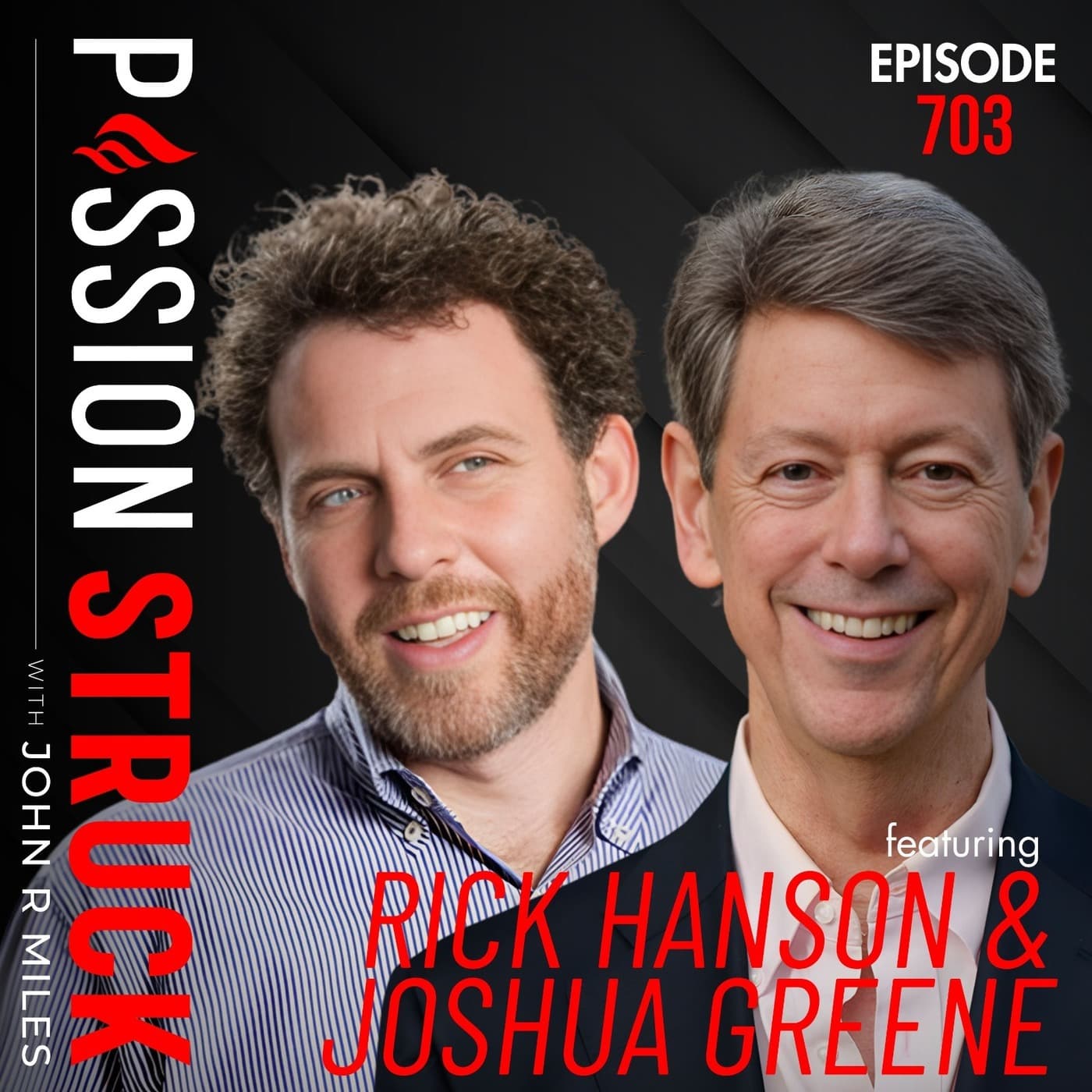
Podcast Summary: Passion Struck with John R. Miles - Episode 704
Episode Title
Rick Hanson & Joshua Greene on From Us and Them to All of Us
Overview In this episode, John R. Miles engages in a thought-provoking discussion with Harvard cognitive scientist Joshua Greene and psychologist Rick Hanson. They explore the deep-rooted "us vs. them" mentality that characterizes human social interactions and delve into the neuroscience behind compassion and inclusion. The conversation emphasizes the need to expand the moral circle to include broader humanity in a polarized world.
Key Themes
- Human Connection and Division: The episode begins with the assertion that the greatest leadership challenge today may not lie in strategy or speed, but rather in our waning capacity to care for one another amidst rising polarization and loneliness.
- Neuroscience of "Us vs. Them":
- The hosts discuss how our brains are wired for tribalism, which historically helped humans survive. However, this instinct can lead to dehumanization and division in modern society.
- Rick Hanson explains the biological and psychological mechanisms that contribute to this mentality, emphasizing the importance of expanding compassion to include all humanity.
- Compassion Practices:
- The episode outlines various strategies to cultivate compassion and empathy, including mindfulness and self-reflection.
- Rick Hanson introduces the concept of compassion circles, highlighting the significance of shared experiences and emotional connections in fostering moral courage.
Discussion Points
- Widening the Moral Circle: The conversation addresses the necessity of moving beyond narrow identities to embrace a shared global humanity. Greene suggests effective tools to broaden our circle of caring, emphasizing the importance of meeting individuals where they are.
- Combatting Compassion Fatigue: The speakers discuss the challenges of maintaining compassion in today's world, where despair and conflict are prevalent. They propose curiosity as a means to dissolve fear and build trust.
- Real-World Impact:
- The episode introduces the Pods Fight Poverty initiative, a collaborative effort aimed at providing direct cash assistance to families in Rwanda through the organization GiveDirectly.
- Listeners are encouraged to support this initiative, which aims to raise $1 million to help lift families out of extreme poverty.
Actionable Insights
- Empathy as a Practice: Developing empathetic responses towards others, even those with differing views, can lead to greater societal cooperation and understanding.
- Community Involvement: Individuals are encouraged to participate in local and global initiatives that promote collective action and compassion, recognizing that small acts can lead to significant change.
- Self-Compassion: Cultivating compassion for oneself is crucial for maintaining the strength to help others and engage meaningfully with societal issues.
Conclusion This episode serves not only as a diagnosis of societal division but also as a guide to fostering inclusion and compassion in our daily lives. The conversation concludes with a reminder that while division may feel inevitable, it is conditioned and can be unlearned through intentional action and empathy.
Further Resources
- Global Compassion Coalition: [globalcompassioncoalition.org](https://globalcompassioncoalition.org)
- Support Pods Fight Poverty: [givedirectly.org/passionstruck](https://givedirectly.org/passionstruck)
Upcoming Episode Next week, John will be joined by Nir Bhishan, author of *The Solution Mindset*, to discuss resilience and creativity in challenging times.
---
This markdown summary highlights the essential discussions and insights from the podcast episode, providing a structured overview for readers interested in the themes of compassion, neuroscience, and moral responsibility in contemporary society.
Written by AI. May contain mistakes. Listen to the episode to check what was said.
Transcript
Automatic transcript. May contain errors.0:00Coming up next on PassionStruck. All living systems are built on a combination of cooperation and competition, right? So cooperation at multiple levels means starting with primordial soup. You have molecules come together to form cells and cells come together to form more complicated cells and colonies and individuals with organs that are worked together in complementary ways. And then we have individuals forming small scale societies, villages, chiefdoms, nations, and sometimes even United Nations. And all of that works because the parts are able to accomplish more together than they can separately.
0:36And so they form a whole. Welcome to PassionStruck. I'm your host, John Miles. This is the show where we explore the art of human flourishing and what it truly means to live like it matters. Each week, I sit down with changemakers, creators, scientists, and everyday heroes to decode the human experience and uncover the tools that help us lead with meaning, heal what hurts, and pursue the fullest expression of who we're capable of becoming. Whether you're designing your future, developing as a leader, or seeking deeper alignment in your life, this show is your invitation to grow with purpose and act with intention.
1:13Because the secret to a life of deep purpose, connection, and impact is choosing to live like you matter.
1:27Hey, friends, this is episode 704 of PassionStruck, and today's episode is a little different. This is a special conversation I'm sharing to support an event that deeply matters to me and to our shared future. Our world is divided in ways we can see and in ways we can feel. Us versus them, my group versus yours. This conversation brings together two leading voices, psychologist and bestselling author Rick Hansen and Harvard cognitive scientist Joshua Green to explore how we widen the moral circle. So instead of pulling apart, we expand toward compassion, cooperation, and shared humanity. This live event supports Pods Fight Poverty, a joint initiative with Lori Santos and the Happiness Lab, giving multiplier and give directly with one clear and urgent goal, to raise$1 million to provide direct cash assistance to more than 700 families across three villages in Rwanda.
2:25You'll hear more about how to get involved during the episode. What you'll hear about in today's conversation is why humans default to us versus them, what neuroscience and psychology reveal about compassion and bias, how we expand empathy without burning out, and why direct cash transfers are one of the most evidence-backed tools we have to reduce extreme poverty. Today's episode is about more than ideas. It's about action. All right, here's the conversation from us and them to all of us. Thank you for choosing PassionStruck and choosing me to be your host and guide on your journey to creating an intentional life.
3:00Now, let that journey begin.
3:07Hey, welcome everyone. I'm John Miles. I'm host of the PassionStruck podcast, and I am so grateful you're joining us for this important conversation. Our world is divided in ways we can see and in many ways we can feel, us versus them, my side versus yours. But beneath those divisions, the science is clear. Human beings are wired for connection, for fairness, and for shared flourishing. So the question before us today in this conversation is how do we move from a world of us and them to a future of all of us. To help us explore this shift, I'm honored to welcome two friends and two of the most impactful minds working at the intersection of psychology, neuroscience, and moral philosophy.
3:53First is my friend Rick Hansen, who's a psychologist, a senior fellow at UC Berkeley's Greater Good Science Center, a New York Times bestselling author, and he's also the president of the Global Compassion Coalition, something I hope all of you check out, and co-host of the Being Well podcast with his son, Forrest. And second, we have my friend, Dr. Joshua Green, who's a Harvard cognitive scientist, author of the amazing book, Moral Tribes, and co-founder of Pods Fight Poverty, which is a groundbreaking effort uniting the podcasting community, which I feel like I'm a small part of to expand the moral circle in tangible, measurable ways.
4:33Other podcasters who are friends of mine who are part of this are Adam Grant, Lori Santos, Katie Milkman, and many others, Dan Harris, Dan Heath, and others. Today's event supports a joint event we're calling Pods Fight Poverty, which is a joint initiative with Lori Santos, the Happiness Lab, Giving Multiplier and Give Directly with one bold goal, to lift three Rwandan villages out of extreme poverty through direct cash assistance that restores dignity and autonomy. And why we're doing this is because while matching funds last, every$100 donated becomes$150, amplifying your impact instantly. So over the next hour, we're going to dig into why humans fall into us versus them, what science says about expanding empathy and cooperation, how compassion translates into real-world action and opportunity.
5:27This is a conversation about human potential, not just to care, but to include. Thank you again for being here. So with all of that, Josh, I'm going to start out with you. Why are human moral systems built so deeply around us versus them? And how did that help us survive? And how is it hurting us now? Yeah, well, the story of humanity really reflects the story of life on earth more broadly. That is everything we see around us, all living systems are built on a combination of cooperation and competition, right? So cooperation at multiple levels means starting with primordial soup, you have molecules come together to form cells and cells come together to form more complicated cells and colonies and individuals with organs that are, you know, work together in complementary ways.
6:21And then we have individuals forming small scale societies, you know, villages, chiefdoms, nations, and sometimes even United Nations. And all of that works because the parts are able to accomplish more together than they can separately. And so they form a whole. But, you know, what drives that process is competition. That is, groups that are able to survive better and out-compete the competition are more likely to pass on their genes and pass on their ideas at a cultural level. And so cooperation is built in to humans. You know, it's built into the way the cells in our bodies cooperate with each other, and it's built into the way that we cooperate with each other as individuals.
7:11And what we call morality, which has been my main topic of study for now, depending on you count something like 30 years is really a a suite of psychological capacities that enable us to to be cooperative that's sort of the bright side the dark side is that the reason this stuff evolved is because teamwork is a is a powerful weapon either for direct confrontation or for out competing in a in in in a more peaceful kind of way and as i see it the sort of long-term challenge for our species is can we take the cooperative apparatus that we've developed for life within the tribe and apply it in a broader way so that it doesn't it doesn't have to be a destructive force well thank you for that Josh and Rick I know a lot of your work deals with compassion.
8:09And one of the things that I love the Global Compassion Coalition is doing is creating compassion circles. And I wanted to ask at a nervous system level, what happens inside of us when we sense we're part of the in-group versus the out-group? First off, I wanted to say it's a pleasure to be here. And Josh, I've been a longtime admirer of your work. And I find it really quite haunting to feel within ourselves experientially. I say this as a longtime therapist and a longtime, you know, mindfulness kind of teacher, and also someone for a long time who was a very shy and dorky kid, very young going through school, who felt quite terrified by the groups and the alphas around me.
8:57And I was, you know, a living laboratory of some of the things we're going to be talking about here, the longing to be part of an us and the fear and dehumanization, and eventually often on a slippery slope, aggression, callousness, and cruelty toward them. So as context here, with your specific question, John, and then I'll back up into maybe a bit more of the ways in which it's quite remarkable to appreciate drawing on a metaphor from the great affective neuroscientist, Yach Panksepp, bless his memory, that we are each a living museum. We are each living in a body, as Joshua was pointing out, that's the result of three and a half billion or so years of life on the planet evolving in 600 million years or so of an evolving nervous system, including the last only three million of those years in which the brain tripled in volume, which has a lot of implications.
9:51So one example, if you do experiments with people and you show them faces for maybe a tenth of a second and you ask them what they see, if you speed up that interval, so or shorten it, you increasingly people cannot name what they see. On the other hand, if you contrast a angry face, a threatening face with a loving, sweet, inviting face flashed on the screen for a 20th of a second or a 10th of a second below any kind of conscious recognition, people will report, I didn't see anything. But if you have shown to them the angry face, their heart will start beating faster. There will be a physiological response that is biased toward the recognition of threat, which is a part of a larger negativity bias in our brain that has enabled our ancestors to survive and pass on genes that passed on genes, which bias us toward recognizing threat and reacting to it and over-learning from it, For example, on the other hand, when people experience, for example, there's a recent meta analysis and psychological bulletin that talked about how perceived social support is a major factor of physical health, mental health, improved performance in educational and occupational settings, and a major factor in reducing risk taking behaviors in both Western and non Western cultures.
11:25There's, wow, perceived social support. So we need to have the actual social support and the perception of it. And it's also true that when people perceive social support, neurologically, you know, threat systems in the brain centered around parts of it, such as the amygdala, as Josh knows well. There are two of these, but they're spoken of in the singular. And other systems in the brain settle down. So we have both of those. And all of that is the result of the crucible of evolutionary pressures and what confers selective advantages. Mother Nature doesn't care if we're happy. She cares if we pass on genes that pass on genes.
12:06And so it's amazing to realize, at least for me, I'm so blown away by this, that every primate species except humans, and there are hundreds of primate species, is organized around alpha dominance within their groups. And between their groups, they're very aggressive and violent. But within the group, they organize around alpha dominance, summarized as holding and control, holding food, controlling reproduction. Humans. So that our brain could gradually triple in its volume, which requires an extended childhood, which requires extended care by mothers, motivated by compassion for their infants, toddlers, and preschoolers who cannot live independently, right?
12:54Which then requires growing pair bonding based on compassion for the mommy baby unit, which then requires tighter bonds in the village it takes to raise a child. That process, which enabled and helped to drive the tripling in volume in our human brain over the last three million or so years was driven and enabled a lot by the power of love, by the value of compassion and related pro-social qualities in one-to-one relationships and then in the group altogether. Humans uniquely then evolved a strategy called caring and sharing, compassion and justice inside their vans. So that's our deep nature.
13:38And we feel those two energies and drives today in the classic parable of the two wolves in the heart, one of love and one of hate. And everything depends on which one we beat every day. It's haunting to appreciate how vulnerable we are to appeals for grievance. We see that in our politics today. Josh is better than me, for sure. Appeals to grievance. And we see how vulnerable and easy it is to establish in-group identity by aiding an outgroup of one kind or another, demonizing them. We're very vulnerable there. On the other hand, I think ultimately love is more powerful than me. And we need to find ways today to scale up to a billion what worked inside our bands of 50 or so people who spent most of their lives together.
14:23And that's what the Global Compassion Coalition is about. And I think that'll be the defining challenge of the 21st century. Can we scale to 8 billion? What has worked so well for 97 % of the time our species walked the earth? Thanks for letting me blather on that. Yeah. Now, Rick, I thought that was a great foundation and complimented a lot of what Josh was saying. And Josh, I want to talk about expanding the circle going from personal to cultural, etc. What do you find are the most effective tools for widening our circle of caring beyond people who look or think like us? Yeah. So before I do that, I neglected to exercise my emotionally driven gratitude.
15:09Thank you again for having me here. And it's a special honor since I'm a big fan of both of you. I think there are a few different things. The general theme is that you have to meet people where they are, right? That if you're talking about being open to some new cause or open to some new person or type of person, if people feel that they're being forced into something that they don't like, they won't go along with it. I'll give you an example. There was this great study that was done by Benedict Hermann and colleagues. It came out in science in 2008. They ran what are called public goods games.
15:50So this is essentially a multi-person prisoner's dilemma and a kind of cooperation sort of setup where everybody gets a certain amount of money. They can put their money into a common pool. Whatever gets put in gets doubled by the experimenters and then divided equally among everybody who participates. And there were plenty of places where people, they ran the exact same study in different cities around the world. And there are places like Denmark and Boston and St. Gallen and Switzerland, where people right off the bat put lots of money in and cooperation stayed high. And as a result, people pulled out, made a lot of money.
16:29There are other places like Chengdu in China and Melbourne, Australia, where people put in sort of mid levels to begin with, but then people could punish people who did not play the way that they liked. And the people who didn't put enough in got punished. And by the end, it looks just like Copenhagen with people putting in lots of money. And then there were other places, including, say, Athens, Greece, which, you know, in many ways, the cradle of Western civilization, where cooperation levels were low at the beginning, and they stayed low throughout. And the researchers were like, well, what's going on in Athens?
17:04Where's the wisdom of Socrates here? And what they found was that some people were punishing, didn't put money in the pool, were punishing the people who did put money in. And this is a sort of strange thing. They called this antisocial punishment. And they asked people, why are you doing this? And it was a kind of rejection of the setup, right? And it has to do with people's circle of comfort. So it's not that people in Athens in 2006 or whenever this was done are not nice people. They're not cooperative people. But it is a more closed culture where the way you end up having a relationship with somebody is you're introduced.
17:45This is my friend. This is my friend's cousin, my cousin's friend. Right. And the idea of going to a room with a bunch of strangers that maybe work well in Switzerland. But in Athens, it's too antiseptic. It doesn't feel like it feels like it's being forced on them. And as a result, you know, in that weird context, they came out behind. But if there was, let's say, some crisis in the community, that might be a more densely interconnected community where those people would be more willing to help each other out in an emergency than perhaps in other places. And so what you need to figure out is how can you get people to take the next step?
18:29And this has been the theme of the two main sort of public facing projects that I've been working on, which I won't go into great detail now, but just sort of mention them and plant some seeds. So one is Giving Multiplier, which is part of the Pod's Fight Poverty project, which is essentially encouraging people to support charities that they have a personal connection to, but also charities that are highly impactful. And this is a way of kind of building a bridge and expanding the circle in a way that feels comfortable to people. My other main public facing project is a game called Tango, which is a cooperative quiz game that you play with a partner who might be different from you.
19:11So Republicans and Democrats in the U.S., Arabs and Jews in Israel, Palestine, Hindus and Muslims in India, for example. and there you know we we're getting people to connect in a fun game-like context where there are prizes and where you know you you you don't have to worry about having a big fight about ideology the game is set up so that you can easily cooperate and use each other's knowledge and skills in in in a productive way and so that's i think the general the general advice i think is you need to appeal to people's motivations as they already exist and figure out how to turn that into a positive experience that makes people want to engage more widely.
20:02Before we continue, I want to pause on something important. Listening to a conversation about compassion, moral courage, and shared humanity is one thing. Practicing it, especially when it's inconvenient is another. Every week, people tell me, I believe in these ideas, but how do I actually live them? This episode exists because widening the circle of moral concern isn't theoretical. It shows up in real choices, real lives, and real action. If this conversation moved you, here's one meaningful way to respond. Visit givedirectly.org slash passionstruck. This This episode supports Pods Fight Poverty with a clear and urgent goal to raise$1 million in direct cash assistance so families in three villages in Rwanda can decide for themselves what they need most.
20:50Right now, Giving Multiplier is matching first-time donations by 50%, meaning every$100 becomes$150 while matching funds last. If you've ever asked yourself how to turn empathy into impact, this is one answer. Now, a quick break from our sponsors. Thank you for supporting those who support the show.
21:19You're listening to PassionStruck on the PassionStruck Network. Now, back to my conversation with Joshua Green and Rick Hansen. I want to go back to you, Rick, and talk about compassion for a second. I know growing up and then serving in the military, I was kind of brought up to believe that compassion is soft. But science, I think, is showing that it actually results in strength and resilience. So I was hoping you could go into that. And then what do we do with compassion for my group and how it feels in conflict with compassion for all of us? And how do we bridge that gap? I love the question because it's really practical.
22:01And at the end of the day, I love science. I consume a ton. I produce almost none. But I'm really interested in how do we apply it. So tip of the hat again to people like Josh. So let's see. What is compassion? Compassion is a combination of three things. Empathy for suffering. Benevolence. So there's a caring response to the suffering. Empathy alone is morally neutral. And third, there's motivation to help if you can. In evolutionary terms, that motivational aspect was very primary in the mother-baby unit, in ancestors with brains, you know, half our size. Today, that motivational aspect is still very relevant, but there very often are situations in which there is recognition of suffering.
22:51There's an empathic recognition that's not merely conceptual, combined with caring, while being unable to do anything at all. Maybe about a loss that someone has suffered, and also, of course, compassion can be applied to oneself. So that's the nature of compassion, in general. As to whether it's soft, well, it is soft. It softens your heart a little bit. And interestingly, first of all, compassion contains the bitter and the sweet, and the aspect that sweet, the caringness, is protective and strengthening. There is such a thing as empathy fatigue, particularly under conditions in which boundaries are quite porous between self and other.
23:32There is really not a thing, compassion fatigue per se, because the sweetness, even neurologically, is actually buffering and protective. So the caringness is protective already. It is strengthening. And compassion also has been shown by much research to, as you said, John, to increase resilience because of the warmheartedness in compassion and the sense of connecting with others that often follows are supportive factors of individual resilience. Compassion also supports relationships and that then confers benefits typically, not perfectly, but often they reverberate back to individuals. And there's a place for self-compassion, which, for example, increases ambition, because self-compassion is a great buffer against harsh internalized criticism.
24:24So people then become more willing to take risks, good risks in their career, swing for the fences, because they know that if they strike out, and let's remember that Hall of Fame hitters strike out two out of three times, they won't be so devastated by it. So compassion is really good in that way. And there's even some really interesting research that is suggestive of the fact that ways in which compassion is eudaimonically fulfilling in the ways that it brings a sense of meaning and purpose to one's life, distinct from eudonic rewards that are fine, but ordinary pleasure as well. So eudonic, eudaimonic, there we go, rewards tend to be protective of the telomeres, these little caps at the end of chromosomes whose degradation over time and decay is associated with diseases of aging.
25:15So who knows? You know, having a warm and caring heart could actually have benefits in terms of the lifespan. So that's part one. Part two, how do we cultivate it? That's really the question. So we have states and traits. We have momentary states of compassion. And then how do we develop trait compassion and also trait factors of compassion, such as empathy, self-regulation, so we can tolerate that empathic sense of suffering and other things within us. Well, I come from a contemplative tradition, Buddhist tradition, particularly early Buddhism, that's quite deliberate about the cultivation of kindness, which does not presuppose suffering, but can be a response to suffering, as well as the cultivation of compassion, which is a response to suffering.
26:01And people can deliberately cultivate it. And there's good evidence now that as people do deliberate training in cultivation, they report certainly increases in trait compassion. And then there's evidence for neurological changes, relatively lasting changes in the brain that underlie that development of greater trait compassion. So part of it is a matter of intent. And then when I think about other groups, the us versus them, us and them dichotomy, how do we mobilize states of compassion grounded in traits of compassion in real time? Well, one thing is it's really important to do what we can in larger objective systems outside of people to reduce the demands on them.
26:54We're in the terror, because when people feel desperate inside, they're running for their lives, they're impoverished, they're being attacked, they're in a war zone. Their family feels like a war zone. It's harder to mobilize pro-social qualities. It's kind of like Maslow's hierarchy. People are now dealing with issues that are raw survival. So if you want to help people become more compassionate, establish the social democracy systems like in Copenhagen and in Denmark, you know, that put more of a flooring under most people. Part one, inside the person, I was thinking about four factors that are quite real and people can pay attention to them.
27:34So research shows that it's for a typical person, and there are exceptions for people who have developed a lot of trait compassion. Typically, it's easier to mobilize compassion for someone who is similar to you, that you like, that you do not feel wronged by, while fourth, you are not desperate yourself. Oh, and fourth, their suffering is not their fault. okay while fifth not feeling desperate yourself so you can help yourself if you're trying to expand your circle of moral concern it's a turn the jobs she's very familiar with James Kirby and others in Australia for example have done work on this how do you expand your circle of moral concern to include more people recognize similarities you know meditations like this like me you will suffer and one day die like me you love your children like me you enjoy chocolate but like me, you're a sports fan, similarities.
28:37Two, can you find some sense of liking them or anything along the lines of wishing them well? Even if you don't like them, can you wish them well? Third, can you recognize that whatever they've done to you is part of a much larger whole in which, yeah, they have their part. You're opposed to them politically and otherwise, but there's more to it than that. And fourth, can you see the ways in which their actions towards you are the result of another wider, complicated collection of actions that, you know, don't relieve them of moral responsibility, but contextualize it in a much bigger way? Now, these are cognitive efforts, but they're quite helpful.
29:19And then just to finish, you know, we have a lot of influence over how we feel, period. how we feel toward others. We have a lot of influence over how loving we can choose to be. I had an experience personally of sparing the details in my 20s where someone I loved had betrayed me and I had to decide what to do about it. And I just made a choice to love at will for a while and then see what she did over time. I was willing to give us some months. It wasn't going to be years, but during those months, I was going to love it well. And I realized that the heart emotionally is like a muscle. You can exercise it, strengthen it.
Read the full transcript
30:01And there's a certain, within a range of what's available to you. Are you going to the high end or defaulting to the low end of the range of what's authentically available to you? Mobilizing an affective response to others in addition to the more cognitive four things I've said so far. so so josh i want to um touch on compassion fatigue for a second because i think it's very real right now especially when so many people are exhausted by conflict uncertainty ai um everything that's going on how do we stay compassionate when all of that is going on with us? And what role does curiosity play in helping us dissolve fear and building trust?
30:50You know, I think Rick is in a better position to answer that question than I am. So I'll pass it to him if he wants. I'll speak more from personal experience because it's not something that I directly research. I think that curiosity can be an entryway to that broader understanding. right? That if you want to understand the people who really piss you off, you know, but you just, you really, you have a drive to understand that that can lead to an understanding, well, why are these people so angry and why are they lashing out at me, right? Or people like me. And, you know, there's a, I think a French saying to know all is to forgive all, right?
31:38And curiosity sort of hopefully doesn't make you a know-it-all, but makes you want to know more. And that's not just about, you know, the physical world, but about the social world and what makes people tick, including the people who make your life challenging. I'll leave it at that. Rick, you want to add anything? Well, can I ask you a question? So feel free to evade my question. Anyway, so when you look out at American politics these days, and we can see similar tendencies in other areas there, you, I think, are probably toward the liberal end of the spectrum. It doesn't matter. You could be at the other end of the spectrum and you're more abused.
32:22is how do you personally practice with people that, from your standpoint, are morally corrupt and doing terrible things that hurt people? To bring it home. You know, I find this is one of the most interesting kind of questions when you get a bunch of talking heads, especially dudes. To go, like, okay, that's great. I love your ideas. There's this classic line in psychoanalysis, the client doesn't need a new idea, they need a new experience. So I think getting at the experience there is really useful. I just kind of wonder, Josh, with everything you know, what do you do inside yourself about this?
32:57Yeah. Well, I will be honest. I mean, I'm living in a liberal bubble, right? I mean, I'm in Cambridge, Massachusetts and at a left-leaning university. So I don't encounter a lot of people whose views are different from mine in a more right-leaning way. I actually end up in some cases often playing the conservative in the room because I might, you know, be relatively more moderate or, you know, open to compromise in a way that some people around me are not. But, you know, culturally, it's not so far off. So mostly to the extent that I've dealt with this, even in a relatively local way, it's been more through my research and social impact ventures.
33:46And here I'm thinking of Tango, which would require a little bit of explaining. And I don't want to usurp the answer to this question. But again, to just kind of plant a seed, I think that what makes people work is if you say, look, I know you're not a monster and I know that you're not stupid. and we try to set up our interactions in our game so that right off the bat, everybody feels not just, you know, feels respected in two senses, in a moral sense and in a capabilities or intellectual sense. And I think you can't really have a meaningful connection unless that baseline level of trust and respect is there.
34:35You can't really build until you get that foundation in place. And that's part of our strategy. Do you, I mean, for me, it's been helpful to wish people well. Minimally, I wish that they not be harmed. So that's a wish. There's a moral motivation there. And then it's been interesting to realize that, again, based on some neuroscience, that if we can warm up the circuitry, as it were, inside ourselves by starting with feeling cared about ourselves, we're part of a group, even if affiliation is pretty minimal in our softball league or team and so forth, we're cared about ourselves, then we're able to care about others.
35:25And then in turn, for many people, the hardest of all is to bring that compassion to themselves. So I find that that kind of warming up is really helpful. And then, meanwhile, I think it's also really important to bring in the dimension of self-interest. We have to take care of ourselves, too. Autonomy supports intimacy. Taking care of ourselves, we're more able to be compassionate for them. And so I think that anything we're saying about expanding the circle of us, so forth, does not mean being chumps or sands. And it concludes the capacity to be a fierce advocate, to find an integration of kindness and assertiveness together as we stand up for ourselves.
36:10So that, to me, is really baked in and it's important to appreciate. And I think it's also being personal. Some years ago, I realized that my anger at other people was an affliction on me. and you may know that of all the four so-called negative emotions categorically loosely anger sorrow fear and shame the one of the four that's actually rewarding is anger there's a mobilization of dopamine or nephron in the brain there's a buddhist proverb that describes anger with this honey tip and poison bar you know we just love it we love getting righteous i have that you didn't know the righteous mind that was Jonathan Hayden but anyway the tendency toward righteousness so we have to really be aware of the appeals of all of that and to reframe that if we let hatred in if we let ourselves be hijacked by those righteous grievances that's an affliction on us and it's especially important to pay attention to that affliction because it can feel so rewarding Yeah, I remember many years ago hearing about the Dalai Lama being asked if he was angry at the Chinese, you know, and his response was, well, this is in reference to Tibet.
37:36and say, well, they've already stolen my country. Why would I let them steal my mind?
37:44You're only hurting yourself if you allow that anger to dominate you instead of taking what information value it has and then channeling it in a productive way. I just finished rereading Man's Search for Meaning by Viktor Frankl. And it's a book that I tend to take out every so many years as a reminder. And the discussion here reminded me of something I read in the afterword of the book. And a person asked Frankl, you know, why do you write your books in German, the language of Hitler? And he said back to him, do you have any knives in your kitchen? Why do you use a knife when you eat when it has caused so much harm to so many people?
38:38And I think it's a valuable point. But the other thing is, as I was reading the book, and I'm going to tie this in, is Frankel talks about meaning and says that there are really three ways that people can find it. and says one of those is through work. Another one of those is through proximity of love. So loving someone, caring for someone. And he says another one is through suffering. I wanted to ask, and maybe I'll ask you both this. As I was thinking about this, for some reason, I started to think about Dacher Keltner and his work, whom I'm sure you both are very familiar with. And I started to think about moral beauty as you were both talking, because I think when we are cooperating with others, oftentimes we feel awe inside.
39:34And he found that moral beauty happens the most when we're expressing kindness or service or some type of reframing to another, either doing it ourselves or witnessing it from someone who's doing it to another. Do you think that moral beauty, Josh, I'll ask you first, could help scale cooperation at a societal level? Well, I think there's certainly an aesthetic dimension to things that build, right? That when you meet someone and at first you're skeptical and you think, oh, this is not going to go well. This is not my kind of person, gritting your teeth and preparing for the worst. And then you find a surprising connection there, right?
40:29Whether it's about some shared interest or just, you know, your shared humanity. It's even sweeter than, you know, when it's something that you're expecting and there's something that are beautiful about it that makes you not only think, I like this person, but it makes the world feel a little bit bigger. and more likely to surprise you in a positive way tomorrow. So I think that all of those kinds of social growth experiences have a kind of beauty to them. That it's built into the nature of the process.
41:09This makes me think about exemplars and our strong tendency, because I'm a developmental psychologist, to what's called social learning, where we observe people. And I have a friend, Dr. Daniel Ellenberg, past president of the division of the APA that focused on men and masculinities. Anyway, he makes the point that the problem, which goes back to what you said earlier, John, we don't have enough models, mainstream models of compassion and action. We don't have enough, you know, macho men being compassionate. We don't have as much models of that, including in our politics and in business and so forth.
41:47And when we see someone like that, who is morally beautiful, like a comment about the Dalai Lama, considering everything that he and his people had to deal with at the hands of the Chinese government, which I separate from the Chinese people, make a distinction there. We're very, very moved by that. And I feel like we need more and more of that. We need more and more examples of that. One example that just comes to my mind, which you can find on the Internet, is Frank Rogers. Mr. Rogers, famously a TV person working with kids, was testifying before Congress, which was about to cut off funding, I think, for PBS or that sort of thing.
42:27And a very hostile, I think it was a Republican congressman who was the chair of the committee at the time, was grilling Mr. Rogers, who then just did not get defensive and really spoke from his heart about the children in America who were benefiting from the show. And you could see that his embodiment of moral beauty there was deeply persuasive to that congressman who was started on a righteous path this way, and he finished being a complete supporter and things like that. So I look for more examples like that. And maybe that's an area of research for you, Josh. I don't know. But I am also looking for ways that you and I have talked about, John, to invest some money in social media and in influencers who can foreground more of these models, because I think we really need them.
43:19And it's our culture that's toxic right now in particular. As a quick sidebar, I had this interaction with Gabor Matea about this. And he said, as a physician and biologically trained person, if you take a species of bacteria from one Petri dish and you put them in another Petri dish and they flourished in the first Petri dish and they start to die in the second Petri dish, you don't blame the bacteria. You look at the culture. culture. And in much the same way, we need to look hard at our culture right now and look for ways to address toxic influences in it and to bring in more influences that are pro-social and healthy.
44:03Yeah, I want to go back to kids here for a second. I happen to read this pretty alarming article yesterday, there was this research study which included 17 ,000 fifth grade through 12th grade girls in the girls index. And it revealed this troubling trend in those adolescents. 60 % of those girls reported that they don't say what they're thinking or disagree with others, even if they think they're wrong because they want to be liked. They want to feel like they're part of the tribe that we've been talking about. And 17 ,000 kids is a lot to survey to get that statistic. So how do we teach expanding this moral circle that we've been talking about to kids, not just in theory, but in real world conflict that happens on the playgrounds at school, on screens and in social media.
45:09I'm not sure which one of you would take it first, but it's a really interesting and important topic. Are you guys parents? I am. We have an adult daughter and son. Yeah. I was surprised it was only 60%. I mean, I think this is something that we all do to some extent, right? And in some cases, it's not so bad. You know, tell me what you really think of this new outfit, right? You know, that, you know, there's a skillful kind of way of keeping your mouth shut. And then there are times when it can be really dangerous, right? And so the challenge is to, you know, give people the skills to know when it's constructive to speak up and speak your mind and how to do it, right?
46:03In a way that is more likely to solve whatever problem you're voicing your opinion about rather than just start a new fight to add on top of whatever the existing problem is. This is much more at the level of kind of, you know, interpersonal relations. And so I defer to Rick on all such things. But yeah, what are your thoughts here? Well, how about I take before Rick? Yeah, please. Yeah, yeah. Because I have two kids and, you know, one boy, one girl, all they're both now adults. But what was alarming to me is that when they both hit middle school, this whole tribal instinct was really a big thing for each of them.
46:51My son experienced it when we lived in Austin, Texas, and my daughter experienced it when I lived in Tampa, Florida. So So it doesn't depend. Geography didn't matter. My son was having a lot of pushback from his peer group because he joined band in a high school or in a middle school community in Austin that was very pro sports leaning. Not to say he wasn't a great athlete because he was. He just had a passion in a different area. And so a lot of his friends would bully him. And in the same way, I found my daughter experiencing this as well. And hers was more social bullying through apps than it was in-person bullying.
47:50But what I found is that in both cases, we had to kind of open their minds to realize that the people who were saying these things to them were hurting themselves and they were lashing out because of their own insecurities, not because of what either one of them were doing. And so for me, it became a discussion that we were trying to get them to stay true for who they were, for their value system that we had worked so hard as parents to try to instill in them and to be themselves and not feel like they had to wear a mask because someone was telling them not to feel accepted as they are. And I don't know if that resonates, but that's as a parent what I was trying to do.
48:42yeah well i relate to this question and i've spent a lot of time in schools actually and there are definitely things we can do at the individual level like you did with your kids john and there are programs in schools that increasingly you know are helping kids to be bully-proofed and to build up mindfulness and self-worth and they often will use different words because those words even sound a little too left coasty for some people. You could do that. And I say as a guy who spent a lot of time watching what really goes down on the playground, and at the end of the day, those individual events and experiences occur inside of larger systems that often have a lot of hierarchical and cultural pressures in those systems that also have upstream causes in poverty, class, culture, racism, and so forth, and then upstream pressures with their parents.
49:48So to address those systems, and this goes to Global Compassion Coalition, et cetera, and what we're doing here with Pods Fight Poverty, to address these real issues, we have to move beyond the merely individual level. It's both and. We need to address and elevate individual consciousness. We need to help people have more beneficial states of being and then help use tools from positive neuroplasticity to accelerate the internalization of those positive states so they become lasting, durable traits inside. We need to do that with individuals. But additionally, we need to change the systems and the upstream sources and factors that these kids and adults and so on are living with.
50:30And the only way to change systems is, as our ancestors did, inside their vans through collective action, through coming together, to change the culture of a school, to change policies in a school board, to reduce ridiculous, you know, teach-to-the-test pressures in a school district, to change those systems in various kinds of ways. And it's really interesting as the question then becomes, how do you mobilize collective action that's effective? And around us, we see so many examples of wonderful people and wonderful NGOs that are doing great work that never collaborate and combine their resources at a scale that's big enough to make a difference.
51:11So the kind of founding notion behind the Global Compassion Coalition, which other people I think are increasingly seeing as well, so we don't own this idea, is to explore the power of compassion to bring people together to change the world. So you can come together around a common enemy, and that's very motivating, but it's fraught with some peril. On the other hand, you can help people come together around recognition of suffering and the motivation to do something about it in terms of its systemic causes. And then you can actually change the world. And that's what I that's what I'd like to see more and more of these days.
51:53So so let's now talk about how we are trying to expand the circle through pods fight poverty. So I'm going to turn this over to you, Josh, but Lori Santos, a friend of mine, has been on this podcast, has a great podcast herself, Giving Multiplier and Give Directly, have come together to try to raise a million dollars for 700 plus families across three villages in Rwanda. Why Rwanda? Why these villages? And why is this important? Right. So it begins with the recognition that we have an enormous power to do good. And this is ordinary people with the kind of disposable income that many listeners of this podcast have.
52:46I don't mean to assume that everybody's in that situation. And that's one. And in particular, that some charities are far more effective than others at producing a positive impact. And that the size of the impact, the bang for your buck that you get out of a certain way of spending money to improve people's lives doesn't necessarily track with our feelings about what is most meaningful to us. So my connection with GiveDirectly began with the work that led to giving multiplier. And as I alluded to earlier, the challenge we have there is that there's this kind of dilemma between giving with the heart and giving with your head.
53:38And the heart we're all familiar with, right? that you know you love animals and you want to support the local animal shelter or your aunt died of breast cancer and you really want to support breast cancer research to help people so that others don't have to suffer what she suffered from and you know those are those are the most powerful and and sort of beautiful and noblest motives uh that we have at the same time uh the the things that we're most compelled by are not necessarily the most effective uh and uh You know, when I first learned about this, I thought, OK, well, a more effective charity might be like the difference between, you know, someone who's very tall and someone who's not so tall.
54:18You know, it might be a difference of 50 percent. Someone who's really tall is 50 percent taller than a relatively short person. But in fact, when it comes to charitable giving an impact, it's like redwood trees and shrubs that that the most impactful charities can be over 100 times more impactful in terms of lives saved per dollar or the amount of good it does to improve somebody's life. And there are a lot of examples of this. A classic example now is in the case of blindness. For example, in the United States, training a seeing eye dog to help someone in the U.S. might cost$50 ,000. In some parts of the world, people lose their vision to a disease called trachoma, which can be treated and eliminated with a surgery that, in context, costs less than$100.
55:02Now, we don't want to say, I at least don't want to say that we should abandon blind people in countries like the U.S. and say, okay, everything goes only to people overseas. But I think we shouldn't ignore that opportunity as well. The connection with GiveDirectly is, GiveDirectly is one of these highly impactful charities. And it's an interesting story about how the impact of this strategy was discovered. So GiveDirectly just gives people cash directly and in some of the poorest places in the world. And this has really been made possible by the revolution in digital banking, reaching far flung and poor villages where there's satellite networks up in the sky and one person in the village could have a flip phone and that can enable financial freedom for the entire village.
56:01Okay, so how did GiveDirectly get started? There were economists who wanted to do experiments on different ways of improving the lives of poor people. And good scientists said, well, we need a control condition. What's the standard of care? What's the baseline? And they asked around and there wasn't really an accepted kind of standard of care. So they said, all right, well, maybe our baseline for comparison should just be what happens if we take the money that you could spend on this program doing some specific thing and just gave it to them directly. And what they found is that giving people cash directly actually did better, in many cases, a lot better than the innovative programs that they were looking to test.
56:38So they created this organization called GiveDirectly that follows this simple strategy. And, you know, the first thing people worry about when they hear about this is, okay, well, are people going to spend the money, you know, on things that are destructive? Are they going to spend it on alcohol or things like that? And what they found when they first studied this is no. What people tend to do is first satisfy their basic needs. If they don't have food, if their children are in danger of dying from some disease, they get treatment. If there's a hole in the roof, they fix the roof, right? And then with whatever money is left, they invest in themselves and they invest in their communities.
57:16And this is where GiveDirectly really is sort of different from other interventions, because not only can it account for people's or support people's most immediate needs, but someone who wants to start a business, but let's say they need some way to sell their goods in the surrounding villages, is they can buy a motorcycle that can allow them to travel around and allow them to sell their goods and allow them to make a living. So it's not just giving a fish and it's not teaching a fish because they already know how to fish. It's giving people the money to buy the fishing rod that they know that they need and they know exactly the right one for them.
57:54So it gives a lot more sort of freedom and agency than typical charitable initiatives. And recent research has shown that for every dollar that's given directly to somebody, there's a 2.5x multiplier in terms of the local economy. So it really is sort of pulling people up in a broader kind of way and holding out the promise that there can be the kind of sustained growth that really makes it a a long-term difference when it comes to poverty. Okay. So we like GiveDirectly. Pods fight poverty. What are we doing? So this started when Lori Santos is an old friend of mine, and I went on her podcast to talk about Giving Multiplier, where the idea is instead of saying to people, forget the breast cancer charity, you should just give to something like GiveDirectly.
58:43We say, look, it's your values. Do both. And if you're willing to do both, and if you're willing to expand and support a charity that you hadn't heard of before, like GiveDirectly, but that we know is very impactful, will add money on top. This was research originally done with my former postdoc, Lucius Caviola, who's now a professor at the University of Cambridge in the UK. We found that people really like splitting between a charity that they chose and that's close to their heart and one that's highly impactful, like GiveDirectly. And we found that people were willing to do it even more if you add money on top.
59:19And we found that people are willing to pay to put money for future donors into a fund. So a sort of pay it forward kind of system. So Lucius and I started giving multiplier based on this research to try to create this virtuous circle. And the great news is we've been doing this since 2020. We've raised over$5 million this way. And over 3 million of that has gone to super effective charities like GiveDirectly. So I went and talked to Lori about this and we and Lori did an incredible job and we raised a lot of money specifically through her podcast. And then she and her team and Matt Coleman on our team had the idea of why don't we broaden this?
59:59And so now we're working specifically with GiveDirectly and Lori invited a lot of her podcasting leading lights like you, John, and Rick to be part of this. So what we're doing is giving multiplier is now our matching funds are not are we're doing a 50 % match on all of the donations that are made through these podcasts. And the goal is to we do this village by village or giving give directly does. We are looking to lift people out of out of poverty. I see that we're getting at time. So, John, I'll let you take it from here. And I'll just mention the link for this, which is givedirectly.org slash passionstruck.
1:00:41Sorry for going on. John, go ahead. Well, I know we're getting right at time, but I feel because we have a number of questions from the audience, I would just like to ask one. And given that we're talking about an African charity here or benefiting charity, we have a question from Victor, who is in Nigeria, and he is asking, and I think I'm going to direct this at you, Rick, how can ordinary people feel like their compassion matters in a world with such big problems? I know Josh certainly would have something to say as well, and you too, John, I'll just say briefly, in our immediate networks, the people who receive our compassion are touched by it.
1:01:32It matters to them. Think about what it does for you when someone takes the time, if only a few seconds, to let you land in their heart so they have a sense of what it's like to be you, including what's hard for you, perhaps horribly hard for you. When that happens from now, you benefit. Turn it around. When you give people that gift yourself, you are helping them immensely. Second, even if your compassion for suffering does not change anything out there for those other people, it changes you as it moves through you. It opens your heart. It illuminates your mind. And over time, it purifies you.
1:02:18And so that increasingly you rest in this stream of lovingness as your own identity. Those are profound benefits. And then there's increasing research that shows the ways in which, speaking of multipliers, that compassionate acts and other related pro-social acts ripple through social networks. You know, touching one person who touches another person who touches another person in turn. And I find it helpful to appreciate that there is so much in the world that we cannot change. It's beyond our control. What is in our control, going back to Viktor Frankl, who John quoted earlier, is how we relate to the conditions that we're dealing with out there in the world and inside our bodies and inside our minds.
1:03:02How do we relate to them? What's our relationship to them? How do we practice with them? And to me, it speaks to the most fundamental of human freedoms, that no matter how bad it is outside, deep down inside ourselves, we always have a choice in how we respond to it. And do we respond to it with indifference or coldness, or do we respond with a warm heart? And that's the opportunity and compassion for all of us.
1:03:34well i wanted to thank you both so much for joining us in this discussion uh josh thank you for and laurie for having me uh part of this initiative happy to have passion struck help contribute to this great cause um and um i just if i could leave the listeners with one thing um rick if people want to hear more about the global compassion coalition where can they go I just go to the website globalcompassioncoalition.org. Thank you very much. It's free to join the whole idea. Like I said, is to explore how compassion can bring us together to change the world at scale. That's the really ambitious and kind of crazy, but still very cool idea behind it all.
1:04:19And I also think that people should really look into your work, John, you're like a hidden treasure and you know, or not so hidden, actually. So I totally support that, too. And what you're doing, too, Josh, it's an honor, truly, to be with you. And then lastly, Josh, if we can give the call to action again for where they can go to support this initiative. Oh, sure. So again, that's that's give directly dot org slash passion struck all one word. And we're adding 50 percent on on on top. And, you know, these funding these funds allow people to take care of their immediate needs and also build a better life.
1:04:59And in a world where there's so much we can't control, this is something we have good evidence that we know we can really make a huge difference even as individuals. So I hope people find that motivating and invigorating and get a kind of charge out of doing that that lights you up for a while and keeps you going. So thanks. And thank you, John, for having me on. And Rick, it's a great pleasure to connect with you as well. This has been great. Well, thank you for everyone who turned in today. And thank you again, Josh and Rick. Be well, everyone. And we will also be posting this on the podcast in the coming days if you want to listen to it there and get a recap as well.
1:05:42Thank you, everyone. That's a wrap on today's conversation. And what stays with me the most from this episode is this reminder. Division is not inevitable. It's conditioned. And that means it can be unlearned. When we understand how our brains sort people into us and them, we gain something powerful. Choice. The choice to pause. To widen the circle. To act from compassion instead of reflex. This conversation also reminds us that ideas matter most when they turn into action. If today's conversation moved you, there's a way to carry it forward. You can support families directly through GiveDirectly at givedirectly.org slash passionstruck.
1:06:20It'll also be in the show notes. Thank you for being part of a community that believes flourishing should be shared. And next week, we continue the season of becoming with a powerful shift in focus. I'll be joined by my friend Nir Bhishan, author of The Solution Mindset for a conversation about what it really takes to move forward when answers aren't obvious. We'll explore why constraints don't block creativity, they activate it, and why the future belongs to those who can adapt without losing themselves. Because becoming isn't just about who we are today, it's about how we respond when the path forward isn't clear.
1:06:54For people, I highly suggest that somebody's frustrated at work, things aren't happening. I highly suggest that you step out of that, like, laser focus of what's going on that minute, that day, that week. And start to look at your career and start to look at your life as a long-term trajectory, right? Is it how you treat other people? Maybe you going to work at that particular place, John, isn't about the work that you do. Maybe about how you're touching other employees there and how you're helping them through their problems, how you're making an impact with your community. I'm John Miles. You've been Passion Struck.
1:07:33And until next time, choose curiosity over certainty, connection over division, and live like you matter.
1:07:49Thank you.
From the publisher
What if the most significant leadership challenge of our time isn’t strategy, speed, or scale but our shrinking capacity to care for one another?
In an era of deepening polarization and quiet loneliness, this special episode of Passion Struck confronts the root of division: our brain's ancient "us vs. them" wiring that once ensured tribal survival but now fragments society.
Host John R. Miles joins Harvard cognitive scientist Joshua Greene (author of Moral Tribes) and psychologist Rick Hanson (New York Times bestselling author and founder of the Global Compassion Coalition) to explore how evolutionary moral instincts fuel exclusion and how neuroscience and compassion practices can rewire them toward broader belonging.
Blending rigorous science with profound wisdom, the conversation explores how to expand the "moral circle" from narrow identities to shared global humanity, cultivate moral courage without erasing differences, and turn insight into action.
A highlight: the tied-in Pods Fight Poverty initiative, uniting leading podcasters to support GiveDirectly's evidence-based cash transfers. These lift entire Rwandan villages out of extreme poverty with dignity-restoring direct aid (amplified by Giving Multiplier's matching funds).
This episode does not just diagnose division. It offers a hopeful, actionable path to inclusion, proving small acts of expanded empathy ripple into real-world change. At a time when trust is eroding, this reminds us that true belonging is not zero-sum. It is the future we can choose.
Go Deeper. Read the full show notes: https://passionstruck.com/us-vs-them-psychology-rick-hanson-joshua-greene/
Support the Impact: Join the effort to transform lives in Rwanda: GiveDirectly.org/PassionStruck
About the Guests
Rick Hanson, PhD
Rick Hanson is a psychologist, Senior Fellow of UC Berkeley’s Greater Good Science Center, and New York Times bestselling author of books including Hardwiring Happiness, Resilient, and Just One Thing. His work focuses on the neuroscience of resilience, compassion, and well-being. Rick is also the president of the Global Compassion Coalition and co-hosts the Being Well podcast with his son, Forrest Hanson.
Joshua Greene, PhD
Joshua Greene is a professor of psychology and neuroscience at Harvard University and a leading expert in moral cognition. He is the author of Moral Tribes, a groundbreaking book exploring why we clash over moral values and how we can find common ground. His research bridges philosophy, psychology, and neuroscience to understand how humans make moral decisions in an increasingly interconnected world.
🔗 All links in one place — books, Substack, YouTube, and Start Mattering apparel:
https://linktr.ee/John_R_Miles
Disclaimer
The Passion Struck podcast is for educational and entertainment purposes only. The views and opinions expressed by guests are their own and do not necessarily reflect those of Passion Struck or its affiliates. This podcast is not a substitute for professional advice, diagnosis, or treatment from a licensed physician, therapist, or other qualified professional.
See Privacy Policy at https://art19.com/privacy and California Privacy Notice at https://art19.com/privacy#do-not-sell-my-info.


