Ask ChatGPT
 Passion Struck with John R. Miles
16 Oct 2026 · 1h 7m · 26 chapters
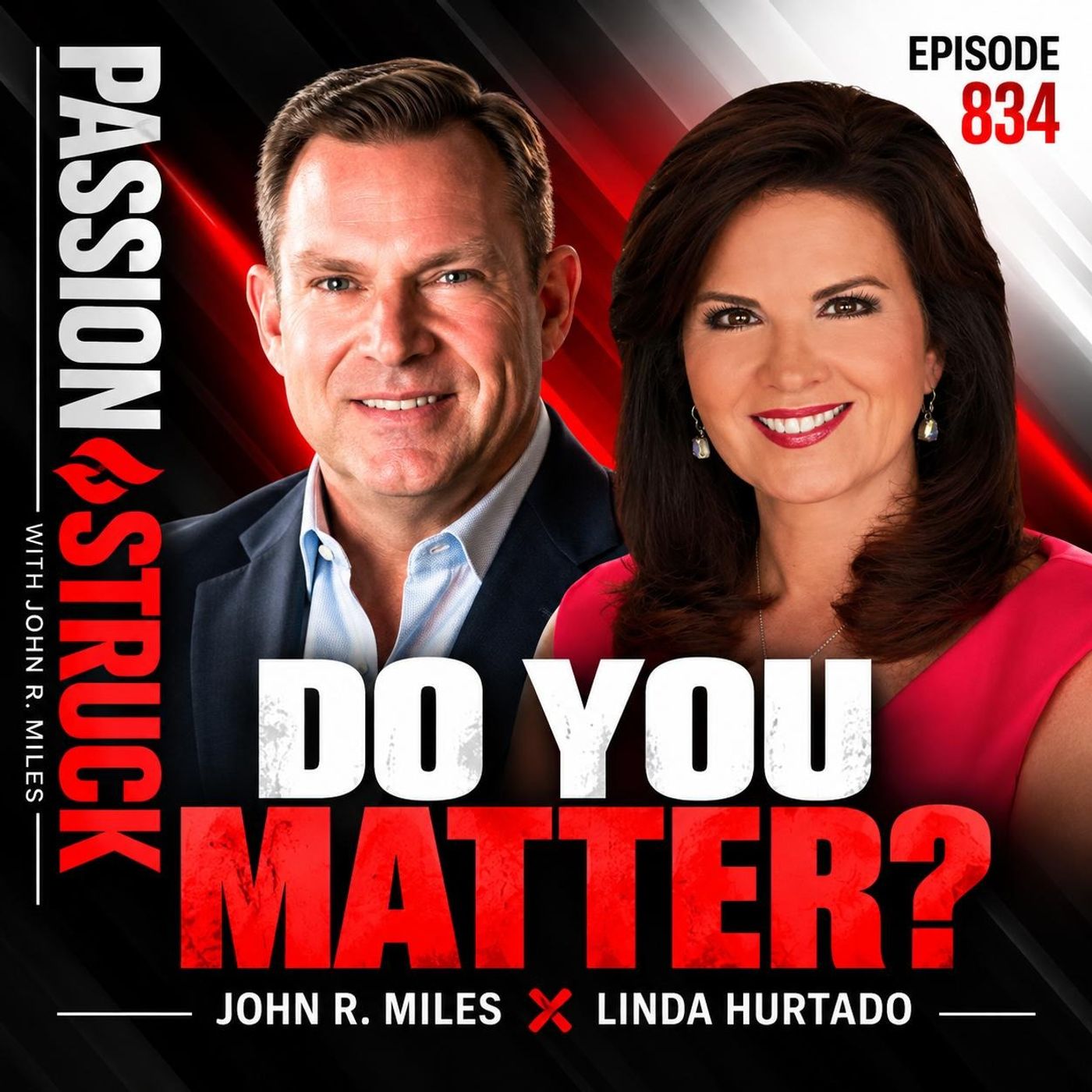
The episode explores why people can look successful externally yet feel invisible internally, arguing that modern systems measure output but fail to reflect worth. John R. Miles frames this as “the great erasure,” a slow process that extracts value without giving back a sense of mattering.
John R. Miles—U.S. Naval Academy graduate, Navy veteran; former Fortune 500 CIO/CISO/COO and four-time CEO; author of The Mattering Effect and host of PassionStruck. Linda Hurtado—Emmy Award-winning Fox 13 news anchor; previously worked for 20 years at another TV station before leaving due to feeling undervalued.
Success ≠ fulfillment; mattering is distinct from achievement. Mattering can be rebuilt through a framework that spells M-A-T-T-E-R: meaning/autonomy, time, trust, energy, and mutual care/reciprocity. Loneliness, burnout, and disengagement share underlying causes tied to feeling insignificant.
Miles’ burglarizing incident and friend’s suicide; his son asking why he stopped laughing; a Lowe’s engagement survey showing his team scored last and revealing missing autonomy, meaning, trust, and care; Linda’s contract “mind game” and decision to leave a station where her contributions felt discounted.
Written by AI. May contain mistakes.
John R. Miles shares insights on his new book and the personal experiences that led to its creation.
“Last week, on Tuesday, October 6th, I celebrated the launch of my new book, The Mattering Effect, Creating a Life of Meaning and Worth, at the St.”
Linda Hurtado is introduced, highlighting her background and significance to the discussion.
“Here is my book launch conversation with Linda Hurtado, recorded live at the St.”
John discusses the realization of his disengagement despite success and the call to study mattering.
“Raise your hand if you have ever asked yourself, do I matter?”
John recounts pivotal life events that led him to confront his feelings of emptiness and the call to help others.
“There are a couple of people in this room who...”
John shares a poignant story about a moment with his son that prompted deep reflection on his happiness.
“I think we get caught up in the grind and we don't realize maybe we've changed.”
John explains his journey from feeling stuck to starting his podcast and writing his first book.
“If I can share kind of an example, you were on my show yesterday and told that story, and it kind of stuck with me.”
John elaborates on the idea of mattering versus success, emphasizing the importance of feeling valued.
“And as I was coming up for pitching this to agents to write a – if you're not an author, I don't think you realize how difficult it is to get a book in the world.”
Explore the distinction between success and feeling significant in life.
“So in your book, you say success and mattering are not the same thing.”
Transition back to the core discussion about workplace engagement.
“You're listening to PassionStruck right here on the PassionStruck Network.”
Hear insights on employee engagement and the impact of feeling undervalued.
“Like how can the average, how is that affecting the average worker today that shows up on the job?”
Discuss the six components of mattering and their importance in life.
“Or maybe you can talk about how you fixed it or tried to fix it while you were still at Lowe's.”
Learn about the health implications of feeling valued and how to foster self-worth.
“East is what I call relational mattering, which means you are seen by others.”
Explore the significance of the mattering instinct and its wide-ranging impacts on health and relationships.
“It flows everywhere in your life when it's absent.”
Learn about the steps taken to reconnect with meaning and overcome personal barriers.
“So the steps you took were changing your work, spending more time with the family.”
Discuss the challenges of finding fulfillment in work while balancing obligations and security.
“So that was a huge decision for me and it took many years to finally make the decision.”
Delve into the importance of seeking help for mental health issues and the journey of healing.
“I feel, I guess as a journalist maybe, I think what you're talking about right now, while I do believe what you're saying is true that mattering is an issue, I think it is okay more today than ever to say I need help.”
Examine the experiences of giving without receiving and the effects on personal well-being.
“But you take on that responsibility, and you keep giving and giving and giving, but you're not getting that care back.”
Reflect on personal growth, the impact of relationships, and the importance of feeling valued.
“you should ask Corey I mean if I'm honest some of that drive that I've had doesn't go away so I mean I've always been a hard worker So some of that drive never goes away.”
Learn about the author's new children's book and its connection to the concept of mattering.
“I'll be glad to walk around and give you guys the mic.”
Learn how the concept of mattering influences children's development and the importance of parental involvement.
“the thing I realized with mattering is that it's a social immune response so it It is our social immunity, mattering is.”
Explore the societal challenges surrounding the concept of mattering and its implications.
“Would you like me to come over or do you have a loud voice too?”
Discover how to foster recognition and acknowledgment in close relationships.
“this, I asked people at Wharton, like who at Wharton is studying mattering?”
Understand how workplace environments can affect one's sense of mattering and self-esteem.
“I'm full of confidence and I feel good about myself.”
Learn about the emotional impact of feeling undervalued in your job and the importance of personal branding.
“So, you know, when your contract's up, you're gone, basically.”
Discover effective ways to make people feel valued in both family and work settings.
“Some people like attaboys, they want to hear good job.”
Understand how asking the right questions can empower employees and enhance engagement.
“When I was at that Lowe's job, I had this manager who had been there for like 20, 25 years.”

Get the gist, explore an idea or ask about something said.
 Claude
On Passion Struck with John R. Miles, what are the key points of this episode?
Searching your listeningAutomatic transcript. May contain errors.
0:00Coming up next on PassionStruck. As I was trying to understand why this is happening to so many of us, I found that the systems and the environments that surround all of us are very good at measuring what we produce, what we earn, what we give, what we prove, what we achieve, but they are very bad at reflecting back our worth. Hey friends, welcome back to episode 834 of PassionStruck. Today's episode is a special one. Last week, on Tuesday, October 6th, I celebrated the launch of my new book, The Mattering Effect, Creating a Life of Meaning and Worth, at the St. Petersburg Museum of History here in Florida.
0:44It was an evening I'll remember for a long time. We brought together friends, readers, and members of the community to talk about a subject that has become the central focus of my work. why so many people can look successful on the outside while feeling increasingly invisible on the inside. For those of you who couldn't join us in person, I wanted to bring part of that evening to you. At the event, I sat down with Emmy Award-winning Fox 13 news anchor, Linda Hurtado, for a conversation about the experiences that led me to write this book, The Personal Cost of Pursuing Success without a deeper sense of fulfillment and what we can do to rebuild our sense of meaning worth and connection we talked about the moment my son asked me why I never laughed anymore the experiences that forced me to reconsider the life I was building and the realization that loneliness burnout and disengagement can share a deeper underlying cause I also explained what I mean by the great erasure, the gradual process through which the systems environments around us extract our value without reflecting our worth back to us.
1:58Linda brought her own perspective to the conversation, sharing what it felt like to work in an environment where her contributions seemed to matter less and how she ultimately made the difficult decision to leave. Her story illustrates how deeply our sense of worth can be affected by the places where we spend our time. We also explored practical ways to help people feel seen, from the way a parent welcomes a child home to the questions a leader asks an employee who has spent decades doing their job. These are the conversations that inspired the mattering effect, and I'm glad I can share this one with you.
2:35Here is my book launch conversation with Linda Hurtado, recorded live at the St. Petersburg Museum of History. Thank you for choosing PassionStruck and choosing me to be your host and guide on your journey to creating an intentional life that matters. Now, let that journey begin.
2:56Before we start our conversation, I would like to read the bio of the gentleman sitting next to me because it's quite impressive. John R. Miles is a U.S. Naval Academy graduate and Navy veteran. Thank you for your service. Who went on to become a Fortune 500 CIO, CISO, COO, four-time CEO. I'm not even sure what all those CI-whatevers mean, but that's a lot. Leading global transformations in technology and culture. He is also the host of the globally acclaimed Passion Struck Podcast. Raise your hand if you've listened. And if you haven't, you have to find it as soon as we leave here tonight. The Alternative Health Show with over 85 million downloads.
3:37Wow and the award-winning author of passion struck in his groundbreaking new book the mattering effect creating a life of meaning and worth He draws in over a decade of research and over 200 interviews with psychologists leading thinkers to name what he calls the great erasure which we're going to talk about and He offers a practical step-by-step framework to help us recover our sense of worth Significance and presence. Please help me in welcoming John Miles Maybe we should start with a question to the audience. Raise your hand if you have ever asked yourself, do I matter? Who do I matter to? What I'm doing in the world doesn't matter.
4:21Pretty universal thing. And I think it's even more of a crisis now. But you wrote a whole book on it and spent 10 years studying it. So let's start with the moment you realized that despite all your success, you are disengaged, maybe not happy. Am I saying that correctly? And why you decided you needed to study this whole idea of mattering. Yeah, I'm going to do a different starting point. There are a couple of people in this room who... That matter to you? Who matter to me, who this story will touch. There was an earlier moment when I was an executive where it first hit me. But around 2017 I had two things that happened in quick succession that kind of altered my life so I at the time I was living in the old Northeast and I had taken my daughter to Shorecrest where she was going at the time and I went to Orange Theory that day as I always did at that time with Jay who's sitting in the back that day we happened to have a fire in the electrical system so I went home early and walked in on someone who had been canvassing my house and who was burglarizing it and I thought it was a person from my rental company doing some work at the time turned out it was but he ended up pointing my own gun at me and so I was able to evade it and then three days later Ed Copco and I were both in New York about ready to start an interview and my phone kept blowing up from all these people calling me from St.
6:06Pete and finally I saw my friend Tracy who's here to call me and she told me unfortunately that one of our best friends took his life off the Skyway Bridge and I that those two moments really were an eye-opening experience for me because I had felt this calling for so many years that I was supposed to help a group of people and I had put it on the back burner for a long time and kind of came out of those two things saying what am I what am I waiting for you know what why do I keep postponing this thing that I feel so called to do was it that you weren't enjoying your job anymore or you weren't the grind got to you or I mean I know the the idea of you you having this calling and you wanting to help others but what else other than that was it just it got to be too much well I think it I think I just felt this I had felt an emptiness inside a hollowing that I couldn't put my finger on for a long time.
7:15And the things that I had been called to solve were, you know, help the lonely, help the broken, help the disengaged, help the battered, help the burned out. And I think the hardest thing for me to look at was who were these people? Because when I was thinking about this initially, I didn't realize that I was one of the very people I had been called to solve. And I think coming through this experience and really reflecting on my life, I realized that not only was I one of those, but I was suffering from many of those. And that was a huge turning point. I think we get caught up in the grind and we don't realize maybe we've changed.
7:59And you said, it was a family member that looked at you one day and said, when was the last time you laughed, right? And you probably did ask yourself, what is the last time I laughed? Tell us about that story. Well, I mean, this one is a hard one because it involves my son, and he was young at the time playing blocks with his sister, and they would do, you know, the typical game where he was building up the blocks, and she would knock him down on the floor, and and the two of them were laughing and all giddy and and I was in a completely different place at the time I was working at Dell and I think I had just come off a two-week trip to overseas and I'd been working 100 hour weeks and I was just consumed with all the stuff that was going on and he he just made the comment dad why don't you ever laugh anymore and I mean that was a huge wake-up call at that point.
9:01So you weren't enjoying just the simple moment of playing with blocks? No. Yeah. If I can share kind of an example, you were on my show yesterday and told that story, and it kind of stuck with me. And then today, I had so much on my mind. I went to sit on the set to do a tease, and I had those big Velcro curlers still in my hair. You guys know that your grandma used to use, I used those, my mom used to use them. And I started to do the tease, and my director popped me up, and I was horrified to see I still had my curlers on, right? And I thought it had gone out live, but it did not. She was only doing that, you know, she popped it up as a joke and wanted to show me that, you know, get it together, Hurtado, you got curlers in your hair.
9:50But she came out and belly laughed, belly laughed, and I thought of you, And I thought, oh my gosh, we need more of this. We should do stupid things every once in a while and be laughed. Laughed at, laughed with, right? And laugh. So that really made what you said to me yesterday really made a difference to me too. So you knew you needed to make a change. Did you come up with the title of the book? You just knew what you wanted to write about? Like what were the steps after that? It wasn't even in my vernacular. Neither was the word passion struck at this time. I had been lucky to get introduced to the media world, your world, through Ed Copco.
10:38Ed used to run Chief Executive Magazine and had started this business called Bold Business. And he invited me to come into it to be the assistant editor-in-chief of this publication. And so through this, we decided, or we were interviewing people all over the United States. And I developed a passion through doing this of a calling that I didn't know I had. And so as I got further into this, I decided that I was going to write my first book, Passion Struck, which was really about the journey I took getting out of that initial hollow place and kind of taking my own course on a life of fulfillment.
11:26And as I was coming up for pitching this to agents to write a – if you're not an author, I don't think you realize how difficult it is to get a book in the world. because if you don't have a platform, which I didn't have a platform at the time, the first thing they say is you don't have an audience to sell the book to. So as I was thinking about this, they said you should start a podcast. And I happened to be talking to a mentor of mine, and expressed this kind of feeling that you have inside when you find, you know you're because, you find your why, you find the problem you want to solve, You have passion, but you then are trying to figure out how do you deploy it in the world?
12:12And he said, well, it sounds like you go from stuck to passion struck. And that became... The log line. The log line. And so I immediately went to GoDaddy, thought in a million years, this thing's never going to be available. And there it was. As it turns out, it had been a fragrance for Victoria's Secrets, and they had just released their trademark on it. So I got it at exactly the right time. But even then, I wouldn't say that mattering was the core thing in my mind. I didn't know how to build a personal brand, so I started to work with this company called Brand Builders out of Nashville. And they have you do this one-word problem exercise.
12:54And after you kind of figure out your because, it helps you figure out what is the problem you're trying to solve. And so I went back to that calling. You know, you're supposed to help the lonely, the beaten, the broken, etc. And I started to examine this. We treat all these things as separate things. Loneliness is one thing. Burnout is one thing. Employee disengagement is another. Rising mental health is another. And I asked the question, what if they are all downstream of something larger? And that became the question. And so what I started to look at is what causes all those things to happen.
13:33It's what happens when we become extremely visible on the outside, but more and more invisible to ourselves. And so the problem I was called to solve was invisibility. And the way you reverse that is through mattering. And that's when mattering became the topic. And then ever since then, it's been the North Star. So in your book, you say success and mattering are not the same thing. Let's talk about that. Well, I think success is something that you can aim for. It's a byproduct of you doing things that are because of your why. But I don't think success itself makes you feel fulfilled. it certainly didn't for me.
14:28So to me, mattering is a completely different element altogether from success. You call this the great erasure. So I think what you mean by that is that it's not just something that's happening to you or your neighbor or your community. It's happening to the world. Yeah, and so I've been in a master's program that I'm doing in organizational psychology and And this, I specifically picked a university that's based outside the United States because I wanted a community that would hear what I'm working on and reflect back more than what I get in the United States. And so what I am hearing is universal.
15:15So when you start looking at the statistics, one out of six people around the world is lonely. In the United States, it's one in two. Wow, it's one in two in the U.S. According to the Surgeon General. 64 % of people feel like they don't belong at work. 900 million workers are disengaged. According to McKenzie, 22 % of people are burned out globally. I think it's even higher than that. 74 % of Americans don't believe they belong in the communities that they exist in, and we lose 12 billion hours of work just in the United States alone, which is over a trillion dollars due to rising anxiety and mental health levels.
15:59So when you look at all that, that is the lonely, the broken, the beaten, the battered, the bored. And so when I looked at all of that, I started to think, what is causing us to feel invisible? and it's when the systems and environments that are around you keep extracting your value without reflecting your worth back to you. And that became the hypothesis behind the Great Erasure. Let me take a moment to share a little more about the book behind today's conversation. The Mattering Effect explores why so many people feel overlooked, disconnected, or valued primarily for what they produce and how we can begin to change that.
16:43Drawing on research in psychology, behavioral science, and organizational behavior, I introduced a practical framework for strengthening the conditions that help us feel significant in our own lives and in our relationships with others. If these ideas resonate with you, you can find The Mattering Effect wherever books are sold. And if you've already read it, I'd love to hear what stood out to you. Just connect with me on Instagram, theignitedlife.net, or LinkedIn. Now, a quick break for our sponsors. Thank you for supporting those who support the show.
17:27You're listening to PassionStruck right here on the PassionStruck Network. Now, let's return to the conversation. So no appreciation for a job well done. And let's dig deeper into that. Like how can the average, how is that affecting the average worker today that shows up on the job? And is checking off the boxes that they're supposed to? So when I went to Lowe's, I got this job. And the job was Lowe's had experienced the worst hacking event in retail history around 2003. The main perpetrators, two of them got two to three years in jail, the main person got a decade. And I took over this function, thought I was going in to fix this security issue.
18:13Well, day 10 into the job, the chief human resources officer calls me into her office and I think we're there to talk about what can she do to help me meet more people in the organization to help me get my arms around this. But that wasn't it. She instead said, we just did the first employee engagement survey in Lowe's history. She was new to the company. And out of 350 ,000 employees, your group scored last. And not last by a little margin, by a huge margin. And so the question you're asking me became the question that I sought to answer. So what I heard externally from everyone who was a customer of the group was that these people should all, you need to get a whole new bus of people.
19:04They don't know what they're doing. They're completely, their heads are somewhere else. They're not engaged with the work. So it's the worker's fault. It's the worker's fault. It's what you were told, yes. You've got a bunch of people who are dysfunctional. They don't know what they're doing and they need to be replaced. And then when I did the work over the next series of months, what I found out was they didn't understand how their jobs mattered or meant, they didn't understand the meaning of their jobs in the larger scheme of the business. How did what they do influence a customer in a store or someone using a financial system in the finance department?
19:49They didn't have autonomy in their roles. They were complete order takers in the organization. Their time was consumed by tons of bureaucracy, so they had no time for white space. They had no trust in the executives above them because they had been telling them for such a long time about these security issues and other things, but no one did anything about it. They had a low return on energy because the environment was taking from them but not giving back and they had no one who was showing care to them. And if you look at what I just said, it spells the word matter, meaning autonomy, time, trust, energy, and mutual care or reciprocity.
20:36And why are all those important together, that they have to work together? So looking at that, I then took this as a hypothesis. And this is where talking to leading psychologists, behavioral scientists came into play. So I wanted to see were these really, I mean I saw it at play, but now I wanted to look at the science behind it to determine are these really six ingredients that either when they're present cause us to feel like we matter or when they're absent lead to the matter and gap in our lives. And the conclusion I've come to after thousands of peer review articles I've read and the interviews that I've done is that these six things, which just happen to spell matter, are the framework of mattering.
21:31So how do we fix this? Or maybe you can talk about how you fixed it or tried to fix it while you were still at Lowe's. And then how you hope this book. gives everybody in the audience and anyone who reads it some tools. So I think analogies are good for understanding something this big. And so as I was approaching this, I thought of here in Florida, we're all familiar with the Champlain condominium disaster down in Surfside. That happened in, I think it was 2021. So if you look at what happened in that terrible accident, You had a condominium that had been there for many years but ended up collapsing in 12 seconds.
22:17And as I went back and I kept reading the engineering reports for it, what they signified was that in engineering terms it was a progressive failure. So there were a number of things that had happened over the years that were attributing to decay and rot and other things. Like passing the buck on paying for improvements, just one of them. But like, right, they pile up. They all piled up and they all got postponed and postponed and postponed until you took something that had some cracks in it and the whole thing went down. And the same thing I correlate is happening to so many of us, but I call it the slow fade, which then leads to the vanish.
23:05So that same way that it's a progressive failure in that condominium, the same thing happens to us as humans. So what steps do we take? So the purpose of the book was, I felt like there were other books that have come out recently, Mattering Instinct, Power of Mattering, that kind of expressed why mattering is so important. So what I think my contribution is on top of those is explaining this systemic component to it that I've discussed today which is the environments and systems around us but there has been no book that explains how do you build this back. So what I discovered doing the research on this and specifically there were there were two researchers who have done more on the science of mattering than anyone.
23:58One is Isaac Perlintensky, who passed away a number of months ago as I was writing the book. And we were in dialogue almost until the day he died. He and his wife both died within about a week of each other. But he is the one who defined mattering as both giving value and feeling value. And then the other person is psychologist Gordon Flett. And Gordon Flett, I think, is the father of the science of mattering he he came up with this term anti-mattering so anti-mattering is what we feel inside of us when we go through prolonged prolonged periods of feeling insignificant so that's what I was trying to figure out how do you reverse so the six steps to reversing this first need to start with you as an individual.
24:53So this is some of the deepest research that comes from Gordon Flett is to feel like you matter to others, you have to first feel like you matter to yourself. So the way that the book is laid out is I go through the six matter components and then I go into how do you apply this and I bring about what I call the matter and compass. So the matter and compass has north, northeast, west, and south coordinates. So north, true north is personal mattering, that you matter to yourself. East is what I call relational mattering, which means you are seen by others. The west coordinate is you are known. So this is emotional mattering you feel you feel the sense of mattering and then south is impact mattering you feel like you can make an impact with your life and so when you build those four coordinates back using the matter components which we can talk about some of them it then unleashes the mattering effect so that is building the mattering dividend and then once that dividend is restored within you as a person, it then unleashes the energy that you have been storing inside.
26:12That becomes the mattering dividend, which then becomes the mattering effect that you can then take into your relationships, house, communities, work. I'm curious how you started with yourself, this whole idea of mattering to yourself. You know, you hear meditate, you hear positive thinking, you know, don't talk negatively to yourself but what did what did you do to well I guess for me I knew that Gordon was on to something because there there was a point for me around 2014 where I I felt so emotionally numb inside that I like I was losing my mind I was going to neurologists thinking I had a brain tumor.
27:07I was forgetting things. I mean, it was just like, it was some of the worst darkness I had ever experienced. And so what that taught me was that at that point, I didn't matter to myself. And so I knew I was on to the right thing because I'd felt it personally and then the more people I've talked to about this it keeps the science keeps coming back to it is the starting point let's talk a little bit more about the health angle of that these physical symptoms were manifestations of an emotional or internal well I don't know if I want to use the word illness but emptiness maybe is better Well, I think what we don't realize about mattering is it's like, as I said earlier to Mark Wilson, it's like water.
28:03It flows everywhere in your life when it's absent. And the research shows that it is as important as safety and love. But it's the first thing we experience in life. It is the mattering instinct. So when it is lacking, it doesn't just affect one part of your life, it impacts everything. So it impacts your physical health. You're not sleeping as well. You're not functioning as well. It impacts your mental health. It impacts your emotional. You may actually get sick. You might actually get sick. You experience hypervigilance. you experience depression, and it impacts your relationships, it impacts your career, it impacts everything.
28:50It impacts your ability to feel. So it was interesting. The book was luckily selected as the next big idea club, and we were doing this discussion with all the authors who were in the October cohort, and there was this doctor who was on there who made the statement, he wrote this book Food is Medicine. He said, food is the most important thing in our lives. I want anyone here to tell me it's not. And I said, let's talk about food. You know, food definitely is a shortage and you can't live without it. But what aspects of your life does it influence compared to the things I just went over? And by the time we were done, he was like, I stand corrected.
29:38So mattering impacts every area. And the way I think about this is it's like your life is on a stool and it's got different supports on it. And like going back to career, relationship, physical health, mental health, emotional health, all those. Now imagine if multiple things are broken at the same time, how are you going to sit on that stool? That's exactly what mattering is like. So the steps you took were changing your work, spending more time with the family. What other kind of things did you do and would you recommend or recommend in the book? So the steps I ended up taking were, without knowing it, the steps that I outlay in this book.
30:29So one is I had to reconnect with what I felt was meaning in my life. So I went back to what is my because? And to me your because comes before your why. So my because was I felt called to serve the lonely, broken, beaten, battered board of the world. I then got very deep on understanding what the problem was I was supposed to solve, which was invisibility. So then I had to figure out, like, what are the choices that I'm making that are keeping me away from pursuing this dream? Did you share some of them with us? I'm just curious. Well, one of them, if I'm going to be honest, was drinking. So I learned that my drinking was a barrier to some of the relationships that I had with my family members and the environments that I was in.
31:32It was becoming a huge thing that was costing me time to pursue the things I wanted to pursue. So that was a huge decision for me and it took many years to finally make the decision. But over three years ago I made it and there's not a day I regret not drinking. So I mean that's a big one. But some of the other things was getting into a routine where every single day I get up at 5 a.m. and I go for a five-mile walk. And on that walk I meditate for the first 30 minutes of my day. and I do gratitude practices and it was all those things showing me that the more I took, the more I made choices to stop postponing the things that I wanted to do, the more my autonomy grew.
32:28Do you think a lot of people do that for money or security? Because I think for a lot of people, you know, the job that pays the bills is that's like we're taught security. But it may not feed your soul. Well, I mean, that is the hardest thing is I'm not immune to this. It is so easy. It is like you build your whole life.
32:53And, I mean, I had gotten the dream job I had always wanted at one point. I had climbed my Everest. and then I realized that I was on the wrong mountain and the mountain that you see is like Kilimanjaro and it's 3 ,000 miles away but you have no idea how do you get from point A to point B and I think that's where so many people get stuck because you know you want to get there but you have no idea how do you cross it and you have obligations and you have a ton of obligations right so One piece of advice I guess maybe to someone who finds themselves in that situation in a work environment
33:37Stop looking at Kilimanjaro and take the first step off of Everest I mean I think the thing that's the hardest thing to do is to actually start I mean that is that is the hardest thing and for me the starting point like the easiest way I can think about is you got to look at what is the biggest stuck point in your life for me it was pent-up PTSD from being in combat that I had never properly addressed so before I could deal with anything else I had to I had to go to to cognitive processing therapy and I had to do EMDR and I had to do prolonged exposure therapy and I had to do, I mean it sucked and it took like 18 months but I had to get through that before I could unleash the other things.
34:33I feel, I guess as a journalist maybe, I think what you're talking about right now, while I do believe what you're saying is true that mattering is an issue, I think it is okay more today than ever to say I need help. And there are different ways like you just talked about to actually start and retrain your brain if that's the right thing to say. I think there are more. I think the military is doing better. When I was in, it was definitely not the case. I mean, I worked for the National Security Agency and so it was known if I would have gone to seek help back then, I would have lost all my security clearances.
35:16Plus, at that time, I was spending a lot of time with special forces. And so in that community, you didn't do it either. And so because of that, I just, you know, ended up internalizing so much of it. What else do you want to talk about before we just, I'd like to ask you some other questions just in general about making the shift to becoming an author and a podcaster and what life is like now but is there anything that I haven't touched on that you think is really important in the book that might help some of the people in the audience right now maybe I'll just talk about reciprocity because this wasn't really my vernacular it kind of became part of my vernacular really understanding it over the past two years and there's a great book out there by Sonia Lieber and Harry Reese who if you have no idea who they are Sonia's professor in California and the foremost authority one of happiness research and Harry is one of the foremost authorities teaches at the University of Rochester on relationships so the two of them came together and wrote this book and they came up with this great analogy of the seesaw and to me that's what reciprocity means if you think about mutual care and what I'm talking about with us giving value and not getting it back for so many people today we become the strong one the the essential person at work the provider at the house the teacher who's carrying the weight of so many kids who are struggling or they're in a district that's not providing them the needs that they have to do their job.
37:08But you take on that responsibility, and you keep giving and giving and giving, but you're not getting that care back. And that's exactly what I was experiencing when I was at Dell. Man, I was getting paid great, and it was part of the job. I understood it. But, you know, I would come off these trips, and my son can tell you, I was not I mean I was gone like half the time and when I was there I was working 100 hour weeks because You know what ended up happened to me is I came in and I was hired as the CIO of one division Within three months that president got fired. I Went from CIO of one division to two divisions to three divisions to four divisions to six divisions to to then being put in charge of, we acquired this company called Perot Systems, $5 billion company, 28 ,000 employees.
38:04Wasn't going well, so they put that on top of me too, and then put me as the co-captain on two of the three largest strategies in the company, and then put me as the co-captain on our merger and acquisition strategy, which didn't exist at the time. So I have all of these things hitting me. I'm going to India, I think I went there 27 times in two years. and I remember sitting in this room and had all the presidents in there and Michael and and and I I had like I had barely even come home to to say hi to the family I'm back in there and the entire thing is just ripping me a new one about why this one project out of 450 that we had going on was so down the table and none of it was on anything else and what I realized as I'm sitting there and this is right after Josh had made that comment to me is like you give and give and give and give but what is anyone doing looking at the person who's given and and you know what this is doing to their life and even with that I didn't get the wake up call and I what is life like now?
39:22what are your days? you get up, you walk maybe you ride a little bit you should ask Corey I mean if I'm honest some of that drive that I've had doesn't go away so I mean I've always been a hard worker So some of that drive never goes away. I try to be more thoughtful at times about my energy level and what I'm giving. But I work out. I've kind of flipped the switch from what is guiding my life. So the reason I wrote this book is because I saw so many people suffering. So it's really the impact that I'm trying to give. But there are times when it's hard because this stuff, when you become a solopreneur, an entrepreneur, you've got no one else to do the work.
40:30So at the end of the day, it falls back on you if stuff needs to get done, if the podcast needs to go out. If you've got to get something back to your editor, there's no one else to do it. So it's still a balanced thing that I work on. Do you feel like you matter now more? Oh, yes, definitely. Well, and Corey has been a huge part of that, so a huge blessing in my life. and my friends who are here in the audience. So thank you all for coming. Should we open it up to questions? Do you guys have some questions? I'll be glad to walk around and give you guys the mic. Okay, hold on. Let me walk to you.
41:14My voice is okay. Okay, good, good, good. All right. So you recently wrote a children's book, Mariluna. That's like an introduction to this as an adult. Can you talk a little bit about that? Marilyn, thank you. She and I had the great opportunity to work at Catalina Marketing together. I wish I had had the ability to be in that company before I got there because the founders of that company, man, they had built such an incredible culture inside. and it was one of those examples where a private equity firm comes in and kind kind of starts taking it away but we had a lot of fun working together but the the thing I realized with mattering is that it's a social immune response so it It is our social immunity, mattering is.
42:18And what I discovered is what it is, like if you think about what's happening to us, who is the person who is the largest victim of this? It's our kids. Because we reflect to them what worth looks like. And if we're not feeling it, then what are we reflecting to our kids? So as I started to think about this, I thought, like, what are the intervention points that you can do for children? And there are really two. I've been working with this great group of people at the Global Compassion Coalition. If you're not familiar with this organization, Rick Hansen, a phenomenal human being, started this, and they're trying to spread compassion through the world.
43:06and so they were good enough to help me start looking at the research and it turns out you've got two periods of time with kids where I call them the wet cement years. The first one is 3 to 8, second one is 9 to 14. The biggest difference is when they're 9 to 14 they're asking the deeper questions that they don't know how to ask when they're 3 to 8. So You Matter Luma was my attempt to put a book into the world that serves two purposes. One, I was definitely trying to influence the three to eight year old who's reading it. So they had an understanding through this story of watching Luma's journey of discovering that she's a storyteller and that she has a voice that matters in the forest that they matter too.
43:54And I put storms in it and other things so it's not a complete linear track for her. But the difficult thing when you're writing a children's book is it's not the child who buys it, it's the parents. So you have to write it for two lenses. So the whole book is written on behavioral science, positive psychology, and organizational psychology principles that are built into the illustrations that my illustrator did. So it's teaching this at both an adult level and a child level because I was trying to impart on the adult who's reading it the importance of mattering too. So does it help parents tell their kids without just saying you matter?
44:41Like how do they show their children they matter without just using words?
44:51So what We've built a whole curriculum around it. So for teachers who homeschool, we have a whole curriculum. I partnered with Kaplan, an after-school program company who's developed courses to support it. And we developed a whole web site called Pass the Ripple where after a child reads it, they can go to this site that logs random acts of kindness that they can see ripple throughout the world. So the idea was to create an extension to the book. But for the parent, they can either use the guide along with the book, or the more important thing is using the story and the different symbols that I put in the book, they can ask their child questions as they're reading it.
45:37That then starts the dialogue and their prompts in the book as well, especially at the end, for them to use. Will this be a continuing series? Yes. Thank you. So it was so hard to write the first one. Once I got the formula down, I wrote 10 of them. So the second one, we're in the middle of illustrating now. And then that one, we're done the black and white illustrations. So the process is you go through all these rounds of doing black and white illustrations. And then we're just about ready to start the color illustrations. and then after that we'll start working on the next three books in the series.
46:18And both of these books available at your local bookstores, Tom Volo, of course, and also on Amazon? Amazon, Barnes & Noble, everywhere. That was a great question. Anybody else have a question? Yes, sir. Would you like me to come over or do you have a loud voice too? I also have a loud voice. John, I love the work that you're doing and it makes me think that if mattering matters so much, why is it so scarce? but then I think it's not scarce I think there's so many people climbing their wrong Everest right with trying to get famous with being an influencer or they want the Lamborghini but you already got there and you know that that's like the false you know summit so how do you get to people that think they're doing it but you know that maybe the path they're on is going to be empty when they get to the destination like how do you get to those people yeah well first thing I wanted to address is you would think mattering is such a big thing, people would be studying it.
47:15They're not. So there's currently no PhD program in the world for mattering. There's no master's program either. Stanford is about ready to start the first one, I just learned. So as I was starting to look at how do I study this, I asked people at Wharton, like who at Wharton is studying mattering? No, one talk to Ethan Cross at Michigan so I asked Ethan talk to Edward DC or Richard Ryan at Rochester so and if you don't know these names they started self determination theory which is one of the major theories of intrinsic motivation but through this huge journey I finally found this guy in London of all places who said there's this professor at this university you've probably never heard of called the University of York in Ontario.
48:09He's the leading researcher on the science of matter. And that turned out to be Gordon Flett. So it turns out there was no one, there's not a lot of people studying this. There's people studying belonging, there's people studying aspects of it. But there were really two or three professors in the entire world who were studying the topic. So your second question is, how do you go to the people who need it the most? So that is where the podcast, Substack, things like that come into play. It's interesting. There's this gentleman who taught at Boston College named Peter Gray, who's been studying the youth mental health crisis for the past 40 years.
48:57and he has this great sub stack and he let me do a guest post on it and my guest post was examining up at the story of a friend of mine who I call in the book David who was one of the best leaders I've ever worked with he he was over all of supply chain at at Lowe's when I was there I probably 50 ,000 people in this organization and this guy I mean I never went to a distribution center and these things are a million and a half square foot, 5 ,000 people in them, where he didn't know every single person's name, what they did, everything. But when he got home, he was as numb as I was. And his kids were recognizing this, and they started to put a brick on the table any time that he was spacing out and wasn't present.
49:48And so that brick became his new centering point. So I told this story to try to get the people to see it. And this article came out yesterday, had 38 ,000 views today. And I went in to start doing the comment section because I thought there were like two or three. There was like 38 comments that I had to respond to. So it's telling me that this is a topic that, so grassroots level is how you have to do it. So same way that you're doing it with the meaning mixers that you're doing at them. It's, you can't, you can't only top down this. It's like the Global Compassion Coalition, the way that they're getting the traction is they've started compassion groups where they're facilitating small groups of compassion, and that's how they're growing it.
50:43And now they're in like 80 countries throughout the world. Word of mouth, just keep spreading, right? You've got to think globally, but you have to act locally is how you do it. Anybody else have a question?
51:02No more. I do, but I'm not sure exactly how to phrase it.
51:09So I know that I matter. but what do you do when the people closest around you don't recognize that or acknowledge it? And you know. I know. I got no problems. I'm full of confidence and I feel good about myself. I do a lot of things and charity work and a business and my mom lives with me and friends and family and all of that. but how do you get other people that are close to you to acknowledge that? Because it seems a lot of times it's so taken for granted.
51:58And I think it's great to reach other people because they think there's a lot of depression and loneliness because they do. They're stuck in a job and a life and whatever, and they can't stand it. They don't know how to get out of it. but I'm not in that but sometimes I how do you get other people that are close to you to acknowledge and give you that feedback so that you know that they know that you matter are you looking for action or are you looking for words well words are easy words are so thank you thank you sorry Sorry. Question. I mean, from a relationship standpoint, yeah, I mean, I hate to use it comes back to your love languages, but I think it comes back to them being on their own signal frequency and being on a completely different frequency from understanding your needs compared to theirs, and they don't know how to bridge that gap and give you what you need.
53:04So if they can't close that gap, I mean, you can seek outside help for it, or you've got to communicate to them how you feel and what you need back from them. It doesn't work. Sorry. You can totally hit a nerve, though. I heard a lot of, ooh, when you answer it, when you ask that question. Do you think therapy helps in situations like that? No. I think you have to have two willing participants. And the other person has, you have to be able to see yourself in the situation, which I don't. You have to look in the mirror. Yes. It would be the same thing at work though, you know, you feel like you're very worth your position in your job, your job, your boss doesn't appreciate or treat you that way, that you're disposable.
54:03I feel like it's in every relationship you can possibly have. So I feel like communicating is really, when you internalize and you just keep it in with yourself, I feel like that is you showing that you don't matter enough to yourself. When you matter enough to yourself, that's when you will speak up and you will no longer tolerate that. Whether it's in your home life or in your work life, right? And I feel like that's where the acronym and the mattering sets, it really makes you look at yourself and be aware. because that's the first thing. You have to be aware that the Lamborghini is not bringing you the joy you thought it would.
54:34You know, if you still are just living in that Instagram world, maybe you don't even realize it and you think you have it all. And then when you look around and you're standing there alone with your Lamborghini, maybe you don't feel fulfilled. With work, though, I will tell you from personal experience, when you do stand up and say, you're not treating me the way I deserve to be treated, you have to be willing to be fired or walk. I mean, you do have to get to that point where that's a decision you're making in some cases, but I think a lot of cases. I see people nodding. They don't change. You really, you're right.
55:06You only have those two choices. Do you stay and take it, or do you do anything? I walked, and it was a really good decision. She's the boss. Yeah. I'm going to quit my own job. So if you, maybe you can just quickly tell that story because that was one of, I'm so thankful that you took your time to do this, Linda. So thank you very much. And there were a couple reasons why I wanted Linda to do it. One, she's an author herself. Her books are for sale over there. But she is giving so much back to the Tampa Bay area because she features so many local authors. on her show on Fox and it is for an author it is so difficult to get publicity and the fact that you do that is huge but you also so you know what it's like to be an author but you also in this case knew what it was like to not feel like you mattered in your work environment yeah so I guess without naming names but I most of you probably know I worked at ABC for before Fox here for 20 years and new management came in and the only reason I'll tell the story now is because they don't work there anymore I wouldn't do that but I could tell you know you get that instant feeling like they don't care that I've been here 20 years they don't care what I bring to the table they don't it's not about that you know I even had one boss tell an anchor and it wasn't me it was somebody else I I'm sure new boss I'm sure you're really good at what you do but you're the first one who has their contract coming up and I need the money for something else.
56:51So, you know, when your contract's up, you're gone, basically. And I guess he thought he was doing it a nice way because he gave him six months notice, which I guess was nice. But talk about feeling like you don't matter, right? So I kind of had the feeling that I did matter to this person anyway. And I talked to my husband who's sitting over there. and what he told me was you're the brand it's not the TV station they have their own brand but you are your brand and if you're not happy well you know I'll stand behind you and you know we'll go and so we put a plan to play together and silently executed it and we were getting to the point where I was about to tell them that I was going to leave and go to another TV station in town.
57:45But I still was so conflicted about it because the people that work there are great. I love them. I'm still good friends with them, you know. And I was very conflicted about it. And then on the night before we were supposed to have this contract talk, he, the boss at the time, emails my agent and says, oh, I'm going to have to cancel. I have to go to Los Angeles for a very important meeting. I'm going to send her a one-month contract extension, which was basically kind of a mind game, right, you know, to try to make me feel insecure, make me feel not, I'm not sure, but it was definitely a mind game.
58:23And, you know, he had no idea, obviously, that I was already out the door. So I told my agent at that time, I said, just tell him we don't, you know, need to sign that one-month contract that I'm leaving. And then I get an email, oh, my gosh, this is so upsetting now I can't go to Los Angeles and I need to see you in my office tomorrow morning. Now I'm at her. But at that point I was already gone and it turned out to be a really good decision. I mean it was a scary one but I understand what it felt like to come to work every day and and just think you know I could be that person that is let go just because my contract is up and And it has nothing to do with the value I bring to the table.
59:08And interestingly, when I did go to Fox, the American Cancer Society and all of these nonprofits and organizations that I was giving my time and doing things for followed me, which proved my husband's point that I was the brand. And it wasn't necessarily the TV station. And now they're working with me again, but over at Fox. So it was scary. But, you know, sometimes you just have to take the stand and say, you know, I want to work someplace where I feel like I, you know, am valued. Right?
59:48Anybody else have any questions? Yes. if we are the person who's the boss or if we're responsible for people like if we're a parent what's one thing that anyone can do every day to make the people around us feel like they better yeah well so I love this question when when I get asked by parents about their kids so like the simplest thing that that you can do like if you're a parent with your with your kids is to give them the first moment that you see them complete undivided presence that they are the only thing in the world like you your face lights up and etc so before like if you come home before you ask them about your homework before you do any of this like just light up and with your presence show them how much they mean to you and i think the same thing reflects to us as adults as well and i would say in a work setting acknowledge someone's accomplishments and do it in a setting where um you know they it's not it's not just you one-on-one but i think that everybody like in a
1:01:22I think that's really good because, you know, and again it goes back to your language of love. Some people like attaboys, they want to hear good job. And some people just want to be, you know, treated with respect. So I think it does help to know your employees, like you said, and know what it is that they need. And I know that seems like a lot, but a lawyer is a good job. employee is going to work so much harder for you and will have your back if they think that you have even taken the time to understand what it is they need you know like I would say my husband is kind of he's a he likes action actions like what you do and I like to hear it and I don't know if it's because I'm a woman but like I it's got to go into my brain through my ears and but that's how we're different.
1:02:11Right? Yeah, I would just give you one other example. When I was at that Lowe's job, I had this manager who had been there for like 20, 25 years. And we were putting in the new strategy in place, blah, blah, blah, blah, blah. And I remember he worked at night. So I went in at like two o 'clock in the morning to spend some time with him on the shift. And it I had done this a bunch, because it took a bunch to get to make him feel because he was a manager there was a senior manager another person a director an executive director and then me so it's it's not like this he was like in my direct individual chain of command but I knew that if we were going to change the organization it had to start with the frontline supervisors so after a while when I when he I had earned his trust that he could say things to me he was talking about what he was doing on the shift and the details really don't matter but he basically said so how do you want me to get this team to perform better like what are your instructions for me and i'm like you have the whole equation wrong his name was giles and i said i i like i trust you i know that you know how to do your job I can't be here doing it for you.
1:03:37What I need to know from you is what better training do you need? What better support do you need? What barriers am I causing that I need to be aware of or we are causing? What bureaucracy is getting in the way? And how do I help you do your job better and give you more ability to have autonomy in your job? And he started crying. He said, no one in my entire career has ever asked me that question. And it became a huge changing point because he started to just take ownership. And instead of me going in front of everyone and showcasing his story, when we did all hands, I put him in front of everyone and I said, tell them what happened.
1:04:26Tell them what you're doing. And it wasn't that everything he did was perfect. He made a bunch of mistakes. But we didn't penalize him for the mistakes. They became learning opportunities for him to grow. And then from there, it just spread like wildfire. And the bottom line is, two years later, we were the second highest scoring group on the employee engagement survey. Nicely done. Thank you.
1:04:57I want to thank Linda Hurtado for helping bring this conversation to life at the launch of the mattering effect and everyone who joined us at the St. Petersburg Museum of History. For those who couldn't be there, thank you for spending part of your day with me here on Passion Struck. My hope is that something in this conversation helps you look differently at your own life, the people around you, and the environments we have the power to shape. Because the question of mattering touches is nearly every part of our lives. It influences how we see ourselves, how we treat others, and how we respond to the systems we're a part of.
1:05:29And that brings us to our next conversation in our current series, The Architecture of Agency. Next Tuesday, I'll be joined by Nir Halavy, a Stanford professor of organizational behavior and author of the new book, Level Up, why hierarchies are broken and how to fix them. Nir and I explore how hierarchy, competition, and status shape the way people behave and what happens when the pursuit of advancement starts undermining collaboration. He shares a revealing insight about how competition can lead people to withhold information, keep their expertise to themselves, and choose not to help a colleague.
1:06:04These small decisions can tell us a great deal about the cultures we create and whether those cultures help people thrive together. It's a conversation about leadership, human behavior, and the structures that shape our choices. I hope you'll join me on Tuesday. But I'm really worried about what happens when it gets to sabotage and other harmful behaviors. And it doesn't have to be a very active sabotage. It can just be that you're not helping your teammates or other coworkers and colleagues, right? They need a little bit of your time and a little bit of your experience and advice here and there.
1:06:37And you're keeping that yourself. You're hoarding information. You're not sharing. Until then, I'm John Miles. Stay curious, stay intentional and stay passion-struck.
1:06:50Thank you.
What happens when you achieve the life you thought you wanted, only to realize you no longer feel connected to it?
For John R. Miles, that question became impossible to ignore. After years of executive success, demanding workweeks, and responsibilities that kept growing, a simple question from his young son stopped him in his tracks: “Dad, why don't you ever laugh anymore?”
In this special live conversation from the launch of The Mattering Effect at the St. Petersburg Museum of History, John sits down with Emmy Award-winning Fox 13 anchor Linda Hurtado to explore the experiences that led him to investigate a question millions of people quietly carry: Do I matter?
John explains why success and mattering are not the same, how the environments around us can reward what we produce while overlooking who we are, and how this gradual loss of connection can lead to what he calls the Great Erasure.
In this conversation, you'll discover:
The conversation also explores John's personal turning points, the experiences that prompted him to reconsider his priorities, and why rebuilding a sense of mattering starts with how we treat ourselves and the people closest to us.
The central takeaway: You can climb the mountain you always wanted to climb and still discover it was the wrong mountain. Sometimes the next step isn't working harder. It's asking what kind of life you're actually building, and whether it allows you and the people around you to feel that you matter.
This is a special episode about the ideas, experiences, and human stories behind The Mattering Effect: Creating a Life of Meaning and Worth.
Pre-Order The Mattering Effect: https://matteringeffect.com/. Take the 90-second diagnostic to see if you're disappearing.
Explore the Show: https://passionstruck.com/starter-packs/. New to Passion Struck? Start with the best episodes curated for you.
Connect with John
Support the Movement: https://startmattering.com/. Every human deserves to feel seen, valued, and like they matter. Wear it. Live it. Show it.
Passion Struck — #1 Alternative Health Podcast. 85M+ downloads.
Disclaimer
The Passion Struck podcast is for educational and entertainment purposes only. The views and opinions expressed do not necessarily reflect those of Passion Struck or its affiliates. This podcast is not a substitute for professional medical or psychological advice.
Hosted by Simplecast, an AdsWizz company. See pcm.adswizz.com for information about our collection and use of personal data for advertising.