
 Passion Struck with John R. Miles
8 Oct 2026 · 1h 1m

 Add vo to ChatGPT or Claude to ask about everything you hear
vo listened to this episode to put together the overview and transcript, so there may be the odd mistake.
The episode argues that high achievers can be successful yet feel “unseen,” proposing this comes from “systemic unmattering” and a “slow fade” where people become invisible to themselves. It promotes John R. Miles’s book The Mattering Effect and its “mattering needs pyramid” (matter to yourself; relational reflection/being seen; emotional resonance/being known; impact/making a difference). It contrasts being needed vs mattering, and reframes modern workplace/algorithmic life as “quiet disorientation” rather than “quiet desperation.”
loneliness, burnout, and disengagement are downstream of the unanswered question “Do I matter?” Healthy environments require meaning, autonomy, trust (psychological safety), time, energy (return on energy), and reciprocity.
veterans/first responders showing the same slow-fade symptoms; a teacher, caregiver, CEO, and overachiever fading out while remaining indispensable; a personal burglary and a friend’s suicide as wake-up calls.
John R. Miles (Navy veteran; corporate executive; leadership/culture/personal growth author/podcaster; wrote The Mattering Effect). Mick Hunt (host; USA Today bestselling author; runs Mick Unplugged).
0:01Hey friends, what if your biggest problem isn't that you're not doing enough, but that you've spent too long proving that you are enough? You can be successful, needed, and surrounded by people and still feel completely unseen. That's the problem I explore in my new book, The Mattering Effect. I show you how we become hypervisible for what we produce while quietly becoming invisible to ourselves and introduce the matter framework to help you reclaim meaning, autonomy, trust, time, energy, and reciprocity. Stop auditioning for your worth. Start living from it. The Mattering Effect is available for pre-order now at matteringeffect.com.
0:36Fall tastes better with better ingredients from Whole Foods Market. No added growth hormones or antibiotics in their meat department means slow-braised short ribs are even more satisfying. All seafood is wild-caught, like their vibrant sockeye salmon or verified responsibly farmed. And all sweets, including fall-themed cookies, are made without high fructose corn syrup. Spice up fall at Whole Foods Market. Coming up next on Passion Struck. What if the beliefs that made you successful are the very beliefs that are quietly making you miserable? The belief that you always need to do more, that being needed makes you valuable, that your next milestone will finally make you feel secure.
1:25Those beliefs can build an extraordinary career, but they can also build a life where you are constantly performing and never actually arriving. That is the core of the conversation Mick Hunt and I had about the mattering effect. Take a listen.
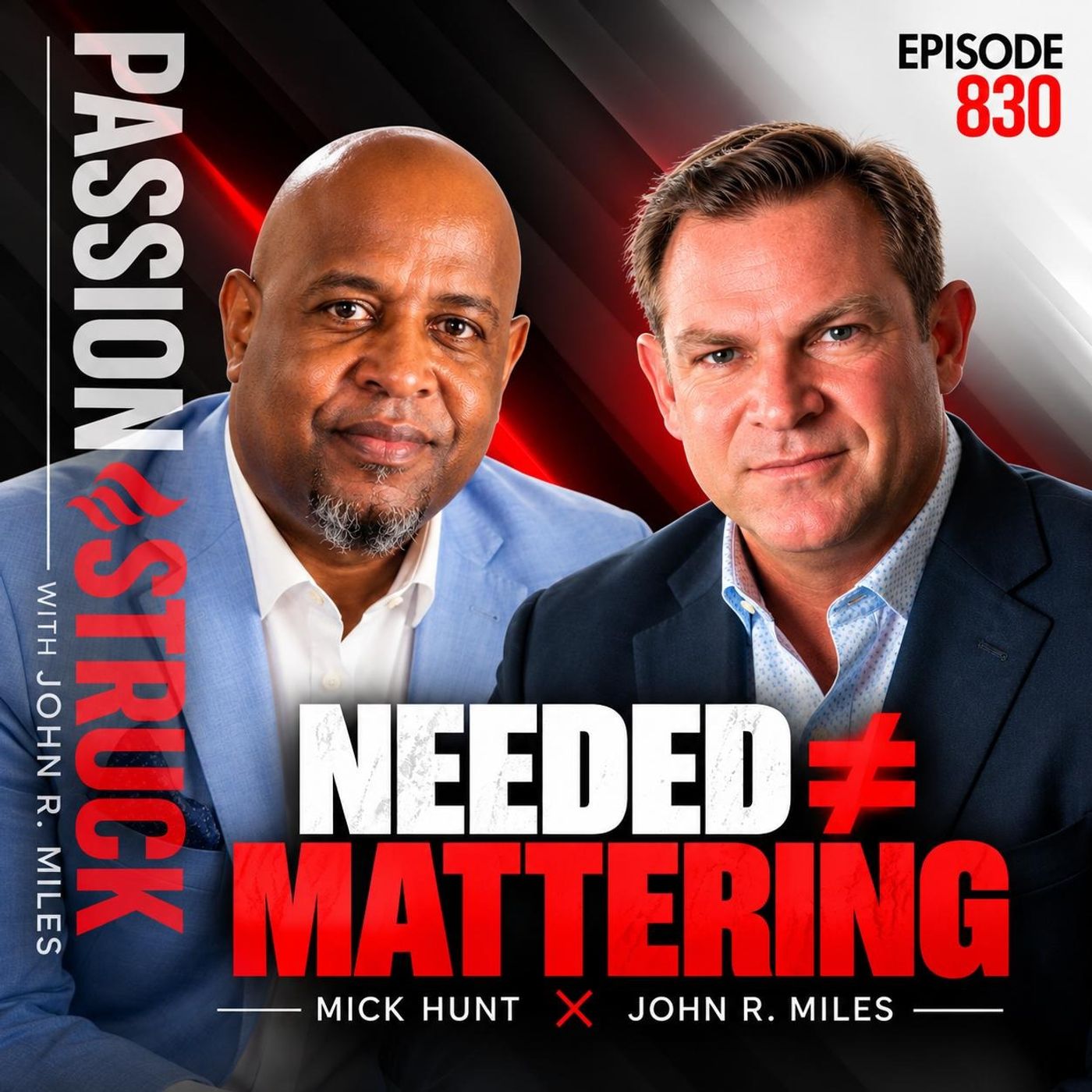
1:48Welcome back to episode 830 of PassionStruck. On Tuesday, The Mattering Effect, creating a life of meaning and worth, officially launched into the world. After years of researching, writing, and living with this message, it's an incredible feeling to finally see it in your hands. I wrote this book for anyone who's ever wondered, do I matter beyond what I produce, achieve, or provide for other people? The high achievers trapped on the treadmill of constantly proving their worth. The leaders, executive, caregivers, teachers, first responders, and parents who spend their entire lives pouring into everyone else, wondering why, despite being indispensable, they quietly feel like they're disappearing from their own lives.
2:37Because you can be highly visible on the outside and still feel completely invisible on the inside. Mattering is more than being liked, popular, or useful. It is the fundamental human need to know that your life has worth and that who you are and what you contribute makes a real difference. In this book, I explore why we lose that sense of mattering and how we find our way back from the inside out. But launching a book is one thing. sitting down with someone who pushes you to examine the foundational purpose behind it is another. That is exactly what happened when I joined my friend, USA Today bestselling author Mick Hunt on his podcast, Mick Unplugged, a leadership and personal growth podcast dedicated to exploring the deeper purpose, the because behind high performers and culture shapers.
3:34Mick's show is one of the few on repeat in my own morning routine, and this episode went far beyond a standard conversation. We dug into why loneliness, burnout, and disengagement are just downstream symptoms of a single unanswered question. Do I matter? We went into my concept of the slow fade, how so many people remain completely indispensable to everyone else while quietly fading out in their own lives. We discussed why Thoreau's warning about quiet desperation has evolved in an extractive world dominated by algorithms, performance scoreboards, and 24 by 7 connectivity. And we did a deep dive into the mattering needs pyramid.
4:17The practical progression from mattering to yourself to relational reflection, emotional resonance, and genuine impact. Sometimes the thing we need to change isn't our performance. It's the belief underneath the performance. Here's my conversation with Mick Hunt. Thank you for choosing PassionStruck and choosing me to be your host and guide on your journey to creating an intentional life that matters. Now, let that journey begin.
4:47Mick Hunt: Exciting episode of Mick Unplugged. Today, I have someone that I've actually looked up to from afar from a long time. He's a military Navy veteran. He is a guy who talks about culture and leadership. He's someone who we're going to talk about why you matter and why you matter more than you even know. Please join me in welcoming the brilliant, the amazing, the connected, Mr. John R. Mills. John, how are you doing today, brother? Mick, I am just static to be on your podcast because I am a huge, huge, huge fan of Mick Unplugged. so I'm such an even bigger fan of you and I told you offline that I wanted to to have this moment because I want to give you your flowers dude like the respect that I have for our military and our veterans um what you have done and continue to do in the podcast space what you've done career-wise what passion struck and that podcast is about just means so much to me dude I know you talked about like listening to my show but honestly I don't listen to a ton of podcasts yours is one of the few that not only do I listen to it's on repeat it's one of the things that you know on my Saturday mornings when I'm sitting out reflecting on the week that's come or that that's past and things that I want to work on.
6:20Mick Hunt: You're the first podcast that I listen to every Saturday morning, dude. And I truly mean that you are the show that I listen to and I've needed that. So I wanted to thank you personally for that. Wow, man, that means a lot. That means a lot, brother. Thank you so much. You got it. There's so much I want to talk to you about, John. There's so many things that we have in common outside of just podcasting, right? Like you talk a lot about culture. You talk about a lot about leadership, emotional intelligence, and those are all the things that are in my wheelhouse as well. And I'm so honored to have you on because I wanted to ask you, you know, I always ask my guests, what's their because, what's their purpose?
7:02Mick Hunt: Why do they continue to do the things that you do? And this amazing book that you have coming out has helped me connect with my because even more. So I'd love for you to tell us, like, what's your because? Why do you do the things that you do so well? Mick, because I was given a calling. Years ago, it had to be around 2005, 2006, I was sitting in this discipleship class that I was taking at my church. The course is called Discipleship One. And man, it's like signing up for a master's degree. It lasted 34 weeks. We met with our minister twice a week for two to three hours in the evening. And when I wasn't doing that, we had all these reading assignments from beginning to the end of the Bible.
8:01And during that time, out of nowhere, I was given this assignment, man, that completely altered the entire trajectory of my life. I felt called to serve the lonely, the broken, the beaten, the battered, the disengaged, and the burned out. And Mick, I have to tell you, I had no idea what hit me because all I saw was a bunch of separate epidemics. Loneliness was one crisis. Burnout was another that I was feeling myself at that time. Disengagement in all these companies was another. Rising despair, suicide rates, declining mental health were another. And for so many years, as I pounded my head against the wall, I thought about them individually.
8:59But the deeper I went into the human condition and into my podcast, the more a different question began to haunt me. what if we're endlessly treating downstream symptoms while we're ignoring an upstream wound sitting underneath many or all of them and so that became the burning question when you peel back the leather the layers whether it's someone burning out at work an employee checking out or someone quietly spiraling into isolation, you often encounter the same unspoken human question. Do I matter? And the more I began to realize that, I realized that billions of people are getting very little evidence that they do.
9:56And what it caused me to do, Mick, is I had to look beyond psychology and examine where neuroscience, contemplative wisdom, and system design intersect because the issue isn't just what's happening inside us, man. It's happening around us in our workplaces, our institutions, the algorithms we're using, our schools, consumer culture, even in our families. We've built systems all around us that are extraordinarily good at measuring what we produce, perform and deliver, but are far less capable of reflecting who we are. And I call that because systemic unmattering.
10:46Bro, I have chills right now.
10:49Mick Hunt: Like, like knowing your story, like knowing the things that you do, but I've never heard it in that context. I've never heard it said that way. And hearing that passion that you have when you talk about that, talking to me, talking to our audience, like it really gives me chills. And I want to go a little bit deeper into that and those moments for you, because for those that are watching, for those that are listening, for those that don't know John, and you're weird if you don't know John, go Google John or Miles, but Navy veteran, corporate executive. On the outside, John, you looked like you were the epitome of what everyone should strive to be, right?
11:44Mick Hunt: Outside, that was you. But on the inside, you've talked about that battle internally. What was that really like for you to discover that within yourself? Mick, I'm going to give you a little context and that for the audience. So, man, we're recording this on 9-11. And what a meaningful day for so many of us in America, but also around the world. And one thing that people don't know about 9-11 is 3 ,000 people unfortunately lost their life that day. 7 ,000 veterans lost their life fighting the war on terror. And it impacted countless thousands beyond that. But the statistic that doesn't get talked about enough is the over 150 ,000 veterans who have taken their life beyond those who lost it.
12:51And I went on this retreat three years ago, and there were a group of about 150 special operators there from every different community. and we did the 4x4x48 Goggins Challenge. And as I was talking to all these veterans, and it goes well beyond this to first responders, medical providers, so many people, like 99 % of the symptoms that we were all experiencing were exactly the same. And the symptoms we were experiencing is something that I call the slow fade. And a person will understand this as I talk about it because this is what happened to me. Man, you're doing it all. You're functioning. You're giving.
13:48You're showing up. But what ends up happening is I gradually your own voice, your very identity, your needs, your sense of significance, man, it begins to recede. And the only way I can like talk about this is it's like this pair of glasses here. And it's like one day, a long time ago, they were completely clear. But every day, it's like more and more smudges are beginning to appear on these glasses, yet nothing you use wipes them away. And it's like your life just starts getting dimmer and dimmer and dimmer and you feel less and less alive. And the more I started to see it in myself, I began to see it everywhere.
14:44You see it in the poor teacher who's working her heart out where you live in Atlanta, in the inner city, and she's pouring everything into her students. It's the first responder who's running toward everyone else's crisis. It's the CEOs who are listening to this, who are carrying the weight of the company and the board. It's the caregivers who are tending to loved ones, the nurses tending to sick patients, and the overachiever who's built an identity around constantly proving their worth like I was. Yeah. And what I found is they're needed, they're giving, they're contributing, but Mick, who's seeing them?
15:31That's where the slow fade becomes so dangerous because you remain highly visible to the world while you're becoming increasingly invisible to yourself. And that, my friend is exactly what was happening to me
15:50Mick Hunt: dude the chills the chills get even stronger man like this is so deep like and and i want to because i know a lot of our viewers a lot of our listeners are entrepreneurs and they're leaders and they hear me when you hear me speak you hear me talk a lot about emotional intelligence and i want to go to a segment that I call the unplugged truth. And I'm going to elaborate on some, or I want you to elaborate on something that I'm about to say, because I know that you talk about this. And I know that there's a framework around this in the mattering effect, which by the way, will be a New York times bestseller, by the way.
16:30Mick Hunt: And we'll, we'll talk about that book in a moment, but here's an unplugged truth. We've talked a lot in the last two to three years about making sure in the workplace people are seen. I think that's step one. Because hearing you and your story and understanding some of your frameworks, people don't just need to be seen. They also need to be valued, right? And I know that that is something that you talk about. So I would love for you to elaborate because for the people that are watching that are leaders, that are founders of companies, I'm going to say it's no longer good enough to just make your people feel seen.
17:16Mick Hunt: That's actually pretty easy now, right? But how do you make them feel valued? And I think from a culture standpoint, it's the most important thing, but I'd love for you to elaborate, brother.
17:29So I want to introduce Henry David Thoreau. and then I had this interview last year and I've always said Henry David Thoreau and I was interviewing the leading expert in the world on his name and he goes you're mispronouncing his name it's Thoreau so for anyone who's out there who like me has said it the wrong way it's actually Henry David Thoreau the man practically two centuries ago wrote the line the mass of men lead lives of quiet desperation. And I think he was right. But Thoreau was looking at a world entering the Industrial Revolution, a world where work at that time had become increasingly organized around production, efficiency, specialization, and most importantly, the machine.
18:26And over the next century and a half, that logic has become so deeply embedded into every institution that we surround ourselves with, but especially our work environment. Because, Mick, I'm not sure what you've experienced, but man, what I experienced is that we increasingly have learned to measure people by what they produce, what they contribute. and so many people look at shareholder value and what economic value our employees can create. But I think something is happening now that is drastically different. Like not only are we living in a more global world, but with the advent of AI algorithms, digital networks and constant information, we're now having to respond not only to caring about the person down the street, we're having to care about billions of people around the world.
19:33And so our communities, our workplaces, our neighborhoods, even our own identities have become increasingly porous. So I don't think we're simply experiencing quiet desperation anymore. I think we're experiencing what I call quiet disorientation. Quiet desperation says, I know something is wrong, but I feel trapped inside these walls. Well, the issue is we don't have these walls anymore. And that's the difference between quiet desperation and quiet disorientation. We're connected to almost everything, but increasingly uncertain about where we belong in that connection. And so when you think about this whole ecosystem that you're talking about, about the need to feel valued, and then to receive that value back, it really goes back to this core thing that I have in the book, which is called the mattering needs pyramid.
20:35And I started to look at like what needs to happen inside ourselves for mattering to take place. And it starts with a foundational internal belief that I matter to myself. The second is you have to have a relational reflection. I am seen. My existence registers with someone else. And that's more than just being surrounded by people. So in the workplace, you have to not only have the workplace tell you that you're seen, but you have to believe it. But it's more than that. You have to be known. Someone understands who I am beneath the role. And I think that is something that even as a leader, when I look back upon my time leading people, I didn't do effectively.
21:29So often we look at the people we work with and we see them in the role they're in. We don't see the roles that they've done before that. We don't see the roles that they're doing beyond work. And then lastly, you have to feel that you make a difference, that my presence changes out something outside of me. If this conversation is hitting home for you, The Mattering Effect is available right now wherever books are sold. If you've ever wondered why hitting every benchmark of success still leaves you feeling hollow, or why being indispensable to everyone else never feels like enough, I wrote this book for you.
22:08It's a roadmap to help you escape the mattering market, dismantle conditional worth, and build an internal anchor of significance. Grab your copy at your local bookstore, Amazon, Barnes & Noble, bookshop.org, or wherever books are sold. And make sure to listen to the end of this episode for a special giveaway Mick is hosting for our listeners. Now, a quick break for our sponsors. Thank you for supporting those who support the show. Therapy's biggest impact doesn't show up in some dramatic breakthrough. It shows up in the smallest moments. You bite your tongue instead of escalating. You put your phone down instead of firing off that text.
22:49You say what you actually mean instead of what would hurt someone else the most. Nobody applauds those moments, but they quietly change your life. That's what growing feels like. And that's exactly what Grow Therapy is here for. Grow is therapy that works covered by insurance. Sessions average$21 with insurance and some pay as little as$0 depending on their plan. There are no subscriptions, no long-term commitments. You just pay per session. Grow connects you with thousands of high-quality licensed therapists across the U.S., offering both virtual and in-person sessions nights and weekends. You can search by what matters, like insurance, specialty, identity, or availability, and you can book a therapy session in minutes and begin in as little as two days, not the national 48-day average.
23:41See if you could pay as little as$0 for therapy in seconds at growtherapy.com slash book now. That's growtherapy.com slash book now. growtherapy.com slash book now. Availability and coverage vary by state and insurance plan.
24:03You're listening to PassionStruck right here on the PassionStruck Network. Now back to my conversation with Mick Hunt.
24:10Mick Hunt: so john you're talking about the the mattering effect the mattering needs in the in the pyramid can you break down what that actual pyramid is from top to bottom so mick you were talking to me about this very let me mick you were talking to me about uh that mattering has two components the feeling that you're seen, but that you need to be giving as well. So it's adding value and receiving value. And so as I started to think about this in a broader terms, I was trying to figure out like, what does that really mean beyond just those two conditions? And so this is, this is where the mattering needs pyramid came about.
25:03So it has four different layers to it, and I'll try to relate this both to the individual and to the work environment. So the foundational element is before you can matter to anyone else, before you can feel seen, you have to matter to yourself. Do I possess enough internal sense of worth that doesn't rise and fall with approval, achievement, productivity, or other people's opinions? and in a work environment are you giving the conditions that allow that that allow people to matter to themselves and it goes it obviously goes beyond the work environment but then this leads to the second foundational level which i call relational reflection am i seen does my existence register with someone else.
26:00And it's important for people to realize that this is more than just being surrounded by people. This is, you know, am I really seen? And in work environments, this is something that I have to tell you, sometimes as a leader, I didn't do as good a job as I should have. Because oftentimes when we look at someone, we see them in the role that they're playing, but we don't see them in the roles that led up to that role. We also don't see them in their life outside of work, which we really need to spend a lot more time doing. And then that leads to the third layer, which is emotional resonance. And this really gets to, you can be seen, but are you known?
26:48And this gets into what I was just saying. Does someone understand who I really am beneath that role. And that happens in our family situations, in the role that we're playing. It happens in our work environments, happens in our church environments. You know, there's really a difference between someone knowing your name and someone knowing your heart. And I'm sure that resonates with you. And then lastly is impact. Do I feel I can make a difference? Does my presence change something out of me? Does my role at work influence the company culture? Does it influence the company's customers? Does it influence the company's strategy?
27:35because an employee and any of us want to know, does my life leave a mark? And those four layers together create a more resilient sense of mattering. It's like a living system.
27:50Mick Hunt: Amen to that. And I'm smiling because, again, it's like we're brothers from another mother, because one of the things that I was challenged by from my mentor and my best friend, Robert Irvine, who I know is listening to this episode is, Mick, nothing really matters if you don't make impact, right? And he was talking both in my professional and personal life. It's like, your people want to make impact, right? And so ironically, or funny enough, John, I was actually going to talk to you about being seen and valued. And then most importantly, especially when we talk about this new age employee, and I don't mean it by age literally.
28:40I just mean by where we are in society.
28:45Mick Hunt: In a good way, people actually want to make impact, right? The people that you lead want to make impact. So I would definitely say being seen, being valued and having the ability to make impact to me is a recipe of amazing culture. So I'd love to get your your spot on that, too. Yeah, well, I think it's important for people to understand the difference between being needed and mattering. Being needed basically says what you do is valuable to valuable to me. Mattering is a little bit different. it it really says you're valuable to me and your presence makes a difference and i think that that second part is huge and that's why like my mission today mick is i want to make the invisible visible and remind the people who spend their lives making other people matter that they matter to.
29:50Mick Hunt: Yeah. Because I think that second part is missing in so many people's lives. Totally agree. Totally agree. So I'm going to move to the hot takes on my show and I'm going to give the hottest take of 2026. The Mattering Effect by John R. Miles will be a New York Times bestseller because I know the man behind the book and I respect the man behind the book. So John, I'd love for you, I'm gonna open the floor on The Mattering Effect. What are people gonna get out of this book? What are some of the takeaways that is gonna be unveiled to the person that reads it? Well, Mick, first of all, I wanna say that I, like for me, I never go into writing any of these books that I write to get on a bestseller list.
30:48And I think when you do, you're just setting yourself up for great disappointment. Like the biggest measure for me is when I, when I hear from a leader or someone who's read the book and they tell me that the impact that it's, it's had on them, that was the best part of writing passion struck. And the other thing that that is huge for me is the next big idea club. And I found out last night that the book was picked up to be a must read in the in the October segment of the next big idea club. So that that was a huge validation because people don't know about that. That book club is led by Malcolm Gladwell, Adam Grant, Susan Cain, and Dan Pink.
31:40And I can't think of four greater writers out there. So for people who are reading this, one of the big ideas that you will get is something that I call the great erasure. And the great erasure is what I think is happening and what is causing so many people to feel lonely, burned out, disengaged, etc. And that is the gradual loss of individuality as people become increasingly interchangeable parts inside the systems that organize their lives. This is the systemic unmattering that I'm talking about. And one of the most important things for people to understand is that healthy environments that we interact with require three ingredients.
32:35And as I was researching this book, I came across this theory I didn't even know existed. A lot of people have heard of self-determination theory, which really gets into intrinsic motivation. But I found this thing called FIRO theory, and it has three important components, inclusion, control, and openness. Inclusion really answers the question, do I belong here? Control answers the question, do I have a say in what happens in the environments I walk into? And openness might be the most important element. Can I be the real me in that environment? And when those three signals weaken, and that's what my book really gets into is following this signal.
33:24People don't rebel, they shrink. And the place that that is happening most, unfortunately, is in our homes. Because the thing that I realized, the more research I did on this, is that the mattering instinct starts the moment that we are born. It's the first thing we're searching for when we come out of our mother's wombs. and it's most loss in our home environments. And the second key concept that I think people really need to understand is something that I call the mattering market. Because the more you think about it, we are living in a mattering market. Like everything that we interact with, whether it's the consumer websites, websites, the major brands, the schools that we send our kids to, the schools that we go to, the work environment, the communities, they're all trying to extract something from us.
34:29And the more they're extracting, the more our individuality is taken away from us. So the other very important thing that comes out of this book, which I spend 75 % of the book talking about is how do you build all this back? If I haven't made a case for this and why people are feeling this, then I've done a poor job. But I think it's important for people to understand the core framework in the book. As I interviewed over 400 people on the podcast for this book, and I'm talking Nobel Prize winners, professional athletes, ministers, priests, contemplative practitioners, psychologists, neuroscientists, I mean, you and I interview like the same groups of people, I found six recurring conditions that either make us matter or lead to systemic unmattering.
35:28And man, it just so happened that they spelled out the word matter. So the first one is meaning. Am I connected to something that makes my life feel significant? The second one, A, is autonomy. Do I have authorship over my own life? And in a work environment, do I have authorship over the ability to make a difference in the work environment that I'm existing in. T is trust. This really gets down to psychological safety. Do I feel safe enough to be fully myself in the environments that I enter into? And I was interviewing Dr. John Demartini. I'm not sure if you've had him on your show or not, Mick.
36:18But we spent a whole hour talking about this. So many of us never feel safe enough to be fully ourselves. And that's why so many people today are wearing masks. I did for like two, two decades of my career instead of being my full self. The third T or the second T is time. So do I have enough shared presence to actually experience my life in my relationship? And this is so important because we're so busy in our lives that we're not actually experiencing it. The E is for energy, and it's specifically return on energy. Is my life replenishing me, or is it simply extracting from me? And then the last one is a word that some people may not use very often, but is extremely important.
37:13Reciprocity. And when I say reciprocity, think about being on a seesaw. Is care, contribution, and significance moving in both directions or only one? Because if it's only moving in one, you're either on the bottom or at the top of that seesaw. And so then the last thing is you then have to apply that matter framework to the mattering needs pyramid. And when you do that, it becomes the mattering compass. And so you have to then take that matter framework and apply it through those four layers, which is personal mattering, relational mattering, emotional mattering, and impact mattering. And once you're able to build that back in yourself, that's when the mattering effect, that's when you achieve the mattering dividend.
38:10And that's when the mattering effect takes place. And that impact starts happening at home, in your relationships, in your work environments, in your community, man and then eventually throughout society wow you just gave me
38:32Mick Hunt: like an amazing lesson man like because there are a couple of things in the acronym you talk about trust so important psychological safety you know i just did an entire keynote on that for a fortune 100 company and how you just eloquently put all of that together dude like it's it's what makes you who you are it's why you are who you are and it's why i'm gonna say this it's why you matter man like that's why thank you miles matters because that's you that's all you and it brings me to a question that i have and in this segment i quickly We call it the room. And it's one of those things where it's like, was there ever a moment where there was a meeting, a dinner, a conversation you had with someone that sparked this in you?
39:29Mick Hunt: Like I know internally, right, you decided to look at the man in the mirror. But was there a conversation? Was there a room? Was there a meeting that propelled you to an even higher level?
39:43Mick there there there wasn't really a conversation there was a gun
39:53so uh about uh nine years ago I was in the middle of uh this just terrible divorce and And man, things were as low as I thought low could possibly get. And my son at this point had gone off to college. And my daughter is in middle school. And I had just dropped her off at school. And at this point in time, I had this schedule that after I would drop her off, I would go by the gym. And it just so happened this day, the gym had some kind of electrical fire. So fire engines were there when I showed up. So instead of being able to go and work out, I had to drive home. And I should have known better from my time at the military that I was doing the same pattern too much.
40:49And unfortunately, at this point in time, a couple people were watching my pattern and had picked that exact moment to rob me. so I walk into my home at the exact time a burglary is going on and I saw the work shoes when I went into my house but at the time because I had I had given my spouse about 90 % of everything that I had made to close out the divorce so I didn't have enough money make at this point in time to even buy a house. So I was, I was renting. And, uh, it turns out that the, the manager of the rental company was the person had been canvassing my house and he was the person robbing me.
41:44So I go up the stairs thinking he's here, whoever this person is, who I, who I just figured was from the rental company had their headphones in and couldn't hear me. And as I'm charging up the stairs, dude, I can, I can hear the accelerated breathing. And, um, I'm like, I had enough momentum that I couldn't stop myself. And I turned the corner and there he is at the top of the stairs, pointing my own handgun back at me. And man, And it's like your life flashes before you. And unfortunately, I had the military training. So I was able in that moment, I had a quick split second to decide, am I going to rush up the stairs and try to take him down?
42:34And he was a much bigger guy than me. Plus, he was commanding the high ground. Or is I going to evade him? And I decided I was going to evade him, live to fight another day. so I successfully get out of the situation and then dude three days later the one person in my life my best friend the guy who I could call two o 'clock in the morning 5 a.m in the morning and he would come there in a heartbeat commit suicide and at this point in time you know I had been given this because that I talked to you about and I had been resisting it with every strength that I had in my bones because it was so foreign to anything I had done before it and this was my wake-up call like John what are you waiting for and I have to say like after that point in time it like didn't come overnight it took me two years of figuring it out.
43:41And that's what led to me writing Passion Struck was like Passion Struck. People haven't read it are 12 principles that I used to build back my life by doing research on myself. But that was the start of it was those two events. And it really made me realize there's this professor at Cornell, Tom Gilovich, whose work on people in the third trimester of their life has found that 76 % of people he has examined have the same regret. And that is the regret for not allowing themselves to make the choice to become their ideal self, man. And that was the moment I made the choice that I was gonna live my life differently.
44:29And I was gonna solve that question and start helping people live their life differently. So if there's anything that I hope to do with the rest of the days that I have on earth, it's to help people not become the 76 % who go on their deathbed looking back and wondering, what the heck did I do with my life?
44:55Mick Hunt: Bro, you've done nothing but give me chills this entire conversation, man. I knew the story of the burglary. I did not know the story of your best friend. And to know that that happened within 72 hours of each other, man. The self-resiliency that you have, the self-awareness that you have, and you know this, right? We both talk about emotional intelligence. 90 % of the people would tell you that they're very self-aware, but only 10 % really are, right? and you again take that a step further by talking about the self-audit or the self-research which is not something I'm going to do like you've given me something to start this weekend because I'm sitting here listening to you say all this and I'm like doggone it he's right like and while yeah I do think that my life has been very purposeful I do feel like I have made and will continue to make impact I still need to do that self-research on me because it could be something I'm leaving on the table.
46:07Mick Hunt: So, bro, like you gave me something to do and I love that. Well, Mick, one of the things that I discovered while writing this book is that
46:21we've all heard that it's the tiny choices that matter. but what I discovered is that there's actually a mattering loop and each since you're talking about self each self-honoring choice that you make strengthens the belief that your choices matter and the more your choices matter the more you believe in yourself the more you're willing to take off the mask, the willing, the more you become willing to live by your values and your aspirations and your ambitions. And man, to live what Marshall Goldsmith calls the earned life. It isn't that what it's all about. And I have to tell you, I started this conversation talking about the Bible.
47:14Man, my Bible was my prized possession. I had decades of notes in my Bible. It was like every time I heard a sermon that resonated with me, I would take notes from the pastor talking and I would underline it. And my house got flooded two years ago and the Bible that I had spent so many years writing in was destroyed. And I have to tell you, after my friend's suicide, I, man, I was just like on my knees one day, just in tears and in like agony. And I opened the Bible up and Mick, the first thing I read was, was basically this line that said, I don't want you to worry. I've got you. And you're let me guide your life to do something that will impact so many people.
48:21And, and I just like looked at that moment and said, I'm just going to devote my life to trusting in this moment. And that's what I've done through, you know, losing everything in floods and everything else that's happened. I just keep focused on like, like this mission matters so much, um, that that's what gives me the strength to keep going through the ups and downs that, you know, this entrepreneurial journey in this life journey, uh, brings us.
48:55Mick Hunt: Amen, brother. Amen. And here's what I want to do. Um, just because this, this conversation is touching me so much and those that listen, and watch the show know that anytime that there is an amazing conversation, an amazing book, I like to make sure that I show my love back. So here's what I want to do, John. And I'm going to have John's social media links to his website. We're going to get to all that in a second too, but I'm going to have all that in the show notes and description. Here's what I want. The first 20 people that message me on LinkedIn or Instagram, but you have to tag John and I too.
49:39Mick Hunt: So you got to message me and you got to add John. I'm going to buy 40 copies of the book. Oh man. And I'm going to send the first 40 people. So I'm going to go the first 20 on LinkedIn, the first 20 on Instagram. Got to tag us as you DM me. I'm going to send you a copy of the book and then I'm going to need you, the person on the other side, the listener, the viewer, the people that get this book after you've read it I need you to come back and tell us what you picked up what what you've implemented or the first thing you are going to implement is because this is what I know about John his book's going to give you a framework his book's going to lay out a really good path but John can't make you do it Mick can't make you do it you've got to take those first steps.
50:35Mick Hunt: But I promise you, John's going to lay out every step that you need to take, because if you know John, that's what he does. And he does it really, really well. So John, I want to do that. If you will allow me to do that. And Mick, that is huge. Thank you. Thank you for believing in me and the message. A thousand percent. So first 20 people message me, you matter, got you covered. And you're going to get an amazing book, the mattering effect. John, you've been awesome. I'm going to get you out of here on my rapid fire unplugged five. Are you ready? I'm ready. All right. You are a Navy man and one of my closest friends in the world who actually lives right around the corner from you.
51:19Mick Hunt: Darren Vermost is an army guy. Who's going to win the football game this year, Navy or army? Well, I mean, both teams are going to be good. I was just at Navy this past weekend and they're looking awful good this year. So my money is on Navy. So this is Go Navy Beat Army. Darren, you heard it. There you go. John, you do a lot of work. You work with a lot of Fortune 50 companies. What's one culture trait or characteristic that every great company gets right? What's one? i think it's when they stop stereotyping people in the organization because if you're going to build a culture of mattering you do that by restoring the ambiguity about people's legitimacy you reduce that ambiguity and you know one of the things that's killing me right now is the greatest companies are made because they have diversity of thought and and diversity of thought is so important because when you have group think that's when companies die you need to have diversity of perspective and people to push back when you don't allow people to push back and you don't allow voices to be heard, mattering gets destroyed and the culture loses its willingness to speak up and to tell the leadership when things are broken, the need to be fixed.
53:07Love it. Love it. The,
53:10Mick Hunt: the self-research, if I'm someone who's going to start that, I really am. What's something that I need to make sure that I do in this self-research so that it goes the right way?
53:29So I am a big believer that we need mentors and we need our own coaches. And one of my own coaches a long time ago said to me, and I talk about this on my podcast, Um, like when I was going through the slow fade, it was as if I was living on a stool that had one support underneath it. And that support was the constant grind. And he said, you need to start looking at the foundation that you're building. And he goes, you need to look at it through different dimensions. You need to think about your physical health, your emotional health, your mental health, your relationship health, your career health, et cetera.
54:19And you need to keep all of those in balance. And it goes hand in hand with kind of that matter framework. And I found that for me, the first step I needed to take was to figure out what was causing the most imbalance in my life. And that was the first point that I needed to work on. And for me, I had a whole bunch of PTSD that I wasn't dealing with because I thought that by going and seeking help, it made me weak as a man. when I broke down that barrier and I actually sought the help and I figured out what my stuck points were that were barriers in my life, man, when you start working on one area, almost like water, it starts permeating the other areas and you give yourself permission to expand.
55:22And that's exactly what happened to me. and it's the only way I can like help people think about this is like imagine you're pushing a boulder up a huge hill like when you start those first pushes are going to feel so hard but the second you start getting momentum behind it that momentum carries forward and before you know it, uh, one step happens and another step happens. And then like overnight, the boulder then is over a ridge and it's catching more momentum. That's kind of how self development happens, but you have to pick one area and it's gotta be one of the biggest areas that's holding you back if you want to change.
56:12I like that. I like that.
56:14Mick Hunt: Fourth question. If someone and everybody that's listening and watching, I want you to go to Passion Struck now, wherever you listen or view podcasts, go there right now. John, what's one episode you want them to make sure they listen to first? Well, since we've been talking so much about the environments that we surround ourselves with. I, the one that comes right off the tip of my tongue would be the, the episode I recently did with Angela Duckworth or about her new book situated, because we, we talk a lot about this. Um, another great episode that happened to happen in the same week, um, was with, um, um, Jared, I, I'm, I'm drawing a blank and I shouldn't, uh, Jared, Jared is Pulitzer Prize winner.
57:05And he basically talks about the situations that leaders find themselves in. And like, as he was examining Harry Truman, like it was, he was like at that point in time, there were 85 other senators beyond Harry Truman who were more qualified than Harry Truman to do that job. So was it the environment that Harry Truman was in or was it the fact that he had more courage? That's kind of what Jared gets into. And then the third one would be Greg McKeown. And he and I have this incredible conversation about the signals that govern our lives. And he's currently pursuing a PhD at Oxford. And if you haven't read his books, man, he's a great author, too.
58:01but that would be another great discussion. I love it.
58:04Mick Hunt: All right, last question. I'm gonna get you out of here, John. When your memoir is written and we're on the last page and the last paragraph in that final sentence, what's one word you want to make sure is in that sentence to define your legacy?
58:29Belief. I think there are a number of ways we can look at leaf belief But the belief that I'm talking about is so many of us get caught in the mastery trap trap the mastery trap We believe life will finally become more meaningful once everything is under control and the simple fact is It's never gonna be under control so this the second you start believing in yourself Now is the second your life is going to change.
59:05Mick Hunt: Love it. I love it. Dude, I'm completely humbled. I'm completely honored to spend this time with you. One of the best conversations I've had. You're someone, again, I've looked up to for a long time. I told you I listen to your podcast every Saturday. That's how I start my Saturday. Even during football season, the first thing I do is I'm popping on your podcast to catch up and there's always something that I can implement based on conversations that you have so John brother thank you so much everybody that's watching this listening the mattering effect I don't care if you get it on Amazon you can go to John's website we'll have it plugged up for you in the show notes in the description your local bookstore Barnes and Nobles it doesn't matter books a million get this book Look, the first 40 people, remember, 20 on LinkedIn, 20 on Instagram.
1:00:02Mick Hunt: Tag myself and John. That's all. I'm going to hold myself accountable to make sure you get the book. You're going to get a copy. Bro, you mean the world to me. This conversation was much needed. You gave me some work that I'm going to start doing this weekend. So, brother, from the bottom of my soul, thank you so much, John. Thank you. Thank you, Mick, for having me. it sucked. I mean, you have such an amazing community that's behind you. And, and man, I, I, I have to say there's some jealousy with some, some of the guests that you've had on the show, because we, although you and I have a lot of overlap, we, we each have some unique guests that we've had and, and man, you do it right.
1:00:45Your episodes are top notch. So such a huge honor.
1:00:49Mick Hunt: it's because I have people like you that I can I can blueprint behind man I you know we never do anything on our own I tell people this all the time there's a whole bunch of room on the mountaintop people just don't try to fight to get there so they think it's this very little tip the mountaintop is a huge is a huge space and I'm honored to share that mountaintop with you my man I really am Thank you, Mick. Mick, thank you so much for a heartfelt, transparent, and powerful conversation. What I appreciate most about Mick is that he lives what he preaches. As he said so well at the end of our chat, there's a whole bunch of room on the mountaintop.
1:01:31We don't have to claw over each other or sacrifice our souls just to achieve meaningful success. As a quick reminder, Mick is generously purchasing and giving away 40 copies of The Mattering Effect, 20 on LinkedIn and 20 on Instagram. If you want to claim one, tag both Mick Hunt and me on LinkedIn or Instagram and share your biggest takeaway from today's discussion. Tomorrow, we're continuing this launch week momentum with a very special guest. Sean Acor, New York Times bestselling author of The Happiness Advantage, joins me for a deep dive into the architecture of belief, positive psychology, and why believing you matter is the prerequisite to sustainable flourishing.
1:02:11But we're still hungering for meaning, for purpose, and as you know, for mattering in this world. What we see in the midst of this great drift is driving us towards all those negative beliefs. My behavior doesn't matter. Look at this news alert. I don't matter. I'm alone. This work isn't meaningful. I have nothing to give. It's not that I matter less. It's that I don't matter. If you haven't picked up your copy of The Mattering Effect yet, make sure to grab it today. And if you've already started reading, leaving a quick rating or review on Amazon or Goodreads goes an enormous way in helping this message find people who need it most now.
1:02:47Remember, you were never meant to disappear from your own life. Thank you for listening, and as always, stay passion-struck.
What if you can be successful, needed, productive, and admired, and still feel like you don't matter?
That's the paradox at the heart of John R. Miles' new book, The Mattering Effect.
In this special conversation, originally recorded for Mick Hunt's Mick Unplugged, Mick sits down with John to explore the personal story behind the book and the question that changed the direction of John's life:
Do I matter?
John shares the calling that emerged during a discipleship class, the experience that forced him to confront his own “slow fade,” and why he eventually recognized that burnout, loneliness, disengagement, and disconnection weren't separate problems—but symptoms of something deeper. AudioTranscriberAI_0aa8383c46d9…
The conversation then moves into the ideas behind The Mattering Effect: why being needed isn't the same as mattering, how the Great Erasure strips individuality from modern systems, and how the Mattering Needs Pyramid, M.A.T.T.E.R. Framework, and Mattering Compass can help rebuild a sense of worth, agency, connection, and impact.
Most importantly, this isn't just a conversation about a book. It's about what happens when you stop living to prove your worth and start living from the belief that you already have it.
Pre-Order The Mattering Effect: https://matteringeffect.com/. Take the 90-second diagnostic to see if you're disappearing.
Explore the Show: https://passionstruck.com/starter-packs/. New to Passion Struck? Start with the best episodes curated for you.
Connect with John
Support the Movement: https://startmattering.com/. Every human deserves to feel seen, valued, and like they matter. Wear it. Live it. Show it.
Passion Struck — #1 Alternative Health Podcast. 85M+ downloads.
Disclaimer
The Passion Struck podcast is for educational and entertainment purposes only. The views and opinions expressed do not necessarily reflect those of Passion Struck or its affiliates. This podcast is not a substitute for professional medical or psychological advice.
Hosted by Simplecast, an AdsWizz company. See pcm.adswizz.com for information about our collection and use of personal data for advertising.
Scan the code with your iPhone camera
Listen in the app.