
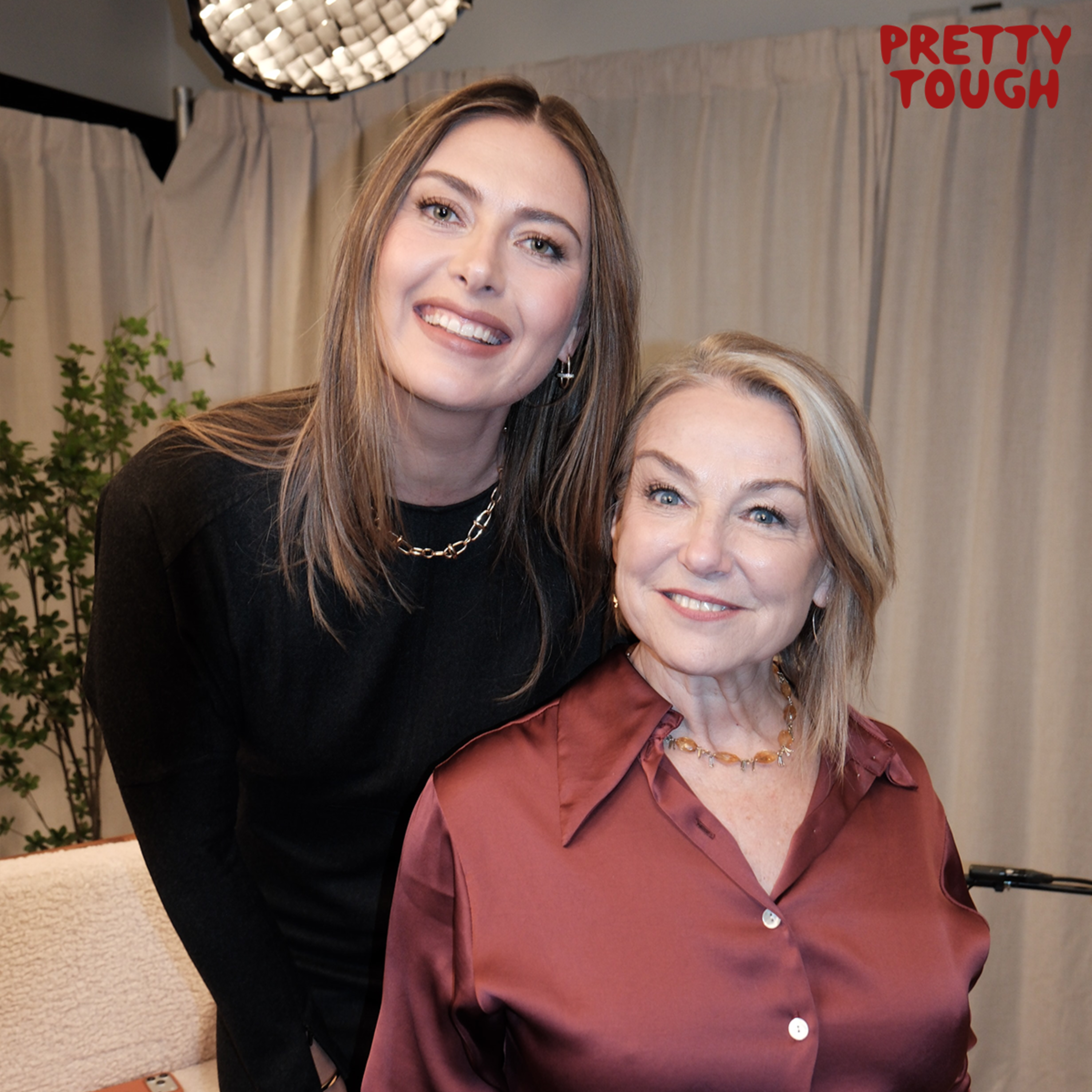
 Pretty Tough with Maria Sharapova
14 Oct 2026 · 58m

 Add vo to ChatGPT or Claude to ask about everything you hear
vo listened to this episode to put together the overview and transcript, so there may be the odd mistake.
Vera Wang’s career pivots from figure skating to fashion—how discipline, failure, and creative authenticity shaped her rise from Vogue editor to founder of a fashion empire, plus what it takes to run a business and stay creatively driven at 77.
Vera Wang competed in singles at the 1968 U.S. Figure Skating Championships, narrowly missing the Olympic team. She later became one of Vogue’s youngest editors (before designing dresses), then worked in fashion including Ralph Lauren, and eventually founded her bridal label.
Skating is a metaphor for life because you learn by falling and must get up again. Not everything you do will work out, even with passion and hard work. For Vera, dressing isn’t about looking young; it’s about feeling truthful to herself and designing for women’s bodies through lived experience. Running a brand requires both creative instinct and business understanding (“sweat”).
She designed her own wedding dress after struggling to find one in the late ’80s; she dressed Nancy Kerrigan, Michelle Kwan, Ariana Grande, Zendaya, and Elizabeth DeBecchi. She sold her company in 2024 after WHP Global acquired Vera Wang, and she’s launching a new ready-to-wear collection.
0:00I was lost. I didn't know what I was going to do with my life. What is my life without skating? And so I took a year off from college and I went to Paris and I fell in love with fashion. What have you observed from dressing thousands of women? Whether it's Endaya, whether it's Ariana, each woman is so unique. For me, it's not about looking young. It's about feeling truthful to myself. Passion, hard work, discipline, sacrifice. Not everything you do is necessarily going to work out, despite your best efforts.
0:38My guest today competed at the 1968 U.S. Figure Skating Championships and narrowly missed making the Olympic team. After that, she went on to become one of the youngest Vogue editors in the magazine's history. And that was all before she designed a single dress. In the late 80s, Vera was engaged and having trouble finding a dress. So she designed her own. That led to her leaving her job at Ralph Lauren to start her own bridal label. That label became a fashion empire. She's dressed everyone from Olympic ice skaters like Nancy Kerrigan and Michelle Kwan to big-time entertainers like Ariana Grande and Zendaya.
1:16After running her own company for over 35 years, she sold it. But now, at age 77, Vera is launching a new ready-to-wear collection this year. Today, we're getting into the discipline she's carried from skating into fashion, what it actually takes to run a business, and why she feels she's still at her very best creatively. I'm Maria Sharapova, and this is Pretty Tough.
1:46Your heart can tell you a lot about your health. Apple Watch Series 12 measures your heart rate every five seconds with the most accurate heart rate sensing in a wearable. So your vitals app, now with heart rate variability, can tell you when something is off. And your readiness score can let you know when to rest and when to push. Hear the story in every heartbeat with Apple Watch Series 12. The features described are for wellness purposes only and not for medical use. iPhone 11 or later required. Based on Apple-conducted study of heart rate accuracy, August 2026. Visit apple.com slash applewatchseries12.
2:17This episode is brought to you by Google Chrome. You think you know a browser, but Gemini and Chrome? That's new. It can help you with practically anything on the web. like restoring a vintage motorcycle from a 50-page restoration block, or finally break down that long article you've had open for weeks. Gemini and Chrome is here for it. Ready to make anything online make sense? There's no place like Chrome. Check responses set up required compatibility and availability varies 18+. When you need to build up your team to handle the growing chaos at work, use Indeed Sponsored Jobs. It gives your job post the boost it needs to be seen and helps reach people with the right skills, certifications, and more.
2:54Spend less time searching and more time actually interviewing candidates who check all your boxes. Listeners of this show will get a$75 sponsored job credit at Indeed.com slash podcast. That's Indeed.com slash podcast. Terms and conditions apply. Need a hiring hero? This is a job for Indeed sponsored jobs. Vera, welcome to Pretty Tough. I'm so thrilled to be here, Maria. Oh, and I were just saying how we go way back. I met you when I was a little girl, a teenager. I think you were 16. Yes. If I remember. With Anna Wintour. Yes. And there was a party that was being held by Teen Vogue. Yes, that's right.
3:34And I'm going to pull up that photo because it is so sweet and I am so innocent. And I don't know. To be fair, I don't think I knew anyone in the room. I was just like, my eyes were open. I was like, these are very influential people. What am I doing here? But that's you. I mean, I think you're someone that was so passionate and dedicated and disciplined, which athletes have to be at that level. And probably until you're more seasoned, you ignore some of the other things that come with that responsibility. Yeah, it's true. So with every episode, I like to begin with a quote by the guest. And I had so much fun choosing yours.
4:16and yours goes back to your skating career. Yes. And you say it's the only sport where you can be an artist, an athlete, you can skate to music, and you have choreography, speed, and discipline. It's a metaphor for life. So powerful. How does that resonate today? Oh, I think probably for me at this stage of my life more than ever, skating is about falling. All you do to learn how to skate is fall. And you spend 90 % of your time falling. So if you have that tenacity to really get up and try again, I think that is the real metaphor for not only skating for all sports, if I'm really honest. And I'm a big sports person.
5:03I love sports. I mean, skating's my first love, but number two is tennis. And I think there are many similarities. you're out there for alone for the most part and it's about you in a way in yourself so i think you know you have to live through losses live through wins and some people never win and a lot more losses than winning and a lot more losses and i think that's something that's for me um very valuable it's a life's lesson really in how to go through life How about the discipline of it? Because I've always thought of you as someone that is, you are a workaholic. You get in there and you work your butt off in any profession that you've had over the course of many years.
5:54That's probably true. I hate to say that. It is. I've seen you do it. I've seen you, you know, before your show and after your show and you're so meticulous and detail oriented. And you certainly didn't get to where you are today without that precision. So is the discipline aspect of figure skating, did it allow you, did it teach you that I'm going to be the first one in the gym and I'm going to be the last one to leave? First to get on the ice after Zamboni refinishes and resurfaces. And the last one to get up while it's making rounds Zamboni and cleaning the ice and fixing the ice. I still wanted to skate until it almost finished resurfacing.
6:35I think it carries through to someone like you. truthfully, what it takes to be a competitive athlete. I think people see the glamorous side of it and the fact that you can go out there and show people what you are made of. But I don't think people really understand what goes on behind the loneliness, the failures, the days you don't feel it, the days you want to give up, the days you get confused. Why can't I do this anymore? They see the results. They see the results. Whether it's winning or losing, they just see that. And they see the glamour if you do win. Talk to me about 1968. Yes. You have a big disappointment.
7:20You don't make the Olympic team. Yes. In singles, actually. In singles. And that was a very pivotal moment in your career because you shifted gears. You had an identity for so many years, and following that, your career took on to another—it morphed into something completely different. You're right. But talk to me about that disappointment. I think when you devote your time from a young age, and you know this very well, I started training when I was six. and in the summers I'd probably train 12 hours a day in summer skating camp. We used to have school figures so we'd start at 5 a.m. to noon. I used to look at my bed and say, oh my god, I just want to stay in bed.
8:12And all my friends I'm sure during the summer are going to parties, swimming, lying on the beach. And I distinctly remember my mother saying to me one morning, you don't have to get up. We can all go back to New York. We don't have to stay in Michigan and train. And you don't have to skate anymore. And I got up right away. Because of those words, I just said, no problem. I was on the ice right away. So my mother knew how to deal with me. She really knew rather than force me. She gave you a choice. She gave me a choice. And I think that choice has sort of been a metaphor for the rest of my life.
8:52Do you have to do this? You don't want to. You can walk away. And she taught you well to make the right choice. She taught me well to feel that I should try to live a life that I'm proud of. Not only in terms of a public life, but how I live my own life internally and with my family. And you say you started at six years old? Yeah. I started playing at four. And you're telling me these hours, I mean, this commitment and dedication, 12 hours a day. And you're so different. Your upbringing becomes such a different version of any other kid that's next to you. Totally. I mean, I don't think they can relate to what we've lived through.
9:39I feel because I love the idea of standing out and being different, but not everybody feels that way. And so I wasn't popular because I made a choice to stand out. Of course. I remember your early matches, too. I mean, for me, it was the same in school. People thought I was, since you were a figure skater in those days, they thought you were in the ice capades and you wore a costume and you were like Donald Duck or something. They couldn't relate to the fact it was a very serious sport. It looked so effortless. And behind that incredible showmanship is so much control, discipline, technique, stamina.
10:21But we didn't know in 1959, 1965, we did in 1964, we did not know about diet. My mother was a tennis player in college in China. in 1918, I would say 1928, 1930. She played college tennis for a woman in China at that time. And she gave my brother and I that love of tennis as a sport, as a hobby, something we'd love. And as a context of loving something, you loved skating despite the effort, despite falling on that cold damn ice. Despite that failure. To this day, you love it. And I feel like that's such a beautiful metaphor for the continuation of everything that you've done in your career. And it's kind of been the thread is things that you love don't necessarily have to bring you joy 100 % of the time.
11:19And they don't, do they? No. What I love about what I've seen with you, Maria, is that you've really pivoted, you've morphed. That's very hard for athletes. When you give that much, the window for an athlete is so much shorter than, say, tech or, say, teaching. or it's a small short window given the length of one's life. And I think when you love something that much and you no longer do it at the level you did or participate in that kind of result, I think it's what you do next. And that's really what happened to me when I had my breakdown. I really, up to 1968, I was going to be a sophomore in college and I was trying to figure out what is my life without skating.
12:09And so I took a year off from college and I went to Paris. It was the time I was dating the French champion of figure skating. That's the time to do it, Mary. Yeah, and I fell in love with fashion there, although my mother was really a clothes horse. But I really saw young women working in fashion, particularly my friend Natalie Delanois. She was at French Vogue. And we were only 19 or 20 at that time. And I said, God, when I go back to New York, that may be something I really want to do. And that's what spurred me on when I got back to New York. I went to Vogue after college. And you dressed Nancy Kerrigan, Michelle Hwan, Nathan Chen, who won the gold medal in Beijing in 2022.
12:50What did you learn from designing things for athletes? Because it's a different specification. Totally. Because I did collaborations. Yes, but also the technicality. of function, performance. The torque, the turns, how it has to hold together. The sweat. For men, it's very difficult because the pants have to stay hooked under the skate. And can you imagine someone training and losing the Olympics because of wardrobe malfunction? I mean, that is the love of responsibility for a sport that looks so effortless and so beautiful and so seductive. But the actuality of the costumes, particularly now more than ever, there's a delicacy now, there's more experimentation.
13:37But that wasn't the case when I dressed all those kids for nearly 40 years. After the Olympics, you go to Paris, you fall in love with the city. Yes. Then you back in New York and you start working for Vogue. Yes. I was a sales associate at Saint Laurent this summer to make pocket money. and I was discovered by a woman named Frances Pateke Stein, who was at that time one of the two fashion directors of Vogue. And she said, when you finish college, call me. I'll make you an editor. And I waited on her, of course, at the store. And I went back and told my mother and I said, this woman says I can become an editor.
14:19I didn't know what an editor of Vogue was. And my mother said, no, she's not. She's just being polite to you. But when I graduated from college, I did call her. She did remember me. And I got a job as a rover and then an assistant, and then I became an editor. When did you meet Anna Wintour? I met Anna long before she came to Vogue. I was at Vogue. She'll joke about it. I think I preceded her by 12 years. You're a trendsetter. I don't know if I was that, but I remember Anna had come from London. Her family's very involved in publishing, both her father, her brother. That was really their family legacy, I believe.
15:00What was your first interaction? I think my first was we did. She wasn't at Vogue. So we really became friends. We were introduced through friends. She just moved from London to New York. And we just got along really, really well as friends. So not many people may know that, but we go back a long, long way. I think I was, I think I was 20. She says we were 25. I think we were 24. We argue about that year. It's just a year. It was just a year. But then it's very odd because I stayed there. But as things turned out, in a way, things evolved. Anna Ventry came to Vogue. She'd been at Condé Nast, at House and Garden, other magazines.
15:42But when she took over Vogue at the time, I had already left. And that is a true story. I was working for Ralph Lauren at that time. And she wanted me to come back. And I said, you know, I think it's another period of my life, yet another pivot. I've always won design. And I'm getting my chance there to learn about that side of the business. So I didn't go back. We've stayed friends. I think we've stayed friends ever since. Oh, incredible. I mean, your friendship with her is, you know, the longevity of it, the authenticity of it. You've seen so—you've been through so much together through this industry.
16:21Yes. And to still see you side by side. And I have an Anna story for you. After I played my last— I sort of met you through her. Well, I sort—yes. You know. She—Anna introduced us for the first time. Because you both love tennis. Exactly. When I decided to retire, I played my last match at the Australian Open. I wrote this piece basically saying that I'm retiring. And it was like for myself, but knowing that I wanted to share this with the world. Of course. And I called her up and I said, Anna, I'm in New York City. It was around Fashion Week. Do you have 20 minutes for me? I want to share this piece with you.
16:59And she said, come to Vera's show with me. I remember when you came with her. I still remember that. And I'm sitting in the front row at your show. Absolutely. And that is when I told her I'm retiring from the sport. And I don't think you could have had a better mentor to confide in. Because one thing I think is very true is Anna understands chapters and careers and that pattern. And because of her enormous love and dedication to tennis on so many levels, I really think that she was the right person being in the media for you to be able to at least confide with. Yeah. It was a comfort level and a trust and a respect for someone that has seen me grow up.
17:51And also just to get her thoughts on this piece that I've been like holding in my body for so long. Did you know, I'm just curious, did you know that you wanted to stop before? I knew after that specific match in Australia. You just knew. Step slower. My body was not there. I'm curious because I went through same thing. I just felt I couldn't do the jumps anymore. I wasn't sure of the landings. I wasn't sure about my stamina. I think my brain went from wanting not to show off, but to show what I could do, whichever athlete wants a chance to get out there. That's your stage. And I suddenly felt like self-doubt.
18:35and um i just knew sad as i was yeah and i was horrified um i literally had a breakdown i was lost i didn't know what i was going to do with my life but um i knew also that i couldn't go on yeah i i mean the first sign besides my body breaking down everywhere was that your opponent was quicker. The opponents that you used to beat on your bad day are now faster than you, are now there for three and a half hours. They're more determined. You're just happy to get on the court feeling like your body can withstand a match. Exactly. That's not good enough. I totally understand. But after that match, I lose that first round of the Australian Open.
19:24I get to my hotel and my manager knocks on my hotel door and I open the door and he has a bucket with champagne in it. And he knew exactly what I was feeling. He knew instinctively. He's like, congratulations on a fantastic career. And then we cried. I do see that story repeating itself, not just with the biggest winners of all time, but with all the other incredible tennis players that never win a slam or never win a major open. That keep fighting for it and don't really know when the end should be. And every time I've seen the U.S. Open, somebody the last few years has been there. It's been their last year.
20:08You know, so you do see that. And we all can empathize with how hard that is. In a way, it's almost you feel like you're giving up on life, not just giving up on your passion. Speaking of chapters, after 17 years at Vogue, you become a design director at Ralph Lauren. Yes. Happy, happy moment. And now I love Vogue too. I adored it. But then you're about to turn 40 and you get engaged. And most brides that can't find a wedding dress, they just keep looking, but not Vera Wang. What did you do? I just felt old. So when I started looking shopping for wedding gowns because when you shop for a wedding gown, everyone's an amateur.
20:52Most of them have not done it before for your first wedding. And I went to Saks Fifth Avenue. I went to Berdorf Goodman. I went to a very traditional department service, which you wouldn't think from someone had been a senior editor at American Vogue Fashion Editor. But I really was, I did go through my research and I realized there wasn't really anyone. I mean, you could go to Chanel with Carl and have a custom-made dress. But, you know, that takes four fittings. It flies back and forth. And I was working for Ralph at the time. But I realized there wasn't anyone really bringing fashion to weddings.
21:28It was sort of stuck in this place, sort of like, you know, the figures on top of a wedding cake. And I thought, can't you bring a little bit of fashion in this moment that for most women is their big stage moment. For them, it's their Oscar. It's their Grand Slam. It's whatever it is. It's the Met Gala. It's the Met Gala. And I just thought there's not enough dedication here to this kind of dress that I felt women deserved. They deserved if they wanted to wear trousers, if they wanted to wear a bustier, if they wanted to wear a mini. I just thought, why not? Wedding should be one's most creative moment to be who they want to be.
22:12It's not necessarily about my dictating to people, but I'm there to try to help women. And I feel that I'm very open-minded, obviously being a fashion person, that whatever they've said to me, I'm up for it. Whoever I've collaborated with, Kate Hudson, all the different girls I've dressed, they all have their own ideas. They are, you know, professional, consummate professional performers. They know And they know their body. Exactly. Yeah. And you knew your body. I knew mine. So you were like, I'm just going to make this for myself? Yes. I just said, you know, I know having worked in fashion, I was never going to be a model body.
22:50I was really a pretty perfect type of body for figure skating as a sport. And I don't think people talk about that enough. I think every sport, there's specificity. I mean, when you think of Lindsay and what she does, I mean, the strength you need in your legs. I mean, it's something you can't explain to people going 100 miles an hour down a hill. I think every sport, sometimes if you're suited to that sport, it can really help you. And I know, you know, being my height of 5 '6", I was never going to be a model. That was never, you know. But you needed a dress. Yes, and I needed a dress. Yes. And I was just shy of 40.
23:33I wasn't 28 or 32 or 35. And most addresses felt almost childlike to me. So that's why I really, my father helped me. Yeah. My father said, there's an opening. There's a little white spot here. Maybe you can do something. So that's how it really started my own wedding. And you said that getting married is the most optimistic thing that people do. What have you observed from dressing thousands of women? Thousands. Pretty much at this stage. Thousands of women. That helps you understand why we keep betting on love. I think it's human. I really do. And, you know, I'm a big proponent of women. I don't think you can find anyone that's more.
24:22I'm the mother of two daughters, I'm proud to say, both Ivy League. I'll take that responsibility as a Chinese mother. I was maybe not that I don't think they think I'm a tiger mom but I was at a woman's magazine almost 20 years I worked for Mr. Lauren in the woman's division of licensing and then in my own company for 37 years, 38 years, I've really been dedicated to dressing women on the most emotional day of their lives so for me I think it has been an incredible honor and privilege to be able to really in some way impact a woman's life. And that is not only a huge pleasure, but it's also a huge responsibility like dressing an athlete.
25:10There's a responsibility inherent when you take that on. And now it's almost a common practice for several wedding dresses to be part of that long weekend. I know that's great for business. Is that an overkill? It depends if you get all the dresses or not. I don't necessarily. Sometimes I do. Sometimes I really do. I know that Dustin Johnson, the golfer, I did get Paulina Gretzky's entire wedding. So that was a ton of fun to have control over every single thing. The rehearsal, dinner, absolutely. The party afterwards, the actual ceremony. I think that's ideal because you really get immersed in the actual celebration.
25:50Other times I'm doing one dress out of five. Right. Another time I may be doing five dresses just for the ceremony, but a certain somebody is only going to wear one of them. So I've had a wide range of wedding experiences over 30, almost 39 years. I wanted to ask you about being a woman designer, designing for a female body. I love that. And you said something really interesting. You said for men making clothes for women, there's often a level of abstraction or maybe amuse. But for women, it's very personal. I think that if you ask any woman designer today, among the ones I admire the very most, like Mutual Prada, certainly.
26:40There have been so many in history. Obviously Chanel, I never knew her, but it becomes a very intense personal relationship to not only how you dress, how you style, how you create. A woman can put a dress on. I'm not saying men can't, but women designers actually must, like they feel the clothing on the body. And that's always often said to a lot of my male designers that work for me. I said, I wish I could put this on you so you could understand what the hoop skirt feels like on the body or what a bias sheath feels like. I mean, if you could feel that, it would inform what you do on another level, which I can't necessarily impart to you when it's only abstract or you're only looking at it from the outside.
27:31It's something you can't teach. You have to feel. You can't teach it. You have to feel it. And it's the same with women doing men's tailoring. Men's tailoring or tailoring is so specific. So to learn all those disciplines, which hopefully I have at this point, we've done suits, we've done all kinds of clothing, not just bridal but obviously collection. I always have to put things on for me to really feel things, feel what the shoulder pad feels like, what the drape of a trouser is, the tension of a sweater, all those things. I feel the more you can be in those pieces of clothing, the more you're going to learn.
28:13And you ran your own business for more than 35 years. And that's very rare. It's an exception in this industry. And you don't necessarily romanticize all those years and that experience. I think you've said it's 85 % sweat and 15 % exhilaration. I think, you know, there was this sort of common thought in fashion that I'll quote two people who are very well known, Yves Saint Laurent and Pierre Berger. And Berger was always the business. And Saint Laurent was always the artist. And at first, I always thought, well, you need both parts. and that was Valentino as well in the College of Medi, also friends of mine.
29:04And you saw this sort of way of creating a fashion brand that involved more than just the artistry and more than just the business side and to somehow be able to merge those sides, particularly if you're not involved personally. And that does enter into it too. And I have to say that in my case, a large part of my company, I've been alone. And I now have a sort of different thought on it. I feel that if you are in the business end, you must understand the creative instinctively and thoroughly and vice versa. If you're designing for a house or for yourself, you must understand the implications financially and be part of the business study of what it really takes to grow a brand.
29:56And that is the sweat. That is the sweat. And that is, well, I've lived through, I think, two Afghanistan wars. I've lived through 9-11. I've lived through the year that fashion sort of collapsed in 2008. And I think many of us were still trying to recover from that. I've lived through the pandemic. And I think back to all the obstacles in the way I'm just amazed I'm even standing here and sitting here now. So, you know, there are things you can control. And for the most part, there's so much you can't. And that's what you just try to make. I've learned to try to give myself some credit and say you made the best decision you could at the time you made it.
30:47It doesn't mean it was perfect. I was right. It was all I was equipped to be able to do at the time I did it. And for someone that's keen on entering this industry and seeing the bright lights of it and not under the glam, as we spoke about, and not seeing the meticulous details and the sweat and the business aspect, what would you say to them? Oh God, right now, Maria, it's such a, it's such a unique time and fashion in the world, really, when you think about it. I think that tech has changed so much, and I don't just mean AI and people being able to design through AI. I think on a whole other level, on the one end, it gives you enormous creativity.
31:34I mean, I do work with AI in shoots that I do, and it gives me sort of a new kind of freedom, new possibilities creatively. At the same time, it's very frightening. Even technology, say, 20 years ago, it sort of made it very hard for people in retail because so many people were shopping in a store. And that changed the whole way we operate, including myself. I thought, I'm never going to buy anything I really want online. But I find myself even doing this now as a lifelong fashion professional. And that has changed a lot for retail as well. retail has now become I think a promotional vehicle to really sell your vision sell your brand get people excited but on the other hand I'm not sure that everybody really consumes any part of fashion that way I think so much is done online now and that's a good thing perhaps convenient but it's also a bit sad because I think something about entering a store and feeling something and experiencing it, there's something so wonderful about that that I'm not sure it's replaceable.
32:55Right. I'm not sure it's replaceable. And maybe it's not for everyone.
33:15I heard at T-Mobile, you can get iPhone 18 Pro for nothing up front and get$1 ,000 off. Pass it on. Pay nothing today. No taxes, no fees, nothing down. Pass it on. Hey, Mickey, pass it on. iPhone 18 Pro has the most advanced iPhone camera ever. Pass it on. At T-Mobile, you can get iPhone 18 Pro for nothing up front. Pass it on. At T-Mobile, get$1 ,000 off the amazing iPhone 18 Pro with no trade-in needed. With 36 monthly bill credits when you switch to T-Mobile on a qualifying plan. If you cancel entire account before receiving all bill credits, credit stop and balance and required finance agreement is due.
33:53Example,$1 ,199.99, iPhone 18 Pro, 256 gigabytes. Bill credits in if you pay off device early. Qualifying credit, new line, port in, and service. $85 more per month with auto pay plus taxes and fees required. $35 device connection charged due at sale. Visit T-Mobile.com. This episode is brought to you by Google Chrome. You think you know a browser, but Gemini and Chrome, that's new. It can help you with practically anything on the web, like restoring a vintage motorcycle from a 50-page restoration block, or finally break down that long article you've had open for weeks. Gemini and Chrome is here for it.
34:22Ready to make anything online make sense? There's no place like Chrome. Check responses set up required, compatibility and availability varies 18+. When you need to build up your team to handle the growing chaos at work, use Indeed Sponsored Jobs. It gives your job post the boost it needs to be seen and helps reach people with the right skills, certifications, and more. Spend less time searching and more time actually interviewing candidates who check all your boxes. Listeners of this show will get a$75 sponsored job credit at Indeed.com slash podcast. That's Indeed.com slash podcast. Terms and conditions apply.
34:57Need a hiring hero? This is a job for Indeed sponsored jobs. Fall has never looked or tasted this good. Sweet Green's fall harvest menu is back with seasonal favorites dressed to impress and made to be devoured. Warm roasted sweet potatoes, crisp apples, maple glazed Brussels and crave worthy flavors in the autumn harvest bowl, maple glazed salmon plate and roasted bacon Brussels side. The season's most desirable menu has returned to Sweet Green featuring fall's best dressed. Make your move. Order on the Sweet Green app. This episode is brought to you by Palmolive. Family time isn't just the big moments.
35:37It's weeknight dinners, sitting around the table, everyone talking all at once. So when the plates are empty and the sink is full, use Palmolive Ultra. Palmolive's most powerful formula removes up to 99.9 % of grease, leaving your dishes sparkling clean. And the new convenient pump makes cleaning even easier, so you can spend less time tackling dishes and more time together. Shop now at palmolive.com. Chronic migraine is 15 or more headache days a month, each lasting four hours or more. Botox, onabotulinum toxin A, prevents headaches in adults with chronic migraine before they start. It's not for those with 14 or fewer headache days a month.
36:15It prevents on average eight to nine headache days a month versus six to seven for placebo. Prescription Botox is injected by your doctor. Effects of Botox may spread hours to weeks after injection causing serious symptoms. Alert your doctor right away as difficulty swallowing, speaking, breathing, eye problems, or muscle weakness can be signs of a life-threatening condition. Patients with these conditions before injection are at highest risk. Side effects may include allergic reactions, neck and injection site pain, fatigue, and headache. Allergic reactions can include rash, welts, asthma symptoms, and dizziness.
36:42Don't receive Botox if there's a skin infection. Tell your doctor your medical history, muscle or nerve conditions, including ALS Lou Gehrig's disease, myasthenia gravis or Lambert-Eaton syndrome, and medications, including botulinum toxins, as these may increase the risk of serious side effects. Why wait? Ask your doctor, visit BotoxChronicMigraine.com, or call 1-800-44-BOTOX to learn more. In 2024, WHP Global acquires VeraWing. Yes. And you stay on as founder, chief creative officer. That is a huge decision. Huge. After so many years of running something that is your baby, that you've held on to for such a long period of time through all the ups and downs that you referenced.
37:29Absolutely. Why did it feel like it was the right decision at that particular time? I think I felt the temperature of fashion, since I've witnessed so much, changing. I'm not sure what the correct formula would be because every house, as you know quite well, you're quite a fashion aficionado. Every company is different. We all operate differently. We all have different codes. We all have different ambitions, different strategies. But I think in mine, so much of what I did within my own company, which is evening, wedding, and collection, was at a price point that was very elevated. And yet, we couldn't maximize that in terms of sales.
38:23It's wonderful when people have pieces and they wear them beautifully, and I'm addicted to that. Obviously, most designers are. But we primarily were licensed and had a fairly robust licensing company, which is unusual. I think the breadth of what we license in product, I don't think many people are really aware of. I mean, I was doing ready-to-wear for Samsung in Seoul in Korea. I had stores, at least eight bridal stores, at the most elite level in China. I do eyewear, ophthalmic, as well as sun. I mean, we had at one point almost 30 licenses. And I was determined to maintain control creatively in terms of quality with every one of them.
39:13And I learned that from Ralph Lauren. That is the utmost master of branding for me in so many different disciplines. And since I work for Ralph, obviously I witnessed it very closely. But for me, I just found the world was changing very quickly. Certain business were very, very profitable for us were no longer. Certain other business were developing, but I didn't have the wherewithal to develop it. And I always thought of my employees as well. You know, I had to close down one of my biggest factories, which I had in Palm Beach. And I remember looking at the headcount of everyone that had worked there.
39:53And during the pandemic, I put on a mask to go see how they were when I was in Florida, how their morale was. And there were some women there that worked for me for 34 years. They said, when I came to work for you, I was a young woman. I got married. I had a daughter. My daughter went to college, and she's now married. So I felt this heart-tugging feeling that these women who are unsung heroes, they're in my factory working, creating these beautiful or recreating these beautiful clothes for clients. And their whole life spent supporting me, someone they didn't see every day. They were in Florida and I'm in New York and whatever.
40:35And I just felt very emotional about it. And I really had to look at every single person on an org chart to really see just how so many people really supported me that never get the credit. And I think when you see that and you see how hard they work, if you can't really assure them of safety for their children, for their homes, for their salaries, sorry to say for food on the table. Yeah, you're right.
41:34as it was and is, it was the right decision.
41:45I want to shift our conversation to longevity and age-defying. And I came across this headline, and I want to know your honest thoughts on it. And it was, Vera Wang, 76, turns heads an age-defying two-piece look. What did you think? You know, I'm going to say something very honest. I know people accuse me of not eating and things like that, which is so not true because Oh, you eat. I'm pretty well known. That's why we're friends. I know. I'm pretty well known. And I eat out enough everywhere in the world that people don't know me. Mater D's don't know me. Waiters don't know me. They know how I eat.
42:27But I have to say that for me, it's not about looking young. It's about feeling truthful to myself, how I dress. I am a fashion person, individual, not only designer, but I was an ex-fashion editor. I mean, I styled pictures and it wasn't age, wasn't the goal. It's more about what looks fashion forward now for me or for anyone I dress. Could be Elizabeth DeBecchi at the Met this year. I mean, I wanted her to really feel like a Grecian goddess. And I'd never seen her look like that on the red carpet. And I'd studied every picture of her ever. And I said, I just feel for you. And seeing and admiring your work and your intellect, I love you.
43:14This was more of a role for her. I said, the Grecian dress I designed is something she could get behind as an actor, not only as a model. and that kind of thing is how deeply I feel about design not only what I you know not only what I wear myself but how I dress other people whether it's Endaya whether it's Ariana each one each woman is so unique you know some of incredible charm somebody had incredible sensuality each woman is different and that's something that I got dressing brides no two brides are the same Well, I was going to ask you about the variety that you've worked across. Yes, and also red carpet in Hollywood, which I've dressed a lot of Hollywood.
43:59Because the variety with which you've designed is incredible. It's a wide breadth. Yes. The bridal can be ethereal, and then some of your ready-to-wear has always had a little goth. Yes, very goth and tough. It's very strong. You're right. It's more masculine. Absolutely. How did you live with those two identities? Like white swan, black swan? I think that is very much, I'm not particularly frou-frou as a woman. I really think that comes from having been an athlete. It's more my own taste. Minimal is more me. It doesn't mean it's not sophisticated and not hard. I think minimal is in a way harder to design because you see everything.
44:45Well, I say that about interior design. I agree. You see everything. thing. The simpler an item is, the more of its details. It may look deceivingly easy, but it's not. And construction becomes even more important because nothing's hidden, you know? But I know for me, in my own life, how I live, I live in leggings, basically still sportswear, hoodies, like I was a skater. Like I'm going to get on the ice right now. I mean, you could technically. Yes, literally I could. Even in those heels. Yes. And I have to say for me, skating is at the foundation of everything I think I feel. So whether something is really hyper-modern and flowing, but you see the body within, the transparency, or whether it's really a body-con kind of construction, I always feel that drawback to having been, forgive me, you may be misplaced in saying this, but an artist on ice.
45:41When you're a figure-scatter, you're interpreting, there's choreography, there's movement, there's nuance, there's interpretation, and there's performance. And I think with everything that I wear myself, but also what I've done for, I think, what, four generations of Hollywood, from Sharon Stone, Michelle Williams, Kira Knight, let me just goes on and on. Every one of those women, to me, has been an individual, as if I was your choreographer. And that is a wonderful, wonderful opportunity to really hone your craft and to learn and study. I mean, it's all part of the same journey, same creative journey.
46:24I want to talk to you about young designers today. And I know you care a lot about them. Are there a few you could name that I should have my eyes on? I think a lot of them that I could have named are now very big designers. So it's something that, I mean, certainly I'm very proud of my friend, Zach Posen. I think Princess Shuler, certainly since I've known them since they started. I didn't judge them in the Vogue Scholarship Awards, but I really do think they've really grown into their craft. When you see a lot of these young designers, it's very uncertain, given the world we live in, if they're going to be able to find a path.
47:08Certainly when I was an editor, or even I might not have been an editor anymore, was Marc Jacobs. And you just see how Marc has evolved, not only as a designer, but as an artist. And I think, and it takes courage. It takes courage to put things out there that nobody's expecting. And so that age range of young designers is, you know, maybe the wrong term I should use anymore. But to me, I remembered them when they were young. So to me, they were young and probably are still young by most people's calculations. But for me, I've seen so much growth. And it just that's when I put my Vogue editor's hat back on.
47:53And I applaud like Rick Owens. Obviously, I'm a big fan. Oh, I used to when I used to play that French Open. Yes. Going to the store, the Royal Palais was like. It's incredible. Like I knew I could get Rick Owens elsewhere. Yes. But just the experience of going into this. It's incredible. Exactly. It's a world. You get brought into a world. And I think his idea of sexuality and sensuality is so unique to him. I mean. Not everybody gets it. No, I have to say that. Very few. My friend Donatella Versace, also a consummate dressmaker, understands a certain kind of Italian bravado, sex appeal. I mean, when you think back, the brands that really resonate ultimately with people are people and brands and founders and designers that really stay devoted to their codes.
48:46They understand who they are and who they're not. That may take a little bit of time to get there. You know, certainly I've loved what Jonathan Anderson has done at Loewe and now Dior. But I have to say, Daniel Roseberry at Schiaparelli, you have to give people time. I think Tom Ford said something that was so astute. He said the biggest enemy of fashion, in a way, I may be paraphrasing him the wrong way, but the biggest enemies were not given enough time. And by that, I don't mean just for one collection, like six to eight weeks. I calculate that's about all we ever get when we show five times a year.
49:23but also time over a period of years to get to know your rooms, to get to, like you, with your trainers, your off-court help, all the sparing partners you have, the entourage you need. It's a different version of rinse and repeat because it's not, because every collection has its own identity and you're drawing from different inspirations. Yes. And although the system is rinse and repeat, you are creating these five little worlds that have to feel unique and have to excite a buyer and an editor and all that jazz. And it never stops. And it never stops. And I think that perhaps Tom was so right, was a bit of the enemy of fashion is time.
50:08And I think time, of course, implies money. Because those are inevitably connected. Are young designers willing to put in the time and the work, in your opinion? I think they are. I think one of their biggest concerns when I've spoken to any of them, because I've spoken at Oxford, spoken at Wharton, I've spoken at FIT Parsons. I think what they're worried about is will they be able to have a platform that means anything? and will they be able to get that done in a timely fashion in which they're able to pay the bills and grow. And I think there's so many other things have entered into it. Supply chains, all kinds of other issues that as fashion got bigger and bigger and bigger, all these things became huge challenges, which didn't exist even when I started.
51:10Don't you think AI will actually help supply chain and take some of the risk factor? I think a lot of design would be very helpful with AI. I mean, I like to look at things. I mean, I'll type in something and see what it comes up with. Give me an example. Well, the photographer I work with, have been working with for the last six years, is a tech photographer. and we typed in black boots with studs. And this was five, four years ago. Within not even a minute, 500 shoes came up on the screen. Boots with studs. And I would say 90 % were really phenomenal. Where they placed the buckle, where the studs were, The scale of the boot, the silhouette of the heel, the toe box.
52:09I mean, I was just staggered. And this is four years ago. This wasn't last year. So already you can see, if you type in Bura Wang Wedding, they come up with things that I'm not sure. You don't even know about. That I'm not sure I could even sew, let alone produce. But it is fascinating. I have to, it's frightening, but it's also fascinating. Someone's always curious. I'm curious, so. Is there something that you've yet to design that you want to? I mean, I haven't really designed ready to wear or collections. What we do is not really ready to wear. It's really collection. Demi couture, as we call it, Xana calls it.
52:55I would love to have a last hurrah. I'd love a shot at it. Um, I think probably I'm at my very best creatively right now and I've had a long break. So when you're not on that schedule that is impossible, um, it actually gives you time to absorb, as Tom Ford said. And I would love that shot. I don't know whether it will happen or not, but that'd be something I'd love. Like a mega show. I don't want to say bye-bye show, but a mega show. And why not? And why not? We're going to make it happen. And why not?
53:36You ready for our last pretty tough questions? They've all been tough. Have they? No. They're meant to be. No, they're all loving. Conversational, Vera. They're all conversational. They're all so well-informed. I'm like amazed. But the toughest one. Okay. What is something you've had to unlearn? I think that even despite your best efforts, your most ardent desire, passion, hard work, discipline, sacrifice, things may not work out. It's not because you worked hard that it means you're going to succeed. I used to not think that. I probably wouldn't have lived to be 77. But I have to say for me, now that I've seen what I've seen, I think really hard work, of course, is a given.
54:30Passion, how do you get up in the morning if you're not passionate? But I have to say not everything you do is necessarily going to work out. And that's a life lesson. It really is. I think we would think both we're in competitive sports, me not to your level, but certainly. You were up there, girl. But I have to say, in both cases, just because we put everything we had in it doesn't mean that it's going to work out. And yet we're taught that as we're growing up. Work harder. Spend more hours on the ice. Do more off-ice training. Listen more music. Think of more choreography. I will challenge an element of that.
55:11Yes. Is that just because it doesn't work out in this specific field or toward the specific goal that you work for, Or it always ends up coming up in different aspects of your life. I truly believe that. I would totally agree with you on that. It may not be immediate. It may not be obvious. But somehow it will help to form who you're going to become or are. I totally agree. What is a routine that's helped shape your success? I think one of them is curiosity. I'm always curious what's newer, what's happening. Even at my age, I think that that's something that keeps my brain young. What is a common misconception about you?
55:59I think that everything's effortless. I may be wrong, but I do think people think that things are sort of easy for me. I could be wrong. You never really know what people think about you. But I know that for anyone that does anything with their life, I don't mean you have to be on a world stage. It doesn't matter. I think raising kids is one of the hardest jobs. There's no Bible for that. There's no roadmap. There's no playbook. There's no playbook. What is your relationship to perfection? I think that in some cases I'm very, very perfectionistic. in my work. I can't stand if I don't see it the way I see it.
56:43In my home, where you would think I might be, I'm not. And that ties back to being a mom. You know, when you're a minimalist and you're a fashionista and you like art and you like very perfect installations of furniture and that kind of give up on all that. My kids used to roll their bicycle in our foyer. And some of their young friends, the parents you remember, all our kids used to bicycle around your foyer. But you know, someone who came to kids, I wanted to be home. So for an aesthetic like me, you can imagine. Yeah, you have to let go of that level of perfection. Yeah, I just say, you know what?
57:24Forget it. It's just not happening. It's just what it is. It's just not happening. And no one's going to judge you, by the way. Yeah, and I think that that sort of carried on even further because now they're not there living with me anymore. But I sort of, that's not where I choose to focus the most. If the art is absolutely perfect or the table setting's perfection. It's more about, it's still related to my work. I think that's where my energy really goes. And what makes you feel tough? Tough. See, I don't know if I ever feel tough. I think I've grown to feel tougher. I think I've grown to perhaps defend myself a little bit more, which I probably was incapable of doing for most of my life.
58:10When you compete in a sport, you have a coach for other people involved, not just a coach, choreographer, other people. And you pay them to yell at you and scream at you and train you. You're paying them to do that. And so you want to take their orders like gospel. You know, go do this. Go practice that axle again. Do you know what I mean? But as you get older and bit by bit, for some people much faster than others, in my case, a very long journey, I do think that I've gotten to the point where I say at this stage, this is absurd. And why would I do this anymore? Because we're all people pleasers.
58:52And particularly athletes. We are trained to take direction. And what makes you feel pretty? Ah, good lighting and great makeup. That's the only thing. Because I don't normally wear makeup. Good lighting is a big deal. You and me both. I feel like we have good lighting in here. Good lighting. Yes. Good lighting is everything. We make our guests look beautiful. Just you wait. We'll talk again. It really is. I think that really great makeup. I've worked with some of the greatest. You know all about lighting. I know about lighting other people. I'm not sure I know about lighting myself. But I have to say that I was lucky enough at Vogue to be exposed to the greatest talents and photographers.
59:33And when you've had that background for nearly two decades, you really can bring it in a way to your own life. For me, certainly, I wasn't a particularly Instagram-able entity before. But these last few years, I pretty much have always dressed the same and done the same things. There's been more attention called, maybe because I'm old. Definitely because I'm old. But I do say I am a stylist. I can't say I'm not. Besides even being a designer, I'm a stylist. And I've produced so many shoots all my life. I mean, hundreds of shoots for Vogue, for myself, my own company. And so I am, in a way, a professional.
1:00:14And that's pretty. So that's the truth. Thank you, Vera.
1:00:25Brussels clean up nicely at Sweetgreen. Maple glazed, roasted, and edges perfectly caramelized. Sweetgreen's fall harvest is back on the menu, and the season's most overlooked little green vegetable is dressed to be devoured. You know what to do. Order on the Sweetgreen app. Close your eyes, exhale, feel your body relax, and let go of whatever you're carrying today. Well, I'm letting go of the worry that I wouldn't get my new contacts in time for this class. I got them delivered free from 1-800-CONTACTS. Oh my gosh, they're so fast. And breathe. Oh, sorry. I almost couldn't breathe when I saw the discount they gave me on my first order.
1:01:05Oh, sorry. Namaste. Visit 1-800-CONTACTS.com today to save on your first order. 1-800-CONTACTS. This week, it pays extra to be a Milo's Rewards member. Through October 14, members get$10 MyLow's money when you spend$200 or more on an eligible purchase during MyLow's Money Days. Also using your MyLow's Rewards credit card? Even better. That's an additional$20 MyLow's money. Use it to save on your next Lowe's haul. Exclusions, restrictions, and more terms apply. See lowes.com slash MyLow's Money Days for details. MyLow's money expires 30 days after issuance. Subject to change. Credit offer subject to credit approval.
Maria Sharapova sits down with celebrity designer Vera Wang. Before becoming one of the most recognized names in fashion, Vera trained as a competitive figure skater with dreams of making the Olympic team. When that dream fell short, she pivoted to fashion.
Vera opens up about her years at Vogue and Ralph Lauren, and the search for her own wedding dress that inspired her bridal business at 40, selling the company she spent decades building and her mindset around reinventing yourself.
SUBSCRIBE►Subscribe to Pretty Tough: https://www.youtube.com/@mariasharapova?sub_confirmation=1
LISTEN:►Listen to every episode on your favorite podcast platform: https://pod.link/1893437254
CHAPTERS
00:00 — Introduction: Meet Vera Wang and Her Legendary Career
02:00 — Figure Skating as a Metaphor for Life and Learning How to Fall
05:30 — The 1968 Olympic Trials Heartbreak and Pivoting After Skating
10:30 — Moving to Paris, Discovering Fashion, and Starting at Vogue
14:45 — Mentorship, Ralph Lauren, and Working Alongside Anna Wintour
18:45 — Turning 40, Searching for a Wedding Dress, and Launching a Bridal Empire
24:30 — The Difference Between Male and Female Designers and Feeling the Clothes
27:15 — Running a Business for 35 Years: The Sweat, Recessions, and Hard Decisions
36:15 — Age Defying, Personal Style, and Feeling Truthful to Yourself
41:30 — Looking at Young Designers, Mentorship, and the Role of AI in Fashion
48:00 — The "Pretty Tough" Rapid-Fire Questionnaire: Unlearning Perfection
FOLLOW THE SHOW
►Maria on Instagram: https://www.instagram.com/mariasharapova/
►Maria on X: https://x.com/MariaSharapova►Pretty Tough on Instagram: https://www.instagram.com/prettytough/?hl=en
About Pretty Tough
Pretty Tough is the weekly interview podcast hosted by five-time Grand Slam champion, entrepreneur, and bestselling author Maria Sharapova. Each week, Maria sits down with founders, CEOs, athletes, creatives, investors, and other high achievers for candid conversations about leadership, ambition, decision-making, performance, entrepreneurship, wellness, and building exceptional careers.Drawing from her own experience at the highest levels of sport and business, Maria explores what it really takes to succeed—from navigating failure and reinvention to scaling companies, leading teams, and pursuing excellence over the long term.
About Maria Sharapova
Maria Sharapova is a five-time Grand Slam champion, former World No. 1 tennis player, entrepreneur, investor, bestselling author, and one of the most recognizable athletes of her generation. Since retiring from professional tennis, she has built businesses, invested in consumer, technology, and lifestyle companies, and become a respected voice on leadership, performance, and entrepreneurship.
Learn more about your ad choices. Visit podcastchoices.com/adchoices
Scan the code with your iPhone camera
Listen in the app.