Ask ChatGPT
 Remarkable Retail Podcast
11 Aug 2026 · 56m · 26 chapters
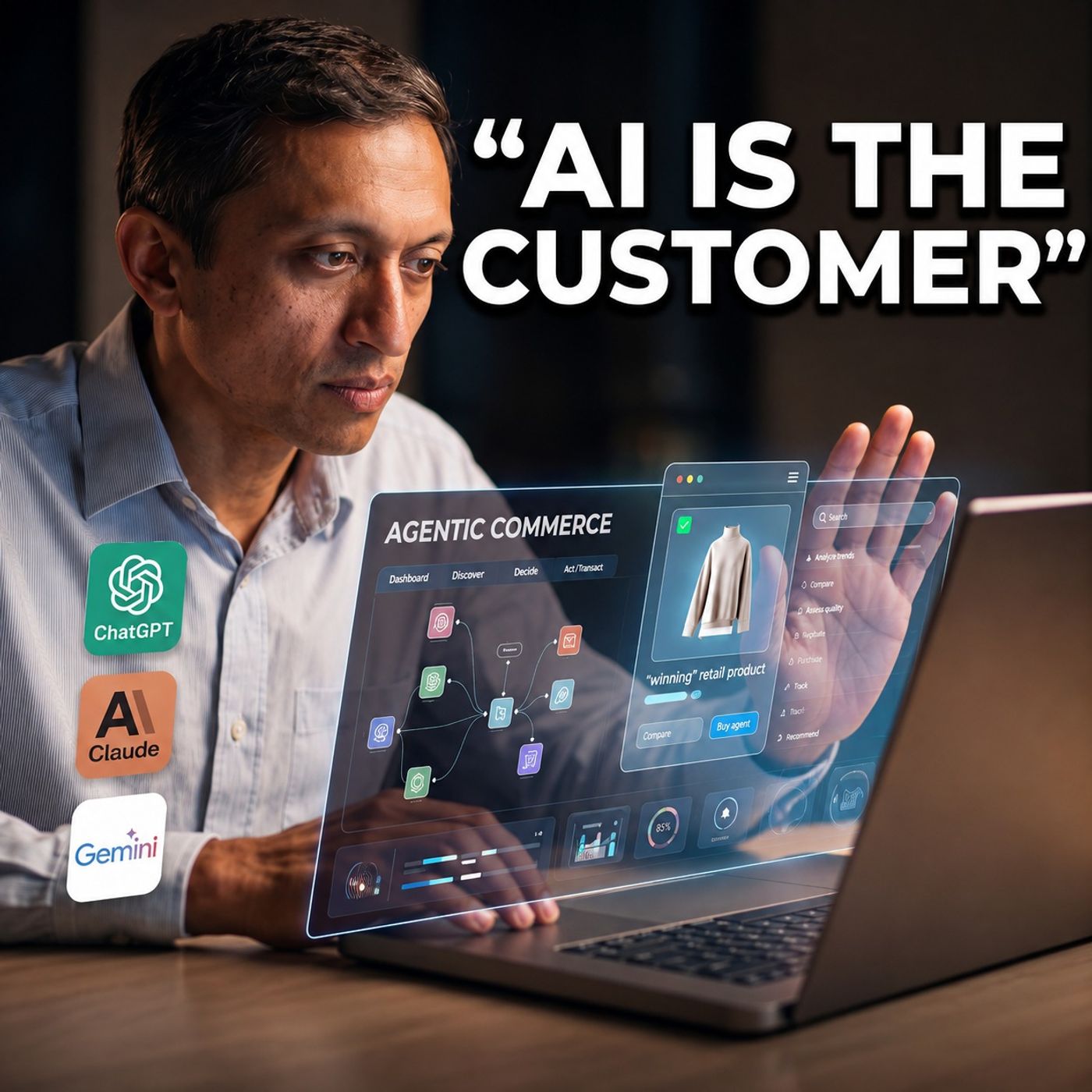
Retail and grocery performance news (Amazon, Shopify Canada, luxury outlook, Warby Parker, Wayfair) plus a live interview with Wharton’s Kartik Hosanagar on “when AI becomes your customer.”
Kartik Hosanagar, John C. Howard Professor of Technology and Digital Business at Wharton; co-director of Wharton’s AI Center; co-founder of (stealth) Bodium Labs/Bliss Labs; previously founded companies; wrote “A Human’s Guide to Machine Intelligence.” Podcast hosts: Michael Oloa and Steve Dennis (NRF retail voices).
The biggest retail shift is not AI as a new channel, but AI systems making decisions on behalf of customers—so retailers must influence AI like a customer. Retailers should avoid the “dangerous middle ground” between efficiency and meaning; choose either an efficiency plan (AI-optimized information) or a meaning play (experience worth showing up for). Trust and persuasion in AI are poorly understood; retailers need experiments.
Ridge wallet brand went from not appearing in “gifts for men” ChatGPT answers to being the main recommended brand in three weeks, but ChatGPT also hallucinated promotions. Hosanagar suggests “digital twins”/simulation sandboxes to run counterfactual tests (e.g., table-format product info) before rollout.
Written by AI. May contain mistakes.
Steve shares details about an upcoming webinar on shifting consumer demand.
“Hey, Steve, you mentioned earlier in the season you were partnering with our friends at Placer AI with a webinar in the fall.”
Discussion on Amazon's impressive financial performance and growth metrics.
“So every time I think Amazon has reached some kind of zenith and I'm just waiting for some kind of shoe to drop, they don't.”
Reflections on Amazon's leadership transition and its impact on the business.
“Like, if you think about Apple, when Steve Jobs left or passed on, and some guy named Tim Cook took it over, They're like, I wonder what's going to happen to Apple.”
Analysis of Shopify's growth and its significance in retail.
“We have lots of others, but nobody is successful as Shopify.”
Exploration of the luxury market's uneven performance and current trends.
“Let's check in with one of your predictions.”
Introduction to the interview segment featuring Kartik Hosanagar.
“Well, that's the first part of the news.”
Kartik discusses his background, research in AI, and his insights on e-commerce.
“For now, let's get to our great interview with Kartik Hossanagar.”
Discussion on how AI is changing the concept of 'customer' in retail.
“So, as I said, we're getting you not exactly the minute you came off stage.”
Exploration of how AI impacts customer decision-making processes.
“There's also this whole thing about disintermediation.”
Insights into the rising costs and challenges associated with implementing AI in businesses.
“We don't know today, and that's where I would really recommend your listeners, those in retail, those in branding and so on, to be really thinking about.”
Karthik shares a case study about Ridge Wallet's visibility challenges in AI search.
“I mean, I'm starting to hit thresholds And I don't use it anywhere near like big retailers do.”
Discussion on two strategic paths for retailers: efficiency vs. meaning.
“And I was really interested when I saw some of the stuff you're going to be speaking about because I will say you're very aligned with my thinking, so it must be right.”
Exploration of why creating a unique shopping experience is essential in retail.
“I'm breaking a little bit of news here, but I'm working on a new book that's, you know, kind of very much in this direction.”
Discusses the need for retailers to create engaging in-store experiences to draw customers in.
“Because there's, there's really no joy I get from walking into one of these stores and kind of discussing like my internet plan.”
Explores the dichotomy between efficiency-driven capitalism and the necessity of emotional, human experiences in retail.
“Just sort of errands versus experience, you know, more emotional experiences.”
Examines how retailers can leverage AI simulations to optimize strategies and improve decision-making.
“Is that what you find, I guess, from your academic lens or just your general experience?”
Discusses how brands can use storytelling and experiences to connect with consumers in a digital world.
“I mean, literally, we found that you present information in a table format instead of usual essay format.”
Kartik Hosanagar shares insights about his company Bliss and its innovative approach to AI in retail.
“is when you ask them a question, there's a bunch of things that influence their answers.”
Provides actionable advice for retailers on staying competitive in a rapidly changing market.
“generous with your time and insights, is for the retailers listening, what's the one or two or three things they need to prioritize or think about in this rapidly changing world?”
Learn about the importance of curiosity, experimentation, and collaboration in adapting to rapid changes in retail.
“If you don't do these three things, you're going to really fall behind.”
Hear reflections on the interview regarding AI and its implications for the retail industry.
“I really appreciate your time and wish you continued success on the new startup and the work you're doing.”
Discuss the pitfalls of channel strategies versus a holistic view of retail dynamics.
“You know, when thinking about my interview with him, I thought I had AI all figured out because I was like, AI is easy.”
An analysis of Wayfair's recent financial progress and challenges in the home furnishings market.
“but is showing some positive signs of improvement and making progress, Wayfair.”
Examine Warby Parker's growth, challenges, and the impact of new store openings on sales.
“Well, sticking with the W's, let's move to a retailer we've been more positive with.”
Discuss current tariff implications and the financial landscape for retailers amid changes.
“Well, you know, just when you think it was safe to not talk about tariffs anymore, here we are again.”
Explore the emerging trend of live selling and its potential impact on retail shopping behaviors.
“It's a certain kind of fun and it's addictive qualities.”

Get the gist, explore an idea or ask about something said.
 Claude
On Remarkable Retail Podcast, what are the key points of this episode?
Searching your listeningAutomatic transcript. May contain errors.
0:06Steve Dennis: Welcome to the Remarkable Retail Podcast, the only podcast hosted by two of NRF's top retail voices for 2026. I'm Michael Oloa. And I'm Steve Dennis. On this episode, our guest is Kartik Hosanagar, professor at the Wharton School of the University of Pennsylvania and co-founder of Bodium Labs, recorded live in person at our pop-up podcasting studio in New York at the Commerce Next Growth Show. Kartik is no woolly-headed academic. He's the John C. Howard Professor of Technology and Digital Business and puts his rigorous academic experience and research into AI, into the wild, into real-world practice with his clients.
0:43Steve Dennis: It's a great interview. Also, in this episode, we'll be looking at Amazon's blockbuster numbers and the deeper lessons for the retail and grocery industry, Canada's Shopify solid results, catch up on your prediction for luxury industry, Warby Parker update, and in a clear departure for us, something actually quite very positive about Wayfair and what is on our respective radar screens. Hey, Steve, you mentioned earlier in the season you were partnering with our friends at Placer AI with a webinar in the fall. Do you want to update people on that? Yeah, it's coming up relatively quickly. So if you haven't saved the date, go ahead and do that.
1:17It is Tuesday, September 29th at 1 p.m. Eastern time. It's one of the Placer Discovery sessions. We're going to be talking about shifting consumer demand. And when I say we, it's going to be Placers RJ Hattavi. I always say his name wrong. Sorry, RJ, for messing that up. We've got several topics we'll get into a little bit about what's going on with consumer behavior as we head into the holidays, some general retail trends, the state of retail turnarounds, maybe a few predictions. And I think what's really exciting, if people haven't checked out the Placer discovery sessions in the past is they have a ton of really, really interesting data by category, by retailers to really dig into.
2:00It's not going to just be pontification, it's going to be some real data and analysis and perspective. So look for the registration information on my sub-stack and on LinkedIn coming up pretty soon.
2:13Steve Dennis: And listeners might remember that or recognize that name, RJ from Placer was on the stage with us back at Shop Talk when we were doing the debates, the battles. so he would be a somewhat familiar voice to dedicated listeners. So looking forward to that. September 29th, you said, right? September 29th. All right, well, let's get into the news. So every time I think Amazon has reached some kind of zenith and I'm just waiting for some kind of shoe to drop, they don't. I mean, their numbers just keep rolling on. Blockbuster earnings, take us through it. Yeah, well, it really is incredible, both at the overall Amazon level because they had huge gains in AWS, huge gains in their advertising business, flowed through to the bottom line very, very well.
2:57I guess the other thing at the high level, and we'll talk about retail in a second, is they, like Meta, like Google, like just about all of these hyperscalers, are spending a humongous amount on capital. Some folks might have seen I posted a chart that I borrowed from Scott Galloway in his newsletter and podcast showing some of the comparisons of the spending against each other, but year over year. And it's just massive, the amount of incremental capital that's going in mostly to AI, but to other support things. The retail business in particular, again, we've talked about this probably for the past year or so, where Amazon keeps putting really strong numbers on top of really strong numbers and a huge base.
3:45So the retail business overall on a revenue basis grew 16%. That compares to 12 % last year. One of the things I think we always put the caveat on is Amazon's revenues in retail are a mix of their first party sales, but over 60 % of their retail business now is through third party. And so their revenues are what they're getting paid by their business customers. But But some folks do try to estimate what their GMV is. So that's what the consumers are actually paying. And Citibank, anyway, is often considered to have the best estimate there. And they show that that GMV growth was about 10 % year over year.
4:28So that's twice the retail industry average. And again, on a huge base. A couple other just little fun facts, which they called out, is their business-to-business division is now generating revenues of over$60 billion. Sometimes because Amazon's so huge, it's just hard to get your head around some of these numbers. So I'm curious, if you just looked at the$60 billion in revenue, even though that's business to business, how does that compare to other retailers? And there are only 11 retailers in the U.S. that would be bigger than$60 billion. So it just kind of gives you a little bit of perspective there.
5:04Of course, Amazon always goes through this litany of fun facts about the business, and usually that's pretty interesting to take a look at. The set of things that I really focused on is what they had to say about agentic commerce. Folks might know that when they launched their original agent, they called that Rufus. They've now retired the Rufus name and put it all under shopping by Alexa. But they quoted a lot of numbers about year-over-year growth and what percent of people are using AgendaKai. And they're really, really impressive numbers, like I think just about everybody's numbers are. Relatively small base.
5:44And a lot of times, of course, we see retailers quoting how much better the people that use their agent perform relative to everybody else. I still think that we have to be careful, as impressive as it is, to recognize that there is a sample bias there that you're more inclined to use an agent. Remember we had that discussion with Amazon over dinner in Vegas, right?
6:05Steve Dennis: That was a big point of the discussion. We had a very good discussion with folks from Amazon about that exact issue, right, when you start quoting these. On the one hand, you can certainly say that there's got to be that bias, and we should be careful unless we've got really kind of apples-to-apples comparison to make too much of that. But at the same time, the usage is increasing very, very quickly, and it is already a very sizable base. So I think it takes a little bit more time to really understand how significant that is, and there's a lot of hype behind it. and some of the agentic stuff is really just kind of a slightly better search.
6:41It's not some fundamental change in shopping behavior. But there's no doubt that these numbers are quite large already and growing very, very quickly. I guess the only other thing I wanted to point out from their results is really a continuation of what we've talked about for a little while. It's just the continued growth in their grocery business. I'm actually going to be out at Amazon for Analyst Day, and I'll probably know a little bit more about this. so I'm sure I'll know a little bit more about it next time we get on the mic. But their grocery business continues to grow very quickly. I think last time we talked about how they became the second biggest grocer in North America.
7:20They didn't share a lot of specificity other than to say that the grocery business is growing disproportionately well. So given what we've said about their year-over-year growth, you can interpret how you will there. But there's no loss of momentum there. And when you see some of the results from the more traditional grocers, which are flat-ish at best, I think you can definitely conclude that Amazon is gaining quite a lot of relative market shares. That's a story to definitely watch.
7:50Steve Dennis: Well, you know, every time I think about Amazon, I listen and hear their numbers. It makes me think about succession planning. Like, if you think about Apple, when Steve Jobs left or passed on, and some guy named Tim Cook took it over, They're like, I wonder what's going to happen to Apple. And then when some new guy took over Walmart, and then when Jeff Bezos left, everybody was like, huh, I don't know how that's going to work out. Turns out pretty well, right? The foundation was built quite well. It's not always the case, right? Think about the Jack Welch days at GE and what happened to GE after he left.
8:21Steve Dennis: So I just wanted to acknowledge how successful Amazon is at that succession planning and moving into new leadership, right? So congratulations to Amazon. Lessons to be learned, for sure. Let's talk about Shopify. Canada's tech darling, so to speak. We have lots of others, but nobody is successful as Shopify. They've put up some pretty big numbers and very, very connected to the retail space. So talk about those. Yeah, we don't talk about Shopify all that much, which is kind of strange because they are such an important part of the retail ecosystem. Obviously quite huge, serving, I don't even know what the number of retailers that are on their platform would be.
9:02It tends to skew small and medium size, but they've got some big enterprise clients as well. Their revenues were up, I think, 32%. Several straight quarters now where their numbers have been extremely strong. Profitability is excellent. I guess the thing I was thinking when I stepped back, somewhat in the context of Amazon's results in particular, We'll hear from Walmart and Costco in another month or so, I guess, because slightly different reporting period. But, you know, they've been talking about how strong their e-commerce growth is as well. But when you look at e-commerce overall, the growth rates are maybe high single digits, right?
9:44And so you just see a few of these very, very big players growing at these extraordinary rates. And for the most part, you don't see the rest of the retail growing very much on the e-commerce side. So it's kind of a tale of two cities. But yeah, shout out to the gang in Ottawa and Montreal and throughout Canada that are driving these numbers. Super, super impressive. Nasty Canadians. Maybe it's because they're nasty. That's right. I couldn't be.
10:13Steve Dennis: Let's check in with one of your predictions. We've been doing this periodic check-in. And this time, let's focus on prediction number eight for those who are following at home. Luxury's future will not be evenly distributed. Talk about what your observations are here in the month of August, three quarters or somewhere through the year. Yeah, we are doing kind of this mid-year-ish check-in rather than kind of going through all of them. And part of the reason why I picked this was that we do have a bunch of luxury retailers' earnings. So it's easy to kind of connect it to some data. But the general prediction was, even though we've got this rich getting richer, so much of the retail shopping coming from the more affluent consumers, which might make you think that luxury would perform super, super well.
11:05My prediction is, no, we wouldn't necessarily see that so much and that we kind of continue to see this pattern of a few players doing especially well. but most of luxury, I wouldn't say struggling necessarily, but not really lighting things up. And that's kind of what we're seeing. I mean, some of this is maybe not totally anticipated. I mean, I think the weakness in China, which is a big market for lots of global luxury players, obviously, but kind of the surprising thing when I put this prediction together was it didn't expect war to break out in the Middle East. And definitely some of the weakness we're seeing from some of the players is particular to the Gulf region for, I think, obvious reasons.
11:44But if we look just kind of quickly at some of the results, a few of the really big kind of conglomerate players like LVMH and Caring, which is the owner of Gucci, Burberry, I mean, their numbers are lower than the average retail growth rates we're generally seeing. Capri, which their big brand there is Coors, has been weak. Hermes, which has been above average. In fact, high single digits, I think, for the last several quarters slowed a little bit. But still, 6.7 % revenue growth is pretty good. But a couple of outliers. Ralph Lauren, which has been doing quite well for a while, continues to do well.
12:29They had growth of 13%, 14%, depending on how you look at it on a constant currency basis. Richemont, which is mostly in the jewelry business, also really strong results. and your really strong results. So it's kind of a little bit all over the place. The bigger traditional players, I would say, kind of meh, but I think they are being affected by what's going on. The ones that are more international, have bigger China, bigger Middle East businesses, that's definitely being weighed down. But then you see some of the really great brands performing super well. So Hermes, Ralph Lauren, just keep going.
13:08So I guess, you know, I would say at this point I'm doing okay on the prediction that there isn't going to be a robust turnaround overall. That definitely doesn't seem to be happening so far. But, you know, the ones that have really been successful in the past, you know, for the most part, continuing to do well.
13:25Steve Dennis: Seems like a robust turnaround is only going to happen when things settle down in the Middle East and in Russia. We don't talk about Russia very often, but in the day, Russia was a huge buyer of these luxury goods, right? Absolutely. All right. Well, that's the first part of the news. We'll be back talking about Warby Parker and Wayfair, as well as what's on our respective radar screens. For now, let's get to our great interview with Kartik Hossanagar. Kartik, welcome to the Remarkable Retail Podcast studio here live at Commerce Next. How are you today? I'm very well. Thank you, Steve and Michael, for inviting me here.
13:57Well, we're happy to, and we're going to get to this. You did a really interesting talk on stage that we'll, I guess, unpack, as the kids like to say. But before we get into that, maybe you could just tell our audience a little bit about who you are and what you do. Yes, of course. So I'm Karthik Hassanagar. I'm a professor at the Wharton School at the University of Pennsylvania, where I'm also a co-director of our AI center. And outside of that, I am a co-founder of Bliss Labs, which is a currently still in stealth AI, applied AI company.
14:34Steve Dennis: Not after this podcast. Not after this podcast. Yes, that's true. But we're broadly focused on agent e-commerce and AI search. And then outside of that, I've previously founded a couple companies and written a book called A Human's Guide to Machine Intelligence. Excellent. Excellent. So, as I said, we're getting you not exactly the minute you came off stage. It was a little bit earlier in the day. But the topic of your talk was when AI becomes your customer. Could you just, obviously, we're not going to do the whole thing here, but could you just give us a sense for why did you pick that topic?
15:06What was kind of the main series of points you were trying to make? Yeah. So, a couple of reasons why I chose it. I think, you know, the point I started with is that I believe that the biggest shift in retail happening right now is not that there's a new technology or there's a new tool or even a new channel for product discovery. But it is that you have a new customer. And the reason I brought that up is that, you know, a lot of people currently think about AI as another channel through which they can reach their customers. And I think that's certainly true, but it is dangerous because it's incomplete.
15:48And when you think about it as a channel, you're kind of missing something very important that could happen. And that is that these systems are not just a means through which your customers are going to come to you, but they're going to be making more and more decisions on behalf of the customers. and when they are making decisions actively, you should think of them like the customer. You should think about, you know, how do you influence them? All of those things. And when you think about them as a channel, you're not thinking about them much more than our regular customers are going to come through this channel.
16:24And the other point I'll quickly make is that it's a bit like, you know, when the movie studios thought about Netflix and the streamers as another channel, distribution channel versus a full system level shift that was going to change over the next several years what got made by whom and who gets to see and that's the kind of change coming up. So is that just to kind of tease this out a little bit you know it's not uncommon for people now to think about you know when they realize that Google meta were you know basically toll booth operators right you were traveling kind of on their highway but then they eventually figured out how to extract more money.
17:03It's not exactly what you're saying. There's also this whole thing about disintermediation. So how does that touch on, or does it touch on what you're talking about? So it touches in one way, and that wasn't my main point, but the manner in which it does touch is that if these systems are making more and more decisions on behalf of the customer and also influencing the customer's decision in a big way, it increases the power they have in this value chain. And so there is certainly a shift in how much more they can control systems. We've already seen ChatGPT attempt or OpenAI attempt to roll out instant checkout where even the checkout would happen on their platform.
17:51It didn't quite work out, but it gives you a sense for the kind of ambition they can have if they're controlling the customer's discovery and decision-making here. Sure. So broadly speaking, obviously things are changing quite quickly, but when you think about how agentic AI, I guess in particular, what behaviors does it tend to reward or maybe downscore? And how does trust between a retailer and their end consumer change by virtue of that? Yeah, that's an interesting question. And I think the short answer is we know very little today about how you pursue. Nobody knows nothing, right? Yeah. I mean, if you think about it, we now have decades of research on how people make decisions.
18:41We know$9.99 is not the same as$10. We know social proof matters. You know scarcity. And, oh, we're running out of stock. That makes a difference. Now, do all these things work with AI? We don't know. We know how color and copy matter. How do they work with AI? We don't know. We know AI is going to have its own biases, its own framing effects. But in fact, my main point is that we are lacking the equivalent of a marketing science for AI. And that's where both researchers and practitioners will have to focus and run lots of experiments to figure out how or why is the AI system recommending one brand versus the other and things like that.
19:26So we learn it over time. So my short answer is, I don't know. I could hypothesize a few things. And we've seen a few things. We know, for example, what a large language model thinks about a brand is influenced partly by what the brand puts out there, but it also is influenced by what other companies, other media outlets, as well as community sites like Reddit and others are discussing about the brand. And so all of that matters. But what drives trust in an AI system? How do you influence the AI system? We don't know today, and that's where I would really recommend your listeners, those in retail, those in branding and so on, to be really thinking about.
20:08Because if you understand that before everyone else, that's your goal. Yeah, that's your superpower for sure.
20:17Steve Dennis: Let's broaden the lens a little bit and talk about the risks and the costs behind AI. Satya Nadella had a pretty bracing statement this week basically coming out and saying, we just can't have all these companies leading AI and sucking up the world, all the oxygen in the world. And as part of his message, he was saying that companies are realizing that they're starting to see the costs go up and up and up. It's not so free. It's kind of like Uber in the early days. It's a cheap ride. Now it's not cheap anymore. Those days are long gone. So I think about the risks to companies and I think about the escalating costs.
20:52Steve Dennis: How do you think about him? Yeah, I think those are good points. I think as far as Satya Nadella's comment, you know, it's probable, possible that he meant everything he said. It's also possible that they're worried about losing their market share to these AI labs. Well, of course, it's funny because he was the biggest funder, one of the bigger funders behind, you know. Yeah, behind OpenAI. And then, of course, their relationship went south. So, yeah, who knows what he's really thinking. Yeah, exactly. But I will say that, yes, costs are a big driver. And a lot of companies have been telling their employees, look, we need to embrace AI.
21:37We need to push on AI. and a strategy that many on Twitter are calling token maxing, which is the idea that we will even measure employees based on how many tokens you're consuming as a way to say, hey, you're AI forward. But if AI is showing that you're AI forward is a matter of just consuming more tokens, that's a race to the bottom. Maybe they're processing Bitcoin or something.
22:01Steve Dennis: I mean, maybe they're just using it. Exactly, who knows what. I mean, I'm starting to hit thresholds And I don't use it anywhere near like big retailers do. I'm starting to hit limits and thresholds too. Now, I want to change tacks a little bit. Where I'm from in Canada, there's a story about BMW and a customer who got an offer from a BMW chatbot that he tried to cash in and they reneged on it. It said, we never made that. The AI made that. Now, you've got your own example about a men's wallet and gifting. Talk about why you use that as an example and what's going on there. Yeah, so I use the example of direct-to-consumer men's wallet company, Ridge.
22:40And late last fall in October, they were interested in assessing their brand's visibility in ChatGPT. And of course, if you search for best men's wallet, best men's minimalist wallet, they would show up. But the real search for them was best gifts for men because that's how their customers, wives, sisters, you know, and so on would find gift for my brother, gift for my husband and so on. And when they did that search, they were almost never showing up. First of all, if a wallet brand was listed in that answer, it was not them. And so that worried them. And then, you know, I worked with them a little bit.
23:21We tried a bunch of different strategies. in three weeks they went from not showing up to being the the main brand that shows up as the main wallet recommendation that shows up when you search for gifts for men and that happened in just three weeks but at the same time what also happened was that the LLM chat gpt was sharing some information about promotions that they were offering except that it was not an actual promotion that they were offering. And it was either a hallucination or something that ChatGPT picked up from Reddit or wherever. So for me, it was a great example of both the opportunity and the risks here where they went in just three weeks from being completely invisible to being famous, being the default wallet brand and also having their brand message be hijacked by a hallucinating LLM or a community information that was taken in here.
24:20So I thought that was an interesting way to present the... Risks and opportunities. Risks and opportunities, exactly. That was a great story. What a time to be alive, huh? Let's get a little bit strategic. And I was really interested when I saw some of the stuff you're going to be speaking about because I will say you're very aligned with my thinking, so it must be right. But you argue, so I've talked about it as the difference between buying and shopping, errands and experience is a little bit different than you talk about it as kind of two viable strategies, efficiency or meaning. Can you just tell us a little bit more about how you see that and therefore what should retailers be doing?
24:58Yeah, so I was mentioning at a strategic level, retailers and brands should be thinking about a very clear dichotomy here. One is what I call an efficiency plan, which is that an AI system is going to drive a lot of decision making And for a customer, it's, you know, you need to get a job done. And you're kind of saying, okay, if an AI can get most of it done for me, fine, let it do it for me. And if so, then your strategy as a brand has to be, how do we make sure our information is accessible, readable in the right format where AI can ingest it? How do I make sure I can influence that AI system and understand what drives AI recommendations and so on?
25:45and the challenge with this is that it's going to be a mix of data technology marketing so it's a multidisciplinary play at a time where within retail companies you have people claiming you know this is my turf this is my turf they have to break those boundaries and come together now the other strategy is a meaning play where you can really deliver to the customer an experience that is worth showing up for. And so over here, the point is, even if an AI system can do a lot of the work for you, I still want to show up and I want to shop because that shopping experience is really enjoyable and there's product categories like that.
26:25And that requires craft and branding and so on. And that's the other play. And I think the dangerous middle ground is trying to be in between and trying to do both. Right, right. Do you see any room, because I'm working, I'm breaking a little bit of news here, but I'm working on a new book that's, you know, kind of very much in this direction. And one of the things I've been thinking about, I call it sort of jobs versus joys, but you know, it's a lot of different words. But anyway, 10 years ago, I talked about the collapse of the unremarkable middle and the bifurcation that was going on in retail.
26:54And it seems like it's just, this is causing it even maybe more to polarize. But as I started to think about some of the stuff you're talking about, you know, there is a role, I think, for a little bit of meaning. as I frame it, sort of joy. But when you go to Costco, for example, you're mostly going to get a job done, but there's aspects of fun or meaning or Trader Joe's is maybe a bigger example because you're sort of the tribe. So there's this emotional side to it. And I wonder whether it's not quite so black and white. But particularly from the context of AI, I mean, that's a little easier to imagine just going into a store and feeling it.
27:35It's not so much starting with an agent or using AI to shop. Any nuance you'd give to that? Yeah, I like those examples. And I think, you know, I enjoy going to Trader Joe's Whole Foods and there is something interesting about coming in and even discovering some new items they've added in there. And, you know, there's all of that stuff. But I think that's an interesting example where you curate and create a nice experience worth showing up for. But I'll give you another example and i won't name the company i was just talking to somebody right after my talk and this person is at a um telecom company they sell internet access and they have uh stores where you can go in and sign up for uh internet access like your home broadband and so on there's many companies verizon at &t charter comcast and so on now we were chatting about it and i was really kind of telling her, give me a reason to show up at your store.
28:34Steve Dennis: Right. Right. Why am I showing up? Because there's, there's really no joy I get from walking into one of these stores and kind of discussing like my internet plan. You give me the information, I'll sign up online. Right. Right. So that's like, to me, a really good contrast. So if you, if you are going to invest in retail and invest in physical retailing and you're going to invest in experiences, like really double down on that and deliver wow with that experience. Otherwise, you know, it doesn't matter. And you brought up joy. What did you call it? Joy versus jobs? Yeah. Yeah. Just sort of errands versus experience, you know, more emotional experiences.
29:17So here's what's interesting about it, that in the past, there might've been certain things that were errants and certain things that were experiences to your use your term but i had no choice i had to show up for both right but today if something's an errand i can outsource a big chunk of it to you yeah and i can focus on what's the experience it's like meals i'll look forward to a dinner a special dinner at a restaurant with a great chef but then there are other things where i'll doordash it sure and it's a means to an end right and so you've got to be clear if you're a restaurant, am I the experience you want to show up for?
29:54And am I the doordash restaurant? Right. Do you feel, and I'll pass it over to Michael, but do you, you know, I know some of the people, you're probably familiar with the book Filter World, you know, there's this idea that, you know, kind of mindless capitalism and, you know, all the tech giants and everything, there's a sort of inexorable pull towards the optimization efficiency side. And then, you know, then there's this counter narrative of, well, don't lose sight of the human or don't lose sight of what physical stores do better than an agent or just even e-commerce, right? You know, it's not even an agentic, pre-agentic world that was, had some of the same kind of conversations.
30:28Do you think that's true that there's a kind of bias towards efficiency because of the way companies are run and it's easier to do the productivity thing than to maybe take the risk to create that wow experience or to create an environment that you can't quantify, you know, why is there a bar? Why is there, you know, climbing wall? You know, those kinds of things. Is that what you find, I guess, from your academic lens or just your general experience? Yeah, I mean, even before the academic lens, I'll give you an anecdote. I was in Portugal last week. And one of the things we were looking, I was noticing, my wife and I were like, wow, everything is slow.
31:12And initially, we're like, we're not moving fast. We're not getting out of this place fast. And so I was like, oh, you know, we're always rushing it. And that's the American way. We're just like, it's all efficiency here. But the whole world is not like that. It's a very American thing. And you go to Europe and you're like, oh, there's a different way to live and to breathe through things and experience things and so on. I also think there's a lot of heterogeneity in this, the productivity play based on people. Some people prefer some one way, some people prefer others. So even within a product category, there's scope for brands who are focused on the efficiency play and focus.
31:48There's room for brands who are focused on the experience play. And it's also there's heterogeneity by product category. So how does this efficiency focus play out in groceries versus, say, shopping for clothing versus shopping for jewelry or luxury watches? Luxury handbag. Yeah, exactly. So there's all of this. I think there's room for multiple strategies, but be clear on your strategy.
32:16Steve Dennis: Right. Pick a lane. Yeah, pick a lane. Yeah. I want to take you back to some of those comments you made about earlier on, very provocative, about scarcity and the 99 cent versus the rounded up dollars. All the things that really were part of a retailer's persuasion book seem to be a different set of elements around AI. You kind of hinted at it. You didn't reveal any secrets. But when you work for the wallet company, you were able to find a way to persuade or inform the AIs. Talk about what retailers should be thinking about and how to persuade AIs and change that dynamic or understand the psychology of the different.
32:53Yeah, so I will share a little bit on how to approach it rather than this is what works with AI. Because it's too early to say this is what works with AI. So how to approach it is that the nice opportunities these AI systems are probable. meaning you can probe these systems and you can ask counterfactuals on what will happen if i change this or that a simple thing you could yourself do is you know create two versions of a page two different products your product your competitor's product and create that and kind of say hrgbt here's information on product a here's information product b which one would you prefer and why and so on and give you a recommendation and then you can ask then you can make changes and see if the recommendation changes and you're describing your product differently or changing your price and you're seeing what it's doing to the recommendation but that's a simple experiment you do but a more i guess a research-backed approach would be that it's possible today for you to create simulation sandboxes where you can create a digital twin or a replica of an llm like chat gpt or gemini and then you can ask if you have a good simulator where if you ask the question to your simulator, the answer resembles what you would get with the actual LLM.
34:15You can now run all kinds of experiments where you can release AI agents and set them free and have AI agents create thousand variations of your website and for every variation, ask the same question and see how the AI answer is changing. and before you know it, instead of trying something and then waiting six to eight weeks to see how the AI answer changes and find out it didn't work, now you try your next strategy, wait for six to eight weeks and do this for a long period of time. You can do this in simulation, get the answer in a day and now you've pre-tested 100 strategies, found the three that works and you roll it out.
34:52And that's what we did with these other brands and that's how you get to, instead of trying and then waiting and crossing your fingers and hope something works, All of that is happening in the simulation. The strategy you deploy has been pre-tested, and so there's a 90 % chance it works. And that's what happened here. And sometimes it's silly things. I mean, literally, we found that you present information in a table format instead of usual essay format. LLM suddenly seemed to take it very seriously if you're providing a table format. And some of it is, you know, it's maybe structuring the data differently.
35:29it's providing information
35:30Steve Dennis: is a shortcut to do not a shortcut is the wrong word but is a halfway mark having the LLMs judge two things it will pick one could you just ask it why it picked that one does that work it doesn't because LLMs make stuff up and they're very obsequious oh that was such a great question you're the smartest I couldn't pick but I just yeah exactly you ask it why did you pick something it's going to make up an answer and say here's why i picked this and you will either believe it or you'll ask a question but then what about this other thing and say oh you're right oh you're right i totally forgot that i need to be truthful here's something that one of those yeah so i think the better way to do this is actually run the experiment and build that digital twin exactly one of my phd students is doing that where we just keep changing things and keep asking the llm the same question and suddenly you see when i change the image this way the answer suddenly changed or when I changed the, you know, metadata in this following manner, the answers just changed.
36:32And now you know the real answer versus asking the LLM, which is a bullshitting genius.
36:39Steve Dennis: So fun. Let's talk about the last question. I'll pass the mic back to Steve. I want to understand, like, there's some brands that really, sometimes it's said they buy the story before the product. You know, they really focus on the meaning behind them, the essence. I can think of, like, a Yeti, for example. Like you're really buying the outdoors, you're buying whatever. There's all kinds of other examples. Teco Bass is like that. You're buying experience. Not that we like to mention Teco Bass a hundred times, but they were on the stage. So they're top of mind for me. But anyway, in the context of these agents, how do brands think about being discovered as an experience in a fairly algorithmic world?
37:17Yeah, I think if you actually break it down, what's going on with a lot of these agents is when you ask them a question, there's a bunch of things that influence their answers. One of it is that they actually go use search tools because whenever they were trained, that was six months ago, five months ago, that data is old. So they use search tools to fetch new information. So some people who say SEO is dead, I say it's not dead. Its relevance has changed and it's kind of different because the AI systems are now using search tools. But not earlier, you would only focus on Google, but now only Gemini uses Google.
37:53ChatGPD uses a different search engine. Claude uses a different search engine. So first it is, you know, it's first breaking down if I ask a certain question, what is the LLM doing? What search tools are those LLMs using? What pages are retrieved? Then it's based on how are you represented in the training data? So all of these things start to matter but the nice thing is it's an algorithmic system that you can break down into subcomponents and ask, where am I losing this battle? And so that's why I kind of feel that this is something you bring some real science to it. You can actually break down and figure out why am I not winning this?
38:34And what needs to happen for me to win this? Fascinating perspective. Yeah. Well, you've dropped a lot of knowledge, which is of course what we want. Before we let you go, though, I also wanted to just see if you might spend a minute or two because in addition to being faculty at Wharton, you're an entrepreneur. You have this, you mentioned it at the outset, a company called Bliss in stealth mode. Can you share a little bit, even though it's stealthy, a little bit about what you're doing? Yeah, it's funny. You know, we haven't yet launched. Part of the reason is we haven't fully finalized the name we'll be launching.
39:07So we've got two names. Bliss-ish. Yeah, Bliss-ish. So we've got two names, Bliss Labs and then Bodium Labs. We're sorting through trademark for each of them. Have you asked ChatGPT, which is the better? Oh, I should. But then it's going to be its way to the answer. So I don't know. But yeah, what we're doing, really what motivated us to start the company was that, as we just discussed, AI is already driving a lot of product and discovery and research for consumers. And over time, it's going to have even more and more impact. But everything we see in this space right now, in, you know, people have different terms for it.
39:47Some call it generative engine optimization. Some focus on agentic commerce. But everything we see in this space, we feel is not rigorous or science-based. So a lot of the solutions here, for example, will do things like, okay, let me guess what your customers might type into ChatGPT. Let me send those questions to ChatGPT. Let's see if your brand shows up or not show up. And we'll present the analytics to you. Okay, so what am I supposed to do with the data? What actions should I take? no one knows so the the typical answer is why don't you try publishing more blog posts and hopefully one of those posts might change the AI update your wikipedia yeah update your wikipedia push more blog posts and hopefully something changes it's a bit like throwing spaghetti on the wall and hoping something sticks and so what we wanted to my co-founder was at google deep mind just before this, I was at, I'm still at the Wharton School.
40:42Our research was looking at the fact that as we just discussed, you can actually break these AI systems down into subcomponents, figure out why the answers are what they are. And if you can actually build those simulations that I mentioned, you can run counterfactuals. What by that I mean, is there a different website or a different web copy or a different social media presence of mine where suddenly I start to win. And the analogy I provide is, I don't know if you guys remember this, I think it was the Avengers movie where the multiverse won, where they're losing. And then this person shows them, hey, there's all these different universes and here's one you're actually winning.
41:21And let's focus, let's go there. And so that's what we do. We simulate thousands of different universes and tell you, this is the one where you're winning. And then you can go in that direction. So it's bringing actionability to a lot of this stuff.
41:32Steve Dennis: Well, I guess, are we living in a simulation or are we living in a Marvel movie? More and more, it sounds like we're living in a Marvel movie. Last question, and I guess it's kind of a tough question because you've been so generous with your time and insights, is for the retailers listening, what's the one or two or three things they need to prioritize or think about in this rapidly changing world? I mean, you've given them lots of great ideas to get their arms around the digital twin idea, but is there any, in a succinct kind of way, one, two, three, you got to do these three things. If you don't do these three things, you're going to really fall behind.
42:04Yeah, I would say a couple things about the attitude you need to bring in here. And then maybe one thing on tooling or resources here. The attitude is important because when things are changing that fast, I think you have to, first of all, be way more curious than in regular times. You've also got to be way more experimental than in regular times. And you've also got to be way more collaborative than regular times. And so I think that's the attitude that I'd really advocate your listeners to, which is be more curious, try more things, try things internally with vendors, be open to experiments because this is a time of change and the learning you will get from trying many things is going to be great.
42:50And be collaborative with other people within the company. You know, I just talked earlier about how sometimes there are silos and it's like, oh no this is our domain but what's the point of it being your domain if you don't know the answer and you know we're all going to sync together with it how do we collaborate how does marketing collaborate with the data science team with the technology team how do we all come together and not say this is my turf this is your turf so i think those are the attitude kinds of things i
43:14Steve Dennis: would say it's fascinating because if you think about the covet year of retail it built a lot of resilience yes whereas this ai area area of retail or era of retail is building that curiosity and experimentation. I mean, it is all a little bit exhausting, though, right? I mean, to be always curious, always trying more. But with your advice that you've given us today, I think it's very, very helpful to everybody trying to figure it out. So thanks again for joining Steve and I in the Commerce Next podcasting studio. I really appreciate your time and wish you continued success on the new startup and the work you're doing.
43:49Thank you both for having me. Really enjoyed being here.
43:51Steve Dennis: We are back. You know, when thinking about my interview with him, I thought I had AI all figured out because I was like, AI is easy. You just ask it why it does the stuff it does. And he goes, yeah, that doesn't work. So for me, I found this is one of the most insightful interviews and talking about actually using and figuring out how to use AI. What did you think of the interview? Well, I know I made these sort of comments before that. It's interesting to talk to people that have this broad view. We have a lot of people coming on from particular retailers and therefore they're talking about their own category or their own brand, which is incredibly interesting.
44:29But it's a different thing to talk to somebody who looks more holistically at what's going on. And so I'm impressed with him and the perspective he brings. I thought he made a number of good points. I'm not going to go back over all of them. But one of the things that really struck me is, because I think we often make this mistake at getting really hung up on channel strategies, all this narrative about DTC brands, is that a business model, is that a channel strategy, digital versus physical. And so I think, yeah, that idea that when we take a channel-oriented view, we often misread things. I did a little bit of thinking out loud there, which maybe wasn't the most interesting thing from an audience perspective.
45:15But I've very much been of the buying versus shopping, efficiency versus more emotional kind of connections. And so I do think, which I got out a little bit, I mean, I do think meaning is an important distinction in terms of contrasting it with what an agent can do from a more efficiency standpoint. I do think there's a little bit more going on there. I think there's affiliation, there's belonging, there's fun. I mean, there's other things there. But I think that fork in the road is an important thing to really think about. So, yeah, I mean, I found it really interesting, gave me a lot to think about.
45:55So hopefully the listeners benefited from that as well.
45:58Steve Dennis: All right, let's talk about a couple of retailers, one of whom we haven't always been that positive about, but is showing some positive signs of improvement and making progress, Wayfair. Some time listeners will know I have been extremely skeptical of the Wayfair business model for a while. I would say that this is the first quarter in forever, I would say, other than a couple interesting things went on during COVID where they really benefited and managed to make some money. But they have a long track record of losing a lot of money. And I think they're really starting to show some pretty tangible progress.
46:31First of all, as I think we talked about last time they reported, for them to run a pretty healthy sales increase when the home furnishings business is basically stuck in neutral. at best, continues to be pretty important. And it doesn't look like they're just buying market share. I think one of the criticisms that I and others have leveled against them is they were spending an incredible amount of money on marketing and they were really sharp, which is probably a charitable way of saying it with their promotions. And so, you know, through discounts, through a lot of marketing, they were buying market share.
47:05But that, of course, resulted in them lighting a big pile of cash on fire for quarter after quarter. But what's happened is they've really throttled back on that and seem to have found a pretty good mix, which is allowing them to grow sales at a good solid rate, in fact, an impressive rate for the category, and start to translate that to the bottom line. I wouldn't declare a complete victory here because they are still losing money, but their cash flow is quite good. And so I think they seem to be getting to a point that is working for them or at least a lot closer to it. The other thing that's interesting aside, we've talked about their physical store openings which I'm sure we'll come back to as they continue to add new stores.
47:50It seems like they're pretty committed to that path but also a lot of times when we talk about Wayfair I think people think about the mass brand but they also have some high-end brands like Paragold which apparently are doing quite well growing disproportionately well. And those are less price sensitive and have better margin. So I think that's another thing is the mix is tilting a little bit in their favor. So I would say I'm good for them. They're making good progress. Again, I would not declare victory, but Wall Street liked it. Though to be fair, they're still down like 60 % from their high a few years ago.
48:25So it's very volatile stock. It seems to really ebb and flow pretty much every quarter on whether it looks like they're headed in the right direction or not. But I would say, I'm willing to be wrong that they might be able to turn this into a real business.
48:38Steve Dennis: Well, sticking with the W's, let's move to a retailer we've been more positive with. In fact, we had Neil Blumenthal on with the founder of Warby Parker, and they've put out some numbers. They're growing their stores. There are some other things to look at, though. Take us through it. Yeah, I thought this was a pretty mixed report. I mean, Warby Parker has definitely had better unit economics. And like we just said about Wafer, I think several years ago, they started to really throttle back on some of the kind of crazy spending, got a better marketing mix. Obviously, they've been in physical stores for quite a while, adding like 50 this year.
49:16So, you know, they're going to be over 400 stores, I think, within about a year or so. So, I mean, they've been very much an omni-channel retailer for quite some time. I guess what I would say is, I mean, they continue to put up pretty solid numbers. But the thing that concerned me is with all the physical store growth, I would expect their customer count to be going up more and their sales growth to be better. Now, there's not enough detail to really understand how much of this might be new stores underperforming or, you know, the comp stores for mature stores maybe not being there. They're a fashion-ish business, so you can understand how discretionary spending and just macro stuff might be tamping things down.
50:03I looked at this as a pretty good report, but I would say there are a few things to maybe pay attention to as we move forward to see if these newer stores are really performing as well as they would really need them to get to the level of profitability they need.
50:17Steve Dennis: I saw in the world of irony that they just opened up a new store in a location where they moved into the old Allbirds location. The two we often talk about coming, our worlds come together, so to speak. All right, well, let's talk about what's on our respective radar screens. You want to talk about IEPA, IEPA, rebate. Well, you know, just when you think it was safe to not talk about tariffs anymore, here we are again. I mean, the thing that, a couple of things, I guess, prompted me to put this on the radar screen. I noted that Amazon talked about getting$600 million in rebates in this past quarter.
50:58Now, that's actually not as big a number as people might think, given how big they are. But that's because, and I know this is going to shock people, it turns out that the vendors pay the tariffs, not China. Amazon's retail business is over 60 % third party. It's the third party people that are paying the tariffs on most of this. But of course, Amazon does have a first party business. So that's why they got$600 million. Now, I'm sure when we hear from Walmart and Costco and a number of others, we are going to hear about a much bigger number in terms of refunds because they don't have all that third-party business.
51:40These are really large numbers. Apparently, about$100 billion of the$160 billion that retailers are owed back from the IEPA ruling has been paid. So, that is not trivial to some of these numbers that we're hearing. And of course, that's really a one-time thing. But new tariffs are being imposed. So, we're still kind of back to this situation where we've got some things going on in the short term that are kind of one time. And then we've got some other stuff on the horizon on top of the increased distribution costs because of fuel going up and other things that are a result of the Iran war. So it's still kind of an interesting, volatile, uncertain environment for a lot of retailers.
52:24So we just have to kind of keep watching that, I think, as we go into the holidays. So anyway, I guess the takeaway is you have to be careful to look at some of the numbers that retailers are reporting because they look way better, but a lot of that is a one-time thing. But then we also just have to cast our minds forward to, okay, what sort of tariff burden is going to be in place as we go forward? Because clearly the Trump administration is trying to get some of that put back in place.
52:49Steve Dennis: You know, as a former reformed marketing guy, my mind turns to, you know, as consumers, you read in the paper, hey, you know, Costco, Walmart, they just got a billion dollars back. They're like, hey, is that my money? I can see this turning against the retail industry, if you're not careful, trying to understand that that may or may not have resulted in price increases and this wave of refunds going like, hey, where's my money? Are you guys holding out on me? It would be very, very interesting to see what happens. Now, on my radar screen is, have we hit a tipping point of live selling? Now, this has been the next thing for 10, 15 years coming out of China.
53:30Steve Dennis: What got me thinking about this, two things. QVC has now come out of bankruptcy, has restructured. Their CEO just resigned, saying it's been a journey five years, and I've brought them to a safe harbor. They've cleared$5 billion of debt. In that release, he was talking about they're the number one retailer on TikTok shop. So they've kind of modernized and kept up with the pace. Now, I was reading in the Wall Street Journal about this whatnot. And it's not on my radar screen, but it's not a great story, actually. in the Wall Street Journal, but some poor guy got addicted to whatnot, and he blew through a million dollars spending on this bidding thing, which is kind of like Tinder versus shopping.
54:11Steve Dennis: You swipe left, swipe right, and it is now just valued at$20 billion. It's backed by Anderson Horowitz, Sequoia Capital, Capital G. It's raised a lot of money, and it is this live, I've watched a little bit, and it's just too much for me. It's insane. I'm used to the, as a long time listeners. I came out of the as-on-TV business and I was at the QVC North, the shopping channel, which is a much more similar vein, but these guys are just the energy and they're just like, we're going to sell you something and it may have no value, but that will be fun, right? It's a certain kind of fun, I guess. It's a certain kind of fun and it's addictive qualities.
54:53Steve Dennis: It's like mystery box. It's mystery box. Anyway, check out I'll put a link in the notes to the Wall Street Journal article. I'll open it up for everybody. But I experienced the same thing in the shopping channel. You get some people who just could not stop buying and buying, and you'd find garages full of stuff because they get addicted to the process and the people and the thrill of it all. So anyway, maybe it's all coming together in this, you know, what's different from this in eBay? You know, I'm just trying to think of all these things. But anyway, I'm keeping an eye on live shopping. Maybe, maybe its moment is finally here.
55:26Steve Dennis: All right, well, that's a wrap on this episode. We'll be back again. Let's leave it there. Thanks for listening. To learn more about my keynote speaking, bestselling books, and advisory services, go to stephenpdennis.com. And don't forget to check out my sub stack, Pardon the Disruption. Be sure and follow us on your favorite podcast platform or on YouTube and give us a five-star rating and review. This summer, new episodes will be released every two weeks. You can learn more about me or get in touch on LinkedIn or online at emileblanc.co.
Amazon keeps raising the bar. Steve Dennis and Michael LeBlanc open with the retailer's blockbuster quarter: massive gains in AWS and advertising, staggering AI capex, and retail revenue up 16% year over year, up from 12% last year. Third-party sellers now drive more than 60% of the business, and Citi pegs underlying GMV growth near 10%, roughly double the industry average. Amazon's B2B division alone now tops $60 billion, bigger than all but eleven U.S. retailers. Then the hosts dig into the agentic commerce numbers Amazon disclosed as Rufus folds into Alexa shopping, why sample bias demands caution here, and how grocery momentum is turning Amazon into a mega market-share threat.
Then: Shopify's revenue up 32%, and the tale-of-two-cities reality that a handful of giants now drive nearly all e-commerce growth. A mid-year check on Steve's Prediction #8 — luxury's future won't be evenly distributed. LVMH, Kering, and Capri lag on China softness and war induced Gulf weakness, while Hermès, Ralph Lauren, Richemont, and Zegna keep delivering outsized results.
Live from the CommerceNext Growth Show: Kartik Hosanagar. He's Wharton's John C. Hower Professor of Technology and Digital Business, author of A Human's Guide to Machine Intelligence, and co-founder of Bliss Labs. His argument: the biggest shift in retail isn't a new technology or channel. It's a new customer. Treating AI as another distribution channel is the same mistake movie studios made with Netflix.
There's no marketing science for AI yet. $9.99 pricing, scarcity, social proof — a model may not respond to any of it. Kartik walks through the Ridge wallet case: invisible in ChatGPT's "gifts for men" results, then the default recommendation within three weeks, complete with a hallucinated promotion. Every retailer faces the same fork: efficiency or meaning. The middle is the most dangerous place to stand.
Kartik also details the simulation sandboxes that let brands test counterfactuals in a day instead of eight weeks, why you can't just ask an LLM why it picked a brand, and the three attitudes retailers need now: curious, experimental, collaborative
Back in studio: Wayfair's encouraging quarter and Steve's change of heart, Warby Parker's mixed report as store count passes 400, tariff rebates ($100 billion of $160 billion already repaid, more tariffs looming), and whether live selling has hit its tipping point with QVC out of bankruptcy and Whatnot valued at $20 billion.
About Us
Steve Dennis is a strategic advisor and keynote speaker focused on growth and innovation, who has also been named one of the world's top retail influencers. He is the bestselling author of two books: Leaders Leap: Transforming Your Company at the Speed of Disruption and Remarkable Retail: How To Win & Keep Customers in the Age of Disruption. Steve regularly shares his insights in his role as a Forbes senior retail contributor and on social media.
Michael LeBlanc is a senior retail advisor, keynote speaker and media entrepreneur. Michael has delivered keynotes, hosted fire-side discussions hosted senior retail executive on-stage in 1:1 interviews worldwide. Michael produces and hosts a network of leading retail trade podcasts, including The Remarkable Retail Podcast, The Voice of Retail, The Food Professor, The FEED powered by Loblaw and the Global eCommerce Leaders podcast. He has been recognized by the NRF as a global Top Retail Voice for 2025 and 2026 and continues to be a ReThink Retail Top Retail Expert for the fifth year in a row.