Ask ChatGPT
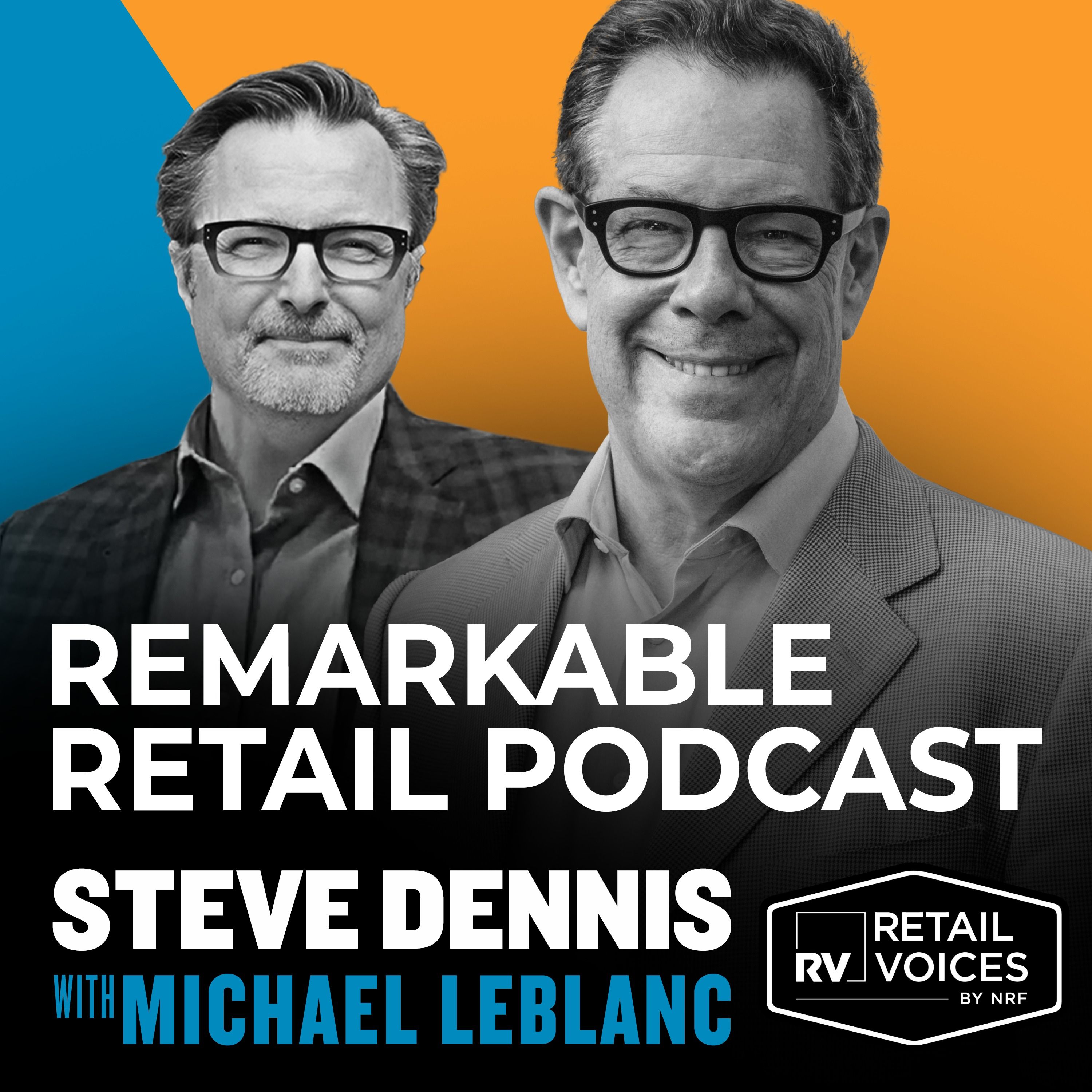
 Remarkable Retail Podcast
27 Oct 2026 · 52m · 18 chapters
Retail news roundup and analysis (episode 317) covering Walmart/Sam’s loyalty convergence, tight U.S. retail real-estate availability, holiday sales forecasts inflated by price inflation, why “smart” tech predictions often miss, grocery e-commerce growth and “Grocery Wars,” and Quince’s UK expansion; plus “What’s on Our Radar” on political unrest and retail cybercrime.
No external guests. Hosts are Michael LeBlanc and Steve Dennis (Steve is in a Chicago hotel room during recording).
Not applicable (no guests).
Walmart and Sam’s are bundling memberships to mimic Prime-like value (delivery, discounts, entertainment) and to capture more customer data; physical retail isn’t disappearing; holiday growth (NRF 4.2%) is mostly price-driven; AI/agentic shopping may improve decision-making but won’t instantly replace stores; online grocery growth is channel shift with warehouse clubs and big e-commerce players gaining share; Quince’s “factory-to-customer” model claims big price cuts.
10-cent gas discount; 17,000 gas stations; U.S. retail vacancy ~4%; NRF holiday growth 4.2% vs ~3.7% inflation; online grocery: 64% of households buy online (Sept), Q3 sales +21% for 8 straight quarters; Walmart ~40% of online grocery sales; Quince compares cookware to Williams-Sonoma/Calphalon and launches in the UK; cyber incidents include hacked grocery refrigerators to 120°F and a PHP vulnerability affecting major sites.
Written by AI. May contain mistakes.
Hosts share personal anecdotes and context for the episode's recording.
“But the weather is beautiful and get this in before I go have dinner with my daughters and my son-in-law.”
Discussion about the competitive landscape between Amazon and Walmart's membership offerings.
“And with that, let's jump right into the news.”
Exploration of how loyalty programs leverage data for customer targeting and personalization.
“So they're not exactly apples to apples, but to the extent probably most people join these memberships to get the free delivery, get some discounts.”
Insight into the current state of physical retail and challenges in obtaining retail space.
“Now, Amazon has pretty much perfect data because anybody in e-commerce, they got your address.”
Analysis of holiday sales predictions and the influence of inflation on retail growth.
“And that tells me, you know, overall, that tells me that in the hot markets at zero, there might be six or seven.”
Discussion on misconceptions surrounding retail technology and its evolution.
“All right, let's move on to holiday forecasting.”
Learn about the misconceptions in retail predictions and technology trends.
“We also think about these kind of twos and, you know, guardrail to guardrail statements.”
Discuss various failed predictions in retail and their implications.
“And it got me thinking about, you know, how is it in the past anyway, that so many smart people have been so wrong about certain trends?”
Examine the realities behind the so-called retail apocalypse and store openings.
“You had people going on CNBC saying, you know, two thirds of the malls would be gone in the next three or four years and half the retail stores are going to close in the next five and all these kinds of things.”
Analyze how e-commerce growth during COVID-19 affected retail strategies.
“And the classic example of this, which we've talked about several times, is Nike.”
Consider the historical context of tech predictions and consumer behavior.
“And investors are going to talk their own book and push their own investments.”
Discuss consumer trust issues regarding AI technologies in retail.
“but I would be a little bit more careful to look back at our history here of overestimating the impact of technology on market share and on particular winners and losers, or at least the pace of it will be much slower.”
Explore the complexities and skepticism surrounding AI's role in personalized shopping experiences.
“And how much, you know, a perfect agent, sure, in the holodeck, the agent will know everything about me because I've told it everything about my life.”
Discuss the rapid growth of online grocery shopping and the competitive landscape among major retailers.
“And without a hint, without a hint of irony, we're now going to talk about grocery e-commerce.”
Learn about Quince's expansion into the UK and the challenges they face in a tough market.
“Last piece of news is an American, North American retailer, Quince, heads across the pond and launches in the UK.”
Discussion on global civil unrest, economic challenges, and political implications.
“it's a tougher launching pad to get into Europe, no longer being part of the EU.”
Exploration of recent cyber attacks and their implications for retailers.
“Well, and these are real implications on retail.”
A light-hearted conclusion emphasizing optimism for future discussions.
“So anyway, not to end the show on a bummer.”

Get the gist, explore an idea or ask about something said.
 Claude
On Remarkable Retail Podcast, what are the key points of this episode?
Searching your listeningAutomatic transcript. May contain errors.
0:07Steve Dennis: Welcome to Markle Retail Podcast, episode 317. I'm Michael LeBlanc. And I'm Steve Dennis. On this episode, we're covering our take on the retail news of the week, including the Battle of the Giants and their membership programs, the challenge of finding retail space in America, the Potemkin Village of Christmas Sales Predictions. I'd like that one. A deep think on the nature and technology of retail, e-commerce growth in grocery, and of course our popular What's on Our Radar Screen closing segment. So stick around. And speaking of popular and sticking around, you can help us continue to spread the word, grow our little media empire here by giving us a five-star review.
0:47Steve Dennis: When you listen to us, we'll wait. Okay. All right. Thanks for that. let's get on with the show now steve before we jump in you uh you look uh and sound a bit different where are we finding you today well yet again i am in chicago visiting my children uh and so i am presently in a hotel room which is part of the explanation for the questionable acoustics as well as the uh lighting but i don't know in certain light maybe it makes me look better. I don't know. Well, you look at...
1:27An angelic halo behind you. Exactly. But the weather is beautiful and get this in before I go have dinner with my daughters and my son-in-law. I have to say that because that's a new thing. Just a few weeks ago, he was the fiancé and then he walked before that the boyfriend. Yeah, yeah.
1:46Steve Dennis: He has graduated. He has graduated to be dinner with the son-in-law. Well, good luck. Enjoy. And with that, let's jump right into the news. Now, you and I have been kind of fanboying a bit, if I could say so, on Amazon and the nature of Prime and how great it is and how they have tentacles that go everywhere and positive cycles and all these kind of things. But the news this week is interesting. A bit of loyalty integration between Sam's and Walmart got us thinking that, you know, let's spend a little more time thinking about Sam's and Walmart and what these big players are doing with loyalty.
2:22Well, you know, I think in general, Walmart and Amazon, obviously they've been huge competitors for quite a long time now. I just feel like there's more and more of this convergence, partially because of what we talked about a few weeks ago, which was more of Amazon being able to do 30-minute delivery, which kind of changes the equation between a store trip. At that point, it's like, oh, I could run out and get it, or I could get it in the same amount of time. If it's two hours, four hours, or whatever, you've got to be there, or you have to schedule it, and all that kind of stuff. So I think that has put them more in competition.
2:59And then this is just upping the ante. So the particular story is that there's going to be a combined bundle combining Walmart and Sam's Club. Now, probably most people know that they are part of the same entity. I was actually a little, like when I heard this news, I was a little bit surprised that this didn't exist to a certain degree already. This combined bundle is going to be essentially, well, roughly similar to the Prime offering from a delivery standpoint, as we've talked about several times. Prime, one of the great things about it is it brings in a lot of other things because it brings in the entertainment side, music, podcasts, et cetera.
3:42So they're not exactly apples to apples, but to the extent probably most people join these memberships to get the free delivery, get some discounts. So this particular bundle does include some entertainment, does include 10 cents off a gallon of gas, which has obviously become a more important thing. at, get this, this was a number that really sort of stunned me, 17 ,000 gas stations.
4:09Steve Dennis: I didn't even know there were that many gas stations to be kidding me. I know. So I think it's really interesting, when I say convergence, I mean, as Amazon comes in with a short delivery that somewhat neutralizes Walmart's advantage of having all these stores where you can get immediate gratification, at the same time, Walmart pushing to offer more and more delivery, obviously up being their e-commerce game over the last few years. So, you know, very similar assortments, kind of the heart of the business. So more and more going head to head. So we'll see. I think the timing of it, of course, with the holidays coming up, with gas prices continuing to be high, with inflation seeming pretty sticky to try to lock in customers.
4:56And, you know, for the most part, I think if you've got a membership, well, other than my gym membership, but if you've got a gym membership, you sort of sit at yourself, you want to concentrate a certain amount of spending. So we'll see how this plays out.
5:10Steve Dennis: Well, and another point that you and I have talked about before, but these loyalty programs don't engender loyalty, right? They still need to have a habit that is broken in one way, shape, or another. Now, we've had a couple of big changes in consumer habits. The COVID ear was a big, as I've said, broomstick in consumer habits. AI and the way people are discovering is another one of those. E-commerce, of course. So we've seen many of these kind of things that have shook up people's habits. Do you think there's enough there there that this will make a difference? Or is this just a good headline getting people talking about it heading into the holidays?
5:46Well, from a consumer standpoint, it does make Walmart closer to the prime offering. So I got to think that's important. Of course, the other thing, as you well know, from a loyalty program perspective or membership program perspective, you get all this data. And as we move to a more agentic world, using that data for greater targeting, personalization, mass customization, whatever you want to call it. Now, Amazon has pretty much perfect data because anybody in e-commerce, they got your address. I mean, it's not perfect, but they know who you are. whereas Walmart, for years, really didn't know any other consumers.
6:26They had great transactional data, but you're just checking out. They don't know you individually. So obviously they've changed that to a certain degree with their credit offering and as e-commerce has become a bigger part of Walmart and Sam's. But this kind of takes it to the next level. So I think it's a bit of a data grab as well as kind of a neutralization effort against Walmart.
6:50Steve Dennis: And a gratuitous addition. They combine this up with Paramount+. And for anybody who does or doesn't have Paramount +, Mobland is now my new obsession at the TV show. Here's Croson and Helen Mirren. Oh, my goodness. What a show. Anyway. You get everything here. You get retail news. You get media critiques, recommendations. You get Tom Hardy. You could just stare at Tom Hardy all day. What an actor. Anyway, let's get back on task, as you would often nudge me. In the world of not the worst problem to have in the world, retailers who want to expand their store networks are running into some practical constraints at the lease signature line.
7:32Steve Dennis: See what I did there? Well, we'll come back to this a little bit. But of course, I always say, it turns out physical retail is not dead. Who could have possibly seen that coming? It's just so interesting to me, and I don't know that I would have predicted this in particular, but with all the retail apocalypse stuff and, oh, Gen Z is going to be shopping all online, retail space is actually very tight. We've talked about, for example, Simon Property's statistics of having their malls, and I forget the exact number, but 96 % plus. And we're actually seeing overall vacancy across the U.S. at just over 4%.
8:15Steve Dennis: And that tells me, you know, overall, that tells me that in the hot markets at zero, there might be six or seven. Oh, for sure. Yeah. Slower markets, right? Well, I can tell you even just being here in Chicago a lot because my kids being here and there are definitely places in the city and parts of the suburbs where you see quite a lot of vacancies, but you can really tell the difference. I don't have to be an expert. Tell the difference of the quality. You can kind of understand why this little strip center is not doing so well or this particular part of the road. But then right outside at the Thompson, if people know Chicago, and just south of me is where all these kind of original DTC brands, Viore, Warby Parker, et cetera, as well as Dior, Louis Vuitton, and there is no space to be had.
9:05And I'm sure the rents on these few blocks here are quite high. So yeah, I mean, to a certain degree, that's always the case. Now, part of what is going on for sure is, yeah, physical retail is still continuing to grow, though obviously less quickly than e-commerce. But the other thing is there hasn't been a ton of construction. So one of the things for you retail historians out there, one of the things that caused a lot of problems with regional malls in particular, but also a lot of power centers, is there was just this building boom in the 80s and 90s, which really didn't slow down all that much when interest rates were particularly low.
9:46So that created a bit of a disconnect. But as the economy grows, more population, et cetera, the absorption rate's been pretty good. But there's not a lot of new space being built, some of that, frankly, is causing shortages in some key areas because construction's been constrained, in some cases because of labor issues, some cases the typical zoning thing, some cases interest rates going in the other direction slow down the pace. So, you know, there's some interesting dynamics. So it's both supply and demand, and there is definitely a shortage of supply of the kind of real estate that people really, really want.
10:26So anyway, it's just interesting to me because I think 10 years, I mean, even though I've obviously been, you and I have both been very much pushing back against the retail apocalypse narrative, I still think it would have said over time there would be more vacancies in real estate just on a broad basis.
10:46Steve Dennis: All right, let's move on to holiday forecasting. So the holiday forecasting season is pretty much wrapping up and most people are giving some pretty good prognostications. But But underneath the waterline, there's a bit of an undertow that you brought up. And I want you to talk more about what could be kind of inflating their numbers. Yeah, well, the thing that kind of we were waiting on the NRF, National Retail Federation's projection. We talked about a couple other predictions a few weeks back. So we did get that. And they're predicting 4.2 % growth, which really, if you look, there are a couple outliers.
11:21But if you look at the predictions, they're really in the 4 to 4.5 % range. But of course, we're looking at like 3.7 % on average inflation. So a lot of that growth is really coming from prices being high. Now it's a little bit, you can't exactly line up the overall rate with retail. Yeah, there's a lot of different things going on. So you have to be a little bit careful. But for sure, energy prices are driving up a lot of the costs here. And that's fuel, diesel, gasoline, et cetera, but it's also electricity in many cases, a lot of that coming from the AI build out. So, you know, unless, I mean, we're so close to the holiday now, it's hard to imagine that you're really going to see any dramatic shifts.
12:10One of the things I was taking a look at as part of this report was, you know, demand in particular areas is really driving prices up in particular categories. So electronics, I hadn't really been paying attention to this, consumer electronics are up like 12 % in terms of price inflation. I saw another report, I don't think we talked about it last week or a couple weeks ago, that toy prices were actually up like 6%. And a lot of that, I think, is tied back to toys coming from China, which are highly tariffed, not just China, but highly tariffed category. And then I think you pointed out maybe last week or the week before that grocery prices really haven't gone up that much.
12:53So the mix is obviously pretty important here. So that will always determine what's going to happen. But yeah, for the most part, we're not seeing or not predicting a ton of unit growth.
13:04Steve Dennis: Well, I can tell you from my lived experience, I had to go buy a new MacBook. I spilled a whole bottle of pickle juice on my last one. Don't ask. And by the way, never do that. It's bad. But I was like, oh, I was shocked because I was looking at them in the summer and they were at one price and I looked at them again now and I'm paying three, four hundred bucks for the same unit more and it tracks back to, well, there's a lot of demand for programming and all that stuff, but it really impacts and it really, it does echo the inflation narrative behind where all this growth is coming from. Alright, well let's take a break for the news and let's talk about retail technology because you made some super interesting comments when we were off mic and And, of course, you're just back from Greece taking your new keynote for a test drive.
13:49Steve Dennis: And you were out last night listening to some friends of ours. And it all just resonates around something you and I have kind of, you know, if we're united around the retail apocalypse narrative being just a canard, really. We also think about these kind of twos and, you know, guardrail to guardrail statements. Like retail is all about experience or you must eliminate every bit of friction or you're finished. It is not true, but it's also not true sometimes what they say about retail technology. Yeah, I've been thinking about this for a while in some of these topics. We've definitely touched on it on the podcast.
14:26But when I was working on this new keynote, one of the things I was thinking about was, well, how much change is going to be caused by virtue of generative AI, agentic shopping? And it got me thinking about, you know, how is it in the past anyway, that so many smart people have been so wrong about certain trends? So the one from five years ago was the metaverse. That took over conferences, and so many companies were pushing that. That was followed by retail media networks, which certainly have grown. The metaverse went away. Big nothing. Just like Clubhouse. There's been various Second Life. There have been various things that just don't work.
15:19But somehow we're going to have all this conversational commerce. And that is coming, but it's been coming for 15 years. I think retail media networks have grown a lot. But when you really look at what's going on in retail media networks, so much of that growth is really just Walmart and Amazon. And some of the physical in-store stuff is happening, but not happening as quickly as you would have thought three or four years ago. But in particular, I went through, as part of the keynote development, looking at some of the predictions about e-commerce. And then that was really kind of a setup to say, well, why did they get it wrong?
16:00And does that have any bearing on AI adoption or agendic commerce adoption? So just really quickly, I'll mention the four predictions I've talked about in the keynotes. One is, one, we've talked about a bunch, which is Marc Andreessen's prediction. and if folks don't know, Mark Andreessen is a famous venture capitalist. The firm Andreessen Horowitz was one of the biggest and most successful venture capitalist companies, or venture capital firms. Anyway, he did an interview in 2013 where, I'll paraphrase it, he essentially said, in the future, all shopping will be done online. You will not have a choice.
16:36Basically, that physical retail will cease to exist. Those of you who have listened to me talk about this know that one of the smart things about predictions is not to say a year. And so he just said in the future. But since he said that, physical retail has grown a lot. In fact, it has been up every single year except the COVID year. So it does not appear to be on a trend to going away anytime soon. Now, obviously, e-commerce has continued to grow. So e-commerce is growing much faster.
17:07Steve Dennis: Equally obvious, to put a point to it, very smart guys, very smart people. To your point about, let's give them their due, super smart, but very wrong. Very wrong, at least so far, again, in the future. It's a long time horizon. But something that's a little bit closer in, but also related because a lot of venture capital firms were invested in this as well, which was this idea of these pure play online, digitally native brands becoming the next big thing. And one of the things I included in a version of the keynote was several very high profile names that are either out of business, like Smile Club, or got sold or marked down for a significant amount.
17:54Casper, Bonobos, Dollar Shave Club. These were bought or purchased at a high price and then written off. We've talked several times about some of the firms like The RealReal and Stitch Fix, which are down 90 plus percent from their valuation. So a lot of money went into dozens of these companies. In fact, like the whole flash sales site thing is pretty much blown up. So there was this whole era of massive investment going in on the presumption that these really big, valuable brands could be built. Now, venture capital obviously is built on not everything working. That is part of the whole model.
18:38But a very high percentage of these deals went south or performing very, very poorly. The other one we just talked about earlier is the whole retail apocalypse narrative. You had people going on CNBC saying, you know, two thirds of the malls would be gone in the next three or four years and half the retail stores are going to close in the next five and all these kinds of things. And while there has been some pullback in stores for sure and pockets of major closing, there also have been, you know, thousands of stores open on the part of dollar stores. and I don't know the exact number, but over 1 ,000 stores open on the part of off-price retailers and even Walmart and Costco and Target are continuing opening store of tractor supply.
19:21You can just go down a list of retailers that have been opening lots of stores since the retail apocalypse narrative started. The last one I was going to mention quickly, which is related to this, is the so-called great e-commerce acceleration and another bunch of smart people at McKinsey wrote this really laughable article about how during COVID, we were going to see, I think it was 10 years of e-commerce acceleration in only three months. Few other people had a slightly different timetable. But basically, this massive acceleration was going to occur, which did happen. But it was very short lived.
20:04Now, because most people will be listening to this with audio. I can't show you my snazzy chart, but you just very much see the spike of e-commerce penetration. Now, one of the ways to get a spike in a number of percentages is have the denominator collapse. That's what happened there. But anyway, we're basically back on the same trend you would have forecast pre-COVID. Slight acceleration, but more like 12 to 18 months, nowhere close to 10 years. And really the major category that benefited from the acceleration was the grocery industry. For the most part, the other categories are exactly where you would expect them to be.
20:47So again, here you have very smart people looking at all the same data, making wildly different or wildly wrong predictions. And what I would say is, so what? This is just not like, okay, I'm better predicting than you are, or I'm just inherently skeptical or whatever. The problem is people invested in some of these startup firms and fast-growing firms and ended up losing a lot of money because you would have lost a huge amount of money in many of these IPOs if you stayed in the stock. It caused a lot of companies to tap their brakes on store expansion, but probably even more importantly, store investment.
21:31People really paused the amount of investment they were doing in remodels or expansion or relocations or that kind of stuff. And I think the other thing that happened is, if you believe the e-commerce acceleration, one of the things you might have done is really shifted your business much more heavily into digital. And the classic example of this, which we've talked about several times, is Nike. Nike was on a strategy to be building more of their own stores, in particular, basically stopped, pulled out of wholesale, or not completely, but decreased their distribution, quite a lot thinking they could make up for that in e-commerce.
22:13And it was good until it wasn't because, again, this huge spike looked really great, but then things came back down to earth. So anyway, that's kind of the setup for it. But it begs the question, how did so many people get this wrong? And is this about to happen again with Gen.AI and agentic shopping? And at the core of it, And the way I go about it in the keynote is to frame up these questions, which seem very basic. Why do we shop? And what is a store for? And part of what I think definitely happened with some of these other investments or predictions going wrong is there was just this belief about shopping being highly transactional or overly functional, which clearly a lot of it is.
23:06But a lot of the reasons we shop has nothing to do with getting something off our to-do list or doing an errand efficiently. It has to do with being in community and tactile experiences and trying things on. And that's one of the reasons, again, never say never because never is a long time. But it's one of the reasons why physical retail has clearly held in and is still 80 % of all retail is because it's not just about getting something done efficiently. Now, stores also are very good at certain kinds of fulfillment, immediate gratification, buy online, pick up in store. So, you know, you have to really think about the role of the store in people's shopping.
23:50You know, sometimes it's a showroom. Sometimes it's social. Sometimes it's emotional. Sometimes it's getting things taken care of. So I think as it relates to AI, you know, I think AI and agentic shopping in particular will improve the decision-making process quite a lot. But it still may point you to getting a transaction done in a physical store or doing your discovery or exploration or trying on in a physical store. I do think it will enhance a certain amount of discovery improvement because if the agent knows you better, it may get you to break your habits or get you to see something that would better meet your needs, which you wouldn't otherwise find because it takes too long.
24:42So I do absolutely believe that agentic shopping is pretty transformative. but I'm not sure that if I'm Hermes as an example or even Ulta or Sephora that it radically changes the role of the physical store um and so the people that talk about this massive or re-acceleration in e-commerce I don't know I think the math on that is is pretty challenging But what you and I were talking about offline, and I was talking to a couple of people at both these conferences, is, number one, you definitely have the tech vendors that are pushing their technology. So there's just a bias towards that. And investors are going to talk their own book and push their own investments.
25:37So I think that's just something you have to be skeptical of, the hype behind it, the self-promotion and what have you. But I also think a lot of people that are technology-centric, as I looked at these other predictions, they just seem to see shopping as a functional thing. And then they zoom in on that part of the market. And then they say, oh, within this part of the market, how much share will be grabbed? But it's like taking huge swaths of retail out of the equation, right? Yeah, yeah. So I think that's, you know, I just want to think about the math of it. You know, why was I so confident that we weren't going to have this retail apocalypse?
26:20Well, it's because I understand why people go to retail and stores do things that just pure e-commerce can't or not, you know, remotely in the same way. So, again, I'm not being super skeptical that agentic AI is not transformative. but I would be a little bit more careful to look back at our history here of overestimating the impact of technology on market share and on particular winners and losers, or at least the pace of it will be much slower. And some of that, I think, has to do just with consumers' reluctance to change. Not all. I mean, some people just love, you know, The number of people that become heavy users of chat and Claude or whatever very, very quickly, that's tremendous.
27:13But there are a lot of people, and I don't even want to get into the pushback against AI or make that as a side point. But some people are just like, I don't need it. I'm fine with what I have. Or I'm just very slow to experiment with it. In the same way that almost everybody in a developed country has a phone, but not everybody is using their phone to pay, even though the phone's right there.
27:39Steve Dennis: I had this great discussion with a retailer this week, actually, and it was about trust. I'd connect a few dots here. I saw Elon Musk put up a tweet. He said, you know, and not a tweet, I don't know what it's called now, an X or whatever. Just put your credit card in Grok and we'll do the rest. I'm not giving my credit card to him or anybody else. And, you know, shame me, you know, fool me once, shame on you, fool me twice, shame on me kind of thing with consumers. And how much, you know, a perfect agent, sure, in the holodeck, the agent will know everything about me because I've told it everything about my life.
28:16Steve Dennis: I have no, I have zero amount of trust in that. And so therefore, the experience the agent is going to deliver is going to be materially less than its potential because I'm not going to tell it everything about my life. No way. Whereas I'll walk into a crate and barrel, as I have recently, and said, hey, you know, let me tell you a bit about my wife. What do you think would be a great gift? I'm not telling that to an agent. So, you know, this idea that agents will be the perfect vehicle for your shopping because they'll understand your life entirely assumes a dark side. It assumes it can go find that out without you telling it, first of all.
28:55Steve Dennis: Or you're going to give it permission to do that. And to your point about AI reluctance, I mean, you can see it demonstrated in the city town halls around AI computing. That's a bit less about what that is and more about, geez, you know what? I feel like AI is going to be done to me whether I like it or not. I don't know about you. When I go into customer service now, I'm dealing with these stupid bots. And I have no agency. I just like, can I talk to a human? Because you continue to give me the wrong answer. And it says, no, this is a dead end. That's it. You're done. So I have no agency anymore in some of these things.
29:31Steve Dennis: Anyway, long rant. Welcome to my TED Talk, as you would say. But a long rant, in terms of sure, an agent can give you perfect information, but it's a two-way street. Yeah. And I know I've said before that, but I'll say it again because I think it's important. One is, there's a little bit of a question of what counts as AI, right? Because if you're automatically, or so many people are automatically in Google, and Google's using AI in search now more as a default, or it's very easy, well, it is very easy to shift to AI mode. It's enhanced search, but I wouldn't think, and it's not really like AI driven shopping so much.
30:18Just like if you went to a website and now it's dynamically personalized or what have you, that's an improvement to it.
30:27Steve Dennis: Yeah. But it's not a whole different way of doing things. And so we always have improvements in technology. It's not necessarily, to me, some of this is more of a step change. Now, one of the things I heard yesterday, and I'll give credit to Shish Shradar from Microsoft, who many of our listeners might know. One of the things he really got me thinking about, which I hadn't thought about so much, but as soon as he said it, it made sense to me in my own behavior, is there are aspects that agents can help you tackle things that wouldn't otherwise get done because it's just too much work. So he was talking about it more in the corporate experience.
31:09But he did a demo of building a website, which took like five minutes. Because previously, you'd have to know code. And you'd have to have three people that know how to put it together. And then the widgets and yada, yada, yada, yada. And he just, because he knew how to give the instruction, had Claude build this website, was pretty functional in like five minutes. Which is quite extraordinary. But I also think about it in some of the research I do and editing and ways I use it, which is not putting someone else out of a job. But I just wouldn't do it because it's too expensive, too time-consuming, too complicated or whatever.
31:52And so from a retail standpoint, I almost think about when we first had spreadsheets, which is a two-edged sword. Now that we can run 80 scenarios, we'll run 80 scenarios. Before, if it took me two hours to go through something, it's just like, we'll do one or two, right? So I think it's always worth being a bit cynical or skeptical about some of these things, but you definitely don't want to go too far to the other side and get left behind. And so in a lot of cases with these things, it's just like the metaverse. I thought it was worth experimenting a little bit to try to understand it and to try to get a sense of...
32:31Steve Dennis: Yeah, remember we talked to a couple of youth-oriented brand CEOs, and they said, yeah, I'm all over it because that's my customer. That suits me. That's just fine. You know, my own little way with AI and shopping, of course, after I put in the question, how bad is it to spill an entire bottle of pickle juice on your laptop? Very helpfully, it said, would you like me to show the latest deals in a replacement laptop? Which told me that I should give up on the idea of repairs. anyway, so it was very, you know, kind of helpful. Anyway, not to dwell on that, but all right. Now, let's get back to the news.
33:07Steve Dennis: And without a hint, without a hint of irony, we're now going to talk about grocery e-commerce. We're going to talk about e-commerce and all the products that's made there. Yeah, exactly. Well, like I said, grocery was one of those areas that did get a pretty solid acceleration, and its growth continues to be above the average for e-commerce. So I just look at a few notes here because I did find a couple of articles talking about this. First of all, just in the month of September, 64 % of U.S. households made at least one grocery purchase online. So, you know, that's pretty good adoption. Now, that doesn't mean they're buying the majority of their groceries online, of course.
33:51But in the third quarter, online grocery sales rose by almost 21%, which is the eighth straight quarter that the growth has been over 20%. So if you think about overall e-commerce growth in the U.S. is 8%, 9%, somewhat in that range, that's definitely really distorted growth. So when we get into the share thing, what's included in the denominator sometimes is disputed. And different groups have different numbers. But I would say it looks like the grocery share of total e-commerce is somewhere between 15 % and 20%. So that's getting it much closer to the overall share of e-commerce in the U.S. I guess a couple quick things to mention.
34:44Oh, actually, before I get to that, the other thing, and I've seen different numbers on this as well, and I couldn't really pin it down. I was told this number by an executive at a big company who I think would know. It was that over, and they wouldn't give me the exact number, but they said over 30 % of all online grocery purchases are buy online, pick up and store.
35:09Steve Dennis: Wow. Which is also interesting because if you don't have the store, there's no place to go pick it up, which is an Amazon issue, right? They don't, I mean, other than Whole Foods, they don't have stores. The other thing when you look at who's been winning over the last several years, well, Walmart is approaching 40 % of all online grocery sales. So that's above their total share of grocery, which I think is mid-30s. Amazon, as we've talked about, is growing quickly. For the most part, those that are losing, with the notable exception of HEB in Texas, are the regional grocery change. And we've talked about Kroger and Albertsons kind of stuck in neutral.
35:52You know, I guess just the other fit to what we started with is the battle of the titans here. You know, if you got Amazon at 40%, we don't exactly know what Amazon's number is, but growing very quickly, you're starting to see this head-to-head competition. And then, of course, you've got Costco and Sam's in the warehouse space. So, you know, between those four chains, you've just got a huge amount of the online grocery. And if you look at the growth rates, they're all growing at a really pretty extraordinary rate. So it's really...
36:25Steve Dennis: It is all, I think, where you're going with that last comment as well, though, it is all channel shift more than net growth. And my mind turns to, you know, grocers sell in tonnage, and they don't make a lot of money on what they sell, notwithstanding pharmacy and beauty. So have they just shifted all their sales into a more expensive channel, more costly channel? Well, I think this depends a lot of where you sit. Clearly Walmart, Sam's, and Costco have been gaining share. And you'd have to assume that the majority of that share growth has come through online, which means they're stealing it from other players.
37:11Now, they may be stealing it in the physical world as well. Presumably they are. The investment that's gone into online, Walmart talks about, I don't know exactly how they measure this, but they've said e-commerce finally became profitable. So to really understand the incremental economics, I think has a lot to do with where you sit. If you're Walmart, you've got great scale. If you're Amazon, you've got this amazing distribution center, or distribution asset, which we've talked about. So they're not channel shift. All their growth presumably is coming from a lot of the physical players. So I think it depends a lot.
37:50I mean, for the most part, if you were somebody other than the warehouse club guys and Walmart and Amazon, I think the online offering for the most part is defensive. Now, that's a hard thing to tell your CFO. If we hadn't done this, we otherwise would be deleveraging our fixed costs.
38:12Steve Dennis: And that fights against the cannibalization thing you hear often, right? All I'm doing is cannibalizing myself. Well, to speak of cannibals, either you do it to yourself or Amazon's going to do it to you or someone else. A risk, right? That's the discussion between the operators and the CFO encapsulated right there, right? Yeah, but there's clearly a lot going on here. The share shift is significant. The channel shift is significant. The delivery wars, the membership wars seem to be escalating. So get out your popcorn, pull up a chair, and watch Grocery Wars. All right. Last piece of news is an American, North American retailer, Quince, heads across the pond and launches in the UK.
39:01Steve Dennis: Talk about it. I'm a fan of Quince from their performance, and it's mostly apparel. They have other categories. For those who don't know a lot about Quince, crossing the pond is a big deal for them. Yeah, well, we talked about them a little while ago as a brand to watch, partially because they appear to have gotten a$10 billion valuation. So for a relatively new, still relatively small, but very fast-growing company, that's pretty impressive. For people that aren't familiar, they are a factory-to-customer model. They have no stores. They have a very fast turnaround. Now, the critical part is to say that they're basically, well, their claim is they make their products in the same factories as some of the leading brands.
39:52So if you go to their website or some of their marketing, you'll see these kind of compare-outs. So here's a cookware set compared to Williams-Sonoma, compared to Calphalon, whatever, and the price is 30, 40, 50, 60, sometimes 70 % lower. So essentially they're saying, you know, we eliminate the middleman, pass the savings on to you. So this has been a very successful model. They claim to be ethically produced as well. Some people think it's a little bit of a shell game. We don't know much about their profitability, but they continue growing. And as we said, they are now making, well, last week they launched in the UK.
40:35So this is their first market outside of North America. Again, online only. And they seem to be really going for it. And since we have a fair number of listeners in the UK, I would go check them out. But some of the prices are pretty good. They're sort of famous for their cashmere sweaters, jumpers, and items of that realm that are about 50 pounds. Handbags, 100 bucks, 200 bucks that are similar, allegedly in quality to much more expensive. So they also announced that they are opening offices in Madrid and Berlin. So connect that however you will. Anyway, I guess the pushback on this aside from just generally, do they make any money?
41:23How does this all work? Is it a shell game kind of thing? Specific to the UK is the UK market for apparel is not exactly booming. And in fact, it's been pretty brutal in terms of some bankruptcies and pullbacks and that whole scenario. So they're not exactly going into a market where they've got kind of the rising tide on their side. Whereas in the U.S., it's been much more favorable to apparel and accessories for the last several years. So watch this space.
41:52Steve Dennis: Well, echoing that, I had the opportunity to talk to our friend Andrew Busby from London. And we were talking about the state of U.K. retail. And one of the things that is not the way it used to be, if we were having this discussion five years ago, it's a tougher launching pad to get into Europe, no longer being part of the EU. Andrew says hello, by the way. All right. Well, listen, that's a wrap on the news. Let's get to our popular what's on our radar screens. What's on your radar screen today? They're sitting in Chicago. Well, it's somewhat related to what I talked about last week, which I'll come back to in a second.
42:27And I guess it's tied to what's going on in the UK as well. But it just seems like the degree of civil unrest in particular, we look at things that are going on in France. but just in general dissatisfaction with how things are going. Of course, a lot of this is caused by what's going on with fuel costs because that's hitting just about every market very hard. So, so many consumers are feeling the pinch. A lot of governments in the G7, but elsewhere, having fiscal difficulties escalating. So, I don't know. This just all makes me more than a little bit nervous, particular to the U.S. and I know I've come back to this a couple times we are really seeing our fiscal deficits explode you know and it's not as if the current administration is the first one to have issues with deficits but they made some decisions very specifically about tax cuts and spending increases that are really driving things up Now, I really love this economist from the University of Michigan, Justin Wolfers.
43:43Some of you may. He's really kind of a rising star because he's on MSN Now a lot, CNN. He's got a very popular sub stack and podcast. And so he's just kind of come to me anyway. I don't know, maybe other people knew about him, but just kind of got on my radar screen a couple of years ago. And I just want to read this quote that he had about the U.S. philosophy here. Washington has discovered a brilliant financial strategy, cut benefits for people who need them, cut taxes for people who don't, and then borrow the difference from people who aren't old enough to vote. So basically mortgaging our future and accelerating the oligarchy.
44:24So I don't know where this goes. It's just hard to really kind of piece this all together and not see some troubles ahead. that hopefully the violence in particular, the protesting, you know, does not get out of hand in France and some other countries. Just quickly related to it though, because like I said, this is a little bit tied to last week, which is specifically the unrest or potential unrest in the U.S. given our midterms, which are coming up next week. Just since I made that prediction, things have gotten a little bit crazier. First of all, Trump is really off the rails I don't know if people are paying attention to just his, I don't know why this doesn't get more news, but just his wild comments in these rallies or whatever you want to call them, he's doing about the Ohio senator's ass.
45:20And yes, these percussive noises. By the way, if you haven't checked out the video, if you know it, you'll know exactly what I'm talking about. If you don't, you'll have no idea what I'm talking about. but there's a Weezer song, Trump mashup. That's pretty interesting. And just as we're recording this, the Trump administration has already filed, I don't even know how this works, like a presumptive lawsuit if the Republican candidate doesn't win the Alaska election. Now this has to do, I don't want to go down a rabbit hole on this, this has to do with the similarity in the names between the candidates, but the election hasn't even occurred and they're challenging the results.
46:06But it's only if the Republican wins then it has to have been stolen. So anyway. Otherwise it's fine.
46:11Steve Dennis: Yeah, otherwise it's fine. It's just nuts. And we also learned that apparently Vladimir Putin is a great humanitarian. So you just can't make this shit up. So I don't know. I just feel like either we're living in a simulation or shit's about to get real. dumpster fire on steroids. Pick your, get your memes lined up. But yeah, good times. Good times. Well, and these are real implications on retail. I was reading Carrefour, the great France retailer, had to take their numbers down 10, 15 % because they, A, from the losses, and B, you see this crime because everything that was looted in France wound up on all the eBay and all the online reseller sites.
46:54Steve Dennis: So they've got to get control of that. I'm a long, long, long, you know, I've been saying this for a long time. People organize retail crime, steal stuff only if they can sell it. And these online platforms are, you know, they're not all selling this out of the back of a trunk in the back of a parking lot. Let's just put it that way. Well, just like in a way that we rehearsed it, what's on my radar screen is cyber crime. So there's been some incidents in the past week. We talked about France. I don't know if you saw it, that someone got a hold of the refrigerators of a chain of many, many grocery stores and cranked them up to like 120 degrees.
47:33Steve Dennis: So they hacked into that. We've got all kinds of – we had this PHP global vulnerability this week where major, major sites – the Canadian government had to take its sites all offline to fix this patch. I almost texted you as we were working on some stuff because I could not get into my corporate email because of the PHP thing for several hours. And we've got two retailers in Canada who are dealing with a cyber attack and a break-in. And various sophisticated retailers, Save on Foods was part of the Patterson Group and Loblaw, have both reported to Hacks. You remember those days when it was back in the time tunnel?
48:12Steve Dennis: I remember, who was it before Brian Cronell at Target, the CEO was dumped because they were a victim of a cyber attack. Imagine that these days. It's pretty much acknowledged by most that it's a kind of a when, not if. And I was talking to a cyber crime expert this week on the technology side, and their advice I thought I'd share with everyone if they haven't heard it before. It's like, listen, it's probably a when, not if you're going to get hacked. And the formula is don't call us and say we've been hacked and then have us spend two weeks trying to figure out your architecture, your data stack, where all your customers live.
48:50Steve Dennis: If we can walk into your organization, whether we did it or someone else, this is a consulting firm, and have a complete blueprint and architecture of your data, we are like two weeks ahead in terms of helping you reverse the problem or shut the problem down. So what my advice and their advice to me and that I tell everyone out there is like, listen, these things are pernicious and now they're AI powered. It's going to get worse. That's the thing, right? That is the thing that's really scary. It's very frightening. And, you know, this PHP had millions of attacks, millions of hack attacks on government sites in like moments.
49:29Steve Dennis: So what do you do about all this? Well, you got insurance. You got very, very smart people. You hire the best talent. And if you haven't of any size business, whether you're running a small retailer all the way up to mega, it's just, you know, map out, put it on a piece of paper on a napkin, what your systems look like so that when you call for help, people come in and they don't, you know, spend all this time trying to figure out just the lay of the land and they can really just jump in and help you. But I'm very, very, as many retailers tell me, worried about the dark side of AI and that it's being adopted by the bad guys as fast as it is being adopted by everyone else.
50:05Steve Dennis: So anyway, not to end the show on a bummer. Let's make a pact that next week our radar screen will be super, super optimistic. We're all happy, happy next week. Civil war. For those of you that are, you know, bulletproofing your cars after this episode, we're waiting for the urban anarchy. We'll be much brighter and it'll be sunnier next week. It'll always be better. Anyway, that's a wrap on this episode. Thanks for tuning in. Don't forget to give us that five-star rating and review. And we'll be back again with lots more insights on the retail news next week. Thanks for tuning in. To help more retail leaders discover the industry's leading podcast, please drop us that five-star rating and review on Apple, Spotify, YouTube, or wherever you enjoy your pods.
51:00And for more on my strategic advisory services, keynote speaking, best-selling books, and even more retail industry insights, go to stephenpdennis.com.
51:11Steve Dennis: If you are a brand or service provider looking to take your influence to the next level, reach out to us for sponsorship, advertising, or event partnerships. And if you want to learn more about my own keynote speaking and advisory practice, reach out to me via LinkedIn.
Steve Dennis and Michael LeBlanc open with the battle of the membership giants. Walmart and Sam’s Club are rolling out a combined bundle that edges closer to Amazon Prime, pairing delivery and discounts with Paramount+ and 10 cents off a gallon at 17,000 gas stations. With Amazon’s 30-minute delivery neutralizing Walmart’s store advantage, Steve sees growing convergence between the two, plus a data grab that sets Walmart up for a more agentic, personalized future.
Next, physical retail’s not-so-dead moment: U.S. retail vacancy sits just over 4%, and on prime blocks there is simply no space to be had. Steve explains why, from strong absorption to years of constrained construction driven by labor, zoning and interest rates. On the holiday front, the NRF’s 4.2% forecast lands in line with peers, but with inflation near 3.7%, much of that growth is price, not units, with consumer electronics up roughly 12% and toys about 6%.
The centerpiece is a deep think on retail technology and how consumers actually shop. Drawing on his new keynote, Steve walks through four famous misfires: Marc Andreessen’s prediction that all shopping would move online, the DTC pure-play boom and bust, the retail apocalypse narrative, and McKinsey’s “10 years of e-commerce in three months.” The cost was real, from lost investment to paused store remodels to Nike’s costly wholesale retreat. His questions for the agentic AI era are simple: why do we shop, and what is a store for? Shopping is social, emotional and tactile, not just an errand, and stores still account for about 80% of retail. Michael adds the trust problem: consumers won’t hand an agent their whole life, or their credit card. Steve credits Microsoft’s ShiSh Shridhar with a key insight: agents unlock tasks we’d never otherwise bother doing.
Back to the news, online grocery keeps surging: 64% of U.S. households bought groceries online in September, Q3 sales rose nearly 21%, and more than 30% of orders are buy online, pick up in store. Then factory-to-customer brand Quince, valued at $10 billion, launches in the UK, its first market outside North America, into a tough apparel market.
On the radar screen, Steve flags global unrest, including protests in France, along with rising fuel costs and exploding U.S. fiscal deficits ahead of the midterms; Michael notes the fallout for retailers like Carrefour. Michael then turns to cybercrime, now increasingly AI-powered, from hacked grocery refrigerators in France to a PHP vulnerability and attacks on major retailers, with simple advice from a cyber expert: map your systems architecture before the hackers arrive.
Photo by Azwedo L.LC on Unsplash
About Us
Steve Dennis is a strategic advisor and keynote speaker focused on growth and innovation, who has also been named one of the world's top retail influencers. He is the bestselling author of two books: Leaders Leap: Transforming Your Company at the Speed of Disruption and Remarkable Retail: How To Win & Keep Customers in the Age of Disruption. Steve regularly shares his insights in his role as a Forbes senior retail contributor and on social media.
Michael LeBlanc is a senior retail advisor, keynote speaker and media entrepreneur. Michael has delivered keynotes, hosted fire-side discussions hosted senior retail executive on-stage in 1:1 interviews worldwide. Michael produces and hosts a network of leading retail trade podcasts, including The Remarkable Retail Podcast, The Voice of Retail, The Food Professor, The FEED powered by Loblaw and the Global eCommerce Leaders podcast. He has been recognized by the NRF as a global Top Retail Voice for 2025 and 2026 and continues to be a ReThink Retail Top Retail Expert for the fifth year in a row.