Ask ChatGPT


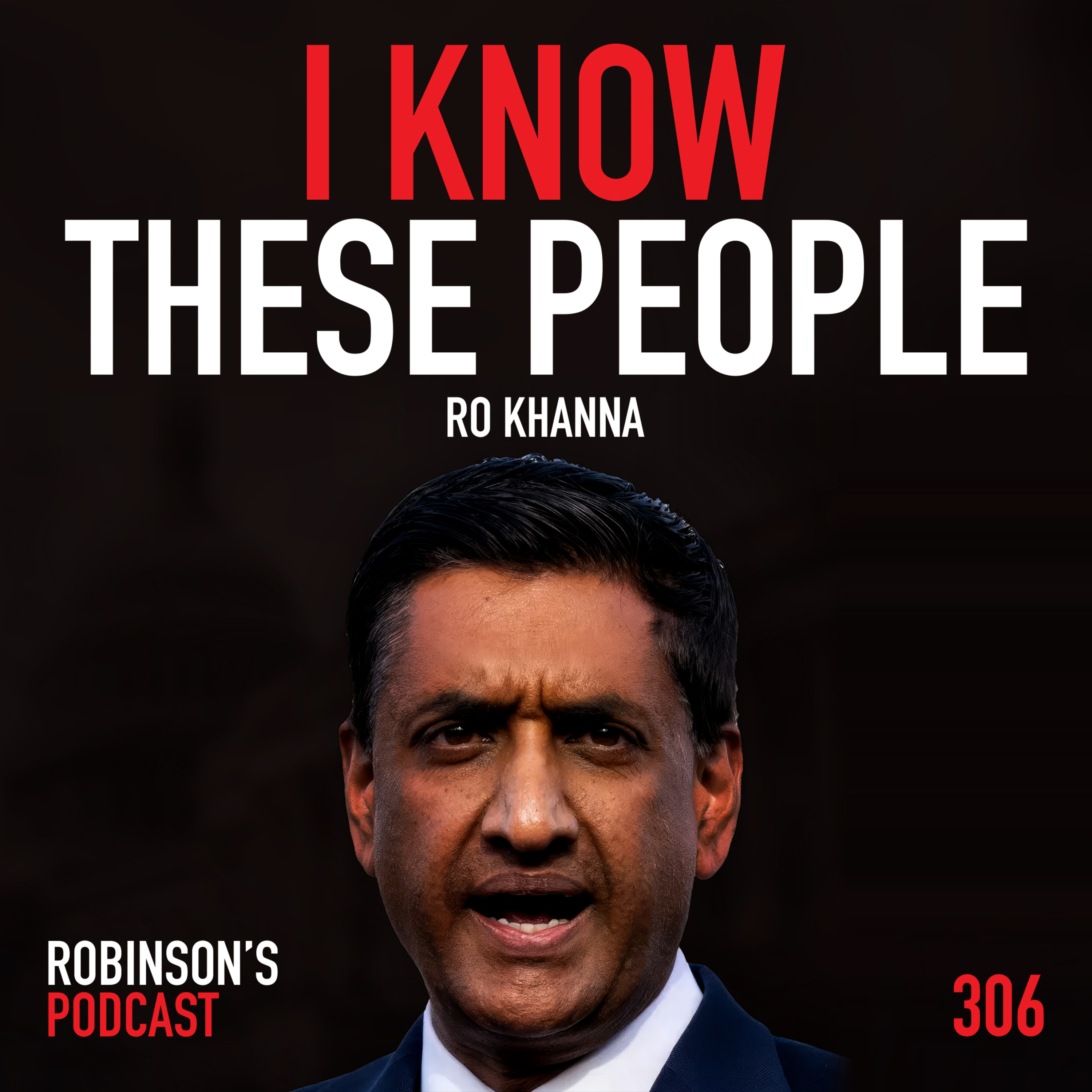
 Robinson's Podcast
17 Oct 2026 · 2h 12m · 52 chapters
The episode argues that the U.S. empire is in “denial” about its power, imperial/colonial foundations, and the collapse of a postwar social contract. It connects this denial to weak class organization, the rise of right-wing leaders, and the disappointments of left electoral politics (especially Cornel West’s Zora Neale Mamdani campaign decisions). It also debates whether structural change is possible under concentrated oligarchic power and whether a U.S.–China war can be avoided.
Written by AI. May contain mistakes.
The host introduces the episode and its special guests, highlighting their expertise.
“Check responses set up required compatibility and availability varies 18+.”
A discussion on the limitations of individual political power in enacting change in America.
“with three scholars like you, though Norm already referred to you guys as three grumpy old men.”
Exploration of the necessity of social movements in challenging institutional decay.
“I'll open the question to the two of you to hear what you think about that.”
A critical examination of political accountability and the expectations from elected officials.
“There are working people, but there isn't a working class.”
An exploration of the concept of denial in various societal contexts, including politics and education.
“He doesn't say, I'm supporting Hakeem Jeffries for this reason or that reason.”
Discussion on the pervasive denial in U.S. and global politics.
“the administration, whereupon it dissolved in the ether of denial.”
Exploring the potential for economic conditions similar to the 1960s.
“but also defer to those who know much more than I on an aspect of the subject.”
Analysis of the historical impact of colonialism and its modern implications.
“a realistic possibility, even if a radical comes into power?”
Discussion on how the U.S. inherited colonialism and its consequences.
“The ultimate achievement of colonialism was the two worst wars in the history of the human race, World Wars I and II, conducted by competing colonial powers.”
Examination of political power dynamics and the rise of populism.
“Europe has become, I'm gonna exaggerate, Europe is becoming a tourist attraction.”
Discussion on America's working class shifting towards the left due to the right's failures.
“Trump said I'm gonna magically bring it all back so go with me and then he gave the finger to Mexicans and everybody else so you he could rile up that kind of behavior.”
Analyzing Bernie Sanders' views on wealth inequality and class struggle as part of the broader left movement.
“There are people who get paid wage labor.”
Exploration of left populism and its limitations compared to true class consciousness and struggles.
“The only word, there is no, I don't want to pour cold water on the parade.”
Critique of narratives around immigration and the historical context of race and labor in America.
“Then you've got workers, black workers tied in the channel of slavery who don't fit into wage slavery paradigm, but they're still workers, as Du Bois rightly pointed out.”
Discussion on the complexities of military occupation in the South post-Civil War and its implications on class.
“Now DSA is tied very much to gentrifiers, to the educated chatteling classes who are preoccupied with affordability, rightly so, because corporate greed is not allowing them to live decent lives.”
Discussion on the dashed hopes and disappointment of youth in current political leadership.
“As long as they think there is no alternative, first they'll try neo-fascism, that's Trump.”
Analysis of the rise of socialist sentiment among younger generations.
“But out of that upset and frustration comes the demand for something else.”
Exploration of the challenges and critiques of the Democratic Party and the Democratic Socialists of America.
“Now, once they're elected, how do you keep them accountable?”
Connecting historical immigration patterns to current political discourse and representation.
“Well, then the young folk come along and say, I follow Bernie, and I give Bernie a lot of credit, even though I got my critiques of my dear brother.”
Personal reflections on the challenges faced within the Green Party and its political direction.
“Now, what was interesting was New York Knicks.”
Discussion on the lasting impact of the Black Freedom Struggle on contemporary politics.
“Well, I appreciated the fact that she, on Brother Chris Hedges, who I deeply love, has suggested that I move to the Green Party.”
The discussion explores personal experiences with money and class, reflecting on lessons learned from negative experiences.
“So what resonated for me, and probably maybe even for you, because I don't know your background financially.”
A conversation about how personal identity influences political campaigns and the balance between personal and collective narratives.
“Now, I understand you would feel that's a denial of a core part of you.”
Analyzing the charisma of figures like Bernie Sanders and Donald Trump, and the emotional connection they forge with supporters.
“But I think he was being true to himself.”
Examining Tucker Carlson's shift in political stance and his potential alignment with leftist issues, particularly immigration and religion.
“I think that's why you're seeing the right-wingers whether it's Tucker Carlson or Marjorie Taylor Greene, they're running the other way.”
A discussion on the implications of immigration policies and the economic contributions of immigrants in the U.S.
“He sure changed on the Gaza-Israel issue.”
Discussing reasonable immigration policies and their economic implications.
“Very hardworking, totally uncomplaining.”
Exploring the grievances related to immigration in the African-American community.
“But you got stronger moral and spiritual and political impulses that play a role.”
Explore how personal beliefs affect political collaborations and priorities.
“Also, there's that, that's very American in my judgment.”
Discuss the importance of having red lines in political partnerships.
“We have to have some kind of way of deciding who we work with and who we don't.”
Understand the complexities of voting for candidates with controversial records.
“But I don't expect the person I'm collaborating with to agree with me on everything.”
Examine the tension between principled stances and pragmatic political choices.
“Then Trump will be worse than Kamala Harris.”
Discuss how historical figures' actions impact their legacy and our understanding of them.
“Right, but I don't feel comfortable in that position of weighing something as not being important enough on a pragmatic level.”
Analyze the shortcomings of prominent abolitionists regarding Native American issues.
“I can see some of the sisters saying the same thing about patriarchy.”
Evaluate the impact of historical actions on the assessment of great figures.
“They accepted vicious stereotypes of our precious indigenous brothers and sisters.”
Explore how morality shapes the identity and actions of the political left.
“You say, this is a great man for reasons one, two, three, four.”
Discuss potential paths for the left to gain support and power in contemporary politics.
“Question two is, if it actually attains power, can it return what it promised?”
Examine the historical context of labor movements and their relevance today.
“You want a free bus because you're going to work.”
Understand how labor organizing has evolved and the challenges it faces today.
“So if you wanted to ridicule a friend's toy, you'd say, oh, it was made in Japan.”
Explore the decline of unions and the rise of gig work, and its implications for workers' rights.
“Here's the irony you might want to enjoy looking at.”
Discuss the hybrid nature of the Chinese economy and its development successes.
“There's going to be new creative forms of collective resistance, resilience, but it's not going to be in any way similar to the old forms of organic solidarity that you had with the culture of labor.”
Examine the concept of denial in American society and its historical context.
“But I've had so many conversations already with Rick and Norm that I am able to respond to things that they've already said in the past.”
Discussion on America's status as an empire and its global military presence.
“Now we've got 800 military units around the world, 101 been won special operations in countries all around the world.”
Exploration of the nature of truth and its eventual resurgence despite suppression.
“in some ways, America is the one country that is most in need of revolution, but the country least likely to have a revolution because of its childish, innocent-centered culture.”
Norman Finkelstein shares his regrets about his educational path and family influence.
“But the great advantage of truth is that at some point it strikes when it's ready to strike.”
Finkelstein discusses his thoughts on pursuing law versus academia for activism.
“When I went home to my parents, immigrants from Europe, and said I want to take a year off, because there were some people that did that.”
Finkelstein recounts a pivotal moment in his education involving Fritz Pappenheim.
“I know how to dance, I know how to dress, I know Marx in theory really well because I had opportunities.”
Discussion about Finkelstein's advancement in academia and the influence of his experiences.
“He wrote a book called The Alienation, Modern Man.”
Finkelstein reflects on the formation and impact of the Afro-American studies program at Harvard.
“and that was energy that I could have used.”
A critical look at how black intellectuals have been perceived as brands rather than activists.
“He met every chairman of every department other than African American Studies.”
Discussion about the erosion of academic freedom and the response of university administrations.
“Black intellectuals are getting access to monies and contracts and so forth and so on.”
Conversations about personal experiences, legacies, and the impact of notable figures in academia.
“But I've got a history of getting pushed out.”

Get the gist, explore an idea or ask about something said.
 Claude
On Robinson's Podcast, what are the key points of this episode?
Searching your listeningAutomatic transcript. May contain errors.
0:00Your heart can tell you a lot about your health. Apple Watch Series 12 measures your heart rate every five seconds with the most accurate heart rate sensing in a wearable. So your vitals app, now with heart rate variability, can tell you when something is off. And your readiness score can let you know when to rest and when to push. Hear the story in every heartbeat with Apple Watch Series 12. The features described are for wellness purposes only and not for medical use. iPhone 11 or later required. Based on Apple conducted study of heart rate accuracy, August 2026. Visit apple.com slash apple watch series 12.
0:30This episode is brought to you by Google Chrome. You think you know a browser, but Gemini and Chrome, that's new. It can help you with practically anything on the web, like restoring a vintage motorcycle from a 50-page restoration block, or finally break down that long article you've had open for weeks. Gemini and Chrome is here for it. Ready to make anything online make sense? There's no place like Chrome. Check responses set up required compatibility and availability varies 18+. Making America great again. What a slogan. What an admission. You got to make it great again. It's an admission that it isn't.
1:04The empire, greed on steroids, continues towards self-destruction. You know how many people are now despairing of Mamdani? 90 ,000 people knocked on doors for you. Don't you owe them an explanation for what you're doing? I'm sure there are 25 ,000 Trumps waiting in the wings to try to be the next Trump. Tucker Carlson could well be among them, absolutely. Democratic Party spent$20 million to keep us off the ballot, and they claim to be committed to free elections. How many times can you be disappointed before you just give up? You can't do that. Out of that upset and frustration comes the demand for something else.
2:01It is very, very cool, to put it bluntly, to be able to do the 300th episode of my show with three scholars like you, though Norm already referred to you guys as three grumpy old men. And I was going to talk about the experience that you'll bring to this question, the question that I wanted this conversation to be about, who really rules or runs America. But after hanging out with the three of you for the last 15 minutes, I've already realized it's going to be like herding cats trying to get you to follow this topic. So I'm gonna start with the first question and then we'll see where things go.
2:46But Cornell, I've already talked to Norm and Rick earlier this week. So I'm gonna start with you. Also because you're the only one of us who's run for president. If somebody wins an election, how much of the United States can they actually change? Or how much of the power remains in other people's hands? I think that it's impossible for any one individual to have a major structural institutional impact. You have to have strong substantive social movements that are sustained over time. Because of the level of corruption, the level of lethargy, the level of bureaucratic inertia that goes hand in hand with the oligopolies and monopolies, who really are the major, have major leverage of power in the American empire, both imperial policy as well as the domestic policy.
3:45And that doesn't mean we don't keep fighting. It just means we have to be very honest and candid about what we're up against. So I was blessed to run. Brother Norman was with me. Of course, Brother Rick is always saying such wonderful and positive supportive things about me as well. But I knew that all I wanted to do was to try to make sure that the American empire, as it undergoes unbelievable decay and decline and near fall, has some sense of what its best traditions look like. And the best traditions look like serious critiques of imperialism, serious critiques of capitalism, serious critiques of white supremacy on the ground, concrete, in the flesh with people coming together around these issues, trying to keep alive legacies of, It could be Paul Robeson.
4:39It could be W.B. Du Bois. It could be Paul Sweezy. It could be Harry Magdolph. They represent the best of the country. I'll open the question to the two of you to hear what you think about that. The problem now is that, and here again, I'm happy to hear you folks out, We don't have any longer a political force that's generated by the system. Marx was an economist. He was also a sociologist. He said, predicted correctly, that capitalism would create as a result of concentration and centralization these giant units of production. It would socialize masses of people. The masses of people would develop deep bonds of solidarity and that they are at the core of the system and they could bring it down if they're organized.
5:45That doesn't exist anymore. There are working people, but there isn't a working class. It doesn't exist anymore because they're completely atomized. They have what they call gigs. You don't develop feelings of solidarity with gigs. You barely know your co-workers. And you're not at the core of the economy anymore. I mean, if you take the biggest outfit, take Amazon. If all the Amazon workers went on strike, so retail would pick it up. It would just go back to Macy's and they'll just pick up the slack from Amazon. You don't have the power to bring down the system. But you also don't have one other thing.
6:30When you don't have those institutions, and here I have to defer to Dr. West, if you don't have those institutions, you have no accountability to the people in power. I remember when Zora Mamdani was running for office, we were all very enthusiastic. Just like I was in the street for your campaign, I was knocking door. I was obviously 40 years older than the next person, but I was knocking door to door for Zoram Amdani. And I remember I was surprised. Cornel West, in his understated way, he kept saying, we'll wait and see. We'll wait and see. Well, what happened? I don't want to get on Zoram Amdani's case, But he makes a lot of fateful decisions.
7:24I'm going to retain Jessica Tisch as the police commissioner. She comes from one of the richest families in New York City, the Tishes. Then he says, I'm going to support Hakeem Jeffries in the House of Representatives. Hakeem Jeffries is in the pocket of AIPAC. He's a complete crook. then he says I'm not going to go to the demonstration when Netanyahu goes to the UN so those are faithful decisions because those were key planks when he ran for office those were key planks I don't mind the decisions maybe he can make a case maybe he can make an argument what I do mind a lot He doesn't give any explanations.
8:17He doesn't say, I'm supporting Hakeem Jeffries for this reason or that reason. He's interviewed by a broadcaster on mainstream media, and that broadcaster says, are you supporting Hakeem Jeffries? He goes, yes! And he gives a big smile. No. You have to explain your decision. You're carrying on like you're Louis XIV now. Where's the accountability? Where is the accountability? 90 ,000 people knocked on doors for you. Don't you owe them an explanation for what you're doing? You said you were going to arrest Netanyahu, and then you said you couldn't legally. Fine, I get that. I get that, though you should have researched the question before you said you're going to arrest him.
9:10But then you say, I'm not going to go to the demonstration. I'm not telling anybody to attend a demonstration. And then he pulls an Obama. He says, I'm going to an LGBTQ museum with the Netherlands. What is that? You couldn't go? Hey, Dr. West will recall when there were the demonstrations at the South African consulate during the apartheid era a lot of politicians got arrested absolutely they went to the south south african everybody was going Ron Dellums who was member DSA and yeah they went they got around he could have gone even if you're a mayor you a mayor is a mayor in his professional life and a citizen in his non-professional life.
10:01As a citizen, he could have attended. Why don't you believe you're accountable? And the main reason he's not accountable, because there are no institutions. The people who elected him, they're not organized in unions. They don't have institutional power. They can't say, hey, buddy, hold on. That's not the platform you ran on. I want to know why you've changed your mind. They can't do that. Well, what's been in my mind recently about this is that I'm kind of overwhelmed, even though I've known it much of my life. I'm overwhelmed by the level of denial I see all around me. I'm married to a psychotherapist, and in our long marriage she has tutored me in psychological ways of thinking and denial you know is a very important content concept and I see it everywhere it is this desperate effort on the one hand not to see the kind of tradition you're pointing to and to focus instead on a set of powerful metaphors that are comforting, because if that's what's going on, then we can relax in our lethargy, in our whatever it is.
11:33I'll give you the two examples, just jumped into my head.
11:39Many people like us hid in the last Cold War 75 years in the American university. It was a place to go where relative to what could happened to you elsewhere you were kind of safer I don't want to go too far with this anyway I've been a professor all my life and I pick up the newspaper the other day and I read the hair-raising story of the young women at Cornell University and all of what happened to them to her and the behavior of the university, the young men involved, the fraternity. And I read in the paper stories written on the most profound denial imaginable. That goes on all the time. There's nothing unique about it, nothing exceptional, nothing new, nothing it's all over the place.
12:40In all every university, I taught about six universities in my life. That kind of event happened all the time. I read about it, I heard about it, we even had discussions in the university, and I noticed something just as a casual observer, which is every time it happened the university became very concerned to either hide it altogether or wrap it up in some cocoon of denial, make it exceptional, make it you know questionable, is the young lady telling the truth or whatever but the whole point was to protect the university's reputation that's that was clear that that's what they were doing an occasional administrator I would talk to would admit it maybe take a couple of drinks but they would admit it and I and it's you know I mentioned it to a doctor I saw I had my checkup to my doctor not a very nice man and he said to me I used to be at such and such a hospital I won't mention the name but we don't have that many in the New York anyway he said I was on the ethics committee he said once a week we had this at the hospital once a week we had a not exactly that but a variety of the I said what did you do well we had a hearing that investigation did you do anything about it oh he said never we wrote a report and gave it to the Dean up the ladder of the administration, whereupon it dissolved in the ether of denial.
14:12So we live, you know, United States and Israel attack Iran last year and then again this year. But if I read the newspaper, it's they're the bad guys who are aggressive. What? What? I mean, what do you do? Russia is fighting in Ukraine, unprovoked. For 20 years, we watched NATO move to the east, country by country, step by step, which could only be frightening to the Russians, who said so over and over again. Unprovoked attack in the New York Times, All the time. For me, there's something that I don't understand, which is the power of that denial approach. Why is that so pervasive and so successful?
15:06Your heart can tell you a lot about your health. Apple Watch Series 12 measures your heart rate every five seconds with the most accurate heart rate sensing in a wearable. So your Vitals app, now with heart rate variability, can tell you when something is off. And your readiness score can let you know when to rest and when to push. Hear the story in every heartbeat with Apple Watch Series 12. The features described are for wellness purposes only and not for medical use. iPhone 11 or later required. Based on Apple conducted study of heart rate accuracy, August 2026. Visit apple.com slash apple watch series 12.
15:37This episode is brought to you by Google Chrome. You think you know a browser, but Gemini and Chrome, that's new. It can help you with practically anything on the web, like restoring a vintage motorcycle from a 50-page restoration block, or finally break down that long article you've had open for weeks. Gemini and Chrome is here for it. Ready to make anything online make sense? There's no place like Chrome. Check responses set up required, compatibility and availability varies 18+. Well, I want to try to address directly that question, but also defer to those who know much more than I on an aspect of the subject.
16:15The question is, first of all, objective. Under the current system, the current arrangement, what is possible anymore? Is it possible to have an economy like we had in, say, the 1960s, where I think it was Henry Luce, the publisher of Time magazine, he said his famous line was, Everybody is either in the middle class or on the way to the middle class. That was the 60s. Now, there was one portion of which Cornell is hypersensitive, rightfully so, and they were deemed by a friend of Cornell, Michael Harrington, they were deemed the other America, which was about 20%, which meant minorities, Appalachia, poor whites, and so forth.
17:13But for 80%, the system worked. We have to be honest about that. The system worked. You had a reasonable possibility of, well, you were guaranteed, actually. You were guaranteed a 40-hour-a-week job. I can tell you that because when I was in college, except for pre-meds, nobody ever talked about a job. We just knew that when we graduated and we were ready to go to work, there would be a job waiting for us. And then there was the expectation, suburban home, and all the rest, pension, and so forth. Now, the question is, and here I will defer to Richard Wolff, whether that potential any longer exists in our society, or has capitalism passed into a new phase such that it's no longer a realistic possibility, even if a radical comes into power?
18:19Our system has simply exhausted that potential. That's a possibility I don't know. I remember you mentioned Paul Sweezy. He was a famous Marxist economist. And at the end of his life, I remember he said, even though he was a radical, he said, I would be happy at this point if we could just get a new New Deal. If we could just get a new, you know, the Roosevelt New Deal, a new New Deal. I don't know in the nature of our economy now whether objectively it's even possible to do that anymore, or has that phase passed? And then there's the subjective element, which Dr. West alluded to. And the subjective element is, he said, referring to Dr.
19:08West, he said, an individual can change anything. It has to be much more deeply rooted, because you're up against concentrated power. I wanted to add something to answer the powerful question that Norman raised. The relationship of the United States to colonialism, imperialism, is very poorly understood, half-baked, and repressed all the time. Let me explain what I mean. For 300 years, roughly, 17th, 18th, 19th century, The European countries, eventually joined by Japan and the United States, carved up the whole world, culminating in that famous conference of Berlin in 1884, where they took the map of Africa and marked it up.
20:01You know, Germany got this and Spain got that and all the rest. So this was a project, a project which Marx talked about. Capitalism creates a world economy. He wanted to give capitalism credit in a sense. You brought the world together so that something happening in Asia is known to the people of Africa and something happening in Latin America is understood in Asia. What Marx didn't say, the sentence that should have come after you get credit, the sentence is in the dialectic, this good thing you did is wrapped up with an awful thing you did because you created a world economy in which the vast majority of people had the wealth drained out of them to render enormous wealth in North America, Western Europe, and Japan.
20:52You built the most lopsided world economy, and now you're going to pay. Here's what I mean. I think we're living through an anti-colonial era. I think we've begun, and we're going to stay in it, beyond the lifetimes of all of us, because it has to go through the undoing, if you like, of the three centuries that made it. But now the critique. The ultimate achievement of colonialism was the two worst wars in the history of the human race, World Wars I and II, conducted by competing colonial powers. They carved up the whole world. The only way they could grow, and capitalism has to do that is by taking pieces from each other.
21:40You know, it's exactly what, well, I'll come to it. And so they blew themselves out of the water. They destroyed. Colonialism's ultimate achievement was utter self-negation. They killed each other on a scale that terrified them. That's why they created the League of Nations afterward or United Nations after the second. Because even they, the combatants, understood this was crazy. That much people get. But what they don't get is the next step. There was one country among all who escaped. That was the United States. Because air power and technology hadn't been developed, the Atlantic and Pacific ensured it.
22:27It was a protection. You couldn't, other than Pearl Harbor, that moment. But that was the only moment. No other bombs dropped here. Nothing. You know, I once looked at the statistics. In World War II, 27 million Russians perished. In World War II, 400 ,000 Americans perished. You know, that's a world historical difference. More in the Battle of Leningrad died than all Americans were at home. And it's an elephant and a fly. But here comes the part that I don't think is understood. it. The United States came out and because it had not been bombed by anybody and had not had very many colonies and none of them had been taken away either in World War I or in World War II, the United States, here comes the key, inherited all the other colonialisms.
23:23When the British are kicked out of India the Americans come in. American companies, American government, American military. When the French are kicked out of Africa, and on and on and on. In Japan, when they are defeated, Americans come in. The United States in the second half of the 20th century, most of our lifetimes, the three of us, we lived at a moment of an absurd concentration of wealth. All the previous three centuries of empire had led up to the United States, which had to cover the reality of inheriting colonialism by the pretense there is no colonialism. We have nothing to do with the colonialism.
24:11We are about democracy. What? That has as much validity as the early colonialists from Europe who declared that they were bringing Christianity to the heathens. We're beyond that. But I don't think folks have understood that now the last 10 or 20 years we're peaked and the rising tide of anti-colonialism is becoming every day more focused on the one big colonial power left and that's US. Europe has become, I'm gonna exaggerate, Europe is becoming a tourist attraction. Europe is becoming the handmaiden, the junior partner of the United States, being kicked around by the current leader in a way to underscore how trivial they are.
25:03And granted, they are generating leaders that are really bottom of the back. My family's French. Macron. I mean, A, he has lower popularity than Mr. Trump and well-deserved. Mr. Mertz in Germany, the same. And Burnham, who replaced Starmer, pretty much the same. I wonder if I can just ask at this point, since you bring that up, you identify a pattern. Trump is, he's egregious, but he's not aberrant. Right. If you look at your pattern. So the question I have for you is, obviously, I think, at root is the economy, why these leaders are coming into power throughout Europe or within range of coming into power.
25:56So the question is, as an economist, the world in post-World War II was about the system worked for 80 percent. It didn't work for 20 percent. Now, speaking of my own country, because I can't speak with authority in Europe, the percentages are exactly reversed. It works for 20%, and it's failing for 80%. So the question is, even if you have the best organized radical movement, can the percentage, given the nature of our system, can it be reversed again to 80-20, or the system can't handle that? and the system has exhausted itself. And the second question is, can a war between the U.S. and China be averted, in your opinion?
26:49Okay, in my opinion, I agree with everything you said, particularly the nice reversal of the numbers. I think you're right on with what's going on. I don't believe the United States, it's not a question that it can't do it, but it is so lost in denial it's like it's like having a love affair that goes bad and neither of the partners can face it they can't realize that whatever they had it's not there anymore so they hold on now it's not that with therapy and they might not be able to work something out but their denial precludes their own engagement with the 30 % are no longer a denial I don't know that I see people who are despairing but they're acutely aware well they have no future but let's take let's take the MAGA people all right if the numbers are right 30 % more or less of people remain making America great again they understand what a slogan what an admission you got to make it great again it's an admission that it isn't they too understand it and so they went to the right where would an American working-class go after 70 years of anti communism they went to the right mr.
28:17Trump said I'm gonna magically bring it all back so go with me and then he gave the finger to Mexicans and everybody else so you he could rile up that kind of behavior. He's done nothing. He has... All my right-wing colleagues, they agree with that. Bring back manufacturing. That hasn't happened. Nothing like that has happened. So what can happen? I'm curious. I think... Can you bring back manufacturing? I'm going to give you something to hope for. Okay? Here we go. When the right wing has finished demonstrating to the American people that it really is what you got there now. That Mr. Higgs has just announced yesterday the Bureau of Religious Affairs in the Pentagon, you know, and there's no job coming for you, and there's no income, and your social security is in deep trouble.
29:18At that point, I believe that the American working class will do what it did in the 30s. It will go to the left. Because it can't—it has to have change, and the right wing has failed to deliver. There isn't a working class. Whatever that is. There are people who get paid wage labor. But in the classical left sense, let's not call it Marxist sense, in the classic left sense, there's no working class. There's no organized labor. Eight percent of American workers are currently unionized and probably next year will be down to six percent. There is no big units of production which are at the core of our system.
30:10None of that exists anymore. And then so the question is, A, can you bring back that time of relative prosperity? And D, is there the possibility of a movement of change? There are people who feel hopeless. They feel despondent. They see the problem is, as Bernie Sanders, you know, classical socialist, he was actually much more radical than anyone like Mamdani. I'm not faulting Mamdani. But Bernie Sanders came from a tradition. He kept saying the problem is that a handful of people control everything. They control all the wealth. They have all the money. He would attack Big Pharma. And he was very clear in his own way.
31:04It's a class struggle. It's between the haves and the have-nots. which is my impression is it's much more radical, at least in the traditional sense, than people like Mamdani because Mamdani's whole premise now is he's going to reconcile everyone. He wants reconciliation. So he's trying to work with the powers that be, most notably Governor Ho Chi, in order to try to, I don't know, does he think he's going to smile his way into socialism? That's not going to happen. I don't think, but what's... Yes, go right ahead. The only word, there is no, I don't want to pour cold water on the parade. There is no organized, powerful, potentially or really organized, powerful agent of change that can actually threaten the system, which I think Bernie Sanders accurately described.
32:07A handful of people who are crooks and who are fantastically wealthy. That doesn't exist anymore. Go ahead. No, but I mean, I think when you talk about Brother Bernie or Brother Zoran, in an empire that has such weak class organization and such weak class consciousness, the best you're going to end up with is left populism. It's like the flight of Sheldon Moeller. Now, populism is just people who work in churches, mosques, synagogues, and civic institutions who generate a condemnation of arrogant elites and bosses. And usually, I mean, Debs himself. I mean, when Debs talk about, I'm going to be part of the lower element, I know as long as the soul is in prison and so forth, that's spiritual moral language.
33:05That's much more tied to left populism than serious class struggle. Emma Goldman got a different language. Class consciousness, that's a different kind of language. The best that America has tended to do, because when Lenin called America a dictatorship of capital, what he meant was workers couldn't even engage in collective bargaining until 1935. Argentina had it in 1836, 100 years before the United States. And Argentina's not known for being a country on the cutting edge of social justice. But class consciousness and class organization was thoroughly crushed or at least attempted to be crushed by capital.
33:46I mean, you had capitalists that had Pinkertons bigger than state armies. So how in that situation are you going to have a class consciousness in the class movement? So you get left populism. Now, in that left populism, what do you get? Well, my God, you've got to come to terms with America's own bloody imperialist past, raw, which is indigenous peoples. They're rendered invisible. Then you've got workers, black workers tied in the channel of slavery who don't fit into wage slavery paradigm, but they're still workers, as Du Bois rightly pointed out. How do you relate to those folk? Left populists have always been hit, even Bernie himself.
34:31I mean, I was with Bernie in two campaigns, a hundred times. He's my dear brother. We could not penetrate the legacy of white supremacy such that the black community, often the most progressive community in the history of the nation, couldn't support the most progressive person running for president. Major, major missed opportunity. We did all we could in reaching out. But no, by that time, those folk who had come out of the black freedom struggle had already been captive to neoliberal Democratic Party, already been captive that there is no alternative other than liberalism and neoliberalism. liberalism.
35:11So we were viewed as outliers. We were viewed as, oh, those folk, you know, who they're decent people, but they don't have any organic links because the Democratic Party has, in fact, captured them. One of the differences between Bernie and Sohran is Bernie's not captive to the Democratic Party. I think he unjustly and wrongly supported Hillary and Biden, but he's not captive to the party. So Ron is a bona fide member of the Democratic Party. So his comrade is the governor. His comrade is Jeffries. And he's been explicit about it because that's what allowed him to make access to the state assembly.
35:54But in both cases, what happens? And this is really part of a larger discussion. Namely, So Ron comes out talking about we're a nation of immigrants and we're a city of immigrants. That's a lie. That's not true. You don't get stolen land. You don't get a country to come to without slave labor between 1619 and when the masses of immigrants begin to come, given the Italians in the South, Irish, dealing with 800 years of British colonialism, precious Jewish brothers and sisters dealing with vicious pogroms and so forth. All of that talk about immigration and migration. At Harvard, we used to go to Oscar Hanlon's classes, his classic of 1951.
36:39They uprooted. He would start off, we're a nation of immigrants. Professor Hanlon, could you please quit telling that lie? What do you mean? What about black folk? What about indigenous peoples? Well, yes, those are exceptions. Oh, my God. You're not telling the full truth at all. So here Mondani, when you use that language, it's a settler mentality and gentrifier sensibility. Then you got a city with 300 ,000 black people who have been pushed out in the last 30 years. That's gentrification. Part of DSA's base, and I love DSA, I was there with the co-founder with the great Stanley Aronowitz and Barbara Ehrenreich and Michael Harrington and Bogdan Denish and others.
37:20At that time, we were tied much more to industrial working class. We had ties to the UAW and so forth, right? Now DSA is tied very much to gentrifiers, to the educated chatteling classes who are preoccupied with affordability, rightly so, because corporate greed is not allowing them to live decent lives. That's different than the trade union move. So with this gentrifying sensibility from the black point of view is, dang, these are the very people who are pushing us out. So it's no accident that Brother Saran never promised to get rid of Tish. Before he even ended, before the election, he had already told the governor, Jessica's staying.
38:05That's part of the deal. When he went to the White House, what did Trump say? One of the things I like about him is both of us love Jessica Tish. She's not just tied to the family, but real estate development, but she's tied to Eric Adams' repressive apparatus It goes back to why many of us went to jail 2011, which was what? Stalk and frisk. You got police brutality, police murder, repressive apparatus, the same legacy at work now under the Democratic Socialists. And he says, I'm not touching her with a 10-foot pole because that's part and parcel of my agreement. And black folk are saying, and we're saying, many of us still support him because he's so much better than the alternative, but that's not saying a whole lot.
38:53But if he doesn't hit that head on, even the left populism is going to be weak. And that is a major, major problem. But let me just add this to it about Brother Wolf's story, though. I do think that, you know, the 14th, the 48th state was a project of massive imperial expansion in the United States. So I think you'd agree with me with that. But after the Civil War, there's no accident that Cornelius Vanderbilt was the one who bailed out Jefferson Davis. Now, how is it you're going to have a president of a confederacy who engaged in the violent insurrection to overthrow the U.S. government? How many thousand killed in the Civil War?
39:40700 ,000 precious folk are killed. This guy is the president. In the Constitution of the Confederacy, he says what? These black people will be enslaved in perpetuity, and these Yankees will be crushed. He never goes to prison. He spends two years in jail, and Cornelius Vanderbilt pays the bill, and he's free forever. How come? He didn't get to speak at the U.N., though. Who was that? Jefferson Davis, Benjamin Netanyahu. He died. Well, that's true. But what I'm saying is the South itself was viewed as a neocolony after the Civil War by the industrial capitalists. Which it was, basically. And the New South would be incorporated into the industrial.
40:28Birmingham, for example, which never existed until after the Civil War. Anniston, Alabama. I was just in Auburn, Alabama yesterday because Birmingham was going to be Pittsburgh. That was where Steele was. It was founded in 1872. Anniston was founded in 1873. Those were industrial sites for the northern industrialist capitalists incorporating the South as a colony. But the sad thing is, and this is where the paradox comes in, that you got a military occupation of the South, which is part of a colonial project. And the Klan opposed the military operation because once the military leaves, we're going to keep these black people under violent control or any control necessary.
41:20Because it was that military occupation that protected the rights of black folk that allowed us to become citizens for a few years. So you've got a major contradiction and paradox here. And what spaces are left, usually left populism, but left populism is hard to sustain. And without a strong trade union movement, this is why class is still always indispensable. But in the end in America, it's inadequate because it doesn't cut deep enough into the history to sustain the kind of possibilities for everyday people. So that most Americans walk around thinking that Thatcher was right. There is no alternative.
42:02As long as they think there is no alternative, first they'll try neo-fascism, that's Trump. Establishment in the Republican Party, gold's under. You would turn the fight against the socialist Democrats or the liberal arrogant Democrats. It's clear neo-fascism cannot deliver. This is what Trump's lesson is going to be for people. Then what does the left have to offer? That's one reason why we had our campaign, right? We got to offer them something. I just want to say, I'm there. But you know what bothers me the most? The dashed hopes. You know how many people are now despairing of Mamdani? We thought a new era was going to open up, and now I hear the young people.
42:48What, are you appointing the person, the police commissioner, who has been banging our heads all these years? That's who you appointed? You didn't come to the demonstration. You said you're going to arrest him, and now you're telling me you're going to an LGBTQ museum? They're so disappointed. How many disappointments can you take? You know, Bob Dylan, how many times can a man turn his head and pretend that he just doesn't see? How many times can you be disappointed before you just give up? Absolutely. It makes you so angry. What are you doing, Namdani? You organized hope. The young people came out.
43:26They were trying again, again, after the Bernie Sanders double debacle in 2016 and 2020. They try again. And how many times can you batter them by just what your, excuse me, but your stupid smile? And you think that's going to pass? We elected you for your smile? No. I understand. You can't do that. But out of that upset and frustration comes the demand for something else. Well, it also comes with antidepressants, unfortunately. Yes. That's it. Those things come together. Look, I take, and you know, this is a matter of disposition. I said to myself when I watched the DSA, right, I can't believe it.
44:15The last time I saw anything like this, I was a student. Totally agree. And our students wouldn't have dared use the word socialism. Totally agree. So they called themselves students for a democratic society. Was I glad they emerged? Of course I was. Weren't we all? Of course we were. And you three of us, I'm sure, participated in all kinds of things they did. I know I did. For me, I mean, I share your frustration that things are not going faster. But this young group, as it emerges out of these contradictions, wants the name socialist. Responded to Bernie because he didn't let that name go. He wouldn't walk away from it.
44:59And they picked that up, and they've shown the American people, and in the long run, I think this is crucial, that socialism is not to be scared about. Look at the president. He uses socialism and communism as synonyms of fascism. He doesn't understand anything. But it's not working very well for him. It's not mobilizing people. They do horrible things, but they're not really doing horrible things on that because there's no traction from it. The problem with DSA, listen, I was very skeptical about DSA. I admit it, and I have to say, I always happily say when I'm wrong. I was wrong. The problem, in my opinion, acknowledging what they did, they did the most important thing scientists do.
45:48It's called trial and error. They made errors. They honed their program. They mastered the art of a campaign. Yep. And they brilliantly, brilliantly got all these people. And they blew an old hack right out of the water. Got a lot of people elected. The problem now with the challenge for DSA, it's the day after. You got them elected. Now, once they're elected, how do you keep them accountable? And they don't have yet institutions in place that can say to Mr. Ramdani, I think we're entitled. You must be accountable, too. I think we need an explanation here. Absolutely. We want more than the smile.
46:28But part of it has to do with when you have such hegemony of New Deal liberalism that collapsed, then the market-driven neoliberalism, that even the term socialism really would mean in any mature industrial society a social democratic project. It ain't got nothing to do with workers' control. That's what really socialism is about. Ain't got nothing to do with trying to shatter these monopolies and oligopolies, the kind of things we talked about in our campaign. We said, if we're going to call ourselves socialists, then we want workers' councils and workers' self-organization vis-a-vis elites who are taking this money from workers.
47:11That's part of the—that's at the core of the socialist vision. Social Democrats have never accepted that. But because in America, you know, the New Deal liberalism and great society liberalism was so pervasive, even that kind of talk made it look as if you were a communist and you were just a social democrat. Now, so what happens? Well, then the young folk come along and say, I follow Bernie, and I give Bernie a lot of credit, even though I got my critiques of my dear brother. When it comes to the empire, when it comes to can't use the word ceasefire, genocide, when it comes to not speaking to the issue of police murder and police brutality and so on.
47:52But he's played a very important role, he's been heroic. But he held on to that term. Memories of Eugene Debs, a documentary he made, Eugene Debs, and so forth. That's his hero. That's a good hero to have. Debs is not perfect, but that's a very good hero to have. But in a moment in which the right wing has pushed so much of the discourse to the right, just New Deal liberalism looks communist to a lot of the right wing. It really does. But I would say this, though, Brother Dorman, you tell me what you think. When you see these young people who say, oh, they get so discouraged and depressed, they got the blues, they don't know what to do.
48:32We have it so good in our generation. They also have to grow up, too. They have to understand the history. They've got to know that Mamdani coming out of the Democratic Party could easily become a highly creative, brilliant Muslim version of Obama. They need to know that. Many of us were telling them that from the very beginning. This is not the first time they disappointed. We told them from the very beginning, keep track of this brother given his ties to the Democratic Party. Keep track of this brother, given his preoccupation was the new immigrants. And that's very important. After 1965, you got a different set of immigrants coming into the American empire as a result of what?
49:14Black freedom struggle. That's Martin and others, right? That's Fannie Lou and the others. The White Supremacist Immigration Act 1921, 1924, between 24 and 65, it looked like the National Hockey League. That's how white it was. After 65, all these folks start coming, Ethiopia, India, Indochina, Thailand. That's what we want. But then when they get here, Mamdani's part of that. His beloved father, great Marxist economist, a scholar that he is, he's part of that too. When he got pushed out of Uganda, and that was vicious. Uganda was engaging in some very immoral activity, pushing out those folk who'd come in from outside of Africa and what have you.
49:58So when they get here, all of a sudden, even in his speeches, it's the Ethiopians, it's the Yemen, and so forth and so on. Well, is there anybody else? Now, what was interesting was New York Knicks. All of a sudden, what's the one thing that brings New York together? All of these black people on the basketball court, very few of them are new immigrants. But you don't include them in the speeches. You don't exclude them in your rhetoric at all. You either assume they're going to go their way or you just look for other groups. Now, it's got to be a holistic project owing to the whole truth about the formation of the American empire, where the stolen land, the stolen labor, the black freedom movement, other movements tied to the class struggle, tied to gender, tied to trans struggles against transphobia and homophobia have to play a role.
50:55And at this point, it's in co-eight. We really don't have any strong left at all. It's one thing I discovered, you know, running for president. I would go to the Green Party. You're talking about the Black Freedom Movement too much. And then so many of my comrades in the Green Party. And I remember we supported this brother when he ran for mayor in the Green Party. What was that, 1984? 85. 85. Yeah, we had some good times together back then. I was blessed at Yale at that time. But we were referred to in the newspapers every day as when I ran for mayor of New Haven as the red-green Well, that was because your speeches had class at the center of them Whereas nowadays, you know the Green Party Oh my god struggles we had with sister Jill Stein and the others might that was one reason why I had to leave so quickly I used to my god if this is where it left us headed.
51:45We in a world of trouble You never fully expressed your problems with Joe Stein. You could put this program over 10 million viewers if you... Your heart can tell you a lot about your health. Apple Watch Series 12 measures your heart rate every five seconds with the most accurate heart rate sensing in a wearable. So your Vitals app, now with heart rate variability, can tell you when something is off. And your readiness score can let you know when to rest and when to push. Hear the story in every heartbeat with Apple Watch Series 12. The features described are for wellness purposes only and not for medical use.
52:19iPhone 11 or later required. Based on Apple conducted study of heart rate accuracy, August 2026. Visit apple.com slash apple watch series 12. This episode is brought to you by Google Chrome. You think you know a browser, but Gemini and Chrome, that's new. It can help you with practically anything on the web, like restoring a vintage motorcycle from a 50 page restoration block, or finally break down that long article you've had open for weeks. Gemini and Chrome is here for it. Ready to make anything online make sense? There's no place like Chrome. Check responses set up required compatibility and availability varies 18+.
52:51Speak out there. Well, I appreciated the fact that she, on Brother Chris Hedges, who I deeply love, has suggested that I move to the Green Party. But once I got there, Lord have mercy. Can you expand on that? Lord have mercy. Yeah, no, we'd have to have a whole show on that. I mean, because I don't want to just say something quick without getting a chance to unpack it. You can unpack it. But I just say this. I could say this, that to be honest, you heard my speeches. I always talk about where I come from. Product of the black freedom struggle. Product of the black church, Martin King. Product of the black Panther Party.
53:37Couldn't join the Panther because they're atheistic. That's all right. I still got Jesus and my socialism, too. So I'm working the Panther Party breakfast program. I'm working in the prison program. And the Black Panther Party is still a very important part of my legacy. And when I bring that up, they said, oh, no, we're not used to that. We don't want all this. This is not what the Green Party is about. This is not what the Green Party is about. I said, well, I thought it was about freedom. It's a freedom struggle against capitalism, against imperialism. No, no, no, no, no. So at that point, I said, oh, Lord.
54:08Then he got at the micro individual level and all the different clashes. And then he got the money challenge. The money challenge. Money coming in, the Green Party going one way and my camp camp going somewhere else. I go, oh, Lord, we really got some problems now. So those are the levels and the registers. So I just said, no, I've got to break off on my own start from zero because they already started from a good 25, 30 states, which really would have been a gift for me. I'd start on my own. So I ended up with 16 states and 26 writing. We had the biggest write-in campaign in the history of the country.
54:44But nobody really talked about it. But the Democratic Party spent$20 million to keep us off the ballot. And they claimed to be committed to free elections. We went to the Supreme Court, North Carolina, went to the Supreme Court, Pennsylvania, and it's still in process. So that in that regard, you say, where does one go? I want to ask a question. You ran with the Bernie campaign. You were one of his - 2016. You were one of his major surrogates, for sure. Bernie's campaign was premised on the following. Number one, it was a class campaign. It was about big pharma, the billionaires, Goldman Sachs.
55:27Yes, that was an old-fashioned socialist campaign. That's good stuff. That's good stuff. Number two, he always said, it's not about me, it's about us. Right. You could go through listening to every one of Bernie's speeches, and the only thing you would know is that he grew up sort of poor, not rich, but not very poor. His father was right here in Kings Highway. Best bureau in the world, Brooklyn, even though I live in Harlem. Sorry about that, Manhattan, Brooklyn. Right. So you knew he came. I remember what resonated for me because I grew up near him. We went to the same high school. So what resonated for me, and probably maybe even for you, because I don't know your background financially.
56:11But he used to say, I remember the fights in the house about money. I remember my parents always... Every speech, every speech. About money. And, you know, coming from that background, I remember the fights between my parents about money. Not a pleasant thing to grow up with, I assure you. I can assure you. So it was a class-based platform, and he himself, he pushed to the rear. It's about us. Now, I recognized in you, you wanted to be true to who you were, just like Bernie wanted to be true to who he was. but I felt like You say you walk into the Green Party meetings and you talk about your history, your background, this, that, and the other.
57:11In retrospect, because we all have to do, you know, that's the most important thing, learning lessons. Learning lessons. The alma and nervous brings its wings upon the falling of the dust. Right. Absolutely. No experience is wasted unless you don't learn from it. That's right. Every negative experience is not wasted if you learn from it. Do you believe, in retrospect, that if you had focused more on the strictly class issues, which is what Bernie did, and your person, you pushed it to the rear, it's not about me, said Bernie. Sanders. It's about us. Now, I understand you would feel that's a denial of a core part of you.
58:10But if you're running a political campaign, I kind of think it's okay to deny a core part of which is for personal life, but for the campaign. Did Lennon speak to crowds that his family came from the nobility? Did he say his father was in the nobility? Brother was a lawyer. Did Rosa mention that she was among the first female economist PhDs in the world? No, but you see, that's not what's at stake when we're talking about ourselves. Well, I'm speaking from the vantage point of a hated, terrorized, traumatized black people who usually get overlooked, downplayed. Their suffering gets pushed aside.
59:00So when I talk about the suffering of oppressed peoples, I'm beginning with my chocolate side, but I always move to other sides, too. I will never for a billion dollars run as a politician and talk about class, class, class, class, and can't talk about lynching and can't talk about mamas getting raped as domestic maids. That would just be me trying to play bluegrass when I'm in the funk band. I got to be true to me. But the crucial thing is not my personal story. is the suffering of black people that's at the center that then centers the suffering of working people, suffering of women, suffering of gay men, so that in that sense the class analysis is there, but it has an overwhelming thing.
59:51But I appreciate that question. But Bernie did not talk. But Bernie was true to himself too. But he didn't talk about Jewish oppression. That's true. He barely even mentioned the Nazi Holocaust or any of that. That's very true. That's right. But I think he was being true to himself. There was a group of secular Jewish progressives who never highlighted Jewish, the specificity of Jewish oppression. He's part of that. Is that fair? It's true of me. It's true of him. Yeah, he's just being true to himself. But don't you think that was part of the success of his campaign? Well, that's a wonderful question.
1:00:31Well, one, he's just so for real. That's what I love. That's what I love about y 'all, too. Well, I'm just meeting you, but I know you got the same thing. He was just true to himself. You got to be true to yourself. My students saw those pictures of him sitting in some bleachers somewhere with those mittens. And they loved him. Oh, yeah. And they loved him the way the MAGA people loved Trump. It had nothing to do with what comes out of his mouth. It is an image of something that they feel close to. And you can say whatever you want about him. They feel that. And what you say is not strong enough to undo that feeling.
1:01:10And Bernie did that for a lot of people. And that's what charisma means. With Trump, it was kind of the reverse. The MAGA people identified with him because the liberal elites looked down on Trump as being uncouth, unsophisticated, unwoke. and so the MAGA people felt weirdly he was one of us he was one of us even though he's not really one of them he's a billionaire he's a landlord his father was an overt racist landlord on and on and on didn't matter because they found someone who behaved in a way that said I'm not like the Bush family or the Clinton family or any of that I'm not like Obama who learned how to be like that.
1:02:03I'm in your face a racist. I'm in your face vulgar in every way. But I think he's used it up. I think he's just burnt it up. He's running out of gas at this point. There's no doubt about it. I think that's why you're seeing the right-wingers whether it's Tucker Carlson or Marjorie Taylor Greene, they're running the other way. They're aware that the ship is sinking and who they are time to get off that ship quick I think Tucker Carlson asks for him to be removed based on the 25th amendment I mean that that's as harsh as you can since we're people of the Left roughly speaking so let me ask you I don't want to put this in the prejudicial way there are aspects of Tucker Carlson that seem to make him look like a person of the left now, in particular Gaza.
1:02:58Does the Tucker Carlson phenomenon worry you, encourage you, or are you neutral? I'm encouraged because for me, I see it as the growing disappointment of the right with what they thought would save them. And that opens more to us on the left. If we can do what Cornell said. It's mass deportation. Yes, even though that's part of it. Even though. Even though. You have to talk about—that's what's wrong with Tucker. We can talk about what's wrong. I interpreted your question as, is there something there that's positive? I'm overwhelmed that he made that decision. He really was with Trump. He was in the White House giving advice and all that kind of crap.
1:03:45Now he's a man on the outs, and he's organizing with Green, another monster. He's organizing the breakup of that MAGA, eagerly doing that. Does it worry you, though, that he could be running for president while he's now drawing support from the left? No, I'm worried. I'm sure there are 25 ,000 Trumps waiting in the wings to try to be the next Trump. Tucker Carlson could well be among them, absolutely. Could you look past the fact that he advocates mass deportation? For what? To support him for president? Oh, no. When you're evaluating the phenomenon, the Tucker. Oh, no. When I see Tucker, I just see it.
1:04:34Brotherhood, he made an image of God. He tried to make sense of the world. The same Tucker who I met in 2004 when we went to Africa together, he wrote a magnificent reflection on black folk going to Africa. We tried to stop the Civil War in Liberia, and he was there for a whole week with Al Sharpton and a host of others. We had a good time with Tucker. At that time, he was a liberal, so very critical of him. People change. Then he made the move to Fox News, and there I heard a whole lot of racist stuff. George Floyd is a so-and-so. I don't know why people are concerned about him. That was just a pick of the iceberg.
1:05:10He said, oh, Tucker, you really adjusted yourself to this Fox stuff. You were a different brother than I met in Africa. Now he's changed again. People do change. I believe in people changing. And when they change, you give them a chance to be tried and true. You see how honest they are, what kind of consistency and integrity they have? If they do have it, it's fine. He sure changed on the Gaza-Israel issue. He changed on Gaza. I think he's changing on the Gaza-Israel. We'll see what he does with immigration. He's becoming more religious, too. Yeah, I was about to say, this turn towards religion.
1:05:45He's going through a spiritual transformation. My guess is it's going to be religion that gets those people about immigration. The clash between welcome the stranger, all those themes in Christianity and other religions, that the person from abroad, the different one, that could be Jesus in disguise. That could be God. We welcome. What are you doing deporting all these people in all these horrible ways? I think that's a good part of what is anti-ice. I know three people in Minneapolis who mobilized driving ice out of that city. They're all big Christians. They're very committed to their church.
1:06:30Then they mobilize the church on the grounds that ICE is the horror. Instead of embracing the foreigner, they are driving him. And that was powerful in those parishes. I don't know more than that. But I suspect Mr. Carlson may have an epiphany around his squaring the religion with that deportation. You know, there's a clip of he and I on his show, Fox News. We were defining. He said, what is socialism? And I defined it for him. And he said, then I'm a socialist. I said, I don't know why I'm not a socialist. I said, I don't know why you're not either. But at the same time, then he caught himself because he got his constituency.
1:07:15He's got his followers. He's got his big money flowing. And he adjusted himself, I think, to some very immoral positions in regard to not just racism, but attacks on the trade union. Listen, on Tuesday... But people do change. Are there some possibilities for working together? On some issues, absolutely. You seem skeptical. Well, if he's in the street with you and I on Gaza, let him march. I get that. Let him march. That's all. That part, the door is open. But I have a problem, not to use emotive language, but mass deportation is a form of state terrorism. When you talk about mass deportation it doesn't mean any kind of administrative constraints like courts even in the administrative court.
1:08:09That's why all these horrors happen all the time. Indiscriminately rounding up people. In many cases indiscriminately rounding up people and separating the children from the parents. So it's hard to compartmentalize that and say, well, there are other things that are good. The first rule, I believe, of being a person of the left is there but for the grace of God go I. How would I feel if somebody were fraternizing with somebody who's advocating my mass deportation? I would just find it very hard. Yeah, I would encourage people who are facing that to do exactly that and confront Tucker Carlson with all of your arguments why this is a horror and a failure and a desperation and part of a declining empire.
1:09:04It is also, just for a footnote, it's an empire shooting itself in the foot. We do not reproduce our population in this country. We are going down for that reason too. And the only thing that has prevented it from being more dramatic is immigration, which is true in many other countries too, right? So the immigrants are saving American capitalism by coming here and working. And if you're a Marxist, you know that the worker produces a surplus which funds the system. So the worker is always giving more than you're paying him because that's true of everybody. So let me now ask that question from your vantage point and your vantage point.
1:09:48You're in New York City. You can't help but notice now that most construction workers are Mexican. Yeah. It's just right there in your face. They're very hardworking, totally uncomplaining. I'm just speaking. I know the Mexican workers. Very hardworking, totally uncomplaining. Apparently live on nothing. I don't know how they do it. Look, huge numbers of them in two or three little apartments. I know, I know. If you're on the colony island boardwalk, you see the mother, the father, and 10 kids behind them. It's like a little army. So it's very hard for an, quote unquote, American, including American minority, to compete with them.
1:10:35It's very hard because they work so hard, so fast, so uncomplaining, and live in so little. What, in your view, would be a reasonable immigration policy? Is there any model that you can sort of outline in three steps? A reasonable immigration policy, bearing in mind that there are many Americans, you know, I see in New York, they've been locked out of construction. that was a large number of minorities were after the civil rights movement after the 60s a large number because construction workers were the most racist they were the worst the hard house but it changed it changed so what in your view is a reasonable immigration policy very simple guaranteed job for everybody all immigrants and all non-immigrants are guaranteed a job how could that be?
1:11:31You could do that tomorrow. What's the problem? According to the government - It's called money. Yeah, you asked me how we could do it. Yeah, you'd have to raise some money to do it. But remember, when you hire, let's say it's 12 million people, which might be what it is, if you hire 12 million people in a capitalist system, they all produce more value than you pay them. That's how the system works. So if you can come up with the money for hiring 12 million people, you will make back more. That will be true of your system. Therefore, it pays for itself. You don't need charity. So why hasn't it been done?
1:12:15You need someone who can even cognize what I just said. Which I can't. Which I can't. I can't. I mean, you're not used to it, but this is not an economic problem. It's a political problem. But there is no, it's like somebody, I don't know whether it was you, Cornell, or you, talked about going back and having a new deal again. Can we have a new deal? Of course we could. I don't know that. I don't know that. That's why I'm asking you. I don't know if that's possible. If I'm right. In the United States, we had 3 % unemployment. And that was called frictional unemployment, which meant people were changing jobs.
1:13:00So we never had, we didn't have at that point real unemployment anymore. It was just a very, is that possible now? Absolutely. Do you think so? I think it is. Absolutely. A number of capitalist countries have had it in the last 20 years. Say that again. A number of capitalist countries have done that. We began this whole conversation a long time ago talking about how the right is making so many advances in Europe. And one of the obvious reasons is the economy is failing. In Germany, in the UK, I don't know the situation as well in France, but I know some, it's not working. But you seem to think that it's very easy to make it work.
1:13:41And I have a problem reconciling that with all the labels saying made in China. Well, here's the answer, okay? Let's take Germany, for example. Germany has got the strongest right-wing challenge of government in Europe at this point, pretty much. The French, in America, people think the French right is very strong. It is, but the French left is stronger. That's the reality. But the media here. So now let's do this. So Germany, where it's true that the right is the alternative for Deutschland in Germany. Okay, so here's what their upset is. It's wonderful. Capitalism in Germany destroyed itself.
1:14:30It destroyed itself as a political project. Half of that project was fealty to the United States, which is the career of every leading politician in Germany and has been for 70 years. And the next thing was how to handle your position as the creature of the United States. Mertz was the German head for BlackRock before he became—I mean, totally Americanized people. They are now being thrown under the bus by the United States because its empire can't give them enough money to fund them. So, fuck you to the Germans. So, what did the Germans do? They had to—how are they going to survive? Their economy is going down.
1:15:17They have to, to fight Russia once it invades Ukraine, have to stop buying the oil, stop buying the gas. Well, in Germany, the economic performance after World War II is called Wirtschaftswunder. That's German for economic miracle. Why did they have an economic miracle? There's no miracle. They got the cheapest energy of any country in Europe by bringing in Soviet gas and oil, which they were able to buy at a ridiculous price. The Russians loved it, the Soviets loved it, They continued it after the Soviet Union fell apart. They did great. If you're going to now turn against Russia and try to beat it out of Ukraine by stopping to buy the oil and gas, what they did, okay, well then where are you going to get your oil and gas, you moron?
1:16:12Well, we'll buy it in the market. Yeah, but you can pay three, four times. They now buy most of their oil and gas from the United States, paying three to four times. OK, their problem then became, we are now a high cost producer. At what moment in history? When China is flooding the world with the best quality manufacturing there is at a much lower price, you're dead. Now, you can solve the problem. And by the way, Alternative for Deutschland, that's its number one proposal, is end our support for the Ukraine. and number two, reset, that's the language they use, the relationship with Russia. That word reset is bullshit for open up the cheap oil and gas, which Putin is eager to do.
1:17:02So this will be, nope, they will solve the problem. And here's the danger for me and my parents are Germans. They were refugees from Nazi. Most of my family was killed in all the concentration camps you ever heard of. But the joke is they will put the Germans back to work by the deal they make with Russia. It will make in Germany the Russians become heroes, not villains, saviors, not threats. It's going to change the political landscape of Europe and therefore of the United States in ways nobody talks about because it's too hard to get at the hard truth of the situation. So they will. They will have another Wirtschaftswunder, another economic...
1:17:56I'll wait and see. I wouldn't ask you... But one of the ways... We'll have to meet and talk about it. I don't know. Maybe in heaven. Or... Or... I mean, just like... Before we... I want to ask you a question. I want to ask you a question. What complaints about immigration, which you must hear in the African-American community? Oh, I get it from my black brothers and sisters all the time. Which complaints, grievances, do you consider legitimate? Oh, I mean, it's legitimate for any new immigrant that comes to a white supremacist civilization. They easily adapt white supremacist sensibilities when they first get here.
1:18:34When you get to Ellis Island, N-I-G-G-E-R, it's one of the first things you learn. because you got to learn how to get your footing. You're going to see a Jim Crow bus. You got to know which way to go and so forth. That's precisely why this is part of the genius of Martin King and the others, but it's part of the genius of Hebrew Scripture and Jesus and Hellel as well as Paul. You have a moral and spiritual commitment to welcoming the stranger, no matter what the economic situation is. You embrace those who are new, usually are themselves rescued, or of escaping ugly, catastrophic situations. Now, they arrive here.
1:19:12Very few of them can see the catastrophic situations here. New immigrants hit the ground, running, education available. Well, these black folks have been here 12 generations. They can't go to some of these schools. You all are there already. I'll be thanked. You don't say. But that doesn't mean that you don't counter so many of the critiques that you hear that are just downright... Which are legitimate in your view. Oh, no, what is legitimate is... I walk into a supermarket, and I have to say, it gets a little bit under my skin. I'm the only one paying with money. Everybody's on food stamps. Oh, it's food stamps.
1:19:57It does get under my skin. Because I see them buy these bags of salmon, you know,$100. Bags of? Salmon. Fish. The fish. You know,$100. And I'm watching every dime. OK, it's part of my background, but I'll walk an extra mile to save 10 cents on a chickpea scan. I'll admit it. And they're paying everything with food stamps. It gets under my skin. Oh, I see. Yeah, well, no. And they're all very recently here. Last week. And my best friend is a doctor. And he said in the hospital, it's all people from Central America. And he says if they have a cough, if they have a headache, immediately they go to the hospital because it's all free.
1:20:47It's all free. I see. Are those legitimate? Is my grievance? Of course I try to say to myself, yeah, but all the money that's being wasted in the Pentagon and why are you focused on this? But still, it gets under my skin. But that's a vibe and a feeling. You have a right to your vibes, though, brother, and your feelings. But you got stronger moral and spiritual and political impulses that play a role. But this also connects. And I know before we went to an end. You've never seen that? Well, you live in a supper. No, but that's very old. I mean, you don't need black and white, and you don't need immigrants.
1:21:26Poor people who've gotten any kind of public assistance. have immediately been confronted in this country by politicians who work that difference. You're totally right. You know that. You should vote for me because I'm not going to. Those people, that money that they're, they could really get by, but they're stealing your money with the taxes and they're getting their free lunch. You transform the burdens of these people, not from where they suffer, the system, but onto the less fortunate than myself. And by the way, good Christian lingo makes that point. And strong moral and spiritual lingo, which is what we're talking about, but this also holds.
1:22:08The trouble is they think that moral language means you don't have to pay attention. Well, no, but that's the sadness of it. Yeah. That's the sadness of it. When it comes to international relations, those of us who want to be critical of certain forms of domination in China, people say, oh, don't say a word because they're anti-imperialist against America. Those of us who want to be critical of Iran with the executions and various kinds of repressure, don't say a word because they're the only ones supportive of our precious Palestinian brothers. We can talk about the vicious genocide in Gaza and still talk about executions in Iran because we're trying to be morally consistent even though we have a structural analysis.
1:22:49Same is true with Russia. People say, oh, I don't say anything critical about Putin because he's anti-human. That man's a gangster. But at the same time, he was provoked with the expansion of NATO that resulted in his Russian empire feeling as if his back was against the wall. And if the United States had missiles in Mexico or Canada that were Russian missiles, what do you think the American empire would do? Your heart can tell you a lot about your health. Apple Watch Series 12 measures your heart rate every five seconds with the most accurate heart rate sensing in a wearable. So your vitals app, now with heart rate variability, can tell you when something is off.
1:23:29And your readiness score can let you know when to rest and when to push. Hear the story in every heartbeat with Apple Watch Series 12. The features described are for wellness purposes only and not for medical use. iPhone 11 or later required. Based on Apple-conducted study of heart rate accuracy, August 2026. Visit apple.com slash applewatchseries12. This episode is brought to you by Google Chrome. You think you know a browser, but Gemini and Chrome? That's new. It can help you with practically anything on the web. like restoring a vintage motorcycle from a 50-page restoration block, or finally break down that long article you've had open for weeks.
1:24:02Gemini and Chrome is here for it. Ready to make anything online make sense? There's no place like Chrome. Check responses set up required. Compatibility and availability varies 18+. Also, there's that, that's very American in my judgment. I don't think you see that in Europe. The purity test. Is somebody pure? All of us are a mixed bag. That's true. We don't know our private lives to one another. We don't reveal that to one another. That's a custom in our country. Okay. But I know that somewhere in you, there's some things I wouldn't like. And ditto. And you know it of me. More than some. More than some.
1:24:44So you're even more honest than I am. But we understand that we have to have some kind of priorities. We have to have some kind of way of deciding who we work with and who we don't. And if you and I can see clearly what's going on in Gaza and are prepared to try to do something about it, I'm going to work with you. I'm not even going to ask about other things. I mean, if I encounter one and there you are busy, you know, flogging children, we're going to have a problem and I'm going to have to deal with that. And that may make it impossible to work. All of that's possible. Red lines. Yeah, red lines.
1:25:26That's right. But I don't expect the person I'm collaborating with to agree with me on everything. It's not a requirement. I thought that's what politics is. I recognize all the different interests. It is and it isn't. I agree with everything you say, but we all recognize, let's say, the last presidential election. I would not vote for Biden. Gaza was a red line for me. And not just because I spent so much time on it. It's because a genocide. It's outrageous. I'm not voting for him. Now, I recognize he's going to be worse. Yes. Then Trump will be worse than Kamala Harris. But I'm not going to do it.
1:26:10And I'm always sensitive to the fact that you try to be politics. You have to be not just principled you have to also be pragmatic I get that and you work with people who you disagree on things but I I have always I always have to also think let's say let's work with Hitler even though he's not too good in the juice but you recognize there are people they're just a small people no but there were the They're people who weigh the different things differently than you from me. Right, but I don't feel comfortable in that position of weighing something as not being important enough on a pragmatic level.
1:27:06You grew up in a country where the majority of Americans supported barbaric slavery. The majority of Americans support Balbaric Jim Crow. If they were to take a vote, it would be Topevillian, tyranny of the majority. So what do you do? Well, you still have to have some kinds of negotiations and affiliations with folk. But you say at a certain point, I'm not supporting any politician who's not critical of Jim Crow between 1877 and 1965. How many politicians can you support? Almost zero. Same is true in terms of with the new Jim Crow. That was part of my critique of Obama, right? It wasn't just he's a war criminal.
1:27:51It wasn't just that he bailed out Wall Street. But he's a black president who can't say one word about new Jim Crow when one out of three young black brothers are tied to that system? How come? Because he's a pragmatic politician. You got to have some red lines. But if you have red lines that completely exclude you because certain things that you're so thoroughly shot through. I can see some of the sisters saying the same thing about patriarchy. Some of these very progressive white males and so forth were thoroughly committed to patriarchy. Some of them thoroughly committed to homophobia and transphobia.
1:28:29How does one proceed? Those are very important questions. I don't think you talk about them in the abstract. You got to go case by case by case, just like Paul Robeson, just like Du Bois. Case by case. I'll work with this politician, but he won't support the anti-lynching bill. Okay, let me ask you a couple of questions. That's not a whole lot of moral courage, but - I'm curious, okay? So I was doing a lot of reading by the abolitionists, not about them, but themselves. themselves. One thing you discover of Frederick Douglass or Charles Sumner, they were wonderful in every question, but they were absolutely horrible on Native Americans.
1:29:10Douglass was terrible. Horrible on Native Americans. Indigenous peoples. They were very Americanized in that way. They accepted vicious stereotypes of our precious indigenous brothers and sisters. You're absolutely right. for 150 years of sustained genocide. That's what this country's history is. That's true. That's true. Do you believe that if they acquiesced in the expulsion and extermination of the native population, and there were smart people, completely cognizant of what's going on around them, does that disqualify them from the pantheon of greatness? Well, I think that means that they're committed to war crimes, so that whatever pantheon they're part of, those war crimes have to be part and parcel of our understanding of who they are.
1:30:02Does it disqualify them? Well, it depends on what we mean by qualifying. You gave the answer. You say, this is a great man for reasons one, two, three, four. He's great because of what he has to say. And then after number four, five and six, he's a shithead this way. Absolutely. You just specify. Frederick Douglass called for annexation of Canada and the Dominican Republic. You know that. That is about as American imperialist as you can be because he was in the age of American imperialism in Haiti. Do I love Fred? Yes, I love Fred. Am I critical of Fred? Hell yes. In the name of what? For me, the name of Jesus, but it could be the name of morality, spirituality, decency, dignity, all the things that make a left in the end a left, because a left is not just smart people who negotiate, but they're people who are serious about living and dying for people who are suffering, specifically poor and working people of whatever color, whatever nation.
1:31:03That's part of what it is to be a left. You agree with that, right? Yes. Absolutely. And you agree with that, brother? You agree with that, brother? There's distinct questions. One, what does the left have to offer? That's question one. Question two is, if it actually attains power, can it return what it promised? Or is it objectively not possible. So you take the case, you'll forgive me, I'm a New Yorker, you take the case of Zoran Mamdani. His initial planks when he ran for office, we all know them, that was stabilized the rent, pre-K, free buses. Buses faster. Buses faster. Grocery stores in poor areas.
1:32:01Test grocery stores. Okay, experimental grocery stores. So here's the thing. I'm an oldster. However, I'm very much in contact with young people, either through correspondence, teaching, and so forth. The first thing is the 90 ,000 people who knocked on doors for Zoran Mamdani, They didn't really do it for free buses. You know why? Free bus to where? Where are we going? We have no jobs. There's nowhere to go. You want a free bus because you're going to work. But if you don't have a job, the 90 ,000 people who knocked on doors and then the millions who voted for him, it was clear what they wanted.
1:32:55They needed a public works program so they can get a job. And number two, they needed doubling of the minimum wage. Otherwise, there's no future. You're never going to move out of your parents' basement. And if you do, it's going to be with three other roommates paying roughly$1 ,300 a month. So the first thing to be said is what Zoran Mamdani offered was not what people really were hoping for. They saw it as part of a radical enterprise. It's get them something not very radical. What we had in abundance in the 1960s. so the first question is uh what can we offer as a left the second question is let's say we get the power and let's say we are organized let's say we are organized what realistically can you rest from power what realistically can you rest from power uh i would i'll repeat the question you'll forgive me.
1:34:07Is it possible to go back to where we were in terms of prosperity for the 80 %? Is that possible?
1:34:18When we were growing up, every label said made in the USA. Now every label says made in China. I don't see it possible to go back to made in the USA. Or there was also made in Japan, but in our generation made in Japan was kind of an insult. It meant shoddy goods. So if you wanted to ridicule a friend's toy, you'd say, oh, it was made in Japan. But not made in China. It's not shoddy, obviously. Not anymore. It was at first. Yeah, at first, but not anymore. So realistically, can the labels switch back? You can't go back to where we were, but you can go to new directions in the future, which I think speak to those people.
1:35:04So maybe you could speak about that. Let me very briefly. When the Great Depression hit, 1929, there was a deep sense, like you, not expressed as well as you just did, but there was a deep sense that the labor movement was useless. It had been the AFL. It was highly skilled workers. you know the gompers cigar rollers in Miami and all of that and that this was a fading part of the economy because it was being overtaken by the auto industry the chemical these monstrous industry and the unions weren't there and that was too you couldn't organize because if you didn't have a skilled worker and went on strike if it was an unskilled way you just get somebody off the street this mentality.
1:35:57When it finally hit, it took one guy, John L. Lewis of the Mine Workers Union, who had a big union, the Mine Workers. One of those core industries. Right. And he said, we can do this for everybody. We can have an industrial union. Doesn't matter if you're skilled, semi-skilled, unskilled. Doesn't matter whether you're white or black, but pretty good. pretty good universal kind of thinking for a union and they did that and by the by the time a decade one decade of the 30s by the end of that decade the cio was like this and the afl was like this and they merged but it was the merger of an elephant and they fly okay so now think with me If Brother Cornell is right and we have a populism, a left populism, that we have reason to believe is now going to grow as the people— remember the people who were half Bernie, half Trump and wobbly?
1:37:03If we can get those wobblers over to us, which we should now be able to do, given the mess that Trump has made, All right, then I would say we have to come up with an equivalent new way of organizing people, the way the CIA was—CIO was new relative to the AFL. And our natural audience is a left populace. And they have to be given the message, look, it's very nice what you have, but you don't have the institutions. You don't have the—just your argument. that's what we that's what you have to now with whoever allies you can find create look it is perfectly possible that everybody who thinks of themselves as a gig worker could have defined for themselves a set of objectives that put them together with all the other gig workers some common set of things.
1:38:00Here's the irony you might want to enjoy looking at. Capitalism converted the salaried, unionized worker into the individual gig seller. Maybe the next step of the left is to go exactly the other way, to go to the gig workers and say, If we had a union and if we had an employer, we could get the things you're not getting. You thought gig would be your freedom. It hasn't. I don't believe it. Look, I want to speak forthrightly. I don't believe that's possible. Why? Well, because it's a very different experience to be in this huge factory, be it Ford, be it the miners, be it General Motors. I mean, we're all of the same generation.
1:38:57We remember the days where these were huge, powerful unions. Everybody knew, believe it or not, I'm speaking to you now, Robinson, because you're so much younger. Everybody knew at the breakfast table the name of every head of every union. We knew Walter Ruther. We knew Leonard Wilcox. we knew Albert Shanker okay that was the strategic union unfortunately we knew Albert Shanker we even knew in New York everybody knew the head of the transport workers his name was Mike Quill got that big building right here in New York and you know how we all knew his name because Mike Quill was a fanatic anti-communist he was a former communist became a fanatic every New Year's Eve he threatened to go on strike so we always waited by the radio, is he going to strike?
1:39:53Which meant all the trains and buses are going to stop in New York City. No, we had a Taylor law. We still do. The Taylor law means public workers can't strike. He didn't give a darn. We're going on strike. And they had to pay like$250 ,000 a day. You remember? Everybody knew every labor leader. We just knew their names. We talked about them. Of course, I wouldn't mean Walter Maney and those who we prefer to forget. And they also played key roles, as you know, in the civil rights movement. Oh, yeah. There wouldn't have been, you know, forgiveness, I'm factually wrong. You know, you got the memory, not me.
1:40:33There couldn't have been a march on Washington without the unions. That's true. They brought the buses. And remember the slogans. What was the slogan, the March on Washington. Jobs and freedom. And they put jobs first. You know why? Because the unions demanded. We won't work with this unless you put jobs first in the march on Washington, not freedom first. It was the unions. That coming together. And Bernie Stanley was the contact person between A. Philip Randolph, Martin King, Barrett Rustin and the trade unions. I'm not going to glorify the unions because they were very ugly pictures of racism and during the Vietnam War, what were called the hard hats, the construction workers, very nasty.
1:41:25I don't want to dump on them either. I won't glorify them. I'm not going to dump, but very nasty, nasty. But it was power. You felt the power. When Mike Quill says, I'm going to strike on January 1st, we felt it. Every home felt it because it was also always the winter, you know, so we don't want to walk to work in the winter, you know. That doesn't, there's nothing even remotely like that anymore. A bunch of gig workers. And then there's the sense of solidarity. You're working with these people every day for 10 years, 20 years, 30 years. The feeling of all for one and one for all. An injury to one is an injury to all of us.
1:42:07That's not with gig workers. None of that is coming back. I mean, we have to be honest about that as we confront the future and figure out what do you tell people that's realistic that can happen. And I don't know the answer to that. New forms of solidarity can be forged, though. They always come. But the atomism, the individualism that you talked about. They always come. I do think so. There's going to be new creative forms of collective resistance, resilience, but it's not going to be in any way similar to the old forms of organic solidarity that you had with the culture of labor. I mean, labor had educational dimensions.
1:42:48They had ideological dimensions. They had senses of the history of the labor movement. There were night classes. Night classes. There were summer camps. Jefferson School, you go listen to Du Bois and Lorraine Hansberry. Arthur Miller, Ramified, tightly knit camaraderie, you know, in ways it was beautiful. But I mean, Motown's gone too. So I mean, things go. But the question is, how do you build on it? Well, that was actually a big loss which we've never recovered from. And that Motown, I mean, you know, Barry Gordy and Smokey began in the Ford plant. That's where they met each other. That's where they connected and so forth.
1:43:33I told you the range was not like that. Next thing you know, here come Marvin and Stevie and others, but they're genius. You said before we started that Cornell's a mile wide and a mile deep. Well, I'm trying to be a swimmer and a stroker, but these brothers have been deep swimmers and strokers. But I will say this, though, that part of the charge, I think, of Brother Norman V. saw his brother, our dear brother Rick here, is that the levels of deracination and atomism and individualism and careerism and opportunism and psychic depression and despair and despondency, you know, those are part of the spiritual quality of an empire that's undergoing deep decline and decay and deterioration.
1:44:23But there is an unpredictable element in history. We don't know what new forms will emerge. It's not going to look like the old ones, but people are going to keep swinging and fighting and organizing and mobilizing and laughing. What label would you use to describe the Chinese economy? Would you call it state capitalist? Yeah, I mean it depends who I'm talking to. When I'm talking to my comrades, then I would say yes that's what that is. Would you say they have figured certain things out to control the crises of capitalism? They've done a good job there. The most amazing thing they've done is taken one of the poorest countries on this planet 50 years ago and made it a colossus.
1:45:06It's what every third world country in the world hoped to. When I got trained at Yale I was in economic development. They trained all people like me to go off to Asia, Africa, very romantic idea, and help those people develop. They got AID money, and they got the Marshall Plan.
1:45:28China, which got no Marshall money, not a nickel, because they were communists. They got nothing but opposition. They did it. What everybody else hoped to do. Because of economies of size, or because they just figured out? No, because they came up with a unique operation. Half of their economy is a straight-out capital, owned and operated by private individuals, maybe half Chinese, half Japanese, European, American, and so on. And the other half of the economy is government-owned and operated. This is a hybrid. We've never seen that before. The Soviet Union was not that. And you think it works?
1:46:06The famous pudding. Eat the pudding. It tastes like pudding. yeah it works your heart can tell you a lot about your health Apple Watch Series 12 measures your heart rate every 5 seconds with the most accurate heart rate sensing in a wearable so your vitals app now with heart rate variability can tell you when something is off and your readiness score can let you know when to rest and when to push hear the story in every heartbeat with Apple Watch Series 12 the features described are for wellness purposes only and not for medical use iPhone 11 or later required based on Apple conducted study of heart rate accuracy August 2026.
1:46:40Visit apple.com slash apple watch series 12. This episode is brought to you by Google Chrome. You think you know a browser, but Gemini and Chrome, that's new. It can help you with practically anything on the web, like restoring a vintage motorcycle from a 50-page restoration block, or finally break down that long article you've had open for weeks. Gemini and Chrome is here for it. Ready to make anything online make sense? There's no place like Chrome. Check responses set up required. Compatibility and availability varies 18 plus.
1:47:09Talking to the three of you, there are so many things that I could respond to, so I've just got to limit myself. But I've had so many conversations already with Rick and Norm that I am able to respond to things that they've already said in the past. And something that jumped out at me the most is the ether of denial, the ether of denial, your phrase. And you and I, Rick, have been talking about the decline of the American empire and how so many people are in denial about that. Norm, you and I spoke just a few days ago about how people are finally waking up to what's happening with AIPAC and Israel and Gaza and how much things have changed since October 7th.
1:47:52I've had 300 episodes of this show now, and some of them get millions of views. That wouldn't happen if people were still addicted to the ether being pumped down their throats from mainstream news. But what I'm wondering is, if you had to think about or point a finger at who it is that controls this ether, the ether of denial that they've been foisting on people for so long, who is it and where does it come from? It's hard to say, though. You know, there's a wonderful line in the great W.B. Du Bois in his essay in 1920 called The Souls of White Folk. Most people read The Souls of Black Folk of 1903.
1:48:32But a Malcolm X-like rage is in The Souls of White Folk, 1920, after they read some of 26 different massacres of black people. And he says, what is it about America that somehow we have a profound fear of the truth and rely on the efficacy of lies? And that gets very much about what both of my brothers are talking about. Because on the one hand, you see, when you're tied to the efficacy of lies, then you're locked into childish innocence. The great F.O. Matheson used to say, America is unique among modern industrial nations to move from perceived innocence to corruption without a mediating stage of maturity, which means you never grow up.
1:49:18You grow powerful, you grow wealthy, you never grow up. Well, what is in growing up? Well, growing up has to do with being willing to confront the truth. Now, if you begin with an Adamic mentality, you think you're American Adam, you're in the Garden of Eden, El Dorado echoes of Voltaire's candy, right? Somehow prior to any serious experience, any serious struggle, pain, what have you, America viewed itself initially in that way. That's what City on the Hill is all about. That's what Beacon of Hope is all about. And of course, we know it's a lie because every empire, every nation state, every society is locked into organized greed, institutionalized hatred, forms of cruelty.
1:50:03That's what it is. That's what human history is. So America is, of the 70 empires that have existed since the beginning of the species, is the only empire that denies it's an empire. If you'd go to the Austro-Hungarian, are you an empire? Of course we are. Russian empire from Catherine to Peter. Of course we are. American empire. Oh, my God. Well, Jefferson said we're an empire of liberty. Ooh, that's oxymoronic, isn't it? Indigenous peoples, enslaved Africans, white workers who can't vote when the country is founded. But no, why? We got an anti-colonial beginning. We push back the British Empire.
1:50:43That's major. I don't want to downplay that now. I mean, you got an urban guerrilla movement to push back the British Empire. That's serious business. But your self-understanding locks you into, and this is what Sister Harriet, his beloved wife, who's one of the grand psychiatrists and psychiatric figures that we know, especially within leftist culture, we know that it has this historical grounding so that we've never had a race problem. No, we've had catastrophes visited upon race of black people and indigenous people and others, but people still view themselves as innocent. And if you're innocent and childish, there's no accountability.
1:51:23If you're innocent and childish, there's no responsibility. There's no answerability. And the empire with greed on steroids, hatred on steroids, continues towards self-destruction. And our great artists understood this. You know, Melville's Pequod is, in some ways, at work, right? In Moby Dick. I just read Moby Dick. You understand exactly what I'm saying. addicted to self-destruction of that white whale, that symbol, both of white supremacy, symbol of power conquering domination. To be great is to what? For Ahab. Conquer the world. Well, that sounds like an empire to me. America, 13 colonies, 48 states.
1:52:11Here comes Guam. Here comes Hawaii. Here comes Puerto Rico. Now we've got 800 military units around the world, 101 been won special operations in countries all around the world. Is that enough for an empire? Well, let's just call it a hegemony. You forgot Greenland. Exactly. Exactly. So that, I mean, when Trouski said in Mexico, he said, in some ways, America is the one country that is most in need of revolution, but the country least likely to have a revolution because of its childish, innocent-centered culture. Leon Trouski was on to something. That doesn't mean we don't fight We've got a rich history of struggle We've got a rich history of truth tellers But the truth tellers tend to be You know cruciform To use theological language You've got to be ready to get crucified When this brother told the truth about Gaza for 40 years He tried to crucify him Vilify him, demonize him He had to keep telling the truth Now sooner or later Truth crushed the earth Tends to rise again Not always, I don't want to get too theological about this because you got to be historical.
1:53:18Sometimes truth is crushed for a long time. But sooner or later, it comes back. It happened to come back in his lifetime about Gaza. Who would have thought? How often is CNN asking you to come on? I think that's a rhetorical question. You know, John Stuart Mill in On Liberty, he said that truth can be repressed just as efficaciously as falsehood. Don't think truth has any special power that falsehood does not. But he said there's one advantage to truth. It was just what you said. He said it can be crushed once, twice, three times. But the great advantage of truth is that at some point it strikes when it's ready to strike.
1:54:11and then it makes sufficient headway that it can't be reversed. So you call, what did you say once, twice, three times? You said, I forgot, but it brought to mind that. And obviously what he was talking about, he was saying, there have been slave uprisings since the beginning of time. but at some point in time the wrongness of slavery struck at a moment and made the headway and you know as awful as the world is you can't really imagine the world in which slavery chattel slavery I have to be careful Marxist economist in which chattel slavery will be restored and it's the same thing with the women questions hard to imagine a world in which women will lose the right to vote yeah yeah yeah so that's the advantage of truth I believe mr.
1:55:06Hegseth though is part of a church that wants women not to have the vote is that so I believe so well he's pastor his pastor yeah the pastor said that since we're three grumpy old men I think most people I'm gonna ask you a question you look back on your life as a person of the left. What's the biggest mistake you made? I think it was going into the university.
1:55:38Even though I've done it all my life, I wanted to take time off from my education. When I went home to my parents, immigrants from Europe, and said I want to take a year off, because there were some people that did that. I heard about it. I loved the idea. They started crying, both of them. Either one would have been enough. Two, I didn't have whatever it takes to resist two parents crying. You'll never come back, life will intervene, and you'll never get your education. So I went straight through 10 years, 20 semesters, undergraduate, graduate school, more graduate school, PhD, you're done. and then I went immediately into the university teaching.
1:56:29My father had done some of that so there was a little bit of that going on. My parents were convinced that I should stay in the university because it was safe. Remember they're both refugees they ran for their lives and people very close to them siblings parents were killed so for them it was all a big fat trauma which they could not discuss. My father's sister for example, my aunt, died in Auschwitz. My father never spoke of it. In the many years, and I was close to my father, that conversation never happened. Ditto. Yeah, and my mother barely. From my grandmother with who was saved and with whom I had to live because we had no money so my bedroom and my grandmother's with the same room she told me stories and I got a little bit of a family history from the stories my grandmother told me but other than that I had no connection.
1:57:30What do you mean the biggest mistake was going... what should you have done in your opinion? My biggest mistake was going to university. I think I either should have gone to law school to become a lawyer so I could fight actively or I should have tried to be a politician even in this chaotic and unwelcoming environment. I know how to dance, I know how to dress, I know Marx in theory really well because I had opportunities. Because of my parents refugee when I went to Harvard, which was to be real honest, a real mediocre experience. Compared to where you came from. Well, but my father had saved the lives of a whole bunch of people escaping from Europe.
1:58:19One of them knocks on my door. I mean, I'm a freshman in Cambridge, you know. So I'm a freshman. He knocks on my door. Nobody knocks on students' doors. So I open the door. The little man, about the height of a Hitler, with a mustache just like Hitler's. And who are you? I'm a friend of your father's. I knew my father had told me some other story. He said, your father saved my life, which I knew. He said, I'd like to offer you something. Okay. I've always wanted to pay back your father. You saved my life. By the way, this guy was the economic advisor to the Ministry of Agriculture of the government in Spain that was the left-wing government before the Spanish Civil War.
1:59:04Anyway, I want to pay back your father and I can offer you something. Are you interested at all in Marxism? And I knew a little. I didn't know much. A little. I said, yes, I would like to learn more. He says, okay. He says, am I right? You speak German? Yes, I speak German. Here's the deal. You come to my house every other Friday and my wife will make you a lovely dinner. We will drink Chateauneuf du Pop wine. It's a very good French wine. And then we will retire to my study, and I will take you through the entire corpus of Karl Marx's work in German. You will write little essays, and by the time you're done, you're going to know Marxism the way no one in this country could begin.
1:59:56And that's what happened. That saved me. And that person's name was Milton Friedman. No. You may know the man's name. I may know. Let's hear it. Fritz Pappenheim. Yeah, I know Fritz Pappenheim. He wrote a book called The Alienation, Modern Man. No, that was the, strangely enough, it was the biggest seller of Monthly Review. At one point, Monthly Review published it. That was the man who taught me. So by the time I get to graduate school, I have an advantage that nobody has. I've gone through it all. When I got something wrong, Fritz would be the taskmaster to make me get... I really got an intense education.
2:00:40And then when it came time to go to graduate, then by that time, I was hooked. I loved this. This was really good. So I went to Stanford to study with Paul Baran. Because he was the only one like that for me to go to. And then he died. He had a very bad taste, had a heart attack, and died the spring of the year I was there. And then by that time, having gone to Harvard and Stanford, I had acquired that patina that American culture celebrates. So when Yale opened a new program, I said, I'd like to go. How much money do you want, they said. And so I made up a number. They gave me that. But I'm so glad that you did stay in the academy.
2:01:27Yeah. There would be no University of Massachusetts Amherst, the only Marxist department in the whole economic profession, rethinking Marxism, social tax, all of this good stuff. I'm not going to let go down your biggest mistake. Spend too much time with Democrats. I spent a lot of time with Democratic Party. and that was energy that I could have used. My memory is vague. You were pretty close to Clinton. Well, he invited me to the White House with Tony Morrison when Race Matters came out. You regret that? Oh, no, no, because I went in as an independent, though. No, very much so. I went in as an independent.
2:02:12And I ended up making a big break over the crime bill, over the welfare bill, and so forth. I was very explicit. You made a break at that time, but I don't remember. Oh my god. At the NAACP conference, right in front of all the black folks. I got in a lot of trouble back then. But I still spent a lot. I mean, there were some decent people who were in the party. Ron Dellums and people. Very aggressive in my question. These are like questions of always wanted to ask, but never dare. There was a famous book in the 1960s called Everything You Wanted to Know About Sex, But Were Afraid to Ask. It was everything you want to know about sex, and there was an asterisk, but we're afraid to ask.
2:02:53How do you look back? There was a period, so much of what we talked about, nobody of your listeners will know, even mentioning things like Pinkertons, AFL-CIO. It's all a foreign language to everybody who's listening. How do you feel about your period as the dream team at Harvard? First, explain what it is. Yeah, well, it was Brother Skip Gates had been brought in by Neil Rudenstein. near Rudinstein actually was a very visionary president. He's a brother. Remember, he found out he was Jewish when he was president. All the time. He grew up Catholic and so forth. He was a very decent person. He really was.
2:03:28He's still going. Like Madeleine Albright. Yeah, Madeleine. She discovered us. Absolutely. There are a large number of us who take that seriously, like not at all. No, I know. I hear you. I hear you. Go ahead. But no, I had the dream team at Harvard. We had such a good time. We had founded the PhD program, Afro-American studies. We had strong connections with critical legal studies, Roberto Unger and Duncan Kennedy, as well as critical race studies with those at the law school. So we came interdisciplinary in a very good way, in a very positive way. We had historians, Walter Johnson and others.
2:04:14It didn't last that long. It went for about eight years, eight to ten years. But what happened was that black professors became a crucial central face of Harvard. And the backlash was unbelievable. That's why when Larry Summers came in, he met with every head of the department other than African American Studies. Skip thought it was an overlook. I said, no, I don't think so. And he called Larry Summers. Really? Every one? He met every chairman of every department other than African American Studies. So Skip, finally. Not very subtle. Calls him up and goes in and says, I'm sure you overlooked. And so he said, no, I didn't overlook at all.
2:04:48He said, for too long, you all have been the public face of this institution. That era is over. And then two weeks later, he brings me in and starts cussing me out. We won't go into all of that. But it was very clear that he wanted to shift gears in that way. But what happened was, was that in terms of the culture of the empire, black intellectuals became more and more viewed as celebrities rather than intellectual freedom fighters. So it became much more a brand that sent messages to young black intellectuals in other places. You should be on TV. You should be a brand. You should do so-and-so.
2:05:34And we said, no, some of us are not brands at all. This is our cause. When we're on television, we're promoting a cause. No, no, that's your brand. Well, you say it's a brand. I come from a people who've been branded. So don't put the brand on me. That's a market strategy. A cause is something you live and die for. More and more of the folk viewed black intellectuals as celebrities and brands. And so that dream team became a brand for Harvard to recruit for. Black intellectuals are getting access to monies and contracts and so forth and so on. And in that sense, it became something bigger than myself or anybody else.
2:06:13And, of course, I left a few weeks after I had that meeting with Summers. Skip gets in the way. He said, what you going to do? I said, I'm leaving. I can't be disrespected like that. I got one life to live. Where you going to go? I don't know. I got to find a job. And I had to find a job. I left immediately. One last question. As academics, the universities thrive in the notion of havens of academic freedom and freedom of speech. Were you surprised at how easily they caved in in the spring of 2024 when all the encampments were crushed and freedom of speech, at least on certain subjects, completely disappeared.
2:07:00Did that surprise you how easily the administrations gave in? No. No. Not at all. I would have expected nothing else. I didn't expect anything else. I shook my head. You could say I had a little bit of disappointment. Because? I didn't expect much backbone and there was less even than that. Yes, true. That was about it. Look, you mentioned Paul Sweezy. I went to Harvard. It was because, among other reasons, Paul Sweezy told me to go. He had been a professor there. They had rousted him out because of his Marxism, even though he was the chosen successor to the great professor, Joseph Jumper. Joseph himself.
2:07:48That's right. So he was the star student, and he was to inherit that chair. And you know, Sweezy's part of the Rockefeller family. He's got pedigree up the wazoo. I shouldn't say all these things, but anyway. J.B. Morgan. Yeah, all of that. Yeah, absolutely. So I've heard these stories all my life. Harry and Paul had lost one job or opportunity. All of them had. Those people used to come through my parents' house. You know, I'm being introduced. This is Charlie, whoever he was. And then there would be the story about who shafted Charlie. You know, most of these were immigrants, European, runaways from Hitler.
2:08:32My father worked for a few years in the Frankfurt Institute. So the first time I went back to Europe, I went to see Horkheimer and some of the other people around. European culture had accepted Marxism as a serious undertaking for decades and was an established thing. People read Marx without an intention of being Marxist or any interest in that way, but simply because the notion of an educated person was somebody who knew what the name Plato meant and who knew what St. Augustine had been something, and they'd read something, and they read Marx because you're supposed to. And the American ability to say, no, I'm not going to have anything to do with Marx would have been seen as a kind of vulgar stupidity.
2:09:28No one's asking you to sign up, but proudly not knowing something? What's that? It's the Cold War. The Cold War was crazy here. You know that. You're listening to a quick ad. You know what else is quick? Selling your car on Carvana. Just put in your vehicle information and we'll give you an offer. Done. No hassle. No negotiation. No guy from an online listing lowballing you. Which means by the time I'm done explaining this, you could have basically done it.
2:10:02Still haven't started? Hey, better late than never. Sell your car today on Carvana. Pickup fees may apply. You know that friend you only call when you need something? HomeServe's here for you. Got a burst pipe, HVAC outage, or electrical issue? HomeServe has your back for regular use, where basic homeowners insurance typically won't help. With a protection plan from HomeServe in place before disaster strikes, just call us. We'll send a qualified contractor and help you avoid unexpected expenses. Maybe we're the last ones you want to call, but we're happy to hear from you. Go to homeserve.com slash audio for 50 % less your first year.
2:10:37Savings compared to renewal price, boy, in Florida. So you weren't surprised either? Oh, no. Not at all. Not at all. But I've got a history of getting pushed out. Yes. He's famous. That's when we first met when you were young. The first professor in the history of Yale to get arrested on Yale property and solidated with the clerical union. We went to jail. David Montgomery paid the money. And I wrote the pamphlets for that union. He wrote the pamphlets for that union. So I had to come back to the union. And then, of course, at Harvard, with the thing, not just with Summers, but with Brother Bacall himself, the other Larry who was president, who was very explicit, because I was the advisor for a student for Justice in Palestine, as well as advisors for the gospel choir.
2:11:29Karumba. And it was very clear that they said, we will never allow anybody to go through who has this kind of condemnation of the Israeli occupation. I said, well, then you got the wrong person. You got the wrong person. And so I ended up having to leave again. That was just in my individual case. But given that experience, I wasn't surprised at all when they then have to make a collective decision and the neo-fascists in DC with Trump and company say, we're going to pull your money in. Boom, they like the law firm. They're like Paul Weiss and some of these other places. They capitulate in a second.
2:12:07And it's sad. It's very, very sad. The first meeting I had with Paul Buran at Stanford, he introduced himself, I introduced himself, and all that. He began to complain. What did he complain about? They had just given a blanket salary raise to everybody on the faculty except him. I mean, you know, this small-minded, this billion-dollar university that has sold itself to Silicon Valley. You know, three times over. And they're going to express their displeasure. With him, it was because he wrote about Cuba. He went to Fidel and then went to visit Cuba and wrote about Cuba. So they didn't give him the increment that every other fact.
2:12:57And he sat there, you know, and he had that look on his face. He didn't, you know, he was by that time divorced and single. He didn't need the money. But he could not get over the sheer... Penny of music. Yes. Penny of music. Wow. And that's why I regret what I did. I think these universities have been for me, you know, I tell people a joke. When I went to Harvard, I was overwhelmed by how nothing was, what nowadays we called a nothing burger. When I went to Stanford, it was so bad I appreciated Harvard. And when I went to Yale, I appreciated Stanford. It was just downhill. Just awful. These were institutions that long ago had made their number one priority their image of enhancing the reputation of the institution.
2:13:59and everything else, everything else was unimportant. They didn't, the people who ran the university didn't know or care what goes on in the classroom. They would celebrate the Nobel Prize when faculty member comes. They would make a big deal out of that because it was good for a photo op in the New York Times. What that person did or what it might have meant, I knew some of the administrators, but there was nothing. There was no friend. See, we were blessed to have Sheldon Walden, you see. He was a giant. Sheldon, wasn't he? Sheldon was a giant man. I'm telling you. Not too good to me. He wasn't that good to you?
2:14:40I always thought he had a certain support to you. I have to be honest. Is it right? I'm not going to dwell on it because I know he was serious. I know. I know that. Absolutely. I remember in the last year when I was among his last students, Sheldon Wollin, who's a well-known political theorist, he was supervising 85 theses. So he was serious. Absolutely. He was serious. But I can't say my experience was possible. And I'll just end on the note that you would never have heard of me. Nobody would ever have heard of me. I would have been just one more number if it weren't for Noam Chomsky. That's a fact.
2:15:30And even now, as it's popular to deride and diminish him, there were many souls, myself included, who were saved by him. But from even Sheldon Wolff. Even. What about Arnold Mayer? The worse. He was even worse. The worse. Not even worse. The worst. These are leftists. That's something. Because I'm talking about the two major leftists there. Absolutely. 300 episodes. It's funny. I think one of the first few, I interviewed my Uncle Perry about his favorite ice creams. And this is what it's turned into. But I have to thank Norm for being an excellent co-moderator. It's funny that this show is called Robinson's Podcast.
2:16:22It has my name in it, but it is at its best when I have guests like you three and I just am quiet as a mouse and I just listen and I just stare and smile and say, yes, that's when it's the best. So thanks. Thanks, Norm. But I have an absolutely tremendous amount of respect and affection for all three of you. And this has just been such a special, cool conversation. 300 episodes, brother, that is worthy of serious celebration. I don't know how you do it, but the work you're doing, the PhD in philosophy, math, and law school as well, and forceful good, and to be able to sit here with these two brothers.
2:17:02These two brothers are not just living legends. They are long-distance marathon intellectual freedom fighters, and I want the world to know that, and it's a blessing to be in the same room with them. We thank you so much. Thank you for making it all happen. And Lord, to be able to just reflect publicly about so many things, we go back, what, 45 years?
2:17:37You know that friend you only call when you need something? HomeServe's here for you. Got a burst pipe, HVAC outage, or electrical issue? HomeServe has your back for regular use, where basic homeowners insurance typically won't help. With a protection plan from HomeServe in place before disaster strikes, just call us. We'll send a qualified contractor and help you avoid unexpected expenses. Maybe we're the last ones you want to call, but we're happy to hear from you. Go to homeserve.com slash audio for 50 % less your first year. Savings compared to renewal price point in Florida. Shaq here. What's it like to buy a car from Carvana 100 % online and get it delivered to your door?
2:18:14Let me tell you. Your car is here, Mr. Shaq. Thank you, Mr. Carvana guy. Can't wait to take it for a spin. Only the best for you, Mr. Shaq. Hey, have you always been so big, tall, and handsome? Not always. I was 6 '10 once. Seven days to love it or return it, Mr. Shaq. Not that I would. You never do. No, I never do. So buy your car today on Carvana. Delivery fees may apply. See our seven-day return policy at Carvana.com.
Support the Show: https://www.youtube.com/channel/UCsxwneBx6apV1mQ7CbWKfXQ/join
Richard Wolff is Professor Emeritus of Economics at the University of Massachusetts Amherst and co-founder of Democracy at Work. Cornel West holds the Dietrich Bonhoeffer Chair at Union Theological Seminary. Norman Finkelstein is a political scientist and author who received his PhD in politics from Princeton University. In this episode, Richard, Cornel, Norman, and Robinson discuss the crisis of the American left and whether it can rebuild its political power. More particularly, they discuss Zohran Mamdani’s compromises, Cornel’s warning that he could become another Barack Obama, and their disagreements over working with Tucker Carlson. They also discuss Donald Trump and American decline, Bernie Sanders and class politics, Cornel’s break with Jill Stein and the Green Party, immigration, Gaza, and where to draw moral lines when building political coalitions. Their recent books include Richard’s Understanding Capitalism (Democracy at Work, 2024), Cornel’s Truth Matters, coauthored with Robert P. George (Post Hill Press, 2025), and Norman’s Gaza’s Gravediggers: An Inquiry into Corruption in High Places (OR Books, 2026).
Richard’s Website: https://www.rdwolff.com/
Understanding Capitalism: https://www.democracyatwork.info/understanding_capitalism
Cornel’s Website: https://www.cornelwest.com/
Truth Matters: https://www.simonandschuster.com/books/Truth-Matters/Robert-P-George/9798888451700
Norman’s Website: https://www.normanfinkelstein.com/
Gaza’s Gravediggers: https://www.orbooks.com/catalog/gazas-gravediggers/
OUTLINE
00:00 Introduction
01:06 What Do Elections Actually Change?
05:47 How Enthusiasm Turned Into Disappointment for Zohran Mamdani
09:36 The Deep Denial in the United States
14:11 Is Another New Deal Still Possible?
17:27 The Repression of American Colonialism
23:49 Is America’s Decline Irreversible?
30:25 Cornel West on Bernie, Mamdani, and Colonialism
42:12 America Fears Socialism—But for How Long?
44:36 Neoliberalism Is a Curse on Socialism
49:06 Jill Stein and Why Cornel West Left the Green Party
52:15 Bernie Sanders and the Holocaust
59:52 Is Tucker Carlson Dangerous for the Left?
1:06:53 Can Immigration Be Fixed?
1:11:04 How Capitalism Destroyed Itself in Germany
1:15:21 Do Blacks Have Legitimate Complaints About Immigrants?
1:19:23 International Relations
1:21:04 Biden, Obama, and Red Lines
1:25:09 What If Our Heroes Were Racist?
1:27:27 Will the Rest of Us Ever Be Prosperous Again?
1:42:29 Who Is Pumping Denial Down America’s Throat?
1:48:55 John Stuart Mill on Truth
1:50:34 Rick’s Biggest Mistake in Life
1:57:00 Cornel’s Biggest Mistake in Life
2:01:49 The Academy Caved to Biden, Trump, and Israel
Robinson Erhardt researches symbolic logic and the foundations of mathematics at Stanford University, where he is also a JD candidate in the Law School.