
In short
Taste Radio Podcast Episode Summary
Episode Title
Scaling Salt. The Makings Of An Iconic Cult Food Brand.
Episode Overview In this episode, Ben Jacobsen, founder of Jacobsen Salt Co., shares his journey of turning seawater into one of America’s most beloved artisanal salt brands. The discussion covers his inspirations, the startup challenges of building a food brand, and the evolution of Jacobsen Salt into a culinary staple.
Key Themes and Discussions
- Origins of Jacobsen Salt Co.
- Inspiration: Sparked by a memorable experience with tinned fish enhanced by quality sea salt.
- Early Influences: Exposure to high-quality salt during his time in Copenhagen and Oslo.
- Transformation: Realization that great salt can elevate simple meals to extraordinary culinary experiences.
- Startup Journey
- Bootstrapping: Started from scratch by hand-harvesting salt and building the brand through word of mouth.
- Use of Local Resources: Transporting seawater in wine totes and experimenting in commercial kitchens.
- Initial Growth: Gained traction through chef endorsements, community support, and unique packaging.
- Challenges and Resilience
- Entrepreneurial Rollercoaster: Dealt with risks, doubts, and the pressure of launching a new product.
- Learning Process: Constantly learning about the food industry, brand building, and production logistics.
- Creative Drive: A passion for quality and craft fuels ongoing improvements in the product.
- Product Differentiation
- Flake Salt vs. Commoditized Salt: Jacobsen’s flake salt offers a unique texture and taste that enhances dishes.
- Quality and Authenticity: Focus on maintaining high standards in production while scaling the business.
- Marketing and Brand Strategy
- Word of Mouth: Emphasis on personal connections and community engagement as a primary marketing strategy.
- Culinary Events: Hosting dinners and collaborations with chefs to showcase the versatility of their salt.
- Packaging Design: Premium packaging that communicates quality and encourages gifting.
- Future Aspirations
- Growth Potential: Belief in the long-term viability of the brand within the market.
- Focus on Accessibility: Aiming to make their products available to a broader audience while maintaining quality standards.
- Ongoing Innovation: Continued experimentation with new products and flavors to attract new customers.
Key Takeaways
- Passion for Quality: Ben’s deep love for his product translates to a commitment to excellence in every aspect of the business.
- Community and Relationships: Building strong ties with chefs, customers, and the culinary community is vital for sustained growth.
- Continuous Learning: The entrepreneurial journey involves a steep learning curve, with challenges serving as opportunities for growth.
- Culinary Impact: Quality salt can significantly enhance the culinary experience, making every meal memorable.
Conclusion Ben Jacobsen’s story exemplifies the power of passion, resilience, and innovation in building a successful food brand. Through his dedication to quality and his community, Jacobsen Salt Co. has established itself as a prominent name in the artisanal salt market.
---
For further insights and discussions, tune into the full episode of Taste Radio featuring Ben Jacobsen. If you enjoyed this summary, consider sharing the podcast with colleagues and friends!
Written by AI. May contain mistakes. Listen to the episode to check what was said.
Transcript
Automatic transcript. May contain errors.0:10Hello friends, I'm Ray Latif and you're tuned into Taste Radio, the leading podcast for entrepreneurs, makers, and innovators in the food and beverage industry. In this episode, we sit down with Ben Jacobson, the founder of pioneering artisanal salt brand, Jacobson Salt Company. How do you turn seawater into a cult food brand? Ben Jacobson did just that and changed the way America thinks about salt. Ben's journey began with a single revelatory bite of tinned fish topped with a few flakes of sea salt. That moment sparked a passion that led him to the windswept Oregon coast, where he began hand-harvesting salt and ultimately built one of the most iconic artisanal food brands in the country.
1:00In this episode, Ben shares how he bootstrapped the business from scratch, earned the trust of renowned chefs, and turned Jacobson's salt into a symbol of quality, craft, and flavor. He speaks candidly about the entrepreneurial rollercoaster, the risks, the resilience, the moments of doubt, and the deep creative drive that continues to fuel his work.
1:26Hey folks, it's Ray with Taste Radio. Right now, I am supremely honored to be sitting down with Ben Jacobson, who is the founder of Jacobson Salt Company. How are you, Ben? I'm doing very well. How are you? I'm doing well. We're here in the press room at the Summer Fancy Food Show 2025 in New York City, the Javits Center. before we hopped in the mics. I heard you and your publicist talking about some amazing places to eat here in the city. Have you been out and about and trying some things? I have been. I've been really lucky to have a great couple of meals. We ate at Gage and Tolner a couple of nights ago.
1:59Yeah, I think it started in 1797 originally and then was reopened like in 2021 by St. John Frizzell. And he used to have Fort Defiance and has now reopened Gage and Tolner, which is spectacular. Yeah, it is a really great place. Have you always been a restaurant guy, a foodie like that? No. It's a really answer. Since I started my company, I've learned to love restaurants. I've always loved great restaurants, but I've certainly become much more in tune to great restaurants and chefs since starting the company. Yes, it certainly helps the development of your brand and your company for sure. I guess we should probably start with the origins of Jacobson Salt Company.
2:38You know, one of the funniest things that I got some information from your team about you. And I didn't realize you spent some time in Oslo. Yeah. And I am, folks who know the podcast and listen to the podcast know I'm a Scandi. I'm not from Scandinavia, but I consider myself to appreciate and love everything about the region. I haven't been to Oslo yet, though. Surprisingly, yes, I know. Have you been to Copenhagen? Copenhagen, I would move in a heartbeat. It's one of the best cities in the world. It really is. It just feels good. Yeah. And you can give a whole bunch of other adjectives about it and around it, But to me, it just feels spectacular.
3:14I love the way you put that. It just feels good. Because you're right. You go there to the city, and there's something about it that just feels warm. Even when it's dark there. It gets very, very dark in the wintertime. The upside is in the summertime, it stays late. The sun stays out until 9, 30, 10 o 'clock sometimes. Hoiga. I think that's the term. Hoiga. I always get that wrong. Yeah. It's real. And I mean, there's a reason why the Scandinavians are so good at lighting, you know, lighting design, because you're inside so much of the year. And you want those spaces to be warm, cozy, and inviting and set a tone and the mood for a room.
3:53So anyway. Yeah, we could go on and on. Well, you ended up in Oslo for reasons that have nothing to do with your salt company. But the origins of your salt company, I keep calling it a salt company, your company. Well, it's true. It's from there. Absolutely. Yeah. I lived in, went to school in Copenhagen and lived there for two and a half years. And my girlfriend at the time in Copenhagen, who I just saw last summer and we had a great time reconnecting. She said she's followed the journey, which has been fun to see. And I brought her some salt, of course. But she inspired me to start the company, truly.
4:26And she inspired my fascination in great salt. I had never tried, you know, great flake finishing salt before. She brought some and said, just try it. And I did. and I was amazed by how much better it was. I then moved to Oslo for a job. At that point, was fully obsessed with Great Salt and how much better it made seemingly, you know, very simple food to great complex food. I think one of the powers of Great Salt to me is that I have never worked in a restaurant in the restaurant kitchen. I made pizzas in high school. Okay. And delivered them as well. But Domino's or a pizza? What's going on? Vancouver Pizza Company.
5:00Vancouver Pizza Company. Vancouver, Washington. Yes. Okay. Yes. It's a cult favorite. I could throw some dough. And the pizza was good. I think Richard and Sherry Green were the owners. No shade to them, but it was good, not great. But my point is, like, I've never worked professionally in a restaurant aside from that period of time. And so as a result, I'm not necessarily a great cook. I'd say I'm a good, I'm definitely, I think I'm an above average cook, but I'm not a great cook. So I understand how to go from good to great in a meal. And frankly, it can be as simple as sprinkling, a light sprinkling of flake salt on a piece of buttered sourdough.
5:37And it just transforms a meal. And in my case in Copenhagen, I remember the specific meal that I made. It was canned mackerel and tomato sauce, the cheapest of the cheap stuff, on a piece of dark Danish rye bread with a little bit of arugula on top and then a sprinkle of flake salt on top. And I was blown away by how much better it was for the flake salt. And so I moved to Oslo, got a job, worked, moved back to Portland, looked around and realized nobody in America was making great pure flake finishing salt and just had to try and figure it out. I think just for context for listeners, flake salt, the difference between what you sell and what you've been talking about versus commoditized salt.
6:19to us talk about how flake salt is made created and again what makes yours so unique and differentiated from you know any other salt product out there yeah so flake salt i brought some here i wonder if the asmr thing will work well yeah i'm getting that yeah look at that it's so it sounds like small rocks like pebbles almost yeah okay so it's i have some of my fingertips here. It's super light and flaky. And so when you try some, you're welcome to try, of course, salt is natural antibacterial. So it's fine to put your hands in. Oh, how about that? I even washed my hands this morning too. It's a pure flake finishing salt.
6:58It provides not only a burst of salinity, but also a textural contrast. So when you get, say, some soft scrambled eggs, and then you put flake salt on top, you can imagine the soft scrambled eggs and then a nice light crunch of the salt on top of that. It just adds to the complexity in a very kind of very subtle way, but it really sets the dish off. And so flake salt is just one of those things that, you know, frankly, most of the world has used for a long time, decades, if not 100 plus years, but it's still a relatively new category to most of America. You're so passionate about salt. You're so passionate about the type of salt that you sell.
7:36I can feel it if you're watching the video. Ben is leaning in. He's just like, so it seems like you're just as excited about what you're selling as you were the first day that you thought of this concept. But to start a CPG company, idea to finish product, idea to brand ready concept, idea to on shelf and selling in retailers, there's a lot that goes into that. How did you acquire the information that you needed to start your company? Or did you have it? Did you surround yourself with people who knew how to build a brand? To be quite honest, I'm still learning, and we all are still learning each and every day.
8:13I, you know, headed up global marketing for a software company in Norway, and we were selling web browsers and selling, but we were distributing web browsers, and we were the smallest of the, of the small, of the browser companies, and you had to be able to kind of communicate nuance of a very kind of seemingly invisible product. So I learned a fair amount there, certainly. But, you know, reality is consumer packaged goods company is one that, you know, you have to. I mean, I think, number one, we make salt from seawater on the Oregon coast. You can't fake authenticity. All we do is we communicate what we're doing and we try and make the best salt that we can each and every batch.
8:56and hopefully that comes through in both the product, of course, but also the packaging and the marketing and how we talk about it each and every day. I didn't necessarily surround myself with, I would say, a ton of experts because I didn't really have a lot of people that knew that I'd started consumer packaged goods. I know my brother built the original Excel model with me and effectively for me for the company, which parts of that are still in use today. So thank you, Gabe. Honestly, it's a lot of trial and error. You throw a lot of stuff at the wall. You make a ton of mistakes. And, you know, you gradually kind of refine and hone in on what you think might work and pivot to what, you know, if it doesn't.
9:39Yeah, I think there's a third component to what you're talking about. Great product, great packaging. Timing is also really important as well. Great point. Yeah. And it seemed like when you launched Jacobson Salt Company, there was a demand. The demand was actually there and people were receptive to the concept. So, I mean, I don't want to skip over the, you know, how you actually built. I don't know. What would you call it? Like a salt sourcing or how would you? We, Saltworks. Saltworks, okay. Yeah. Because like you have to have enough product, right? I mean, you have to have the capacity to be able to service all the people that might actually want this.
10:15And building that supply chain from scratch, that must have been some kind of undertaking. It still is. Yeah. Honestly. We just have some new, we were chatting with Allison just a bit ago, and we have some new salt making equipment that arrived last week that's going to increase our capacity. But, you know, it's frankly, it's a work in progress. It's not like something that's static and like, oh, we're good. We can walk away now. And part of the challenge with our salt making process is that, you know, great salt hadn't been made commercially before in the Pacific Northwest or even, frankly, the West Coast.
10:50arguably in the United States to the level that we're making it. And so there's not a lot of reference points in terms of, all right, we're going to go start a brewery. There are a fair amount of resources I could turn to. Hey, I can talk to this person who was head brewer at such and such. What equipment do we get? Literally, we've had to figure out how to create the equipment that we use to make salt. And we're still doing that. There are some off-the-shelf components that we can kind of cobble together, but it's still most definitely a work in progress. Because it's sort of chicken and the egg, did you realize that there was demand for a product like yours before you invested the time and money to building a supply chain?
11:29Yes and no. I can give you a quick overview, but literally the first steps were to bring seawater back in a wine tote in a rented U-Haul truck to a commercial kitchen where I used boil pots and a tilt skillet for the first batches of salt. As with Saltho, it's extremely caustic. It pitted the tilt skillet, so it caused corrosion in the tilt skillet. Michael Madigan, owner of Kitchen Crew, is actually an investor on our cap table from the very, very early stages, and he owned that commercial kitchen. He understood we were able to fix the tilt skillet, but my point is he helped me create a pan that went on the six-burner stovetop to use in place of that tilt skillet.
12:12We then moved, we were fortunate enough a couple of years later to get an old oyster farm that we are still converting to our salt making facility. So all of this equipment is, you know, custom made, custom fabricated. But starting out with that single pan that sat on top of a six burner stove in the commercial kitchen. I don't want to say this in any kind of negative way, but how many times were you called crazy when you were starting? It's not negative. It sounds like a crazy idea, doesn't it? I mean, believe me. Yes, it does. It's, it's, I get it. And it's either crazy. I mean, if it works, I guess maybe something's there in terms of maybe a little bit less crazy.
12:50Yeah. But I'll say this entrepreneurship for anybody is a little bit crazy. Yeah. It's really hard. And I don't think until people had done it themselves, I don't think people understand how hard it is and how many, how much pressure you feel from every aspect in your life. And so I'll definitely raise my hand in the crazy category there. But hey, you know, you got to swing for the fences. I mean, I say that because it might be a crazy idea, but the charismatic individuals, the educated individuals, the ones who can persuade people to believe in their vision, all of a sudden that crazy idea has some legs, right?
13:33How did you get people on board? How did you get people to see and believe in what you wanted to do? I think that to me, that goes back to, you know, when we do a demo at a grocery store at a Williams-Sonoma or when a chef tastes our salt, the power of great salt. It's as simple as that. And our salt is so great. And all props to our salt makers who are working on at the coast 24-7 to make the salt that's sitting here on the table. But I think once you taste our salts, you get it. Right. And, you know, frankly, not everybody does get it too. And that's okay also. But it's something where you have to kind of taste it and see it and use it to believe it.
14:15Well, that's the other part is there might be an audience out there, but how big is that audience and how much bigger can that audience get? I mean, your first interaction with flake salt was with mackerel, tomato sauce and some dark rye bread. I mean, not everyone's going to eat that stuff. So yes, you can start out with sort of a niche audience. But did you see the potential? I mean, did you see what this brand could become? And did you start preparing early on for that potential? Or was it very much just sort of day by day, year by year kind of thing? I understood the enormity of the potential very early on.
14:52That said, until you're in it and until you're actually, you know, you get a little positive feedback or customers love your product or, you know, buy it again or what have you, you're never quite sure. And that's the risk that entrepreneurs take. But I think there are moments where you start to kind of gain momentum and confidence in making investments in production capacity or what have you that, you know, you believe that the demand is there. But yeah, the reality is it's always a chicken and the egg. And I'll give you one example of this. Okay. So Gabe, my brother, built a spreadsheet early on and we ran the numbers and it was very clear that Jacobson Salt had to be a bigger company than just selling in Portland or in Oregon.
15:35It's CapEx you got to cover. There's SG &A that has to be, you know, that there's a certain baseline to pay somebody to pay insurance, et cetera. Anyway, we ran the numbers inside and out. And I was at this point, I was still trying to figure out what to call it. The early iterations of the name of the company were actually Oregon salt company. Okay. And I was like, Oh, it's probably has to be bigger than Oregon. Honestly, didn't know what to call it. And so I think I've looked at the domain name, like host salt or something. Didn't feel right. I had a friend who's a winemaker who I was borrowing wine toads from to bring salt water back named John Groshaw.
16:13And he has a winery called Groshaw Cellars. I was like, and I used to race bikes with John 20 years ago and we're great friends. And you know, So the point is, I really trust him and he knows what he's doing and he makes great wine. And he was like, John created Grossoff Cellars. You got a successful business. Why not Jacobs and Salt? Yeah. That was literally the thinking. Frankly, though, also, you know, we have family in Norway. To me, I wanted to sell and the original inspiration for the salt came from my time living in Copenhagen. So I did want there to be a through line. And when I sat down with our designer, I knew exactly the colors that we wanted to kind of embody and what we wanted to tell from a stylistic perspective.
16:55Quick break. If this episode has you thinking about what's next in food and beverage, explore BevNet and Nosh Insider, our subscription platform with deeper insights from the BevNet team. Visit TASERadio.com slash Insider to learn more. the packaging is stunning i think when i first saw one of your tins i probably had the same reaction a lot of people have this is super premium almost precious in a way it's something that you want to hold on to and not necessarily even use i know well that's the thing i i think i got it as a part as part of a gift you know there's a lot of gifting i think that goes on with your brand, but the packaging and the label design feels so premium that I wonder if that impacts where you could sell it or where you think, you know, you could be sold.
17:44I believe we sell in all 50 states, but we sell in right now some of the best specialty shops, restaurants, cafes, boutiques, gift shops, et cetera, in all 50 states. We don't sell in, you know, mass grocery. We are in a couple of grocery chains, but those are, you know, we're very, very thoughtful about where our brand and where our salt shows up. I think from our perspective, we've got a tremendous amount of headroom for growth. That being said too, you know, the way we grow has got to be very strategic. I think we all believe that we're educating and creating and building the market as we go.
18:22And so it's a very maybe different process than if we were to sell or make a bag of potato chips, I guess. Well, with this design, I guess where I was going was sometimes design gives you permission to go into places that other brands may not be able to go because they don't have as good, as high quality a label design. Again, with yours, I think a retail buyer will look at this and say, yes, I know the quality that the product is high quality, but this is going to pop off shelf because of its design. Was that a part of your initial strategy? Was it, yes, the salt is great, but really for people to appreciate what we're selling, we have to have the design pop in the way that it does.
19:07I would appreciate that. I mean, I think whatever we want to do, we want to do the absolute best we can, whether it's making salt from seawater or the packaging that it goes in or the emails that we send out. I think that's one of the reasons why we're here. I love that you mentioned that Now, because it's not just one thing. The emails that you just mentioned, emails, which is interesting, is that you have to take a really holistic approach to what you do and make sure that everything is on brand. Absolutely everything. Yeah. It all matters from, you know, the interactions that we have with our customers to, frankly, this right here.
19:40This podcast is what you're referencing. Yes, exactly. Like, we're only some of our parts. And, you know, we're here for a very brief period of time. And so everything that we do is cumulative. Earlier I mentioned timing. And in 2011, I think that was the spark that lit the fire for Jacobson Salt. And chefs seem to love your product. I think there was a sort of craft food, beverage movement that really kicked off at that time as well. And certainly in Oregon, I can imagine it was really palpable in that part of the country. How do you keep it going, though? Like, cause sometimes trendy things can be a flash in the pan.
20:22All of a sudden, like, this is cool one day. And then the next day it's just like, oh, nobody does that anymore. Nobody eats that anymore. So how do you make sure that you're keeping that momentum going for your product? Man, you've, you've got a lot of insight. You ask great questions. I appreciate you saying that. Well, it's true. I think that's the ultimate question. I don't think we need to necessarily reinvent the wheel. You mentioned, you know, chefs were buying our products and still are. And Gregory Gordet was literally the first chef to buy salt from Jacobson Salt and still uses it to this day, even in his restaurants here in New York.
20:56So it's maintaining those great relationships that we have, continuing to build new ones. But also I would say salt, it's the original form of currency, one of the original forms of currency on the planet. Yeah. and enabled world trade for good and bad. There was a march for the ability to make salt without being taxed in India that Gandhi led. It has an enormous, radically significant through line throughout world history, salt. And it happens to be one of the most essential minerals for human survival. So I would argue that we are not a trend. I would say that what we do makes food even better than what it is.
21:40And so we certainly are a slightly different form of kind of salt that's been around for tens of thousands of years. But it's one that hopefully will be around for tens of thousands of years. It's so amazing. I mean, the story of salt, and I'm sure people have referenced the book a million times. Yeah, the book is called Salt. Yeah, it's a really interesting book. And for people to appreciate it, I think you don't necessarily need to read the book. But I think the story is important. And obviously the product is really important, but what really moves the needle for new customers, for new consumers?
22:16Why are new consumers getting into Jacobson Salt Company? I think it's discovery. I think it's word of mouth, you know, of people saying, have you tried this salt before? There's multitudes of ways you can spend money on media. I think word of mouth is the most powerful, telling your story to those that care. but first and foremost it's the product that has to stand on its own two feet and it has to do the talking and and it really you know hopefully the the marketing for you in a sense early on we did you know dinners too we and to this day i should say we really don't spend because we can't spend much money on marketing we absolutely believe in it but we don't spend a lot of money on i would say marketing and advertising where we do try and invest where we can are through in in our community where, you know, if a chef is doing a dinner or if a school is doing a fundraiser or what have you, you know, we're all in on what we can do to possibly affect those outcomes.
23:15Early on, we used to do, you know, dinners where we'd host a chef in Portland in our warehouse. And then, or we've even done a couple of dinners out at the Bay. We're creating really just kind of beautiful experiences that allow people to experience how great salt can be. Are you getting to a point where you have consumers who you didn't expect to start buying the brand and become loyalists of the brand? I guess when you started out, you probably thought you had a target consumer, but has your impression or has your perspective on who your customers are, has that changed? To some extent, it's changed.
23:54Although, you know, I'd say too very early on, we wanted to very deliberately bring people into our way of thinking about great salt every day. And one of the ways that we did that very early on, we have a salty black licorice and a salty caramel. And I think we might be the only salt company on the planet that has a line of confections, which is probably a little crazy and that's okay. But the thinking there was to create a vehicle for people to experience how great salt can be and what are ways that we can do that that might be unexpected, where we might have the ability to bring somebody into our journey.
24:33And so I would say, yes, I am consistently surprised by all of our customers who choose, not surprised, but I'm grateful for the customers who choose to spend money with us. that being said, you know, we're also trying to appear in unexpected ways to help further that along. Ben, I mentioned this word before, but you know, passionate, you can tell how much you love what you're doing. Was that always the case? Did you ever, you know, fall into a mood or, you know, a few days or months or what have you and just be like, well, what am I doing? Is this, this is really hard. With this company? Yeah.
25:06I mean, sure. Everybody's had plenty of bad days and really hard days and tough times. So I used to race bicycles a long time ago, and that was my church in a way. You know, it was where I found balance, where I found myself, where I saw the value of hard work, and we saw the results from that hard work. Finished up college, didn't want to be a pro bike racer, so frankly kind of fumbled my way through life for the next probably 10 years or so. ended up going to school. And, and by that, I mean, like I, I liked what I did, but I didn't love it. And I wasn't very good at it. So I think I was incredibly fortunate to find salt in a way.
25:48I think we're pretty good at what we do. I think we can be a lot better. I know I can be a lot better. That being said, like it constantly inspires me every day. And it inspires me, of course, by the salt that we make, but I love the historical significance of salt and how important it is to our bodies. Like I sweat on my walk over here and guess what? I'm going to replace that sweat with salt later. So I'm constantly inspired and in awe by how much better we can, and this is not BS, but how much better we can make tiny little moments in people's lives each and every day by just using a better salt.
Read the full transcript
26:31And to me, that's really inspiring. Yeah, I mean, it's amazing when you can feed people, right? I mean, it's one of the highest callings, I think, of human beings, whether you make someone a meal or you introduce new ingredients to their lives. I mean, and the fact that people actually pay money for these things, it's an amazing, amazing endeavor for sure. But, you know, it feels like you have so much more runway to go. and you've alluded to this, what do you want to do with the company? Do you have a, do you have a sort of envision in mind for, I guess, what Jacobson Salt represents and what your, how your role evolved?
27:07I mean, if we're doing the same thing 10 years from now and just making more salts and making it even better, more consistent batch to batch, because also salt is not, you know, it's not a, it's not like a science, like, oh, add one and one and we get two. Right. It's not the case at all, which is also kind of part of the fun and the mystery of it. And hats off to our salt makers who do that. I think our job is to make our salts as available as possible to anybody who wants it. And hopefully we'll continue to pop up in kind of unexpected, different ways to make people think differently about the power of great salt.
27:47But aside from that, like it's, it's, yeah, that's a bad answer to a short question. No, no, I think it's making your salt available to whoever wants it, I think is an important perspective, an important part of the strategy. I think accessibility to good food is one of the toughest parts of our business, because, you know, everyone should be able to eat well, right? Certainly, there's some financial restrictions on what people can eat and why, but affordability and accessibility, it's an important consideration, I think, for founders, especially in CPG. It absolutely is. And I mean, you know, we need to keep trying to scale our production so that we can get there and keep putting our salt in front of people who want it and love it and really appreciate it.
28:36We've got a long way to go too. Like we're still a blip on the radar in the aggregate salt market and that's okay. And there's a very long runway to, to your point. Yeah. Ben, I've enjoyed every second I've been talking to you. This has been so great. And I think if there's a, if there's, I mean, there's been many lessons, but one lesson for me, I think is that if you're going to do something, put your whole heart into it. And that's, I think that's the, that's the vibe I'm getting and have been getting for the past, you know, 35 minutes that we've been chatting. And so it sounds so simple, but I think it's overlooked often.
29:11I think you're right. Yeah, you're absolutely right. And, and, uh, yeah, I mean, life is short. It's so strange and it's surreal in a way. And we might as well spend the time on this planet that we have, like giving a shit about what we do and do the absolute best we can. Cause that's all we got. I should, I should just drop the microphone now, Ben, this has been amazing. Thank you so much for taking the time. I'm really excited for folks to listen to this and I'm already looking forward to our next conversation. Likewise, Ray. Thank you. Truly. Thanks for the time. Thanks for caring about what we do.
29:44And I'm a big fan of what you do. Thank you so much for saying that. And thanks for bringing some salt. Heck yeah.
29:54That brings us to the end of this episode of Taste Radio. Thank you so much for listening. Taste Radio is a production of BevNet.com Incorporated. Our audio engineer for Taste Radio is Joe Cratchy. Our technical director is Joshua Pratt. And our video editor is Ryan Galang. Our social marketing manager is Amanda Smirlinski. And our designer is Amanda Huang. Just a reminder, if you like what you hear on Taste Radio, please share the podcast with friends and colleagues. And of course, we would love it if you could review us on the Apple Podcasts app or your listening platform of choice. check us out on instagram our handle is bevnet taste radio as always for questions comments ideas for future podcasts please send us an email to ask at taste radio.com on behalf of the entire taste radio team thank you for listening and we'll talk to you next time
From the publisher
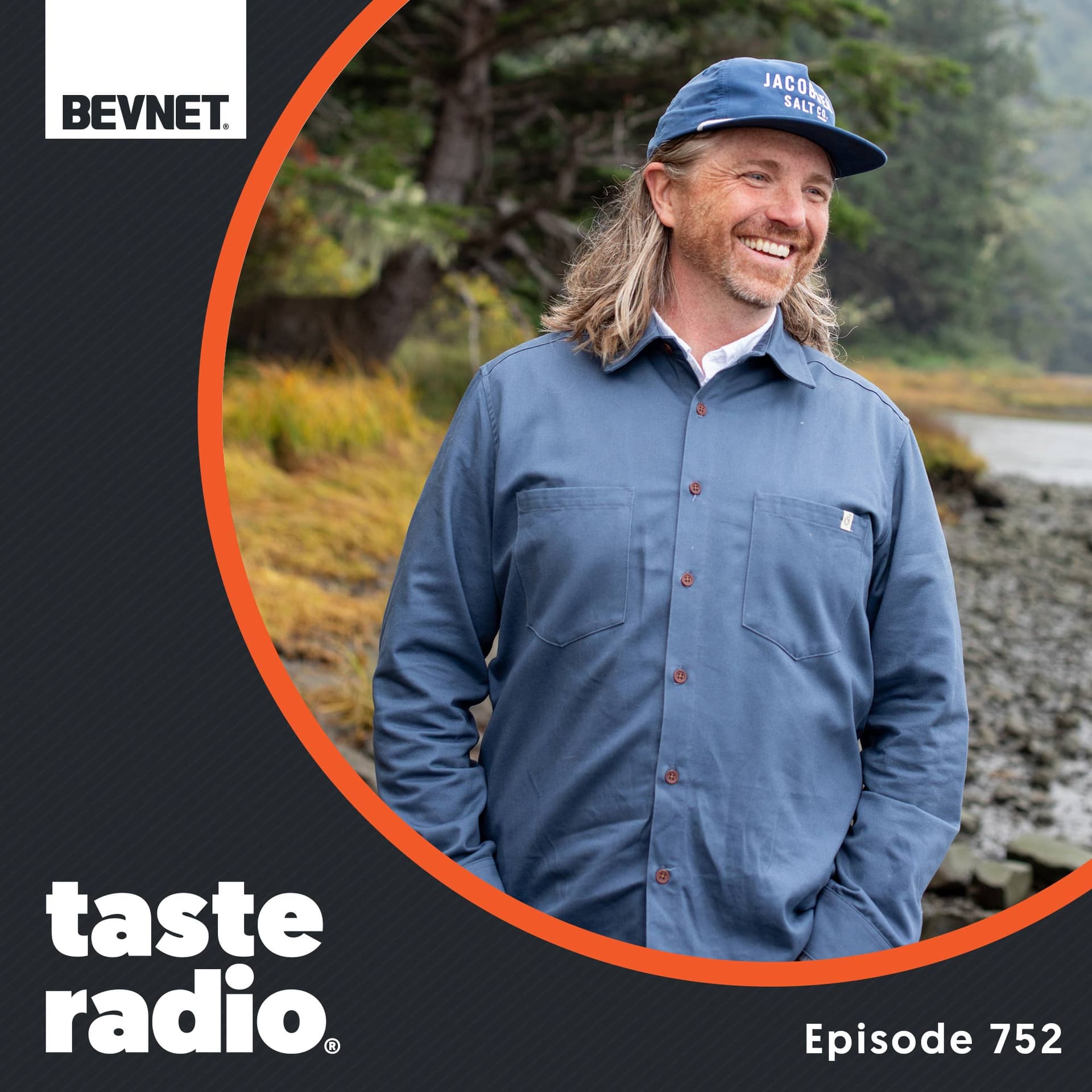
How do you turn seawater into a cult food brand? Ben Jacobsen did just that – and changed the way America thinks about salt.
In this episode, we sit down with Ben, the founder of Jacobsen Salt Co., whose journey began with a single, revelatory bite of tinned fish topped with a few flakes of sea salt. That moment sparked a passion that led him to the windswept Oregon coast, where he began hand-harvesting salt, and ultimately to building one of the most iconic artisanal food brands in the country.
Ben shares how he bootstrapped the business from scratch, earned the trust of renowned chefs, and turned Jacobsen Salt into a symbol of quality, craft and flavor. He speaks candidly about the entrepreneurial rollercoaster – the risks, the resilience, the moments of doubt – and the deep creative drive that continues to fuel his work.
Show notes:
0:25: Interview: Ben Jacobsen, Founder, Jacobsen Salt Co. – The conversation begins with Ben's recent culinary experiences in NYC and his growing appreciation for restaurants since starting his company. Ben traces the origins of Jacobsen Salt Co. to his time living in Copenhagen and Oslo and how he was inspired by the profound difference high-quality salt made in simple meals. The conversation delves into the technical and entrepreneurial challenges of creating a salt company from scratch and the humble beginnings of Jacobsen Salt, which involved transporting seawater in wine totes and experimenting in a commercial kitchen. He touches on how Jacobsen Salt gained early traction through word of mouth, support from chefs, and compelling design – all of which contributed to expansion in specialty shops and boutiques across all 50 states. Ben also explains why he sees a long runway for growth, emphasizing the importance of scaling production and increasing accessibility while staying true to the brand's mission.
Brands in this episode: Jacobsen Salt Co.