
 Ask ChatGPT

- Podcasts
- TED Business
- What sitting all day does to your brain and body
TED Business3 Aug 2026 · 47m · 14 chapters
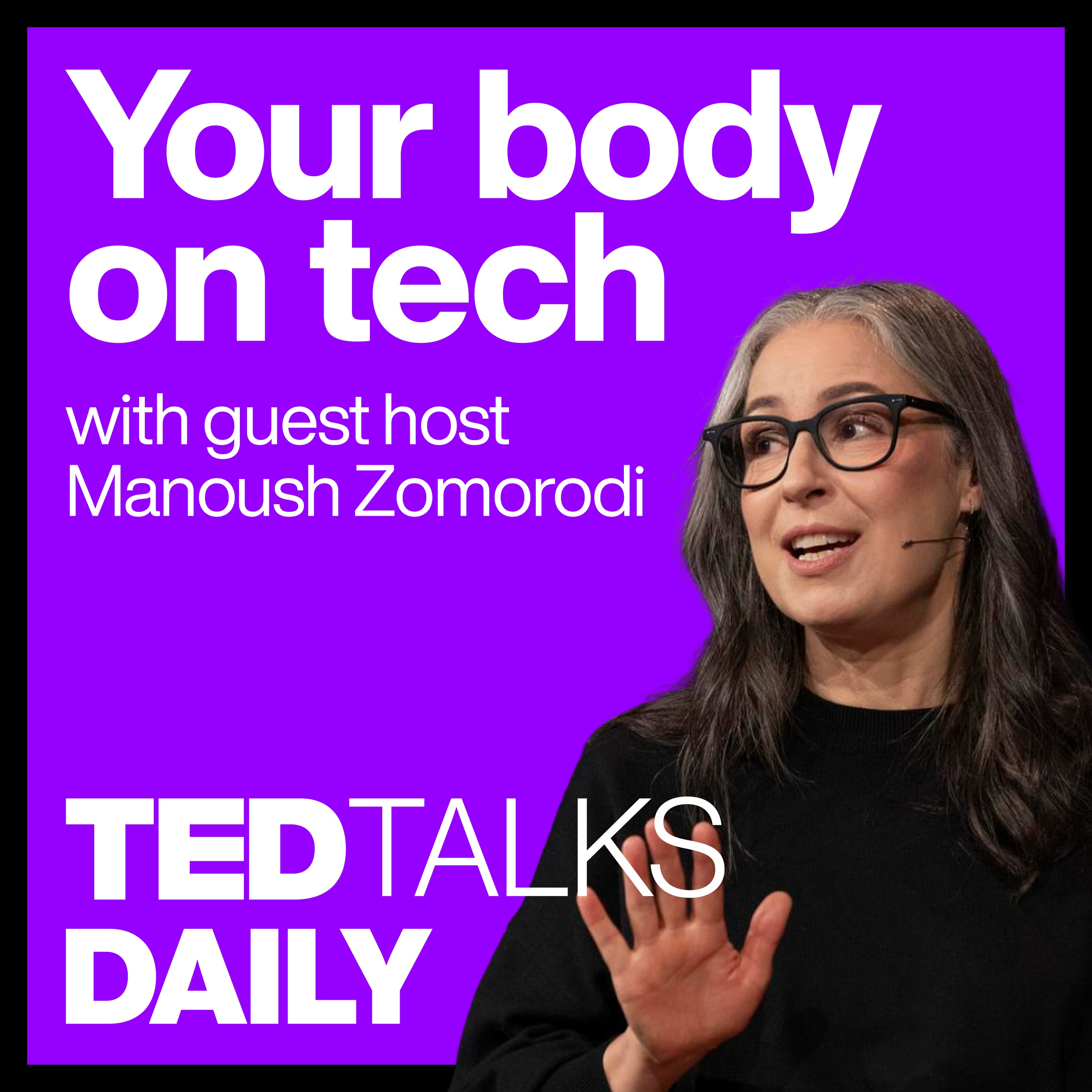
What sitting all day does to your brain and body | Keith Diaz | Your Body on Tech
In short
The episode explains how prolonged sitting and screen-based work harm brain and body health, even for people who exercise. It argues that “exercise isn’t enough” because muscles need frequent contractions to regulate metabolism (especially blood sugar) and support brain function (mood, focus, fatigue). Key claims include: highly sedentary behavior increases risk of diabetes, cancer, dementia, heart disease, and early death; bed rest rapidly erodes fitness and resembles decades of aging in heart changes; movement breaks can reduce fatigue and improve focus quickly.
Notable examples
endurance athletes’ aerobic fitness dropped ~20% after 3 days of bed rest; a “sponge” analogy for muscles soaking up blood sugar; a “smoke-break” style strategy for “movement breaks.” In Keith Diaz’s lab and “Body Electric” citizen-science study (20,000+ participants), the gold standard was a 5-minute walk every 30 minutes, reducing post-meal blood sugar spikes ~60%, and real-world participants averaged 4–5 breaks/day, reducing fatigue ~25%.
Guests
Keith Diaz, physiologist at Columbia University Medical Center studying sedentary behavior; host Manoush Zomorodi (journalist, author, TED speaker, TED Radio Hour host) interviews him.
Written by AI. May contain mistakes.
Chapters
0:45
The Sedentary Epidemic
Keith Diaz explains the health risks associated with a sedentary lifestyle.
“Well, this week I am taking over from Elise to bring you something a little special.”
6:20
Finding Movement in Sedentary Lives
Keith Diaz discusses the importance of movement breaks to combat sedentary living.
“And now our TED Talk end conversation of the day.”
14:00
The Impact of Movement Breaks
Learn how small movement breaks can significantly improve mood and productivity.
“our participants only average four to five movement breaks a day, far below our lab-tested prescription.”
17:00
Introducing Keith Diaz
Get to know physiologist Keith Diaz and the exciting research on sedentary lifestyles.
“Because movement breaks are ultimately about something bigger.”
20:14
Understanding the Dangers of Sedentarism
Explore how prolonged sitting impacts health and the misconception about exercise.
“We partnered with you and your team over at Columbia to do this study.”
23:17
Movement Frequency and Health Benefits
Discuss optimal movement frequency to counteract the effects of prolonged sitting.
“But then when you sit for eight hours, by the end of that day, you have a dry shriveled up sponge again.”
25:38
The Muscle-Brain Connection
Discover the relationship between muscle activity and brain function.
“But right, like recognizing that If you're worried about your health, then you do need to find ways to integrate movement and sprinkle it in throughout your day.”
28:03
The Effects of Sitting on Brain Function
Learn how prolonged sitting affects cerebral blood flow and contributes to feelings of fatigue.
“sitting all day, it's not causing drastic reductions in your cerebral blood flow, but there's still reductions enough that your brain feels that and likely interprets that as feeling exhausted and feeling fatigued.”
33:13
The Impact of Technology on Sedentary Behavior
Explore how technology and societal norms contribute to sedentary lifestyles and the importance of movement breaks.
“all the latest innovations in tech and what they'll mean for your life, TED Tech has you covered.”
42:00
Rethinking Movement in Daily Life
Explore the challenges and importance of incorporating movement into daily routines.
“and we'll sit there and be like, do we need to drive our car?”
Show all 14 chapters
44:00
Understanding the Guidelines for Movement
Learn about the evolution of movement guidelines and the need for actionable advice.
“What really pushed me to go further down this road is in 2018, the U.S.”
46:48
Cultural Shifts and Movement
Discuss the cultural changes needed to normalize movement in work environments.
“And people want to keep talking about it, but nothing is changing.”
48:44
Harnessing Technology for Better Health
Explore the intersection of technology and health, emphasizing collective action.
“Like right now, actually, I am going to wrap up this episode by standing up in my studio and taking one of my many daily movement breaks.”
50:42
Harnessing Technology for Better Health
Explore the intersection of technology and health, emphasizing collective action.
“This episode was produced by Lucy Little and Katie Monteleone.”

Ask about this episode
Get the gist, explore an idea or ask about something said.
 Claude
On TED Business, what are the key points of this episode?
Searching your listeningTranscript
Automatic transcript. May contain errors.
0:06Hi, everyone. It's Madhupa here. Today, we're sharing an episode of a podcast we think you'll love. It's been handpicked by the TED staff, and we think that as TED business listeners, you'll come away with a fresh idea and a totally new perspective. Enjoy, and head to the link in the description for more.
0:31You're listening to TED Talks Daily, where we bring you new ideas and conversations to spark your curiosity every day. Hello. No, I am not Elise Hu. I'm Manoush Zomorodi. I'm a journalist, an author, a two-time TED speaker, and you might recognize my voice because I host the TED Radio Hour podcast over on NPR. So why am I here? Well, this week I am taking over from Elise to bring you something a little special. A series of episodes all about how you can live a healthier life in our high tech era. Because in April, I had the honor of guest curating a session at the TED 2026 conference, And I packed it full of speakers whose work I have been obsessed with and who I think will make you think differently about your body, how you use your technology, and what is keeping us human in this digital age.
1:29So every day this week, we are bringing you one of these talks from my session, followed by a conversation with these incredible speakers to go deeper. Really, truly, they are amazing. Let's begin with a feeling, okay? That end of the day, so drained, can barely think, exhausted feeling that comes after spending hours on our devices. Physiologist Keith Diaz knows that feeling. I was still tired. Exhausted, actually. But I hadn't used my body at all. I met Keith in 2023 when I came across research he'd done in his lab at Columbia University Medical Center. This is where he studies how lives spent mostly sitting and looking at screens affects our health.
2:20We are living in the most sedentary error in modern history. And what scientists have found is that being highly sedentary increases your risk of diabetes, cancer, dementia, heart disease, and ultimately early death. This is true even if you exercise regularly. Yeah, it's awful. But Keith has spent his career trying to figure out the minimum amount of movement that the human body needs every day so that you don't die an early death. Our teams at NPR and Columbia ended up partnering to see if we could get his research out into the world. We wanted to find out could people take movement breaks throughout their day and take back their health from their sedentary screen filled lives.
3:08And we ended up creating one of the largest citizen science studies ever. If you follow me on social media, you have probably seen me post about this study. We called it Body Electric. And very recently, I put out a book by the same name, which has these findings at the heart of it. Keith explains the study and what you need to maintain your body on a daily basis. And then I join him to talk about what it takes to balance our biological needs with all the conveniences of modern life so that we're not living some drained, tired version of ourselves. All that right after a quick break.
3:53This episode is sponsored by Toyota. Expression shows up in ways we don't always notice. It's not just what we say. It's the choices we make, the things we surround ourselves with, the way we move through the world. Even something like the car you drive can be a form of expression. Toyota's new all-electric family leans into that idea. The CHR, for example, has a bold, distinctive design, something that stands out a little in a good way. While the BZ and the BZ Woodland each bring their own personality to the table, it's a reminder that the things we use every day don't have to be neutral. They can actually reflect who we are.
4:27Learn more at Toyota.com, the new all-electric family. Toyota, let's go places. I'm here on the job site with Dale, who's a framing contractor. Hey, good morning. Dale traded up to Geico Commercial Auto Insurance for all his business vehicles. We're here where he needs us most. Yep, they sure are. We make it easy for him to save on all his insurance needs, all in one place, with coverage that fits his business and bottom line. Oh, I shouldn't have looked down. It's all right. We're so far up here. Look at me. Take a deep breath. No, I'm good. So good. Get a commercial auto insurance quote today at Geico.com and see how much you could save.
5:03It feels good to Geico.
5:08This episode is brought to you by LinkedIn. Running a small business means every hire matters. A bad hire can cost you time, money, and momentum. A good hire, they can help grow your business. But finding great talent isn't easy, especially when you don't have the time or resources to sift through piles of resumes to find the right fit. That's why LinkedIn built HiringPro, your new hiring partner that screens candidates for you, so instead of sorting through applications, you can spend your time talking to candidates who are actually a good fit. With HiringPro, you can hire with confidence knowing you're getting the best talent for your business.
5:50In fact, according to LinkedIn, those hiring with LinkedIn are 24 % less likely to need to reopen a role within 12 months compared to the leading competitor. Join the 2.7 million small businesses using LinkedIn to hire. Get started by posting your job for free at linkedin.com slash tedbiz, spelled B-I-Z. Terms and conditions apply.
6:20And now our TED Talk end conversation of the day. My favorite job ever was as a summer camp counselor, where I was basically paid to play games with kids all day. We played capture the flag, running bases, dodgeball, went swimming in the pool every day. And at the end of the day, I'd be tired, but in a good way. Not mentally drained, but physically tired. A satisfied kind of tired, where I'd use my body to complete a hard day's work. Flash forward, and my job today looks very different. Even though I'm an exercise scientist, I don't get to actually do any exercise at work. Instead, my days consist of staring at a computer screen and sitting in countless meetings.
7:05The transition for me to office work was jarring. I no longer had those same feelings of satisfaction at the end of the day's work. I was still tired, exhausted, actually, but I hadn't used my body at all. And this shift that I experienced, I'm not alone in feeling. We are living in the most sedentary error in modern history. In a single year, the average adult now spent a full 187 days, over half of the year, sitting or physically idle. The bad news is that our bodies weren't designed for this. I know because I've spent my career as a scientist studying the harms of being highly sedentary. And what scientists have found is that being highly sedentary increases your risk of diabetes, cancer, dementia, heart disease, and ultimately, early death.
7:57Worse, this is true even if you exercise regularly. To put it simply, being highly sedentary, as many of us are, is toxic. Let's start with the healthiest people among us to use as an example. In one study, when highly trained endurance athletes were forced to bed rest, their aerobic fitness levels dropped by about 20 percent in just three days. What took them months to build was erased in a matter of a long weekend with no movement. This isn't unique to highly trained endurance athletes. If you took a regular typical healthy adult and forced them to 40 days of bed rest, their heart would show changes similar to 50 years of aging.
8:47Now, this isn't about missing a workout or two. Exercise only makes up a tiny fraction of your day. The toxicity comes from when movement begins to disappear from your life. And this begs the question, why isn't exercise alone enough? A part of the answer lies in our muscles. Our muscles are more than just the machinery that power movement. They're also really important for regulating things like our metabolism. Let's use blood sugar as an example. Our muscles are like sponges for blood sugar. When we regularly use and contract our muscles, they're like a moist sponge soaking up the sugar from the bloodstream.
9:32But when we don't regularly use and contract our muscle, like a dry and shriveled sponge. It's not really good at soaking up anything. Now, here's the key. When we exercise, it rewets the sponge. But eventually, that sponge dries out if you get little to no movement the rest of your day. So what do we do? Well, we need to keep the sponge moist. Now, I'm not going to tell you that we need to move all day. Instead, I'm going to suggest that we follow the lead of an unlikely place, the tobacco industry. In their early days, cigars were their primary product, but this was the industrial age. Millions were working in factories, and those workers only got short breaks from their lines, certainly not long enough to smoke a cigar.
10:25Thus, the cigarette became the primary focus of the tobacco industry so that these workers could get their fix in small, short doses a few minutes at a time throughout the day. And if sitting truly is the new smoking, as the saying goes, then what better way to fight back than to use the approach of the tobacco industry but instead of smoke breaks, movement breaks. Short bouts of movement, a few minutes at a time, sprinkled in throughout the day. If our muscles need regular use to function optimally, then outside of any exercise time, we need to be contracting them frequently through movement.
11:05The question that we asked in my lab is, what's the least amount of movement breaks that we need in order to offset the harms of being highly sedentary? And the answer we found was a five-minute walk every half hour. This reduced the blood sugar spike after eating by about 60 percent. That's the size of a reduction you would expect to see if you put someone on medication. to manage their blood sugar levels. The cool part is that our participants weren't sprinting or even walking fast. This was a stroll. They were walking at two miles an hour. Now, I want to be honest. What I'm proposing to you as the answer to our modern sedentary lives are five-minute movement breaks every hour, or every half hour, I should say.
11:52The truth is that when I found out that this was the answer, I was disappointed. My immediate reaction was, there's no way people are going to do this, largely because I couldn't realistically do it myself. And so part of me wondered whether this should be the end of the road for my research on movement breaks. But rather than argue with the data, I decided to press forward and put it to the test in the real world. With a little help from public radio, we had over 20 ,000 people try our experiment to take movement breaks throughout the day, anywhere from every half hour to every two hours for two weeks.
12:25And to my surprise, the vast majority of people liked taking movement breaks. Many wanted to keep going. We had tapped into something that people were craving, an antidote to our toxic modern lives. But what really surprised me is that when we asked people what they liked about movement breaks, very few touted the physical health benefits. Instead, what they liked was how the movement breaks made them feel. They loved that they felt energized, that they no longer felt like they were in this brain fog throughout the day, that they were able to actually better focus at work. And this really resonated with me and my experiences as an office worker and how the exhaustion impacted my life.
13:13I remember when my kids were younger, they'd come home from my office job, I'd open the door, and they'd greet me with energy and enthusiasm and want me to immediately start playing with them. And I just didn't have it in me. I was too drained from the day. And that's one of the most striking findings that we see in the lab. Over the course of sitting all day with no movement, people's mood plummets while their fatigue builds and builds. And that's because our muscles have a symbiotic relationship with our brains. They're in constant communication. Our biological need to contract muscle is more than just about physical health and metabolism.
13:53It's also foundational to mental and brain health. The promising news is that in our real-world experiment, our participants only average four to five movement breaks a day, far below our lab-tested prescription. And yet, they still reduce their feelings of fatigue by about 25 percent. And we see this play out in the lab as well. Something as small as a one-minute walk every hour can still largely offset the impact of sitting all day on your mood. So even small, short, infrequent movement breaks can counter some, not all, but some of the hidden costs of our sedentary lives. Now, one of the biggest concerns I often hear from employers in schools about movement breaks is that they worry that it's disruptive, that will hurt productivity and performance.
14:48But movement doesn't mean you have to stop working. You can have walking meetings, pace around while you're on a call, get walking pads, or somebody just move around while thinking. But the bigger idea and concept with movement breaks is that when you compare brain activity after movement versus after sitting, the differences are so striking. The brain after movement looks like one certainly far more ready to learn and to work. And yet, somewhere along the way, we decided that sitting and staring in front of a computer screen for eight hours straight is the best way to work. And that's where the real challenge lies.
15:25Productivity culture, convenience culture and technology are reengineering our lives and steadily removing the need for movement. We can have groceries delivered and robots vacuum our floors without ever getting off the couch. And the consequences of this reengineering is that we now often see movement as an inconvenience. We see it as an interruption. We see it as something to avoid. I saw this play out with my daughter recently when I had to drive her to our local library. But when we got there, the parking lot was full. So I had to park a little further away in the street, and she immediately started complaining that I had parked so far away.
16:13Now, mind you, the place I had parked may have had an additional 20 seconds of walking to her life. Not a mile, but 20 seconds. But that moment hit me. Movement had become an inconvenience for my daughter, too. So I gave her a classic dad lecture, and this was met with a preteen eye roll. But a few days later, we were leaving a stadium, and I was taking the escalator down. As I'm going down, I see something pass by me, and I look, and it's my daughter taking the regular set of stairs, happily taking the regular set of stairs, smiling at me as she goes by. It was a small victory. And if my eye-rolling preteen can make this shift on occasion, then I have hope for the rest of us.
17:00Because movement breaks are ultimately about something bigger. They're about seeing those small moments in your day when you have the opportunity to move, to see them not as inconveniences, but as a way to reconnect our bodies and our brains so we're not living some tired, drained version of ourselves. Thank you. That was Columbia University Medical Center physiologist Keith Diaz. In a minute, my conversation with Keith about the scientific findings that are about to be published. I am super excited about that. And what it takes to actually change the systems that keep us so sedentary in our lives.
17:42I am always learning from Keith. You will too. Don't go away. Support for today's episode comes from Square. Think about the local businesses that make your community feel like home. The cafe where they know your order. The shop owner who remembers your name. the service that always goes the extra mile. Those moments don't happen by accident. They happen when owners have the right tools to focus less on operations and more on the people walking through their doors. Square brings it all together in one system so businesses can run smoothly and create more of those experiences that keep people coming back.
18:25And whether you're just opening your doors or growing into something bigger, Square scales with you. No hidden fees and no surprises. With Square, you get all the tools to run your business with none of the contracts or complexity. And why wait? Right now, you can get up to$200 off Square hardware at square.com slash go slash TEDbusiness. That's S-Q-U-A-R-E dot com slash go slash ted business run your business smarter with square get started today this episode is brought to you by paca you know those pieces you'd wear every day if you could get away with it for me it's my paca hoodie and crew sweater made with the same care and unmistakable softness paca creates outdoor and lifestyle apparel from alpaca fiber one of the most sustainable natural fibers on the planet.
19:26Their signature hoodie is unbelievably soft, warmer than wool, yet still breathable enough to wear throughout the day. Each one is made from start to finish in Peru and comes with an Inca ID hand-woven by artisans, a little piece of tradition connecting you closer to where your clothing comes from. And guess what? More than 250 ,000 people have already picked up theirs. Once you feel the quality of PACA, you'll understand why people keep coming back. To grab your PACA hoodie, go to www.pacaapparel.com. That's www.pakaapparel.com.
20:13Okay, so you just gave your TED Talk about this project. I was the NPR person. We partnered with you and your team over at Columbia to do this study. But, you know, as I've sort of been talking to people about the work that we've done and the book that's come out about the project, the thing that really catches people, Keith, and really makes them mad and sad is this idea that doing a morning workout or taking an evening jog won't undo a day of sitting and looking at a screen. Can we just unpack like your own coming to grips with that information? Because there is a backstory here. Yeah, let's normalize that reaction first.
20:57That's totally appropriate. I had the same initial reaction. It's why I started the research that I'm doing. When I was a doctoral student, I came across some news headline. It was like in Runner's World magazine. And there was a headline that said something like, sitting is the new smoking, even if you're a runner. And I was like, you know, as a runner, as an exercise physiologist in training, I tend to see exercise as the cure-all, prevent-all for everything. And so for this article to put it out there that like, you know, what you do exercise-wise, you're running, that's not enough. I didn't believe it.
21:33And so I set off in my career to debunk that and show that, you know, that's not true. Exercise can overcome. That sitting isn't the kryptonite to exercise. and here we are almost 15 years later and man, I've come to see it in a very different light. And the way that I think about it now is I picture like the iceberg, that exercise is just the tip of the iceberg that we focus on that's on the surface that we see and that there's so much underneath when it comes to what is a healthy movement profile look like. And why I say it's the tip of the iceberg because if you do the math, you exercise 30 minutes a day, that's only 2 % of your day.
22:15Is 2 % of your day really going to offset the other 98 % of the day that you're not moving? Can you just explain, like, people want to know, they're like, how long is sitting for too long going to cause all these problems? What exactly is the mechanism? Let's talk about the sponge that you brought up in your talk. Yeah. So first I want to start with by saying that if you are an exerciser, that's great, keep doing it. You are far better off and healthier as an exerciser who sits all day than as a non-exerciser who sits all day. So I think that's the first and most important part, that your exercise that you're doing still matters.
22:53But what we're learning is that our body was designed in a way that it needs regular muscle contraction to function optimally. And our muscles are really important for regulating things like our metabolism. And so the example that we use in the talk is about blood sugar. And so that's the key here is that, yes, when you exercise, that wets the sponge undoubtedly and helps soak up some of that sugar. But then when you sit for eight hours, by the end of that day, you have a dry shriveled up sponge again. Right. And so the key here is more kind of like a faucet dripping over your muscles, You don't need to pour water all over it.
23:32You just need some drips to just keep it going, keep it moist and not dry out. It's not that we need to soak it every hour. We're talking little movements throughout the day just to keep it moist enough. That's what we're looking to do. So the gold standard that you found was this five minutes of movement for every half hour. And people are like, what? I can't do. That's going to be like 16 breaks that you're talking about. What is a better way to think about it based on all the data that you've collected from thousands of people? And, of course, just talking to people about what is possible in real life.
24:10Yeah. So, you know, if you were to pick a dose that you were really worried about managing your blood sugar levels, managing your blood pressure levels, that's the dose that the science at least looks like we should recommend. But what we found in the real world is that people really had a hard time sticking to that regimented clock. But there were other doses of movement that we tested that were still beneficial. Maybe you didn't get all the benefits. So, for example, moving every hour for five minutes still reduced blood pressure by almost five points and still improved a person's mood, reduced their feelings of fatigue, helped them feel more energized.
24:42And so instead of 16 movement breaks, we're talking about eight movement breaks a day. But I'll give folks even more encouraging news. I've been crunching our body electric data more to see what's really the least amount out in the real world that people really need to do to strive for. And what we're finding is that once people take about five movement breaks a day, you start to see diminishing returns in terms of their improvements in fatigue. Right. Like after about five to six breaks a day, you don't get that much extra benefit from doing seven, eight or nine. that somewhere about five is where you maximize your benefits for reducing your feelings of fatigue.
25:21But, you know, I think part of the bigger message here that I think people should take home is that this is really about that our bodies just need regular movement throughout the day. Like that's the take home more than anything, that you just can't sit for hours at a time. And that's what our world is designed. And we can get into that. But right, like recognizing that If you're worried about your health, then you do need to find ways to integrate movement and sprinkle it in throughout your day. I think the other thing that people have been really connecting with is that tired, can't focus feeling.
25:56Like everyone feels like they have ADHD. And I feel like we have talked so much in our culture about how too much time online and social media is the reason why we're having all these mental health problems. But actually, maybe some of that is biological. It's because we haven't paid enough attention to our physical needs as well. And not just like athletics or going in the gym, but like this tending to our anatomy. Yeah, absolutely. You know, when we kept analyzing the data time and time again, we kept seeing this effect on how people felt, their mood and their fatigue and their energy levels.
26:31That's what kept kind of resonating and standing out consistently, no matter how we approach the studies. Physiologically, it makes so much sense to me now. And I think we're learning so much more about this. You know, there was a study that found in flies who have a much less complex and much smaller brain than ours. They found 51 proteins in a fly's brain that come from muscle. And so I can only imagine how many proteins are coming from muscle in a human's brain. And so we're learning that there's these chemical messengers called myokines that are muscles, when they contract, release into circulation, and then they travel and communicate to other organs.
27:08So we're learning through a lot of these basic science studies that there's something to this kind of muscle-brain crosstalk and relationship that probably could explain some of what you're describing, Manoush, of people not realizing that actually our brains and our muscles have this symbiotic relationship. and their constant communication. How much does oxygen also play a role in this? In that, like, muscles being stimulated pushes oxygen literally up our bodies to our brain. And of course, we need oxygen if we're switching tasks constantly, opening another window, answering another email. We burn through oxygen really fast when we're so busy on our screens.
27:49Yeah, and the thing about our brain is that even like a slight change in your oxygen levels and your cerebral blood flow, you can feel that. And that comes across as feelings of fatigue, right? And so when we're sitting all day, it's not causing drastic reductions in your cerebral blood flow, but there's still reductions enough that your brain feels that and likely interprets that as feeling exhausted and feeling fatigued. And so that's why like the muscle contraction and getting up and moving helps kind of restore that cerebral blood flow, that oxygen rich blood that your brain really needs to function optimally.
28:26I think that's one of the key pieces of why people are feeling so fatigued at the end of the day is that their brains sense that just slight turning down of the dial because their muscles weren't active for so long. Maybe people know some of this, you know, ambiently know it, but actually hearing it like out loud and specifically, and then reminding yourself of it when you're sitting at your screen and you're getting kind of sleepy that like, guess what? Maybe coffee's not the answer. Maybe just moving your body and pumping some oxygen up to your brain is the thing you need. I guess I'm curious, then where does the research go from here?
29:02I mean, we just crowdsourced from 20 ,000 people, like what works and what doesn't in terms of how to take movement breaks in the real world. And so for us from here, it's how do we build interventions? How do we build programs that we can roll out in workplaces that help people do this, right? The number one reason people didn't take movement breaks is they forgot. I think that's the one thing that really stood out to me was that sitting is so ingrained in our lives that we don't even notice it. We don't even notice that we've sat for four hours straight. Like we've tuned out to that our body is probably telling us that like, I don't feel so good right now.
29:39I'm feeling really stiff. I'm feeling lethargic. I don't have great focus right now. And what do we do? We just press forward. We keep going. And that was the number two barrier that our challenge that people reported. I was too busy. I was too focused on what I was doing and I didn't want to break away. And so that combination of not being as mindful as we need to be about our sitting habits and then just this notion or idea that I got to push through and keep doing my work. Those two are really the biggest barriers that people have to taking movement breaks. And I totally get it and understand it.
30:13It's wrestling with how do we change our cultures, our social norms to address those behaviors because those are deep rooted issues that we have to tackle. Here's the thing I've been thinking about, too, which is, you know, there is so much distrust right now amongst the American public into medical science. And how, you know, obviously this was a self-directed clinical trial, and that's never going to replace like a double blind drug studies. But I think what our paper documents is that maybe we should be taking people in more to do the science and maybe they'll trust the results more because they were part of finding it.
30:48Oh, yeah, absolutely. I mean, having done this and had this experience, I'm like, how do we just keep doing it this way? Like, this was such a way to tap into citizen science. And, you know, I also thought it was such a powerful way to like, we harnessed kind of this collective spirit of, we're all doing this together. Like there was this energy around the project where everybody just felt invested in this. And think about like, how do you harness that collectivism to help fuel behavior change and to change how we operate as a society in terms of managing our health? We had this issue where our server crashed the first day, right?
31:36And people got mad because our server crashed and we couldn't start. But rather than like some people were upset, but like how many people reached out to us were like, we want to help you fix it. Like, no, we're all in this together trying to figure out an answer to a question. And we all have equal stake in it. And that's what I really loved. And I think it's a really different way to do science. And I think if we do more of that, we can develop tools, interventions, health care that actually works for people. And that's what I really liked about the project. It makes me think that there must be so many other clinical trials that are locked up in labs that, you know, need to be set free into the real world to be, you know, given a tryout, see if we can do this.
32:18Things that maybe scientists are like, well, forget it. This is impossible. But maybe we could try. Yeah. We kind of learned, like, it's possible, but we're going to have to pivot a little bit. And so doing this really early on and getting that feedback from people in the real world, I think, can really help scientists figure out how to then move forward in the best way possible. And so I think that was a key piece of our study is that we didn't spend 10 years developing this to then try it out in the real world. We tried it one time in the lab and then right away to the real world, tell us what you think.
32:56and so I think it was really important for us to do it that way rather than spend decades working on this to find out it actually is not going to work in the real world. We're going to take a quick break. Feel free to move and then we'll be right back.
33:12If you're struggling to keep up with all the latest innovations in tech and what they'll mean for your life, TED Tech has you covered. Get ahead of the curve with digestible downloads on some of the biggest ideas in technology From AI and virtual reality to cleantech. Find TED Tech wherever you get your podcasts.
33:39One of the questions that I've been working to figure out, too, is this relationship to technology. Where does that fit into this? Like, did we have this sedentary problem in 1986 before everyone had smartphones? or is this a very particular 2026 issue? It's both. So if you kind of map out the trajectories of our sedentary time and how much time we spend watching TV, how much time we spend sitting in a car, how much time we spend sitting at work, it's kind of been steadily increasing across decades. But it has really ramped up when the smartphone error came about, right? So in the 2014, 2015, 2016, there were dramatic increases in people's overall tech usage in that time.
34:27We're talking like 40 % increases in people's tech usage over that period of time. I think the pandemic probably accelerated that even more. So we've been creeping up steadily as technology has advanced and developed. And then I think it just really kicked up even more in the last 10 to 15 years. Some researchers are looking into whether technology interferes with something called interoception, this idea that the body sort of sends messages like, I need a break, I need to get a snack, I need to go to the bathroom, and that we're so captivated by what is on our devices that we ignore those signals that the body is sending us.
35:08Yeah, I mean, we haven't measured it so much in our lab studies, but I think it's something that has long resonated with me, and this idea or notion that this process of not having that interoception and not being mindful of our bodily cues is something that starts when we're in kindergarten and we go into schools and teachers tell us to sit in our chairs for, you know, seven, eight hours a day, right? And that you shouldn't get up and move. And so you have your teachers harping on that. You sit in your desk all day and then you get that message your entire school career. And then you transition, you know, to go to college, it's much of the same.
35:43And you go into workplace and it's much the same. So we're kind of just training ourselves to ignore those sensations. So that's part of this going back to the social norms piece of this is that we have this expectation that we must ignore those cues. So your body's cues, a lot of people rely these days on their device, a smartphone to ping them, you know, it's time to get up or they're sort of outsourcing it because, you know, technology is amazing and they can count their steps and their blood heart rate and all those things. You're actually not a fan, if I understand correctly, of fitness trackers, you've told me.
36:20We did see that people who adhered to the protocol ended up needing their timers less. They did sort of get back into the rhythm of what their body needed. So like what, how do you approach this? I think we learn from the body lecture study that people need reminders to start, right? Because you first have to kind of check back in and realize like, how much actually am I sitting? And how much often do I need to get up and move around? But, you know, why I'm not as much of a fan of it is that you're relying on kind of external cues still. You're not relying on your interoception. You're not checking back in on your body.
36:58You're just relying on a device to tell you to do this. And where I'd love to see this and what the science kind of tells us on human behavior change is that for us to build a habit, it has to be more so something internal. And so when we kind of learn how to check back in with our bodies, we don't have to rely on external cues to do that. That behavior is much more likely to stick. The example I always use is brushing teeth is like the ultimate health behavior that we all aspire to get people to eat as good as they are at brushing their teeth or exercise or move as much as they are good at brushing their teeth.
37:35And that's because brushing teeth is something that we have since we were kids were taught and trained to do. But we also have tied it to cues in our day. We automatically are cued by our environment that like, oh, yeah, I put my pajamas on. I go brush my teeth. Like that's just the natural part of it. And so getting to that place in our everyday lives for movement breaks or just movement in general of like, OK, I just I've just finished a work task. I'm going to take a movement break before I go on to the next one. I just finished a meeting. Before I go to the next one, I'm going to move. Right.
38:08And tying it to cues in our day rather than relying on some kind of device to remind us. You know, like I remember I was in a store one day and two workers were sitting and I heard one of them say, oh, my watch just went off to tell me to stand up. And then she looked at it and she's like, nah. And they just kept working. And they just kind of both looked at each other like, yeah, no, we're just going to ignore that and keep going. I just feel like that's where it ends up with these external reminders, right? It works for some people, but it doesn't work for everybody. I'm old enough to remember that people wouldn't forget to go out for a cigarette.
38:38So let's talk about this analogy of smoke breaks, cigarette breaks, short breaks. What do you do when you sit outside and smoke a cigarette? You're taking deep breaths. Okay, you're filling yourself with smoke, but maybe people were just looking for a getaway from everybody, a getaway from the grind, take some deep breaths, and that used to be fine. How do we begin to normalize something without people thinking that, like, oh, they're slacking? Yeah. I wish I had, like, the answer to change that. We looked at it in the Body Electric study. This notion of idea that if you're away from your desk, that you're not productive, right?
39:16That's going to hurt your work performance. And what we found in the study was that that's actually not the case, that people's work performance and how engaged they felt actually got better and improved. And there's lots of science on this outside of just movement breaks, but just breaks in general from work actually are really beneficial for helping you concentrate better, to have better executive function, better memory. And movement in particular really helps with a lot of those pieces too, right? And so it's getting employers to kind of see this perspective of actually sitting for eight hours straight is not the best way to work.
39:55And in fact, a healthy and more productive workforce is one that is actually taking movement breaks. You know, one of the things that we see with movement breaks is that those improvements in mood that people experience is instantaneous. It's not like you see it at the end of the day. You feel better right there in that moment. And so harnessing that and creating a positive feedback loop where like, I took a break. Oh, I actually felt better. Or getting us to focus on, I like how I perform better at work when I take these movement breaks. This is going to make me feel better and actually make me a better worker, I think, as a way to help start to address some of this.
40:31Can we talk about younger generations of people and how we start to make this part of their lives? because recess is not a law in the majority of U.S. states, and movement breaks, you know, some teachers do them, some don't. I'm thinking, you know, you have a teenage daughter who you tell a story about life being inconvenient if you have to move to execute. What's it like to be a parent of a teenager in this time when this is what the norm is, sedentary with a screen? The world, as you say, is being built around those two things. Yeah, I still think we're struggling with both of my kids of how to fit more movement into their days.
41:13And part of it is it's so structural. Changing the classroom environment would be one helpful. Two, allowing kids to stand up and go take movement breaks is really hard to do. And how schools can easily allow that to happen in a safe way, too, I think is logistically challenging. I think what we've strived to do is kind of try to change our daughter's view or relationship with movement and kind of fostering that mentality of like, this can help with your mental health. And this is a way for you to reset and, you know, also to change your perspective, to see where there are opportunities for movement.
41:52And so one of the things that we always do is like, she loves going to the library and getting books. And our library is about two miles from our house. and we'll sit there and be like, do we need to drive our car? Oh, I love it. Like, can we, like, go ride our bikes? Right? Yeah, I guess it's kind of rethinking, like, where can we actually fit movement in? I'm laughing because in my family it's like a joke that we always end up walking by the side of some highway when we go on vacation because my husband and I are like, I think we could walk. Like, we'll look at the map and be like, it's not that far.
42:24I think it could walk. And then so many American cities are not set up for you to walk a mile from one place to another. So, like, it is, you know, if there are no sidewalks, if there's no safe way to get somewhere, if you live in a neighborhood where there's pollution or you don't feel safe. Like, it's so frustrating when people want to do these things and yet there's nowhere to go because they work in an office park and because everyone drives to and from everything. Yeah, I feel the same way. And that's what's like so discouraging, I think, is that like school environments, our neighborhood environments, our world wasn't designed for this.
43:02And so it's like, how do we redesign it? And those are big questions. And it's got to take a lot of work to think about how we redesign these things. And so I think part of our hope with the work that we do and the project that we did was to find small, simple ways to do this that you could easily fit into your day. and the Bioelectric Project, the study that we do in the lab, it's all walking based, but you don't have to walk, right? Like this is about muscle contraction and there's studies that show like if you did squats and high knees and calf raises, you could still see a lot of the same effects that we saw with walking, right?
43:37So it's just about getting movement and it doesn't have to be you leaving your house to do that. You know, I don't think I've ever asked you this. Was there a moment back in the day when you were trying to research why working out once a day wasn't the antidote for sitting all day? Was there like a moment, the aha moment, when you were like, ah, it needs to be interstitial? What led you to that conclusion? What really pushed me to go further down this road is in 2018, the U.S. Fiscal Activity Guidelines came out. It was the second time they'd ever released guidelines. And for the first time, they actually said, in addition to exercise, people need to sit less, move more, right?
44:18So they're acknowledging for the first time ever that it's not just about exercise, that your sitting also matters. But those guidelines were sit less, move more. And I remember thinking like, those are terrible guidelines. And that's not to bash the people who made those guidelines. That's all the evidence we had at that time, right? But like, if we're gonna get people to do something about this, we need more than sit less, move more. That's what I liked about the Movement Breaks concept. It was a way to give someone an actionable plan. to do something about it than just, oh, you should sit less and move more.
44:49Mm-hmm. I mean, it's interesting. Here we are. You said that was the 2010s, and, like, AI is becoming a thing. And, you know, there's this fantasy that AI will all set us free and we'll have time to frolic in fields five times a day. But that is not what people are seeing. If anything, AI is causing more compression of work, making people sit for longer periods of time because they're also overseeing the work of eight AI agents or whatever. So I guess my question is, what happens next? Our relationship with technology is getting even more entangled. So are we at this point where we have to be more specific, put language around or doses, as you say, around things that like, you know, probably when I was a kid, if someone was like, did you get enough movement today?
45:36That would be kind of like, maybe not in school, but like generally we were always moving. This is not getting better. Yeah, I wish I had a great answer to that. I'm equally as concerned. And this doesn't change unless policies are developed around the workplace and around technology. Because I don't know how much the tech companies care about people's bodies and their health. Some do. Don't get me wrong. But they care about their efficiency, right? Yeah. Yeah. And their productivity. And maybe it's going back to that point of like harnessing like this idea or notion that like a body that moves is a more efficient and productive body as well.
46:24Maybe it's tapping into that. And like what moves the needle for employers, right, to allow this to happen? That's kind of where my mind goes. I was talking with a journalist recently who was doing another piece on sitting. and she's like, I feel like I've been writing the same piece for 10 years. Do you feel the same? I'm like, yes. I feel like I keep saying the same story again and again and again. And people want to keep talking about it, but nothing is changing. And that's where I just feel like I feel stuck because I'm like, how much do I have to keep talking about it? How much more science needs to come out before somebody starts doing something about it?
47:06And that's what really concerns me. I'm going to offer a little bit more positive anecdote. One, it is we can change our habits really freaking fast. Look at us getting on Zoom for everything during the pandemic. I'm starting to hear from people. Everybody's reading the book and the work that Keith is doing. And we did it today. So like at first they'll be like, oh, my God, we are out of our seats. We're not working. Oh, actually, we felt better. And we got to the end of the day without feeling exhausted. Yeah. What you're getting at is it's a grassroots movement, right? Like the top ain't changing things.
47:40So we're going to have to start from a different perspective and a different approach. And it's this trickle effect. And normalizing the behavior has to start with somebody being willing to do it and step out of that comfort zone. Like I'm always that guy in a Zoom call who like is walking on a treadmill while everybody else is sitting. I know it's weird to see you sitting right now, actually. Yeah. When you make it part of like, oh, that's totally a normal thing to do. And I wouldn't even think twice about it. We have to start changing that perception and that culture. And it may have to start with just people doing it and making it normal.
48:14I think we need a meme. Like, touch grass worked really well. Maybe we need, like, dance on grass or something like that. We're going to figure it out, Keith. We're on the journey. All right. Time for a movement break. Keith, great to see you. Thank you, as always. Keep it going. Keep it going. Exactly. Exactly.
48:35Oh, what I love about Keith is his openness to experimentation and his patience in taking deep science and turning it into language that we can all use in our daily lives. We don't have to be researchers. Like right now, actually, I am going to wrap up this episode by standing up in my studio and taking one of my many daily movement breaks. Please feel free to join me by walking or pumping your arms in place or marching side to side. That's what I'm doing. Feels good to move. It's true. And I think that is the most delightful thing that I found working with Keith and the thousands of listeners who were willing to share their time and data with us for the original project and my book, Body Electric, that just came out.
49:24People are interested in science. And, you know, living with technology is one big experiment. And so they are ready and willing to be part of figuring out how to live with their devices the way that they want to, not just how the tech companies want them to. I think this is part of how we restore people's trust in the medical community, that we bring them into the process. We work together to find answers. Meanwhile, I love Keith's positive message. Let's enjoy being in our bodies and being alive.
50:02Keep walking, keep moving. That was Keith Diaz at TED 2026 in conversation with me, Manoush Zomorodi. You can also watch Keith's full talk at TED.com. On tomorrow's episode, all the things you know or think you know about kids and social media, Child psychologist Candice Auders says not so fast. Tomorrow, her talk, our conversation, and why she wants you to reconsider how you think about teens and screens, and adults and screens, for that matter. That's it for today. If you're curious about TED's curation, visit ted.com slash curationguidelines. TED Talks Daily is a podcast from TED. This episode was produced by Lucy Little and Katie Monteleone.
50:47Leone. It was edited by Alejandra Salazar with editing support from Maggie Bishop, Ban Ban Chang, Tanaz Meshkanpour, and me. Keith's talk and conversation was fact-checked by the TED Research Team, and this episode was mixed by Matthew Polis. The TED Talks Daily team includes Martha Estefanos, Oliver Friedman, Lucy Little, Emma Taubner, and Tanzika Sungmarni Vong, with support from Daniela Ballarezzo, Valentina Bohanini, Ban Ban Chang, and Lainey Lott. Special thanks to Sanaz Meshkinpour and my team at NPR's TED Radio Hour for all their help on this special takeover. And to my co-curator at TED2026, a very special thank you to David Biello.
51:30You can hear more from these speakers on the TED Radio Hour with episodes coming out throughout the summer. I'm Manoush Zomorodi. I'll be back tomorrow with a fresh idea and conversation for your feed. Thank you so much for listening. I'm going to sit down now.
51:57This episode is sponsored by Toyota. A lot of us have this instinct to explore, to get out of our routines, to try something new, to maybe go somewhere we haven't been before. But the ability to do that, it depends on having the right tools. Toyota's new all-electric family is built with that in mind. vehicles like the BZ Woodland are designed for movement and possibility with dual motors, all-wheel drive, and the kind of capability that makes it easier to take the long way home or leave town entirely. Because sometimes escape isn't about going far. It's just about knowing you can. Learn more at Toyota.com, the new all-electric family.
52:33Toyota, let's go places. Hello, I'm here during the lunch rush with Janice, who owns her own food truck. Best cheese steaks in town. Janice traded up to Geico Commercial Auto Insurance for her food truck business. We're here where she needs us most. They sure are. We make it so easy for her to save. With customized coverage, it grows with her business. Sorry, I just get so emotional talking about saving folks money. Not this onion I'm chopping? It's just so beautiful. Oh yeah, nice onion. Get a commercial auto insurance quote today at geico.com and see how much you could save. It feels good to Geico.
From the publisher
Can a five-minute walk change how you feel all day? Exercise scientist Keith Diaz shows how your body is built for the kind of movement that modern life has quietly erased — and suggests something refreshingly doable: making time for small doses of movement sprinkled throughout the day, as a way to boost your brain and body. And stick around after his talk for a deep dive conversation with our guest host for the week, author and podcaster Manoush Zomorodi, into the ideas he shared on stage and beyond.
This is episode one of a seven-part series airing this week on TED Talks Daily, where Manoush — and the seven speakers she curated for TED2026 — explore how you can live a healthier life in our high-tech era.
To hear more from Manoush, listen to TED Radio Hour wherever you get your podcasts. Check out her new book, Body Electric, to learn more about the hidden health costs of the digital age.
Hosted on Acast. See acast.com/privacy for more information.
More from TED Business
All episodes

We use cookies.They keep VO running smoothly and help us improve it. Privacy policy