
 Ask ChatGPT


 The Business of Fashion Podcast
12 Jun 2026 · 24m · 10 chapters
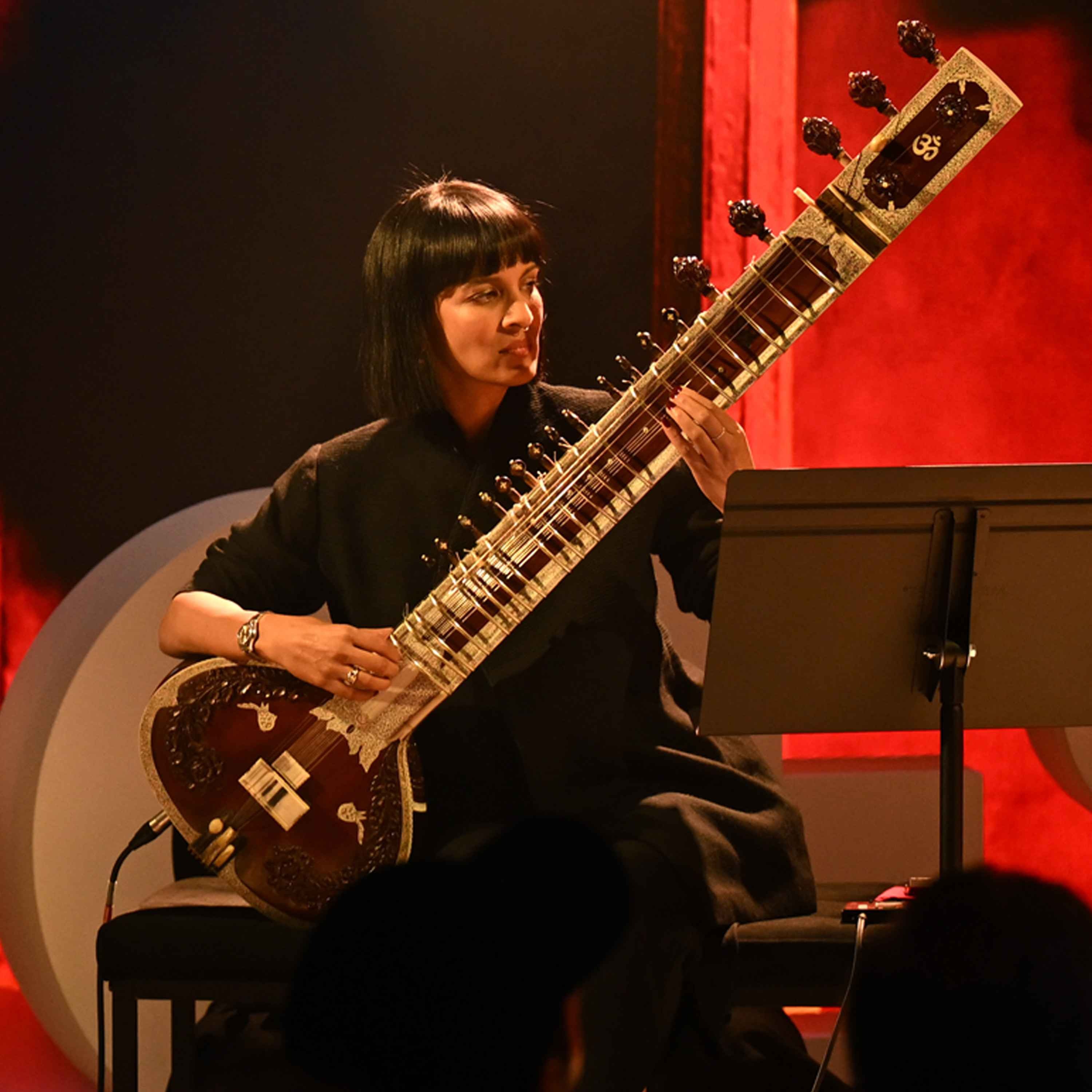
Anoushka Shankar discusses “creativity as an act of hope,” using her three-album trilogy to explain how she returned to music after pandemic-era creative numbness and personal hardship, and how improvisation helps her adapt to upheaval.
Anoushka Shankar is a contemporary musician who has spent ~30 years touring and ~20 years writing. She is trained in North Indian Hindustani sitar traditions (learned from her father, Ravi Shankar) and blends Hindustani raga structures with electronic, flamenco, and Western orchestral influences. Imran Ahmed (BOF founder/CEO) hosts.
Any creative act is hopeful; hope is a choice made without guaranteed outcomes; improvisation and presence keep tradition current and resilient.
A lullaby practice moment with her sick child on a trampoline; album chapters “Forever for now,” “How Dark It Is Before Dawn,” and “Land of Gold” song “Reunion” (written for the 2015 refugee crisis).
Written by AI. May contain mistakes.
Anoushka discusses her innovative approach to music and the hope it embodies.
“I find Anushka's music hauntingly beautiful.”
Anoushka shares her experience of overcoming creative numbness post-pandemic.
“I'm so happy to be here and speaking and playing with you today as part of this incredible event.”
Anoushka recounts how a moment with her child inspired her creativity.
“And I've been feeling like I can't fix it for them, even though that's what I want to do more than anything in the world.”
Anoushka reflects on the need for hope during challenging global times.
“and it's about kind of living fully in these fleeting moments.”
Anoushka explains how her creative process reflects cycles of darkness and light.
“I have to choose to hope in the moment when I don't know it's going to work and that anything's going to happen.”
Learn about the importance of hope and connection in overcoming adversity.
“And that was kind of the thing that I was holding on to through the whole process of going through the difficulties was that knowledge that one day I'll come back to that bit again.”
Anoushka introduces her song 'Reunion' inspired by the refugee crisis.
“I wrote this in response to the ongoing refugee humanitarian crisis in 2015.”
Discover Anoushka's experiences with the sitar and its cultural significance.
“And thank you so much for listening today.”
Learn about the raga system and its differences from Western music.
“While they're striking the stage, we're going to go stand near...”
Explore how improvisation in music can translate to adaptability in life.
“performance that's the classical music I made three albums of classical music and And then once I started writing, I started, as you said, wanting to kind of mix all these different cultures that I'd grown up with.”

Get the gist, explore an idea or ask about something said.
 Claude
On The Business of Fashion Podcast, what are the key points of this episode?
Searching your listeningAutomatic transcript. May contain errors.
0:00Anoushka Shankar: This episode of the BOF podcast is brought to you by Macy's. Golden Hour. That warm, glowing slice of the day when everyone looks radiant. Macy's has bottled that feeling into this summer's trend, Golden Hour Glow. Think warm neutrals, artisanal emblemishments, gold hardware, and breezy statement linen. Everything designed to look effortlessly sun-drenched. For the actual glow, reach for the Guerlain Terracotta Healthy Glow Bronzer. Blush, bronzer and highlight in one palette. And it even doubles as an eyeshadow. Shop the Golden Hour Glow Edit at Macy's. In-store or at macys.com.
0:45Hi, this is Imran Ahmed, founder and CEO of the Business of Fashion. Welcome to the BOF podcast. It's Friday, June 12th. Anushka Shankar has spent three decades building one of the most distinctive bodies of work in contemporary music. She has taken the sitar, an instrument rooted in centuries of North Indian classical tradition, into completely new territory, blending the ancient Hindustani raga system with electronic, flamenco, and Western orchestral influences. I find Anushka's music hauntingly beautiful. At a time when we're bombarded with wars and looming AI risk and a constant churn of uncertainty, her music is a salve.
1:32It carries echoes of long road trips with my family, listening to her father, Ravi Shankar, play the sitar. But this is not just nostalgia. All of Anushka's music is rooted in her personal journey. at BOF Voices 2025. She explained how she has written from joy and from pain and from outrage. But in each case, the impulse to release something into the world is inseparable from the belief that it will matter to someone. Every act of creation is an act of hope. Writing music is obviously a creative act, and I believe that any creative act is a hopeful act because we wouldn't send anything out into the void if we didn't have a hope and belief that it was going to reach other people, that it was going to help other people by nature.
2:23Anushka spoke about how she found her way back to music after a prolonged creative numbness following the pandemic and what the ancient discipline of improvisation has taught her about adapting to a world in constant upheaval. She also treated us to a beautiful rendition of my favorite song of hers, Reunion. Here's Anushka Shankar on the BOF podcast. Hello, everyone. I'm so happy to be here and speaking and playing with you today as part of this incredible event. This is about living your best life in session five. So I wanted to just talk a little bit about my experience with choosing hope and taking leaps of faith.
3:04I'm a musician. As Imran said, I've been touring for 30 years. I started when I was a baby and writing music for 20 years. Writing music is obviously a creative act, and I believe that any creative act is a hopeful act, because we wouldn't send anything out into the void if we didn't have a hope and belief that it was going to reach other people, that it was going to help other people. By nature, it is about hope. I've written from a place of joy, I've written from pain, I've written from outrage about global events, but each of those times there is some shred of hope that means it's going to make some kind of a difference to bother putting something out into the world.
3:41In the last couple of years in particular, I've released a trilogy of albums that told a longer story over the three-album cycle. We've been touring around the world. And I think from the outside, it's looked like a particularly kind of empowered or creatively fertile time in my life because there's been so much output. There's been so much going on. And there has. But it's really come on the back of a period that was very much the opposite of that. I was feeling really creatively numb for a long period and unable to write music. Coming out of the pandemic, I moved into a really difficult personal experience that went on for a really long time.
4:21And it just made me feel smaller and smaller and more trapped in the experience. And I kept thinking, I want to play music. I want to make music. And I just wasn't able to. And it was a strange and kind of isolating experience for me because I've always been very vocal. I've always been very connected to people. I've always shared my stories with people without much of a filter, even in this kind of public-private world we live in. I talked about addiction. I talked about coming into recovery a long time ago. When it felt important and helpful to do so, I spoke about having been sexually abused as a child for many years.
4:57I spoke about recent autoimmune conditions and neurodivergence, divorce, single parenting, women's health also, which I always think is something not talked about enough. I talked when it felt relevant about undiagnosed PCOS and having a lifetime of struggling with fibroids. I had like a juicy cantaloupe-sized fibroid when I was in my early 20s that had to get taken out. And a few surgeries after that, I finally had a hysterectomy in my 30s. So I've talked about all of that, and I feel like I believe in talking. I believe in sharing and how it helps us. But this particular thing I was going through was very unusual for me because it was actually about someone else.
5:33And it never really felt like it was my story to tell. It was someone I loved who I've been sitting alongside for a long period while they're struggling. And I've been feeling helpless. And I've been feeling like I can't fix it for them, even though that's what I want to do more than anything in the world. But it doesn't feel like my story. So I'm speaking just obliquely about the fact that I was in a period of very, very numb and debilitating pain. Creatively, I didn't know how I was going to get out of it. One day I was with my kids and one of them was sick. One of them was very boisterous. I needed to practice.
6:07I had a tour de prep for, and it was a kind of standard single parenting madness of how do I manage this? And I suggested we go out in the garden because the sun came out, and in this country, if the sun comes out, you go outside. So I took a blanket and I took my instrument and put out the trampoline, and so I said, lie down to the sick one. I said, jump on the trampoline to the happy one, and I started trying to practice. And I suppose because of the nature of the situation, I was playing a bit differently than I normally do because my kid was next to me not feeling very well. And he nuzzled closer and closer until finally his head was in my lap and I started playing a lullaby.
6:42And he fell asleep. And the moment really crystallized for me just as something precious, something to hold on to, that this was a moment of beauty and joy, no matter how hard it was in that overall phase of my life. And over the next days, I found myself coming back to that memory of, you know, kid asleep, kid laughing, sunlight through the trees, melody. And it gave me strength over those next few days. And I realized it was possible if I was truly present, not caught up in my head or in worries or thoughts, that I could really fully experience these moments of joy, even in the hardest of times, and they would give me the strength to move through.
7:23So that finally, weirdly became the seed of my next creative idea, which was chapter one, Forever for now, just about living in these precious transient moments in order to gain from them what we can. The song you heard at the beginning was a song from that collection. It was called Stolen Moments, and it's about kind of living fully in these fleeting moments.
7:50As I released chapter one and toured the world, I felt like I'd kind of cracked it and I was coping with this stuff and it was okay. But it started to feel like not enough because I started to feel like I, we needed something deeper than that. And just getting enough solace to cope wasn't acceptable to me anymore. Palestine was being raised to the ground alongside so many other global atrocities. And it just felt like I was living through one of the darkest and heaviest periods in my living memory. And everywhere I was touring and whoever I was talking to, whoever came to the shows, there was a kind of shadow over everyone and it was inescapable.
8:28I started thinking about how we needed a deeper shift and simply sustaining ourselves and accepting these little crumbs of moments wasn't enough. But I had so little faith at that time. I didn't have a lot of faith in the world turning or changing or becoming what I hoped it would be. And I had to just make a decision, which was about just digging in and thinking of the history of the world, of stories from the past, stories from my life, stories from other people's lives. And I just had to trust that things do eventually change, even if I'm in that moment where I can't see it. I had to choose hope.
9:04I can't be proved that there's a future outcome in order to decide to hope. I have to choose to hope in the moment when I don't know it's going to work and that anything's going to happen. It's an act of faith. This became the seed of the second chapter, which is called How Dark It Is Before Dawn. I wanted to make music for those darkest of times that could hopefully be a space of holding and healing. I wanted to tell a story that drew on the rhythms of nature, morning following night, spring following winter, cycles always in motion that I could see and trust as what always happens, that change always happens.
9:40I'll play a quick moment from the trilogy called Sleeping Flowers Awaken Every Spring, which I try to use to draw on that feeling.
10:17Thank you.
10:48Thank you.
11:13We'll be right back with more on the BOF podcast.
11:18Anoushka Shankar: This episode of the BOF podcast is brought to you by Macy's. Golden Hour, that warm, glowing slice of the day when everyone looks radiant. Macy's has bottled that feeling into this summer's trend, Golden Hour Glow. Think warm neutrals, artisanal emblemishments, gold hardware, and breezy statement linen. Everything designed to look effortlessly sun-drenched. For the actual glow, reach for the Guerlain Terracotta Healthy Glow Bronzer. Blush, bronzer, and highlight in one palette. And it even doubles as an eyeshadow. Shop the Golden Hour Glow Edit at Macy's. In store or at macy's.com. Starting something new isn't just hard.
12:02It's terrifying. So much work goes into this thing that you're not entirely sure will work out. And it can be hard to make that leap of faith. Trust me, I know. When I started my business, I wasn't even sure what I was doing. What if I make a fool of myself? What if no one buys my products? Now, I know I was in the right in believing in myself and launching my business, despite all of the fears and hesitations. It also helps when you have a partner like Shopify on your side to help. Shopify is the commerce platform behind millions of businesses around the world and 10 % of all e-commerce in the U.S., from household names like Gymshark and Thrive Cosmetics to brands just getting started.
12:40Accelerate your efficiency, whether you're uploading new products or trying to improve existing ones. Shopify is packed with helpful AI tools that write product descriptions, page headlines, and even enhance your product photography. It's time to turn those what-ifs into... With Shopify Today. Sign up for your$1 per month trial today at shopify.com slash bofpodcast. Go to shopify.com slash bofpodcast. That's shopify.com slash bofpodcast.
13:14So chapter two led me into what I thought of as the beginning of the light. I was thinking of the whole album cycle as drawing from a cycle of day, that obviously the whole thing had started for me in that afternoon in the sunlight with the sun about to set. And that chapter two was about a sense of night, but night not as in the bad thing, but night as a place of solace, like a womb-like space that we can go to, because we need to. I think we need to pause, we need to stop, we need to take ourselves away sometimes in order to come back a better way. So chapter two, how dark it is before dawn, was that kind of cocooning night leading me into morning, which meant that chapter three had to be about the new day.
13:52So I always pictured chapter three would be this coming into the light, coming into a space of new strength, that sun is there, I'm full of power, I've healed. And that was kind of the thing that I was holding on to through the whole process of going through the difficulties was that knowledge that one day I'll come back to that bit again. And in the time since I started the journey, I have. I have come back into a space of power and connection and joy because that is this bizarre cycle that we live. And I just have to trust that when I'm in the other side, you know, that it is going to move. In Alcoholics Anonymous and other 12-step programs, the second step came to believe we could be restored to sanity.
14:32And I've always thought that word could was the most important word and the most interesting word because it's not saying to you, we will be restored to sanity. It doesn't say we will definitely guaranteed give you sanity. It just says we could. So when we come in at a place of having been broken, having no hope, feeling like there's no future, the word could just opens that shut door just enough that we believe something could change. And I feel like from there, that's where our action can come in. That's where we can draw it from ourselves and start to do things because we believe something could be possible.
15:07So I feel like for us individually, collectively, we have to choose hope. We have to choose it because it's a self-fulfilling prophecy. I'm going to finish with a song called Reunion, which is from an album called Land of Gold. I wrote this in response to the ongoing refugee humanitarian crisis in 2015. And this was the last song on the record to try and draw on a sense of reunion, of connection, of hope. So I hope you enjoy it. And thank you so much for listening today.
16:16guitar solo
16:43guitar solo
17:15guitar solo
17:36Thank you.
18:07Thank you.
18:37Thank you.
19:06Thank you.
19:39Thank you.
20:14Thank you.
20:42I get to steal you for a minute. Thanks, of course. While they're striking the stage, we're going to go stand near...
20:51Anoushka Shankar: So that's my favorite... That's why I played it. Oh, I love that song so much. Anushka and I met during COVID. Yeah. We had a mutual friend, and she played a concert in the South Bank, and we were all separated, you know, three seats in between us. That was the first time I got to experience her music live. But, of course, I knew you by reputation, and I know of your father, because I grew up, you know, everyone should know Ravi Shankar. We grew up listening to his music at home. And so I thought we could just talk a little bit about the sitar. For people who've never experienced sitar music before, tell us about the instrument and the history of the instrument.
21:41The instrument's probably the most recognizable of the North Indian classical musical style. The South of India has a whole other separate style called the Carnatic system. The sitar belongs to the Hindustani system of the North, which has been an evolving oral tradition developing over many, many centuries. It traces its roots as far back as, for example, people say the Vedic chants, which evolved slowly into music and our Raga system and so on, but also took a huge amount of influence from the Mughals and from all the other cultures. So there's a lot of kind of Arabic and Persian influences within Hindustani music as well, which makes a really beautiful amalgamation.
22:20What's really special about it is unlike a lot of other classical music forms, it's not a written-down form of music traditionally. It's learned by ear. it's taught generation to generation so even though you're learning music that might be centuries old or very old you're also taught to improvise within it and how to be very present and very current so each generation infuses the music with its own influence of the time which is very beautiful so you started integrating and improvising and kind of blending western tradition and you know in your indian tradition like can you also talk a little bit about ragas and how that's different from like the western canon that's a whole other talk i know but just very quickly because this idea of you know we've been talking a lot about you know culture and sharing and like blending things and how there's power in blending but there's also importance in understanding and crediting ancient cultures yes well it's uh the whole root it's like it's like how a lot of European languages may have the same root in Latin.
23:24So if you speak Italian or you speak Spanish or you speak French, you might have some common words because of a shared root. And then you've got other languages that have a completely different root. And so, yes, there may be some ways to find to communicate, but you don't have the same root. And so Hindustani music, Carnatic music, they come from a completely different root, which is the raga system. The raga system is about melody forms. It's very deeply about melody and how it sits against the tonic like the main note of a scale rather than about chords and counterpoint which is the kind of baseline of Western classical music so the whole way you listen is different because you may not modulate you may not have all these dramatic chord changes within the within the music what you have instead is these really subtle shifts in how you express these ragas that have to kind of be brought to life through the performance that's the classical music I made three albums of classical music and And then once I started writing, I started, as you said, wanting to kind of mix all these different cultures that I'd grown up with.
24:24And I wanted to make music that represented that a little bit more. So I started drawing on ragas, but also on a lot of the Western traditions I'd grown up with, too. OK, last question. One of the other things you just said about, you know, being able to adapt and improvise, that's been another message from what we've been hearing over the past couple of days, which is like when there's so much change, there's so much happening. on. What's your, like, how do you take the, like, mindset of your practice and improvisation and adaptability and agility, which is something we all need in this world, how do you take that into your daily life?
24:58I think it's the act of playing music in this way, you know, I learned under my father from when I was seven years old, and it's very much an apprenticeship where a guru teaches as a student, starting with scales, then songs, then more complex melodies, and finally guiding you into the art of improvisation, it's very much being shown a world. And it's about kind of taking all this and assimilating all this stuff that could be a weight, you know, the history and how much there is to learn, but finding a way to have freedom within that and find your own space within that. So I guess it's about combining heritage, combining history, but understanding that it doesn't really live unless it's present as well.
25:38And knowing that I have to make that tradition current and real to me in order for it to resonate with other people who are here with me today as well. I think touring also teaches you a lot of that because nothing goes the way you expect it to and and we just we just have to think on our feet and we were unplugged yesterday. Yeah you know. Yeah exactly. Anushka, that was an absolute treat. I'm so I mean she is very in demand so we should all be super grateful to have had her here. Thank you so so so much.
26:10Thank you.
Anoushka Shankar has spent three decades building one of the most distinctive bodies of work in contemporary music. She has taken the sitar — an instrument rooted in centuries of North Indian classical tradition — into completely new territory, blending the ancient Hindustani raga system with electronic, flamenco and Western orchestral influences.
At a time when we're bombarded — wars, looming AI risk, a constant churn of uncertainty — her music is a salve. It carries echoes of long road trips with my family, listening to her father, Ravi Shankar, play the sitar.
But this is not just nostalgia; Shankar’s music is rooted in her personal journey. At BoF VOICES 2025, she explained how she has written from joy, from pain, from outrage — and in each case, the impulse to release something into the world is inseparable from the belief that it will matter to someone. Every act of creation is an act of hope.
“I believe that any creative act is a hopeful act, because we wouldn't send anything out into the void if we didn't have a hope and belief that it was gonna reach other people,” says Shankar. “By nature, it is about hope.”
Shankar spoke about how she found her way back to music after prolonged creative numbness following the pandemic, and what the ancient discipline of improvisation has taught her about adapting to a world in constant upheaval.
Key Insights:
Additional Resources:
Hosted on Acast. See acast.com/privacy for more information.


