
 Ask ChatGPT



Written by AI. May contain mistakes.

Get the gist, explore an idea or ask about something said.
 Claude
On The Business of Fashion Podcast, what are the key points of this episode?
Searching your listeningAutomatic transcript. May contain errors.
0:04Hi, this is Imran Ahmed, founder and CEO of the Business of Fashion. Welcome to the BOF podcast. It's Friday, November 8th. Sammy Basso left an indelible mark on our community last year at BOF Voices 2023. Sammy had a rare genetic condition called progeria that accelerates aging and affecting only 1 in 20 million people with an average life expectancy of 13 and a half years. Last year at Voices, Sammy celebrated his 28th birthday with us and shared his extraordinary resilience and passion for life and for his research. Never think that you are not enough to make the difference. You are enough.
0:49Just start to do the right thing and you will find you to do the impossible. Build your own community of people. Without my family, I wouldn't be nothing. Without my friends remembering me every time of who I am, why I am here, I wouldn't be nothing. The other people, the dear people, are really the reason why my life is worth living. Sadly, last month Sammy passed away. He leaves an enduring legacy in science and a profound philosophy on life. I thought it would be inspiring to share his talk on the power of positive thinking with all of you in advance of BOF Voices 2024 next week. If you haven't yet signed up for our global live stream, there is still time to register.
1:42Check out the link in the episode notes. In the meantime, here's Sammy Basso in conversation with his friend Anastasia Seabom Giacomini on the BOF podcast.
1:58I'm just going to set the scene a little bit, and I want to start with a disclaimer that I'm neither a doctor nor a scientist, but I'm a friend of Sammy Bassett. I'm a great admirer of the work happening in his field. Every year, there are about 10 million babies born with genetic disorders caused by misspellings in their DNA. The strings of billions of A's, C's, G's, and T's that make up our genomes. Just about any type of genetic mutation can cause a disorder. Swapping the C with a T results in the rapid aging disease progeria. Replacing an A with a T causes the painful and deadly sickle cell disease.
2:42And the loss of all of these three letters is the most common cause of cystic fibrosis. These misspellings in our DNA collectively cause thousands of disorders that affect hundreds of millions of people and their families. To address the global health challenges caused by DNA mutations, scientists have developed amazing gene editing technologies. And one of those scientists is Sammy. Thank you. Thank you. you.
3:16Sammy also has a knighthood. So Sammy, can you tell us what is progeria? Yes, progeria is a genetic disease. So we have to imagine our body composed by 37.4 trillions of cells. There are a and in every cell there is at least one nucleus and inside there is the DNA. And DNA can be imaged as a 3.2 billion of pairs of letters, long instruction manual, that the cell use to act and to behave in the right way. So progeria is caused by just one letter changed. So there is just one mutation in 3.2 billions of letters. But it is a very important sequence. So this sequence usually is used for producing a protein called lamin A, and the lamin A is able to join the nuclear envelope and to organize the DNA in the right way.
4:23In progeria, because of the mutation, laminate is aberrant, and we call it progerine. And progerine is not able to organize the DNA in the right way. So we have the loss of the DNA organization. And usually when it happens, we call it aging. So progeria is known as premature aging because of this reason. We see in the patients so many symptoms that are common in the normal age to people. So, for example, osteoporosis, arthritis, slowdown of the growth, lipodystrophy, so many different symptoms. And the most dangerous symptoms are those related to the heart and the vascular system. So, calcification of the cardiac valves, stiffness of the vessels.
5:19And this is one of the reasons why progeria has an average lifespan of 13.5 years. We are very rare. There is an incidence of progeria of just one person in 4 million of newborns. But given the life expectancy, we are just one person in 20 millions. So we are very, very, very rare. And you're the oldest known living patient at 27? Exactly. Well, 27... And a half? In some hour, I will be 28. Ah!
6:04what an amazing occasion I'm celebrating my birthday yeah we can't wait a great gift we can't wait to celebrate with you later what else is rare is that you're both a scientist of your own disease and a patient why do you think it's so important that we're studying this what are some of the advances that have been made and of course being a patient and understanding your disease you can offer a very unique perspective yeah to be a patient and a scientist is beautiful for me because it is a great antidote against fear to know what is happening in my body helps me to live better and research is very very important progeria can be a great model for so many different diseases, the cardiovascular one, the lipodystrophic one, and so many others.
7:00And every disease, when studied, can give answers for other diseases. Yeah, of course. We saw it with the cancer, because between cancer and progeria, for example, there is a correlation, so they are related, but they are also very different. And so many times, studying one of these, we find answers for the other. And I can say that we know the aging more studying progeria than studying the normal age. Of course. So progeria is a great model for different disease. And the research on progeria has a beautiful story. We started 20 years ago, 23, to do research. So it was the 2000s. and in 2003 we discovered the gene causing progeria.
7:53It was a real scientific miracle because just three years is nothing. It was nothing at that time and in 2007 there was the first clinical trial for progeria patients and this experimental drug was then approved in 2020 in the United States and in 2022 here in Europe. So it is a beautiful story of achieved goals and we are so proud of it. And now we are working for different new technologies, new drug designed specifically for Progibia and technologies as base editing and prime editing that we know will be pivotal in the future. Well, if you understand the disease of aging, you can understand disease in far greater detail.
8:47Moving away from the science and a bit more into your personal story, what has Progeria taught you? What's it like to live with the disease? Well, to live with Progeria is difficult because it is a genetic disease threatening the life of patients. So, for example, some year ago, I had a very important cardiac surgery. I had no choice. I had to do that, but the risk was 50 and 50. So progeria is very dangerous for patients, of course. But despite it, there is something harder to face, that is the loss of autonomy and independence. So with progeria, you can't be autonomous at 100%. For example, I need a person every time to help me do also the normal things.
9:42I can't just decide to go away for a week without telling anything to anyone, without giving answer to anyone. I can't do that. And so it is hard because adulthood would take you in this way of independence while progeria peddle in the opposite. And that is difficult. But progeria taught me so many things. For example, Progeria taught me not to believe anything to be granted. I risked my life so many times, I risked to die several times. So now every day for me is a gift. When I wake up in the morning, I have to be grateful for that day. I must be grateful for that day. and Progeria taught me also to understand that the good in the world if we see the television if we watch the television we can see about the war we can see about violence and we could imagine that the world is a bad place to live in and of course sometimes the world is a bad place But there is also good in this world.
10:59I experienced that because so many people knocked our home's door for asking us, what can we do for helping you? So there is a lot to fight for. There is. One of the things that I find most remarkable and inspiring about you is that in spite of everything, or despite everything, you have such a positive outlook. you always you know fill up a room with your positivity we can talk a bit about how you sign off on emails with a big hug but what has shaped your life with this positive light oh that's a good question I don't know I mean it is a matter of logic sometimes I must be positive because if I want to be I would limit my life more than perjuve itself I cannot, really.
11:55And my life is worth living. Progeria or not, I love my life.
12:07I believe that I am part of the universe, as I would everyone else. And so this is the only possibility for the universe to be myself. You are the only possibility for the universe to be Anastasia. So we can't waste this great opportunity. We need to be the best copy of ourselves. And, of course, faith is very important for me. I believe in God. And sometimes when life is very hard, I ask, where are you? What do you know what it means to live with such a disease? or with such difficulties. But my faith remembered me every time that I believed in God that was a person. So it experienced everything like us.
12:58And it made me to feel very happy and positive. Then, of course, I must say I'm lucky. I'm very, very lucky because, sure, I was born with one of the rarest diseases in the world. but I was never being beaten hard or no one fight against me. I am just to face a disease, not people fighting against me. I must say I'm very lucky. Despite it, there are some days that I'm very tired and I say, okay, this is too much. I don't want to be here. I don't want to wake up. I'm tired of my life. And in this case, I have the only real secret, it is the others. So hormonal for this session, yeah. So my family, my friends are very important for me.
13:58And they are the reason why I wake up every morning. Sometimes when I'm too tired, I remember that my life is not only mine. so if I can't do it for myself I must do it for them and do you sign off every single email with a big hug because that encapsulates your life philosophy it is it is kind of philosophy I don't know if I have a real philosophy but yeah this is just I try to live my life in the best way just this the science helped me a lot because it gave me a reason for living too we were talking about base editing and prime editing yeah of course and it is a project in which i'm involved and maybe i can explain it sure i think that's useful so we are researching for a real cure for progeria so i told you that the research on progeria is a very great story but now we are and the turning point for the research.
15:04So you may know about CRISPR-Cas9. That is a method able to go in a specific sequence of the DNA and to cut the sequence. And it is very useful if you have to knock out a gene, but not really if you have to modify a gene. And there is a scientist, David Liu, that with his team developed a new approach called the base editing. With the base editing, it is like if he has a molecular eraser and a molecular pencil. He is able to go exactly in the sequence to modify. And it is like if he deleted the wrong letter and rewrites the right letter. So we know that if we are able to do it in every single cells of our body, we are able to cure progeria.
15:56We are not able to do right now, but we know we can heal, we can treat an amount of cells. And the expecting results are more than what we have ever seen before. So it is great because now there is a team, David Liu is part of this team. Of course, David Liu is amazing. I'm part of this team. and this team led by Purdue Research Foundation is trying to translate this technology in a clinical trial for patients. So maybe we are not able to do it perfectly the first time, but in the near future, when a family has a diagnosis of progeria, it will not be like for my family. For my family, it was a nightmare because when I was two years old, there was no research, there was no hope.
16:51Now, in the near future, we will be able to say to a family, okay, your child has progeria. It is one of the rarest diseases in the world, but we have a technology able to cure your child, and he or she will live as a perfectly normal person. That is enough. It is great because the easier thing we can do once we know how to do it perfectly is to change the focus. So we can focus to another mutation for treating another disease. So thanks to the base editing, we are able to treat around when it will be developed. We will be able to treat the 30 % of the genetic disease in the world. What for the other 70 % that have you invented another technology, able not just to rewrite a letter, but to rewrite entire sequences of the genome.
17:56So maybe starting from one of the rarest diseases in the world, we can pave the way to treat 400 millions of people in the world. We will need a great commitment. Sure. we will need so many a lot of money a lot so if someone want to help us we are open please help us and what we can promise is that we will never stop until we will arrive to the real cure thank you
18:38Two very quick things to close out on. And we were talking that our ability to improve our condition and the condition of our children is perhaps the defining trait of our species. So I'm going to ask two final, very quick questions, one on the scientific front and the other just on the philosophical front. for the public or people that are interested in how they can be involved what's the best way for people to find out more should they come up to you give you a birthday hug and chat with you later what do you want to say to people on the scientific side about what's important for people to know well it is important to know that we will not stop until the end and that everyone can be involved Really, we need the help of everyone and everyone can put their signature in this project.
19:29This will be a project that will change the way we are thinking biology and medicine. Because can you imagine it will be a one shot treatment? A person with a genetic disease can just have a shot and he will be OK. so it is something that it is it was science fiction since uh exactly so so now we are here in this turning point you can be part of it so please if you are interested ask to me or go on our website you can just progeria and you will find us and we will be very happy to do this way all together. And then finally, so this is part of the Live Your Best Life session and you are an inspiration that indeed does live your best life.
20:20Either tell us what inspires you to do that or what piece everybody faces turbulent times in their professional lives, in their personal lives. What piece of advice, what parting piece of advice would you give to us as an example? Well, I'm not a person that used to give advice because I'm just trying to live my life at best. Sometimes I'm not able. I mean, what I told you maybe can be my philosophy of life, to try to do the best, to believe to the oneness of everyone. But I'm not able every time to think in this way. But I would say two things. The first is never think that you are not enough to make the difference.
21:10You are enough. Just start to do the right thing and you will find you to do the impossible. I really believe that because so many people told us it is impossible to do research in such a rare disease. Now, thanks to that rare disease, we are opening such a great way for treating so many others. We are making the difference, but we are just working. We are just believers. We just believed it was possible, and we act in this way. So just do that. And the second one is build your own community of people. Without my family, I wouldn't be nothing. Without my friends remembering me every time of who I am, why I am here, I wouldn't mean nothing.
22:05The other people, the dear people, are really the reason why my life is worth living. Thank you, Sami. Thank you. Thank you. Thank you.
22:25The BOF podcast is edited and produced by Olivia Davies and Eric Bria.
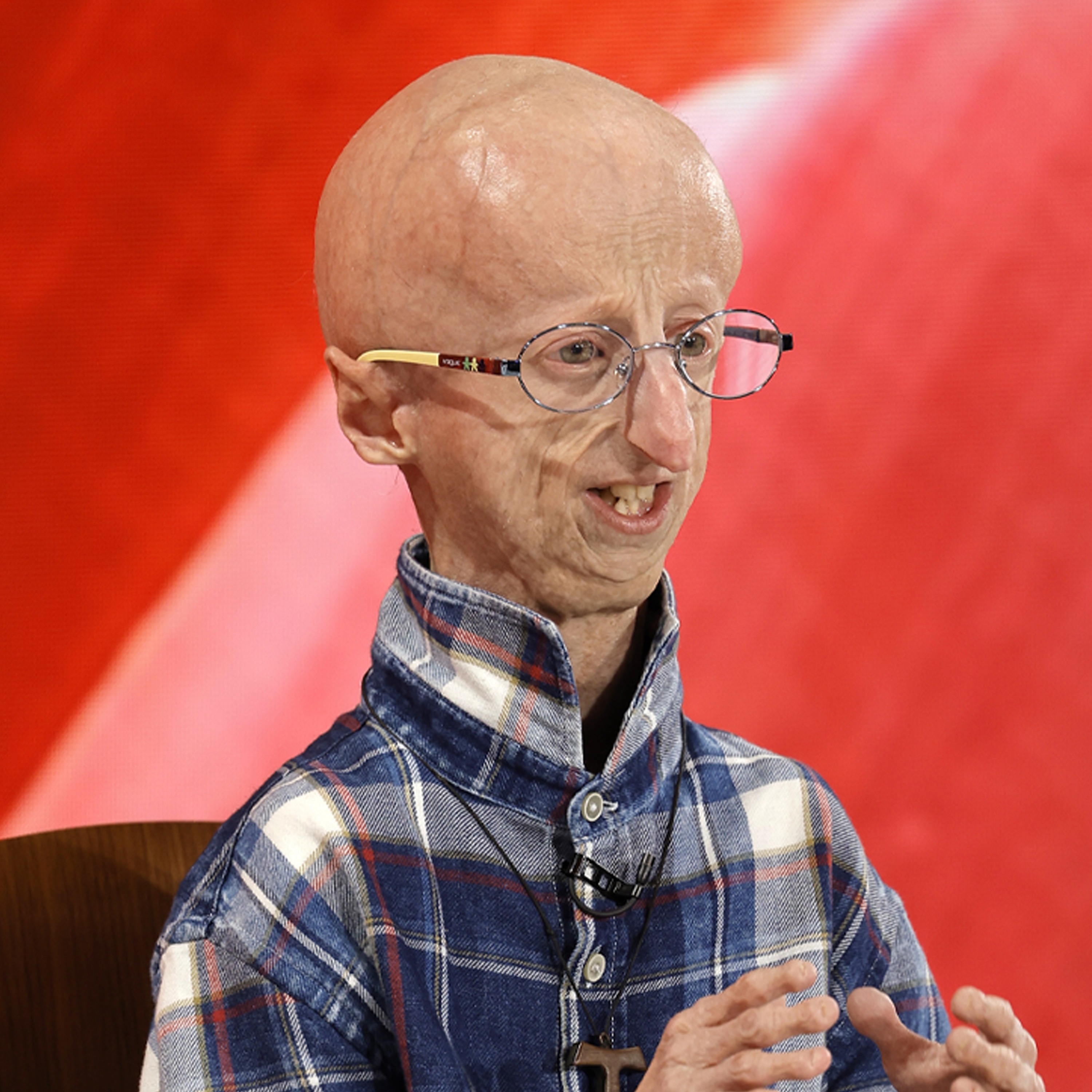
Sammy Basso left an indelible mark on our community last year at BoF VOICES 2023. Sammy had a rare genetic condition called Progeria that accelerates ageing, affecting only one in 20 million people, with an average life expectancy of 13-and-a-half years. Last year at VOICES, Sammy celebrated his 28th birthday with us, and shared his extraordinary resilience and passion, for life and for research.
“To be a patient and scientist is beautiful for me because it is a great antidote against fear,” he reflected. “Never think you are not enough to make a difference ... So many people said it’s impossible to do research into such a rare disease. But now thanks to that, we are opening ways to treat so many others. We are making a difference.”
This week on The BoF Podcast, Basso in conversation with friend Annastasia Seebohm Giacomini about the importance of his research and his philosophy of how to live a full life.
Key Insights:
Additional Resources:
Register now to join us at BoF Voices 2024, our annual gathering for big thinkers, streaming live from November 12 to 14
Hosted on Acast. See acast.com/privacy for more information.


