Ask ChatGPT

 The Business of Fashion Podcast
18 Apr 2025 · 32m
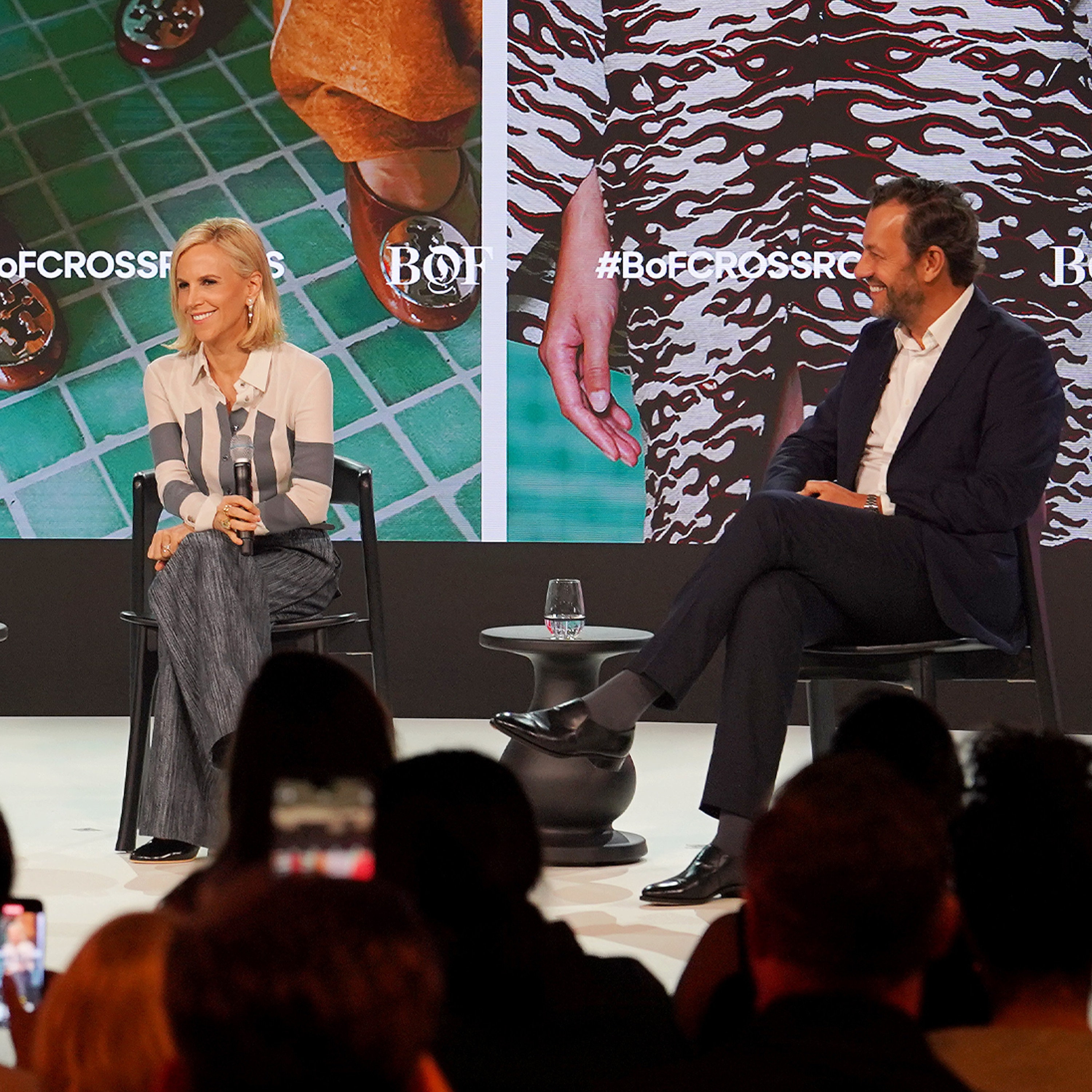
In this episode of The Business of Fashion Podcast, host Imran Amed converses with Tory Burch and Pierre-Yves Roussel about creating a global fashion brand that resonates with local cultures. They discuss the balance between ambition and authenticity in a saturated market and the importance of purpose in business strategy.
Written by AI. May contain mistakes.

Get the gist, explore an idea or ask about something said.
 Claude
On The Business of Fashion Podcast, what are the key points of this episode?
Searching your listeningAutomatic transcript. May contain errors.
0:04Hi, this is Imran Ahmed, founder and CEO of The Business of Fashion. Welcome to the BOF podcast. It's Friday, April 18th. From the outset, Tori Birch had a vision to create a business where profit and purpose could go hand in hand. She was quick to take her brand global, first to Tokyo in 2009, and then on to Rome, Paris, Shanghai, and beyond. Today, Tori Birch operates more than 350 stores around the world and across the global south, including the Middle East, Latin America, and Asia. Her partner in life and business, Pierre-Yves Roussel, joined the company as CEO in 2019, after working with some of the industry's top creatives as chairman and CEO of the fashion group at LVMH.
0:54Together, they've taken a measured, intentional approach to growth, balancing global ambition with a focus on finding local relevance. It seems so superficial to hear, let's just transplant a Westerner into a market. And that's just the opposite of how we look at things. And authenticity is, I think, what people are going to be looking for more and more. And you don't try to please every customer in the world. You know, that's not the point. You attract the people that relate to who you are and what you stand for and what you propose. This week on the BOF podcast, I'm pleased to share this conversation with Tori and Pierre-Yves from BOF Crossroads in Dubai, exploring what it means to build an authentic global brand in today's competitive fashion marketplace.
1:40Here's Tori Birch and Pierre-Yves Roussel on the BOF podcast.
1:48Hello. Tori, you know, the last time you and I sat down for an interview like this, it was, I think we were at Central Saint Martin. So there is, I think that was like over 10 years ago. We're long overdue, Imran. It's long overdue and it's happening here in Dubai. And I want to talk in a minute about why you're both here because there's lots to talk about there. But I want to start with the personal story that I started with, which is, you know, it's unusual and potentially like really powerful to have a working and personal relationship like the two of you do. Can you share with us a little bit about the background of how you ended up working and being together in life and business?
2:34Well, it's very exciting. We met through bankers. So, Piri, do you want to start or do you want me to? No, really, we met through bankers. We had a meeting for breakfast at the Ritz in Paris. And I think you had heard about our business. We had a great meeting. I think it lasted two hours. It was you and Tony. And they sent an email after the meeting, and I missed the email. So I did not email him back. I think you had an interest in investing in our business, and I missed the email. I didn't email him back. Oh, really? So that was like a real... It was a real meeting. And it was a real miss on my part.
3:15So I didn't email him for a year, and a year later, I had to email him because I was being sued by my ex-husband. I was, my board was, our entire company was, and he was deposing every single person we ever had a meeting with, a business meeting. Oh, wow. So I called Pierre-Yves, and you can take it. And then what happened from there, Pierre-Yves? And from there, yeah, I was surprised. We had a great breakfast. We were very interested. I mean, I was very impressed with Tori's success. I mean, what she had achieved back in 2012. So that was eight years after you had launched a brand in 2004. And I thought that what she was doing on multiple levels was very interesting.
3:58I mean, she was one of the very first to be on e-commerce. She created the first blog on fashion with the Tory daily, you remember. Of course. And social media. I mean, there were so many things that was innovative in the way she was approaching fashion. And you know, you've been in that industry for as long as I have been. And there's very few success of designers and founders that have reached a scale, you know, even in the last 20 years. If you look in the last 20 years, probably less than not even five brands that I mentioned that have reached, you know, significant scale. So we were kind of fascinating with that.
4:30So we had this discussion and we were interested in investing, you know, in the brand and thinking about our investment. It took another turn because of our relationship. You took another kind of investment. Exactly. Here we are now. What's it like working together as husband and wife? I mean, first of all, it took me four years to convince him to come on board. This was not a given. So you were married first. Well, we were together for a long time. Yeah, right. So, and, you know, he was living in Paris. I was living in New York. And so it wasn't exactly, you know, in the same country or, you know.
5:03So it took a while. I always admired Pierre Eve and obviously his CEO skills and his brand building and all the things that he's done at LVMH and McKinsey, but he has such an innate sense of understanding creatives. And I think that that's very unusual for a CEO to be thinking about that. So I thought, listen, if he ever would consider running our company, I said to our board, this would be an absolute gift to us. Like this is not exactly what Pierre Eve was thinking would be his next phase in his career. But I think it's been incredible. I mean, we have very different styles. And we were talking to Patrick and Inji last night saying how, you know, I'm a total entrepreneur.
5:49I think quickly. I go by instinct. And you're much more methodical. And I don't want to speak for you, but go ahead. You know that book, Thinking Fast and Slow, by this Nobel Prize winner, which is called Daniel Kahneman, which, by the way, passed away not so long ago. And we actually had dinner with him like a year ago. And he wrote that book, which is called Thinking Fast and Slow, which, by the way, I highly recommend. It's a very interesting book. Try things fast, I think slow. You know, like very methodical. And I think that's how we complement each other. But, you know, I really, you know, love working.
6:21I mean, obviously, I think the brand is incredibly interesting. We do a lot of things. We have a size which allow us to do, you know, interesting things. At the same time, we're not too big. So we can, you know, be agile and still entrepreneurs. So we're kind of in that sweet spot where we have skill, but still a lot of potential ahead of us. And working together has been, you know, obviously a personal decision. I was not convinced in the first place. So what convinced you? Because, you know, we started actually when, you know, I was relocating to New York because we're getting married. So I was thinking of what would be my next steps.
6:53And we actually worked on, we bought back one of our early investors in the brand. And I worked on that, you know, transaction with Story. and it was like, you know, real work, you know, on working with, it was the first time that we were, before it was like just giving advice or like changing or, you know. And it felt very natural and very organic and I started to spend time with the team and the culture and at one point I said, honestly, she had to have someone coming on board. Because you were the CEO, right? I was the CEO for 14 years and I will say it was a big, and I have a great team, but not my skill set in retrospect.
7:30It was wonderful, and I loved building the business, but I really loved the creative process more, and it was pulling me in so many different directions. I used to spend maybe 20 % of my time on the creative, and now it's 100%. I hope you've seen a bit of a change. The Tory songs, of course I have. That's what everyone in New York is talking about. That's a good segue to the state of American fashion. There's the kind of big picture of what's going on. And I think the fashion industry just generally is in a very unusual place right now. I mean, you've both been working in the industry for almost 20 years.
8:07I cannot recall a moment in fashion where things felt so blurry and so confused. Globally, just, yeah. I mean, globally, particularly with big Western brands that have had a lot of success in the last 10 years. A lot of them, as I was saying here yesterday, a lot of them using kind of a formula that worked. And you talked, Pierre-Yves, about Tori being one of the first designers to use social media and think about creating her own content, which was completely different for brands before. Brands didn't, brands, there was a very clear system. It was like a brand talks to a PR, the PR helps to get stories placed.
8:52It was all this very linear process, right? the communication in the fashion world has completely changed since then. It's like a multi-faceted, many-to-many conversation, right? And the last 10 years has been incredible as we've seen the way fashion engages with customers. But now it feels like the industry is maybe overexposed. There's too much content. Everybody's doing the same things. You look at ads or social media content. If you remove the little logo or don't look at which account it is, you don't even know which brand it's from like what do you make of the state of fashion right now i think there's there's so many things happening um in the world but i think it's probably worth to go back to a form of authenticity if i were to try to to describe what's probably i think people probably feel that there's too much you know formula around everyone is doing pretty much the same thing There's a lot of debate also around the value and pricing.
9:53A lot of change of designer, which is probably needed because you need creativity. Go from one brand to another. So people can see and read through everything. I mean, the customers are sophisticated. They see it a lot because everything is exposed. And I think they're really looking for authenticity. We are very unique in a way. we were at Dubai Mall yesterday because we were reopening our store. And you walk in Dubai Mall, which is probably the biggest mall in the world. I mean, 80 million people visiting this mall. It's incredible. It's insane. And for so many brands, it's the number one store.
10:27It's incredible. But then you look at all those brands that are working in the mall. I mean, it was probably one of the very few, I don't know, maybe the only one, where we have a brand on the store, which is Tori's name, and she's still running the business and creating. He's not replacing me yet. So the authenticity of what we do and what we say, and we're going to talk about a lot of other things that Tory brought very early on, like the foundation and being a purpose-driven company, which a lot of brands now are bringing into, but it was really part of the brand in the first place. So a lot of the things that are the essence of and makes, I think, this brand unique and why it's resonating everywhere.
11:08Sometimes when people ask me, describe what this brand is about, and I talked about authenticity and integrity. And authenticity is, I think, what people are going to be looking for more and more. And there's different answers for different brands out there. So I'm not going to speak for any of those brands out there. But authentic project with a real connection that are different. And you don't try to please every customer in the world. That's not the point. You attract the people that relate to who you are and what you stand for and what you propose. I think that's the way I'm looking at it today.
11:40Tori, what would you add to that? I mean, I think I started with an idea that business and purpose could go hand in hand. And I think back then, 20 years ago, that was a very novel idea and one that was not very popular. So to have a North Star, and that is women for me. And it's women globally that have always been so inspiring. But we started with women entrepreneurs in the United States. And the company launched in 2004 and then the foundation in 2009. And it was really part of my business plan from day one is how do we have a successful business with incredible products, but that actually has deeper meaning and will help support a foundation for women entrepreneurs.
12:28So that was sort of the framework. I think as we've gone, it's been such an incredible experience to have the women that we work with also weigh in and on our product. And it's been such a win for our employees. It's a win for our customer. And it's become this like incredible win-win across the board. And so I think if we could be role models for business to have purpose in a very authentic way, I'm very proud of that. I also think of just even the culture. That's a big thing at our company. We spend a lot of time working on that. That's a differentiator. I don't know that, and I don't want to say American brands.
13:11I think all brands. Like, how do people feel when they work in your office? You know, people are spending a tremendous amount of time at their workplace. And we want to have a workplace that celebrates different kinds of people, different thinking, diversity. It's all something that is super important to me and has been from day one. And that's something that will never change. So I love that because at BOF, we talk a lot about purpose as well, like having a business grounded in a really clear mission that people can understand and get behind. yesterday we were talking about how you take businesses like yours and you make them work in markets like these right and there's this kind of notion that in the past the way most big international brands would operate in in new markets is they'd have a template formula and they'd come and they kind of plop that template in different markets i'll never forget once i was in And I think it was Indonesia.
14:15And I was walking through one of the like fancy shopping malls. And it was literally 40 degrees outside. And the stores inside the mall had like winter clothes. And that's like a very basic thing. But like I think, how do you think about taking your kind of global, it's not even your global, your authentic purpose, your vision, your kind of positioning of Tory Burch as a brand. And localizing that for different markets. It's because you have stores all over the world. How do you localize while keeping that same core Tory Burch essence? Yeah, and I can speak just initially how we approached it from day one.
14:53And going into any market, we wanted to really learn the market, the local traditions, respect the cultures. And so that's something that's always been deeply important to me. So even our second store was in Japan. It was a very different culture and 20 years ago and more so. So I think, you know, we have this foundation that is about what we are changing now, women's empowerment. We're changing the way we talk about that because women have the power. We're helping them realize their power. We're not bestowing. So what changed? Well, just the way we say women's empowerment. But that might not resonate in Japan the same way that it does.
15:31But another part of what we do is it's about involving men in our conversation. And that's a big... You can't have women's empowerment without men. Of course not. And we need men to be our allies. We need men. And it seems what's so exciting to me being here is that you feel it. It's palpable. You feel the change. You feel the support. You feel how that's happening. And I said to a group of women, I always say this. I said, we can feel how we feel about women and women's equality or anything. And we're going to be talking to ourselves if we're sitting in a room talking to women. That's just not interesting.
16:11And it's not going to move the needle at all. And then Pierre-Yves, in terms of like the more methodical business side of things, in terms of how you think about operating globally, but creating a local authenticity, how do you do that? That's the thing we discussed a lot. But I think what helped, as Tori has mentioned, is that a lot of brands in the U.S., they expand in the U.S. and they get big in the U.S. before they go internationally because the market is so big that you can have, you know, whatever, 100 store, 200 store in the U.S. before you bother going to Japan or the Middle East or wherever.
16:43But Tori made that decision very early on to, you know, we've been in the Middle East since 2012. And the brand was great in 2004. So that's quite early in the development of the brand. and it really I think has helped really understanding and bringing into the way we're doing things you know the global you know culture and diversity of the world then obviously there's you know there's always something where and we worked a lot with our local team is and our philosophy is that you don't change the essence of who you are and the brands you are and what you stand for but you translate it into the local culture obviously the local language but the local culture so you don't change the essence of it or the meaning of it because otherwise you become a different brands in different regions and different parts of the world but you adjust for it but it's it's a very how do you do that right because i think one of the things i've seen is brands parachute an american or european executive into these regions and like all the decision making is this kind of conversation between the western leader in new york or paris or milan and then the the kind of transplanted Westerner in the local market.
17:54How do you make it so that the people here have the power to have input into the decision making? I mean, first here, we work with the best partner that we can... That we could ever hope to have. I mean, they build, as you know, luxury and fashion in this part of the world. So, I mean, they have more insight than anyone else in the industry, by the way, even any partner in the So we listen to them and we work with them. So a good local partner. So when we have a partner which is in certain parts of the world, when we think we really need to work with someone and there's really a partnership. When we operate directly, we work with people that really understand the culture.
18:39I mean, I'm not American and I work in New York and I'm French. So we have a lot of different culture and people that really, but what is interesting is that when you see a bestseller for example is usually a bestseller everywhere everywhere in the world when it comes to accessories in particular and and and and footwear which is sometimes intriguing because you know it's a but then when you go to just the level underneath which is you know the not the top bestseller but underneath then you start seeing some differences by colors by size obviously we work a lot also on the on the fit you mean you talked about the under seasonality but the fit is very important because, you see, we know that there's a lot of diversity.
19:18So you're adapting shapes and silhouettes to different markets. I mean, we do have different fits. It seems so superficial to hear, let's just transplant a Westerner into a market. And that's just the opposite of how we look at things. We have incredible teams that partner with the people on the ground. And also, I'm involved. I want to know because I'm doing all the product. I mean, it's so exciting to see the opportunities here and meeting with customers yesterday, hearing from Shalhoub, our team, but also having a great team that has that intellectual curiosity that is critical to really not make it superficial and make it very meaningful.
19:57Yeah. We'll be right back with more on the BOF podcast.
20:07The kind of elephant in the room in fashion right now is around this announcement around tariffs, which has really thrown the whole fashion world into a complete state of uncertainty and shock. I think people were still reeling about it. I mean, Tori, you and your business, you started a made in China thing early on. It was part of the strategy, right? It was about how to get like really good quality merchandise delivered at a value. Because part of what the value proposition of Tory Burch has always been that it's not necessarily like, you know, these insane prices of some of the luxury brands.
20:43Piri, from an operational perspective, I'm so interested to get into your mind around this. Because how are you thinking about how a company should navigate this right now? When there's so much uncertainty, you don't know what's going to happen. You know, potentially your sourcing strategy is only to change. Someone on our team, Ruan, was talking to me about Dubai potentially being an interesting hub where people could ship stuff because apparently tariffs only apply based on where the product is coming from. So we might see the rise of these other hubs. What is the operational supply chain side of your brain thinking about in terms of how to navigate this uncertainty?
21:21First, it's hard to comment on the... Because it's changing every half an hour. There's not much that we can comment on this. But I would just, you said the initial strategy of Tory was not, you mentioned made in China. It was not that. And by the way, the made in China for us is a very, very, very small model. Is it small now? It's less than 6%. It's really about finding... So where is it made now? So it's in a lot of different places. Well, the way we're looking at it is to get the best craft that we want. Craft and also the ability to embrace the innovation that Tory has been bringing. having agility also in the way we work in different places in the world.
22:01And, you know, there's a lot of things very interesting. And we work in Brazil, for example, in India, in different places in Europe. In Eastern Europe and Turkey. We have a global sourcing that really is specific to where we find the right skill set for the type of product that we do. We do multiple categories because we have handbags, we have footwear, we have jewelry, we have ready-to-wear, we have home, we have a home collection. And even when you take footwear, there's a lot of different types of footwear between the sneakers and the sandal and the high heel. So you don't find the skills to be able to source that in just one place.
22:34So our strategy is really finding all those global sourcing. The only thing that I can say is that this takes years to build. And when you manage a business, you cannot change it like every other day or even every six months. It takes years to build the proper sourcing and the partnership with suppliers that really understand and work with you. And obviously you evolve it as you go, but you cannot change it overnight. I mean, and that's clear. And so leaving aside China for a minute, if you have sourcing in all of these different countries, I mean, everybody saw the list of countries, and it's on pause for 90 days and who knows what's going to happen.
23:16How are you thinking about that in terms of now? I know you can't make a prediction, But what do you advise people to do in terms of if you can't change your sourcing overnight, if it's something that takes a long time to build, what do you do? Do you manage it from absorbing some of the increased costs from the tariffs in your margin? Do you pass it on to customers? How do you get through that? I'm not advising any longer. I used to advise people when I was at McKinsey. Okay. So we're really focusing on our business. And we'll see. You know, and depending on what will happen, we'll do whatever we feel is the right thing.
23:53The product is critical for us. So we don't want to compromise in any way on the quality of the product. And then we'll deal with it. I mean, we have not much that we can do. You know, the politicians would decide whatever they do. We'll see when things would be real. In the meantime, you know, we're not going to go left and right, depending on the announcement of the day. Try to be blunt on this one. Yeah, I mean, I understand. And it's just so complicated at the moment navigating a situation like this, because, you know, even for our team, you know, they're like, do we have to change the story we just wrote an hour ago?
24:26Because I do feel grace under pressure is very important right now. And I think being an entrepreneur, you have things I mean, obviously, this is unique and different, but you have things coming at you all the time. And so you have to be calm. You have to not overreact, overcorrect, because it's an iterative process that's happening. And we just don't, no one knows. I don't even think people in the very close circles know. We had COVID. We were, you know, 350 store closed for three months. With no visibility. As a private company, I can tell you, it's just a bit, you just, you know, continue to, and then you know the crisis is going to be over at one point.
25:04You do what you can do. Yeah, this feels like it might be a four-year crisis. There's no vaccine that's going to get us out of it. We were looking at some growth stats yesterday around what's happening in Western Europe, what's happening in China, what's happening in the US, which you just discussed. What does that do for the way the two of you think about where you look for growth as a company? Like, where are you focusing? You're obviously here in Dubai. You haven't been here for a while. Like, what are you thinking about? And I know you planned this trip far before. I'll start with this, Imran, because I've always wanted to be the most exceptional company, not necessarily the biggest company.
25:47So for me, looking at the idea of rethinking a company, transforming it, that's something that's been happening over the last five years. I think we've done a pretty good job of doing that carefully where we haven't just become someone different and we haven't alienated our core customers. But I like to think of it as refining what we do and keep building on that. And so I know that you have probably a different answer on that, but we talk about it all the time. It's I don't want to have growth for growth's sake. I want it to be meaningful and have a long-term perspective on the health of the business.
26:26Carrie? No, but we're a private company. We're trying to control the company. So we can really decide the path at which we grow. The company was profitable in year two and has been since then self-financing its own development. So we found our own development, so we don't have to rely on any other source of funding. And we can really decide the pace at which we grow. And I think this has been very important in a lot of decisions that Tory has taken over the years in terms of distribution. For example, the store, the store size, the number of stores. It's really been a curated development. But we have tremendous opportunities because even in the U.S., the U.S.
27:04is a big market for us. But it's a gigantic market. We have a lot of growth. I mean, this region is very exciting. You know, we just, you know, as I mentioned, we just reopened our Dubai Mall store, which is a store that we had. But we brought our new concept, which is a concept that has been working in during COVID and that we came up in 21. I think that's the one I went to visit in New York because you told me to go visit it, right? Which we have continued to evolve. Yeah. We just opened L.A., which is a bit different. We just opened, in the last two weeks, we've opened LA on Rodeo Drive, which is a store that we had.
27:38We've been redoing it. And we opened Shanghai in Cary Center, which is a store that we had that we've been redoing after 10 years. So, you know, it's not about opening a lot of stores. It's also taking the store that we have that are great, you know, and one of the best location. And after 10 years, you know, or eight years or six years, you need to bring, you know, new and freshness as part of the evolution of the brand. It's more about being focused and really going after things that we really want because the opportunities are tremendous. We can do so many things in all the categories that we have.
28:11There's potential to grow in all those countries. If you just look in the, because here we're talking about the South. The global South, yeah. The development that we have obviously here in the Middle East, but also we're opening a third store in India, in Bangalore in three months. We already have a two store there. But there are countries like Indonesia, we have eight stores in Indonesia, incredible countries, 300 million people, a very big up and coming middle class that is discovering luxury. And we're an incredible brand for that because they're really discovering luxury with us. We are selling actually bags, for example, in Indonesia at a very high price, in our pricing architecture, but they're not gonna buy a bag at$10 ,000.
28:56dollar. So we're offering a great and incredible value for those customers. But we see that in Thailand. We see that in a lot of those countries and the same obviously in the US. So we are in that very sweet spot obviously of being very unique as a brand. And we started with that, with the purpose, the aesthetic, Tori being at the helm of the brand. But also, we talked a bit about the pricing, the value that we're offering to the customer is incredible. And we see a lot of customers that are trading up, you know, for a brand that they feel is not as qualitative, don't offer, you know, as much innovation.
29:31So we're getting customers that are elevating, but we're also getting a lot of customers that were kind of in and out in buying high-end luxury. And they feel now, you know, when the sneakers were at 700 was fine, when it's 1 ,300, it's a different story. And when the bag is at 5 ,000, I mean, it seems to me like this is a really great moment for brands like Tory Burch, because there's such a, like a broken sense of the value proposition with customers. Like they just look at those prices and they just, it doesn't make sense, you know? I could talk to you guys forever. We're already five minutes over, but I do want to ask each of you for, I know you don't advise people, but maybe you could give some advice, which is, you know, there's a lot of business builders here, right?
30:16Entrepreneurs who are at the early stage of their journeys and trying to build their own businesses. what's one piece of advice you have? I'll start with you, Pierre. What's one piece of advice for someone building something new? How do you create something with longevity and authenticity? I mean, I just have to look at Tori. I'm not an entrepreneur. I mean, I've managed big businesses, but now I'm partnering with Tori. I think you always look at the positives and you always look at the glass half full. And as an entrepreneur, you have to look at the opportunity and you have to have an incredible drive.
30:50And when I see Tori, she's always positive. She always sees the opportunity. And she has the drive through ups and downs. And obviously, you have to have the vision. You have to have all these other things. But I think the personality and the character is what makes a huge difference. And so I just have to look at her. And then I see what I'm doing. That's a really good answer. Tori? I would just say, don't let people put you in a box. Because I think that there's the tendency to do that. People like to label you, put you in a certain place. And I think write your own story. Okay. I am so grateful to both of you for joining us at BF Crossroads.
31:31Enjoy the rest of your time in the region. I'm sure it's going to be really inspiring. I'll just say also, being in this region was so inspiring and really talking to people. I've never been to a place where more people absolutely love living here, like authentically through and through. It's really wonderful to see. Yeah, it's kind of infectious. Yeah. Well, anyway, thank you so much. Thank you. Thank you.
31:58The BOF podcast is edited and produced by Olivia Davies and Eric Bria.
Right from the outset, Tory Burch had a vision: to create a business where profit and purpose could go hand in hand. She was quick to take her brand global, first to Tokyo in 2009, and then on to Rome, Paris, Shanghai and beyond.
Today, Tory Burch operates more than 350 stores around the world and across the Global South, including the Middle East, Latin America and South East Asia.
Her partner in life and business, Pierre-Yves Roussel, joined the company as CEO in 2019 after working with some of the industry’s top creatives as Chairman and CEO of the fashion group at LVMH. Together, they’ve taken a measured, intentional approach to growth, balancing global ambition with a focus on finding local relevance.
“It seems so superficial to hear, ‘let's just transplant a Westerner into a [different] market. That's just the opposite of how we look at things,” says Burch. "Authenticity is what people are going to be looking for more and more," adds Roussel. "You don't try to please every customer in the world. You attract the people that relate to who you are and what you stand for and what you propose."
This week on The BoF Podcast, BoF founder and CEO Imran Amed in conversation with Tory and Pierre-Yves from BoF CROSSROADS in Dubai, exploring what it means to build an authentic, global brand in today’s competitive fashion marketplace.
Key Insights:
Additional Resources:
Hosted on Acast. See acast.com/privacy for more information.