Ask ChatGPT
 The CMO Podcast
16 Oct 2026 · 1h 1m · 21 chapters
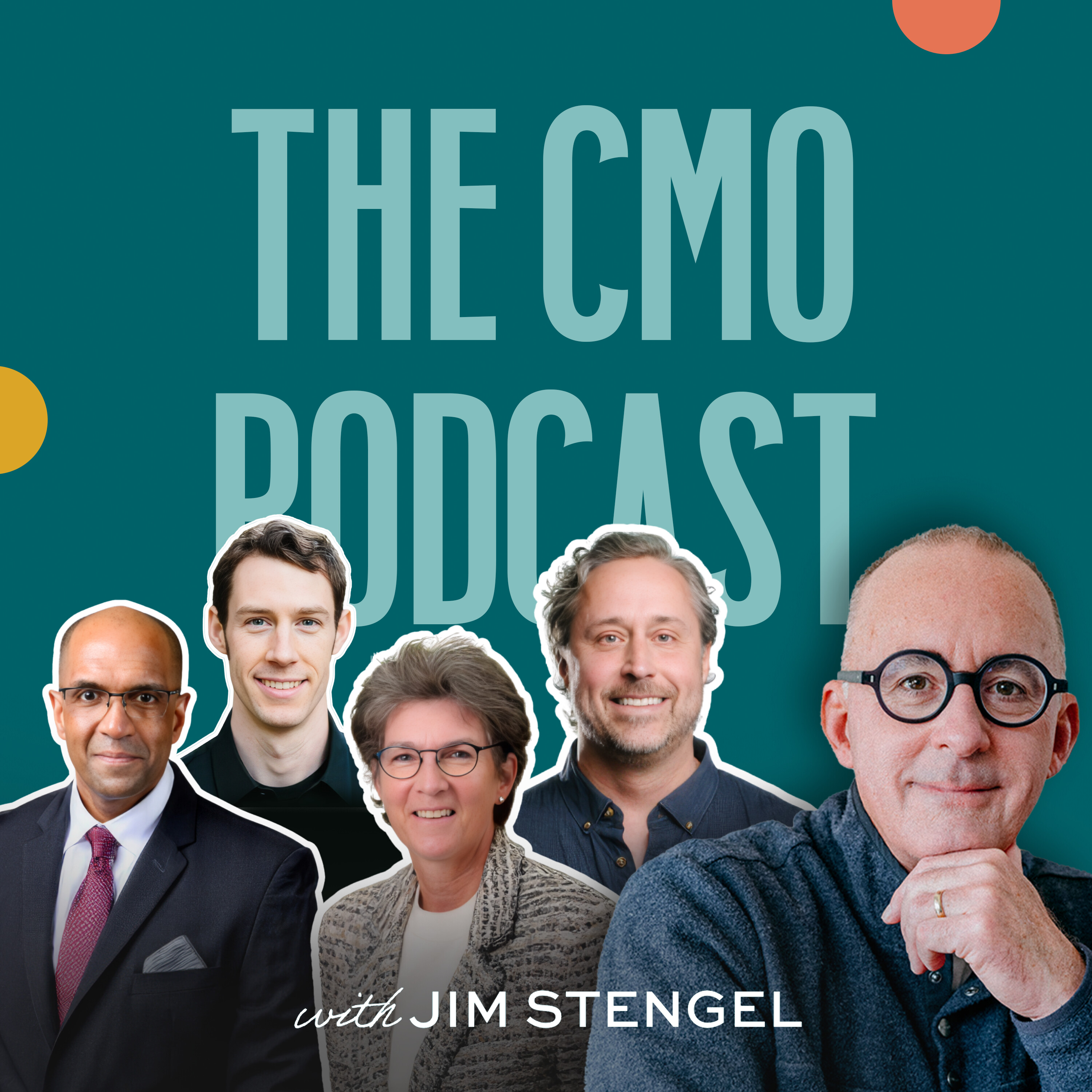
Live panel at Penn State Alumni Leadership Conference on how great leaders build trust, addressing rising “insularity” (Edelman Trust Barometer: 70% hesitant to trust people with different facts/values/backgrounds), and practical methods for trust-building, authenticity, delegation, transparency, and rebuilding trust after failures.
Written by AI. May contain mistakes.
Jim introduces the panelists for the discussion on trust, highlighting their backgrounds.
“For the fourth year, we are taking the CMO podcast on the road to the Penn State University campus for a special show in front of a live audience in Recital Hall.”
John Waldheisen shares his journey in healthcare technology and his connection to Penn State.
“So the plan today, you've been with us before.”
Cindy Miller recounts her 30-year career at UPS and leadership role at Stericycle.
“What do you wear on Saturdays in the fall?”
Gary Brito discusses his military career and leadership experience in the U.S. Army.
“Senior management, you ran Europe for UPS.”
Dave Becker shares his experience in education technology and connection to Penn State.
“I try to wake up every day and make this day better than yesterday, and we'll talk to that a little bit as well.”
The panel begins discussing trust and insights from the Edelman trust barometer study.
“Thanks for listening to the CMO podcast and hope to talk to you more about Vibe.”
Exploring how trust is built and lost in various contexts, from personal to professional.
“I think we've gotten better along the decades with technology and everything else and with fancy words and names to call things, insularity.”
Discussion on the different strategies for building trust in startups compared to large organizations.
“The study sought to answer the question why, and they gave four kind of reasons they saw from the data.”
How effective delegation can lead to trust between leaders and their teams.
“So every six weeks, you pull people together and all hands meeting, I guess.”
Trust as a journey that requires time, alignment, and authenticity.
“Did you give, in the situation I always went in, very clear guidance, very clear runway space to do things, delegate tasks with resources, and then a mechanism for feedback?”
The importance of authenticity in building trust and how it affects relationships.
“I think I've learned a lot just listening.”
Learn how authenticity in leadership can build trust and improve company culture.
“but you can spend people, but people are much more polished and, and much more eloquent and use far bigger lingo to sound self-inflated and important and, you know, all the identities and all the other kinds of things.”
Understand how to navigate personnel changes while maintaining trust within teams.
“I want to touch on something I want the panel to react to.”
Explore the implications of AI on trust and authenticity in business practices.
“And if you're comfortable, say who you are, you know, maybe where you live.”
Explore the implications of AI on authenticity and business practices.
“This was coded by somebody that wasn't within our group.”
Learn how young professionals can build trust despite age-related challenges.
“And so when I find people that are authentic, I grab onto them like I do not want them leaving my company.”
Understand the process and importance of rebuilding trust in leadership.
“But the resiliency, all-star performance, roll your sleeves up, and when you have an opportunity to hit a home run, hit a home run.”
Discuss how to build professional relationships and trust without likability.
“I think this is a very hard bridge to rebuild, but one worthy.”
Learn about the necessity of setting aside personal feelings to achieve common goals in professional settings.
“If I could invite a million people to the picnic, they would have been about a million five.”
Discover practical strategies for building and repairing trust among colleagues.
“For each of you personally, in either building trust or rebuilding trust, what's a piece of practical advice you would share with our audience that works for you.”
Understand key traits and behaviors that enhance trust in leadership roles.
“I think going back to just establishing trust from the beginning, I would say do your research.”

Get the gist, explore an idea or ask about something said.
 Claude
On The CMO Podcast, what are the key points of this episode?
Searching your listeningAutomatic transcript. May contain errors.
0:00Jim Stengel: Hi, I'm Jim Stengel. I've helped hundreds of major brands discover and activate their purpose. Because when a brand's purpose is clear, compelling, and authentic, profit naturally follows. Each week, I welcome the CMOs, the chief marketing officers of your favorite brands, to speak to how their job is so much more than marketing. These leaders share their inspiration and challenges, along with how they try to build a full, healthy, and happy life in and out of the office. And it's that energy that reaches everyone they touch. And we're glad you're here to feel that energy and to learn from these remarkable leaders.
0:35Jim Stengel: So here we go. For the fourth year, we are taking the CMO podcast on the road to the Penn State University campus for a special show in front of a live audience in Recital Hall. Each year, we invite notable Penn State alumni and we probe a different aspect of leadership. This year, we will talk about trust. My guests this year are a special bunch. We have two founder CEOs and two people who have led large legacy organizations, a former U.S. Army General and a CEO of a Fortune 500 companies. Let's start with the two founders. First up, we have John Waldheisen, an entrepreneur in healthcare technology.
1:11Jim Stengel: Shortly after earning his Ph.D. from Berkeley in 2012, John founded Lucera Health, which developed the first at-home COVID-19 vaccine cleared by the FDA. He is now working on his third startup and is a co-inventor of 50-plus patents across the world. Next, we have Dave Becker, the Philadelphia-based co-founder and CEO of Campus ESP. Dave's company is an education tech company that helps more than 500 universities and colleges engage families, support students, and improve enrollment and retention. Now to the two leaders with large organization experience. Cindy Miller is the former CEO of Stericycle, the global B2B company that provides waste management and compliance solutions to healthcare companies and assorted other enterprises.
1:56Jim Stengel: Cindy led the company through its sale to waste management at a valuation of about$7 billion. Prior to Stericycle, Cindy rose to the ranks of UPS over the course of a 30-year career there, including nine years as the head of Europe. Cindy now serves on the board of the Granger Corporation. Last, we have a man who has held senior leadership roles in one of the largest organizations in the world, the U.S. Army. Gary Brito is a retired four-star U.S. Army general. Gary served as the commanding general of U.S. Army Training and Doctrine Command, and prior to that was the Army Deputy Chief of Staff for Personnel.
2:32Jim Stengel: Gary is now president of the Brito Group, a strategic advisory services company. Gary was given the Penn State Distinguished Alumni Award in 2005, the institution's highest honor. Now to the live event with a theater full of students and members of the Penn State Alumni Association. Here we go with an intense discussion on how to build trust, which is the most important thing a leader can do. Oh, hello. So it's good to be back. How do you feel? Good to be back? Yeah. So the plan today, you've been with us before. We're going to record a show. We'll come to you for questions. We'll run a microphone to you.
3:12Jim Stengel: So in our topic today is going to be trust, which is a really interesting leadership topic, right? It's a very foundational one. But before we jump into that, I want our panel to have a chance to introduce themselves. So we're going to go, they'll do a much better job of this than me doing it. So I want them to introduce themselves to you by saying a word or a picture that describes themselves And then i've asked them to give a short paragraph of who they are So that's a hard brief. I gave them a little bit of notice about this, but not much So we're going to go I think in order of yeah, we'll start here So thanks jim john.
3:54Yeah, i'm john woldeisen I guess in terms of a word or picture describes me is probably Beaker from the Muppets. I started a company that became the first company to get FDA approval during COVID for at-home testing by the FDA. I went to, thank you, a proud Penn State alum. I was born and raised here in State College. I graduated in 2007, went out to California, got my PhD degree there, but and and then focused on infectious diseases, and recently came back home to be closer to family as I raised my family. My wife and I raised our daughter, so thank you.
4:33Jim Stengel: I'll fill in the holes. You have a three-year-old, right? Yes. Have you been to the Arboretum? Plenty of times. It's highly recommended, I hear. And you got your PhD at Berkeley. Not bad. So how's Berkeley similar or different from Penn State? Well, they're both public schools, large institutions, about the same population size, and both are top 20 institutions even when you include public schools. But they're both, because they're public schools, I think it's very, the students are very down to earth, humbling individuals from all sorts of backgrounds and they're both incredible places to be educated and learn there.
5:11Jim Stengel: What do you wear on Saturdays in the fall? What color? Oh, definitely blue and white. Cindy. Welcome. Thank you very much. So I think for me, I would put out diesel fume. It's not my perfume, but most of my career, so struggled and did a lot of different things, but I had a 30-year career with UPS, and I started as a truck driver, as a package car driver. So I was going to say brown uniform, but I wasn't quite sure you might have thought I played for a different sports team or school. So I didn't go with the Brown. But so 30 years with UPS, started as a UPS driver. I can tell you that I do believe that UPS was a privately held company for many, many years, and they went public in 1999.
6:04And prior to that, no one else had ever left the company and gone on to do anything else. And I know for a fact that until when I became a CEO of another company, Stericycle, which is a medical waste company, another trucking company. When I became CEO of Stericycle, I know for a fact that I was the only current or past at that time CEO of a publicly traded company who ever was a UPS driver. So I do know that. I do have that claim to fame. I was the first. A couple people have come after me now, but I was the first. So 30 years there, then left and became a CEO of Stericycle, a publicly traded company, medical waste company.
6:45They also owned another business called Shred It, which you can imagine what they did. But all of that was evolved around transportation and trucking. And that's what I did. So I retired. For any of you who looked at anything, waste management bought our company for over$7 billion in November of 2024. And I've been retired ever since and enjoying every minute of it. And my biggest claim to fame is season ticket holder for Penn State football.
7:15Jim Stengel: And you live in South Carolina and State College, right? South Carolina? Yeah, we live in the mountains of South Carolina, if anybody's familiar with the mountain area. And it looks very much like this. It's just that winter is only about 15 minutes long. So it's long enough to kill bugs so that they don't grow really big. And you do get four seasons, but it makes us feel as if we're home. And then we do have a place here for, we're up here in the fall. You spent nine years in Europe, right? Senior management, you ran Europe for UPS. How did that shape you as a leader, that nine years? Wow. A couple of things.
7:53It, you know, living outside the U.S., many of you, I'm sure if I asked and you raised your hands, many of you have traveled outside and every village and every place you've ever been is the cutest and the most adorable. And it's the most amazing place you've ever been and you wish you could live there. It's hard living outside the United States, living there every day, where the plethora of things that we take for granted here in the United States are not always easily and readily available. One thing I did learn is I learned to appreciate home. I learned to appreciate more all the great things that there is, I learned to understand why everybody wants to come here.
8:33Yet I had a great appreciation for all the nuance and the really cool things that were somewhere else. So, but I think the biggest thing that I can say I learned was adaptability. You really have to, you've got to give a little, you know, you take a little, but that whole dance of adaptability to adapt to where you are and, and, um, you know, figure out, uh, do a whole lot more listening at first, you know, than talking so that you get a basic of understanding of what's going on. I think those things helped not just in terms of the survival there, but just in basic life skills. So it was great.
9:08Jim Stengel: It's also a wonderful way to build trust, which we'll talk about later. So Dave, now, other than not knowing we had an arboretum, do you know, we have a football stadium? Yeah, I have heard that. I heard it's growing actually. So one word or picture to describe yourself, and then you take it from there. It was going to be Arboretum. So, you know, I think Arboretum, that was a big surprise to me. And I think a big surprise is, or not a big surprise, but one of the things I like to think about myself is like, life is fun when it's surprising. And you take big steps and big risks. And I think that's going to be a big part of the conversation with trust today.
9:47I'm here with my wife, Veronica, who you want to wave? also a Penn State alum and we are going to check out the Arboretum tomorrow Jim. I promise we are going to check that out. Just to be sure. But I graduated from Penn State in 1995 and I have had an interesting journey but part of that journey has been at three different startups and one of those startups is called Campus ESP. Your parents might use something called the Penn State Parent and Family Experience. That is my company. I'm the CEO and co-founder of that. Penn State was customer number three and now we are at 500 colleges and universities across the US and about 7 million parents use that service every single year.
10:30So I love Penn State it's great to be back here I have twins that are rising juniors that did not choose Penn State so I'm a little bit disappointed. You might see me bite through my tongue if you ask me about that a little bit here but I'm excited to be here and hopefully share my experiences with all of you.
10:50Jim Stengel: Gary, close us out. One word or picture? Two words, if I may. Okay, for sure. Positive attitude. I try to wake up every day and make this day better than yesterday, and we'll talk to that a little bit as well. My name's Gary. I'm married. My wife's also a Penn State alumni. I graduated a long time ago, 1986, if not, but I feel damn good. I won't say I chose different path the path chose me i was a cadet in army rotc while here started at the altoona campus moved here to university park intend on doing just four years in the army i just retired last november after 38 and a half years thank you uh my dad as well have two sons they went to ohio state university so i just put them back i just put them back in the family will had to bring them back in, but we're okay now.
11:45And it's an absolute honor to be with you today. Thank you.
11:54Hey, everybody. This is Andrea Sullivan, the CEO of Vive, and we produce the CMO podcast and are so excited to have partnered with Jim Stengel for so many years. Wanted to tell you a little bit about something that could be right for you. Vive is a program for entrepreneurs and business leaders who want to get more out of their life and become their best and happiest selves, both personally and professionally. We have a 12 month program that allows people to meet up with some of the best business leaders out there and additionally experts in the wellness sector so that you can learn how to nurture yourself.
12:28So we teach things around sleep optimization, meditation, all those good things as well. Please reach out to us at podcasts at five.co to get more information. That's P-O-D-C-A-S-T-S at V-Y-V-E dot co. Thanks for listening to the CMO podcast and hope to talk to you more about Vibe.
12:53Jim Stengel: So we're going to flip into talking about trust. And I think these four panelists will have some really interesting insights. And I want to start by setting the context. There's a public relations agency called Edelman. It's a global PR agency, it was by many standards, the best in the world. And they do a study every year called the trust barometer. And they've been doing it for many, many years so they can look at trends. And it's like 35 ,000 respondents. So it's a big, big, it's a lot of data. It's a big base size. And they just released a 2026 report. And they found this concept of insularity is at an all time high.
13:33Jim Stengel: And what do I mean by that? Seven out of 10 people, 70 % are unwilling willing or hesitant to trust someone who has different facts, values, problem-solving approaches, or a different cultural background. They are calling this, we're living in the age of insularity. So before I go on further with a bit more data, let me turn to the panel. Are you surprised by that? I think for me, I'm not surprised by it. And here's why I'm not. I think we've gotten better along the decades with technology and everything else and with fancy words and names to call things, insularity. You know, we make up, I don't know that we make up a lot of words, but it feels to me like we make up a lot of words.
14:21And we get to a point where we can redefine the definition and get down and we can get more granular because we have better data and we can survey more people and we can do a lot of things. But I can tell you back in 1988, nobody could spell insularity. I don't think I can spell insularity, just for the record. But I don't know that, you know, folks would not understand what that is. But still, you know, being a UPS driver, or prior to that, I had a part-time job at the Orville Redenbacher Popcorn Factory in Easton, Pennsylvania, working night shift box and boxes. There wasn't a lot of, you know, there was a similar amount of, you trusted some folks, you didn't trust others.
15:02A leader would walk in the room, you'd feel trust when somebody would walk in, someone else would walk in the room, you wouldn't trust them. You have trust issues in your own family, you have trust issues in your own neighborhood, you have trust issues on your own sports team or within your own sorority. I don't know that all of a sudden because we've gotten to the point where we can really, really, really use great tools and use big words that it's become a different issue. I think you either earn trust or you blow it up. And I think that has been since the beginning of time. So for me, I don't find any of the statistics surrounding it new.
15:35I find the fact that because we use, we have greater detailed data in this age of nothing but data, but yet my humble experiences in when the dinosaurs were walking around the world too, it was very, very similar. So I'm not surprised by that, and I think that's just, it's a microcosm of what we just call life. Yeah, I would agree, and I also think the labeling is a real thing. At Campus ESP we have, I would say about 35 % of our team are in their 20s and about 20 % of the team has actually moved to Philadelphia where we're based to take the job, which is pretty awesome and I'm very proud of it.
16:13We also hire a lot of our interns. Point being, I work with a lot of younger people and they are very disconnected oftentimes and so we try to get them into the office to have that more in-office experience. I would term it hybrid. They're still working remote in a lot of cases. But it is interesting that they will oftentimes gravitate to a term like quarter-life crisis is something that I don't know if you guys have ever heard that term. We used to have that as well. We would just call it we didn't like our first job. You're 25 years old, maybe not wherever you ended up isn't going to be where you're going to be.
16:49But there's a term for all those things. And I think that labeling creates some justification for you to believe that it's the only way that you can think. So I really like getting people into the office and trying to create more connections between people. Because I do think even with all this technology, it's not necessarily creating deep connections that you can rely on further in your career. And it's something that I think, you know, the leaders and the mentors and the people you trust should help push you through. I'm pulling on the same thread. Not surprised, but also throw the question in why.
17:26I'll give one example. I do believe the social connectivity, which has maybe waned a little bit, caused that some. You can buy a car sitting on your couch on your phone today, almost run your entire life, don't know how to write a check anymore, go talk to a dealer, with some of the generations. But that's not a bad thing. It's just why. So I would flip it, recommend, what's the impact to my team, my organization, the command you're running, what have you, and how do you address it? You mentioned bringing in an environment where folks talk to each other, that's great. And maybe minimizing remote work, that's great as well.
18:01So if it's going to impact your team, answer the why, and just accept it. You know, the time clock does evolve and we have to react to it.
18:09Jim Stengel: Let me go on. The study sought to answer the question why, and they gave four kind of reasons they saw from the data. And their first one was that pervasive insularity, I'll use the word again, they use it, stalls progress as people look for safety and certainty. Second point they make, business must address insularity as it impedes innovation. Third, they call this trust brokering, trust building, I would say, is a necessary strategy and mindset and skill set. And the fourth is employers are uniquely positioned to scale trust as they are more trusted than more than all other institutions. So even though people might say they distrust business, they trust their employer because it's personal.
19:00Jim Stengel: I think it gets at your point, Cindy. It's people, you know, you build trust personally, right? So I want to, you know, And trust is a big issue. If you don't have trust, I don't know where you go, in relationships or in companies. And we have four individuals up here who have worked in different sizes of institutions, different situations. But my guess is each of them has been pretty good at this from the two hours I've known you. So I'd like each of you to talk about how you have built trust in the organizations, teams, boards whatever your milieu is your context what have you your choices you've made the rituals you have the communication you use the strategies you choose to focus on so give us a little bit of how you your your experience in building trust Dave and I were actually talking a little bit about this earlier um and so we're probably vastly different from Cindy and Gary but you know when In our organizations, my first startup was 20 to 50 people when I was running it.
20:12And so I remember my co-founder coming to me and telling me, like, hey, John, when you're making decisions as a CEO, you really need to get buy-in. The team was all really mission-driven. They were incredibly smart people. But because of the culture of the company, of being autonomous and action-first oriented, you really need to get buy-in from the team and explain the decision-making process. And so through this, we developed this kind of whole system, but we became radically transparent in everything from the decisions of what technology we were deciding to use to the performance of the tests, sensitivity, specificity, where essentially the product, where the product was in terms of how close we were to FDA clearance, even the financials.
21:02We weren't generating revenue. We're investor funded business. There was a couple of times we were close to bankruptcy. And I remember we would present to the team every six weeks and we would show how much cash was left. And I would pause and be like, we just have a couple of months runway. And the team really formed behind that because they understood where the business stood financially, where we were going. Technologically, they saw the progress. But that was really, I think, really important. And you can do that with a small organization. Now, a million-plus member organization, it's probably a very different story.
21:45But I think when you're a small organization, that transparency is really important, especially if you want to retain the best type of colleague and team member on it.
21:55Jim Stengel: So every six weeks, you pull people together and all hands meeting, I guess. And you shared everything. Everything. And there was a member, there's one, in between these company updates, there was one point in time where we had an investor fall out. Big investor, where there's going to be like a big funding round, big milestone for the company. And it happened to be on my birthday. And so I pulled the team together at like 10 a.m. And I'm just like, guys, we have nine days of runway left. The term sheet didn't come through. Like if you should just stop everything you're doing and just start applying for companies.
22:37Like those of you that have kids and families, like you just like, this is your two week. Like just stop doing it at all work and just start sending your resume out to friends and whatever. and uh they like the team coalesced we're like well we like have been working here for you know a couple years and and um it's just like speaks a lot to the culture but like you know they didn't let that hold them back we like went and then we celebrated with cake and ice cream in the kitchen like nothing happened um and it's like goofiest thing for me to look back on but uh it was like incredible team to work with um and when you like there is like when you put that much into a company and you try to do as much as you're right, there is like a payback kind of in terms of a loyalty.
23:24We never lost any employee during my time I was running the company. And so in terms of employee retention and just like people coming in and working and giving their best every day, it was like really incredible environment that you can build when you have an opportunity to do so.
23:42Jim Stengel: Gary, you work for an organization of a million plus people. So that's a challenging environment, right? You can't hate that. Yeah, so talk about that and trust. Sure. For context, I want to throw one word out there. I want to back off with that word. That word is delegation. And I'm going to flip the mirror on you as well. I know you should never answer a question with a question, but if you, as a future leader, if you're the type of person who can delegate or create an environment that accepts a little risk and you feel comfortable with that, you may end up developing trust within your subordinates.
24:19And I'll give an example. Big organizations may very much rely on delegating things for success. And this was the case where you had to delegate things for success. So the responsibility of you as the future leaders, you as leaders as well, do you have an environment where someone can grow, learn, and make some minimal mistakes and you yet trust them? Did you give, in the situation I always went in, very clear guidance, very clear runway space to do things, delegate tasks with resources, and then a mechanism for feedback? You may be surprised what you'll learn in those within the organization that need to execute things, and you'll build the trust in them, and they'll build the respect and trust in you.
25:06Flip that. But if you do all of that and you see that that can't be executed or can't be delegated, you've learned just as much about that person. And you may need to shift tasks or adapt in how you communicate, how you delegate, and how you resource. Long answer to a very tough question. You need to build that trust within your subordinations or you're probably going to have some type of failure. Yeah, it does. Dave? Okay. I guess I would view trust as kind of a journey. You know, it takes time. It's not something you can just flip open your phone and say, I now trust this person. It definitely takes more thought and more time.
25:49And I think I was trying to think about, like, what would be useful for all of you guys to hear, which is when you're interviewing for a job, like, your goal right then and there is to, like, build a little bit of trust. And the employer also wants to build that trust back with you. They want you to know that, hey, this is a two-way street. So when I do an interview, usually about, I usually say 45 minutes in case it goes an hour. I can extend it, but I can also cut it off if it's not going well. I feel like 45 minutes is the sweet spot for me. But the first 30 minutes, I'm just asking questions that are just trying to build trust and rapport, communication.
26:31And then the final 15 minutes is where I have the zingers. And the zingers, I'm really just trying to understand what their goals are and whether their goals align with my goals. And that is the first moment where I'm trying to establish trust with them. Understand what their goals are and then candidly whether or not I feel like the role that I'm offering can help them meet those goals. So I would say it's not transactional. Trust is not transactional. You have to earn it. It takes some time. And then also it's really important to make sure your goals are aligned because trust isn't just, you don't trust everybody, right?
27:13That would actually be bad, I think, if you trusted everybody. But you do need to find some people you really trust to get you through life and to get you through your career and to help you grow. And that alignment is a real big part of it. Cindy, bring us home.
27:28Jim Stengel: React to all this. I think I've learned a lot just listening. I agree with everything that all of you are saying. For me, trust has always aligned around authenticity. And it's been true at home. It's been true with friends. It's been true in working at a big place. It's been true leading a company. I'll put things into perspective. One of the things that I think we all know, I think the world is really getting good at smelling fake, really good at smelling, but you can spend people, but people are much more polished and, and much more eloquent and use far bigger lingo to sound self-inflated and important and, you know, all the identities and all the other kinds of things.
28:15But at the end of the day, you can either find if there's depth and there's authenticity or there isn't. I'll give you a couple examples. Number one, at the other firm I can remember there was a guy really really high up with the company and he would win a humanitarian of the year awards and like three days earlier I'd see him at a dinner party and he would walk up to someone someone that worked at the company who was sitting with his wife who he just got done berating in a meeting and I mean deeply humiliating and say to this person's spouse something to the effect, geez, you seem like a nice lady.
28:56I can't believe you've married such a loser. Now, but then three days later on a stage winning humanitarian awards where you could see the difference in the human being versus the pretend. And I think the world's gotten really good and you're very good at seeing that. So don't always be enamored with someone who says all the right things or likes all the same things you do. There's character and there's authenticity behind it that you've got to be able to find. Second thing I'll say, I can remember taking over the company that I did and the company was in trouble with every alphabet agency in the government.
29:36Some alphabet agencies in foreign governments. Just really a company that was on tough times, which is probably why they gave me a chance at being CEO because everybody else who was a current CEO wouldn't want that job. But I can remember at one point getting out and to build authenticity or to build the trust with people. I wanted to get out to see what people did. You know, it's one thing to sit up there and think you know how they make the show go on. It's another thing you have to come down from there and you've got to get out and you've got to meet people and you've got to find out, okay, tell me what you do.
30:09Why is this good? Why is this bad? How could you do it better? and I was very sincere about doing that and I've been that way whether I was in Europe or in the US or whatever it is you have to do you got to find out, you got to understand what you do before you can just all of a sudden pontificate on how great it could be better and I can remember in front of the group after doing that for a couple months I came back and I did a video and I let everybody know and I introduced everybody that worked at the company 30 ,000 folks or however many and I said hey, I'm going to introduce you to Penn State and I'm going to introduce you to a verse on our alma mater and the verse in the alma mater that I made everybody understand was may no act of ours bring shame to one heart that loves thy name may our acts but swell thy fame Daryl State Daryl State Daryl State but what I said to them was I'm going to lead I want you to hold me accountable to that I'm going to help make this place better and we're going to turn this place around so that no act of ours brings shame.
31:14And whether it was an investor or whether people, because at the company, people had stock in the company and it just, it went from, you know, in the hundreds down to$33 or whatever it was when I got there. And I told them, we are going to do this the right way. And I'm going to be right next to you helping us do this. I'm going to do the right thing. and my expectations are that as a result you will too. And we turned around the culture of the company. We became one of the most compliant companies. We became poster children for every alphabet agency that would then turn around and say, hey, do it like that company because they figured it out.
31:52But the only reason we did it is because I think the employees saw me out there with them. The employees felt that I was sincere in everything that we were trying to do. And to everybody else's point here, I used to get on a weekly call. Transparency was key. I would get on a weekly call with them and I'd videotape myself with my phone and I would say, okay, this week, this is what we did well. This is what we stunk at. And I would, I would let them know. And this is, this is what I messed up. And these are the things that I'm going to change for next week. Have a great weekend. Um, every once in a while I'd show my grandkids on the video or, you know, whatever else case might be.
32:26But, but the authenticity to me was, is the golden key to getting somebody to trust you. I didn't say like you. I didn't say like you. I've trusted a lot of people that I felt were authentic, but I didn't necessarily like them. But I respected the trust. I knew exactly what we were about to do. I knew where everybody stood. So don't confuse that. And I think for me, they were the greatest. It's kind of, I think, the secret sauce for me and my success has always been I am who I am. I'm not bigger. I've met many people who their resume, their resume didn't match their character. That lack of authenticity shines and it's a beacon and you will get found out.
33:18So be you, be comfortable in who you are and then earn that trust by being authentic. And I think you'll win a lot more than you lose. Let's just say that. Thanks.
33:40Jim Stengel: Thanks, Cindy. I want to touch on something I want the panel to react to. And I'm coming to the audience next. So get ready with your questions. You set a standard by citing that verse in the alma mater. Sometimes to achieve that standard and to build a trusting organization that performs, You have to make people changes because for some reason or another, they can't meet that standard. So how do you do that, any of you, and at the same time, build greater trust when you have to make the toughest calls? All that is shifting people in and out of the company or the position. John, do you want to start?
34:22Yeah, well, I would say actually coworkers often understand the performance of their coworkers, right? So, and sometimes when you make those calls, you actually are building the trust process, right? So we had an experience where I think three of the first five people that I hired, I had to fire because they were underperforming. And that was, and I explained to them that it's on me. I was not good. It came out of grad school. I was not good at hiring. And those mistakes were my mistakes. And I communicated to those people like, look, this is not a good fit for you. This is on me. But the team resonated and performed even better after that because they had appreciated that decision making process.
35:12process. And if they're putting, you know, their hearts and souls in this company, they have high expectations for everyone else. And we were able to maintain those high expectations. And so, you know, of course it's different when you have a small six person startup than a larger company, but through those decisions, you can actually. Oh, that's releasing half of your employees. Sorry.
35:32Jim Stengel: That's releasing half your employees. It's not that easy. Yeah. But the bad ones. What's that? But the bad ones. Yeah. Yeah. But I will tell you this leading off of that big company, little company, the issues are still the same. You have small work groups potentially in big places. And you can go into that group. And if you're sitting in there and you're authentic and you're engaged, you can tell who's pulling their weight and who isn't. But more importantly, everybody in that room knows. And there's nothing bigger than a deflator of effort, energy, drive, focus goals execution than having then having everybody feel I don't even know why we're working as hard as we do or or here's another bad one to your point nobody likes berating the whole group because of you because everybody's sitting out there thinks I didn't need that lecture like instead of cracking down and making all these new rules, just fix that.
36:32Then there's no problem. We could move on. And to your point, you fixed the three that's, and then everything else was allowed to flourish. And I think that's also part of the authenticity, because you said, okay, this isn't living up to my standards or to everybody else's standards and the effort and energy that everybody else is putting forward and you don't deserve the right to bring everybody else down. Not be perfect, but in most instances, the points that you're talking about are just folks that just, they're just not in it like everybody else. And I think that also stands out. And the more you address it, the sooner you address it and address it as opposed to policing everybody else because of that, I have found that it's kind of like, what do you have to do you have to clip one of the flowers at one point so then the tree it's an unbelievable concept like for those of you that do gardening if you clip sometimes the prettiest piece on the bush the rest of it's just gonna grow amazingly big and flourish and it's an it's an art form but you do get to see it I'm sure all of you do at a young age you'll learn whether you're on in engaged in team things or go to summer camp and do different things you find out pretty quickly you know the ones that that that that they aren't in it
37:52Jim Stengel: Another Arboretum metaphor. I love it. Gary, you want to say something? Well, no metaphors this time, but a perspective to the left of that situation. And depending upon the supervisory or command role or leadership role that you may be in, whether small organization or large organization, try to invest some time in one getting to know your people. I'll give one small example of a job I had a while back. It was easy for the staff. I'm coming to your office. I'm going to brief you on A, B, and C, everybody for two days. said, no, we're going to take five days. I'm going down to your office and get to know you.
38:24So you get to know your people for one. That also allows you to invest a little bit in talent management and development of those folks. I don't believe anyone joins an organization to fail. So as you get to know them, invest in a little talent management, you may find, I know you apply for this job or you were assigned in this position, but you're a little bit better over here. And kind of tied to Cindy's and John's initial point, Make sure the standards are well known. If your due description is XYZ, you execute XYZ. And if you don't, friendly feedback mechanism to counsel or move them somewhere else underneath the talent management.
39:01And lastly, perhaps just a personal opinion, if you need to let somebody go, whether it's a legal reason, ethical reason, or you're just not performing, consider a little bit of dignity and respect when you do it. That person leaves with some value. They also leave as an ambassador for your organization because they could go back out there and use social media and other things to really make the organization look badly. And that's not good as well. So dignity and respect and a little bit of investment in talent management up front may help depending upon the size of the organization. Thanks.
39:34Jim Stengel: So good. So good. Let's go to the audience. And we have microphones. So there's a hand up in the middle. And if you're comfortable, say who you are, you know, maybe where you live. Hi, my name is Alan Pye. I live in Downingtown, Pennsylvania, down towards Philadelphia. You bringing up authenticity made me think about something that I think is probably going to cause some questions of authenticity for culture, for business, and that's AI. Generative approaches to getting things done. we've already had questions of authenticity of stories of pictures of things like that what what impact would you believe that ai is going to have on trust that's a great question i i just came back i was sharing with the group i was at a board meeting this week and um for a two-hour education session in the board meeting we had a professor who's um leading professor on um on AI right now from Carnegie Mellon came in to give us, give the board two hours of, you know, kind of, I'm going to say probably elementary level, but still, we talked about different things.
40:51AI on ethics, AI kind of things. Like as an example, there's a gentleman who recently, I'll give you an example out of Canada. So Canada Air has a chat bot, okay? This guy's sitting on the airplane and he was talking to the chat bot and the chat bot they was taking a rain delay and As a result of the rain delay was going to miss another flight and as a result of something so he's on he's engaged with the chat bot And at one point in time the chat bot is reviewing all the paperwork and all the Documents and all the how do you get a refund and how do you get all these other kinds of things and it ended up It's about a$700 difference the guy finally got the chat bot to agree that he was entitled to a refund so when he went to file the refund the canadian company uh said no no you don't qualify for a refund no no your chat bot said i do they went to court over seven seven hundred dollar refund but what what it established was a precedent that said no no no no if you are going to engage in artificial intelligence on your website?
41:59Because the company tried to argue, no, no, no, no, no. This was coded by somebody that wasn't within our group. We bought it. It's not us. And they're like, no, no, no, no, no. You bought the chat bot. That's your bot. You bought that bot. And so the end of it, it really set a standard for businesses over the last, let's say, six months to say, whoa, whoa, whoa, whoa. know that they are a direct representation of us. Next one is, gentleman uses AI for a health diagnosis, stops taking a particular medicine. Now the question is, was somebody just trying to sell something? What was the whole thing behind there?
42:41But at the end of the day, he wanted to sue the creator of that AI that came up with a solution that caused him to now have some grave health issue. So the point would be, for as much as we think it's just going to be this unleashed beast and we're going to see it in Mission Impossible 7 or whatever that one was where Tom Cruise is beating up the AI genius or whatever you call it, bot thing, whatever it is. I think what I did take from the discussion with the professor was that for all the upside and for all the amazing things, the legal parameters within it are going to have to ring, will eventually ring fence some things to the point where I don't know, I don't know what's going to happen 10 years from now, but I know right now just full on put your foot on the gas, unleash everything is not going to be the response to the world.
43:41At least from these case studies that we're starting to see where it didn't work out and it didn't follow normal legal ramifications. So I think back to authenticity, I think it's got to get to a point from its unbridledness to the point where it figures out how it engages from a civil perspective. And I think some of the laws and the regulations may wrap around that, and we may eventually get to a point where we understand, you know, the use it for this, don't use it for that, I'm not quite sure. There will always be somebody to push the envelope, But I'm just saying I think I think there's real case studies that are making people pause Which I think will put some potential authenticity back into it People
44:30If I remember correctly, I think your website says you use AI we do You know, I don't know like I I think it's a it's a big question So I will focus on the authenticity part because on the AI technology part, I don't know if there's any laws or regulations that are really being followed. And I think there's like interesting stories about things that are working and that aren't working. But let's focus on authenticity for a second, which I think it's really hard to find people who are authentic. I do not think it's easy. And so when I find people that are authentic, I grab onto them like I do not want them leaving my company.
45:10So the key is how do you find those people who are authentic? And I think you just have to be like vulnerable yourself. Like you have to tell stories and, you know, that's, we were talking backstage about like all of our personal experiences, very different personal experiences, but we were finding like connection points. We were like, let's talk after this because I'm seriously interested in his journey and he's interested in my journey. So when you find those people that you can build that trust and that authenticity around, it's like pretty special. Then AI comes in and every email that you read, you're like, oh, come on.
45:44This is not somebody's voice. I can, I know, John, you can read an email. You know when it's AI, right? Because I'm in it all the time. But a lot of people can't. So what do you do in that case? I know this is going to be very old school, but you just got to pick up the phone and talk to the human, right? And you'll get a feeling in the first 10 minutes.
46:06Jim Stengel: The human won't answer. The human might not answer. you might have to text them first because that's the only way to get them to talk. But I mean, I will say, like, how do you get that authenticity out of people? You have to like authenticity and trust are like hand in hand. Another question. Hello, my name is Jeremy. I'm here with the Young Alumni Ambassador Group. A lot of us here are young alumni ambassadors and student leaders. And one conflict that we often face is not being taken seriously in the workforce or within professional organizations. As a young person, how can we start to establish trust with our counterparts when they don't trust us based on age or experience?
46:48I think in the beginning of this, we talked about resiliency. Keep up, just keep it up, keep it up, keep it up, keep performing and get better at every single task that you're given. Because at some point, if you're a 3-0 or you get five home runs in a row, So you're going to be trusted, one for your capability, two for your authenticity, we just showed, and more importantly, the resilience and work ethic that you've shown. So I wouldn't allow yourself to get down. Now, you may have a supervisor or a boss that's just not supportive. Chances are he or she should move on as well, and you can deal with that any way you want to.
47:24But the resiliency, all-star performance, roll your sleeves up, and when you have an opportunity to hit a home run, hit a home run. because there's somebody just as talented behind you that that boss can pick as well. So just stay in the fight for the military side. Don't stay in the fight. Just stay resilient and excel. Don't allow yourself to be denied and hit your home runs every opportunity you get. And do your homework so you can get it done. Don't call your friend an AI named Claude. He can probably help you out, but do your own homework. I don't know if John feels the same way about this, but like energy and enthusiasm, right?
47:58You don't have a ton of experience. Nobody's hiring you for your experience of the internships that you did. I think you want to make sure somebody's hardworking, but then when you come on board, you really want to show energy and enthusiasm. That is like everything. That's what we hire young people for because we want to make sure that you bring that energy. That's what the organization needs, especially when there's older people that have been there a long time. I don't know, John, if you feel the same way about that. Yeah, I would actually love to hear more about your personal experience because I think any agency or organization that discredits you because of your age is probably a, I mean, it's really unfortunate.
48:40it and but um yeah i guess like it's it certainly can happen but um you know i think there are i could see businesses where there's like you need to have experience but as dave was saying and gary were saying like energy hard working if you get the job done you're going to start to rise amongst the other colleagues your age and more and more people will probably turn to you to ask for help with task solving and project completion, and you'll build a reputation at your organization. If your organization is not allowing you to excel and be that person, then maybe it's time for you to move along and find a better organization.
49:21Hey, Jim, can I add 10 seconds? Jeremy, great question. I bet there's one thing, and I'll bet money, that you and all your peers can offer right away, innovative solutions, just by your experience. And so you may have problem A and you give solution B, C for it. That'll really inspire a boss. Like, hey, this person is on it. Some innovative thoughts. So just think that way and deliver. Those opportunities are there.
49:58Hi, good afternoon, everyone. My name is Melissa, and I'm from Fort Mill, South Carolina. So yes, I figured you would appreciate that. So I really enjoyed our conversations we've had around building trust and authenticity, but I wanna change the conversation slightly. Can we talk about rebuilding trust? Because as many times as we want to get it right, there are times where we fail. Sometimes we mess up, where we fall short. So how do you work on rebuilding when it's, you have not made those expectations that you wanted to do as a leader. Thank you.
50:36Jim Stengel: It's a fabulous question. Thank you. If my memory serves me correctly, I think I saw you in the hotel lobby yesterday or this morning. So glad to meet you. I'm not from South Carolina, though. Glad to meet you. I think this is a very hard bridge to rebuild, but one worthy. As a leader, have the humility to make yourself vulnerable a little bit and identify what needs to be fixed and then take action to fix it. That may not be saying, I'm sorry, I messed up, let me try again, but it may be developing some type of mechanism to allow you to see the gaps in your organization or the gaps in your style of leadership.
51:14I'll give a technique in a moment and then address those and hopefully rebuild the trust within your organization at large, whatever it may be, which can have a positive effect in the climate and by osmosis infect the people in it as well. A technique that I offer up, we call the red team. And specifically, I had a couple of folks that their sole job was to see what wasn't going well and what were the gaps and then bring them back, either to me or the organization, and then take action on it. But being vulnerable and address it is a way to go. But that is a hard bridge to rebuild if you don't get there, depending upon the size of your organization as well.
51:55Hope that helps a little bit. Good to see you again. Just very quickly, I think one thing, and it's not to say, I'll give you a real life example. You get the first person you get the story from, whether it's your kid, whether it's somebody you work with, somebody that works for you, doesn't matter even in the C-suite. The first story is not the full story. And I can recall getting a story, an employee did so-and-so and something was really messed up. taking this individual. We were in between two trucks, two package cars early in the morning, and I am laying into them like, you know, like you would imagine.
52:32And we're getting after it pretty early in the morning, only to find out that I knew a third of the story. There is nothing more defeating and nothing more crushing than when you are the idiot. So at that moment, to try to lead a group of people where you know you have one person in the group that, you know, that was your behavior, that's what happened, is it, you know, you learn, you figure out that, wow, I've got to come to work every day, and so do you, and we have to figure it out. Now, you can crumble like a cheap suit, and, you know, or like a cheap tent, and, you know, never recover, and those are choices that you're making, or you can figure it out.
53:07I can remember, my apology wasn't just to that individual, that's how it was, and it was sincere, and it was like, hey, I learned a big lesson. I am really, really sorry here. Now, how it got to where it got to, you know, the other person had some of it, and they weren't completely innocent, but there were parts of it. And then making sure that within the group, in a very heartfelt way, said, hey, you all may not know what happened, but this just happened. And this is what I did. And this is how poorly I behaved. And this is how wrong I was. And I couldn't be any more sincere. I couldn't be any more embarrassed.
53:41I couldn't be any more sincere in how I feel. And I'm going to do all I can to make sure that I don't let that happen again. To everybody's point about vulnerability, I learned that in an industrial setting, in a warehouse, smell and diesel fume. But to me, for the rest of my life, things go wrong. And rarely is it ever 100 % to zero, or 100 % to zero, rarely. Even if you contribute 10 % to the 100 % problem, you contributed. You know, it helped. It didn't make it right. And I think the ability to understand that the self-awareness to get it, and then to know that that for the good ones, for the relationships that are worth making sure that the trust is rebuilt, the other person eventually will help will change too.
54:30And we'll get to that same point. You also going to find that sometimes, you know, trust with someone isn't going to be rebuilt for whatever reason. But I think you can only handle, you're only responsible for what you can handle. I mean, what you can change in you. And I think the more we want all of our approvals and things to come from someone else understanding or behaving or changing, I think that's where we never make a step forward.
54:57Jim Stengel: Next question right here. Hello. This question is for anyone that wants to answer, but specifically something that Cindy said. You mentioned trust does not equal likability, but how do you build trust for people to approach you and ask for help if there's not that sense of like, to feel comfortable about asking questions? And then also very off topic, but Gary, I do love the Paul Robinson Cultural Center, so I'm very happy that you mentioned that. I think for me a classic example, I'll give you an example. There are folks that within the company, any company that I've worked that, that are really, really smart people, good people, terrific people.
55:38And I have a respect. I had a respect for them as being the expert at that moment. I trusted and I saw that their decisions were always like for the betterment of the company or the group or whatever. They were always spot on. You can tell, you can tell the ones that bring the right things to the table. And there were several that I wouldn't invite to a picnic. If I could invite a million people to the picnic, they would have been about a million five. They would have just missed the million limit. They were just over the edge, but they wouldn't have made a million. I didn't agree with them on a lot of different things, sports teams.
56:15I didn't agree with a lot of different things from them. I wasn't going to hang out with them. But I could tell that when it came to the common goal of whatever we were trying to do, I knew that what they brought to the table, their ability to do it, how they did it, was respected, they were strong of character. So for me, I didn't like them. Again, I wouldn't invite them. But if I knew in my area that I needed that person's expertise for something, I did not hesitate to make sure I brought them in and engaged them. Because I looked at whatever the company, what was the goal at that moment? I'm not talking about personal relationships, I'm talking about, you know, a business goal.
56:55And we'd be mutual, we'd be cordial, you know, thanks for your help there. That was terrific. I appreciate it. And we'd leave. Again, not going, I'm not inviting them to a picnic. Could invite a million people, they ain't making it. But I think you have to open yourself up to get away from the likey, like. I don't like, you know, whether or not I like. Life isn't about just purely relationships with people, things, and stuff you like. You have to figure out how to work within parameters of people that that I'm not gonna go to a ballgame with. But I can tell that what they're focused on for whatever our common goal is, they bring something to the table authentically and I trust that and I need that resource.
57:37That's the best way I can describe it.
57:41Jim Stengel: I wanna end on a question. For each of you personally, in either building trust or rebuilding trust, what's a piece of practical advice you would share with our audience that works for you. Yeah, I guess something from one of my personal experiences is just offering that olive branch and that I had a colleague at work and I was like, we had a disagreement and I was like, hey, let's go. Like the day after is a big disagreement. Like day after, let's go get a coffee at Starbucks. And we just like have an opportunity to reset and be the bigger person, and try to understand from their viewpoint what they're thinking and where they're coming from, and acknowledge that, be empathetic to that.
58:30If they're open to it, share your viewpoint and understand. Try to understand, do red team, essentially, where the disconnect is. But offering the olive branch will 99.9 % of the time smooth over any dispute or difficulty, And that's always been something that a great tool to have for any leader.
58:50Jim Stengel: Dave, how about yourself? What works for you? I think going back to just establishing trust from the beginning, I would say do your research. It's really easy to look people up on LinkedIn and just find information about them online. So your first interaction with that person should be asking them about something you learned about them. That is hugely trust building. It just shows that you put in the effort and the energy to, like, build a relationship and that you're taking it seriously and you're not wasting the person's time. Gary? Be a humble leader or CEO or boss. If something's ugly, it's ugly.
59:26Don't try and put lipstick on the pig. Just call it as it is. This didn't go well, team. Here's how we're going to fix it. Here's the time and resources, and I trust you to get it done, and then it can rewire itself. But be humble in that aspect and deliver the communications. I would also flip that on you. Take time to recognize success as well. You're going to have some great people, all the future CEOs sitting right there. I hope that your bosses recognize your good work, and that builds trust and confidence in your organization as well. I think just understand the first story that you hear isn't always the truth.
59:59You've got to go a little further. And then I think listening to me is a key. Try to listen more. The old phrase I know everybody says, you have two ears and one mouth because you're supposed to listen twice as much. I don't always live up to that. And it's something I really wish that when I look, when my alter self that's floating around looks at me, I think I'm phenomenal at it. But then you come to find out I'm not really that good. And you can always be better. So I think listening helps bridge any issue you might have.
1:00:31Jim Stengel: Mine would be be honest. Just always be honest in good times and bad times and be full of gratitude when it's deserved. I think we never do anything alone. We always do things with others. We do things with teams. And every chance you have, if you're getting some sort of promotion, award, recognition, thank others you've done it with. And as long as it's real and authentic and honest. So you've been a great audience. You've been a great panel. This was awesome.
1:01:12Jim Stengel: That's it for this week's episode of the CMO Podcast. As always, I would be grateful if you shared our show with your friends, along with subscribing and leaving a review on Apple Podcasts, Spotify, or wherever you listen. The CMO Podcast is a Vive Original Production.
This week, Jim has a special bonus episode of The CMO Podcast, recorded live from one of his favorite places in the world: Penn State.
Back in Happy Valley for the Penn State Alumni Leadership Conference, Jim sits down with four remarkable Penn State alumni whose careers have taken them from entrepreneurship and healthcare to the C suite and the highest levels of the U.S. Army:
Their careers couldn't look more different, but this conversation centers on something every leader needs to earn: trust. Together, they explore what it takes to build trust across organizations of vastly different sizes, why authenticity and transparency matter, and how listening can be one of a leader's most powerful tools. They also get practical about delegating with trust, making difficult people decisions, giving young leaders opportunities to prove themselves, and rebuilding trust when you've gotten something wrong.
Throughout it all is a lesson Jim has carried with him from Penn State, captured in a line from the alma mater: “May no act of ours bring shame to one heart that loves thy name.” How we show up matters. How we treat people matters. And whether you're leading a startup, a global company or an organization of nearly a million people, trust is built one action at a time.
From Happy Valley, this is a conversation about listening first, leading with humility, and earning the trust of the people you lead.
—
Meet The CMO Podcast On the Road
The CMO Podcast will be on the road throughout early 2027, capturing conversations with the leaders shaping the future of marketing, leadership, and business. If you'll be attending one of these events, we'd love to connect. Let us know!
—
Interested in partnering with The CMO Podcast?!
Looking ahead to the rest of 2026 and into 2027, we're partnering with brands to create executive content platforms that extend far beyond a single event. From pop-up podcast studios and live recordings to executive roundtables, keynote conversations, and bespoke thought leadership programs, we work with partners to build meaningful experiences that connect with senior marketing leaders.
Whether you'd like to partner with us at one of the industry's biggest marketing events or create a custom experience designed specifically for your brand, we'd love to explore what's possible. Reach out to learn how we can build something together.
Email us at [email protected]
—
Produced by vYve
The CMO Podcast is proudly produced by vYve Production, a full-service production and content studio specializing in podcasts, executive storytelling, branded content, and live experiences.
vYve is a community of ambitious leaders dedicated to unlocking what's next in business and in life. Through executive coaching, transformative experiences, strategic content, and communities like The CMO Podcast, vYve helps entrepreneurs, corporate leaders, and teams grow their businesses, strengthen their leadership, and build meaningful connections that last.
Learn more about vYve and The CMO Podcast community at www.vyve.co.
See Privacy Policy at https://art19.com/privacy and California Privacy Notice at https://art19.com/privacy#do-not-sell-my-info.