In short
Jacqueline Corbelli argues that AI and connected TV ad tech can improve measurement and execution, but “AI doesn’t bring wisdom”—human judgment, creativity, and values must guide it. She also connects this to supply-chain resilience and sustainability work, and advises CMOs to build internal understanding rather than rely on “geniuses”/consultants.
Guest backgrounds
Jacqueline Corbelli is founder and CEO of Brightline, an interactive/connected TV advertising pioneer (envisioned two-way measurable TV experience; flipped to tech in 2016). She also founded SustainChain (AI-powered supply-chain sustainability; nonprofit). She advises the UN and the Vatican; her work traces to a decade-long Africa economic development effort with Jeffrey Sachs/Millennium Promise. She wrote Changemaker.
Key claims
Connected TV is existential for TV; pandemic accelerated adoption. AI provides data/answers but can’t supply wisdom. Cloud/AI infrastructure costs may harm small innovators.
Notable examples
Pope Francis AI discussions; Brightline’s shift after Netflix/Hulu; “truth teller” Jeffrey Sachs; supply-chain fragmentation during COVID; Pope Leo/Francis AI remarks; Mean Joe Green ad as her early advertising inspiration.
Written by AI. May contain mistakes. Listen to the episode to check what was said.
Chapters
Tap a time to open that second in VOExploring the Impact of AI and Leadership
2:53 to 3:24
Jacqueline discusses the intersection of advertising, leadership, and AI at Cannes Lions.
“You know, we don't have many ad tech pioneers on, so I'm looking forward to this conversation.”
Relationship with the Vatican and UN
3:24 to 4:27
Jacqueline shares her experiences advising the Vatican and the UN on technology and humanitarian issues.
“Yes, I just came from the Vatican and spoke on AI there.”
Career Path and Work Ethic
4:27 to 5:50
Jacqueline reflects on her diverse career path and the driving forces behind her success.
“And it coincided with the UN's work on the Millennium Development Goals.”
Challenges of Leading a Company
5:50 to 10:11
Discussion on the complexities of managing a company and the importance of external perspectives.
“It's just it's just a challenging place right now.”
Focus on Human Creativity and Science
10:11 to 10:46
Jacqueline emphasizes the need to balance human creativity with scientific advancements in AI.
“I have a lot of good luck in my - We all do.”
Inspiration Behind Brightline's Founding
12:13 to 13:20
Jacqueline discusses the original inspiration and evolution of Brightline.
“It's really two companies, but it's the same name.”
The Evolution of a Consulting Firm
14:00 to 16:40
Learn about the transition from consulting to tech in the media space.
“I'll take three months and I'll tell you whether I think you have something.”
Connected TV and Streaming Insights
16:40 to 19:00
Explore how companies are leveraging technology in the connected TV space.
“And I think the pandemic was a huge catalyst.”
Economic Shifts in Media Consumption
19:00 to 21:40
Understand the changing economics of the media landscape and viewer satisfaction.
“stumbling there, but I think it's the numbers.”
Navigating AI and Consulting
21:40 to 23:20
Insights on the relationship between consultants and CMOs in the age of AI.
“Iterative, some people are in their third or fourth iteration of this already.”
Show all 23 chapters
SustainChain: Building Resilient Supply Chains
23:20 to 25:50
Discover the motivation behind SustainChain and its focus on sustainability.
“I love being in a place where I can help people understand that.”
Challenges in Innovation and AI
25:50 to 28:00
Discuss the challenges small businesses face with innovation and AI costs.
“How's it evolved since you started in 2019?”
Finding Common Ground in a Dysfunctional World
28:00 to 28:39
Learn about the commitment to finding solutions despite chaos.
“And what makes it work is that as dysfunctional as the world is, there's a lot of us that actually are very committed to getting to the right answer.”
Writing 'Changemaker': A Personal Journey
28:39 to 29:39
Discover the motivations and experiences behind Jacqueline's book.
“I don't want you to have to wait 30 years to develop any real wisdom about how to approach things in the smartest way that achieved the most meaningful outcomes, the fastest.”
Audience Reactions to 'Changemaker'
29:39 to 30:39
Explore the diverse responses Jacqueline received from readers.
“You must've been taught out and out talking about it.”
Family Influence on Leadership
30:39 to 31:29
Understand how Jacqueline's upbringing shaped her leadership style.
“I never thought I had this book in me either, though.”
Overcoming Adversity and Achieving Success
31:29 to 33:06
Learn how family struggles motivated Jacqueline to succeed.
“you know, they came here saying our children are going to have a better life than we had, right?”
Education and Career Aspirations
33:06 to 34:38
Hear about Jacqueline's academic journey and early career thoughts.
“myself into banking hated it found this other situation and started saying oh I can fix things I can help people.”
A Pivotal Moment: Meeting Jeffrey Sachs
34:38 to 35:58
Relive the impactful moment Jacqueline met a key mentor.
“I'm going to combine that with international business, international finance so that I can pay my bills.”
Building Relationships in Business
35:58 to 36:38
Explore the importance of relationships in professional success.
“I do not want to be a founding CEO ever again.”
Influences of Advertising in Childhood
36:38 to 37:30
Reflect on how childhood advertisements shaped perceptions of branding.
“What's the first brand you remember as a child making an impact on you?”
Inspiration from Thought Leaders
37:30 to 38:34
Discover who Jacqueline admires and why.
“And that's what actually held me into this industry.”
The Evolving Role of CMOs
38:34 to 39:40
Understand the challenges and opportunities facing today's CMOs.
“And so I have to say, I admire him most.”
Transcript
Automatic transcript. May contain errors.0:00Why does Progressive work hard for truckers? Because truckers unite the world. They unite kids with their first drum sets and parents with earplugs. But truckers can't do this if they're not on the road. That's why Progressive has over 360 heavy truck employees to help truckers stay on time and on track. Quote truck insurance today in as little as eight minutes at ProgressiveCommercial.com. Progressive Casualty Insurance Company and Affiliates. This episode is brought to you by Progressive Insurance. Do you ever think about switching insurance companies to see if you could save some cash? Progressive makes it easy to see if you could save when you bundle your home and auto policies.
0:39Try it at Progressive.com. Progressive Casualty Insurance Company and Affiliates. Potential savings will vary. Not available in all states. What's the first brand you remember as a child making an impact on you? I think it was probably the cereal commercials. Yeah. Only because my mother never would buy the sugary cereals, but I always wanted sugar smacks. So I always like, I love those ads. Right. And then Tony and then all the stuff. Sorry, but that's what I'm wrong. Hi, I'm Jim Stengel. I've helped hundreds of major brands discover and activate their purpose. Because when a brand's purpose is clear, compelling, and authentic, profit naturally follows.
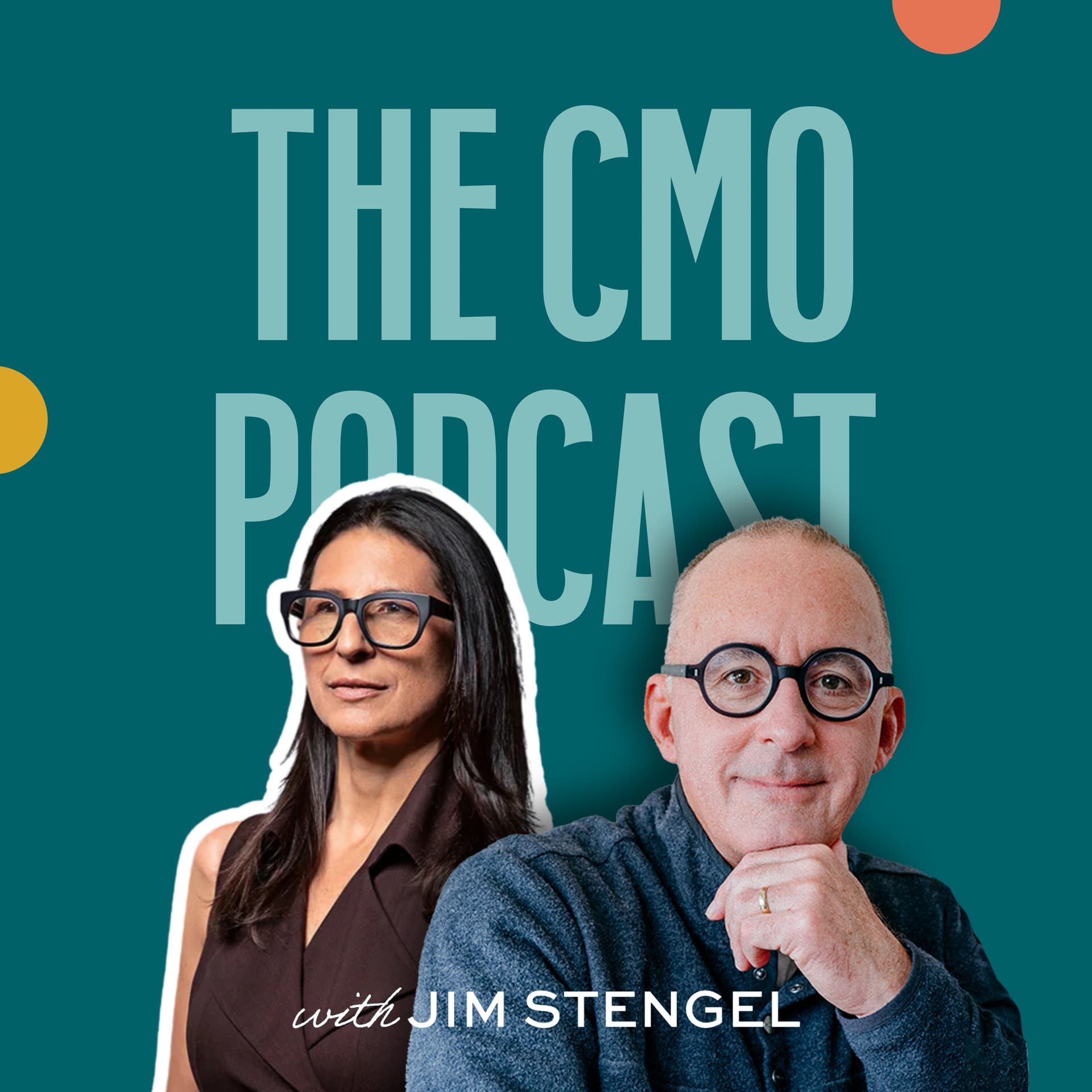
1:18Each week, I welcome the CMOs, the chief marketing officers of your favorite brands, to speak to how their job is so much more than marketing. These leaders share their inspiration and challenges, along with how they try to build a full, healthy, and happy life in and out of the office. And it's that energy that reaches everyone they touch. And we're glad you're here to feel that energy and to learn from these remarkable leaders. So here we go. Every once in a while, a conversation goes in a completely unexpected direction. That's exactly what happened when I sat down with Jacqueline Corbelli during Cannes Lions.
1:53What began as a discussion about ad tech became a much broader discussion about leadership, purpose, and the future of AI. Jacqueline is the founder and CEO of Brightline, one of the pioneers in interactive and connected TV advertising. More than two decades ago, she helped envision a world where television would become a two-way, measurable experience long before streaming transformed the industry. Today, Brightline works with many of the world's leading broadcasters, streaming platforms, and Fortune 100 brands to bring that vision to life. But her story extends far behind advertising. Jacqueline also founded SustainChain, an AI-powered platform focused on strengthening global supply chains and advancing sustainability.
2:31She serves as an advisor to both the United Nations and the Vatican, bringing together business, technology, and humanitarian initiatives. She recently published her first book, Changemaker, sharing her framework for creating meaningful impact. This is my conversation with a leader who truly believes that the future belongs to those who combine technology with human wisdom. Here's Jacqueline. Jacqueline, welcome to the CMO Podcast. You know, we don't have many ad tech pioneers on, so I'm looking forward to this conversation. I feel honored. We're here at Cannes Lions. You must have been here before.
3:07Many times. Many times. So what's exciting this year for you? I mean, I think what's most fascinating is the time we're in. And interesting in that there's a lot that's the same, even though it's different. Especially where the tech is concerned and AIs, of course. Now, after Cannes is over, are you stopping by the Vatican? I just came from the Vatican. Yes, I just came from the Vatican and spoke on AI there. You probably read Pope Leo's statement on AI. And I've been involved with the Vatican in advising from the standpoint of business and technology for a decade. And so it was really Pope Francis who brought myself in and a person who I have most respect for, Jeffrey Sachs.
3:51So each time I go, it is about being a on the ground source of real practical perspective. Because as you can imagine, there's a lot of very conceptual intellectual things being discussed at the Vatican. So that's what I'm there to do, just to bring some mainstream. What was the origin of that relationship? The origin of that relationship was being a integral part of a 10 year integrated economic development program in Africa. when I was chairman of the board of Millennium Promise, which is Professor Jeffrey Sachs' work to end poverty. And it coincided with the UN's work on the Millennium Development Goals.
4:31And as we started to reach the end of that time frame, the Sustainable Development Goals came to be. And it dovetailed with when Pope Francis became the Pope. And his whole focus was on poverty and sustainability, people and planet. And so we were invited to advise him, given all of our firsthand experience with poverty across the continent. How long does your relationship with the UN go back? About the same. About the same. About the same. Yeah, it's been about 20 years. Yeah. Yeah. Those are two really interesting organizations, the Vatican and the UN. Talk a bit more about how that's influenced you and your priorities and how you lead.
5:11I feel so incredibly privileged to be in a position to observe and be asked to contribute to the conversations that we all hope can ultimately shape who we are as people and where we go with humanity and things like that. Being a business person, of course, I'm constantly trying to bring a sort of the sort of practical reality aspect into the picture. And it's a struggle. It's a struggle because doing the right thing is a value. Right. And putting it into practice has its obvious challenges. I mean, we look around the world. It's just it's just a challenging place right now. So I feel I don't know how I got here.
5:56You know, you just it's surreal. It's surreal to be in a position where you're being asked to help guide them. I don't know how it happened. I mean, I can tell you the timeline, but why me, you know? And yeah, it is just grateful. Just grateful. Let's talk about your career path. Sure. We're going to talk about Brightline, but I think it's such an interesting career path. It crosses finance, supply chain, ad tech, and of course, your work at the Vatican and the UN. You found the two companies, Brightline and Sustained Chain. You found time to write a book, Changemaker, which we'll talk about, recently published.
6:28All this with a husband and three daughters and a dog named Pup Francis. Yes, isn't that hilarious? And the dog takes, you know, some attention. Yes. So what's the red thread in all this? Or is there a red thread? You know, I'm either a freak or a freak of nature. You pick the one. But I think it had to do initially with a drive to succeed that came from an ethic, a work ethic that was born out of first generation immigrants, Italian immigrants. And then it was a self-discovery and constant deep curiosity. And the first part of my career was in the financial services industry. And I, again, extraordinary circumstances where I was advising, I was employee number one in a firm that was advising CEOs and boards, banks in particular, you know, international, global, hundreds of businesses, you know how it is, thousands of products, on creating the delta.
7:26finding the delta between how they were operating and who they really were and who they said marketing wise, who they said they were and the sort of internal dilemma of being set up from a technology standpoint, an operational standpoint, a workflow standpoint to do what was really being done and the ability of the CMO and the CEO to be marketing and positioning themselves in terms of what they wanted to be and who they felt the market should know them as. And when you go through that with 10 global institutions that's corporate wide, and it's not just a consulting gig where you're saying, these are smart things you're doing, these are not smart things you're doing.
8:07Ours was like total focus on execution and creating a blueprint and overseeing a blueprint and pushing it into the budget and making sure the change was happening and so on. I had a moment of clarity about this is sort of who I am. I feel like I can apply this in so many ways. So the combination of creating a certain mastery, if you will, of guiding in highly complex layered situations where leadership and the bottom up and the top down really needed to be connected in ways that were very difficult, took me from there into an industry outside what I was doing because I became convinced that what we were doing was not industry specific.
8:49And that's what started the journey that created the different accomplishments that all feel very different, but are all achieved by the same approach and that constant drive and curiosity. Long story short. No, no. How do you manage all of it? When I just look at your life and your career and what you're doing today, it's a lot. It is. It is a lot, but here's the secret. These big issues in the world, they don't move very quickly. Big companies don't move very quickly. Creating your own company, the whole startup piece was the challenge, I have to say. But I also knew that I couldn't be what I needed to be to steer the company through such a fundamental time of change.
9:38if I didn't have the other sources, outside-in sources of thinking and creativity to bring to bear all along the way. And I would say it's probably one of the most important things that allowed us to exist all these years as a company because it wasn't a sure bet that Brightline was going to make it. I mean, so many of the companies who got into this new media, interactive, blah, blah, blah, they're gone. And I feel that what I came from and that certain kind of mastery that I was able to hone is really what allowed us to succeed. And again, lucky. I have a lot of good luck in my - We all do. In this.
10:14Yeah, it's a big thing. Where are you personally focused right now? Where are you spending your time? I'm personally focused on the nexus. I feel that it's a critical time to be focused on the nexus, which is to say, I still believe that the most meaningful way to exist, to preserve, to reach the future is a form of human, the cross-section between creativity and science, where science guides us, but human, what it is to be human, is what makes it meaningful. And I do, I wake up thinking about how to help people and bring whatever wisdom, right? I mean, technology doesn't bring wisdom. AI doesn't bring wisdom.
10:55It brings data and it brings certain answers that may be true or false, and you really have to be careful with that. But I feel that it's a really critical time to be bringing wisdom into the equation in terms of where we're all headed.
11:13Hey, everybody. This is Andrea Sullivan, the CEO of Vive, and we produce the CMO podcast and are so excited to have partnered with Jim Stengel for so many years. Wanted to tell you a little bit about something that could be right for you. Vive is a program for entrepreneurs and business leaders who want to get more out of their life and become their best and happiest selves, both personally and professionally. We have a 12 month program that allows people to meet up with some of the best business leaders out there and additionally experts in the wellness sector so that you can learn how to nurture yourself.
11:48So we teach things around sleep optimization, meditation, all those good things as well. Please reach out to us at podcasts at five.co to get more information. That's P-O-D-C-A-S-T-S at V-Y-V-E dot co. Thanks for listening to the CMO podcast and hope to talk to you more about Vibe.
12:12I won't get into that a bit more later, but I want to look backward for a moment. You started Brightline 23 years ago. Yes. It's really two companies, but it's the same name. Yes, but yes. Yeah. So tell us about the original inspiration for the company and then how it's evolved. It's funny. I never saw myself as getting into interactive TV, let alone interactive TV advertising or media or any of that. And so to be honest with you, it coincided with when I sat down, I said it was employee number one at this firm I was at and I sat down with the founder. His name was Paul Allen, different Paul Allen.
12:47And I said, this is not industry specific what we do. This is a type of value you can ad across industries and outside of business. Let's open up the ambit of what we do. And he said, well, Jacqueline, I always knew this day would come. And he said, there's only one problem with that. He's a British guy and still is. And he said to me, there's only one problem with that. And I said, what's that? He said, it's not broken. So he didn't have the motivation to change. It was very successful. It was a very lucrative thing to be doing with banks. Okay. And I said, well, that, there's only one problem with that.
13:19And he said, what's that? I said, I'm your age when you started this firm and it's not going to be enough for me. And so I said, I'll stay with you for three years. I'll do two more deals because they took a year. I'll do two more deals with you and I'll help you build your team. And then I'm going to go do something else and you're going to back me. And he said, well, you couldn't have handled this in any better way. Let's do it. Okay. But at around the same time, a very dear friend said, Jack, I'm doing something really cool. It's interactive TV and so on. I'm like, great, you know, fun, awesome.
13:50He's like, will you help me? And I said, well, I'll help you, but it's not my passion. He put me, he's like, can you please be an advisory board member? And I said, yes, but here's what I'll do. I'll take three months and I'll tell you whether I think you have something. Because I was used to telling hundreds of, you know, different product areas and businesses. It felt a little narrow to me. Okay. Three months go by. Do I have something? No. Why? Because you're a bunch of smart, young Manhattan kids, you know, who are telling Comcast, you know, something more than they do, and they believe you, and you're getting paid for that, but you're not selling anything, right?
14:30That's a wasting asset. So he said, well, do you think something is here? And I said, I do think something is here, but you're not going to know it until you see it. So you would need to set up in a way to keep learning, be inductive, stay ahead of it until you spot the way you can actually add value to the industry. Do you want to do that? He said, yeah. I said, it's not for me. It's for you. I'll help you build it. You've got me for six months. I'll set it up and then you run it. Well, at the end of the six months, he sat down with me and he said, I'm not a CEO, am I? I said, you're not. He's a lawyer.
15:05Often those two things don't go hand in hand. And he said, well, will you run it? I said, well, if I'm going to run it, then I'm going to own it. And that's what got me in. Because once I get into something, I put everything into it. And I couldn't stand the idea of it not succeeding in all the ways I had come to see it could succeed. So the company in its first iteration was a high-end boutique consulting firm working with folks like you to say, it's not time to do this stuff at scale, but it's time to know what you're going to do with it when it comes. And that was a great business. It was a lot of fun until Netflix came into the TV space.
15:44Hulu was the first online streamer to come into the TV space. And that's when we saw it was time. We need a technology here that can be integrated into these apps that allows the viewer to have an engageable experience the way they can on the web, but in a way they're used to on TV. And that's when we flipped the switch in 2016 and became the tech company that we talk about today. Long story. Yeah, no, but you work with it. I mean, the company has really evolved, right? You work with almost everyone, all the media companies, content platforms, who's who have top brands. So who do you think with the lens you have is taking the most advantage of the potential of this technology?
16:25Would you highlight a category or a brand? Well, I feel two things. One is that I feel it was existential for TV. It was an existential moment for TV that finally pushed them into whole hog, into the connected TV streaming space. And I think the pandemic was a huge catalyst. It was like the domino that dropped and said, OK, we're in, we're in. So I do think they're taking advantage of it. And I think that there being an existential aspect to it means there's an urgency to it. And that's, I feel, why it's moving so quickly. who is taking the most advantage of it i think is on the other side is on the netflix amazon youtube side who have been looking for a way to get into television all these years and they've got the capital to drive faster and in a way that's very specific to digital so i think right now i have a soft spot for the traditional guys and i think they're doing a great job they're all our partners then you've got the fast platforms you know you've got the equipment makers themselves who are saying, we've got a cable-like experience for you, and it's free.
17:29Want it? And that's a very powerful thing too. So the fact that they were able to respond in the way that they are makes them folks that are capitalizing on it as well. So I think that we're capitalizing it across in the ecosystem differently, but I would say television's found its new place. The economics are way different. They're trying to sort that out, right? The fast platforms, the equipment makers are actually finding a new day for themselves because of everything that's going. And then it's everybody better watch out for Amazon. Where do you think space is going? The future of connected TV?
18:02Yeah. I mean, I think we're going to see a version of what we've seen in the past. I think we're seeing it. The consolidation is real. The big deals that we're hearing about in the last couple of weeks are, you know, you look at them and they're like, natural, of course, right? There's very few of those left, I think, but they will happen. And then it's going to be a question, I believe, of, and you're seeing it already, where, you know, the content creators in the television space, it's all a distribution game again now, right? It's like content is king, but the subscribers are how you make money, and retention is huge.
18:40So now you're seeing Peacock and Warner and Paramount all moving toward the Amazon environment, which is another reason to beware, right? And so you're seeing like everywhere all the time so that the churn isn't as big a factor. The ad revenue can continue to climb, right? And I think there's going to be some stumbling there, but I think it's the numbers. It's the economics of the game are driving these kinds of changes, and I think there'll be more of it. And the end of this is the consumer or the viewer, the audience, are they happy? I don't think so. I don't think so. I think they're not even as happy about the content as they used to be because everything costs, you know, either ads or more money.
19:22And I think it's confusing more than anything else. I think there's so much noise in the system. It's hard to know what you want to watch, let alone where you can watch it. Right. And is the next season here and so on. So there's a lot of that that needs to shake out. But we got into this because of the viewer. We saw the big opportunity to make the viewing experience something so much better than it could be in the past. And what we ran up against was, oh, there's these huge economic models that aren't completely aligned with what the viewer might like to be experiencing. And I think you're seeing that in spades right now.
19:56So we're on the side of bringing the opportunity to the advertiser that allows them in a very efficient way at scale to make the experience for the viewer better. It's getting easier and easier, but as a viewer, we have to say, this is a very confusing time. It's also very frustrating at times. And it'll, I think, be interesting to see who ultimately dominates. Is it going to be the fast platforms or is it going to be the app environment? And that's going to be interesting. What would you like CMOs to understand about the space and what would you recommend to them? So I'm taking from the learnings that I've developed all along the way and sort of observing firsthand what happens in the CMO, with the function and the place they sit.
20:46I would say consultants are not necessarily the friend. I don't think you need to tell your, were you or CMO, you know that, right? But I think a lot of companies think it's still it's just one more time where we lean on geniuses who know what we need to be doing and who we can go to the CEO and say we're doing all the best things because so and so says we are. Right. Is not the day to be doing that. Practical realities are they don't know much more than you know. They may have access to more data because they consolidate data. But it's new to everyone. not to mention the speed with which the change is occurring.
21:28They couldn't possibly be ahead of the game in the ways that they're trying to, you know, advise you that they are. And so I'm seeing it, you know, because I wear these two hats and you can see where the stumbling is occurring. Iterative, some people are in their third or fourth iteration of this already. The money that is being wasted to be guided in AI is the bugaboo. It's the bugaboo in all of this. Invest in your own understanding and knowledge. Know when you're being told things that have changed yesterday. That, to me, is the guidance I would give. If you need someone in your place that you charge with knowing it, understanding it, so that you're sitting in a position where you're not wasting money on geniuses or frankly wasting money in the areas you think are going to lift your brand that's my advice what's your hope for bright line as you look ahead i feel like bright line has been on such a long path to this moment that i i can't even tell you how fun it is to be able to provide a certain kind of value that no one can provide because we were able to build the relationships on the merits, right?
22:42And to show how to get to a place and then bring the brand to that place. I'm still in a bit of a honeymoon phase of being able to have fun with this business and to show the way because we do have deep experience in AI, but we don't sell consulting. We basically talk about it like I'm doing right now. And to say, listen, here's the way to bring creativity to bear, use AI to do it, and then to execute with that combination because that cross-section is real between human creativity and technology. And if we don't watch out, we'll get run over by the technology and we'll destroy value. So I love being, personally, I love being in a place where I can help people understand that.
23:32Now you founded SustainChain in 2019. so you're already very busy so what was the inspiration the catalyst for that right before the pandemic yes right and and it was the pandemic that pushed it full bore because we were all experiencing the problems with what happens to the supply chains in a global crisis right they fall apart and it wasn't hard for people to understand that whether you think climate is a climate change is a reality or not you don't want to be in that situation so i was asked actually coming out of the work in Africa, where I guess it's rare to have someone who does bring in the sort of practical reality side of things and to say, that's not going to work for the following reasons, my opinion, right?
24:19And to be a bit of a truth teller and not have a horse in the race, which meant they trust you to tell them things you see without thinking it's going to benefit you. When I was, by the time I was done working in that realm in that way, there were people on Wall Street who said, we're going to need to figure out what's happening in sustainability. So they asked me to go and figure it out. I came back and I said, all comes down to whether we can rebuild the supply chains in a way where we can be as resilient as we can possibly be, because it's happening faster than anybody is willing to manage it or can, frankly.
24:54There's a lot of bad management, as you know. So that's what led to SustainChain. It was doing the diligence that said, If you could, what would you build to make sure that all of the fragmentation that is out there, whether it's through procurement, vendor management, not thinking big enough, right? That could bring the money, the expertise, the institutions together to understand how fast you can move to rebuild supply chains, not just for you, but for your industry and globally. So that's what the technology does. It's AI driven. Did it five years ago, not AI of today, but like, you know, and that's what brought it on.
25:36It's really the same stuff. It's just looking ahead. What are the things that are going to stop us? Great. Let's assume it doesn't stop us. What do we, let's build it. Let's not convince ourselves that it can't happen. Let's know what it looks like when we get there. And now let's build the tech that does. How's it evolved since you started in 2019? I know AI has evolved, but how's the business model. The model hasn't evolved the way you get there, the roadmap, the technology roadmap. And I think what is really important is just how flexible the thinking and execution needs to be so that you can do it in a way that isn't obsolete and doesn't break you.
26:16Right now, the reality out there is for the biggest concern we should have is that innovators, people who bring breakthrough things to the table, they need a way to create betas around those things. And AI is actually creating a problem with that. You know, Amazon, God bless them, I guess, in a way because they're underwriting all of the infrastructure build for everyone so that everyone can move faster into Agenic. Well, it comes with a catch. It's all in AWS cloud. And it doesn't work anywhere else. That's one. Two is it's expensive. What they don't realize yet, all of us, sorry, all of us don't see yet is there's two sources of cost that we haven't even begun to understand.
Read the full transcript
27:01One, of course, is the compute. People think they know what that is, but it keeps changing. And then there's the data storage. So now you've got all these small businesses thinking Amazon and others are on their side. They're tethered to them. And now comes the bill. It's really going to hurt innovators. It's going to hurt small and medium sized enterprises. So knowing what I know, our biggest focus is on not being one of those that dies underneath the weight of the requirements of capital and so on. And I worry about innovators for that reason as well. So the customers of your supply chain business are all sorts of companies?
27:38Yeah, across industry. It's also venture capital, PE, experts, academicians. It's really creating, it created the ecosystem. UN agencies, the Sustainable Development Solutions Network is the largest academic network for sustainability. There's thousands of them in there. And I'm happy to say that we are really, industry-wise, we're really well represented as well. And what makes it work is that as dysfunctional as the world is, there's a lot of us that actually are very committed to getting to the right answer. And you just needed a place where you could all come together. So it's great. But that company is a nonprofit right now.
28:18Yeah, got it. Got it. Okay. Now you have a book, right? I do. It's called Changemaker. Tell me about why you did it and did you enjoy the process? I loved the process. Let's start there. If you'd asked me to write any other kind of book, I would have had a fundamentally different experience. I probably would have quit. This is a book that is doing what we're doing now and putting it inside a structure that comes from this place of, I don't want you to have to wait 30 years to develop any real wisdom about how to approach things in the smartest way that achieved the most meaningful outcomes, the fastest.
28:59And that's what I felt like I could communicate. Kate. And because we did it, I've done it across industry and I've done it in African economic development and these things with the Vatican and so on. And with tech, that's what really Wiley came to me. I don't have an agent. It just happened. They said, it's a transformative time. Will you do this? And I said, okay, because it basically just fell right out of me. And so it was really fun. Have your daughters read it? Have your daughters read it? One of my daughters was the editor. I don't think my kids ever read my books. That's okay. I mean, my daughter just graduated from NYU.
29:34She said, I've already read four books. I said, is one of them mine? She's like, not yet, mom, not yet. I was like, it's been seven months. So how do you, what's your action? What's the reaction to the book? You must've been taught out and out talking about it. I'm delighted to say that it's not a book, by the way, to sit at the beach and read. Right, right. It takes a certain like curiosity. People who wonder how does this stuff actually happen? who maybe feel like, is it, can it happen? It's those people. And I'm one of those people. So, but the people who read it coming from that place say, oh my God, it's so good.
30:06You know, some people, I think they're lying, but some people say it sits right next to, now that I've read it, I feel like it's a reference for everything I want to do. And that certainly feels very good. But I really wrote it for young, as I said, for people who have a lot of big appetite and think the world can be a completely different thing and haven't yet suffered the bruises that we all do. And I love to get them at that point. Because if you can do more of what you think can happen in this way, you might be right. So you enjoyed the process, but you don't think you have another book in you?
30:41I don't think so. I never thought I had this book in me either, though. So we'll see. But it's like when people ask you, are you going to make a run for the presidency? Well, I have no plans. I have no plans to write a book. No, I have no plans.
31:04I want to flip into the creative brief. You're from a large Italian family. Yeah. How'd that shape you as the leader you are today? Completely. Completely. Honesty, integrity, generosity, hard work. All of it is being a privilege to be able to have an opportunity. And then, you know, there was a pride factor of, you know, they came here saying our children are going to have a better life than we had, right? So you want to honor it. And I think that's a big part of where my drive comes from. You know, my family was, we're very humble people. And then we went through a lot of family issues. And I think the combination of what I just described and going through the adversity was the combination of things that said, not only do I want to go do this, I'm going to do this.
31:54I'm going to make it happen. I'm never going to, my mother told me, don't ever be reliant on any individual person. Be able to stand on your own two feet. And secondly, don't let anybody tell you you can't do what you want to do. And those things have guided me along with those other things. And I don't know that it would have happened if it didn't come from, you know, that really sort of almost innocent place where you feel like you can do anything, and then you have that drive, and honesty, I think, is a big thing, too. What did your parents do when they came over? Railroad. My grandfather worked on the railroad.
32:32I died on the railroad. My grandmother worked in the shirt factory, never got through school, eight years old, back when that was okay. My mother was valedictorian, but wasn't allowed to work, wasn't allowed to learn how to swim, wasn't allowed. and my father was the one who broke out as something white collar and then my family broke apart so we were back to square one and got myself through school got myself through master's degree at Columbia you know nobody understood how it was getting done and threw myself into banking hated it found this other situation and started saying oh I can fix things I can help people.
33:12And that's where it all kind of was rooted and grew from. Yeah, yeah. So your family came to New York, right? Yes, Ellis Island. Ellis Island, yeah. How they got to Batavia, New York, right outside Buffalo is beyond me. But I'm a Buffalo Bills fan. Very proud. Yeah, I know why you're laughing. It's okay. You've had a good year. I like the Bills too. Everybody likes Josh. You can't not like Josh. Okay, let's leave it at that. I like watching the weather. Yeah. It's fun. Giants fan? No, no, no. Eagles, Bengals. Oh, Eagles. Yeah, my daughter's a big Eagles fan now. Yeah, it's a loyal fan base. Oh, they're tough.
33:48Yeah, they are tough. Now, you studied finance, banking, international business at Columbia. What were you thinking back then? What was your dream? Or did you just retract it to the content or you had something beyond that? Always had this sort of world thing, world thing going on. I was in student government. I was a student of government and not politics, government, governance, you know, how to make things actually work and make them happen and make them better. I studied political science and economics in undergrad and I thought I wanted to be a lawyer and then realized I do not want to be a lawyer.
34:26I want to keep going. I thought maybe diplomacy, foreign policy, things like that. And I had the opportunity to go to the School of International and Public Affairs at Columbia. It was like a dream. I was like, oh God. And because I had no money and because I had lots of debt, I decided I'm going to combine that with international business, international finance so that I can pay my bills. But I always felt like my, what is a homing mechanism? Like this, I need to be part of how to help the world. It's always just been there. So when, can I tell you a little story? Yeah. Okay. After I'd had that conversation with my boss, he would say partner, but I would say boss.
35:05I was coming to the end of the three years and I did what I said I was going to do. And my friend handed me a book and it was called the end of poverty. This was Jeffrey Sachs's book. I read the book and I had never seen something come so close to the way I was approaching the business side of change that he was doing in Africa. And so he became a professor at Columbia. I took the break. I found out when he was going to speak. I went an hour before. I waited for him to approach the lectern and I rushed him. And I said, everything that I have done so far in my life has prepared me to help you with your work in Africa.
35:45And that's how he made it back to the beginning. Wow. And he listened. Yeah. I think he was completely like stunned. Who is this person? And give her a try. Yeah. Yeah. Good for him. And good for you. Good for him. And good for me. Yeah. I mean, it's just a blessing. Yeah. Now, you've started two companies. One's a nonprofit. One's obviously a for-profit. Do you have another company in you? An idea? I have more companies to back. Okay. I do not want to be a founding CEO ever again. Why not? It is excruciating. And it's very hard to stay true to what you came in to do in the first place. Very, very hard.
36:20Do you believe you've done that? Yes, I do. And we almost didn't survive it. But I think that, as we know, it comes down to how strong are the relationships? How did you build those relationships? What are people willing to do for you because you've proven those relationships? And because of that, I sit here with you today. I love that. What's the first brand you remember as a child making an impact on you? Oh, my gosh. Oh, my heavens. I think it was probably the cereal commercials. Yeah. You know? You've heard that before. But the one that stuck with me when I was young. Only because my mother never would buy the sugary cereals, but I always wanted sugar smacks.
37:00So I always like, I love those ads, right? And then Tony and then all the stuff. Sorry, but like, that's what I remember. And then it was the one you remember, which is the Mean Joe Green ad. Yeah, right. Right, where he gives the towel to the kid. And that's when I realized like advertising is not just, it's mean, it touches you. And that's what I felt technology is going to give brands the opportunity to do more of what they really want to do. And that's what actually held me into this industry. That's a great idea. It was for Coke, right? Yeah. Yeah. Very powerful. You're not a Steelers fan, though.
37:42No, I'm a Bills fan. I can't. You can't be, no. No. Who has been the most inspiring person in your life? It's changed, actually, over the years. And some of them used to be foreign policy experts and things like that, who I just was blown away by the level of genius and the ability to think so laterally and so precisely and so on. Now I have to say I've raised his name three or four times now, but Jeff Sachs is a genius. And one of the things I admire most about him is not only is he a genius, but he's a truth teller. And you may not like what he has to say, but his data and evidence base, you can't question it.
38:26And he tells the truth every time. And he puts his money where his whole life, where his mouth is. And he's tireless. And so I have to say, I admire him most. Yeah, it's a great choice. What would you like CMOs to do more of in this world? Push. It may have changed a lot since I've been at that table. I feel that CMOs have maybe the most difficult position in the company. And they have to be incredibly resilient. And if I were a CMO right now, in addition to who I have that I really value, I would get myself a tag team that keeps me completely clear on how the technology serves me versus be led by that technology.
39:17because I don't think there's ever been a better time, if you can do that, to prove the value of the CMO beyond any other executive in the company. It is a huge time of opportunity. And to do it with impact and to do it the most efficient way possible and with the continuity and strength of brand. It's a great note to end on. Thank you. Jacqueline, thank you. This was so much fun. I appreciate it. I'm so looking forward to it. And it went way beyond my expectations. Oh, wonderful. I'm so glad to hear that. Thank you. And good luck with the book and everything in your life. Thank you so much. The Vatican, the UN, Pup Francis, everyone.
39:54Yes, the best. That's who I admire most. Pup Francis. That was my conversation with Jacqueline Corbelli. Three takeaways from this one for your business brand and life. First one, curiosity creates opportunity. Throughout her career, Jacqueline has built businesses by recognizing inflection points before they become obvious. Whether it was interactive television, AI, or supply chain resilience, Her approach has always been the same. Stay curious, keep learning, and don't wait for certainty before taking action. Innovation rarely comes from following the crowd. It comes from asking better questions and having the courage to explore what's next.
40:32Second takeaway, AI needs human wisdom. One of the most memorable ideas from this conversation is Jacqueline's belief that technology can provide information, but only people can provide wisdom. AI will continue to transform how we work, but judgment, creativity, empathy, and values remain uniquely human. The organizations that thrive won't be the ones that replace people with technology. They'll be the ones that combine the strengths of both. And the third takeaway, business indeed can be a force for good. Whether Jacqueline's building companies advising the United Nations and the Vatican or writing her book Changemaker, Jacqueline's work is rooted in a simple belief.
41:09Business should create meaningful impact. Success isn't just about growing companies, it's about helping people, solving problems, and leaving the world better than you found it.
41:21That's it for this week's episode of the CMO Podcast. As always, I would be grateful if you shared our show with your friends, along with subscribing and leaving a review on Apple Podcasts, Spotify, or wherever you listen. The CMO Podcast is a Vive Original Production.
From the publisher
What happens when technology moves faster than our ability to understand its impact?
Our final episode captured during the Cannes Festival, Jim sits down with Jacqueline Corbelli, Founder and CEO of BrightLine, for a conversation that begins with the future of connected television and expands into a much broader discussion about AI, leadership, purpose, and human wisdom.
Jacqueline is one of the earliest female founders in adtech and helped pioneer interactive and connected TV advertising more than two decades ago. Today, BrightLine works across the streaming ecosystem with leading broadcasters, platforms, and Fortune 100 brands to make television more engaging, measurable, and interactive.
Her career extends far beyond advertising. Jacqueline also founded SustainChain, an AI-powered platform focused on global supply chain resilience and sustainability. She has advised both the United Nations and the Vatican, and her book, Changemaker, offers a framework for turning ambitious ideas into meaningful action.
At its heart, this episode is a timely reminder that the future will not be shaped by technology alone. It will be shaped by the people who know how to use it with judgment, creativity, and humanity.
—
This week’s episode is brought to you by Brightline.
—
Meet The CMO Podcast On the Road
The CMO Podcast will be on the road throughout Q4 2026, capturing conversations with the leaders shaping the future of marketing, leadership, and business. If you'll be attending one of these events, we'd love to connect. Let us know!
- Advertising Week New York | October 5–7
- BLINK Cincinnati | October 8-9
- ANA Masters of Marketing | October 19–22
—
Interested in partnering with The CMO Podcast?!
Looking ahead to the rest of 2026 and into 2027, we're partnering with brands to create executive content platforms that extend far beyond a single event. From pop-up podcast studios and live recordings to executive roundtables, keynote conversations, and bespoke thought leadership programs, we work with partners to build meaningful experiences that connect with senior marketing leaders.
Whether you'd like to partner with us at one of the industry's biggest marketing events or create a custom experience designed specifically for your brand, we'd love to explore what's possible. Reach out to learn how we can build something together.
Email us at podcasts@vyve.co
—
Produced by vYve
The CMO Podcast is proudly produced by vYve Production, a full-service production and content studio specializing in podcasts, executive storytelling, branded content, and live experiences.
vYve is a community of ambitious leaders dedicated to unlocking what's next in business and in life. Through executive coaching, transformative experiences, strategic content, and communities like The CMO Podcast, vYve helps entrepreneurs, corporate leaders, and teams grow their businesses, strengthen their leadership, and build meaningful connections that last.
Learn more about vYve and The CMO Podcast community at www.vyve.co.
See Privacy Policy at https://art19.com/privacy and California Privacy Notice at https://art19.com/privacy#do-not-sell-my-info.